• Trade
  • Markets
  • Copy
  • Contests
  • News
  • 24/7
  • Calendar
  • Q&A
  • Chats
Trending
Screeners
SYMBOL
LAST
BID
ASK
HIGH
LOW
NET CHG.
%CHG.
SPREAD
SPX
S&P 500 Index
6827.42
6827.42
6827.42
6899.86
6801.80
-73.58
-1.07%
--
DJI
Dow Jones Industrial Average
48458.04
48458.04
48458.04
48886.86
48334.10
-245.98
-0.51%
--
IXIC
NASDAQ Composite Index
23195.16
23195.16
23195.16
23554.89
23094.51
-398.69
-1.69%
--
USDX
US Dollar Index
97.950
98.030
97.950
98.500
97.950
-0.370
-0.38%
--
EURUSD
Euro / US Dollar
1.17394
1.17409
1.17394
1.17496
1.17192
+0.00011
+ 0.01%
--
GBPUSD
Pound Sterling / US Dollar
1.33707
1.33732
1.33707
1.33997
1.33419
-0.00148
-0.11%
--
XAUUSD
Gold / US Dollar
4299.39
4299.39
4299.39
4353.41
4257.10
+20.10
+ 0.47%
--
WTI
Light Sweet Crude Oil
57.233
57.485
57.233
58.011
56.969
-0.408
-0.71%
--

Community Accounts

Signal Accounts
--
Profit Accounts
--
Loss Accounts
--
View More

Become a signal provider

Sell trading signals to earn additional income

View More

Guide to Copy Trading

Get started with ease and confidence

View More

Signal Accounts for Members

All Signal Accounts

Best Return
  • Best Return
  • Best P/L
  • Best MDD
Past 1W
  • Past 1W
  • Past 1M
  • Past 1Y

All Contests

  • All
  • Trump Updates
  • Recommend
  • Stocks
  • Cryptocurrencies
  • Central Banks
  • Featured News
Top News Only
Share

US Defense Secretary Hegseth: Attacker Was Killed By Partner Forces

Share

Pentagon Says Two USA Army Soldiers And One Civilian USA Interpreter Were Killed, And Three Were Wounded In Syria

Share

Israel Says It Kills Senior Hamas Commander Raed Saed In Gaza

Share

Ukraine's Navy Says Russian Drone Attack Hit Civilian Turkish Vessel Carrying Sunflower Oil To Egypt On Saturday

Share

Israeli Military Says It Put Planned Strike On South Lebanon Site On Hold After Lebanese Army Requested Access

Share

Norwegian Nobel Committee: Calls On The Belarusian Authorities To Release All Political Prisoners

Share

Norwegian Nobel Committee: His Freedom Is A Deeply Welcome And Long-Awaited Moment

Share

Ukraine Says It Received 114 Prisoners From Belarus

Share

USA Embassy In Lithuania: Maria Kalesnikava Is Not Going To Vilnius

Share

USA Embassy In Lithuania: Other Prisoners Are Being Sent From Belarus To Ukraine

Share

Ukraine President Zelenskiy: Five Ukrainians Released By Belarus In US-Brokered Deal

Share

USA Vilnius Embassy: USA Stands Ready For "Additional Engagement With Belarus That Advances USA Interests"

Share

USA Vilnius Embassy: Belarus, USA, Other Citizens Among The Prisoners Released Into Lithuania

Share

USA Vilnius Embassy: USA Will Continue Diplomatic Efforts To Free The Remaining Political Prisoners In Belarus

Share

USA Vilnius Embassy: Belarus Releases 123 Prisoners Following Meeting Of President Trump's Envoy Coale And Belarus President Lukashenko

Share

USA Vilnius Embassy: Masatoshi Nakanishi, Aliaksandr Syrytsa Are Among The Prisoners Released By Belarus

Share

USA Vilnius Embassy: Maria Kalesnikava And Viktor Babaryka Are Among The Prisoners Released By Belarus

Share

USA Vilnius Embassy: Nobel Peace Prize Laureate Ales Bialiatski Is Among The Prisoners Released By Belarus

Share

Belarusian Presidential Administration Telegram Channel: Lukashenko Has Pardoned 123 Prisoners As Part Of Deal With US

Share

Two Local Syrian Officials: Joint US-Syrian Military Patrol In Central Syria Came Under Fire From Unknown Assailants

TIME
ACT
FCST
PREV
U.K. Trade Balance Non-EU (SA) (Oct)

A:--

F: --

P: --

U.K. Trade Balance (Oct)

A:--

F: --

P: --

U.K. Services Index MoM

A:--

F: --

P: --

U.K. Construction Output MoM (SA) (Oct)

A:--

F: --

P: --

U.K. Industrial Output YoY (Oct)

A:--

F: --

P: --

U.K. Trade Balance (SA) (Oct)

A:--

F: --

P: --

U.K. Trade Balance EU (SA) (Oct)

A:--

F: --

P: --

U.K. Manufacturing Output YoY (Oct)

A:--

F: --

P: --

U.K. GDP MoM (Oct)

A:--

F: --

P: --

U.K. GDP YoY (SA) (Oct)

A:--

F: --

P: --

U.K. Industrial Output MoM (Oct)

A:--

F: --

P: --

U.K. Construction Output YoY (Oct)

A:--

F: --

P: --

France HICP Final MoM (Nov)

A:--

F: --

P: --

China, Mainland Outstanding Loans Growth YoY (Nov)

A:--

F: --

P: --

China, Mainland M2 Money Supply YoY (Nov)

A:--

F: --

P: --

China, Mainland M0 Money Supply YoY (Nov)

A:--

F: --

P: --

China, Mainland M1 Money Supply YoY (Nov)

A:--

F: --

P: --

India CPI YoY (Nov)

A:--

F: --

P: --

India Deposit Gowth YoY

A:--

F: --

P: --

Brazil Services Growth YoY (Oct)

A:--

F: --

P: --

Mexico Industrial Output YoY (Oct)

A:--

F: --

P: --

Russia Trade Balance (Oct)

A:--

F: --

P: --

Philadelphia Fed President Henry Paulson delivers a speech
Canada Building Permits MoM (SA) (Oct)

A:--

F: --

P: --

Canada Wholesale Sales YoY (Oct)

A:--

F: --

P: --

Canada Wholesale Inventory MoM (Oct)

A:--

F: --

P: --

Canada Wholesale Inventory YoY (Oct)

A:--

F: --

P: --

Canada Wholesale Sales MoM (SA) (Oct)

A:--

F: --

P: --

Germany Current Account (Not SA) (Oct)

A:--

F: --

P: --

U.S. Weekly Total Rig Count

A:--

F: --

P: --

U.S. Weekly Total Oil Rig Count

A:--

F: --

P: --

Japan Tankan Large Non-Manufacturing Diffusion Index (Q4)

--

F: --

P: --

Japan Tankan Small Manufacturing Outlook Index (Q4)

--

F: --

P: --

Japan Tankan Large Non-Manufacturing Outlook Index (Q4)

--

F: --

P: --

Japan Tankan Large Manufacturing Outlook Index (Q4)

--

F: --

P: --

Japan Tankan Small Manufacturing Diffusion Index (Q4)

--

F: --

P: --

Japan Tankan Large Manufacturing Diffusion Index (Q4)

--

F: --

P: --

Japan Tankan Large-Enterprise Capital Expenditure YoY (Q4)

--

F: --

P: --

U.K. Rightmove House Price Index YoY (Dec)

--

F: --

P: --

China, Mainland Industrial Output YoY (YTD) (Nov)

--

F: --

P: --

China, Mainland Urban Area Unemployment Rate (Nov)

--

F: --

P: --

Saudi Arabia CPI YoY (Nov)

--

F: --

P: --

Euro Zone Industrial Output YoY (Oct)

--

F: --

P: --

Euro Zone Industrial Output MoM (Oct)

--

F: --

P: --

Canada Existing Home Sales MoM (Nov)

--

F: --

P: --

Euro Zone Total Reserve Assets (Nov)

--

F: --

P: --

U.K. Inflation Rate Expectations

--

F: --

P: --

Canada National Economic Confidence Index

--

F: --

P: --

Canada New Housing Starts (Nov)

--

F: --

P: --

U.S. NY Fed Manufacturing Employment Index (Dec)

--

F: --

P: --

U.S. NY Fed Manufacturing Index (Dec)

--

F: --

P: --

Canada Core CPI YoY (Nov)

--

F: --

P: --

Canada Manufacturing Unfilled Orders MoM (Oct)

--

F: --

P: --

Canada Manufacturing New Orders MoM (Oct)

--

F: --

P: --

Canada Core CPI MoM (Nov)

--

F: --

P: --

Canada Manufacturing Inventory MoM (Oct)

--

F: --

P: --

Canada CPI YoY (Nov)

--

F: --

P: --

Canada CPI MoM (Nov)

--

F: --

P: --

Canada CPI YoY (SA) (Nov)

--

F: --

P: --

Canada Core CPI MoM (SA) (Nov)

--

F: --

P: --

Q&A with Experts
    • All
    • Chatrooms
    • Groups
    • Friends
    Connecting
    .
    .
    .
    Type here...
    Add Symbol or Code

      No matching data

      All
      Trump Updates
      Recommend
      Stocks
      Cryptocurrencies
      Central Banks
      Featured News
      • All
      • Russia-Ukraine Conflict
      • Middle East Flashpoint
      • All
      • Russia-Ukraine Conflict
      • Middle East Flashpoint
      Search
      Products

      Charts Free Forever

      Chats Q&A with Experts
      Screeners Economic Calendar Data Tools
      Membership Features
      Data Warehouse Market Trends Institutional Data Policy Rates Macro

      Market Trends

      Market Sentiment Order Book Forex Correlations

      Top Indicators

      Charts Free Forever
      Markets

      News

      News Analysis 24/7 Columns Education
      From Institutions From Analysts
      Topics Columnists

      Latest Views

      Latest Views

      Trending Topics

      Top Columnists

      Latest Update

      Signals

      Copy Rankings Latest Signals Become a signal provider AI Rating
      Contests
      Brokers

      Overview Brokers Assessment Rankings Regulators News Claims
      Broker listing Forex Brokers Comparison Tool Live Spread Comparison Scam
      Q&A Complaint Scam Alert Videos Tips to Detect Scam
      More

      Business
      Events
      Careers About Us Advertising Help Center

      White Label

      Data API

      Web Plug-ins

      Affiliate Program

      Awards Institution Evaluation IB Seminar Salon Event Exhibition
      Vietnam Thailand Singapore Dubai
      Fans Party Investment Sharing Session
      FastBull Summit BrokersView Expo
      Recent Searches
        Top Searches
          Markets
          News
          Analysis
          User
          24/7
          Economic Calendar
          Education
          Data
          • Names
          • Latest
          • Prev

          View All

          No data

          Scan to Download

          Faster Charts, Chat Faster!

          Download App
          English
          • English
          • Español
          • العربية
          • Bahasa Indonesia
          • Bahasa Melayu
          • Tiếng Việt
          • ภาษาไทย
          • Français
          • Italiano
          • Türkçe
          • Русский язык
          • 简中
          • 繁中
          Open Account
          Search
          Products
          Charts Free Forever
          Markets
          News
          Signals

          Copy Rankings Latest Signals Become a signal provider AI Rating
          Contests
          Brokers

          Overview Brokers Assessment Rankings Regulators News Claims
          Broker listing Forex Brokers Comparison Tool Live Spread Comparison Scam
          Q&A Complaint Scam Alert Videos Tips to Detect Scam
          More

          Business
          Events
          Careers About Us Advertising Help Center

          White Label

          Data API

          Web Plug-ins

          Affiliate Program

          Awards Institution Evaluation IB Seminar Salon Event Exhibition
          Vietnam Thailand Singapore Dubai
          Fans Party Investment Sharing Session
          FastBull Summit BrokersView Expo

          Will Israel Target Iranian Nuclear Facilities in "Retaliation"?

          FastBull Featured
          Summary:

          Iran's missile attack on Israel over the weekend was in retaliation for Israel's bombing of the Iranian embassy in Syria on April 1st. Now that Iran has "made its move," how Israel will respond has become the global attention.

          Iran's missile attack on Israel on April 13th spooked financial markets. This attack was the result of Israel bombing the Iranian Embassy in Syria on April 1st. Judging from the response of Israeli Prime Minister Benjamin Netanyahu, who convened a war cabinet meeting for the second time in less than 24 hours after the attack, there was a high probability that Israel would strike back. For a moment, the Iranian-Israeli conflict showed great signs of escalation. And Iran launched retaliatory air strikes against Israel, turning the main conflict in the Middle East from the previous "Israel and Hamas" to "Iran and Israel".
          Since Israel bombed the Iranian Embassy in Syria on April 1st, the world has been waiting for Iran's reaction, and when and by what means Iran will retaliate. As the period between March 11th and April 10th is the Iranian month of Ramadan, Iran has to delay action to avoid violating the rules.
          The Eid al-Fitr starts after April 10th. The Iranian religious leader Ali Khamenei said that the "Zionist attack on the Iranian diplomatic embassy is a major mistake, and they should be punished for their actions". It means that Iran will fight back.
          The same day, Israeli Prime Minister Benjamin Netanyahu responded to Iran's speech, warning that "whoever harms us, we will harm them". Surely, the counterattack will be implemented directly if Iran fights back.
          Now, Iran has "made its move". According to the attitude of Israel's previous statements and recent actions, a counterattack is inevitable. At present, Israel is likely to launch an attack on Iran's hinterland. On Friday, it was reported that the Israel Defense Forces and Mossad have approved the counterattack on the core of the Iranian hinterland if Israel is attacked by Iran, which is included in a battle plan.
          But another question is why Israel bombed the Iranian embassy in Syria. This was not even a mistaken bombing, but a blatant bombing. Why? There is an interesting point of view that Israel's real purpose is to induce Iran to retaliate, and then Israel will destroy Iran's nuclear facilities in the name of counter-retaliation.
          In the Middle East, the only country that is capable of creating an existential crisis for Israel is Iran. Iran has nuclear facilities that may develop into nuclear weapons. Thus, as Israel possesses nuclear weapons, those non-nuclear Arab countries won't be threats. And if "there is no way back" for Israel, nuclear weapons will be used. Therefore, Iran is the only country that can cause a substantial threat.
          If Israel "destroys" Iran's nuclear facilities under the name of anti-retaliation, Israel will have long-term security and its status will also be enhanced.
          From this point of view, it is almost inevitable that Israel will strike back after the weekend's attack. This in turn begs the question, how would Iran retaliate if its nuclear facilities were attacked?
          Since Israel possesses nuclear weapons, an "all-out war" by Iran is probably only a secondary option. The first option would be to blockade the Strait of Hormuz, as the Houthis have done. As the Houthis are "regional proxies" backed by Iran, Iran can certainly copy their moves, and the blockade may be even stronger. Accordingly, Iran may then announce that only cruise ships from friendly countries will be allowed to pass through.
          Iran's control of the Strait of Hormuz, through which about one-third of the world's crude oil is shipped to the world, is a disguised threat to the United States and the West. Because it will greatly increase the cost of crude oil in these countries, and from the point of view of the current de-inflation process in these countries, this will lead to considerable trouble or even oil wars.
          According to Russian estimates, if the Strait of Hormuz is blocked by Iran, global oil prices will immediately soar to more than $400 per barrel. In this way, the inflation in Europe, the United States, and Japan will collapse, and the global financial markets will oscillate tremendously.
          In other words, if Iran starts blocking the Strait of Hormuz, it will be a serious escalation of the war conflict, which will lead to two huge problems.
          One is that a large amount of global hedge funds will surely flock to the U.S. bond futures market. In this market, there is a basis difference arbitrage trading hedge funds (using the price difference between the U.S. bond spot and U.S. bond futures arbitrage), the size of about 0.8 - 1 trillion U.S. dollars between them in the U.S. bond futures market is bearish. And because the U.S. debt futures liquidity is better with leverage, the price of U.S. debt futures will be boosted once a large number of hedge funds into the U.S. debt futures market to buy U.S. debt futures. Therefore, the price difference between the U.S. debt spot and U.S. debt futures will decline sharply, or will even "reverse", which will turn the hedge fund's profit into a loss! Finally, hedge funds will be forced to sell U.S. debt spots to "stop loss". This will trigger a chain reaction, leading to more hedge funds to accelerate selling. Moreover, the selling treasury bonds value may reach hundreds of billions in a couple of hours, which may trigger restrictions or suspension, also known as "credit market freezes".
          A "freeze" in the credit market would mean a simultaneous loss of liquidity in all financial markets, including the money market and the stock market. The impact would be incalculable (such signs were shown in September 2019 and March 2020).
          The Fed may then massively expand the balance sheet, i.e. QE, and cut interest rates sharply at the same time, to save the markets.
          The other problem is that if Iran does block the Strait of Hormuz, it will have a serious impact on inflation in all countries. The logic chain is very simple, the increase in the cost of crude oil transportation (detour) leads to an increase in the price of crude oil, which in turn leads to an increase in energy inflation, and finally affects overall inflation. After that, a series of chain reactions will be triggered, such as a rise in gold, the long bond in the U.S. debt appearing to plummet, and even a second banking crisis. If inflation rebounds badly or even reverses, the Fed may be forced to raise interest rates again to control inflation. The original policy path is disrupted, market expectations are subverted, and there will be a huge oscillation in the entire financial market.
          Therefore, no matter how the Iranian-Israeli situation is, as long as Israel does not bomb Iran's nuclear facilities, the impact on the global financial markets is still under control. And once Israel bombs Iran's nuclear facilities, the "chaos" will arrive. So, we should pay special attention to the conflict between Israel and Iran. We need to closely watch how Israel will fight back.
          Risk Warnings and Disclaimers
          You understand and acknowledge that there is a high degree of risk involved in trading. Following any strategies or investment methods may lead to potential losses. The content on the site is provided by our contributors and analysts for information purposes only. You are solely responsible for determining whether any trading assets, securities, strategy, or any other product is suitable for investing based on your own investment objectives and financial situation.
          Add to Favorites
          Share

          South Korean Officials Ramp Up Warnings On Won Weakness

          Cohen

          Economic

          Forex

          South Korea discussed concerns about its currency with Japan after the won and yen slumped to multi-year lows amid a surge in the dollar that’s reverberating through global markets.
          South Korea’s finance ministry released a statement outlining comments from Finance Minister Choi Sang-mok and his Japanese counterpart Shunichi Suzuki in which they expressed “serious concerns” over the recent weakening of their currencies and warned of taking appropriate steps to counter any drastic volatility. There was no immediate comment from Japanese officials.
          The won dropped to the key level of 1,400 versus the dollar on Tuesday for the first time since late 2022 while the yen set a fresh 34-year-low. Japanese officials have issued a steady stream of verbal warnings in recent months as the yen trades beyond levels that have previously brought authorities into the market to protect the currency.
          Shortly after the statement, Bank of Korea Governor Rhee Chang-yong described recent moves in the won as a little excessive. “The central bank is ready to deploy stabilizing measures” and has enough resources to do so, Rhee said during an interview with CNBC. The yuan and yen’s weaknesses are also affecting the won, he added.
          South Korean Officials Ramp Up Warnings On Won Weakness_1
          The statement and comments by Rhee are the latest indication of the increasing frustration felt by policymakers in Asia as the strengthening dollar pummels currencies throughout the region.
          The won’s slide on Tuesday prompted the finance ministry and central bank to issue a rare joint statement to warn against the currency’s weakness.
          The won rose as much as 0.9% to 1,382.80 on Wednesday morning, following the string of warnings. The yen traded little changed at 154.66 versus the dollar.
          The won has weakened about 7% this year, the most in emerging Asia, as robust US data softened expectations for the Federal Reserve to cut rates soon. The yen has depreciated about 9%, the most among Group-of-10 currencies.
          Weakening economic momentum in China, Korea’s biggest trading partner, and concerns of capital outflows linked to a string of dividend payouts due in April, along with growing tensions in the Middle East, have also weighed on the currency.
          Rhee’s remarks on currencies and the statement come before Choi and Suzuki are set to meet US Treasury Secretary Janet Yellen on Wednesday in Washington in the first trilateral meeting of finance chiefs. Before leaving for Washington, Suzuki told reporters that currency matters weren’t currently on the agenda for the Group-of-20 talks. If the topic comes up, he’ll thoroughly explain Japan’s position, he added.
          The yen has remained under pressure with market participants expecting the US-Japan interest rate gap to stay wide for longer.
          Japanese authorities spent more than $60 billion in 2022 to intervene on three occasions arrest its slide toward 152 against the dollar. While the currency pair has now weakened beyond that mark, Tokyo has so far refrained from stepping back into markets, a move that would come under the spotlight when Suzuki is in Washington to meet his global peers.
          International agreements call on nations to allow markets to determine exchange rates. Accords generally leave the door open to action against excessive movements in the market.
          South Korea employs a different strategy to Japan with regular forays into the foreign exchange market to smooth movements. Data shows that authorities stepped into markets in each of the 10 quarters up to the end of last year. The won still remains off its 13-year low of 1444.5 in October 2022.

          Source:Bloomberg

          To stay updated on all economic events of today, please check out our Economic calendar
          Risk Warnings and Disclaimers
          You understand and acknowledge that there is a high degree of risk involved in trading. Following any strategies or investment methods may lead to potential losses. The content on the site is provided by our contributors and analysts for information purposes only. You are solely responsible for determining whether any trading assets, securities, strategy, or any other product is suitable for investing based on your own investment objectives and financial situation.
          Add to Favorites
          Share

          [ECB] Villeroy: ECB Will First Cut Rates in June

          FastBull Featured

          Remarks of Officials

          Bank of France Governor François Villeroy de Galhau said in a conversation with New York Fed President John Williams on April 16 as follows.
          The European Central Bank (ECB) will make its decisions according to the 2% inflation target and based on its best assessment of euro area data and the outlook.
          As far as the euro area is concerned, there is no evidence that the last mile of disinflation might be more arduous. Services disinflation can be slower, but will not stall. Headline inflation remains in line with the target as goods inflation has eased. Moreover, there are no signs of a wage-price spiral, and average compensation per employee is slowing markedly.
          We should accept that the last kilometer of disinflation could take longer, which may provide protection against the risk of undershooting the inflation target, rather than remaining excessively tight to accelerate the disinflation process.
          We should, barring major shocks or surprises, decide on a first rate cut at our next meeting in June. I favor a gradual approach to rate cuts. There will have to be further cuts this year and next. Economic activity in the euro area is not as strong as in the U.S., so the gradual easing of our monetary policy is more evident.
          In the euro area, the real neutral rate is now between 0% and 0.5%; and therefore the nominal neutral rate, adjusted for 2% inflation, could be between 2% and 2.5%. This range is a reasonable estimate of the average of ECB policy rates over a future full monetary cycle. It shows that we have significant leeway to lower our rates before exiting restrictive territory.
          The ECB will also be watching the geopolitical developments in the Middle East and their possible spillover effects on energy prices. If the geopolitical conflict affects the disinflationary process after the first rate cut, the ECB will adjust the pace and target of monetary policy going forward if necessary. We'll anyway still be in restrictive territory for a while.

          Villeroy's Speech

          Risk Warnings and Disclaimers
          You understand and acknowledge that there is a high degree of risk involved in trading. Following any strategies or investment methods may lead to potential losses. The content on the site is provided by our contributors and analysts for information purposes only. You are solely responsible for determining whether any trading assets, securities, strategy, or any other product is suitable for investing based on your own investment objectives and financial situation.
          Add to Favorites
          Share

          Bitcoin Price Drops As Powell Signals Delay In Interest Rate Cuts

          Samantha Luan

          Cryptocurrency

          Bitcoin’s (BTC) price has dropped by 1% to approximately $62,900, coinciding with Federal Reserve Chairman Jerome Powell’s recent statements regarding the future of interest rates.
          Speaking at the panel discussion on Tuesday, Fed Chair Powell underlined the necessity of persisting in restrained monetary policy, which was justified by the limited progress in reaching the Fed’s 2% inflation target. This stance implies that higher rates could last much longer than most investors and analysts anticipated.
          This position follows a spate of strong economic numbers, such as job growth and retail sales, which show that the economy is strong. In March, 303,000 jobs were added, which was much more than expected, and retail sales grew by 0.7% percent, rather than 0.4% percent as predicted.
          The Fed has recurrently utilized these indicators as the foundation for a slow strategy in lowering rates in spite of the pressure from different market segments to reduce rates to assist growth.

          Market Reactions to Economic Indicators

          The persistent strength of the U.S. economy has been a catalyst for markets. A strong labor market and consumer spending are indicators of economic resilience but also impede the Federal Reserve’s inflation management strategy and, thus, its rate policy. The Fed’s suggestion that rates are likely to remain elevated to fight off persistent inflation has depressed hopes of rate cuts, with implications for investment markets, including cryptocurrencies and stocks.
          U.S. stock indices, such as the S&P 500 and Nasdaq Composite, saw modest gains, each increasing by about 0.1% halfway through the trading session.
          On the other hand, cryptocurrencies responded poorly to Powell’s comments, with the values of both Bitcoin and Ether falling. Historically, Bitcoin has been highly affected by interest rate movements as it tends to change the investment environment by directing capital flows into riskier assets such as cryptocurrencies. Although the approaching Bitcoin halving event is likely to impact supply dynamics, it has been neutralized by bearish sentiment driven by the Fed policy outlook.

          No Immediate Rate Cuts in Sight

          As the Fed’s next meeting approaches on April 30, May 1, the central bank’s current posture indicates that rates are unlikely to be cut in the immediate future. Analysts have revised their targets, now predicting that the first-rate cut might not happen before September, with the probability of additional cuts within the year reducing.
          This change is very different from the earlier part of the year when several rate cuts were expected to come as part of the economic outlook.
          Further affirming this cautious approach, Fed Vice Chair Philip Jefferson omitted any mention of rate cuts in his recent statements, focusing instead on the readiness to maintain tight monetary policy. The Fed’s consistent message that rate decisions will be data-dependent continues to guide market expectations, with a clear emphasis on the need for more conclusive signs of inflation nearing target levels before any policy easing is considered.

          Source:coingape

          Risk Warnings and Disclaimers
          You understand and acknowledge that there is a high degree of risk involved in trading. Following any strategies or investment methods may lead to potential losses. The content on the site is provided by our contributors and analysts for information purposes only. You are solely responsible for determining whether any trading assets, securities, strategy, or any other product is suitable for investing based on your own investment objectives and financial situation.
          Add to Favorites
          Share

          New Zealand PM Says Fiscal Restraint Key to Taming Prices, Stoking Growth

          Samantha Luan

          Economic

          The government is determined to get New Zealand's “books in order,” Luxon said in an interview with Bloomberg Television's Haslinda Amin on Tuesday in Singapore, where he's leading a trade delegation as part of a three-nation visit to Southeast Asia including Thailand and the Philippines.
          In a wide-ranging interview, Luxon expressed concerns on the Middle East conflict as well as rising tensions in the South China Sea, seeking deescalation and a path toward stability and security. He emphasized the importance of China as an economic partner and reaffirmed his plan to visit. However, Luxon said he won't be able to make the trip this year.
          On the domestic front, he said cutting wasteful expenditure is a priority for the government, as it seeks to reverse an economic downturn. New Zealand's economy slumped into recession in the second half of 2023, and has contracted in four of the past five quarters.
          “We've had an 84% increase in government spending in the previous six years, and what we've acknowledged and what we've identified is that actually there's a lot of inefficient and wasteful government spending,” Luxon said, ahead of the budget due to be presented on May 30.
          Some economists expect the recession to extend into this year as the central bank keeps interest rates high to rein in price pressures.
          Luxon said checking government spending is the “way to support lowering inflation,” which then “brings those interest rates down and gets the economic growth happening as well.”
          Annual inflation slowed to 4% in the first quarter from 4.7% in the fourth, data showed Wednesday in Wellington, though a gauge of domestic price pressures remained elevated. Stubborn inflation in the US has led the market to price a rate cut by the Federal Reserve in September instead of July previously, which could in turn delay any easing by central banks globally.
          New Zealand's Reserve Bank has said it doesn't intend to start cutting interest rates until 2025, though most economists and investors expect the weak economy will prompt a pivot to monetary easing later this year.
          “You've actually seen no further rise in interest rates, we've seen inflation trending down. We hope to have it back within our band by the end of the year,” Luxon said. The inflation target range is 1-3%.
          Below are some excerpts from the interview with Luxon on other topics:
          On Iran's strikes on Israel and the tensions in the Middle East
          “We condemn Iran for the attack. I mean it was unprecedented in terms of what we've seen in the region. But what's important now is that actually all parties show restraint. To be honest, our primary thought is actually with the suffering, the pain and suffering of the people in the region. It's been a region that's gone through a tremendous amount.”
          On New Zealand's relationship with China
          “We have a longstanding and important relationship with China, it's been the case for many decades now. But what we do is we cooperate where we can, and that's in areas of trade and certainly in areas of climate change. We have a strong set of values, where we have differences of opinion, given our differences in our political system.”
          On when he plans to visit China
          “I will do at some point. It won't be this year, just by virtue of the schedule.”
          On New Zealand's plans to join Aukus
          “We are open to exploring pillar two of Aukus to see whether there's any opportunities for any involvement there. Obviously the pathway has been opened up for pillar two discussions and conversations in the recent weeks and we'll obviously take our time over the course of the coming months and year to consider and explore what they may look like.”

          Source: Bloomberg

          To stay updated on all economic events of today, please check out our Economic calendar
          Risk Warnings and Disclaimers
          You understand and acknowledge that there is a high degree of risk involved in trading. Following any strategies or investment methods may lead to potential losses. The content on the site is provided by our contributors and analysts for information purposes only. You are solely responsible for determining whether any trading assets, securities, strategy, or any other product is suitable for investing based on your own investment objectives and financial situation.
          Add to Favorites
          Share

          April 17th Financial News

          FastBull Featured

          Daily News

          [Quick Facts]

          1. WSJ's Timiraos says Powell dials back expectations on rate cuts.
          2. Israel has decided on how to strike back at Iran.
          3. The U.S. may release more SPR oil to keep gas prices low.
          4. Bailey hints the BOE may cut rates before the Fed.
          5. Powell dampens rate-cut expectations again.
          6. Lagarde says rates will be cut soon unless there are major shocks.
          7. Jefferson says the policy will remain restrictive for longer if necessary.
          8. IMF raises its outlook for global growth this year to 3.2%.

          [News Details]

          WSJ's Timiraos says Powell dials back expectations on rate cuts
          Fed Chair Jerome Powell said that firm inflation during the first quarter has called into question whether the Federal Reserve will be able to lower interest rates this year without signs of an economic slowdown, Nick Timiraos, chief economics correspondent for The Wall Street Journal, wrote on Monday. His comments suggested a clear shift in the Fed's outlook after a third straight month of stronger-than-expected inflation data, which appeared to dash hopes that the Fed might preemptively cut rates. Powell also said that if inflation continues to be above 2%, the Fed could keep rates at their current high levels for a longer period. The remarks implied that further rate hikes are unlikely though inflation is stronger than expected.
          Israel has decided on how to strike back at Iran
          The Israel Defense Forces have decided on how to strike back at Iran and its proxies, but the timing has not yet been determined, multiple sources said on Tuesday, according to Israeli newspaper The Jerusalem Post. This decision shows the determination of the Israeli leadership to strike back after IDF Chief of the General Staff Herzi Halevi hinted that the time for a counterattack is not very urgent. He indicated that they were developing a large policy that would at least allow citizens to live almost as usual during the week of Passover. A simple reading of the relevant signals suggests that a major attack is not imminent in the coming days, which may be delayed longer.
          The U.S. may release more SPR oil to keep gas prices low
          President Joe Biden will do what he can to ensure gasoline prices are at affordable levels, senior White House adviser John Podesta said at an industry conference on Tuesday when asked about future releases from the Strategic Petroleum Reserve (SPR) oil. In 2022, the Biden administration sold 180 million barrels of oil over about six months, the biggest sale ever that was aimed at lowering gasoline prices in the wake of the Russia-Ukraine conflict.
          Republicans slammed this sale, which in part reduced U.S. SPR levels to their lowest level in about 40 years. Podesta said the president has done this before. He wants to keep gasoline prices affordable and he's going to do everything in his power to make sure that happens, Podesta added.
          Bailey hints the BOE may cut rates before the Fed
          Bank of England (BOE) Governor Andrew Bailey said in a speech on Tuesday that "demand-led inflationary pressures" were greater in the U.S. than in the U.K. after surprisingly strong U.S. price data surprised markets last week. There is strong evidence that price pressures in the U.K. are receding. The dynamics of inflation in Europe and the US are quite different. There is little threat of a pick-up in inflation in the U.K. similar to that suggested by U.S. March price data. This means that Bailey is suggesting that the Bank of England could cut rates before the Fed, as inflation dynamics in the two economies are diverging.
          Powell dampens rate-cut expectations again
          Federal Reserve Chairman Jerome Powell continued to release hawkish remarks in his speech on Tuesday. He said the U.S. economy is strong in most aspects, though inflation has not returned to the central bank's target level. Inflation has been moving down, but not at a fast enough pace. Therefore, the current policy should remain unchanged.
          This echoes Powell's statement earlier this month. He said on April 3 that he did not intend to cut interest rates until the Fed was more confident that inflation was steadily declining toward its 2% target. Recently, some Fed officials also expressed the idea that "the level of policy may remain unchanged".
          Lagarde says rates will be cut soon unless there are major shocks
          We are watching the process of inflation coming down, which is proceeding as we expected, said European Central Bank (ECB) President Christine Lagarde at the IMF spring meeting. We just need to build more confidence in the disinflation process. If it develops as expected and there are no major shocks, it will be time to moderate the restrictive monetary policy in reasonably short order. We do not pre-commit to any interest rate path. We rely on the data.
          The so-called "major shocks" include the risk of rising commodity prices that Lagarde mentioned, especially volatility in energy and food prices, which could have a rapid and immediate impact.
          Jefferson says the policy will remain restrictive for longer if necessary
          Federal Reserve Vice Chairman Philip Jefferson said on Tuesday that if inflation fails to slow as expected, it would be appropriate to maintain the current restrictive policy stance for longer. "My baseline outlook continues to be that inflation will decline further, with the policy rate held steady at its current level, and that the labor market will remain strong, with labor demand and supply continuing to rebalance," Jefferson said.
          If the data show that inflation is more persistent than I currently expect, it would be appropriate to maintain the current restrictive policy stance for a longer period. With inflation data over the past three months higher than the lows seen in the second half of last year, while job growth and retail spending remain stronger than expected, the job of sustainably restoring 2% inflation is not yet done.
          IMF raises its outlook for global growth this year to 3.2%
          At 9 a.m. EDT on April 16, the International Monetary Fund (IMF) released its latest World Economic Outlook report. In the report, the IMF expects the global economy to grow at 3.2% in 2024, 0.1 percentage points higher than January's forecast; global headline inflation is expected to fall to 5.9% in 2024 from 6.8% in 2023. The IMF forecasts that the global economy will increase by 3.2% as well in 2025. The report noted that geopolitical tensions and persistent core inflationary pressures remain the main risks facing the global economy.

          [Focus of the Day]

          UTC+8 14:00 U.K. CPI YoY (Mar)
          UTC+8 21:00 ECB Executive Board Member Cipollone Speaks
          UTC+8 23:45 ECB Executive Board Member Schnabel Speaks on Monetary Policy
          UTC+8 02:00 Fed's Beige Book
          UTC+8 02:00 Bank of England MPC Member Haskel Speaks
          UTC+8 02:00 ECB President Christine Lagarde Speaks
          UTC+8 05:30 Cleveland Fed President Mester Speaks
          Risk Warnings and Disclaimers
          You understand and acknowledge that there is a high degree of risk involved in trading. Following any strategies or investment methods may lead to potential losses. The content on the site is provided by our contributors and analysts for information purposes only. You are solely responsible for determining whether any trading assets, securities, strategy, or any other product is suitable for investing based on your own investment objectives and financial situation.
          Add to Favorites
          Share

          Chinese Economy’s Strong Start To 2024 Is Already Fading

          Cohen

          Economic

          China reported faster-than-expected economic growth in the first quarter – along with some numbers that suggest things are set to get tougher in the rest of the year.
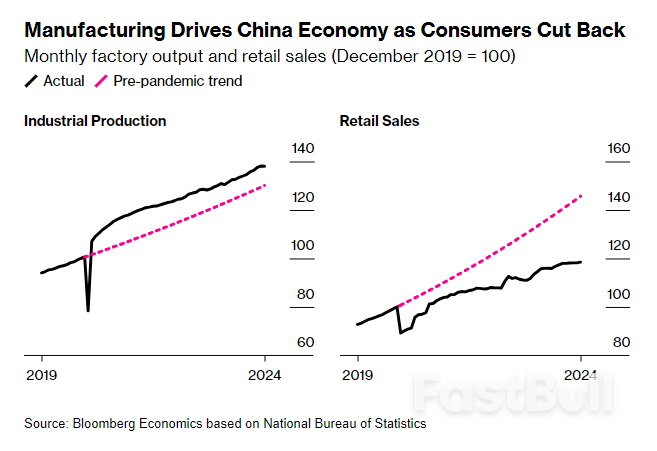
          Gross domestic product climbed 5.3% in the period, accelerating slightly from the previous quarter and beating estimates. But much of the bounce came in the first two months of the year. In March, growth in retail sales slumped and industrial output fell short of forecasts, suggesting challenges on the horizon.
          “Markets may find it hard to be convinced by the strong GDP growth print and difficult to reconcile with the mixed March data,” said Xiaojia Zhi, chief China economist at Credit Agricole. “There could be also concerns that if GDP growth remains above 5% as data suggest, policymakers would be quite comfortable and see no pressure to further ease their policies.”Chinese Economy’s Strong Start To 2024 Is Already Fading_1
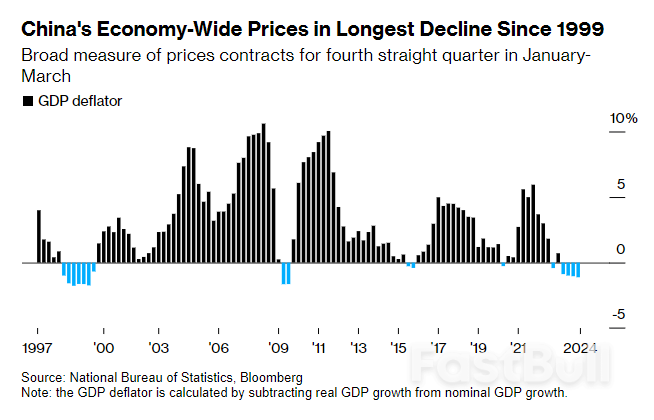
          The world’s second-largest economy has struggled to find a firm footing post-pandemic. Manufacturing is holding up, thanks to overseas demand and Beijing’s focus on developing advanced technologies at home. But a prolonged real estate crisis is weighing on confidence, factory prices have been in decline for more than a year and a broad measure based on Tuesday’s data showed the economy slipping deeper into deflation — all reflecting anemic domestic demand, as well as excess capacity in some industries.
          The yuan narrowed earlier losses to trade 0.2% weaker in the offshore market, after the People’s Bank of China loosened its grip on the currency earlier on Tuesday. The yield on the 10-year benchmark government bond was little changed at 2.28%. .
          Chinese Economy’s Strong Start To 2024 Is Already Fading_2
          Economists at Australia & New Zealand Banking Group Ltd and DBS Group Holdings Ltd raised their forecast for China’s annual growth to 4.9% and 5% respectively after the National Bureau of Statistics released the data, bringing those numbers in line with the government’s annual target. Nathan Chow, senior economist at DBS, cited stronger-than-expected US demand and an improving labor market as reasons for the upgrade. The urban jobless rate eased slightly last month.
          But doubts over the economy’s momentum added to angst over elevated US interest rates and tensions in the Middle East. A gauge of regional stocks in Asia on Tuesday tumbled the most since August, and a global index of emerging market currencies dropped, with South Korea’s won and the Indonesia rupiah weakening to multi-year lows.
          Data published Tuesday also highlighted the recovery’s unevenness. Cement output plunged 22% in March, the largest drop since records began in 1995, highlighting the impact of the housing slump. On the other hand, production of integrated circuits and new-energy vehicles — considered China’s key new economic drivers — both maintained rapid growth at a pace around 30%.
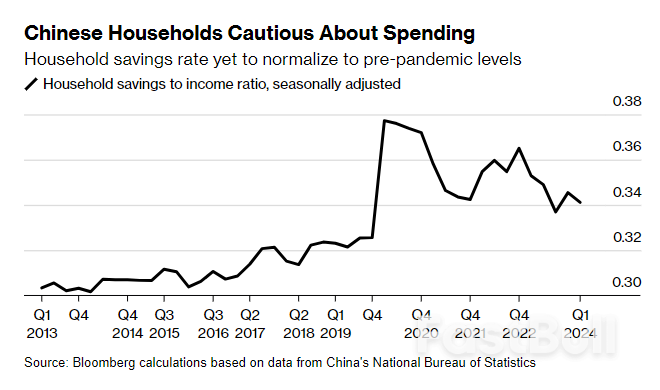
          Falling growth in restaurant spending and declining automobile sales show consumer demand remains weak in contrastwith strong investment, led by state-owned companies. China’s elevated savings rate is another sign of household caution.Chinese Economy’s Strong Start To 2024 Is Already Fading_3
          The two-speed growth model carries its own risks. China’s manufacturing drive has exacerbated tensions with trading partners, with US Treasury Secretary Janet Yellen and German Chancellor Olaf Scholz both traveling to China this month to scold officials on what they see as a deluge of cheap exports.
          Data released Tuesday showed China’s factories used less of their potential in the first quarter than at any time since the pandemic, giving credence to complaints over excess capacity.
          The National Bureau of Statistics said the economy “got off to a good start” in the first quarter but cautioned on external risks. “The complexity, severity and uncertainty of the external environment are on the rise,” the NBS said in a statement accompanying the Tuesday release. “The foundation for economic stabilization is not yet solid.”
          Chinese Economy’s Strong Start To 2024 Is Already Fading_4
          Most economists agreed the latest numbers suggest the government’s growth goal of about 5% is well within reach. But they warned policymakers still need to take more action to stabilize the property market and encourage consumers to spend. Attention will now shift to a meeting of the Politburo — China’s top leadership body — to set economic policy, which typically happens in late April.
          One risk is that surprisingly strong first-quarter growth may not only reduce the prospects of additional fiscal stimulus, but also lead officials to conclude they don’t need to implement already planned measures.
          “The pace of execution of policies set during the Two Sessions may be affected” if policymakers feel they can now lie back, said Ding Shuang, chief economist for Greater China and North Asia at Standard Chartered Plc, referring to the annual parliamentary session in March. The government has yet to release a clear plan for issuing the ultra-long special sovereign bonds, a major fiscal tool this year to shore up domestic demand, he said.
          Monetary policy support is likely to be constrained by the strong US economy. With an imminent Federal Reserve interest-rate cut looking less likely, the chances of China’s central bank easing rates is also “diminishing,” according to Zhiwei Zhang, president and chief economist at Pinpoint Asset Management.

          Source:Bloomberg

          To stay updated on all economic events of today, please check out our Economic calendar
          Risk Warnings and Disclaimers
          You understand and acknowledge that there is a high degree of risk involved in trading. Following any strategies or investment methods may lead to potential losses. The content on the site is provided by our contributors and analysts for information purposes only. You are solely responsible for determining whether any trading assets, securities, strategy, or any other product is suitable for investing based on your own investment objectives and financial situation.
          Add to Favorites
          Share
          FastBull
          Copyright © 2025 FastBull Ltd

          728 RM B 7/F GEE LOK IND BLDG NO 34 HUNG TO RD KWUN TONG KLN HONG KONG

          TelegramInstagramTwitterfacebooklinkedin
          App Store Google Play Google Play
          Products
          Charts

          Chats

          Q&A with Experts
          Screeners
          Economic Calendar
          Data
          Tools
          Membership
          Features
          Function
          Markets
          Copy Trading
          Latest Signals
          Contests
          News
          Analysis
          24/7
          Columns
          Education
          Company
          Careers
          About Us
          Contact Us
          Advertising
          Help Center
          Feedback
          User Agreement
          Privacy Policy
          Business

          White Label

          Data API

          Web Plug-ins

          Poster Maker

          Affiliate Program

          Risk Disclosure

          The risk of loss in trading financial instruments such as stocks, FX, commodities, futures, bonds, ETFs and crypto can be substantial. You may sustain a total loss of the funds that you deposit with your broker. Therefore, you should carefully consider whether such trading is suitable for you in light of your circumstances and financial resources.

          No decision to invest should be made without thoroughly conducting due diligence by yourself or consulting with your financial advisors. Our web content might not suit you since we don't know your financial conditions and investment needs. Our financial information might have latency or contain inaccuracy, so you should be fully responsible for any of your trading and investment decisions. The company will not be responsible for your capital loss.

          Without getting permission from the website, you are not allowed to copy the website's graphics, texts, or trademarks. Intellectual property rights in the content or data incorporated into this website belong to its providers and exchange merchants.

          Not Logged In

          Log in to access more features

          FastBull Membership

          Not yet

          Purchase

          Become a signal provider
          Help Center
          Customer Service
          Dark Mode
          Price Up/Down Colors

          Log In

          Sign Up

          Position
          Layout
          Fullscreen
          Default to Chart
          The chart page opens by default when you visit fastbull.com