• Trade
  • Markets
  • Copy
  • Contests
  • News
  • 24/7
  • Calendar
  • Q&A
  • Chats
Trending
Screeners
SYMBOL
LAST
BID
ASK
HIGH
LOW
NET CHG.
%CHG.
SPREAD
SPX
S&P 500 Index
6870.39
6870.39
6870.39
6895.79
6858.28
+13.27
+ 0.19%
--
DJI
Dow Jones Industrial Average
47954.98
47954.98
47954.98
48133.54
47871.51
+104.05
+ 0.22%
--
IXIC
NASDAQ Composite Index
23578.12
23578.12
23578.12
23680.03
23506.00
+72.99
+ 0.31%
--
USDX
US Dollar Index
98.900
98.980
98.900
98.960
98.730
-0.050
-0.05%
--
EURUSD
Euro / US Dollar
1.16529
1.16537
1.16529
1.16717
1.16341
+0.00103
+ 0.09%
--
GBPUSD
Pound Sterling / US Dollar
1.33206
1.33214
1.33206
1.33462
1.33136
-0.00106
-0.08%
--
XAUUSD
Gold / US Dollar
4212.13
4212.54
4212.13
4218.85
4190.61
+14.22
+ 0.34%
--
WTI
Light Sweet Crude Oil
59.231
59.261
59.231
60.084
59.160
-0.578
-0.97%
--

Community Accounts

Signal Accounts
--
Profit Accounts
--
Loss Accounts
--
View More

Become a signal provider

Sell trading signals to earn additional income

View More

Guide to Copy Trading

Get started with ease and confidence

View More

Signal Accounts for Members

All Signal Accounts

Best Return
  • Best Return
  • Best P/L
  • Best MDD
Past 1W
  • Past 1W
  • Past 1M
  • Past 1Y

All Contests

  • All
  • Trump Updates
  • Recommend
  • Stocks
  • Cryptocurrencies
  • Central Banks
  • Featured News
Top News Only
Share

Agrural - Brazil's 2025/26 Total Corn Output Seen At 135.3 Million Tonnes Versus 141.1 Million Tonnes In Previous Season

Share

Agrural - Brazil's 2025/26 Soybean Planting Hits 94% Of Expected Area As Of Last Thursday

Share

S.Africa's Eskom Says Regulator Nersa Is Processing An Application For An Interim Tariff Adjustment For The Smelters, While Government Is Working On A Complementary Mechanism To Support A More Competitive Pricing Path For The Sector

Share

SEBI: Modalities For Migration To Ai Only Schemes And Relaxations To Large Value Funds For Accredited Investors

Share

All 6 Bank Of Israel Monetary Policy Committee Members Voted To Lower Benchmark Interest Rate 25 Bps To 4.25% On Nov 24

Share

India Government: Cancellations Are On Account Of Developer Delays And Not Due To Transmission Side Delays

Share

Fitch: We See Moderation Of Export Performance In China In 2026

Share

India Government: Revokes Grid Access Permissions For Renewable Energy Projects

Share

Stats Office - Tanzania Inflation At 3.4% Year-On-Year In November

Share

Temasek CEO Dilhan Pillay: We Are Taking A Conservative Stance On Allocating Capital

Share

Brazil Economists See Brazilian Real At 5.40 Per Dollar By Year-End 2025 Versus 5.40 In Previous Estimate - Central Bank Poll

Share

Brazil Economists See Year-End 2026 Interest Rate Selic At 12.25% Versus 12.00% In Previous Estimate - Central Bank Poll

Share

Brazil Economists See Year-End 2025 Interest Rate Selic At 15.00% Versus 15.00% In Previous Estimate - Central Bank Poll

Share

EU Commission Says Meta Has Committed To Give EU Users Choice On Personalised Ads

Share

Sources Revealed That The Bank Of England Has Invited Employees To Voluntarily Apply For Layoffs

Share

The Bank Of England Plans To Cut Staff Due To Budget Pressures

Share

Traders Believe There Is Less Than A 10% Chance That The European Central Bank Will Cut Interest Rates By 25 Basis Points In 2026

Share

Egypt, European Bank For Reconstruction And Development Sign $100 Million Financing Agreement

Share

Israel Budget Deficit 4.5% Of GDP In November Over Past 12 Months Versus 4.9% Deficit In October

Share

JPMorgan - Council Chaired By Jamie Dimon Includes Jeff Bezos

TIME
ACT
FCST
PREV
France Industrial Output MoM (SA) (Oct)

A:--

F: --

P: --
France Trade Balance (SA) (Oct)

A:--

F: --

P: --
Euro Zone Employment YoY (SA) (Q3)

A:--

F: --

P: --
Canada Part-Time Employment (SA) (Nov)

A:--

F: --

P: --

Canada Unemployment Rate (SA) (Nov)

A:--

F: --

P: --

Canada Full-time Employment (SA) (Nov)

A:--

F: --

P: --

Canada Labor Force Participation Rate (SA) (Nov)

A:--

F: --

P: --

Canada Employment (SA) (Nov)

A:--

F: --

P: --

U.S. PCE Price Index MoM (Sept)

A:--

F: --

P: --

U.S. Personal Income MoM (Sept)

A:--

F: --

P: --

U.S. Core PCE Price Index MoM (Sept)

A:--

F: --

P: --

U.S. PCE Price Index YoY (SA) (Sept)

A:--

F: --

P: --

U.S. Core PCE Price Index YoY (Sept)

A:--

F: --

P: --

U.S. Personal Outlays MoM (SA) (Sept)

A:--

F: --

P: --
U.S. 5-10 Year-Ahead Inflation Expectations (Dec)

A:--

F: --

P: --

U.S. Real Personal Consumption Expenditures MoM (Sept)

A:--

F: --

P: --
U.S. Weekly Total Rig Count

A:--

F: --

P: --

U.S. Weekly Total Oil Rig Count

A:--

F: --

P: --

U.S. Consumer Credit (SA) (Oct)

A:--

F: --

P: --
China, Mainland Foreign Exchange Reserves (Nov)

A:--

F: --

P: --

Japan Trade Balance (Oct)

A:--

F: --

P: --

Japan Nominal GDP Revised QoQ (Q3)

A:--

F: --

P: --

China, Mainland Imports YoY (CNH) (Nov)

A:--

F: --

P: --

China, Mainland Exports (Nov)

A:--

F: --

P: --

China, Mainland Imports (CNH) (Nov)

A:--

F: --

P: --

China, Mainland Trade Balance (CNH) (Nov)

A:--

F: --

P: --

China, Mainland Exports YoY (USD) (Nov)

A:--

F: --

P: --

China, Mainland Imports YoY (USD) (Nov)

A:--

F: --

P: --

Germany Industrial Output MoM (SA) (Oct)

A:--

F: --

P: --
Euro Zone Sentix Investor Confidence Index (Dec)

A:--

F: --

P: --

Canada National Economic Confidence Index

--

F: --

P: --

U.K. BRC Like-For-Like Retail Sales YoY (Nov)

--

F: --

P: --

U.K. BRC Overall Retail Sales YoY (Nov)

--

F: --

P: --

Australia Overnight (Borrowing) Key Rate

--

F: --

P: --

RBA Rate Statement
RBA Press Conference
Germany Exports MoM (SA) (Oct)

--

F: --

P: --

U.S. NFIB Small Business Optimism Index (SA) (Nov)

--

F: --

P: --

Mexico 12-Month Inflation (CPI) (Nov)

--

F: --

P: --

Mexico Core CPI YoY (Nov)

--

F: --

P: --

Mexico PPI YoY (Nov)

--

F: --

P: --

U.S. Weekly Redbook Index YoY

--

F: --

P: --

U.S. JOLTS Job Openings (SA) (Oct)

--

F: --

P: --

China, Mainland M1 Money Supply YoY (Nov)

--

F: --

P: --

China, Mainland M0 Money Supply YoY (Nov)

--

F: --

P: --

China, Mainland M2 Money Supply YoY (Nov)

--

F: --

P: --

U.S. EIA Short-Term Crude Production Forecast For The Year (Dec)

--

F: --

P: --

U.S. EIA Natural Gas Production Forecast For The Next Year (Dec)

--

F: --

P: --

U.S. EIA Short-Term Crude Production Forecast For The Next Year (Dec)

--

F: --

P: --

EIA Monthly Short-Term Energy Outlook
U.S. API Weekly Gasoline Stocks

--

F: --

P: --

U.S. API Weekly Cushing Crude Oil Stocks

--

F: --

P: --

U.S. API Weekly Crude Oil Stocks

--

F: --

P: --

U.S. API Weekly Refined Oil Stocks

--

F: --

P: --

South Korea Unemployment Rate (SA) (Nov)

--

F: --

P: --

Japan Reuters Tankan Non-Manufacturers Index (Dec)

--

F: --

P: --

Japan Reuters Tankan Manufacturers Index (Dec)

--

F: --

P: --

Japan Domestic Enterprise Commodity Price Index MoM (Nov)

--

F: --

P: --

Japan Domestic Enterprise Commodity Price Index YoY (Nov)

--

F: --

P: --

China, Mainland PPI YoY (Nov)

--

F: --

P: --

China, Mainland CPI MoM (Nov)

--

F: --

P: --

Q&A with Experts
    • All
    • Chatrooms
    • Groups
    • Friends
    Connecting
    .
    .
    .
    Type here...
    Add Symbol or Code

      No matching data

      All
      Trump Updates
      Recommend
      Stocks
      Cryptocurrencies
      Central Banks
      Featured News
      • All
      • Russia-Ukraine Conflict
      • Middle East Flashpoint
      • All
      • Russia-Ukraine Conflict
      • Middle East Flashpoint
      Search
      Products

      Charts Free Forever

      Chats Q&A with Experts
      Screeners Economic Calendar Data Tools
      Membership Features
      Data Warehouse Market Trends Institutional Data Policy Rates Macro

      Market Trends

      Market Sentiment Order Book Forex Correlations

      Top Indicators

      Charts Free Forever
      Markets

      News

      News Analysis 24/7 Columns Education
      From Institutions From Analysts
      Topics Columnists

      Latest Views

      Latest Views

      Trending Topics

      Top Columnists

      Latest Update

      Signals

      Copy Rankings Latest Signals Become a signal provider AI Rating
      Contests
      Brokers

      Overview Brokers Assessment Rankings Regulators News Claims
      Broker listing Forex Brokers Comparison Tool Live Spread Comparison Scam
      Q&A Complaint Scam Alert Videos Tips to Detect Scam
      More

      Business
      Events
      Careers About Us Advertising Help Center

      White Label

      Data API

      Web Plug-ins

      Affiliate Program

      Awards Institution Evaluation IB Seminar Salon Event Exhibition
      Vietnam Thailand Singapore Dubai
      Fans Party Investment Sharing Session
      FastBull Summit BrokersView Expo
      Recent Searches
        Top Searches
          Markets
          News
          Analysis
          User
          24/7
          Economic Calendar
          Education
          Data
          • Names
          • Latest
          • Prev

          View All

          No data

          Scan to Download

          Faster Charts, Chat Faster!

          Download App
          English
          • English
          • Español
          • العربية
          • Bahasa Indonesia
          • Bahasa Melayu
          • Tiếng Việt
          • ภาษาไทย
          • Français
          • Italiano
          • Türkçe
          • Русский язык
          • 简中
          • 繁中
          Open Account
          Search
          Products
          Charts Free Forever
          Markets
          News
          Signals

          Copy Rankings Latest Signals Become a signal provider AI Rating
          Contests
          Brokers

          Overview Brokers Assessment Rankings Regulators News Claims
          Broker listing Forex Brokers Comparison Tool Live Spread Comparison Scam
          Q&A Complaint Scam Alert Videos Tips to Detect Scam
          More

          Business
          Events
          Careers About Us Advertising Help Center

          White Label

          Data API

          Web Plug-ins

          Affiliate Program

          Awards Institution Evaluation IB Seminar Salon Event Exhibition
          Vietnam Thailand Singapore Dubai
          Fans Party Investment Sharing Session
          FastBull Summit BrokersView Expo

          U.S PPI Data Unexpectedly Higher Than Forecast

          Zi Cheng

          Traders' Opinions

          Economic

          Summary:

          According to data from the Labor Department released on Friday, the producer price index for final demand rose by 0.3% from December.

          In January, prices paid by US producers surged beyond expectations, underscoring the persistent challenge of inflation. According to Friday's Labor Department data, the producer price index for final demand rose by 0.3% from December, surpassing forecasts. Additionally, the index climbed by 0.9% compared to the previous year, also exceeding expectations.
          The core PPI, which excludes the volatile food and energy sectors, increased by 0.5% from the previous month and by 2% from a year ago, both exceeding anticipated levels.
          U.S PPI Data Unexpectedly Higher Than Forecast_1
          The uptick in prices was driven by increases in service categories, notably in hospital outpatient care and portfolio management.
          In response to the PPI data, Treasury yields continued their decline. Two-year yields reached their highest level since mid-December, coinciding with the Federal Reserve's indication that interest rates had peaked. Traders adjusted their expectations for interest rate cuts, now estimating only a 25% chance of a move in May.
          Earlier this week, a separate report showed a significant rise in consumer prices at the beginning of the year. With the wholesale price figures echoing this trend, it is likely to reinforce the belief that the Fed will refrain from reducing interest rates until they are confident inflation is under control.
          Economists at the Fed and on Wall Street closely analyze the PPI report because it includes several categories used to inform the Fed's preferred inflation measure, the personal consumption expenditures price gauge. The January reading of the PCE is scheduled for release later this month.
          While service costs saw a notable increase of 0.6%, the highest since July, prices paid by producers for goods experienced a decrease of 0.2%, marking the fourth consecutive decline.
          Factors that increase PPI
          The Producer Price Index measures the average change over time in the selling prices received by domestic producers for their output. Several factors can contribute to an increase in the PPI.
          One significant factor is rising input costs, such as increases in the prices of raw materials, energy, or labor. When the cost of production goes up, producers often pass these higher costs onto consumers in the form of increased prices for goods and services, leading to an upward pressure on the PPI.
          Additionally, increased demand for goods and services can drive prices higher as producers seek to capitalize on greater demand by raising prices. Changes in government policies, such as tariffs or taxes, can also influence the PPI by affecting production costs or altering market dynamics.
          Furthermore, supply chain disruptions or natural disasters can constrain production, leading to scarcity and higher prices, further contributing to an increase in the PPI.
          To stay updated on all economic events of today, please check out our Economic calendar
          Risk Warnings and Disclaimers
          You understand and acknowledge that there is a high degree of risk involved in trading. Following any strategies or investment methods may lead to potential losses. The content on the site is provided by our contributors and analysts for information purposes only. You are solely responsible for determining whether any trading assets, securities, strategy, or any other product is suitable for investing based on your own investment objectives and financial situation.
          Comments
          Add to Favorites
          Share

          U.S. Producer Price Index: Mixed Trends in Final Demand Reflect Economic Dynamics

          Ukadike Micheal

          Forex

          Economic

          The U.S. Bureau of Labor Statistics reported that the Producer Price Index (PPI) for final demand experienced a 0.3% increase in January, adjusted for seasonal variations. This comes after a 0.1% decline in December 2023 and a 0.1% rise in November. On an unadjusted basis, the index for final demand showed a 0.9% increase for the 12 months ending January 2024.
          The advance in the index for final demand in January was driven by a 0.6% rise in prices for final demand services, while the index for final demand goods decreased by 0.2%. Notably, the index for final demand excluding foods, energy, and trade services exhibited a substantial 0.6% increase in January 2024, marking the most significant advance since January 2023. Over the 12 months ending January 2024, prices for final demand excluding foods, energy, and trade services rose by 2.6%.
          Within final demand services, the 0.6% increase in January was largely influenced by a 0.8% climb in prices for final demand services excluding trade, transportation, and warehousing. The index for final demand trade services rose by 0.2%, while prices for final demand transportation and warehousing services fell by 0.4%.
          Product detail analysis reveals a major factor in the January rise in prices for final demand services was a substantial 2.2% increase in the index for hospital outpatient care. Other notable increases were observed in the indexes for chemicals and allied products wholesaling, machinery and equipment wholesaling, portfolio management, traveler accommodation services, and legal services. Conversely, prices for long-distance motor carrying decreased by 1.0%, with declines also seen in the indexes for computer hardware, software, and supplies retailing, as well as engineering services.
          In the realm of final demand goods, the index exhibited a 0.2% decline in January, marking the fourth consecutive decrease. The majority of this decline was attributed to a 1.7% drop in prices for final demand energy, while the index for final demand foods fell by 0.3%. On the positive side, prices for final demand goods excluding foods and energy increased by 0.3%.
          A detailed analysis of final demand goods in January showed a significant 3.6% decline in prices for gasoline, leading the overall decrease. Notable decreases were also observed in the indexes for electric power, hay, hayseeds, and oilseeds, beef and veal, ethanol, and iron and steel scrap. Conversely, prices for communication and related equipment increased by 2.4%, with gains also seen in the indexes for soft drinks and liquified petroleum gas.
          This PPI data provides valuable insights into the pricing dynamics across different sectors of the U.S. economy, offering a comprehensive view of inflationary trends. The continued monitoring of these indices aids in understanding the broader economic landscape and its implications for businesses, policymakers, and investors. As the market digests this information, considerations for potential impacts on monetary policy and investment strategies come to the forefront.

          Source: US Bureau of Labour Statistics

          To stay updated on all economic events of today, please check out our Economic calendar
          Risk Warnings and Disclaimers
          You understand and acknowledge that there is a high degree of risk involved in trading. Following any strategies or investment methods may lead to potential losses. The content on the site is provided by our contributors and analysts for information purposes only. You are solely responsible for determining whether any trading assets, securities, strategy, or any other product is suitable for investing based on your own investment objectives and financial situation.
          Comments
          Add to Favorites
          Share

          Donald Trump's Big Election Problem—'Likely Voters'

          Alex
          Donald Trump's hopes of winning the 2024 Election may be hindered by a lack of his supporters heading to the ballots, polls have suggested.
          There have been a number of examples in recent surveys which note that while the presumed GOP presidential candidate in November is ahead of Joe Biden in a general poll of U.S. adults or registered voters, the current president beats Trump when the data is broken down to likely voters.
          The results indicate that Biden—who has long faced concern about his polling numbers, approval ratings, age, and cognitive ability—may have additional ammunition against Trump as he looks to defeat the Republican in an election for the second time in a row.
          Newsweek reached out to Trump's campaign team by email for comment.
          A Big Village poll released in January showed that the presumptive 2024 Election between Biden and Trump is neck and neck, with both candidates receiving 38 percent among registered voters. Yet among those who said they are likely voters, Biden takes the lead (42 to 39 percent).
          A month earlier, a New York Times/Siena poll found that Trump leads Biden by 46 percent to 44 percent among registered voters. However, when the results are broken down to just those who said that they are "almost certain" or "very likely" to cast a ballot in the 2024 Election, the results switch and Biden beats Trump by 47 percent to 45 percent.
          Also in December, a Reuters/Ipsos poll found Trump with a 2-point lead in a head-to-head matchup with Biden (38 percent to 36) in a survey of 4,411 U.S. adults nationwide.
          The results improve for Biden again when the results are just between likely voters. In this case, the poll found that in the seven states where the election was closest in 2020—Arizona, Georgia, Michigan, Nevada, North Carolina, Pennsylvania and Wisconsin—Biden had a 4-point lead over Trump among Americans who said they were sure to vote.
          Biden won all these states except North Carolina in 2020, and would need to ensure he holds on to most of them while winning strong Blue states if he has any hopes of a second term.
          Cary Coglianese, an Edward B. Shils professor of law at the University of Pennsylvania Carey Law School, suggested that the reason for the change of outcomes is that general polls feature members of the public who are "expressing more of their feeling" about the state of affairs, such as the economy, in comparison with voters who intend to go to the ballot box.
          "As the election gets closer, people are likely to focus more on what it would really be like to have another four years of President Biden versus President Trump," Coglianese told Newsweek. "The Biden team is hoping to fare well with that comparison."
          As with any poll result, there are a number of caveats that need to be considered.
          The 2024 election is still nine months away, meaning there is plenty of time for other outcomes to influence who voters will back. Trump is facing 91 felony charges, to which he has pleaded not guilty, across four criminal trials, with Biden continuing to be met with concerns about his age and his handling of the Israel-Hamas conflict.
          There are also still a significant number of surveys which show Trump is the current frontrunner in the close race, including those which only feature likely voters.
          Christopher Borick, a professor of political science and director of the Muhlenberg College Institute of Public Opinion, said that the rise of Trumpism has buoyed Democratic voters to come out and vote for the past eight years, which has helped "propel" Democrats to multiple victories in midterm and off-year elections.
          "While this is good news for Democrats in lower-turnout elections, the impact on the presidential race is less clear," Borick told Newsweek.
          "The most likely voters do lean towards Biden, and if the overall turnout this fall declines from 2020, a possibility given dissatisfaction with the alternatives, Biden may have a slight advantage.
          "However, the lack of enthusiasm for Biden combined with Trump's demonstrated ability to bring out less regular voters—such as lower educated and working-class voters—may negate the slight advantage Biden has in polls that give higher weights to traditional likely voters," Borick added.
          Coglianese also noted that even though Trump can easily rely on his strong MAGA base to support him at the ballots, this may not be enough to secure a general election victory.
          "Voters concerned about reproductive rights and the future of democracy and the rule of law will likely be highly motivated to get out to vote—and there may be enough of them to put Biden on top," Coglianese said.

          Source:NewsWeek

          Risk Warnings and Disclaimers
          You understand and acknowledge that there is a high degree of risk involved in trading. Following any strategies or investment methods may lead to potential losses. The content on the site is provided by our contributors and analysts for information purposes only. You are solely responsible for determining whether any trading assets, securities, strategy, or any other product is suitable for investing based on your own investment objectives and financial situation.
          Comments
          Add to Favorites
          Share

          Gold Remains Calm As PPI Data Awaits

          Zi Cheng

          Commodity

          Traders' Opinions

          Fundamental Analysis

          Gold prices surged and surpassed the significant $2,000 mark on Thursday, driven by a declining U.S. dollar and subdued U.S. Treasury yields following lackluster U.S. macroeconomic data. In context, January's U.S. retail sales figures fell short of expectations, contracting by 0.8% instead of the anticipated 0.1% decline, signaling a potential softening in household consumption.
          While typically, decreased consumer spending might prompt the Federal Reserve to consider accelerating policy easing, the current situation is anything but normal, with inflation consistently exceeding the 2.0% target and exhibiting significant resilience. Therefore, policymakers may choose to refrain from preemptive measures in response to signs of economic weakness.
          Given the U.S. central bank's current singular focus on restoring price stability and its prioritization of this aspect of its mandate, traders must closely monitor the forthcoming release of the producer price index survey on Friday. Projections indicate that January's headline PPI is expected to ease to 0.6% year-on-year from the previous 1.0%, with the core gauge moderating to 1.6% from December's 1.8%.
          Gold Remains Calm As PPI Data Awaits_1
          While subdued PPI figures are likely to support higher gold prices, an unexpected increase akin to the Consumer Price Index report earlier in the week, which showed a slowdown in disinflation progress, could have the opposite effect. In such a scenario, we may witness simultaneous rises in yields and the U.S. dollar as markets adjust their dovish interest rate expectations, which would be bearish for precious metals.

          Technical Analysis

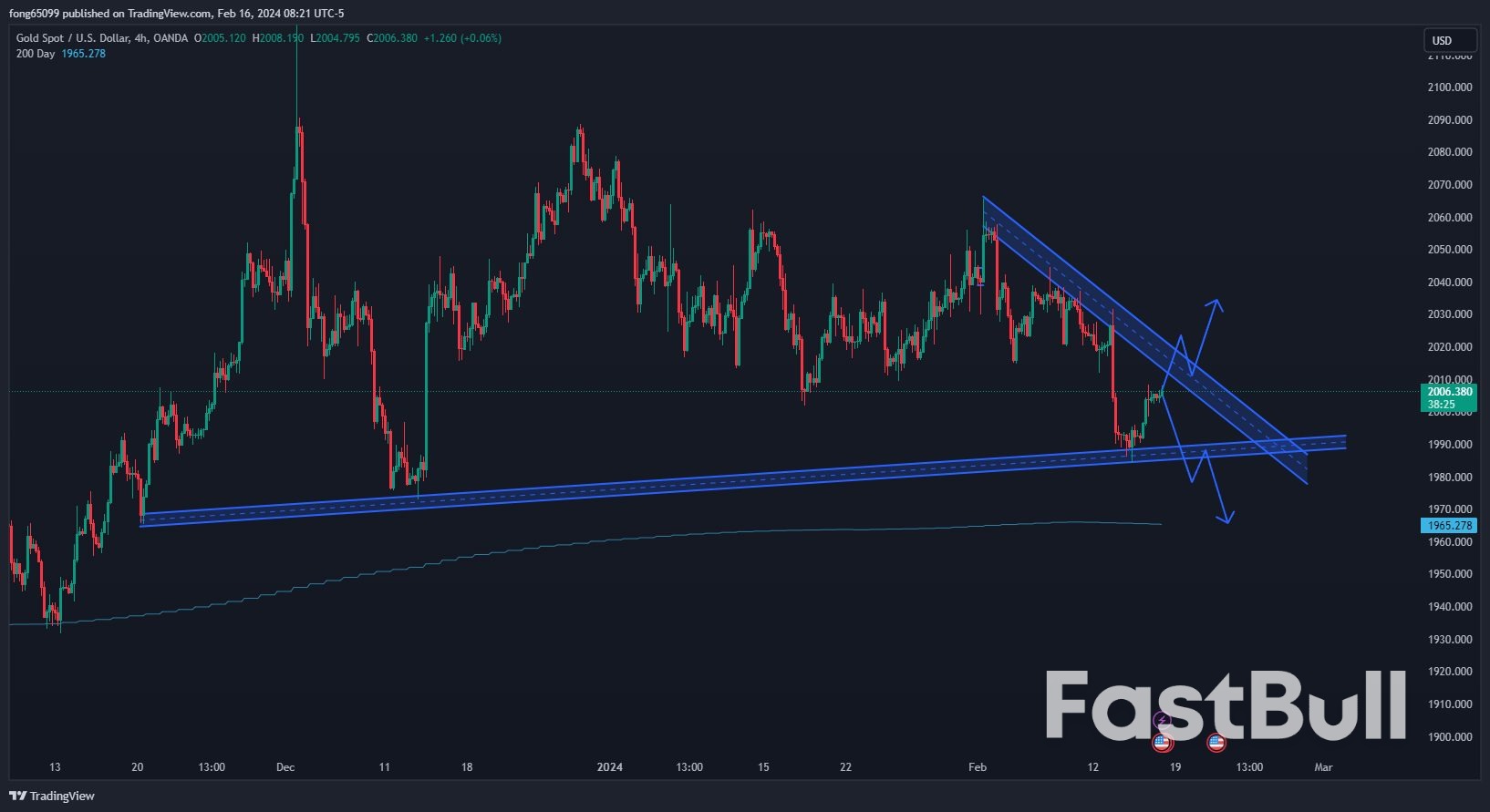
          Gold is currently ranging in a channel that I have drawn as attached below. It will be tough to estimate which direction it will break as the PPI data will act as a catalyst to either push Gold price higher or lower. Judging from the current long term trend, there is a higher probability that it will break towards the upside.
          Besides that, Gold's price currently is also above the 200 Day Moving Average which is a strong dynamic support indicator which increases the probability of Gold price moving higher. However, if you have been keeping up with the Dollar recently, Dollar has been strengthening aggressively hence Gold price has been in a short term downtrend.
          The reason why I am not in any position for Gold is that there is mixed confluences for Gold currently which puts me in a bad position to take any trades. I will remain patient and monitor Gold's reaction after the PPI data being released.
          Gold Remains Calm As PPI Data Awaits_2
          Risk Warnings and Disclaimers
          You understand and acknowledge that there is a high degree of risk involved in trading. Following any strategies or investment methods may lead to potential losses. The content on the site is provided by our contributors and analysts for information purposes only. You are solely responsible for determining whether any trading assets, securities, strategy, or any other product is suitable for investing based on your own investment objectives and financial situation.
          Comments
          Add to Favorites
          Share

          Oil Prices Decline in Anticipation of U.S. Pricing Data Following a Bleak Demand Outlook

          Ukadike Micheal

          Palestinian-Israeli conflict

          Economic

          Commodity

          Oil prices declined in anticipation of upcoming U.S. pricing data, reflecting a subdued demand outlook that counteracted the bullish sentiment prevailing in broader markets. Brent crude hovered around $82 per barrel, showing minimal changes over the week despite a spike in oil prices on Thursday, coinciding with another record closing for U.S. equities.
          The oil market remains within a narrow range this year, and the International Energy Agency's warning of a potential surplus throughout the year, coupled with weakening global demand growth, has contributed to this cautious atmosphere. Although the OPEC+ alliance is implementing supply cuts to support the market, the prospect of an extended surplus has restrained significant upward movement in oil prices. Russia has reportedly come close to fulfilling its voluntary reduction targets for the first time since committing to these cuts last year. Meanwhile, Iraq and Kazakhstan have affirmed their commitment to compliance after falling short of production cut promises in the previous month.
          Despite the lackluster demand outlook and concerns about a potential surplus, oil is consolidating near the upper end of its trading range for the year. Traders are displaying a measured approach, booking profits amidst uncertainties in the market. Ole Hansen, Head of Commodities Strategy at Saxo Bank, notes that crude oil seems to be establishing a slightly higher base despite the current softness.
          In the Middle East, geopolitical tensions have escalated with intensified exchanges of fire between Hezbollah in Lebanon and Israel, raising concerns about a broader conflict. Additionally, in Gaza, Israel's arrest of dozens of Hamas combatants in Nasser Hospital, along with the discovery of grenades and mortar shells, adds another layer of regional instability.
          While geopolitical events contribute to market volatility, the primary focus remains on the delicate balance between global oil supply and demand. The technical viewpoint emphasizes the need for continuous monitoring of these factors, as any significant disruptions in supply or unexpected shifts in demand could impact oil prices. As the market navigates geopolitical uncertainties and assesses the implications of the ongoing conflict in the Middle East, maintaining a vigilant stance becomes crucial.
          Oil prices face a nuanced landscape with a cautious outlook driven by concerns of a potential surplus and geopolitical tensions. The ongoing conflict in the Middle East adds an element of uncertainty, emphasizing the need for market participants to stay informed and adaptable in response to evolving conditions.

          Source: Bloomberg

          To stay updated on all economic events of today, please check out our Economic calendar
          Risk Warnings and Disclaimers
          You understand and acknowledge that there is a high degree of risk involved in trading. Following any strategies or investment methods may lead to potential losses. The content on the site is provided by our contributors and analysts for information purposes only. You are solely responsible for determining whether any trading assets, securities, strategy, or any other product is suitable for investing based on your own investment objectives and financial situation.
          Comments
          Add to Favorites
          Share

          The Pace of Economic Growth in the U.S. Slowed, But a Downturn Seems Unlikely

          Ukadike Micheal

          Economic

          Forex

          After a robust end to last year, the U.S. economy experienced a slowdown in January, with retail sales declining by 0.8% from December, a more significant drop than the anticipated 0.3% decrease, as reported by the Commerce Department. Concurrently, Federal Reserve data revealed a 0.1% dip in January industrial production, contrary to expectations for a 0.2% increase. While technical issues in seasonally adjusting retail sales data and adverse weather conditions in January might have influenced the results, these factors do not entirely account for the observed weakness.
          Economists from Goldman Sachs noted that cold weather alone does not explain the decline in e-commerce, as sales by nonstore retailers fell by 0.8%. Similarly, analysts at Bank of America observed persistently soft card spending in mid-February, despite the absence of significant weather events. Amid the concerning data, some positive signals emerged, with spending on food services and drinking places increasing by 0.7% from December and showing a robust 6.3% rise compared to January last year. This unexpected resilience contradicts expectations of an economic downturn.
          Additional encouraging signs included stronger-than-expected Fed surveys of manufacturing activity in New York and the Philadelphia area in February, lower-than-expected weekly unemployment claims, and indications in the industrial production report affirming the U.S. shift towards high-tech manufacturing. Notably, semiconductor output increased by 23% from a year earlier, according to Capital Economics.
          Economists had long anticipated that the Federal Reserve's rate increases in the previous year would eventually impact economic activity. While there has been ongoing debate about the duration of the savings cushion consumers built up during the pandemic, January's data suggests that consumers and manufacturers did indeed take a pause. Surprisingly, the economy exhibited resilience to the tightening measures implemented by the Fed.
          Contrary to earlier expectations of an imminent recession, the economy's strength became evident, prompting analysts at Morgan Stanley to predict first-quarter GDP growth at a 2% annualized pace. They also anticipate a revision of fourth-quarter growth to 2.1% from the initially reported 3.3%. Acknowledging the strong yet cooling economy, they emphasized that there is no rush for the Fed to make the next move in interest rates.
          The recent fluctuations in stock and bond prices in response to economic data are deemed to be much ado about little. The S&P 500 rebounded to end the week above its Monday closing level, suggesting that a slower yet steady U.S. economy should not be a cause for concern. The nuanced economic landscape emphasizes the importance of monitoring indicators and maintaining a balanced perspective in navigating market dynamics.

          Source: Wall Street Journal

          To stay updated on all economic events of today, please check out our Economic calendar
          Risk Warnings and Disclaimers
          You understand and acknowledge that there is a high degree of risk involved in trading. Following any strategies or investment methods may lead to potential losses. The content on the site is provided by our contributors and analysts for information purposes only. You are solely responsible for determining whether any trading assets, securities, strategy, or any other product is suitable for investing based on your own investment objectives and financial situation.
          Comments
          Add to Favorites
          Share

          ECB Intensifies Rate Discussion as Lagarde Advocates Prudent Approach

          Ukadike Micheal

          Economic

          Forex

          The intensifying debate within the European Central Bank (ECB) on the timing of interest rate cuts is revealing internal divisions within the Governing Council. While the consensus leans towards a rate cut this year, the disagreement centers on when to initiate this move. The majority favors a later implementation, possibly in June, while some are inclined towards April, and one member does not rule out the possibility of a cut as early as March.
          This divergence underscores the varying perspectives on inflation trajectory and the future of the sluggish European economy. The uncertainty surrounding monetary easing actions by the Federal Reserve and the Bank of England further complicates the decision-making process. The outcome of this debate in Frankfurt is poised to shape the pace and magnitude of rate adjustments.
          Analysts note a diminishing consensus for the previously embraced high-for-longer policy, highlighting a shift from a time-dependent approach to a data-dependent one officially adopted by the ECB. Euro-zone inflation has witnessed a decline from a record 10.6% in October 2022 to 2.8% last month, and projections indicate a further cooling towards the 2% target this year. Nevertheless, risks persist, with elevated wage growth, scrutiny on corporate profits, and disruptions in Red Sea shipping threatening supply chains.
          For those advocating caution, such as Executive Board member Isabel Schnabel, premature rate cuts could risk repeating historical mistakes, emphasizing the need to avoid a stop-and-go policy akin to that of the 1970s. Bundesbank President Joachim Nagel echoes this sentiment, cautioning against loosening too early, emphasizing potential adverse economic consequences in the long run.
          Concerns about the ECB's credibility loom large among the hawks, given the underestimation of the inflation shock in 2021 and 2022. There is a fear that delaying rate cuts may erode this credibility further. However, the doves argue that unexpectedly strong disinflation may push the inflation target achievement to 2024, contrary to the mid-next year projection in the latest ECB forecasts. They also express worries about an economy recently dodging a recession and the potential undershooting of the medium-term price goal.
          Bank of Italy Governor Fabio Panetta and his Portuguese counterpart Mario Centeno advocate for prompt policy easing, emphasizing the urgency to address the retreating inflation. Malta's Edward Scicluna suggests acknowledging the inflation retreat and considering rate cuts as early as March. Despite being a minority view, France's Francois Villeroy de Galhau emphasizes the importance of acting gradually and pragmatically to avoid delayed adjustments.
          As this internal debate unfolds, market observers closely monitor the potential impact on the credibility of the ECB and the broader market dynamics. The divergence in viewpoints within the Governing Council adds an element of uncertainty, with implications for investor sentiment and decision-making. The evolving narrative in the ECB's policy discussions underscores the intricacies of managing monetary policy amid economic uncertainties and global factors.

          Source: Bloomberg

          To stay updated on all economic events of today, please check out our Economic calendar
          Risk Warnings and Disclaimers
          You understand and acknowledge that there is a high degree of risk involved in trading. Following any strategies or investment methods may lead to potential losses. The content on the site is provided by our contributors and analysts for information purposes only. You are solely responsible for determining whether any trading assets, securities, strategy, or any other product is suitable for investing based on your own investment objectives and financial situation.
          Comments
          Add to Favorites
          Share
          FastBull
          Copyright © 2025 FastBull Ltd

          728 RM B 7/F GEE LOK IND BLDG NO 34 HUNG TO RD KWUN TONG KLN HONG KONG

          TelegramInstagramTwitterfacebooklinkedin
          App Store Google Play Google Play
          Products
          Charts

          Chats

          Q&A with Experts
          Screeners
          Economic Calendar
          Data
          Tools
          Membership
          Features
          Function
          Markets
          Copy Trading
          Latest Signals
          Contests
          News
          Analysis
          24/7
          Columns
          Education
          Company
          Careers
          About Us
          Contact Us
          Advertising
          Help Center
          Feedback
          User Agreement
          Privacy Policy
          Business

          White Label

          Data API

          Web Plug-ins

          Poster Maker

          Affiliate Program

          Risk Disclosure

          The risk of loss in trading financial instruments such as stocks, FX, commodities, futures, bonds, ETFs and crypto can be substantial. You may sustain a total loss of the funds that you deposit with your broker. Therefore, you should carefully consider whether such trading is suitable for you in light of your circumstances and financial resources.

          No decision to invest should be made without thoroughly conducting due diligence by yourself or consulting with your financial advisors. Our web content might not suit you since we don't know your financial conditions and investment needs. Our financial information might have latency or contain inaccuracy, so you should be fully responsible for any of your trading and investment decisions. The company will not be responsible for your capital loss.

          Without getting permission from the website, you are not allowed to copy the website's graphics, texts, or trademarks. Intellectual property rights in the content or data incorporated into this website belong to its providers and exchange merchants.

          Not Logged In

          Log in to access more features

          FastBull Membership

          Not yet

          Purchase

          Become a signal provider
          Help Center
          Customer Service
          Dark Mode
          Price Up/Down Colors

          Log In

          Sign Up

          Position
          Layout
          Fullscreen
          Default to Chart
          The chart page opens by default when you visit fastbull.com