• Trade
  • Markets
  • Copy
  • Contests
  • News
  • 24/7
  • Calendar
  • Q&A
  • Chats
Trending
Screeners
SYMBOL
LAST
BID
ASK
HIGH
LOW
NET CHG.
%CHG.
SPREAD
SPX
S&P 500 Index
6827.42
6827.42
6827.42
6899.86
6801.80
-73.58
-1.07%
--
DJI
Dow Jones Industrial Average
48458.04
48458.04
48458.04
48886.86
48334.10
-245.98
-0.51%
--
IXIC
NASDAQ Composite Index
23195.16
23195.16
23195.16
23554.89
23094.51
-398.69
-1.69%
--
USDX
US Dollar Index
97.950
98.030
97.950
98.500
97.950
-0.370
-0.38%
--
EURUSD
Euro / US Dollar
1.17394
1.17409
1.17394
1.17496
1.17192
+0.00011
+ 0.01%
--
GBPUSD
Pound Sterling / US Dollar
1.33707
1.33732
1.33707
1.33997
1.33419
-0.00148
-0.11%
--
XAUUSD
Gold / US Dollar
4299.39
4299.39
4299.39
4353.41
4257.10
+20.10
+ 0.47%
--
WTI
Light Sweet Crude Oil
57.233
57.485
57.233
58.011
56.969
-0.408
-0.71%
--

Community Accounts

Signal Accounts
--
Profit Accounts
--
Loss Accounts
--
View More

Become a signal provider

Sell trading signals to earn additional income

View More

Guide to Copy Trading

Get started with ease and confidence

View More

Signal Accounts for Members

All Signal Accounts

Best Return
  • Best Return
  • Best P/L
  • Best MDD
Past 1W
  • Past 1W
  • Past 1M
  • Past 1Y

All Contests

  • All
  • Trump Updates
  • Recommend
  • Stocks
  • Cryptocurrencies
  • Central Banks
  • Featured News
Top News Only
Share

USA Embassy In Lithuania: Maria Kalesnikava Is Not Going To Vilnius

Share

USA Embassy In Lithuania: Other Prisoners Are Being Sent From Belarus To Ukraine

Share

Ukraine President Zelenskiy: Five Ukrainians Released By Belarus In US-Brokered Deal

Share

USA Vilnius Embassy: USA Stands Ready For "Additional Engagement With Belarus That Advances USA Interests"

Share

USA Vilnius Embassy: Belarus, USA, Other Citizens Among The Prisoners Released Into Lithuania

Share

USA Vilnius Embassy: USA Will Continue Diplomatic Efforts To Free The Remaining Political Prisoners In Belarus

Share

USA Vilnius Embassy: Belarus Releases 123 Prisoners Following Meeting Of President Trump's Envoy Coale And Belarus President Lukashenko

Share

USA Vilnius Embassy: Masatoshi Nakanishi, Aliaksandr Syrytsa Are Among The Prisoners Released By Belarus

Share

USA Vilnius Embassy: Maria Kalesnikava And Viktor Babaryka Are Among The Prisoners Released By Belarus

Share

USA Vilnius Embassy: Nobel Peace Prize Laureate Ales Bialiatski Is Among The Prisoners Released By Belarus

Share

Belarusian Presidential Administration Telegram Channel: Lukashenko Has Pardoned 123 Prisoners As Part Of Deal With US

Share

Two Local Syrian Officials: Joint US-Syrian Military Patrol In Central Syria Came Under Fire From Unknown Assailants

Share

Israeli Military Says It Targeted 'Key Hamas Terrorist' In Gaza City

Share

Rwanda's Actions In Eastern Drc Are A Clear Violation Of Washington Accords Signed By President Trump - Secretary Of State Rubio

Share

Israeli Military Issues Evacuation Warning In Southern Lebanon Village Ahead Of Strike - Spokesperson On X

Share

Belarusian State Media Cites US Envoy Coale As Saying He Discussed Ukraine And Venezuela With Lukashenko

Share

Belarusian State Media Cites US Envoy Coale As Saying That US Removes Sanctions On Belarusian Potassium

Share

Thai Prime Minister: No Ceasefire Agreement With Cambodia

Share

US, Ukraine To Discuss Ceasefire In Berlin Ahead Of European Summit

Share

Incoming Czech Prime Minister Babis: Czech Republic Will Not Take On Guarantees For Ukraine Financing, European Commission Must Find Alternatives

TIME
ACT
FCST
PREV
U.K. Trade Balance Non-EU (SA) (Oct)

A:--

F: --

P: --

U.K. Trade Balance (Oct)

A:--

F: --

P: --

U.K. Services Index MoM

A:--

F: --

P: --

U.K. Construction Output MoM (SA) (Oct)

A:--

F: --

P: --

U.K. Industrial Output YoY (Oct)

A:--

F: --

P: --

U.K. Trade Balance (SA) (Oct)

A:--

F: --

P: --

U.K. Trade Balance EU (SA) (Oct)

A:--

F: --

P: --

U.K. Manufacturing Output YoY (Oct)

A:--

F: --

P: --

U.K. GDP MoM (Oct)

A:--

F: --

P: --

U.K. GDP YoY (SA) (Oct)

A:--

F: --

P: --

U.K. Industrial Output MoM (Oct)

A:--

F: --

P: --

U.K. Construction Output YoY (Oct)

A:--

F: --

P: --

France HICP Final MoM (Nov)

A:--

F: --

P: --

China, Mainland Outstanding Loans Growth YoY (Nov)

A:--

F: --

P: --

China, Mainland M2 Money Supply YoY (Nov)

A:--

F: --

P: --

China, Mainland M0 Money Supply YoY (Nov)

A:--

F: --

P: --

China, Mainland M1 Money Supply YoY (Nov)

A:--

F: --

P: --

India CPI YoY (Nov)

A:--

F: --

P: --

India Deposit Gowth YoY

A:--

F: --

P: --

Brazil Services Growth YoY (Oct)

A:--

F: --

P: --

Mexico Industrial Output YoY (Oct)

A:--

F: --

P: --

Russia Trade Balance (Oct)

A:--

F: --

P: --

Philadelphia Fed President Henry Paulson delivers a speech
Canada Building Permits MoM (SA) (Oct)

A:--

F: --

P: --

Canada Wholesale Sales YoY (Oct)

A:--

F: --

P: --

Canada Wholesale Inventory MoM (Oct)

A:--

F: --

P: --

Canada Wholesale Inventory YoY (Oct)

A:--

F: --

P: --

Canada Wholesale Sales MoM (SA) (Oct)

A:--

F: --

P: --

Germany Current Account (Not SA) (Oct)

A:--

F: --

P: --

U.S. Weekly Total Rig Count

A:--

F: --

P: --

U.S. Weekly Total Oil Rig Count

A:--

F: --

P: --

Japan Tankan Large Non-Manufacturing Diffusion Index (Q4)

--

F: --

P: --

Japan Tankan Small Manufacturing Outlook Index (Q4)

--

F: --

P: --

Japan Tankan Large Non-Manufacturing Outlook Index (Q4)

--

F: --

P: --

Japan Tankan Large Manufacturing Outlook Index (Q4)

--

F: --

P: --

Japan Tankan Small Manufacturing Diffusion Index (Q4)

--

F: --

P: --

Japan Tankan Large Manufacturing Diffusion Index (Q4)

--

F: --

P: --

Japan Tankan Large-Enterprise Capital Expenditure YoY (Q4)

--

F: --

P: --

U.K. Rightmove House Price Index YoY (Dec)

--

F: --

P: --

China, Mainland Industrial Output YoY (YTD) (Nov)

--

F: --

P: --

China, Mainland Urban Area Unemployment Rate (Nov)

--

F: --

P: --

Saudi Arabia CPI YoY (Nov)

--

F: --

P: --

Euro Zone Industrial Output YoY (Oct)

--

F: --

P: --

Euro Zone Industrial Output MoM (Oct)

--

F: --

P: --

Canada Existing Home Sales MoM (Nov)

--

F: --

P: --

Euro Zone Total Reserve Assets (Nov)

--

F: --

P: --

U.K. Inflation Rate Expectations

--

F: --

P: --

Canada National Economic Confidence Index

--

F: --

P: --

Canada New Housing Starts (Nov)

--

F: --

P: --

U.S. NY Fed Manufacturing Employment Index (Dec)

--

F: --

P: --

U.S. NY Fed Manufacturing Index (Dec)

--

F: --

P: --

Canada Core CPI YoY (Nov)

--

F: --

P: --

Canada Manufacturing Unfilled Orders MoM (Oct)

--

F: --

P: --

Canada Manufacturing New Orders MoM (Oct)

--

F: --

P: --

Canada Core CPI MoM (Nov)

--

F: --

P: --

Canada Manufacturing Inventory MoM (Oct)

--

F: --

P: --

Canada CPI YoY (Nov)

--

F: --

P: --

Canada CPI MoM (Nov)

--

F: --

P: --

Canada CPI YoY (SA) (Nov)

--

F: --

P: --

Canada Core CPI MoM (SA) (Nov)

--

F: --

P: --

Q&A with Experts
    • All
    • Chatrooms
    • Groups
    • Friends
    Connecting
    .
    .
    .
    Type here...
    Add Symbol or Code

      No matching data

      All
      Trump Updates
      Recommend
      Stocks
      Cryptocurrencies
      Central Banks
      Featured News
      • All
      • Russia-Ukraine Conflict
      • Middle East Flashpoint
      • All
      • Russia-Ukraine Conflict
      • Middle East Flashpoint
      Search
      Products

      Charts Free Forever

      Chats Q&A with Experts
      Screeners Economic Calendar Data Tools
      Membership Features
      Data Warehouse Market Trends Institutional Data Policy Rates Macro

      Market Trends

      Market Sentiment Order Book Forex Correlations

      Top Indicators

      Charts Free Forever
      Markets

      News

      News Analysis 24/7 Columns Education
      From Institutions From Analysts
      Topics Columnists

      Latest Views

      Latest Views

      Trending Topics

      Top Columnists

      Latest Update

      Signals

      Copy Rankings Latest Signals Become a signal provider AI Rating
      Contests
      Brokers

      Overview Brokers Assessment Rankings Regulators News Claims
      Broker listing Forex Brokers Comparison Tool Live Spread Comparison Scam
      Q&A Complaint Scam Alert Videos Tips to Detect Scam
      More

      Business
      Events
      Careers About Us Advertising Help Center

      White Label

      Data API

      Web Plug-ins

      Affiliate Program

      Awards Institution Evaluation IB Seminar Salon Event Exhibition
      Vietnam Thailand Singapore Dubai
      Fans Party Investment Sharing Session
      FastBull Summit BrokersView Expo
      Recent Searches
        Top Searches
          Markets
          News
          Analysis
          User
          24/7
          Economic Calendar
          Education
          Data
          • Names
          • Latest
          • Prev

          View All

          No data

          Scan to Download

          Faster Charts, Chat Faster!

          Download App
          English
          • English
          • Español
          • العربية
          • Bahasa Indonesia
          • Bahasa Melayu
          • Tiếng Việt
          • ภาษาไทย
          • Français
          • Italiano
          • Türkçe
          • Русский язык
          • 简中
          • 繁中
          Open Account
          Search
          Products
          Charts Free Forever
          Markets
          News
          Signals

          Copy Rankings Latest Signals Become a signal provider AI Rating
          Contests
          Brokers

          Overview Brokers Assessment Rankings Regulators News Claims
          Broker listing Forex Brokers Comparison Tool Live Spread Comparison Scam
          Q&A Complaint Scam Alert Videos Tips to Detect Scam
          More

          Business
          Events
          Careers About Us Advertising Help Center

          White Label

          Data API

          Web Plug-ins

          Affiliate Program

          Awards Institution Evaluation IB Seminar Salon Event Exhibition
          Vietnam Thailand Singapore Dubai
          Fans Party Investment Sharing Session
          FastBull Summit BrokersView Expo

          Jackson Hole Economic Symposium: Powell Will Make Policy Direction Clear, But Nothing More

          Alex

          Forex

          Central Bank

          Economic

          Summary:

          Powell may not be vague about the policy direction, but the exact pace and timing of interest rate cuts will depend on the data collected from now until the September meeting.

          The highly anticipated annual central bank conference - the Jackson Hole Economic Symposium - commenced on August 22 for a three-day duration. The complete agenda was released at 8 p.m. New York time on August 22. Each year, the schedule has some variations, but it typically includes panel discussions featuring central bank governors from around the globe, alongside officials from international organizations such as the International Monetary Fund (IMF) and the Bank for International Settlements (BIS). This year's theme, "Reassessing the Effectiveness and Transmission Mechanisms of Monetary Policy," underscores the significance of the event, particularly within the context of global economic recovery from the COVID-19 pandemic, elevated interest rates, and geopolitical tensions.
          However, this year's "Global Central Bank Annual Meeting" appears to lack substantive participation, with only the Federal Reserve Chairman and the Governor of the Bank of England (BOE) confirmed to attend and speak. Notably, European Central Bank (ECB) President Christine Lagarde is expected to miss this year's meeting, with her place being taken by the ECB's Chief Economist, Philip Lane.
          Powell will deliver a speech regarding the economic outlook via livestream, which is typically regarded as a keynote address. Bailey will present the luncheon speech, while Lane from the ECB is set to participate in a review panel discussion on Saturday, possibly engaging in dialogue with central bank governors from emerging markets and leaders of international organizations. Although Bank of Japan Governor Kazuo Ueda participated in panel discussions last year, he has been requested to attend a parliamentary meeting on the 23rd this year, and thus will not be present.
          The most highly anticipated event is undoubtedly the address by Fed Chairman Powell, as he usually clarifies the "medium-term policy trajectory" during such meetings, even in the absence of actual policy announcements (for instance, during Bernanke's term, he would "forecast" new policies). This speech will also outline future areas of concern.

          Fed's Performance in Previous Sessions

          In recent years, the Fed has made erroneous assessments at crucial moments, but following a period of "reflection," it is evident that there has been "progress" in this regard.
          During the tumultuous repurchase market of 2019, the Fed's interest rate management range once went out of control, ultimately requiring the revival of repurchase tools to provide liquidity. Notably, in his speeches that year, Powell failed to mention any aspect of the money market. The Fed's policy communication was heavily criticized, as reflected in a market survey conducted by the New York Fed, where only one primary dealer deemed the Fed's communication "relatively effective." Meanwhile, eight found it "average," eleven categorized it as "very ineffective," and four dismissed it as having "no (or low) effectiveness." Among the twenty-eight surveyed market participants, eight described the Fed's communication as "relatively effective," five considered it "average," seven labeled it as "very ineffective," and another seven identified it as having "no (or low) effectiveness," with only one participant rating it as "very effective."
          The speech from 2020 was closely related to the adjustments in the Fed's framework at that time, establishing a foundation for monetary policy over the next decade. During his address, Powell extensively discussed the impact of the low productivity, low inflation, and low unemployment since the 2008 financial crisis on monetary policy. He referenced the well-explored concept of the flattening of the Phillips Curve, which seemingly justified the Fed's shift toward an average inflation-targeting regime. However, Powell clearly overlooked the onset of the pandemic in the same year and the aggressive shifts in fiscal policy. In reality, the post-pandemic era has numerous structural challenges for the labor market, while inflation has become exceptionally high and uncontrollable, making it difficult for the new framework to adapt to the current economic landscape and labor market conditions. Consequently, discussions on average inflation targeting had largely fallen by the wayside, and the highly politically correct notion of a "broad employment objective" within the new framework has become nearly forgotten.
          By 2021, when the meeting convened, inflation in the U.S. had already begun to rise, while fiscal stimulus efforts continued at a significant scale from 2020. In his speech, Powell emphasized that "inflation is transitory", attempting to substantiate this claim with five key arguments and extensive elaboration to convey that inflation was manageable within the Fed's control and that a decrease would occur by the year's end. The subsequent developments are well-known; not only did inflation fail to decline, but it continued to rise.
          In the 2022 speech, it was evident that Powell learned from previous experiences, particularly from 2021, and firmly established a notably hawkish tone regarding the "medium-term policy path," characterized by "slower, longer, and higher."
          Fed Chairman Powell underscored the necessity of addressing inflation while also noting the deceleration of the labor market and economic growth. Many developments aligned with expectations; however, the requirement to maintain interest rates below 4% by 2023 seems to be significantly at odds with the current rate levels in the context of employment elasticity.
          Overall, the decisions made by the Fed appear to be correct. Therefore, this meeting has humorously been dubbed the "Fed's moment of self-reflection." It is worth mentioning that the theme of the Jackson Hole Economic Symposium in 2022 was "Reassessing Constraints on the Economy and Policy," which closely resembles this year's theme.
          In 2023, the persistent inflationary pressures, uncertainties surrounding the economic recovery process, and fluctuations in the global economic environment have set the primary tone. During this meeting, Powell's remarks predominantly focused on inflation and the economy, while also underscoring the importance of maintaining a hawkish stance and not ruling out the possibility of future interest rate hikes. Overall, there is greater caution regarding the approach to inflation.
          Whether the Fed's policy in 2023 is "correct" depends on whether inflation has effectively come down, but also takes into account the performance of economic growth and the job market. From the current point of view, it is undoubtedly correct.

          Challenges Faced by the Fed

          Since the beginning of this year, the Fed has faced a number of challenges. Initially, inflation showed signs of rebounding, leading both the market and the Fed to view this as merely a "bump" in the disinflation process. However, after three consecutive months of increasing inflation, market sentiment began to shift - from perceiving it as a "bump" to acknowledging a rebound in inflation, then recognizing a stall in the disinflation efforts, and ultimately interpreting it as a reversal in inflation trends. Fortunately, starting from the April CPI, the market gradually began to believe that the disinflation process was progressing sustainably.
          However, just as the inflation issue seemed to be resolving, complications arose in the labor market. The unemployment rate in the non-farm payrolls for May and June began to climb, reaching 4.3% in July - the highest level since October 2021, and almost triggering the "Sahm Rule." According to the Sahm Rule, if the unemployment rate (based on a three-month SMA) rises by 0.5 percentage points above its low from the previous year, a recession has begun. This indicator has accurately predicted economic downturns 100% of the time since 1970. Consequently, concerns over a potential recession began to permeate the market. The Fed explained that the rise in the July non-farm unemployment rate was likely attributed to an increase in the labor force population coupled with a decrease in hiring demand. It was only through comments from several Fed officials and the recent positive performance of various economic data that worries about a recession began to dissipate.

          Early Signals of a Cut?

          Throughout this process, whether dealing with inflation or labor market issues, the Fed has been actively guiding expectations through "expectation management." However, despite these efforts, the market still anticipates a 100-basis-point rate cut by the Fed by the end of the year. Judging from the speeches made by two FOMC officials at the Jackson Hole Economic Symposium yesterday, one supports a rate cut, while the other agrees with discussing the magnitude of the cut.
          Boston Fed President Susan Collins stated that it would soon be appropriate to start cutting rates to help maintain a still-healthy labor market.
          Philadelphia Fed President Patrick Harker mentioned that upcoming economic data in the next few weeks will help determine the appropriate magnitude of the first rate cut. He emphasized the need to review several weeks of data before deciding whether a 25 or 50 basis point rate cut is warranted in September.
          From these two officials' remarks, it appears that the Fed has reached a consensus internally on the timing of rate cuts, but there is still disagreement over the magnitude of the cuts. This is one of the main reasons the market is focusing so closely on Fed Chair Jerome Powell's speech.
          Considering the Fed's performance in the last two meetings and its recent attitude, Powell's speech might not be as hawkish as the market expects, as the market often likes to "jump the gun," which is not what Powell wants to see. Another piece of evidence supporting this is the previous remarks made by the two officials—one hawkish and one dovish (relatively speaking)—which seems to serve as a "precaution" for the market.
          The market might hear more comments similar to those made in early August, such as avoiding reactions to single-month data and continuing to observe the broader trends. Key data like the PCE (Personal Consumption Expenditures) and the August non-farm payroll report will be released shortly after the Jackson Hole Economic Symposium, which may emphasize the need to wait for these data before deciding on the extent of easing required.
          Simultaneously, there might be assurances that if the economy takes a more severe downturn, the Fed is prepared to act swiftly.
          In summary, Powell might not be ambiguous about the direction but will indicate that the speed and timing of rate cuts will depend on the data between now and the next meeting. According to the minutes from the July meeting, unless unexpected events occur, the "vast majority" of members support a rate cut in September. The remaining question is whether the cut will be 25 or 50 basis points. This is actually somewhat predictable, with regional Fed Presidents like Harker being reluctant to reveal specifics, let alone Powell.

          A 50bp Cut Theoretically Feasible?

          There are other clues suggesting that a 50 basis point rate cut might be feasible. Although the U.S. economy is currently weakening, the real economy has not yet experienced a crisis. At the same time, considering the risk of inflation possibly rebounding—especially as the economy may further recover after a rate cut—the Fed might still be concerned about inflation rising again. Therefore, the Fed may take a more cautious approach, opting for a 25 basis point cut as an initial move, rather than being too aggressive at the outset.
          However, from the perspective of benefiting the economy and financial markets, a larger 50 basis point cut might be more advantageous. A key question regarding the current understanding of the U.S. economy is: Why hasn't the U.S. economy entered a recession after such a rapid rate hike to high levels? So far, there hasn't been a substantial financial recession in the U.S. The main reason behind this is that financial institutions and the government have protected the household and corporate sectors by taking on risks themselves. Therefore, during the entire rate hike process in the U.S., the accumulated risk has been more financial rather than a risk to economic growth.
          The current liquidity in the U.S. is not lacking; it's just that the cost of funds is relatively high. Based on this, we believe that a more substantial, preventive rate cut would be more effective in alleviating financial risks. Otherwise, high interest rates might not truly resolve the risks.
          This is why some officials, such as Harker, are open to a 50 basis point rate cut. In theory, the current environment in the U.S. supports a 50 basis point rate cut by the Fed, but due to uncertainties, in practice, the Fed might lean towards a more cautious 25 basis point cut as a more realistic initial step.
          Additionally, as mentioned earlier, the Fed has made misjudgments during this economic cycle, mainly in underestimating the persistence of inflation in its early stages. Powell initially believed that inflation was temporary, but it turned out he was wrong. Late last year and early this year, the Fed thought that inflation had dropped to a level where rate cuts could be considered, but subsequent events proved this judgment wrong again. In other words, the Fed's misjudgments have more to do with the resilience of the economy rather than whether it has entered a recession. The robust growth of the U.S. economy in this cycle has actually given the Fed considerable confidence.
          Although there has been a slight deterioration in the employment situation, it is unlikely to evolve into a large-scale recession. Therefore, discussing whether it is too late to cut rates might be inaccurate. Employment data from the first or second quarter, or even GDP growth, were somewhat overheated. The Fed might choose to delay the rate cut and proceed cautiously.
          Even if a rate cut occurs in September, it might be more of a preventive measure rather than a crisis response. With non-farm payrolls not showing a sharp decline and the Fed still having substantial policy space, the notion of a rate cut being too late might not hold. Instead, the market’s anticipation and demand for a rate cut might be premature.
          As for the impact on the U.S. Dollar Index, it is expected to decline, but the drop may be limited. Although Powell might clarify the policy direction at this meeting, the market has already priced this in. Considering the market's tendency to anticipate prematurely, Powell might be more cautious in his wording, which could disappoint some investors who are looking for signs of a 50 basis point rate cut. This could provide upward momentum for the dollar, but ultimately, due to a clear policy direction, the dollar index is likely to end lower.
          To stay updated on all economic events of today, please check out our Economic calendar
          Risk Warnings and Disclaimers
          You understand and acknowledge that there is a high degree of risk involved in trading. Following any strategies or investment methods may lead to potential losses. The content on the site is provided by our contributors and analysts for information purposes only. You are solely responsible for determining whether any trading assets, securities, strategy, or any other product is suitable for investing based on your own investment objectives and financial situation.
          Add to Favorites
          Share

          Gaza War Extends Toll On Israel's Economy

          Thomas

          Economic

          Last week, Fitch Ratings downgraded Israel's credit score from A+ to A. Fitch cited the continued war in Gaza and heightened geopolitical risks as key drivers. The agency also kept Israel's outlook as "negative", meaning a further downgrade is possible.
          After Hamas's deadly attack on October 7, Israel's stock market and currency nosedived. Both have since bounced back. But concerns about the country's economy persist. Earlier this year, Moody's and S&P also cut their credit ratings for Israel.
          So far, Israel's war on Gaza has killed more than 40,000 Palestinians and decimated the economy in the besieged Palestinian enclave.
          There are signs of a blowback in Israel, too, where consumption, trade and investment have all been curtailed.
          Separately, Fitch warned that heightened tensions between Israel and Iran could incur "significant additional military spending" for Israel.
          The Bank of Israel has estimated that war-related costs for 2023-2025 could amount to $55.6bn. These funds will likely be secured through a combination of higher borrowing and budget cuts.
          The upshot is that combat operations are putting a strain on the economy. On Sunday, Israel's Central Bureau of Statistics estimated that output grew by 2.5 percent (at an annual rate) in the first half of 2024, down from 4.5 percent in the same period last year.

          Slowing growth

          Before the outbreak of the war, Israel's economy was forecast to grow by 3.5 percent last year. In the end, output expanded by just 2 percent. An even sharper drop was avoided thanks to the country's all-important tech sector, which has been largely unaffected by fighting.
          Other parts of the economy have taken a significant hit. In the final quarter of last year and in the weeks after the war began, Israel's gross domestic product (GDP) shrank by 20.7 percent (in annual terms). The slump was driven by a 27 percent drop in private consumption, a drop in exports and a slash in investment by businesses. Household expenditure snapped back at the start of the year, but has since cooled.
          Israel also imposed strict controls on the movement of Palestinian workers, forgoing up to 160,000 workers. To tackle those shortages, Israel has been running recruitment drives in India and Sri Lanka with mixed results. But labour markets remain undersupplied, particularly in the construction and agriculture sectors.
          According to the business survey company CofaceBDI, roughly 60,000 Israeli companies will close this year due to manpower shortages, logistics disruptions and subdued business sentiment. Investment plans have, in turn, been delayed.
          At the same time, tourist arrivals continue to fall short of pre-October levels.
          Meanwhile, the war has triggered a steep rise in government spending. According to Elliot Garside, a Middle East analyst at Oxford Economics, there was a 93 percent increase in military expenditure in the last three months of 2023, compared to the same period in 2022.
          "In 2024, monthly data suggests military expenditure will be around double the previous year," Garside said. Much of that increase will be used on reservist wages, artillery, and interceptors for Israel's Iron Dome defence system.
          Garside told Al Jazeera these expenditures "have mostly been financed by issuance of domestic debt".
          Israel has also received some $14.5bn supplemental funding from the United States this year, on top of the $3bn in annual aid that the US provides to the country.
          Garside noted, "We are yet to see any major cutbacks to other parts of the budget [like healthcare and education], although it is likely that cuts will be made in the aftermath of the conflict."
          Absent a full-scale regional war, Oxford Economics anticipates that Israel's economy will slow to 1.5 percent growth this year. Subdued growth and elevated deficits will put further pressure on Israel's debt profile, which will likely raise borrowing costs and soften investor confidence.

          Gaza War Extends Toll On Israel's Economy_1Bruised public finances

          Fitch expects Israel to permanently increase military spending by 1.5 percent of GDP compared to prewar levels, with unavoidable consequences for the public deficit. Last week's rating report noted that "debt [will] remain above 70 percent of GDP in the medium-term".
          The report emphasised that public finances have been hit, and that "we project a deficit of 7.8 percent of GDP in 2024 [up from 4.1 percent last year]". Israel's far-right Finance Minister Bezalel Smotrich has publicly disagreed, and expressed confidence that it will fall back to 6.6 percent this year.
          "The downgrade following the war and the geopolitical risks it creates is natural," Smotrich said, according to media reports. He added that a responsible budget will soon be passed, and that Israel's ratings would rise "very quickly". For now, doubts remain about the budget's timeline.
          There has been speculation that Prime Minister Benjamin Netanyahu is delaying his fiscal package, which may prove domestically unpopular. Failure to pass a budget by March 31, 2025 would automatically trigger snap elections.
          Earlier this week, Israel's Central Bank chief – Amir Yaron – called on Netanyahu to speed up the 2025 state budget, as further delays risk stoking financial market instability.
          For its part, Fitch believes that Israel will adopt a combination of austerity measures and tax hikes. But in their August 12 report, Fitch analysts Cedric Julien Berry and Jose Mantero pointed out that "political fractiousness, coalition politics, and military imperatives could hinder [fiscal] consolidation".
          What's more, the rating agency warned that "the conflict in Gaza could last well into 2025 and there are risks of it broadening to other fronts".

          Regional conflict

          On Monday, US Secretary of State Antony Blinken said that Netanyahu had accepted a "bridging proposal" designed to reach a ceasefire between Israel and Hamas and diffuse growing tensions with Iran.
          The following day, eight Palestinians were killed in an Israeli attack on a crowded market in Deir el-Balah, in central Gaza.
          Hamas has yet to agree to the bridging proposal, calling it an attempt by the US to buy time "for Israel to continue its genocide". Instead, the Palestinian group has urged a return to a previous proposal announced by US President Joe Biden, which has more guarantees that a ceasefire would bring about a permanent end to the war.
          Netanyahu has insisted that the war will continue until Hamas is totally destroyed, even if a deal is agreed. Israeli officials, including Defence Minister Yoav Gallant, have rubbished the idea of a total victory against Hamas.
          Gaza War Extends Toll On Israel's Economy_2A decades-old shadow war between Israel and Iran surfaced in April, when Tehran launched hundreds of drones and missiles at Israel in response to the killing of two commanders from Iran's Islamic Revolutionary Guard Corps (IRGC) in Damascus.
          Along its Lebanese border, Israel has traded near-daily attacks with Hezbollah since last October. The armed group began firing on Israel as a show of solidarity with Hamas. Both organisations have close ties with Iran.
          More recently, the assassinations of Hamas leader Ismail Haniyeh in Tehran and Hezbollah military commander Fuad Shukr in Beirut have sparked fears that the conflict in Gaza could metastasise into a regional conflict.
          "The human toll [of a wider war] could be significant. There would also be huge economic costs," says Omer Moav, an Israeli economics professor at the University of Warwick.
          "For Israel, a long war would come with high costs and greater deficits," he said.
          In addition to undermining Israel's debt profile, Moav said that prolonged fighting would incur "other costs", like labour shortages and infrastructure damage, as well as the possibility of international sanctions against Israel.
          "Israel is currently ignoring the fact that economics may lead to greater [societal] damage than war itself," said Moav. "The government is not behaving responsibly. Does it want to avoid the costs of war, or does continued conflict serve political interests?"

          Source: Al Jazeera

          To stay updated on all economic events of today, please check out our Economic calendar
          Risk Warnings and Disclaimers
          You understand and acknowledge that there is a high degree of risk involved in trading. Following any strategies or investment methods may lead to potential losses. The content on the site is provided by our contributors and analysts for information purposes only. You are solely responsible for determining whether any trading assets, securities, strategy, or any other product is suitable for investing based on your own investment objectives and financial situation.
          Add to Favorites
          Share

          Pound to Euro Rate Still Has Upside Potential: Commerzbank

          Warren Takunda

          Economic

          "We continue to expect sterling to strengthen in the coming months on the back of continuing inflation, a recovering real economy and the prospect of a more stable government," says Michael Pfister, FX Analyst at Commerzbank.
          The call comes as the Pound to Euro exchange rate recovers losses made earlier in the month, having fallen sharply amidst a downturn in global investor sentiment and an interest rate cut from the Bank of England.
          "As concerns about the global economy peaked in late July/early August, sterling came under significant pressure, giving up much of its gains for the year," says Pfister. "This was not surprising, as part of sterling's strength was based on the fact that the UK economy had recently recovered somewhat. Logically, when concerns about the economy arise, some of this strength is lost."
          The losses raised questions about whether 2024's top-performing G10 currency had seen its outperformance come to an end. GBP/EUR retreated from highs near 1.19, but analysts think this level can be tested again before the end of the year.
          The Bank of England's decision to cut rates by 25 basis points was not fully expected and explains why the Pound lost value on August 01 and 02. Pfister confirms the interest rate cut "certainly did not help the pound in this environment."
          Pound to Euro Rate Still Has Upside Potential: Commerzbank_1

          Above: GBP/EUR has moved back above its 200-day moving average, which adds evidence that the Pound is back in appreciation mode.

          Nevertheless, he thinks the Pound can see further upside potential in the coming months. "We continue to believe that sterling should outperform the euro for the time being."
          There are three reasons to back the Pound, according to the analyst:
          1) Core inflation in the UK remains much more persistent than in other G10 countries.
          2) UK growth finally seems to be picking up. This was underpinned by Thursday's release of PMI survey data for August, which showed the UK economy continues to comfortably expand, while forward-looking components of the report confirmed improving confidence amongst the country's businesses.
          3) There is still optimism that the new Labour government will undertake much-needed reforms that will also boost the UK's long-term growth potential. "Although there is still a long way to go, fundamental optimism is currently supporting the pound," says Pfister.
          Commerzbank forecasts the Pound to end 2024 around 1.19 against the Euro.
          Risks to the Pound's outlook include a slowdown in UK economic growth, and the government's poor finances could leave the new government struggling to enact reforms that can boost growth.

          Source: Poundsterlinglive

          To stay updated on all economic events of today, please check out our Economic calendar
          Risk Warnings and Disclaimers
          You understand and acknowledge that there is a high degree of risk involved in trading. Following any strategies or investment methods may lead to potential losses. The content on the site is provided by our contributors and analysts for information purposes only. You are solely responsible for determining whether any trading assets, securities, strategy, or any other product is suitable for investing based on your own investment objectives and financial situation.
          Add to Favorites
          Share

          Bitcoin Is Holding $60K — Here’s Why It’s Important

          Warren Takunda

          Cryptocurrency

          Bitcoin gained 4% between Aug. 21 and Aug. 22, and despite losing some momentum, it has sustained the $60,000 support. Some analysts argue that a break above the $62,000 resistance is necessary to confirm a bullish trend. However, given the market’s confidence in the United States Federal Reserve (Fed) implementing expansionary measures, the odds still favor Bitcoin bulls.

          Bitcoin’s fundamentals and spot ETF flows remain solid

          Bitcoin analyst and investor Decode believes that BTC's price must break above the 200-day moving average, especially at the monthly close, to “resume the bull trend.”
          However, Decode adds that Bitcoin “seems to have lost momentum for now, [...] so, August - September looks most likely a continuation of the boring zone, but I am bullish on Q4 and ready to be surprised.”
          In essence, investors remain bullish for the medium term but do not foresee an immediate catalyst to close the gap between Bitcoin and traditional markets.
          Investors anticipate that the Federal Open Market Committee (FOMC) will cut interest rates at the next meeting scheduled to conclude on Sept. 18. Some economists believe there is potential for a 0.50% rate cut, which would be considered aggressive and typically favorable for risk-on markets.
          Such a cut would lower the compensation for fixed-income investments like US Treasuries and reduce the cost of capital for companies. Even a 0.25% rate cut would signal to the market that the most severe phase of monetary tightening is behind us.
          Bitcoin Is Holding $60K — Here’s Why It’s Important_1

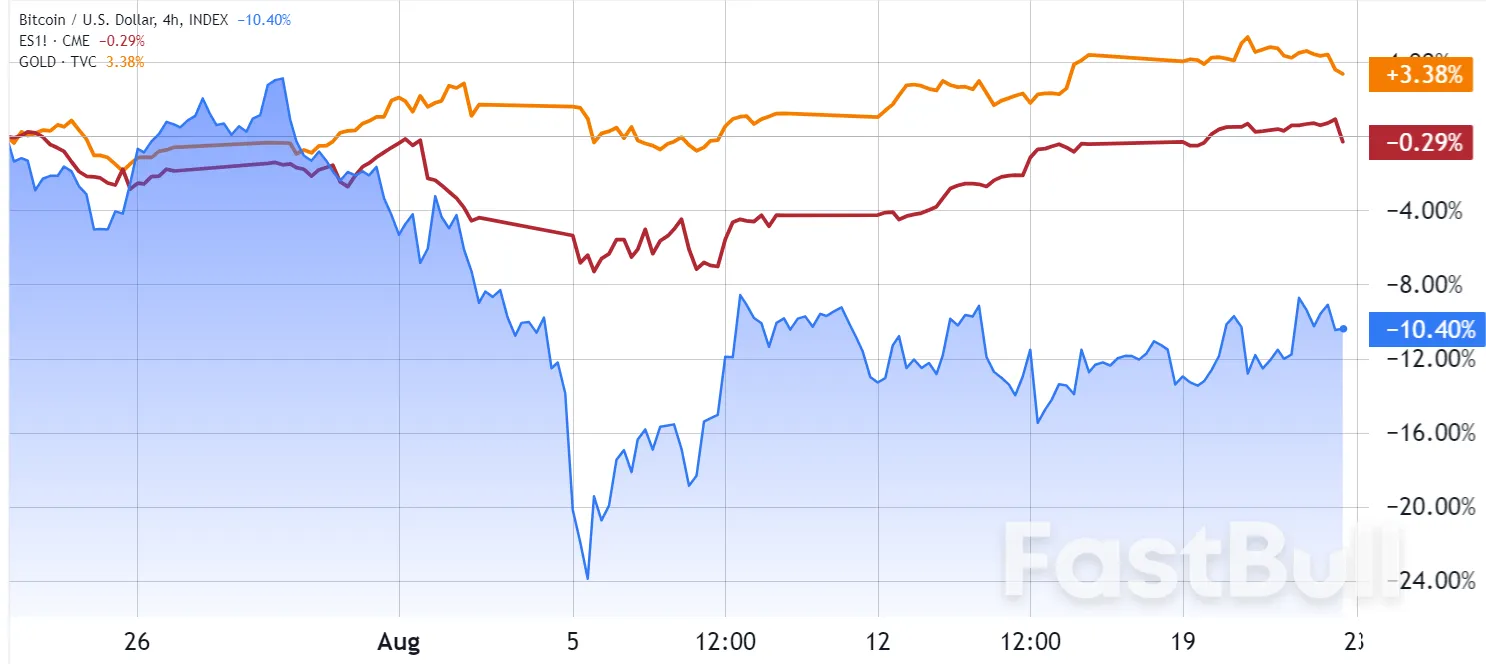
          Bitcoin (blue) vs. gold (orange) vs. S&P futures (red). Source: TradingView

          Some traders might note that the S&P 500 is trading just 1% below its all-time high, and even gold, often considered the world’s most reliable store of value, reached its highest-ever mark on Aug. 20. In contrast, Bitcoin remains 16% below its June 2024 historical high of $71,943. This discrepancy partly stems from differing risk perceptions. Stocks offer a cushion through dividends and strong balance sheets, while gold is viewed as a hedge.
          Meanwhile, Bitcoin continues to struggle to establish itself as an uncorrelated asset that serves multiple purposes. For example, global gold ETFs hold $246.2 billion in assets under management, according to gold.org, while spot Bitcoin instruments, including ETFs and ETNs, total $66.6 billion, according to CoinShares. Despite Bitcoin’s intrinsic properties of censorship resistance and a fixed monetary policy, it still has a long way to go to solidify its presence in traditional financial markets.
          This disparity in risk perception explains why gold’s rise to $2,531 was not mirrored in Bitcoin's performance. While investors are certainly concerned about the US government’s fiscal debt and are seeking protection in scarce assets, most are not yet ready to fully embrace an independent digital currency. However, recent inflows into spot Bitcoin ETFs suggest a promising path forward. These instruments captured $226 million in net inflows during the four trading days ending Aug. 21, indicating growing interest once initial barriers are overcome.

          Bitcoin could benefit from a constructive regulatory approach

          In addition to macroeconomic trends, the cryptocurrency industry is seeing a more favorable outlook as the US presidential elections in November approach. Candidates have strong incentives to publicly support the digital finance industry, regardless of their actual intentions. An Aug. 21 Bloomberg report indicated that the Democratic presidential nominee Kamala Harris has reportedly pledged to support the continued growth of the crypto industry.
          Ultimately, as long as US employment and inflation data remain neutral to positive, the likelihood of a less stringent monetary policy from the Fed increases. This could help reduce government spending on debt repayment, but it may also weaken the domestic currency as investors seek better fixed-income opportunities elsewhere. Consequently, Bitcoin's prospects for breaking above $62,000 before year-end remain solid.

          Source: Cointelegraph

          Risk Warnings and Disclaimers
          You understand and acknowledge that there is a high degree of risk involved in trading. Following any strategies or investment methods may lead to potential losses. The content on the site is provided by our contributors and analysts for information purposes only. You are solely responsible for determining whether any trading assets, securities, strategy, or any other product is suitable for investing based on your own investment objectives and financial situation.
          Add to Favorites
          Share

          Flash UK PMI Signals Faster Economic Growth And Lower Inflation In August

          S&P Global Inc.

          Data Interpretation

          August is witnessing a welcome combination of stronger economic growth, improved job creation and lower inflation, according to provisional PMI survey data.
          Both manufacturing and service sectors are reporting solid output growth and increased job gains as business confidence remains elevated by historical standards.
          Although GDP growth looks set to weaken in the third quarter compared to the impressive gains seen in the first half of the year, the PMI is indicative of the economy expanding at a reasonably solid quarterly rate of around 0.3%.
          Inflationary pressures have meanwhile moderated further in August, including notably in the service sector, which has been a key area of concern for the Bank of England.
          The latest survey data therefore help lower the bar for further interest rate cuts, although the still-elevated nature of inflation in the service sector suggests that policymakers will move cautiously.

          Output growth ticks higher

          Business activity rose for a tenth month running in August, according to early PMI survey data, the rate of growth picking up momentum to the fastest since April and the second fastest in the past 15 months. The headline economic growth indicator from the flash PMI surveys, the seasonally adjusted S&P Global UK PMI Composite Output Index, rose from 52.8 in July to 53.4 in August.
          The latest PMI reading is broadly indicative of the UK economy growing at a quarterly rate of 0.3%, based on the historical relationship of the PMI with GDP, adding to signs that the economy sustained a robust pace of expansion in the third quarter.
          Official GDP data have come in stronger than the PMI so far this year, signaling a 0.7% expansion in the first quarter and a 0.6% rise in the second quarter, but many economists, including those at the Bank of England, expect the pace of growth to moderate in the second half of the year to a rate more in line with that signalled by the PMI.

          Manufacturing sector continues to revive alongside sustained services expansion

          A reviving manufacturing sector led the economic expansion for a fourth consecutive month in August. Factory output has now risen in five of the past six months, marking a welcome recovery after the steep declines seen throughout late 2022 and much of 2023. Although manufacturing output growth slowed in August, the past two months have seen the strongest back-to-back increases since the opening months of 2022.
          The latest manufacturing production expansion was driven by reviving domestic demand, as export orders for goods continued to fall in August, dropping at an increased rate to register a thirty-first successive monthly decline.
          Service sector activity meanwhile grew at the fastest rate since April, rising for a tenth month in a row. As with manufacturing, the main stimulus to services activity was domestic demand, with export sales growth weakening in August to an eight-month low to register only a modest increase. Within services, the expansion was largely fueled by Tech & IT followed by Financial services.

          Jobs growth edges up to 16-month high

          The sustained expansion of output in August was accompanied by increased job creation. Employment rose at the fastest rate for 16 months, representing an eighth month of net job gains after the falling employment seen in the closing four months of 2023. The current PMI employment index is broadly consistent with 100,000 jobs being added to the economy in the third quarter.
          Service sector jobs growth cooled slightly compared to July, but the August rise was still the second largest for over a year. However, the biggest improvement in recent months has been seen in the manufacturing sector, where employment rose for a second month in August, increasing at a rate not seen for just over two years.

          Inflationary pressures wane further

          Despite rising staff costs continuing to be widely reported amid the expansion of workforce numbers, overall inflationary pressures cooled further in August.
          Input costs across goods and services rose collectively at the slowest rate since January 2021, led lower notably by a softening of services inflation to the lowest since February 2021. Importantly, the current rate of services inflation is now only marginally above ten-year average preceding the pandemic, pointing to a normalisation of cost trends in a sector which has been the principal inflationary concern of policymakers in recent months.
          While manufacturing input costs rose, often linked to supply chain shortages, shipping delays and higher import prices, the rate of increase moderated from July's one-and-a-half-year high.
          The softening of input cost pressures fed through to lower selling price inflation, which moderated for both goods and services in August. The overall PMI selling price gauge consequently fell to its joint-lowest since February 2021, consistent with a further reduction of core inflation from its current 3.3% annual rate. The rate of inflation signalled by the PMI nevertheless remains elevated by historical standards - the current selling price index reading of 55.0 compares with a pre-pandemic decade average of 52.2 - to suggest some stubbornness of price pressures, particularly in the service sector.

          Outlook

          Looking ahead, future output expectations softened in both manufacturing and services in August though the overall level of optimism remained well above the survey's long-run average. Thus, while the pull-back in sentiment hints at output growth potentially slowing in September, any slowdown is likely to be only modest with contraction avoided in the near term.
          S&P Global Market Intelligence economists are therefore forecasting UK GDP growth to slow to around 0.25% in both the third and fourth quarters of 2024. After the strong 0.7% and 0.6% gains seen in the first two quarters of the year respectively, that would result in 1.0% GDP growth for the year.
          This slowdown, combined with the further moderation of price pressures seen in the August flash PMI surveys, opens the door further for a loosening of monetary policy later in the year.
          The Bank of England lowered its policy rate by 25 basis points to 5% at its July meeting, its first cut since March 2020. The decision was 'finely balanced' with five of the nine members of the Bank's Monetary Policy Committee voting for a rate cut. Bank Governor Andrew Bailey stated that this should not be seen as the start of a rapid decline in rates, highlighting the risk of loosening monetary policy too quickly while inflation remains high. S&P Global Market Intelligence economists consequently expect only one additional 25-basis-point cut this year, taking the policy rate down to 4.75%, though there is clearly a chance that MPC could be further encouraged towards a September rate by these recent PMI numbers.
          Risk Warnings and Disclaimers
          You understand and acknowledge that there is a high degree of risk involved in trading. Following any strategies or investment methods may lead to potential losses. The content on the site is provided by our contributors and analysts for information purposes only. You are solely responsible for determining whether any trading assets, securities, strategy, or any other product is suitable for investing based on your own investment objectives and financial situation.
          Add to Favorites
          Share

          Nvidia, PCE Inflation to Drive Nasdaq Street Sentiment: The Week Ahead

          FOREX.com

          Stocks

          Nvidia’s earnings report on Thursday has the potential to drive sentiment for the Nasdaq 100, particularly if it misses estimates for the first quarter in seven. Traders will then focus on the PCE inflation report on Friday to assess Fed policy – assuming Jerome Powell hasn’t made it crystal clear what to expect at his Jackson Hole speech later today. Which seems unlikely.
          Beyond that we have a stack of second-tier data which is unlikely to be a major driver for markets, and that means we should expect lower levels of volatility overall. Unless inflation data or Nvidia earnings report throws a spanner in the works.
          Australia’s monthly CPI report warrants a look for RBA watchers, although I maintain my view that there may not be a lot to watch and the central bank remains unlikely to change rates this year. But any pickup in the PCI data pours yet more cold water on bets of any cuts.
          Nvidia, PCE Inflation to Drive Nasdaq Street Sentiment: The Week Ahead_1

          Nvidia, Nasdaq 100 technical analysis:

          You’d be forgiven for thinking I overlaid the same chart over Nvidia, but that is in fact the NASDAQ 100. The correlation is not quite perfect but it is close enough to see just how much sway one stock has on the broader index (and visa versa).
          Nvidia’s share price fell -3.6% on Thursday due to the broader selloff on Wall Street, following less-dovish-than-expected comments from Fed members. And prices for both Nvidia and the Nasdaq (and Wall Street in general) could pull back further, should Jerome Powell disappoint and not deliver clearly dovish speech later today.
          Yet it could be Nvidia that takes the driving seat next week once earnings are released on Thursday. Earnings have beaten expectations over the past six quarters, of which we saw a notable rise of their share price over last two. But with the recent rally failing to take out the record high, are investors less keen on tech than they were this time last year. Possibly.
          Of course, should Nvidia’s earnings exceed expectations for a seventh quarter and US inflation data (released Friday) come in soft, it could just as easily spark the next move higher for the tech giant’s share price. Assuming inflation data does not come in too soft, as to rekindle fears of a recession.
          Nvidia, PCE Inflation to Drive Nasdaq Street Sentiment: The Week Ahead_2
          A bearish engulfing candle formed on Thursday on high volume, which warns of a potential swing high. Trading volumes were also declining throughout the rally from the August low, which is slightly underwhelming for the bull case. Perhaps a deeper pullback is due.
          120 is likely a key level bulls want to defend, a break beneath which assumes a correction is underway. And that brings the 110 and 105 handles into focus for nears, the latter being near a high-volume node at 104.93.
          Risk Warnings and Disclaimers
          You understand and acknowledge that there is a high degree of risk involved in trading. Following any strategies or investment methods may lead to potential losses. The content on the site is provided by our contributors and analysts for information purposes only. You are solely responsible for determining whether any trading assets, securities, strategy, or any other product is suitable for investing based on your own investment objectives and financial situation.
          Add to Favorites
          Share

          U.S. Existing-Home Sales in July: Ending Four-Month Skid, with Prices Hitting New Highs

          NAR

          Economic

          Data Interpretation

          On August 22, the National Association of Realtors released the existing-home sales data:
          The existing-home sales came in at an annual rate of 3.95 million units, compared to an expected reading of 3.93 million and the previous month's 3.90 million.
          The existing-home sales grew 1.3% month-over-month in July, in line with expectations, compared to a 5.1% decrease in June.
          Existing-home sales grew 1.3% in July to a seasonally adjusted annual rate of 3.95 million, stopping a four-month sales decline that began in March. Three out of four major U.S. regions registered sales increases while the Midwest remained steady. However, year-over-year, sales fell 2.5% (down from 4.05 million in July 2023).
          The median existing-home sales price elevated 4.2% from July 2023 to $422,600, the 13th consecutive month of year-over-year price gains. Prices in all four major U.S. regions rose.
          The existing-home sales in July extended the previous uptrend. Total housing inventory registered at the end of July was 1.33 million units, up 0.8% from June and 19.8% from one year ago (1.11 million). Unsold inventory sits at a 4.0-month supply at the current sales pace, down from 4.1 months in June.
          According to Freddie Mac, the 30-year fixed-rate mortgage averaged 6.49% as of August 15. That's up from 6.47% one week ago but down from 7.09% one year ago.
          In general, despite a slight pickup in U.S. existing-home sales in July, the sales were at the lowest July level since 2010. However, the drop in mortgage rates may have improved affordability for potential homebuyers, which is expected to help stabilize the housing market.

          U.S. July Existing-Home Sales

          To stay updated on all economic events of today, please check out our Economic calendar
          Risk Warnings and Disclaimers
          You understand and acknowledge that there is a high degree of risk involved in trading. Following any strategies or investment methods may lead to potential losses. The content on the site is provided by our contributors and analysts for information purposes only. You are solely responsible for determining whether any trading assets, securities, strategy, or any other product is suitable for investing based on your own investment objectives and financial situation.
          Add to Favorites
          Share
          FastBull
          Copyright © 2025 FastBull Ltd

          728 RM B 7/F GEE LOK IND BLDG NO 34 HUNG TO RD KWUN TONG KLN HONG KONG

          TelegramInstagramTwitterfacebooklinkedin
          App Store Google Play Google Play
          Products
          Charts

          Chats

          Q&A with Experts
          Screeners
          Economic Calendar
          Data
          Tools
          Membership
          Features
          Function
          Markets
          Copy Trading
          Latest Signals
          Contests
          News
          Analysis
          24/7
          Columns
          Education
          Company
          Careers
          About Us
          Contact Us
          Advertising
          Help Center
          Feedback
          User Agreement
          Privacy Policy
          Business

          White Label

          Data API

          Web Plug-ins

          Poster Maker

          Affiliate Program

          Risk Disclosure

          The risk of loss in trading financial instruments such as stocks, FX, commodities, futures, bonds, ETFs and crypto can be substantial. You may sustain a total loss of the funds that you deposit with your broker. Therefore, you should carefully consider whether such trading is suitable for you in light of your circumstances and financial resources.

          No decision to invest should be made without thoroughly conducting due diligence by yourself or consulting with your financial advisors. Our web content might not suit you since we don't know your financial conditions and investment needs. Our financial information might have latency or contain inaccuracy, so you should be fully responsible for any of your trading and investment decisions. The company will not be responsible for your capital loss.

          Without getting permission from the website, you are not allowed to copy the website's graphics, texts, or trademarks. Intellectual property rights in the content or data incorporated into this website belong to its providers and exchange merchants.

          Not Logged In

          Log in to access more features

          FastBull Membership

          Not yet

          Purchase

          Become a signal provider
          Help Center
          Customer Service
          Dark Mode
          Price Up/Down Colors

          Log In

          Sign Up

          Position
          Layout
          Fullscreen
          Default to Chart
          The chart page opens by default when you visit fastbull.com