• Trade
  • Markets
  • Copy
  • Contests
  • News
  • 24/7
  • Calendar
  • Q&A
  • Chats
Trending
Screeners
SYMBOL
LAST
BID
ASK
HIGH
LOW
NET CHG.
%CHG.
SPREAD
SPX
S&P 500 Index
6817.46
6817.46
6817.46
6861.30
6801.50
-9.95
-0.15%
--
DJI
Dow Jones Industrial Average
48375.88
48375.88
48375.88
48679.14
48285.67
-82.16
-0.17%
--
IXIC
NASDAQ Composite Index
23103.70
23103.70
23103.70
23345.56
23012.00
-91.46
-0.39%
--
USDX
US Dollar Index
97.940
98.020
97.940
98.070
97.740
-0.010
-0.01%
--
EURUSD
Euro / US Dollar
1.17465
1.17473
1.17465
1.17686
1.17262
+0.00071
+ 0.06%
--
GBPUSD
Pound Sterling / US Dollar
1.33732
1.33742
1.33732
1.34014
1.33546
+0.00025
+ 0.02%
--
XAUUSD
Gold / US Dollar
4302.77
4303.11
4302.77
4350.16
4285.08
+3.38
+ 0.08%
--
WTI
Light Sweet Crude Oil
56.317
56.347
56.317
57.601
56.233
-0.916
-1.60%
--

Community Accounts

Signal Accounts
--
Profit Accounts
--
Loss Accounts
--
View More

Become a signal provider

Sell trading signals to earn additional income

View More

Guide to Copy Trading

Get started with ease and confidence

View More

Signal Accounts for Members

All Signal Accounts

Best Return
  • Best Return
  • Best P/L
  • Best MDD
Past 1W
  • Past 1W
  • Past 1M
  • Past 1Y

All Contests

  • All
  • Trump Updates
  • Recommend
  • Stocks
  • Cryptocurrencies
  • Central Banks
  • Featured News
Top News Only
Share

Goldman Sachs Says They Believe That The Copper Price Is Vulnerable To An Ai-Linked Price Correction

Share

Goldman Sachs Upgrades 2026 Copper Price Forecast To $11400 From $10,650

Share

Attempts By Ukrainian Troops To Advance From The South-West To Outskirts Of Kupiansk Are Being Thwarted

Share

Russian Troops Control All Of Kupiansk - IFX Cites Russian Military

Share

On Monday (December 15), The South Korean Won Ultimately Rose 0.60% Against The US Dollar, Closing At 1468.91 Won. The Won Was On An Upward Trend Throughout The Day, Rising Significantly At 17:00 Beijing Time And Reaching A Daily High Of 1463.04 Won At 17:36

Share

Health Ministry: Israeli Forces Kill Palestinian Teen In West Bank

Share

New York Federal Reserve President Williams: Over Time, The Size Of Reserves Could Grow From $2.9 Trillion

Share

New York Fed President Williams: AI Valuations Are High, But There Is A Real Driving Factor

Share

New York Federal Reserve President Williams: The Job Market Is In Very Good Shape

Share

New York Fed President Williams: 'Very Supportive' Of USA Central Bank's Decision To Cut Interest Rates Last Week

Share

New York Fed President Williams: 'Too Early To Say' What Central Bank Should Do At January Meeting

Share

New York Fed President Williams: Strong Markets Part Of Reason Why Economy Will Grow Robustly In 2026

Share

New York Fed President Williams: What Constitutes Ample Reserves Will Change Over Time

Share

New York Fed President Williams: Market Valuations 'Elevated,' But There Are Reasons For Pricing

Share

New York Fed President Williams: Ample Reserves System Working Very Well

Share

New York Fed President Williams: Some Signs That Parts Of Underlying Economy Not As Strong As GDP Data Suggests

Share

New York Fed President Williams: Expects Coming Job Data Will Show Gradual Cooling

Share

Ukraine President Zelenskiy: Monitoring Of Ceasefire Should Be Part Of Security Guarantees

Share

Ukraine President Zelenskiy: Ukraine Needs Clear Understanding On Security Guarantees Before Taking Any Decisions Regarding Frontlines

Share

U.S. Commerce Secretary Rutnick Praised Korea Zinc Co. Ltd., Stating That The United States Will Have Priority Access To The Company's Products In 2026

TIME
ACT
FCST
PREV
Japan Tankan Small Manufacturing Outlook Index (Q4)

A:--

F: --

P: --

Japan Tankan Large Non-Manufacturing Outlook Index (Q4)

A:--

F: --

P: --

Japan Tankan Large Manufacturing Outlook Index (Q4)

A:--

F: --

P: --

Japan Tankan Small Manufacturing Diffusion Index (Q4)

A:--

F: --

P: --

Japan Tankan Large-Enterprise Capital Expenditure YoY (Q4)

A:--

F: --

P: --

U.K. Rightmove House Price Index YoY (Dec)

A:--

F: --

P: --

China, Mainland Industrial Output YoY (YTD) (Nov)

A:--

F: --

P: --

China, Mainland Urban Area Unemployment Rate (Nov)

A:--

F: --

P: --

Saudi Arabia CPI YoY (Nov)

A:--

F: --

P: --

Euro Zone Industrial Output YoY (Oct)

A:--

F: --

P: --

Euro Zone Industrial Output MoM (Oct)

A:--

F: --

P: --

Canada Existing Home Sales MoM (Nov)

A:--

F: --

P: --

Canada National Economic Confidence Index

A:--

F: --

P: --

Canada New Housing Starts (Nov)

A:--

F: --

P: --
U.S. NY Fed Manufacturing Employment Index (Dec)

A:--

F: --

P: --

U.S. NY Fed Manufacturing Index (Dec)

A:--

F: --

P: --

Canada Core CPI YoY (Nov)

A:--

F: --

P: --

Canada Manufacturing Unfilled Orders MoM (Oct)

A:--

F: --

P: --

U.S. NY Fed Manufacturing Prices Received Index (Dec)

A:--

F: --

P: --

U.S. NY Fed Manufacturing New Orders Index (Dec)

A:--

F: --

P: --

Canada Manufacturing New Orders MoM (Oct)

A:--

F: --

P: --

Canada Core CPI MoM (Nov)

A:--

F: --

P: --

Canada Trimmed CPI YoY (SA) (Nov)

A:--

F: --

P: --

Canada Manufacturing Inventory MoM (Oct)

A:--

F: --

P: --

Canada CPI YoY (Nov)

A:--

F: --

P: --

Canada CPI MoM (Nov)

A:--

F: --

P: --

Canada CPI YoY (SA) (Nov)

A:--

F: --

P: --

Canada Core CPI MoM (SA) (Nov)

A:--

F: --

P: --

Canada CPI MoM (SA) (Nov)

A:--

F: --

P: --

Federal Reserve Board Governor Milan delivered a speech
U.S. NAHB Housing Market Index (Dec)

A:--

F: --

P: --

Australia Composite PMI Prelim (Dec)

--

F: --

P: --

Australia Services PMI Prelim (Dec)

--

F: --

P: --

Australia Manufacturing PMI Prelim (Dec)

--

F: --

P: --

Japan Manufacturing PMI Prelim (SA) (Dec)

--

F: --

P: --

U.K. 3-Month ILO Employment Change (Oct)

--

F: --

P: --

U.K. Unemployment Claimant Count (Nov)

--

F: --

P: --

U.K. Unemployment Rate (Nov)

--

F: --

P: --

U.K. 3-Month ILO Unemployment Rate (Oct)

--

F: --

P: --

U.K. Average Weekly Earnings (3-Month Average, Including Bonuses) YoY (Oct)

--

F: --

P: --

U.K. Average Weekly Earnings (3-Month Average, Excluding Bonuses) YoY (Oct)

--

F: --

P: --

France Services PMI Prelim (Dec)

--

F: --

P: --

France Composite PMI Prelim (SA) (Dec)

--

F: --

P: --

France Manufacturing PMI Prelim (Dec)

--

F: --

P: --

Germany Services PMI Prelim (SA) (Dec)

--

F: --

P: --

Germany Manufacturing PMI Prelim (SA) (Dec)

--

F: --

P: --

Germany Composite PMI Prelim (SA) (Dec)

--

F: --

P: --

Euro Zone Composite PMI Prelim (SA) (Dec)

--

F: --

P: --

Euro Zone Services PMI Prelim (SA) (Dec)

--

F: --

P: --

Euro Zone Manufacturing PMI Prelim (SA) (Dec)

--

F: --

P: --

U.K. Services PMI Prelim (Dec)

--

F: --

P: --

U.K. Manufacturing PMI Prelim (Dec)

--

F: --

P: --

U.K. Composite PMI Prelim (Dec)

--

F: --

P: --

Euro Zone ZEW Economic Sentiment Index (Dec)

--

F: --

P: --

Germany ZEW Current Conditions Index (Dec)

--

F: --

P: --

Germany ZEW Economic Sentiment Index (Dec)

--

F: --

P: --

Euro Zone Trade Balance (Not SA) (Oct)

--

F: --

P: --

Euro Zone ZEW Current Conditions Index (Dec)

--

F: --

P: --

Euro Zone Trade Balance (SA) (Oct)

--

F: --

P: --

Euro Zone Total Reserve Assets (Nov)

--

F: --

P: --

U.K. Inflation Rate Expectations

--

F: --

P: --

Q&A with Experts
    • All
    • Chatrooms
    • Groups
    • Friends
    Connecting
    .
    .
    .
    Type here...
    Add Symbol or Code

      No matching data

      All
      Trump Updates
      Recommend
      Stocks
      Cryptocurrencies
      Central Banks
      Featured News
      • All
      • Russia-Ukraine Conflict
      • Middle East Flashpoint
      • All
      • Russia-Ukraine Conflict
      • Middle East Flashpoint
      Search
      Products

      Charts Free Forever

      Chats Q&A with Experts
      Screeners Economic Calendar Data Tools
      Membership Features
      Data Warehouse Market Trends Institutional Data Policy Rates Macro

      Market Trends

      Market Sentiment Order Book Forex Correlations

      Top Indicators

      Charts Free Forever
      Markets

      News

      News Analysis 24/7 Columns Education
      From Institutions From Analysts
      Topics Columnists

      Latest Views

      Latest Views

      Trending Topics

      Top Columnists

      Latest Update

      Signals

      Copy Rankings Latest Signals Become a signal provider AI Rating
      Contests
      Brokers

      Overview Brokers Assessment Rankings Regulators News Claims
      Broker listing Forex Brokers Comparison Tool Live Spread Comparison Scam
      Q&A Complaint Scam Alert Videos Tips to Detect Scam
      More

      Business
      Events
      Careers About Us Advertising Help Center

      White Label

      Data API

      Web Plug-ins

      Affiliate Program

      Awards Institution Evaluation IB Seminar Salon Event Exhibition
      Vietnam Thailand Singapore Dubai
      Fans Party Investment Sharing Session
      FastBull Summit BrokersView Expo
      Recent Searches
        Top Searches
          Markets
          News
          Analysis
          User
          24/7
          Economic Calendar
          Education
          Data
          • Names
          • Latest
          • Prev

          View All

          No data

          Scan to Download

          Faster Charts, Chat Faster!

          Download App
          English
          • English
          • Español
          • العربية
          • Bahasa Indonesia
          • Bahasa Melayu
          • Tiếng Việt
          • ภาษาไทย
          • Français
          • Italiano
          • Türkçe
          • Русский язык
          • 简中
          • 繁中
          Open Account
          Search
          Products
          Charts Free Forever
          Markets
          News
          Signals

          Copy Rankings Latest Signals Become a signal provider AI Rating
          Contests
          Brokers

          Overview Brokers Assessment Rankings Regulators News Claims
          Broker listing Forex Brokers Comparison Tool Live Spread Comparison Scam
          Q&A Complaint Scam Alert Videos Tips to Detect Scam
          More

          Business
          Events
          Careers About Us Advertising Help Center

          White Label

          Data API

          Web Plug-ins

          Affiliate Program

          Awards Institution Evaluation IB Seminar Salon Event Exhibition
          Vietnam Thailand Singapore Dubai
          Fans Party Investment Sharing Session
          FastBull Summit BrokersView Expo

          Iran Sticks to Uranium Enrichment; Powell Faces Criminal Charges

          FastBull Featured

          Daily News

          Summary:

          Iranian Foreign Minister: Iran has not halted Uranium Enrichment Program;Powell faces criminal charges from Trump's Ally......

          [Quick Facts]

          1. Iranian Foreign Minister: Iran has not halted Uranium Enrichment Program.
          2. Trump tax reform bill to increase U.S. deficit by 3.4 trillion dollars.
          3. Next round of Ukraine-Russia Peace Talks scheduled for Wednesday in Turkey.
          4. Powell faces criminal charges from Trump's Ally.
          5. Shigeru Ishiba's prospects for governance appear bleak.

          [News Details]

          Iranian Foreign Minister: Iran has not halted Uranium Enrichment Program
          According to CCTV News, Iranian Foreign Minister Abbas Araghchi stated on July 21st that uranium enrichment-related facilities in Iran have been "severely damaged" following a U.S. attack. He also noted that the uranium enrichment program has not been suspended, emphasizing that Iran cannot give it up as it is extremely precious to the country and tied to national dignity.
          Trump tax reform bill to increase U.S. deficit by 3.4 trillion dollars
          According to the latest estimate from the U.S. Congressional Budget Office (CBO), the tax and spending bill signed by President Donald Trump recently will increase the U.S. deficit by $3.4 trillion over the next decade and result in millions losing health insurance. An assessment released by the CBO on Monday showed that the bill will reduce revenue by $4.5 trillion and spending by $1.1 trillion by 2034. The latest analysis does not incorporate so-called dynamic effects, such as potential impacts on economic growth or interest rates in the future. Trump signed the "One Big Beautiful Bill" on July 4th after months of consultations with congressional Republicans. The bill covers most of Trump's economic agenda, including permanently extending his 2017 income tax cuts and some corporate tax reductions, raising the state and local tax (SALT) deduction cap, and providing temporary tax breaks for tip and overtime income.
          Next round of Ukraine-Russia Peace Talks scheduled for Wednesday in Turkey
          Ukrainian President Volodymyr Zelenskyy, citing the Chairman of Ukraine's Security and Defense Council, stated that the next round of peace talks between Ukraine and Russia is planned for Wednesday in Turkey. In an evening video address, Zelenskyy said, " Today, I discussed with (Ukrainian Security Council chief) Rustem Umerov the preparations for the exchange and another meeting in Turkey with the Russian side. Umerov reported that the meeting is scheduled for Wednesday." Umerov currently serves as the Secretary of Ukraine's Security and Defense Council and chaired the first two rounds of talks with Russia.
          Powell faces criminal charges from Trump's Ally
          U.S. Representative Anna Paulina Luna has presented criminal charges to the Department of Justice, alleging that Federal Reserve Chair Jerome Powell committed perjury twice. In her letter, Luna wrote, " On June 25, 2025, Chairman Powell provided testimony under oath before the U.S. Senate Committee on Banking, Housing, and Urban Affairs regarding the renovation of the Federal Reserve’s Eccles Building. In his statements, he made several materially false claims." Luna further stated, " Powell characterized the changes that escalated the cost of the project from $1.9 billion to $2.5 billion as minor. However, documents reviewed by congressional investigators indicate that the scope and cost overruns of this project were neither minor in nature nor in substance." Perjury is punishable by fines and up to five years in prison.
          Shigeru Ishiba's prospects for governance appear bleak
          Analysts attribute the recent electoral defeat of Japan's ruling Liberal Democratic Party (LDP) - Komeito coalition primarily to public discontent over rising prices, weak policy responses, and voter attrition due to the aging image of traditional parties. These factors have also exposed deeper crises in the coalition's policy implementation and public communication. Lu Hao, Director of the Department of Comprehensive Strategy at the Institute of Japanese Studies, Chinese Academy of Social Sciences, noted that while Ishiba may continue as prime minister, his prospects for governance are highly uncertain, and it will be difficult to quell doubts about him from both within and outside the ruling camp in the short term. Meanwhile, trends toward conservatism and populism in Japan's political landscape are expected to intensify.

          [Today's Focus]

          UTC+8 17:15 BoE’s Bailey, Crozier & Wilkins Testify on Financial Stability Report Before UK Parliament
          UTC+8 20:30 Fed Chair Powell Speaks
          UTC+8 01:00 Fed Governor Bowman Speaks
          Risk Warnings and Disclaimers
          You understand and acknowledge that there is a high degree of risk involved in trading. Following any strategies or investment methods may lead to potential losses. The content on the site is provided by our contributors and analysts for information purposes only. You are solely responsible for determining whether any trading assets, securities, strategy, or any other product is suitable for investing based on your own investment objectives and financial situation.
          Add to Favorites
          Share

          RBA Holds Rates Steady Amid Internal Split, Citing Need for Data Caution

          Gerik

          Economic

          Internal Divergence Reflects Policy Uncertainty

          The Reserve Bank of Australia (RBA) surprised markets this month by holding the cash rate at 3.85%, resisting what would have been a third rate cut in just four meetings. Minutes from the July 7–8 meeting reveal a board divided, with six of the nine members favoring a pause, citing the need for more data before shifting further. The split highlights rising internal tensions between a proactive easing stance and a more gradualist approach.
          Those in favor of holding rates argued that the current rate remains “modestly restrictive” and that cutting too quickly could misjudge the neutral level of interest rates. The majority emphasized that monetary easing should proceed “cautiously” as the economy rebalances and inflation eases. In contrast, the three dissenting members believed the evidence already justified further cuts, citing progress toward returning inflation to target and weakening economic indicators.

          Markets Wrong-Footed by Cautious Stance

          The central bank’s decision defied widespread market expectations. Traders had priced in a near-certain cut after the May monthly inflation report showed the trimmed mean an indicator closely watched by the RBA falling to a 3.5-year low of 2.4%. The economy’s stagnation in Q1 and signs of sputtering public demand added to the case for more accommodative policy. However, the board's minutes suggest concern over reading too much into monthly inflation swings, especially with underlying components like housing potentially showing stronger June-quarter pressures.
          The RBA acknowledged that financial markets have occasionally mispriced policy intentions in the past, reinforcing its desire to act independently of speculative sentiment. This view was supported by data showing stronger-than-expected private sector activity and a surprisingly resilient labor market, despite soft headline GDP figures.

          Inflation, Employment, and Global Risk in Focus

          While acknowledging muted GDP growth in the first quarter, the RBA pointed to robust private demand, which came in above projections, as a counterbalance. Labor market conditions, too, remained tight by historical standards, although the RBA noted emerging signs of softening particularly following a weaker-than-expected jobs report just after the meeting, which could now factor into the August decision.
          The board also recognized ongoing volatility in monthly inflation readings and the risk of overstating the disinflationary trend. Housing costs, in particular, may exert upward pressure in the near term. Globally, the risk of a severe downturn has diminished slightly, but the outlook remains clouded by uncertainties in US trade policy and other geopolitical variables.

          Forward Guidance and Market Projections

          Looking ahead, financial markets now see a 91% probability of a rate cut at the RBA’s next policy meeting on August 12, spurred by weakening job market data. Futures markets are also pricing in a gradual easing cycle, with the cash rate expected to bottom near 3.10% by early 2026.
          Nonetheless, the RBA’s July minutes make clear that policy will remain data-dependent. The bank is prepared to ease further if inflation remains subdued and economic momentum slows, but it will do so methodically rather than reactively.
          The RBA’s decision to pause reflects a nuanced strategy aimed at navigating between easing inflation and underlying economic resilience. With mixed signals from key indicators and growing concerns over premature action, the central bank has opted for prudence. While rate cuts remain likely, the path forward will depend on incoming data particularly on inflation, labor market trends, and global risks. This calibrated approach underlines the RBA’s commitment to long-term stability over short-term accommodation.

          Source: Reuters

          To stay updated on all economic events of today, please check out our Economic calendar
          Risk Warnings and Disclaimers
          You understand and acknowledge that there is a high degree of risk involved in trading. Following any strategies or investment methods may lead to potential losses. The content on the site is provided by our contributors and analysts for information purposes only. You are solely responsible for determining whether any trading assets, securities, strategy, or any other product is suitable for investing based on your own investment objectives and financial situation.
          Add to Favorites
          Share

          Japanese Bonds Remain Vulnerable As Unpopular Ishiba Holds On

          Winkelmann

          Economic

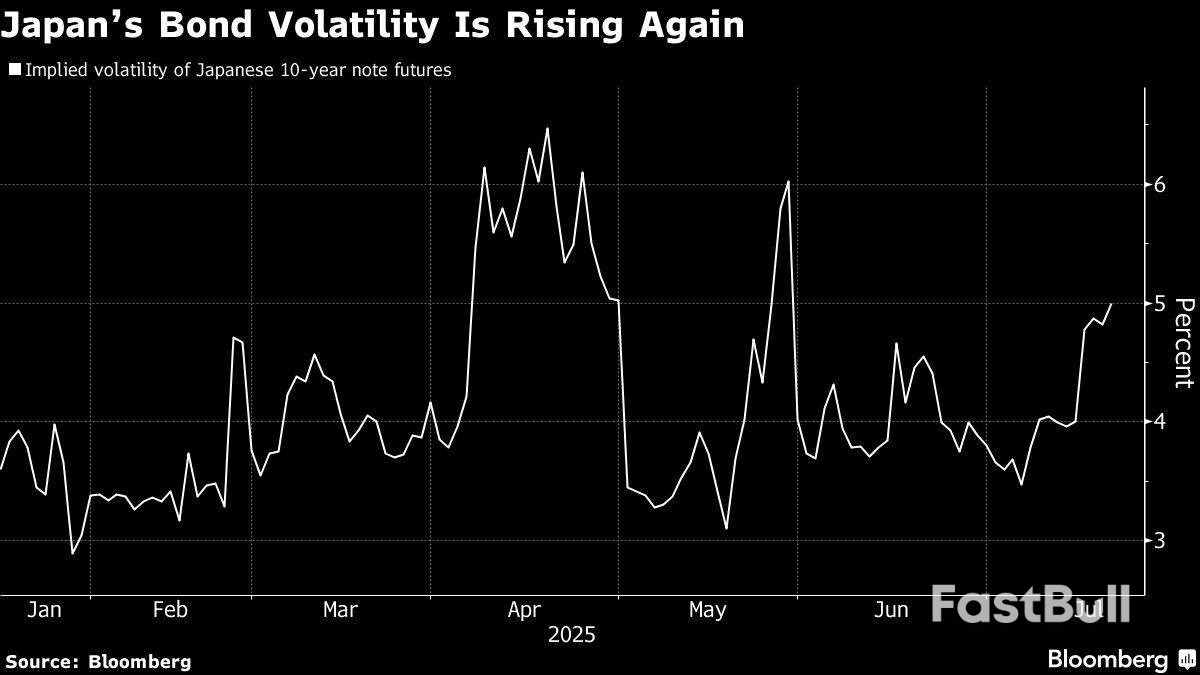
          (July 22): Japanese government bonds are vulnerable to further selling following a historic election defeat for Prime Minister Shigeru Ishiba, although the immediate reaction Tuesday has been damped by a rally in global debt markets.

          Benchmark 10-year bonds fell only slightly as trading resumed in Tokyo, pushing yields up by 1.5 basis points. Stocks opened higher on post-election relief, even as their outlook remains at the mercy of tariffs. The yen dipped and faces downside risks in the coming days and weeks from the prospect of more government spending.

          While Ishiba hanging on as leader for now provides a measure of continuity for markets, he will also need to find ways to placate opposition lawmakers seeking tax cuts and households wanting relief from inflation. Any concessions to these pressures can be expected to quickly translate into higher bond yields.

          With Japan’s markets closed for a national holiday on Monday, investors expressing an initial view on the election did so largely through the yen, which advanced about 1% against the dollar after weakening for most of July. The currency weakened about 0.1% to trade around 147.54 as of 9.27am in Tokyo.

          “Concerns over fiscal expansion continue to simmer in the market, and in light of the election results, JGBs could come under selling pressure,” said Katsutoshi Inadome, a senior strategist at Sumitomo Mitsui Trust Asset Management. “I anticipate a bearish steepening of the yield curve, driven especially by super-long bonds.”

          Benchmark 10-year bond yields rose to 1.535%, while the 5-year bond yields rose a basis point to 1.05%.

          Yields on longer-maturity JGBs of 20 to 40 years dipped slightly on Friday but have been in an acute uptrend over recent months. The moves in Japanese yields, which have flowed through into global markets, reflect concerns among investors that the government is spending beyond its means.

          A lack of clarity around fiscal and economic policies is likely to dim the global appeal of Japanese assets, at least in the short term, said Dilin Wu, a research strategist at Pepperstone Group Ltd. She added that political uncertainty may complicate Tokyo’s trade negotiations with Washington, denting market sentiment.

          “A triple dip scenario is still on the table,” according to Wu, referring to the risk of the yen, bonds and stocks all falling. Despite Ishiba’s insistence that he’ll remain in charge, “investors are likely to question how much political capital he has left,” she said.

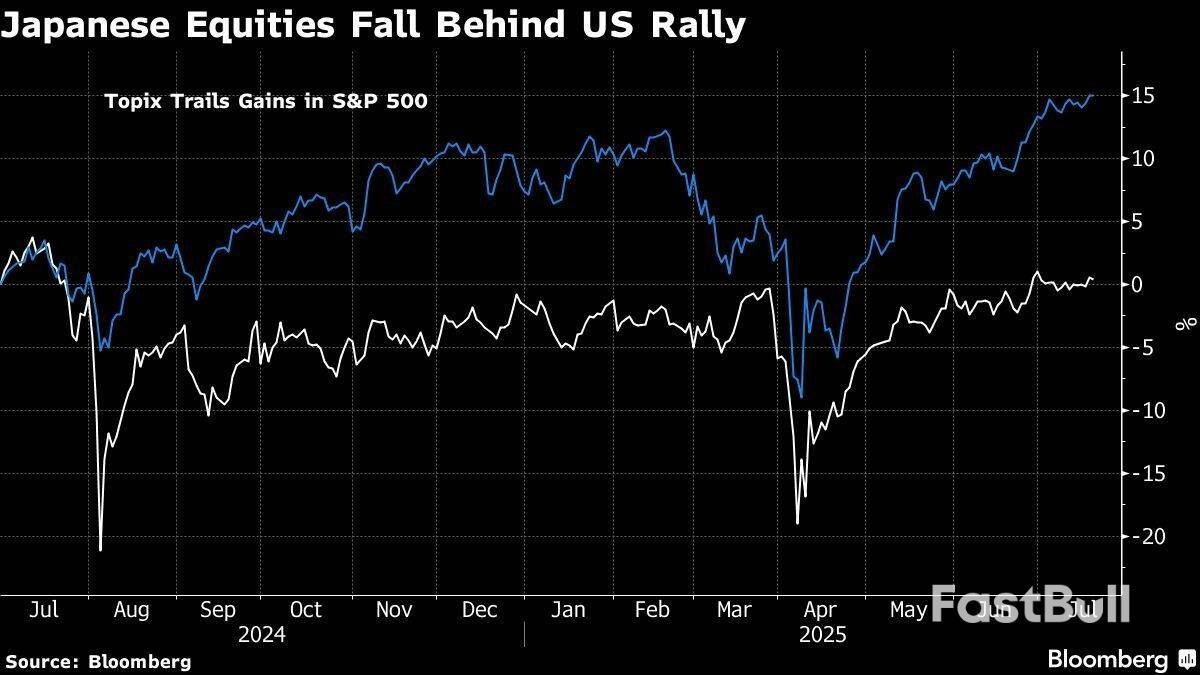
          While Japan’s benchmark Topix stock gauge has bounced back from its sharp decline in the wake of US President Donald Trump’s tariffs salvo in April, it remains well off the record high set in mid-last year.

          “For Japanese equities, the picture is more complex,” said Hebe Chen, an analyst at Vantage Markets in Sydney. “A weaker yen may offer short-term support to exporters, but the deepening political noise threatens to erode broader investor confidence.”

          The yen could also be hit Tuesday, particularly if long-term government bonds sell off, said Hiroshi Namioka, chief strategist and fund manager at T&D Asset Management. “There’s a significant possibility of yen depreciation,” he said. “Although I expect super-long JGB yields to rise, it’s for negative reasons. That could prompt yen selloffs.”

          Nick Twidale, chief analyst at ATFX Global Markets, said he expects selling in Japanese stocks Tuesday, and an overall weakening in the yen, despite its “initial haven move” higher on Monday.

          “There’s plenty of volatility to come on both the domestic front and the trade front,” said Twidale. “I don’t think policy uncertainty bodes well for Japanese equities, plus we still have the US tariffs hanging over their heads and the new political setup could make things more tricky,” he added.

          Source: Theedgemarkets

          To stay updated on all economic events of today, please check out our Economic calendar
          Risk Warnings and Disclaimers
          You understand and acknowledge that there is a high degree of risk involved in trading. Following any strategies or investment methods may lead to potential losses. The content on the site is provided by our contributors and analysts for information purposes only. You are solely responsible for determining whether any trading assets, securities, strategy, or any other product is suitable for investing based on your own investment objectives and financial situation.
          Add to Favorites
          Share

          Asian Stocks Hold Near Four-Year Highs Amid Earnings Optimism and Trade Talks

          Gerik

          Economic

          Stocks

          Asian Markets Resilient as Trade and Earnings Dominate Sentiment

          Asian share markets began the week on a positive note, hovering close to four-year highs, driven by optimism over upcoming corporate earnings and guarded hope surrounding US trade negotiations with key partners. The MSCI Asia-Pacific index (excluding Japan) briefly reached its highest point since October 2021 during early trading on Tuesday before stabilizing. The index has already gained nearly 16% year-to-date, signaling broad regional confidence despite global macroeconomic headwinds.
          Wall Street's strong overnight performance acted as a catalyst, with the S&P 500 and Nasdaq posting record highs. Gains were led by tech giants, notably Alphabet, ahead of a busy earnings season that investors expect to reflect resilient profitability in the face of policy and trade uncertainty.

          Japanese Market Reacts Modestly to Political Shifts

          Japanese equity markets reopened following a national holiday, facing the aftermath of a weakened ruling coalition in upper house elections. Prime Minister Shigeru Ishiba’s commitment to stay in office soothed short-term concerns, and equities managed modest gains. However, the Japanese yen’s earlier rally of 1% on Monday suggested that currency markets are pricing in potential fiscal expansion risks linked to Ishiba’s weakened mandate.
          Economists, including Kristina Clifton of the Commonwealth Bank of Australia, have warned that more aggressive fiscal policies could eventually weigh on Japanese government bonds and the yen. She suggested that growing concerns over fiscal imbalances may exert longer-term downward pressure on both yields and currency valuation.

          Tariff Negotiations Shape Global Currency and Commodity Trends

          Investor attention remains sharply focused on ongoing US trade negotiations with the European Union and Japan. Talks have stalled, and with President Donald Trump threatening 30% tariffs on EU imports beginning August 1, the prospects for a resolution are dimming. EU officials are considering a broader set of countermeasures, increasing the risk of a full-scale trade clash. These negotiations are seen as critical for global trade dynamics, and the outcomes could significantly influence currency movements and asset allocation.
          The euro maintained its recent strength, trading at $1.1689 after a 0.5% gain in the previous session. Despite staying below its four-year high reached earlier this month, the euro’s 13% appreciation in 2025 reflects growing investor interest in non-dollar assets amid US trade tensions. Meanwhile, the US dollar index stood at 97.905, still under pressure from geopolitical uncertainty and policy concerns.

          Federal Reserve Independence in the Spotlight

          Adding to the market's cautious undertone are renewed questions about the autonomy of the Federal Reserve. Recent reports suggesting that President Trump considered firing Fed Chair Jerome Powell have unsettled investors, though the idea was reportedly shelved to avoid market turmoil. U.S. Treasury Secretary Scott Bessent’s comments that the Fed’s institutional role should be reassessed only deepened market unease.
          Markets widely expect the Fed to hold rates steady at its July meeting. However, forward guidance particularly from Chair Powell’s scheduled remarks will be pivotal in shaping expectations. Goldman Sachs now anticipates three 25-basis-point cuts starting in September, contingent on subdued inflation expectations and no further erosion of central bank credibility.

          Oil Prices Slip on Trade Concerns

          In commodities, crude oil prices edged lower as fears of a trade conflict between the U.S. and the EU raised concerns about global fuel demand. Brent crude futures dipped 0.35% to $68.97 per barrel, while U.S. West Texas Intermediate fell 0.31% to $66.99. The pullback in prices highlights the sensitivity of commodity markets to trade policy shifts, especially among major consuming regions.
          While investor appetite remains supported by strong earnings prospects and steady global liquidity, political volatility and unresolved trade tensions are capping further upside in Asian markets. With Japanese fiscal uncertainty, US-EU tariff risks, and growing scrutiny of the Federal Reserve’s independence, markets are likely to remain reactive to policy signals in the coming weeks. The confluence of macroeconomic and geopolitical factors continues to drive both optimism and caution in equal measure.

          Source: Reuters

          To stay updated on all economic events of today, please check out our Economic calendar
          Risk Warnings and Disclaimers
          You understand and acknowledge that there is a high degree of risk involved in trading. Following any strategies or investment methods may lead to potential losses. The content on the site is provided by our contributors and analysts for information purposes only. You are solely responsible for determining whether any trading assets, securities, strategy, or any other product is suitable for investing based on your own investment objectives and financial situation.
          Add to Favorites
          Share

          China’s Smartphone Market Slips in Q2 as Huawei Surges and Apple Dips

          Gerik

          Economic

          Overall Market Contraction Reflects Saturation and Caution

          According to Counterpoint Research, smartphone shipments in China fell by 2.4% in the second quarter of 2025 compared to the same period last year. The decline reflects broader market saturation, subdued consumer sentiment, and heightened competition, particularly in the premium segment. Although the contraction is relatively modest, it underscores the challenges global and domestic brands face in maintaining growth momentum in the world’s largest smartphone market by volume.
          The standout performer in this quarter was Huawei, which recorded a 17.6% year-on-year increase in sales. This growth marks a robust recovery for the company, which has navigated through years of supply chain constraints and geopolitical restrictions. Huawei reclaimed its position as China’s top smartphone vendor, capturing an 18.1% market share, outpacing long-time rivals Vivo, Oppo, and Xiaomi.
          Huawei’s rebound can be attributed to its emphasis on domestic chip production, an expanding mid-to-high-end portfolio, and strong national brand loyalty. This upward trend indicates that the company is successfully realigning its strategy in response to regulatory headwinds and shifting consumer preferences.

          Apple Slightly Down as Competition Intensifies

          In contrast, Apple saw its China sales decline by 1.6% year-on-year in the second quarter. While the drop is relatively minor, it points to mounting pressure from local competitors, especially in the premium smartphone segment. The release of the iPhone 16 series, although high-profile, may have struggled to differentiate itself from increasingly advanced offerings by Chinese manufacturers in terms of features and price.
          The contraction also suggests that consumer demand for flagship devices remains price-sensitive and brand loyalty can shift quickly, particularly when domestic alternatives gain traction.
          The second quarter of 2025 reveals a tightening race for dominance in China’s smartphone market. While total shipments declined slightly, the reshuffling of market share highlights the dynamic nature of competition. Huawei’s resurgence signals a growing appetite for local innovation and design, while Apple’s minor dip reflects the challenges of sustaining brand leadership in a price-sensitive and fast-evolving landscape. Looking forward, the market is likely to remain volatile as both domestic and foreign players adapt to changing consumer behaviors and macroeconomic headwinds.

          Source: Reuters

          To stay updated on all economic events of today, please check out our Economic calendar
          Risk Warnings and Disclaimers
          You understand and acknowledge that there is a high degree of risk involved in trading. Following any strategies or investment methods may lead to potential losses. The content on the site is provided by our contributors and analysts for information purposes only. You are solely responsible for determining whether any trading assets, securities, strategy, or any other product is suitable for investing based on your own investment objectives and financial situation.
          Add to Favorites
          Share

          Canadian Businesses Reported Improved Outlooks in Q2

          Damon

          Central Bank

          Economic

          The bottom line:

          The latest Bank of Canada BOS Survey reported worsened near-term sales expectations, but improved outlooks and normalizing inflation expectations among businesses in Q2. Conducted from early to late May, the survey covered a period of broad de-escalation in global trade tensions. Results indicated that “fewer businesses are considering extremely negative scenarios in their planning.” Significantly, most participating exporters reported they are not currently subject to tariffs.
          This aligns with our analysis that critical exemptions for USMCA-compliant goods are allowing the vast majority of Canadian exports to enter the U.S. duty-free. However, businesses subject to tariffs—including steel and aluminum manufacturers and auto companies—continue to maintain softer outlooks.
          Trade-related uncertainty remains elevated, hampering businesses’ hiring and investment plans. Reports of upward pressure on input costs were also common, though firms indicated limited ability to pass these costs to consumers, forcing them to absorb increases through reduced profit margins.
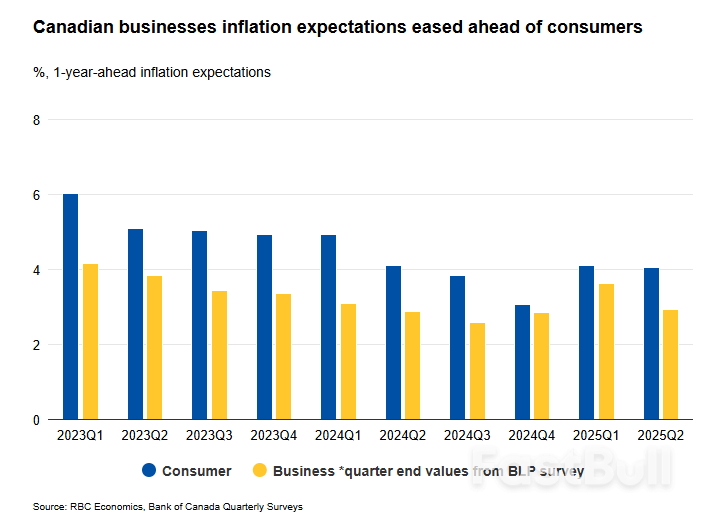
          One-year-ahead inflation expectations among businesses eased to below 3% in June, primarily reflecting anticipated disinflationary pressures from softer demand. However, recent CPI data showed contrary trends, with readings reflecting building pressures in domestic services components.
          Looking ahead, we maintain that the BoC faces an unusually high hurdle for considering additional rate cuts. The central bank must also account for increased government support, which is better suited to address concentrated weakness in trade-exposed sectors than the blunt tool of lower interest rates.
          Our base-case forecast continues to project that the BoC will maintain the overnight rate at current levels going forward.

          The details:

          In Q2, firms reported a net deterioration in future sales indicators compared with a year ago.This reflects businesses’ expectations of various factors, including generally weak consumer spending and housing activities, soft oil and gas activities stalled by low global oil prices, and a reversal of an export boom earlier this year that was primarily due to tariff front-running.
          Capacity issues remained on the backburner. The share of firms reporting challenges with meeting unexpected increases in demand was below the historical average in Q2. The share reporting labour shortages was near a record low.Given expectations of soft demand, reports of abundant capacity, and still-heightened trade uncertainty, most firms continued to either scale back or pause their investment plans in Q2. Hiring intentions were also subdued, although layoffs were less prevalent and mostly viewed as a last resort.
          Wage growth expectations have broadly continued to ease, although the same can’t be said about input prices, which were again expected to rise faster over the next 12 months.Businesses also reported difficulties passing on cost increases to consumers, citing weakness in demand as the main hurdle and margin compressions as a result.
          Near-term inflation expectations among businesses eased substantially in June to 2.9% from a recent peak of 3.7% in April. This still partly reflects soft demand expectations and the associated disinflationary effect rather than reduced trade uncertainty.In contrast, consumers’ near-term inflation expectations remained stubbornly high in Q2 at above 4%, as reported in the separate survey of consumer expectations.
          Longer-term business inflation expectations, including for 2 to 5 years ahead, remained somewhat well-anchored, mostly within the 2.5% – 3% range but were up slightly from a year ago.
          Canadian Businesses Reported Improved Outlooks in Q2_1

          Source:RBC

          To stay updated on all economic events of today, please check out our Economic calendar
          Risk Warnings and Disclaimers
          You understand and acknowledge that there is a high degree of risk involved in trading. Following any strategies or investment methods may lead to potential losses. The content on the site is provided by our contributors and analysts for information purposes only. You are solely responsible for determining whether any trading assets, securities, strategy, or any other product is suitable for investing based on your own investment objectives and financial situation.
          Add to Favorites
          Share

          Oil Edges Lower As Trade War Concerns Increase Worries About Fuel Demand

          Oliver Scott

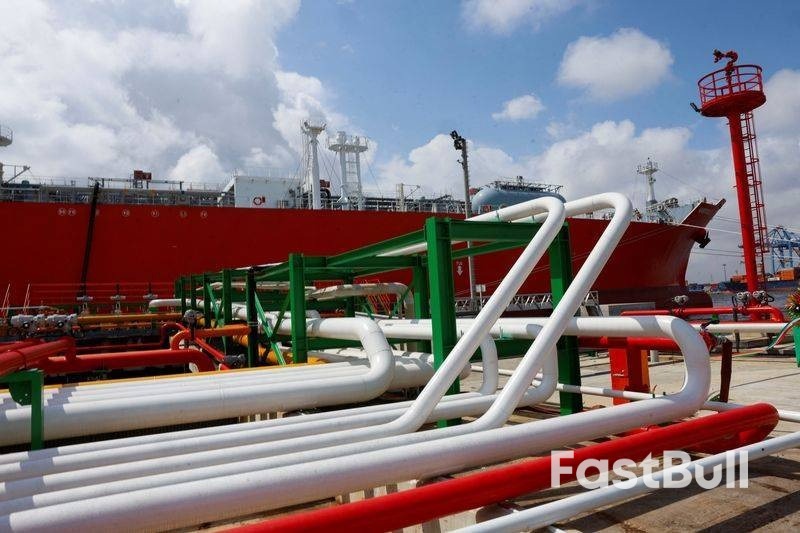
          Ivory Coast national oil company (PETROCI) inaugurates a new quay in Abidjan

          Oil prices edged down on Tuesday as concerns the brewing trade war between major crude consumers the U.S. and the European Union will curb fuel demand growth by lowering economic activity weighed on investor sentiment.

          Brent crude futures fell 24 cents, or 0.35%, to $68.97 a barrel by 0055 GMT after settling 0.1% lower on Monday.

          U.S. West Texas Intermediate crude was at $66.99 a barrel, down 21 cents, or 0.31%, following a 0.2% loss in the previous session.

          The August WTI contract expires on Tuesday and the more active September contract was down 23 cents, or 0.35%, to $65.72 a barrel.

          Still, the oil market has struggled to find any direction since the ceasefire on June 24 ending the conflict between Israel and Iran removed concerns about major supply disruptions in the key Middle East producing region.

          Since then, Brent has traded in a range of $5.19 and WTI in a range of $5.65 as supply concerns have been alleviated by major producers raising output and investors are increasingly worried about the global economy amid U.S. trade policy changes. However, a weaker U.S. dollar has provided some backing for crude as buyers using other currencies are paying relatively less.

          Prices have slipped "as trade war concerns offset the support by a softer (U.S. dollar)," IG market analyst Tony Sycamore wrote in a note.

          Sycamore also pointed to the possibility of an escalation in the trade dispute between the U.S. and the EU over tariffs.

          The EU is exploring a broader set of possible counter-measures against the United States as prospects for an acceptable trade agreement with Washington fade, according to EU diplomats. The U.S. has threatened to impose a 30% tariff on EU imports on August 1 if a deal is not reached.

          There are also signs rising supply has entered the market as the Organization of the Petroleum Exporting Countries and their allies unwind output cuts.

          Saudi Arabia's crude oil exports in May rose to their highest in three months, data from the Joint Organizations Data Initiative (JODI) showed on Monday.

          Source: Yahoo Finance

          Risk Warnings and Disclaimers
          You understand and acknowledge that there is a high degree of risk involved in trading. Following any strategies or investment methods may lead to potential losses. The content on the site is provided by our contributors and analysts for information purposes only. You are solely responsible for determining whether any trading assets, securities, strategy, or any other product is suitable for investing based on your own investment objectives and financial situation.
          Add to Favorites
          Share
          FastBull
          Copyright © 2025 FastBull Ltd

          728 RM B 7/F GEE LOK IND BLDG NO 34 HUNG TO RD KWUN TONG KLN HONG KONG

          TelegramInstagramTwitterfacebooklinkedin
          App Store Google Play Google Play
          Products
          Charts

          Chats

          Q&A with Experts
          Screeners
          Economic Calendar
          Data
          Tools
          Membership
          Features
          Function
          Markets
          Copy Trading
          Latest Signals
          Contests
          News
          Analysis
          24/7
          Columns
          Education
          Company
          Careers
          About Us
          Contact Us
          Advertising
          Help Center
          Feedback
          User Agreement
          Privacy Policy
          Business

          White Label

          Data API

          Web Plug-ins

          Poster Maker

          Affiliate Program

          Risk Disclosure

          The risk of loss in trading financial instruments such as stocks, FX, commodities, futures, bonds, ETFs and crypto can be substantial. You may sustain a total loss of the funds that you deposit with your broker. Therefore, you should carefully consider whether such trading is suitable for you in light of your circumstances and financial resources.

          No decision to invest should be made without thoroughly conducting due diligence by yourself or consulting with your financial advisors. Our web content might not suit you since we don't know your financial conditions and investment needs. Our financial information might have latency or contain inaccuracy, so you should be fully responsible for any of your trading and investment decisions. The company will not be responsible for your capital loss.

          Without getting permission from the website, you are not allowed to copy the website's graphics, texts, or trademarks. Intellectual property rights in the content or data incorporated into this website belong to its providers and exchange merchants.

          Not Logged In

          Log in to access more features

          FastBull Membership

          Not yet

          Purchase

          Become a signal provider
          Help Center
          Customer Service
          Dark Mode
          Price Up/Down Colors

          Log In

          Sign Up

          Position
          Layout
          Fullscreen
          Default to Chart
          The chart page opens by default when you visit fastbull.com