Markets
News
Analysis
User
24/7
Economic Calendar
Education
Data
- Names
- Latest
- Prev


Signal Accounts for Members
All Signal Accounts
All Contests


Japan Tankan Small Manufacturing Outlook Index (Q4)A:--
F: --
P: --
Japan Tankan Large Non-Manufacturing Outlook Index (Q4)A:--
F: --
P: --
Japan Tankan Large Manufacturing Outlook Index (Q4)A:--
F: --
P: --
Japan Tankan Small Manufacturing Diffusion Index (Q4)A:--
F: --
P: --
Japan Tankan Large Manufacturing Diffusion Index (Q4)A:--
F: --
P: --
Japan Tankan Large-Enterprise Capital Expenditure YoY (Q4)A:--
F: --
P: --
U.K. Rightmove House Price Index YoY (Dec)A:--
F: --
P: --
China, Mainland Industrial Output YoY (YTD) (Nov)A:--
F: --
P: --
China, Mainland Urban Area Unemployment Rate (Nov)A:--
F: --
P: --
Saudi Arabia CPI YoY (Nov)A:--
F: --
P: --
Euro Zone Industrial Output YoY (Oct)A:--
F: --
P: --
Euro Zone Industrial Output MoM (Oct)A:--
F: --
P: --
Canada Existing Home Sales MoM (Nov)A:--
F: --
P: --
Canada National Economic Confidence IndexA:--
F: --
P: --
Canada New Housing Starts (Nov)A:--
F: --
U.S. NY Fed Manufacturing Employment Index (Dec)A:--
F: --
P: --
U.S. NY Fed Manufacturing Index (Dec)A:--
F: --
P: --
Canada Core CPI YoY (Nov)A:--
F: --
P: --
Canada Manufacturing Unfilled Orders MoM (Oct)A:--
F: --
P: --
U.S. NY Fed Manufacturing Prices Received Index (Dec)A:--
F: --
P: --
U.S. NY Fed Manufacturing New Orders Index (Dec)A:--
F: --
P: --
Canada Manufacturing New Orders MoM (Oct)A:--
F: --
P: --
Canada Core CPI MoM (Nov)A:--
F: --
P: --
Canada Trimmed CPI YoY (SA) (Nov)A:--
F: --
P: --
Canada Manufacturing Inventory MoM (Oct)A:--
F: --
P: --
Canada CPI YoY (Nov)A:--
F: --
P: --
Canada CPI MoM (Nov)A:--
F: --
P: --
Canada CPI YoY (SA) (Nov)--
F: --
P: --
Canada Core CPI MoM (SA) (Nov)A:--
F: --
P: --
Canada CPI MoM (SA) (Nov)A:--
F: --
P: --
Federal Reserve Board Governor Milan delivered a speech
U.S. NAHB Housing Market Index (Dec)--
F: --
P: --
Australia Composite PMI Prelim (Dec)--
F: --
P: --
Australia Services PMI Prelim (Dec)--
F: --
P: --
Australia Manufacturing PMI Prelim (Dec)--
F: --
P: --
Japan Manufacturing PMI Prelim (SA) (Dec)--
F: --
P: --
U.K. 3-Month ILO Employment Change (Oct)--
F: --
P: --
U.K. Unemployment Claimant Count (Nov)--
F: --
P: --
U.K. Unemployment Rate (Nov)--
F: --
P: --
U.K. 3-Month ILO Unemployment Rate (Oct)--
F: --
P: --
U.K. Average Weekly Earnings (3-Month Average, Including Bonuses) YoY (Oct)--
F: --
P: --
U.K. Average Weekly Earnings (3-Month Average, Excluding Bonuses) YoY (Oct)--
F: --
P: --
France Services PMI Prelim (Dec)--
F: --
P: --
France Composite PMI Prelim (SA) (Dec)--
F: --
P: --
France Manufacturing PMI Prelim (Dec)--
F: --
P: --
Germany Services PMI Prelim (SA) (Dec)--
F: --
P: --


No matching data
Latest Views
Latest Views
Trending Topics
Top Columnists
Latest Update
White Label
Data API
Web Plug-ins
Affiliate Program
View All

No data
Japan's LDP to accelerate preparations for leadership election; French government collapse triggers debt crisis fears......
The usual suspect: Gold, A.K.A. The Bullion (or just “bully” for people who are caught short).Gold has always been a very complex asset. It does not have a face value yet it serves as store of value for many Central Banks. It cannot be eaten yet people always starve for it.And these days, it not-only is at the center of the 2025 Trump-Administration deglobalization theme but also a good edge against every potential catalyst against positive sentiment this year:
Rate cuts? Wars? Fiscal catastrophes? Political instability (France, Japan, US, UK, …)
Bonds haven’t seen much demand since the end of the 2022 hike cycle and stocks are at all-time highs, therefore the question is more one of currency-debasing rather than a purely risk-off Market.Metals had been stabilizing and correcting from their relative highs as war situations seemed to be resolving, central banks had cut their purchases and a signs of higher-than-projected inflation pushed the FOMC to hold their rates higher (typically negative for Gold as a non-yielding assets).However, Markets had calmed from their higher term overbought conditions. The latest change in Powell’s tone at Jackson Hole followed by an increasingly compromised FED Independence led to a massive rebound in metals, propulsed by both Gold and Silver.
Let’s attack a high to intraday timeframe analysis for Gold as it keeps breaking records, and identify levels of interest.Multi-timeframe analysis for Gold, starting from the Weekly to intraday
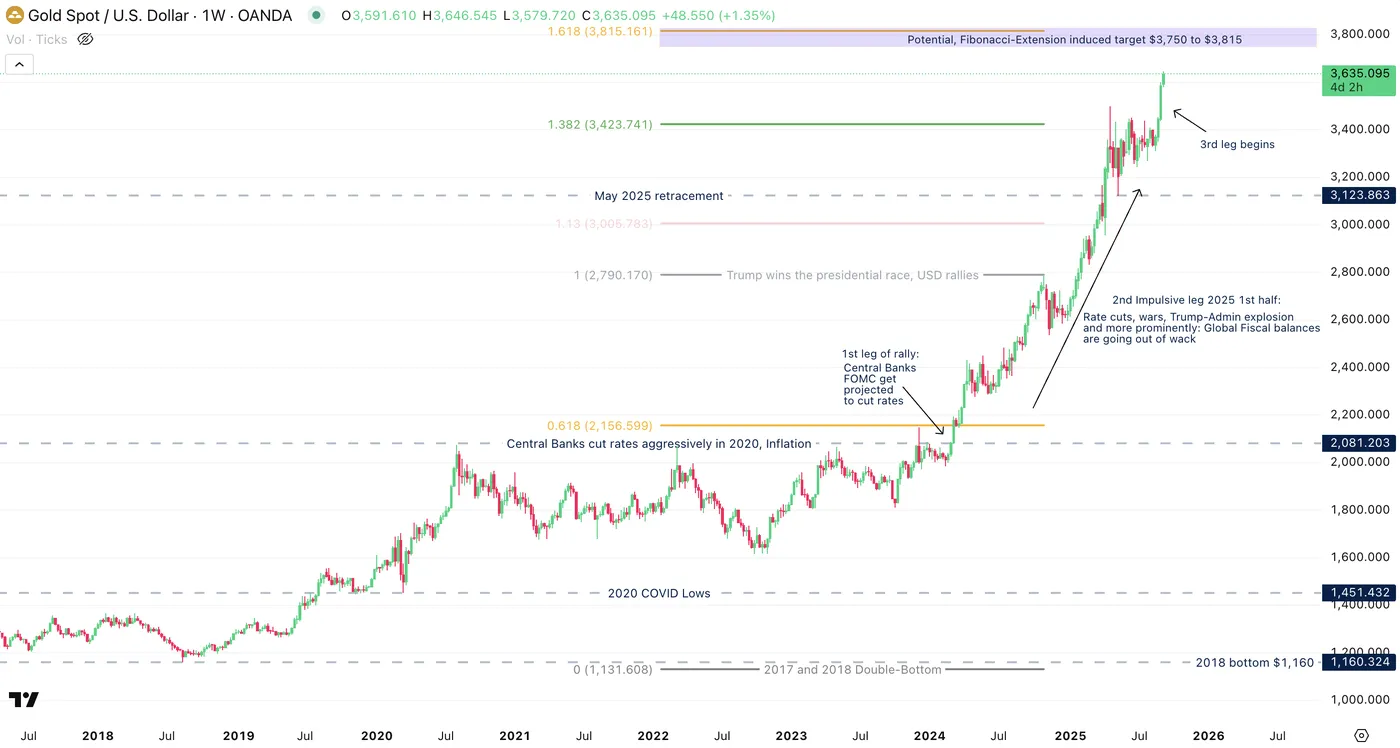
Gold Weekly timeframe
Taking a look back to the weekly charts really helps to see how significant this ongoing move in Gold is.Some key levels and their significant events point to what trends or themes helped Gold to rally so much and actually find its own local tops.The latest one, leading to a consolidation between May to end-August 2025 was due to uncertainty on the real impact of tariffs. They hadn’t seemed to hurt economies yet, particularly the US and conflicts were resolving at the same time (Israel-Iran, easing conflict in Eastern Europe… This one aged like fine milk).
The current move seems to form a typical 3 legged impulsive move with the 3rd one starting most recently. Elliott Wave analysis, which is very useful to evaluate trending markets, helps to check the state of a current trend and the usual 3rd impulsive tends to be the final one.
There’s an infinity of potential answers but some key changes of theme would be necessary: A more restrictive US balance sheet, forcing other governments to do the same; conflicts resolving, particularly the ongoing technology cold-war between the occident (G7) and the orient (Russia, China) or more simply a re-globalization; Finally, Central Banks Independence (i.e. the FOMC) being able to reborn.
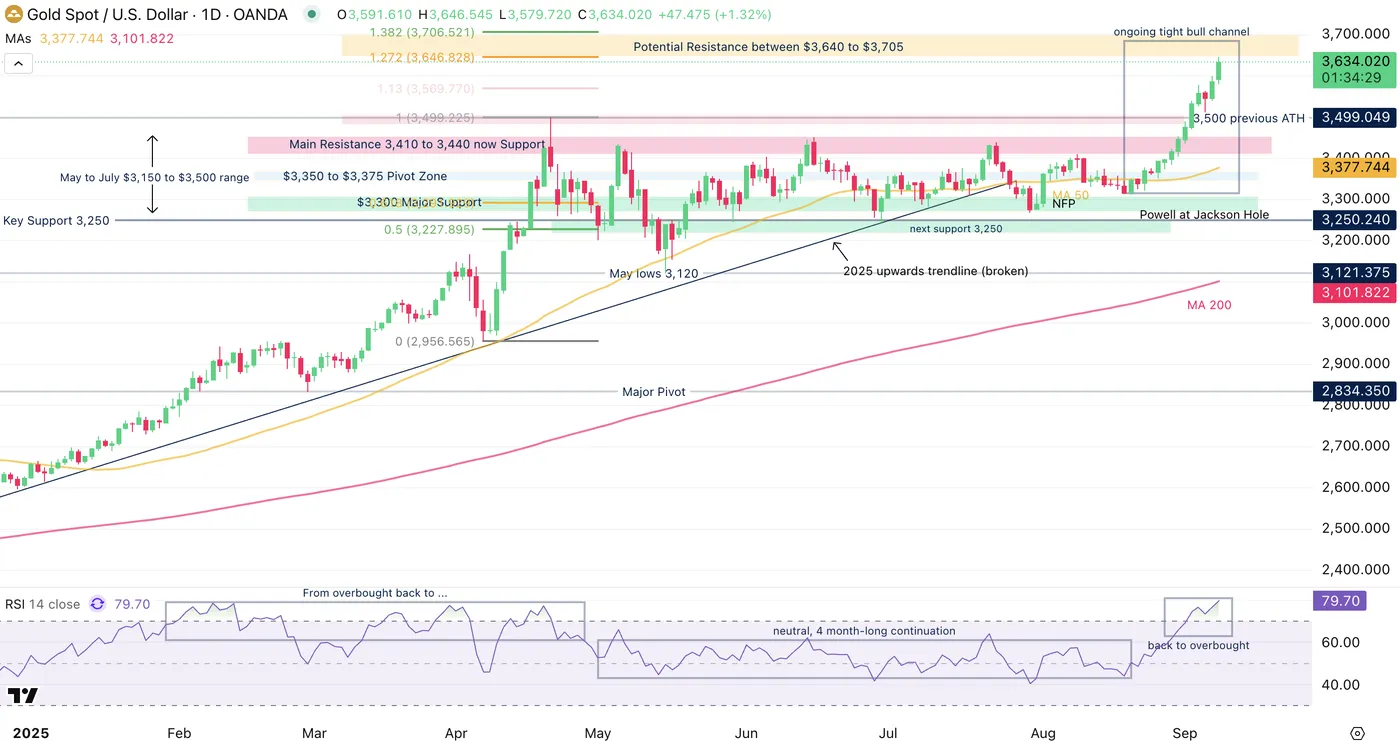
Gold Daily Chart
There is a lot to see on this daily chart but focus on these few elements:
The technical uptrend from October 2024 into the April 22nd 2025 $3,500 top in overbought conditions led to a 4-month consolidation which took the RSI back to neutral and now, the ongoing up-trend is heading back to overbought.Remember that overbought don’t mean a top, particularly in such strong trends: A tight bull channel (no red candle closing below the prior green) shows that the current price discovery is one of bullish dominance.
However, some wicks are appearing after today’s bull candle as the first Fibonacci-induced targets (Yellow Zone) is getting reached.The timing coincides with Markets needing to know if the FOMC cut will be a 25 bps (consolidation/slight selloff in Gold ceteris paribus) or a 50 bps (dovish FED = metals keep flying).
Levels of interest for Gold trading:
Support:
Resistance and potential technical targets (due to all-time highs, can only use potential targets):
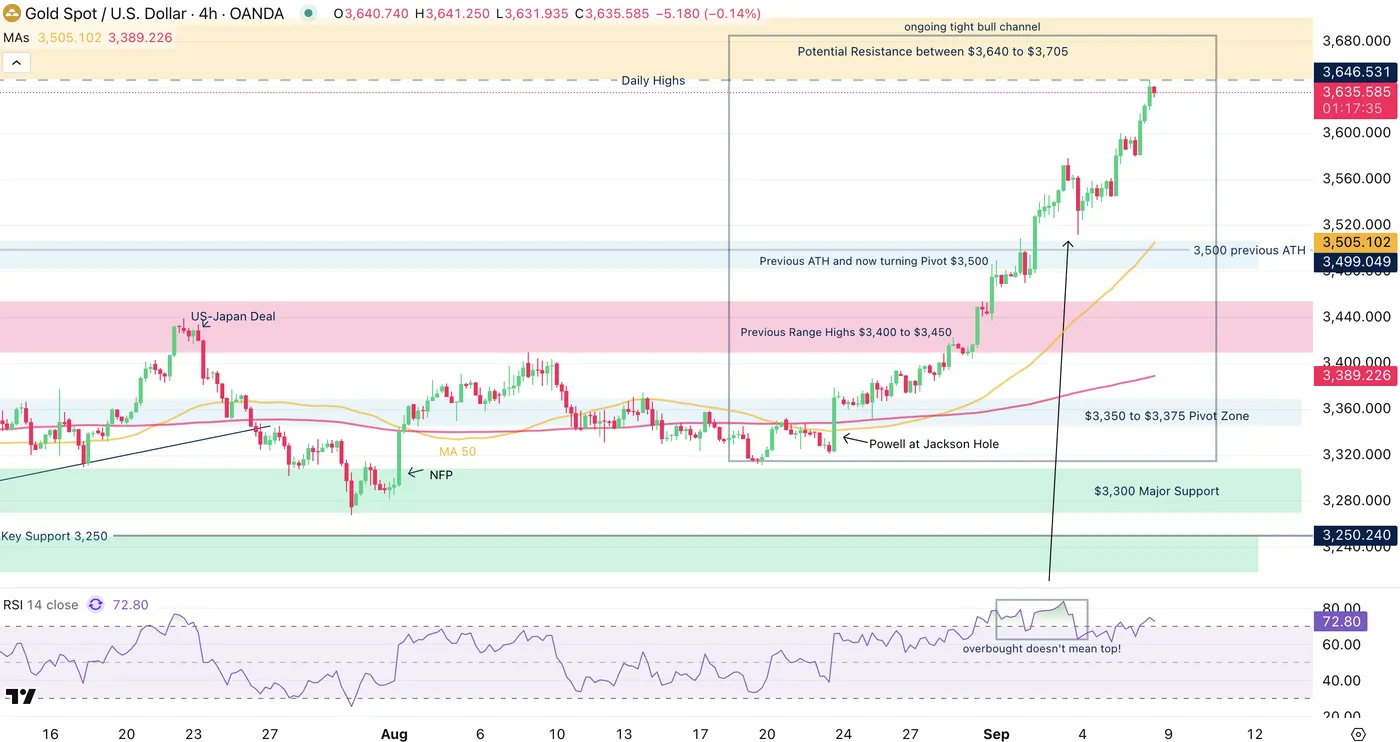
Gold 4H Chart
One highlight of this 4H intraday chart is to see how small reversals don’t imply bigger trend reversals. Generally, longer term reversals show signs of forming and (tend to) start with a slowdown in the trend, except for a fundamental black swan.
We are however reaching a potential fib-target, which may imply some slowing in the buying in the waiting of US Inflation data – Do consider that the tight bull channel is still active.
French President Emmanuel Macron will appoint a new prime minister within days, after the current premier lost a confidence vote in the lower house of parliament.Prime Minister Francois Bayrou is formally presenting his resignation to Macron on Tuesday. Whoever Macron picks as his successor will need to assemble a government and then find a way to pass a budget in a starkly splintered National Assembly, an exercise that’s toppled the last two prime ministers.
While Macron doesn’t lack for people who might accept the role, selecting someone who can find common ground among the groups is far from obvious.“Which party can one even recruit from?” Kathryn Kleppinger, George Washington University professor of French studies said in an interview on Bloomberg television. “I fear we’re going to be dealing with more of the same.”The new premier will be France’s fifth in less than two years, a reflection of the irreconcilable blocs in the country’s fractured political landscape.The Socialists were quick to propose their services following the vote. “I think it’s time for the left to again govern this country and break with the policies that have been implemented for the past eight years,” party leader Olivier Faure said on TF1 television, referring to Macron’s time in office.
At the same time, on France 2 television, outgoing interior minister Bruno Retailleau, who also heads the center-right Republicans, said he wouldn’t take part in a government led by a Socialist prime minister. Speaking on the same channel, far-left firebrand Jean-Luc Melenchon also said he would not support a government led by Faure.The current upheaval comes a year after Macron called an ill-fated snap election to consolidate centrist power in the face of a rising far right. Since then, France’s CAC 40 Index — home of bellwethers such as LVMH Moet Hennessy Louis Vuitton SE, Airbus SE and L’Oreal SA — has fallen 3.3%, compared with a 5.4% gain for the Stoxx Europe 600 Index and a 25% rise in Germany’s DAX Index, excluding dividends.
The spread between the yield of France’s 10-year government bond and Germany’s bund — a key measure of risk — was 76 basis points late Monday, down from 82 basis points in late August, shortly after Bayrou called the confidence vote.“Whichever outcome of the current political crisis, the probability of a significant public finances reform will remain low,” Michael Nizard, head of multi-asset and overlay at Edmond de Rothschild Asset Management, wrote in emailed comments. “So much so that financial markets themselves seem resigned and might settle for a scenario where the budget deficit does not deteriorate further.”
Bayrou had proposed €44 billion of spending cuts and tax hikes that would narrow France’s 2026 deficit to 4.6% of economic output from an expected 5.4% this year. He also floated an unpopular proposal to cut two public holidays as a way to reduce costs in Europe’s second-largest economy.France’s deficit is the widest in the euro area with debt rising by €5,000 ($5,840) a second, according to Bayrou. The cost to service its obligations is set to hit €75 billion next year, he has also said.
Marine Le Pen’s far-right National Rally as well as the leftist France Unbowed have both called for new legislative elections, something that Macron appears to have ruled out with his statement on naming a new prime minister. Some have also called for Macron’s resignation, but he has steadfastly said he will remain through the end of his term in 2027.“If there’s no dissolution, we will continue in a constructive but uncompromising spirit to promote the ideas that our voters have asked us to defend,” Le Pen said on Monday in a speech before the confidence vote. “But I say this solemnly: do not expect the National Rally to follow you in your fiscal and migratory craziness, in your petty ideological biases that prevent you from seeing the reality of the country.”
A union strike planned for Sept. 18 is putting pressure on Macron to have a new government in place by then. A separate, less centralized, protest is planned on Sept. 10.On Friday, Fitch Ratings is scheduled to update its assessment of France’s creditworthiness.The French president is solely responsible for picking a new premier, and there is no constitutional time limit for a decision. It took Macron two months to appoint the previous premier, Michel Barnier, who lasted only 90 days. Macron took more than a week to name Bayrou after Barnier was ousted. Once appointed, the premier must propose a cabinet to be signed off by Macron.
A humiliating election defeat is forcing Argentine President Javier Milei to face up to a series of political miscalculations — chief among them, his reliance on his beloved sister.The president’s libertarian party got just 34% of votes in Sunday’s local elections in Buenos Aires province, to 47% for Peronism, its main rival. While the area has long been a stronghold for the leftist party, Milei had anticipated a closer result.The rout showed the limitations of a campaign built on attacks on the previous government, which left office nearly two years ago. It also shocked investors since a similar drubbing in crucial mid-terms next month could sink Milei’s free-market revolution altogether.
One of his biggest challenges will be to rethink the role of Karina Milei, a top aide who the president describes as “el jefe”, or the boss of his government. Now she has become perhaps his biggest liability with a double responsibility for Sunday’s fiasco: firstly, by designing the electoral strategy that failed to persuade voters, and, secondly, by herself becoming embroiled in a graft scandal that exploded just two weeks ahead of the vote.Much of Milei’s popularity comes from his success in taming inflation and bringing some stability to the economy, so chaos in financial markets is an additional threat to his government. The official peso plunged as much as 7% when local markets opened, before paring some of those losses, while the nation’s dollar bonds posted the biggest declines in emerging markets.
In a contrite speech after his defeat, Milei said he won’t budge from his tough austerity and strong peso policies, but pledged a period of reflection and “deep self-critique” ahead of the October vote which will renew nearly half of Argentina’s congress. He didn’t elaborate, but any overhaul of his political strategy will inevitably involve his younger sibling.“Milei has to put on his adult pants and take charge of his government’s politics,” said Alejandro Catterberg, director of political consulting firm Poliarquia. “He has to lead the political decisions himself and break the delegation he has handed over to his sister.”
On Monday, Milei convened his top advisers to two separate meetings to discuss changes to his political messaging, according to two people familiar with his agenda. He isn’t planning to fire any cabinet ministers, according to two government officials close to Milei who asked not to be named since the conversations were private. So far, the government has only created a working group to address the crisis.The bribery allegations were particularly damaging since Milei had promised to clean up the corruption that has plagued the country. The government has denied wrongdoing, but hasn’t yet given a full account of Karina Milei’s behavior.
Last month, local media published leaked audio messages in which the head of the national disability agency, who has since been fired, described alleged kickbacks on pharmaceutical purchases benefiting Karina Milei. A judge later blocked audios of her from being released.Karina consolidated power after Milei became president, becoming his gatekeeper with control over his agenda even though she had no political experience. In recent months, she’s clashed with the president’s strategist, Santiago Caputo, who had sought alliances with centrist parties, and wanted to add members of his own communications team to the list of candidates.
Karina allied with the center-right PRO party of former president Mauricio Macri, but gave them little decision-making power, thereby losing access to their political machinery, while other centrists launched a third-way party. The government was disappointed by its failure to win over PRO supporters, according to a person familiar with the discussions.Spokesman Manuel Adorni said that the president will now preside over a political decision-making body that includes his sister and other cabinet members, indicating that there are no immediate plans to drop Karina from the administration.
Government officials blamed the loss on low turnout, which was below 63% among 14 million registered voters, as well as on their rivals’ success in using their party machinery to mobilize the own vote in their traditional strongholds. Analysts don’t expect these same conditions to be repeated in the nationwide vote in October, given higher participation in national elections.Annual inflation slowed to 37% in July, from a peak of nearly 300% last year. However, economic growth has stalled, and the jobless rate has risen. Industrial output shrank month-on-month for the fourth time this year in July, as Milei’s strong peso policy took a toll on manufacturers, who are especially concentrated in the province of Buenos Aires.
“When the economic situation is complicated, and on top of that there are alleged acts of corruption, that’s a deadly combination,” said Mariel Fornoni, from polling firm Management and Fit. “People won’t let that slide.”
British shoppers spent more in August, helped by summer weather and stronger demand for food, furniture and back-to-school computers - though some of the increase reflected higher food prices too, the British Retail Consortium said on Tuesday.
The BRC said spending at its members, mostly larger retail chains, increased by 3.1% in annual terms in August after a 2.5% rise in July.
On a like-for like basis - a measure which adjusts for changes in floorspace and is used by equity analysts - sales rose 3.1%, their fastest this year apart from a 7.0% jump in April due to the timing of Easter this year.
Food spending rose by 4.7% in August compared with a 1.8% increase for other goods.
"Stronger growth in food and drink was largely down to rising prices, which rose over 4% in August, rather than increasing volumes," BRC chief executive Helen Dickinson said.
Retailers were worried about consumer confidence and spending in the lead up to Christmas due to impact of the British government's budget, set to be delivered by finance minister Rachel Reeves on November 26, she added.
Consumer spending figures from Barclays - which cover a wider range of goods and services - showed spending growth slowed to 0.5% in August from 1.4% in July.
Spending on essentials dropped while discretionary spending increased by 2% - boosted in part by Netflix subscriptions to watch summer hit "KPop Demon Hunters", Barclays said.
Concerns about food prices in August rose after stronger-than-expected inflation data the month before, but consumers grew more confidence about Britain's economy after the Bank of England cut rates last month.
"However, the outlook for the rest of the year remains subdued, particularly as Budget speculation is likely to add to uncertainty for both households and businesses. In our view, it will take further interest rate cuts to provide the economy with a sustained boost," Jack Meaning, Barclays' chief UK economist, said.
The BoE last month reduced borrowing costs to 4% from 4.25% in a narrow 5-4 split vote and after a rare second round of voting. It is widely expected to hold rates on September 18.
Official data showed inflation hit an 18-month high of 3.8% in July. But retail sales jumped by much more than expected, partly due to the women's European soccer championship.
Australia’s consumer confidence declined in September as households worried about prospects for the economy and the broader labor market at a time of high-profile job cuts.
Sentiment retreated 3.1% to 95.4 points, a Westpac Banking Corp. survey showed Tuesday. Pessimists persist in outweighing optimists, and it has now been 43 months since Australian consumers last registered a sentiment reading above 100 – the second-longest period of continuous pessimism since the survey began in 1974, behind only the early 1990s recession.
“Outright optimism remains elusive for Australian consumers,” said Matthew Hassan, Westpac’s head of Australian macro forecasting. “Consumers look to have renewed concern about prospects for the economy” which appears to have “eaten away at confidence around jobs,” he said.
The result comes as ANZ Group Holdings Ltd. said it expects 3,500 employees to leave the bank in the next year and the Westpac–Melbourne Institute Unemployment Expectations Index climbing 4.6% in September, highlighting expectations that the jobless rate will rise. A strong labor market has been one of the pillars of the economy in the post-pandemic period.
Australia’s central bank has lowered borrowing costs by 75 basis points since the start of the year for a cash rate of 3.6%. Reserve Bank Governor Michele Bullock last month signaled a “couple more” cuts will be required to achieve the bank’s latest forecasts.
Figures this month showed Australia’s economic growth accelerated faster than expected in the second quarter, led largely by household consumption. Following the report, Bullock warned that a strong pick-up in consumer spending could slow the pace of monetary easing if it persists.
Economists see another rate reduction in November and a final one early next year, for a terminal rate of 3.1%.
Oil prices gained on Tuesday after OPEC+ decided to increase production by less than what market participants had anticipated, while concerns over tighter supply due to potential new sanctions on Russia continued to lend support.
Brent crude gained 22 cents, or 0.33%, to $66.24 a barrel by 0005 GMT, while U.S. West Texas Intermediate crude climbed 24 cents, or 0.39%, to $62.50 a barrel.
Eight members of the Organization of the Petroleum Exporting Countries and allies, collectively known as OPEC+, agreed on Sunday to raise production from October by 137,000 barrels per day. That is much lower than the monthly increases of about 555,000 bpd for September and August, and 411,000 bpd in July and June. It is also less than some analysts had expected.
The October move "marks the reversal of cuts that were set to remain in place until the end of 2026, following the rapid return of the previous tranche of idled barrels over recent months," said Daniel Hynes, senior commodity strategist at ANZ, in a client note on Tuesday.
Prices were also supported by speculation of more sanctions on Russia after the country's biggest air attack on Ukraine set fire to a government building in Kyiv. U.S. President Donald Trump said he was ready to move to a second phase of restrictions.
The European Union's top sanctions official was in Washington with a team of experts to discuss what would be the first coordinated transatlantic measures against Russia since Trump returned to office.
Further sanctions on Russia would diminish its oil supply to global markets, which could support higher oil prices.
The U.S. Federal Reserve's Federal Open Market Committee meets next week, and traders see an 89.4% chance of a quarter-point interest rate cut.
Lower rates reduce consumer borrowing costs and can boost economic growth and demand for oil.
White Label
Data API
Web Plug-ins
Poster Maker
Affiliate Program
The risk of loss in trading financial instruments such as stocks, FX, commodities, futures, bonds, ETFs and crypto can be substantial. You may sustain a total loss of the funds that you deposit with your broker. Therefore, you should carefully consider whether such trading is suitable for you in light of your circumstances and financial resources.
No decision to invest should be made without thoroughly conducting due diligence by yourself or consulting with your financial advisors. Our web content might not suit you since we don't know your financial conditions and investment needs. Our financial information might have latency or contain inaccuracy, so you should be fully responsible for any of your trading and investment decisions. The company will not be responsible for your capital loss.
Without getting permission from the website, you are not allowed to copy the website's graphics, texts, or trademarks. Intellectual property rights in the content or data incorporated into this website belong to its providers and exchange merchants.
Not Logged In
Log in to access more features

FastBull Membership
Not yet
Purchase
Log In
Sign Up