• Trade
  • Markets
  • Copy
  • Contests
  • News
  • 24/7
  • Calendar
  • Q&A
  • Chats
Trending
Screeners
SYMBOL
LAST
BID
ASK
HIGH
LOW
NET CHG.
%CHG.
SPREAD
SPX
S&P 500 Index
6857.13
6857.13
6857.13
6865.94
6827.13
+7.41
+ 0.11%
--
DJI
Dow Jones Industrial Average
47850.93
47850.93
47850.93
48049.72
47692.96
-31.96
-0.07%
--
IXIC
NASDAQ Composite Index
23505.13
23505.13
23505.13
23528.53
23372.33
+51.04
+ 0.22%
--
USDX
US Dollar Index
98.890
98.970
98.890
98.980
98.890
-0.090
-0.09%
--
EURUSD
Euro / US Dollar
1.16538
1.16545
1.16538
1.16555
1.16408
+0.00093
+ 0.08%
--
GBPUSD
Pound Sterling / US Dollar
1.33389
1.33399
1.33389
1.33391
1.33165
+0.00118
+ 0.09%
--
XAUUSD
Gold / US Dollar
4216.26
4216.71
4216.26
4218.25
4194.54
+9.09
+ 0.22%
--
WTI
Light Sweet Crude Oil
59.269
59.306
59.269
59.469
59.187
-0.114
-0.19%
--

Community Accounts

Signal Accounts
--
Profit Accounts
--
Loss Accounts
--
View More

Become a signal provider

Sell trading signals to earn additional income

View More

Guide to Copy Trading

Get started with ease and confidence

View More

Signal Accounts for Members

All Signal Accounts

Best Return
  • Best Return
  • Best P/L
  • Best MDD
Past 1W
  • Past 1W
  • Past 1M
  • Past 1Y

All Contests

  • All
  • Trump Updates
  • Recommend
  • Stocks
  • Cryptocurrencies
  • Central Banks
  • Featured News
Top News Only
Share

India's NIFTY IT Index Last Up 1.3%

Share

India's Nifty 50 Index Rises 0.35%

Share

Israel Sets 2026 Defence Budget At $34 Billion

Share

Russia Says Azov Sea's Port Of Temryuk Damaged In Ukrainian Attack

Share

Israel's Defense Budget For 2026 Will Be 112 Billion Israeli Shekels - Defense Minister Office

Share

One India Rate Panel Member Ram Singh Was Of View That Stance Should Be Changed To 'Accommodative' From 'Neutral' - Monetary Policy Committee Statement

Share

Reserve Bank Of India Chief: Will Continue To Meet Productive Needs Of Economy In Proactive Manner

Share

Reserve Bank Of India Chief: System Level Financial Parameters Of Nbfcs Sound

Share

Reserve Bank Of India Chief: Dollar Rupee Swap To Be For 3 Years, To Be Conducted This Month

Share

India's Nifty Realty Index Extend Gains, Last Up 1.4%

Share

India's Nifty Psu Bank Index Rises 1%

Share

Reserve Bank Of India Chief: Commited To Providing Sufficient Durable Liquidity

Share

Reserve Bank Of India Chief: Transmission Has Been Broad Based Across Sectors, Satisfactory

Share

Reserve Bank Of India Chief: As Of Nov 28, India's Forex Reserves Stood At $686 Billion

Share

Reserve Bank Of India Chief: Healthy Services Exports With Strong Remittances To Keep Cad Modest In This Year

Share

Reserve Bank Of India Chief: CPI Inflation Seen At 0.6% In Q3 Fy26

Share

Reserve Bank Of India Chief: Fy26 CPI Inflation Seen At 2% Versus 2.6% Previously

Share

India's Nifty Realty Index Up 1% After Reserve Bank Of India's Rate Cut

Share

India's Nifty Psu Bank Index Turns Positive, Up 0.43% After Reserve Bank Of India's Rate Cut

Share

Reserve Bank Of India Chief: Merchandise Exports Face Some Headwinds

TIME
ACT
FCST
PREV
Turkey Trade Balance

A:--

F: --

P: --

Germany Construction PMI (SA) (Nov)

A:--

F: --

P: --

Euro Zone IHS Markit Construction PMI (Nov)

A:--

F: --

P: --

Italy IHS Markit Construction PMI (Nov)

A:--

F: --

P: --

U.K. Markit/CIPS Construction PMI (Nov)

A:--

F: --

P: --

France 10-Year OAT Auction Avg. Yield

A:--

F: --

P: --

Euro Zone Retail Sales MoM (Oct)

A:--

F: --

P: --

Euro Zone Retail Sales YoY (Oct)

A:--

F: --

P: --

Brazil GDP YoY (Q3)

A:--

F: --

P: --

U.S. Challenger Job Cuts (Nov)

A:--

F: --

P: --

U.S. Challenger Job Cuts MoM (Nov)

A:--

F: --

P: --

U.S. Challenger Job Cuts YoY (Nov)

A:--

F: --

P: --

U.S. Initial Jobless Claims 4-Week Avg. (SA)

A:--

F: --

P: --

U.S. Weekly Initial Jobless Claims (SA)

A:--

F: --

P: --

U.S. Weekly Continued Jobless Claims (SA)

A:--

F: --

P: --

Canada Ivey PMI (SA) (Nov)

A:--

F: --

P: --

Canada Ivey PMI (Not SA) (Nov)

A:--

F: --

P: --

U.S. Non-Defense Capital Durable Goods Orders Revised MoM (Excl. Aircraft) (SA) (Sept)

A:--

F: --

P: --
U.S. Factory Orders MoM (Excl. Transport) (Sept)

A:--

F: --

P: --

U.S. Factory Orders MoM (Sept)

A:--

F: --

P: --

U.S. Factory Orders MoM (Excl. Defense) (Sept)

A:--

F: --

P: --

U.S. EIA Weekly Natural Gas Stocks Change

A:--

F: --

P: --

Saudi Arabia Crude Oil Production

A:--

F: --

P: --

U.S. Weekly Treasuries Held by Foreign Central Banks

A:--

F: --

P: --

Japan Foreign Exchange Reserves (Nov)

A:--

F: --

P: --

India Repo Rate

A:--

F: --

P: --

India Benchmark Interest Rate

A:--

F: --

P: --

India Reverse Repo Rate

A:--

F: --

P: --

India Cash Reserve Ratio

A:--

F: --

P: --

Japan Leading Indicators Prelim (Oct)

A:--

F: --

P: --

U.K. Halifax House Price Index YoY (SA) (Nov)

--

F: --

P: --

U.K. Halifax House Price Index MoM (SA) (Nov)

--

F: --

P: --

France Current Account (Not SA) (Oct)

--

F: --

P: --

France Trade Balance (SA) (Oct)

--

F: --

P: --

France Industrial Output MoM (SA) (Oct)

--

F: --

P: --

Italy Retail Sales MoM (SA) (Oct)

--

F: --

P: --

Euro Zone Employment YoY (SA) (Q3)

--

F: --

P: --

Euro Zone GDP Final YoY (Q3)

--

F: --

P: --

Euro Zone GDP Final QoQ (Q3)

--

F: --

P: --

Euro Zone Employment Final QoQ (SA) (Q3)

--

F: --

P: --

Euro Zone Employment Final (SA) (Q3)

--

F: --

P: --
Brazil PPI MoM (Oct)

--

F: --

P: --

Mexico Consumer Confidence Index (Nov)

--

F: --

P: --

Canada Unemployment Rate (SA) (Nov)

--

F: --

P: --

Canada Labor Force Participation Rate (SA) (Nov)

--

F: --

P: --

Canada Employment (SA) (Nov)

--

F: --

P: --

Canada Part-Time Employment (SA) (Nov)

--

F: --

P: --

Canada Full-time Employment (SA) (Nov)

--

F: --

P: --

U.S. Dallas Fed PCE Price Index YoY (Sept)

--

F: --

P: --

U.S. PCE Price Index YoY (SA) (Sept)

--

F: --

P: --

U.S. PCE Price Index MoM (Sept)

--

F: --

P: --

U.S. Personal Outlays MoM (SA) (Sept)

--

F: --

P: --

U.S. Core PCE Price Index MoM (Sept)

--

F: --

P: --

U.S. UMich 5-Year-Ahead Inflation Expectations Prelim YoY (Dec)

--

F: --

P: --

U.S. Core PCE Price Index YoY (Sept)

--

F: --

P: --

U.S. 5-10 Year-Ahead Inflation Expectations (Dec)

--

F: --

P: --

U.S. UMich Current Economic Conditions Index Prelim (Dec)

--

F: --

P: --

U.S. UMich Consumer Sentiment Index Prelim (Dec)

--

F: --

P: --

U.S. UMich 1-Year-Ahead Inflation Expectations Prelim (Dec)

--

F: --

P: --

U.S. UMich Consumer Expectations Index Prelim (Dec)

--

F: --

P: --

Q&A with Experts
    • All
    • Chatrooms
    • Groups
    • Friends
    Connecting
    .
    .
    .
    Type here...
    Add Symbol or Code

      No matching data

      All
      Trump Updates
      Recommend
      Stocks
      Cryptocurrencies
      Central Banks
      Featured News
      • All
      • Russia-Ukraine Conflict
      • Middle East Flashpoint
      • All
      • Russia-Ukraine Conflict
      • Middle East Flashpoint
      Search
      Products

      Charts Free Forever

      Chats Q&A with Experts
      Screeners Economic Calendar Data Tools
      Membership Features
      Data Warehouse Market Trends Institutional Data Policy Rates Macro

      Market Trends

      Market Sentiment Order Book Forex Correlations

      Top Indicators

      Charts Free Forever
      Markets

      News

      News Analysis 24/7 Columns Education
      From Institutions From Analysts
      Topics Columnists

      Latest Views

      Latest Views

      Trending Topics

      Top Columnists

      Latest Update

      Signals

      Copy Rankings Latest Signals Become a signal provider AI Rating
      Contests
      Brokers

      Overview Brokers Assessment Rankings Regulators News Claims
      Broker listing Forex Brokers Comparison Tool Live Spread Comparison Scam
      Q&A Complaint Scam Alert Videos Tips to Detect Scam
      More

      Business
      Events
      Careers About Us Advertising Help Center

      White Label

      Data API

      Web Plug-ins

      Affiliate Program

      Awards Institution Evaluation IB Seminar Salon Event Exhibition
      Vietnam Thailand Singapore Dubai
      Fans Party Investment Sharing Session
      FastBull Summit BrokersView Expo
      Recent Searches
        Top Searches
          Markets
          News
          Analysis
          User
          24/7
          Economic Calendar
          Education
          Data
          • Names
          • Latest
          • Prev

          View All

          No data

          Scan to Download

          Faster Charts, Chat Faster!

          Download App
          English
          • English
          • Español
          • العربية
          • Bahasa Indonesia
          • Bahasa Melayu
          • Tiếng Việt
          • ภาษาไทย
          • Français
          • Italiano
          • Türkçe
          • Русский язык
          • 简中
          • 繁中
          Open Account
          Search
          Products
          Charts Free Forever
          Markets
          News
          Signals

          Copy Rankings Latest Signals Become a signal provider AI Rating
          Contests
          Brokers

          Overview Brokers Assessment Rankings Regulators News Claims
          Broker listing Forex Brokers Comparison Tool Live Spread Comparison Scam
          Q&A Complaint Scam Alert Videos Tips to Detect Scam
          More

          Business
          Events
          Careers About Us Advertising Help Center

          White Label

          Data API

          Web Plug-ins

          Affiliate Program

          Awards Institution Evaluation IB Seminar Salon Event Exhibition
          Vietnam Thailand Singapore Dubai
          Fans Party Investment Sharing Session
          FastBull Summit BrokersView Expo

          XRP Q4 2025 Price Prediction: Can Ripple End the Year Bullish?

          Damon

          Cryptocurrency

          Summary:

          Discover the latest XRP Q4 2025 price prediction with expert insights on Ripple’s market outlook, key catalysts, and potential price targets as 2025 draws to a close.

          XRP Q4 2025 Price Prediction —How High Could XRP Go

          As 2025 nears its final quarter, investors are closely watching Ripple’s performance and the broader crypto recovery. The xrp q4 2025 price prediction focuses on whether XRP can sustain momentum amid shifting market conditions, regulatory clarity, and institutional demand, revealing if Ripple might end the year on a bullish note.

          XRP Price Performance in Q1 to Q3 in 2025

          Price Trend Overview in the First Three Quarters of 2025

          Before diving into the xrp q4 2025 price prediction, it’s essential to review XRP’s journey throughout the year. Ripple’s native token maintained steady growth across the first three quarters of 2025, benefiting from renewed optimism in the broader crypto market and increased institutional interest following regulatory progress. The token’s price gradually strengthened as investor confidence improved alongside Bitcoin’s post-halving momentum.

          QuarterAverage Price (USD)Quarterly ChangeKey Market Drivers
          Q1 2025$0.78+12%Post-SEC clarity and renewed exchange listings
          Q2 2025$0.96+23%Institutional inflows and cross-border adoption
          Q3 2025$1.12+17%Strong remittance demand and stable crypto sentiment

          Major Events That Influenced XRP’s Price

          Several pivotal events shaped XRP’s trajectory during the first three quarters of 2025. The U.S. Securities and Exchange Commission (SEC) finalized its settlement terms with Ripple early in the year, opening the door for wider institutional participation. Additionally, Ripple expanded its partnerships across Latin America and Southeast Asia, strengthening remittance networks. The integration of XRP into central bank digital currency (CBDC) pilot programs further supported global visibility and demand.

          • ✔️ Ripple–SEC resolution restored market confidence.
          • 🌍 Global banking partnerships boosted real-world utility.
          • 💹 Increased payment volume via RippleNet improved liquidity metrics.

          Key Technical Indicators Review (Support, Resistance, and Volume Trends)

          XRP’s price behavior in 2025 displayed healthy technical patterns. The asset consistently held above the key support zone of $0.70–$0.75 throughout Q1, later establishing new resistance near $1.10 by Q3. Trading volume rose steadily, indicating sustained accumulation by retail and institutional traders. RSI levels remained within a neutral range (45–60), suggesting a gradual bullish structure without overheating.

          The consolidation between support and resistance points implies a stable base formation, giving analysts confidence that Q4 could see a breakout if macro sentiment remains positive. Increased liquidity and positive on-chain signals both set the stage for the next leg of upward movement.

          Key Catalysts That Will Drive XRP’s Q4 2025 Price

          As investors anticipate the final quarter of the year, attention turns to the forces that could determine XRP’s trajectory. The market’s performance in Q4 will likely depend on a combination of macroeconomic trends, Ripple’s institutional integrations, and regulatory follow-through. Below are the key catalysts expected to shape price action heading into the final months of 2025.

          XRP Q4 2025 Price Prediction

          Bullish Case Prediction (Upper Target)

          In an optimistic scenario, strong global adoption and renewed institutional interest could propel Ripple’s token higher. If regulatory clarity continues and remittance volumes expand across RippleNet partners, XRP could test an upper range between $2.00 and $2.40 by late Q4. A decisive break above resistance levels near $1.80 would signal bullish momentum, potentially attracting speculative inflows similar to Bitcoin’s post-halving rallies.

          Analysts tracking xrp q4 2025 price prediction suggest that sustained on-chain volume growth and utility-driven demand could reinforce this target, especially if major banks integrate Ripple’s liquidity hub by year-end.

          Base Case Prediction (Most Likely Target)

          Under a balanced market scenario, Ripple maintains steady growth while crypto sentiment remains neutral. XRP may consolidate between $1.30 and $1.60, reflecting moderate investor confidence and stable regulatory footing. The base case assumes continued usage for cross-border payments but limited speculative surges. This level also aligns with historical resistance zones from 2021–2023, suggesting fair valuation without bubble dynamics.

          Price stability in this range supports long-term sustainability, appealing to investors prioritizing utility and compliance over short-term hype.

          Bearish Case Prediction (Lower Target)

          If macroeconomic pressures intensify or risk assets face a broad pullback, XRP could retrace to $0.85–$1.00. A bearish outcome may stem from delays in exchange adoption, renewed legal uncertainty, or lower liquidity across decentralized platforms. Should global crypto volumes contract significantly, Ripple’s ecosystem growth might slow, pressuring XRP to revisit earlier 2025 support levels.

          For risk-averse traders, maintaining a diversified portfolio remains key during any downturn, especially while monitoring technical support around the $0.80 level.

          Expert and AI-Based Predictions for Q4 2025

          Multiple forecasting models provide varying outcomes for xrp q4 2025 price prediction based on on-chain data, sentiment indices, and historical correlations. AI-driven tools such as ChatGPT and CoinCodex’s predictive models indicate average estimates near $1.75 by December 2025, aligning closely with institutional projections.

          SourcePredicted Price (Q4 2025)Outlook
          CoinCodex$1.68Moderately bullish
          ChatGPT AI Model$1.75Stable with gradual upside
          WalletInvestor$2.15High volatility, strong rebound potential
          DigitalCoinPrice$1.42Neutral, slow growth outlook

          The convergence of forecasts suggests moderate optimism for XRP heading into 2026, contingent on broader market sentiment and macroeconomic stability.

          FAQs about XRP Q4 2025 Price Prediction

          1. Will XRP ever reach $100?

          Realistically, reaching $100 would require XRP’s market capitalization to exceed the entire crypto market’s current value—an unlikely event in the short to medium term. Analysts agree that while long-term adoption could support growth, a $100 valuation remains speculative beyond 2030.

          2. Will XRP hit $20?

          Hitting $20 would likely demand institutional-level adoption on a global scale and a major expansion of RippleNet’s transaction volumes. Current data suggests such a target is possible only in an extreme bull cycle, not within the 2025 time frame of this xrp q4 2025 price prediction.

          3. Will Ripple XRP reach $10?

          A $10 target, while ambitious, could occur over multiple market cycles if Ripple’s utility-driven adoption continues and crypto market capitalization expands significantly. For 2025, however, most credible projections cap the upper limit around $2.50 under optimal bullish conditions.

          Conclusion

          The xrp q4 2025 price prediction highlights a cautiously optimistic outlook for Ripple. While bullish momentum could lift prices toward $2, sustained growth will depend on regulatory clarity, institutional adoption, and market sentiment. For long-term investors, XRP remains a promising yet volatile asset best approached with disciplined risk management.

          Risk Warnings and Disclaimers
          You understand and acknowledge that there is a high degree of risk involved in trading. Following any strategies or investment methods may lead to potential losses. The content on the site is provided by our contributors and analysts for information purposes only. You are solely responsible for determining whether any trading assets, securities, strategy, or any other product is suitable for investing based on your own investment objectives and financial situation.
          Add to Favorites
          Share

          How to Sell Pi Coin in 2025: Step-by-Step Guide for Beginners

          Samantha Luan

          Cryptocurrency

          How to Sell Pi Coin and Exchange It for Real Money or USDT

          Wondering how to sell Pi Coin in 2025? As Pi Network transitions toward its open mainnet, many holders are eager to turn mined Pi into real money. This guide explains the current status, what you must do before selling, and the safest ways to trade or withdraw your Pi coins for cash or USDT.

          Can You Sell Pi Coin TODAY?

          The Current Reality: Pi's "Enclosed Mainnet" Explained

          Before you learn how to sell Pi Coin, it’s important to understand that Pi Network is still operating under an “enclosed mainnet” phase. This means coins cannot yet be freely transferred or traded on major exchanges such as Binance or Coinbase. While internal apps and Pi ecosystem projects allow limited transactions, open exchange listings remain pending until regulatory and technical conditions are fully met. For users wondering how to sell Pi Coin in the US or globally, official access will only begin once Pi’s open mainnet is live.

          Red Flag Alerts: Top 3 “Sell Pi Now” Scams to Avoid

          With the growing interest in how to sell my Pi Coin, many fake platforms and social media schemes have appeared—especially those promising instant withdrawals. Stay alert to these red flags:

          • “Instant Pi Sale” websites asking for wallet keys or private information.
          • Telegram or Reddit groups offering P2P Pi trades without escrow protection.
          • Apps claiming to connect your wallet to “pre-listed” Pi markets before official launch.

          Always verify with official Pi Network channels and avoid any service that demands payment upfront or your credentials. On platforms like how to sell Pi Coin Reddit threads, many users report losing access to their coins through such scams.

          Is Immediate Selling Advisable?

          Technically, you can’t yet sell Pi coins on open markets. However, understanding how to sell Pi Coins when the mainnet opens will help you prepare. Holding your Pi in a verified mainnet wallet ensures eligibility once Pi is listed. Early “unofficial” sales through P2P groups remain risky—especially if you’re exploring how to sell Pi Coin 2024 methods. It’s wiser to wait for the legitimate launch rather than jeopardize your holdings.

          What You MUST Do Before Selling Pi

          Complete KYC Verification in the Pi App

          Before attempting how to sell Pi Coin, every user must pass Pi Network’s Know Your Customer (KYC) verification. This process ensures compliance with global regulations and prevents fraudulent transactions. Verification can be completed directly through the Pi Browser app using government-issued identification and face recognition. Without KYC approval, you cannot migrate tokens or withdraw assets—even if you know how to sell your Pi coins later.

          Migrate Tokens to the Official Pi Mainnet Wallet

          Once KYC is approved, your next step is to migrate tokens to the official Pi mainnet wallet. This confirms your Pi holdings are real and recorded on the blockchain. Testnet Pi coins cannot be sold or transferred. Users asking how to sell my Pi Coin or how to sell Pi Coin in the US need to ensure their tokens have completed this migration. Keep your seed phrase private to protect your holdings.

          Check Transfer Eligibility and Wallet Balance

          Only verified mainnet users can transfer Pi. Within the Pi Wallet, check the “Transfer Eligibility” tab to confirm if your coins are unlocked and transferable. Knowing your wallet’s available balance helps avoid failed transactions once you explore how to sell Pi coins through official exchanges or peer-to-peer options.

          Prepare a Secure Exchange Account (BitMart, HTX, etc.)

          After migration, set up an account with a trusted exchange such as BitMart, HTX, or PiBridge. Although how to sell Pi Coin on Binance isn’t possible yet, having an exchange account ready will streamline your first trade once listings go live. Enable two-factor authentication (2FA) and email verification for enhanced security before linking your wallet.

          Verify Exchange Reputation and Fees

          When preparing for how to sell Pi Coin 2024 or beyond, always research each platform’s reputation, liquidity, and withdrawal fees. Choose exchanges with transparent pricing, high daily volume, and strong user protection. Community sources like how to sell Pi Coin Reddit threads can provide useful feedback on trading safety and withdrawal times, but verify all information through official channels before committing.

          Step-by-Step Guide — How to Sell Pi Coin in 2025

          Step 1. Move Your Pi to a Verified Mainnet Wallet

          Before you begin how to sell Pi Coin, make sure your tokens are migrated to a verified mainnet wallet. Only mainnet coins are eligible for trading or transfers. Testnet or “app-only” balances cannot be exchanged. To ensure smooth transactions, always back up your wallet’s seed phrase and confirm that your Pi is unlocked for transfer. This is the first requirement whether you’re in Asia, Europe, or learning how to sell Pi Coin in the US.

          Step 2. Choose a Reliable Exchange or Platform

          Not all exchanges currently support Pi trading. For those exploring how to sell Pi Coins, early trading may be available on smaller platforms such as BitMart, PiBridge, or HTX once listings become official. Avoid unauthorized apps that promise “instant Pi sales.” Binance has not yet listed Pi, so queries like how to sell Pi Coin on Binance currently have no legitimate solution.

          PlatformTrading PairApprox. FeeWithdrawal Options
          BitMartPI/USDT0.25%Crypto or Bank Transfer
          PiBridgePI/BUSD0.30%Crypto Only

          Step 3. Select a Pi/USDT or Pi/USD Trading Pair

          Once your account is set up, choose a stable trading pair—such as PI/USDT or PI/USD. This allows you to easily convert Pi into stable assets that can later be withdrawn or reinvested. When researching how to sell your Pi coins, check the liquidity and 24-hour volume to avoid slippage during execution.

          Step 4. Execute the Trade and Confirm Transaction

          To sell your Pi, enter the desired amount and confirm the order on your exchange dashboard. For beginners searching how to sell my Pi Coin, start with small test trades to understand fee structures and settlement times. Once executed, verify your transaction in the order history or blockchain explorer before proceeding with withdrawals.

          Step 5. Withdraw Funds to Your Bank or Crypto Wallet

          After selling, convert your USDT or USD balance to your preferred withdrawal method. For users studying how to sell Pi Coin 2024 or preparing for future trades, withdrawals can be made via:

          • 💳 Bank transfer to supported countries
          • 🏦 On-chain withdrawal to a verified crypto wallet
          • 🔄 P2P (peer-to-peer) transfer for direct crypto swaps

          Always double-check withdrawal addresses and fees. If unsure, seek guidance on how to sell Pi Coin Reddit threads but confirm advice with official Pi sources.

          Common Mistakes to Avoid When Selling Pi Coin

          • ❌ Using unverified “pre-listing” apps that claim instant liquidity.
          • ❌ Forgetting to complete KYC or mainnet migration before trading.
          • ❌ Sharing wallet keys with third-party “buyers.”
          • ❌ Ignoring transaction fees and network delays when selling large volumes.

          Whether you’re figuring out how to sell my Pi Coins or planning a first withdrawal, patience and verification are crucial. Selling Pi safely is better than selling it fast.

          Alternative Methods: Peer-to-Peer (P2P) Trading

          How P2P Pi Coin Transactions Work

          While official exchanges are still limited, some users explore how to sell Pi Coin through peer-to-peer (P2P) transactions. In this setup, you directly sell your Pi to another user instead of a centralized platform. Payments are often made in USDT, local currency, or goods and services. This method appeals to users researching how to sell Pi Coin in the US or regions where exchange access remains restricted.

          Here’s how it generally works:

          • 🔹 Seller and buyer agree on price and payment method.
          • 🔹 The Pi transfer occurs through the Pi Wallet once payment is confirmed.
          • 🔹 Both parties verify transaction details and complete settlement.

          Although flexible, this approach requires trust and careful verification, as disputes can’t always be reversed on blockchain once executed.

          Best P2P Platforms for Pi Trading (PiBridge, PiChainMall)

          Two popular community-backed solutions—PiBridge and PiChainMall—enable limited trading and internal value exchange. Users exploring how to sell my Pi Coin or how to sell Pi Coin 2024 often begin here:

          PlatformFeaturesSecurity LevelSuitable For
          PiBridgeHybrid DEX–P2P system with cross-chain conversionModerate (requires manual verification)Users seeking early Pi–USDT swaps
          PiChainMallMarketplace allowing Pi payments for goodsLow–Medium (buyer–seller trust-based)Merchants testing Pi’s utility

          Keep in mind these are experimental networks, not officially endorsed exchanges. Always verify contract addresses and user reputation before committing your Pi.

          Safety Tips When Selling Pi Coin via P2P

          • 🔒 Trade only with verified users who have consistent transaction history.
          • ⚖️ Use escrow services when possible to prevent payment disputes.
          • 🚫 Never share your Pi Wallet’s private keys or seed phrase with anyone.
          • 📞 Confirm transactions on both ends—especially if you’re testing how to sell Pi Coins for the first time.

          On forums like how to sell Pi Coin Reddit, experienced users warn that even trusted buyers may exploit beginners. Always double-check the buyer’s identity and proof of payment before releasing coins.

          Why P2P Trading Is Risky but Sometimes Necessary

          For many holders waiting for official listings, P2P trading offers temporary liquidity. It helps users who want to understand how to sell your Pi Coins before global exchanges open. However, without regulation or mediation, risk exposure remains high—scams, fake receipts, and failed transfers are common. Until exchanges like Binance or BitMart fully support Pi, exercising caution is essential for anyone learning how to sell my Pi Coins through informal markets.

          FAQs about How to Sell Pi Coin

          1. How much is a 1000 Pi Coin worth?

          Pi’s value is still speculative since it’s not yet openly listed on major exchanges. Estimates vary across unofficial P2P trades. Once the open mainnet launches, prices will stabilize, making it easier to calculate and track value for how to sell Pi Coin globally.

          2. Where to sell Pi Coin in the UK?

          UK users can explore verified exchanges like BitMart once listings go live. Until then, P2P options via PiBridge or PiChainMall are possible but risky. Always confirm KYC and wallet migration before attempting how to sell Pi Coin in the UK or similar regions.

          3. Should I sell or hold my Pi Coin?

          If your goal is short-term profit, waiting for exchange listings is wise. For believers in Pi’s ecosystem growth, holding may provide long-term benefits. Your decision depends on risk tolerance and understanding how to sell Pi Coins safely once official trading begins.

          4. Can I sell Pi Coin without completing KYC?

          No. KYC verification is mandatory before migration and selling. Without it, transactions won’t be valid. Even if you know how to sell my Pi Coin on paper, Pi Network will block unverified transfers. Complete KYC first to protect your wallet and assets.

          Conclusion

          The process of how to sell Pi Coin requires patience, verification, and awareness. Completing KYC, migrating to the mainnet, and using trusted exchanges are crucial steps. While P2P trading offers early liquidity, official listings will provide safer, transparent options. Stay alert, verify all platforms, and sell only through legitimate Pi Network channels.

          Risk Warnings and Disclaimers
          You understand and acknowledge that there is a high degree of risk involved in trading. Following any strategies or investment methods may lead to potential losses. The content on the site is provided by our contributors and analysts for information purposes only. You are solely responsible for determining whether any trading assets, securities, strategy, or any other product is suitable for investing based on your own investment objectives and financial situation.
          Add to Favorites
          Share

          China Becomes Canada’s Top Oil Customer Amid U.S. Tensions: Trans Mountain Pipeline Reshapes Global Flows

          Gerik

          Economic

          Commodity

          From Sole Buyer to Second Fiddle: The U.S. Loses Ground

          For decades, the United States was virtually the only significant buyer of Canadian crude, particularly Western Canadian Select (WCS). But this changed in 2024 when Canada completed the expansion of the Trans Mountain pipeline, boosting its capacity to 890,000 barrels per day. As a result, the volume of Canadian oil flowing to China has now surpassed that sent to the U.S., averaging 207,000 barrels per day to China versus 173,000 to the U.S. in the same period.
          Amid falling global oil prices driven by oversupply fears, China the world’s largest oil importer has taken full advantage. In October 2025, 70% of crude shipments from British Columbia’s port of Vancouver were reportedly headed for China. Analysts believe the actual percentage may be even higher, with some shipments first routed to Los Angeles before being redirected to Asia.
          China is aggressively building its oil reserves, with Goldman Sachs estimating an average stockpiling rate of 990,000 barrels per day this year. Although this pace is expected to slow to 500,000 barrels per day in 2026, it may remain elevated if oil prices continue to decline. To accommodate these inflows, China plans to build 11 new storage facilities, adding 169 million barrels in capacity equivalent to about two weeks of imports.

          Canadian Oil Gets a Boost

          This redirection has delivered unexpected benefits to Canadian producers. Even as international crude benchmarks falter, prices for Western Canadian Select have surged, reaching their highest levels since July an unusual upswing for the traditionally slow Q4 season. S&P Global projects that Canadian oil sands output will hit a record 3.5 million barrels per day in 2025, rising to 3.9 million by 2030.
          The Trans Mountain pipeline, now crucial to Canada’s Asian pivot, is forecast to operate at 84% capacity in 2025, up from 77% in 2024, with 92% utilization projected by 2027 if current demand trends persist.

          U.S.-Canada Energy Tensions Simmer

          Despite reduced flows southward, Washington and Ottawa are revisiting the controversial Keystone XL pipeline, previously canceled under President Biden. In a recent interview with the Financial Times, Canada’s Energy Minister Tim Hidgson stated that Canada is open to energy security talks provided the U.S. addresses unresolved disputes over steel and aluminum tariffs.
          With China emerging as the new “VIP customer” for Canadian crude and investing heavily in oil infrastructure, Canada’s energy future is becoming increasingly tied to Asia. The redirection not only challenges the U.S.'s dominance as Canada's energy partner but also signals a broader shift in global supply chains one shaped by geopolitical tensions, trade realignments, and infrastructure innovation.
          To stay updated on all economic events of today, please check out our Economic calendar
          Risk Warnings and Disclaimers
          You understand and acknowledge that there is a high degree of risk involved in trading. Following any strategies or investment methods may lead to potential losses. The content on the site is provided by our contributors and analysts for information purposes only. You are solely responsible for determining whether any trading assets, securities, strategy, or any other product is suitable for investing based on your own investment objectives and financial situation.
          Add to Favorites
          Share

          Bitcoin Volatility Index Spikes Above 95% Again

          Glendon

          Cryptocurrency

          The Bitcoin Volatility Index has once again surged past the 95% mark, the third such occurrence this month. This metric, closely watched by traders and analysts alike, suggests that the crypto market may be on the edge of significant price movements—either up or down.

          This heightened volatility signals uncertainty and can result in rapid and unpredictable price changes. For investors, this means both opportunities and risks are amplified, and the coming days could be pivotal.

          What's Driving the High Volatility?

          There are several possible factors behind this spike in volatility. Speculation around the U.S. spot Bitcoin ETF approvals, shifting macroeconomic conditions, and upcoming central bank meetings are all contributing to the market's unpredictability. The geopolitical landscape and ongoing regulatory news also fuel uncertainty in crypto markets.

          Bitcoin's price has shown sudden moves in recent weeks—jumping or dipping by thousands of dollars within hours. These quick changes are now reflected in the rising volatility index, making this a crucial time for both short-term traders and long-term holders to stay alert.

          How Traders Can Navigate the Volatility Zone

          Traders should proceed with caution. A volatility index above 95% indicates turbulent conditions where prices may swing sharply in either direction. This could lead to sudden liquidations in leveraged positions or unexpected entry and exit points for spot traders.

          To manage risk, traders might consider tightening stop-losses, reducing leverage, or simply waiting out this uncertain period. Meanwhile, seasoned investors often view such volatility as an opportunity—buying during dips and selling into rallies.

          Source: CryptoSlate

          Risk Warnings and Disclaimers
          You understand and acknowledge that there is a high degree of risk involved in trading. Following any strategies or investment methods may lead to potential losses. The content on the site is provided by our contributors and analysts for information purposes only. You are solely responsible for determining whether any trading assets, securities, strategy, or any other product is suitable for investing based on your own investment objectives and financial situation.
          Add to Favorites
          Share

          Commodity Vessels Clog China Ports As Fee Imposed On US Ships

          Samantha Luan

          Economic

          Commodity

          Forex

          Political

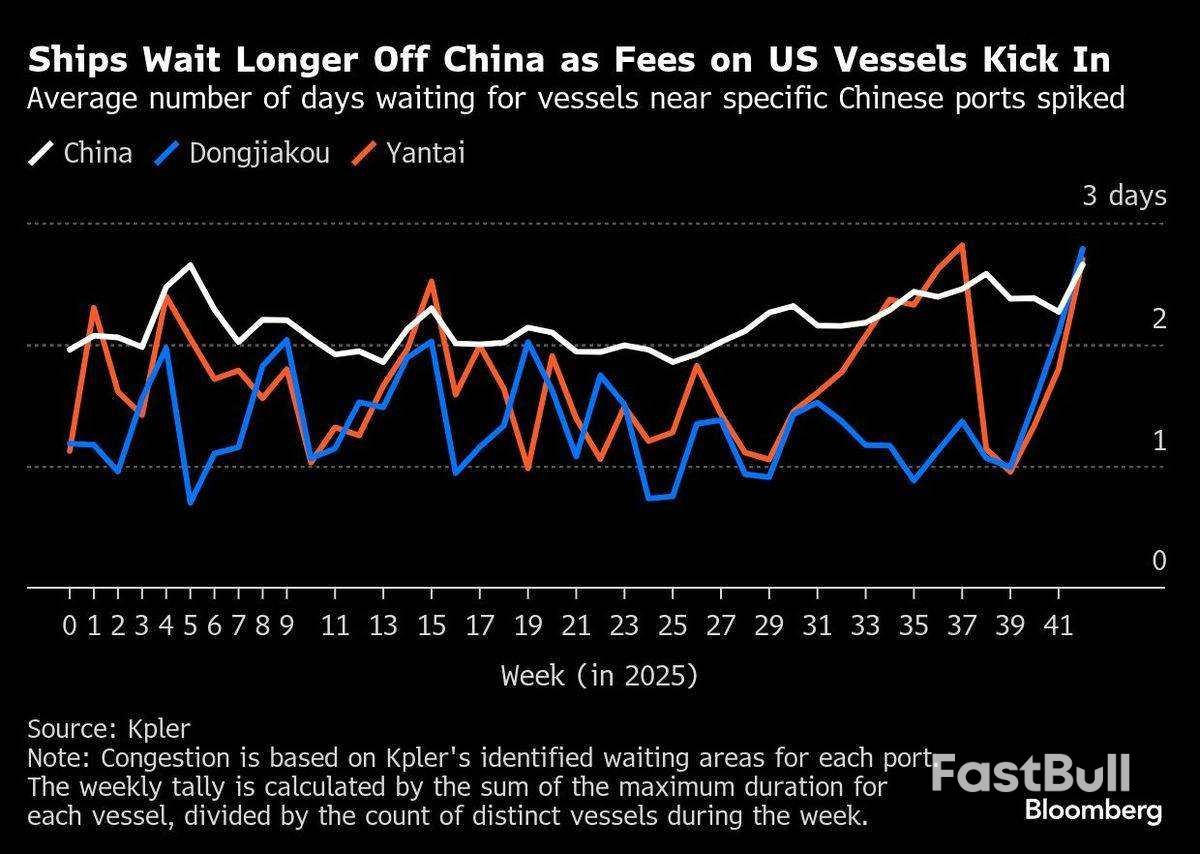
          Waiting times for commodity vessels queued off China’s ports increased to the lengthiest this year, as geopolitical sparring between Beijing and Washington disrupts global trade.It took an average of 2.66 days for a vessel to get into a berth after arrival in the week to Oct 19, according to Bloomberg calculations based on data from ship-tracking platform Kpler on Tuesday (Oct 21). That’s an increase of 17% on the week and the longest period this year, the calculations show.

          China has introduced a hefty extra fee on vessels known to have American links, following a similar US move. The maritime friction forms one part of the nations’ broader trade dispute and has left the shipping industry scrambling to prepare documents or find workarounds.Beijing's new levies came into effect last week, just days after the announcement. Among them, the requirement that any vessel with at least 25% American ownership is subject to the duties means that any owner or operator — regardless of whether they’re based in the US — could be impacted. That short lead time has prompted shipping companies to review their ownership structures, prepare required documents or swap out vessels.

          The disruption jolted shipping markets as charterers and shipowners rushed to settle trades and book compliant ships. The cost to book a very large crude carrier on the benchmark Middle East-to-China route was near US$84,000 (RM355,278) as of Tuesday, 48% higher than on the day before the announcement.

          China is the world’s largest commodity importer. Vessel snarls — if prolonged — could ripple through the global supply chain, affecting liquid cargoes such as crude, as well as bulk carriers like iron ore.The average cost to book Capesizes on major routes remained elevated on Tuesday, despite a carve-out unveiled by Beijing at the last minute that spares most of these large bulk carriers. Some 88 Capesize carriers were waiting to discharge in China in the first two weeks of October, up from 55 at end-September, according to BRS Shipbrokers analysis of AXSMarine data.

          However, “port congestion is still comfortably within historical norms”, said Wilson Wirawan, BRS’s head of dry bulk research.In addition, Washington also imposed sanctions on a major oil-import terminal operator in China’s east, Rizhao. That move was the latest in a long line of moves aimed at frustrating shipments of crude oil from Iran to China.

          Some oil hubs have seen wait times lengthen as tanker owners sought to comply with the new directives. Ships at Dongjiakou waited an average of 2.79 days last week, the second-highest period in Kpler figures as of Tuesday. Those at Yantai, meanwhile, idled for 2.7 days, up from about 1.8 the prior week.“Shipowners are thinking they should hold on and wait until they can enter the port,” said Matt Wright, freight analyst at Kpler. “There is still a great deal of uncertainty surrounding which owners face fees.”

          Source: Theedgemarkets

          To stay updated on all economic events of today, please check out our Economic calendar
          Risk Warnings and Disclaimers
          You understand and acknowledge that there is a high degree of risk involved in trading. Following any strategies or investment methods may lead to potential losses. The content on the site is provided by our contributors and analysts for information purposes only. You are solely responsible for determining whether any trading assets, securities, strategy, or any other product is suitable for investing based on your own investment objectives and financial situation.
          Add to Favorites
          Share

          UK Inflation Holds Steady at 3.8%, Boosting Rate Cut Hopes for November

          Gerik

          Economic

          Stable CPI Surprises Analysts

          Contrary to market expectations of a slight uptick to 4%, the UK’s Consumer Price Index (CPI) held steady at 3.8% in the 12 months to September. This marks the third consecutive month of unchanged inflation, suggesting that price pressures may be stabilizing. The data comes at a critical time as the Bank of England (BoE) considers monetary easing after holding its benchmark rate at 4% last month.
          Rising petrol prices, a key driver in global inflation, were balanced out by easing food prices — an area that had previously contributed to cost-of-living concerns across British households. This balancing effect helped inflation remain flat, providing some breathing room for consumers and policymakers alike.

          Economist Reactions and Policy Implications

          Martin Sartorius of the Confederation of British Industry (CBI) stated that while price pressures are expected to ease gradually, a more meaningful drop in inflation is unlikely until early 2026. Still, the surprise moderation in the data has increased the likelihood that the BoE could lower rates at its upcoming policy meeting on November 6.
          If the Bank of England moves forward with a rate cut, it would signal a shift from the previous stance of caution amid stubborn inflation. Financial markets will closely monitor upcoming indicators to assess whether this downward trend has enough momentum to warrant policy loosening.

          Fiscal Implications for the UK Government

          The flat inflation reading also has fiscal consequences. September’s CPI figure is typically used to calculate the annual increase in welfare benefits. A lower-than-expected figure reduces the government’s financial burden, offering potential relief ahead of Chancellor Rachel Reeves’s key budget announcement on November 26.
          While inflation is still nearly double the BoE’s 2% target, the data offers early evidence that price growth is peaking. With disinflationary forces now more visible, the balance of risks is gradually shifting — opening the door for potential rate cuts and policy recalibration in the months ahead.

          Source: AP

          To stay updated on all economic events of today, please check out our Economic calendar
          Risk Warnings and Disclaimers
          You understand and acknowledge that there is a high degree of risk involved in trading. Following any strategies or investment methods may lead to potential losses. The content on the site is provided by our contributors and analysts for information purposes only. You are solely responsible for determining whether any trading assets, securities, strategy, or any other product is suitable for investing based on your own investment objectives and financial situation.
          Add to Favorites
          Share

          Strategists Expect WoW USA Crude Inventory Drop

          Michelle

          Economic

          Commodity

          In a report sent to Rigzone by the Macquarie team late Monday, Macquarie strategists, including Walt Chancellor, revealed that they are forecasting that U.S. crude inventories will be down by 2.5 million barrels for the week ending October 17.

          “This follows a 3.5 million barrel build in the prior week, with the crude balance realizing modestly tighter than our expectations,” the strategists said in the report.

          “For this week’s balance, from refineries, we model an increase in crude runs (+0.3 million barrels per day) following a surprisingly weak print last week; turnaround timing represents a source of meaningful potential variability in this week’s stats,” they added.

          “Among net imports, we model a moderate reduction, with exports higher (+0.6 million barrels per day) and imports up slightly (+0.1 million barrels per day) on a nominal basis,” they continued.

          The strategists also warned in the report that the timing of cargoes remains a source of potential volatility in this week’s crude balance.

          “From implied domestic supply (prod.+adj.+transfers), we look for a slight decrease (-0.1 million barrels per day) on a nominal basis this week,” the strategists went on to note.

          “Rounding out the picture, we anticipate a slightly larger increase (+0.9 million barrels) in SPR [Strategic Petroleum Reserve] stocks this week,” they added.

          The strategists stated in the report that, “among products”, they “look for draws in gasoline (-4.0 million barrels) and distillate (-1.2 million barrels), with a build in jet (+0.5 million barrels)”.

          “We model implied demand for these three products at ~14.4 million barrels per day for the week ending October 17,” the strategists added.

          In its latest weekly petroleum status report at the time of writing, which was released on October 16 and included data for the week ending October 10, the U.S. Energy Information Administration (EIA) highlighted that U.S. commercial crude oil inventories, excluding those in the SPR, increased by 3.5 million barrels from the week ending October 3 to the week ending October 10.

          The EIA report showed that crude oil stocks, not including the SPR, stood at 423.8 million barrels on October 10, 420.3 million barrels on October 3, and 420.6 million barrels on October 11, 2024. Crude oil in the SPR stood at 407.7 million barrels on October 10, 407.0 million barrels on October 3, and 383.9 million barrels on October 11, 2024, the report revealed.

          Total petroleum stocks - including crude oil, total motor gasoline, fuel ethanol, kerosene type jet fuel, distillate fuel oil, residual fuel oil, propane/propylene, and other oils - stood at 1.696 billion barrels on October 10, the report highlighted. Total petroleum stocks were up 2.4 million barrels week on week and up 60.7 million barrels year on year, the report showed.

          Frank Walbaum, a market analyst at Naga, defined the crude inventory build of 3.5 million barrels as “larger than expected” in a market analysis sent to Rigzone on October 17.

          In a Skandinaviska Enskilda Banken AB (SEB) report sent to Rigzone by the SEB team on October 16, which focused on the EIA’s latest weekly petroleum status report at the time of writing, Ole R. Hvalbye, Commodities Analyst at the company, highlighted that, “in total, commercial petroleum inventories (excluding SPR) increased by 1.7 million barrels on the week”.

          “The build was not as large inventory build as API [American Petroleum Institute] indicated … [Wednesday] night, but still up in total (including SPR) 2.4 million barrels vs normal decline of about 2.4 million barrels this time of year,” he added.

          In an oil and gas report sent to Rigzone on October 13 by the Macquarie team, Macquarie strategists, including Walt Chancellor, revealed that they were forecasting that U.S. crude inventories would be up by 5.2 million barrels for the week ending October 10.

          The EIA’s next weekly petroleum status report is scheduled to be released on October 22. It will include data for the week ending October 17.

          In its weekly petroleum status report, the EIA describes itself as the independent statistical and analytical agency within the Department of Energy. Although the White House website highlights that the U.S. government is currently shut down, a banner visible on the EIA website on Wednesday states that the EIA “is continuing normal publication schedules and data collection until further notice”.

          Source: Rigzone

          To stay updated on all economic events of today, please check out our Economic calendar
          Risk Warnings and Disclaimers
          You understand and acknowledge that there is a high degree of risk involved in trading. Following any strategies or investment methods may lead to potential losses. The content on the site is provided by our contributors and analysts for information purposes only. You are solely responsible for determining whether any trading assets, securities, strategy, or any other product is suitable for investing based on your own investment objectives and financial situation.
          Add to Favorites
          Share
          FastBull
          Copyright © 2025 FastBull Ltd

          728 RM B 7/F GEE LOK IND BLDG NO 34 HUNG TO RD KWUN TONG KLN HONG KONG

          TelegramInstagramTwitterfacebooklinkedin
          App Store Google Play Google Play
          Products
          Charts

          Chats

          Q&A with Experts
          Screeners
          Economic Calendar
          Data
          Tools
          Membership
          Features
          Function
          Markets
          Copy Trading
          Latest Signals
          Contests
          News
          Analysis
          24/7
          Columns
          Education
          Company
          Careers
          About Us
          Contact Us
          Advertising
          Help Center
          Feedback
          User Agreement
          Privacy Policy
          Business

          White Label

          Data API

          Web Plug-ins

          Poster Maker

          Affiliate Program

          Risk Disclosure

          The risk of loss in trading financial instruments such as stocks, FX, commodities, futures, bonds, ETFs and crypto can be substantial. You may sustain a total loss of the funds that you deposit with your broker. Therefore, you should carefully consider whether such trading is suitable for you in light of your circumstances and financial resources.

          No decision to invest should be made without thoroughly conducting due diligence by yourself or consulting with your financial advisors. Our web content might not suit you since we don't know your financial conditions and investment needs. Our financial information might have latency or contain inaccuracy, so you should be fully responsible for any of your trading and investment decisions. The company will not be responsible for your capital loss.

          Without getting permission from the website, you are not allowed to copy the website's graphics, texts, or trademarks. Intellectual property rights in the content or data incorporated into this website belong to its providers and exchange merchants.

          Not Logged In

          Log in to access more features

          FastBull Membership

          Not yet

          Purchase

          Become a signal provider
          Help Center
          Customer Service
          Dark Mode
          Price Up/Down Colors

          Log In

          Sign Up

          Position
          Layout
          Fullscreen
          Default to Chart
          The chart page opens by default when you visit fastbull.com