• Trade
  • Markets
  • Copy
  • Contests
  • News
  • 24/7
  • Calendar
  • Q&A
  • Chats
Trending
Screeners
SYMBOL
LAST
BID
ASK
HIGH
LOW
NET CHG.
%CHG.
SPREAD
SPX
S&P 500 Index
6827.42
6827.42
6827.42
6899.86
6801.80
-73.58
-1.07%
--
DJI
Dow Jones Industrial Average
48458.04
48458.04
48458.04
48886.86
48334.10
-245.98
-0.51%
--
IXIC
NASDAQ Composite Index
23195.16
23195.16
23195.16
23554.89
23094.51
-398.69
-1.69%
--
USDX
US Dollar Index
97.950
98.030
97.950
98.500
97.950
-0.370
-0.38%
--
EURUSD
Euro / US Dollar
1.17394
1.17409
1.17394
1.17496
1.17192
+0.00011
+ 0.01%
--
GBPUSD
Pound Sterling / US Dollar
1.33707
1.33732
1.33707
1.33997
1.33419
-0.00148
-0.11%
--
XAUUSD
Gold / US Dollar
4299.39
4299.39
4299.39
4353.41
4257.10
+20.10
+ 0.47%
--
WTI
Light Sweet Crude Oil
57.233
57.485
57.233
58.011
56.969
-0.408
-0.71%
--

Community Accounts

Signal Accounts
--
Profit Accounts
--
Loss Accounts
--
View More

Become a signal provider

Sell trading signals to earn additional income

View More

Guide to Copy Trading

Get started with ease and confidence

View More

Signal Accounts for Members

All Signal Accounts

Best Return
  • Best Return
  • Best P/L
  • Best MDD
Past 1W
  • Past 1W
  • Past 1M
  • Past 1Y

All Contests

  • All
  • Trump Updates
  • Recommend
  • Stocks
  • Cryptocurrencies
  • Central Banks
  • Featured News
Top News Only
Share

Incoming Czech Prime Minister Babis: Czech Republic Will Not Take On Guarantees For Ukraine Financing, European Commission Must Find Alternatives

Share

Turkey President Erdogan: Hopes To Discuss Ukraine-Russia Peace Plan With Trump After Meeting With Putin

Share

Turkey President Erdogan: Peace Is Not Far Away, Black Sea Should Not Be Used As A Battleground, Safe Navigation Needed

Share

IAEA: Ukraine's Znpp Temporarily Lost All Offsite Power Overnight Due To Widespread Military Activities Affecting The Electrical Grid

Share

Iranian Media Says 18 Crew Members Of Foreign Tanker Seized In Gulf Of Oman Over Carrying 'Smuggled Fuel' Detained

Share

Regional Governor: Two Killed In Ukrainian Drone Strike On Russia's Saratov

Share

Chinese Foreign Ministry - China Foreign Minister Met With United Arab Emirates Counterpart On Dec 12

Share

China's Central Financial And Economic Affairs Commission Deputy Director: Will Expand Export And Increase Import In 2026

Share

Thai Leader Anutin: Landmine Blast That Killed Thai Soldiers 'Not A Roadside Accident'

Share

Thai Leader Anutin: Thailand To Continue Military Action Until 'We Feel No More Harm'

Share

Cambodian Prime Minister Hun Manet Says He Had Phone Calls With Trump And Malaysian Leader Anwar About Ceasefire

Share

Cambodia's Hun Manet Says USA, Malaysia Should Verify 'Which Side Fired First' In Latest Conflict

Share

Cambodia's Hun Manet: Cambodia Maintains Its Stance In Seeking Peaceful Resolution Of Disputes

Share

Nasdaq Companies: Allergan, Ferrovia, Insmed, Monolithic Power Systems, Seagate Technology, And Western Digital Will Be Added To The NASDAQ 100 Index. Biogen, CdW, GlobalFoundries, Lululemon, ON Semiconductor, And Tradedesk Will Be Removed From The NASDAQ 100 Index

Share

Witkoff Headed To Berlin This Weekend To Meet With Zelenskiy, European Leaders -Wsj Reporter On X

Share

Russia Attacks Two Ukrainian Ports, Damaging Three Turkish-Owned Vessels

Share

[Historic Flooding Occurs In At Least Four Rivers In Washington State Due To Days Of Torrential Rains] Multiple Areas In Washington State Have Been Hit By Severe Flooding Due To Days Of Torrential Rains, With At Least Four Rivers Experiencing Historic Flooding. Reporters Learned On The 12th That The Floods Caused By The Torrential Rains In Washington State Have Destroyed Homes And Closed Several Highways. Experts Warn That Even More Severe Flooding May Occur In The Future. A State Of Emergency Has Been Declared In Washington State

Share

Trump Says Proposed Free Economic Zone In Donbas Would Work

Share

Trump: I Think My Voice Should Be Heard

Share

Trump Says Will Be Choosing New Fed Chair In Near Future

TIME
ACT
FCST
PREV
U.K. Trade Balance Non-EU (SA) (Oct)

A:--

F: --

P: --

U.K. Trade Balance (Oct)

A:--

F: --

P: --

U.K. Services Index MoM

A:--

F: --

P: --

U.K. Construction Output MoM (SA) (Oct)

A:--

F: --

P: --

U.K. Industrial Output YoY (Oct)

A:--

F: --

P: --

U.K. Trade Balance (SA) (Oct)

A:--

F: --

P: --

U.K. Trade Balance EU (SA) (Oct)

A:--

F: --

P: --

U.K. Manufacturing Output YoY (Oct)

A:--

F: --

P: --

U.K. GDP MoM (Oct)

A:--

F: --

P: --

U.K. GDP YoY (SA) (Oct)

A:--

F: --

P: --

U.K. Industrial Output MoM (Oct)

A:--

F: --

P: --

U.K. Construction Output YoY (Oct)

A:--

F: --

P: --

France HICP Final MoM (Nov)

A:--

F: --

P: --

China, Mainland Outstanding Loans Growth YoY (Nov)

A:--

F: --

P: --

China, Mainland M2 Money Supply YoY (Nov)

A:--

F: --

P: --

China, Mainland M0 Money Supply YoY (Nov)

A:--

F: --

P: --

China, Mainland M1 Money Supply YoY (Nov)

A:--

F: --

P: --

India CPI YoY (Nov)

A:--

F: --

P: --

India Deposit Gowth YoY

A:--

F: --

P: --

Brazil Services Growth YoY (Oct)

A:--

F: --

P: --

Mexico Industrial Output YoY (Oct)

A:--

F: --

P: --

Russia Trade Balance (Oct)

A:--

F: --

P: --

Philadelphia Fed President Henry Paulson delivers a speech
Canada Building Permits MoM (SA) (Oct)

A:--

F: --

P: --

Canada Wholesale Sales YoY (Oct)

A:--

F: --

P: --

Canada Wholesale Inventory MoM (Oct)

A:--

F: --

P: --

Canada Wholesale Inventory YoY (Oct)

A:--

F: --

P: --

Canada Wholesale Sales MoM (SA) (Oct)

A:--

F: --

P: --

Germany Current Account (Not SA) (Oct)

A:--

F: --

P: --

U.S. Weekly Total Rig Count

A:--

F: --

P: --

U.S. Weekly Total Oil Rig Count

A:--

F: --

P: --

Japan Tankan Large Non-Manufacturing Diffusion Index (Q4)

--

F: --

P: --

Japan Tankan Small Manufacturing Outlook Index (Q4)

--

F: --

P: --

Japan Tankan Large Non-Manufacturing Outlook Index (Q4)

--

F: --

P: --

Japan Tankan Large Manufacturing Outlook Index (Q4)

--

F: --

P: --

Japan Tankan Small Manufacturing Diffusion Index (Q4)

--

F: --

P: --

Japan Tankan Large Manufacturing Diffusion Index (Q4)

--

F: --

P: --

Japan Tankan Large-Enterprise Capital Expenditure YoY (Q4)

--

F: --

P: --

U.K. Rightmove House Price Index YoY (Dec)

--

F: --

P: --

China, Mainland Industrial Output YoY (YTD) (Nov)

--

F: --

P: --

China, Mainland Urban Area Unemployment Rate (Nov)

--

F: --

P: --

Saudi Arabia CPI YoY (Nov)

--

F: --

P: --

Euro Zone Industrial Output YoY (Oct)

--

F: --

P: --

Euro Zone Industrial Output MoM (Oct)

--

F: --

P: --

Canada Existing Home Sales MoM (Nov)

--

F: --

P: --

Euro Zone Total Reserve Assets (Nov)

--

F: --

P: --

U.K. Inflation Rate Expectations

--

F: --

P: --

Canada National Economic Confidence Index

--

F: --

P: --

Canada New Housing Starts (Nov)

--

F: --

P: --

U.S. NY Fed Manufacturing Employment Index (Dec)

--

F: --

P: --

U.S. NY Fed Manufacturing Index (Dec)

--

F: --

P: --

Canada Core CPI YoY (Nov)

--

F: --

P: --

Canada Manufacturing Unfilled Orders MoM (Oct)

--

F: --

P: --

Canada Manufacturing New Orders MoM (Oct)

--

F: --

P: --

Canada Core CPI MoM (Nov)

--

F: --

P: --

Canada Manufacturing Inventory MoM (Oct)

--

F: --

P: --

Canada CPI YoY (Nov)

--

F: --

P: --

Canada CPI MoM (Nov)

--

F: --

P: --

Canada CPI YoY (SA) (Nov)

--

F: --

P: --

Canada Core CPI MoM (SA) (Nov)

--

F: --

P: --

Q&A with Experts
    • All
    • Chatrooms
    • Groups
    • Friends
    Connecting
    .
    .
    .
    Type here...
    Add Symbol or Code

      No matching data

      All
      Trump Updates
      Recommend
      Stocks
      Cryptocurrencies
      Central Banks
      Featured News
      • All
      • Russia-Ukraine Conflict
      • Middle East Flashpoint
      • All
      • Russia-Ukraine Conflict
      • Middle East Flashpoint
      Search
      Products

      Charts Free Forever

      Chats Q&A with Experts
      Screeners Economic Calendar Data Tools
      Membership Features
      Data Warehouse Market Trends Institutional Data Policy Rates Macro

      Market Trends

      Market Sentiment Order Book Forex Correlations

      Top Indicators

      Charts Free Forever
      Markets

      News

      News Analysis 24/7 Columns Education
      From Institutions From Analysts
      Topics Columnists

      Latest Views

      Latest Views

      Trending Topics

      Top Columnists

      Latest Update

      Signals

      Copy Rankings Latest Signals Become a signal provider AI Rating
      Contests
      Brokers

      Overview Brokers Assessment Rankings Regulators News Claims
      Broker listing Forex Brokers Comparison Tool Live Spread Comparison Scam
      Q&A Complaint Scam Alert Videos Tips to Detect Scam
      More

      Business
      Events
      Careers About Us Advertising Help Center

      White Label

      Data API

      Web Plug-ins

      Affiliate Program

      Awards Institution Evaluation IB Seminar Salon Event Exhibition
      Vietnam Thailand Singapore Dubai
      Fans Party Investment Sharing Session
      FastBull Summit BrokersView Expo
      Recent Searches
        Top Searches
          Markets
          News
          Analysis
          User
          24/7
          Economic Calendar
          Education
          Data
          • Names
          • Latest
          • Prev

          View All

          No data

          Scan to Download

          Faster Charts, Chat Faster!

          Download App
          English
          • English
          • Español
          • العربية
          • Bahasa Indonesia
          • Bahasa Melayu
          • Tiếng Việt
          • ภาษาไทย
          • Français
          • Italiano
          • Türkçe
          • Русский язык
          • 简中
          • 繁中
          Open Account
          Search
          Products
          Charts Free Forever
          Markets
          News
          Signals

          Copy Rankings Latest Signals Become a signal provider AI Rating
          Contests
          Brokers

          Overview Brokers Assessment Rankings Regulators News Claims
          Broker listing Forex Brokers Comparison Tool Live Spread Comparison Scam
          Q&A Complaint Scam Alert Videos Tips to Detect Scam
          More

          Business
          Events
          Careers About Us Advertising Help Center

          White Label

          Data API

          Web Plug-ins

          Affiliate Program

          Awards Institution Evaluation IB Seminar Salon Event Exhibition
          Vietnam Thailand Singapore Dubai
          Fans Party Investment Sharing Session
          FastBull Summit BrokersView Expo

          "Widow Maker" Bond-ETF Trade Delivers Fast Gains for Dip-Buyers

          Manuel

          Bond

          Forex

          Summary:

          “Investors aren’t letting TLT’s widow-maker reputation scare them off,” said Athanasios Psarofagis, ETF analyst at Bloomberg Intelligence. “They’re still buying in, holding on to hope that long-term Treasuries will finally bounce back.”
          Dip buyers in the dangerous world of long-dated Treasury debt are enjoying a rare pay day — and fast.
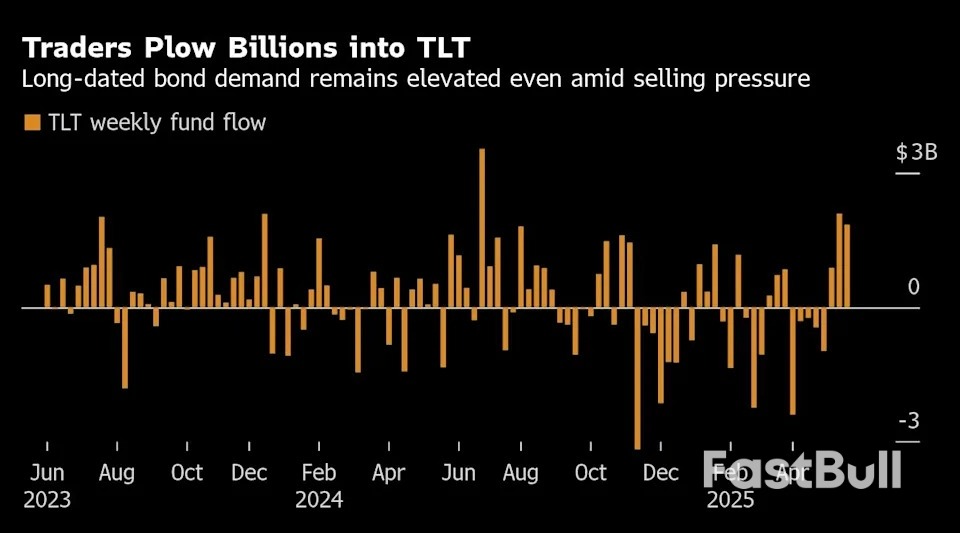
          Investors over the past week poured $1.8 billion into BlackRock Inc.’s iShares 20+ Year Treasury Bond ETF (ticker TLT) — the most among all the 630 ETFs that Bloomberg tracks — just as longer-maturity government bonds sold off on fears over America’s debt trajectory.
          The timing has proved fortuitous. In Tuesday trading, Treasuries rallied — pushing the 30-year yield below 5% — on optimism about trade negotiations between the US and the European Union, and as Japan signaled it may adjust debt sales to stabilize its bond market. TLT jumped 1.7% during the session, on track for its biggest daily rise since February.
          It’s a rare win for an ETF trade that has earned a reputation as a so-called widow maker. True to its infamy, TLT has attracted some $49 billion in the past five years despite shedding more than 40% in that time horizon.
          “Investors aren’t letting TLT’s widow-maker reputation scare them off,” said Athanasios Psarofagis, ETF analyst at Bloomberg Intelligence. “They’re still buying in, holding on to hope that long-term Treasuries will finally bounce back.”
          For some time, bond investors have been demanding extra compensation for the risk of investing in longer-duration debt as Republican lawmakers haggled over President Donald Trump’s signature tax-cut bill that would add trillions of dollars to already bulging budget gaps. Benchmark 30-year Treasury bonds surged above 5.1% last week to trade near the highest in almost two decades.
          But last week’s buying streak in TLT suggests that a growing cohort of traders are betting that yields are high enough to entice buyers and compensate for the risks. Long-maturity bonds are most exposed to interest-rate risk, so they tend to rally the most when borrowing costs fall.
          “Dip-buyers are trying to pick the bottom,” and long-term bonds give investors “the biggest bang for your buck” because they are exposed to the most volatile part of the yield curve, said Byron Anderson, head of fixed income at Laffer Tengler Investments Inc."Widow Maker" Bond-ETF Trade Delivers Fast Gains for Dip-Buyers_1
          The iShares 10-20 Year Treasury Bond ETF (TLH) was also among the ETFs that attracted the most inflows over the past week, along with the iShares 0-3 Month Treasury Bond ETF (SGOV).
          Peter Tchir of Academy Securities is among those recommending long-bonds, saying the pessimism is overdone. Adding heft to his belief is the rally in global bonds after Japanese authorities signaled they are considering adjusting their debt plan.
          “The situation wasn’t as bad as the narrative,” said Tchir who recommended investors add duration last week. “Positioning had swung from too bullish to too bearish fairly quickly, too.”
          Of course, TLT — which is almost as volatile as US stocks — isn’t for faint hearts. In the options market, traders remain wary of further declines in long bonds. It costs more to buy put options in TLT than to purchase calls, a sign there is demand for downside protection.
          “We believe the long end will continue to see term premium increase,” said Lindsay Rosner, head of multi-sector fixed income investing at Goldman Sachs Asset Management. “It’s all about the fiscal, what is the right level to lend at to countries whose balance sheets are trending the way they are.”

          Source: Bloomberg

          Risk Warnings and Disclaimers
          You understand and acknowledge that there is a high degree of risk involved in trading. Following any strategies or investment methods may lead to potential losses. The content on the site is provided by our contributors and analysts for information purposes only. You are solely responsible for determining whether any trading assets, securities, strategy, or any other product is suitable for investing based on your own investment objectives and financial situation.
          Add to Favorites
          Share

          Oil Prices Dip as US-Iran Talks, OPEC+ Plans Spur Supply Concerns

          Manuel

          Commodity

          Middle East Situation

          Oil prices fell more than 1% on Tuesday, spurred by worries of a supply glut after Iranian and U.S. delegations made progress in their talks and on expectations that OPEC+ will decide to increase output at a meeting this week.
          Brent crude futures were down 90 cents, or 1.4%, at $63.86 a barrel by 1:25 p.m. ET (1725 GMT). U.S. West Texas Intermediate crude fell 90 cents, or around 1.5%, to $60.63 a barrel.
          The Organization of the Petroleum Exporting Countries and its allies, known as OPEC+, is not expected to change policy at a meeting on Wednesday.
          However, another meeting on Saturday is likely to agree to a further accelerated oil output hike for July, three delegates from the group told Reuters.
          Meanwhile, Iranian and U.S. delegations wrapped up a fifth round of talks in Rome last week. While signs of limited progress emerged, there were many points of disagreement that were hard to breach, notably the issue of Iran's uranium enrichment.
          "OPEC+ also meets next week where they will likely agree on further output increases, which, if it occurs, will be a major near-term headwind for crude, especially if Iran adds barrels in the possible (U.S.) deal," said Dennis Kissler, senior vice president of trading at BOK Financial.
          If nuclear talks between the U.S. and Iran fail, it could mean continued sanctions on Iran, which would limit Iranian oil supply, while any resolution could add Iranian supply to the market.
          Supporting prices, U.S. President Donald Trump's decision to extend trade talks with the European Union until July 9 alleviated immediate fears of tariffs that could suppress fuel demand. Wall Street rose on Trump's trade reprieve.
          Easing trade concerns were supportive, said UBS analyst Giovanni Staunovo, adding that upside to prices remains limited until it is clear what OPEC+ will decide on Saturday.
          Also helping prices, a wildfire in the Canadian province of Alberta prompted the temporary shutdown of some oil and gas production.

          Source: Reuters

          Risk Warnings and Disclaimers
          You understand and acknowledge that there is a high degree of risk involved in trading. Following any strategies or investment methods may lead to potential losses. The content on the site is provided by our contributors and analysts for information purposes only. You are solely responsible for determining whether any trading assets, securities, strategy, or any other product is suitable for investing based on your own investment objectives and financial situation.
          Add to Favorites
          Share

          Tariff Shockwaves: Indonesia’s Export Strategy Under Fire

          Owen Li

          Economic

          Just when the calm of Ramadan had settled in, U.S. President Donald Trump dropped the bombshell: “reciprocal” import tariffs that cut short everyone’s well-earned break and threatened to upend global trade with staggering losses.

          The Tax Foundation summarized the reason for the reciprocal tariffs on imported goods at the U.S. Congress Joint Economic Committee Hearing on December 18, 2024: the relative decline in competitiveness of U.S. industries compared to other nations, widening inequality, insufficient job creation, and other domestic economic issues. These concerns have driven a high-risk protectionist practice that may ultimately harm all parties involved.

          The trade-balance deficit with various partners is not sufficient justification for raising trade barriers. Researchers conclude that permanent import tariffs have only a modest impact on reducing trade deficits at best and suggest temporary tariffs can trigger a recession, an effect that deepens if trading partners retaliate.

          Although Trump’s 90-day postponement of the reciprocal tariffs (though not a 10 percent baseline tariff) is encouraging, uncertainty persists due to the unpredictability of Trump’s directives and his questionable judgment. MacroMicro’s Trade Policy Uncertainty Index in April rose to nearly ten times its level from last September, underscoring the growing need for negotiation strategies to ensure trade stability.

          There are indications that this tariff scheme was premeditated by the administration, given that the 10 percent rate far exceeds the prior average tariff of 2 to 3 percent. Trump has achieved his objectives, apart from China, which has resisted pressure and compelled him to relent amid potential economic consequences – yet he framed the outcome as a victory.

          In this context, the current tariff war more closely resembles Trump’s first administration policies with elevated duties that provoke retaliation and serve as bargaining chips in negotiations, now applied to a wider array of countries.

          What We Learned from Tariff War 1.0

          During Trump’s previous term, the United States steadily increased its import tariffs on Chinese goods from around 3 percent in January 2018 to almost 20 percent by February 2020, while tariffs on the rest of the world rose only modestly from 2 to 3 percent.

          Despite these levies, the U.S. trade-balance deficit with both China and the rest of the world failed to shrink. Two key factors drove this: China sidestepped U.S. tariffs by rerouting exports through third countries such as Mexico and ASEAN nations, and U.S. domestic industries could not fully substitute for imports. Instead, import barriers disrupted production and stoked inflation.

          Despite not being as successful as fellow ASEAN countries such as Vietnam, Indonesian products supplanted Chinese goods in the U.S. market and export-oriented Chinese foreign direct investment (FDI) flowed into Indonesia. Moreover, Indonesia accelerated the signing of bilateral and regional trade agreements such as ASEAN Plus Three and Regional Comprehensive Economic Partnership (RCEP) to diversify its export destinations and bolster supply-chain resilience.

          On reflection, there might be a chance for Indonesia to convert this disaster into an opportunity. But is it?

          Tariff War 2.0

          Learning from the limited impact of Phase One, this second salvo imposes extremely high rates on a vast array of trading partners simultaneously, an all-out effort to squeeze global imports.

          The mechanics of fallout are straightforward. First, exports from nearly every country to the U.S. will contract. Next, China’s persistent overcapacity is likely to flood global markets, including Indonesia, with surplus goods. U.S. investors, deterred by harsher trading conditions abroad, will redirect capital back home, while rest-of-world investors chase lower-tariff jurisdictions.

          China may shift more FDI toward Indonesia’s domestic market, but export-driven projects will wane. Major industrial powers could resort to dumping surpluses at cut-rate prices, and if large economies retaliate in kind, global trade volumes may plunge further, dragging down growth worldwide.

          For Indonesia, the consequences are immediate and stark. The previous influx of export-oriented Chinese investment may slow while the domestic market is still uncertain. Indonesia can strengthen its trade defense and remedies in anticipation of the surge of dumping and illegal imports.

          It is unclear how U.S. tariffs on Chinese and Indonesian products will differ beyond the 90-day postponement and if Indonesia still holds the competitive advantage it once enjoyed. It is also unclear whether Indonesia can rely on substituting Chinese goods in the U.S. market. In response, Indonesia must brace for a drop in U.S.-bound exports of key products due to hefty reciprocal duties and prepare for higher global production costs.

          Although the outlook is bleak, there are still windows of opportunity. Exports to the U.S. account for less than 10 percent of Indonesia’s total shipments, lower than most of its ASEAN peers, hence offering greater flexibility to diversify Indonesia’s markets.

          What Can Be Done

          Indonesia can proactively pursue bilateral negotiations with the United States, mirroring moves by other ASEAN members while refraining from retaliation.

          To make a difference, Indonesia may consider initiating preferential trade agreements or bilateral limited free trade agreements with the U.S. Indonesia can also leverage its status under the U.S. Generalized System of Preferences to seek a limited preferential/free trade agreement.

          Contrary to U.S. assertions, Indonesia’s average Most Favored Nation tariffs in 2023 were moderate and applied uniformly at around 8 percent. Notably, the United States enjoyed a services-trade surplus of $1.6 billion in 2023 despite a goods-trade deficit, underscoring mutual benefits that should guide bilateral negotiations.

          At the same time, the Indonesian government must reassess its own non-tariff measures, since U.S. sanctions have cited both Indonesia’s import duties and regulatory barriers. Moderating these policies with prudent review will help improve American perceptions while simultaneously addressing asymmetric liberalization effects.

          In the short term, Indonesia can step in to supply goods that complement exports from heavily tariffed nations, capturing new opportunities in global supply chains.

          To diversify risk, Indonesia can deepen production partnerships over the long term by attracting FDI into intermediate-goods manufacturing with countries facing lower U.S. tariffs such as Japan and expand its diplomatic outreach by accelerating cooperation frameworks including BRICS and OECD accession among others.

          Internally, sweeping reforms to enhance the business climate, raising productivity and lowering high-cost economic structures are essential, as is an active role in World Trade Organization reform to revitalize multilateral trade.

          Upgrading logistics and industrial infrastructure can target broad competitiveness rather than aligning with any single foreign investor’s supply chain and ensure that any re-export of foreign-origin goods satisfies Rules of Origin requirements with substantial value additions compared to mere goods in transit. Stronger enforcement against illegal imports and more robust anti-dumping measures will protect domestic industries from unfair competition.

          By maintaining an independent foreign policy, Indonesia can preserve diplomatic flexibility and preparing for non-economic conditions such as domestic politics, foreign policy and defense commitments will round out its readiness.

          Negotiations are still underway, but rising tensions and disputes over key issues could drive tariffs even higher. No one knows exactly what the Trump administration has in mind. As Bob Dylan famously said, the times they are a-changin’. One can remain hopeful and act on what we can control.

          Source: The Diplomat

          To stay updated on all economic events of today, please check out our Economic calendar
          Risk Warnings and Disclaimers
          You understand and acknowledge that there is a high degree of risk involved in trading. Following any strategies or investment methods may lead to potential losses. The content on the site is provided by our contributors and analysts for information purposes only. You are solely responsible for determining whether any trading assets, securities, strategy, or any other product is suitable for investing based on your own investment objectives and financial situation.
          Add to Favorites
          Share

          Trump Threatens To Withhold California's Federal Funding Over Transgender Athlete

          Olivia Brooks

          Economic

          US President Donald Trump and First Lady Melania Trump are greeted by California Governor Gavin Newson upon arrival at Los Angeles International Airport in Los Angeles, California, on Jan. 24, 2025, to visit the region devastated by the Palisades and Eaton fires.

          President Donald Trump on Tuesday threatened to strip "large scale federal funding" from California if the state goes against his executive order banning transgender athletes from participating in women's sports.

          That funding could be withheld "permanently" if California continues to flout the Feb. 5 order, Trump warned on Truth Social.

          The president's post complained that a trans athlete who qualified to compete against women in an upcoming competition is "practically unbeatable."

          He wrote that he will order "local authorities, if necessary, to not allow the transitioned person to compete in the State Finals."

          Trump added that he will speak with California Gov. Gavin Newsom, a Democrat, later Tuesday "to find out which way he wants to go" on the issue.

          Trump did not name the athlete whose participation in women's sports drew his ire. AB Hernandez, a California high school student and transgender athlete competing in girls track and field, has recently received media attention.

          Trump's threat to shut off federal funding could be significant for California, the world's fourth-largest economy.

          Over one-third of the state's budget comes from the federal government, according to the California Budget and Policy Center. The state's 2025-2026 budget includes more than $170 billion in federal funds.

          The threat also carries weight in light of Trump's increasing willingness to cancel billions of dollars in federal funds to universities, cities and other entities whose whose conduct he opposes.

          Earlier Tuesday, Trump moved to cancel all remaining federal government contracts with Harvard University — reportedly totaling roughly $100 million — in the administration's latest salvo against the elite institution.

          Trump has previously threatened to withhold federal funds from Maine over the state's compliance with Trump's executive order barring transgender women and girls from participating in female sports.

          Newsom, widely seen as a contender for the 2028 Democratic presidential nomination, has been a vocal critic of a number of Trump policies, including on tariffs and immigration.

          He downplayed the debate over trans athletes in April, saying the issue has been "weaponized by the right to be 10x, 100x bigger than it is."

          But he also suggested in March that trans athletes participating in girls' and women's sports was "deeply unfair," separating himself from many of his fellow Democrats.

          "I think it's an issue of fairness. I completely agree with you on that," Newsom told conservative influencer Charlie Kirk on his podcast.

          Newsom's office did not immediately provide a comment in response to Trump's post.

          Source: CNBC

          To stay updated on all economic events of today, please check out our Economic calendar
          Risk Warnings and Disclaimers
          You understand and acknowledge that there is a high degree of risk involved in trading. Following any strategies or investment methods may lead to potential losses. The content on the site is provided by our contributors and analysts for information purposes only. You are solely responsible for determining whether any trading assets, securities, strategy, or any other product is suitable for investing based on your own investment objectives and financial situation.
          Add to Favorites
          Share

          US Business Spending On Equipment Softening As Tariff Uncertainty Persists

          Devin

          Economic

          The report from the Commerce Department on Tuesday also showed shipments of these goods falling last month. Economists said President Donald Trump's flip-flopping on import duties was making it difficult for businesses to plan ahead. That has been evident in the deterioration in sentiment among businesses.

          "I have predicted for months that business investment will be the main driver of a softer economic performance this year, as executives postpone their capital projects until they have more clarity on policy," said Stephen Stanley, chief U.S. economist at Santander U.S. Capital Markets. "These data offer the first confirming evidence of that hypothesis."

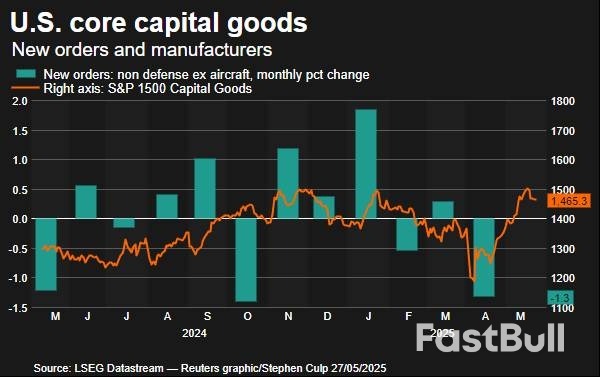
          Non-defense capital goods orders excluding aircraft, a closely watched proxy for business spending plans, tumbled 1.3% last month. That was the largest drop since last October and followed an upwardly revised 0.3% gain in March, the Commerce Department's Census Bureau said. Economists polled by Reuters had forecast these so-called core capital goods orders dipping 0.1% after a previously reported 0.2% drop in March.

          Core capital goods shipments slipped 0.1% after increasing 0.5% in March. Nondefense capital goods orders slumped 19.1%. Shipments of these goods rebounded 3.5% after falling 1.1% in March. Front-running by businesses eager to avoid higher prices from Trump's sweeping tariffs on imports contributed to business spending on equipment, mostly information processing equipment, surging at its fastest rate in 4-1/2 years in the first quarter.

          That helped to limit the drag on gross domestic product from a flood of imports. Trump has delayed higher import duties on most countries until July. The White House this month announced a deal with Beijing to slash tariffs on Chinese goods to 30% from 145% for 90 days.

          The truce in the trade war between Washington and Beijing helped to lift consumer confidence in May after deteriorating for five straight months. Consumers, however, continued to worry about tariffs raising prices and hurting the economy.

          The Conference Board's consumer confidence index increased 12.3 points to 98.0 this month, blowing past economists' expectations for an improvement to 87.0.

          But concerns about the labor market lingered, even as consumers planned to spend more over the next six months on big-ticket items such as motor vehicles and household appliances, take vacations and buy houses.

          The survey's so-called labor market differential, derived from data on respondents' views on whether jobs are plentiful or hard to get, narrowed to 13.2 from 13.7 in April. This measure correlates with the unemployment rate in the Labor Department's monthly employment report.

          Trump last week ratcheted up his trade war, proposing a 50% tariff on European Union goods starting June 1 and threatened Apple (AAPL.O), opens new tab with a 25% duty on any iPhones manufactured outside the United States. Trump at the weekend, however, backed off his threat against the EU, restoring a July 9 deadline.

          Stocks on Wall Street were trading higher. The dollar rose against a basket of currencies. U.S. Treasury yields fell.

          Core capital goods

          FRESH ROUND OF FRONT-LOADING

          Economists are anticipating a period of volatility for business spending, with the pauses in higher tariffs for Chinese and EU products seen unleashing a fresh round of front-loading. Ultimately, they expect investment to soften this year.

          Trump sees tariffs as a tool to, among other things, revive a long-declining U.S. industrial base, a feat that economists argue would be difficult to achieve in the short-term because of structural issues, including labor shortages.

          While orders for computers and electronic products rebounded 1.0% last month, bookings for communications equipment decreased 2.6%. Electrical equipment, appliances and components orders fell 0.2%. But orders for machinery increased 0.8% as did those for fabricated metal products.

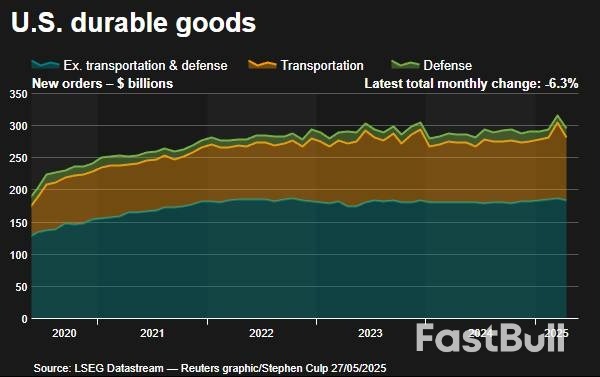
          Orders for durable goods, items ranging from toasters to aircraft meant to last three years or more, dropped 6.3% last month after a slightly upwardly revised 7.6% rise in March.

          Durable goods

          Durable goods orders were previously reported to have jumped 7.5% in March. They were last month weighed down by a decline in orders for commercial aircraft as well as the fading boost from the tariff-related front-running.

          Boeing (BA.N), opens new tab reported on its website that it had received only eight aircraft orders in April, down from 192 in March. Orders for motor vehicles and parts decreased 2.9%.

          Overall transportation orders plummeted 17.1% after soaring 23.5% in March. The Atlanta Federal Reserve lowered its second-quarter GDP growth estimate to a 2.2% annualized rate on the data from a 2.4% pace earlier. The economy contracted at a 0.3% rate in the January-March quarter.

          Some economists expect business spending on equipment to hold up if companies more or less maintain the first quarter's robust pace of front-running of imports.

          "It is not until this import-driven boost fades later this year that we expect investment growth in that category to slow sharply," said Thomas Ryan, an economist at Capital Economics. "We expect business equipment investment to flatline in the second half of the year."

          The tariff-driven economic uncertainty and higher mortgage rates are weighing on demand for homes, resulting in a rise in supply that is curbing house price growth. New housing inventory is at levels last seen in 2007, while the supply of previously owned homes is the highest in more than four years.

          A third report from the Federal Housing Finance Agency showed house prices increased 3.7% in the 12 months through March after advancing 3.9% in February.

          "Prospects for house prices do not look strong," said Carl Weinberg, chief economist at High Frequency Economics. "A new slowing trend is emerging as the economy slows and real incomes falter."

          Source: Reuters

          To stay updated on all economic events of today, please check out our Economic calendar
          Risk Warnings and Disclaimers
          You understand and acknowledge that there is a high degree of risk involved in trading. Following any strategies or investment methods may lead to potential losses. The content on the site is provided by our contributors and analysts for information purposes only. You are solely responsible for determining whether any trading assets, securities, strategy, or any other product is suitable for investing based on your own investment objectives and financial situation.
          Add to Favorites
          Share

          Trump Media to raise $2.5 billion to buy bitcoin

          Adam

          Cryptocurrency

          Trump Media & Technology Group (DJT) is doubling down on cryptocurrency, unveiling plans Tuesday to create what it claims will be one of the largest bitcoin treasuries held by any public company.
          The initiative is backed by a $2.5 billion private funding round, with commitments from roughly 50 institutional investors, according to a company press release. The deal includes $1.5 billion in Trump Media common stock and $1 billion in convertible senior secured notes, set to close on or around May 29.
          Once finalized, the move will place bitcoin directly on Trump Media’s balance sheet, alongside existing cash, cash equivalents, and short-term investments totaling $759 million as of the end of Q1 2025.
          Shares of Trump Media, which are majority owned by the President Donald Trump, fell over 7% in early trading following the announcement. Bitcoin (BTC-USD), meanwhile, is hovering near record highs, trading around $110,000 per coin.
          Trump Media, the parent company of social media platform Truth Social, streaming service Truth+, and fintech brand Truth.Fi, said the bitcoin play is part of a broader strategy to integrate digital assets across its media and financial ecosystem.
          "We view bitcoin as an apex instrument of financial freedom, and now Trump Media will hold cryptocurrency as a crucial part of our assets," Trump Media CEO and Chairman Devin Nunes said in the release.
          Nunes called it a "big step forward" in Trump Media’s plans to transform into a diversified holding company focused on acquiring "profit-generating, crown jewel assets consistent with America First principles."
          Earlier this year, the company revealed plans to launch a bitcoin exchange-traded fund (ETF), part of a broader expansion into digital finance that includes trademark filings for a "Bitcoin Plus ETF" and other investment products. The move builds on Trump’s vocal support for cryptocurrency during his campaign, when he pledged to make the United States the "crypto capital of the planet."
          Just before taking office, his team introduced official meme coins for the 47th president (TRUMP) and First Lady Melania Trump (MELANIA) on the Solana (SOL) blockchain.

          Source: finance.yahoo

          Risk Warnings and Disclaimers
          You understand and acknowledge that there is a high degree of risk involved in trading. Following any strategies or investment methods may lead to potential losses. The content on the site is provided by our contributors and analysts for information purposes only. You are solely responsible for determining whether any trading assets, securities, strategy, or any other product is suitable for investing based on your own investment objectives and financial situation.
          Add to Favorites
          Share

          How retail investors won round one of tariff market volatility

          Adam

          Economic

          Who's the dumb money now?
          As $74 billion flowed out of equity mutual funds and ETFs in April, retail investors bought the dip and participated in the fastest snapback in the S&P 500 (^GSPC) since 1982.
          Retail investor inflows have surpassed $50 billion since April 8, according to a May 15 note from JPMorgan quantitative strategist Emma Wu. Although the pace of purchases slowed from "dip-buying weeks," Wu noted on Thursday that retail investors still bought $7.5 billion in equities over the past week.
          "I have to give retail a back-clap because they had been buying the dip all the way through," RBC Capital Markets derivatives strategist Amy Wu Silverman said on Catalysts (see video above). "It was really the institutional investor base that massively de-grossed [i.e., reduced exposure to financial markets]. So they're the ones who actually have to catch up right now."
          Data from investing platform Public indicates that investors who bought the dip between April 3 and May 9 earned a nearly 12% return. That winning streak led Bank of America's retail clients to sell stocks and take profits for the first time in 23 weeks prior to Memorial Day, according to a note from BofA senior US equity strategist Jill Carey Hall.
          Public founder and CEO Leif Abraham said the buy-the-dip strategy has become the norm, noting that "the concept of buying the dip has definitely become sort of retail investing culture."
          So what did the so-called smart money get wrong about the volatility and subsequent rally?
          Part of the reason is baked into the demands of the role, according to Silverman.
          "The pickle that an institutional investor is in ... [is] you're usually benchmarked to the S&P 500," she said. "So the S&P 500 goes up 15%, and you went up 5%. That's not great."
          It can be hard to justify fees if you're not beating the benchmark. Silverman calls this "career risk," which she said is something that isn't talked about enough.
          Retail investors benefit from a longer time horizon that institutional investors can't enjoy, since they are judged annually.
          "We miss a lot of returns," Invesco global market strategist Brian Levitt acknowledged. "Investors are still their own worst enemies."
          Levitt added that the lesson for long-term investors to stay the course in market volatility is a tale as old as time and not necessarily a strategy that indicates retail is winning.
          "Great days almost always happen near the worst days," Levitt said. "We've been through this so many times now. ... If you had told me when I graduated college in '98 that I would live through a tech wreck, a global financial crisis ... I wouldn't have thought that I would be up 12% a year in the broad US market."
          To be sure, retail or institutional buying can't protect investors from looming headwinds.
          Silverman warned investors to expect "uglier outcomes just down the road" because of how the 90-day tariff pauses were implemented.

          Source: finance.yahoo

          To stay updated on all economic events of today, please check out our Economic calendar
          Risk Warnings and Disclaimers
          You understand and acknowledge that there is a high degree of risk involved in trading. Following any strategies or investment methods may lead to potential losses. The content on the site is provided by our contributors and analysts for information purposes only. You are solely responsible for determining whether any trading assets, securities, strategy, or any other product is suitable for investing based on your own investment objectives and financial situation.
          Add to Favorites
          Share
          FastBull
          Copyright © 2025 FastBull Ltd

          728 RM B 7/F GEE LOK IND BLDG NO 34 HUNG TO RD KWUN TONG KLN HONG KONG

          TelegramInstagramTwitterfacebooklinkedin
          App Store Google Play Google Play
          Products
          Charts

          Chats

          Q&A with Experts
          Screeners
          Economic Calendar
          Data
          Tools
          Membership
          Features
          Function
          Markets
          Copy Trading
          Latest Signals
          Contests
          News
          Analysis
          24/7
          Columns
          Education
          Company
          Careers
          About Us
          Contact Us
          Advertising
          Help Center
          Feedback
          User Agreement
          Privacy Policy
          Business

          White Label

          Data API

          Web Plug-ins

          Poster Maker

          Affiliate Program

          Risk Disclosure

          The risk of loss in trading financial instruments such as stocks, FX, commodities, futures, bonds, ETFs and crypto can be substantial. You may sustain a total loss of the funds that you deposit with your broker. Therefore, you should carefully consider whether such trading is suitable for you in light of your circumstances and financial resources.

          No decision to invest should be made without thoroughly conducting due diligence by yourself or consulting with your financial advisors. Our web content might not suit you since we don't know your financial conditions and investment needs. Our financial information might have latency or contain inaccuracy, so you should be fully responsible for any of your trading and investment decisions. The company will not be responsible for your capital loss.

          Without getting permission from the website, you are not allowed to copy the website's graphics, texts, or trademarks. Intellectual property rights in the content or data incorporated into this website belong to its providers and exchange merchants.

          Not Logged In

          Log in to access more features

          FastBull Membership

          Not yet

          Purchase

          Become a signal provider
          Help Center
          Customer Service
          Dark Mode
          Price Up/Down Colors

          Log In

          Sign Up

          Position
          Layout
          Fullscreen
          Default to Chart
          The chart page opens by default when you visit fastbull.com