• Trade
  • Markets
  • Copy
  • Contests
  • News
  • 24/7
  • Calendar
  • Q&A
  • Chats
Trending
Screeners
SYMBOL
LAST
BID
ASK
HIGH
LOW
NET CHG.
%CHG.
SPREAD
SPX
S&P 500 Index
6849.31
6849.31
6849.31
6878.28
6841.15
-21.09
-0.31%
--
DJI
Dow Jones Industrial Average
47819.39
47819.39
47819.39
47971.51
47709.38
-135.59
-0.28%
--
IXIC
NASDAQ Composite Index
23533.06
23533.06
23533.06
23698.93
23505.52
-45.06
-0.19%
--
USDX
US Dollar Index
99.130
99.210
99.130
99.160
98.730
+0.180
+ 0.18%
--
EURUSD
Euro / US Dollar
1.16219
1.16227
1.16219
1.16717
1.16162
-0.00207
-0.18%
--
GBPUSD
Pound Sterling / US Dollar
1.33127
1.33136
1.33127
1.33462
1.33053
-0.00185
-0.14%
--
XAUUSD
Gold / US Dollar
4195.05
4195.48
4195.05
4218.85
4175.92
-2.86
-0.07%
--
WTI
Light Sweet Crude Oil
59.007
59.037
59.007
60.084
58.837
-0.802
-1.34%
--

Community Accounts

Signal Accounts
--
Profit Accounts
--
Loss Accounts
--
View More

Become a signal provider

Sell trading signals to earn additional income

View More

Guide to Copy Trading

Get started with ease and confidence

View More

Signal Accounts for Members

All Signal Accounts

Best Return
  • Best Return
  • Best P/L
  • Best MDD
Past 1W
  • Past 1W
  • Past 1M
  • Past 1Y

All Contests

  • All
  • Trump Updates
  • Recommend
  • Stocks
  • Cryptocurrencies
  • Central Banks
  • Featured News
Top News Only
Share

France's CAC 40 Down 0.2%, Spain's IBEX Up 0.1%

Share

Europe's STOXX Index Up 0.1%, Euro Zone Blue Chips Index Flat

Share

Germany's DAX 30 Index Closed Up 0.08% At 24,044.88 Points. France's Stock Index Closed Down 0.19%, Italy's Stock Index Closed Down 0.13% With Its Banking Index Up 0.33%, And The UK's Stock Index Closed Down 0.32%

Share

The STOXX Europe 600 Index Closed Down 0.12% At 578.06 Points. The Eurozone STOXX 50 Index Closed Down 0.04% At 5721.56 Points. The FTSE Eurotop 300 Index Closed Down 0.05% At 2304.93 Points

Share

Israeli Prime Minister Netanyahu: Hamas Has Violated The Ceasefire Agreement, And We Will Never Allow Its Members To Re-arm Themselves And Threaten US

Share

Israeli Prime Minister Netanyahu: We Are Working To Return The Body Of Another Detainee From The Gaza Strip

Share

Iraq's West Qurna 2 Oil Field Will Increase Oil Production Beyond Normal Levels To Compensate For The Production Stoppage Caused By The Trump Administration's Sanctions Against Russia

Share

Israeli Prime Minister Netanyahu: We Are Close To Completing The First Phase Of Trump’s Plan And Will Now Focus On Disarming Gaza And Seizing Hamas Weapons

Share

Moody's Affirmed Burberry's Long-term Rating Of Baa3 And Revised Its Outlook (from Negative) To Stable

Share

The Trump Administration Supports Iraq's Plan To Transfer Russian Oil Company Lukoil Pjsc's Assets In The West Qurna 2 Oil Field To An American Company

Share

JMA: Tsunami Of 70 Centimetres Observed In Japan's Kuji Port In Iwate Prefecture

Share

The U.S. Bureau Of Labor Statistics Plans To Release A Press Release On January 15, 2026, For November 2025, Along With Data For October

Share

Tiger Global Has Established A New Fund, Aiming To Raise $2 Billion To $3 Billion

Share

The U.S. Bureau Of Labor Statistics Announced That It Will Not Release A Press Release Regarding The U.S. Import And Export Price Index (MXP) For October 2025

Share

The U.S. Bureau Of Labor Statistics (BLS) Will Not Release U.S. October CPI Data

Share

Government Negotiator: Dutch Political Center And Center Right Parties D66,  Cda And Vvd Advised To Start Talks On Possible Government

Share

New York Fed: November Home Price Rise Expectation Steady At 3%

Share

New York Fed: US Households' Personal Finance Worries Grew In November

Share

New York Fed: November Five-Year-Ahead Expected Inflation Rate Unchanged At 3%

Share

New York Fed: Households More Pessimistic On Current, Future Financial Situations In November

TIME
ACT
FCST
PREV
France Trade Balance (SA) (Oct)

A:--

F: --

P: --
Euro Zone Employment YoY (SA) (Q3)

A:--

F: --

P: --
Canada Part-Time Employment (SA) (Nov)

A:--

F: --

P: --

Canada Unemployment Rate (SA) (Nov)

A:--

F: --

P: --

Canada Full-time Employment (SA) (Nov)

A:--

F: --

P: --

Canada Labor Force Participation Rate (SA) (Nov)

A:--

F: --

P: --

Canada Employment (SA) (Nov)

A:--

F: --

P: --

U.S. PCE Price Index MoM (Sept)

A:--

F: --

P: --

U.S. Personal Income MoM (Sept)

A:--

F: --

P: --

U.S. Core PCE Price Index MoM (Sept)

A:--

F: --

P: --

U.S. PCE Price Index YoY (SA) (Sept)

A:--

F: --

P: --

U.S. Core PCE Price Index YoY (Sept)

A:--

F: --

P: --

U.S. Personal Outlays MoM (SA) (Sept)

A:--

F: --

P: --
U.S. 5-10 Year-Ahead Inflation Expectations (Dec)

A:--

F: --

P: --

U.S. Real Personal Consumption Expenditures MoM (Sept)

A:--

F: --

P: --
U.S. Weekly Total Rig Count

A:--

F: --

P: --

U.S. Weekly Total Oil Rig Count

A:--

F: --

P: --

U.S. Consumer Credit (SA) (Oct)

A:--

F: --

P: --
China, Mainland Foreign Exchange Reserves (Nov)

A:--

F: --

P: --

Japan Trade Balance (Oct)

A:--

F: --

P: --

Japan Nominal GDP Revised QoQ (Q3)

A:--

F: --

P: --

China, Mainland Imports YoY (CNH) (Nov)

A:--

F: --

P: --

China, Mainland Exports (Nov)

A:--

F: --

P: --

China, Mainland Imports (CNH) (Nov)

A:--

F: --

P: --

China, Mainland Trade Balance (CNH) (Nov)

A:--

F: --

P: --

China, Mainland Exports YoY (USD) (Nov)

A:--

F: --

P: --

China, Mainland Imports YoY (USD) (Nov)

A:--

F: --

P: --

Germany Industrial Output MoM (SA) (Oct)

A:--

F: --

P: --
Euro Zone Sentix Investor Confidence Index (Dec)

A:--

F: --

P: --

Canada National Economic Confidence Index

A:--

F: --

P: --

U.K. BRC Like-For-Like Retail Sales YoY (Nov)

--

F: --

P: --

U.K. BRC Overall Retail Sales YoY (Nov)

--

F: --

P: --

Australia Overnight (Borrowing) Key Rate

--

F: --

P: --

RBA Rate Statement
RBA Press Conference
Germany Exports MoM (SA) (Oct)

--

F: --

P: --

U.S. NFIB Small Business Optimism Index (SA) (Nov)

--

F: --

P: --

Mexico 12-Month Inflation (CPI) (Nov)

--

F: --

P: --

Mexico Core CPI YoY (Nov)

--

F: --

P: --

Mexico PPI YoY (Nov)

--

F: --

P: --

U.S. Weekly Redbook Index YoY

--

F: --

P: --

U.S. JOLTS Job Openings (SA) (Oct)

--

F: --

P: --

China, Mainland M1 Money Supply YoY (Nov)

--

F: --

P: --

China, Mainland M0 Money Supply YoY (Nov)

--

F: --

P: --

China, Mainland M2 Money Supply YoY (Nov)

--

F: --

P: --

U.S. EIA Short-Term Crude Production Forecast For The Year (Dec)

--

F: --

P: --

U.S. EIA Natural Gas Production Forecast For The Next Year (Dec)

--

F: --

P: --

U.S. EIA Short-Term Crude Production Forecast For The Next Year (Dec)

--

F: --

P: --

EIA Monthly Short-Term Energy Outlook
U.S. API Weekly Gasoline Stocks

--

F: --

P: --

U.S. API Weekly Cushing Crude Oil Stocks

--

F: --

P: --

U.S. API Weekly Crude Oil Stocks

--

F: --

P: --

U.S. API Weekly Refined Oil Stocks

--

F: --

P: --

South Korea Unemployment Rate (SA) (Nov)

--

F: --

P: --

Japan Reuters Tankan Non-Manufacturers Index (Dec)

--

F: --

P: --

Japan Reuters Tankan Manufacturers Index (Dec)

--

F: --

P: --

Japan Domestic Enterprise Commodity Price Index MoM (Nov)

--

F: --

P: --

Japan Domestic Enterprise Commodity Price Index YoY (Nov)

--

F: --

P: --

China, Mainland PPI YoY (Nov)

--

F: --

P: --

China, Mainland CPI MoM (Nov)

--

F: --

P: --

Q&A with Experts
    • All
    • Chatrooms
    • Groups
    • Friends
    Connecting
    .
    .
    .
    Type here...
    Add Symbol or Code

      No matching data

      All
      Trump Updates
      Recommend
      Stocks
      Cryptocurrencies
      Central Banks
      Featured News
      • All
      • Russia-Ukraine Conflict
      • Middle East Flashpoint
      • All
      • Russia-Ukraine Conflict
      • Middle East Flashpoint
      Search
      Products

      Charts Free Forever

      Chats Q&A with Experts
      Screeners Economic Calendar Data Tools
      Membership Features
      Data Warehouse Market Trends Institutional Data Policy Rates Macro

      Market Trends

      Market Sentiment Order Book Forex Correlations

      Top Indicators

      Charts Free Forever
      Markets

      News

      News Analysis 24/7 Columns Education
      From Institutions From Analysts
      Topics Columnists

      Latest Views

      Latest Views

      Trending Topics

      Top Columnists

      Latest Update

      Signals

      Copy Rankings Latest Signals Become a signal provider AI Rating
      Contests
      Brokers

      Overview Brokers Assessment Rankings Regulators News Claims
      Broker listing Forex Brokers Comparison Tool Live Spread Comparison Scam
      Q&A Complaint Scam Alert Videos Tips to Detect Scam
      More

      Business
      Events
      Careers About Us Advertising Help Center

      White Label

      Data API

      Web Plug-ins

      Affiliate Program

      Awards Institution Evaluation IB Seminar Salon Event Exhibition
      Vietnam Thailand Singapore Dubai
      Fans Party Investment Sharing Session
      FastBull Summit BrokersView Expo
      Recent Searches
        Top Searches
          Markets
          News
          Analysis
          User
          24/7
          Economic Calendar
          Education
          Data
          • Names
          • Latest
          • Prev

          View All

          No data

          Scan to Download

          Faster Charts, Chat Faster!

          Download App
          English
          • English
          • Español
          • العربية
          • Bahasa Indonesia
          • Bahasa Melayu
          • Tiếng Việt
          • ภาษาไทย
          • Français
          • Italiano
          • Türkçe
          • Русский язык
          • 简中
          • 繁中
          Open Account
          Search
          Products
          Charts Free Forever
          Markets
          News
          Signals

          Copy Rankings Latest Signals Become a signal provider AI Rating
          Contests
          Brokers

          Overview Brokers Assessment Rankings Regulators News Claims
          Broker listing Forex Brokers Comparison Tool Live Spread Comparison Scam
          Q&A Complaint Scam Alert Videos Tips to Detect Scam
          More

          Business
          Events
          Careers About Us Advertising Help Center

          White Label

          Data API

          Web Plug-ins

          Affiliate Program

          Awards Institution Evaluation IB Seminar Salon Event Exhibition
          Vietnam Thailand Singapore Dubai
          Fans Party Investment Sharing Session
          FastBull Summit BrokersView Expo

          Why Lithium, Copper, and Uranium Are Set to Soar in the Global Energy Transition

          Adam

          Commodity

          Summary:

          Lithium, copper, and uranium are set to soar as electrification, EVs, AI, and data centers boost demand. Tight supply and strong institutional buying support their long-term bullish outlook.

          The global energy landscape is undergoing a massive transformation, with electricity emerging as the new engine of economic growth. The demand is increasing, outpacing all other energy sources as the world shifts toward electric vehicles (EVs), AI-powered data centres, and digital infrastructure.
          Renewables are leading the charge, but nuclear and fossil fuels still play vital supporting roles. This accelerating electrification wave is driving a surge in demand for key raw materials. Lithium powers the batteries, copper delivers the current, and uranium ensures grid stability. These three elements have become the backbone of the energy transition and a strategic focus for long-term investors.

          Rising Global Electricity Demand

          The International Energy Agency (IEA) reports that global energy demand increased by 2.2% in 2024. However, electricity demand surged by 4.3%, nearly double the pace of overall energy growth.
          Renewables accounted for the largest share of demand growth at 38%, followed by natural gas (NG) at 28% and coal at 15%. Oil contributed 11%, while nuclear made up 8%. The data shows that the energy transition is underway, with renewables leading growth, but fossil fuels and nuclear still play significant roles in meeting rising electricity needs.
          Why Lithium, Copper, and Uranium Are Set to Soar in the Global Energy Transition_1
          This surge reflects structural shifts in the global economy. More households and industries now rely on electricity-intensive appliances such as air conditioning. Manufacturing is also moving toward electricity-heavy processes, increasing pressure on grids worldwide.
          New technologies are driving additional demand. Rapid adoption of EVs, the expansion of AI and data centres, and the broader digitalisation trend require vast amounts of power. This shift underscores electricity’s central role in future growth and highlights the pressure on raw materials needed to sustain it.
          Why Critical Materials Matter for the Energy Transition
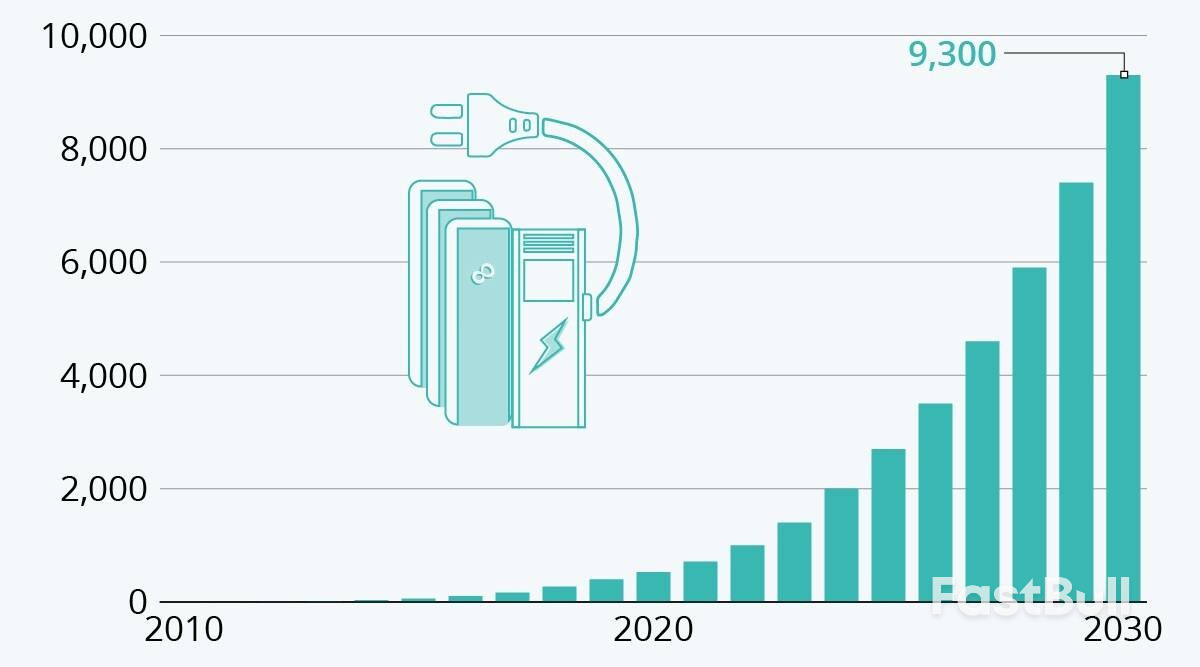
          The surge in electricity demand has increased the need for battery solutions. In particular, lithium is essential for batteries and energy storage systems that support solar and wind power. Furthermore, the rapid expansion of EVs and grid-level storage creates long-term structural demand. The lithium shortages can slow adoption and disrupt renewable integration. According to Statista, the chart below shows that the demand for lithium-ion batteries will reach 9,300 gigawatt-hours by 2030.
          Why Lithium, Copper, and Uranium Are Set to Soar in the Global Energy Transition_2
          On the other hand, copper is used in motors, charging stations, transformers, and transmission lines. The shift toward EVs and smart grids is driving a surge in copper demand. Without copper, clean energy infrastructure cannot scale. Grid upgrades in emerging economies also depend on a reliable copper supply.
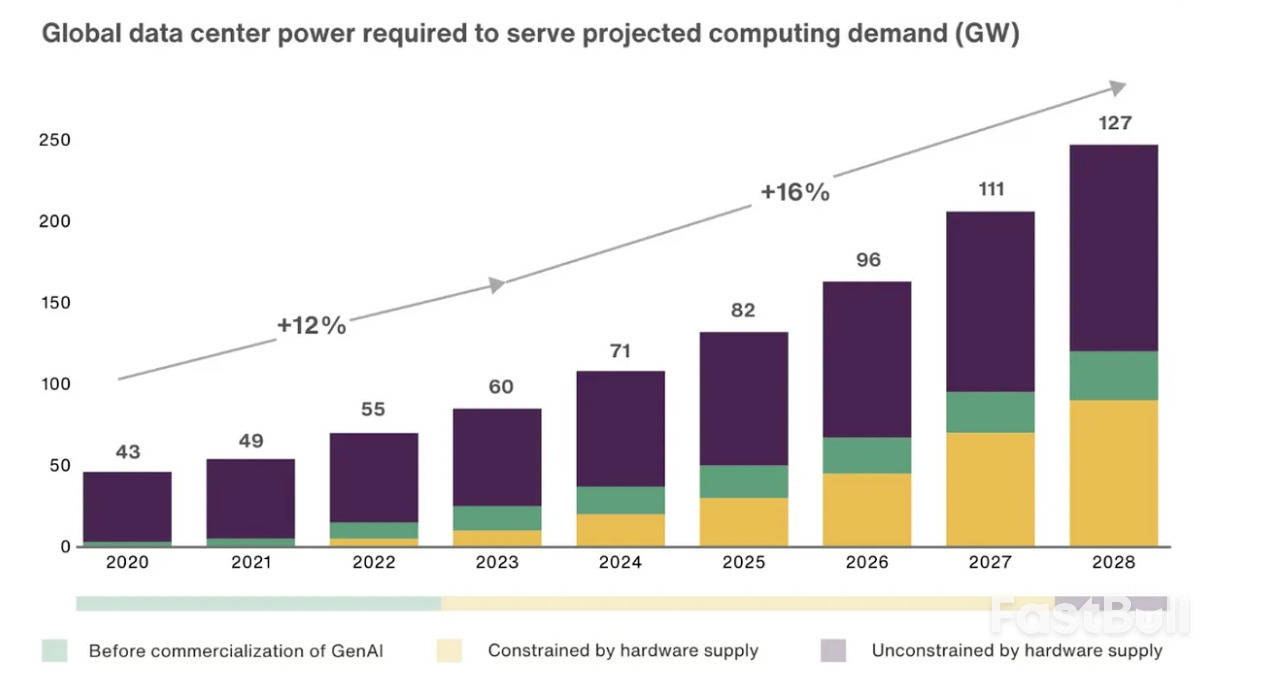
          According to the chart below, global data centre power demand is projected to reach 127 GW by 2028, mainly driven by generative AI workloads. As a result, this rapid growth in electricity needs strengthens the case for uranium. Unlike intermittent renewables, nuclear power offers a stable, carbon-free baseload source essential to supporting AI and digital infrastructure. Therefore, uranium ensures energy security in areas where renewables alone fall short.
          Why Lithium, Copper, and Uranium Are Set to Soar in the Global Energy Transition_3
          Lithium stores the power. Copper delivers it. Uranium keeps it steady. These three elements form the backbone of the electrified world. As electricity becomes the dominant force in global energy, the pace of the transition now hinges on the supply of electricity. Policymakers and investors are watching them closely as electricity becomes the world’s primary energy driver.
          Lithium Rebounds Sharply as Supply Tightens and EV Demand Surges
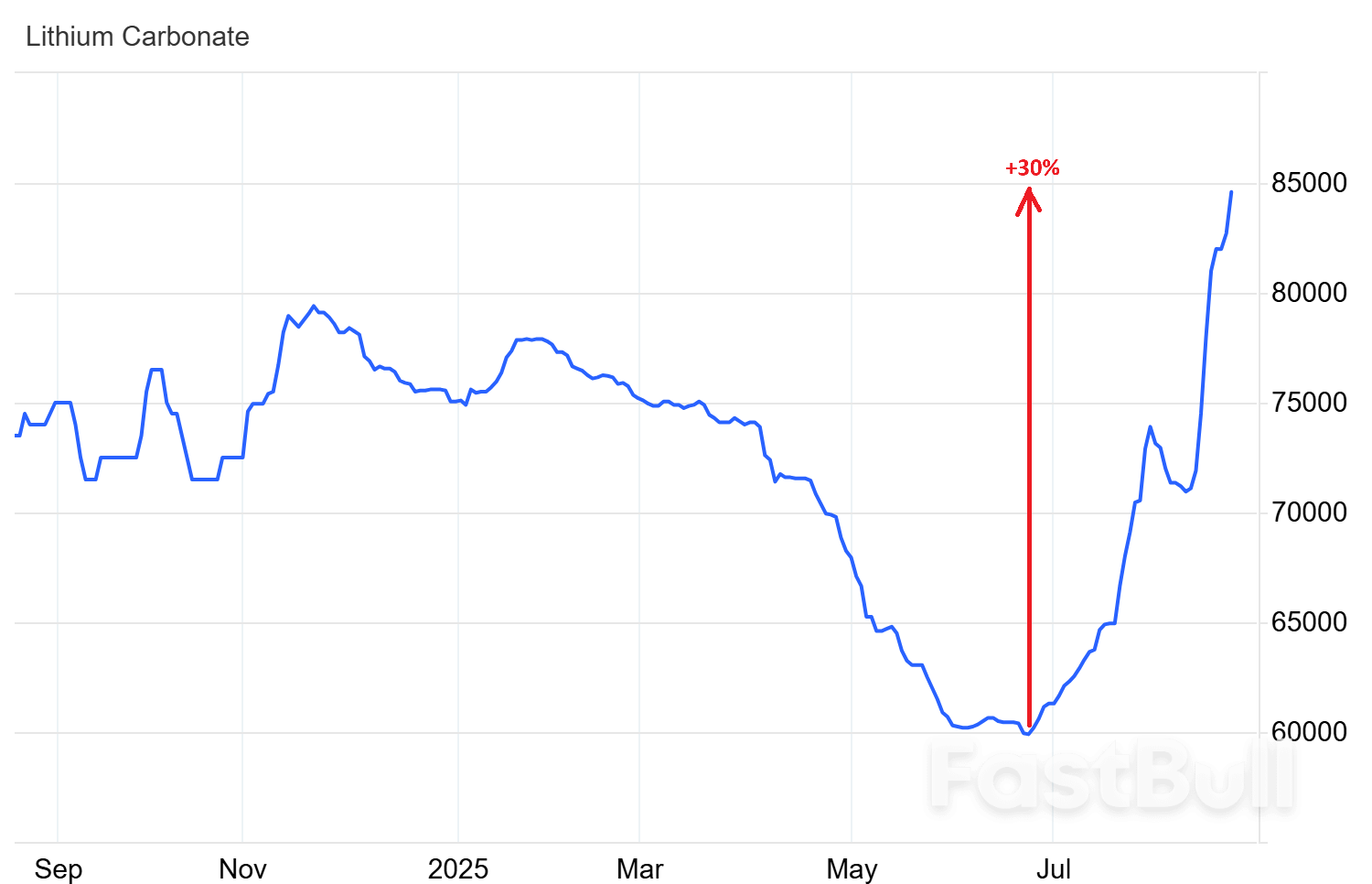
          Lithium carbonate prices jumped over CNY 84,000 per tonne in August, hitting a one-year high. This rally was over 30% after a rebound from the June bottom, which erased earlier losses for the year.
          Why Lithium, Copper, and Uranium Are Set to Soar in the Global Energy Transition_4Why Lithium, Copper, and Uranium Are Set to Soar in the Global Energy Transition_5
          The lower output from key mines helped offset oversupply concerns. China pledged to cut capacity in deflation-hit industries, signalling tighter lithium supply. Investors responded by betting on reduced output from the world’s top lithium refiner. This momentum was further increased after CATL halted production at its Jianxiawo mine, which lacked a renewed permit. The mine accounts for about 5% of global supply.
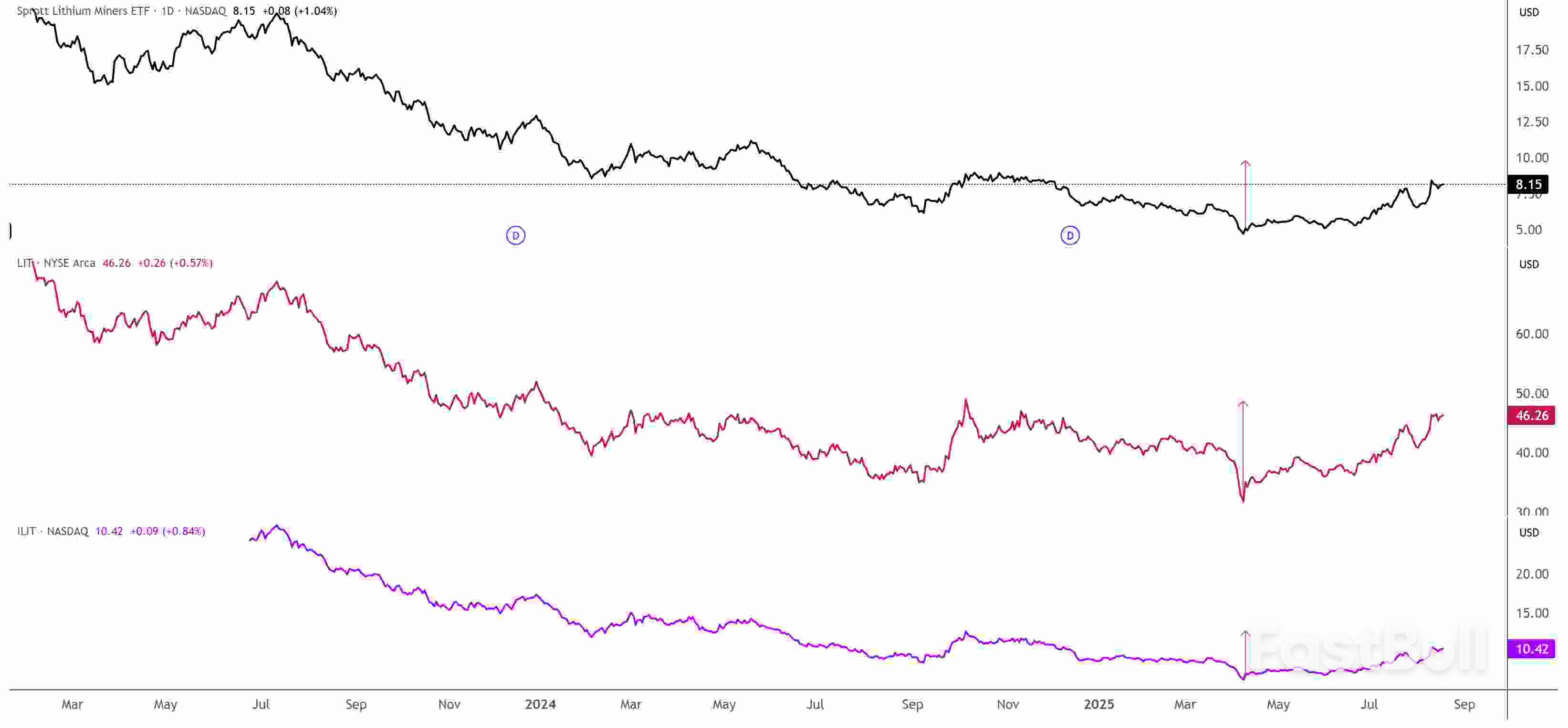
          The chart below compares the performance of three lithium-related ETFs: the Sprott Lithium Miners ETF (LITP), Global X Lithium & Battery Tech ETF (LIT), and iShares Lithium ETF (ILIT). All three ETFs experienced a prolonged downtrend from early 2023 through mid-2024, reflecting lithium market weakness. However, a noticeable rebound occurred around April–May 2025, shown by the upward arrows.
          Why Lithium, Copper, and Uranium Are Set to Soar in the Global Energy Transition_6
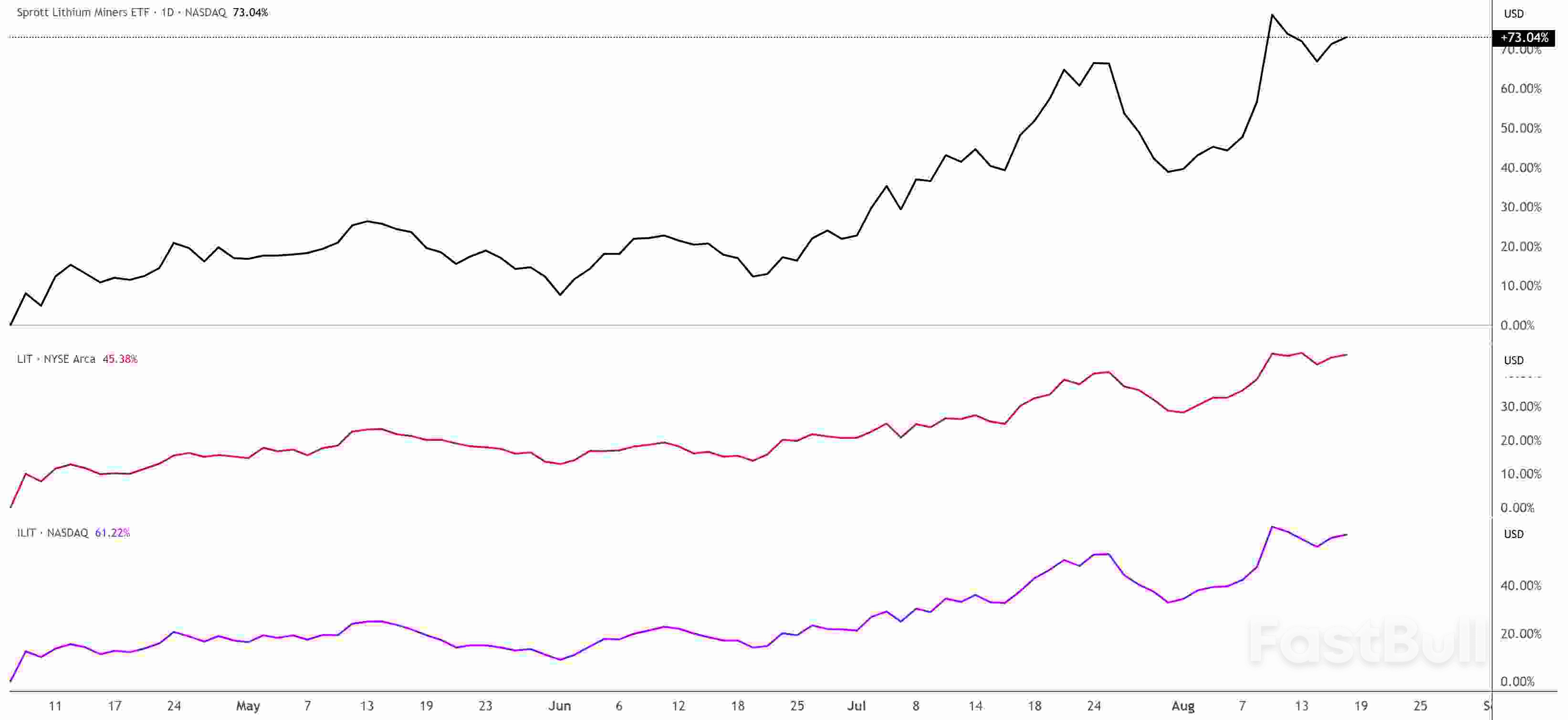
          It is observed that the Sprott Lithium Miners ETF led the rally with a 73% gain since the bottom in 2025. On the other hand, iShares Lithium ETF followed with a 61% rise, and the Global X Lithium & Battery Tech ETF climbed over 45%. The upward trend aligns with rising lithium prices, tightening supply expectations, and the growing demand from EVs and battery storage. As electrification accelerates, capital continues to rotate back into lithium assets.
          Why Lithium, Copper, and Uranium Are Set to Soar in the Global Energy Transition_7

          Copper’s Long-Term Uptrend Holds as Prices Reverse From Key Resistance

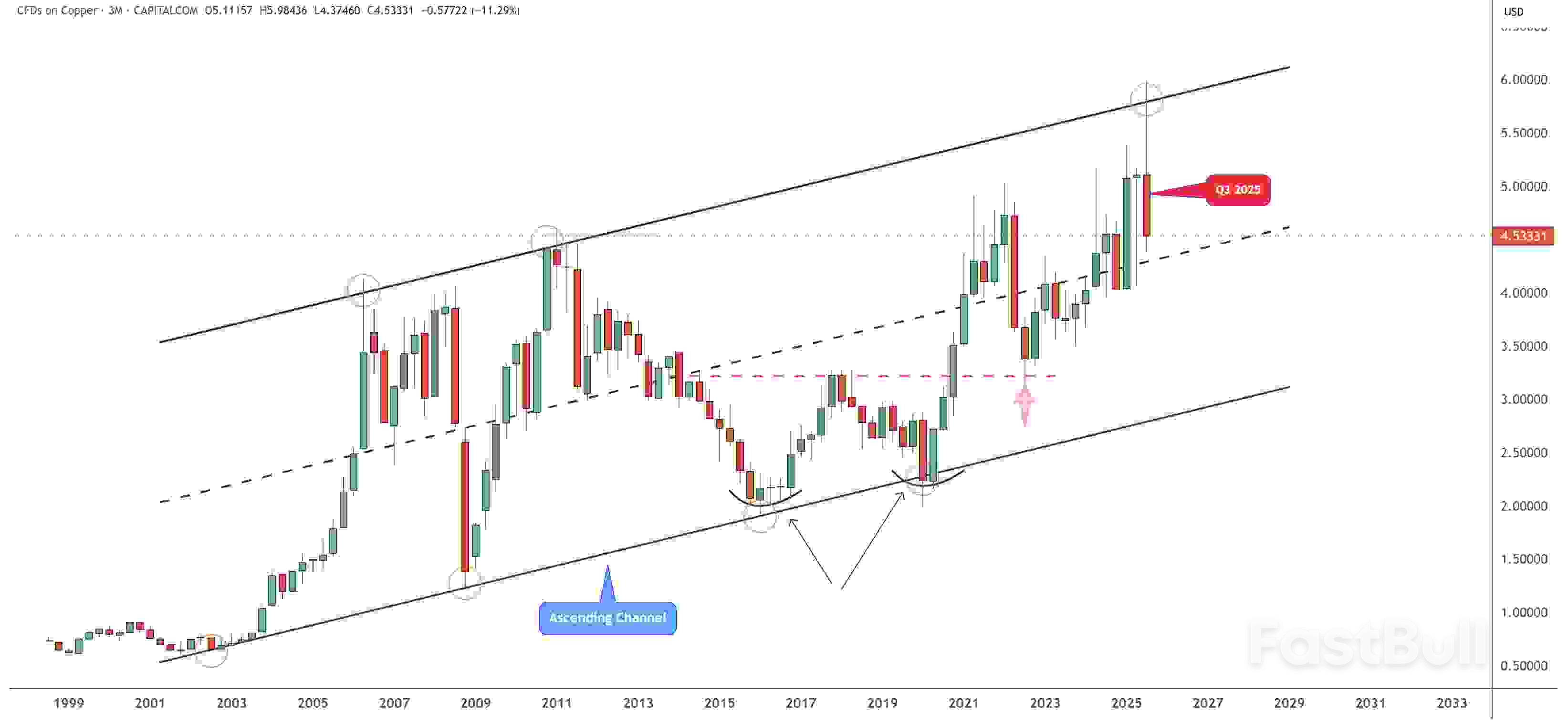
          The long-term outlook for copper is observed through the quarterly chart below. It shows that prices have been trending higher within an ascending channel. Each time the price touches the lower trendline, it recovers sharply.
          Why Lithium, Copper, and Uranium Are Set to Soar in the Global Energy Transition_8
          For example, copper bottomed in July 2002 at $0.65. It then surged to record highs by 2006. After this rally, prices dropped during the 2008 financial crisis to a low of $1.24. From there, copper rebounded and reached a high of $4.59 in 2011.
          After this peak, the price again dropped to form a double bottom in 2015 and 2019. Prices broke above the neckline at $3.29 and began a strong upward move. This rally reached a high in 2025 at the $5.98 area, followed by a sharp reversal in Q3 2025.
          This recent reversal in copper prices was due to the resistance of the ascending channel. However, the prices are now approaching the channel’s midline, suggesting possible volatility in the coming months.
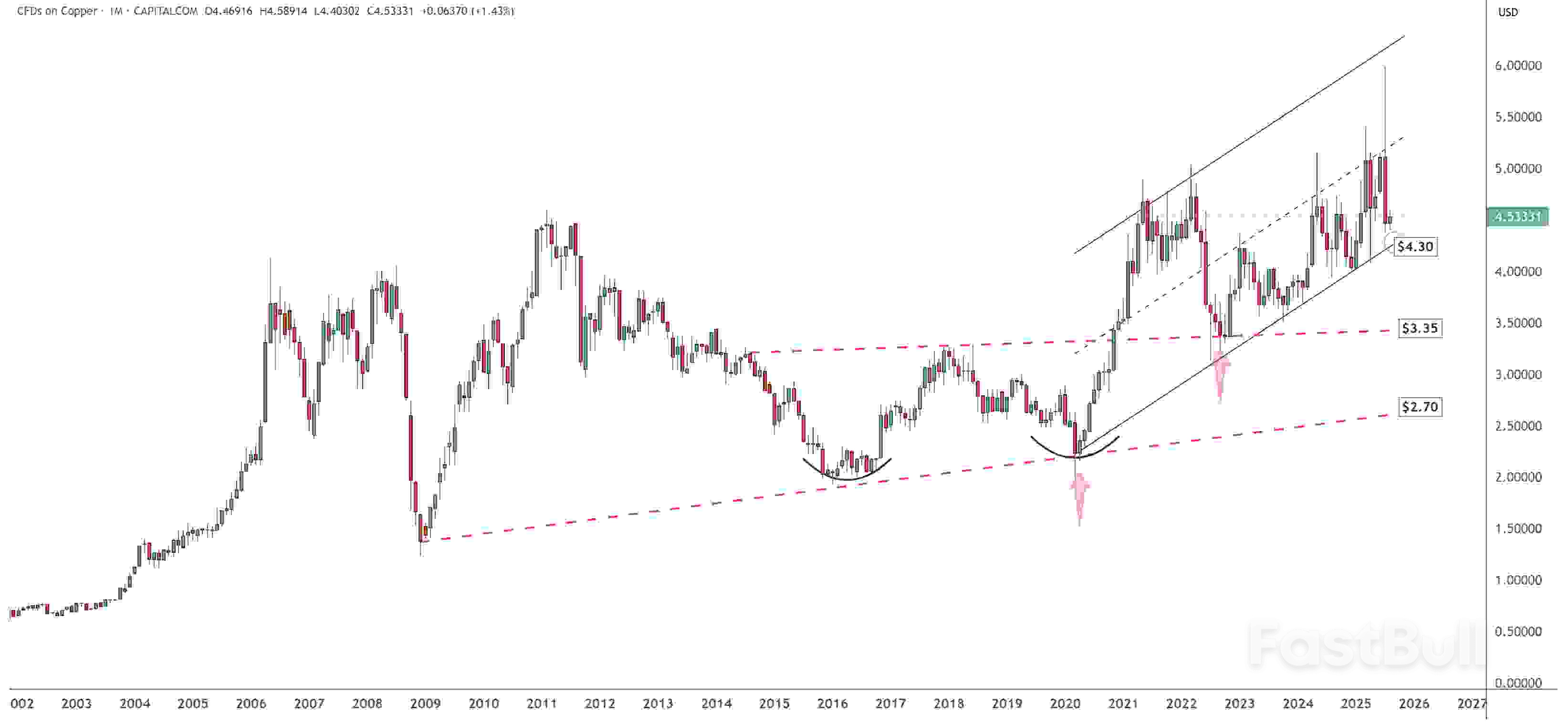
          To understand the bullish price action in copper, the monthly chart below highlights an ascending channel formed between the March 2020 low and the July 2025 high. This channel shows strong support at $4.30, and a break below this level could trigger a decline toward the $3.35 support area. However, the $2.70 zone remains the long-term support for copper, indicating strong buying pressure around that level.
          Why Lithium, Copper, and Uranium Are Set to Soar in the Global Energy Transition_9

          Uranium Rally Gains Strength on Supply Constraints and Data Centre Demand

          Uranium prices remain bullish and hold $71 per pound support in August. This level comes after a pullback from the June peak of $79, when holding funds paused their aggressive buying.
          The Sprott Physical Uranium Trust fueled the rally by committing $200 million for new uranium purchases, twice the amount first planned. However, uranium trades in a thin market; these large purchases had an outsized impact, sharply lifting prices and keeping momentum strong. This strong momentum is observed by the rounding cup pattern in the chart below, which indicates continued upward momentum.
          Why Lithium, Copper, and Uranium Are Set to Soar in the Global Energy Transition_10
          The short-term outlook for uranium is also bullish, as the chart below shows a rounding cup pattern on shorter time frames.
          Why Lithium, Copper, and Uranium Are Set to Soar in the Global Energy Transition_11

          Institutional Buying and Tech Giants Drive Momentum

          The support for uranium comes from rising demand expectations. Microsoft Corp (MSFT), Alphabet Inc. (GOOG), Amazon.com, Inc. (AMZN), and Meta Platforms. Inc. signed nuclear power supply deals to secure energy for future datacenters, signalling a structural shift in consumption. On the supply side, Kazatomprom confirmed output of 14 million pounds, nearly 20% below earlier targets, tightening the market further. French miner Orano also warned of a possible closure of its SOMAIR mine in Niger, adding to supply risks. This mix of firm demand and constrained output keeps uranium well-positioned for sustained gains.
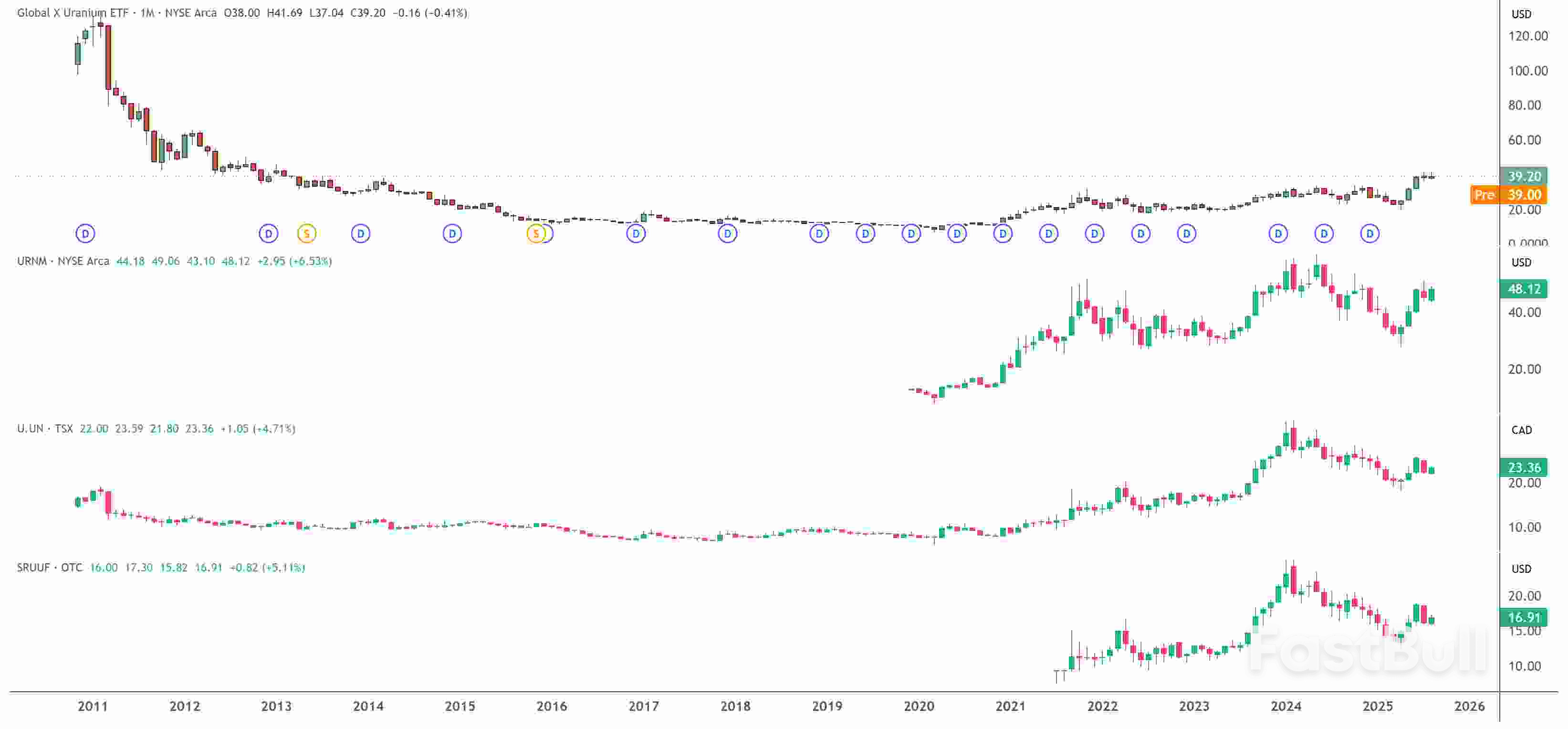
          The chart below shows the performance of various uranium-related instruments used by investors to gain exposure to the sector. Global X Uranium ETF (URA) has followed a long-term downtrend since 2011, falling from above $100 to below $20 before stabilising and gradually recovering toward $40. This ETF tracks a basket of uranium mining companies. Its movement reflects the prolonged bear market after the Fukushima disaster, followed by a renewed uptrend as nuclear energy gained momentum post-2020.
          Why Lithium, Copper, and Uranium Are Set to Soar in the Global Energy Transition_12
          Moreover, Sprott Uranium Miners ETF (URNM) shows intense volatility with higher highs since 2021, reflecting investor demand for miners leveraged to uranium prices. Sprott Physical Uranium Trust Fund (U.UN) and Sprott Physical Uranium Trust (SRUUF), which directly hold physical uranium, display steadier growth patterns, showing uranium’s gradual appreciation in spot markets since 2020. These instruments illustrate how uranium has moved from a decade-long slump into a period of structural recovery, driven by energy transition policies and renewed nuclear demand.

          Conclusion: Why Lithium, Copper, and Uranium Are Set to Soar

          The global energy transition is accelerating. Electricity demand is rising faster than overall energy use, driven by EVs, AI, data centres, and digitalisation. This shift creates structural demand for critical raw materials. Lithium, copper, and uranium form the foundation of this new energy economy. Investors should closely watch these markets as the next decade will be shaped by the race to secure these resources.
          Lithium, copper, and uranium offer a unique investment edge:
          Lithium powers EV batteries and grid storage. The prices rebounded sharply in 2025 due to tightening supply and strong demand. ETFs like LIT and LITP rallied over 70%, signalling investor confidence.
          Copper is essential for electrification. Copper demand is increasing due to the need for use in EV motors and the development of grid infrastructure. The long-term technical charts show an ascending channel, with prices bouncing strongly from key support levels.
          Uranium ensures stable, carbon-free baseload power. Tech giants are locking in nuclear deals to fuel AI data centres. Supply disruptions from Kazatomprom and Niger amplify its bullish outlook.
          From a technical perspective, all three commodities show solid foundations for long-term accumulation. Specifically, lithium-related ETFs are forming recovery patterns after multi-year bottoms. Meanwhile, copper has reversed from long-term support in the quarterly trend channel, pointing to structural upside. At the same time, uranium remains in breakout mode, supported by thin supply and rising institutional demand.
          Therefore, investors may consider buying copper at $4.30 levels and add more positions if the price drops to $3.35 and $2.70 levels. Moreover, uranium and lithium are considered strong buys at current levels. These materials are not just cyclical trades; they are strategic assets for the decade ahead.

          Source: fxempire

          Risk Warnings and Disclaimers
          You understand and acknowledge that there is a high degree of risk involved in trading. Following any strategies or investment methods may lead to potential losses. The content on the site is provided by our contributors and analysts for information purposes only. You are solely responsible for determining whether any trading assets, securities, strategy, or any other product is suitable for investing based on your own investment objectives and financial situation.
          Add to Favorites
          Share

          US Copper Firms Hike Prices Even After Trump Tariff Reprieve

          Manuel

          Commodity

          China–U.S. Trade War

          Major US producers of electrical wire are raising prices just weeks after a surprise decision by President Donald Trump to exempt the most basic copper imports from tariffs, suggesting that American consumers may end up paying more even after metal prices plunged.
          Southwire Co. LLC, one of the largest makers of copper wire and cable in the US, and Cerro Wire LLC, a wiremaker owned by Berkshire Hathaway Inc., in recent days announced price increases of 5% across a range of copper wire products, according to a Bloomberg calculation based on their published price sheets.
          US copper-processing plants are likely to be the primary beneficiaries of Trump’s shock tariff reprieve.
          The president’s decision to apply his 50% import tariff only to manufactured goods containing copper such as wires and cables, and not to unprocessed refined copper as widely expected, means companies like Southwire and Cerrowire will now be paying much less than they feared for the metal they purchase. At the same time, the import tariff on copper-containing goods raises costs for their international competitors shipping products to the US.
          And until the US builds more copper processing plants, the added cost on the hundreds of thousands of tons of copper-containing goods it imports each year is likely to be inflationary for US consumers despite a sharp drop in domestic prices for copper itself, analysts say.
          “While wire and cable prices are influenced by copper prices, they are not the same. The margin between the two can widen if local producers have more pricing power,” said Aisling Hubert, senior wire and cable analyst at consultancy CRU Group. The tariff means that US producers will have the upper hand in price negotiations with their customers, she said.
          It’s not clear whether the price increases were a direct response to the tariff decision, and it’s likely to take some time before the full effects on the market are clear.
          Domestic prices for copper wire and cable — used in almost every building, electronic device, and power utility — had already risen sharply before Trump’s decision, according to US government data. An index of prices that forms part of the calculation of producer price inflation hit a record high in July, up 12% from a year earlier.
          Neither Southwire nor Cerrowire responded to requests for comment. Southwire, which is one of the largest importers of refined copper into the US, lobbied against tariffs on refined copper imports in a letter to the Department of Commerce earlier this year.
          Massimo Battaini, chief executive of Prysmian SpA, which together with Southwire dominates the US wire and cable market, said the tariff decision had been a relief and would likely mean higher profits for his company.
          Speaking on a conference call with analysts the day after the announcement, he said: “Local producers, like we are, will benefit from cost of cables imported from overseas much higher than today. So this will certainly benefit our guidance, our forecast for the full year.”
          The US imported 810,000 tons of unprocessed copper last year, accounting for 45% of the country’s consumption of 1.8 million tons, according to US Geological Survey data.
          While those imports are spared from tariffs, the US also imports hundreds of thousands of tons of copper-containing goods, which are now set to be subject to 50% duties. That includes semi-processed products like copper rod, pipe, tube and sheet, and finished goods like cables. Of the total US cable demand last year, 23% was met by imports.

          Domestic Capacity

          To be sure, US companies may invest in more domestic capacity to replace imports, reducing the inflationary effect of the tariff. Cable imports would be “difficult to replace in the short term” but new capacity for low-voltage cable can be built in 1-2 years, said Hubert at CRU.
          What’s more, there’s significant uncertainty about how broadly the tariffs will be applied. It isn’t clear whether imports from Canada and Mexico, two of the main sources of imports of copper products, would be exempt from the new tariffs under the free trade agreement between the three countries, according to Hubert. For wire rod, an intermediate copper product which is used to make electrical cable, the US sources most of its supplies domestically but relies on imports from Canada and Mexico for 17% of consumption.
          Analyst at JPMorgan Chase & Co. said that the US was significantly less dependent on imports of copper products than on refined copper, making the buildout of additional domestic capacity “likely relatively achievable in the coming years.” Still, they predicted “higher end-use prices” in the meantime.
          Peter Schmitz, director of global copper markets research at Wood Mackenzie, said that copper accounted for about two thirds of the cost of a cable and 20%-30% of the cost of an electrical motor.
          “Is it inflationary? Yes it is,” he said of the tariffs. “Ultimately somebody pays; that is going to be the American consumer.”

          Source: Bloomberg

          Risk Warnings and Disclaimers
          You understand and acknowledge that there is a high degree of risk involved in trading. Following any strategies or investment methods may lead to potential losses. The content on the site is provided by our contributors and analysts for information purposes only. You are solely responsible for determining whether any trading assets, securities, strategy, or any other product is suitable for investing based on your own investment objectives and financial situation.
          Add to Favorites
          Share

          This 15% Dividend May See Big Upside With Fed Rate Cuts

          Adam

          Economic

          Could the Fed cut rates—and actually cause interest rates to rise?
          Absolutely. In fact, it’s a setup I see as very much in play. Today we’re going to talk about a 15%-yielding (!) stock that’s well-positioned to benefit.

          Powell Vs. the 10-Year, Round 2

          How would this “rate split” come about? To get at that, we need to bear in mind that the Fed only controls the effective Federal funds rate. That’s the “short” end of the yield curve—or the rate at which financial institutions lend to each other.
          Meantime, the “long” end—pacesetter for consumer and business loans (including mortgages—more on those shortly) is tied to the 10-year Treasury yield—and has a mind of its own.
          This wouldn’t be the first time the 10-year has called out Jay Powell. Last September, the Fed cut rates for the first time since 2020, after hiking to counter the 2022 inflation spike.
          The bond market was having none of it. Even as the Fed cut, 10-year Treasury rates jumped, sending Powell a clear message: Slow your roll.
          Powell Gives the “All-Clear.” Bond Market Says “Not So Fast”
          This 15% Dividend May See Big Upside With Fed Rate Cuts_1
          When the Fed cut rates, it ironically sparked a rally in long yields. Once Powell backed off, leaving the Fed’s rate where it is now, the 10-year yield steadied, too.
          History doesn’t repeat, as the saying goes, but it does rhyme. As I write this, inflation is still above target. But even so, July’s CPI report came in below expectations. That’s another point in favor of a lower Fed rate—and a higher 10-year Treasury rate.
          And yes, producer prices did jump in July, and tariffs likely played a role. But as we’ve written before, recent studies have found that tariffs are not inflationary, because rising prices depend on a hot economy. A trade war brings in the opposite, since tariffs are a short-term headwind on growth.
          And don’t forget that Powell’s term ends in nine months, and whoever the administration appoints is likely to cut quickly—inflation or no.
          Mortgage REITs Borrow “Short” and Lend “Long”
          In my August 5 article, we looked at business development companies (BDCs) as contrarian plays on this “rate split.” But there are other options, like mortgage REITs (mREITs).
          When most people think of REITs, they think of equity REITs—landlords of buildings, such as warehouses and apartments. mREITs deal in paper—buying mortgage loans and collecting the interest.
          They make money by borrowing at short-term rates to buy mortgages that pay income tied to long-term rates. The profit is in the difference, so management always wants short-term rates to be lower than long-term ones (which they typically are).
          Moreover, the value of these loans gets a nice bump when short-term rates decline and long-term rates hold steady or, better yet, move lower. That’s because lower rates mean mREITs’ mortgages—issued when rates were higher—yield more than newly issued ones, so they’re worth more.
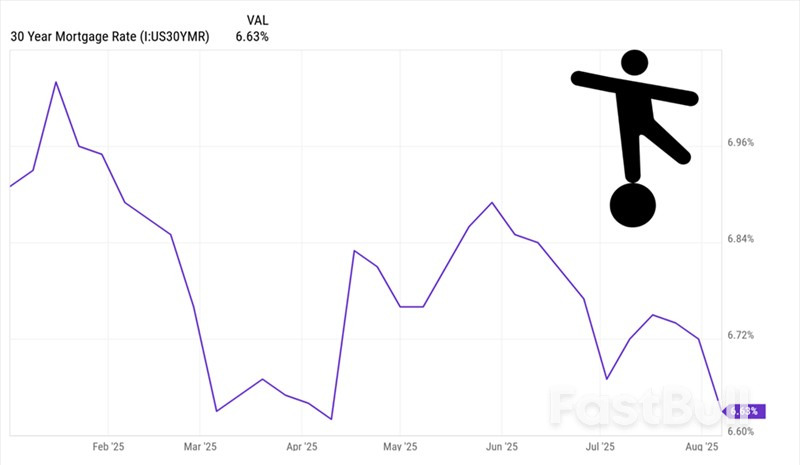
          That, in a nutshell, is the setup we’re looking at now. Look at this chart of 30-year mortgage rates. You can see they’re drifting lower now, but not quickly enough to encourage a wave of refinancing or prepayments. The sweet spot for mREITs!
          30-Year Mortgages Edge Lower, Boosting mREITs’ Loan Values
          This 15% Dividend May See Big Upside With Fed Rate Cuts_2
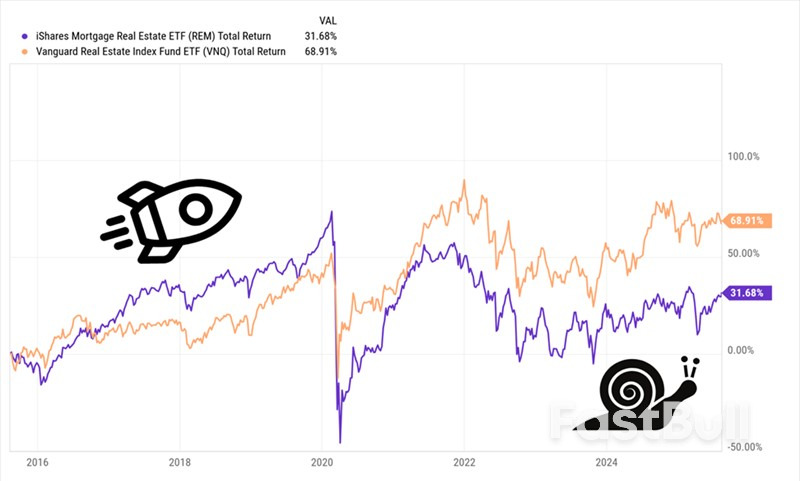
          This comes at a time when mREITs, as measured by the iShares Mortgage ETF (NYSE:REM), in purple below, have lagged the REIT pack, as measured by the Vanguard Real Estate Index Fund (NYSE:VNQ), in orange.
          mREITs Lag the Field, Tee Up an Opportunity
          This 15% Dividend May See Big Upside With Fed Rate Cuts_3
          However, as you can also see toward the left of the chart above, mREITs have outperformed for long stretches, such as during the low-rate 2010s. In the coming months, with the gap between mREITs and REITs as a whole still wide and the Fed set to lower rates, we’ve got a nice setup for another run of mREIT outperformance.
          To add an extra layer of safety, we’re going to focus on an mREIT dealing in “agency” mortgage-backed securities (MBS)—those guaranteed by Fannie Mae (OTC:FNMA), Freddie Mac (OTC:FMCC) and Ginnie Mae.
          A 15% Dividend About to Get “Backup” From the Fed
          That would be AGNC Investment Corp. (NASDAQ:AGNC), which yields 15% now. It buys MBS (often through repurchase agreements) and profits off the spread between its loan cost and the yield these assets deliver. Its profits are easy to spot: In the second quarter, its average asset yield was 4.87%, while its average repo cost was 4.44%, down slightly from Q1.
          Falling short-term rates would cut its repo costs almost immediately, further widening this spread (and boosting AGNC’s profits). The mREIT did post a modest loss in Q2, but we love the fact that management added to its assets at attractive prices as a result of the April “tariff terror”:
          This 15% Dividend May See Big Upside With Fed Rate Cuts_4
          Now let’s talk about that 15% dividend. As you can see below, management cut the payout (in purple) when the Fed hiked rates (in orange) through to the end of 2019 and into the COVID lockdown period. We’d expect that, as rising rates boosted repo costs and COVID uncertainty—especially in the early days—put the real estate market on ice.
          But look to the right and you’ll see that AGNC did hold the line on the dividend as the Fed drove rates higher in response to the inflation surge of 2022/2023. That’s a great sign—and shows the payout likely got an assist from the hedging programs AGNC uses to cut its rate risk:
          Dividend Falls Heading Into COVID, But Holds Up in 2022 Dumpster Fire
          This 15% Dividend May See Big Upside With Fed Rate Cuts_5
          Now that the Fed looks to be headed back into cutting mode, the dividend should get some extra backup on lower borrowing costs. Going forward, analysts have the mREIT pegged for $1.60 per share in earnings for this fiscal year. The dividend—$0.12 per month for a total of $1.44 annually—accounts for 90% of that.
          That is a bit high, but bear in mind that a falling Fed funds rate would add to profits and therefore reduce that number. It may even open the door to a dividend increase, especially if 10-year Treasury rates hold steady or gradually move lower, as I expect.
          Finally, as I write this, AGNC trades at 1.1-times book value and six times forward earnings. A wider gap between the Fed rate and 10-year Treasury yield would boost both numbers—putting a lift under the share price as it does.

          Source: investing

          To stay updated on all economic events of today, please check out our Economic calendar
          Risk Warnings and Disclaimers
          You understand and acknowledge that there is a high degree of risk involved in trading. Following any strategies or investment methods may lead to potential losses. The content on the site is provided by our contributors and analysts for information purposes only. You are solely responsible for determining whether any trading assets, securities, strategy, or any other product is suitable for investing based on your own investment objectives and financial situation.
          Add to Favorites
          Share

          Hamas Agrees To Ceasefire-Hostage Release Deal With Israel

          Kevin Du

          Political

          Hamas has agreed to a new proposal for a ceasefire-hostage release deal with Israel.

          The “comprehensive two-stage plan” was based on a framework advanced by US envoy Steve Witkoff and presented to Hamas by Qatari and Egyptian mediators, according to the BBC.

          It would see Hamas free around half of the 50 remaining Israeli hostages – 20 of whom are believed to be alive – in two stages during a 60-day temporary truce.

          During that time, there would be negotiations on a permanent ceasefire and an Israeli troop withdrawal.

          The Egyptian and Qatari mediators reportedly met with Hamas representatives Sunday in Cairo, and presented them with the plan.

          In a post on Facebook Monday, Hamas leader Basem Naim said Hamas and other Palestinian terror groups had agreed to the deal:

          “The movement has submitted its response approving the new mediators’ proposal,” Naim wrote in Arabic.

          “We pray to God to extinguish the fire of this war against our people.”

          The deal was reached ahead of a major Israeli offensive to occupy Gaza City and just hours after President Donald Trump said Hamas needed to be “confronted and destroyed,” Axios noted.

          “We will only see the return of the remaining hostages when Hamas is confronted and destroyed!!!,” Trump posted on Truth Social Monday morning.

          “The sooner this takes place, the better the chances of success will be. Remember, I was the one who negotiated and got hundreds of hostages freed and released into Israel (and America!). I was the one who ended 6 wars, in just 6 months. I was the one who OBLITERATED Iran’s Nuclear facilities. Play to WIN, or don’t play at all!”

          The plan is reportedly “98 percent similar” to the last U.S.-backed proposal, but the deal fell though when Hamas refused to sign on.

          Hamas said at the time that it would only free the remaining hostages if Israel agreed to end the 22-month war. But Netanyahu said that would only happen once Hamas was disarmed and released all the hostages.

          On Sunday, more than 200,000 Israelis took to the streets to demand Netanyahu not launch the new offensive in Gaza, and instead sign a deal to bring back the hostages. It was the biggest anti-war protest since the beginning of the war, according to Axios.

          The Gaza War began in response to Hamas’ surprise attack in southern Israel on 7 October 2023.

          The terrorists killed about 1,200 people—mostly civilians—in the attack, and took another 251 hostage.

          Source: Zero Hedge

          Risk Warnings and Disclaimers
          You understand and acknowledge that there is a high degree of risk involved in trading. Following any strategies or investment methods may lead to potential losses. The content on the site is provided by our contributors and analysts for information purposes only. You are solely responsible for determining whether any trading assets, securities, strategy, or any other product is suitable for investing based on your own investment objectives and financial situation.
          Add to Favorites
          Share

          Oil Prices Fall As Traders Bet Russia Sanctions Could End Soon

          Devin

          Economic

          Commodity

          Oil prices fell on Tuesday as traders thought a possible cease-fire in Russia's war with Ukraine might lead to easing or the end to sanctions on Russian crude oil, which would in turn boost global supply.

          Brent crude futures were down 50 cents, or 0.75%, at $66.10 a barrel at 10:38 a.m. CDT (1538 GMT). U.S. West Texas Intermediate crude futures for September delivery, set to expire on Wednesday, were down 72 cents, or 1.14%, at $62.70 per barrel.

          The more active October WTI contract was down 66 cents, or 1.05%, at $62.04 a barrel.

          "Even with this peace dividend, we have a record short position," said Phil Flynn, senior analyst with Price Futures Group. "Because of the size of the short position, people are betting on a cease-fire and if we don't get one there could be a bounce."

          Following a White House meeting on Monday with Ukrainian President Volodymyr Zelenskiy and European allies, U.S. President Donald Trump announced in a social media post that he had spoken with Russian President Vladimir Putin.

          Trump said arrangements were being made for a meeting between Putin and Zelenskiy, which could lead to a trilateral summit involving all three leaders.

          Suvro Sarkar, lead energy analyst at DBS Bank, said Trump's softened stance on secondary sanctions targeting importers of Russian oil had reduced the risk of global supply disruptions, easing geopolitical tensions slightly.

          Chinese refineries have purchased 15 cargoes of Russian oil for October and November delivery as Indian demand for Moscow's exports has fallen away, two analysts and one trader said on Tuesday.

          Zelenskiy described his talks with Trump as "very good" and noted discussions about potential U.S. security guarantees for Ukraine. Trump confirmed the U.S. would provide such guarantees, though the extent of support remains unclear.

          Trump has pressed for a quick end to Europe's deadliest war in 80 years, but Kyiv and its allies worry he could seek to force an agreement on Russia's terms.

          "An outcome which would see a ratcheting down of tensions and remove threats of secondary tariffs or sanctions would see oil drift lower toward our $58 per barrel Q4-25/Q1-26 average target," Bart Melek, head of commodity strategy at TD Securities, said in a note.

          Source: Reuters

          To stay updated on all economic events of today, please check out our Economic calendar
          Risk Warnings and Disclaimers
          You understand and acknowledge that there is a high degree of risk involved in trading. Following any strategies or investment methods may lead to potential losses. The content on the site is provided by our contributors and analysts for information purposes only. You are solely responsible for determining whether any trading assets, securities, strategy, or any other product is suitable for investing based on your own investment objectives and financial situation.
          Add to Favorites
          Share

          Stocks Making The Biggest Moves Midday: Home Depot, Intel, Nvidia And More

          Olivia Brooks

          Economic

          Stocks

          These are some of the stocks making the biggest moves in midday trading Tuesday.

          Viking Therapeutics, shares tumbled 42% after phase 2 trial results showed Viking's experimental oral obesity drug had more side effects than expected. About 20% of the patients in the trial quit using the drug due to symptom such as nausea and vomiting. On average, patients lost 12% of their starting weight after 13 weeks.

          Target Hospitality, the temporary workforce housing play jumped around 6%. On Monday, Stifel upgraded Target Hospitality to buy from hold, dubbing it a "back door data center play" and lifting its target price to $11 from $7.50.

          The new target price suggests about 37% upside from Monday's close. Nvidia , Advanced Micro Devices and Palantir Technologies: investors took profits in some of this year's high-flying tech stocks. Nvidia shares dropped nearly 3%, while AMD fell close to 5%. Palantir lost 7%.

          Strategy , Robinhood and Mara Holdings: crypto-linked stocks dipped on Tuesday as bitcoin pulled back more than 2%. Bitcoin proxy Strategy and trading app maker Robinhood fell roughly 6% each. Bitcoin miners Mara Holdings and Riot Platforms lost more than 5% and 2%, respectively.

          UnitedHealth, the health insurance giant slid more than 2% following back-to-back winning days. The stock had seen a recent resurgence after Warren Buffett revealed a stake of 5 million shares in UnitedHealth, valued at about $1.6 billion. On Friday, the stock posted a nearly 12% advance for its best day since 2020.

          Intel, shares of the chipmaker jumped more than 6% after it was announced that SoftBank will make a roughly $2 billion investment in the company, paying $23 per share for Intel's common stock. This comes as the U.S. government reportedly has been considering taking a stake in Intel.

          Palo Alto Networks, the cybersecurity stock gained more than 3% after the company's fiscal fourth-quarter results topped Wall Street's expectations. Palo Alto also posted better-than-expected guidance for the first quarter and full year and announced that its founder and chief technology officer, Nir Zuk, is retiring.

          Fabrinet, the electronic manufacturing services company dropped 10%. Fiscal fourth quarter adjusted earnings of $2.65 per share just barely beat the $2.64 per share that analysts polled by FactSet were expecting. Revenue of $909.7 million topped the consensus estimate of $883.1 million. Additionally, the company announced upbeat earnings and revenue guidance for the first quarter.

          Viking Holdings, shares fell nearly 2% after the cruise operator posted its quarterly results. Viking's second-quarter adjusted earnings of 99 cents per share came in line with analysts' expectations, according to FactSet, while its revenue for the quarter of $1.88 billion beat the $1.85 billion that was anticipated. The company also said it plans to take delivery of six river vessels during the rest of this year.

          Best Buy, the consumer electronics retailer rose 3% following the launch of its third-party marketplace , which will expand its product offerings to shoppers.

          Xpeng, U.S. shares of the Chinese electric car startup popped 5% on the heels of the company posting a smaller-than-expected loss for the second quarter, per FactSet. Its revenue for the period also topped analysts' estimates.

          Tegna, shares climbed 4%. Television broadcaster Nexstar Media and Tegna announced Tuesday that Nexstar has agreed to acquire Tegna for $3.54 billion . The deal is expected to close by the second half of next year.

          Home Depot, shares of the home improvement retailer added 3%. Despite the company missing on both lines for the first time since 2014, it maintained its full-year outlook.

          Source: CNBC

          To stay updated on all economic events of today, please check out our Economic calendar
          Risk Warnings and Disclaimers
          You understand and acknowledge that there is a high degree of risk involved in trading. Following any strategies or investment methods may lead to potential losses. The content on the site is provided by our contributors and analysts for information purposes only. You are solely responsible for determining whether any trading assets, securities, strategy, or any other product is suitable for investing based on your own investment objectives and financial situation.
          Add to Favorites
          Share

          Analysts downplay AI bubble worries as Altman says some investors will be left ‘very burnt’

          Adam

          Economic

          The artificial intelligence boom that Sam Altman helped ignite with ChatGPT in late 2022 is starting to make even him uneasy.
          Startups with little more than a pitch deck are raising hundreds of millions. Valuations have become “insane.” Capital is chasing a “kernel of truth” with feverish speed.
          The OpenAI CEO still believes the long-term societal upside of AI will outweigh the froth, and he’s ready to keep spending in pursuit of that goal.
          “Are we in a phase where investors as a whole are overexcited about AI? My opinion is yes,” he said at a recent dinner with reporters. “Is AI the most important thing to happen in a very long time? My opinion is also yes.”
          He repeated the word ’bubble’ three times in 15 seconds, then half-joked, “I’m sure someone’s gonna write some sensational headline about that. I wish you wouldn’t, but that’s fine.”
          While Altman warned that valuations are now out of control, he’s ready to shell out on more infrastructure.
          “You should expect OpenAI to spend trillions of dollars on datacenter construction in the not very distant future,” Altman said. “And you should expect a bunch of economists wringing their hands, saying, ‘This is so crazy, it’s so reckless,’ and we’ll just be like, ‘You know what? Let us do our thing.’”
          OpenAI is already looking beyond Microsoft
          Azure’s cloud capacity, and is shopping around for more.
          The company signed a deal with Google Cloud this spring and, according to Altman, OpenAI is “beyond the compute demand” of what any one hyperscaler can offer.
          “You should expect us to take as much compute as we can,” he added. “Our bet is, our demand is going to keep growing, our training needs are going to keep going, and we will spend maybe more aggressively than any company who’s ever spent on anything ahead of progress, because we just have this very deep belief in what we’re seeing.”
          It’s not just OpenAI. All the megacaps are trying to keep up.
          In their most recent earnings, tech’s biggest names all raised capital expenditure guidance to keep pace with AI demand: Microsoft is now targeting $120 billion in full-year capital expenditures, Amazon
          is topping $100 billion, Alphabet raised its forecast to $85 billion, and Meta lifted the high end of its capex range to $72 billion.
          Wedbush’s Dan Ives said Monday on CNBC’s “Closing Bell” that demand for AI infrastructure has grown 30% to 40% in the last months, calling the capex surge a validation moment for the sector.
          Ives acknowledged “some froth” in parts of the market, but said the AI revolution with autonomous is only starting to play out and we are in the “second inning of a nine-inning game.”
          “The actual impact over the medium and long term is actually being underestimated,” he said.
          Citi’s Rob Rowe, speaking Monday on CNBC’s “Money Movers,” pushed back on comparisons between today’s AI boom and the dotcom bubble.
          “Back then, you had a lot of over-leveraged situations. You didn’t have a lot of companies that had earnings,” Rowe said. “Here you’re talking about companies that have very solid earnings, very strong cash flow, and they’re funding a lot of this growth through that cash flow. So in many respects, it’s a little different than that.”
          He added that the current wave of AI investment is being driven by structural shifts in the global economy, particularly the rapid growth of digital services, which now account for a large share of global exports. Also unlike the dotcom cycle of the late 90s, companies today are funding their infrastructure spending with strong cash flow rather than relying on debt.
          Still, concerns about overheating have been mounting.
          Alibaba co-founder Joe Tsai pointed to worrying signs in the AI sector well before the hyperscalers raised their annual capex guidance during the latest earnings prints.
          In March, he warned of a brewing AI bubble in the U.S.
          Speaking at HSBC’s Global Investment Summit in Hong Kong, Tsai said he was astounded by the scale of datacenter spending under discussion. Tsai questioned whether hundreds of billions in spending is necessary, and flagged concern about companies starting to build datacenters “on spec,” without clear demand.
          Altman, for his part, sees these cycles as part of the natural rhythm of technological progress.
          The dotcom crash wiped out scores of companies, but still gave rise to the modern internet. He expects AI to follow a similar path: a few high-profile wipeouts, followed by a lasting transformation.
          “I do think some investors are likely to get very burnt here, and that sucks. And I don’t want to minimize that,” he said. “But on the whole, it is my belief that... the value created by AI for society will be tremendous.”

          Source: cnbc

          To stay updated on all economic events of today, please check out our Economic calendar
          Risk Warnings and Disclaimers
          You understand and acknowledge that there is a high degree of risk involved in trading. Following any strategies or investment methods may lead to potential losses. The content on the site is provided by our contributors and analysts for information purposes only. You are solely responsible for determining whether any trading assets, securities, strategy, or any other product is suitable for investing based on your own investment objectives and financial situation.
          Add to Favorites
          Share
          FastBull
          Copyright © 2025 FastBull Ltd

          728 RM B 7/F GEE LOK IND BLDG NO 34 HUNG TO RD KWUN TONG KLN HONG KONG

          TelegramInstagramTwitterfacebooklinkedin
          App Store Google Play Google Play
          Products
          Charts

          Chats

          Q&A with Experts
          Screeners
          Economic Calendar
          Data
          Tools
          Membership
          Features
          Function
          Markets
          Copy Trading
          Latest Signals
          Contests
          News
          Analysis
          24/7
          Columns
          Education
          Company
          Careers
          About Us
          Contact Us
          Advertising
          Help Center
          Feedback
          User Agreement
          Privacy Policy
          Business

          White Label

          Data API

          Web Plug-ins

          Poster Maker

          Affiliate Program

          Risk Disclosure

          The risk of loss in trading financial instruments such as stocks, FX, commodities, futures, bonds, ETFs and crypto can be substantial. You may sustain a total loss of the funds that you deposit with your broker. Therefore, you should carefully consider whether such trading is suitable for you in light of your circumstances and financial resources.

          No decision to invest should be made without thoroughly conducting due diligence by yourself or consulting with your financial advisors. Our web content might not suit you since we don't know your financial conditions and investment needs. Our financial information might have latency or contain inaccuracy, so you should be fully responsible for any of your trading and investment decisions. The company will not be responsible for your capital loss.

          Without getting permission from the website, you are not allowed to copy the website's graphics, texts, or trademarks. Intellectual property rights in the content or data incorporated into this website belong to its providers and exchange merchants.

          Not Logged In

          Log in to access more features

          FastBull Membership

          Not yet

          Purchase

          Become a signal provider
          Help Center
          Customer Service
          Dark Mode
          Price Up/Down Colors

          Log In

          Sign Up

          Position
          Layout
          Fullscreen
          Default to Chart
          The chart page opens by default when you visit fastbull.com