• Trade
  • Markets
  • Copy
  • Contests
  • News
  • 24/7
  • Calendar
  • Q&A
  • Chats
Trending
Screeners
SYMBOL
LAST
BID
ASK
HIGH
LOW
NET CHG.
%CHG.
SPREAD
SPX
S&P 500 Index
6805.80
6805.80
6805.80
6861.30
6801.50
-21.61
-0.32%
--
DJI
Dow Jones Industrial Average
48301.61
48301.61
48301.61
48679.14
48285.67
-156.43
-0.32%
--
IXIC
NASDAQ Composite Index
23059.33
23059.33
23059.33
23345.56
23012.00
-135.83
-0.59%
--
USDX
US Dollar Index
97.950
98.030
97.950
98.070
97.740
0.000
0.00%
--
EURUSD
Euro / US Dollar
1.17457
1.17466
1.17457
1.17686
1.17262
+0.00063
+ 0.05%
--
GBPUSD
Pound Sterling / US Dollar
1.33668
1.33675
1.33668
1.34014
1.33546
-0.00039
-0.03%
--
XAUUSD
Gold / US Dollar
4302.45
4302.79
4302.45
4350.16
4285.08
+3.06
+ 0.07%
--
WTI
Light Sweet Crude Oil
56.416
56.446
56.416
57.601
56.233
-0.817
-1.43%
--

Community Accounts

Signal Accounts
--
Profit Accounts
--
Loss Accounts
--
View More

Become a signal provider

Sell trading signals to earn additional income

View More

Guide to Copy Trading

Get started with ease and confidence

View More

Signal Accounts for Members

All Signal Accounts

Best Return
  • Best Return
  • Best P/L
  • Best MDD
Past 1W
  • Past 1W
  • Past 1M
  • Past 1Y

All Contests

  • All
  • Trump Updates
  • Recommend
  • Stocks
  • Cryptocurrencies
  • Central Banks
  • Featured News
Top News Only
Share

Russian Troops Control All Of Kupiansk - IFX Cites Russian Military

Share

On Monday (December 15), The South Korean Won Ultimately Rose 0.60% Against The US Dollar, Closing At 1468.91 Won. The Won Was On An Upward Trend Throughout The Day, Rising Significantly At 17:00 Beijing Time And Reaching A Daily High Of 1463.04 Won At 17:36

Share

Health Ministry: Israeli Forces Kill Palestinian Teen In West Bank

Share

New York Federal Reserve President Williams: Over Time, The Size Of Reserves Could Grow From $2.9 Trillion

Share

New York Fed President Williams: AI Valuations Are High, But There Is A Real Driving Factor

Share

New York Federal Reserve President Williams: The Job Market Is In Very Good Shape

Share

New York Fed President Williams: 'Very Supportive' Of USA Central Bank's Decision To Cut Interest Rates Last Week

Share

New York Fed President Williams: 'Too Early To Say' What Central Bank Should Do At January Meeting

Share

New York Fed President Williams: Strong Markets Part Of Reason Why Economy Will Grow Robustly In 2026

Share

New York Fed President Williams: What Constitutes Ample Reserves Will Change Over Time

Share

New York Fed President Williams: Market Valuations 'Elevated,' But There Are Reasons For Pricing

Share

New York Fed President Williams: Ample Reserves System Working Very Well

Share

New York Fed President Williams: Some Signs That Parts Of Underlying Economy Not As Strong As GDP Data Suggests

Share

New York Fed President Williams: Expects Coming Job Data Will Show Gradual Cooling

Share

Ukraine President Zelenskiy: Monitoring Of Ceasefire Should Be Part Of Security Guarantees

Share

Ukraine President Zelenskiy: Ukraine Needs Clear Understanding On Security Guarantees Before Taking Any Decisions Regarding Frontlines

Share

U.S. Commerce Secretary Rutnick Praised Korea Zinc Co. Ltd., Stating That The United States Will Have Priority Access To The Company's Products In 2026

Share

Ukraine President Zelenskiy: USA Passed On Russian Demands

Share

Zelenskiy Says: Don't Think USA Was Demanding Anything On Territories

Share

Merz: USA Has Offered Ukraine Considerable Security Guarantees

TIME
ACT
FCST
PREV
Japan Tankan Small Manufacturing Outlook Index (Q4)

A:--

F: --

P: --

Japan Tankan Large Non-Manufacturing Outlook Index (Q4)

A:--

F: --

P: --

Japan Tankan Large Manufacturing Outlook Index (Q4)

A:--

F: --

P: --

Japan Tankan Small Manufacturing Diffusion Index (Q4)

A:--

F: --

P: --

Japan Tankan Large-Enterprise Capital Expenditure YoY (Q4)

A:--

F: --

P: --

U.K. Rightmove House Price Index YoY (Dec)

A:--

F: --

P: --

China, Mainland Industrial Output YoY (YTD) (Nov)

A:--

F: --

P: --

China, Mainland Urban Area Unemployment Rate (Nov)

A:--

F: --

P: --

Saudi Arabia CPI YoY (Nov)

A:--

F: --

P: --

Euro Zone Industrial Output YoY (Oct)

A:--

F: --

P: --

Euro Zone Industrial Output MoM (Oct)

A:--

F: --

P: --

Canada Existing Home Sales MoM (Nov)

A:--

F: --

P: --

Canada National Economic Confidence Index

A:--

F: --

P: --

Canada New Housing Starts (Nov)

A:--

F: --

P: --
U.S. NY Fed Manufacturing Employment Index (Dec)

A:--

F: --

P: --

U.S. NY Fed Manufacturing Index (Dec)

A:--

F: --

P: --

Canada Core CPI YoY (Nov)

A:--

F: --

P: --

Canada Manufacturing Unfilled Orders MoM (Oct)

A:--

F: --

P: --

U.S. NY Fed Manufacturing Prices Received Index (Dec)

A:--

F: --

P: --

U.S. NY Fed Manufacturing New Orders Index (Dec)

A:--

F: --

P: --

Canada Manufacturing New Orders MoM (Oct)

A:--

F: --

P: --

Canada Core CPI MoM (Nov)

A:--

F: --

P: --

Canada Trimmed CPI YoY (SA) (Nov)

A:--

F: --

P: --

Canada Manufacturing Inventory MoM (Oct)

A:--

F: --

P: --

Canada CPI YoY (Nov)

A:--

F: --

P: --

Canada CPI MoM (Nov)

A:--

F: --

P: --

Canada CPI YoY (SA) (Nov)

A:--

F: --

P: --

Canada Core CPI MoM (SA) (Nov)

A:--

F: --

P: --

Canada CPI MoM (SA) (Nov)

A:--

F: --

P: --

Federal Reserve Board Governor Milan delivered a speech
U.S. NAHB Housing Market Index (Dec)

A:--

F: --

P: --

Australia Composite PMI Prelim (Dec)

--

F: --

P: --

Australia Services PMI Prelim (Dec)

--

F: --

P: --

Australia Manufacturing PMI Prelim (Dec)

--

F: --

P: --

Japan Manufacturing PMI Prelim (SA) (Dec)

--

F: --

P: --

U.K. 3-Month ILO Employment Change (Oct)

--

F: --

P: --

U.K. Unemployment Claimant Count (Nov)

--

F: --

P: --

U.K. Unemployment Rate (Nov)

--

F: --

P: --

U.K. 3-Month ILO Unemployment Rate (Oct)

--

F: --

P: --

U.K. Average Weekly Earnings (3-Month Average, Including Bonuses) YoY (Oct)

--

F: --

P: --

U.K. Average Weekly Earnings (3-Month Average, Excluding Bonuses) YoY (Oct)

--

F: --

P: --

France Services PMI Prelim (Dec)

--

F: --

P: --

France Composite PMI Prelim (SA) (Dec)

--

F: --

P: --

France Manufacturing PMI Prelim (Dec)

--

F: --

P: --

Germany Services PMI Prelim (SA) (Dec)

--

F: --

P: --

Germany Manufacturing PMI Prelim (SA) (Dec)

--

F: --

P: --

Germany Composite PMI Prelim (SA) (Dec)

--

F: --

P: --

Euro Zone Composite PMI Prelim (SA) (Dec)

--

F: --

P: --

Euro Zone Services PMI Prelim (SA) (Dec)

--

F: --

P: --

Euro Zone Manufacturing PMI Prelim (SA) (Dec)

--

F: --

P: --

U.K. Services PMI Prelim (Dec)

--

F: --

P: --

U.K. Manufacturing PMI Prelim (Dec)

--

F: --

P: --

U.K. Composite PMI Prelim (Dec)

--

F: --

P: --

Euro Zone ZEW Economic Sentiment Index (Dec)

--

F: --

P: --

Germany ZEW Current Conditions Index (Dec)

--

F: --

P: --

Germany ZEW Economic Sentiment Index (Dec)

--

F: --

P: --

Euro Zone Trade Balance (Not SA) (Oct)

--

F: --

P: --

Euro Zone ZEW Current Conditions Index (Dec)

--

F: --

P: --

Euro Zone Trade Balance (SA) (Oct)

--

F: --

P: --

Euro Zone Total Reserve Assets (Nov)

--

F: --

P: --

U.K. Inflation Rate Expectations

--

F: --

P: --

Q&A with Experts
    • All
    • Chatrooms
    • Groups
    • Friends
    Connecting
    .
    .
    .
    Type here...
    Add Symbol or Code

      No matching data

      All
      Trump Updates
      Recommend
      Stocks
      Cryptocurrencies
      Central Banks
      Featured News
      • All
      • Russia-Ukraine Conflict
      • Middle East Flashpoint
      • All
      • Russia-Ukraine Conflict
      • Middle East Flashpoint
      Search
      Products

      Charts Free Forever

      Chats Q&A with Experts
      Screeners Economic Calendar Data Tools
      Membership Features
      Data Warehouse Market Trends Institutional Data Policy Rates Macro

      Market Trends

      Market Sentiment Order Book Forex Correlations

      Top Indicators

      Charts Free Forever
      Markets

      News

      News Analysis 24/7 Columns Education
      From Institutions From Analysts
      Topics Columnists

      Latest Views

      Latest Views

      Trending Topics

      Top Columnists

      Latest Update

      Signals

      Copy Rankings Latest Signals Become a signal provider AI Rating
      Contests
      Brokers

      Overview Brokers Assessment Rankings Regulators News Claims
      Broker listing Forex Brokers Comparison Tool Live Spread Comparison Scam
      Q&A Complaint Scam Alert Videos Tips to Detect Scam
      More

      Business
      Events
      Careers About Us Advertising Help Center

      White Label

      Data API

      Web Plug-ins

      Affiliate Program

      Awards Institution Evaluation IB Seminar Salon Event Exhibition
      Vietnam Thailand Singapore Dubai
      Fans Party Investment Sharing Session
      FastBull Summit BrokersView Expo
      Recent Searches
        Top Searches
          Markets
          News
          Analysis
          User
          24/7
          Economic Calendar
          Education
          Data
          • Names
          • Latest
          • Prev

          View All

          No data

          Scan to Download

          Faster Charts, Chat Faster!

          Download App
          English
          • English
          • Español
          • العربية
          • Bahasa Indonesia
          • Bahasa Melayu
          • Tiếng Việt
          • ภาษาไทย
          • Français
          • Italiano
          • Türkçe
          • Русский язык
          • 简中
          • 繁中
          Open Account
          Search
          Products
          Charts Free Forever
          Markets
          News
          Signals

          Copy Rankings Latest Signals Become a signal provider AI Rating
          Contests
          Brokers

          Overview Brokers Assessment Rankings Regulators News Claims
          Broker listing Forex Brokers Comparison Tool Live Spread Comparison Scam
          Q&A Complaint Scam Alert Videos Tips to Detect Scam
          More

          Business
          Events
          Careers About Us Advertising Help Center

          White Label

          Data API

          Web Plug-ins

          Affiliate Program

          Awards Institution Evaluation IB Seminar Salon Event Exhibition
          Vietnam Thailand Singapore Dubai
          Fans Party Investment Sharing Session
          FastBull Summit BrokersView Expo

          Why India Is In Trump’s Crosshairs When Crude Is Not Even Sanctioned

          Thomas

          Economic

          Commodity

          Summary:

          U.S. President Donald Trump added further pressure to India on Wednesday by bumping up tariffs to 50% — but calls for India to immediately stop buying Russian oil could cause global crude prices to spike, industry sources told CNBC.

          U.S. President Donald Trump added further pressure to India on Wednesday by bumping up tariffs to 50% — but calls for India to immediately stop buying Russian oil could cause global crude prices to spike, industry sources told CNBC.

          Trump has accused India of "fueling" Russia's war machine and said the country is "directly or indirectly importing Russian Federation oil." As a result, the U.S. imposed an additional 25% tariff on India, bringing total levies against the major U.S. trading partner to 50%.

          India was once encouraged to buy Russian crude by the United States, and, unlike LNG, Russian crude isn't sanctioned, but traded under a price cap to limit Moscow's ability to profit from its sale. India is one of the biggest buyers of Russian oil, according to data from Kpler which shows total Russian crude exports amount to around 3.35 million barrels per day, of which India takes about 1.7 million and China 1.1 million.

          In New Delhi, there must be "confusion," Bob McNally, president of Rapidan Energy Group and former White House energy advisor to former President George W. Bush, told CNBC.

          "Joe Biden went to India after the invasion of Ukraine and begged them to take Russian oil, the Indians hardly imported any Russian oil, and they begged India, 'please take the oil,' so that crude prices would remain low, and they did. Now we're flipping around and saying, 'why are you taking all this oil,'" McNally added.

          Industry sources in the Indian petroleum sector told CNBC the country has abided by all international sanctions, and that India is doing the global economy a "favor" by buying Russian oil which in turn, stabilizes prices. The sources did not wish to be identified due to the sensitivity of the matter.

          India has argued that it if it were to stop buying Russian oil, a plan must be put in place to stabilize energy markets, along with a contingency to fill the shortfall in supply if Russian barrels are taken off the market.

          "In case India decides to cut Russian oil imports, the refineries likely would try to find alternative barrels from the Middle East, as they used to rely on those barrels until 2022. Likely other buyers would not step in," Giovanni Staunovo, a commodity analyst at UBS told CNBC.

          Russia is the third largest global crude producer, after the U.S. and Saudi Arabia. Moscow produces nearly 11 million barrels of oil per day, according to the U.S. Energy Information Administration. India's Russian crude oil imports was 38% in both 2023 and 2024 and is currently 36% in 2025. Total Indian crude imports are increasing each year with rising demand, and as a result, imports of Russian crude in 2025 are their strongest annual pace yet.

          If this supply was to be removed from the market, prices would skyrocket, according to the industry sources in the Indian petroleum sector. "If India were to stop buying Russian crude oil today, global crude prices could jump to over $200 per barrel for all global consumers," an industry source told CNBC.

          "Very near term, there is a risk of a pop in brent prices to $80 or above," McNally told CNBC, signaling that the impact of additional tariffs and a potential cut to Russian oil imports would be significantly less catastrophic.

          U-turn

          "When they didn't want India to buy something, they told us," an industry source in the Indian petroleum sector said. This was indeed the case when India was once purchasing Iranian crude, which New Delhi no longer buys and is now sanctioned as Washington doubles down on its maximum pressure campaign against the Islamic Republic.

          Hardeep Singh Puri, India's petroleum minister, last month told CNBC's Dan Murphy: "The price of oil would have gone up to 130 dollars a barrel. That was a situation in which we were advised, including by our friends in the United States, to please buy Russian oil, but within the price cap."

          Sara Vakhshouri, the founder and president of SVB Energy International, told CNBC the hefty duties announced by Trump are a "negotiation tactic," aimed at "reclaiming lost U.S. oil market share in India and oil export declines since 2022, and securing equivalent export of other commodity to India."

          "India has always coordinated closely on US oil policy, including sanctions on Iranian oil. At the same time, for the Trump administration, energy security, affordability, and reliability are priorities" Vakhshouri added.

          Russian crude has been placed under a price cap by the European Union since Moscow's 2022 invasion of Ukraine. That price cap, set at $60 per barrel, allows Russia to export its crude, but at a price lower than the commodity generally trades. The aim is to limit Moscow's revenue from oil exports, constricting the country's ability to finance its war in Ukraine. The policy was implemented by G7 nations, hoping to maintain a stable supply of Russian oil on the market.

          Sources within the Indian petroleum sector told CNBC "the price cap is a $1 to $2 difference" and insists New Delhi is not buying Russian crude at a major discount per barrel.

          Even Russian LNG is not "completely under US secondary sanctions, Europe still buys gas from Russia via pipelines and LNG. Only some Russian LNG export terminals (e.g. Artic LNG 2) are under sanctions, but not all LNG exports," UBS' Staunovo, told CNBC.

          In 2021, Russia was the largest supplier of petroleum to the European Union. After the bloc's ban on seaborne imports of Russian crude, the share of imports from Moscow fell from 29% to 2% in the 2025. The EU still imports 19% of its LNG from Russia, according to data from the first quarter of 2025 from Eurostat.

          Russia is a member of OPEC plus, established alongside Saudi Arabia in 2016. The group works to stabilize oil prices, adjusting output based on market fundamentals and trends in supply and demand. A group of eight producers just moved days ago to raise output in September, fully unwinding cuts and helping calm fears of Russian supply concerns.

          "While OPEC+ countries hold spare capacity to tackle supply disruptions, a full drop in Russian crude production/exports would see that spare capacity completely dwindling. The Biden administration was aware of this," UBS' Staunovo said.

          The Russian price cap aimed "to reduce the revenues of the Russian government by allowing Russian oil to remain in the markets and to prevent an oil price spike," Staunovo added, noting that these decisions were made in the run up to a presidential election in the U.S.

          Now, after winning that very election, Trump means business. Before slapping an additional 25% tariff on India on Wednesday, he told CNBC that India "hasn't been a good trading partner."

          It means that U.S. ties with New Delhi, a key security and defense partner, could be at risk. India responded sharply to Trump's criticism on Wednesday, saying it was "unjustified and unreasonable" and that it bought Russian oil with U.S. support.

          Source: CNBC

          To stay updated on all economic events of today, please check out our Economic calendar
          Risk Warnings and Disclaimers
          You understand and acknowledge that there is a high degree of risk involved in trading. Following any strategies or investment methods may lead to potential losses. The content on the site is provided by our contributors and analysts for information purposes only. You are solely responsible for determining whether any trading assets, securities, strategy, or any other product is suitable for investing based on your own investment objectives and financial situation.
          Add to Favorites
          Share

          Goldman Sachs Predicts Fed Rate Cut This September

          Samantha Luan

          Political

          Economic

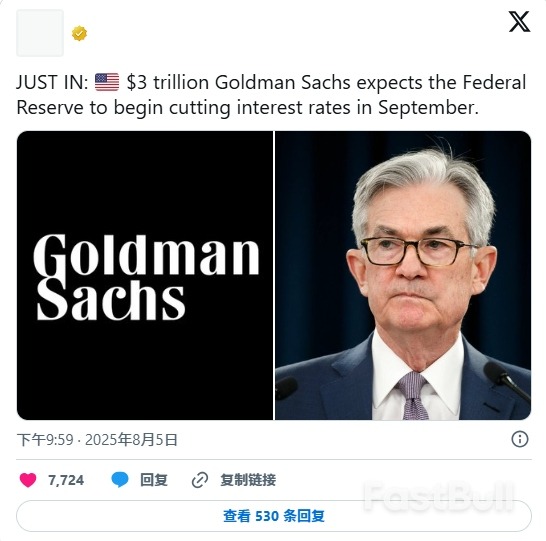
          ● Goldman Sachs sees rate cuts starting in September.
          ● Fed likely responding to slowing inflation and economic signals.
          ● Markets may rally ahead of the expected policy shift.

          Goldman Sachs Signals September Rate Cut

          In a major economic forecast, Goldman Sachs has announced that it expects the Federal Reserve to begin cutting interest rates as early as September. The $3 trillion investment giant points to recent signs of slowing inflation and cooling job growth as reasons for this anticipated policy shift. The Fed has held interest rates steady at historically high levels to combat inflation, but with economic indicators softening, analysts believe the time for cuts is approaching. According to Goldman, the Fed is preparing to pivot in response to more stable prices and a moderate pace of economic activity.

          Why It Matters to Markets and Investors

          If the Fed does cut rates in September, it could trigger a market rally, especially in risk assets like tech stocks and crypto. Lower interest rates reduce the cost of borrowing and often boost corporate earnings, making equities more attractive.For the average consumer, rate cuts could lead to lower mortgage and loan rates, easing some financial pressure. However, Goldman Sachs notes that the Fed is likely to move cautiously, emphasizing data-dependence and gradual adjustments.

          The Road Ahead for the Fed

          While Goldman Sachs has been relatively accurate in its macro predictions, the Fed has consistently communicated that any rate decisions will be guided by incoming data. The central bank wants to avoid cutting too early and reigniting inflation.Still, if inflation continues its downward trend and employment remains stable, the September meeting could mark the beginning of a more accommodative monetary cycle. That would be welcome news for both Wall Street and Main Street.

          Source: CryptoSlate

          To stay updated on all economic events of today, please check out our Economic calendar
          Risk Warnings and Disclaimers
          You understand and acknowledge that there is a high degree of risk involved in trading. Following any strategies or investment methods may lead to potential losses. The content on the site is provided by our contributors and analysts for information purposes only. You are solely responsible for determining whether any trading assets, securities, strategy, or any other product is suitable for investing based on your own investment objectives and financial situation.
          Add to Favorites
          Share

          Gold price down on profit taking, less risk aversion

          Adam

          Commodity

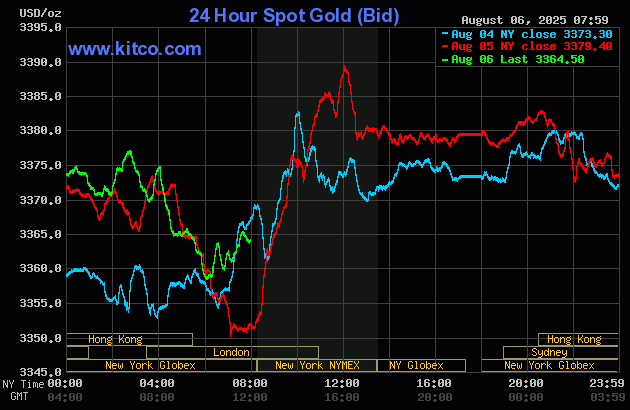
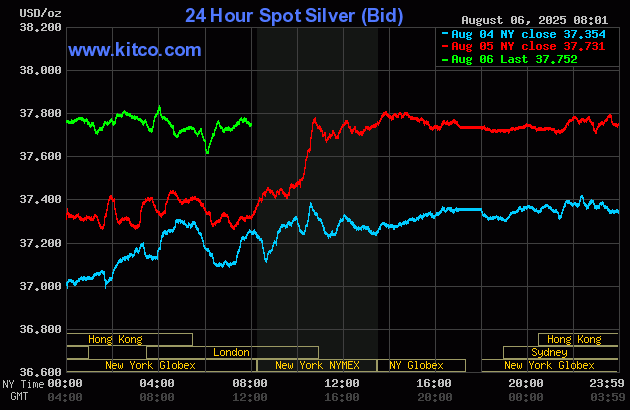
          Gold prices are moderately lower in early U.S. trading Wednesday, while silver prices are slightly up. Gold is seeing some profit-taking pressure and weak long liquidation from the shorter-term futures traders. Somewhat improved trader/investor risk appetite in the general marketplace at mid-week is also a negative for the safe-haven metals. December gold was last down $12.70 at $3,422.00. September silver prices were last up $0.057 at $37.88.
          European and Asian stock markets were mostly higher in overnight trading. U.S. stock indexes are pointed toward slightly higher openings when the New York day session begins.
          In overnight news, Bloomberg reports gold bullion stocks held in warehouses linked to the Shanghai Futures Exchange have jumped to an all-time high, a sign of resilient demand for gold in China. More than 36 tons of gold bars have been registered for delivery against futures contracts, with traders and banks taking advantage of a price gap between futures and physical gold. John Reade, senior market strategist at the World Gold Council, said "This shows how strong gold trading demand is in China right now" due to a surge in arbitrage activity triggered by heavy demand for futures. Traders and banks have moved to take advantage of the price gap, buying cheaper gold on the spot market and delivering it to the exchange’s warehouse. From there, it can be used to offset sales of futures, allowing them to close positions at a profit, said the Bloomberg report.
          The key outside markets today see the U.S. dollar index weaker. Nymex crude oil futures are higher and trading around $66.25 a barrel. The yield on the benchmark 10-year U.S. Treasury note is presently around 4.236%.
          U.S. economic data due for release Wednesday includes the MBA mortgage applications survey and the weekly DOE liquid energy stocks report.
          Gold price down on profit taking, less risk aversion_1
          Technically, December gold futures bulls have the overall near-term technical advantage. Bulls’ next upside price objective is to produce a close above solid resistance at the July high of $3,509.00. Bears' next near-term downside price objective is pushing futures prices below solid technical support at $3,300.00. First resistance is seen at this week’s high of $3,444.90 and then at $3,450.00. First support is seen at this week’s low of $3,397.90 and then at $3,350.00. Wyckoff's Market Rating: 6.5.
          Gold price down on profit taking, less risk aversion_2
          September silver futures bulls have the overall near-term technical advantage but are fading fast. A price uptrend on the daily bar chart has been negated. Silver bulls' next upside price objective is closing prices above solid technical resistance at this week’s high of $38.51. The next downside price objective for the bears is closing prices below solid support at $35.00. First resistance is seen at $38.00 and then at $38.50. Next support is seen at this week’s low of $36.76 and then at last week’s low of $36.28. Wyckoff's Market Rating: 6.0.

          Source:kitco

          Risk Warnings and Disclaimers
          You understand and acknowledge that there is a high degree of risk involved in trading. Following any strategies or investment methods may lead to potential losses. The content on the site is provided by our contributors and analysts for information purposes only. You are solely responsible for determining whether any trading assets, securities, strategy, or any other product is suitable for investing based on your own investment objectives and financial situation.
          Add to Favorites
          Share

          Trump is hailing the EU’s $600 billion investment pledge — but it might never happen

          Adam

          Economic

          U.S. President Donald Trump is hailing a win after the European Union vowed to invest an additional $600 billion in the U.S. — although it’s unclear if the bloc can materialize its pledge.
          Asked in a Tuesday interview with CNBC what could happen if the EU fails to honor its commitment, Trump said, “Then they pay tariffs at 35%. No, no. They brought down their tariffs, so they paid $600 billion and because of that, I reduced their tariffs from 30% down to 15%.”
          The investment pledge is part of the July trade deal between the two partners which includes 15% tariffs on EU goods, as well as an agreement for increased investment and the purchase of $750 billion worth of U.S. energy.
          Describing the investment as a “gift,” Trump told CNBC on Tuesday that the EU “gave us $600 billion that we can invest in anything we want.”
          For its part, the European Commission noted in a breakdown of the partners’ trade agreement that “EU companies have expressed interest in investing at least $600 billion (ca. €550 billion) in various sectors in the US by 2029.”
          A spokesperson for the EU told CNBC that the European Commission had reached out to EU industries and sectors to establish their U.S. investment intentions.
          “On this basis, the EU Commission was able to present a coherent, non-binding commitment to the US on estimated EU investment in the coming years,” they said.

          What could the investment look like?

          So far, the only detail that is certain amid the EU’s pledge to invest is that the private sector will be footing the bill.
          Alberto Rizzi, policy fellow at the European Council on Foreign Relations, told CNBC that the investment could effectively be made in any industry in the U.S.
          “But looking at recent trends manufacturing, finance, chemicals and tech are the most likely areas of investment,” he said, noting that the final recipients of the funds will ultimately depend on the decisions of individual companies.
          Other potential areas— in which Trump might also like to see increased investment — include autos, pharmaceuticals and aircraft, said William Reinsch, senior adviser and Scholl Chair emeritus with the Economics Program at the Center for Strategic and International Studies.
          Looking at a potential timeline, Reinsch noted that “these things always move slower than expected.”
          “The policy uncertainty Trump’s actions have generated will slow down the decision making process even more. Making a multi-million dollar investment is not a decision made lightly. Companies have to assure themselves that the long term economics are favorable,” he told CNBC by email.
          Notably, the 2029 target timeframe flagged by the EU also coincides with the end of Trump’s presidential term, after which the U.S.′ trade and tariffs regime is unknown.

          Will it happen?

          It remains to be seen whether the investment will be made, especially as the EU does not have the power to force businesses to follow through with their plans.
          “The investment pledge of the EU ... is much more smoke and mirrors than a binding commitment,” Rizzi commented. “The EU Commission has no power to bind member states on this, and, with the exception of state-owned firms, capitals cannot coerce their national companies’ choices either.”
          Arthur Leichthammer, policy fellow for geo-economics at the Jacques Delors Centre, likewise said that, while the $600 billion “is not wildly unrealistic in economic terms,” the EU’s inability to enforce investment makes it a tricky pledge.
          “The number is not incredibly unrealistic but the EU’s ability to credibly commit to it is limited,” he told CNBC.
          As for Trump’s suggestion of potentially higher tariffs if the investment does not materialize?
          “That’s exactly the risk,” Leichthammer said, suggesting that the EU’s pledges have given Trump leverage to add further pressure or even threaten to call off the trade deal further down the line.
          “It shows that this is not a one-off agreement but the beginning of an ongoing, transactional process, which Trump can escalate at any point. The ‘deal’, which is more of a political announcement, bought time, but no lasting stability,” he said.

          Source: cnbc

          To stay updated on all economic events of today, please check out our Economic calendar
          Risk Warnings and Disclaimers
          You understand and acknowledge that there is a high degree of risk involved in trading. Following any strategies or investment methods may lead to potential losses. The content on the site is provided by our contributors and analysts for information purposes only. You are solely responsible for determining whether any trading assets, securities, strategy, or any other product is suitable for investing based on your own investment objectives and financial situation.
          Add to Favorites
          Share

          Swiss President Discussed Tariffs With US Secretary Of State

          James Whitman

          Economic

          Political

          Swiss President Karin Keller-Sutter said she talked about trade relations in her meeting with US Secretary of State Marco Rubio as she attempts to avert a 39% levy as of Thursday.

          “We discussed bilateral cooperation between Switzerland and the US, the tariff situation, and international issues,” she said on X after the meeting in Washington. The US State Department doesn’t lead negotiations for bilateral deals.

          The Swiss president dashed to the US capital Tuesday in a last-minute attempt to prevent her American counterpart from imposing the highest tariff of any developed nation on Switzerland. Donald Trump announced the measure last week, and it’s set to take effect Thursday — leaving the Swiss with a tight window to try to sway him.

          Keller-Sutter traveled to America without a formal invite from the White House, according to a person familiar with the matter, so it remains to be seen whether the US president will agree to meet.

          The two spoke on the phone last Thursday, with Trump telling CNBC that “the woman was nice, but she didn’t want to listen” to his complaint about Switzerland’s massive trade surplus with the US.

          Asked about the latest on Switzerland, National Economic Council Director Kevin Hassett said that “I’m not aware of any changes since yesterday, but it’s a fast moving thing.”

          “You know, we’ve got Switzerland coming in and trying to renegotiate their tariffs, and we’ll see how it goes,” he told Fox Business.

          The level of Trump’s tariff stunned the Swiss after talks that they thought looked promising. If the tariff rate came into effect across the board — including on pharmaceuticals — that would put up to 1% of Switzerland’s economic output at risk over the medium term, according to Bloomberg Economics.

          The paradox faced by the Swiss president — who also is her country’s finance minister — is that any concessions may be politically costly without meaningfully curbing the US-Switzerland trade gap.

          The $38 billion overhang as of last year is probably the main obstacle to any deal. The nature of the massive Swiss surplus with the US — primarily down to gold, pharmaceuticals, watches and medical devices — means a quick reduction is unlikely.

          Source: Bloomberg

          To stay updated on all economic events of today, please check out our Economic calendar
          Risk Warnings and Disclaimers
          You understand and acknowledge that there is a high degree of risk involved in trading. Following any strategies or investment methods may lead to potential losses. The content on the site is provided by our contributors and analysts for information purposes only. You are solely responsible for determining whether any trading assets, securities, strategy, or any other product is suitable for investing based on your own investment objectives and financial situation.
          Add to Favorites
          Share

          AMD stock slumps 5% on earnings miss, China AI chip concerns

          Adam

          Stocks

          Shares of Advanced Micro Devices slumped more than 5% after the chipmaker’s earnings fell short of earnings expectations and raised concerns about the timing of a restart in China shipments.
          The Santa Clara, California-based company reported adjusted earnings of 48 cents per share, falling short of the 49 cents per share expected by analysts polled by LSEG.
          CEO Lisa Su singled out the hit from U.S. controls on artificial intelligence chips in a call with analysts.
          “AI business revenue declined year over year as U.S. export restrictions effectively eliminated MI308 sales to China, and we began transitioning to our next generation,” Su said.
          For the current quarter, AMD forecasted $8.7 billion in revenue, plus or minus $300 million, versus $8.3 billion expected by analysts. The company said its guidance does not account for revenue from its MI308 AI chip designed for the China market to work around chip restrictions.
          During an interview with CNBC’s “Squawk on the Street” on Wednesday, Su said the company has been working closely with the Trump administration on license requirements necessary to ship its chips to China, but took a “prudent” approach to its guide.
          “From our standpoint, we think we have an extremely strong portfolio,” she said. “Tens of billions of dollars is the opportunity in a market that’s going to be, let’s call it 500 billion plus over the next few years.”
          Earlier this year, AMD said it would take a $800 million hit during the second quarter as a result of chip restrictions. AMD said in July it plans to soon resume those shipments as the Department of Commerce gets set to restart application review.
          Some Wall Street analysts raised concerns over how soon those shipments may begin. Analysts at Morgan Stanley called the timing of the restart in China shipments “vague,” adding that the company requires a “near terms upside in GPU” to keep its premium.
          “China upside sounds like it will take time to materialize (and it sounded like we shouldn’t count too much on it even if licenses are granted), pull-forward and inventory risks remain, and opex continues to march higher which is limiting earnings leverage,” wrote Bernstein analysts.
          Investors also raised concerns about the company’s datacenter business, which grew 14% to $3.2 billion and includes its central processors and graphics processing units.
          “We are more guarded on the company’s ability to drive significant scale in Datacenter GPUs over time, and think operating leverage is likely to be hampered by the significant OpEx we believe is needed for the company to support its software and systems efforts tied to datacenters,” wrote analysts at Goldman Sachs.
          Su said Wednesday the company is seeing strong forecasts for compute from some of its largest customers and anticipates an “inflection point” into the third quarter.
          “The data center business is actually the main driver of our growth, and we look at that as the opportunity in front of us,” she added.
          Despite the post-earnings move, AMD’s revenues grew 32% from a year ago to $7.69 billion and topped a $7.42 billion estimate from analysts polled by LSEG. Net income jumped to $872 million, or 54 cents per share, up from $265 million, or 16 cents per share in the year-ago period.

          Source: cnbc

          Risk Warnings and Disclaimers
          You understand and acknowledge that there is a high degree of risk involved in trading. Following any strategies or investment methods may lead to potential losses. The content on the site is provided by our contributors and analysts for information purposes only. You are solely responsible for determining whether any trading assets, securities, strategy, or any other product is suitable for investing based on your own investment objectives and financial situation.
          Add to Favorites
          Share

          5 Things to Know Before the Stock Market Opens

          Adam

          Stocks

          U.S. stock futures are pointing slightly higher as a slew of corporate earnings reports roll in; Walt Disney (DIS) shares are slipping in premarket trading as the entertainment giant reported fiscal third-quarter sales that missed expectations; Advanced Micro Devices (AMD) stock is falling after the chipmaker reported quarterly income that was in line with expectations even as revenue soared; Super Micro Computer (SMCI) shares are sinking on an earnings miss and weak outlook; and Snap (SNAP) shares are plummeting as its earnings fell short of estimates. Here's what investors need to know today.

          US Stock Futures Tick Higher as Investors Review Corporate Earnings

          U.S. stock futures are pointing slightly higher as investors pour over lots of corporate earnings reports. Dow Jones Industrial Average futures are up 0.4% after the blue-chip index closed slightly lower in the prior session, while both S&P 500 and Nasdaq futures are pointing 0.2% higher after the indexes ended lower yesterday. Bitcoin (BTCUSD) is slightly up at just over $114,000. The yield on the 10-year Treasury yield ticking. Oil futures are higher by nearly 2%. Gold futures are declining.

          Disney Reports Revenue Miss, Big Deals for ESPN

          Walt Disney Co. (DIS) shares are nearly 2% in premarket trading after the entertainment giant reported fiscal third-quarter results and announced multiple new deals. Disney reported sales of $23.69 billion, just below Visible Alpha consensus, and adjusted earnings per share of $1.61 that beat them. Disney announced that its ESPN unit will acquire NFL Network and other league media assets in exchange for a 10% equity stake in the sports giant. Disney also said its direct-to-consumer sports service, simply called "ESPN," will launch Aug. 21, and added an exclusive deal with WWE to be the U.S. home of the wrestling promotion's premium live events, including "Wrestlemania," starting next year.

          AMD Stock Falls as Profit Underwhelms Investors

          Advanced Micro Devices (AMD) shares are down 6% in premarket trading as investors apparently are underwhelmed by second-quarter profit of $0.48 per share that was in line with projections. AMD posted revenue that jumped 32% year-over-year to a record $7.67 billion, well above the $7.43 billion consensus estimate of analysts polled by Visible Alpha. AMD also said it took a roughly $800 million hit on U.S. export controls of its MI308 chip. The company has said it's ready to resume deliveries of the chip to China once it receives approval from U.S. regulators.

          Supermicro Stock Tumbles on Worse-Than-Expected Results, Weak Outlook

          Super Micro Computer (SMCI), or Supermicro, shares are sinking 17% in premarket trading after the server maker reported disappointing quarterly results while issuing weak earnings guidance. Supermicro reported adjusted earnings per share of $0.41 on sales that increased 7.5% year-over-year to $5.76 billion. However, estimates from analysts tracked by Visible Alpha called for $0.45 and $6.01 billion, respectively. Its adjusted EPS outlook for the current quarter was for $0.40 to $0.52 when estimates called for $0.60. Entering Wednesday, Supermicro shares had soared nearly 90% this year after almost being delisted from the Nasdaq over corporate governance and accounting issues.

          Snap Stock Plunges as Results Fall Short

          Shares of Snap (SNAP) are sinking by 18% in premarket trading after the social media firm reported second-quarter results that fell short of analysts' estimates. The Snapchat operator reported adjusted EBITDA of $41.3 million, while Visible Alpha estimates called for $47.0 million. The company also posted revenue that increased 9% to $1.34 billion, a tick below Visible Alpha consensus.

          Source: finance.yahoo

          Risk Warnings and Disclaimers
          You understand and acknowledge that there is a high degree of risk involved in trading. Following any strategies or investment methods may lead to potential losses. The content on the site is provided by our contributors and analysts for information purposes only. You are solely responsible for determining whether any trading assets, securities, strategy, or any other product is suitable for investing based on your own investment objectives and financial situation.
          Add to Favorites
          Share
          FastBull
          Copyright © 2025 FastBull Ltd

          728 RM B 7/F GEE LOK IND BLDG NO 34 HUNG TO RD KWUN TONG KLN HONG KONG

          TelegramInstagramTwitterfacebooklinkedin
          App Store Google Play Google Play
          Products
          Charts

          Chats

          Q&A with Experts
          Screeners
          Economic Calendar
          Data
          Tools
          Membership
          Features
          Function
          Markets
          Copy Trading
          Latest Signals
          Contests
          News
          Analysis
          24/7
          Columns
          Education
          Company
          Careers
          About Us
          Contact Us
          Advertising
          Help Center
          Feedback
          User Agreement
          Privacy Policy
          Business

          White Label

          Data API

          Web Plug-ins

          Poster Maker

          Affiliate Program

          Risk Disclosure

          The risk of loss in trading financial instruments such as stocks, FX, commodities, futures, bonds, ETFs and crypto can be substantial. You may sustain a total loss of the funds that you deposit with your broker. Therefore, you should carefully consider whether such trading is suitable for you in light of your circumstances and financial resources.

          No decision to invest should be made without thoroughly conducting due diligence by yourself or consulting with your financial advisors. Our web content might not suit you since we don't know your financial conditions and investment needs. Our financial information might have latency or contain inaccuracy, so you should be fully responsible for any of your trading and investment decisions. The company will not be responsible for your capital loss.

          Without getting permission from the website, you are not allowed to copy the website's graphics, texts, or trademarks. Intellectual property rights in the content or data incorporated into this website belong to its providers and exchange merchants.

          Not Logged In

          Log in to access more features

          FastBull Membership

          Not yet

          Purchase

          Become a signal provider
          Help Center
          Customer Service
          Dark Mode
          Price Up/Down Colors

          Log In

          Sign Up

          Position
          Layout
          Fullscreen
          Default to Chart
          The chart page opens by default when you visit fastbull.com