• Trade
  • Markets
  • Copy
  • Contests
  • News
  • 24/7
  • Calendar
  • Q&A
  • Chats
Trending
Screeners
SYMBOL
LAST
BID
ASK
HIGH
LOW
NET CHG.
%CHG.
SPREAD
SPX
S&P 500 Index
6880.13
6880.13
6880.13
6901.43
6879.64
-16.11
-0.23%
--
DJI
Dow Jones Industrial Average
48221.42
48221.42
48221.42
48394.51
48220.84
-145.63
-0.30%
--
IXIC
NASDAQ Composite Index
23368.16
23368.16
23368.16
23445.26
23352.95
-50.91
-0.22%
--
USDX
US Dollar Index
98.180
98.260
98.180
98.180
97.850
+0.300
+ 0.31%
--
EURUSD
Euro / US Dollar
1.17218
1.17225
1.17218
1.17591
1.17198
-0.00256
-0.22%
--
GBPUSD
Pound Sterling / US Dollar
1.34069
1.34079
1.34069
1.34763
1.34068
-0.00606
-0.45%
--
XAUUSD
Gold / US Dollar
4331.65
4332.06
4331.65
4373.05
4274.29
-7.46
-0.17%
--
WTI
Light Sweet Crude Oil
58.100
58.130
58.100
58.414
57.580
+0.247
+ 0.43%
--

Community Accounts

Signal Accounts
--
Profit Accounts
--
Loss Accounts
--
View More

Become a signal provider

Sell trading signals to earn additional income

View More

Guide to Copy Trading

Get started with ease and confidence

View More

Signal Accounts for Members

All Signal Accounts

Best Return
  • Best Return
  • Best P/L
  • Best MDD
Past 1W
  • Past 1W
  • Past 1M
  • Past 1Y

All Contests

  • All
  • Trump Updates
  • Recommend
  • Stocks
  • Cryptocurrencies
  • Central Banks
  • Featured News
Top News Only
Share

Global Surplus And Strong Euro Drive EU Wheat Down 20% In 2025

Share

Ukrainian President Volodymyr Zelenskyy Dismissed Ruslan Magomedov From His Post As Chairman Of The State Securities And Stock Market Committee

Share

The U.S. Treasury Department And The Internal Revenue Service (IRS) Have Proposed New Rules Regarding Annual Fees Payable By Companies That Manufacture Or Import Certain Brand-name Prescription Drugs. The Proposal Aims To Update The Brand-Name Prescription Drug Fee Regulations To Reflect The New Manufacturer Discount Program Implemented Under The Inflation Reduction Act. This Program Requires Pharmaceutical Manufacturers To Offer Discounts To Medicare Part D Beneficiaries, Covering Both The Initial Coverage Phase And The Catastrophic Coverage Phase

Share

The Nasdaq Golden Dragon China Index Fell By More Than 1%

Share

USGS - Magnitude 6 Earthquake Strikes Noda, Japan Region

Share

Brazil's Rua: Brazil Able To Redirect Beef Exports To Other Countries To Offset Chinese Safeguard Effects, No Reason To Panic

Share

Brazil Ag Ministry Official Rua: Brazil Might Try To Get China's Approval For Pork And Beef Offal Exports To Offset Impact Of Tariff On Beef

Share

The S&P 500 Opened 2.58 Points Higher, Or 0.04%, At 6898.82; The Dow Jones Industrial Average Opened 4.46 Points Higher, Or 0.01%, At 48371.52; And The Nasdaq Composite Opened 1.77 Points Higher, Or 0.01%, At 23420.85

Share

The Nasdaq Golden Dragon China Index Fell 0.76% In Early Trading

Share

Toronto Stock Index .GSPTSE Falls 25.97 Points, Or 0.08 Percent, To 31840.29 At Open

Share

Finland Police: Crew Members Are Russian, Georgian, Kazakh And Azerbaijani

Share

Finland Police: We Are Investigating Aggravated Disruption Of Telecommunication And Aggravated Sabotage And Attempted Aggravated Sabotage

Share

State Media: Iranians Try To Access Local Government Building On Fourth Day Of Protests

Share

[EU: Israel's Ban On Aid Organizations Is Equivalent To Cutting Off Lifeline Supplies To Gaza] The Israeli Government Has Threatened To Suspend The Activities Of Some Aid Organizations In The Gaza Strip Starting January 1, 2026. EU Officials Stated On December 31 That This Move Is Tantamount To Cutting Off The "lifeline" Supplies For The Local Population. Hagia Rabib, The EU Commissioner For Emergency Preparedness, Crisis Management, And Equality, Posted On Social Media On December 31: "The EU Has Made It Clear That The NGO Registration Law Cannot Be Implemented In Its Current Form, And All Barriers To Humanitarian Aid Access Must Be Removed. International Humanitarian Law Is Indisputable; Aid Must Reach Those In Need."

Share

Finland Border Guard: Fitburg Vessel Was Enroute From Russia's St Petersburg To Israel

Share

Fed Data - USA Effective Federal Funds Rate At 3.64 Percent On 30 December On $87 Billion In Trades Versus 3.64 Percent On $87 Billion On 29 December

Share

S&P 500 E-Minis, Nasdaq Futures Up 0.1% Each, Dow Futures Flat

Share

Chinese President Xi Promises More Proactive Macro Policies In 2026

Share

[Russia Releases Details Of Ukrainian Attack On Putin's Residence: One Drone Carried 6 Kilograms Of Explosives] The Russian Ministry Of Defense Announced On December 31 That The Russian Aerospace Forces Detected An Attack By Ukraine On The Residence Of Russian President Vladimir Putin In Novgorod Oblast In Northwestern Russia At Around 7:20 P.m. Local Time On December 28. Ukraine Used 91 Drones That Took Off From Sumy And Chernihiv Oblasts, One Of Which Carried 6 Kilograms Of Explosives

Share

According To Data From The Federal Reserve Bank Of New York, The Secured Overnight Funding Rate (Sofr) Was 3.71% On The Previous Trading Day (December 30), Compared To 3.77% The Day Before

TIME
ACT
FCST
PREV
Brazil Unemployment Rate (Nov)

A:--

F: --

P: --

U.S. Weekly Redbook Index YoY

A:--

F: --

P: --

U.S. S&P/CS 10-City Home Price Index YoY (Oct)

A:--

F: --

P: --

U.S. S&P/CS 10-City Home Price Index MoM (Not SA) (Oct)

A:--

F: --

P: --

U.S. S&P/CS 20-City Home Price Index (Not SA) (Oct)

A:--

F: --

P: --

U.S. S&P/CS 20-City Home Price Index MoM (Not SA) (Oct)

A:--

F: --

P: --

U.S. FHFA House Price Index YoY (Oct)

A:--

F: --

P: --
U.S. S&P/CS 20-City Home Price Index YoY (Not SA) (Oct)

A:--

F: --

P: --

U.S. S&P/CS 20-City Home Price Index MoM (SA) (Oct)

A:--

F: --

P: --
U.S. FHFA House Price Index (Oct)

A:--

F: --

P: --

U.S. FHFA House Price Index MoM (Oct)

A:--

F: --

P: --
U.S. Chicago PMI (Dec)

A:--

F: --

P: --

Brazil CAGED Net Payroll Jobs (Nov)

A:--

F: --

P: --

U.S. Weekly Total Oil Rig Count

A:--

F: --

P: --

U.S. Weekly Total Rig Count

A:--

F: --

P: --

FOMC Meeting Minutes
U.S. API Weekly Refined Oil Stocks

A:--

F: --

P: --

U.S. API Weekly Crude Oil Stocks

A:--

F: --

P: --

U.S. API Weekly Cushing Crude Oil Stocks

A:--

F: --

P: --

U.S. API Weekly Gasoline Stocks

A:--

F: --

P: --

South Korea CPI YoY (Dec)

A:--

F: --

P: --

China, Mainland NBS Manufacturing PMI (Dec)

A:--

F: --

P: --

China, Mainland Composite PMI (Dec)

A:--

F: --

P: --

China, Mainland NBS Non-manufacturing PMI (Dec)

A:--

F: --

P: --

China, Mainland Caixin Manufacturing PMI (SA) (Dec)

A:--

F: --

P: --

Turkey Trade Balance (Nov)

A:--

F: --

P: --

South Africa Trade Balance (Nov)

A:--

F: --

P: --

U.S. Initial Jobless Claims 4-Week Avg. (SA)

A:--

F: --

P: --
U.S. Weekly Continued Jobless Claims (SA)

A:--

F: --

P: --
U.S. Weekly Initial Jobless Claims (SA)

A:--

F: --

P: --
U.S. EIA Weekly Cushing, Oklahoma Crude Oil Stocks Change

--

F: --

P: --

U.S. EIA Weekly Crude Demand Projected by Production

--

F: --

P: --

U.S. EIA Weekly Gasoline Stocks Change

--

F: --

P: --

U.S. EIA Weekly Crude Stocks Change

--

F: --

P: --

U.S. EIA Weekly Heating Oil Stock Changes

--

F: --

P: --

U.S. EIA Weekly Crude Oil Imports Changes

--

F: --

P: --

U.S. EIA Weekly Natural Gas Stocks Change

--

F: --

P: --

South Korea Trade Balance Prelim (Dec)

--

F: --

P: --

Indonesia Core Inflation YoY (Dec)

--

F: --

P: --

Indonesia Inflation Rate YoY (Dec)

--

F: --

P: --

Turkey Manufacturing PMI (Dec)

--

F: --

P: --

Brazil IHS Markit Manufacturing PMI (Dec)

--

F: --

P: --

Mexico Manufacturing PMI (Dec)

--

F: --

P: --

South Korea IHS Markit Manufacturing PMI (SA) (Dec)

--

F: --

P: --

Indonesia IHS Markit Manufacturing PMI (Dec)

--

F: --

P: --

India HSBC Manufacturing PMI Final (Dec)

--

F: --

P: --

Russia IHS Markit Manufacturing PMI (Dec)

--

F: --

P: --

U.K. Nationwide House Price Index MoM (Dec)

--

F: --

P: --

U.K. Nationwide House Price Index YoY (Dec)

--

F: --

P: --

Turkey Manufacturing PMI (Dec)

--

F: --

P: --

Italy Manufacturing PMI (SA) (Dec)

--

F: --

P: --

Euro Zone Manufacturing PMI Final (Dec)

--

F: --

P: --

Euro Zone M3 Money Supply (SA) (Nov)

--

F: --

P: --

Euro Zone 3-Month M3 Money Supply YoY (Nov)

--

F: --

P: --

Euro Zone Private Sector Credit YoY (Nov)

--

F: --

P: --

Euro Zone M3 Money Supply YoY (Nov)

--

F: --

P: --

U.K. Manufacturing PMI Final (Dec)

--

F: --

P: --

India Deposit Gowth YoY

--

F: --

P: --

Brazil IHS Markit Manufacturing PMI (Dec)

--

F: --

P: --

Canada Manufacturing PMI (SA) (Dec)

--

F: --

P: --

Q&A with Experts
    • All
    • Chatrooms
    • Groups
    • Friends
    john flag
    DX32NYLKQJ
    @DX32NYLKQJaré you sure you read the rules because what you are asking is already in the first paragraph
    john flag
    DX32NYLKQJ
    @DX32NYLKQJits demo account,,,, contest are always Carrie out on a demo account
    JustLeon flag
    EuroTrader flag
    HOÀNG LÊ
    @HOÀNG LÊLolllss. we don't look at luck in trading. I really don't believe in luck in trading
    HOÀNG LÊ flag
    EuroTrader
    [100] This is just a New Year's greeting according to the customs of our beloved homeland, Vietnam, where everyone wishes each other well.
    john flag
    JustLeon
    @JustLeonnice one make sure you are trailing the stop just incase
    QVOJON7PLW flag
    Is it a sell or do I have to wait for 15 minutes
    Charizard flag
    QVOJON7PLW
    If it breaks 4333 it's a sell
    @QVOJON7PLW Gold really be playing a lot of games.
    john flag
    HOÀNG LÊ
    @HOÀNG LÊbest of luck as well,,,,may the odds be stucked ín your favour
    john flag
    Charizard
    @Charizardwe might see it testing 4300 again
    HOÀNG LÊ flag
    john
    I also wish you and your family good luck and good health.
    user flag
    john
    @johnnot really
    john flag
    Charizard
    @Charizardso let us look for an opportunity to align or to be in sync
    john flag
    user
    @useranything can happen,,,let's see how if unfolds
    HOÀNG LÊ flag
    Short-term selling zone (Scalping) 4372-4384
    user flag
    john
    @johnalright bro
    "QVOJON7PLW" recalled a message
    King OF TRADERS❤🔥📉📈📊 flag
    hey guys sell xauusd no 1min time
    john flag
    HOÀNG LÊ
    @HOÀNG LÊyou too bro ,,,2026 will be different
    QVOJON7PLW flag
    I think it's a sell t p at 4315 in 15m
    Type here...
    Add Symbol or Code

      No matching data

      All
      Trump Updates
      Recommend
      Stocks
      Cryptocurrencies
      Central Banks
      Featured News
      • All
      • Russia-Ukraine Conflict
      • Middle East Flashpoint
      • All
      • Russia-Ukraine Conflict
      • Middle East Flashpoint
      Search
      Products

      Charts Free Forever

      Chats Q&A with Experts
      Screeners Economic Calendar Data Tools
      Membership Features
      Data Warehouse Market Trends Institutional Data Policy Rates Macro

      Market Trends

      Market Sentiment Order Book Forex Correlations

      Top Indicators

      Charts Free Forever
      Markets

      News

      News Analysis 24/7 Columns Education
      From Institutions From Analysts
      Topics Columnists

      Latest Views

      Latest Views

      Trending Topics

      Top Columnists

      Latest Update

      Signals

      Copy Rankings Latest Signals Become a signal provider AI Rating
      Contests
      Brokers

      Overview Brokers Assessment Rankings Regulators News Claims
      Broker listing Forex Brokers Comparison Tool Live Spread Comparison Scam
      Q&A Complaint Scam Alert Videos Tips to Detect Scam
      More

      Business
      Events
      Careers About Us Advertising Help Center

      White Label

      Data API

      Web Plug-ins

      Affiliate Program

      Awards Institution Evaluation IB Seminar Salon Event Exhibition
      Vietnam Thailand Singapore Dubai
      Fans Party Investment Sharing Session
      FastBull Summit BrokersView Expo
      Recent Searches
        Top Searches
          Markets
          News
          Analysis
          User
          24/7
          Economic Calendar
          Education
          Data
          • Names
          • Latest
          • Prev

          View All

          No data

          Scan to Download

          Faster Charts, Chat Faster!

          Download App
          English
          • English
          • Español
          • العربية
          • Bahasa Indonesia
          • Bahasa Melayu
          • Tiếng Việt
          • ภาษาไทย
          • Français
          • Italiano
          • Türkçe
          • Русский язык
          • 简中
          • 繁中
          Open Account
          Search
          Products
          Charts Free Forever
          Markets
          News
          Signals

          Copy Rankings Latest Signals Become a signal provider AI Rating
          Contests
          Brokers

          Overview Brokers Assessment Rankings Regulators News Claims
          Broker listing Forex Brokers Comparison Tool Live Spread Comparison Scam
          Q&A Complaint Scam Alert Videos Tips to Detect Scam
          More

          Business
          Events
          Careers About Us Advertising Help Center

          White Label

          Data API

          Web Plug-ins

          Affiliate Program

          Awards Institution Evaluation IB Seminar Salon Event Exhibition
          Vietnam Thailand Singapore Dubai
          Fans Party Investment Sharing Session
          FastBull Summit BrokersView Expo

          Why Even a Historic BOJ Rate Hike Has Failed to Save the Yen

          Zi Cheng

          Economic

          Summary:

          Japan's yield remains world's lowest, real exports stagnant.
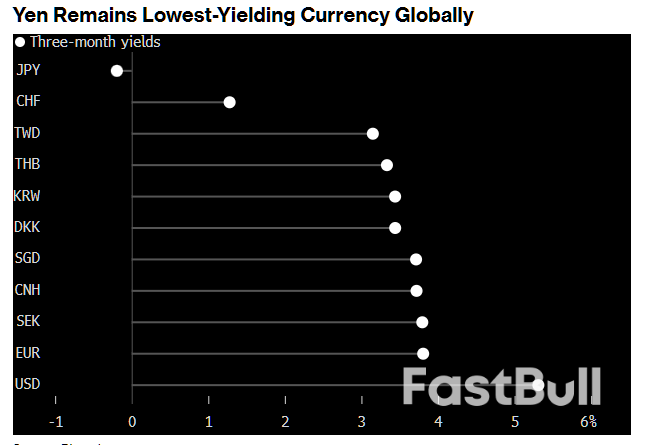
          Japan’s first interest rate hike in 17 years has failed to deliver the boost to the yen that policymakers had hoped for, with strategists pointing to four key reasons for the currency to remain weak for now.
          At the top of the list is rates in Japan that remain much lower than the rest of the world, followed by speculation the yen hasn’t weakened fast enough to invite intervention, low market volatility that favors carry trades, and signs the depreciating currency isn’t bolstering exports.
          While officials have said the yen isn’t moving in line with fundamentals, and that they will take appropriate steps to stem declines, the currency remains near the three-decade low of 151.97 per dollar set last week.
          “The yen is likely to remain weak,” said Daisaku Ueno, chief foreign-exchange strategist at Mitsubishi UFJ Morgan Stanley Securities Co. in Tokyo. “Despite the rate hike, there’s no prospect to see positive real interest rates in the near term, which makes the appeal of the yen very poor.”

          Low Yields

          Why Even a Historic BOJ Rate Hike Has Failed to Save the Yen_1Source: Bloomberg

          After accounting for inflation, Japan’s 10-year yield stands around minus 0.650%, compared with about 2% in the US and 0.27% in Germany.
          That’s a huge incentive for traders to borrow in yen to invest in high-yielding assets in a strategy known as the carry trade. It’s a headache that just won’t go away for the Japanese government, which has to deal with political fallout of the weak yen pushing up the cost of living for households.
          While the Bank of Japan is expected to increase borrowing costs further this year, as its major counterparts start to cut interest rates, the exact timing is uncertain and it will take time to meaningfully narrow the nation’s yawning yield gap with its peers.
          “Surplus funds naturally flow from lower-yield places to higher-yielding countries, just like water flows from high to low,” said Ayako Sera, market strategist at Sumitomo Mitsui Trust Bank Ltd. “There’s no reason to keep surplus funds here where the policy rate is around zero.”

          Intervention Uncertainty

          Currency traders are on high alert for possible intervention to support the yen by Japan’s Ministry of Finance after officials ratcheted up their warnings. Yet the hurdle to leap from words to actions appears to be high.Traders focused on quantifiable guidance from the government’s top currency official, Masato Kanda, are looking to 10-yen moves over one month against the dollar as a key metric.

          Kanda Index Suggests Yen Intervention Still Unlikely

          Why Even a Historic BOJ Rate Hike Has Failed to Save the Yen_2

          Source: Bloomberg

          The yen still hasn’t moved that much in recent weeks, according to a gauge that measures the currency’s swings from its highest to lowest against the dollar in a rolling 28-day window. The last time the dollar-yen reached that threshold was in October 2022, when the Ministry of Finance intervened twice. It’s now less than half that level.
          Japan is committed to international agreements calling on governments to allow markets to determine exchange rates. But there’s some scope for intervention in response to excessive moves.

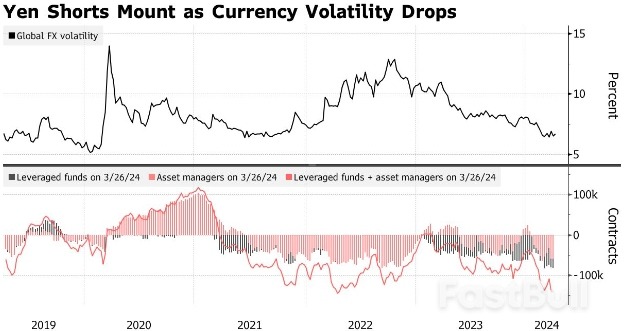
          Falling Volatility

          Why Even a Historic BOJ Rate Hike Has Failed to Save the Yen_3

          Source: Commodity Futures Trading Commission

          Volatility has come down in the currency market, boosting the allure of carry trades for investors, who have less to worry about market fluctuations wiping out profits.
          Leveraged funds and asset managers combined pushed up bearish yen bets to the most since April 2022 last month, according to data from the Commodity Futures Trading Commission. A JPMorgan Chase & Co. gauge of global currency volatility has halved from a recent peak in September 2022.

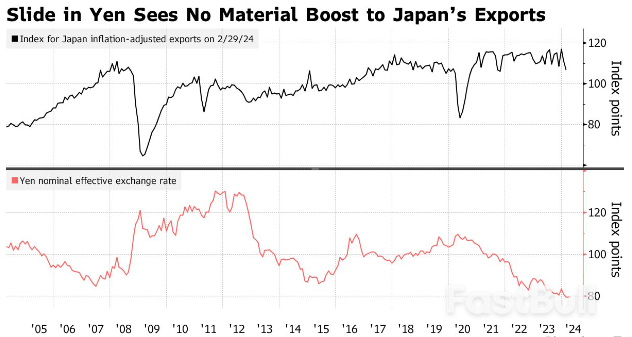
          Falling Exports

          Economics textbooks say that a weak currency should increase exports by making products more affordable abroad, and that the foreign demand will eventually strengthen the currency. But that’s not really happening now in Japan, with an export boost absent.
          The yen’s nominal effective exchange rate, an indicator of the currency’s strength against those of Japan’s major trading peers, has slumped almost 25% since the end of 2020. But a BOJ gauge for inflation-adjusted exports has fallen 3.3% during the period.

          Why Even a Historic BOJ Rate Hike Has Failed to Save the Yen_4Source: Bank Of Japan

          That may reflect Japanese companies increasingly producing goods overseas rather than exporting, while fund flows out of the country to seek higher investment returns abroad also are a headwind for the yen.
          An improved trade balance should be part of the adjustment process for a currency, Steven Englander, head of global G-10 FX research at Standard Chartered Bank, wrote in a research note last week. “The absence of such an improvement weakens the case for a yen rebound.”

          Source: Bloomberg

          To stay updated on all economic events of today, please check out our Economic calendar
          Risk Warnings and Disclaimers
          You understand and acknowledge that there is a high degree of risk involved in trading. Following any strategies or investment methods may lead to potential losses. The content on the site is provided by our contributors and analysts for information purposes only. You are solely responsible for determining whether any trading assets, securities, strategy, or any other product is suitable for investing based on your own investment objectives and financial situation.
          Add to Favorites
          Share

          Will The NFP Report Take June Off The Rate-cut Map?

          XM

          Economic

          Data and Fed rhetoric weigh on Fed rate cut bets

          At its latest gathering, the Fed appeared more dovish than expected, still pointing to three quarter-point rate cuts for 2024. This allowed market participants to add back to their June cut bets, lifting the probability for a 25bps reduction to around 80%.
          However, this proved to be a temporary assessment. Last week, Fed Governor Waller said that the Committee is in no rush to start cutting interest rates, a view echoed by Fed Chair Powell on Friday, after the core PCE index came at 2.8% y/y, as it was expected.Will The NFP Report Take June Off The Rate-cut Map? _1
          This allowed dollar bulls to jump back into the action, adding to their positions on Monday after the ISM manufacturing PMI for March expanded for the first time since September 2022. The prices subindex rose to 55.8 from 52.5, corroborating the outlook painted by the S&P Global flash PMIs for the month, which revealed that selling prices rose at the fastest pace in just under a year.
          Combined with the upward revision of the Atlanta Fed GDPNow model to 2.8% from 2.3% for Q1, the latest developments prompted investors to push back again their rate reduction bets According to Fed funds futures, the probability of a first quarter-point reduction in June has dropped to around 65%, while the total number of basis points worth of rate cuts by the end of the year has been decreased to 68.Will The NFP Report Take June Off The Rate-cut Map? _2
          From anticipating around 160bs at the start of the year, the market is now expecting less reductions than the 75bps projected by the Fed itself, which adds downside risks to the dollar in case of disappointing data moving forward.

          Will further easing in labor market ring the alarm bells?

          With that in mind, the next major event on investors’ agenda may be Friday’s US employment report for March. The unemployment rate is expected to have held steady at 3.9% and nonfarm payrolls are forecast to have slowed to 205k from 275k. That said, the rebound in the employment subindex of the ISM manufacturing PMI tilts the risks to the upside. Average hourly earnings are expected to slow somewhat to 4.1% y/y from 4.3%.Will The NFP Report Take June Off The Rate-cut Map? _3
          These numbers point to further easing in the labor market, but they are far from suggesting that a rate cut is urgent. After all another month of above 200k jobs is very encouraging for the economy, while a wage growth rate at around 4% is unlikely to help inflation come down faster than previously thought.

          Dollar may continue to outperform the euro

          The dollar is likely to stay the course north especially against the euro, as according to money markets, a June quarter-point reduction by the ECB is more than fully priced in, while following recent dovish remarks by ECB member Villeroy de Galhau and Stournaras, there is a nearly 20% chance for a cut at the upcoming meeting on April 11.
          Euro/dollar fell below the key support zone of 1.0795 on Thursday and accelerated its slide this week, headed for the very important area between 1.0655 and 1.0695. A decisive dip below 1.0655 could carry larger bearish implications and perhaps pave the way towards the 1.0520 barrier, marked by the lows of October 26 and November 1.
          Nonetheless, in case the jobs report disappoints, the pair may rebound and break back above 1.0795, but for the outlook to start looking brighter, a move all the way above the round number of 1.1000 may be needed.
          To stay updated on all economic events of today, please check out our Economic calendar
          Risk Warnings and Disclaimers
          You understand and acknowledge that there is a high degree of risk involved in trading. Following any strategies or investment methods may lead to potential losses. The content on the site is provided by our contributors and analysts for information purposes only. You are solely responsible for determining whether any trading assets, securities, strategy, or any other product is suitable for investing based on your own investment objectives and financial situation.
          Add to Favorites
          Share

          US Services Growth Cools as Price Gauge Drops to Four-Year Low

          Zi Cheng

          Economic

          Growth in the US services sector eased in March for a second month while a gauge of input costs slumped to a four-year low.
          The Institute for Supply Management’s composite gauge of services fell 1.2 points to 51.4, largely reflecting a drop in the supplier deliveries index to a record low. Readings above 50 indicate expansion, and the March figure was lower than all but one estimate in a Bloomberg survey of economists.
          The index of prices paid for materials and services decreased more than 5 points to 53.4, the lowest since March 2020, according to the report issued Wednesday.

          US Services Growth Cools as Price Gauge Drops to Four-Year Low_1Source: Insitute for Supply Management

          That stands in stark contrast to ISM data earlier week showing a manufacturing input-cost gauge climbed to the highest level since July 2022, suggesting the pace of goods disinflation is leveling off.
          The services price data may temper concerns that the Federal Reserve’s progress on inflation is at risk of stalling. Policymakers are tracking developments in the services sector, the largest part of the economy, for signs of easing price pressures as they debate when to reduce interest rates.
          “The plunge in the prices paid index to the lowest level since the pandemic began implies that core services ex-housing inflation, aka supercore, will resume falling back toward its pre-pandemic normal rate,” Stephen Brown, deputy chief North America economist at Capital Economics, said in a note.
          With the decline in March, ISM’s gauge of prices paid by services dipped below the manufacturing input-cost measure for the first time since May 2022.
          Still, service-industry respondents noted “that even with some prices stabilizing, inflation is still a concern,” Anthony Nieves, chair of the ISM Services Business Survey Committee, said in a statement.
          Nieves said on a call with reporters that because fuel costs are rising again, he doesn’t anticipate input costs for services to continue falling.
          The overall services index was depressed by the gauge of delivery times, which dropped 3.5 points to the lowest in ISM data back to 1997. Signs of improving supply chains help explain why order backlogs at service providers shrank at the fastest pace since August.
          Twelve services industries reported growth in March, led by accommodation and food services. Four indicated a decrease in activity.
          The ISM new orders gauge fell to a three-month low, though remained consistent with resilient demand.
          The group’s business activity index — which parallels its factory output gauge — showed the strongest growth since September.
          The measure of services employment ticked up slightly but remained in contraction territory.
          Meanwhile, an index of inventories at service providers retreated to the lowest level since the end of 2022. A gauge of sentiment about inventories, while still indicating companies see stockpiles as too high, fell for the second straight month.

          Source: Bloomberg

          To stay updated on all economic events of today, please check out our Economic calendar
          Risk Warnings and Disclaimers
          You understand and acknowledge that there is a high degree of risk involved in trading. Following any strategies or investment methods may lead to potential losses. The content on the site is provided by our contributors and analysts for information purposes only. You are solely responsible for determining whether any trading assets, securities, strategy, or any other product is suitable for investing based on your own investment objectives and financial situation.
          Add to Favorites
          Share

          Powell Says Fed Has Time to Assess Data Before Deciding to Cut

          Zi Cheng

          Economic

          Federal Reserve Chair Jerome Powell signaled policymakers will wait for clearer signs of lower inflation before cutting interest rates, even though a recent bump in prices didn’t alter their broader trajectory.
          Powell said recent inflation figures — though higher than expected — did not “materially change” the overall picture. He reiterated his expectation that it will likely be appropriate to begin lowering rates “at some point this year.”
          “On inflation, it is too soon to say whether the recent readings represent more than just a bump,” Powell said Wednesday in the text of a speech at Stanford University in California. “We do not expect that it will be appropriate to lower our policy rate until we have greater confidence that inflation is moving sustainably down toward 2%.”
          The Federal Open Market Committee held interest rates steady last month. Officials narrowly maintained their outlook for three interest-rate cuts this year, even as key inflation metrics have picked up in 2024. Powell and other Fed officials have repeatedly said they are in no hurry to cut rates, and that their moves will depend on incoming data.
          Following the release of Powell’s prepared remarks, Treasury yields remained higher as did the S&P 500. Investors are putting roughly even odds on an initial cut in June, and pricing suggests they see a chance of fewer than three reductions this year, according to futures.
          “Given the strength of the economy and progress on inflation so far, we have time to let the incoming data guide our decisions on policy,” Powell said in the opening remarks ahead of a fireside chat. “If the economy evolves broadly as we expect, most FOMC participants see it as likely to be appropriate to begin lowering the policy rate at some point this year.”
          Powell’s prepared remarks reinforce those he’s made following the March meeting. They also suggest that the Fed is unlikely to reduce rates at their next gathering taking place April 30-May 1.

          Inflation Gauge

          The Fed’s preferred gauge of underlying inflation cooled in February after an even larger increase than previously reported in January, government data released Friday showed. Even so, the back-to-back increases in the core personal consumption expenditures price index — which excludes volatile food and energy costs — were the biggest in a year.
          Powell said last month that an unexpected weakening in the labor market could warrant a policy response from Fed officials. The Fed will get another update on the health of the job market Friday with the release of the monthly employment report, which is expected to show a gain of 213,000 jobs in March.
          Fed officials in March were split on how aggressive rate cuts will be this year. The central bank’s “dot plot” showed 10 officials forecast three or more quarter-point cuts this year, while nine anticipated two or fewer.
          The Fed chair also used part of his speech to emphasize that the central bank makes its decisions independent from politics. Powell added that he feels it is improper for him to weigh in on other public policy issues, like climate change policies.
          “Our analysis is free from any personal or political bias, in service to the public,” he said. “We will not always get it right — no one does. But our decisions will always reflect our painstaking assessment of what is best for our economy in the medium and longer term — and nothing else.”

          Source: Bloomberg

          To stay updated on all economic events of today, please check out our Economic calendar
          Risk Warnings and Disclaimers
          You understand and acknowledge that there is a high degree of risk involved in trading. Following any strategies or investment methods may lead to potential losses. The content on the site is provided by our contributors and analysts for information purposes only. You are solely responsible for determining whether any trading assets, securities, strategy, or any other product is suitable for investing based on your own investment objectives and financial situation.
          Add to Favorites
          Share

          World Labor Markets Defy Odds And Force A Reset Of Rate-Cut Bets

          Alex

          Economic

          Labor markets across most of the developed world just keep on beating expectations, pushing back bets on interest-rate cuts as hopes grow that central banks can pull off a soft landing after all.
          The reasons for the high demand for workers — an aging workforce, lack of skilled labor and companies hoarding staff — are holding firm even as economies start to slow.
          In all, the unemployment rate in developed economies remains near a record-low, according to quarterly data from the OECD. The consequences of that resilience for borrowing costs triggered a selloff in stocks and bonds this week.World Labor Markets Defy Odds And Force A Reset Of Rate-Cut Bets_1
          While demand for workers may have waned from the initial post-pandemic surge, it’s still much higher than experts forecast it would be by now. In the US, for instance, the Congressional Budget Office last year forecast the US unemployment rate would hit 5.1% by now; it remains at 3.9% today.
          Data due Friday is set to show the US economy added more than 200,000 payrolls in March, double the level that Federal Reserve Chair Jerome Powell has said is sustainable.
          As a result, markets continue to recast their pricing for Fed rate cuts — the odds for a move in June have slipped to around 59% — and those forecasts could be pushed out again. They slipped below 50% briefly this week after strong US factory data.
          The S&P 500 saw its worst day in almost a month on Tuesday and the US 10-year yield touched its highest level since November as investors started to come to terms with that shift.
          Economists at Goldman Sachs Group Inc. estimate it would take an increase of 0.2 to 0.3 percentage points to the US unemployment rate to justify three consecutive Fed cuts this year.
          It’s a similar story elsewhere, even in economies that are slowing.
          In Europe, where inflation has cooled in recent months, European Central Bank President Christine Lagarde has cited pay increases as one of three main factors officials are watching. Investors have pushed back expectations for a first interest rate cut to June, while at the end of 2023 their bets pointed to a 50% chance of a move in March and certainty the ECB would have eased by its April meeting.
          In Canada, where the population soared by the most in more than 60 years in 2023, the jobless rate has barely budged as employers soaked up the new workers. In New Zealand — which entered a double-dip recession — unemployment has only just reached 4% and in Australia, a surprise surge in employment in February pushed the unemployment rate back down to 3.7%.
          Central banks have consistently cited tight labor markets as an inflationary force and one of their top considerations when deciding interest rates. Powell last week said the strong job conditions give officials more time to consider when to cut.
          “The fact that the US economy is growing at such a solid pace, the fact that the labor market is still very, very strong, gives us the chance to just be a little more confident about inflation coming down before we take the important step of cutting rates,” Powell said at an event at the San Francisco Fed.
          To be clear, inflation remains the north star for central banks and the primary driver of policy. Powell has also said recently that strong hiring on its own wouldn’t be a reason to avoid cutting rates.

          Lagging Indicator

          To be sure, jobs tend to be a lagging indicator with monetary policy taking about 18 months to filter through into the economy, so higher rates may yet take a toll. The UK in January registered its first increase in unemployment since July, but the rate remained below 4%.
          As consumer price pressures moderate back toward central banks’ comfort zones, forecasts that mass unemployment would be needed to get inflation down now look misplaced.
          Usually during an extended period of high interest rates, companies cut back on expansions. Not so this time. If anything, the jobs picture could remain tighter for longer as business sentiment and planned investment remain healthy.
          “Many firms are likely engaged in labor hoarding,” said Citigroup Inc. senior global economist Robert Sockin. “Firms know how difficult it is to find and train workers, and likely do not want to go through the same process in several quarters time when demand is stronger.”
          The JPMorgan/S&P Global manufacturing index expanded again in March with the highest reading since July 2022 as companies worldwide broadly saw higher orders and output. Business Roundtable’s CEO Index rose to the highest level since 2022 in the first quarter on higher capital spending, employment and sales expectations.
          “Higher interest rates appear only to have destroyed demand for jobs that never existed, i.e. vacancies,” said Freya Beamish, chief economist at TS Lombard.

          Source:Bloomberg

          To stay updated on all economic events of today, please check out our Economic calendar
          Risk Warnings and Disclaimers
          You understand and acknowledge that there is a high degree of risk involved in trading. Following any strategies or investment methods may lead to potential losses. The content on the site is provided by our contributors and analysts for information purposes only. You are solely responsible for determining whether any trading assets, securities, strategy, or any other product is suitable for investing based on your own investment objectives and financial situation.
          Add to Favorites
          Share

          Euro-Area Inflation Inches Toward 2% With Focus On June Cut

          Samantha Luan

          Economic

          Central Bank

          Euro-area inflation slowed more than expected, cementing prospects for an interest-rate cut by the European Central Bank in June.
          Consumer prices rose an annual 2.4% last month, down from 2.6% in February, in line with a Bloomberg Economics Nowcast model. Analysts predicted an increase of 2.5%. A measure excluding volatile items such as food and energy also eased more than anticipated, to 2.9%.Euro-Area Inflation Inches Toward 2% With Focus On June Cut_1
          The report adds to evidence that policymakers are on track to return inflation to the 2% target, allowing them to soon dial back some of the restriction needed after price gains surged into double digits. President Christine Lagarde has signaled a first cut in June — informed by fresh forecasts and an update on wage growth in the early months of the year.
          Most of the Governing Council — including officials from Germany, France and Spain — have signed up to that timeline, with few clinging to hopes of an earlier move. Economists and money markets are equally aligned, suggesting it would take a big shock to change course.
          Traders held wagers on the scope for rate cuts this year after the report, pricing three quarter-point reductions starting in June with the chance of a fourth at around 60%. That compares to as many as four cuts priced ahead of last month’s monetary-policy decision.
          While shipping disruptions in the Middle East haven’t affected inflation in Europe much and last week’s collapse of a bridge in Baltimore — a key port for carmakers and other manufacturers — is also unlikely to do so, rising pay within the 20-nation euro zone may yet stoke prices.
          Euro-Area Inflation Inches Toward 2% With Focus On June Cut_2
          Chief Economist Philip Lane insists wage increases must continue to retreat for him to consider reversing some of the ECB’s past hikes.
          While a key compensation gauge showed some moderation at the end of 2023, salaries continue to expand by more than 4%. That’s sustaining price pressures in services, where labor has an outsized impact on final costs.
          Inflation in that sector remained at 4% in March, while the rate for non-energy industrial goods fell to 1.1%.Euro-Area Inflation Inches Toward 2% With Focus On June Cut_3
          Across the region, trends also diverge. Spanish inflation accelerated after the government removed some of the support put in place to keep a lid on energy costs, and Italy also saw an uptick. Meanwhile, German and French readings both showed that inflation eased for a third month.
          Such trends make it harder to determine the optimal path following the ECB’s initial cut. Policymakers have already shifted some attention to discussing the pace of later steps, though insist that ultimately economic data will decide.
          Lagarde, too, says the ECB will respond to new information as it comes in. “This implies,” she said last month, “that, even after the first rate cut, we cannot pre-commit to a particular rate path.”

          Source:Bloomberg

          To stay updated on all economic events of today, please check out our Economic calendar
          Risk Warnings and Disclaimers
          You understand and acknowledge that there is a high degree of risk involved in trading. Following any strategies or investment methods may lead to potential losses. The content on the site is provided by our contributors and analysts for information purposes only. You are solely responsible for determining whether any trading assets, securities, strategy, or any other product is suitable for investing based on your own investment objectives and financial situation.
          Add to Favorites
          Share

          Brent Oil Futures Rise Toward $90 as Supply Risks Intensify

          Warren Takunda

          Economic

          Commodity

          Oil prices extended gains on Wednesday, as investors mulled supply risks stemming from Ukrainian attacks on Russian refineries and the potential for escalation in the Middle East conflict, while OPEC+ ministers made no changes to current output cuts in a meeting.
          Brent crude futures for June rose 75 cents, or 0.84%, to $89.67 per barrel at 1130 GMT, while U.S. West Texas Intermediate crude futures for May gained 73 cents, or 0.86%, to $85.88 a barrel.
          OPEC+ ministers made no fresh policy recommendations in a meeting on Wednesday, two sources said, after the group already decided to extend current production cuts until June last month.
          Oil futures compounded Tuesday's gains, when both Brent and WTI climbed 1.7% to their highest since October.
          Prices jumped higher on Tuesday after a fresh round of Ukrainian drone attacks on Russian refineries threatened to take even more of the country's processing capacity offline.
          Investors were also concerned that conflict in the Middle East could spread, after Iran vowed revenge against Israel for an attack on Monday that killed high-ranking military personnel.
          A wider conflict in the Middle East involving more oil-producing nations could cause supply disruptions. Iran, which provides support for the Hamas militia fighting Israel in Gaza, is the third-largest producer in the Organization of the Petroleum Exporting Countries (OPEC).
          "The rise in hostilities in both hotspots pushed the price of the two crude oil futures contracts to their highest levels this year," PVM analyst Tamas Varga said of Tuesday's rise.
          Bank of America Global Research raised its 2024 Brent and WTI forecasts to $86 and $81 a barrel respectively, it said in a note on Wednesday, on firming demand and escalating political tensions.
          "Geopolitical turmoil has also boosted oil demand via longer trade routes and impacted supply by reducing refining capacity via attacks on Russian energy infrastructure." the bank said.
          Elsewhere on Wednesday, Taiwan's strongest earthquake in at least 25 years briefly caused Formosa Petrochemical to halt operations at its Mailiao refinery as a precautionary measure, but works have since restarted.
          The U.S. Energy Information Administration (EIA) will also release oil inventory data later on Wednesday. Data from the American Petroleum Institute reported crude inventories fell by 2.3 million barrels last week, traders said on Tuesday.

          Source: Reuters

          To stay updated on all economic events of today, please check out our Economic calendar
          Risk Warnings and Disclaimers
          You understand and acknowledge that there is a high degree of risk involved in trading. Following any strategies or investment methods may lead to potential losses. The content on the site is provided by our contributors and analysts for information purposes only. You are solely responsible for determining whether any trading assets, securities, strategy, or any other product is suitable for investing based on your own investment objectives and financial situation.
          Add to Favorites
          Share
          FastBull
          Copyright © 2025 FastBull Ltd

          728 RM B 7/F GEE LOK IND BLDG NO 34 HUNG TO RD KWUN TONG KLN HONG KONG

          TelegramInstagramTwitterfacebooklinkedin
          App Store Google Play Google Play
          Products
          Charts

          Chats

          Q&A with Experts
          Screeners
          Economic Calendar
          Data
          Tools
          Membership
          Features
          Function
          Markets
          Copy Trading
          Latest Signals
          Contests
          News
          Analysis
          24/7
          Columns
          Education
          Company
          Careers
          About Us
          Contact Us
          Advertising
          Help Center
          Feedback
          User Agreement
          Privacy Policy
          Personal Information Protection Statement
          Business

          White Label

          Data API

          Web Plug-ins

          Poster Maker

          Affiliate Program

          Risk Disclosure

          The risk of loss in trading financial instruments such as stocks, FX, commodities, futures, bonds, ETFs and crypto can be substantial. You may sustain a total loss of the funds that you deposit with your broker. Therefore, you should carefully consider whether such trading is suitable for you in light of your circumstances and financial resources.

          No decision to invest should be made without thoroughly conducting due diligence by yourself or consulting with your financial advisors. Our web content might not suit you since we don't know your financial conditions and investment needs. Our financial information might have latency or contain inaccuracy, so you should be fully responsible for any of your trading and investment decisions. The company will not be responsible for your capital loss.

          Without getting permission from the website, you are not allowed to copy the website's graphics, texts, or trademarks. Intellectual property rights in the content or data incorporated into this website belong to its providers and exchange merchants.

          Not Logged In

          Log in to access more features

          FastBull Membership

          Not yet

          Purchase

          Become a signal provider
          Help Center
          Customer Service
          Dark Mode
          Price Up/Down Colors

          Log In

          Sign Up

          Position
          Layout
          Fullscreen
          Default to Chart
          The chart page opens by default when you visit fastbull.com