• Trade
  • Markets
  • Copy
  • Contests
  • News
  • 24/7
  • Calendar
  • Q&A
  • Chats
Trending
Screeners
SYMBOL
LAST
BID
ASK
HIGH
LOW
NET CHG.
%CHG.
SPREAD
SPX
S&P 500 Index
6827.42
6827.42
6827.42
6899.86
6801.80
-73.58
-1.07%
--
DJI
Dow Jones Industrial Average
48458.04
48458.04
48458.04
48886.86
48334.10
-245.98
-0.51%
--
IXIC
NASDAQ Composite Index
23195.16
23195.16
23195.16
23554.89
23094.51
-398.69
-1.69%
--
USDX
US Dollar Index
97.830
97.910
97.830
98.070
97.810
-0.120
-0.12%
--
EURUSD
Euro / US Dollar
1.17574
1.17581
1.17574
1.17596
1.17262
+0.00180
+ 0.15%
--
GBPUSD
Pound Sterling / US Dollar
1.33953
1.33963
1.33953
1.33957
1.33546
+0.00246
+ 0.18%
--
XAUUSD
Gold / US Dollar
4342.80
4343.23
4342.80
4350.16
4294.68
+43.41
+ 1.01%
--
WTI
Light Sweet Crude Oil
56.962
56.992
56.962
57.601
56.878
-0.271
-0.47%
--

Community Accounts

Signal Accounts
--
Profit Accounts
--
Loss Accounts
--
View More

Become a signal provider

Sell trading signals to earn additional income

View More

Guide to Copy Trading

Get started with ease and confidence

View More

Signal Accounts for Members

All Signal Accounts

Best Return
  • Best Return
  • Best P/L
  • Best MDD
Past 1W
  • Past 1W
  • Past 1M
  • Past 1Y

All Contests

  • All
  • Trump Updates
  • Recommend
  • Stocks
  • Cryptocurrencies
  • Central Banks
  • Featured News
Top News Only
Share

Peru Energy And Mines Ministry: Copper Production Up 4.8% Year-On-Year In October To 248192 Metric Tons

Share

Security Source: Ukrainian Drones Hits Russian Oil Infrastructure In Caspian Sea For Third Time

Share

Spot Palladium Extends Gains, Last Up 5% To $1562.7/Oz

Share

Mexico's Economy Ministry Announces Start Of Anti-Dumping Investigation And Anti-Subsidy Investigations Into USA Pork Imports

Share

Canada Nov CPI Common +2.8%, CPI Median +2.8%, CPI Trim +2.8% On Year

Share

NY Fed's Empire State Prices Paid Index +37.6 In December Versus+49.0 In November

Share

Canada Nov Consumer Prices +0.1% On Month, +2.2% On Year

Share

Canada Nov CPI Core -0.1% On Month, +2.9% On Year

Share

Canada Nov Core CPI, Seasonally Adjusted +0.2% On Month, Oct +0.3% (Unrevised)

Share

UK Health Minister Streeting On Doctors' Strike: Vote To Go Ahead Reveals The Bma's Shocking Disregard For Patient Safety

Share

Venezuelan State Oil Company Pdvsa Says Was Subject To Cyber Attack But Operations Unaffected

Share

Russia Central Bank Says January-October Current Account Surplus At $37.1 Billion

Share

Polish Current Account Balance At +1924 Million Euros In October Versus+130 Million Euros Seen In Reuters Poll

Share

Statement: Germany, Ukraine Propose 10-Point Plan To Strengthen Armament Cooperation

Share

London Metal Exchange Three Month Copper Falls More Than 3% To $11541.50 A Metric Ton

Share

[Market Update] Spot Silver Surged $2.00 During The Day, Returning To $64/ounce, A Gain Of 3.23%

Share

European Central Bank: Italy's Recurrent Ad Hoc Tax Provisions Cause Uncertainty, Damage Investor Confidence, And May Affect Banks' Funding Costs

Share

Stats Office: Nigeria Consumer Inflation At 14.45% Year-On-Year In November

Share

European Central Bank: Italy's Budget Measures Weighing On Domestic Banks Could Have "Negative Implications" On Their Credit Liquidity

Share

Azerbaijan's January-November Oil Exports Via Btc Pipeline Down 7.1% Year-On-Year Data Shows

TIME
ACT
FCST
PREV
Japan Tankan Small Manufacturing Outlook Index (Q4)

A:--

F: --

P: --

Japan Tankan Large Non-Manufacturing Outlook Index (Q4)

A:--

F: --

P: --

Japan Tankan Large Manufacturing Outlook Index (Q4)

A:--

F: --

P: --

Japan Tankan Small Manufacturing Diffusion Index (Q4)

A:--

F: --

P: --

Japan Tankan Large Manufacturing Diffusion Index (Q4)

A:--

F: --

P: --

Japan Tankan Large-Enterprise Capital Expenditure YoY (Q4)

A:--

F: --

P: --

U.K. Rightmove House Price Index YoY (Dec)

A:--

F: --

P: --

China, Mainland Industrial Output YoY (YTD) (Nov)

A:--

F: --

P: --

China, Mainland Urban Area Unemployment Rate (Nov)

A:--

F: --

P: --

Saudi Arabia CPI YoY (Nov)

A:--

F: --

P: --

Euro Zone Industrial Output YoY (Oct)

A:--

F: --

P: --

Euro Zone Industrial Output MoM (Oct)

A:--

F: --

P: --

Canada Existing Home Sales MoM (Nov)

A:--

F: --

P: --

Canada National Economic Confidence Index

A:--

F: --

P: --

Canada New Housing Starts (Nov)

A:--

F: --

P: --
U.S. NY Fed Manufacturing Employment Index (Dec)

A:--

F: --

P: --

U.S. NY Fed Manufacturing Index (Dec)

A:--

F: --

P: --

Canada Core CPI YoY (Nov)

A:--

F: --

P: --

Canada Manufacturing Unfilled Orders MoM (Oct)

A:--

F: --

P: --

U.S. NY Fed Manufacturing Prices Received Index (Dec)

A:--

F: --

P: --

U.S. NY Fed Manufacturing New Orders Index (Dec)

A:--

F: --

P: --

Canada Manufacturing New Orders MoM (Oct)

A:--

F: --

P: --

Canada Core CPI MoM (Nov)

A:--

F: --

P: --

Canada Trimmed CPI YoY (SA) (Nov)

A:--

F: --

P: --

Canada Manufacturing Inventory MoM (Oct)

A:--

F: --

P: --

Canada CPI YoY (Nov)

A:--

F: --

P: --

Canada CPI MoM (Nov)

A:--

F: --

P: --

Canada CPI YoY (SA) (Nov)

A:--

F: --

P: --

Canada Core CPI MoM (SA) (Nov)

A:--

F: --

P: --

Canada CPI MoM (SA) (Nov)

A:--

F: --

P: --

Federal Reserve Board Governor Milan delivered a speech
U.S. NAHB Housing Market Index (Dec)

--

F: --

P: --

Australia Composite PMI Prelim (Dec)

--

F: --

P: --

Australia Services PMI Prelim (Dec)

--

F: --

P: --

Australia Manufacturing PMI Prelim (Dec)

--

F: --

P: --

Japan Manufacturing PMI Prelim (SA) (Dec)

--

F: --

P: --

U.K. 3-Month ILO Employment Change (Oct)

--

F: --

P: --

U.K. Unemployment Claimant Count (Nov)

--

F: --

P: --

U.K. Unemployment Rate (Nov)

--

F: --

P: --

U.K. 3-Month ILO Unemployment Rate (Oct)

--

F: --

P: --

U.K. Average Weekly Earnings (3-Month Average, Including Bonuses) YoY (Oct)

--

F: --

P: --

U.K. Average Weekly Earnings (3-Month Average, Excluding Bonuses) YoY (Oct)

--

F: --

P: --

France Services PMI Prelim (Dec)

--

F: --

P: --

France Composite PMI Prelim (SA) (Dec)

--

F: --

P: --

France Manufacturing PMI Prelim (Dec)

--

F: --

P: --

Germany Services PMI Prelim (SA) (Dec)

--

F: --

P: --

Q&A with Experts
    • All
    • Chatrooms
    • Groups
    • Friends
    Connecting
    .
    .
    .
    Type here...
    Add Symbol or Code

      No matching data

      All
      Trump Updates
      Recommend
      Stocks
      Cryptocurrencies
      Central Banks
      Featured News
      • All
      • Russia-Ukraine Conflict
      • Middle East Flashpoint
      • All
      • Russia-Ukraine Conflict
      • Middle East Flashpoint
      Search
      Products

      Charts Free Forever

      Chats Q&A with Experts
      Screeners Economic Calendar Data Tools
      Membership Features
      Data Warehouse Market Trends Institutional Data Policy Rates Macro

      Market Trends

      Market Sentiment Order Book Forex Correlations

      Top Indicators

      Charts Free Forever
      Markets

      News

      News Analysis 24/7 Columns Education
      From Institutions From Analysts
      Topics Columnists

      Latest Views

      Latest Views

      Trending Topics

      Top Columnists

      Latest Update

      Signals

      Copy Rankings Latest Signals Become a signal provider AI Rating
      Contests
      Brokers

      Overview Brokers Assessment Rankings Regulators News Claims
      Broker listing Forex Brokers Comparison Tool Live Spread Comparison Scam
      Q&A Complaint Scam Alert Videos Tips to Detect Scam
      More

      Business
      Events
      Careers About Us Advertising Help Center

      White Label

      Data API

      Web Plug-ins

      Affiliate Program

      Awards Institution Evaluation IB Seminar Salon Event Exhibition
      Vietnam Thailand Singapore Dubai
      Fans Party Investment Sharing Session
      FastBull Summit BrokersView Expo
      Recent Searches
        Top Searches
          Markets
          News
          Analysis
          User
          24/7
          Economic Calendar
          Education
          Data
          • Names
          • Latest
          • Prev

          View All

          No data

          Scan to Download

          Faster Charts, Chat Faster!

          Download App
          English
          • English
          • Español
          • العربية
          • Bahasa Indonesia
          • Bahasa Melayu
          • Tiếng Việt
          • ภาษาไทย
          • Français
          • Italiano
          • Türkçe
          • Русский язык
          • 简中
          • 繁中
          Open Account
          Search
          Products
          Charts Free Forever
          Markets
          News
          Signals

          Copy Rankings Latest Signals Become a signal provider AI Rating
          Contests
          Brokers

          Overview Brokers Assessment Rankings Regulators News Claims
          Broker listing Forex Brokers Comparison Tool Live Spread Comparison Scam
          Q&A Complaint Scam Alert Videos Tips to Detect Scam
          More

          Business
          Events
          Careers About Us Advertising Help Center

          White Label

          Data API

          Web Plug-ins

          Affiliate Program

          Awards Institution Evaluation IB Seminar Salon Event Exhibition
          Vietnam Thailand Singapore Dubai
          Fans Party Investment Sharing Session
          FastBull Summit BrokersView Expo

          Why China’s Property Downturn Has A Silver Lining for Consumption

          Alex

          Economic

          Summary:

          Some economists argue falling home prices allow families to save less and spend more. But a lack of confidence in growth may be holding back spending.

          For Kim Li, a school teacher in a southern city in China, the decision to delay buying a house has freed up cash for spending on tourism.
          “I have seen the quality of life of my friends drop significantly after they bought houses,” the 28-year-old said. “Now we are more willing to spend money on traveling, to see the world and not let housing tie our lives down.”
          Li’s experience defies the conventional wisdom, informed by the experience of advanced economies, that falling house prices leave consumers feeling poorer and thriftier due to a so-called “wealth effect.” The idea holds that people’s spending can rise and fall with the value of their assets, even if their income remains the same.
          But many economists including at Goldman Sachs Group Inc. argue that China is different. That’s because two decades of rising home prices mean households devote an unusually large share of their incomes to saving for down payments and servicing mortgages, squeezing consumer expenditures: a mechanism known as the “substitution effect.”Why China’s Property Downturn Has A Silver Lining for Consumption_1
          The debate suggests there could be a silver lining to China’s property downturn. If the substitution effect dominates, it could set the stage for faster consumption growth. That would raise the return on China’s investment in domestic manufacturing and services, enabling more sustainable growth that’s less dependent on overseas demand.
          This comes at a time when China’s economy is slowing and policymakers appear to have fewer good options to fight the downturn than in the past. The return on infrastructure investment is falling, and trade tensions are on the rise.
          There were signs of the substitution effect in action last year, when China’s household savings rate — the amount of disposable income not spent on goods or services — fell as real estate prices dropped. In other words, consumer spending grew faster than incomes despite the housing downturn.
          “Lower housing cost burdens can lower the savings rate in China,” Goldman analyst Maggie Wei said in an interview.
          Wei sees this mechanism helping consumer spending to expand 6% this year in inflation-adjusted terms, above China’s GDP growth target of around 5%.Why China’s Property Downturn Has A Silver Lining for Consumption_2
          The substitution effect may be stronger in China than in advanced economies as it is still rapidly urbanizing, meaning a larger share of the population is buying an apartment in a town or city for the first time.
          Home-buying strained families’ budgets as prices were growing faster than average incomes in the 2010s, when the idea of urbanites as “housing slaves” working for little else but home ownership became common. A minority who bought early experienced a wealth windfall, but the majority faced pressure to cut spending.
          In 2020, just before the government cracked down on property market leverage and sent prices on a downward spiral, average prices nationwide were about 13 times incomes, and 25 times in Beijing. That’s high compared with an average of six times in the US and eight times in the UK.
          Rising housing prices have prompted a generation of young, non-homeowners to cut back on consumption to accumulate savings, a study by researchers in China published in the Nature journal last year found. In some cases “parents who are saving their entire lives to finance their children’s home purchase,” wrote scholars including Huazhu Zheng at East China Normal University in Shanghai.
          Further squeezing would-be homeowners, Chinese banks require a larger down payment on home purchases of around 20%, compared with as little as 3.5% in the US.
          There’s also spending on mortgages, which economists classify as a form of saving. China’s housing slump has damaged speculative demand for housing as an investment, allowing the central bank to guide average mortgage interest rates from 5.6% at the end of 2021 to 4% at the end of 2023.
          That could cut annual mortgage servicing costs for households by more than 600 billion yuan each year, according to Bloomberg calculations based on central bank data.Why China’s Property Downturn Has A Silver Lining for Consumption_3
          A 15% to 20% fall in home prices, along with cheaper mortgages, reduced the share of household income allocated to housing purchases to about 8% last year from 11.4% in 2021, according to Goldman Sachs.
          Gan Li, director of the Survey and Research Center for China Household Finance, said the housing price downturn could lead to faster consumption growth. He carried out research during the pandemic finding a 5% increase in house prices reduced consumer spending by 1.8%.
          Still, not all economists agree on whether the substitution effect dominates the wealth effect in China. A dozen academic studies reviewed by Bloomberg were split roughly equally on the question.
          The evidence from the last couple of years appears mixed. Household savings fell last year but were still above their pre-pandemic level, while retail sales growth was weaker than pre-pandemic.
          Hanming Fang, a University of Pennsylvania economist, used e-commerce data to track the impact of windfall house price gains in a rural area after it was unexpectedly designated as a national development zone. Fang and his colleagues found that those who experienced sudden housing wealth gains rapidly ordered more goods online.
          “The decline of the housing market will have a net negative effect on consumer spending,” said Fang. China’s home ownership rate is as high as 90%, according to official data, increasing the scope of those feeling the wealth effect.Why China’s Property Downturn Has A Silver Lining for Consumption_4
          For those in the substitution-effect camp, the thing that’s prompting people to save instead of spend is a lack of confidence. “Confidence remains key,” said Goldman’s Wei.
          Though house price declines can lower confidence to some extent, they don’t appear to be the main culprit.
          If the government does more to support household incomes, Wei said, “consumer confidence can be boosted without a reflation of housing prices.”
          A survey by Gan’s research center found that the share of households with a positive outlook for the economy over the next year plummeted in 2022 and has remained low since. Beijing appears to agree: premier Li Qiang called “low public expectations” a key cause of economic weakness in his address to China’s parliament this week.Why China’s Property Downturn Has A Silver Lining for Consumption_5
          Respondents to a February survey of Chinese consumers who had reduced spending during the recent Lunar New Year holiday by Bank of America Corp found they ranked falling asset prices “as a relatively minor reason,” for cutting spending, outranked by a shortage of cash and pessimism about the future, the bank’s economists said in a report.
          The answer could be a dose of stimulus.
          “Ultimately, a complete turnaround in consumer spending would hinge on an improvement in the labor market, future income prospects and consumer confidence, which in turn would rely on more substantial policy support to shore up the economy,” they added.

          Source:Bloomberg

          To stay updated on all economic events of today, please check out our Economic calendar
          Risk Warnings and Disclaimers
          You understand and acknowledge that there is a high degree of risk involved in trading. Following any strategies or investment methods may lead to potential losses. The content on the site is provided by our contributors and analysts for information purposes only. You are solely responsible for determining whether any trading assets, securities, strategy, or any other product is suitable for investing based on your own investment objectives and financial situation.
          Add to Favorites
          Share

          Powell Reinforces Position That The Fed Is Not Ready To Start Cutting Interest Rates

          Samantha Luan

          Economic

          Federal Reserve Chair Jerome Powell on Wednesday reiterated that he expects interest rates to start coming down this year, but is not ready yet to say when.
          In prepared remarks for congressionally mandated appearances on Capitol Hill Wednesday and Thursday, Powell said policymakers remain attentive to the risks that inflation poses and don’t want to ease up too quickly.
          “In considering any adjustments to the target range for the policy rate, we will carefully assess the incoming data, the evolving outlook, and the balance of risks,” he said. “The Committee does not expect that it will be appropriate to reduce the target range until it has gained greater confidence that inflation is moving sustainably toward 2 percent.”
          Those remarks were taken verbatim from the Federal Open Market Committee’s statement following its most recent meeting, which concluded Jan. 31.
          During the question-and-answer session with House Financial Services Committee members, Powell said he needs “see a little bit more data” before moving on rates.
          “We think because of the strength in the economy and the strength in the labor market and the progress we’ve made, we can approach that step carefully and thoughtfully and with greater confidence,” he said. “When we reach that confidence, the expectation is we will do so sometime this year. We can then begin dialing back that restriction on our policy.”
          Stocks posted gains as Powell spoke, with the Dow Jones Industrial Average up more than 250 points heading into midday. Treasurys yields mostly moved lower as the benchmark 10-year note was off about 0.3 percentage point to 4.11%.

          Rates likely at peak

          In total, the speech broke no new ground on monetary policy or the Fed’s economic outlook. However, the comments indicated that officials remain concerned about not losing the progress made against inflation and will make decisions based on incoming data rather than a preset course.
          “We believe that our policy rate is likely at its peak for this tightening cycle. If the economy evolves broadly as expected, it will likely be appropriate to begin dialing back policy restraint at some point this year,” Powell said in the comments. “But the economic outlook is uncertain, and ongoing progress toward our 2 percent inflation objective is not assured.”
          He noted again that lowering rates too quickly risks losing the battle against inflation and likely having to raise rates further, while waiting too long poses danger to economic growth.
          Markets had been widely expecting the Fed to ease up aggressively following 11 interest rate hikes totaling 5.25 percentage points that spanned March 2022 to July 2023.
          In recent weeks, though, those expectations have changed following multiple cautionary statements from Fed officials. The January meeting helped cement the Fed’s cautious approach, with the statement explicitly saying rate cuts aren’t coming yet despite the market’s outlook.
          As things stand, futures market pricing points to the first cut coming in June, part of four reductions this year totaling a full percentage point. That’s slightly more aggressive than the Fed’s outlook in December for three cuts.

          Inflation easing

          Despite the resistance to move forward on cuts, Powell noted the movement the Fed has made toward its goal of 2% inflation without tipping over the labor market and broader economy.
          “The economy has made considerable progress toward these objectives over the past year,” Powell said. He noted that inflation has “eased substantially” as “the risks to achieving our employment and inflation goals have been moving into better balance.”
          Inflation as judged by the Fed’s preferred gauge is currently running at a 2.4% annual rate — 2.8% when stripping out food and energy in the core reading that the Fed prefers to focus on. The numbers reflect “a notable slowing from 2022 that was widespread across both goods and services prices.”
          “Longer-term inflation expectations appear to have remained well anchored, as reflected by a broad range of surveys of households, businesses, and forecasters, as well as measures from financial markets,” he added.
          Powell is likely to face a variety of questions during his two-day visit to Capitol Hill, which started with an appearance Wednesday before the House Financial Services Committee and concludes Thursday before the Senate Banking Committee.
          Questioning largely centered around Powell’s views on inflation and rates.
          Republicans on the committee also grilled Powell on the so-called Basel III Endgame revisions to bank capital requirements. Powell said he is part of a group on the Board of Governors that has “real concerns, very specific concerns” about the proposals and said the withdrawal of the plan “is a live option.” Some of the earlier market gains Wednesday faded following reports that New York Community Bank is looking to raise equity capital, raising fresh concerns about the state of midsize U.S. banks.
          Though the Fed tries to stay out of politics, the presidential election year poses particular challenges.
          Former President Donald Trump, the likely Republican nominee, was a fierce critic of Powell and his colleagues while in office. Some congressional Democrats, led by Sen. Elizabeth Warren of Massachusetts, have called on the Fed to reduce rates as pressure builds on lower-income families to make ends meet.
          Rep. Ayanna Pressley, D-Ohio, joined the Democrats in calling for lower rates. During his term, Democrats frequently criticized Trump for trying to cajole the Fed into cutting.
          “Housing inflation and housing affordability [is] the No. 1 issue I’m hearing about from my constituents,” Pressley said. “Families in my district and throughout this country need relief now. I truly hope the Fed will listen to them and cut interest rates.”

          Source:CNBC

          To stay updated on all economic events of today, please check out our Economic calendar
          Risk Warnings and Disclaimers
          You understand and acknowledge that there is a high degree of risk involved in trading. Following any strategies or investment methods may lead to potential losses. The content on the site is provided by our contributors and analysts for information purposes only. You are solely responsible for determining whether any trading assets, securities, strategy, or any other product is suitable for investing based on your own investment objectives and financial situation.
          Add to Favorites
          Share

          Crude Oil Tests Support Amid Bullish Momentum in Latest Market Forecast

          Chandan Gupta

          Traders' Opinions

          Commodity

          WTI

          Wednesday's early hours has set the stage for an intriguing landscape. Despite this initial setback, a notable undercurrent of support remains, prompting the anticipation of an upward trajectory in the near future. This optimistic outlook has guided my approach to the market, considering both grades in the process.
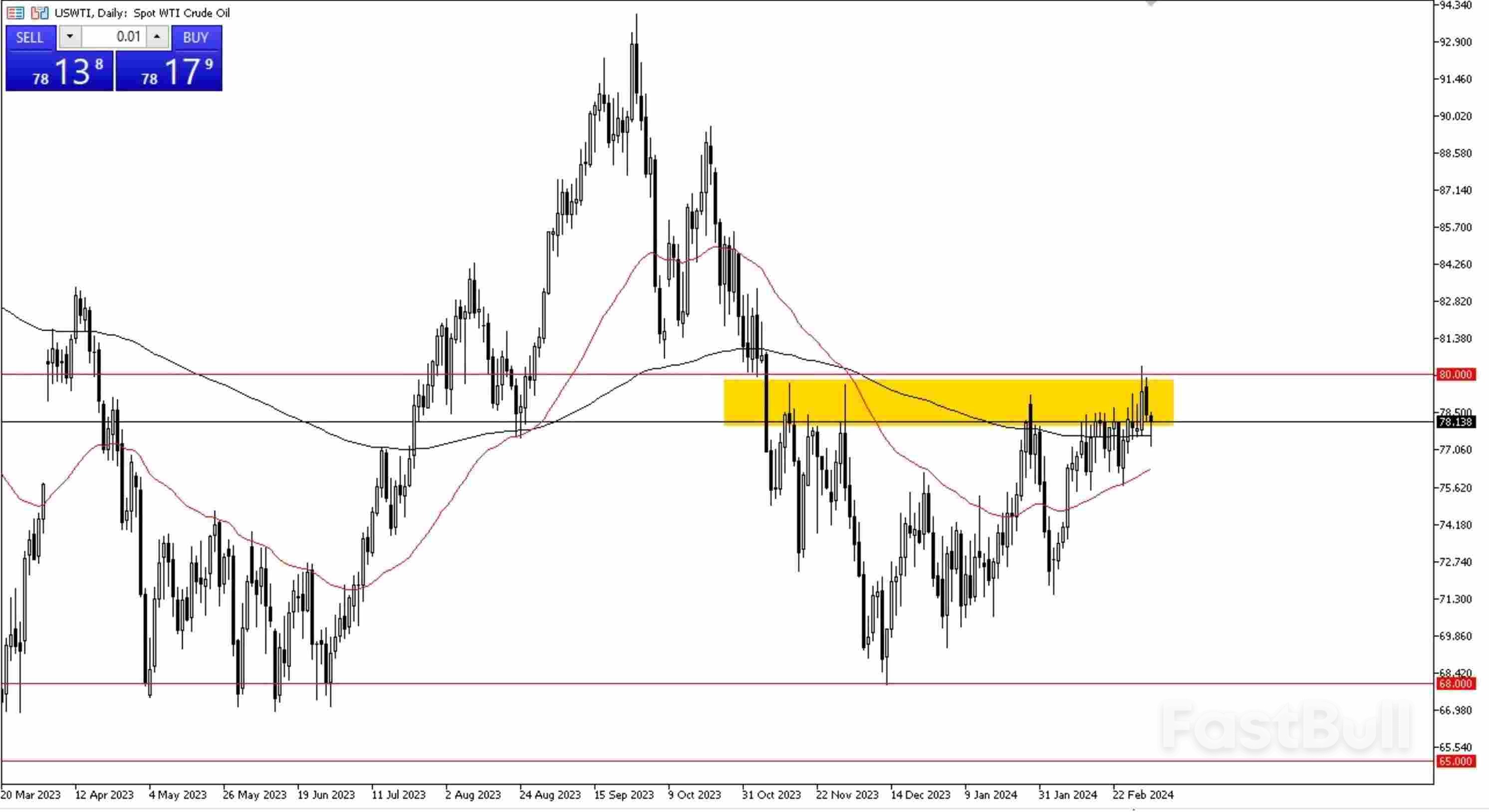
          Volatility has been a defining characteristic of these markets, overshadowing other factors. As crude oil experiences a decline, a closer look at the West Texas Intermediate (WTI) market reveals a hovering pattern around the 200-day Exponential Moving Average (EMA). Within this realm of fluctuation, subtle signs of support are beginning to emerge, hinting at a potential shift in the market dynamics.
          The lens through which I view this market is one of cautious optimism, emphasizing a bullish stance despite the looming possibility of turbulence. This perspective has been a guiding principle in navigating the market's twists and turns, recognizing the inherent volatility as an inherent part of the oil trading landscape.
          Crucially, the resilience of the WTI market around the 200-day EMA serves as a focal point for analysis. While crude oil faces a broader decline, the specific dynamics of the WTI market provide a nuanced narrative. The gradual manifestation of support in this critical area suggests a potential turning point, laying the groundwork for a resurgence in prices.
          In maintaining a bullish outlook, my strategy has been rooted in a steadfast belief that the market is poised for an upward trajectory. This conviction is underpinned by a careful consideration of the factors influencing crude oil prices, emphasizing the inherent strength in the market despite temporary setbacks.
          Crucial to this assessment is the anticipation of the WTI market surpassing the $80 level. The breaking of this threshold is seen not as a distant possibility but as an eventuality that could materialize sooner rather than later. This belief is grounded in a comprehensive analysis of market trends, technical indicators, and a keen awareness of the underlying dynamics shaping the oil markets.
          While acknowledging the current decline in crude oil prices, the focus on potential support and signs of resilience within the WTI market is instrumental. By understanding the market through this lens, it becomes apparent that shorting the market may not be a prudent strategy at this juncture. Instead, the emphasis remains on the potential for further upward movement, driven by the WTI market's ability to weather the storm and exhibit signs of strength.
          The broader context of playing the market in this manner is a testament to the resilience of the oil industry. Despite external challenges and periodic fluctuations, the underlying bullish sentiment prevails. This strategy reflects a calculated and informed approach, acknowledging the ebb and flow of the market while remaining focused on the ultimate goal of capitalizing on potential gains.
          In conclusion, the current state of crude oil markets is marked by turbulence, yet an undercurrent of support and resilience is evident. The WTI market's position around the 200-day EMA, coupled with signs of emerging support, reinforces the belief in an impending bullish movement. The decision to refrain from shorting the market is a deliberate one, grounded in the anticipation of the WTI market breaking above the $80 level. As the oil markets navigate through these fluctuations, the strategy remains one of cautious optimism, aligning with the belief that the path to higher prices is on the horizon.Crude Oil Tests Support Amid Bullish Momentum in Latest Market Forecast_1

          Brent

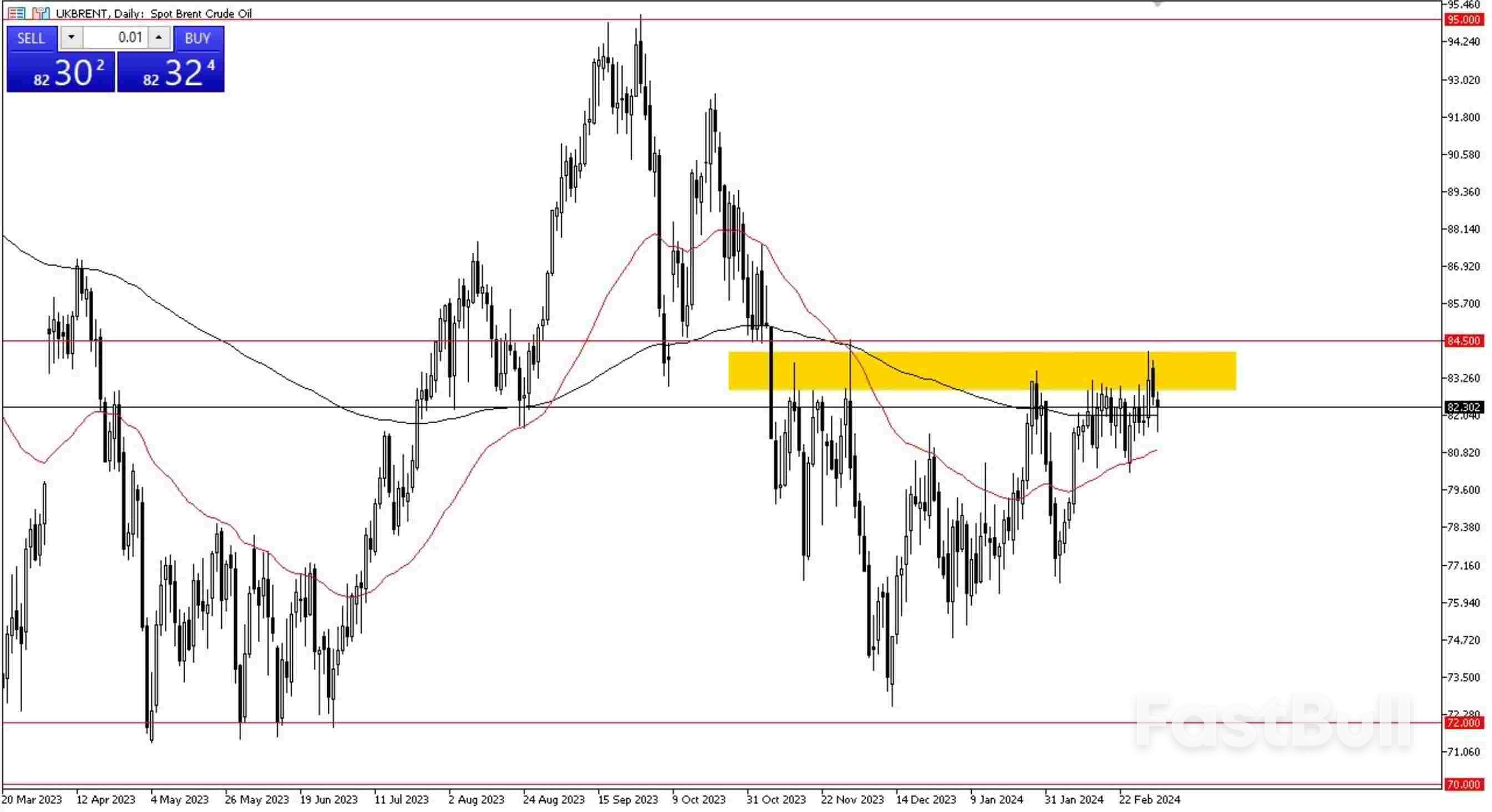
          In the recent ebbs and flows of Brent crude oil prices during Tuesday's trading session, a slight decline was noted. However, a notable player has entered the scene in the form of the 200-day Exponential Moving Average (EMA), displaying signs of providing crucial support. Anchoring the analysis further is the resistance barrier at the $84.50 level, awaiting a confirmed close above it to signal a potential shift in market dynamics.
          The key to unlocking further upward movement lies in breaching the resistance at $84.50. This level acts as a critical juncture, requiring a confirmed close above it to trigger momentum and potentially set the stage for a reversal. Monitoring the candlestick's peak becomes paramount in this context, as breaking above it could pave the way for a meaningful move.
          Looking ahead, I hold the belief that within this framework, the market might well have its sights set on the $90 mark. Beyond that milestone, the $95 level emerges as a tangible objective, signaling an upward trajectory that aligns with the broader market trend. This outlook is not merely grounded in speculation but is informed by a comprehensive understanding of market dynamics, technical indicators, and a strategic anticipation of the road ahead.
          Crucial to this analysis is the consideration of the approaching season when oil demand traditionally experiences an upswing. This contextual lens allows for a nuanced perspective, considering the inherent factors influencing oil markets during this period. Rather than engaging in overly romanticized narratives, the focus is on pragmatic investment strategies aligned with the anticipated bullish run during the summer months.
          Beyond seasonal dynamics, the physical market has exhibited signs of tight supply, further bolstering the case for a bullish outlook. This aspect carries weight as physical market conditions often set the stage for corresponding movements in the futures market. The anticipation is that the futures market will catch up to the prevailing physical market conditions, providing an additional catalyst for upward movement.
          In navigating this complex landscape, the goal is not to romanticize the market but to pragmatically identify opportunities for investment in what is perceived as an imminent bull market run. This approach is rooted in a meticulous analysis of both technical and fundamental factors, allowing for a well-informed and strategic investment strategy.
          As the market gears up for potential bullish momentum, the focus remains on practical and actionable insights. The $84.50 resistance level and its implications for a confirmed close above it become pivotal in gauging the market's trajectory. The envisioned journey toward $90 and subsequently $95 is not fueled by speculation alone but is substantiated by a thorough understanding of market trends and dynamics.
          In conclusion, the Brent crude oil market is currently navigating a nuanced landscape, with the 200-day EMA offering support and the $84.50 resistance level signaling a critical threshold. The potential for a bullish run towards $90 and $95 is not wishful thinking but is grounded in a strategic analysis of seasonal patterns, market conditions, and a forward-looking anticipation of supply-demand dynamics. The focus remains on pragmatic investment strategies that align with the perceived bullish trajectory expected during the upcoming summer months.Crude Oil Tests Support Amid Bullish Momentum in Latest Market Forecast_2
          Risk Warnings and Disclaimers
          You understand and acknowledge that there is a high degree of risk involved in trading. Following any strategies or investment methods may lead to potential losses. The content on the site is provided by our contributors and analysts for information purposes only. You are solely responsible for determining whether any trading assets, securities, strategy, or any other product is suitable for investing based on your own investment objectives and financial situation.
          Add to Favorites
          Share

          GBP/USD Awaits UK Budget with Cautious Optimism and Strategic Anticipation

          Chandan Gupta

          Traders' Opinions

          Forex

          Fundamental Analysis

          In the world of currency trading, today's spotlight is on the GBP/USD pair, eagerly awaiting cues from the UK budget announcement and the testimony of the US Federal Reserve Chairman. These events are expected to wield considerable influence over the pair's performance throughout the trading session.
          According to insights from currency trading platforms, the US dollar finds itself on shaky ground after a business survey fell short of expectations, hinting at a potential slowdown in the previously sizzling US growth rate. Notably, the pound made a move, gaining a modest quarter percent against the dollar, reaching 1.2735. This shift followed the release of the US services PMI reading for February, clocking in at 52.6—down from January's 53.4 and below the anticipated 53.
          Delving into economic calendar data, the composite index pointed to growth for the 14th consecutive month in February. It's a notable streak that started after a contraction in December 2022, marking the first since May 2020. However, amidst this positive trajectory, the employment index experienced its second contraction in three months, dropping to 48%—a 2.5 percentage point dip from January's 50.5%. These contractions raise eyebrows, indicating a potential moderation in the pace of US economic growth, a rare development for investors accustomed to a continuous stream of positive surprises.
          This unforeseen shift has, unsurprisingly, favored the US dollar. The successive positive surprises had pushed back expectations for the first US rate hike, but any reversal in the data could signal the end of this trend. In such a scenario, the focus might shift to building US rate cut bets.
          What does this mean for the pound? It paves the way for potential gains, with the currency likely eyeing the upper bounds of its recent range. While the services sector's activity appears to be slowing, the report underscores an economy still in growth mode. The new orders component, hitting a robust 56.1 in February, marks its strongest performance since August of the previous year. This is coupled with the business activity component reaching 57.2—a testament to service companies meeting demand with the utmost vigor, the strongest since August 2023.
          Yet, amid these positive notes, inflationary pressures linger. The rise in costs faced by service-oriented companies did slow moderately to 58.6 from January's 64.0. This nuanced landscape implies that while the market may not have fresh fuel to feed expectations of further US rate cuts, the US economy is not yet signaling a demand for a rate cut from the Federal Reserve.
          Ultimately, this intricate dance of economic data sets the stage for a balancing act. The limit to USD weakness and the cap on GBP, as indicated by the December high of 1.2825, showcase the delicate equilibrium that the currency markets find themselves in. As traders navigate through the twists and turns of economic indicators, the GBP/USD pair remains under the influence of global events, financial data, and the ever-watchful eyes of investors seeking clues for their next strategic moves.

          Technical Analysis

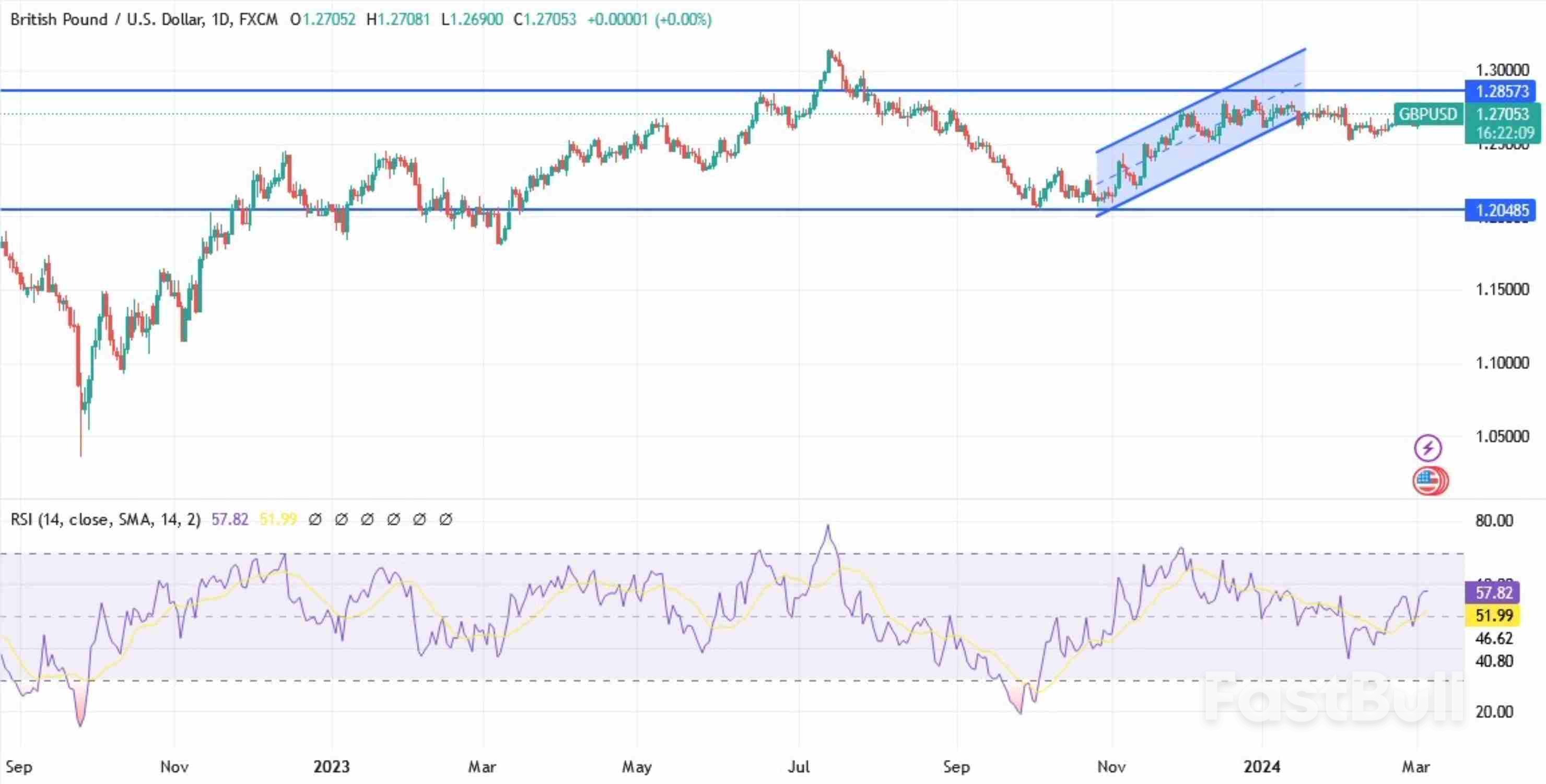
          Analyzing the daily chart signals continued upward momentum for the GBP/USD currency pair. The bulls find support at the 1.2775 resistance level, setting the stage for potential robust gains. Breaking through the 1.2830 resistance could rekindle investor interest in the psychological barrier of 1.3000, contingent on positive outcomes from the UK budget announcement and a shift in the Federal Reserve's hawkish tone. Conversely, a retreat to the 1.2600 support level would dash current upward hopes, signaling a potential reversal in the currency pair's fortunes.GBP/USD Awaits UK Budget with Cautious Optimism and Strategic Anticipation_1
          Risk Warnings and Disclaimers
          You understand and acknowledge that there is a high degree of risk involved in trading. Following any strategies or investment methods may lead to potential losses. The content on the site is provided by our contributors and analysts for information purposes only. You are solely responsible for determining whether any trading assets, securities, strategy, or any other product is suitable for investing based on your own investment objectives and financial situation.
          Add to Favorites
          Share

          Canada Keeps Interest Rate Steady At 5%

          Zi Cheng

          Traders' Opinions

          Economic

          The Bank of Canada, under the leadership of Governor Tiff Macklem, has maintained its policy rate unchanged for the fifth consecutive meeting, citing advancements in inflation while emphasizing that it remains premature to contemplate rate reductions.
          Canada Keeps Interest Rate Steady At 5%_1
          Macklem and fellow policymakers chose to keep the benchmark overnight rate steady at 5% during Wednesday's meeting. This decision was largely anticipated by both financial markets and economists surveyed by Bloomberg.
          In assessing the economic landscape, officials noted that there have been no significant deviations in economic indicators over the six weeks since their previous decision in January. At that time, they had hinted at a shift towards deliberations regarding the duration of maintaining borrowing costs at their current level.
          Macklem, echoing the sentiments of the governing council, stated that the decision reflects their evaluation that a policy rate of 5% remains appropriate. He reiterated that it is still premature to entertain the idea of lowering the policy interest rate, as highlighted in his prepared opening statement.
          Nevertheless, officials have observed "some indications" suggesting a alleviation of wage pressures, and they have highlighted that employment increases are trailing behind population expansion. Despite the economy surpassing expectations with its growth at the end of the previous year, the bank characterized the rate of growth as "subdued and below its potential."
          Prior to Wednesday's decision, traders involved in overnight swaps were anticipating that the bank would initiate a series of rate cuts starting from the July meeting. Economists, however, consider June to be a more probable starting point for the commencement of the easing cycle.
          The bank's upcoming rate decision is scheduled for April 10, during which policymakers will also revise their economic forecasts following the receipt of updated data on corporate pricing behavior and inflation expectations.
          Comparing the current state to a year prior, the country's labor market exhibits signs of weakness. The year-over-year change in the consumer price index slowed to 2.9% at the beginning of the year, marking only the second instance in 34 months that price pressures have dipped below the 3% threshold set by the bank's target range.
          In its statement, the bank reiterated that elevated shelter prices remain the primary driver of inflation. It also highlighted that both yearly and three-month measures of core price pressures continue to hover within the 3% to 3.5% range.
          To stay updated on all economic events of today, please check out our Economic calendar
          Risk Warnings and Disclaimers
          You understand and acknowledge that there is a high degree of risk involved in trading. Following any strategies or investment methods may lead to potential losses. The content on the site is provided by our contributors and analysts for information purposes only. You are solely responsible for determining whether any trading assets, securities, strategy, or any other product is suitable for investing based on your own investment objectives and financial situation.
          Add to Favorites
          Share

          Soybeans,Corn,Wheat Give Back Some Gains

          Samantha Luan

          Commodity

          Economic

          Soybeans were modestly lower on profit taking and technical selling. Contracts held above the recent lows, but the trade seems reluctant to break overhead resistance due to fundamental factors. South American weather generally looks favorable, with large crops expected in Argentina and Brazil, and export demand for U.S. wheat continues to be slow because of Brazil’s price advantage. Brazil’s harvest is right around the halfway point. The USDA’s updated supply and demand numbers are out on the 8th, with CONAB’s fresh outlook for Brazil set for the 12th. Soybean meal and oil were lower on the same factors as soybeans.
          Corn was modestly lower on profit taking and technical selling. Corn is watching second crop planting and development in Brazil and conditions in Argentina. The trade also has an eye on U.S. conditions ahead of widespread planting. The USDA’s Prospective Planting numbers are out on the 28th, along with Quarterly Grain Stocks. Export demand is good and ethanol margins have tightened but remain in positive territory. The U.S. Energy Information Administration’s weekly ethanol production and stocks numbers are out Wednesday. China is reportedly buying corn from Ukraine, re-establishing what had been a solid relationship for trade in that crop before the war with Russia. There’s also been talk, but no confirmation, of China buying U.S. corn this week.
          The wheat complex was lower on profit taking and technical selling, with Chicago notching new lows for the move. Global winter wheat conditions are mostly good with scattered rain in the forecast for the central and southern U.S. Plains later this week. Even with the recent issues, the hard red winter crop is in significantly better condition than this time last year. There’s also a good chance of rain in the northern U.S. Plains and Canada, recharging soil moisture ahead of spring wheat planting. The recent rally was bargain hunting by commercials, not a fundamental change. A drop in Paris milling wheat added to the U.S. woes. Prices for Ukraine and Russia have declined, but that’s more of a bearish factor for U.S. and European Union export demand than overall global price structure, at least over the near-term. Australia’s Bureau of Agricultural and Resource Economics sees that nation’s new wheat crop at 26 million tons, well below last year, but up 500,000 from the previous guess.
          To stay updated on all economic events of today, please check out our Economic calendar
          Risk Warnings and Disclaimers
          You understand and acknowledge that there is a high degree of risk involved in trading. Following any strategies or investment methods may lead to potential losses. The content on the site is provided by our contributors and analysts for information purposes only. You are solely responsible for determining whether any trading assets, securities, strategy, or any other product is suitable for investing based on your own investment objectives and financial situation.
          Add to Favorites
          Share

          Japan's Biggest Bank Sets Trading Strategy For BOJ Pivot This Month

          Samantha Luan

          Economic

          One question is obsessing Tokyo’s financial markets — when will the Bank of Japan exit negative interest rates? The country’s biggest bank expects the move to come in two weeks and is positioning itself accordingly.
          Mitsubishi UFJ Financial Group Inc.’s view is much more definitive than the swap market, which rates the chances of BOJ Governor Kazuo Ueda changing policy this month at about 50%. When he does change course, it will have major implications for both the 1,096 trillion yen ($7.3 trillion) government bond market and for the nation’s currency.
          “I think it’s necessary to end the negative interest rate in March, not April,” Hiroyuki Seki, head of global markets business at Mitsubishi UFJ Financial Group Inc., said in an interview.
          Seki’s reasoning is that the BOJ will likely make an additional hike to take the policy rate to 0.25% by October at the latest “to secure future policy flexibility” after raising rates at its next meeting on March 19 for the first time since 2007.
          The BOJ “needs to secure enough lead time before the next rate hike,” he said.
          He said his outlook for the BOJ action is based on hints telegraphed by the central bank officials’ public remarks as well as political and other events this year, which are likely to dictate monetary policy options.
          Traders of overnight indexed swaps see the chances of a March move around 53%, rising to an 80% chance of a hike by April as of late Tuesday.Japan's Biggest Bank Sets Trading Strategy For BOJ Pivot This Month_1
          Seki said there will be “structural changes” in the Japanese government bond market once the BOJ ends negative rates and starts paying 0.1% interest rates on reserves. This will likely trigger a fall in demand for JGBs, pushing down their prices and driving up yields.
          The yield on Japan’s benchmark 10-year government bond rose half a basis point to 0.700% on Wednesday.
          MUFG is holding bearish positions on JGBs through investment funds and overnight-indexed swaps in anticipation of the BOJ move, Seki said.
          “We are already managing in a way to enhance our tolerance to a rise in yen interest rates,” he said.
          After short- and medium-term rates start rising, MUFG will build up swap receiver positions, since overnight indexed swaps are undervalued relative to bonds, he said. Seki added the bank plans to do that once 10-year overnight indexed swaps reach at least 1.1% or five-year OIS at least 0.6%.
          It also plans to start investing in JGBs “in earnest” if the securities’ overvaluation is corrected, with their yields converging toward corresponding swap rates, he said. Yields on 10-year notes will likely trend toward 1.0% and over and those on 5-year to 0.6% and over, according to Seki.Japan's Biggest Bank Sets Trading Strategy For BOJ Pivot This Month_2
          Seki expects the BOJ to do more than just raise rates.
          At the introduction of the negative interest policy in 2016, the BOJ adopted the three-tier system, wherein interest rates of 0.1%, 0% and minus 0.1% are applied on balances parked at the central bank reserves.
          Seki said the BOJ is likely to get rid of the system along with the negative interest rate and a 0.1% interest rate is likely to be applied to all the money at the central bank reserve.
          And the BOJ policy target is also likely to be changed to unsecured overnight call rates, which is expected to rise to a range of 0-0.1% from the current -0.1-0%.
          Seki expects the BOJ to keep its yield curve control in place for a while to curb excess volatility in the aftermath of the policy change.
          “I don’t think the ceiling reference point will be removed.” he said. “It’s likely to be kept with more flexibility.”
          Higher rates at the BOJ would contrast starkly from expectations for other major central banks, which are forecast to lower rates this year.
          The yen has weakened to about 150 against the dollar after the Federal Reserve launched an aggressive rate-hike campaign in early 2022, which created a sharp divergence from Japan’s policy rate.
          Seki said the expected rate cuts at the Federal Reserve won’t prevent the BOJ from going the opposite direction, as long as the US economy avoids a sharp slowdown and the Fed’s actions are preemptive.
          He also said the bank remains cautious on foreign bond investment while the inverse yield curve continues on US Treasuries.
          The end of the BOJ’s ultra-easy money policy is also “expected to put a brake on loosening of fiscal discipline,” he said, referring to public concerns that years of the central bank’s massive JGB buying have made the government’s deficit spending too easy.

          Source:Bloomberg

          To stay updated on all economic events of today, please check out our Economic calendar
          Risk Warnings and Disclaimers
          You understand and acknowledge that there is a high degree of risk involved in trading. Following any strategies or investment methods may lead to potential losses. The content on the site is provided by our contributors and analysts for information purposes only. You are solely responsible for determining whether any trading assets, securities, strategy, or any other product is suitable for investing based on your own investment objectives and financial situation.
          Add to Favorites
          Share
          FastBull
          Copyright © 2025 FastBull Ltd

          728 RM B 7/F GEE LOK IND BLDG NO 34 HUNG TO RD KWUN TONG KLN HONG KONG

          TelegramInstagramTwitterfacebooklinkedin
          App Store Google Play Google Play
          Products
          Charts

          Chats

          Q&A with Experts
          Screeners
          Economic Calendar
          Data
          Tools
          Membership
          Features
          Function
          Markets
          Copy Trading
          Latest Signals
          Contests
          News
          Analysis
          24/7
          Columns
          Education
          Company
          Careers
          About Us
          Contact Us
          Advertising
          Help Center
          Feedback
          User Agreement
          Privacy Policy
          Business

          White Label

          Data API

          Web Plug-ins

          Poster Maker

          Affiliate Program

          Risk Disclosure

          The risk of loss in trading financial instruments such as stocks, FX, commodities, futures, bonds, ETFs and crypto can be substantial. You may sustain a total loss of the funds that you deposit with your broker. Therefore, you should carefully consider whether such trading is suitable for you in light of your circumstances and financial resources.

          No decision to invest should be made without thoroughly conducting due diligence by yourself or consulting with your financial advisors. Our web content might not suit you since we don't know your financial conditions and investment needs. Our financial information might have latency or contain inaccuracy, so you should be fully responsible for any of your trading and investment decisions. The company will not be responsible for your capital loss.

          Without getting permission from the website, you are not allowed to copy the website's graphics, texts, or trademarks. Intellectual property rights in the content or data incorporated into this website belong to its providers and exchange merchants.

          Not Logged In

          Log in to access more features

          FastBull Membership

          Not yet

          Purchase

          Become a signal provider
          Help Center
          Customer Service
          Dark Mode
          Price Up/Down Colors

          Log In

          Sign Up

          Position
          Layout
          Fullscreen
          Default to Chart
          The chart page opens by default when you visit fastbull.com