• Trade
  • Markets
  • Copy
  • Contests
  • News
  • 24/7
  • Calendar
  • Q&A
  • Chats
Trending
Screeners
SYMBOL
LAST
BID
ASK
HIGH
LOW
NET CHG.
%CHG.
SPREAD
SPX
S&P 500 Index
6846.50
6846.50
6846.50
6878.28
6827.18
-23.90
-0.35%
--
DJI
Dow Jones Industrial Average
47739.31
47739.31
47739.31
47971.51
47611.93
-215.67
-0.45%
--
IXIC
NASDAQ Composite Index
23545.89
23545.89
23545.89
23698.93
23455.05
-32.22
-0.14%
--
USDX
US Dollar Index
99.000
99.080
99.000
99.000
99.000
+0.050
+ 0.05%
--
EURUSD
Euro / US Dollar
1.16379
1.16387
1.16379
1.16389
1.16322
+0.00015
+ 0.01%
--
GBPUSD
Pound Sterling / US Dollar
1.33225
1.33233
1.33225
1.33239
1.33140
+0.00020
+ 0.02%
--
XAUUSD
Gold / US Dollar
4191.86
4192.30
4191.86
4193.80
4189.64
+2.16
+ 0.05%
--
WTI
Light Sweet Crude Oil
58.650
58.692
58.650
58.676
58.543
+0.095
+ 0.16%
--

Community Accounts

Signal Accounts
--
Profit Accounts
--
Loss Accounts
--
View More

Become a signal provider

Sell trading signals to earn additional income

View More

Guide to Copy Trading

Get started with ease and confidence

View More

Signal Accounts for Members

All Signal Accounts

Best Return
  • Best Return
  • Best P/L
  • Best MDD
Past 1W
  • Past 1W
  • Past 1M
  • Past 1Y

All Contests

  • All
  • Trump Updates
  • Recommend
  • Stocks
  • Cryptocurrencies
  • Central Banks
  • Featured News
Top News Only
Share

Brazil Finance Minister Haddad: Loan For Correios Is Possible This Year, But It Is Not The Only Option Under Works

Share

KCNA: North Korea's Supreme Leader Kim Jong UN Sends Condolences To Russian Embassy For Ambassador's Death

Share

Japan Prime Minister Takaichi: 30 Injuries Reported So Far From Monday Earthquake

Share

USA Senate Committee Votes To Advance Nomination Of Jared Isaacman To Head Nasa

Share

Singapore Post - New Rate For Standard Regular Mail & Standard Large Mail Will Be S$0.62 And S$0.90 Respectively

Share

Australia's S&P/ASX 200 Index Down 0.27% At 8601.10 Points In Early Trade

Share

Trump: The USA Needs Mexico To Release 200000 Acre-Feet Of Water Before December 31St, And The Rest Must Come Soon After

Share

Trump: I Have Authorized Documentation To Impose A 5% Tariff On Mexico If This Water Isn't Released

Share

Brazil's Sao Paulo State Governor Tarcisio De Freitas Says Flavio Bolsonaro Will Have His Support - Cnn Brasil

Share

Ukraine's Security Must Be Guaranteed, In The Long Term, As A First Line Of Defence For Our Union, Says European Commission President

Share

Ukraine's Sovereignty Must Be Respected, Says European Commission President

Share

The Goal Is A Strong Ukraine, On The Battlefield And At The Negotiating Table, Says European Commission President

Share

As Peace Talks Are Ongoing, The EU Remains Ironclad In Its Support For Ukraine, Says European Commission President

Share

Pepsico: Asking USA-Based Pepna Employees As Well As Pbus Division Offices And Pfus Region Offices To Work Remotely This Week

Share

A U.S. Judge Ruled That President Trump’s Ban On Several Wind Power Projects Was Illegal

Share

Senior USA Administration Official: We Continue To Monitor Drc-Rwanda Situation Closely, Continue To Work With All Sides To Ensure Commitments Are Honored

Share

Israeli Military Says It Has Struck Infrastructure Belonging To Hezbollah In Several Areas In Southern Lebanon

Share

SPDR Gold Holdings Down 0.11%, Or 1.14 Tonnes

Share

On Monday (December 8), In Late New York Trading, S&P 500 Futures Fell 0.21%, Dow Jones Futures Fell 0.43%, NASDAQ 100 Futures Fell 0.08%, And Russell 2000 Futures Fell 0.04%

Share

Morgan Stanley: Data Center ABS Spreads Are Expected To Widen In 2026

TIME
ACT
FCST
PREV
France Trade Balance (SA) (Oct)

A:--

F: --

P: --
Euro Zone Employment YoY (SA) (Q3)

A:--

F: --

P: --
Canada Part-Time Employment (SA) (Nov)

A:--

F: --

P: --

Canada Unemployment Rate (SA) (Nov)

A:--

F: --

P: --

Canada Full-time Employment (SA) (Nov)

A:--

F: --

P: --

Canada Labor Force Participation Rate (SA) (Nov)

A:--

F: --

P: --

Canada Employment (SA) (Nov)

A:--

F: --

P: --

U.S. PCE Price Index MoM (Sept)

A:--

F: --

P: --

U.S. Personal Income MoM (Sept)

A:--

F: --

P: --

U.S. Core PCE Price Index MoM (Sept)

A:--

F: --

P: --

U.S. PCE Price Index YoY (SA) (Sept)

A:--

F: --

P: --

U.S. Core PCE Price Index YoY (Sept)

A:--

F: --

P: --

U.S. Personal Outlays MoM (SA) (Sept)

A:--

F: --

P: --
U.S. 5-10 Year-Ahead Inflation Expectations (Dec)

A:--

F: --

P: --

U.S. Real Personal Consumption Expenditures MoM (Sept)

A:--

F: --

P: --
U.S. Weekly Total Rig Count

A:--

F: --

P: --

U.S. Weekly Total Oil Rig Count

A:--

F: --

P: --

U.S. Consumer Credit (SA) (Oct)

A:--

F: --

P: --
China, Mainland Foreign Exchange Reserves (Nov)

A:--

F: --

P: --

Japan Trade Balance (Oct)

A:--

F: --

P: --

Japan Nominal GDP Revised QoQ (Q3)

A:--

F: --

P: --

China, Mainland Imports YoY (CNH) (Nov)

A:--

F: --

P: --

China, Mainland Exports (Nov)

A:--

F: --

P: --

China, Mainland Imports (CNH) (Nov)

A:--

F: --

P: --

China, Mainland Trade Balance (CNH) (Nov)

A:--

F: --

P: --

China, Mainland Exports YoY (USD) (Nov)

A:--

F: --

P: --

China, Mainland Imports YoY (USD) (Nov)

A:--

F: --

P: --

Germany Industrial Output MoM (SA) (Oct)

A:--

F: --

P: --
Euro Zone Sentix Investor Confidence Index (Dec)

A:--

F: --

P: --

Canada National Economic Confidence Index

A:--

F: --

P: --

U.K. BRC Like-For-Like Retail Sales YoY (Nov)

--

F: --

P: --

U.K. BRC Overall Retail Sales YoY (Nov)

--

F: --

P: --

Australia Overnight (Borrowing) Key Rate

--

F: --

P: --

RBA Rate Statement
RBA Press Conference
Germany Exports MoM (SA) (Oct)

--

F: --

P: --

U.S. NFIB Small Business Optimism Index (SA) (Nov)

--

F: --

P: --

Mexico 12-Month Inflation (CPI) (Nov)

--

F: --

P: --

Mexico Core CPI YoY (Nov)

--

F: --

P: --

Mexico PPI YoY (Nov)

--

F: --

P: --

U.S. Weekly Redbook Index YoY

--

F: --

P: --

U.S. JOLTS Job Openings (SA) (Oct)

--

F: --

P: --

China, Mainland M1 Money Supply YoY (Nov)

--

F: --

P: --

China, Mainland M0 Money Supply YoY (Nov)

--

F: --

P: --

China, Mainland M2 Money Supply YoY (Nov)

--

F: --

P: --

U.S. EIA Short-Term Crude Production Forecast For The Year (Dec)

--

F: --

P: --

U.S. EIA Natural Gas Production Forecast For The Next Year (Dec)

--

F: --

P: --

U.S. EIA Short-Term Crude Production Forecast For The Next Year (Dec)

--

F: --

P: --

EIA Monthly Short-Term Energy Outlook
U.S. API Weekly Gasoline Stocks

--

F: --

P: --

U.S. API Weekly Cushing Crude Oil Stocks

--

F: --

P: --

U.S. API Weekly Crude Oil Stocks

--

F: --

P: --

U.S. API Weekly Refined Oil Stocks

--

F: --

P: --

South Korea Unemployment Rate (SA) (Nov)

--

F: --

P: --

Japan Reuters Tankan Non-Manufacturers Index (Dec)

--

F: --

P: --

Japan Reuters Tankan Manufacturers Index (Dec)

--

F: --

P: --

Japan Domestic Enterprise Commodity Price Index MoM (Nov)

--

F: --

P: --

Japan Domestic Enterprise Commodity Price Index YoY (Nov)

--

F: --

P: --

China, Mainland PPI YoY (Nov)

--

F: --

P: --

China, Mainland CPI MoM (Nov)

--

F: --

P: --

Italy Industrial Output YoY (SA) (Oct)

--

F: --

P: --

Q&A with Experts
    • All
    • Chatrooms
    • Groups
    • Friends
    Connecting
    .
    .
    .
    Type here...
    Add Symbol or Code

      No matching data

      All
      Trump Updates
      Recommend
      Stocks
      Cryptocurrencies
      Central Banks
      Featured News
      • All
      • Russia-Ukraine Conflict
      • Middle East Flashpoint
      • All
      • Russia-Ukraine Conflict
      • Middle East Flashpoint
      Search
      Products

      Charts Free Forever

      Chats Q&A with Experts
      Screeners Economic Calendar Data Tools
      Membership Features
      Data Warehouse Market Trends Institutional Data Policy Rates Macro

      Market Trends

      Market Sentiment Order Book Forex Correlations

      Top Indicators

      Charts Free Forever
      Markets

      News

      News Analysis 24/7 Columns Education
      From Institutions From Analysts
      Topics Columnists

      Latest Views

      Latest Views

      Trending Topics

      Top Columnists

      Latest Update

      Signals

      Copy Rankings Latest Signals Become a signal provider AI Rating
      Contests
      Brokers

      Overview Brokers Assessment Rankings Regulators News Claims
      Broker listing Forex Brokers Comparison Tool Live Spread Comparison Scam
      Q&A Complaint Scam Alert Videos Tips to Detect Scam
      More

      Business
      Events
      Careers About Us Advertising Help Center

      White Label

      Data API

      Web Plug-ins

      Affiliate Program

      Awards Institution Evaluation IB Seminar Salon Event Exhibition
      Vietnam Thailand Singapore Dubai
      Fans Party Investment Sharing Session
      FastBull Summit BrokersView Expo
      Recent Searches
        Top Searches
          Markets
          News
          Analysis
          User
          24/7
          Economic Calendar
          Education
          Data
          • Names
          • Latest
          • Prev

          View All

          No data

          Scan to Download

          Faster Charts, Chat Faster!

          Download App
          English
          • English
          • Español
          • العربية
          • Bahasa Indonesia
          • Bahasa Melayu
          • Tiếng Việt
          • ภาษาไทย
          • Français
          • Italiano
          • Türkçe
          • Русский язык
          • 简中
          • 繁中
          Open Account
          Search
          Products
          Charts Free Forever
          Markets
          News
          Signals

          Copy Rankings Latest Signals Become a signal provider AI Rating
          Contests
          Brokers

          Overview Brokers Assessment Rankings Regulators News Claims
          Broker listing Forex Brokers Comparison Tool Live Spread Comparison Scam
          Q&A Complaint Scam Alert Videos Tips to Detect Scam
          More

          Business
          Events
          Careers About Us Advertising Help Center

          White Label

          Data API

          Web Plug-ins

          Affiliate Program

          Awards Institution Evaluation IB Seminar Salon Event Exhibition
          Vietnam Thailand Singapore Dubai
          Fans Party Investment Sharing Session
          FastBull Summit BrokersView Expo

          What to Watch for in Friday's U.S. Jobs Report

          Alex

          Economic

          Summary:

          U.S. interest rate hike expectations have been flying all over the place in the past three weeks. The market has now settled on around a 25% chance of a 25bp hike on 14 June, but a strong jobs reading on Friday could easily swing things back in favour of a hike.
          Markets think the Fed will "skip" June hike, but strong jobs could change that
          When Federal Reserve Chair Jerome Powell opened the door to a potential Fed pause after the May FOMC meeting, financial markets swiftly priced a Fed peak with potentially 100bp of rate cuts by January 2024. However, strong jobs, sticky inflation and a raft of hawkish comments from some prominent regional Fed officials saw this completely reversed. As of last Friday a June hike has been seen as more likely than not, with perhaps just a couple of cuts priced by next January. This week though, comments from Fed Governor Philip Jefferson and Philadelphia Fed President Patrick Harker reignited the prospect of skipping a hike in June and a reassessment in July. There is clearly a core group at the Fed who think 500bp of rate hikes and tighter lending conditions may mean they have done enough.
          We outlined our U.S. rates view and the risks surrounding it in this report. It is that the Fed has peaked and we will get rate cuts from the fourth quarter onwards but we must acknowledge that if we get a strong jobs report and U.S. CPI comes in hot on 13 June, the day ahead of the 14 June FOMC meeting, that could be enough to tip the balance in favour of another hike.
          Some data points to strong gains
          At the moment, the consensus is for the economy to add 195,000 jobs in tomorrow's report, which is lower than the 253,000 outcome for April. In fact, none of the 69 organisations surveyed by Bloomberg expect payrolls to come in stronger than last month, which is a little surprising. In terms of the numbers we have seen, we know that job openings remain incredibly high and are in fact larger than the total number of Americans that regard themselves as unemployed. This means that a lack of people with the required skill sets continues to restrict hiring.
          Yet today's ADP jobs release reported private payrolls rose 278k versus the 170k consensus - it is a bit of a black box model that doesn't have a great track record in predicting actual payrolls. Then we have the homebase data on hourly employed workers which was OK and the ISM manufacturing employment which pointed to modest growth. Then there are comments from St. Louis Fed economist Max Dvorkin, reported by MNI as saying that their real-time labour market index points to household employment (not the same as payrolls) rising 638k!
          But other data is more cautious
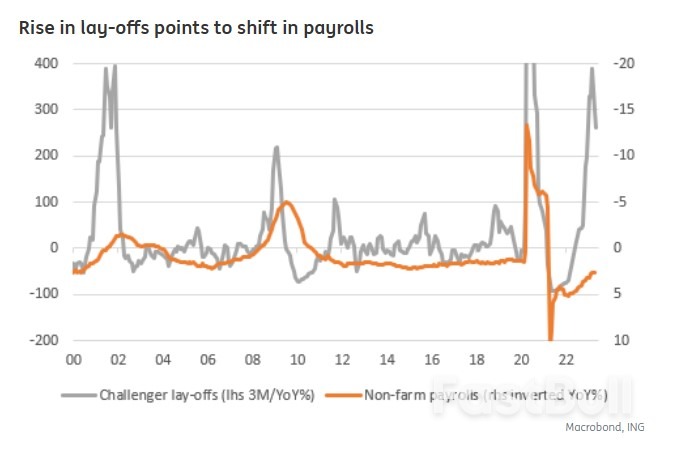
          Nonetheless, we continue to see the number of job lay-off announcements climb. Indeed, today's Challenger job lay-offs report for May showed 80,089 total for lay-offs, up 13,094 on April's level, giving a 286.7% year-on-year change. Hiring announcements totalled just 7,885 versus 23,310 in April. This is the lowest hiring figure since November 2021 and before then, you have to go back to February 2016 to find a lower number than reported today. Yesterday, we had the Federal Reserve's Beige Book which suggested that "Employment increased in most Districts, though at a slower pace than in previous reports".
          What to Watch for in Friday's U.S. Jobs Report_1Watch for slowing wage growth despite record low unemployment
          Putting it all together, we have some very contradictory signals, meaning we have little confidence in our own 200k forecasts and an acknowledgement that pretty much anything could happen. That said, the payrolls number isn't the only figure to watch. Unemployment fell to 3.4% last month, however, it is wages that will probably get more attention given the Fed's wariness that tight labour markets could keep service sector inflation higher for longer. Last month, it rose 0.5% month-on-month, but the market expects this to slow back to 0.3%.
          Nela Richardson, chief economist at ADP, commented within their report that they saw the second month where there has been a "full percentage point decline in pay growth for job changers," before adding that "pay growth is slowing substantially, and wage-driven inflation may be less of a concern for the economy despite robust hiring."
          Inflation could be the clincher
          In terms of consensus expectations, the market is looking for 195k jobs with unemployment ticking up to 3.5% from 3.4% and average hourly earnings rising 0.3% MoM. If we get something similar to that we are likely to see the market remaining of the view that the Fed will not change policy at the June FOMC meeting, but leave the door open for a possible July rate hike.
          However, if we get a 250k+ figure on jobs and wages rise 0.4% MoM or above and unemployment stays at 3.4%, we suspect it is likely to move in the direction of a 50:50 call for a hike. That would leave the outcome determined by the May CPI report, due out the day ahead of the Fed meeting. A 0.4% MoM core CPI print would put the decision on a knife edge and could give enough ammunition to push another hike over the line.

          Source: ING

          To stay updated on all economic events of today, please check out our Economic calendar
          Risk Warnings and Disclaimers
          You understand and acknowledge that there is a high degree of risk involved in trading. Following any strategies or investment methods may lead to potential losses. The content on the site is provided by our contributors and analysts for information purposes only. You are solely responsible for determining whether any trading assets, securities, strategy, or any other product is suitable for investing based on your own investment objectives and financial situation.
          Comments
          Add to Favorites
          Share

          US 30-Year Mortgage Rate Climbs to 6-Month High, Reflecting Market Expectations of Federal Reserve Tightening

          Warren Takunda

          Traders' Opinions

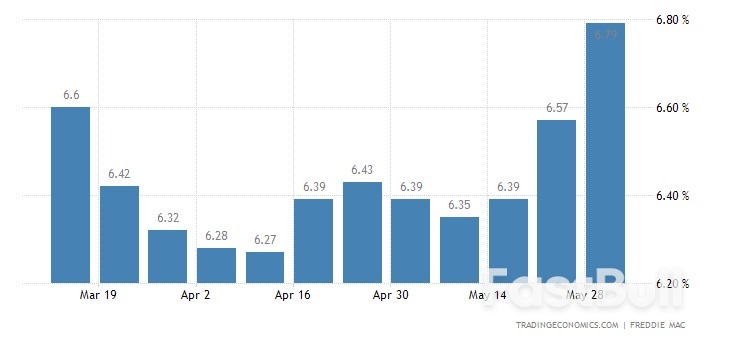
          In a significant development for the US housing market, the average rate on a 30-year fixed mortgage has reached its highest level in six months. According to a survey conducted by mortgage giant Freddie Mac, the rate rose to 6.79% in the week ending May 31st, 2023, up from 6.57% in the previous week. This surge is in line with the Federal Reserve's aggressive tightening measures, leading to growing market expectations of another rate hike. As a result, industry experts anticipate a potential weakening in purchase demand as rates approach the seven percent threshold.US 30-Year Mortgage Rate Climbs to 6-Month High, Reflecting Market Expectations of Federal Reserve Tightening_1

          Rising Mortgage Rates and Economic Outlook

          The recent spike in mortgage rates can be attributed to the buoyant state of the US economy. A thriving economy has instilled confidence in the market, leading to an adjustment in the pricing of mortgage rates. Sam Khater, Chief Economist at Freddie Mac, noted that the rise in rates comes as the market prices in the likelihood of another Federal Reserve rate hike. The current rate of 6.79% is significantly higher than the fixed rate of 5.09% during the same period last year.

          Impact on Housing Market

          The increasing mortgage rates are expected to have implications for the US housing market. Over the past months, there has been a steady flow of purchase demand, primarily driven by attractive rates in the low to mid six percent range. However, with rates inching closer to the seven percent mark, experts anticipate a potential weakening in this demand. Higher mortgage rates generally lead to increased borrowing costs, making homes less affordable for prospective buyers. As a result, this development could potentially slow down the pace of home purchases and impact the overall growth of the housing market.

          Effects on Real Estate Investments

          Rising mortgage rates also have implications for real estate investors. Higher borrowing costs can reduce the affordability of investment properties and potentially affect the returns on such investments. Investors who heavily rely on financing to acquire properties may face challenges in finding favorable terms and interest rates. Moreover, the rising mortgage rates could also impact the demand for rental properties, as potential tenants may reconsider their housing choices in light of increased costs.

          Federal Reserve Policy and Future Outlook

          The Federal Reserve's aggressive tightening measures have played a significant role in the recent surge in mortgage rates. The central bank's actions are aimed at addressing inflationary concerns and maintaining economic stability. However, the impact of these actions on the housing market is a delicate balancing act. While higher rates can help curb inflation, they also have the potential to dampen economic activity, especially in sectors like housing. Therefore, it will be crucial to closely monitor the Federal Reserve's future policy decisions and their implications for mortgage rates and the overall housing market.
          The US 30-year mortgage rate has reached a six-month high, reflecting market expectations of another Federal Reserve rate hike. This increase comes amidst a buoyant economy and the need to address inflationary pressures. However, the rising mortgage rates may weaken purchase demand as affordability becomes a concern for prospective buyers. Additionally, real estate investors may face challenges due to higher borrowing costs. It remains essential to monitor future Federal Reserve policy decisions to better understand their impact on mortgage rates and the broader housing market.
          Risk Warnings and Disclaimers
          You understand and acknowledge that there is a high degree of risk involved in trading. Following any strategies or investment methods may lead to potential losses. The content on the site is provided by our contributors and analysts for information purposes only. You are solely responsible for determining whether any trading assets, securities, strategy, or any other product is suitable for investing based on your own investment objectives and financial situation.
          Comments
          Add to Favorites
          Share

          Finishing the Week with A Flurry

          Damon

          Economic

          Asian markets are looking for a positive end to the week on Friday following a solid rally on Wall Street the day before, as the U.S. debt ceiling vote passed its first congressional hurdle and hopes rose that the U.S. economy will achieve a 'soft landing'.
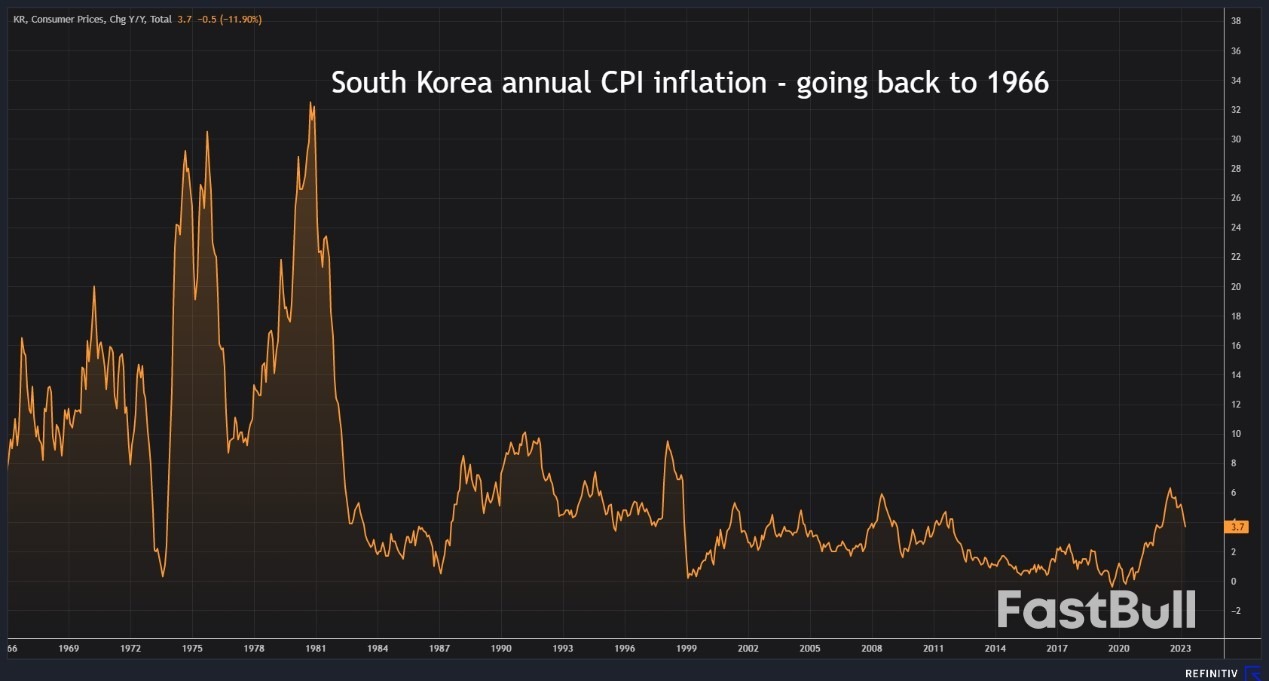
          South Korean inflation for May is the main regional economic indicator on the calendar, and the won could also get a jolt from revised first quarter GDP growth figures. Otherwise, Friday's impetus looks set to come from Thursday's 'Goldilocks' trading on U.S. markets.
          Finishing the Week with A Flurry_1A batch of indicators suggested U.S. inflationary pressures are cooling, which could allow the Fed to pause its rate-hiking cycle later this month, while other data showed the labor market remains strong.
          A win-win for risky assets.
          A weaker dollar and lower Treasury yields also helped fuel the surge in U.S. stocks, with the Nasdaq and tech sector once again the highest fliers. The Nasdaq is on track for a sixth straight weekly gain, which would be its best run since 2019.
          Contrast that with China, where purchasing managers index reports for May were mixed, broader economic data is weak, the central bank is expected to ease policy soon, and investors are pulling their money out of the country.
          Little wonder the yuan is sliding further below 7.00 per dollar to fresh 2023 lows on a near daily basis.
          The dollar's strength against the yuan on Thursday is telling, because it was not replicated across Asia. The Indian rupee registered its biggest rise in three months after PMI data showed factory activity in India grew last month at the fastest pace in two and a half years.
          This follows Wednesday's surprisingly strong GDP data.
          Finishing the Week with A Flurry_2The Australian dollar had its best day in six weeks, and the Japanese yen rose for a fourth consecutive session - its longest winning streak since November.
          Global markets on Friday will take their cue from the U.S. employment report for May but its release comes after Asian markets close, leaving Korean CPI and revised GDP as potentially the main market-moving economic indicators.
          Annual inflation is expected to ease to 3.30% from 3.70% in April, which would be the lowest since October 2021.
          Here are three key developments that could provide more direction to markets on Friday:
          - South Korea CPI inflation (May)
          - South Korea GDP (Q1, revised)
          - Japan monetary base (May)

          Source: Yahoo

          To stay updated on all economic events of today, please check out our Economic calendar
          Risk Warnings and Disclaimers
          You understand and acknowledge that there is a high degree of risk involved in trading. Following any strategies or investment methods may lead to potential losses. The content on the site is provided by our contributors and analysts for information purposes only. You are solely responsible for determining whether any trading assets, securities, strategy, or any other product is suitable for investing based on your own investment objectives and financial situation.
          Comments
          Add to Favorites
          Share

          Adnoc Logistics Soars 52% Following Successful $769 Million Abu Dhab

          Warren Takunda

          Traders' Opinions

          Adnoc Logistics & Services, a subsidiary of the state-owned Abu Dhabi National Oil Company (Adnoc), has experienced a remarkable surge in its stock price, jumping by an impressive 52% after its highly anticipated initial public offering (IPO) in Abu Dhabi. This extraordinary performance reflects the market's overwhelming confidence in the company's potential and the growing attractiveness of the energy sector.
          The IPO, which raised a substantial $769 million, marks a significant milestone for Adnoc Logistics & Services and further demonstrates Adnoc's commitment to diversifying its operations and unlocking value for its stakeholders. It follows the successful listing of another Adnoc subsidiary earlier this year, highlighting the company's strategic approach to capitalizing on the financial markets' favorable conditions.
          Investor enthusiasm for Adnoc Logistics & Services was evident from the remarkable demand generated during the IPO. The company received orders worth an astonishing $125 billion, reflecting the strong interest from both institutional and retail investors. This overwhelming response underscores the belief in the company's growth prospects and the potential for attractive returns.
          Adnoc Logistics & Services is positioned as a key player in the logistics and services sector, supporting the oil and gas industry in Abu Dhabi and beyond. With a wide range of offerings, including shipping, maritime, and onshore and offshore support services, the company plays a crucial role in facilitating the seamless transportation and distribution of energy resources. Its robust infrastructure and strong track record have attracted investors seeking exposure to the thriving energy market in the United Arab Emirates.
          The successful IPO of Adnoc Logistics & Services not only provides a boost to the company's financial standing but also supports the broader ambitions of Adnoc and the Abu Dhabi government. By unlocking value through public offerings, Adnoc can raise capital to fund its ambitious expansion plans, enhance its operational capabilities, and further diversify its revenue streams.
          The impressive market response to the Adnoc Logistics & Services IPO reflects the positive sentiment surrounding the energy sector, driven by increasing global energy demand, favorable oil prices, and the company's strong fundamentals. Investors are recognizing the potential for long-term growth and value creation in this vital industry, and Adnoc Logistics & Services is well-positioned to benefit from these positive dynamics.
          As the stock continues to attract attention and demonstrate its potential, it is essential for investors to closely monitor the company's financial performance and its ability to execute its growth strategy effectively. Additionally, factors such as geopolitical developments, oil price fluctuations, and regulatory changes should be taken into account when evaluating investments in the energy sector.
          The impressive performance of Adnoc Logistics & Services' stock following its IPO serves as a testament to the confidence investors have in the company's future prospects. It also highlights the continued attractiveness of the energy sector for investors seeking opportunities in stable and resilient industries. Adnoc's successful listing adds to the vibrancy of the Abu Dhabi stock market and reinforces the emirate's position as a leading regional hub for business and investment.
          Risk Warnings and Disclaimers
          You understand and acknowledge that there is a high degree of risk involved in trading. Following any strategies or investment methods may lead to potential losses. The content on the site is provided by our contributors and analysts for information purposes only. You are solely responsible for determining whether any trading assets, securities, strategy, or any other product is suitable for investing based on your own investment objectives and financial situation.
          Comments
          Add to Favorites
          Share

          Multi-CBDC Cross-Border Payments Systems Inch Closer to Reality

          Justin

          Central Bank

          Economic

          Improving cross-border payments is a key priority for the G20. At the 2023 Digital Monetary Institute symposium in London, Tommaso Mancini-Griffol, deputy division chief of monetary and capital markets at the International Monetary Fund, said that Libra, Facebook’s attempt at a global currency, delivered a ‘collective shock’ to the public sector. He highlighted the inadequacies of cross-border payments: high costs, low speed and inadequate transparency.
          One of the most promising solutions to these problems is the interconnection of central bank digital currency systems. This is an attractive concept because of the global surge in CBDC development. It is hoped that, as these state digital payments systems emerge, the work of creating a seamless cross-border payments system to bridge the gaps will already have been done.

          Project Icebreaker versus Project mBridge

          Even within this approach, however, there are different strategies. Two projects with distinct philosophies were showcased at the DMI symposium. Project Icebreaker is a collaboration between the Bank of Israel, Norges Bank and Sveriges Riksbank, in coordination with the Bank for International Settlements Innovation Hub Nordic Centre, that aims to connect retail CBDC systems. Project mBridge is a multi-CBDC platform developed by the BIS Innovation Hub Hong Kong Centre, Hong Kong Monetary Authority, Bank of Thailand, People’s Bank of China and the Central Bank of the United Arab Emirates. It is the largest multi-CBDC project involving cross-border transactions.
          Both Project Icebreaker and Project mBridge are multi-CBDC platforms for cross-border payments. Both aim to reduce the costs and increase the speed of cross-border transactions. However, there are key differences in the design and architecture of the models that have implications for interoperability and scalability of the platforms .
          The first and perhaps most important distinction is that Icebreaker aims to interlink domestic retail CBDCs while mBridge is a platform for wholesale CBDCs – in other words, inter-bank settlement. However, although individuals will not interact directly with mBridge, the improvements to the speed and the reductions to the cost of their cross-border transactions should still improve their experience of transacting with counterparties in participating countries.
          The primary difference for retail users of Icebreaker versus mBridge relates to the integration of foreign exchange liquidity provision. Project Icebreaker is a hub-and-spoke system that connects different rCBDC systems of countries (spokes) to a hub, which serves as a marketplace for foreign exchange providers who are willing to provide settlement in more than one currency.
          There are minimal technical preconditions for the rCBDC systems that connect to the hub: they must be a real-time or near-real-time payments system, be able to implement and support the use of hashed time locked contracts and have entities that can act as foreign exchange providers within the rCBDC system. Because foreign exchange providers are within the hub in Icebreaker, this ensures both competition and transparency of on-platform foreign exchange transactions.
          In contrast, Project mBridge has foreign exchange off platform, which means that end users do not have access to the same degree of choice or market transparency. Making provisions to facilitate foreign exchange dealing on bridge was one of the post-pilot recommendations to improve the project. In 2023 and 2024, the roadmap for mBridge will focus on integrating foreign exchange price discovery and matching into the platform.

          Flexibility and scalability

          In terms of scalability, the hub-and-spoke model of Icebreaker minimises the number of connections between domestic rCBDC systems, so it can scale up to support many participating systems without increasing the complexity of the design. The hub routes payment messages and does not act on them – its only action is selecting best foreign exchange rates for the payer. Requirements to be part of the system are low, which allows central banks to have autonomy when designing rCBDC systems, but still participate in an interlinked system enabling cross-border payments.
          Project mBridge, however, does not support the use of bridge currencies, which might limit the flexibility of the platform. Since it will only be able to facilitate transactions between currency pairs with liquid trading, this could limit the future scalability of the system. Integrating foreign exchange price discovery might change this. With foreign exchange liquidity provision integrated in the platform, exchanging one currency for another via a bridge currency might be accomplished as a two-part transaction relatively smoothly.
          Despite being further ahead in foreign exchange liquidity provision and scalability, Project Icebreaker has so far only focused on core features with limited use cases. Before becoming a minimum viable product, Icebreaker still needs to determine a governance arrangement, anti-money laundering and counter-terrorism financing compliance and monitoring, and legal considerations regarding conflict of regulations between connected rCBDC systems.
          Here, the mBridge model has clear advantages. Because of its uniquely designed distributed ledger, it uses a decentralised model to address governance considerations. As explained by Mu Changchun, director-general of the Digital Currency Research Institute at PBoC, for cross-border payments, a trustless, decentralised approach via DLT is appropriate to ensure all participating countries trust the integrity of the network.
          So far, Icebreaker and mBridge have varied in architecture, technology and use of bridge currencies in the development of the two multi-CBDC cross-border payments systems Whether the two will converge or take different approaches to governance, foreign exchange liquidity provision and other factors remains to be seen.

          Source: Arunima Sharan

          To stay updated on all economic events of today, please check out our Economic calendar
          Risk Warnings and Disclaimers
          You understand and acknowledge that there is a high degree of risk involved in trading. Following any strategies or investment methods may lead to potential losses. The content on the site is provided by our contributors and analysts for information purposes only. You are solely responsible for determining whether any trading assets, securities, strategy, or any other product is suitable for investing based on your own investment objectives and financial situation.
          Comments
          Add to Favorites
          Share

          What to Watch for in Friday’s Us Jobs Report

          Justin

          Central Bank

          Economic

          Markets think the Fed will "skip" June hike, but strong jobs could change that

          When Federal Reserve Chair Jerome Powell opened the door to a potential Fed pause after the May FOMC meeting, financial markets swiftly priced a Fed peak with potentially 100bp of rate cuts by January 2024. However, strong jobs, sticky inflation and a raft of hawkish comments from some prominent regional Fed officials saw this completely reversed. As of last Friday a June hike has been seen as more likely than not, with perhaps just a couple of cuts priced by next January. This week though, comments from Fed Governor Philip Jefferson and Philadelphia Fed President Patrick Harker reignited the prospect of skipping a hike in June and a reassessment in July. There is clearly a core group at the Fed who think 500bp of rate hikes and tighter lending conditions may mean they have done enough.
          We outlined our US rates view and the risks surrounding it in this report. It is that the Fed has peaked and we will get rate cuts from the fourth quarter onwards but we must acknowledge that if we get a strong jobs report and US CPI comes in hot on 13 June, the day ahead of the 14 June FOMC meeting, that could be enough to tip the balance in favour of another hike.

          Some data points to strong gains

          At the moment, the consensus is for the economy to add 195,000 jobs in tomorrow’s report, which is lower than the 253,000 outcome for April. In fact, none of the 69 organisations surveyed by Bloomberg expect payrolls to come in stronger than last month, which is a little surprising. In terms of the numbers we have seen, we know that job openings remain incredibly high and are in fact larger than the total number of Americans that regard themselves as unemployed. This means that a lack of people with the required skill sets continues to restrict hiring.
          Yet today’s ADP jobs release reported private payrolls rose 278k versus the 170k consensus - it is a bit of a black box model that doesn’t have a great track record in predicting actual payrolls. Then we have the homebase data on hourly employed workers which was OK and the ISM manufacturing employment which pointed to modest growth. Then there are comments from St. Louis Fed economist Max Dvorkin, reported by MNI as saying that their real-time labour market index points to household employment (not the same as payrolls) rising 638k!

          But other data is more cautious

          Nonetheless, we continue to see the number of job lay-off announcements climb. Indeed, today’s Challenger job lay-offs report for May showed 80,089 total for lay-offs, up 13,094 on April’s level, giving a 286.7% year-on-year change. Hiring announcements totalled just 7,885 versus 23,310 in April. This is the lowest hiring figure since November 2021 and before then, you have to go back to February 2016 to find a lower number than reported today. Yesterday, we had the Federal Reserve’s Beige Book which suggested that “Employment increased in most Districts, though at a slower pace than in previous reports”.

          Rise in lay-offs points to shift in payrolls

          Putting it all together, we have some very contradictory signals, meaning we have little confidence in our own 200k forecasts and an acknowledgement that pretty much anything could happen. That said, the payrolls number isn’t the only figure to watch. Unemployment fell to 3.4% last month, however, it is wages that will probably get more attention given the Fed’s wariness that tight labour markets could keep service sector inflation higher for longer. Last month, it rose 0.5% month-on-month, but the market expects this to slow back to 0.3%.
          Nela Richardson, chief economist at ADP, commented within their report that they saw the second month where there has been a “full percentage point decline in pay growth for job changers," before adding that "pay growth is slowing substantially, and wage-driven inflation may be less of a concern for the economy despite robust hiring."

          Inflation could be the clincher

          In terms of consensus expectations, the market is looking for 195k jobs with unemployment ticking up to 3.5% from 3.4% and average hourly earnings rising 0.3% MoM. If we get something similar to that we are likely to see the market remaining of the view that the Fed will not change policy at the June FOMC meeting, but leave the door open for a possible July rate hike.
          However, if we get a 250k+ figure on jobs and wages rise 0.4% MoM or above and unemployment stays at 3.4%, we suspect it is likely to move in the direction of a 50:50 call for a hike. That would leave the outcome determined by the May CPI report, due out the day ahead of the Fed meeting. A 0.4% MoM core CPI print would put the decision on a knife edge and could give enough ammunition to push another hike over the line.

          Source: ING

          To stay updated on all economic events of today, please check out our Economic calendar
          Risk Warnings and Disclaimers
          You understand and acknowledge that there is a high degree of risk involved in trading. Following any strategies or investment methods may lead to potential losses. The content on the site is provided by our contributors and analysts for information purposes only. You are solely responsible for determining whether any trading assets, securities, strategy, or any other product is suitable for investing based on your own investment objectives and financial situation.
          Comments
          Add to Favorites
          Share

          Hot, Cold and Skipping a Beat

          Damon

          Economic

          If the Federal Reserve does skip raising interest rates this month it's probably because it is as confused as everyone else about the health of the U.S. economy as June kicks off.
          Like a patient with a virus, incoming data appears to blow hot and cold at the same time.
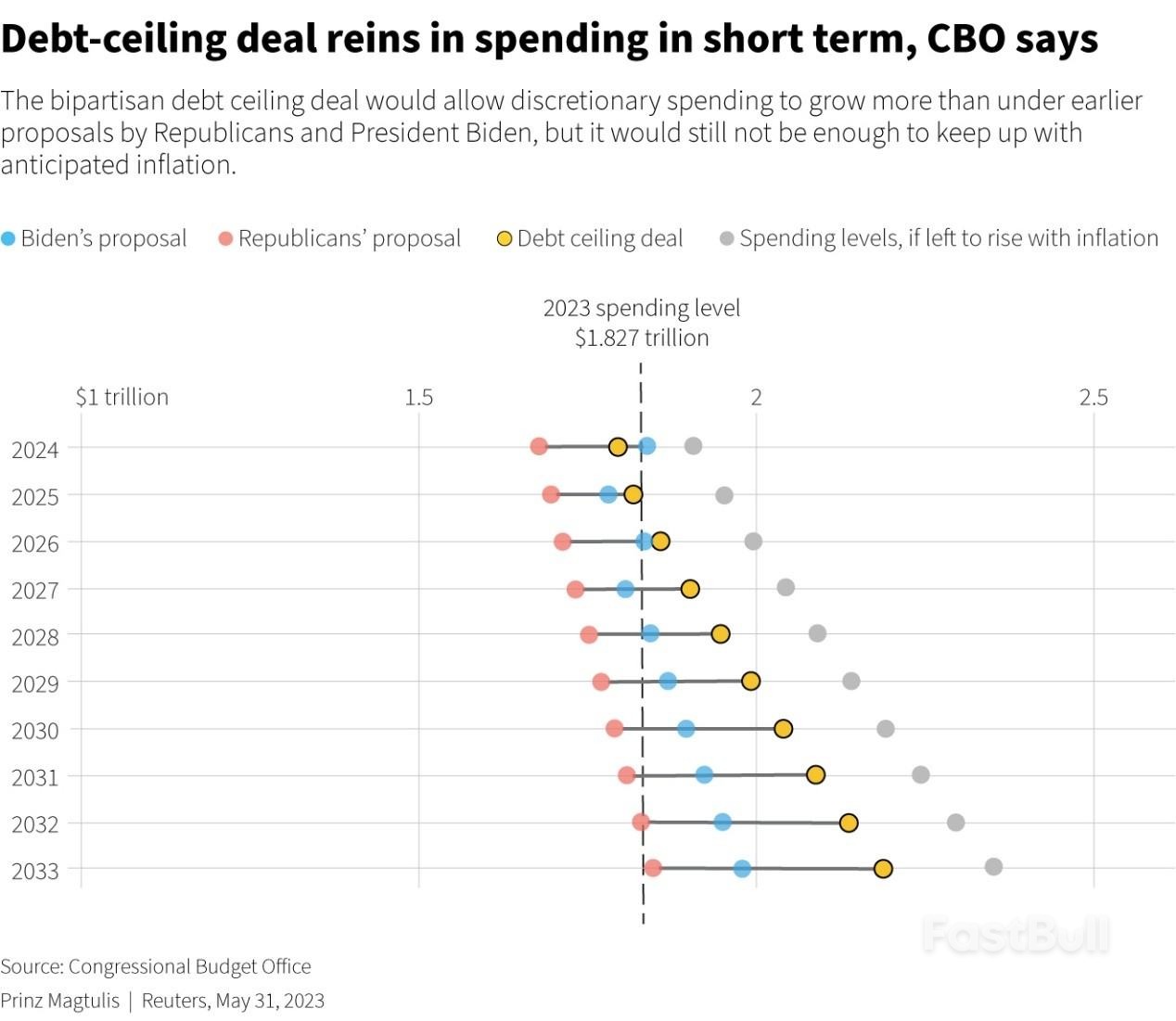
          While a debt ceiling crisis has finally been averted, with the House of Representatives easily passing a deal overnight that lifts the limit until 2025 and the Senate expected to do likewise by Friday, there was much less clarity on the state of U.S. employment or soundings on factory activity.
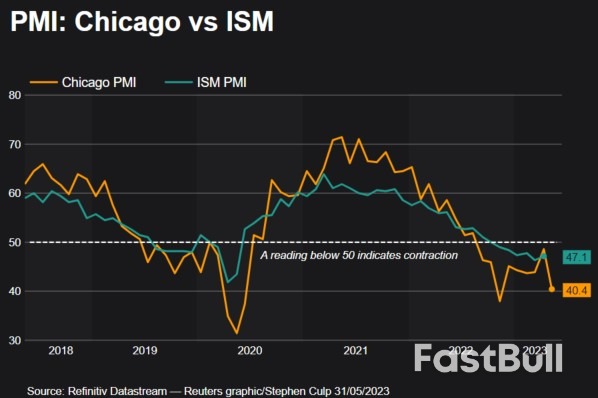
          Private sector and full national snapshots of payroll growth for May are due later today and on Friday. But a renewed rise in U.S. staff vacancies in April showed the labor market tightening again if anything - even a Chicago manufacturing survey alarmed with a sharp contraction in factory activity last month.
          To add to the confusion from overseas, an official readout on deteriorating Chinese manufacturing in May was contradicted by an equivalent private-sector survey released on Thursday.
          Yet, seemingly wary of still above-target inflation getting entrenched in wage settlements, the Fed's interest rate deliberations will likely focus mostly on the rude health of employment and record low joblessness.
          The central bank's "Beige Book" on economic conditions said on Wednesday that the labor market "continued to be strong" in May "with contacts reporting difficulty finding workers across a wide range of skill levels and industries."
          But while Fed hawks have succeeded in convincing financial markets more rate rises are still to come, Fed Governor and vice chair nominee Philip Jefferson held out the prospect that we may not get that additional move this month.
          The upshot is a hesitant market, with futures now seeing a 65% chance of another quarter point hike on June 14 - even if a move is almost fully priced by the end of July.
          Major investors tend to agree - with more and more doubting a significant recession is in fact on the way.
          BlackRock boss Larry Fink said on Wednesday inflation remained sticky and the Fed may need to do more.
          "The economy is more resilient than the market realizes," he said. "I don't see evidence that we're going to have a hard landing."
          U.S. Treasury yields crept back up on Thursday after the debt ceiling vote overnight and despite the mixed economic picture. But Wall Street futures and European stock markets were higher ahead of the U.S. open.
          The dollar was mostly steady, although it set a new high for the year against China's yuan.
          Elsewhere, chair of the G20's Financial Stability Board Klaas Knot said bank regulations and how their liquidity buffers are calculated should be reviewed following recent turmoil in the sector.
          In company news, shares in Salesforce fell 5% overnight after the San Francisco based firm posted its slowest pace of growth in 13 years as companies dialed back spending on cloud-based software offerings in an uncertain economy.
          Events to watch for later on Thursday:
          * U.S. May ADP private sector jobs report, weekly jobless claims, U.S. May S&PGlobal manufacturing business surveys, revised Q1 productivity and unit labor costs
          * European Central Bank meeting minutes
          * Philadelphia Federal Reserve President Patrick Harker speaks
          * U.S. corporate earnings: Broadcom, Dollar General, Hormel Foods, Cooper Companies, Zscaler, LululemonHot, Cold and Skipping a Beat_1Hot, Cold and Skipping a Beat_2Hot, Cold and Skipping a Beat_3

          Hot, Cold and Skipping a Beat_4Source: Yahoo

          To stay updated on all economic events of today, please check out our Economic calendar
          Risk Warnings and Disclaimers
          You understand and acknowledge that there is a high degree of risk involved in trading. Following any strategies or investment methods may lead to potential losses. The content on the site is provided by our contributors and analysts for information purposes only. You are solely responsible for determining whether any trading assets, securities, strategy, or any other product is suitable for investing based on your own investment objectives and financial situation.
          Comments
          Add to Favorites
          Share
          FastBull
          Copyright © 2025 FastBull Ltd

          728 RM B 7/F GEE LOK IND BLDG NO 34 HUNG TO RD KWUN TONG KLN HONG KONG

          TelegramInstagramTwitterfacebooklinkedin
          App Store Google Play Google Play
          Products
          Charts

          Chats

          Q&A with Experts
          Screeners
          Economic Calendar
          Data
          Tools
          Membership
          Features
          Function
          Markets
          Copy Trading
          Latest Signals
          Contests
          News
          Analysis
          24/7
          Columns
          Education
          Company
          Careers
          About Us
          Contact Us
          Advertising
          Help Center
          Feedback
          User Agreement
          Privacy Policy
          Business

          White Label

          Data API

          Web Plug-ins

          Poster Maker

          Affiliate Program

          Risk Disclosure

          The risk of loss in trading financial instruments such as stocks, FX, commodities, futures, bonds, ETFs and crypto can be substantial. You may sustain a total loss of the funds that you deposit with your broker. Therefore, you should carefully consider whether such trading is suitable for you in light of your circumstances and financial resources.

          No decision to invest should be made without thoroughly conducting due diligence by yourself or consulting with your financial advisors. Our web content might not suit you since we don't know your financial conditions and investment needs. Our financial information might have latency or contain inaccuracy, so you should be fully responsible for any of your trading and investment decisions. The company will not be responsible for your capital loss.

          Without getting permission from the website, you are not allowed to copy the website's graphics, texts, or trademarks. Intellectual property rights in the content or data incorporated into this website belong to its providers and exchange merchants.

          Not Logged In

          Log in to access more features

          FastBull Membership

          Not yet

          Purchase

          Become a signal provider
          Help Center
          Customer Service
          Dark Mode
          Price Up/Down Colors

          Log In

          Sign Up

          Position
          Layout
          Fullscreen
          Default to Chart
          The chart page opens by default when you visit fastbull.com