• Trade
  • Markets
  • Copy
  • Contests
  • News
  • 24/7
  • Calendar
  • Q&A
  • Chats
Trending
Screeners
SYMBOL
LAST
BID
ASK
HIGH
LOW
NET CHG.
%CHG.
SPREAD
SPX
S&P 500 Index
6846.50
6846.50
6846.50
6878.28
6827.18
-23.90
-0.35%
--
DJI
Dow Jones Industrial Average
47739.31
47739.31
47739.31
47971.51
47611.93
-215.67
-0.45%
--
IXIC
NASDAQ Composite Index
23545.89
23545.89
23545.89
23698.93
23455.05
-32.22
-0.14%
--
USDX
US Dollar Index
99.000
99.080
99.000
99.000
99.000
+0.050
+ 0.05%
--
EURUSD
Euro / US Dollar
1.16379
1.16387
1.16379
1.16389
1.16322
+0.00015
+ 0.01%
--
GBPUSD
Pound Sterling / US Dollar
1.33225
1.33233
1.33225
1.33239
1.33140
+0.00020
+ 0.02%
--
XAUUSD
Gold / US Dollar
4191.90
4192.34
4191.90
4193.80
4189.64
+2.20
+ 0.05%
--
WTI
Light Sweet Crude Oil
58.650
58.692
58.650
58.676
58.543
+0.095
+ 0.16%
--

Community Accounts

Signal Accounts
--
Profit Accounts
--
Loss Accounts
--
View More

Become a signal provider

Sell trading signals to earn additional income

View More

Guide to Copy Trading

Get started with ease and confidence

View More

Signal Accounts for Members

All Signal Accounts

Best Return
  • Best Return
  • Best P/L
  • Best MDD
Past 1W
  • Past 1W
  • Past 1M
  • Past 1Y

All Contests

  • All
  • Trump Updates
  • Recommend
  • Stocks
  • Cryptocurrencies
  • Central Banks
  • Featured News
Top News Only
Share

Brazil Finance Minister Haddad: Loan For Correios Is Possible This Year, But It Is Not The Only Option Under Works

Share

KCNA: North Korea's Supreme Leader Kim Jong UN Sends Condolences To Russian Embassy For Ambassador's Death

Share

Japan Prime Minister Takaichi: 30 Injuries Reported So Far From Monday Earthquake

Share

USA Senate Committee Votes To Advance Nomination Of Jared Isaacman To Head Nasa

Share

Singapore Post - New Rate For Standard Regular Mail & Standard Large Mail Will Be S$0.62 And S$0.90 Respectively

Share

Australia's S&P/ASX 200 Index Down 0.27% At 8601.10 Points In Early Trade

Share

Trump: The USA Needs Mexico To Release 200000 Acre-Feet Of Water Before December 31St, And The Rest Must Come Soon After

Share

Trump: I Have Authorized Documentation To Impose A 5% Tariff On Mexico If This Water Isn't Released

Share

Brazil's Sao Paulo State Governor Tarcisio De Freitas Says Flavio Bolsonaro Will Have His Support - Cnn Brasil

Share

Ukraine's Security Must Be Guaranteed, In The Long Term, As A First Line Of Defence For Our Union, Says European Commission President

Share

Ukraine's Sovereignty Must Be Respected, Says European Commission President

Share

The Goal Is A Strong Ukraine, On The Battlefield And At The Negotiating Table, Says European Commission President

Share

As Peace Talks Are Ongoing, The EU Remains Ironclad In Its Support For Ukraine, Says European Commission President

Share

Pepsico: Asking USA-Based Pepna Employees As Well As Pbus Division Offices And Pfus Region Offices To Work Remotely This Week

Share

A U.S. Judge Ruled That President Trump’s Ban On Several Wind Power Projects Was Illegal

Share

Senior USA Administration Official: We Continue To Monitor Drc-Rwanda Situation Closely, Continue To Work With All Sides To Ensure Commitments Are Honored

Share

Israeli Military Says It Has Struck Infrastructure Belonging To Hezbollah In Several Areas In Southern Lebanon

Share

SPDR Gold Holdings Down 0.11%, Or 1.14 Tonnes

Share

On Monday (December 8), In Late New York Trading, S&P 500 Futures Fell 0.21%, Dow Jones Futures Fell 0.43%, NASDAQ 100 Futures Fell 0.08%, And Russell 2000 Futures Fell 0.04%

Share

Morgan Stanley: Data Center ABS Spreads Are Expected To Widen In 2026

TIME
ACT
FCST
PREV
France Trade Balance (SA) (Oct)

A:--

F: --

P: --
Euro Zone Employment YoY (SA) (Q3)

A:--

F: --

P: --
Canada Part-Time Employment (SA) (Nov)

A:--

F: --

P: --

Canada Unemployment Rate (SA) (Nov)

A:--

F: --

P: --

Canada Full-time Employment (SA) (Nov)

A:--

F: --

P: --

Canada Labor Force Participation Rate (SA) (Nov)

A:--

F: --

P: --

Canada Employment (SA) (Nov)

A:--

F: --

P: --

U.S. PCE Price Index MoM (Sept)

A:--

F: --

P: --

U.S. Personal Income MoM (Sept)

A:--

F: --

P: --

U.S. Core PCE Price Index MoM (Sept)

A:--

F: --

P: --

U.S. PCE Price Index YoY (SA) (Sept)

A:--

F: --

P: --

U.S. Core PCE Price Index YoY (Sept)

A:--

F: --

P: --

U.S. Personal Outlays MoM (SA) (Sept)

A:--

F: --

P: --
U.S. 5-10 Year-Ahead Inflation Expectations (Dec)

A:--

F: --

P: --

U.S. Real Personal Consumption Expenditures MoM (Sept)

A:--

F: --

P: --
U.S. Weekly Total Rig Count

A:--

F: --

P: --

U.S. Weekly Total Oil Rig Count

A:--

F: --

P: --

U.S. Consumer Credit (SA) (Oct)

A:--

F: --

P: --
China, Mainland Foreign Exchange Reserves (Nov)

A:--

F: --

P: --

Japan Trade Balance (Oct)

A:--

F: --

P: --

Japan Nominal GDP Revised QoQ (Q3)

A:--

F: --

P: --

China, Mainland Imports YoY (CNH) (Nov)

A:--

F: --

P: --

China, Mainland Exports (Nov)

A:--

F: --

P: --

China, Mainland Imports (CNH) (Nov)

A:--

F: --

P: --

China, Mainland Trade Balance (CNH) (Nov)

A:--

F: --

P: --

China, Mainland Exports YoY (USD) (Nov)

A:--

F: --

P: --

China, Mainland Imports YoY (USD) (Nov)

A:--

F: --

P: --

Germany Industrial Output MoM (SA) (Oct)

A:--

F: --

P: --
Euro Zone Sentix Investor Confidence Index (Dec)

A:--

F: --

P: --

Canada National Economic Confidence Index

A:--

F: --

P: --

U.K. BRC Like-For-Like Retail Sales YoY (Nov)

--

F: --

P: --

U.K. BRC Overall Retail Sales YoY (Nov)

--

F: --

P: --

Australia Overnight (Borrowing) Key Rate

--

F: --

P: --

RBA Rate Statement
RBA Press Conference
Germany Exports MoM (SA) (Oct)

--

F: --

P: --

U.S. NFIB Small Business Optimism Index (SA) (Nov)

--

F: --

P: --

Mexico 12-Month Inflation (CPI) (Nov)

--

F: --

P: --

Mexico Core CPI YoY (Nov)

--

F: --

P: --

Mexico PPI YoY (Nov)

--

F: --

P: --

U.S. Weekly Redbook Index YoY

--

F: --

P: --

U.S. JOLTS Job Openings (SA) (Oct)

--

F: --

P: --

China, Mainland M1 Money Supply YoY (Nov)

--

F: --

P: --

China, Mainland M0 Money Supply YoY (Nov)

--

F: --

P: --

China, Mainland M2 Money Supply YoY (Nov)

--

F: --

P: --

U.S. EIA Short-Term Crude Production Forecast For The Year (Dec)

--

F: --

P: --

U.S. EIA Natural Gas Production Forecast For The Next Year (Dec)

--

F: --

P: --

U.S. EIA Short-Term Crude Production Forecast For The Next Year (Dec)

--

F: --

P: --

EIA Monthly Short-Term Energy Outlook
U.S. API Weekly Gasoline Stocks

--

F: --

P: --

U.S. API Weekly Cushing Crude Oil Stocks

--

F: --

P: --

U.S. API Weekly Crude Oil Stocks

--

F: --

P: --

U.S. API Weekly Refined Oil Stocks

--

F: --

P: --

South Korea Unemployment Rate (SA) (Nov)

--

F: --

P: --

Japan Reuters Tankan Non-Manufacturers Index (Dec)

--

F: --

P: --

Japan Reuters Tankan Manufacturers Index (Dec)

--

F: --

P: --

Japan Domestic Enterprise Commodity Price Index MoM (Nov)

--

F: --

P: --

Japan Domestic Enterprise Commodity Price Index YoY (Nov)

--

F: --

P: --

China, Mainland PPI YoY (Nov)

--

F: --

P: --

China, Mainland CPI MoM (Nov)

--

F: --

P: --

Italy Industrial Output YoY (SA) (Oct)

--

F: --

P: --

Q&A with Experts
    • All
    • Chatrooms
    • Groups
    • Friends
    Connecting
    .
    .
    .
    Type here...
    Add Symbol or Code

      No matching data

      All
      Trump Updates
      Recommend
      Stocks
      Cryptocurrencies
      Central Banks
      Featured News
      • All
      • Russia-Ukraine Conflict
      • Middle East Flashpoint
      • All
      • Russia-Ukraine Conflict
      • Middle East Flashpoint
      Search
      Products

      Charts Free Forever

      Chats Q&A with Experts
      Screeners Economic Calendar Data Tools
      Membership Features
      Data Warehouse Market Trends Institutional Data Policy Rates Macro

      Market Trends

      Market Sentiment Order Book Forex Correlations

      Top Indicators

      Charts Free Forever
      Markets

      News

      News Analysis 24/7 Columns Education
      From Institutions From Analysts
      Topics Columnists

      Latest Views

      Latest Views

      Trending Topics

      Top Columnists

      Latest Update

      Signals

      Copy Rankings Latest Signals Become a signal provider AI Rating
      Contests
      Brokers

      Overview Brokers Assessment Rankings Regulators News Claims
      Broker listing Forex Brokers Comparison Tool Live Spread Comparison Scam
      Q&A Complaint Scam Alert Videos Tips to Detect Scam
      More

      Business
      Events
      Careers About Us Advertising Help Center

      White Label

      Data API

      Web Plug-ins

      Affiliate Program

      Awards Institution Evaluation IB Seminar Salon Event Exhibition
      Vietnam Thailand Singapore Dubai
      Fans Party Investment Sharing Session
      FastBull Summit BrokersView Expo
      Recent Searches
        Top Searches
          Markets
          News
          Analysis
          User
          24/7
          Economic Calendar
          Education
          Data
          • Names
          • Latest
          • Prev

          View All

          No data

          Scan to Download

          Faster Charts, Chat Faster!

          Download App
          English
          • English
          • Español
          • العربية
          • Bahasa Indonesia
          • Bahasa Melayu
          • Tiếng Việt
          • ภาษาไทย
          • Français
          • Italiano
          • Türkçe
          • Русский язык
          • 简中
          • 繁中
          Open Account
          Search
          Products
          Charts Free Forever
          Markets
          News
          Signals

          Copy Rankings Latest Signals Become a signal provider AI Rating
          Contests
          Brokers

          Overview Brokers Assessment Rankings Regulators News Claims
          Broker listing Forex Brokers Comparison Tool Live Spread Comparison Scam
          Q&A Complaint Scam Alert Videos Tips to Detect Scam
          More

          Business
          Events
          Careers About Us Advertising Help Center

          White Label

          Data API

          Web Plug-ins

          Affiliate Program

          Awards Institution Evaluation IB Seminar Salon Event Exhibition
          Vietnam Thailand Singapore Dubai
          Fans Party Investment Sharing Session
          FastBull Summit BrokersView Expo

          What is the ‘New Start’ nuclear treaty between US and Russia, and why is it in peril?

          Damon
          Summary:

          The only remaining arms control agreement between the world’s largest nuclear powers – the New Start treaty – is on shaky footin

          The only remaining arms control agreement between the world’s largest nuclear powers – the New Start treaty – is on shaky footing.

          President Vladimir Putin said Russia is suspending its observation of the treaty, following complaints by United States President Joe Biden’s administration that Russia was refusing to allow inspectors into its territory. Russia’s posture “threatens the viability of US-Russian nuclear arms control,” the State Department said in January.

          Russia argues it would be inappropriate to allow inspections while the countries are in a standoff over Russia’s war in Ukraine.

          1. What is New Start?

          Under the accord, the US and Russia committed to reducing deployed nuclear warheads (capped at 1,550 each) and limiting the number of delivery platforms, such as intercontinental ballistic missiles, to 700 or fewer. The agreement also allows each country to conduct on-site inspections of each other’s weaponry and requires the exchange of data and notification concerning covered arms and facilities.

          The US and Russia signed New Start – formally the New Strategic Arms Reduction Treaty – in 2010, to replace the 1991 Start treaty. It took effect on Feb 5, 2011 and received its most recent five-year extension in 2021, after Mr Biden’s predecessor, Mr Donald Trump, pushed unsuccessfully to renegotiate it.

          2. Has the treaty worked?

          Yes. The US and Russia reduced their nuclear arsenals to the agreed-upon limits by the 2018 deadline set forth in the treaty.

          The US had 1,420 deployed warheads and 659 deployed strategic delivery systems as of Sept 1, 2022, according to the State Department. Russia had 1,549 deployed warheads attributed to 540 deployed strategic launchers.

          Combined, the two countries account for about 90 per cent of the world’s nuclear weapons.

          3. Why did inspections come to a halt?

          On-site nuclear inspections in Russia were initially suspended due to the Covid-19 pandemic. The US says Russia refused to restart them in August 2022 because of mounting tensions over the war in Ukraine.

          An attempt to restart talks in Cairo in November failed after Russia decided to postpone them.

          Russia’s ambassador to the US, Mr Anatoly Antonov, said in early February that his country “remains committed to the goals of the New Start treaty” but considers it “unjustified, untimely and inappropriate to invite the US military to our strategic facilities” while the two nations are on opposite sides of the conflict in Ukraine.

          4. Why did Trump want to renegotiate New Start?

          His administration called the treaty “deeply flawed” in part because it addresses only strategic nuclear weapons – long-range ones that can be used to threaten each other’s territory – and not shorter-range, so-called tactical weapons. Russia’s tactical arsenal is much greater than that of the US.

          The Trump administration had hoped to force Russia to agree to a freeze in its overall number of nuclear warheads. Even some Biden aides are on record sharing concern that New Start does not apply to short- and medium-range nuclear weapons.

          5. What’s the status of other arms control agreements?

          Mr Trump withdrew the US from the Intermediate-Range Nuclear Forces (INF) Treaty, signed in 1987 by US President Ronald Reagan and Soviet leader Mikhail Gorbachev, and the Open Skies Treaty, under which more than 30 nations grant each other access to airspace for the purpose of collecting information on military activities.

          The Biden administration decided not to reenter the Open Skies Treaty over concerns Moscow was not taking steps to comply with the agreement. 

          Article Source: Straitstimes

          Risk Warnings and Disclaimers
          You understand and acknowledge that there is a high degree of risk involved in trading. Following any strategies or investment methods may lead to potential losses. The content on the site is provided by our contributors and analysts for information purposes only. You are solely responsible for determining whether any trading assets, securities, strategy, or any other product is suitable for investing based on your own investment objectives and financial situation.
          Comments
          Add to Favorites
          Share

          Putin suspends nuclear pact, Biden says support for Ukraine 'will not waver'

          Ukadike Micheal

          U.S. President Joe Biden and Russian President Vladimir Putin have been sparring verbally, presenting starkly different views of the world and the Ukraine war, Biden promising to defend democracies and Putin asserting the West was a threat to Russia.

          In speeches just hours apart on Tuesday, Putin in Moscow delivered a warning to the West over Ukraine by suspending its last major nuclear arms control treaty with the United States and Biden in Warsaw proclaimed untiring support for Ukraine, which was invaded by Russian forces nearly a year ago on Feb. 24.

          "When Russia invaded, it wasn’t just Ukraine being tested. The whole world faced a test for the ages," Biden said in the Royal Castle of Warsaw, the day after he made a secretive surprise visit to the Ukrainian capital Kyiv.

          Challenged to respond to the invasion, Biden said the United States and its NATO allies replied: "Yes, we would stand up for sovereignty. And we did. Yes, we would stand up for the right of people to live free from aggression. And we did."

          "And we would stand up for democracy. And we did," he said.

          Biden went on to say that "there should be no doubt: Our support for Ukraine will not waver, NATO will not be divided, and we will not tire."

          NUCLEAR TREATY

          Putin, in an earlier speech to Russia's military and political elite, accused the United States of turning the war into a global conflict and announced the suspension of Russia's participation in the New START (Strategic Arms Reduction Treaty). The foreign ministry later said Moscow intended to continue abiding by the restrictions outlined in the treaty on the number of nuclear warheads it could have deployed.

          "The elites of the West do not hide their purpose. But they also cannot fail to realise that it is impossible to defeat Russia on the battlefield," Putin said.

          "They intend to transform a local conflict into a phase of global confrontation," he said. "This is exactly how we understand it all and we will react accordingly, because in this case we are talking about the existence of our country."

          Biden rejected Russia's assertion that Western allies were seeking to control or destroy Russia. He did, however, accuse Russia of crimes against humanity such as targeting civilians and rape. Moscow has denied previous allegations by Ukraine and its allies of war crimes and targeting civilians.

          REACTION TO PUTIN

          U.S. Secretary of State Antony Blinken called Putin's move "deeply unfortunate and irresponsible". NATO Secretary-General Jens Stoltenberg said it made the world a more dangerous place, and urged Putin to reconsider.

          China's U.N. Ambassador Zhang Jun told reporters that the New START treaty and other instruments are important for the global security architecture, adding that "on these important issues the parties concerned should continue to negotiate with each other in finding a good solution".

          Under the treaty that expires in 2026, the United States and Russia may physically check the other's nuclear arsenal, although tensions over Ukraine had already brought inspections to a halt.

          NATO allies and other supporters have sent Ukraine tens of billions of dollars worth of war weaponry and ammunition, with modern battle tanks promised and some mulling President Volodymyr Zelenskiy's appeals for fighter jets and longer-range missiles.

          Russia suffered three major battlefield reverses in Ukraine last year but still controls around a fifth of the country and appears to be making progress in eastern provinces bordering Russia.

          Near Bakhmut, the focal point of Russian advances in the eastern region of Donetsk, 18 towns and villages came under fire, the General Staff of the Ukrainian Armed Forces said in a statement on Tuesday night.

          The Russian defence ministry said its troops had made a 2.5 km (1.5 miles) advance towards the city of Bakhmut, seen by the Kremlin as a main staging post in capturing other towns further west in Donetsk region.

          "It is very important that despite great pressure on our forces, the front line has undergone no change," Ukraine's Zelenskiy said in a nightly video address.

          Outspoken Russian mercenary chief Yevgeny Prigozhin chastised military leaders, accusing them of depriving his Wagner fighters of munitions in what he called a treasonous attempt to destroy his private military company. The defence ministry rejected his initial accusations about blocking ammunition as "absolutely untrue".

          Reuters was not able to verify battlefield reports.

          The biggest land war in Europe since World War Two has displaced millions, left Ukrainian cities, towns and villages in ruins and disrupted the global economy. More than 8,000 civilians have been recorded killed, the U.N. human rights office said, adding thousands more were thought to have died.

          Meanwhile, investigations by Denmark, Germany and Sweden into explosions last September on the Nord Stream gas pipelines have not yet concluded, the three countries said on Tuesday as the U.N. Security Council met to discuss the case. The pipelines connecting Russia and Germany spewed gas into the Baltic Sea and worsened a European energy shortage.

          Article Source: Theedgemarkets

          Risk Warnings and Disclaimers
          You understand and acknowledge that there is a high degree of risk involved in trading. Following any strategies or investment methods may lead to potential losses. The content on the site is provided by our contributors and analysts for information purposes only. You are solely responsible for determining whether any trading assets, securities, strategy, or any other product is suitable for investing based on your own investment objectives and financial situation.
          Comments
          Add to Favorites
          Share

          EIB Takes Digital Bond Issuance Another Step Forward

          Justin

          Central Bank

          Economic

          Cryptocurrency

          The European Investment Bank has been leading the way in the issuance of digital bonds. With the completion of its third transaction earlier this year, the bank has reached several important milestones.
          The most novel aspect of the deal was the use of settlement tokens rather than experimental central bank digital currencies, which the EIB had used for its previous two digital bonds.
          ‘This will allow scale for digital bonds going forward rather than waiting for CBDCs, which may not be issued in the immediate future as central banks – rightly so – will be doing a lot of due diligence around this,’ said Asif Sherani, head of debt capital markets syndicate, EMEA, at HSBC. HSBC is one of the banks that led the EIB’s latest digital bond issuance alongside BNP Paribas and RBC Capital Markets.
          The £50m two-year transaction was also the first digital bond in sterling, with the EIB’s previous digital bonds coming in euros. The deal was priced with a floating rate note coupon, tied to the compounded Sonia index, showing the advancement of digital bonds to more complicated structures.
          It was also the EIB’s first digital bond issued using a combination of private and public blockchains, operated and accessed via HSBC Orion, a tokenisation platform. The bond will be held in digital securities accounts kept on HSBC Orion.
          ‘A lot of issuers are looking at digital bonds,’ said Sherani. ‘The reality is that we have an inefficient system with T+5 and T+7 settlement. Digital bonds allow a clean break from legacy systems so that’s why we’re seeing this interest.’
          In addition to much faster settlement speed, there are numerous other benefits of digital bonds, including ‘an exponential increased reduction of intermediaries and fixed costs, as well as better market transparency through an increased capacity to see trading flows and the identity of asset owners,’ according to an EIB spokesperson. ‘Digital bonds are also a tool to provide additional diversification, which is the basis for a healthy and stable system.’
          Will all of the EIB’s bonds be in digital format in the near future? The EIB spokesperson said it will ‘closely observe the market interest in digital bonds, and will decide step by step how and if to proceed in this direction, as the playing field is still very new and unexplored’. The spokesperson added that the EIB is ‘expressing its readiness and expertise in being able to also manage financial instruments on blockchain’.
          Digital blockchain bonds are still at an early stage and, while the EIB and others have shown enthusiasm for moving these bonds forward, it is hard to say whether every issuer will look to digital bonds, given the technical complexity of conducting these transactions.
          Nevertheless, public sector borrowers are and will be at the forefront of digital bond advancement. Half of public sector borrowers surveyed for OMFIF’s ‘Future of capital markets’ report last year said that they will have performed a test blockchain bond operation within the next three years. Meanwhile, every borrower surveyed said that the public sector bond market would become digital at some point.
          In a snap poll carried out by the OMFIF Sovereign Debt Institute LinkedIn page between 9-10 February, 44% of respondents reckoned we are five years away from fully digital bonds in the public sector bond market, followed by 33% believing we are 10 years away and 22% three years away.

          Source:Burhan Khadbai

          To stay updated on all economic events of today, please check out our Economic calendar
          Risk Warnings and Disclaimers
          You understand and acknowledge that there is a high degree of risk involved in trading. Following any strategies or investment methods may lead to potential losses. The content on the site is provided by our contributors and analysts for information purposes only. You are solely responsible for determining whether any trading assets, securities, strategy, or any other product is suitable for investing based on your own investment objectives and financial situation.
          Comments
          Add to Favorites
          Share

          Eurozone PMI Shows Strong Increase in February

          Justin

          Central Bank

          Economic

          The eurozone economy continues to surprise on the upside. The PMI paints a picture of an economy that is bouncing back from the sluggish performance in recent months, which is mainly driven by fading supply-side problems. This may be giving a larger push to economic activity than initially expected as backlogs of orders are now going into production. Also helpful is that the energy crisis has moved into an undoubtedly milder phase with market gas prices now about a third of what they were only in mid-December.
          The survey also suggests that demand is improving, which is surprising given the downturn in domestic demand in the fourth quarter in most large eurozone economies. Demand is positively affected by some returning optimism among consumers over peak inflation being behind us and a recession likely avoided. But while consumer confidence has been increasing for five months in a row now, it does remain at levels usually associated with recession.
          Inflationary pressures continue to ease, but mainly on the manufacturing side. Fading supply-side issues are having a positive impact on prices, especially as inventories have been building. This has resulted in a continued drop in selling price expectations among manufacturing businesses, although the level remains elevated historically.
          For services, rising wage costs are an important driver of continued high input cost increases. That has resulted in still elevated selling price expectations among service sector businesses. The combination of better-than-expected economic activity at the start of the year and service sector inflationary pressures which remain elevated will likely keep the ECB in hawkish mode.

          Source:ING

          To stay updated on all economic events of today, please check out our Economic calendar
          Risk Warnings and Disclaimers
          You understand and acknowledge that there is a high degree of risk involved in trading. Following any strategies or investment methods may lead to potential losses. The content on the site is provided by our contributors and analysts for information purposes only. You are solely responsible for determining whether any trading assets, securities, strategy, or any other product is suitable for investing based on your own investment objectives and financial situation.
          Comments
          Add to Favorites
          Share

          Russia’s Putin blames West and Ukraine for provoking conflict

          Damon
          Russian President Vladimir Putin on Tuesday used a widely-watched speech to deny responsibility for the war in Ukraine and lash out at his adversaries.
          Putin claimed Russia had been attempting to allow citizens in the contested Donbas region to speak their “own language” and had attempted to resolve the conflict peacefully.
          He also cited the expansion of NATO and new European anti-rocket defense systems as provoking Russia.
          “We had no doubt that by February 2022, everything was prepared for a punitive action in Donbas, where [the] Kyiv regime provided artillery and aviation and other weapons to attack Donbas in 2014. In 2015, they attempted again to directly attack Donbas, they continued shelling, terror,” he said.
          “All of this was completely against the documents that were accepted by the United Nations Security Council. I would like to repeat: they started the war. And we used the force in order to stop it.”
          Russian forces entered Ukraine in 2014, resulting in the annexation of Crimea. The invasion was widely condemned by the international community and resulted in rounds of Western sanctions against Russian officials.
          Putin’s “state of the nation” address is being delivered in Moscow to lawmakers and military officials and being broadcast on state TV.
          Feb. 24 will mark one year since Russia mounted a large-scale invasion of Ukraine, beginning a ground war in Europe that Putin still refers to as a “special military operation.” Intense fighting continues across the war-torn nation.
          U.S. President Joe Biden made a surprise visit to the Ukrainian capital Kyiv on Monday, where he met with Ukrainian President Volodymyr Zelenskyy.
          Biden said the trip was to “reaffirm our unwavering and unflagging commitment to Ukraine’s democracy, sovereignty, and territorial integrity.” He also promised to deliver more artillery ammunition and anti-armor systems, and to announce new sanctions on Russian companies and its elites.
          Biden is due to deliver another speech, pointedly following Putin’s, in Poland. He is also meeting with Polish President Andrzej Duda.

          Source:CNBC

          Risk Warnings and Disclaimers
          You understand and acknowledge that there is a high degree of risk involved in trading. Following any strategies or investment methods may lead to potential losses. The content on the site is provided by our contributors and analysts for information purposes only. You are solely responsible for determining whether any trading assets, securities, strategy, or any other product is suitable for investing based on your own investment objectives and financial situation.
          Comments
          Add to Favorites
          Share

          5 facts about the U.S. national debt

          Thomas
          President Joe Biden and the Republican-controlled House of Representatives appear to be on a collision course over raising the statutory limit on the national debt. House Republicans say they want Biden to accept significant (but unspecified) spending cuts in exchange for raising the limit. But the president has insisted that raising the limit – which allows the government to continue paying its obligations under the law on time – shouldn’t be a budgetary bargaining chip.
          Public concern about federal spending is on the rise. In a new Pew Research Center survey about the public’s policy priorities, 57% of Americans cited reducing the budget deficit as a top priority for the president and Congress to address this year, up from 45% a year ago. Concern has risen among members of both parties, although Republicans and Republican-leaning independents are still far more likely than Democrats and Democratic leaners (71% vs. 44%) to view cutting the deficit as a leading priority. (When the government spends more than it takes in, it borrows to make up the difference. The debt, therefore, can be seen as the accumulated sum of previous years’ deficits that is still outstanding.)
          Federal borrowing has essentially already hit the current debt limit of $31.38 trillion, though Treasury Secretary Janet Yellen has said she can use a variety of accounting maneuvers to postpone a government default for a few months. So far, neither the administration nor the House is budging from the positions they’ve staked out, so the standoff continues.
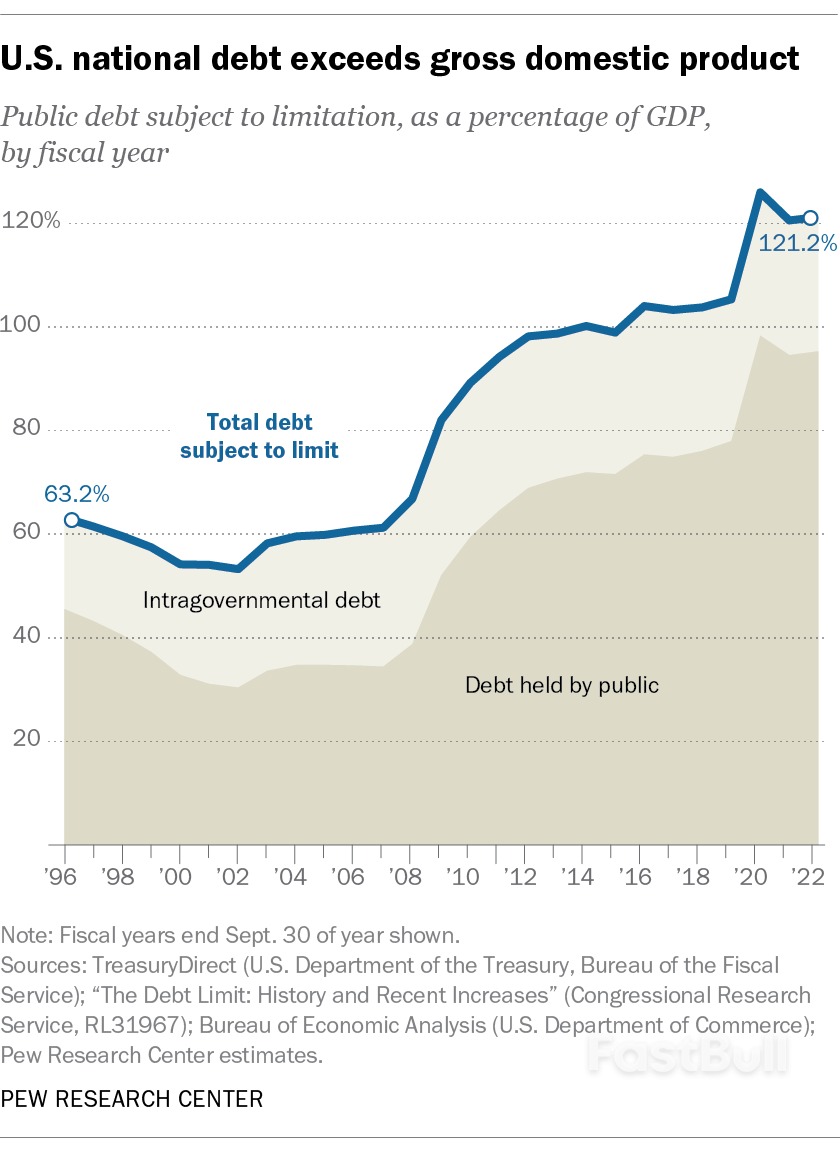
          1.The federal government’s total public debt stood at just under $31.46 trillion as of Feb. 10, according to the Treasury Department’s latest daily reckoning. Nearly all of that debt – about $31.38 trillion – is subject to the statutory debt limit, leaving just $25 million in unused borrowing capacity.
          2.For several years, the nation’s debt has been bigger than its gross domestic product, which was $26.13 trillion in the fourth quarter of 2022. Debt-to-GDP is a useful metric for analyzing the debt over long time spans, as it puts the debt into relative terms by comparing it against the size of the national economy. Looked at this way, debt as a share of GDP has gone through three main growth phases in recent decades. These have corresponded with periods when the federal government ran large budget deficits: the Reagan-Bush years of the 1980s and early 1990s; the 2008 financial crisis and subsequent Great Recession; and the pandemic-caused recession of 2020, when federal debt spiked to an all-time high of 134.8% of GDP. The ratio has come down a bit since but remains well above pre-pandemic levels.5 facts about the U.S. national debt_1
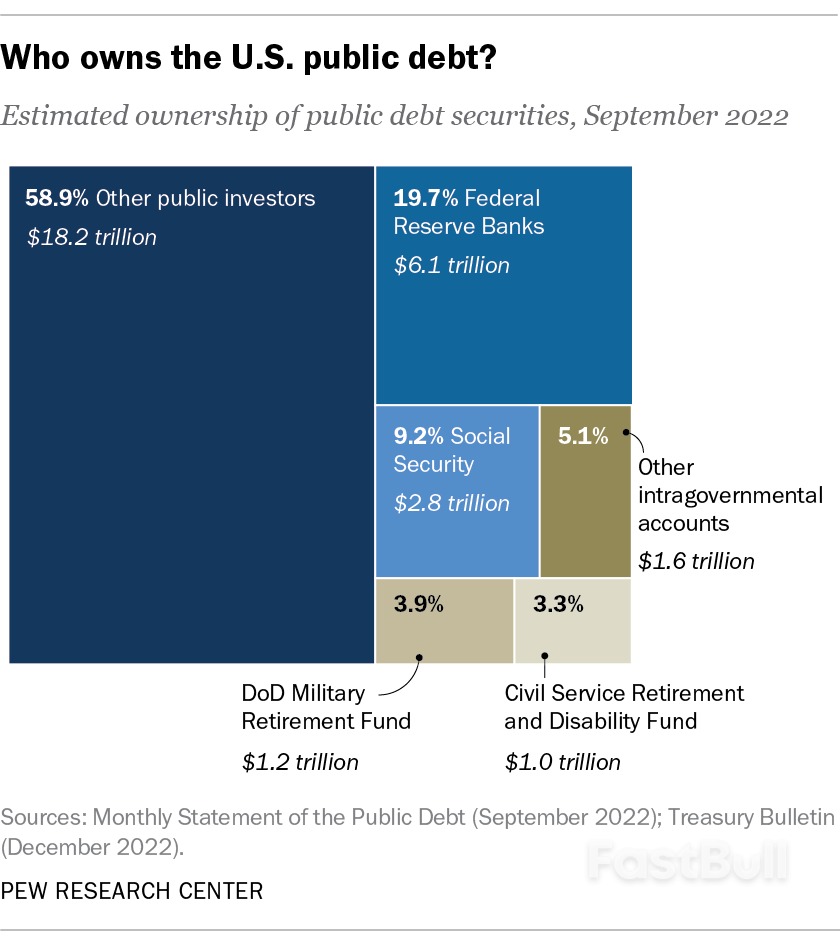
          3.While U.S. government debt is perhaps the most widely held class of security in the world, 21.8% of the public debt, or $6.87 trillion, is owned by another arm of the federal government itself. That includes Medicare; specialized trust funds, such as those for highways and bank deposit insurance; and civil service and military retirement programs. But the biggest chunk of those “intragovernmental holdings” belongs to Social Security. As of the end of January, the program’s retirement and disability trust funds together held more than $2.8 trillion in special non-traded Treasury securities, or 9% of the total debt. (For many years, Social Security collected more in payroll taxes than it paid out in benefits; the surplus was required by law to be invested in Treasuries. That made Social Security, for a time, the federal government’s single biggest creditor.)5 facts about the U.S. national debt_2
          4.Today, the Federal Reserve System is the single largest holder of U.S. government debt. While the Fed regularly buys and sells Treasury securities to execute monetary policy, it bought Treasuries in massive quantities during the COVID-19 pandemic in an effort to keep the U.S. economy from buckling under the strain of shutdowns and quarantines.
          At its peak in April 2022, the Fed held more than $6.25 trillion in U.S. government debt, more than double its holdings just before the pandemic hit the U.S. in March 2020. Even as the Fed has begun to scale back its holdings, it held nearly $6.1 trillion in government bonds – almost a fifth of the entire public debt – as of Sept. 30, 2022, the most recent data available. A decade earlier, by contrast, the Fed’s share of the debt was just under 11%. (Because the Fed is formally independent of the federal government, its stash isn’t included among the intragovernmental holdings discussed above.)5 facts about the U.S. national debt_3
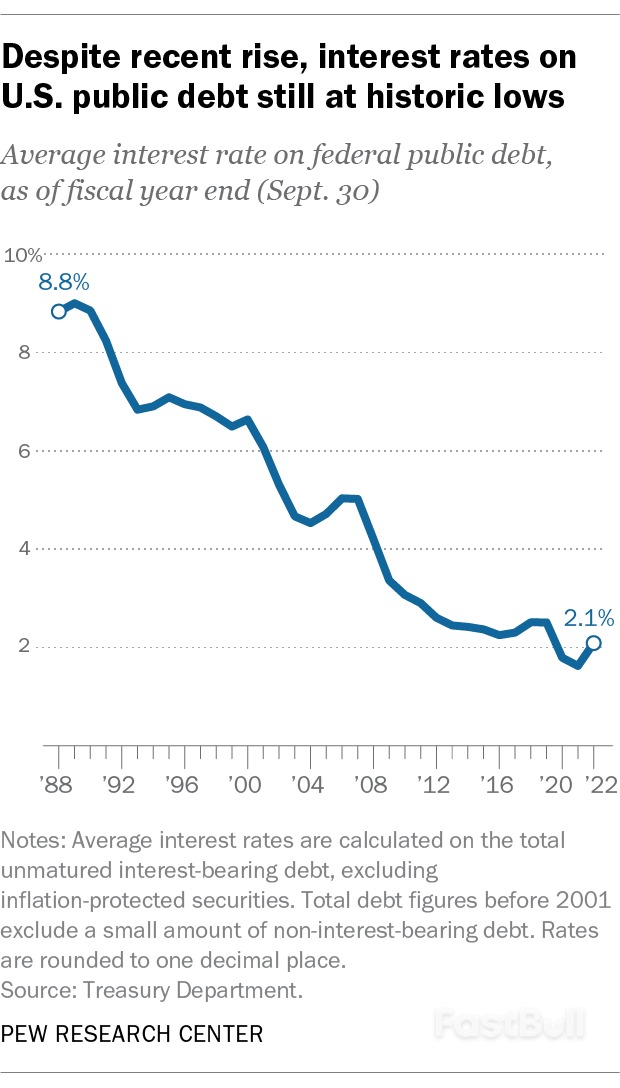
          5.Servicing the debt is one of the federal government’s biggest expenses. Net interest payments on the debt are estimated to total $395.5 billion this fiscal year, or 6.8% of all federal outlays, according to the Office of Management and Budget. That’s more than $100 billion more than the government expects to spend on veterans’ benefits and services and more than it will spend on elementary and secondary education, disaster relief, agriculture, science and space programs, foreign aid, and natural resources and environmental protection combined.
          Debt service as a share of federal outlays peaked at more than 15% in the mid-1990s, but generally falling interest rates have helped hold down payments even as the dollar amount continues to grow. In fiscal 2021, the average interest rate on federal debt was a record-low 1.605%. But with the Fed raising its policy rate to try to cool off the economy, the U.S. has started paying more to borrow: The average interest rate on federal debt last year ticked up to 2.07%.5 facts about the U.S. national debt_45 facts about the U.S. national debt_5

          Source:PEW

          Risk Warnings and Disclaimers
          You understand and acknowledge that there is a high degree of risk involved in trading. Following any strategies or investment methods may lead to potential losses. The content on the site is provided by our contributors and analysts for information purposes only. You are solely responsible for determining whether any trading assets, securities, strategy, or any other product is suitable for investing based on your own investment objectives and financial situation.
          Comments
          Add to Favorites
          Share

          EU economy set to escape recession, but headwinds persist: The Commission's Winter 2023 Economic Forecast

          Damon
          Almost one year after Russia started its war of aggression against Ukraine, the economic outlook for the EU is brightening a bit. Last year, the EU economy managed to shift away from Russian energy commodities. Decisive policy support and consumers’ and businesses’ response to the energy crisis boosted the resilience of the economy. entering 2023 stronger than projected in autumn, the EU economy is now expected to escape the recession that was anticipated for the turn of the year. For the first time in a year, the 2023 projections for growth are revised higher while the inflation outlook is revised lower.

          From the Autumn 2022 Forecast to the Winter 2023 Forecast

          In November, the EU economy was seen at a turning point. As the reopening momentum faded, the terms-of-trade shock unleashed by soaring gas prices was making its way through the economy (Gunnella and Schuler 2022), eroding households’ real incomes and weighing on firms’ profitability. This, combined with monetary policy tightening and weakening external support was expected to push the EU economy into recession (European Commission 2022).
          According to the European Commission’s Winter Interim Forecast, the EU economy is set to escape recession. In the history of the Commission’s euro area forecasting, which began in May 1998 after the Council decision on the introduction of the euro, the withdrawal of a recession call is unique. Against this, backdrop the Winter 2023 Forecast reassesses the global outlook, the pace of monetary tightening, the role of policy support to households, and several technical assumptions (European Commission 2023).
          The Winter Interim Forecast includes mainly revisions to the growth and inflation outlook in 2023. For the first time since the start of Russia’s war of aggression, the 2023 projections for growth are revised upwards while the inflation outlook is revised downward.
          EU economy set to escape recession, but headwinds persist: The Commission's Winter 2023 Economic Forecast_1EU economy set to escape recession, but headwinds persist: The Commission's Winter 2023 Economic Forecast_2

          Enhanced resilience helped the EU economy to finish 2022 stronger than expected

          The EU has made impressive progress in weaning itself off Russian energy commodities and enhancing resilience against adverse shocks. Thanks to benign weather conditions, demand restraint and efficiency gains, gas consumption was about 25% below the average for the same months over the past five years. Stepped up efforts to diversify supply sources have also borne fruit, as evident from a sharp fall in the share of pipeline gas from Russia in total EU imports of gas and the strong increase in imports of seaborne LNG. These developments have left gas storage levels at around 75% of capacity, only marginally below their level at the beginning of the heating season, and above seasonal average. This implies lower refilling needs and easing concerns about gas rationing going forward.
          Stronger-than-anticipated growth in the second half of 2022 improved the starting position for 2023. In the third quarter, the hit to GDP growth was milder than initially estimated. In the fourth quarter, according to Eurostat’s preliminary flash estimate, economic activity stagnated in the EU instead of shrinking by 0.5% as forecast in autumn. These outcomes raised the carry-over to growth in 2023 as compared to the autumn by 0.4 percentage points to 0.3% in the EU (by 0.5 percentage points to 0.4% in the euro area). Moreover, in recent months economic confidence among households and businesses began rebounding, though from low levels.

          Recent developments support a slightly more positive growth outlook, but headwinds remain strong

          Energy commodity prices fell below pre-war levels and should remain lower than assumed in autumn. Recent developments in demand and supply have shifted the outlook for energy prices in Europe. At the cut-off date of the forecast, natural gas prices in Europe (Dutch TTF futures) were about one half lower than at the time of the Autumn 2022 Forecast but also lower than at the time of the Spring 2022 Forecast, and markets expect them to remain broadly stable over the forecast horizon. Electricity prices have also come down significantly since autumn.EU economy set to escape recession, but headwinds persist: The Commission's Winter 2023 Economic Forecast_3
          The EU labour market is expected to remain tight. In the third quarter of 2022, employment continued to increase, labour market slack was unchanged, and the job vacancy rate declined only marginally . Until December, the unemployment rate stood at its all-time low of 6.1%. In January, the Employment Expectations Indicator increased to the highest reading since June and survey results pointed only to a marginal abatement in labour shortages. The temporary slowdown of activity is set to weigh on employment, but difficulties in recruiting could motivate firms to hoard labour. Accordingly, the projected marginal rise in unemployment in early 2023 would be largely temporary.
          Nominal wages are projected to increase stronger than before the pandemic. Continued tightness of labour markets, higher minimum wages in several Member States, and increased efforts to compensate for inflation put upward pressure on wage negotiations, especially in light of fading recession risks. Moreover, wages of many employees still reflect settlements agreed upon before inflation accelerated last year, which suggests a lagged and staggered impact of past inflation on wages.
          Monetary policy tightening is expected to be stronger than previously assumed. Since the turning point in the monetary policy stance in December 2021, the ECB raised policy interest rates by 300 basis points. This has lifted market expectations about short-term interest rates, whereas long-term sovereign yields remained at the previously assumed levels. The annual growth rate of bank lending to the private sector has remained positive but decelerated further in December. In contrast with the tighter credit outlook, conditions for market financing have loosened somewhat, thanks to a pick-up in valuations, which could suggest that investors expect a rather short tightening period.
          The outlook for the EU’s external environment remains weak. After largely stagnating in the first half of 2022, global economic activity picked up somewhat in the third quarter, but signs of renewed weakness emerged at the end of last year. Survey indicators remained consistent with falling momentum heading into 2023, in particular in advanced economies. China’s abandonment of its zero-COVID policy and the vigorous re-opening are likely to improve its growth prospects (IMF 2023), despite possible short-term disruptions.

          The path of output expansion is lifted up and inflation revised downward

          Opposing forces result in a marginal improvement of the growth outlook for this year. The positive growth impact of the faster unwinding of the terms-of-trade shock is set to be partially mitigated by the more forceful monetary tightening. In particular sectors most sensitive to financing conditions (e.g. construction) are set to feel the impact. Overall, GDP is projected to stagnate in the first quarter instead of contracting as forecast in autumn. As of spring, growth-supportive factors (including disbursements under the Recovery and Resilience Facility) are expected to gain importance. GDP growth in 2023 is projected at 0.8% in the EU (and 0.9% in the euro area) and thus 0.5 (0.6) percentage points higher than in autumn, which is mainly due to the higher carry-over. In 2024, growth is expected at 1.6% (1.5% in the euro area), largely unchanged compared to autumn.
          The forecast puts the EU economy on a higher growth path than in autumn. After Russia’s war pulled the economy to a lower growth path, the EU is now projected to move to a slightly higher path, with GDP exceeding in the fourth quarter of 2024 the level projected in autumn by about 1% .EU economy set to escape recession, but headwinds persist: The Commission's Winter 2023 Economic Forecast_4
          HICP inflation is set to continue declining at a slightly swifter pace in 2023. According to Eurostat’s flash estimate, in January, inflation in the euro area fell for a third consecutive month, whereas core inflation slightly increased, partly reflecting the impact of past energy inflation on core items . Looking forward, falling energy commodity prices and tighter financing conditions are set to lower inflationary pressures. By contrast to the expected sharp drop in energy inflation and the fall in food and goods inflation, services inflation is expected to remain elevated, reflecting the wage outlook. Taking into account strong negative base effects, HICP inflation is forecast to fall strongly.EU economy set to escape recession, but headwinds persist: The Commission's Winter 2023 Economic Forecast_5

          Risks to the outlook are more balanced

          While uncertainty surrounding the forecast remains high, risks to growth are seen as broadly balanced. Domestic demand could grow stronger if declines in wholesale gas prices pass through to consumer prices more strongly. Nonetheless, a potential reversal of that fall cannot be ruled out in the context of geopolitical tensions. External demand could get a stronger push from China’s re-opening.
          Risks to inflation remain largely linked to developments in energy markets, mirroring some of the risks to growth. Especially in 2024, upside risks to inflation prevail, as price pressures may turn out broader and more entrenched if wage growth were to settle at above-average rates.

          Source:VOXEU

          Risk Warnings and Disclaimers
          You understand and acknowledge that there is a high degree of risk involved in trading. Following any strategies or investment methods may lead to potential losses. The content on the site is provided by our contributors and analysts for information purposes only. You are solely responsible for determining whether any trading assets, securities, strategy, or any other product is suitable for investing based on your own investment objectives and financial situation.
          Comments
          Add to Favorites
          Share
          FastBull
          Copyright © 2025 FastBull Ltd

          728 RM B 7/F GEE LOK IND BLDG NO 34 HUNG TO RD KWUN TONG KLN HONG KONG

          TelegramInstagramTwitterfacebooklinkedin
          App Store Google Play Google Play
          Products
          Charts

          Chats

          Q&A with Experts
          Screeners
          Economic Calendar
          Data
          Tools
          Membership
          Features
          Function
          Markets
          Copy Trading
          Latest Signals
          Contests
          News
          Analysis
          24/7
          Columns
          Education
          Company
          Careers
          About Us
          Contact Us
          Advertising
          Help Center
          Feedback
          User Agreement
          Privacy Policy
          Business

          White Label

          Data API

          Web Plug-ins

          Poster Maker

          Affiliate Program

          Risk Disclosure

          The risk of loss in trading financial instruments such as stocks, FX, commodities, futures, bonds, ETFs and crypto can be substantial. You may sustain a total loss of the funds that you deposit with your broker. Therefore, you should carefully consider whether such trading is suitable for you in light of your circumstances and financial resources.

          No decision to invest should be made without thoroughly conducting due diligence by yourself or consulting with your financial advisors. Our web content might not suit you since we don't know your financial conditions and investment needs. Our financial information might have latency or contain inaccuracy, so you should be fully responsible for any of your trading and investment decisions. The company will not be responsible for your capital loss.

          Without getting permission from the website, you are not allowed to copy the website's graphics, texts, or trademarks. Intellectual property rights in the content or data incorporated into this website belong to its providers and exchange merchants.

          Not Logged In

          Log in to access more features

          FastBull Membership

          Not yet

          Purchase

          Become a signal provider
          Help Center
          Customer Service
          Dark Mode
          Price Up/Down Colors

          Log In

          Sign Up

          Position
          Layout
          Fullscreen
          Default to Chart
          The chart page opens by default when you visit fastbull.com