• Trade
  • Markets
  • Copy
  • Contests
  • News
  • 24/7
  • Calendar
  • Q&A
  • Chats
Trending
Screeners
SYMBOL
LAST
BID
ASK
HIGH
LOW
NET CHG.
%CHG.
SPREAD
SPX
S&P 500 Index
6870.39
6870.39
6870.39
6895.79
6858.28
+13.27
+ 0.19%
--
DJI
Dow Jones Industrial Average
47954.98
47954.98
47954.98
48133.54
47871.51
+104.05
+ 0.22%
--
IXIC
NASDAQ Composite Index
23578.12
23578.12
23578.12
23680.03
23506.00
+72.99
+ 0.31%
--
USDX
US Dollar Index
98.900
98.980
98.900
98.960
98.730
-0.050
-0.05%
--
EURUSD
Euro / US Dollar
1.16523
1.16531
1.16523
1.16717
1.16341
+0.00097
+ 0.08%
--
GBPUSD
Pound Sterling / US Dollar
1.33196
1.33203
1.33196
1.33462
1.33136
-0.00116
-0.09%
--
XAUUSD
Gold / US Dollar
4212.73
4213.14
4212.73
4218.85
4190.61
+14.82
+ 0.35%
--
WTI
Light Sweet Crude Oil
59.192
59.222
59.192
60.084
59.160
-0.617
-1.03%
--

Community Accounts

Signal Accounts
--
Profit Accounts
--
Loss Accounts
--
View More

Become a signal provider

Sell trading signals to earn additional income

View More

Guide to Copy Trading

Get started with ease and confidence

View More

Signal Accounts for Members

All Signal Accounts

Best Return
  • Best Return
  • Best P/L
  • Best MDD
Past 1W
  • Past 1W
  • Past 1M
  • Past 1Y

All Contests

  • All
  • Trump Updates
  • Recommend
  • Stocks
  • Cryptocurrencies
  • Central Banks
  • Featured News
Top News Only
Share

Temasek CEO Dilhan Pillay: We Are Taking A Conservative Stance On Allocating Capital

Share

Brazil Economists See Brazilian Real At 5.40 Per Dollar By Year-End 2025 Versus 5.40 In Previous Estimate - Central Bank Poll

Share

Brazil Economists See Year-End 2026 Interest Rate Selic At 12.25% Versus 12.00% In Previous Estimate - Central Bank Poll

Share

Brazil Economists See Year-End 2025 Interest Rate Selic At 15.00% Versus 15.00% In Previous Estimate - Central Bank Poll

Share

EU Commission Says Meta Has Committed To Give EU Users Choice On Personalised Ads

Share

Sources Revealed That The Bank Of England Has Invited Employees To Voluntarily Apply For Layoffs

Share

The Bank Of England Plans To Cut Staff Due To Budget Pressures

Share

Traders Believe There Is Less Than A 10% Chance That The European Central Bank Will Cut Interest Rates By 25 Basis Points In 2026

Share

Egypt, European Bank For Reconstruction And Development Sign $100 Million Financing Agreement

Share

Israel Budget Deficit 4.5% Of GDP In November Over Past 12 Months Versus 4.9% Deficit In October

Share

JPMorgan - Council Chaired By Jamie Dimon Includes Jeff Bezos

Share

UK Government: UK Health Security Agency Identified New Recombinant Mpox Virus In England In Individual Who Had Recently Travelled To Asia

Share

European Central Bank Governing Council Member Kazimir: I See No Reason To Change Rates In The Coming Months, Definitely No In December

Share

European Central Bank Governing Council Member Kazimir: Overengineering Policy Around Small Inflation Deviations Would Introduce Unnecessary Policy Uncertainty

Share

European Central Bank Governing Council Member Kazimir: European Central Bank Must Be Vigilant About Some Upside Risks To Inflation

Share

European Central Bank Governing Council Member Kazimir: Forex Pass Through To Prices May Not Be As Strong As Expected

Share

Document: EU Looking At Options For Boosting Lebanon's Internal Security Forces

Share

Thai Foreign Ministry: Military Action Will Continue Until Thai Sovereignty, Territorial Integrity Secure

Share

Ukraine President Zelenskiy: No Accord So Far On Eastern Ukraine In US Talks

Share

NATO: Ukrainian President Zelenskiy Will Meet NATO's Rutte And EU Commission Chief Von Der Leyen And Costa In Brussels On Monday

TIME
ACT
FCST
PREV
France Industrial Output MoM (SA) (Oct)

A:--

F: --

P: --
France Trade Balance (SA) (Oct)

A:--

F: --

P: --
Euro Zone Employment YoY (SA) (Q3)

A:--

F: --

P: --
Canada Part-Time Employment (SA) (Nov)

A:--

F: --

P: --

Canada Unemployment Rate (SA) (Nov)

A:--

F: --

P: --

Canada Full-time Employment (SA) (Nov)

A:--

F: --

P: --

Canada Labor Force Participation Rate (SA) (Nov)

A:--

F: --

P: --

Canada Employment (SA) (Nov)

A:--

F: --

P: --

U.S. PCE Price Index MoM (Sept)

A:--

F: --

P: --

U.S. Personal Income MoM (Sept)

A:--

F: --

P: --

U.S. Core PCE Price Index MoM (Sept)

A:--

F: --

P: --

U.S. PCE Price Index YoY (SA) (Sept)

A:--

F: --

P: --

U.S. Core PCE Price Index YoY (Sept)

A:--

F: --

P: --

U.S. Personal Outlays MoM (SA) (Sept)

A:--

F: --

P: --
U.S. 5-10 Year-Ahead Inflation Expectations (Dec)

A:--

F: --

P: --

U.S. Real Personal Consumption Expenditures MoM (Sept)

A:--

F: --

P: --
U.S. Weekly Total Rig Count

A:--

F: --

P: --

U.S. Weekly Total Oil Rig Count

A:--

F: --

P: --

U.S. Consumer Credit (SA) (Oct)

A:--

F: --

P: --
China, Mainland Foreign Exchange Reserves (Nov)

A:--

F: --

P: --

Japan Trade Balance (Oct)

A:--

F: --

P: --

Japan Nominal GDP Revised QoQ (Q3)

A:--

F: --

P: --

China, Mainland Imports YoY (CNH) (Nov)

A:--

F: --

P: --

China, Mainland Exports (Nov)

A:--

F: --

P: --

China, Mainland Imports (CNH) (Nov)

A:--

F: --

P: --

China, Mainland Trade Balance (CNH) (Nov)

A:--

F: --

P: --

China, Mainland Exports YoY (USD) (Nov)

A:--

F: --

P: --

China, Mainland Imports YoY (USD) (Nov)

A:--

F: --

P: --

Germany Industrial Output MoM (SA) (Oct)

A:--

F: --

P: --
Euro Zone Sentix Investor Confidence Index (Dec)

A:--

F: --

P: --

Canada National Economic Confidence Index

--

F: --

P: --

U.K. BRC Like-For-Like Retail Sales YoY (Nov)

--

F: --

P: --

U.K. BRC Overall Retail Sales YoY (Nov)

--

F: --

P: --

Australia Overnight (Borrowing) Key Rate

--

F: --

P: --

RBA Rate Statement
RBA Press Conference
Germany Exports MoM (SA) (Oct)

--

F: --

P: --

U.S. NFIB Small Business Optimism Index (SA) (Nov)

--

F: --

P: --

Mexico 12-Month Inflation (CPI) (Nov)

--

F: --

P: --

Mexico Core CPI YoY (Nov)

--

F: --

P: --

Mexico PPI YoY (Nov)

--

F: --

P: --

U.S. Weekly Redbook Index YoY

--

F: --

P: --

U.S. JOLTS Job Openings (SA) (Oct)

--

F: --

P: --

China, Mainland M1 Money Supply YoY (Nov)

--

F: --

P: --

China, Mainland M0 Money Supply YoY (Nov)

--

F: --

P: --

China, Mainland M2 Money Supply YoY (Nov)

--

F: --

P: --

U.S. EIA Short-Term Crude Production Forecast For The Year (Dec)

--

F: --

P: --

U.S. EIA Natural Gas Production Forecast For The Next Year (Dec)

--

F: --

P: --

U.S. EIA Short-Term Crude Production Forecast For The Next Year (Dec)

--

F: --

P: --

EIA Monthly Short-Term Energy Outlook
U.S. API Weekly Gasoline Stocks

--

F: --

P: --

U.S. API Weekly Cushing Crude Oil Stocks

--

F: --

P: --

U.S. API Weekly Crude Oil Stocks

--

F: --

P: --

U.S. API Weekly Refined Oil Stocks

--

F: --

P: --

South Korea Unemployment Rate (SA) (Nov)

--

F: --

P: --

Japan Reuters Tankan Non-Manufacturers Index (Dec)

--

F: --

P: --

Japan Reuters Tankan Manufacturers Index (Dec)

--

F: --

P: --

Japan Domestic Enterprise Commodity Price Index MoM (Nov)

--

F: --

P: --

Japan Domestic Enterprise Commodity Price Index YoY (Nov)

--

F: --

P: --

China, Mainland PPI YoY (Nov)

--

F: --

P: --

China, Mainland CPI MoM (Nov)

--

F: --

P: --

Q&A with Experts
    • All
    • Chatrooms
    • Groups
    • Friends
    Connecting
    .
    .
    .
    Type here...
    Add Symbol or Code

      No matching data

      All
      Trump Updates
      Recommend
      Stocks
      Cryptocurrencies
      Central Banks
      Featured News
      • All
      • Russia-Ukraine Conflict
      • Middle East Flashpoint
      • All
      • Russia-Ukraine Conflict
      • Middle East Flashpoint
      Search
      Products

      Charts Free Forever

      Chats Q&A with Experts
      Screeners Economic Calendar Data Tools
      Membership Features
      Data Warehouse Market Trends Institutional Data Policy Rates Macro

      Market Trends

      Market Sentiment Order Book Forex Correlations

      Top Indicators

      Charts Free Forever
      Markets

      News

      News Analysis 24/7 Columns Education
      From Institutions From Analysts
      Topics Columnists

      Latest Views

      Latest Views

      Trending Topics

      Top Columnists

      Latest Update

      Signals

      Copy Rankings Latest Signals Become a signal provider AI Rating
      Contests
      Brokers

      Overview Brokers Assessment Rankings Regulators News Claims
      Broker listing Forex Brokers Comparison Tool Live Spread Comparison Scam
      Q&A Complaint Scam Alert Videos Tips to Detect Scam
      More

      Business
      Events
      Careers About Us Advertising Help Center

      White Label

      Data API

      Web Plug-ins

      Affiliate Program

      Awards Institution Evaluation IB Seminar Salon Event Exhibition
      Vietnam Thailand Singapore Dubai
      Fans Party Investment Sharing Session
      FastBull Summit BrokersView Expo
      Recent Searches
        Top Searches
          Markets
          News
          Analysis
          User
          24/7
          Economic Calendar
          Education
          Data
          • Names
          • Latest
          • Prev

          View All

          No data

          Scan to Download

          Faster Charts, Chat Faster!

          Download App
          English
          • English
          • Español
          • العربية
          • Bahasa Indonesia
          • Bahasa Melayu
          • Tiếng Việt
          • ภาษาไทย
          • Français
          • Italiano
          • Türkçe
          • Русский язык
          • 简中
          • 繁中
          Open Account
          Search
          Products
          Charts Free Forever
          Markets
          News
          Signals

          Copy Rankings Latest Signals Become a signal provider AI Rating
          Contests
          Brokers

          Overview Brokers Assessment Rankings Regulators News Claims
          Broker listing Forex Brokers Comparison Tool Live Spread Comparison Scam
          Q&A Complaint Scam Alert Videos Tips to Detect Scam
          More

          Business
          Events
          Careers About Us Advertising Help Center

          White Label

          Data API

          Web Plug-ins

          Affiliate Program

          Awards Institution Evaluation IB Seminar Salon Event Exhibition
          Vietnam Thailand Singapore Dubai
          Fans Party Investment Sharing Session
          FastBull Summit BrokersView Expo

          What Expected Fed Rate Cut Next Week Will Do for Markets, US Dollar and Investors

          Adam

          Economic

          Summary:

          A Fed rate cut next week appears likely as growth, labor demand, and inflation cool. Markets expect easing to boost stocks and bonds, weaken the dollar, and support global risk appetite.

          Global markets are increasingly positioning for a US interest-rate cut at the December 9–10 policy meeting of the Federal Reserve, with investors concluding that current monetary settings no longer align with an economy losing momentum.
          The case for easing has strengthened decisively as growth indicators soften and inflation risks continue to retreat. The data points to further rate cuts. Labor demand is weakening, consumer spending pressure is emerging, and the inflation backdrop has become far less threatening. Policy no longer needs to remain this restrictive.
          Labor market dynamics remain central to expectations for next week’s meeting.
          While headline job growth persists, underlying signals indicate cooling demand for workers. Job openings have fallen sharply from their peak, hiring intentions have eased, and wage growth is moderating across sectors. Businesses are adjusting to softer conditions rather than competing aggressively for staff.
          Forward-looking labor data matters more than backward headlines. Monetary policy has long lags. Central banks that wait for visible stress tend to respond too late.
          Consumer behaviour reinforces the argument for action. Household spending has supported US growth for much of the past two years, but signs of strain are increasing.
          Credit reliance is rising, delinquency rates are edging higher, and excess savings accumulated during the pandemic have largely faded. Consumers are becoming more cautious and more selective, particularly around discretionary purchases.
          The consumer engine is still running, but it’s no longer accelerating. This change shifts the risk toward overtightening rather than overheating.
          At the same time, inflation conditions have altered meaningfully. Goods prices remain contained, services inflation is easing alongside slower wage growth and supply-side pressures have normalized.
          While inflation remains above target, the trajectory and risk profile have changed. The probability of renewed upside inflation shocks has diminished substantially. Rates were set for an economy running hot, and that environment has passed. Keeping monetary policy unchanged for too long creates unnecessary downside risk.
          For financial markets, a rate cut next week would validate a transition already underway rather than trigger disruption.
          Equities have responded to easing expectations, with sentiment improving and participation broadening beyond defensive sectors. A policy move would reinforce confidence that the tightening cycle has ended and that growth risks are being addressed.
          Bond markets would also respond to confirmation that peak rates are behind us. Yields are likely to continue drifting lower as investors adjust duration exposure and reprice future policy paths.
          Lower yields would ease financial conditions and improve the outlook for fixed income after years of contraction.
          The US dollar would feel the effects indirectly. A shift toward easier policy would reduce yield support, encouraging modest US dollar weakness over time as global capital flows diversify.
          A lower-rate US environment changes the global equation. It eases pressure on international markets, improves conditions for emerging economies, and supports broader risk appetite.
          Globally, a Fed move would ripple well beyond US borders. Other central banks would gain greater flexibility, financial conditions would loosen worldwide, and cross-border investment could regain momentum following an extended period of tight liquidity.
          Next week’s meeting leaves policymakers with narrowing room for delay. Markets are responding to the current available data. When policy follows that reality, confidence strengthens. Hesitation carries its own risks.
          With expectations firming ahead of the December 9–10 meeting, the economic case for a rate cut is clear, investors are positioning for it, and global markets are preparing for the next phase of the monetary cycle.

          Source: investing

          To stay updated on all economic events of today, please check out our Economic calendar
          Risk Warnings and Disclaimers
          You understand and acknowledge that there is a high degree of risk involved in trading. Following any strategies or investment methods may lead to potential losses. The content on the site is provided by our contributors and analysts for information purposes only. You are solely responsible for determining whether any trading assets, securities, strategy, or any other product is suitable for investing based on your own investment objectives and financial situation.
          Add to Favorites
          Share

          Trump May Demolish Another Trade Deal He Negotiated: USMCA

          Devin

          Economic

          The Trump administration is signaling that it could withdraw entirely and renegotiate large parts of an existing trade accord with the Canada and Mexico next year, underscoring its volatile approach even among trusted trade partners.

          In an interview with Politico, U.S. Trade Ambassador Jamieson Greer floated the possibility of the U.S. exiting the U.S.-Canada-Mexico trade agreement that Trump negotiated in his first term. The three countries are set to enter fresh talks in July to update the agreement, if necessary.

          Trump, though, might take a wrecking ball to the entire trade deal in pursuit of something he perceives as fairer.

          "The president's view is he only wants deals that are a good deal," Greer said. "The reason why we built a review period into USMCA was in case we needed to revise it, review it or exit it."

          Greer added that the Trump administration might simply split the agreement in two and negotiate with Mexico and Canada separately.

          Trump blew up trade talks with Canada in October over a Canadian TV ad that borrowed from President Ronald Reagan to criticize his signature tariffs. Those discussions have been paused ever since, and Canadian Prime Minister Mark Carney has expressed no rush on his end to revive the talks.

          "Our relationship with the Canadian economy is totally different than our relationship with the Mexican economy," Greer told Politico. "I mean, the labor situation is different. The stuff that's being made is different. The export and import profile is different. It actually doesn't make a ton of economic sense why we would marry those three together."

          The USMCA represents the biggest trade achievement for Trump in his first term. In 2020, it replaced the North American Free Trade Agreement that he relentlessly attacked first as a 2016 presidential candidate and later on as president.

          It enabled $1.8 trillion in cross-border, tariff-free trade from the U.S. to Mexico and Canada in 2022, according to government data. Much of U.S. exports to both countries consisted of services exports including professional and financial services.

          The U.S. has kept 50% tariffs on Canadian steel and aluminum in tandem with a 25% tariff on Canadian imports. By comparison, Mexico has largely been spared from Trump's tariffs, with the bulk of its goods still entering the U.S. duty-free since they comply with U.S. origin rules under the USMCA agreement.

          Source: Yahoo Finance

          To stay updated on all economic events of today, please check out our Economic calendar
          Risk Warnings and Disclaimers
          You understand and acknowledge that there is a high degree of risk involved in trading. Following any strategies or investment methods may lead to potential losses. The content on the site is provided by our contributors and analysts for information purposes only. You are solely responsible for determining whether any trading assets, securities, strategy, or any other product is suitable for investing based on your own investment objectives and financial situation.
          Add to Favorites
          Share

          China gives most forceful signal since 2022 to slow yuan gains

          Adam

          Economic

          China set its daily reference rate for the yuan at a level that was significantly weaker than estimated by traders and analysts, suggesting the central bank is aiming to cool gains in the managed currency.
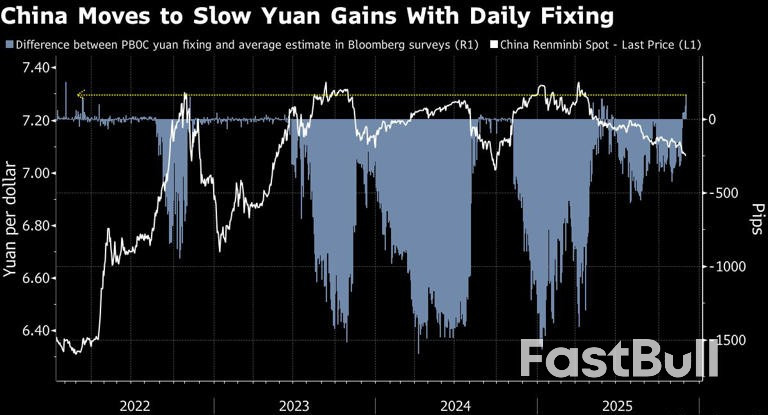
          The People’s Bank of China set the so-called fixing at 7.0733 per dollar, 164 pips from the average estimate in a Bloomberg survey. The gap between the fixing, which limits the onshore yuan’s moves by 2% on either side, and the forecast was the widest to the weak side since February 2022.
          The yuan fell 0.1% in both onshore and overseas trading Thursday morning, after rising to the strongest level versus the dollar in more than a year this week. Versus a basket of currencies, it has been trading near the highest since April.
          China’s central bank is trying to engineer a calibrated ascent in the yuan that reflects stronger sentiment toward local assets and a weaker dollar, but also keeps its export engine humming. While the currency’s rally may be a vote of confidence from returning capital and thawing US relations, it may pose a risk for the nation’s exporters as it reduces the competitive advantage of their products.
          “Obviously, the PBOC is leaning against the appreciating momentum of the yuan,” said Fiona Lim, a senior foreign-exchange analyst at Malayan Banking Berhad in Singapore. “There are reasons for yuan to appreciate but the PBOC has started to ensure that the appreciation pace continues to remain gradual.”
          China gives most forceful signal since 2022 to slow yuan gains_1

          China Moves to Slow Yuan Gains With Daily Fixing

          Thursday’s fixing came in weaker than all 10 estimates submitted by those surveyed by Bloomberg. Still, it was slightly stronger than the previous session’s level, reflecting the greenback’s drop overnight.
          There’s also evidence that China is using more direct tools to limit gains than the fixing. In recent weeks, state-owned banks have been buying dollars from time to time to slow the yuan’s rally, according to traders who asked not to be named as they are not authorized to speak publicly.
          Before Thursday, the yuan had been inching toward the key psychological level of 7 amid a rally in local stocks and a slump in the dollar due to concerns over US’s fiscal conditions. Momentum has grown following an unexpected call between US President Donald Trump and his Chinese counterpart Xi Jinping, and a potential Trump visit to the Asian nation next year.
          “We do not expect the 7 level to be tested for the rest of this year, but it likely will be breached at some point next year,” said Lynn Song, chief economist for ING. “Currency stability has been useful to provide a stable environment for foreign trade and investment, and it has also been key to help avoid another area of market uncertainty when we are already in a period where uncertainty runs rampant.”
          Hedge funds on Wednesday sold dollars against the offshore yuan in the cash market and made trades in the option market that benefit from declines in the dollar-yuan currency pair, according to traders.
          The yuan’s strengthening shows how much things have changed since Trump’s earlier trade war in 2018-19. Back then, the Chinese economy was heavily reliant on US consumers — but the country has since diversified its exports toward the so-called Global South and extended its dominance in critical supply chains, such as rare earths.
          Still, on a trade-weighted basis, the yuan doesn’t look that strong yet. Despite recent gains, China’s real effective exchange rate, which strips out the impacts of inflation, is close to the lowest since 2011, according to data from the Bank for International Settlements.
          The fixing “suggests the authorities are seeking to manage the pace of yuan appreciation, but importantly they are not trying to halt it,” said Khoon Goh, head of Asia research at Australia & New Zealand Banking Group in Singapore. “Most likely the authorities want a smoother path of appreciation for the currency, especially with expected foreign-exchange volatility ahead.”

          Source: Bloomberg

          To stay updated on all economic events of today, please check out our Economic calendar
          Risk Warnings and Disclaimers
          You understand and acknowledge that there is a high degree of risk involved in trading. Following any strategies or investment methods may lead to potential losses. The content on the site is provided by our contributors and analysts for information purposes only. You are solely responsible for determining whether any trading assets, securities, strategy, or any other product is suitable for investing based on your own investment objectives and financial situation.
          Add to Favorites
          Share

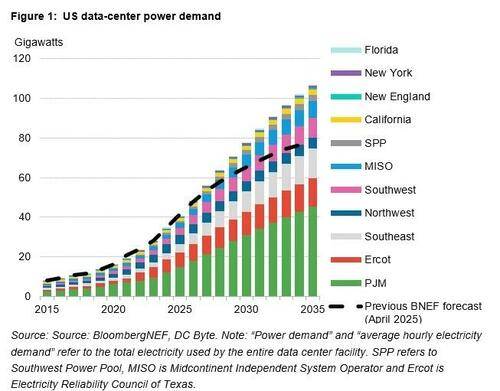
          US Data Center Power Demand Could Reach 106 GW By 2035

          Justin

          Stocks

          Economic

          Summary:

          · U.S. data center power demand could reach 106 GW in 2035, BloombergNEF said Monday in one of the more aggressive load growth estimates to date. The U.S. had about 25 GW of operating data centers in 2024, Bloom Energy said earlier this year.
          · BloombergNEF's latest forecast is 36% higher than its previous prediction, released in April. The jump is due in part to the higher average size of the 150 significant U.S. data center projects announced in the past year, over a quarter of which are larger than 500 MW, BNEF said.
          · The Energy Information Administration, which tracks demand for the federal government, generally only publishes detailed projections out two or three years, and few other analyses have attempted firm forecasts as far out as 2035.

          BNEF's report comes as some energy industry analysts and executives warn that an artificial intelligence bubble or speculative data center proposals could be fueling excessive load growth projections.

          A report from Grid Strategies released last month said utility forecasts of 90 GW additional data center load by 2030 were likely overstated; market analysis indicates load growth in that time frame is likely closer to 65 GW, it said.

          A July report from the Department of Energy estimated an additional 100 GW of new peak capacity is needed by 2030, of which 50 GW is attributable to data centers. Those facilities could account for as much as 12% of peak demand by 2028, according to Lawrence Berkeley National Laboratory.

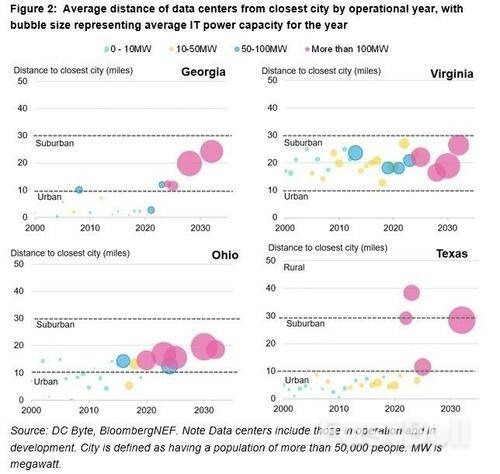
          BNEF's data center project tracker shows the industry diversifying beyond traditional data center hubs like Northern Virginia, metro Atlanta and central Ohio into exurban and rural regions served by existing fiber-optic trunk lines for data traffic.

          A map of under-construction, committed and early-stage projects shows gigawatts of planned data center capacity spreading south through Virginia and the Carolinas, up through eastern Pennsylvania and outward from Chicago along the Lake Michigan shore. More data centers are also planned for Texas and the Gulf Coast states.

          Much of the capacity is poised to materialize on grids overseen by the PJM Interconnection, the Midcontinent Independent System Operator and the Electric Reliability Council of Texas. BNEF predicts PJM alone could add 31 GW of data center load over the next five years, about 3 GW more than expected capacity additions from new generation.

          With the expected surge, the North American Electric Reliability Corp. warned late last year of "elevated risk" of summer electricity shortfalls this year, in 2026 and onward in all three regions.

          Some experts disputed NERC's methodology, however. MISO's independent market monitor said in June that the group's analysis was flawed and that MISO was in a better position than grid regions not expected to see exponential data center growth, like ISO New England and the New York Independent System Operator.

          Other technology and energy system analysts expect a significant amount of proposed data center capacity to dissipate in the coming years due to chip shortages, duplicative permit requests and other factors.

          In July, London Economics International said in a report prepared for the Southern Environmental Law Center that meeting projections for U.S. data center load in 2030 would require 90% of global chip supply — a scenario it called "unrealistic."

          Patricia Taylor, director of policy and research at the American Public Power Association, told Utility Dive earlier this year that it's common for data center developers to "shop around" the same project across neighboring jurisdictions.

          Still, U.S. grid operators face an "inflection moment" as they balance the desire to accommodate large-scale data centers with the obligation to ensure reliable service for all customers, BNEF said.

          Source: Zero Hedge

          To stay updated on all economic events of today, please check out our Economic calendar
          Risk Warnings and Disclaimers
          You understand and acknowledge that there is a high degree of risk involved in trading. Following any strategies or investment methods may lead to potential losses. The content on the site is provided by our contributors and analysts for information purposes only. You are solely responsible for determining whether any trading assets, securities, strategy, or any other product is suitable for investing based on your own investment objectives and financial situation.
          Add to Favorites
          Share

          Market Doubts Hassett Can Deliver at Fed, Says PGIM’s Peters

          Adam

          Economic

          Kevin Hassett may not have the ability to deliver the rapid pace of interest rate cuts US President Donald Trump would like, even if he is approved as the next Federal Reserve Chair, said Gregory Peters, co-chief investment officer at PGIM Fixed Income.
          Peters made the remarks amid rising talk that Hassett, the White House National Economic Council Director, may ease monetary policy aggressively to please Trump if he is picked to run the Fed. But the PGIM fund manager suggested that — since Fed rate decisions are ultimately decided by committee — Hassett won’t have the power to deliver on his own.
          “Does he have the credibility within the committee to drive consensus?” said Peters, who is also a member of the Treasury Borrowing Advisory Committee, in an interview with Bloomberg TV. “We don’t know that answer. I don’t think he has that credibility. I think that’s what the bond market is telling you.”
          Peters’ remarks were in response to a Financial Times report that bond investors, including those on the borrowing advisory committee, have voiced concerns to the US Treasury about Hassett’s potential appointment as the Fed chief.
          His comments come as bond traders and big macro fund managers game out the impact of Trump’s shake-up of the Fed, where even hints of policy changes can send ripples throughout global markets. The rising chance that Trump will appoint a dovish Fed chair follows his months of unprecedented attacks on the institution, including insults aimed at Powell and an attempt to oust board member Lisa Cook.
          Hassett is widely considered a supporter of Trump’s preference for lower rates. Trump said this week the race for the central bank chief job is “down to one” while referring to Hassett as a “potential Fed chair.”
          Hassett, while remaining coy about his chances of getting the job, rebuffed criticisms this week, citing a strong Treasury auction as a sign the market hasn’t been scared by the rumors he will take the job. But some traders have piled into bets that the pace of rate cuts is set to pick up, with such positions building after Hassett emerged as the frontrunner.
          The rising chance of Hassett getting the job has fueled questions about the independence of the Fed, which Peters said remains a major concern for investors.
          “The markets are focused on what happens next,” said Peters. “And what happens next is the new Fed chair, the new composition and quite candidly the meddling of the administration in Fed affairs.“
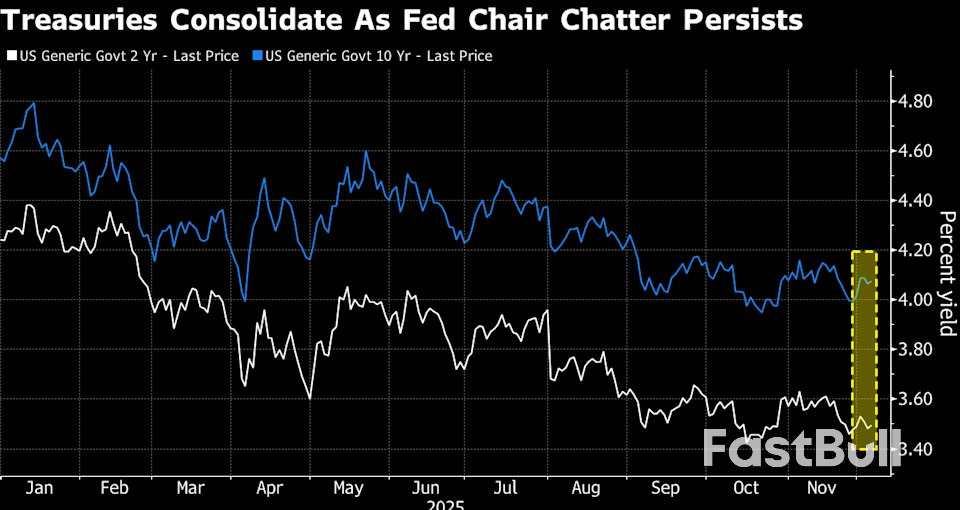
          Still, yields on Treasuries were little changed during Asian trading on Thursday. Those on benchmark 10-year Treasuries held at 4.08% in Asia morning trading Thursday, while yields on policy-sensitive two-year notes edged up one basis point to 3.50%.
          Investors are “worried about Fed independence slash credibility and so risk premium, term premium is being built into the curve not only in the US but across all sovereign bond markets,” said Peters. “It depends where you are - the bond market in the back end is still quite fragile.”
          Market Doubts Hassett Can Deliver at Fed, Says PGIM’s Peters_1

          Source: Bloomberg

          To stay updated on all economic events of today, please check out our Economic calendar
          Risk Warnings and Disclaimers
          You understand and acknowledge that there is a high degree of risk involved in trading. Following any strategies or investment methods may lead to potential losses. The content on the site is provided by our contributors and analysts for information purposes only. You are solely responsible for determining whether any trading assets, securities, strategy, or any other product is suitable for investing based on your own investment objectives and financial situation.
          Add to Favorites
          Share

          Bitcoin Bottom Could Be Near, According To Bitfinex: Here's What They Expect!

          Olivia Brooks

          Cryptocurrency

          Last week, Bitcoin (BTC) rose nearly fifteen percent to over $93,000. However, this recovery didn't last. BTC experienced heavy selling on Monday, falling to $84,000, marking a rough start to both the week and December, the last month of the year.

          However, this selling wave was short-lived. Bitcoin and altcoins quickly recovered after two days of declines.

          As BTC surged back above $93,000, these sudden price swings have divided the market. Some analysts say the decline could continue, while others argue that Bitcoin is holding onto a strong support area and a bottom is near.

          Has Bitcoin Really Bottomed?

          At this point, Bitfinex analysts also took the side that argued that the bottom was near.

          Bitfinex argued in its weekly Alpha report that the Bitcoin price is showing signs of bottoming out.

          The exchange pointed to several indicators, including excessive deleveraging, capitulation by short-term holders, and seller exhaustion, where selling pressure is rapidly diminishing, suggesting that Bitcoin is very close to the cycle bottom.

          "The recent recovery aligns with our previous view that the market is approaching a local bottom in terms of time, although we don't yet know if we've seen a bottom in terms of price."

          According to Bitfinex analysts, these factors suggest that the Bitcoin price has entered a stabilization phase, creating the necessary conditions for a sustained recovery in the short term.

          While Bitfinex analysts stated that there are many indicators pointing to a bottom in Bitcoin, one analyst said that it is too early to say that Bitcoin has reached the bottom.

          It's Too Early to Talk About a Bottom in Bitcoin!

          Cryptocurrency analyst Ted Pillows argued in his latest analysis that it is too early to confirm a bottom has formed for Bitcoin because the asset has not yet established clear support.

          Pillows noted that his bottom predictions were weakened as BTC failed to hold key support levels like $100,000, $95,000, and $90,000 and easily fell below them.

          Stating that BTC is currently stuck at the $93,000-$94,000 level and cannot create a stable support, the analyst said that an upward break of this level again would open the door to $100,000.

          On the other hand, a rejection from this level could push Bitcoin back below the $90,000 level.

          Source: CryptoSlate

          Risk Warnings and Disclaimers
          You understand and acknowledge that there is a high degree of risk involved in trading. Following any strategies or investment methods may lead to potential losses. The content on the site is provided by our contributors and analysts for information purposes only. You are solely responsible for determining whether any trading assets, securities, strategy, or any other product is suitable for investing based on your own investment objectives and financial situation.
          Add to Favorites
          Share

          Gold is exactly where it should be, and the downside remains limited - WisdomTree’s Shah

          Adam

          Commodity

          Although gold has yet to reach October’s all-time highs above $4,360 an ounce, the price is trading close to its fair value, according to one market strategist.
          In a recent interview with Kitco News, Nitesh Shah, Head of Commodities & Macroeconomic Research at WisdomTree, said that with so much uncertainty surging through the global economy, it's not surprising that the gold market, despite its volatility, continues to establish higher support levels at each new breakout.
          He added that investors waiting for bigger pullbacks will continue to be disappointed, as the precious metal is expected to find solid support from growing economic weakness, which will force the Federal Reserve to cut interest rates next week and through 2026, pushing nominal and real bond yields lower and weakening the U.S. dollar.
          Although gold was unable to hold its ground above $4,360 an ounce in October and faced significant profit-taking, the selling pressure has been limited, with support holding above $4,000 an ounce.
          After a brief consolidation period, gold continues to hold its ground, building support around $4,200.
          “After October’s rally, we have seen a healthy pullback, and I think where we are today is probably where we should be,” he said. “Gold is doing exactly what one would expect it to do in a world with rising government debt and falling interest rates.”
          Although many investors have been focused on gold’s upside potential, Shah has spent more time modeling his bear-case scenario.
          He noted that there is a risk gold could drop back to $3,800 an ounce, but his modeling suggests that the market remains well supported at that level.
          “We can get below $4,000, but it will take a significant effort to get there. One could see it as almost an impossibility,” he said.
          In his bearish scenario, Shah said that interest rates would have to rise back to 5%. However, he added that if this were to happen, the U.S. economy would likely fall into a recession, making gold an attractive safe-haven asset.
          “You would have to see a scenario where economic activity is so high that interest rates have to go higher and investors don’t see the need for holding gold anymore,” he said. “That just seems impossible right now. Every time gold finds a new support level, we are hit with new uncertainty that sparks another rally.”
          In recent days, gold has found new momentum after market expectations shifted dramatically once again. Last month, markets aggressively started pricing out a rate cut in December, but disappointing economic data has now caused the pendulum to swing the other way, with markets now pricing in nearly a 90% chance of a cut.
          Shah said that although next week’s monetary policy meeting will be important in setting the tone ahead of the new year, the bigger support for gold remains the uncertainty over who will lead the central bank when Fed Chair Jerome Powell’s term ends in May.
          He added that any political pressure affecting the central bank’s independence would be extremely supportive for gold.
          Shah also said that any questions surrounding the Federal Reserve’s independence could prompt other central banks to further diversify into gold and away from the U.S. dollar.

          Source: kitco

          Risk Warnings and Disclaimers
          You understand and acknowledge that there is a high degree of risk involved in trading. Following any strategies or investment methods may lead to potential losses. The content on the site is provided by our contributors and analysts for information purposes only. You are solely responsible for determining whether any trading assets, securities, strategy, or any other product is suitable for investing based on your own investment objectives and financial situation.
          Add to Favorites
          Share
          FastBull
          Copyright © 2025 FastBull Ltd

          728 RM B 7/F GEE LOK IND BLDG NO 34 HUNG TO RD KWUN TONG KLN HONG KONG

          TelegramInstagramTwitterfacebooklinkedin
          App Store Google Play Google Play
          Products
          Charts

          Chats

          Q&A with Experts
          Screeners
          Economic Calendar
          Data
          Tools
          Membership
          Features
          Function
          Markets
          Copy Trading
          Latest Signals
          Contests
          News
          Analysis
          24/7
          Columns
          Education
          Company
          Careers
          About Us
          Contact Us
          Advertising
          Help Center
          Feedback
          User Agreement
          Privacy Policy
          Business

          White Label

          Data API

          Web Plug-ins

          Poster Maker

          Affiliate Program

          Risk Disclosure

          The risk of loss in trading financial instruments such as stocks, FX, commodities, futures, bonds, ETFs and crypto can be substantial. You may sustain a total loss of the funds that you deposit with your broker. Therefore, you should carefully consider whether such trading is suitable for you in light of your circumstances and financial resources.

          No decision to invest should be made without thoroughly conducting due diligence by yourself or consulting with your financial advisors. Our web content might not suit you since we don't know your financial conditions and investment needs. Our financial information might have latency or contain inaccuracy, so you should be fully responsible for any of your trading and investment decisions. The company will not be responsible for your capital loss.

          Without getting permission from the website, you are not allowed to copy the website's graphics, texts, or trademarks. Intellectual property rights in the content or data incorporated into this website belong to its providers and exchange merchants.

          Not Logged In

          Log in to access more features

          FastBull Membership

          Not yet

          Purchase

          Become a signal provider
          Help Center
          Customer Service
          Dark Mode
          Price Up/Down Colors

          Log In

          Sign Up

          Position
          Layout
          Fullscreen
          Default to Chart
          The chart page opens by default when you visit fastbull.com