• Trade
  • Markets
  • Copy
  • Contests
  • News
  • 24/7
  • Calendar
  • Q&A
  • Chats
Trending
Screeners
SYMBOL
LAST
BID
ASK
HIGH
LOW
NET CHG.
%CHG.
SPREAD
SPX
S&P 500 Index
6827.42
6827.42
6827.42
6899.86
6801.80
-73.58
-1.07%
--
DJI
Dow Jones Industrial Average
48458.04
48458.04
48458.04
48886.86
48334.10
-245.98
-0.51%
--
IXIC
NASDAQ Composite Index
23195.16
23195.16
23195.16
23554.89
23094.51
-398.69
-1.69%
--
USDX
US Dollar Index
97.870
97.950
97.870
98.070
97.810
-0.080
-0.08%
--
EURUSD
Euro / US Dollar
1.17518
1.17525
1.17518
1.17596
1.17262
+0.00124
+ 0.11%
--
GBPUSD
Pound Sterling / US Dollar
1.33905
1.33912
1.33905
1.33961
1.33546
+0.00198
+ 0.15%
--
XAUUSD
Gold / US Dollar
4340.59
4341.02
4340.59
4350.16
4294.68
+41.20
+ 0.96%
--
WTI
Light Sweet Crude Oil
56.813
56.843
56.813
57.601
56.789
-0.420
-0.73%
--

Community Accounts

Signal Accounts
--
Profit Accounts
--
Loss Accounts
--
View More

Become a signal provider

Sell trading signals to earn additional income

View More

Guide to Copy Trading

Get started with ease and confidence

View More

Signal Accounts for Members

All Signal Accounts

Best Return
  • Best Return
  • Best P/L
  • Best MDD
Past 1W
  • Past 1W
  • Past 1M
  • Past 1Y

All Contests

  • All
  • Trump Updates
  • Recommend
  • Stocks
  • Cryptocurrencies
  • Central Banks
  • Featured News
Top News Only
Share

According To Data From The Federal Reserve Bank Of New York, The Secured Overnight Funding Rate (Sofr) Was 3.67% On The Previous Trading Day (December 15), Compared To 3.66% The Day Before

Share

Peru Energy And Mines Ministry: Copper Production Up 4.8% Year-On-Year In October To 248192 Metric Tons

Share

Security Source: Ukrainian Drones Hits Russian Oil Infrastructure In Caspian Sea For Third Time

Share

Spot Palladium Extends Gains, Last Up 5% To $1562.7/Oz

Share

Mexico's Economy Ministry Announces Start Of Anti-Dumping Investigation And Anti-Subsidy Investigations Into USA Pork Imports

Share

Canada Nov CPI Common +2.8%, CPI Median +2.8%, CPI Trim +2.8% On Year

Share

NY Fed's Empire State Prices Paid Index +37.6 In December Versus+49.0 In November

Share

Canada Nov Consumer Prices +0.1% On Month, +2.2% On Year

Share

Canada Nov CPI Core -0.1% On Month, +2.9% On Year

Share

Canada Nov Core CPI, Seasonally Adjusted +0.2% On Month, Oct +0.3% (Unrevised)

Share

Canada CPI YoY (Nov)

Share

Canada Core CPI YoY (Nov)

Share

U.S. NY Fed Manufacturing Index (Dec)

Share

UK Health Minister Streeting On Doctors' Strike: Vote To Go Ahead Reveals The Bma's Shocking Disregard For Patient Safety

Share

Venezuelan State Oil Company Pdvsa Says Was Subject To Cyber Attack But Operations Unaffected

Share

Russia Central Bank Says January-October Current Account Surplus At $37.1 Billion

Share

Polish Current Account Balance At +1924 Million Euros In October Versus+130 Million Euros Seen In Reuters Poll

Share

Statement: Germany, Ukraine Propose 10-Point Plan To Strengthen Armament Cooperation

Share

London Metal Exchange Three Month Copper Falls More Than 3% To $11541.50 A Metric Ton

Share

[Market Update] Spot Silver Surged $2.00 During The Day, Returning To $64/ounce, A Gain Of 3.23%

TIME
ACT
FCST
PREV
Japan Tankan Small Manufacturing Outlook Index (Q4)

A:--

F: --

P: --

Japan Tankan Large Non-Manufacturing Outlook Index (Q4)

A:--

F: --

P: --

Japan Tankan Large Manufacturing Outlook Index (Q4)

A:--

F: --

P: --

Japan Tankan Small Manufacturing Diffusion Index (Q4)

A:--

F: --

P: --

Japan Tankan Large Manufacturing Diffusion Index (Q4)

A:--

F: --

P: --

Japan Tankan Large-Enterprise Capital Expenditure YoY (Q4)

A:--

F: --

P: --

U.K. Rightmove House Price Index YoY (Dec)

A:--

F: --

P: --

China, Mainland Industrial Output YoY (YTD) (Nov)

A:--

F: --

P: --

China, Mainland Urban Area Unemployment Rate (Nov)

A:--

F: --

P: --

Saudi Arabia CPI YoY (Nov)

A:--

F: --

P: --

Euro Zone Industrial Output YoY (Oct)

A:--

F: --

P: --

Euro Zone Industrial Output MoM (Oct)

A:--

F: --

P: --

Canada Existing Home Sales MoM (Nov)

A:--

F: --

P: --

Canada National Economic Confidence Index

A:--

F: --

P: --

Canada New Housing Starts (Nov)

A:--

F: --

P: --
U.S. NY Fed Manufacturing Employment Index (Dec)

A:--

F: --

P: --

U.S. NY Fed Manufacturing Index (Dec)

A:--

F: --

P: --

Canada Core CPI YoY (Nov)

A:--

F: --

P: --

Canada Manufacturing Unfilled Orders MoM (Oct)

A:--

F: --

P: --

U.S. NY Fed Manufacturing Prices Received Index (Dec)

A:--

F: --

P: --

U.S. NY Fed Manufacturing New Orders Index (Dec)

A:--

F: --

P: --

Canada Manufacturing New Orders MoM (Oct)

A:--

F: --

P: --

Canada Core CPI MoM (Nov)

A:--

F: --

P: --

Canada Trimmed CPI YoY (SA) (Nov)

A:--

F: --

P: --

Canada Manufacturing Inventory MoM (Oct)

A:--

F: --

P: --

Canada CPI YoY (Nov)

A:--

F: --

P: --

Canada CPI MoM (Nov)

A:--

F: --

P: --

Canada CPI YoY (SA) (Nov)

A:--

F: --

P: --

Canada Core CPI MoM (SA) (Nov)

A:--

F: --

P: --

Canada CPI MoM (SA) (Nov)

A:--

F: --

P: --

Federal Reserve Board Governor Milan delivered a speech
U.S. NAHB Housing Market Index (Dec)

--

F: --

P: --

Australia Composite PMI Prelim (Dec)

--

F: --

P: --

Australia Services PMI Prelim (Dec)

--

F: --

P: --

Australia Manufacturing PMI Prelim (Dec)

--

F: --

P: --

Japan Manufacturing PMI Prelim (SA) (Dec)

--

F: --

P: --

U.K. 3-Month ILO Employment Change (Oct)

--

F: --

P: --

U.K. Unemployment Claimant Count (Nov)

--

F: --

P: --

U.K. Unemployment Rate (Nov)

--

F: --

P: --

U.K. 3-Month ILO Unemployment Rate (Oct)

--

F: --

P: --

U.K. Average Weekly Earnings (3-Month Average, Including Bonuses) YoY (Oct)

--

F: --

P: --

U.K. Average Weekly Earnings (3-Month Average, Excluding Bonuses) YoY (Oct)

--

F: --

P: --

France Services PMI Prelim (Dec)

--

F: --

P: --

France Composite PMI Prelim (SA) (Dec)

--

F: --

P: --

France Manufacturing PMI Prelim (Dec)

--

F: --

P: --

Germany Services PMI Prelim (SA) (Dec)

--

F: --

P: --

Q&A with Experts
    • All
    • Chatrooms
    • Groups
    • Friends
    Connecting
    .
    .
    .
    Type here...
    Add Symbol or Code

      No matching data

      All
      Trump Updates
      Recommend
      Stocks
      Cryptocurrencies
      Central Banks
      Featured News
      • All
      • Russia-Ukraine Conflict
      • Middle East Flashpoint
      • All
      • Russia-Ukraine Conflict
      • Middle East Flashpoint
      Search
      Products

      Charts Free Forever

      Chats Q&A with Experts
      Screeners Economic Calendar Data Tools
      Membership Features
      Data Warehouse Market Trends Institutional Data Policy Rates Macro

      Market Trends

      Market Sentiment Order Book Forex Correlations

      Top Indicators

      Charts Free Forever
      Markets

      News

      News Analysis 24/7 Columns Education
      From Institutions From Analysts
      Topics Columnists

      Latest Views

      Latest Views

      Trending Topics

      Top Columnists

      Latest Update

      Signals

      Copy Rankings Latest Signals Become a signal provider AI Rating
      Contests
      Brokers

      Overview Brokers Assessment Rankings Regulators News Claims
      Broker listing Forex Brokers Comparison Tool Live Spread Comparison Scam
      Q&A Complaint Scam Alert Videos Tips to Detect Scam
      More

      Business
      Events
      Careers About Us Advertising Help Center

      White Label

      Data API

      Web Plug-ins

      Affiliate Program

      Awards Institution Evaluation IB Seminar Salon Event Exhibition
      Vietnam Thailand Singapore Dubai
      Fans Party Investment Sharing Session
      FastBull Summit BrokersView Expo
      Recent Searches
        Top Searches
          Markets
          News
          Analysis
          User
          24/7
          Economic Calendar
          Education
          Data
          • Names
          • Latest
          • Prev

          View All

          No data

          Scan to Download

          Faster Charts, Chat Faster!

          Download App
          English
          • English
          • Español
          • العربية
          • Bahasa Indonesia
          • Bahasa Melayu
          • Tiếng Việt
          • ภาษาไทย
          • Français
          • Italiano
          • Türkçe
          • Русский язык
          • 简中
          • 繁中
          Open Account
          Search
          Products
          Charts Free Forever
          Markets
          News
          Signals

          Copy Rankings Latest Signals Become a signal provider AI Rating
          Contests
          Brokers

          Overview Brokers Assessment Rankings Regulators News Claims
          Broker listing Forex Brokers Comparison Tool Live Spread Comparison Scam
          Q&A Complaint Scam Alert Videos Tips to Detect Scam
          More

          Business
          Events
          Careers About Us Advertising Help Center

          White Label

          Data API

          Web Plug-ins

          Affiliate Program

          Awards Institution Evaluation IB Seminar Salon Event Exhibition
          Vietnam Thailand Singapore Dubai
          Fans Party Investment Sharing Session
          FastBull Summit BrokersView Expo

          What Are Inflation Surprises Telling Us About Tariffs?

          Adam

          Economic

          Summary:

          Despite rising tariffs, apparel prices have declined, suggesting weak demand and foreign producers absorbing costs. Inflation remains subdued, and the Fed may cut rates if tariff-driven price pressures stay limited.
          The Fed will remain on hold today, and the main justification is the risk of persistently higher inflation due to tariffs. However, the inflation data through May have been weaker than expected, with limited signs of a tariff pass-through to consumer prices.
          The most likely explanation is that it’s too early to see the price effects of tariffs, but it could also be a sign of weaker demand limiting the pass-through to consumer prices. The smaller the boost to consumer inflation from tariffs, the more likely the Fed is to cut rates this year.
          Today’s post digs into one of the surprises in the recent inflation data: apparel prices have fallen in the past two months despite being one of the most import-intensive consumer goods. The post attempts to trace tariffs through economic data and offers some industry-specific context. Spending on apparel accounts for only 2.5% of the CPI, so it won’t settle the debate about tariff-related inflation risks. However, it provides some counter to the worst-case scenarios.

          Consumers Have Yet to See Prices Increase in Apparel

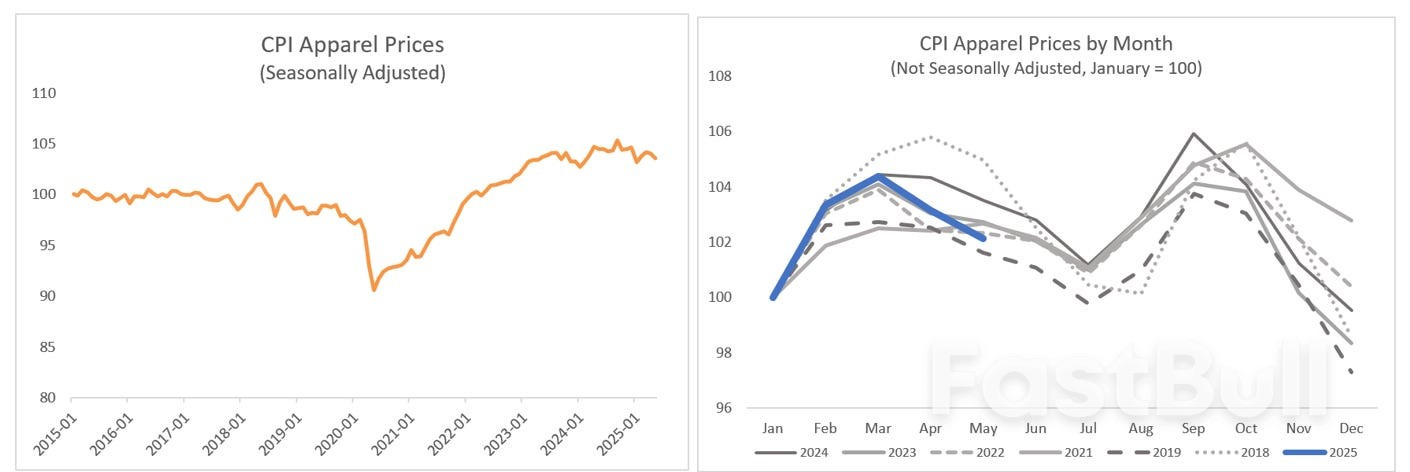
          Apparel prices in the CPI declined 0.4% in April, marking the second consecutive monthly decline, and are down 1% since the end of last year (orange line in left chart). The recent moves do not stand out when compared to the usual monthly volatility. Still, they are somewhat surprising given the tariff increases this year and the sector’s high import intensity.
          What Are Inflation Surprises Telling Us About Tariffs?_1
          The most recent declines are also apparent in the non-seasonally adjusted data (blue line in the right chart). The non-seasonally adjusted data show two clear peaks in prices during the year. Additionally, due to the industry’s import-intensive nature, production and delivery of goods often occur several months later. The tariffs are likely to be more relevant for the pricing of apparel later in the year. The Beige Book included a reference in the Boston District on repricing:
          A clothing retailer, which typically tags items with prices months in advance, took the rare step to retag items with higher prices to cover the cost of tariffs, and those items will hit store shelves this summer.
          Some delay in passing costs to customers is possible, but there are alternative ways to absorb the tariffs and other factors that influence pricing decisions.

          Import Prices for Apparel Have Declined.

          While the domestic importer pays the tariff to the US government, the foreign producer can bear some of the tariff burden if it reduces the prices it charges to US importers. The import price refers to the transaction price between businesses upon entry and does not include tariff duties, insurance, or shipping costs.
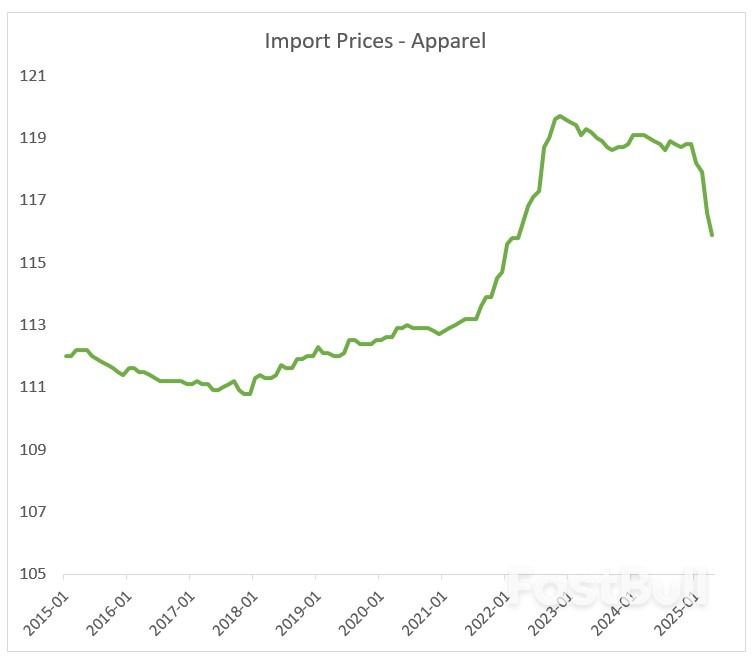
          Overall import prices for end-use goods have remained little changed this year, but import prices for apparel have declined by nearly 3% through May. That is consistent with foreign producers bearing some of the burden of tariffs, though it is insufficient to fully offset the increased tariff duties that the domestic importers must pay.
          What Are Inflation Surprises Telling Us About Tariffs?_2
          The longer production cycles may have given US apparel importers more leverage than importers in other industries. In a Bloomberg interview, Sarah LaFleur, the owner of a women’s clothing brand, M.M.LaFleur, explained that the clothes had already been produced when the tariffs were announced.
          Reducing the import price could be a better alternative than losing the entire order payment for the foreign apparel manufacturers. That particular form of leverage may diminish over time. Still, it does suggest less cost pressure on US apparel importers due to tariffs so far, and could partly explain why consumer prices have not risen.

          Tariff Collections Have Risen, but Are Likely Still in the Process of Adjustment.

          Another reason why the effects of tariffs on apparel consumer prices may be muted is that the ramp-up in tariff collections has been more gradual than the announced changes in tariff rates. Businesses have less cost to pass on than the policy announcements might have suggested.
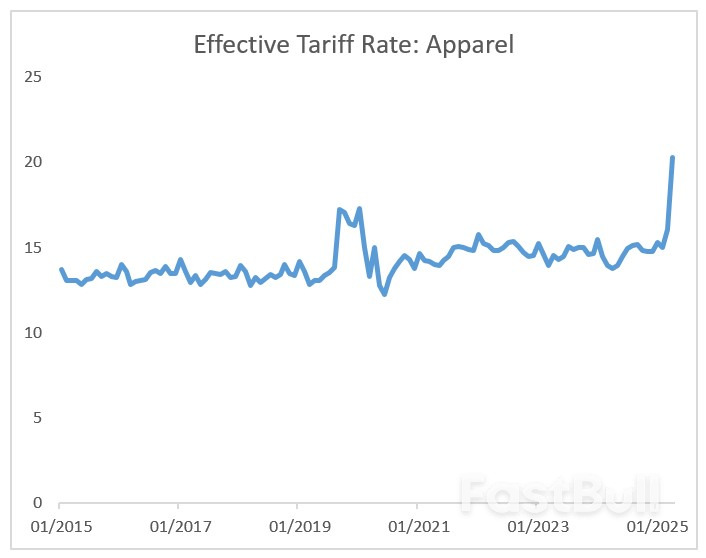
          The effective tariff rate on apparel manufacturing—total value of duties divided by total customs value of imports—from all countries has risen 5.5 percentage points through April. For Chinese apparel imports, it was 34 percentage points higher.
          What Are Inflation Surprises Telling Us About Tariffs?_3
          Those are notable increases, but by April, the tariff rate on apparel had increased by at least 10 percentage points for most countries and by more than 145 percentage points for China. Exemptions from the reciprocal tariffs for goods shipped before April 5 (for the 10% baseline tariffs) and April 9 (for the country-specific tariffs) are likely the primary reason for the gap. That was a one-time way to avoid the tariff increases.
          Given the breadth of the 10% baseline tariffs, the effective tariff rate is likely to rise further, even though the tariff policy rates have declined since April. The tariffs for most countries on apparel were reset to 10% in mid-April, and for China, to 30% in mid-May. June will be the first full month at the current level. The timing of shipping is a good example of how businesses will make an effort to minimize the extra costs of tariffs. Lower costs incurred are lower costs to pass on.

          Gross Margins Are Little Changed, but Could Offer a Buffer.

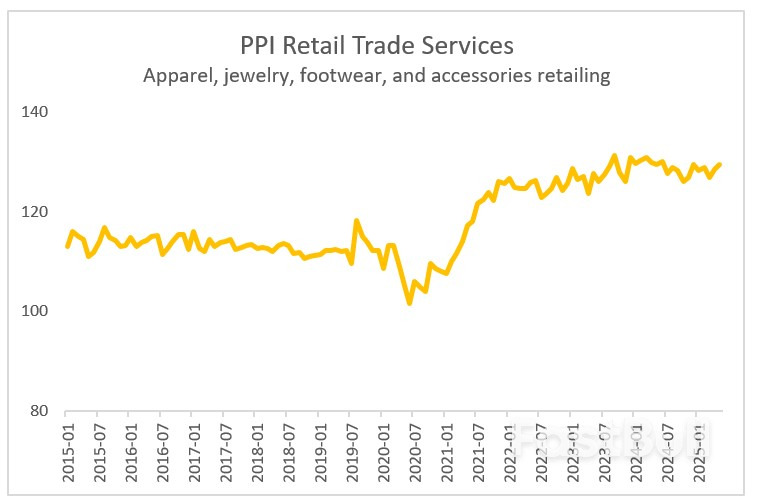
          Businesses that import tariffed goods can also absorb some of the cost by operating with narrower profit margins or by reducing other expenses. One measure of margins is trade services indexes in the Producer Price Index report, which capture the difference between the selling price and the acquisition price of a good.
          Note that the acquisition price (like the import price) does not include tariffs; therefore, a constant trade services margin would suggest that the business is bearing any additional costs associated with the tariff. Trade services for apparel retailers were unchanged in May compared to the end of last year. Steady margins also correspond roughly to declines in apparel import prices and consumer prices in recent months.
          What Are Inflation Surprises Telling Us About Tariffs?_4
          For now, any extra costs of tariffs (not offset by the lower import prices) appear to be absorbed by businesses. Those costs could be passed on later via higher consumer prices, but the apparel gross margins are elevated relative to pre-pandemic levels, which could provide some cushion.
          In his analysis of tariffs and pricing of apparel from 2015 to 2024, Professor Sheng Lu argued:
          … about 50% to 80% of the variation in U.S. retail prices is explained by its past values, underscoring the persistence of retailers’ pricing practices. Meanwhile, U.S. apparel retail sales account for about 27% of the changes in U.S. apparel retail prices. In comparison, apparel tariff changes explained only about 5% of the retail price fluctuations. In other words, market factors, particularly consumer demand, play a more significant role in shaping fashion companies’ pricing decisions than tariffs.
          The declines in consumer prices for apparel could also be a sign of weakening consumer demand. Apparel need not be representative of other consumer goods. Its trade services margins rose less than half as much as retailers overall. However, the lack of price increases in apparel consumer prices may indicate the restraints on passing tariffs on to consumers.

          In Closing

          In 2021, the Fed told us not to worry when inflation rose, saying it would be transitory. Now the Fed is telling us to worry even as inflation has slowed, saying more inflation is coming and it might be persistent.
          The most logical explanation for the modest signs of tariffs on consumer inflation is that it’s too soon to see the effects. But that’s not the only possible explanation. The declines in apparel consumer prices in recent months also suggest greater demand sensitivity and some tariff cost sharing by foreign producers. That would imply a smaller boost to inflation from tariffs, as opposed to simply a delay in the boost.
          It’s too soon to know the effects of the tariffs, but it will be important to hear how the Fed is sifting through the data and assessing the risks.

          source :investing

          To stay updated on all economic events of today, please check out our Economic calendar
          Risk Warnings and Disclaimers
          You understand and acknowledge that there is a high degree of risk involved in trading. Following any strategies or investment methods may lead to potential losses. The content on the site is provided by our contributors and analysts for information purposes only. You are solely responsible for determining whether any trading assets, securities, strategy, or any other product is suitable for investing based on your own investment objectives and financial situation.
          Add to Favorites
          Share

          Shares Of Coinbase, Circle Surge After Stablecoin Bill Passes Senate

          Devin

          Cryptocurrency

          Jeremy Allaire, CEO of Circle Internet Group, the issuer of one of the world's biggest stablecoins, and Circle co-founder Sean Neville pose outside the New York Stock Exchange (NYSE), on the day of the company's IPO in New York City, U.S., June 5, 2025.

          NYSE

          Shares of Circle and Coinbase rallied on Wednesday, as Wall Street cheered the Senate's passage of the GENIUS Act, which would establish a federal framework for U.S. dollar-pegged stablecoins.

          Circle, the issuer of the USDC stablecoin, rose 22% following the passing of the bill late Tuesday. It's the continuation of a remarkable run for Circle's stock since the company held its stock market debut on June 5. The shares are trading at about $180, up almost sixfold from their $31 IPO price.

          Coinbase, which co-founded USDC and shares in 50% of its revenue with Circle, gained more than 10%. Stablecoins have become Coinbase's biggest revenue driver after trading, with stablecoin-related income surging 50% year-over-year in the first quarter.

          The GENIUS Act, short for the Guiding and Establishing National Innovation for U.S. Stablecoins Act, allows private companies to issue stablecoins under strict guardrails, including full reserve backing and monthly audits.

          It represents the crypto industry's first major legislative win, but still has to get signed into law. The bill now heads to the House, which has its own version of a stablecoin bill dubbed STABLE. Both prohibit yield-bearing consumer stablecoins, but diverge on who regulates what.

          The Senate version centralizes oversight with Treasury, while the House splits authority between the Federal Reserve, the Comptroller of the Currency, and others. Reconciling the two could take a while, especially as House Republicans weigh attaching a broader market structure package, according to congressional aides.

          If the GENIUS Act becomes law, it could pave the way for explosive growth in the nearly $260 billion stablecoin market, and drive more revenue to key infrastructure players like Circle and Coinbase.

          Coinbase earns 100% of the interest on USDC held directly on its platform. CEO Brian Armstrong has said he wants USDC to overtake Tether as the world's top stablecoin.

          "If you can get shared economics, I don't see why we wouldn't see more of these banks partnering with USDC," Armstrong said last month, calling stablecoins a major pillar of Coinbase's long-term growth.

          Source: CNBC

          Risk Warnings and Disclaimers
          You understand and acknowledge that there is a high degree of risk involved in trading. Following any strategies or investment methods may lead to potential losses. The content on the site is provided by our contributors and analysts for information purposes only. You are solely responsible for determining whether any trading assets, securities, strategy, or any other product is suitable for investing based on your own investment objectives and financial situation.
          Add to Favorites
          Share

          Crude Oil Price Outlook – Crude Oil Continues to Find Buyers on Dips

          Adam

          Commodity

          WTI/CL Technical Analysis

          The light sweet crude oil market has pulled back just a bit in the early hours here on Wednesday to show signs of life, but it has turned around quite rapidly. With this, I think you have a situation where we are just in a buy on the dip mode. I don’t really see anything out there that would change anything on this chart and my description of it.
          So as long as there is a lot of concern with the oil disruption in the Middle East through the hot wars, it’s just a situation where you have to look at this as a market that eventually goes higher. I have no interest in shorting this market, but if we were to break down below the 200 day EMA, then we could drop to $65, which has to be the absolute floor here.

          Brent Technical Analysis

          The Brent market initially pulled back just a bit to show signs of life, and a little bit later just went straight back up. The $75.50 level is an area that has been massive in its implication, if we can break above the $78.25 level, it’s likely that the $82 level is a target short term pullbacks, I believe continue to get bought into here in the Brent market as well. And I just don’t have any interest whatsoever in trying to short this market. I think if there’s an end to the war, maybe we get a sudden flush. But we will turn around. We had been building up for a while, so this was just the excuse that bulls needed in this market.

          Source: fxempire

          Risk Warnings and Disclaimers
          You understand and acknowledge that there is a high degree of risk involved in trading. Following any strategies or investment methods may lead to potential losses. The content on the site is provided by our contributors and analysts for information purposes only. You are solely responsible for determining whether any trading assets, securities, strategy, or any other product is suitable for investing based on your own investment objectives and financial situation.
          Add to Favorites
          Share

          US Weekly Jobless Claims, Housing Data Point To Softening Economic Activity

          Olivia Brooks

          Economic

          The number of Americans filing new applications for unemployment benefits fell last week, but stayed at levels consistent with a further loss of labor market momentum in June and softening economic activity.

          The report from the Labor Department on Wednesday showed widespread layoffs in the prior week, which had boosted claims to an eight-month high. Though some technical factors accounted for the elevation in claims, layoffs have risen this year, with economists saying President Donald Trump's broad tariffs had created a challenging economic environment for businesses.

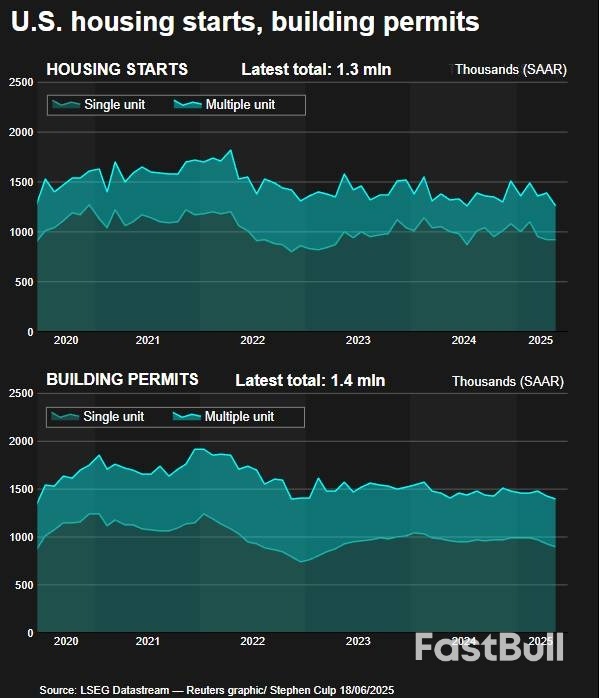
          Those challenges were also evident in other data showing permits for future construction of single-family housing dropped to a two-year low in May as builders grappled with higher costs from duties on materials, including lumber, steel and aluminum.

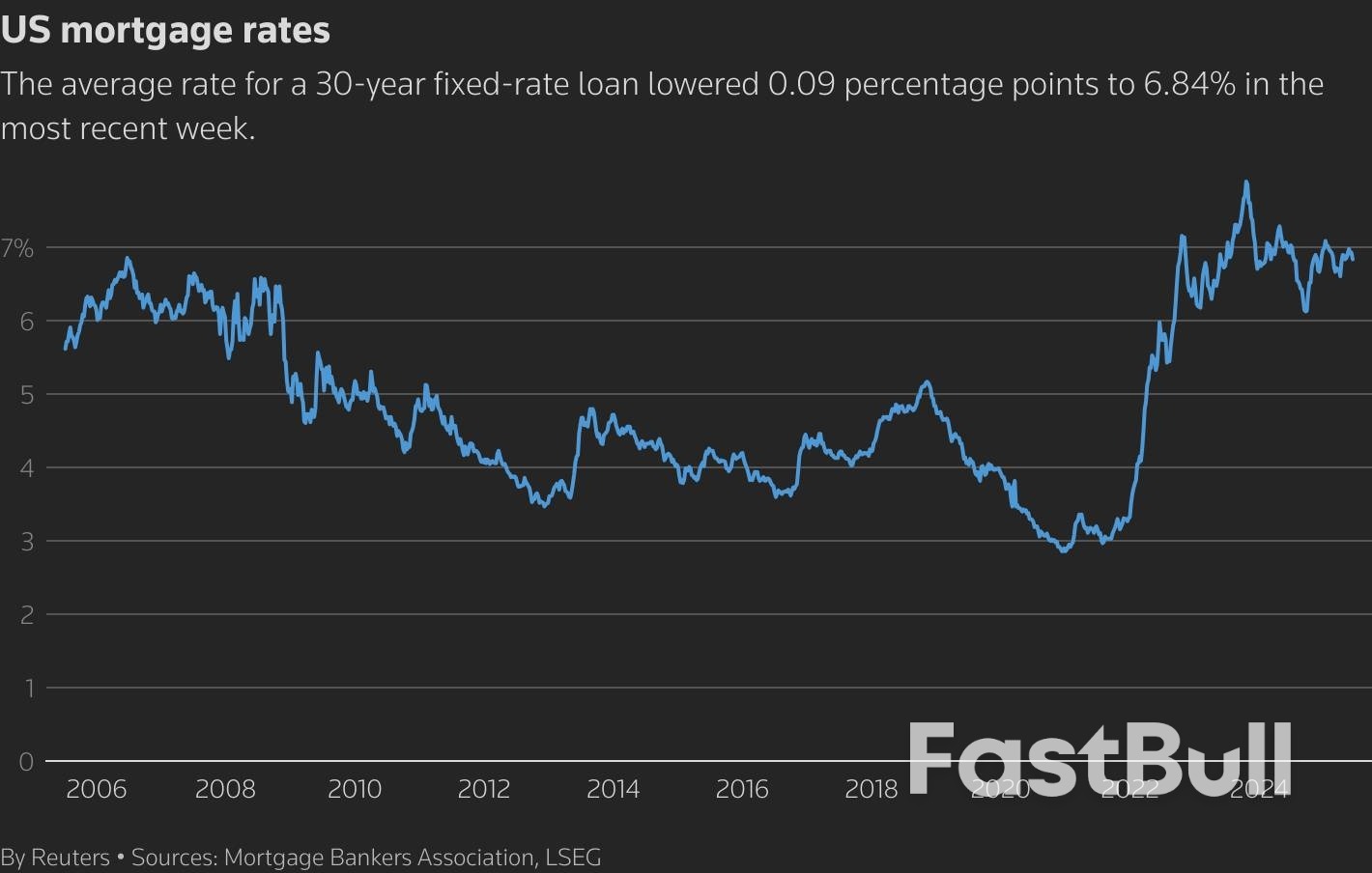
          Higher borrowing costs as the Federal Reserve responded to the heightened economic uncertainty from tariffs by pausing its interest rate cutting cycle have weighed on demand for homes, resulting in excess inventory of unsold houses.

          Fed officials were on Wednesday expected to leave the U.S. central bank's benchmark overnight interest rate in the 4.25%-4.50% range, where it has been since December as they also monitor the economic fallout from the conflict between Israel and Iran.

          "Even though claims remain low by historical standards, we can no longer deny that there is some upward movement toward levels that would support our assessment of an economy slowing into a contraction," said Carl Weinberg, chief economist at High Frequency Economics. "It is time, now, to say that."

          Initial claims for state unemployment benefits dropped 5,000 to a seasonally adjusted 245,000 for the week ended June 14. Data for the prior week was revised to show 2,000 more applications received than previously reported, lifting claims for that week to the highest since October.

          Economists polled by Reuters had forecast 245,000 claims for the latest week. The report was released a day early because of the Juneteenth National Independence Day holiday on Thursday.

          Layoffs were reported in the prior week across several states in a range of industries including transportation and warehousing, accommodation and food services, agriculture, construction and manufacturing.

          The four-week moving average of claims, which strips out seasonal fluctuations from the data, increased 4,750 to 245,500 last week, the highest level since August 2023. But some economists do not view the labor market as having changed much.

          "The increase could be a sign of a slight pickup in job separations," said Conrad DeQuadros, senior economic advisor at Brean Capital. "However, there appears to be a marked seasonal pattern in the last three years in the seasonally adjusted claims data where claims rise from mid-February through the summer and then retreat later in the year."

          Stocks on Wall Street were trading higher. The dollar fell versus a basket of currencies. U.S. Treasury yields eased.

          Housing market shaky

          The claims data covered the period during which the government surveyed businesses for the nonfarm payrolls component of June's employment report. Claims increased between the May and June survey weeks.

          Historically low layoffs have accounted for much of the labor market stability, with the hiring side of the equation tepid amid hesitancy by employers to boost headcount because of the unsettled economic environment. Nonfarm payrolls increased by 139,000 jobs in May, compared with a 193,000 gain a year ago.

          Data next week on the number of people receiving benefits after an initial week of aid, a proxy for hiring, could shed more light on the state of the labor market in June.

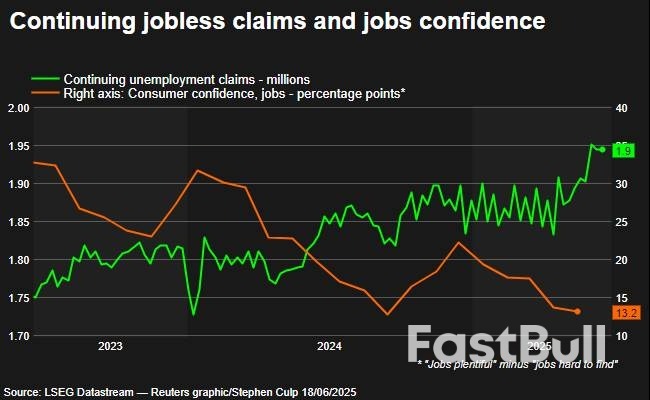
          The so-called continuing claims dropped 6,000 to a still-high seasonally adjusted 1.945 million during the week ending June 7. Recently laid-off workers are struggling to find work.

          Continuing claims and jobs confidence

          A separate report from the Commerce Department's Census Bureau showed permits for future construction of single-family housing dropped 2.7% to a seasonally adjusted annual rate of 898,000 units in May, the lowest level since April 2023.

          Higher borrowing costs have sidelined potential buyers, boosting the supply of new single-family homes on the market to levels last seen in late 2007. That has left builders with little incentive to break ground on new housing projects.

          An immigration crackdown that has seen raids at construction sites could lead to labor shortages, compounding problems for builders, economists said.

          A line chart titled "US mortgage rates" that tracks the metric over time.

          A National Association of Home Builders survey on Tuesday showed sentiment among single-family homebuilders plummeted to a 2-1/2-year low in June.

          Permits for the volatile multi-family housing segment, buildings with five units or more, rose 1.4% to a rate of 444,000 units in May. Overall building permits fell 2.0% to a rate of 1.393 million units, the lowest level since June 2020.

          Single-family housing starts, which account for the bulk of homebuilding, gained 0.4% to 924,000 units last month. Starts for multi-family housing units slumped 30.4% to a rate of 316,000 units. Overall housing starts plunged 9.8% to a rate of 1.256 million units, the lowest level in five years.

          Housing starts and building permits

          The completions rate for single-family houses surged 8.1% to 1.027 million units. The inventory of housing under construction decreased 1.3% to a rate of 623,000 units, the lowest level since February 2021.

          "We don't expect an imminent collapse in the housing market," said Matthew Martin, a senior U.S. economist at Oxford Economics. "However, uncertainty will keep construction depressed the remainder of the year."

          Source: Reuters

          To stay updated on all economic events of today, please check out our Economic calendar
          Risk Warnings and Disclaimers
          You understand and acknowledge that there is a high degree of risk involved in trading. Following any strategies or investment methods may lead to potential losses. The content on the site is provided by our contributors and analysts for information purposes only. You are solely responsible for determining whether any trading assets, securities, strategy, or any other product is suitable for investing based on your own investment objectives and financial situation.
          Add to Favorites
          Share

          GBP/USD in Sharp Focus as Middle East Tensions, Fed, BoE All Come Into Focus

          Adam

          Forex

          With both the Federal Reserve and Bank of England poised to deliver policy updates in the next 24 hours or so, one might expect central bankers to be the main attraction in markets. Not so. The real drama is unfolding on the geopolitical stage, where speculation is intensifying over a potential US military intervention in Iran.
          Unsurprisingly, oil prices spiked once more yesterday, and with them, the US dollar found fresh safe-haven appeal. That put pressure on all major pairs, including the GBP/USD. This morning, though, oil prices eased slightly, paving the way for mild dollar selling. But the situation remains tense, keeping Brent oil steady near the $75 handle. For this reason, the risks for the GBP/USD remain tilted to the downside.
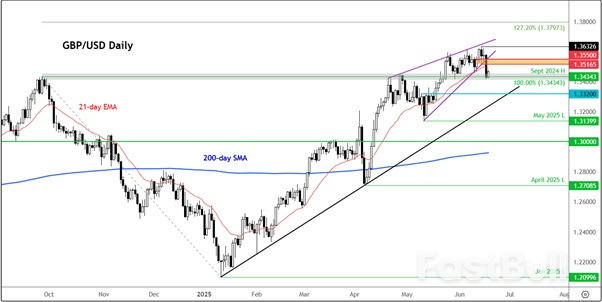
          Before turning our focus to the central bank meetings, let’s take a look at the cable’s chart and discuss some levels that are coming into focus now.

          GBP/USD Technical Analysis and Trade Ideas

          GBP/USD in Sharp Focus as Middle East Tensions, Fed, BoE All Come Into Focus_1
          The GBP/USD chart has now broken below the rising wedge pattern, which was always a prerequisite for downside momentum. The key question now is whether the cable will hold or break back below the pivotal level of 1.3430/35. This area was a major resistance zone in September 2024, before we finally broke above it in May this year.
          Since then, rates have dipped back to test this level from above on a couple of occasions, including yesterday. The bulls have so far prevailed. However, a breakdown could trigger the unwinding of bullish bets and lead to some long-side liquidation. If that happens, the next support is seen around the 1.3400 area. Below that, the bullish trend line at 1.3450 will come into focus next.
          Meanwhile, resistance is now seen in the range between 1.3515 to 1.3550 (shaded in orange on the chart). This area was the previous support and marks the underside of the broken short-term resistance trend. Above that, the recent high at 1.3632 will come into focus.

          FOMC Rate Decision to Be Overshadowed by Middle East Tensions

          As much as traders tune in for tonight’s Fed decision, it’s the chaos in the Middle East that’s truly driving sentiment. The dollar’s recent strength appears to be more a function of risk aversion than anything to do with Fed policy – the flight to safety being driven by crude prices lurching higher.
          Israel’s renewed bombardment of Tehran has already ratcheted tensions, and talks of Washington’s involvement are adding fuel to the fire. Should those whispers become reality, we may well see oil extend its gains – and with it, the greenback.
          Still, one must be cautious. The bounce in the US dollar index could easily be short-lived if oil’s ascent isn’t underpinned by genuine supply disruptions. Markets are running on headlines rather than fundamentals, and that makes for a fragile rally. Take yesterday’s tepid US retail sales figures – once the sort of print that would rattle FX markets, but now merely a sideshow. Geopolitics, it seems, has taken the wheel.
          Turning back to the Fed, tonight’s decision will likely see rates left untouched, with the market laser-focused on the updated “dot plot” of rate projections.
          I expect it to show policymakers still pencilling in 50 basis points of cuts this year. Oil’s resurgence, coupled with lingering concerns over tariff-led inflation, may convince the FOMC to strike a more hawkish tone. That alone could lend the dollar some staying power.

          BoE Could Turn More Dovish

          On the other side of the Atlantic, the pound faces its own challenges. UK CPI figures out this morning showed inflation slowing to 3.4% in May – a shade above expectations – while the core rate was in line at 3.5%, although still down from 3.8% the month before. More notably, services inflation slipped to 4.7%, undercutting forecasts. For a Bank of England that’s recently leaned hawkish, the data offer little support.
          While a rate cut tomorrow remains highly unlikely, the pressure is clearly mounting for a more dovish stance. With economic indicators – from jobs to GDP – painting a softer picture, the BoE will struggle to maintain its tough talk unless inflation surprises to the upside again soon.
          For GBP/USD, the next 24 hours promise plenty of volatility – but not necessarily clarity. Between central bank caution and headline-driven oil shocks, sterling’s upside is likely to remain subdued, with downside risks increasing.

          Source: investing

          Risk Warnings and Disclaimers
          You understand and acknowledge that there is a high degree of risk involved in trading. Following any strategies or investment methods may lead to potential losses. The content on the site is provided by our contributors and analysts for information purposes only. You are solely responsible for determining whether any trading assets, securities, strategy, or any other product is suitable for investing based on your own investment objectives and financial situation.
          Add to Favorites
          Share

          Pro-Israel hackers destroy $90 million in Iran crypto exchange breach, analytics firm says

          Adam

          Cryptocurrency

          Middle East Situation

          Iran’s largest cryptocurrency exchange, Nobitex, was hacked for more than $90 million Wednesday, according to blockchain analytics firm Elliptic.
          The funds were drained from platform wallets into addresses bearing anti-government messages explicitly referencing Iran’s Islamic Revolutionary Guard Corps, or IRGC, pointing to a politically motivated cyberattack, Elliptic said.
          Pro-Israel hacking group Gonjeshke Darande, or “Predatory Sparrow,” claimed responsibility for the attack and said it would release the exchange’s source code. Elliptic said the exchange was offline at the time of its post.
          Predatory Sparrow also claimed credit for a separate cyberattack on Iran’s state-owned Bank Sepah this week.
          Fighting erupted between Israel and Iran on Friday and the countries have continued to trade missile fire. Iran supreme leader Ayatollah Ali Khamenei threatened the U.S. with “irreparable damage” Wednesday in response to President Donald Trump’s demand that the country surrender.
          Though the stolen assets have not been conclusively attributed to the group, Elliptic noted that the funds were sent to cryptographic addresses the hackers likely cannot control — suggesting the money was intentionally destroyed as a symbolic act rather than stolen for profit.
          Elliptic’s research linked the exchange to Iran’s IRGC, a powerful branch of the military designated as a terrorist organization by the United States, United Kingdom, European Union, and Canada.
          Past investigations have connected the platform to sanctioned IRGC-linked ransomware operatives and individuals close to Khamenei.
          Blockchain data also shows activity between the Nobitex exchange and wallets associated with Hamas, Palestinian Islamic Jihad, and the Houthis.
          Elliptic said it’s continuing to monitor virtual asset flows tied to Iranian entities and has updated its compliance tools to reflect emerging threats in the region’s crypto ecosystem.

          Source: cnbc

          Risk Warnings and Disclaimers
          You understand and acknowledge that there is a high degree of risk involved in trading. Following any strategies or investment methods may lead to potential losses. The content on the site is provided by our contributors and analysts for information purposes only. You are solely responsible for determining whether any trading assets, securities, strategy, or any other product is suitable for investing based on your own investment objectives and financial situation.
          Add to Favorites
          Share

          Iran Leader Rejects Trump's Demand For Surrender; Trump Says Patience Has Run Out

          Thomas

          Political

          Iranian Supreme Leader Ayatollah Ali Khamenei rejected Donald Trump's demand for unconditional surrender on Wednesday, and the U.S. president said his patience had run out, though he gave no clue as to what his next step would be.

          Speaking to reporters outside the White House, Trump declined to say whether he had made any decision on whether to join Israel's bombing campaign against Iran.

          "I may do it. I may not do it. I mean, nobody knows what I'm going to do," he said.

          Trump said Iranian officials had reached out about negotiations including a possible meeting at the White House but "it's very late to be talking," he said.

          "Unconditional surrender, that means I've had it."

          Asked for his response to Khamenei rejecting his demand to surrender, Trump said: "I say, good luck."

          Iranians jammed the highways out of the capital Tehran, fleeing from intensified Israeli airstrikes.

          In its latest bombing run, Israel said its air force had destroyed Iran's police headquarters.

          "As we promised – we will continue to strike at symbols of governance and hit the ayatollah regime wherever it may be," Defence Minister Israel Katz said.

          Khamenei, 86, rebuked Trump in a recorded speech played on television, his first appearance since Friday.

          The Americans "should know that any U.S. military intervention will undoubtedly be accompanied by irreparable damage," he said.

          "Intelligent people who know Iran, the Iranian nation and its history will never speak to this nation in threatening language because the Iranian nation will not surrender."

          Trump has veered from proposing a swift diplomatic end to the five-day-old war to suggesting the United States might join it. In social media posts on Tuesday, he mused about killing Khamenei, then demanded Iran's "UNCONDITIONAL SURRENDER!"

          A source familiar with internal discussions said Trump and his team were considering options that included joining Israel in strikes against Iranian nuclear installations. Defense Secretary Pete Hegseth told a Senate committee that the Pentagon was prepared to execute any order given by Trump

          Iran's mission to the United Nations mocked Trump in posts on X: "Iran does NOT negotiate under duress, shall NOT accept peace under duress, and certainly NOT with a has-been warmonger clinging to relevance," it wrote.

          "No Iranian official has ever asked to grovel at the gates of the White House," it said. "The only thing more despicable than his lies is his cowardly threat to 'take out' Iran’s Supreme Leader."

          Israel's military said 50 Israeli jets struck around 20 targets in Tehran overnight, including sites producing raw materials, components and manufacturing systems for missiles. The military told Iranians to leave parts of the capital for their own safety while it struck targets.

          Item 1 of 14 Smoke rises following an Israeli attack in Tehran, Iran, June 18, 2025. Majid Asgaripour/WANA (West Asia News Agency) via REUTERS

          TRAFFIC BACKED UP

          Traffic was backed up on highways leading out of the capital Tehran, a city of 10 million people, as residents sought sanctuary elsewhere.

          Arezou, a 31-year-old Tehran resident, told Reuters by phone that she had made it out to the nearby resort town of Lavasan.

          "We will stay here as long as this war continues. My friend’s house in Tehran was attacked and her brother was injured. They are civilians," she said. "Why are we paying the price for the regime’s decision to pursue a nuclear programme?”

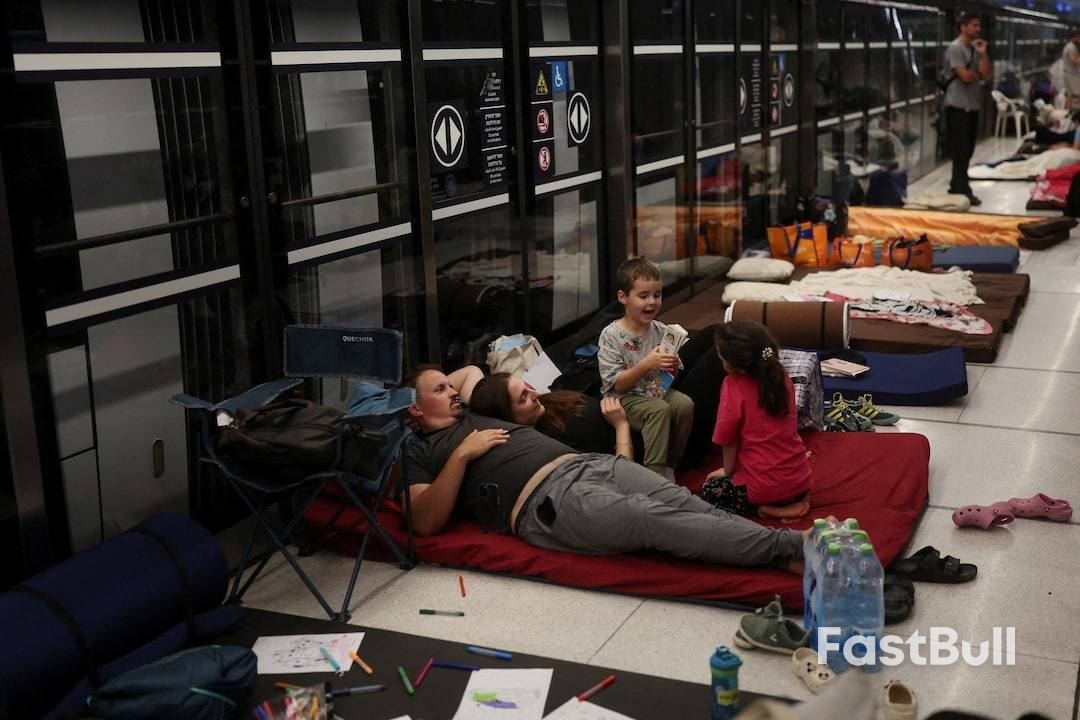
          In Israel, sirens rang out warning people of retaliatory Iranian missile strikes. At Ramat Gan city train station east of Tel Aviv, people were lying on city-supplied mattresses lined along the floor or sitting in the odd camping chair, with plastic water bottles strewn about.

          "I feel scared, overwhelmed. Especially because I live in a densely populated area that Iran seems to be targeting, and our city has very old buildings, without shelters and safe spaces," said Tamar Weiss, clutching her four-month-old daughter.

          Iran has been exploring options for leverage, including veiled threats to hit the global oil market by restricting access to the Gulf through the Strait of Hormuz, the world's most important shipping artery for oil.

          Oil prices leapt 9% on Friday and have marched further higher this week. The CEO of Italian energy company Eni (ENI.MI), opens new tab said the rises so far were still limited, signaling an expectation that serious disruption would be averted.

          A former Iranian economy minister, Ehsan Khandouzi, said on X that Iran should start demanding tankers obtain permission to transit the strait. Iran's Oil Ministry and Foreign Ministry did not immediately respond to requests for comment.

          BAN ON FILMING

          Inside Iran, authorities are intent on preventing panic and shortages. Fewer images of destruction have been allowed to circulate than in the early days of the bombing, when state media showed pictures of explosions, fires and flattened apartments. A ban on filming by the public has been imposed.

          The state has placed limits on how much fuel can be purchased. Oil Minister Mohsen Paknejad told state TV that restrictions were in place to prevent shortages, but there would be no problem supplying fuel to the public.

          Iranian officials have reported at least 224 deaths in Israeli attacks, mostly civilians, though that toll has not been updated for days.

          In Israel, Iran's missile volleys mark the first time in decades of shadow war and proxy conflict that a significant number of projectiles fired from Iran have penetrated defences, killing Israelis in their homes.

          Since Friday, Iran has fired around 400 missiles at Israel, some 40 of which have pierced through air defences, killing 24 people, all of them civilians, according to Israeli authorities.

          With Khamenei's main military and security advisers killed, the leader's inner circle has been narrowed, raising the risk that he could make strategic errors, according to five people familiar with his decision-making process.

          During the Gaza war, Israel has dealt heavy blows to Iran's regional allies Hamas and Hezbollah, limiting Tehran's ability to retaliate through strikes by its proxy fighters close to Israeli borders. Syrian leader Bashar al-Assad, propped up by Iran through 13 years of war, was toppled last year.

          Source: Reuters

          Risk Warnings and Disclaimers
          You understand and acknowledge that there is a high degree of risk involved in trading. Following any strategies or investment methods may lead to potential losses. The content on the site is provided by our contributors and analysts for information purposes only. You are solely responsible for determining whether any trading assets, securities, strategy, or any other product is suitable for investing based on your own investment objectives and financial situation.
          Add to Favorites
          Share
          FastBull
          Copyright © 2025 FastBull Ltd

          728 RM B 7/F GEE LOK IND BLDG NO 34 HUNG TO RD KWUN TONG KLN HONG KONG

          TelegramInstagramTwitterfacebooklinkedin
          App Store Google Play Google Play
          Products
          Charts

          Chats

          Q&A with Experts
          Screeners
          Economic Calendar
          Data
          Tools
          Membership
          Features
          Function
          Markets
          Copy Trading
          Latest Signals
          Contests
          News
          Analysis
          24/7
          Columns
          Education
          Company
          Careers
          About Us
          Contact Us
          Advertising
          Help Center
          Feedback
          User Agreement
          Privacy Policy
          Business

          White Label

          Data API

          Web Plug-ins

          Poster Maker

          Affiliate Program

          Risk Disclosure

          The risk of loss in trading financial instruments such as stocks, FX, commodities, futures, bonds, ETFs and crypto can be substantial. You may sustain a total loss of the funds that you deposit with your broker. Therefore, you should carefully consider whether such trading is suitable for you in light of your circumstances and financial resources.

          No decision to invest should be made without thoroughly conducting due diligence by yourself or consulting with your financial advisors. Our web content might not suit you since we don't know your financial conditions and investment needs. Our financial information might have latency or contain inaccuracy, so you should be fully responsible for any of your trading and investment decisions. The company will not be responsible for your capital loss.

          Without getting permission from the website, you are not allowed to copy the website's graphics, texts, or trademarks. Intellectual property rights in the content or data incorporated into this website belong to its providers and exchange merchants.

          Not Logged In

          Log in to access more features

          FastBull Membership

          Not yet

          Purchase

          Become a signal provider
          Help Center
          Customer Service
          Dark Mode
          Price Up/Down Colors

          Log In

          Sign Up

          Position
          Layout
          Fullscreen
          Default to Chart
          The chart page opens by default when you visit fastbull.com