• Trade
  • Markets
  • Copy
  • Contests
  • News
  • 24/7
  • Calendar
  • Q&A
  • Chats
Trending
Screeners
SYMBOL
LAST
BID
ASK
HIGH
LOW
NET CHG.
%CHG.
SPREAD
SPX
S&P 500 Index
6827.42
6827.42
6827.42
6899.86
6801.80
-73.58
-1.07%
--
DJI
Dow Jones Industrial Average
48458.04
48458.04
48458.04
48886.86
48334.10
-245.98
-0.51%
--
IXIC
NASDAQ Composite Index
23195.16
23195.16
23195.16
23554.89
23094.51
-398.69
-1.69%
--
USDX
US Dollar Index
97.850
97.930
97.850
98.070
97.810
-0.100
-0.10%
--
EURUSD
Euro / US Dollar
1.17550
1.17558
1.17550
1.17590
1.17262
+0.00156
+ 0.13%
--
GBPUSD
Pound Sterling / US Dollar
1.33860
1.33867
1.33860
1.33940
1.33546
+0.00153
+ 0.11%
--
XAUUSD
Gold / US Dollar
4339.13
4340.08
4339.13
4350.16
4294.68
+39.74
+ 0.92%
--
WTI
Light Sweet Crude Oil
57.107
57.129
57.107
57.601
56.878
-0.126
-0.22%
--

Community Accounts

Signal Accounts
--
Profit Accounts
--
Loss Accounts
--
View More

Become a signal provider

Sell trading signals to earn additional income

View More

Guide to Copy Trading

Get started with ease and confidence

View More

Signal Accounts for Members

All Signal Accounts

Best Return
  • Best Return
  • Best P/L
  • Best MDD
Past 1W
  • Past 1W
  • Past 1M
  • Past 1Y

All Contests

  • All
  • Trump Updates
  • Recommend
  • Stocks
  • Cryptocurrencies
  • Central Banks
  • Featured News
Top News Only
Share

UK Health Minister Streeting On Doctors' Strike: Vote To Go Ahead Reveals The Bma's Shocking Disregard For Patient Safety

Share

Venezuelan State Oil Company Pdvsa Says Was Subject To Cyber Attack But Operations Unaffected

Share

Russia Central Bank Says January-October Current Account Surplus At $37.1 Billion

Share

Polish Current Account Balance At +1924 Million Euros In October Versus+130 Million Euros Seen In Reuters Poll

Share

Statement: Germany, Ukraine Propose 10-Point Plan To Strengthen Armament Cooperation

Share

London Metal Exchange Three Month Copper Falls More Than 3% To $11541.50 A Metric Ton

Share

[Market Update] Spot Silver Surged $2.00 During The Day, Returning To $64/ounce, A Gain Of 3.23%

Share

European Central Bank: Italy's Recurrent Ad Hoc Tax Provisions Cause Uncertainty, Damage Investor Confidence, And May Affect Banks' Funding Costs

Share

Stats Office: Nigeria Consumer Inflation At 14.45% Year-On-Year In November

Share

European Central Bank: Italy's Budget Measures Weighing On Domestic Banks Could Have "Negative Implications" On Their Credit Liquidity

Share

Azerbaijan's January-November Oil Exports Via Btc Pipeline Down 7.1% Year-On-Year Data Shows

Share

Azerbaijan's Aliyev Plans A Large-Scale Prisoner Amnesty, Azertac Reports

Share

EU Commission Chief Von Der Leyen, NATO's Rutte Join Ukraine Talks In Berlin

Share

EU Announces Sanctions On Companies, Individuals For Moving Russian Oil

Share

ICE New York Cocoa Futures Fall More Than 5% To $5945 Per Metric Ton

Share

ICE London Cocoa Futures Fall More Than 5% To 4288 Pounds Per Metric Ton

Share

Pakistan Central Bank: Inflation Seen Returning To Target Range In Fy27

Share

Agrural - Brazil's 2025/26 Soybean Planting Hits 97% Of Expected Area As Of Last Thursday

Share

Pakistan Central Bank: Forex Reserves Seen At $17.8 Billion By June 2026

Share

Pakistan Central Bank: Global Headwinds Likely To Constrain Exports Going Forward

TIME
ACT
FCST
PREV
India CPI YoY (Nov)

A:--

F: --

P: --

India Deposit Gowth YoY

A:--

F: --

P: --

Brazil Services Growth YoY (Oct)

A:--

F: --

P: --

Mexico Industrial Output YoY (Oct)

A:--

F: --

P: --

Russia Trade Balance (Oct)

A:--

F: --

P: --

Philadelphia Fed President Henry Paulson delivers a speech
Canada Building Permits MoM (SA) (Oct)

A:--

F: --

P: --

Canada Wholesale Sales YoY (Oct)

A:--

F: --

P: --

Canada Wholesale Inventory MoM (Oct)

A:--

F: --

P: --

Canada Wholesale Inventory YoY (Oct)

A:--

F: --

P: --

Canada Wholesale Sales MoM (SA) (Oct)

A:--

F: --

P: --

Germany Current Account (Not SA) (Oct)

A:--

F: --

P: --

U.S. Weekly Total Rig Count

A:--

F: --

P: --

U.S. Weekly Total Oil Rig Count

A:--

F: --

P: --

Japan Tankan Small Manufacturing Outlook Index (Q4)

A:--

F: --

P: --

Japan Tankan Large Non-Manufacturing Diffusion Index (Q4)

A:--

F: --

P: --

Japan Tankan Large Non-Manufacturing Outlook Index (Q4)

A:--

F: --

P: --

Japan Tankan Large Manufacturing Outlook Index (Q4)

A:--

F: --

P: --

Japan Tankan Small Manufacturing Diffusion Index (Q4)

A:--

F: --

P: --

Japan Tankan Large Manufacturing Diffusion Index (Q4)

A:--

F: --

P: --

Japan Tankan Large-Enterprise Capital Expenditure YoY (Q4)

A:--

F: --

P: --

U.K. Rightmove House Price Index YoY (Dec)

A:--

F: --

P: --

China, Mainland Industrial Output YoY (YTD) (Nov)

A:--

F: --

P: --

China, Mainland Urban Area Unemployment Rate (Nov)

A:--

F: --

P: --

Saudi Arabia CPI YoY (Nov)

A:--

F: --

P: --

Euro Zone Industrial Output YoY (Oct)

A:--

F: --

P: --

Euro Zone Industrial Output MoM (Oct)

A:--

F: --

P: --

Canada Existing Home Sales MoM (Nov)

A:--

F: --

P: --

Canada National Economic Confidence Index

A:--

F: --

P: --

Canada New Housing Starts (Nov)

A:--

F: --

P: --
U.S. NY Fed Manufacturing Employment Index (Dec)

--

F: --

P: --

U.S. NY Fed Manufacturing Index (Dec)

--

F: --

P: --

Canada Core CPI YoY (Nov)

--

F: --

P: --

Canada Manufacturing Unfilled Orders MoM (Oct)

--

F: --

P: --

U.S. NY Fed Manufacturing Prices Received Index (Dec)

--

F: --

P: --

U.S. NY Fed Manufacturing New Orders Index (Dec)

--

F: --

P: --

Canada Manufacturing New Orders MoM (Oct)

--

F: --

P: --

Canada Core CPI MoM (Nov)

--

F: --

P: --

Canada Trimmed CPI YoY (SA) (Nov)

--

F: --

P: --

Canada Manufacturing Inventory MoM (Oct)

--

F: --

P: --

Canada CPI YoY (Nov)

--

F: --

P: --

Canada CPI MoM (Nov)

--

F: --

P: --

Canada CPI YoY (SA) (Nov)

--

F: --

P: --

Canada Core CPI MoM (SA) (Nov)

--

F: --

P: --

Canada CPI MoM (SA) (Nov)

--

F: --

P: --

Federal Reserve Board Governor Milan delivered a speech
U.S. NAHB Housing Market Index (Dec)

--

F: --

P: --

Australia Composite PMI Prelim (Dec)

--

F: --

P: --

Australia Services PMI Prelim (Dec)

--

F: --

P: --

Australia Manufacturing PMI Prelim (Dec)

--

F: --

P: --

Japan Manufacturing PMI Prelim (SA) (Dec)

--

F: --

P: --

U.K. 3-Month ILO Employment Change (Oct)

--

F: --

P: --

U.K. Unemployment Claimant Count (Nov)

--

F: --

P: --

U.K. Unemployment Rate (Nov)

--

F: --

P: --

U.K. 3-Month ILO Unemployment Rate (Oct)

--

F: --

P: --

U.K. Average Weekly Earnings (3-Month Average, Including Bonuses) YoY (Oct)

--

F: --

P: --

U.K. Average Weekly Earnings (3-Month Average, Excluding Bonuses) YoY (Oct)

--

F: --

P: --

France Services PMI Prelim (Dec)

--

F: --

P: --

France Composite PMI Prelim (SA) (Dec)

--

F: --

P: --

France Manufacturing PMI Prelim (Dec)

--

F: --

P: --

Germany Manufacturing PMI Prelim (SA) (Dec)

--

F: --

P: --

Q&A with Experts
    • All
    • Chatrooms
    • Groups
    • Friends
    Connecting
    .
    .
    .
    Type here...
    Add Symbol or Code

      No matching data

      All
      Trump Updates
      Recommend
      Stocks
      Cryptocurrencies
      Central Banks
      Featured News
      • All
      • Russia-Ukraine Conflict
      • Middle East Flashpoint
      • All
      • Russia-Ukraine Conflict
      • Middle East Flashpoint
      Search
      Products

      Charts Free Forever

      Chats Q&A with Experts
      Screeners Economic Calendar Data Tools
      Membership Features
      Data Warehouse Market Trends Institutional Data Policy Rates Macro

      Market Trends

      Market Sentiment Order Book Forex Correlations

      Top Indicators

      Charts Free Forever
      Markets

      News

      News Analysis 24/7 Columns Education
      From Institutions From Analysts
      Topics Columnists

      Latest Views

      Latest Views

      Trending Topics

      Top Columnists

      Latest Update

      Signals

      Copy Rankings Latest Signals Become a signal provider AI Rating
      Contests
      Brokers

      Overview Brokers Assessment Rankings Regulators News Claims
      Broker listing Forex Brokers Comparison Tool Live Spread Comparison Scam
      Q&A Complaint Scam Alert Videos Tips to Detect Scam
      More

      Business
      Events
      Careers About Us Advertising Help Center

      White Label

      Data API

      Web Plug-ins

      Affiliate Program

      Awards Institution Evaluation IB Seminar Salon Event Exhibition
      Vietnam Thailand Singapore Dubai
      Fans Party Investment Sharing Session
      FastBull Summit BrokersView Expo
      Recent Searches
        Top Searches
          Markets
          News
          Analysis
          User
          24/7
          Economic Calendar
          Education
          Data
          • Names
          • Latest
          • Prev

          View All

          No data

          Scan to Download

          Faster Charts, Chat Faster!

          Download App
          English
          • English
          • Español
          • العربية
          • Bahasa Indonesia
          • Bahasa Melayu
          • Tiếng Việt
          • ภาษาไทย
          • Français
          • Italiano
          • Türkçe
          • Русский язык
          • 简中
          • 繁中
          Open Account
          Search
          Products
          Charts Free Forever
          Markets
          News
          Signals

          Copy Rankings Latest Signals Become a signal provider AI Rating
          Contests
          Brokers

          Overview Brokers Assessment Rankings Regulators News Claims
          Broker listing Forex Brokers Comparison Tool Live Spread Comparison Scam
          Q&A Complaint Scam Alert Videos Tips to Detect Scam
          More

          Business
          Events
          Careers About Us Advertising Help Center

          White Label

          Data API

          Web Plug-ins

          Affiliate Program

          Awards Institution Evaluation IB Seminar Salon Event Exhibition
          Vietnam Thailand Singapore Dubai
          Fans Party Investment Sharing Session
          FastBull Summit BrokersView Expo

          What Americans Wanted, And What They Got, From Trump

          Kevin Du

          Economic

          Summary:

          On the 101st day of Donald Trump’s second term as president came news that the US economy shrank during the first quarter. Perhaps it’s not surprising then that polling shows his support is contracting as well. Joshua Green explains how the two are connected. Plus: The Elon, Inc. podcast reviews Elon Musk’s 100 days in government.

          On the 101st day of Donald Trump’s second term as president came news that the US economy shrank during the first quarter. Perhaps it’s not surprising then that polling shows his support is contracting as well. Joshua Green explains how the two are connected. Plus: The Elon, Inc. podcast reviews Elon Musk’s 100 days in government.

          Donald Trump rode back into office on expectations that he’d turbocharge the American economy. Polls showed voters were sick of inflation, nostalgic for the economy of Trump’s first term and willing to overlook doubts about his character and temperament because they liked his promise to bring down prices “on Day 1” and spark an economic “boom like no other.”

          With the first 100 days of Trump’s term now in the books, however, many Americans are experiencing buyer’s remorse. Much of their dissatisfaction is rooted in frustration with what was supposed to be Trump’s great strength: managing the economy.

          At a rally on Tuesday night in Michigan, Trump characteristically sought to paint a much rosier picture, declaring his early tenure “the most successful first 100 days of any administration in the history of our country.” But a flood of recent economic and polling data suggests Trump and Republicans face serious political jeopardy if they don’t turn things around soon.

          To begin with, the Day 1 revival that Trump promised voters didn’t happen. Instead, they got a trade war that’s shaken the foundations of the global economy. Prices haven’t fallen, as Trump claimed they would. But equity markets have dropped sharply. So has the overall US economic outlook. And supply shortages could soon hit US retailers, because cargo shipments have plummeted in response to 145% tariffs on Chinese imports.

          Instead of animal spirits fueling a “Trump boom,” as many forecasters had predicted, the president’s haphazard imposition of steep tariffs on enemies and allies alike has caused recession fears to rear up, as trade partners retaliate with levies of their own and businesses freeze investments and cut earnings outlooks. “America is a brand,” hedge fund magnate and Trump supporter Ken Griffin complained last week, and “we are eroding that brand.”

          Voters are paying close attention to Trump’s actions and responding with historic levels of alarm. Consumer sentiment in the University of Michigan’s survey plunged after he announced his “Liberation Day” tariffs on April 2. The percentage of Americans who expect unemployment to rise is now higher than at any point since the Great Recession. Inflation expectations have skyrocketed too. The University of Michigan survey found that Americans now expect prices to rise at a 6.5% rate over the next year—almost triple the 2.4% the federal government reported in March, and the highest year-ahead expectation since 1981, according to the survey. Perhaps most problematic from a political standpoint, a growing number of Americans say they expect the financial pain to hit them personally. For the first time this century, a Gallup Poll found that a majority—53%—say their personal finances are getting worse.

          The collapsing faith that Trump will improve economic conditions could spell serious trouble for him and Republicans. After all, polling in last fall’s presidential race showed that among voters who viewed the economy negatively, a staggering 69% backed Trump. With so many measures of economic sentiment cratering, what are those voters thinking now?

          Yet this hasn’t triggered the kind of concern among Republicans that some political professionals think it should. “Trump’s numbers on the economy have been the bedrock of his support throughout his political career,” says Alex Conant, a Republican strategist and partner at Firehouse Strategies. “Now, for the first time we’re seeing erosion because of the tariffs. That’s a huge political problem if it continues—if we go into midterms with voters having lost trust in his ability to handle the economy, we’re going to lose in places that haven’t been competitive for a decade.”

          Last weekend, Republicans and Trump fans gathered at parties across Washington that spun off from Saturday’s White House Correspondents’ Association dinner. Guests at the MAGA parties I attended mostly shrugged off concerns about Trump’s standing. Some expect his top legislative priority—a $4.5 trillion tax cut—to turn things around for him. Others, such as Rasmussen pollster Mark Mitchell, claim that polls showing Trump’s support eroding are merely a liberal “psyop.”

          But there’s overwhelming evidence that Trump’s standing is indeed slipping significantly. The latest ABC News-Washington Post poll pegs his job approval rating at just 39%, the lowest of any president at the 100-day mark in 80 years. The Associated Press poll also has Trump deeply underwater, with a 39%-59% approval-disapproval disparity.

          For Republicans who don’t buy the president’s claim that pollsters are afflicted with “Trump Derangement Syndrome,” there’s a deeper concern: his growing weakness among voter groups he’d only recently started to win over. Among Hispanics—the fastest-growing bloc of GOP support—a poll by the Pew Research Center shows Trump with an approval rating of just 27%, while 72% disapprove (down from 36% approve, 62% disapprove on Feb. 2). Among young men, who flocked to him last fall, Trump’s approval in the latest Harvard Kennedy School Institute of Politics poll sits at 34%, with 59% disapproving.

          Much of the dissatisfaction is tied to Trump’s handling of the economy. In January, 62% of young men in the Harvard poll approved of his stewardship. Today, they’re losing faith. Only 19% believe the economy is headed in the right direction, and 66% of those in college expect to have a difficult time finding a job after graduation.

          As Democrats learned the hard way, these critical voting groups are highly sensitive to economic pressures—from gas prices to grocery bills to mortgage rates—and can decisively swing an election. They shifted right during the high-inflation years of the Biden administration. Now, just 100 days into Trump’s second term, they’re delivering a clear warning: Unless economic conditions improve, they’re likely to swing back left.

          Explainer: Why Did the US Economy Shrink in Early 2025?

          The 100th day of the second Trump administration also marked about 100 days since Elon Musk transformed the US Digital Service into what he and Trump contend is a government cost-cutting initiative named after Musk’s favorite crypto coin. With the Trump news cycle more intense than ever and Musk the fastest-moving part of it, a new episode of the Elon, Inc. podcast attempts to make sense of the past three-and-a-half months. Host David Papadopoulos gathers Bloomberg Businessweek senior writer Max Chafkin, Bloomberg Elon Musk reporter Dana Hull and Bloomberg technology reporter Kurt Wagner to break down Musk’s activities as his days as a special government employee are wrapping up.

          Source: Bloomberg Europe

          To stay updated on all economic events of today, please check out our Economic calendar
          Risk Warnings and Disclaimers
          You understand and acknowledge that there is a high degree of risk involved in trading. Following any strategies or investment methods may lead to potential losses. The content on the site is provided by our contributors and analysts for information purposes only. You are solely responsible for determining whether any trading assets, securities, strategy, or any other product is suitable for investing based on your own investment objectives and financial situation.
          Add to Favorites
          Share

          Gold price down but up from overnight lows after weak U.S. data

          Adam

          Commodity

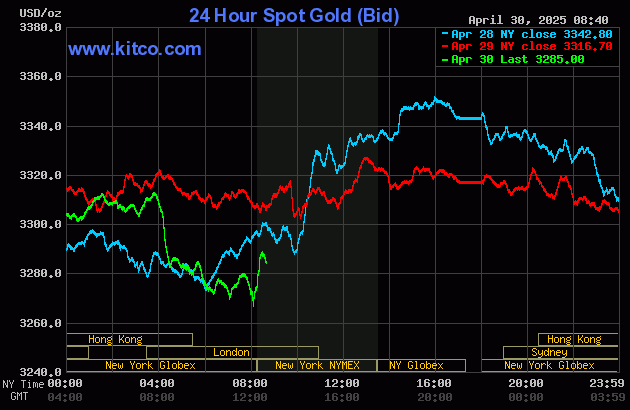
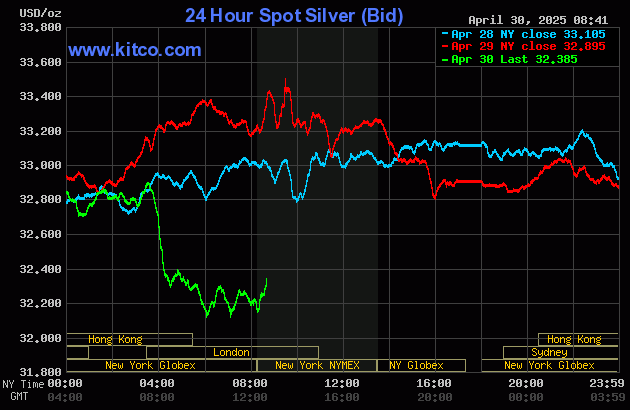
          Gold prices are lower in early U.S. trading Wednesday, but have moved up from overnight lows following some downbeat U.S. economic data just out. Silver prices are sharply down. June gold was last down $34.90 at $3,299.50. May silver prices were last down $1.10 at $32.175.
          The just-released ADP national employment report for April was a big downside miss, showing a gain of 62,000 jobs versus expectations for up 120,000. Also, the first-quarter U.S. GDP number came in at down 0.3% versus expectations for a rise of 0/4%, quarter-on-quarter. These numbers fall into the camp of the monetary policy doves, who want the Federal Reserve to lower U.S. interest rates sooner rather than later.
          Asian and European stock markets were mixed to firmer in overnight trading. U.S. stock indexes are pointed to lower openings today in New York. Broker SP Angel writes the stock markets “have settled into a state of calm” as U.S. Treasury yields have dipped and the volatility index (VIX) has also declined. This is putting strong selling pressure on the safe-haven gold market at mid-week. The key question yet to be answered is: Has the worst of the trade-tariff anxiety in the marketplace passed? If the answer turns out to be yes, then the global stock markets have put in major bottoms. If the answer is no, then a more dour scenario of prolonged stock market weakness and even global economic recession becomes more likely.
          China’s economy is starting to feel the effects of the trade war with the U.S. China’s new export orders plummeted in April to the lowest levels since the pandemic, with overall manufacturing activity the weakest in more than a year. Dow Jones Newswires reports, “The sharp pullback shows Trump’s eye-watering tariffs on Chinese imports are starting to squeeze the engine room of China’s economy, piling pressure on Beijing to boost its stimulus efforts to shore up growth.”
          The key outside markets today and see the U.S. dollar index slightly higher. Nymex crude oil futures prices are weaker and trading around $59.75 a barrel. The yield on the benchmark 10-year U.S. Treasury note is presently at 4.17%.
          A busy slate of U.S. economic data due for release Wednesday includes the weekly MBA mortgage applications survey, the ADP national employment report, the first estimate of first-quarter GDP, the employment cost index, the Chicago ISM business survey, pending home sales, personal income and outlays and the weekly DOE liquid energy stocks report.
          Gold price down but up from overnight lows after weak U.S. data_1
          Technically, June gold futures bulls have the solid overall near-term technical advantage. Bulls’ next upside price objective is to produce a close above solid resistance at the contract high of $3,509.90. Bears' next near-term downside price objective is pushing futures prices below solid technical support at $3,200.00. First resistance is seen at this week’s high of $3,363.80 and then at last Friday’s high of $3,384.10. First support is seen at $3,300.00 and then at last week’s low of $3,270.80. Wyckoff's Market Rating: 7.0.
          Gold price down but up from overnight lows after weak U.S. data_2
          May silver futures bulls have the firm overall near-term technical advantage. Prices are in an uptrend on the daily bar chart. Silver bulls' next upside price objective is closing prices above solid technical resistance at $35.00. The next downside price objective for the bears is closing prices below solid support at $32.00. First resistance is seen at last week’s high of $33.69 and then at $34.00. Next support is seen at this week’s low of $32.585 and then at $32.00. Wyckoff's Market Rating: 7.0.

          Source: kitco

          Risk Warnings and Disclaimers
          You understand and acknowledge that there is a high degree of risk involved in trading. Following any strategies or investment methods may lead to potential losses. The content on the site is provided by our contributors and analysts for information purposes only. You are solely responsible for determining whether any trading assets, securities, strategy, or any other product is suitable for investing based on your own investment objectives and financial situation.
          Add to Favorites
          Share

          Australian core CPI falls within the RBA target, Aussie shrugs

          Adam

          Economic

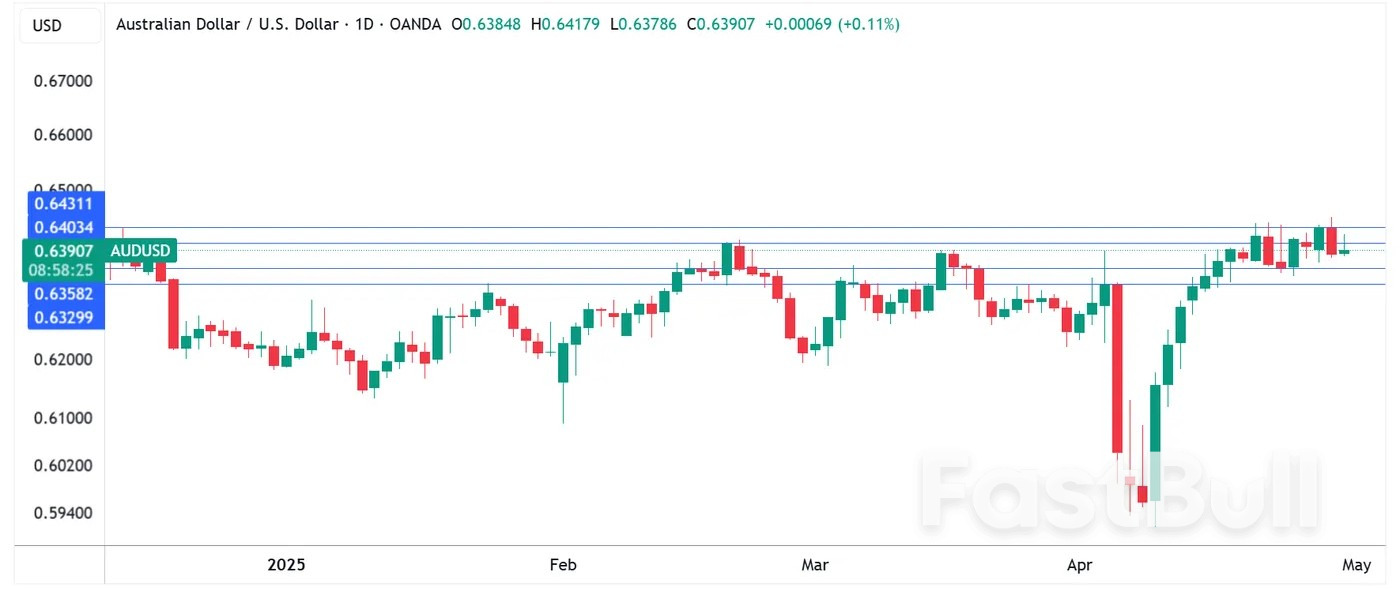
          The Australian dollar has been showing strong movement this week but is calm on Wednesday. In the European session, AUD/USD is trading at 0.6391, up 0.14% on the day.

          Australian core CPI falls to 2.9%

          Australia released the CPI report for the first quarter. The Australian dollar didn't show much reaction, but the data could point to another rate cut from the Reserve Bank of Australia.
          Headline CPI remained unchanged at 2.4% y/y, just above the market estimate of 2.3%. The significant news was that RBA Trimmed Mean CPI, the key core inflation indicator, dropped to 2.9% y/y from a revised 3.3% gain in Q4 2024. This is the first time in three years that core CPI is back within the RBA's target band of between 1-3%.
          The drop in core inflation is good news for the government, with the national election on Saturday. Australian Treasurer Jim Chalmers jumped on the news, stating that the market expects four or five rate additional rate cuts this year, which would save households with mortgages "hundreds of dollars".
          The Reserve Bank is expected to lower rates at its next meeting on May 20, which would mark only the second rate cut this year. After cutting rates in February, the central bank has stayed on the sidelines as US President Trump's tariffs have escalated trade tensions and sent the financial markets on a roller-coaster ride.

          US employment, GDP expected to decelerate

          In the US, the markets are bracing for some weak data later today. ADP employment is expected to slip to 108 thousand, compared to 155 thousand in the previous release. ADP is not considered a reliable gauge for Friday's nonfarm payrolls, but a weak reading will only increase the anxiety of the nervous markets.
          US first-estimate GDP for Q1 is expected to slide to just 0.4% q/q, after a 2.4% gain in Q3. If there is a surprise reading from GDP, we could see a strong reaction from the US dollar after the release.

          AUD/USD Technical

          AUD/USD is testing resistance at 0.6403. Above, there is resistance at 0.6431
          0.6357 and 0.6329 are the next support levels
          Australian core CPI falls within the RBA target, Aussie shrugs_1

          AUDUSD 1-Day Chart, April 30, 2025

          Source: marketpulse

          To stay updated on all economic events of today, please check out our Economic calendar
          Risk Warnings and Disclaimers
          You understand and acknowledge that there is a high degree of risk involved in trading. Following any strategies or investment methods may lead to potential losses. The content on the site is provided by our contributors and analysts for information purposes only. You are solely responsible for determining whether any trading assets, securities, strategy, or any other product is suitable for investing based on your own investment objectives and financial situation.
          Add to Favorites
          Share

          Will Bitcoin Break Records By Summer 2025?

          Fiona Harper

          Cryptocurrency

          Market sentiment for Bitcoin (BTC) appears increasingly bearish as U.S. markets exhibit weakness, fueled by recent remarks from Trump critiquing Biden for economic instability. This has set the stage for potential declines in cryptocurrency values as summer nears, sparking interest in how digital assets might perform leading up to mid-2025.

          What Lies Ahead for Cryptocurrencies?

          As the crypto market approaches the summer months, a typical trend of declining prices is expected, consistent with historical patterns of “sell and go on vacation.” However, the possibility of an anomalous market performance this year remains, especially if macroeconomic factors shift favorably.

          What's the Projection for Bitcoin and Dogecoin?

          There are insights that potential strategic talks with China, combined with significant upcoming Federal Reserve announcements, could drive a short-term rally in cryptocurrencies. Bitcoin, in particular, may peak based on recent chart analyses predicting a run towards $131,000. This forecast stems from Fibonacci extensions, indicating minimal resistance until BTC surpasses the $100,000 mark.
          If Bitcoin reaches the anticipated level before the summer, a domino effect could elevate the entire crypto market. Notably, a significant increase in open positions, reported with a $2.2 billion rise over a span of 20 days, reflects growing interest and market activity.
          Bitcoin's (BTC) open interest experienced volatility, initially falling from $11.9 billion to $7.5 billion, but later recovering by 29% to approximately $9.7 billion. This resurgence fuels speculation of a robust pre-summer upswing in the crypto space, with analysts noting that heightened futures activity might signal mounting upward pressure.
          ● Fibonacci extensions forecast Bitcoin could target $131,000.
          ● Open interest in BTC increased by $2.2 billion in 20 days.
          ● DOGE is forming an Accumulation Cylinder, suggesting potential price rise.
          ● Bitcoin dominance could trigger comprehensive market movements.
          Focusing on Dogecoin (DOGE), investors are optimistic as recent patterns suggest an impending price surge past $3 per token. A chart indicating DOGE's Accumulation Cylinder implies a notable rise could be on the horizon, even though the catalyst remains uncertain. Adding weight to these predictions, BTC dominance peaking is seen as a perfect recipe for market movement.
          As the crypto community braces for these developments, all eyes remain on key economic and geopolitical events that may either propel or hinder this anticipated surge in digital currency values leading into the summer of 2025.

          Source: CryptoSlate

          Risk Warnings and Disclaimers
          You understand and acknowledge that there is a high degree of risk involved in trading. Following any strategies or investment methods may lead to potential losses. The content on the site is provided by our contributors and analysts for information purposes only. You are solely responsible for determining whether any trading assets, securities, strategy, or any other product is suitable for investing based on your own investment objectives and financial situation.
          Add to Favorites
          Share

          German inflation dips less than expected to 2.2% in April

          Adam

          Economic

          German consumer inflation came in at 2.2% in April on an annual basis, easing slightly from March levels but coming in above expectations, preliminary data showed Wednesday.
          Economists polled by Reuters had estimated a 2.1% reading. The country’s consumer price index, harmonized for comparability across the euro zone, had come in at 2.3% in March on an annual basis.
          So-called core inflation, which excludes food and energy prices, accelerated to 2.9% in April from 2.6% in March. The closely-watched services print also jumped to 3.9%, after a 3.5% reading in the previous month.
          Energy prices meanwhile dropped sharply, falling by 5.4% according to the statistics office.
          While the inflation rate closing in on the European Central Bank’s 2% mark is good news for consumers at first glance, there are some less positive points about the data on closer look, Sebastian Becker, economist at Deutsche Bank, said in a note Wednesday.
          The slight decrease of the headline figures only took place due to lower energy and food costs, he said. “In comparison, the core inflation rate, which is more important for the ECB ... rose notably again.” And services inflation appears “considerably more stubborn than expected,” Becker added.

          Economic growth

          Earlier on Wednesday, preliminary data showed that Germany’s economy expanded by 0.2% in the first quarter from the previous three-month period.
          The figure, released by the German federal statistics office, is adjusted for price, calendar and seasonal variations.
          The gross domestic product reading was in line with estimates from economists polled by Reuters. Germany’s gross domestic had contracted by 0.2% in the fourth quarter.
          The statistics office attributed the quarterly increase to the fact “that both household final consumption expenditure and capital formation were higher than in the previous quarter.”
          While acknowledging Wednesday’s figures were positive, “the quarterly increase is still far too small to end the country’s long-lasting stagnation,” Carsten Brzeski, global head of macro at ING, said in a note.
          Europe’s largest economy has long been sluggish, with its GDP flip-flopping between growth and contraction in each quarter throughout 2023 and 2024. The country has so far avoided technical recession, which is defined by two consecutive quarters of contraction.
          Key sectors of the economy, such as autos, have been suffering from stronger competition from China. Other industries including housebuilding and infrastructure have also been going through trying times that have been linked to higher costs, muted investment and bureaucratic hurdles.
          Separately, U.S President Donald Trump’s tariff policies have thrust uncertainty onto export reliant Germany which counts the U.S. as its most important trading partner.
          As part of the European Union, Germany is facing 20% blanket tariffs on goods exported to the U.S., although these levies have been temporarily reduced to 10% to allow time for negotiations. U.S. duties on steel, aluminum and autos also affect the country.
          The German government last week cut its economic outlook to predict stagnation in 2025, with outgoing economy minister Robert Habeck saying Trump’s trade policies and their impact on the country were the main factor behind the revision.

          Fiscal upheaval

          One bright spot could emerge on the horizon. Germany earlier this year made changes to its long-standing debt brake fiscal rule, enabling higher defense spending, and creating a 500 billion euro ($570 billion) fund dedicated to infrastructure and climate investments.
          This move has widely been regarded as a positive shift for the German economy, although much still depends on how the changes are implemented.
          “Today’s GDP report paints a picture of what could have happened if it hadn’t been for US President Donald Trump’s tariff blast – an economy that bottoms out and goes through a weak cyclical rebound, but could gain momentum with the announced fiscal stimulus,” ING’s Brzeski said.
          While this recovery could still happen, the process now will likely take longer, the analyst said. He stressed that tariffs, uncertainty and other shifts in trade and geopolitics are weighing on the short-term economic outlook, while the planned fiscal measures can boost long-term growth.

          Source: cnbc

          To stay updated on all economic events of today, please check out our Economic calendar
          Risk Warnings and Disclaimers
          You understand and acknowledge that there is a high degree of risk involved in trading. Following any strategies or investment methods may lead to potential losses. The content on the site is provided by our contributors and analysts for information purposes only. You are solely responsible for determining whether any trading assets, securities, strategy, or any other product is suitable for investing based on your own investment objectives and financial situation.
          Add to Favorites
          Share

          Trump Says He Deserves A ‘Pass’ On Data Showing GDP Contraction

          Thomas

          Economic

          “I have to start off by saying, that’s Biden. That’s not Trump,” Trump said Wednesday during a Cabinet meeting.

          Inflation-adjusted gross domestic product decreased an annualized 0.3% in the first quarter, well below average growth of about 3%, according to initial government data published Wednesday.

          “Let’s give us a pass on the first month, we were sort of getting a little bit used to things,” Trump added.

          The decrease was led by companies pushing to stockpile imported merchandise ahead of implementation of Trump’s tariffs, with net exports subtracting nearly 5 percentage points from GDP. Cuts to federal funding also impacted the figure.

          White House officials have pointed to promising data within the report – including advancing consumer spending and surging business equipment purchases – to argue the economy remains strong.

          “It takes a little while to get those facilities built, but they’re coming in with big big numbers,” Trump said.

          Trump also said he saw encouraging signs his tariffs were starting to have an impact, even while maintaining they “haven’t kicked in yet.” Trump paused higher duties on dozens of trading partners except China, which he hit with a 145% levy. A flat 10% remains in place for almost all other trading partners for a 90-day period, which several nations are using to negotiate deals with the US.

          Investors have worried that Trump will be unable to broker a deal with Beijing amid the standoff and that sky-high duties will cause a supply shock. The president argued a recent decrease in cargo flows was an indication Beijing would soon need to engage.

          “At a certain point, I hope we’re going to make a deal with China,” Trump said, adding that he was “not happy” with the sharp decline in trade between the two nations.

          “I want China to do well,” he continued. “I want every country to do well, but they have to treat us fairly also.”

          Still, downbeat numbers from ADP Research showing that hiring had moderated in April and broader concerns that the tariffs could lead to goods shortages and inflation drove stocks to a broad selloff on Wednesday.

          In a social media post earlier in the day, Trump urged investors to remain patient and blamed Biden for market woes, while denying his tariff regime played a role.

          “This will take a while, has NOTHING TO DO WITH TARIFFS, only that he left us with bad numbers, but when the boom begins, it will be like no other,” Trump wrote.

          The benchmark S&P 500 Index rose under Biden’s watch, but is down about 7% since Trump’s inauguration.

          Source: Bloomberg Europe

          To stay updated on all economic events of today, please check out our Economic calendar
          Risk Warnings and Disclaimers
          You understand and acknowledge that there is a high degree of risk involved in trading. Following any strategies or investment methods may lead to potential losses. The content on the site is provided by our contributors and analysts for information purposes only. You are solely responsible for determining whether any trading assets, securities, strategy, or any other product is suitable for investing based on your own investment objectives and financial situation.
          Add to Favorites
          Share

          Bond Yield Curve Steepens on Mixed Data, Treasury Refunding Plan

          Adam

          Bond

          Long-term government bonds underperformed Wednesday as mixed economic data muddled the path for the Federal Reserve while the Treasury Department’s unchanged guidance on debt issuance disappointed some investors who had expected more support for longer-maturity bonds.
          Yields on 30-year bonds rose 3 basis points to 4.68%, while those on two-year rates declined 2 basis points to 3.62%, following weaker-than-expected GDP data, stronger-than-forecast consumption and higher-than-estimated prices. The Treasury maintained its guidance on keeping the issuance of longer-dated securities unchanged for at least “several quarters” while flagging it could potentially enhance its buyback program.
          “The overall takeaway to me is stagflation concerns are validated even before many tariffs come into effect,” Zachary Griffiths, head of US investment grade and macro strategy at CreditSights. “I think you’re seeing that in the market reaction with the curve bear steepening now.”
          The 10-year yield jumped as much as five basis points to 4.23% after the data and Treasury’s quarterly refunding announcement, then pared the move.
          The Treasury in a statement said it plans to sell $125 billion of securities at next week’s so-called quarterly refunding auctions, which span 3-, 10- and 30-year maturities. It also reiterated guidance that’s been in place since January 2024, according to which it expects to keep auction sizes steady for the next several quarters.
          While the guidance was in line with most investors’ expectations, some market watchers had anticipated that Treasury officials could take a more aggressive stance to soothe the markets’ supply concerns. Citigroup’s strategists, for example, last week said that the curve may steepen if buybacks are not increased.
          “Although guidance was unchanged, the long-end reaction suggests more was expected from Treasury,” Wells Fargo’s strategists Angelo Manolatos and William Gibbons wrote in a note. “Some market participants likely expected increased liquidity support buybacks and/or a discussion about a shorter weighted average maturity.”
          The underperformance of long bonds widened the yield gap between five- and 30-year yields 4 basis points to 92 basis points. The curve has steepened about 30 basis points in April. The so-called curve steepening has been a popular theme in the bond market as traders expect that the slowing economy would eventually lead the Fed to cut borrowing costs, while inflation and bond supply would keep long-end yields elevated.
          Wednesday’s data showed the US economy contracted at the start of the year for the first time since 2022 amid a monumental pre-tariffs import surge and softer consumer spending. The GDP report also highlighted that a closely watched measure of underlying inflation accelerated to a 3.5% pace in the first quarter — the most in a year.
          “The upside in consumption is the main market driver here followed by the stronger price index,” said Jordan Rochester, head of macro strategy for EMEA at Mizuho International Plc. “GDP today says that is not the current problem to worry about. Instead it’s higher prices and huge import accumulation.”
          April was a highly volatile month in the $29 trillion Treasury market as investors gamed out the impact of President Donald Trump’s tariffs on inflation and economic output. This month’s trading range for the US 10-year government bond was the widest since the collapse of SVB in early 2023.
          A key Bloomberg gauge of the Treasury markets was up 0.6% in April, the fourth monthly advance and the longest winning streak since last September.
          In recent days, the market has rallied amid signs that the US economy is stumbling. That fueled bets on further interest-rate cuts from the Federal Reserve, with swaps now implying 96 basis points of easing this year, which means four quarter-point cuts are almost fully priced. That compares to just three at the end of March. At least one big option trader, however, has dialed up an $18 million bet on the potential that the Fed will avoid cutting interest rates at all this year.
          The focus turns later this week to the US jobs report on Friday, which is expected to show the economy created 135,000 new positions in April compared to 228,000 in March.
          What Bloomberg strategists say...
          “The quarterly refunding announcement duly saw unchanged coupon auction sizes and unchanged guidance for steady issuance over the next several quarters. TIPS re-openings were adjusted slightly higher. There was some discussion of enhancing the buyback program, though that seems unlikely to move the needle much given the gaping budget deficit. Given the opacity of the debt ceiling issue, the Treasury declined to issue any guidance on the x-date. All in, this was all largely as expected and should have a minimal impact.”

          source : Bloomberg

          Risk Warnings and Disclaimers
          You understand and acknowledge that there is a high degree of risk involved in trading. Following any strategies or investment methods may lead to potential losses. The content on the site is provided by our contributors and analysts for information purposes only. You are solely responsible for determining whether any trading assets, securities, strategy, or any other product is suitable for investing based on your own investment objectives and financial situation.
          Add to Favorites
          Share
          FastBull
          Copyright © 2025 FastBull Ltd

          728 RM B 7/F GEE LOK IND BLDG NO 34 HUNG TO RD KWUN TONG KLN HONG KONG

          TelegramInstagramTwitterfacebooklinkedin
          App Store Google Play Google Play
          Products
          Charts

          Chats

          Q&A with Experts
          Screeners
          Economic Calendar
          Data
          Tools
          Membership
          Features
          Function
          Markets
          Copy Trading
          Latest Signals
          Contests
          News
          Analysis
          24/7
          Columns
          Education
          Company
          Careers
          About Us
          Contact Us
          Advertising
          Help Center
          Feedback
          User Agreement
          Privacy Policy
          Business

          White Label

          Data API

          Web Plug-ins

          Poster Maker

          Affiliate Program

          Risk Disclosure

          The risk of loss in trading financial instruments such as stocks, FX, commodities, futures, bonds, ETFs and crypto can be substantial. You may sustain a total loss of the funds that you deposit with your broker. Therefore, you should carefully consider whether such trading is suitable for you in light of your circumstances and financial resources.

          No decision to invest should be made without thoroughly conducting due diligence by yourself or consulting with your financial advisors. Our web content might not suit you since we don't know your financial conditions and investment needs. Our financial information might have latency or contain inaccuracy, so you should be fully responsible for any of your trading and investment decisions. The company will not be responsible for your capital loss.

          Without getting permission from the website, you are not allowed to copy the website's graphics, texts, or trademarks. Intellectual property rights in the content or data incorporated into this website belong to its providers and exchange merchants.

          Not Logged In

          Log in to access more features

          FastBull Membership

          Not yet

          Purchase

          Become a signal provider
          Help Center
          Customer Service
          Dark Mode
          Price Up/Down Colors

          Log In

          Sign Up

          Position
          Layout
          Fullscreen
          Default to Chart
          The chart page opens by default when you visit fastbull.com