

Markets
News
Analysis
User
24/7
Economic Calendar
Education
Data
- Names
- Latest
- Prev



Signal Accounts for Members
All Signal Accounts
All Contests
 U.S. NFIB Small Business Optimism Index (SA) (Nov)
A:--
F: --
P: --
 Mexico 12-Month Inflation (CPI) (Nov)
A:--
F: --
P: --
Mexico Core CPI YoY (Nov)A:--
F: --
P: --
Mexico PPI YoY (Nov)A:--
F: --
P: --
U.S. Weekly Redbook Index YoYA:--
F: --
P: --
U.S. JOLTS Job Openings (SA) (Oct)A:--
F: --
P: --
 China, Mainland M1 Money Supply YoY (Nov)
--
F: --
P: --
China, Mainland M0 Money Supply YoY (Nov)--
F: --
P: --
China, Mainland M2 Money Supply YoY (Nov)--
F: --
P: --
U.S. EIA Short-Term Crude Production Forecast For The Year (Dec)A:--
F: --
P: --
U.S. EIA Natural Gas Production Forecast For The Next Year (Dec)A:--
F: --
P: --
U.S. EIA Short-Term Crude Production Forecast For The Next Year (Dec)A:--
F: --
P: --
EIA Monthly Short-Term Energy Outlook U.S. 10-Year Note Auction Avg. YieldA:--
F: --
P: --
U.S. API Weekly Gasoline StocksA:--
F: --
P: --
U.S. API Weekly Cushing Crude Oil StocksA:--
F: --
P: --
U.S. API Weekly Crude Oil StocksA:--
F: --
P: --
U.S. API Weekly Refined Oil StocksA:--
F: --
P: --
 South Korea Unemployment Rate (SA) (Nov)
A:--
F: --
P: --
 Japan Reuters Tankan Non-Manufacturers Index (Dec)
A:--
F: --
P: --
Japan Reuters Tankan Manufacturers Index (Dec)A:--
F: --
P: --
Japan PPI MoM (Nov)A:--
F: --
P: --
Japan Domestic Enterprise Commodity Price Index MoM (Nov)A:--
F: --
P: --
Japan Domestic Enterprise Commodity Price Index YoY (Nov)A:--
F: --
P: --
China, Mainland CPI YoY (Nov)A:--
F: --
P: --
China, Mainland PPI YoY (Nov)A:--
F: --
P: --
China, Mainland CPI MoM (Nov)A:--
F: --
P: --
 Indonesia Retail Sales YoY (Oct)
A:--
F: --
P: --
 Italy Industrial Output YoY (SA) (Oct)
A:--
F: --
P: --
Italy 12-Month BOT Auction Avg. YieldA:--
F: --
P: --
 BOE Gov Bailey Speaks
 ECB President Lagarde Speaks
 South Africa Retail Sales YoY (Oct)
--
F: --
P: --
 Brazil IPCA Inflation Index YoY (Nov)
--
F: --
P: --
Brazil CPI YoY (Nov)--
F: --
P: --
U.S. MBA Mortgage Application Activity Index WoW--
F: --
P: --
U.S. Labor Cost Index QoQ (Q3)--
F: --
P: --
 Canada Overnight Target Rate
--
F: --
P: --
BOC Monetary Policy Report U.S. EIA Weekly Gasoline Stocks Change--
F: --
P: --
U.S. EIA Weekly Crude Demand Projected by Production--
F: --
P: --
U.S. EIA Weekly Cushing, Oklahoma Crude Oil Stocks Change--
F: --
P: --
U.S. EIA Weekly Crude Stocks Change--
F: --
P: --
U.S. EIA Weekly Crude Oil Imports Changes--
F: --
P: --
U.S. EIA Weekly Heating Oil Stock Changes--
F: --
P: --
U.S. Federal Funds Rate Projections-Longer Run (Q4)--
F: --
P: --
U.S. Federal Funds Rate Projections-1st Year (Q4)--
F: --
P: --
U.S. Federal Funds Rate Projections-2nd Year (Q4)--
F: --
P: --
U.S. Target Federal Funds Rate Lower Limit (Overnight Reverse Repo Rate)--
F: --
P: --
U.S. Budget Balance (Nov)--
F: --
P: --
U.S. Target Federal Funds Rate Upper Limit (Excess Reserves Ratio)--
F: --
P: --
U.S. Interest Rate On Reserve Balances--
F: --
P: --
U.S. Federal Funds Rate Projections-Current (Q4)--
F: --
P: --
U.S. Federal Funds Rate Target--
F: --
P: --
U.S. Federal Funds Rate Projections-3rd Year (Q4)--
F: --
P: --
FOMC Statement FOMC Press Conference Brazil Selic Interest Rate--
F: --
P: --
U.K. 3-Month RICS House Price Balance (Nov)--
F: --
P: --
 Australia Employment (Nov)
--
F: --
P: --
Australia Full-time Employment (SA) (Nov)--
F: --
P: --


No matching data

Latest Views
Latest Views
Trending Topics
Top Columnists
Latest Update
White Label
Data API
Web Plug-ins
Affiliate Program
View All
No data
The USDJPY pair is undergoing a correction amid weak Japanese data and moderately positive US statistics, with the rate currently at 156.72.
The USDJPY pair is undergoing a correction amid weak Japanese data and moderately positive US statistics, with the rate currently at 156.72.
The USDJPY rate is declining after three consecutive days of growth. The Japanese yen is once again under pressure because revised data showed a deeper contraction in the Japanese economy in Q3 than originally expected. The Reuters Tankan index for Japanese manufacturers fell to +10 in December 2025 from November's nearly four-year high of +17, as concerns over fiscal policy and slowing growth weighed on business sentiment.
Markets are forming expectations of a possible BoJ rate hike next week and are closely watching Governor Ueda's comments after the meeting, as they will define the policy trajectory for 2026.
Meanwhile, the US Bureau of Labor Statistics reported with a delay that job openings in the US increased by 12 thousand to 7.670 million in October 2025, up from 7.658 million in September.
The USDJPY rate is correcting after rebounding from the 156.90 resistance level. Despite the decline, buyers are keeping the price above the EMA-65, indicating persistent upward pressure.
The USDJPY forecast for today suggests the bearish correction may end, followed by continued growth towards 157.80. The Stochastic Oscillator further supports the bullish scenario: its signal lines have reached oversold territory and turned upwards.
A consolidation above 156.90 will confirm full-fledged bullish momentum and indicate that the price is exiting the corrective channel.
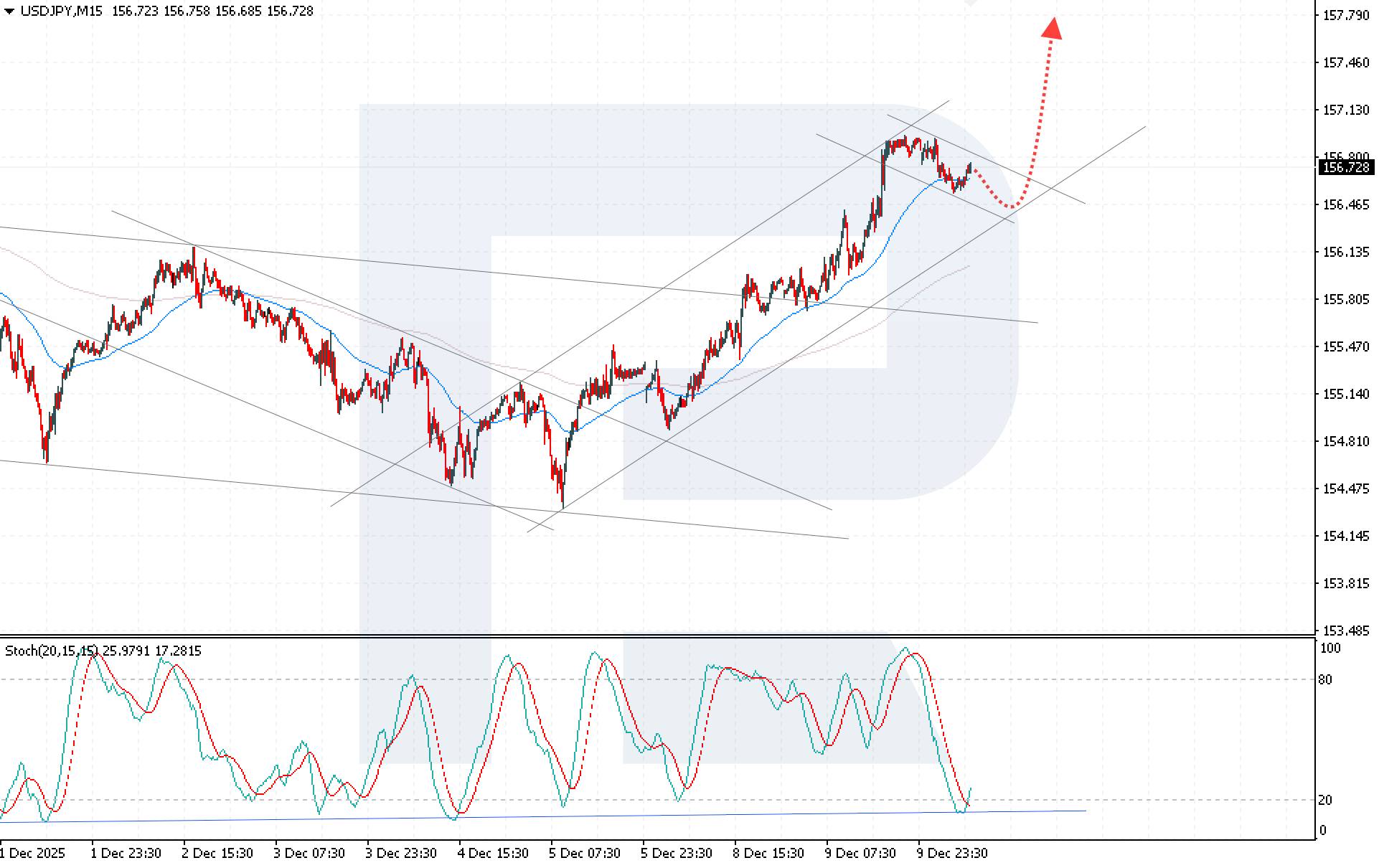
The weakening of the Japanese economy, coupled with supportive US data, creates conditions for sustained bullish momentum. The USDJPY technical analysis confirms the potential for renewed growth towards 157.80 if the price breaks above 156.90.
 EURUSD 2026-2027 forecast: key market trends and future predictions
This article provides the EURUSD forecast for 2026 and 2027 and highlights the main factors determining the direction of the pair's movements. We will apply technical analysis, take into account the opinions of leading experts, large banks, and financial institutions, and study AI-based forecasts. This comprehensive insight into EURUSD predictions should help investors and traders make informed decisions.
 Gold (XAUUSD) forecast 2026 and beyond: expert insights, price predictions, and analysis
Dive deep into the Gold (XAUUSD) price outlook for 2026 and beyond, combining technical analysis, expert forecasts, and key macroeconomic factors. It explains the drivers behind gold's recent surge, explores potential scenarios including a move toward 4,500 to 5,000 USD per ounce, and highlights why the metal remains a strong hedge during global uncertainty.
Everybody knows the Federal Reserve (Fed) will announce a 25bp rate cut today. I know it, you know it, he/she/it knows it, my five-year-old knows it, my cat, your dog, the birds in the sky. Everyone knows the Fed is lowering rates later today. Market pricing is giving it roughly an 88% probability — too high for the Fed to walk back in the absence of an emergency.
What we don't know is what Fed members are planning for next year. How many cuts they anticipate, and whether their projections will convince markets to react accordingly.
For the doves, the case for rate cuts is clear: the US labour market has softened, partly due to a combination of aggressive anti-immigration policies, tariff uncertainty and fears around AI-related job displacement. Tariff-led price pressures, meanwhile, still haven't shown up materially since tariffs were announced in April. Add to that the political noise — with Donald Trump pressuring the Fed to cut rates, at times with aggressive public remarks — and poor Jerome Powell is hearing things he probably never expected to hear in his lifetime.
For the most extreme doves, the Fed has "plenty of room" to cut. Kevin Hassett — one of Trump's favourite candidates to lead the Fed next year — said yesterday that the rise of AI gives the Fed an opportunity to run easier policy because lower rates could lift both aggregate supply and demand. Higher supply, he argues, could help contain inflation.
Others think it may be wiser to pause for thought. AI-driven productivity gains are real. But looming inflation risks from tariffs still require a careful playbook — particularly if AI-driven disinflation doesn't materialise fast enough to neutralize potential tariff-led inflation.
So, it's complicated. All eyes will be on the Fed's dot plot. Any hawkish tilt or reluctance to signal further cuts could trigger another repricing and weigh on sentiment.
The good news: investors aren't walking into this meeting blindly. Money markets have already trimmed their expectations from 2–4 cuts next year to just two, reducing the risk of a sharp reaction to a "hawkish cut."
And judging by yields, the message from investors is clear: they're not buying the dovish narrative. Instead, investors worry that lower yields could revive inflation and ultimately prevent the Fed from cutting more — or even force a hike. The proof: the US 10-year yield has climbed since the Fed began cutting in September.
This disconnect between Fed policy and market yields suggests lower policy rates are not fully transmitting. No matter what Fed officials think, markets remain worried about inflation. They won't absorb lower policy rates until they see evidence of inflation falling. That dynamic could prevent the S&P 500 from pushing higher into year-end.
Meanwhile, global winds are turning hawkish, as well. The Reserve Bank of Australia (RBA) said this week it debated an "extended pause or a hike," and markets now price a rate increase by June — a stark reversal from expectations of a cut just a month ago. The Australian 10-year yield has jumped from ~4.10% in late October to above 4.80%.
The Bank of Canada (BoC) is expected to hold today, but markets are almost fully pricing a hike by late 2026, on the back of strong Canadian labour data. Canadian 10-year yields have risen from around 3% to near 3.50%.
The European Central Bank (ECB) isn't expected to cut next year, and Isabel Schnabel said this week she's comfortable with market pricing that the ECB's next move could be a hike. The European 10-year yield is now around 2.85%, up from ~2.50% in October.
The Reserve Bank of New Zealand (RBNZ) watchers have also shifted from expecting a September cut to expecting a hike. The 10-year yield has spiked from ~4% to above 4.6%.
And the Bank of Japan (BoJ) is widely expected to hike next week. The Japanese 10-year is flirting with 2%, raising the risk of Japanese pension funds and insurers — major US Treasury holders — repatriating capital back home, and pull the rug from under the feet of US treasuries.
Consequently, even though equity investors still debate whether the tech sector is in bubble territory, global bond investors have little doubt about two things: DM debt is unsustainably high, and central bank expectations are shifting hawkish. The latter pushes the yields higher.
And if yields continue pushing higher, valuations will come under pressure — especially for highly leveraged companies.
So, today's reaction to the Fed will likely set the tone for the remainder of the year: will Santa bring gifts, or stay snowed out? Answer in a few hours.
Digital Assets
The AUD and CAD are trading in corrective mode, reflecting market caution ahead of today's Federal Reserve and Bank of Canada meetings. Investors are locking in some profits after a volatile start to the week and prefer to wait for updated guidance from policymakers on the future path of monetary policy.
Over the coming trading sessions, focus will be on decisions from the Bank of Canada and the Fed, as well as the accompanying statements and press conferences. Central banks are setting the tone for the day, meaning reactions in AUD/USD and USD/CAD could be sizeable and highly volatile in the hours ahead.
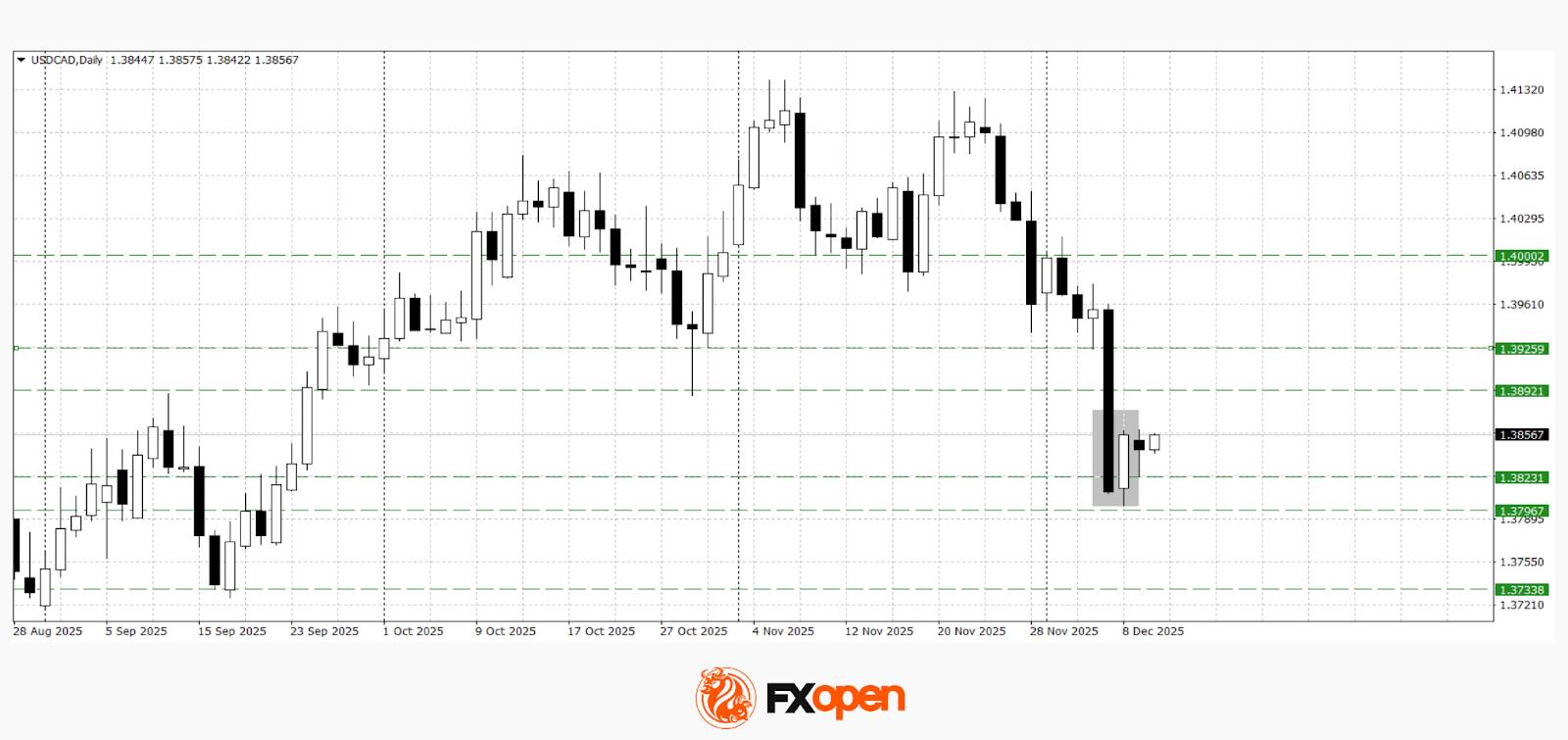
Late last week, USD/CAD fell sharply, breaking through key support levels at 1.3890–1.3930. However, a rebound from the psychological 1.3800 level led to consolidation within the 1.3800–1.3860 range. Technical analysis points to the potential for a corrective move back towards the previously broken support, as a "piercing pattern" has formed on the daily chart.
A sustained move above 1.3860 could signal a recovery towards 1.3890–1.3930. If negative news for the US dollar emerges, a renewed test of 1.3800 is possible, followed by a decline towards 1.3730.
Key events that may influence USD/CAD in the near term:
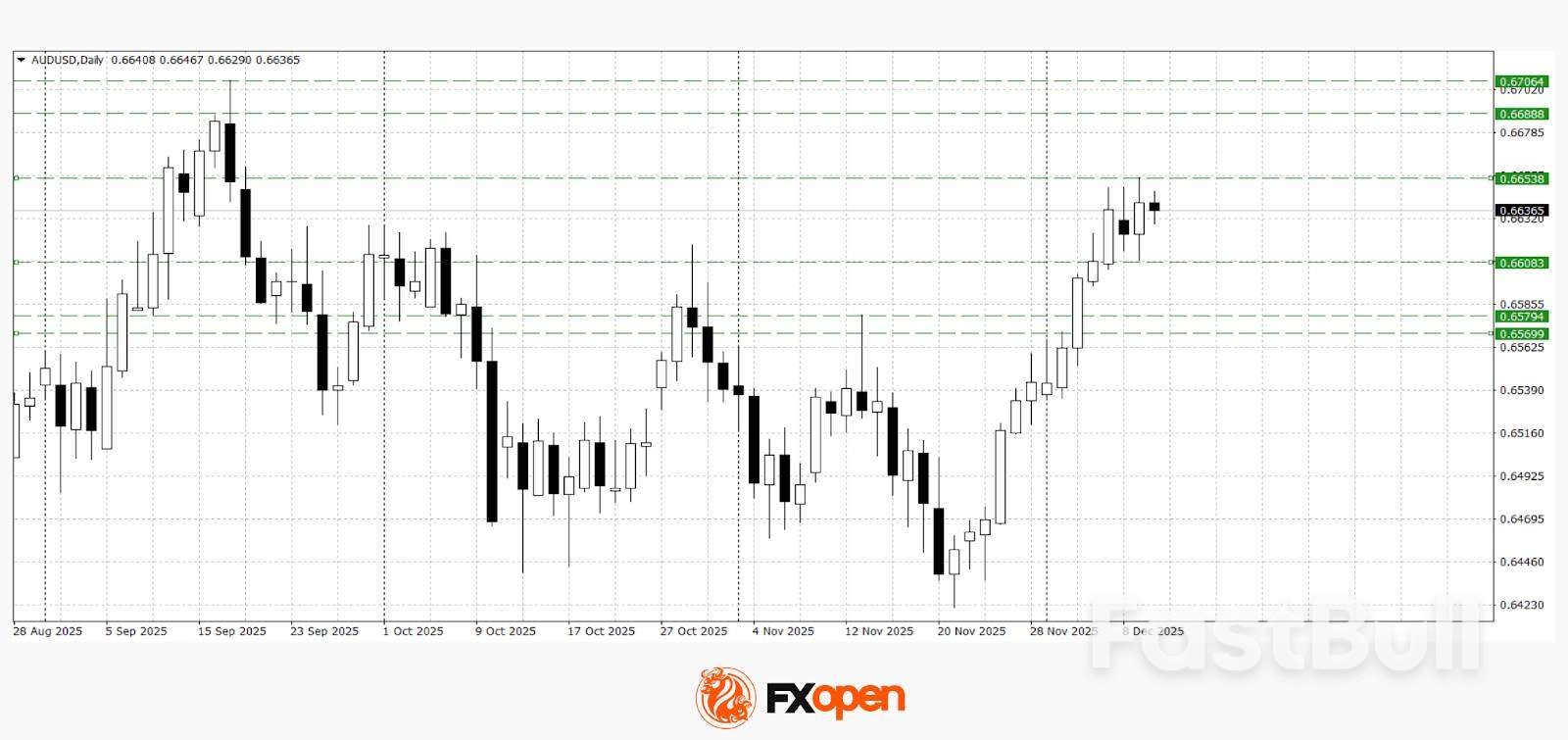
For about a week, AUD/USD has been trading within a relatively narrow range of 0.6600–0.6650. The outcome of the RBA meeting supported the Australian dollar, but the pair has yet to break above the upper boundary of this range and extend its uptrend.
A move above 0.6650 would confirm buyer control and open the way towards 0.6690–0.6710, while a downside break would increase bearish pressure with targets near 0.6550.
Key events that may influence AUD/USD in the near term:
US stock markets eased back on Tuesday as traders moved to the sidelines ahead of today's all-important Federal Reserve interest rate decision. The Dow fell 0.38% to close at 47,560, the S&P 500 dipped 0.09% to 6,840, while the Nasdaq managed a modest 0.13% rise, finishing at 23,576. A stronger-than-expected set of US employment numbers pushed Treasury yields higher across the curve, with the 2-year yield climbing 4 basis points to 3.615% and the 10-year rising 2.4 basis points to 4.188%.
The firmer yield environment helped lift the dollar; the DXY gained 0.14% on the day to settle at 99.23. In commodities, oil markets remained under pressure as renewed optimism over potential progress in Ukraine peace discussions—following meetings between Kyiv and its allies in London—saw Brent crude slip 0.70% to $62.05, while WTI dropped 0.95% to $58.32 a barrel. Gold, meanwhile, pushed back into recent ranges, rising 0.43% to $4,208.21 an ounce as traders sought a safer footing ahead of a packed macro calendar.
Today's Federal Reserve update has probably been the most highly anticipated central bank meeting of the year, with the volatility in rate moves expectations exceeding all others in the preceding 11 months. With less than a day to go, market expectation sits just under 90% that we will see a further 25-basis-point cut later today. That is up from 70% a month ago, but more crucially up from near 30% around six weeks ago.
Most market participants are expecting to see a relatively "cautious cut" today, with a split in the committee well documented. So, a swing either side—i.e., a dovish cut or a hawkish cut—should see some big moves across all financial products. Stock markets have been trading optimistically over the last couple of weeks, indicating that they anticipate more stimulus into 2026, while the bond market has been more cautious. Either way, the possibility of strong corrections is high, and it should be a very lively market into the end of the trading day.
Today looks to be shaping up as one of the biggest days of the month for global markets. The Asian session sees the release of key Chinese data with CPI (exp +0.7% m/m) and PPI (exp +2.0% y/y), which should see some good moves in local markets, while the London session has a scheduled update from ECB President Christine Lagarde. However, the New York session looks set to be extremely lively.
The Federal Reserve's rate call towards the end of the day is without doubt the headline event, where a 25-basis-point rate cut is well priced in; Chairman Jerome Powell's press conference shortly after is likely to drive volatility even further. Earlier in the Northern Hemisphere session, the Bank of Canada will deliver its own interest rate decision, with the market firmly expecting them to hold rates at 2.25%. As with the Fed, traders are expecting forward guidance from the statement and subsequent press conference to add further volatility to local markets. US Crude Oil Inventory data is also due out in the session; however, expect the major central bank updates to dominate.
728 RM B 7/F GEE LOK IND BLDG NO 34 HUNG TO RD KWUN TONG KLN HONG KONG


White Label
Data API
Web Plug-ins
Poster Maker
Affiliate Program
The risk of loss in trading financial instruments such as stocks, FX, commodities, futures, bonds, ETFs and crypto can be substantial. You may sustain a total loss of the funds that you deposit with your broker. Therefore, you should carefully consider whether such trading is suitable for you in light of your circumstances and financial resources.
No decision to invest should be made without thoroughly conducting due diligence by yourself or consulting with your financial advisors. Our web content might not suit you since we don't know your financial conditions and investment needs. Our financial information might have latency or contain inaccuracy, so you should be fully responsible for any of your trading and investment decisions. The company will not be responsible for your capital loss.
Without getting permission from the website, you are not allowed to copy the website's graphics, texts, or trademarks. Intellectual property rights in the content or data incorporated into this website belong to its providers and exchange merchants.
Not Logged In
Log in to access more features

FastBull Membership
Not yet
Purchase


Log In
Sign Up


