• Trade
  • Markets
  • Copy
  • Contests
  • News
  • 24/7
  • Calendar
  • Q&A
  • Chats
Trending
Screeners
SYMBOL
LAST
BID
ASK
HIGH
LOW
NET CHG.
%CHG.
SPREAD
SPX
S&P 500 Index
6800.25
6800.25
6800.25
6819.26
6759.73
-16.26
-0.24%
--
DJI
Dow Jones Industrial Average
48114.25
48114.25
48114.25
48452.17
47946.25
-302.30
-0.62%
--
IXIC
NASDAQ Composite Index
23111.45
23111.45
23111.45
23162.60
22920.66
+54.05
+ 0.23%
--
USDX
US Dollar Index
97.920
98.000
97.920
97.940
97.790
+0.020
+ 0.02%
--
EURUSD
Euro / US Dollar
1.17381
1.17389
1.17381
1.17520
1.17366
-0.00086
-0.07%
--
GBPUSD
Pound Sterling / US Dollar
1.34089
1.34100
1.34089
1.34265
1.34061
-0.00118
-0.09%
--
XAUUSD
Gold / US Dollar
4322.15
4322.60
4322.15
4327.70
4301.37
+19.86
+ 0.46%
--
WTI
Light Sweet Crude Oil
55.790
55.827
55.790
55.966
54.927
+0.851
+ 1.55%
--

Community Accounts

Signal Accounts
--
Profit Accounts
--
Loss Accounts
--
View More

Become a signal provider

Sell trading signals to earn additional income

View More

Guide to Copy Trading

Get started with ease and confidence

View More

Signal Accounts for Members

All Signal Accounts

Best Return
  • Best Return
  • Best P/L
  • Best MDD
Past 1W
  • Past 1W
  • Past 1M
  • Past 1Y

All Contests

  • All
  • Trump Updates
  • Recommend
  • Stocks
  • Cryptocurrencies
  • Central Banks
  • Featured News
Top News Only
Share

Indian Rupee Last Up 0.4% At 90.54

Share

India's Nifty Bank Futures Down 0.01% In Pre-Open Trade

Share

India's Nifty 50 Futures Down 0.06% In Pre-Open Trade

Share

India's Nifty 50 Index Up 0.16% In Pre-Open Trade

Share

Singapore Nov Petrochemical Exports Fall 26.6% Even With Nodx Surge

Share

[On Polymarket, The Probability Of "Bank Of Japan 25 Basis Point Rate Hike In December" Is Currently At 98%.] December 17Th, According To A Related Page, The Probability Of "Bank Of Japan 25 Basis Point Rate Hike In December" On Polymarket Is Currently Reported As 98%, While The Probability Of No Rate Change Is 2%.According To Publicly Available Information, The Bank Of Japan Plans To Announce Its Interest Rate Decision On December 19Th

Share

The USD/KRW Exchange Rate Rose Above 1480 For The First Time In Eight Months

Share

HK Budget Consultation Begins: Paul Chan Sees Expanding Economic Development, Creating Jobs As Key Tasks

Share

The Main Shanghai Silver Futures Contract Rose Nearly 5% To 15,475 Yuan/kg, Setting A New Historical High, And Has Risen More Than 106% Year-to-date

Share

New South Wales Premier Chris Minns: Looking At Reforms To Not Accept Applications For Protests After Terror Events

Share

New South Wales Premier Chris Minns: To Recall State Parliament To Discuss Urgent Legislation On Firearms

Share

Russia - China Far Eastern Gas Route Construction Progressing, China Ambassador To Russia Tells RIA

Share

Spot Silver Rose 3.00% On The Day, Currently Trading At $65.64 Per Ounce

Share

South Korean Won Falls As Much As 0.6% To 1482.10 Per USA Dollar, Lowest Since April 9

Share

South Korea Forex Authority: Resumes Currency Swap With Bank Of Korea

Share

Wsj's Timiraos: Latest US Employment Data May Not Prompt Further Rate Cuts By Fed Next Month

Share

Robinhood: Introduces Next Generation Of Robinhood Cortex, To Roll Out In Q1 Of Next Year To Robinhood Gold Subscribers

Share

Trump Blockade Is "Absolutely Irrational", Violates Free Commerce And Navigability-Venezuela Government

Share

India's Central Bank Governor Sanjay Malhotra Signals Rates To Stay Low For 'Long Period'

Share

India Central Bank Governor: Impact Of US Trade Deal Could Be As Much As About Half A Percentage Point

TIME
ACT
FCST
PREV
U.S. Average Hourly Wage MoM (SA) (Oct)

A:--

F: --

P: --

U.S. Average Hourly Wage YoY (Oct)

A:--

F: --

P: --

U.S. Retail Sales (Oct)

A:--

F: --

P: --

U.S. Core Retail Sales MoM (Oct)

A:--

F: --

P: --
U.S. Core Retail Sales (Oct)

A:--

F: --

P: --

U.S. Retail Sales MoM (Oct)

A:--

F: --

P: --
U.S. Private Nonfarm Payrolls (SA) (Oct)

A:--

F: --

P: --
U.S. Average Weekly Working Hours (SA) (Oct)

A:--

F: --

P: --

U.S. Labor Force Participation Rate (SA) (Nov)

A:--

F: --

P: --

U.S. Retail Sales YoY (Oct)

A:--

F: --

P: --

U.S. Manufacturing Employment (SA) (Oct)

A:--

F: --

P: --
U.S. Government Employment (Nov)

A:--

F: --

P: --

U.S. Weekly Redbook Index YoY

A:--

F: --

P: --

U.S. IHS Markit Manufacturing PMI Prelim (SA) (Dec)

A:--

F: --

P: --

U.S. IHS Markit Composite PMI Prelim (SA) (Dec)

A:--

F: --

P: --

U.S. IHS Markit Services PMI Prelim (SA) (Dec)

A:--

F: --

P: --

U.S. Commercial Inventory MoM (Sept)

A:--

F: --

P: --

BOC Gov Macklem Speaks
Argentina GDP YoY (Constant Prices) (Q3)

A:--

F: --

P: --

U.S. API Weekly Gasoline Stocks

A:--

F: --

P: --

U.S. API Weekly Cushing Crude Oil Stocks

A:--

F: --

P: --

U.S. API Weekly Refined Oil Stocks

A:--

F: --

P: --

U.S. API Weekly Crude Oil Stocks

A:--

F: --

P: --

Australia Westpac Leading Index MoM (Nov)

A:--

F: --

P: --
Japan Trade Balance (Not SA) (Nov)

A:--

F: --

P: --

Japan Goods Trade Balance (SA) (Nov)

A:--

F: --

P: --

Japan Imports YoY (Nov)

A:--

F: --

P: --

Japan Exports YoY (Nov)

A:--

F: --

P: --

Japan Core Machinery Orders YoY (Oct)

A:--

F: --

P: --

Japan Core Machinery Orders MoM (Oct)

A:--

F: --

P: --

U.K. Core CPI MoM (Nov)

--

F: --

P: --

U.K. Inflation Rate Expectations

--

F: --

P: --

U.K. Core Retail Prices Index YoY (Nov)

--

F: --

P: --

U.K. Core CPI YoY (Nov)

--

F: --

P: --

U.K. Output PPI MoM (Not SA) (Nov)

--

F: --

P: --

U.K. Output PPI YoY (Not SA) (Nov)

--

F: --

P: --

U.K. Input PPI YoY (Not SA) (Nov)

--

F: --

P: --

U.K. CPI YoY (Nov)

--

F: --

P: --

U.K. Retail Prices Index MoM (Nov)

--

F: --

P: --

U.K. CPI MoM (Nov)

--

F: --

P: --

U.K. Input PPI MoM (Not SA) (Nov)

--

F: --

P: --

U.K. Retail Prices Index YoY (Nov)

--

F: --

P: --

Indonesia 7-Day Reverse Repo Rate

--

F: --

P: --

Indonesia Deposit Facility Rate (Dec)

--

F: --

P: --

Indonesia Lending Facility Rate (Dec)

--

F: --

P: --

Indonesia Loan Growth YoY (Nov)

--

F: --

P: --

South Africa Core CPI YoY (Nov)

--

F: --

P: --

South Africa CPI YoY (Nov)

--

F: --

P: --

Germany Ifo Business Expectations Index (SA) (Dec)

--

F: --

P: --

Germany Ifo Current Business Situation Index (SA) (Dec)

--

F: --

P: --

Germany IFO Business Climate Index (SA) (Dec)

--

F: --

P: --

Euro Zone Core CPI Final MoM (Nov)

--

F: --

P: --

Euro Zone Labor Cost YoY (Q3)

--

F: --

P: --

Euro Zone Core HICP Final YoY (Nov)

--

F: --

P: --

Euro Zone Core HICP Final MoM (Nov)

A:--

F: --

P: --

Euro Zone Core CPI Final YoY (Nov)

--

F: --

P: --

Euro Zone HICP MoM (Excl. Food & Energy) (Nov)

--

F: --

P: --

Euro Zone CPI YoY (Excl. Tobacco) (Nov)

--

F: --

P: --

Euro Zone HICP Final YoY (Nov)

--

F: --

P: --

Euro Zone HICP Final MoM (Nov)

--

F: --

P: --

Q&A with Experts
    • All
    • Chatrooms
    • Groups
    • Friends
    Connecting
    .
    .
    .
    Type here...
    Add Symbol or Code

      No matching data

      All
      Trump Updates
      Recommend
      Stocks
      Cryptocurrencies
      Central Banks
      Featured News
      • All
      • Russia-Ukraine Conflict
      • Middle East Flashpoint
      • All
      • Russia-Ukraine Conflict
      • Middle East Flashpoint
      Search
      Products

      Charts Free Forever

      Chats Q&A with Experts
      Screeners Economic Calendar Data Tools
      Membership Features
      Data Warehouse Market Trends Institutional Data Policy Rates Macro

      Market Trends

      Market Sentiment Order Book Forex Correlations

      Top Indicators

      Charts Free Forever
      Markets

      News

      News Analysis 24/7 Columns Education
      From Institutions From Analysts
      Topics Columnists

      Latest Views

      Latest Views

      Trending Topics

      Top Columnists

      Latest Update

      Signals

      Copy Rankings Latest Signals Become a signal provider AI Rating
      Contests
      Brokers

      Overview Brokers Assessment Rankings Regulators News Claims
      Broker listing Forex Brokers Comparison Tool Live Spread Comparison Scam
      Q&A Complaint Scam Alert Videos Tips to Detect Scam
      More

      Business
      Events
      Careers About Us Advertising Help Center

      White Label

      Data API

      Web Plug-ins

      Affiliate Program

      Awards Institution Evaluation IB Seminar Salon Event Exhibition
      Vietnam Thailand Singapore Dubai
      Fans Party Investment Sharing Session
      FastBull Summit BrokersView Expo
      Recent Searches
        Top Searches
          Markets
          News
          Analysis
          User
          24/7
          Economic Calendar
          Education
          Data
          • Names
          • Latest
          • Prev

          View All

          No data

          Scan to Download

          Faster Charts, Chat Faster!

          Download App
          English
          • English
          • Español
          • العربية
          • Bahasa Indonesia
          • Bahasa Melayu
          • Tiếng Việt
          • ภาษาไทย
          • Français
          • Italiano
          • Türkçe
          • Русский язык
          • 简中
          • 繁中
          Open Account
          Search
          Products
          Charts Free Forever
          Markets
          News
          Signals

          Copy Rankings Latest Signals Become a signal provider AI Rating
          Contests
          Brokers

          Overview Brokers Assessment Rankings Regulators News Claims
          Broker listing Forex Brokers Comparison Tool Live Spread Comparison Scam
          Q&A Complaint Scam Alert Videos Tips to Detect Scam
          More

          Business
          Events
          Careers About Us Advertising Help Center

          White Label

          Data API

          Web Plug-ins

          Affiliate Program

          Awards Institution Evaluation IB Seminar Salon Event Exhibition
          Vietnam Thailand Singapore Dubai
          Fans Party Investment Sharing Session
          FastBull Summit BrokersView Expo

          Wall St indexes edge up as investors position for busy week of data

          Adam

          Stocks

          Summary:

          Wall Street indexes edged higher as tech stocks rebounded, investors awaited heavy economic data, and optimism grew around a potentially dovish Fed chair despite persistent inflation concerns and recent market volatility.

          Wall Street's main indexes inched higher in choppy trading on Monday, with some heavyweight tech stocks rebounding from last week's rout, while investors braced for a barrage of economic data that could set the course for interest rates.
          Traders also got more clarity on candidates for the post of Federal Reserve chair next year as U.S. President Donald Trump, according to a report, said he narrowed his search to former Fed Governor Kevin Warsh or National Economic Council Director Kevin Hassett.
          Expectations for a dovish Fed chair have fueled hopes for interest rate cuts next year, even as inflation remains above the 2% target and persistent price pressures in other developed markets strengthen calls for a rate hike.
          At 09:35 a.m. ET, the Dow Jones Industrial Average (.DJI) rose 108.61 points, or 0.20%, to 48,557.21. The S&P 500 (.SPX) gained 22.44 points, or 0.33%, to 6,849.85, while the Nasdaq Composite (.IXIC) advanced 91.15 points, or 0.39%, to 23,286.32.
          Of the 11 S&P 500 sectors, 10 were trading higher, with consumer discretionary (.SPLRCD) up 1%, boosted by a 4.5% jump in Tesla (TSLA.O).
          AI chip giant Nvidia (NVDA.O), rose 1.1% and is set to snap a four-day losing streak, if gains hold. A broader index of chip stocks (.SOX) climbed 1.2%.
          The S&P 500 and the Nasdaq had logged their steepest daily declines in more than three weeks on Friday, as worries of sticky inflation and debt-fueled AI investments pulled the indexes further away from record highs.
          These concerns have weighed on U.S. equities several times over the past three months, helping Europe's STOXX 600 (.STOXX) outperform the Nasdaq and the S&P 500 on a quarterly basis.
          PLETHORA OF DATA THIS WEEK
          The nonfarm payrolls figures for October and November are due on Tuesday. The October data was delayed by the government shutdown earlier this quarter.
          Reports on business activity, weekly jobless claims and inflation, due later this week, will also be monitored as investors seek fresh clues on the economy's resilience and the Fed's next policy moves. Rate calls from Europe, the UK and Japan will add to a crowded central-bank calendar.
          "With the Fed still appearing to be more focused on labor-market weakness than inflation, we're likely facing a 'bad news is good' scenario for the jobs report," said Chris Larkin, managing director, trading and investing at E*TRADE from Morgan Stanley.
          A string of Fed officials are due to make remarks throughout the week, starting with Fed Governor Stephen Miran. The permanent voting member, as seen as on the dovish side, argued that current inflation does not reflect true supply-demand dynamics.
          Among other stocks, ServiceNow (NOW.N) slid 7.9% after a report said the cybersecurity company is in advanced talks to buy startup Armis.
          IRobot (IRBT.O) slumped 68.5% after the Roomba vacuum-cleaner maker filed for bankruptcy protection.
          Investors also monitored developments around plans to end Russia's war in Ukraine.
          Advancing issues outnumbered decliners by a 2.59-to-1 ratio on the NYSE and by a 1.57-to-1 ratio on the Nasdaq.
          The S&P 500 posted 18 new 52-week highs and one new low, while the Nasdaq Composite recorded 65 new highs and 42 new lows.
          Reporting by Johann M Cherian, Pranav Kashyap and Shashwat Chauhan in Bengaluru; Editing by Maju Samuel and Shilpi Majumdar

          Source: reuters

          Risk Warnings and Disclaimers
          You understand and acknowledge that there is a high degree of risk involved in trading. Following any strategies or investment methods may lead to potential losses. The content on the site is provided by our contributors and analysts for information purposes only. You are solely responsible for determining whether any trading assets, securities, strategy, or any other product is suitable for investing based on your own investment objectives and financial situation.
          Add to Favorites
          Share

          Fed's Miran Says ‘Underlying’ Inflation Close To Target

          Daniel Carter

          Economic

          Central Bank

          Federal Reserve Governor Stephen Miran again argued the central bank's policy stance is unnecessarily restrictive on the economy, pointing to his benign outlook for inflation and warning signs in the labor market.
          Miran said he expects shelter inflation to ease as rent increases normalize from spikes during the Covid-19 pandemic. He argued that services inflation — excluding housing, food and energy — isn't likely to see upward pressures because of a cooling labor market. He said some drivers of services inflation, such as portfolio management fees, reflect statistical quirks rather than actual consumer experience of prices.
          "There was a large bout of inflation that resulted in an increase in prices after the pandemic," Miran said at an event Monday at Columbia University in New York. "While American families are still rightly distraught with that experience and unhappy with affordability, prices are now once again stable, albeit at higher levels. Policy should reflect that."
          Fed officials cut interest rates for a third consecutive time at their meeting last week, but signaled additional reductions aren't guaranteed. A number of policymakers are concerned about inflation that has lingered above the Fed's 2% goal, while others have focused more attention on the labor market's slowdown.
          Miran — who was recently appointed to the Fed by President Donald Trump — acknowledged sticky goods inflation, but argued it isn't coming from the administration's tariff policies. He said he expects disinflation in housing services will counter elevated price increases for goods.
          Turning to the labor market, Miran said keeping the Fed's policy rate unnecessarily high will lead to job losses.
          "Experience suggests that labor market deterioration can occur quickly and nonlinearly and be difficult to reverse," he said. "In part because monetary policy lags several quarters, a quicker pace of easing policy — as I have advocated — would appropriately move us closer to a neutral stance."

          Source: Bloomberg Europe

          To stay updated on all economic events of today, please check out our Economic calendar
          Risk Warnings and Disclaimers
          You understand and acknowledge that there is a high degree of risk involved in trading. Following any strategies or investment methods may lead to potential losses. The content on the site is provided by our contributors and analysts for information purposes only. You are solely responsible for determining whether any trading assets, securities, strategy, or any other product is suitable for investing based on your own investment objectives and financial situation.
          Add to Favorites
          Share

          ECB Criticises Italy Over Budget Measures Affecting Banks

          Justin

          Central Bank

          Measures envisaged in Italy's 2026 budget could have "negative implications" on banks' liquidity because they might prompt lenders to cut interest paid on deposits to lower taxes, reducing liquidity buffers, the European Central Bank said.

          In an opinion dated December 12 but published on Monday, the ECB also said higher taxes could persuade domestic banks to cut the already modest credit to families and firms while affecting investors' confidence in Italy.

          Measures in the budget affecting banks and insurers, which also include curbs on the way lenders use interest expenses to lower their tax bills, are worth more than 11 billion euros ($12.93 billion) through 2028, according to Treasury estimates.

          "The recurring introduction of ad hoc tax provisions unduly increases policy uncertainty regarding the tax framework, damaging investor confidence and potentially also affecting credit institutions' funding costs," the ECB said.

          It is unlikely that Italy will radically revise its budget plans following the ECB criticism, given that the contribution from the financial sector funds more than 20% of the tax cuts and spending hikes that benefit households and businesses in the 2026-2028 period.

          Both houses of Italy's parliament are due to approve the budget before the end of the year.

          Among several measures, the government will oblige banks to spread over a longer period of time provisions on some loan losses which get deducted from income, while hiking by two percentage points the IRAP corporate tax weighing on domestic lenders and insurers.

          "This might incentivise credit institutions to postpone or lower the amount of write-offs recognised on stage 1 and stage 2 loans in years affected by the change in taxation as they become more costly compared to the current situation," the ECB said.

          Italian banks faced widespread criticism from Prime Minister Giorgia Meloni's right-wing coalition for failing to reward depositors or offer better lending conditions for firms, despite record profits driven by high interest rates and state guarantee schemes adopted in the wake of the COVID-19 pandemic.

          The ECB, however, warned Italy that an increased tax burden on banks could lead to "abrupt adjustments" in their lending to the real economy, especially given the already moderate levels of bank lending in Italy.

          "The elements of pro-cyclicality entailed in the draft law increase this risk of adverse lending adjustment," the opinion added.

          ($1 = 0.8507 euros)

          Source: TradingView

          Risk Warnings and Disclaimers
          You understand and acknowledge that there is a high degree of risk involved in trading. Following any strategies or investment methods may lead to potential losses. The content on the site is provided by our contributors and analysts for information purposes only. You are solely responsible for determining whether any trading assets, securities, strategy, or any other product is suitable for investing based on your own investment objectives and financial situation.
          Add to Favorites
          Share

          China’s Broad-based Slowdown Bolsters Case For Additional Stimulus

          ING

          Political

          Economic

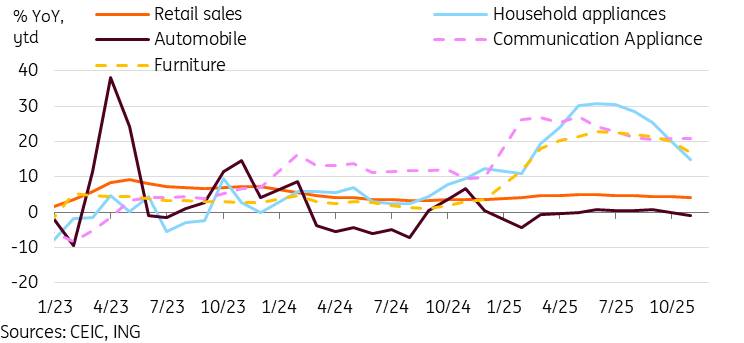
          Retail sales growth falls to lowest since 2022 as trade-in policy turns from tailwind to headwind

          China's retail sales significantly underperformed in November, falling to 1.3% year-on-year from 2.9% in October. This not only fell well short of forecasts but also marked the weakest month of retail sales growth since 2022.

          As we have covered in the past few months, the leading cause is the trade-in policy turning from a tailwind to a headwind. The most obvious example is in household appliances, which saw a -19.4% YoY contraction in November, bringing the year-to-date growth down sharply to 14.9%. Recall that the trade-in policy for household appliances ramped up significantly in the fourth quarter of 2024. This resulted in a wave of purchases, something for which the YoY data is now paying the price. The same impact will likely be observed at the start of 2026 for the communication appliance category.

          While the trade-in policy has primarily been seen as successful in front-loading consumption, we need to see either an expansion of the policy to new categories next year -- or a new direction in supporting consumption. Otherwise, we will likely continue to see pressure on consumption as the policy is phased out.

          China's electric vehicle (EV) transition is influencing soft retail sales data. Reduced petrol demand resulted in a contraction of -8.0% YoY for petrol sales, while the earlier purchases of EVs resulted in a -8.3% YoY drop in auto sales as well. Other categories tended to fare a little better, with catering (3.2%), grains and oils (6.1%), cosmetics (6.1%), and gold and jewellery (8.5%) all outperforming headline growth.

          Boosting domestic demand in 2026 looks to be a top priority for policymakers, according to recent communications from the Politburo meeting and the Central Economic Work Conference. One point that has been mentioned several times: "special actions to boost consumption" will be implemented, along with plans to boost household incomes.

          Trade-in policy headwinds will likely intensify in coming months

          Investment contraction steepened in November

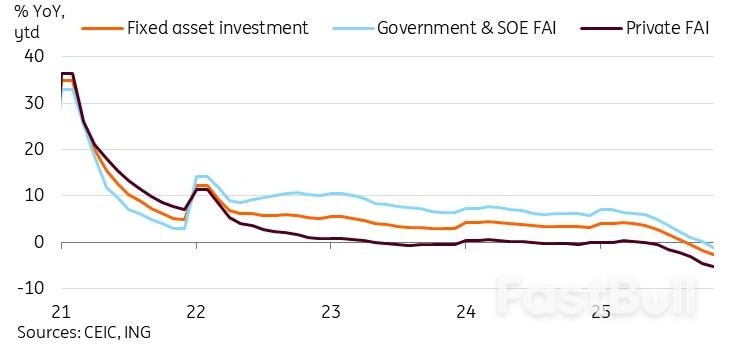
          China's fixed asset investment (FAI) growth fell to -2.6% YoY ytd through November, down from -1.7% YoY ytd from a month ago. This once again underperformed market forecasts for -2.3%, though it slightly beat our house forecast of -2.8%.

          Despite industrial modernisation being at the core of the next Five-Year Plan, the manufacturing FAI continues to slow down to just 1.9% YoY ytd. The rail, ship, and aeroplane manufacturing sector continued to see investment growth accelerate to 22.4% YoY ytd, but auto sector investment moderated to 15.3% YoY ytd.

          As we expected in last month's report, public investment tipped into negative territory by November, dropping to -1.1% YoY ytd. Private investment also continued to fall at a faster pace, down to -2.6% YoY ytd.

          The recent Central Economic Work Conference stated that investment should be halted from next year. How the government plans to do this, while also cracking down on redundant investments, will be worth monitoring in the coming months. We expect public investment to stage a recovery in 2026, but the private sector is a bigger question mark for China's investment picture. It will likely be seen as a more important gauge of investment appetite and business confidence.

          Next year's government investment could recover amid policy support

          Stable industrial production continues to outperform

          China's value added of industry inched down to 4.8% YoY in November, down from 4.9% in October. This outcome was weaker than market forecasts, but the industrial sector remains a clear outperformer despite soft consumption and investment data.

          By sector, we saw outperformance in the usual suspects, with rail, ships, and aerospace, as well as the auto manufacturing sectors, both outperforming at 11.9% YoY in November. We also saw solid production growth of industrial robots (20.6%) and semiconductors (15.6%).

          As we saw in the November trade data earlier this month -- China's trade surplus eclipsed USD 1tn on the year -- external demand has been the main bright spot for China's economy this year. This has helped support industrial production for most of the year. Resilient demand from non-US economies has been a key reason China's growth is likely to remain on track this year, but there are signs that this trend faces risks next year. We recently saw Mexico increase tariffs on Chinese products to up to 50% in an attempt to appease the US. The EU has also signalled potential tariff action if trade imbalances were not addressed in short order.

          Property price slide continued in November

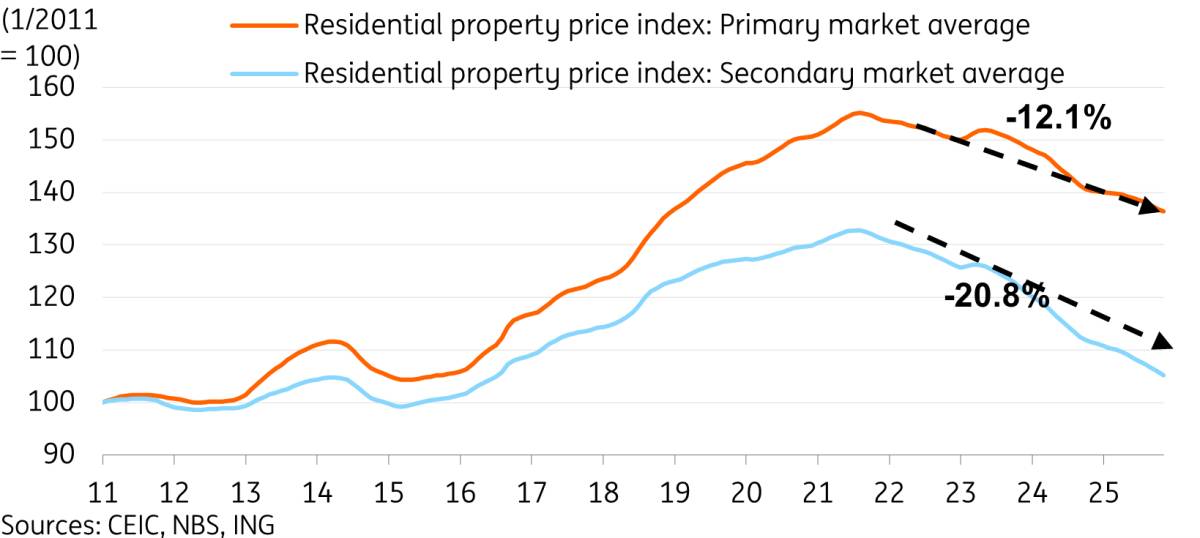
          China's 70-city property prices continued to show downward momentum in November, consistent with expectations following another month of limited support. New home prices fell -0.39% month-on-month, a slightly smaller decline compared to October's data. Used-home prices fell by -0.66% MoM, unchanged from October. From the peak, new home prices are now down -12.1%, while used home prices are down -20.8%. Of the 70 cities, 46 have seen secondary-market prices decline by 20%-30% from their peak, while 4 have declined by more than 30%.

          In the primary market, 11 of 70 cities saw prices stabilise or increase, which marked a three-month high. In the secondary market, we saw a third consecutive month of price declines across the entire sample. Secondary market prices remain the key to watch; they have the most direct impact on household wealth effects.

          As expected, the downturn of property investment continued, now down -15.9% YoY ytd.

          The continued slide in the property market remains one of the most significant issues that could hinder China's efforts to shift to a domestically demand-driven growth model. Comments from the Central Economic Work Conference on actively and prudently resolving key risks focused on the property market, and suggest that property market support could be on the way. The directions in the readout included encouraging the acquisition of existing housing, focusing on affordable housing, and city-specific policies to reduce inventories and optimise supply. Market discussions have also centred on measures to improve housing affordability, such as tax breaks for first-time buyers and potential reduction of mortgage burdens. The wave of support in 2024 showed some promise, with prices stabilising toward the start of 2025. However, this may require continued and concerted efforts, as the downturn resumed after a few months of policy inertia. There remains no easy answer for ending the downturn.

          No relief yet for housing prices

          There's much work to be done if domestic demand is to drive growth in 2026 and beyond

          Policymakers make clear that domestic demand-led growth is the priority moving forward. November's data showd that a lot of work remains for this scenario to play out successfully, with all key domestic activity data continuing to weaken. This year's growth targets should still be on track, though a weak set of November data further pushes risks to the downside from our 5.0% YoY forecast.

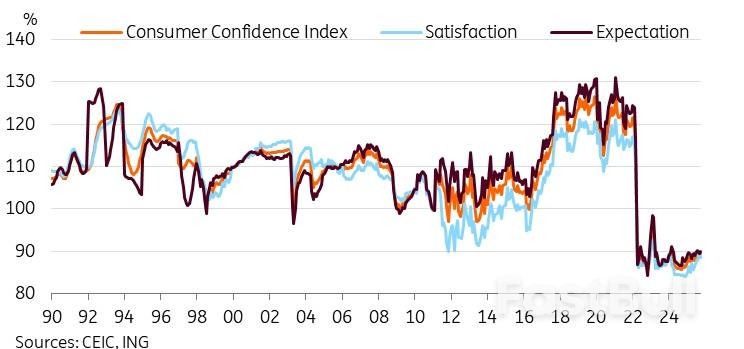
          A bigger question mark lies ahead for next year, and the years ahead. In our view, the biggest issue suppressing China's economy is downbeat confidence, which risks becoming entrenched. While official confidence indicators have been inching higher over the past year, they remain well below historical averages.

          We believe the negative wealth effect from falling property prices remains a major drag on confidence. Falling property prices have thus far overshadowed a solid equity market recovery, which is unsurprising given the greater weight of property prices in household balance sheets.

          The other key area is the widespread cost-cutting environment, which has led to sluggish wage growth and layoffs. This decreased labour market dynamism is also resulting in less hiring and labour mobility. This increases challenges for youth unemployment as well, where the unemployment rate for ages 16 to 24 reached 17.3% in October. It has generally been in the mid-high teens since the pandemic, versus an average of around 11% between 2018-19. A generation of underemployed and unemployed youth will likely constrain their purchasing power in the future.

          These factors translate to an overall deflationary environment, which also acts as a key drag on both consumption and investment. We see some improvement in inflation next year, though food prices will likely drive the recovery. The trajectory of core inflation, which has also shown some positive signs in recent months, will likely be more important.

          It's certainly easier said than done to restore confidence, but it will be key to domestic demand becoming the main driver of growth. To unlock China's savings and transition China's economy into the next phase of domestic demand-led growth, households need to feel confident that tomorrow will be better than today.

          Confidence has edged up slowly and painfully but remains still much closer to historical lows than averages

          Source: ING

          To stay updated on all economic events of today, please check out our Economic calendar
          Risk Warnings and Disclaimers
          You understand and acknowledge that there is a high degree of risk involved in trading. Following any strategies or investment methods may lead to potential losses. The content on the site is provided by our contributors and analysts for information purposes only. You are solely responsible for determining whether any trading assets, securities, strategy, or any other product is suitable for investing based on your own investment objectives and financial situation.
          Add to Favorites
          Share

          Strike By Doctors in England to Go Ahead After Rejecting Government's Offer

          Michelle

          Political

          Economic

          Doctors in England voted to reject the government's latest offer on working conditions, the British Medical Association union said on Monday, confirming that a five-day strike planned for this week would go ahead.

          The doctors' union - which represents the so-called resident doctors who make up nearly half of the medical workforce - will stage a walkout from Wednesday as part of a series of strikes that have taken place this year over pay and working conditions.

          "Tens of thousands of frontline doctors have come together to say 'no' to what is clearly too little, too late," BMA chair Jack Fletcher said in a statement.

          He said the union was still willing to work to find a solution.

          The strike will add pressure to an already stretched healthcare service after NHS England warned last week that hospitals were facing a "worst-case scenario" from a wave of a super flu.

          Health minister Wes Streeting appealed to the doctors to go to work.

          "There is no need for these strikes to go ahead this week, and it reveals the BMA's shocking disregard for patient safety," he said, adding that the strikes are "self-indulgent, irresponsible and dangerous".

          The BMA said 83% of resident doctors rejected the government's offer in an online survey with a 65% turnout of its more than 50,000 members.

          The offer made by the government last Wednesday did not include new pay terms, something the BMA has been campaigning for even before the Labour Party won last year's election.

          At the time, Streeting struck a deal with the doctors, offering them a 22% pay rise - 7 percentage points below the 29% sought by the BMA.

          The union has also been pushing for a better pay offer from the 5.4% pay increase announced earlier this year, saying resident doctors were still suffering from years of pay erosion.

          Source: Reuters

          To stay updated on all economic events of today, please check out our Economic calendar
          Risk Warnings and Disclaimers
          You understand and acknowledge that there is a high degree of risk involved in trading. Following any strategies or investment methods may lead to potential losses. The content on the site is provided by our contributors and analysts for information purposes only. You are solely responsible for determining whether any trading assets, securities, strategy, or any other product is suitable for investing based on your own investment objectives and financial situation.
          Add to Favorites
          Share

          How Many More Times Will the Bank of England Rescue Rachel Reeves?

          Warren Takunda

          Economic

          In the economic gloom of Labour’s first year in power, Rachel Reeves has had a reliable shred of comfort to cling to: five times since the general election, the Bank of England has cut interest rates.
          This week, in all likelihood, the chancellor will get a sixth to shout about, as Threadneedle Street prepares to reduce borrowing costs in an early Christmas present that will be seized upon by the Treasury.
          The view in the City is that a festive cut on Thursday is odds-on. After last week’s disappointing October growth figures, the jobs market and consumer prices data due out on Tuesday and Wednesday – before the rates decision – are expected to confirm that inflationary pressures in the UK economy are fading.
          But while a cut will be good news for businesses, mortgage borrowers and the beleaguered occupants of Downing Street, attention will quickly shift to the prospects for 2026. How many more times could the central bank come to the chancellor’s rescue? Here things are a bit more complicated.
          That Britain’s economy is in the doldrums should hardly come as a surprise. Continual tax speculation has sapped business confidence and household spending, while Reeves’s increase in employer national insurance contributions has played a part in UK unemployment hitting the highest levels since 2021, during the height of the Covid pandemic.
          Celebrating a rate cut, in this context, is akin to an arsonist cheering the arrival of the fire brigade.
          There are, though, factors beyond Reeves’s control. Not least the dire state Britain’s economy was left in by the Conservative party, and Donald Trump’s damaging tariff war.
          The Bank has also played a role. Borrowers have been singed by three years of punitively high interest rates set in deeply restrictive territory. The policy is the central banker’s main tool for combating inflation as it chokes off demand by incentivising saving and discouraging spending.
          After the inflation shock triggered by Russia’s invasion of Ukraine, Threadneedle Street argues it had little choice but to act. But the growth trade-off is clear. Even after successive rate cuts, the Bank’s own analysis shows the base rate continues to subtract about 2% from the level of GDP.
          Anyone who has remortgaged their home since 2022 knows this first-hand. And despite progress since the Liz Truss debacle, millions of borrowers still face substantially higher loan repayments – and will continue to do so for years to come. That is hardly going to light a match under the UK’s consumption-driven economy.
          This week the Bank’s policymakers are expected to be split on the appropriate way forward. Some on the nine-strong monetary policy committee (MPC) recognise the damage rates are doing at a time when inflation is cooling. Others think a tough approach is warranted to snuff out price rises.
          Andrew Bailey is expected to hold the casting vote. The Bank’s governor has suggested he thinks inflation is more likely to fall back than stick at stubbornly high levels – paving the way for a quarter-point cut on Thursday.
          Next year, however, it is tougher to anticipate how the MPC will respond. Policymakers are likely to remain divided on the inflation outlook and the “neutral” position for rates – the point at which they are neither stoking nor hosing down economic activity.
          Reeves’s budget measures – including relief on energy bills, fuel duty, rail fares and prescription charges – could support the case for deeper cuts. The Bank predicts the policies could slash headline inflation by up to 0.5 percentage points by the middle of 2026.
          All of this was part of a deliberate strategy inside the Treasury in the hope voters give credit to Labour for lower mortgage costs. Government borrowing costs could also fall back, unpicking some of the factors behind the recent years of fiscal drama in Westminster.
          However, many economists warn the reprieve could be temporary.
          Much of the disinflationary impulse will be in energy prices, and do little to help Britain’s issues with sticky service sector inflation. Other areas of government policy could also push in the wrong direction.
          Business leaders warn a higher minimum wage, business rates, and other tax increases will drive up their costs – resulting in companies putting up prices for their customers, in turn stoking inflation.
          That said, some of the factors the hawks are betting on look shaky.
          Business costs are rising but hardly at breakneck speed. At 4.1%, the rise in the minimum wage from April is significantly below that in previous years – particularly when set against the context of 2022, when Jeremy Hunt ignored misplaced warnings about a wage-price spiral and increased the legal pay floor by 9.7% from April 2023.
          By the time we get to spring, there should be signs that inflation is undershooting, and wage growth is slowing. The economy will probably still be lacking momentum. Household confidence may be picking up, and companies will probably lack the pricing power to push through yet more increases.
          All of this means Reeves could see more rate cuts from the Bank.

          Source: Theguardian

          To stay updated on all economic events of today, please check out our Economic calendar
          Risk Warnings and Disclaimers
          You understand and acknowledge that there is a high degree of risk involved in trading. Following any strategies or investment methods may lead to potential losses. The content on the site is provided by our contributors and analysts for information purposes only. You are solely responsible for determining whether any trading assets, securities, strategy, or any other product is suitable for investing based on your own investment objectives and financial situation.
          Add to Favorites
          Share

          Xi Blasts "Reckless" Projects Exaggerating Growth After China Reveals Dismal Macro Data for November

          Glendon

          Forex

          Economic

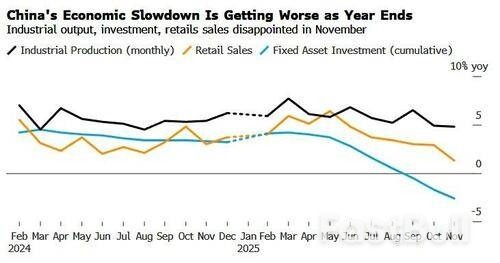
          China's economic momentum slowed broadly in November, with a marked weakening in consumer spending, adding pressure on Beijing to stabilize household and business demand in the world's second-largest economy.

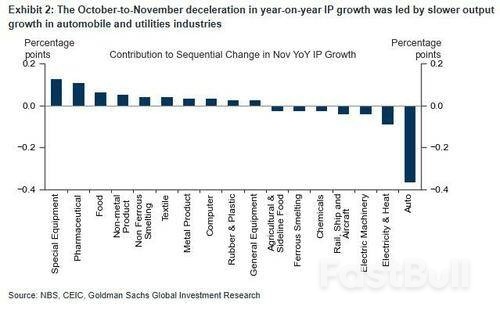
          Industrial production (IP) growth edged down in year-on-year terms despite the notable improvement in export growth, with slower output growth in automobile and utilities industries more than offsetting faster output growth in the special equipment and pharmaceuticals industries.

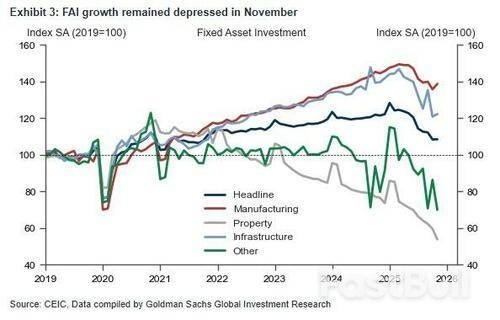
          Fixed asset investment (FAI) maintained its double-digit year-on-year contraction in November on a single-month basis, though we would not over-interpret its recent slump as our study suggests that the NBS statistical correction of previously over-reported data has played at least as large a role as fundamental factors (e.g., the "anti-involution" policies and a prolonged property downturn).

          Retail sales growth dropped meaningfully in November despite a low base, reflecting slowing auto sales growth and the negative distortion from an earlier-than-usual start of the "Double 11" Online Shopping Festival (which had pulled forward some demand from November to October, similar to the patterns observed in June).

          Year-on-year services industry output index growth – which is on a real basis and tracks tertiary (services) GDP growth closely – moderated in November.

          Property sector weakness continued in November, while unemployment rates remained largely stable.

          Regarding the labor market, the nationwide unemployment rate and the 31-city metric (not seasonally adjusted) both remained flat at 5.1% in November. The latest data available suggests the unemployment rate of the 16-24 age group declined to 17.3% in October from 17.7% in September, while Goldman cautions that this indicator may have underestimated the labor market challenges that younger generation is facing amid weak domestic demand, persistent deflation and fragile private sector confidence, because of the definition change.

          Incorporating October-November activity data, Goldman's GDP tracking model based on the production approach points to a small downside risk to our Q4 real GDP growth forecast of 4.5% yoy.

          And with downside economic risks building, Bloomberg reports that Chinese President Xi Jinping lashed out at inflated growth numbers and vowed to crack down on the pursuit of "reckless" projects that have no purpose except showing superficial results.

          "All plans must be based on facts, aiming for solid, genuine growth without exaggeration, and promoting high-quality, sustainable development," Xi said last week, according to a report on Sunday in the People's Daily, the Communist Party's official newspaper.

          "Those who act recklessly and aggressively without regard for reality, impose excessive demands, or deploy resources without careful consideration, must be held strictly accountable," he said at the Central Economic Work Conference.

          Xi used stark language to call for quality in economic gains and listed examples of wrongdoing such as unnecessarily huge industrial parks, disorderly expansion of local exhibitions and forums, inflated statistics and "fake construction kickoffs."

          Access to data in China can be sensitive and controlled, making it hard for observers to assess the health of the economy, but Xi's latest remarks seem to suggest that he wants a revamp of the existing metrics used to evaluate local officials.

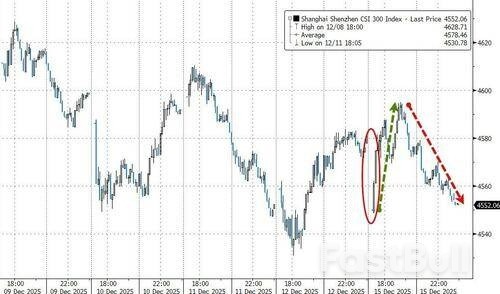
          Finally, we note that the initial downturn in Chinese stocks was quickly bid back into positive territory after the 'bad data' as it appeared 'bad news' would be 'good news' from a 'most stimmies' perspective, but Xi's rant dragged stocks down to end the day in the red...

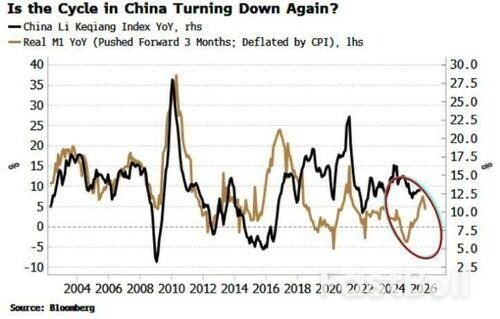
          And as a reminder, we warned last week that the pace of money growth in China has slowed for a second month. If that's sustained, global stocks could lose a hitherto supportive tailwind next year.

          One snowflake doesn't make a winter, but if M1 in China continues to pare back, that's at least one tailwind global stocks won't have next year.

          Source: Zero Hedge

          To stay updated on all economic events of today, please check out our Economic calendar
          Risk Warnings and Disclaimers
          You understand and acknowledge that there is a high degree of risk involved in trading. Following any strategies or investment methods may lead to potential losses. The content on the site is provided by our contributors and analysts for information purposes only. You are solely responsible for determining whether any trading assets, securities, strategy, or any other product is suitable for investing based on your own investment objectives and financial situation.
          Add to Favorites
          Share
          FastBull
          Copyright © 2025 FastBull Ltd

          728 RM B 7/F GEE LOK IND BLDG NO 34 HUNG TO RD KWUN TONG KLN HONG KONG

          TelegramInstagramTwitterfacebooklinkedin
          App Store Google Play Google Play
          Products
          Charts

          Chats

          Q&A with Experts
          Screeners
          Economic Calendar
          Data
          Tools
          Membership
          Features
          Function
          Markets
          Copy Trading
          Latest Signals
          Contests
          News
          Analysis
          24/7
          Columns
          Education
          Company
          Careers
          About Us
          Contact Us
          Advertising
          Help Center
          Feedback
          User Agreement
          Privacy Policy
          Personal Information Protection Statement
          Business

          White Label

          Data API

          Web Plug-ins

          Poster Maker

          Affiliate Program

          Risk Disclosure

          The risk of loss in trading financial instruments such as stocks, FX, commodities, futures, bonds, ETFs and crypto can be substantial. You may sustain a total loss of the funds that you deposit with your broker. Therefore, you should carefully consider whether such trading is suitable for you in light of your circumstances and financial resources.

          No decision to invest should be made without thoroughly conducting due diligence by yourself or consulting with your financial advisors. Our web content might not suit you since we don't know your financial conditions and investment needs. Our financial information might have latency or contain inaccuracy, so you should be fully responsible for any of your trading and investment decisions. The company will not be responsible for your capital loss.

          Without getting permission from the website, you are not allowed to copy the website's graphics, texts, or trademarks. Intellectual property rights in the content or data incorporated into this website belong to its providers and exchange merchants.

          Not Logged In

          Log in to access more features

          FastBull Membership

          Not yet

          Purchase

          Become a signal provider
          Help Center
          Customer Service
          Dark Mode
          Price Up/Down Colors

          Log In

          Sign Up
          Position
          Layout
          Fullscreen
          Default to Chart
          The chart page opens by default when you visit fastbull.com