• Trade
  • Markets
  • Copy
  • Contests
  • News
  • 24/7
  • Calendar
  • Q&A
  • Chats
Trending
Screeners
SYMBOL
LAST
BID
ASK
HIGH
LOW
NET CHG.
%CHG.
SPREAD
SPX
S&P 500 Index
6846.50
6846.50
6846.50
6878.28
6827.18
-23.90
-0.35%
--
DJI
Dow Jones Industrial Average
47739.31
47739.31
47739.31
47971.51
47611.93
-215.67
-0.45%
--
IXIC
NASDAQ Composite Index
23545.89
23545.89
23545.89
23698.93
23455.05
-32.22
-0.14%
--
USDX
US Dollar Index
99.000
99.080
99.000
99.000
99.000
+0.050
+ 0.05%
--
EURUSD
Euro / US Dollar
1.16356
1.16390
1.16356
1.16362
1.16322
-0.00008
-0.01%
--
GBPUSD
Pound Sterling / US Dollar
1.33175
1.33296
1.33175
1.33178
1.33140
-0.00030
-0.02%
--
XAUUSD
Gold / US Dollar
4189.70
4190.14
4189.70
4218.85
4175.92
-8.21
-0.20%
--
WTI
Light Sweet Crude Oil
58.555
58.807
58.555
60.084
58.495
-1.254
-2.10%
--

Community Accounts

Signal Accounts
--
Profit Accounts
--
Loss Accounts
--
View More

Become a signal provider

Sell trading signals to earn additional income

View More

Guide to Copy Trading

Get started with ease and confidence

View More

Signal Accounts for Members

All Signal Accounts

Best Return
  • Best Return
  • Best P/L
  • Best MDD
Past 1W
  • Past 1W
  • Past 1M
  • Past 1Y

All Contests

  • All
  • Trump Updates
  • Recommend
  • Stocks
  • Cryptocurrencies
  • Central Banks
  • Featured News
Top News Only
Share

SPDR Gold Holdings Down 0.11%, Or 1.14 Tonnes

Share

On Monday (December 8), In Late New York Trading, S&P 500 Futures Fell 0.21%, Dow Jones Futures Fell 0.43%, NASDAQ 100 Futures Fell 0.08%, And Russell 2000 Futures Fell 0.04%

Share

Morgan Stanley: Data Center ABS Spreads Are Expected To Widen In 2026

Share

(US Stocks) The Philadelphia Gold And Silver Index Closed Down 2.34% At 311.01 Points. (Global Session) The NYSE Arca Gold Miners Index Closed Down 2.17%, Hitting A Daily Low Of 2235.45 Points; US Stocks Remained Slightly Down Before The Opening Bell—holding Steady Around 2280 Points—before Briefly Rising Slightly

Share

IMF: IMF Executive Board Approves Extension Of The Extended Credit Facility Arrangement With Nepal

Share

Trump: Same Approach Will Apply To Amd, Intel, And Other Great American Companies

Share

Trump: Department Of Commerce Is Finalizing Details

Share

Trump: $25% Will Be Paid To United States Of America

Share

Trump: President Xi Responded Positively

Share

[Consumer Discretionary ETFs Fell Over 1.4%, Leading The Decline Among US Sector ETFs; Semiconductor ETFs Rose Over 1.1%] On Monday (December 8), The Consumer Discretionary ETF Fell 1.45%, The Energy ETF Fell 1.09%, The Internet ETF Fell 0.18%, The Regional Banks ETF Rose 0.34%, The Technology ETF Rose 0.70%, The Global Technology ETF Rose 0.93%, And The Semiconductor ETF Rose 1.13%

Share

Trump: I Have Informed President Xi, Of China, That United States Will Allow Nvidia To Ship Its H200 Products To Approved Customers In China

Share

Argentina's Merval Index Closed Up 0.02% At 3.047 Million Points. It Rose To A New Daily High Of 3.165 Million Points In Early Trading In Buenos Aires Before Gradually Giving Back Its Gains

Share

US Stock Market Closing Report | On Monday (December 8), The Magnificent 7 Index Fell 0.20% To 208.33 Points. The "mega-cap" Tech Stock Index Fell 0.33% To 405.00 Points

Share

Pentagon - USA State Dept Approves Potential Sale Of Hellfire Missiles To Belgium For An Estimated $79 Million

Share

Toronto Stock Index .GSPTSE Unofficially Closes Down 141.44 Points, Or 0.45 Percent, At 31169.97

Share

The Nasdaq Golden Dragon China Index Closed Up Less Than 0.1%. Nxtt Rose 21%, Microalgo Rose 7%, Daqo New Energy Rose 4.3%, And 21Vianet, Baidu, And Miniso All Rose More Than 3%

Share

The S&P 500 Initially Closed Down More Than 0.4%, With The Telecom Sector Down 1.9%, And Materials, Consumer Discretionary, Utilities, Healthcare, And Energy Sectors Down By As Much As 1.6%, While The Technology Sector Rose 0.7%. The NASDAQ 100 Initially Closed Down 0.3%, With Marvell Technology Down 7%, Fortinet Down 4%, And Netflix And Tesla Down 3.4%

Share

IMF: Review Pakistan Authorities To Draw The Equivalent Of About US$1 Billion

Share

President Trump Is Committed To The Continued Cessation Of Violence And Expects The Governments Of Cambodia And Thailand To Fully Honor Their Commitments To End This Conflict - Senior White House Official

Share

[Water Overflows From Spent Fuel Pool At Japanese Nuclear Facility] According To Japan's Nuclear Waste Management Company, Following A Strong Earthquake Off The Coast Of Aomori Prefecture Late On December 8th, Workers At The Nuclear Waste Treatment Plant In Rokkasho Village, Aomori Prefecture, Discovered "at Least 100 Liters Of Water" On The Ground Around The Spent Fuel Pool During An Inspection. Analysis Suggests This Water "may Have Overflowed Due To The Earthquake's Shaking." However, It Is Reported That The Overflowed Water "remains Inside The Building And Has Not Affected The External Environment."

TIME
ACT
FCST
PREV
France Trade Balance (SA) (Oct)

A:--

F: --

P: --
Euro Zone Employment YoY (SA) (Q3)

A:--

F: --

P: --
Canada Part-Time Employment (SA) (Nov)

A:--

F: --

P: --

Canada Unemployment Rate (SA) (Nov)

A:--

F: --

P: --

Canada Full-time Employment (SA) (Nov)

A:--

F: --

P: --

Canada Labor Force Participation Rate (SA) (Nov)

A:--

F: --

P: --

Canada Employment (SA) (Nov)

A:--

F: --

P: --

U.S. PCE Price Index MoM (Sept)

A:--

F: --

P: --

U.S. Personal Income MoM (Sept)

A:--

F: --

P: --

U.S. Core PCE Price Index MoM (Sept)

A:--

F: --

P: --

U.S. PCE Price Index YoY (SA) (Sept)

A:--

F: --

P: --

U.S. Core PCE Price Index YoY (Sept)

A:--

F: --

P: --

U.S. Personal Outlays MoM (SA) (Sept)

A:--

F: --

P: --
U.S. 5-10 Year-Ahead Inflation Expectations (Dec)

A:--

F: --

P: --

U.S. Real Personal Consumption Expenditures MoM (Sept)

A:--

F: --

P: --
U.S. Weekly Total Rig Count

A:--

F: --

P: --

U.S. Weekly Total Oil Rig Count

A:--

F: --

P: --

U.S. Consumer Credit (SA) (Oct)

A:--

F: --

P: --
China, Mainland Foreign Exchange Reserves (Nov)

A:--

F: --

P: --

Japan Trade Balance (Oct)

A:--

F: --

P: --

Japan Nominal GDP Revised QoQ (Q3)

A:--

F: --

P: --

China, Mainland Imports YoY (CNH) (Nov)

A:--

F: --

P: --

China, Mainland Exports (Nov)

A:--

F: --

P: --

China, Mainland Imports (CNH) (Nov)

A:--

F: --

P: --

China, Mainland Trade Balance (CNH) (Nov)

A:--

F: --

P: --

China, Mainland Exports YoY (USD) (Nov)

A:--

F: --

P: --

China, Mainland Imports YoY (USD) (Nov)

A:--

F: --

P: --

Germany Industrial Output MoM (SA) (Oct)

A:--

F: --

P: --
Euro Zone Sentix Investor Confidence Index (Dec)

A:--

F: --

P: --

Canada National Economic Confidence Index

A:--

F: --

P: --

U.K. BRC Like-For-Like Retail Sales YoY (Nov)

--

F: --

P: --

U.K. BRC Overall Retail Sales YoY (Nov)

--

F: --

P: --

Australia Overnight (Borrowing) Key Rate

--

F: --

P: --

RBA Rate Statement
RBA Press Conference
Germany Exports MoM (SA) (Oct)

--

F: --

P: --

U.S. NFIB Small Business Optimism Index (SA) (Nov)

--

F: --

P: --

Mexico 12-Month Inflation (CPI) (Nov)

--

F: --

P: --

Mexico Core CPI YoY (Nov)

--

F: --

P: --

Mexico PPI YoY (Nov)

--

F: --

P: --

U.S. Weekly Redbook Index YoY

--

F: --

P: --

U.S. JOLTS Job Openings (SA) (Oct)

--

F: --

P: --

China, Mainland M1 Money Supply YoY (Nov)

--

F: --

P: --

China, Mainland M0 Money Supply YoY (Nov)

--

F: --

P: --

China, Mainland M2 Money Supply YoY (Nov)

--

F: --

P: --

U.S. EIA Short-Term Crude Production Forecast For The Year (Dec)

--

F: --

P: --

U.S. EIA Natural Gas Production Forecast For The Next Year (Dec)

--

F: --

P: --

U.S. EIA Short-Term Crude Production Forecast For The Next Year (Dec)

--

F: --

P: --

EIA Monthly Short-Term Energy Outlook
U.S. API Weekly Gasoline Stocks

--

F: --

P: --

U.S. API Weekly Cushing Crude Oil Stocks

--

F: --

P: --

U.S. API Weekly Crude Oil Stocks

--

F: --

P: --

U.S. API Weekly Refined Oil Stocks

--

F: --

P: --

South Korea Unemployment Rate (SA) (Nov)

--

F: --

P: --

Japan Reuters Tankan Non-Manufacturers Index (Dec)

--

F: --

P: --

Japan Reuters Tankan Manufacturers Index (Dec)

--

F: --

P: --

Japan Domestic Enterprise Commodity Price Index MoM (Nov)

--

F: --

P: --

Japan Domestic Enterprise Commodity Price Index YoY (Nov)

--

F: --

P: --

China, Mainland PPI YoY (Nov)

--

F: --

P: --

China, Mainland CPI MoM (Nov)

--

F: --

P: --

Italy Industrial Output YoY (SA) (Oct)

--

F: --

P: --

Q&A with Experts
    • All
    • Chatrooms
    • Groups
    • Friends
    Connecting
    .
    .
    .
    Type here...
    Add Symbol or Code

      No matching data

      All
      Trump Updates
      Recommend
      Stocks
      Cryptocurrencies
      Central Banks
      Featured News
      • All
      • Russia-Ukraine Conflict
      • Middle East Flashpoint
      • All
      • Russia-Ukraine Conflict
      • Middle East Flashpoint
      Search
      Products

      Charts Free Forever

      Chats Q&A with Experts
      Screeners Economic Calendar Data Tools
      Membership Features
      Data Warehouse Market Trends Institutional Data Policy Rates Macro

      Market Trends

      Market Sentiment Order Book Forex Correlations

      Top Indicators

      Charts Free Forever
      Markets

      News

      News Analysis 24/7 Columns Education
      From Institutions From Analysts
      Topics Columnists

      Latest Views

      Latest Views

      Trending Topics

      Top Columnists

      Latest Update

      Signals

      Copy Rankings Latest Signals Become a signal provider AI Rating
      Contests
      Brokers

      Overview Brokers Assessment Rankings Regulators News Claims
      Broker listing Forex Brokers Comparison Tool Live Spread Comparison Scam
      Q&A Complaint Scam Alert Videos Tips to Detect Scam
      More

      Business
      Events
      Careers About Us Advertising Help Center

      White Label

      Data API

      Web Plug-ins

      Affiliate Program

      Awards Institution Evaluation IB Seminar Salon Event Exhibition
      Vietnam Thailand Singapore Dubai
      Fans Party Investment Sharing Session
      FastBull Summit BrokersView Expo
      Recent Searches
        Top Searches
          Markets
          News
          Analysis
          User
          24/7
          Economic Calendar
          Education
          Data
          • Names
          • Latest
          • Prev

          View All

          No data

          Scan to Download

          Faster Charts, Chat Faster!

          Download App
          English
          • English
          • Español
          • العربية
          • Bahasa Indonesia
          • Bahasa Melayu
          • Tiếng Việt
          • ภาษาไทย
          • Français
          • Italiano
          • Türkçe
          • Русский язык
          • 简中
          • 繁中
          Open Account
          Search
          Products
          Charts Free Forever
          Markets
          News
          Signals

          Copy Rankings Latest Signals Become a signal provider AI Rating
          Contests
          Brokers

          Overview Brokers Assessment Rankings Regulators News Claims
          Broker listing Forex Brokers Comparison Tool Live Spread Comparison Scam
          Q&A Complaint Scam Alert Videos Tips to Detect Scam
          More

          Business
          Events
          Careers About Us Advertising Help Center

          White Label

          Data API

          Web Plug-ins

          Affiliate Program

          Awards Institution Evaluation IB Seminar Salon Event Exhibition
          Vietnam Thailand Singapore Dubai
          Fans Party Investment Sharing Session
          FastBull Summit BrokersView Expo

          Vietnam Says It Wants To Buy More From US As Trade Talks Begin

          Devin

          Economic

          Summary:

          Vietnam said Wednesday that it wants its companies to buy more high-value US imports in large volumes and at a stable pace, reaffirming its opening line on trade talks with Washington to avoid punishingly high tariffs.

          The Southeast Asian nation’s trade minister and top negotiator, Nguyen Hong Dien, urged the firms, including in energy, mining, telecommunications and aviation, during a meeting in Hanoi to be “proactive” to help US-Vietnam trade reach its “great potential,” the government said in a statement.

          Nguyen Hong Dien also met with the US Ambassador to Vietnam, Marc Knapper, “to promote the ongoing negotiation process aimed at addressing current bilateral economic and trade issues,” it said.

          Vietnam is among a group of countries opening trade talks with the US that are facing some of the steepest tariffs imposed by President Donald Trump, aimed at reviving manufacturing that moved overseas in recent decades. Trump’s main target, China, is also a major trade partner for Vietnam but has challenged its access to offshore areas both countries claim in the South China Sea.

          Vietnam’s trade surplus narrowed sharply in April in what could be an early indication of the impact of higher US tariffs. The surplus in April was $577 million, compared with the $1.64 billion reported for March, according to data released by the National Statistics Office in Hanoi Tuesday.

          US officials late last month had draft plans to hold negotiations with about 18 countries over three weeks, using a template that lays out common areas of concern to help guide the discussions, including on tariffs, non-tariff barriers, digital trade, economic security and commercial concerns.

          The US ran a nearly $124 billion trade deficit with Vietnam last year, according to the US Trade Representative, the third-highest after China and Mexico. The surge in trading in recent years is partly due to firms leaving China to avoid Trump’s trade war during his first term. Besides being a large apparel exporter, Vietnam has also become a manufacturing base for multinational companies including Apple Inc.’s suppliers and Samsung Electronics Co.

          USTR Jamieson Greer in March told Nguyen Hong Dien in Washington that Vietnam must improve the trade balance and further open its market, which the government in Hanoi pledged to do via removing tariffs on US goods and buying more from the US. Vietnam also vowed to combat trade fraud and increase monitoring of products’ origin.

          Trump imposed a 46% tariff on Vietnam on April 2, which was later suspended for 90 days to allow time for talks.

          In its statement Wednesday, Vietnam said it had imported in recent years billions of dollars worth of US aircraft, machinery, power transmission systems, high-end semiconductors and raw materials.

          The US normalized relations with Vietnam in 1995 after lifting a trade embargo the year before, a legacy of their conflict that ended in 1973. In 2023, President Joe Biden updated the relationship to a “comprehensive strategic partnership,” Hanoi’s highest diplomatic level and one it has used for India and China.

          Vietnam has previously sought to improve it export options to the US by applying for “market economy” status from Washington regulators. That request was rejected last August by the Commerce Department as critics argued the government in Hanoi controls prices and production and subsidizes enterprises that compete with American firms.

          Source: Bloomberg Europe

          To stay updated on all economic events of today, please check out our Economic calendar
          Risk Warnings and Disclaimers
          You understand and acknowledge that there is a high degree of risk involved in trading. Following any strategies or investment methods may lead to potential losses. The content on the site is provided by our contributors and analysts for information purposes only. You are solely responsible for determining whether any trading assets, securities, strategy, or any other product is suitable for investing based on your own investment objectives and financial situation.
          Add to Favorites
          Share

          Bitcoin Price Eyes $100K Ahead Of Fed’s FOMC Meeting

          Catherine Richards

          Cryptocurrency

          Technical Analysis

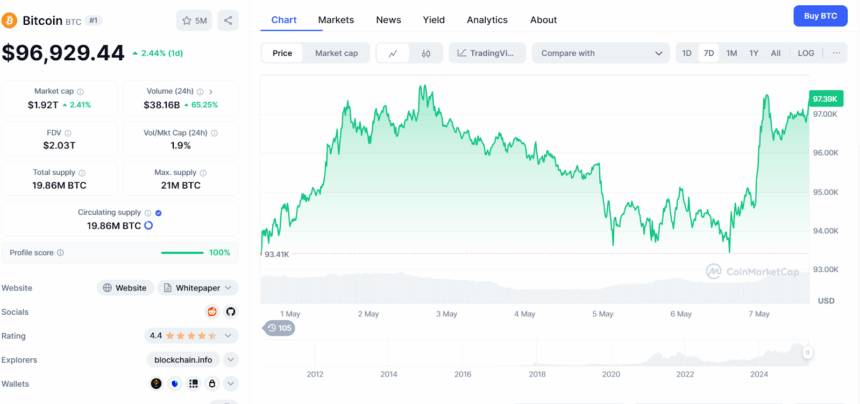
          Bitcoin price has been consolidating between $93,410, and $97,000 for the past 7 days. As of now, traders are waiting on the FOMC meeting set for 2 p.m. ET today to know the next move. There’s a possibility that the BTC price will break above $100k following the meeting.

          According to the data on CME FedWatch Tool, there’s a 97.7% chance the Fed will keep rates steady between 4.25% and 4.50%. Meanwhile, tension is rising as inflation stays sticky and rate-cut demands grow louder. But despite all this political pressure, Fed Chair Jerome Powell is expected to stick to his cautious approach.

          At the time of writing, Bitcoin price is trading at $96,929, up 2.44% in the last 24 hours with a volume of $38.1 billion, according to CoinMarketCap.
          Looking at the 4-hour chart, Bitcoin price recently bounced off a support zone at $93,000. Right now, the price is testing a resistance zone. If the price holds and gains strength, it could jump 5% toward $102,2500. If not, a drop to $88,772 is possible.
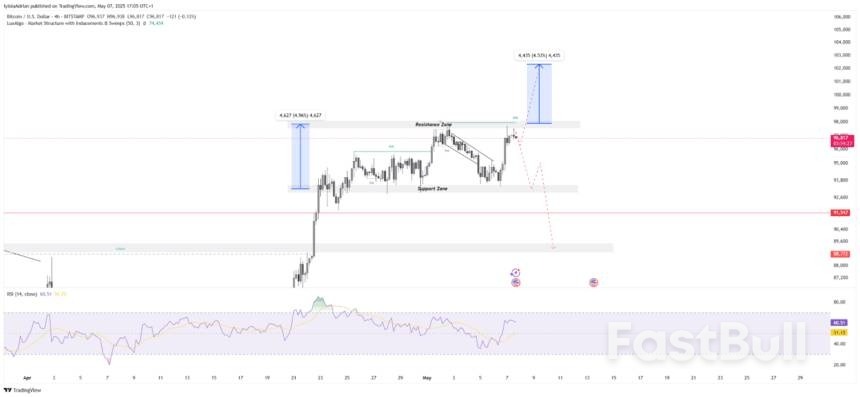
          In a recent report on May 6, Crypto exchange Bitfinex confirmed that Bitc can hit a new all-time high only if the price manages to stay above the support level at $95,000. The exchange said “The $95,000 level—currently under consolidation—is a critical pivot point, acting as the lower boundary of a three-month range.” In short, if the price stays above this level may lead to a new all-time high, but dropping below could trigger a sharp fall.

          Source: CryptoSlate

          Risk Warnings and Disclaimers
          You understand and acknowledge that there is a high degree of risk involved in trading. Following any strategies or investment methods may lead to potential losses. The content on the site is provided by our contributors and analysts for information purposes only. You are solely responsible for determining whether any trading assets, securities, strategy, or any other product is suitable for investing based on your own investment objectives and financial situation.
          Add to Favorites
          Share

          Trump’s team is finally meeting with China. The future of the global economy is riding on its success

          Adam

          Economic

          China–U.S. Trade War

          US President Donald Trump’s top trade officials will meet with their Chinese counterparts this week to discuss a de-escalation of their increasingly ugly and damaging trade war. The future of the global economy is riding on their success.
          The trade talks, the first in-person meeting between Chinese and American officials since the tit-for-tat tariff escalation kicked off in earnest in March, are unlikely to result in a trade deal, Treasury Secretary Scott Bessent said Tuesday. But tariffs have reached such a high level that trade between the two countries has dropped off dramatically. Any thaw in the trade war could be a welcome sign for businesses and consumers in both countries and around the globe.
          “The main objective of this meeting is to establish the conditions for a deal to be reached, including by defining what is feasible to be agreed upon and what isn’t,” said Alfredo Montufar-Helu, head of the Conference Board’s China Center. “There might be some quick wins, like a temporal pause of tariffs, which would bring much needed relief to businesses from both countries.”
          The United States has placed at least a 145% tariff on most Chinese imports, and China has responded with a 125% tariff on some US imports. The last tariff-free ships — those on the water when the tariffs were announced — have almost all docked, and the first ships with goods that will be subject to tariffs are arriving at the ports.
          That means businesses in China and the United States will soon face a difficult decision: pay a tariff that more than doubles the cost of the imported goods, or stop selling them altogether. That means consumers are weeks away from experiencing higher prices and some shortages.
          The punishing tariffs have already damaged both economies. The US economy went into reverse in the first quarter, its first contraction in three years, as businesses stockpiled goods in anticipation of Trump’s “Liberation Day” tariffs, which began in the second quarter. Meanwhile, China’s factory activity contracted at its fastest pace in 16 months in April, and the government is expected to inject the economy with more stimulus measures.
          Although the China-US trade standoff is by far the most aggressive, Trump has imposed large tariffs on most other countries around the world too: a 10% universal tariff on virtually all goods entering the United States, plus 25% tariffs on steel, aluminum, autos, auto parts and some goods from Mexico and Canada. So the world is watching the talks with anticipation.
          Global economists at the International Monetary Fund, OECD and World Bank have all predicted that Trump’s trade war would have disastrous effects on the global economy, slowing growth dramatically in some countries, while reigniting inflation. The United States is expected to be among the hardest-hit economies as other nations, including China, retaliate against it with higher tariffs. Many US economists and large banks predict the United States could enter a recession this year.

          A noticeable thaw

          Bessent and US Trade Representative Jamieson Greer will both travel to Geneva, Switzerland, where they will meet the Chinese officials, authorities announced Tuesday.
          In an interview with Fox News, Bessent Tuesday said the talks represent a first step, but he tried to downplay expectations for a deal.
          “My sense is that this will be about de-escalation, not about the big trade deal … but we’ve got to de-escalate before we can move forward,” Bessent said.
          Despite ongoing tensions, both countries have signaled for several weeks that the current standoff is unsustainable. Bessent and Trump have both acknowledged the tariffs are too high. In an interview with NBC News last week, Trump said he would lower tariffs on China “at some point.”
          China has largely stood firm against Trump, denying his refrains that the countries were in active negotiations — a denial that Bessent concurred with under oath in congressional testimony Tuesday. China shifted its tone slightly last week, saying it was reviewing proposals by the United States to begin trade talks – but it has remained defiant in its criticism of Trump’s trade policies.
          “We have also stated many times that China is open to dialogue, but any dialogue must be based on equality, respect, and mutual benefit,” said Lin Jian, spokesman for China’s foreign ministry on Wednesday. “Any form of pressure or coercion is unacceptable to China.”
          Although Beijing has been projecting an aura of strength, its economy is starting to take a beating. On Wednesday, the People’s Bank of China, the central bank, said it would cut the amount of cash that banks must keep in reserve by half a percentage point, in an effort to promote economic growth by boosting liquidity. The bank’s governor, Pan Gongsheng, also announced a 0.1-percentage-point reduction to the seven-day reverse repurchase rate, which will result in a cut to an important interest rate that influences mortgages.
          Wall Street welcomed the news: Markets rose on reports of the talks. Dow futures were up more than 300 points, or 0.8%. Futures for the broader S&P 500 rose 0.7% and Nasdaq futures were 0.7% higher. Asian markets were modestly higher on Wednesday.

          Trade comes to a near-halt

          As Chinese authorities frequently say in their statements about Trump’s tariffs: No one wins in a trade war. That has become evident in recent weeks as high tariffs imposed significant damage on both economies and effectively froze trade.
          The number of cargo ships headed from China to the United States fell 60% in April, according to Flexport, a logistics and freight forwarding broker. JPMorgan estimates Chinese imports into the United States will plunge by as much as 80% by the second half of the year.
          “A 60% decline in containers means 60% less stuff arriving,” Flexport CEO Ryan Petersen told CNN’s Pamela Brown Tuesday. “It’s only a matter of time before they sell through existing inventory, and then you’ll see shortages. And that’s when you see price hikes.”
          The Port of Los Angeles had expected 80 ships to arrive in May, but 20% of those have been canceled, its executive director Gene Seroka told CNN Tuesday. Customers have already canceled 13 sailings for June.
          “This week, we’re down about 35% compared to the same time last year, and these cargo ships coming in are the first ones to be attached to the tariffs that were levied against China and other locations last month,” Seroka said. “That’s why the cargo volume is so light.”
          Despite the increasingly dire warnings and economic turmoil, the two countries remain quite far from a deal. Both sides have dug in, saying they’ll need major concessions at the outset to begin negotiations. Bessent has said it could take two to three years for trade to normalize with China.
          So much is riding on the Switzerland talks. Even without a trade deal in hand, the face-to-face discussions are encouraging. With the two countries inflicting so much damage on themselves, they have left very little choice other than to start the thawing process.
          “At some point, I’m going to lower them because otherwise you could never do business with them,” Trump said in an interview with NBC’s “Meet the Press with Kristen Welker,” which taped on Friday. “They want to do business very much … their economy is collapsing.”

          Source: cnn

          To stay updated on all economic events of today, please check out our Economic calendar
          Risk Warnings and Disclaimers
          You understand and acknowledge that there is a high degree of risk involved in trading. Following any strategies or investment methods may lead to potential losses. The content on the site is provided by our contributors and analysts for information purposes only. You are solely responsible for determining whether any trading assets, securities, strategy, or any other product is suitable for investing based on your own investment objectives and financial situation.
          Add to Favorites
          Share

          About Doves and Deals

          Adam

          Economic

          China–U.S. Trade War

          Central Bank

          Wednesday morning brought a splash of green to US equity futures, as the announcement of US-China trade talks in Switzerland sent the markets into a cheerful spin. Treasury Secretary Scott Bessent is leading the charge to ease trade tensions, and investors are clearly hopeful.
          All eyes are on the Fed, although financiers are not expecting the central bank to cut rates this afternoon. The real hope among financiers is for the Fed to strike a dovish tone rather than a hawkish one. In simpler terms, they want the Fed to signal its readiness to step in if the U.S. economy starts showing signs of trouble. Of course, the central bank is always prepared to act, but it faces the delicate task of maintaining balance. It must carefully choose its words to avoid tipping the scales too far in favor of the market or coming across as overly strict.
          Tuesday's trading session started with a cloud over Wall Street, but an afternoon announcement brought a ray of hope to the financial markets. Let's break it down. Ahead of the US central bank's interest rate decision, stock indices were generally in the red. Wall Street dipped just under 1%, marking a second day of consolidation after enjoying a nine-day winning streak. Across the pond in Europe, the mood wasn't much brighter, though there were a few glimmers of hope. London's FTSE 100 managed a minuscule gain of 0.01%, but that was enough to extend its winning streak to an impressive 16 days, a feat not seen since the index's inception in 1984. While London hasn't yet reclaimed its record high from February's end, there might be a boost on the horizon, which I'll touch on shortly.
          In the United States, investors find themselves in a classic tug-of-war. On one side, there's the anxiety over the unpredictable nature of Donald Trump's policies. On the other, the tantalizing prospect of snapping up stocks at prices that are more attractive than they were a mere three months ago. So, which side is winning? It seems the allure of a bargain is proving irresistible, driven by two key factors. First, there's the anchoring bias at play. The White House applied significant pressure at the start of April, creating an impression that the situation could only improve from there. This has led investors to believe that the worst is behind us. Second, there's the ever-reliable safety net of the U.S. central bank. Investors are confident that if things start to go awry, the central bank will step in to stabilize the situation, as it has done in the past. In this high-stakes game, the fear of missing out is proving to be a powerful motivator, nudging investors to seize the moment and invest while the opportunity is ripe.
          This was illustrated yesterday, as Wall Street's leading indicators roared with delight at the announcement of preliminary talks between China and the US in Switzerland starting this weekend. Investors were all the more pleased by the news because the negotiators are not underlings, but heavyweights. Treasury Secretary Scott Bessent will lead the US side, and Vice Premier He Lifeng will represent China. This will be a simple introductory meeting, but for now the financial markets are more concerned about the existence of the dialogue than its outcome.
          This has not prevented the two rivals from continuing to proclaim that they will maintain a firm stance, nor has it prevented China from unveiling a major monetary easing package. On the agenda are a cut in the seven-day repo rate, a reduction in the reserve requirement ratio, a 500 billion yuan refinancing program for consumption and elderly care, a 300 billion yuan extension of the technology fund, and a cut in housing-related loan rates. If you want something done right, do it yourself. At the same time, other trade negotiations are underway. The United Kingdom, for example, believes it has made good progress with the US administration towards a trade agreement, although the scope of the agreement remains unclear.
          Meanwhile, geopolitical tensions have shifted from Ukraine and the Middle East to the Indo-Pakistani border. India has struck targets described as “terrorist camps” inside Pakistan in retaliation for an attack that killed many tourists in Kashmir last month. Pakistan said it shot down several Indian aircraft and vowed to retaliate, while saying it was open to talks with its neighbor.
          Returning to the financial world, there are still many earnings reports due today in Europe and the US. Yesterday's announcements were fairly mixed: AMD was fairly reassuring, but other technology players such as Arista, Marvell, and Super Micro disappointed. Today, the spotlight is on heavyweights such as Novo Nordisk in Europe and Walt Disney in the US, as we wait for the Fed's decision at 2:00 pm ET, followed by Jerome Powell's press conference at 2:30 pm.
          In Asia-Pacific, all major markets are open after a series of public holidays. Japan, Australia, China, and South Korea are posting gains of between 0.1% and 0.5%. The Indian market is down slightly, while the Pakistani stock market is falling more heavily. European indices are in the red, with the Stoxx Europe 600

          Source : marketscreener

          To stay updated on all economic events of today, please check out our Economic calendar
          Risk Warnings and Disclaimers
          You understand and acknowledge that there is a high degree of risk involved in trading. Following any strategies or investment methods may lead to potential losses. The content on the site is provided by our contributors and analysts for information purposes only. You are solely responsible for determining whether any trading assets, securities, strategy, or any other product is suitable for investing based on your own investment objectives and financial situation.
          Add to Favorites
          Share

          Bank of England poised for fourth rate cut as economic challenges mount

          Adam

          Economic

          Central Bank

          Bank of England expected to continue gradual easing cycle

          ​The monetary policy landscape in the UK appears poised for another significant shift, with markets widely expecting the Bank of England (BoE) to deliver a fourth consecutive interest rate cut at its upcoming meeting on 8 May. After beginning its easing cycle in August 2024, the central bank has carefully managed a gradual reduction in borrowing costs as inflation pressures have eased.
          ​Most analysts anticipate a modest 25 basis point reduction, which would bring the Bank Rate down from 4.5% to 4.25%. This represents a continuation of the measured approach the Monetary Policy Committee (MPC) has taken since starting its cutting cycle last year, reflecting the delicate balance policymakers must strike between supporting economic growth and ensuring inflation remains contained.
          ​While most committee members appear to favour this cautious stance, reports suggest at least one policymaker may push for a more substantial 50 basis point cut. Such a move would signal greater concern about deteriorating economic conditions, particularly in light of recent weak business activity data and mounting concerns about global trade tensions.
          ​UK businesses and consumers alike will welcome further relief after enduring the highest interest rates since the 2008 financial crisis. Forex trading could see significant volatility around the announcement, with the US dollar likely to respond sharply to both the rate decision itself and any shifts in the Bank's forward guidance.

          ​Gradual easing path expected despite inflation progress

          ​Despite clear progress on the inflation front, the BoE is expected to maintain its self-described "gradual and careful" approach to monetary easing, with forecasts suggesting approximately one rate cut per quarter through 2025 and into 2026. This measured path reflects ongoing concerns about the stickiness of certain inflation components, particularly in the services sector.
          ​The cautious stance contrasts somewhat with market expectations, which have occasionally priced in a more rapid sequence of cuts. However, barring a significant deterioration in economic data, the MPC appears committed to a methodical unwinding of its restrictive policy stance rather than abrupt changes that could unsettle markets or reignite inflation pressures.
          ​Recent economic indicators provide a mixed picture, with the UK economy showing some signs of strain despite previous resilience in the face of elevated borrowing costs. The services sector, in particular, has shown weakness in recent survey data, with business activity dropping to levels not seen since the aftermath of Liz Truss's mini-budget in late 2022.
          ​For investors and traders navigating this evolving monetary landscape, understanding the nuances of the Bank's approach will be crucial when formulating trading strategies. A continuing easing cycle typically impacts multiple asset classes, from bonds and currencies to equities and real estate, creating both risks and opportunities across financial markets.

          ​Inflation dynamics driving monetary policy decisions

          ​The story of UK inflation continues to evolve in ways that are shaping the BoE's policy decisions. While headline inflation has retreated significantly from its double-digit peak, largely helped by falling energy prices and base effects, components of the inflation basket are moving at different speeds, complicating the policy picture.
          ​Services inflation has proven particularly stubborn, remaining above the Bank's 2% target and suggesting that domestic price pressures continue to simmer beneath the surface. This persistence reflects several factors, including ongoing wage growth pressures and businesses passing on higher costs to consumers in sectors where demand remains relatively stable.
          ​Food price inflation has also remained elevated compared to pre-pandemic norms, although it too has begun to moderate. The complex interplay between these various inflation components means the Bank must look beyond headline figures to assess underlying inflationary pressures when calibrating its policy response.
          ​The Bank's economists will be particularly focused on whether the recent cooling in services inflation represents the beginning of a sustainable trend or merely a temporary respite. This assessment will be crucial in determining not just the timing of future rate cuts but also the ultimate destination for UK interest rates once the current easing cycle is complete.

          ​External factors increasingly influencing rate decisions

          ​Recent developments in global trade, particularly Donald Trump's proposed tariffs, have introduced new considerations for the BoE's rate-setting committee. The potential impact of these measures on global growth and inflation creates significant uncertainty about the appropriate path for UK monetary policy in the coming months.
          ​The International Monetary Fund (IMF) has already downgraded growth forecasts for the UK and global economy, reflecting concerns about trade tensions and their potential to disrupt supply chains and increase inflationary pressures. Bank of England Governor Andrew Bailey has publicly acknowledged these risks, suggesting they are being "taken very seriously" by policymakers.
          ​This external environment could potentially tilt the Bank toward a more accommodative stance than previously anticipated, especially if evidence mounts that economic activity is slowing more rapidly than expected. Some economists now suggest that the traditional "gradual and careful" language might be adjusted to reflect these changing circumstances.
          ​For those involved in spread betting or CFD trading, these external factors add another layer of complexity to trading central bank decisions. The interplay between domestic data, inflation concerns, and global developments creates a particularly challenging environment for predicting monetary policy moves.

          ​Long-term interest rate outlook remains uncertain

          ​Looking beyond the May rate decision, considerable uncertainty surrounds the long-term path for UK interest rates. Some analysts suggest that the Bank may need to deliver as many as four rate cuts in 2025 if inflation continues to cool and economic headwinds intensify, potentially bringing the Bank Rate toward 3.5% by early 2026.
          ​This view stands somewhat at odds with current market pricing, which has been adjusting to reflect a potentially less aggressive easing path from the Federal Reserve (Fed). With US monetary policy often influencing global interest rate expectations, these divergent outlooks highlight the difficulty of forecasting policy several years ahead.
          ​The policy divergence between major central banks adds another layer of complexity to the outlook. With the European Central Bank (ECB) having moved earlier than the BoE on rate cuts, and uncertainty surrounding the Fed's policy path, currency markets may experience increased volatility as relative interest rate expectations adjust.
          ​These divergent paths create both challenges and opportunities for traders focused on currency pairs like GBP/USD and EUR/GBP, which are particularly sensitive to interest rate differentials. The coming months will likely see markets continually reassessing relative central bank positions, potentially creating tradable moves in forex markets.

          ​How to trade the Bank of England rate decision

          ​Trading central bank decisions effectively requires thorough preparation and a clear strategy. Start by researching current market expectations for the upcoming decision, focusing not just on the headline rate change but also on the anticipated tone of the accompanying statement and updated economic projections.
          ​Consider whether to approach the event through forex trading or using alternative instruments like interest rate futures or UK-focused equity indices such as the FTSE 100. Each market will respond differently to various aspects of the announcement, offering diverse opportunities depending on how events unfold.
          ​Once you've decided on your approach, open a trading account that provides access to your chosen markets. IG's platforms offer comprehensive coverage of markets that respond to BoE decisions, including sterling currency pairs, UK government bonds, and equity indices, all accessible through spread betting or CFD trading accounts.
          ​Remember that volatility often increases around central bank announcements, making risk management particularly important. Consider using stop losses to protect your position if markets move against you, and think carefully about position sizing given the potential for sharp price movements during and immediately after the Bank's announcement.

          ​Potential market impacts beyond interest rates

          ​While the immediate focus will be on the interest rate decision itself, traders should look beyond the headline figure to assess broader market implications. The Bank's updated economic forecasts for growth and inflation will provide crucial context for the rate decision and may prove more significant for market sentiment than the widely anticipated 25bp cut.
          ​The pound sterling will likely experience heightened volatility around the announcement, with its reaction determined not just by the rate decision but by any signals regarding the future path of policy. A more dovish tone than expected could pressure the currency, while hints at maintaining the current pace of easing might provide support.
          ​UK equity markets will also be watching closely, with different sectors potentially responding in contrasting ways. Banks and financial stocks often benefit from higher interest rates due to improved net interest margins, meaning a clear signal of an accelerated cutting cycle could weigh on this sector while boosting more rate-sensitive areas like utilities and real estate.
          ​Bond markets will be particularly attuned to any shifts in the Bank's language around inflation persistence or economic growth. Gilt yields have adjusted significantly in anticipation of the easing cycle, but could still move sharply if the Bank's outlook diverges from current market expectations, creating opportunities for bond traders.
          ​The BoE's May rate decision represents the next step in its ongoing easing cycle that began last August. While a fourth cut appears likely, external factors including potential trade tensions and slowing economic activity may influence both the immediate decision and forward guidance. Investors should prepare for potential shifts in the Bank's cautious approach as it navigates an increasingly complex global landscape.

          Source : ig

          To stay updated on all economic events of today, please check out our Economic calendar
          Risk Warnings and Disclaimers
          You understand and acknowledge that there is a high degree of risk involved in trading. Following any strategies or investment methods may lead to potential losses. The content on the site is provided by our contributors and analysts for information purposes only. You are solely responsible for determining whether any trading assets, securities, strategy, or any other product is suitable for investing based on your own investment objectives and financial situation.
          Add to Favorites
          Share

          China's Xi Arrives In Moscow In Show Of Support For Putin After Ukrainian Drones Target Capital

          Diana Wallace

          Political

          Chinese President Xi Jinping flew into Moscow on Wednesday for talks with President Vladimir Putin and a pomp-filled visit that Kyiv has made clear it opposes after Ukrainian drones targeted Moscow shortly before he touched down.

          Xi, whose country buys more Russian oil and gas than any other, and which has thrown Moscow an economic lifeline that has helped it navigate Western sanctions imposed over its war in Ukraine, landed at Moscow's Vnukovo-2 airport soon after Russian authorities said they had brought down another Ukrainian drone outside the capital.

          It was the third day Ukraine has targeted Moscow with drones and one of Moscow's main airports was forced to temporarily suspend its activities less than three hours before Xi's arrival.

          When asked during a news briefing about air attacks by both sides on each others' capitals, a spokesperson for the Chinese foreign ministry did not comment on Xi's trip, saying only that the "top priority" was to avoid an escalation in tensions.

          The Kremlin said the attempted Ukrainian attacks on Moscow showed Kyiv's tendency to commit "acts of terrorism" and that Russia's intelligence services and military were doing everything necessary to ensure the security of upcoming World War Two commemorations which Xi is due to attend.

          Ukrainian officials said on Wednesday that Russia had launched its own air attack on Kyiv overnight, killing a mother and her son. Russia says it only targets military objects.

          Xi is the most powerful world leader expected at a military parade on Moscow's Red Square on Friday to mark the 80th anniversary of the victory of the Soviet Union and its allies over Nazi Germany.

          His visit hands President Vladimir Putin an important diplomatic boost at a time when the Russian leader is keen to show his country is not isolated on the world stage. The Kremlin has touted Xi's presence, along with that of 28 other world leaders, as a sign of Russia's growing global authority.

          But Ukraine's Foreign Ministry - in comments that seemed directed at China whose troops are due to march on Red Square - on Tuesday urged countries not to send their militaries to participate in the May 9 parade, saying such participation would go against some countries' declared neutrality in the war.

          Drones Targeted Moscow

          Moscow Mayor Sergei Sobyanin said that Russian air defence units had destroyed at least 14 Ukrainian drones headed for the Russian capital overnight. He later said at least two more had been brought down during the day.

          Xi has called for talks to end the war in Ukraine and has accused the U.S. of stoking the war with weapons supplies to Kyiv. Ukrainian President Volodymyr Zelenskiy has in the past urged him to try to persuade Putin to end the war.

          Xi is due to hold talks with the Russian leader on Thursday and to join other world leaders for the parade on Friday.

          His visit comes as U.S. President Donald Trump is trying to push Moscow and Kyiv to find a way to end the war in Ukraine, with both sides blaming each other for a lack of progress.

          Locked in a tariff war with the United States, Xi is expected to sign numerous agreements to deepen an already tight strategic partnership with Moscow, which has consistently seen China crowned Russia's biggest trading partner.

          Despite recent efforts under Trump to reset U.S.-Russia ties, Putin is expected to present a united front with Xi against Washington, whose dominance and "exceptionalism" both countries have questioned, arguing for a more multipolar world.

          Post-war International Order

          In a signed article published by Russian media on Wednesday, Xi wrote that China and Russia must "firmly maintain the post-war international order."

          "The two sides should jointly resist any attempt to disrupt and undermine China-Russia friendship and mutual trust," read the text of the article, Chinese state media reported.

          Russian Foreign Ministry spokesperson Maria Zakharova called the visit "one of the central events in Russian-Chinese relations this year."

          "The World War Two focus is about the post-war international order and now the U.S. is dismantling or undermining it. So China and Russia will frame themselves as the defenders of the international order and the UN system, and oppose U.S. unilateralism and hegemony," said Yun Sun, a China politics analyst at the Stimson Center in Washington.

          In their talks, Putin and Xi will discuss the "most sensitive" issues, including energy cooperation and the proposed but yet to be built Power of Siberia 2 gas pipeline to China, Yuri Ushakov, a top Kremlin aide, said.

          Source: Reuters

          Risk Warnings and Disclaimers
          You understand and acknowledge that there is a high degree of risk involved in trading. Following any strategies or investment methods may lead to potential losses. The content on the site is provided by our contributors and analysts for information purposes only. You are solely responsible for determining whether any trading assets, securities, strategy, or any other product is suitable for investing based on your own investment objectives and financial situation.
          Add to Favorites
          Share

          EU Will Announce Countermeasures Against US Tariffs On Thursday

          Thomas

          Economic

          "Tomorrow we will announce next preparatory steps, both in the area of possible rebalancing measures, and also in the areas important for the further discussions," Sefcovic said during a news conference in Singapore on Wednesday, in comments reported by Reuters.

          CNBC has contacted the European Commission for comment.

          In a statement on Tuesday, Sefcovic said: "A negotiated solution [with the U.S.] remains our clear preference, respecting our interests and regulatory autonomy. To help get talks underway, we've scoped out ways to reduce barriers. We now need the U.S. to show it's ready for a fair, balanced deal."

          Trump initially imposed a 20% "reciprocal" tariff on all goods coming from the EU but paused the measures for 90 days for negotiations, lowering the duty to 10% until that time. A 25% tariff on foreign cars and steel and aluminum imports remains in place.

          The EU has currently paused its initial set of retaliatory measures — a response to the metals duties — which target around 21 billion euros ($24.1 billion) worth of U.S. goods, chiefly with a tariff rate of 25%.

          Source: CNBC

          To stay updated on all economic events of today, please check out our Economic calendar
          Risk Warnings and Disclaimers
          You understand and acknowledge that there is a high degree of risk involved in trading. Following any strategies or investment methods may lead to potential losses. The content on the site is provided by our contributors and analysts for information purposes only. You are solely responsible for determining whether any trading assets, securities, strategy, or any other product is suitable for investing based on your own investment objectives and financial situation.
          Add to Favorites
          Share
          FastBull
          Copyright © 2025 FastBull Ltd

          728 RM B 7/F GEE LOK IND BLDG NO 34 HUNG TO RD KWUN TONG KLN HONG KONG

          TelegramInstagramTwitterfacebooklinkedin
          App Store Google Play Google Play
          Products
          Charts

          Chats

          Q&A with Experts
          Screeners
          Economic Calendar
          Data
          Tools
          Membership
          Features
          Function
          Markets
          Copy Trading
          Latest Signals
          Contests
          News
          Analysis
          24/7
          Columns
          Education
          Company
          Careers
          About Us
          Contact Us
          Advertising
          Help Center
          Feedback
          User Agreement
          Privacy Policy
          Business

          White Label

          Data API

          Web Plug-ins

          Poster Maker

          Affiliate Program

          Risk Disclosure

          The risk of loss in trading financial instruments such as stocks, FX, commodities, futures, bonds, ETFs and crypto can be substantial. You may sustain a total loss of the funds that you deposit with your broker. Therefore, you should carefully consider whether such trading is suitable for you in light of your circumstances and financial resources.

          No decision to invest should be made without thoroughly conducting due diligence by yourself or consulting with your financial advisors. Our web content might not suit you since we don't know your financial conditions and investment needs. Our financial information might have latency or contain inaccuracy, so you should be fully responsible for any of your trading and investment decisions. The company will not be responsible for your capital loss.

          Without getting permission from the website, you are not allowed to copy the website's graphics, texts, or trademarks. Intellectual property rights in the content or data incorporated into this website belong to its providers and exchange merchants.

          Not Logged In

          Log in to access more features

          FastBull Membership

          Not yet

          Purchase

          Become a signal provider
          Help Center
          Customer Service
          Dark Mode
          Price Up/Down Colors

          Log In

          Sign Up

          Position
          Layout
          Fullscreen
          Default to Chart
          The chart page opens by default when you visit fastbull.com
