Markets
News
Analysis
User
24/7
Economic Calendar
Education
Data
- Names
- Latest
- Prev



Signal Accounts for Members
All Signal Accounts
All Contests


U.S. EIA Weekly Crude Demand Projected by ProductionA:--
F: --
P: --
U.S. EIA Weekly Gasoline Stocks ChangeA:--
F: --
P: --
South Korea Industrial Output MoM (SA) (Nov)A:--
F: --
South Korea Retail Sales MoM (Nov)A:--
F: --
P: --
South Korea Services Output MoM (Nov)A:--
F: --
P: --
Russia IHS Markit Services PMI (Dec)A:--
F: --
P: --
Turkey Economic Sentiment Indicator (Dec)A:--
F: --
P: --
Brazil Unemployment Rate (Nov)A:--
F: --
P: --
U.S. Weekly Redbook Index YoYA:--
F: --
P: --
U.S. S&P/CS 10-City Home Price Index YoY (Oct)A:--
F: --
P: --
U.S. S&P/CS 10-City Home Price Index MoM (Not SA) (Oct)A:--
F: --
P: --
U.S. S&P/CS 20-City Home Price Index (Not SA) (Oct)A:--
F: --
P: --
U.S. S&P/CS 20-City Home Price Index MoM (Not SA) (Oct)A:--
F: --
P: --
U.S. FHFA House Price Index YoY (Oct)A:--
F: --
U.S. S&P/CS 20-City Home Price Index YoY (Not SA) (Oct)A:--
F: --
P: --
U.S. S&P/CS 20-City Home Price Index MoM (SA) (Oct)A:--
F: --
U.S. FHFA House Price Index (Oct)A:--
F: --
P: --
U.S. FHFA House Price Index MoM (Oct)A:--
F: --
U.S. Chicago PMI (Dec)A:--
F: --
P: --
Brazil CAGED Net Payroll Jobs (Nov)A:--
F: --
P: --
U.S. Weekly Total Oil Rig CountA:--
F: --
P: --
U.S. Weekly Total Rig CountA:--
F: --
P: --
FOMC Meeting Minutes
U.S. API Weekly Refined Oil StocksA:--
F: --
P: --
U.S. API Weekly Crude Oil StocksA:--
F: --
P: --
U.S. API Weekly Cushing Crude Oil StocksA:--
F: --
P: --
U.S. API Weekly Gasoline StocksA:--
F: --
P: --
South Korea CPI YoY (Dec)A:--
F: --
P: --
China, Mainland NBS Manufacturing PMI (Dec)A:--
F: --
P: --
China, Mainland Composite PMI (Dec)A:--
F: --
P: --
China, Mainland NBS Non-manufacturing PMI (Dec)A:--
F: --
P: --
China, Mainland Caixin Manufacturing PMI (SA) (Dec)--
F: --
P: --
Turkey Trade Balance (Nov)--
F: --
P: --
Russia CPI YoY (Dec)--
F: --
P: --
U.S. MBA Mortgage Application Activity Index WoW--
F: --
P: --
South Africa Trade Balance (Nov)--
F: --
P: --
U.S. Initial Jobless Claims 4-Week Avg. (SA)--
F: --
P: --
U.S. Weekly Continued Jobless Claims (SA)--
F: --
P: --
U.S. Weekly Initial Jobless Claims (SA)--
F: --
P: --
U.S. EIA Weekly Cushing, Oklahoma Crude Oil Stocks Change--
F: --
P: --
U.S. EIA Weekly Crude Demand Projected by Production--
F: --
P: --
U.S. EIA Weekly Gasoline Stocks Change--
F: --
P: --
U.S. EIA Weekly Crude Stocks Change--
F: --
P: --
U.S. EIA Weekly Heating Oil Stock Changes--
F: --
P: --
U.S. EIA Weekly Crude Oil Imports Changes--
F: --
P: --
U.S. EIA Weekly Natural Gas Stocks Change--
F: --
P: --
South Korea Trade Balance Prelim (Dec)--
F: --
P: --
Indonesia Core Inflation YoY (Dec)--
F: --
P: --
Indonesia Inflation Rate YoY (Dec)--
F: --
P: --
Turkey Manufacturing PMI (Dec)--
F: --
P: --
Brazil IHS Markit Manufacturing PMI (Dec)--
F: --
P: --
Mexico Manufacturing PMI (Dec)--
F: --
P: --
South Korea IHS Markit Manufacturing PMI (SA) (Dec)--
F: --
P: --
Indonesia IHS Markit Manufacturing PMI (Dec)--
F: --
P: --
India HSBC Manufacturing PMI Final (Dec)--
F: --
P: --
Russia IHS Markit Manufacturing PMI (Dec)--
F: --
P: --
U.K. Nationwide House Price Index MoM (Dec)--
F: --
P: --
U.K. Nationwide House Price Index YoY (Dec)--
F: --
P: --
Turkey Manufacturing PMI (Dec)--
F: --
P: --


No matching data
Latest Views
Latest Views
Trending Topics
Top Columnists
Latest Update
White Label
Data API
Web Plug-ins
Affiliate Program
View All

No data
U.S. tariff rates surged above 15% in 2025 and are expected to stay near that level in 2026, with analysts seeing little chance of rollback despite legal and political pressures.


Dec 30 (Reuters) - U.S. home prices rose in October at the slowest annual rate in more than 13 years, government data showed on Tuesday, in a sign of improving affordability in the long-struggling housing market.
The Federal Housing Finance Agency said home prices rose 1.7% from a year earlier in October after climbing by an upwardly revised 1.8% in September. That marked the smallest annual price increase since March 2012, when prices first started rising after a five-year slump triggered by the global financial crisis.
On a regional basis, annual price changes ranged from a drop of 0.7% in the lower Midwest to an increase of 5.3% in the Mid-Atlantic region.
Home price increases are now a fraction of what they were during and immediately after the COVID-19 pandemic, when widespread work-from-home policies sent the real estate market into a frenzy and sent prices spiraling higher at annual rates approaching 20%.
On a monthly basis, U.S. home prices rose 0.4% in October following a downwardly revised decline of 0.1% in September.


For three days, after the latest Russian air attacks on Ukraine, Olena Pazhydaieva has had no power or heat in her apartment in Vyshhorod, a satellite town 20 km (12 miles) north of Kyiv.
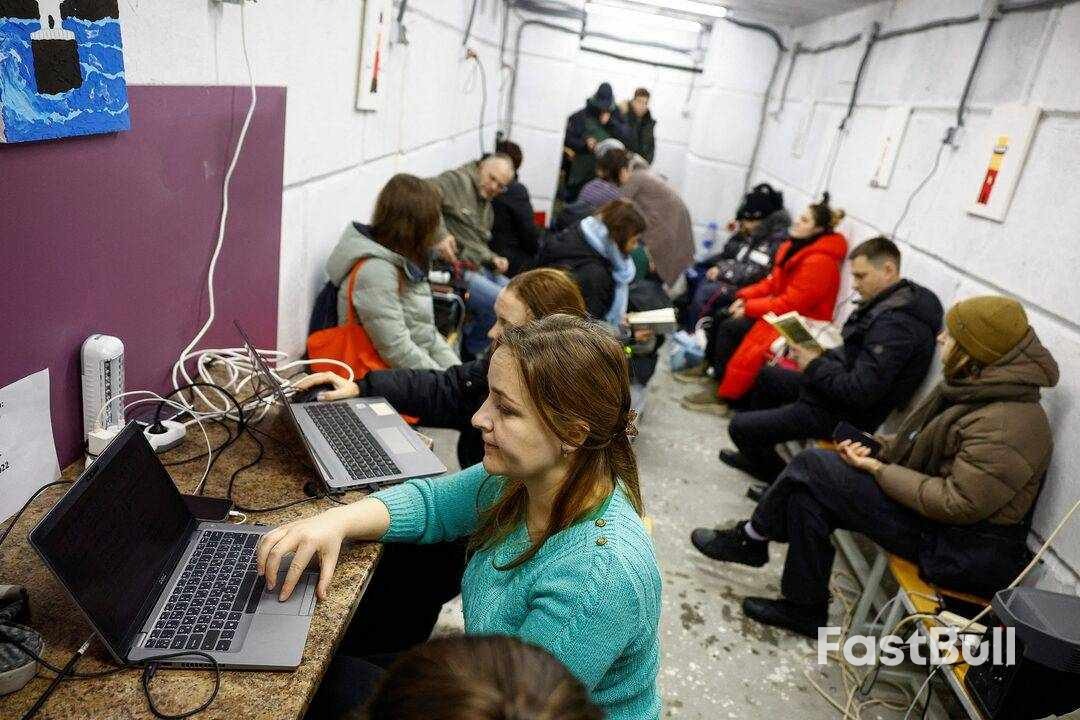
With night-time temperatures dipping to -3 C (27 Fahrenheit), she now spends much of the day with her six-year-old son in a shelter the size of a small shack, but with heating and power to connect the devices she needs to work.
About 20 people crowd into the building - dubbed "islet of warmth and power" on the sign outside - with mobile phones and laptops charging in order to keep working and connected.
"After the last attack, we haven't had electricity for the third day, power hasn't appeared at all, and now we're forced to work here in a shelter, where we can charge our stations, charge our laptops," Pazhydaieva said.
"It's good that there's internet. We can work. I'm not the only person here, there are many people."
Russian drone and missile attacks have long targeted energy facilities throughout Ukraine, triggering blackouts.
The latest massive attack knocked out power to 19,000 customers in Kyiv region surrounding the capital, according to Ukraine's Energy Ministry.
The shack is one of a large network of "resilience points" set up by authorities to keep people warm and able to function.
But family life without power can be complicated.
"We go to an after-school group and they usually take the kids in on holidays, too," Pazhydaieva said. "But when we went there today, we went inside, it was super cold and all the kids were wearing jackets...At least it's warm here."
Each family finds new ways to cope.
For Pazhydaieva, that means spending time at the "islet" to recharge devices and then trying to connect the water heater at home to a portable power station to keep everyone warm.
She has little faith in the U.S.-backed talks on resolving the conflict, particularly U.S. President Donald Trump's remark at a meeting on Sunday in Florida that Russian President Vladimir Putin "wants Ukraine to succeed".
"When Trump says that Putin wants prosperity for Ukraine as missiles are flying at us, somehow these two statements don't really match up," she said.
"Right now we're just observing and not much depends on us. We're doing the best we can here where we are now."
The United Arab Emirates said on Tuesday said it was pulling out its remaining forces in Yemen after Saudi Arabia backed a call for UAE forces to leave the country within 24 hours.
The move followed a Saudi-led coalition airstrike on the southern Yemeni port of Mukalla.
The attack on what Riyadh said was a UAE-linked weapons shipment marked the most significant escalation between Riyadh and Abu Dhabi to date in a widening rift between the two Gulf powers.
Once the twin pillars of regional security, the two Gulf heavyweights have seen their interests diverge on everything from oil quotas to geopolitical influence.
Declaring its national security a red line, Saudi Arabia earlier on Tuesday alleged the UAE had pressured Yemen's southern separatists to conduct military operations that had reached the kingdom's borders.
It was Riyadh's strongest language yet against the UAE in the falling-out between the neighbours, who once cooperated in a coalition against Yemen's Iran‑aligned Houthis but whose interests in Yemen have steadily grown apart in recent years.
Frictions grew inside the coalition as Abu Dhabi backed southern separatists seeking self-rule, while Riyadh kept supporting Yemen's internationally recognised government, eventually creating an open rift between the Gulf allies.
On Tuesday the coalition struck what it said was a dock used to provide foreign military support to the UAE-backed separatists. The head of Yemen's Saudi-backed presidential council gave Emirati forces an ultimatum of 24 hours to leave.
The UAE said in a statement that it had been surprised by the airstrike, and that the shipment that had been attacked did not contain weapons and was destined for Emirati forces.
Yemen's presidential council head, Rashad al-Alimi, cancelled a defence pact with the UAE, the Yemeni state news agency said, and accused the UAE in a televised speech of fuelling strife in Yemen with its support for the separatist Southern Transitional Council (STC).
"Unfortunately, it has been definitively confirmed that the United Arab Emirates pressured and directed the STC to undermine and rebel against the authority of the state through military escalation," he said.
The UAE earlier stressed that "dealing with recent developments must be done responsibly and in a way that prevents escalation, based on reliable facts and existing coordination between the concerned parties."
Major stock indexes in the Gulf fell.
Saudi Arabia and the UAE are both major players in the OPEC oil exporters' group, and any disagreements between the two could hamper consensus on oil output decisions.
They and six other OPEC+ members are meeting online on Sunday, and OPEC+ delegates say they will continue their current policy for no change in first-quarter production.
Fresh data from CoinShares highlights a notable shift in institutional crypto positioning, with XRP emerging as the clear standout amid a broader market rotation.
According to the latest weekly digital asset fund flows report, XRP exchange-traded products (ETPs) recorded $70.2 million in inflows, significantly outperforming the rest of the market. Solana followed at a distance with $7.5 million in inflows, while industry heavyweights Bitcoin and Ethereum faced substantial capital withdrawals.
The stark divergence in flows highlights a clear shift in institutional sentiment. Bitcoin ETPs saw $443 million in weekly outflows, one of the sharpest pullbacks in recent months, while Ethereum products lost $59.3 million, signaling reduced exposure to former market leaders as investors reallocate toward higher risk-adjusted opportunities.
XRP is leading institutional rotation despite a volatile crypto market. Boosted by clearer regulations and renewed confidence in its long-term utility, XRP ETP inflows signal that institutions increasingly see it as a regulated, differentiated investment, moving beyond a high-beta proxy for Bitcoin or Ethereum.
On the other hand, Solana's $7.5M inflows, while smaller than XRP's, highlight targeted institutional rotation rather than a crypto-wide pullback. Its expanding ecosystem and high-performance blockchain continue to attract cautious but strategic investor interest.
Well, Bitcoin and Ethereum outflows signal a strategic reassessment rather than panic. Institutions are rotating capital toward tokens with clear catalysts and growth narratives after locking in gains from earlier rallies.
Therefore, CoinShares data shows XRP emerging as the clear winner in institutional rotation with price currently sitting at $1.87 per CoinCodex data.
While Bitcoin and Ethereum face heavy outflows, XRP's strong inflows reflect selective capital allocation, growing regulatory confidence, and targeted institutional conviction, trends likely to influence market behavior in the coming weeks.
CoinShares' latest data signals a shift in institutional crypto strategy. XRP's strong inflows highlight its rising appeal as a regulated, strategic investment, while Bitcoin and Ethereum outflows reflect a rotation toward assets with clearer catalysts.
Therefore, XRP's dominance underscores a move from broad exposure to selective, conviction-driven positioning, positioning it as a central focus for market momentum.
White Label
Data API
Web Plug-ins
Poster Maker
Affiliate Program
The risk of loss in trading financial instruments such as stocks, FX, commodities, futures, bonds, ETFs and crypto can be substantial. You may sustain a total loss of the funds that you deposit with your broker. Therefore, you should carefully consider whether such trading is suitable for you in light of your circumstances and financial resources.
No decision to invest should be made without thoroughly conducting due diligence by yourself or consulting with your financial advisors. Our web content might not suit you since we don't know your financial conditions and investment needs. Our financial information might have latency or contain inaccuracy, so you should be fully responsible for any of your trading and investment decisions. The company will not be responsible for your capital loss.
Without getting permission from the website, you are not allowed to copy the website's graphics, texts, or trademarks. Intellectual property rights in the content or data incorporated into this website belong to its providers and exchange merchants.
Not Logged In
Log in to access more features

FastBull Membership
Not yet
Purchase
Log In
Sign Up