• Trade
  • Markets
  • Copy
  • Contests
  • News
  • 24/7
  • Calendar
  • Q&A
  • Chats
Trending
Screeners
SYMBOL
LAST
BID
ASK
HIGH
LOW
NET CHG.
%CHG.
SPREAD
SPX
S&P 500 Index
6827.42
6827.42
6827.42
6899.86
6801.80
-73.58
-1.07%
--
DJI
Dow Jones Industrial Average
48458.04
48458.04
48458.04
48886.86
48334.10
-245.98
-0.51%
--
IXIC
NASDAQ Composite Index
23195.16
23195.16
23195.16
23554.89
23094.51
-398.69
-1.69%
--
USDX
US Dollar Index
98.000
98.080
98.000
98.070
97.920
+0.050
+ 0.05%
--
EURUSD
Euro / US Dollar
1.17320
1.17328
1.17320
1.17447
1.17283
-0.00074
-0.06%
--
GBPUSD
Pound Sterling / US Dollar
1.33549
1.33559
1.33549
1.33740
1.33546
-0.00158
-0.12%
--
XAUUSD
Gold / US Dollar
4328.96
4329.35
4328.96
4329.64
4294.68
+29.57
+ 0.69%
--
WTI
Light Sweet Crude Oil
57.533
57.570
57.533
57.601
57.194
+0.300
+ 0.52%
--

Community Accounts

Signal Accounts
--
Profit Accounts
--
Loss Accounts
--
View More

Become a signal provider

Sell trading signals to earn additional income

View More

Guide to Copy Trading

Get started with ease and confidence

View More

Signal Accounts for Members

All Signal Accounts

Best Return
  • Best Return
  • Best P/L
  • Best MDD
Past 1W
  • Past 1W
  • Past 1M
  • Past 1Y

All Contests

  • All
  • Trump Updates
  • Recommend
  • Stocks
  • Cryptocurrencies
  • Central Banks
  • Featured News
Top News Only
Share

Hsi Closes Midday At 25736, Down 240 Pts, Hsti Closes Midday At 5537, Down 100 Pts, Hansoh Pharma Down Over 7%, Ping An, Youran Dairy, Logan Group Hit New Highs

Share

India Foreign Ministry: Foreign Minister To Visit United Arab Emirates And Israel

Share

Reuters Poll - Bank Of Thailand To Lower Key Policy Rate To 1.00% In Q1 Of 2026, Said A Majority Of Economists

Share

Reuters Poll - Bank Of Thailand To Cut Its Key Interest Rate To 1.25% On December 17, Said 26 Of 27 Economists

Share

Thai Finance Minister: Earlier Stimulus Measures To Shore Up Economy

Share

Thai Finance Minister: Strong Baht Driven By Capital Inflows

Share

Thai Finance Minister: Has Discussed With Central Bank To Handle Baht

Share

India's Nifty Bank Futures Down 0.1% In Pre-Open Trade

Share

India's Nifty 50 Futures Down 0.3% In Pre-Open Trade

Share

India's Nifty 50 Index Down 0.45% In Pre-Open Trade

Share

Indian Rupee Weakens Past 90.55 Versus USA Dollar To All-Time Low

Share

China's Fossil-Fuelled Power Generation Falls 4.2% Year-On-Year In November

Share

Indian Rupee Opens Down 0.1% At 90.5450 Per USA Dollar, Versus 90.4150 Previous Close

Share

Australia Home Minister: Father Involved In Bondi Gun Attack Came To Australia On Student Visa, Son Is An Australian-Born Citizen

Share

Australian Prime Minister Albanese: Stricter Gun Control Laws Will Include Restrictions On The Number Of Guns An Individual Can Own Or License To Use

Share

Australia's Prime Minister Albanese: We Are Considering A Review Of Gun Licenses For Some Time

Share

Australia's Prime Minister Albanese: Government Considering Tougher Gun Laws

Share

China Stats Bureau Spokesperson: Next Year, Adverse Impact Of Protectionism And Unilateralism May Continue

Share

China's Onshore Yuan Strengthens To A High Of 7.0516 Per Dollar, Strongest Level Since Oct 8, 2024

Share

Indonesia's November Refined Tin Exports At 7458.64 Metric Tons

TIME
ACT
FCST
PREV
U.K. Trade Balance (Oct)

A:--

F: --

P: --

France HICP Final MoM (Nov)

A:--

F: --

P: --

China, Mainland Outstanding Loans Growth YoY (Nov)

A:--

F: --

P: --

China, Mainland M2 Money Supply YoY (Nov)

A:--

F: --

P: --

China, Mainland M0 Money Supply YoY (Nov)

A:--

F: --

P: --

China, Mainland M1 Money Supply YoY (Nov)

A:--

F: --

P: --

India CPI YoY (Nov)

A:--

F: --

P: --

India Deposit Gowth YoY

A:--

F: --

P: --

Brazil Services Growth YoY (Oct)

A:--

F: --

P: --

Mexico Industrial Output YoY (Oct)

A:--

F: --

P: --

Russia Trade Balance (Oct)

A:--

F: --

P: --

Philadelphia Fed President Henry Paulson delivers a speech
Canada Building Permits MoM (SA) (Oct)

A:--

F: --

P: --

Canada Wholesale Sales YoY (Oct)

A:--

F: --

P: --

Canada Wholesale Inventory MoM (Oct)

A:--

F: --

P: --

Canada Wholesale Inventory YoY (Oct)

A:--

F: --

P: --

Canada Wholesale Sales MoM (SA) (Oct)

A:--

F: --

P: --

Germany Current Account (Not SA) (Oct)

A:--

F: --

P: --

U.S. Weekly Total Rig Count

A:--

F: --

P: --

U.S. Weekly Total Oil Rig Count

A:--

F: --

P: --

Japan Tankan Small Manufacturing Outlook Index (Q4)

A:--

F: --

P: --

Japan Tankan Large Non-Manufacturing Diffusion Index (Q4)

A:--

F: --

P: --

Japan Tankan Large Non-Manufacturing Outlook Index (Q4)

A:--

F: --

P: --

Japan Tankan Large Manufacturing Outlook Index (Q4)

A:--

F: --

P: --

Japan Tankan Small Manufacturing Diffusion Index (Q4)

A:--

F: --

P: --

Japan Tankan Large Manufacturing Diffusion Index (Q4)

A:--

F: --

P: --

Japan Tankan Large-Enterprise Capital Expenditure YoY (Q4)

A:--

F: --

P: --

U.K. Rightmove House Price Index YoY (Dec)

A:--

F: --

P: --

China, Mainland Industrial Output YoY (YTD) (Nov)

A:--

F: --

P: --

China, Mainland Urban Area Unemployment Rate (Nov)

A:--

F: --

P: --

Saudi Arabia CPI YoY (Nov)

--

F: --

P: --

Euro Zone Industrial Output YoY (Oct)

--

F: --

P: --

Euro Zone Industrial Output MoM (Oct)

--

F: --

P: --

Canada Existing Home Sales MoM (Nov)

--

F: --

P: --

Euro Zone Total Reserve Assets (Nov)

--

F: --

P: --

U.K. Inflation Rate Expectations

--

F: --

P: --

Canada National Economic Confidence Index

--

F: --

P: --

Canada New Housing Starts (Nov)

--

F: --

P: --

U.S. NY Fed Manufacturing Employment Index (Dec)

--

F: --

P: --

U.S. NY Fed Manufacturing Index (Dec)

--

F: --

P: --

Canada Core CPI YoY (Nov)

--

F: --

P: --

Canada Manufacturing Unfilled Orders MoM (Oct)

--

F: --

P: --

U.S. NY Fed Manufacturing Prices Received Index (Dec)

--

F: --

P: --

U.S. NY Fed Manufacturing New Orders Index (Dec)

--

F: --

P: --

Canada Manufacturing New Orders MoM (Oct)

--

F: --

P: --

Canada Core CPI MoM (Nov)

--

F: --

P: --

Canada Trimmed CPI YoY (SA) (Nov)

--

F: --

P: --

Canada Manufacturing Inventory MoM (Oct)

--

F: --

P: --

Canada CPI YoY (Nov)

--

F: --

P: --

Canada CPI MoM (Nov)

--

F: --

P: --

Canada CPI YoY (SA) (Nov)

--

F: --

P: --

Canada Core CPI MoM (SA) (Nov)

--

F: --

P: --

Canada CPI MoM (SA) (Nov)

--

F: --

P: --

Federal Reserve Board Governor Milan delivered a speech
U.S. NAHB Housing Market Index (Dec)

--

F: --

P: --

Australia Composite PMI Prelim (Dec)

--

F: --

P: --

Australia Services PMI Prelim (Dec)

--

F: --

P: --

Australia Manufacturing PMI Prelim (Dec)

--

F: --

P: --

Japan Manufacturing PMI Prelim (SA) (Dec)

--

F: --

P: --

U.K. Unemployment Rate (Nov)

--

F: --

P: --

U.K. 3-Month ILO Unemployment Rate (Oct)

--

F: --

P: --

Q&A with Experts
    • All
    • Chatrooms
    • Groups
    • Friends
    Connecting
    .
    .
    .
    Type here...
    Add Symbol or Code

      No matching data

      All
      Trump Updates
      Recommend
      Stocks
      Cryptocurrencies
      Central Banks
      Featured News
      • All
      • Russia-Ukraine Conflict
      • Middle East Flashpoint
      • All
      • Russia-Ukraine Conflict
      • Middle East Flashpoint
      Search
      Products

      Charts Free Forever

      Chats Q&A with Experts
      Screeners Economic Calendar Data Tools
      Membership Features
      Data Warehouse Market Trends Institutional Data Policy Rates Macro

      Market Trends

      Market Sentiment Order Book Forex Correlations

      Top Indicators

      Charts Free Forever
      Markets

      News

      News Analysis 24/7 Columns Education
      From Institutions From Analysts
      Topics Columnists

      Latest Views

      Latest Views

      Trending Topics

      Top Columnists

      Latest Update

      Signals

      Copy Rankings Latest Signals Become a signal provider AI Rating
      Contests
      Brokers

      Overview Brokers Assessment Rankings Regulators News Claims
      Broker listing Forex Brokers Comparison Tool Live Spread Comparison Scam
      Q&A Complaint Scam Alert Videos Tips to Detect Scam
      More

      Business
      Events
      Careers About Us Advertising Help Center

      White Label

      Data API

      Web Plug-ins

      Affiliate Program

      Awards Institution Evaluation IB Seminar Salon Event Exhibition
      Vietnam Thailand Singapore Dubai
      Fans Party Investment Sharing Session
      FastBull Summit BrokersView Expo
      Recent Searches
        Top Searches
          Markets
          News
          Analysis
          User
          24/7
          Economic Calendar
          Education
          Data
          • Names
          • Latest
          • Prev

          View All

          No data

          Scan to Download

          Faster Charts, Chat Faster!

          Download App
          English
          • English
          • Español
          • العربية
          • Bahasa Indonesia
          • Bahasa Melayu
          • Tiếng Việt
          • ภาษาไทย
          • Français
          • Italiano
          • Türkçe
          • Русский язык
          • 简中
          • 繁中
          Open Account
          Search
          Products
          Charts Free Forever
          Markets
          News
          Signals

          Copy Rankings Latest Signals Become a signal provider AI Rating
          Contests
          Brokers

          Overview Brokers Assessment Rankings Regulators News Claims
          Broker listing Forex Brokers Comparison Tool Live Spread Comparison Scam
          Q&A Complaint Scam Alert Videos Tips to Detect Scam
          More

          Business
          Events
          Careers About Us Advertising Help Center

          White Label

          Data API

          Web Plug-ins

          Affiliate Program

          Awards Institution Evaluation IB Seminar Salon Event Exhibition
          Vietnam Thailand Singapore Dubai
          Fans Party Investment Sharing Session
          FastBull Summit BrokersView Expo

          US Second-quarter GDP Revised Higher; Weekly Jobless Claims Fall

          James Whitman

          Economic

          Summary:

          The U.S. economy grew faster than initially thought in the second quarter, in part driven by business investment in intellectual property such as artificial intelligence, but tariffs on imports continued to cloud the outlook.

          The U.S. economy grew faster than initially thought in the second quarter, in part driven by business investment in intellectual property such as artificial intelligence, but tariffs on imports continued to cloud the outlook.

          The upgrade to gross domestic product reported by the Commerce Department on Thursday also reflected upward revisions to consumer spending as well as business investment in equipment. That resulted in a measure of underlying domestic demand also being revised higher. With the Federal Reserve focused on a softening labor market, economists expected the U.S. central bank to resume cutting interest rates next month."I doubt this moves the needle for the Fed, but at the margin, these revisions work against the case for urgency to cut rates," said Stephen Stanley, chief U.S. economist at Santander U.S. Capital Markets.

          GDP increased at a 3.3% annualized rate last quarter, the Commerce Department's Bureau of Economic Analysis (BEA) said in its second estimate. The economy was initially reported to have grown at a 3.0% pace in the second quarter. Economists polled by Reuters had expected GDP growth would be raised to a 3.1% rate.

          The economy contracted at a 0.5% pace in the January-March quarter, which was the first GDP decline in three years.

          The manner in which President Donald Trump's administration has implemented the tariffs, including escalations and 90-day pauses, has muddied the waters, making it challenging to parse economic data. A front-loading of imports as businesses rushed to beat the duties pulled down GDP in the first quarter before snapping back as the flow of foreign merchandise ebbed.

          Neither first- nor second-quarter GDP readings are a true reflection of the economy's health because of the wild swings in imports. To get a better read of the economy, economists are focusing on the final sales to private domestic purchasers measure, which excludes trade, inventories and government spending.

          This measure, also viewed by policymakers as a barometer of underlying economic growth, increased at an upwardly revised 1.9% pace last quarter, matching the first quarter's pace.

          Domestic demand was initially estimated to have grown at a 1.2% rate. The revision reflected upgrades to consumer spending, the economy's main engine, which is now estimated to have increased at a 1.6% rate. That was up from the previously reported 1.4% pace.

          Business spending on intellectual property products grew at a 12.8% rate, double the initially estimated 6.4% pace.

          "Investment related to AI is helping mask some of the weakness elsewhere in the economy, but the good news is that there is little sign that this support is set to fade anytime soon," said Ryan Sweet, chief economist at Oxford Economics.

          Growth in business investment in equipment was upgraded to a 7.4% pace from the 4.8% rate estimated last month.

          Still, economists expect a lackluster second half, which would limit economic growth to about 1.5% for the full year because of tariffs.

          That reading would be down from 2.8% in 2024.CORPORATE PROFITS REBOUND

          The BEA also reported that profits from current production with inventory valuation and capital consumption adjustments rebounded $65.5 billion last quarter. Profits decreased $90.6 billion in the January-March period.

          But further increases are likely to be hampered by Trump's protectionist trade policy, which has raised the nation's average import duty to its highest level in a century, inflicting pain on companies ranging from retailers to manufacturers.

          Caterpillar (CAT.N) this month warned tariffs could cost the economic bellwether up to $1.5 billion this year.

          In July, General Motors' (GM.N) second-quarter earnings took a $1.1 billion hit from the duties and the automaker anticipated more pain in the third quarter. Clothing retailer Abercrombie & Fitch (ANF.N), opens new tab on Wednesday warned that higher tariffs on countries such as Vietnam, Indonesia, Cambodia and India would increase costs by $90 million this year.

          Fed Chair Jerome Powell last week signaled a possible interest rate cut at the central bank's September 16-17 policy meeting, in a nod to rising labor market risks, but also added that inflation remained a threat.

          The Fed has kept its benchmark overnight interest rate in the 4.25%-4.50% range since December.

          News on the labor market remained mixed, with a report from the Labor Department showing initial claims for state unemployment benefits decreased 5,000 to a seasonally adjusted 229,000 for the week ended August 23. The labor market is stuck in a no-hire, no-fire mode due to tariffs.The number of people receiving benefits after an initial week of aid, a proxy for hiring, fell 7,000 to a seasonally adjusted 1.954 million during the week ending August 16, the claims report showed. The so-called continuing claims data covered the week during which the government surveyed households for August's unemployment rate.

          Continuing claims rose slightly between the July and August survey weeks, leaving some economists expecting the unemployment rate will rise to 4.3% in August from 4.2% in July.

          A survey from the Conference Board on Tuesday showed the share of consumers viewing jobs as "hard to get" jumped to a 4-1/2-year high in August. But a shrinking labor market pool because of the White House's immigration crackdown is softening the impact of lackluster hiring on the unemployment rate.

          Economists said reduced labor supply suggests the economy needs to create less than 90,000 jobs per month to keep up with growth in the working population.

          Source: Reuters

          To stay updated on all economic events of today, please check out our Economic calendar
          Risk Warnings and Disclaimers
          You understand and acknowledge that there is a high degree of risk involved in trading. Following any strategies or investment methods may lead to potential losses. The content on the site is provided by our contributors and analysts for information purposes only. You are solely responsible for determining whether any trading assets, securities, strategy, or any other product is suitable for investing based on your own investment objectives and financial situation.
          Add to Favorites
          Share

          US Dollar: China Allows Faster USD/CNY Gains as Selling Pressure Hits Greenback

          Adam

          Forex

          After yesterday’s setback in North America, the US dollar remains under modest pressure today. It is lower against all the G10 currencies. The US dollar also is softer against most emerging market currencies. It was fixed at a new low for the year against the Chinese yuan.
          The yuan has a five-day advance in tow, the longest rally since last September. Today, the US raises $185 bln in bills and sells $44 bln seven-year notes. The US sees a possible slight upward revision in Q2 GDP (3.1% vs. 3.0%) and weekly jobless claims. Federal Reserve Governor Waller speaks after the markets closed.
          The large equity markets in the Asia Pacific region were mixed. The rally in mainland shares continues, but Hong Kong and the index of mainland companies that trade there fell. India, which was on holiday yesterday, when the new US tariffs went into effect, saw stocks come under pressure today.
          Europe’s Stoxx 600 eked out a 0.1% gain yesterday and is straddling unchanged levels today, waiting perhaps for directional cues from the US, where the index futures are also little changed. Benchmark 10-year yields played catch-up today after the rally in the US yesterday.
          European yields are mostly softer, though the survival of the Dutch government of a confidence vote has seen little reaction. While the French government is still on tenterhooks, the 10-year French yield is down the most in Europe today (~2.5 bp). The 10-year US Treasury yield is a little softer, slightly below 4.23%. Gold is firm around $3400, its best level in almost three weeks, while October WTI is softer in a roughly half-dollar range below $64.
          USD: After Fed Chair Powell’s indication at the end of last week that the risk assessment may be shifting, and the dollar reversed lower to extend this month’s pullback after the July bounce, the greenback looked poised to resume the H1 25 decline. Instead, the Dollar Index traded better in the first half of the week.
          It rose to almost 98.75 yesterday, but North American operators sold into the gains and sent the Dollar Index to a new session low near 98.15. Follow-through selling has seen in slip closer to 98.00 today. Yet it remains within the range set last Friday (~97.55-98.35). We note that the odds of a cut next month remain slightly higher than at the end of last week, and the two-year yield is around seven basis points lower.
          The 10-year yield is about three basis points softer compared with the end of last week. Today it is likely to see a small uptick in Q2 GDP, helped by an upward revision in consumption. Weekly jobless claims, pending home sales, and the KC Fed’s manufacturing survey are due. Of note, eight Fed surveys have been published this month and they are split evenly between improvement and deterioration. Governor Waller, a dovish dissent last month, speaks late today on monetary policy.
          EURO: The euro fell to three-week lows yesterday, near $1.1575. This approached the (50%) retracement of this month’s gains, found slightly above $1.1565. In North America, it recovered and set new session highs after European markets closed. It reached almost $1.1650 and left a bullish hammer candlestick in its wake. Follow-through buying has been limited to $1.1655 today but given the intraday momentum indicators, a high for the session may not be in place.
          Meanwhile, the US two-year premium over Germany has tightened. Now, below 170 bp, is the smallest since March. We did not expect the downside correction to this month’s gains after Powell spoke, but with another soft US jobs report next Friday, followed by annual benchmark revisions to nonfarm payrolls the following week, and the independence of the Federal Reserve still under attack, we are reluctant to abandon the constructive outlook for the euro.
          CNY: After approaching the low for the year yesterday, the dollar bounced back against the yuan. The greenback was bid toward CNH7.1655 after recording a low yesterday near CNH7.1455. Follow-through selling today sent the dollar to a new low for the year, slightly below CNH7.13. The PBOC has been setting the dollar’s fix lower on a trend basis since April/May. For the second consecutive session, it was set a new low for the year today (CNY7.1063 vs. CNY7.1108 yesterday). Separately, mainland investors sold a record of HK20.4 bln of HK listed stocks today and apparently repatriated the helped lift the CSI 300 by almost 1.8%, while driving down the index of Chinese companies that trade in HK by 1.15%.
          JPY: The dollar rose to a three-day high near JPY148.20. It was the ninth time this month that it traded north of JPY148, but it was unable to settle above it, which it has done only twice. As the US rates fell 4-5 basis points from intrasession highs, the dollar fell to a new session low near JPY147.30. It has been sold to JPY147 today.
          The price action looks poor, but the greenback remains in the range set last Friday (~JPY146.60-JPY148.80). The intraday momentum indicators suggest that the lower end of last Friday’s range will likely remain intact today. This week’s Japanese macro data is concentrated tomorrow. Broadly speaking, the reports look soft. Retail sales may have pulled back after they rose by 0.9% in June (initially1.0%).
          Industrial output, which jumped 2.1% in June, also likely slowed. The most important data point, however, is the Tokyo CPI. The headline and core rates may have moderated for the third consecutive month. Net-net this month, the swaps market is little changed with 17-18 bp of tightening discounted before the end of the year. At the end of last week, the US 10-year premium over Japan fell to around 263 bp, a three-year low. It is hovering slightly below there now.
          GBP: Sterling was sold to a three-day low yesterday, almost $1.3415. The pre-weekend low, before Powell spoke was closer to $1.3390. It bounced back in North America and, although it took out Tuesday’s high (~$1.3495), and settled above it. Its advance today stalled in front of $1.3520. The odds of another rate cut this year are near 40%, down from 100% that was discounted before the Bank of England met earlier this month. The implied year-end rate in the swaps market has risen by about 12 bp this month, while the 10-year yield is up about 18 bp. In contrast, the implied year-end rate in the US has fallen 22 bp this month, while the 10-year yield has fallen around 14 bp.
          CAD: The US dollar was sold to a seven-day low yesterday near CAD1.3780. It settled below the 20-day moving average (~CAD1.3810) for the first time in a month. Selling today pushed the greenback to new two-week lows today below CAD1.3770. Nearby support is seen around CAD1.3750 and then CAD1.3720.
          Canada reports the Q2 current account balance today ahead of tomorrow’s Q2 GDP. Canada’s current account deficit was as much as 3.6% of GDP in 2010 and has been improving since 2015 and has averaged less than 0.5% of GDP over the past four years. In Canadian dollar terms, it averaged C$3.5 bln a quarter last year and C$4.6 bln in 2023.
          The merchandise trade balance deteriorated sharply in Q2 (~C$19 bln deficit after an almost C$400 mln deficit in Q1 25). The risk is of a blowout deficit of around C$19.3 bln, according to the median projection in Bloomberg’s survey. It would be the largest deficit in at least a decade. A much weaker report could impact expectations for tomorrow’s GDP. Bloomberg continues to show two different median forecasts but the difference (-0.5% and -0.7%) may be inconsequential.
          AUD: The jump in Australia’s July CPI (2.8% vs. 1.9% in June) did little to help the Australian dollar, which fell to a three-day low against the greenback (~$0.6465) before recovering smartly in North America. It rose to a new seven-day high near $0.6515. It settled above Tuesday’s high to post an outside up day against the dollar.
          The (50%) retracement of the Aussie’s losses since the year’s high was recorded in late July (~$0.6625) is about $0.6520 and it has been met today. The next immediate target may be the trendline connecting the July and August highs is found closer to $0.6530. Expectations for the trajectory of Australian monetary policy did not change significantly.
          The futures market has a little more than a 25 bp cut discounted for the November RBA meeting. The implied year-end rate is virtually unchanged this week, near 3.25% (vs 3.60% current target rate).
          MXN: Mexico unexpectedly reported a small trade deficit for July, and it added to the pressure on the currency from the firmer greenback and heavier emerging market currencies. Exports rose by 5%, the largest increase since March, to reach a record high. Imports rose a little more than 6% last month, the first increase in three months, and were just shy of last October’s record $57.3 bln.
          Mexico reports July unemployment today (expected to rise to 2.86% from 2.69%) but it tends not to have much impact on the market. The dollar rose above last Friday’s high (~MXN18.7760) to approach MXN18.80, and as it found sellers broadly, it returned to the MXN18.65 area, where it consolidated in late dealings. It has slipped to almost MXN18.63 today. Monday’s low was near MXN18.5530.
          The dollar posted similar price action against the Brazilian real. The greenback rose to a three-day high initially and tested the 20-day moving average around. BRL5.4555 before reversing. It was knocking on BRL5.4150 at the close. The year’s low was set earlier this month near BRL5.38.

          Source: investing

          Risk Warnings and Disclaimers
          You understand and acknowledge that there is a high degree of risk involved in trading. Following any strategies or investment methods may lead to potential losses. The content on the site is provided by our contributors and analysts for information purposes only. You are solely responsible for determining whether any trading assets, securities, strategy, or any other product is suitable for investing based on your own investment objectives and financial situation.
          Add to Favorites
          Share

          Trump Says Considering Staging Midterm Republican Convention

          James Whitman

          Political

          President Donald Trump said he was considering staging a national Republican convention ahead of the midterm elections, in a bid to rally support behind his party ahead of what is expected to be a hard-fought battle for control of the House of Representatives.

          “I am thinking of recommending a National Convention to the Republican Party, just prior to the Midterms. It has never been done before. STAY TUNED!!” Trump wrote Thursday in a social media post.

          Political conventions are traditionally held ahead of presidential elections for parties to formalize the nominations of their candidates. There wouldn’t be a similar function ahead of congressional elections where candidates are determined in primaries, but the events traditionally generate massive media attention and a convention could provide the GOP an opportunity to promote their message as voters begin weighing their options.

          Control of the House of Representatives is expected to come down to the wire in the 2026 midterm elections, with the Cook Political Report projecting 202 seats as leaning, likely or solid for Democrats and 215 seats similarly favoring Republican. Victory in 218 seats is enough to secure control of the lower chamber. In the Senate, Republicans currently hold a three-seat advantage.

          Trump has already spent recent weeks encouraging governors and lawmakers in Republican-controlled states including Texas and Indiana to undertake redistricting efforts designed to increase the number of congressional districts that favor candidates from his party. Some Democratic officials, including California Governor Gavin Newsom, are vowing to do the same in their states.

          Traditionally, the parties of incumbent presidents fare badly in midterm elections — a fate Trump is eager to avoid as he pushes to implement a broad restructuring of the federal government. A Quinnipiac University poll published this week found that just 37% of Americans approved of the job Trump was doing as president, with 55% of respondents saying they did not approve of his performance.

          Source: Bloomberg

          Risk Warnings and Disclaimers
          You understand and acknowledge that there is a high degree of risk involved in trading. Following any strategies or investment methods may lead to potential losses. The content on the site is provided by our contributors and analysts for information purposes only. You are solely responsible for determining whether any trading assets, securities, strategy, or any other product is suitable for investing based on your own investment objectives and financial situation.
          Add to Favorites
          Share

          Oil News: Summer Demand Fades, Russian Crude Returns—Bearish Signal for Oil Futures

          Adam

          Commodity

          Crude Oil Slips as Summer Demand Wanes and Russian Supply Resumes

          Oil News: Summer Demand Fades, Russian Crude Returns—Bearish Signal for Oil Futures_1
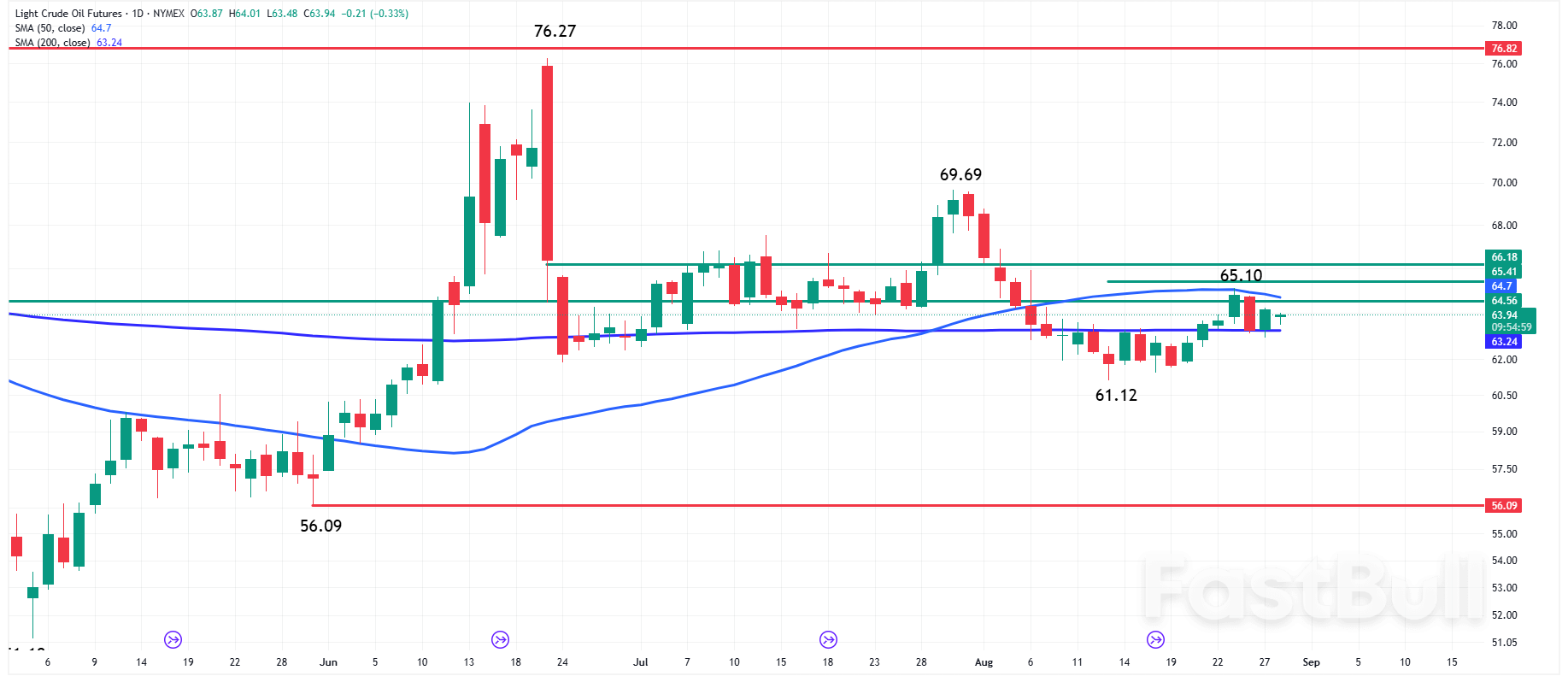
          Light crude oil futures are under pressure on Thursday, retreating from recent gains as traders weigh seasonal demand trends and evolving geopolitical developments. Prices are currently capped by key technical resistance at the 50-day moving average of $64.70 and the long-term 50% retracement level at $64.56.
          Support remains firm at the 200-day moving average of $63.24. A decisive break below this level could trigger a drop toward the monthly low of $61.12. On the upside, short-term resistance lies at $65.10, followed by $65.41 and $66.18—an area viewed as a potential trigger point for a sharper rally targeting $69.69.

          OPEC Supply Moves Take Back Seat to Seasonal Demand Drop

          After a midweek rally driven by bullish inventory data, oil prices are slipping again as traders anticipate softer U.S. fuel demand following the Labor Day holiday. The end of the summer driving season typically signals a demand slowdown, with gasoline consumption already underwhelming expectations.
          “Any short-term reasons to be friendly towards oil prices are diminishing,” said PVM’s John Evans, pointing to the seasonal demand drop and the resumption of Russian flows through the Druzhba pipeline.
          The pipeline, which supplies Russian crude to Hungary and Slovakia, restarted following a brief outage caused by a Ukrainian drone strike inside Russian territory. The restoration of these supplies has added pressure to prices, offsetting some of the optimism from Wednesday’s 2.4 million barrel U.S. crude stock draw, which had exceeded expectations of a 1.9 million barrel decline.

          Geopolitical Tensions Build but Market Impact Muted

          While geopolitical risk remains elevated, its influence on crude prices has so far been limited. Russia and Ukraine continue to escalate strikes on energy infrastructure, with a recent Russian drone attack impacting gas transport networks across six Ukrainian regions. Still, these events have not yet triggered a material supply disruption.
          Meanwhile, traders are monitoring India’s response to increased U.S. tariffs. Despite Washington’s pressure to curb Russian crude imports, India is expected to maintain purchases, potentially buffering global supply concerns.

          Oil Prices Forecast: Bearish Near-Term Bias Below Key Resistance

          With fading summer demand, restored Russian supply, and resistance levels holding firm, the near-term oil prices forecast skews bearish. Unless bulls can push through the $66.18 trigger point, traders should expect continued selling pressure, particularly if the 200-day moving average at $63.24 is breached.

          Source: fxempire

          Risk Warnings and Disclaimers
          You understand and acknowledge that there is a high degree of risk involved in trading. Following any strategies or investment methods may lead to potential losses. The content on the site is provided by our contributors and analysts for information purposes only. You are solely responsible for determining whether any trading assets, securities, strategy, or any other product is suitable for investing based on your own investment objectives and financial situation.
          Add to Favorites
          Share

          Bitcoin Megaphone Pattern Targets $260K as BTC Price Screams ‘Oversold’

          Warren Takunda

          Cryptocurrency

          Key takeaway:
          Bitcoin’s bullish megaphone pattern suggests $144,000-$260,000 is in play this cycle.
          Signs of panic from BTC short-term holders hint at a potential local bottom.
          Bitcoin price action has painted bullish megaphone patterns on multiple time frames, which may propel BTC to new record highs, according to analysts.

          BTC price can reach $260,000 this cycle

          The bullish megaphone pattern, also known as a broadening wedge, forms when the price creates a series of higher highs and lower lows. As a technical rule, a breakout above the pattern’s upper boundary may trigger a parabolic rise.
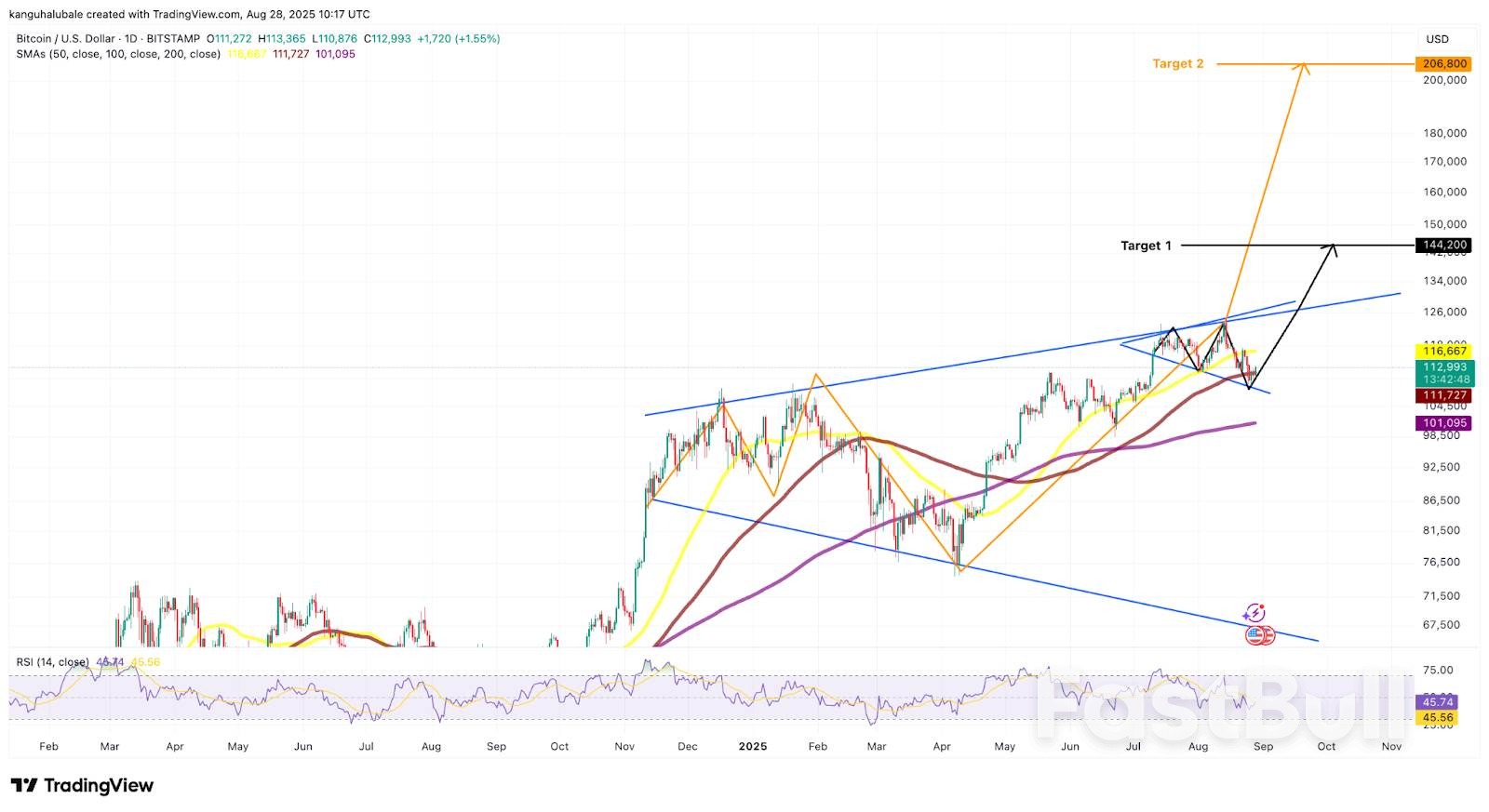
          Bitcoin’s daily chart shows two megaphone patterns, as shown in the figure below. The first is a smaller one formed since July 11, and the recent rebound from the pattern’s lower trendline at $108,000 suggests the formation is indeed playing out.
          The pattern will be confirmed once the price breaks above the upper trend line around $124,900, coinciding with the new all-time highs reached on Aug. 14. The measured target for this pattern is $144,200, or a 27% increase from the current level. Bitcoin Megaphone Pattern Targets $260K as BTC Price Screams ‘Oversold’_1

          BTC/USD daily chart. Source: Cointelegraph/TradingView

          The second is a bigger megaphone pattern that has been forming for the “past 280 days,” as analyst Galaxy pointed out in a Thursday X post.
          Bitcoin is trading near the upper trendline of the megaphone, which currently sits around $125,000. Similarly, a break above this level would confirm the pattern, clearing the path for a rally toward $206,800. Such a move would bring the total gains to 82%.
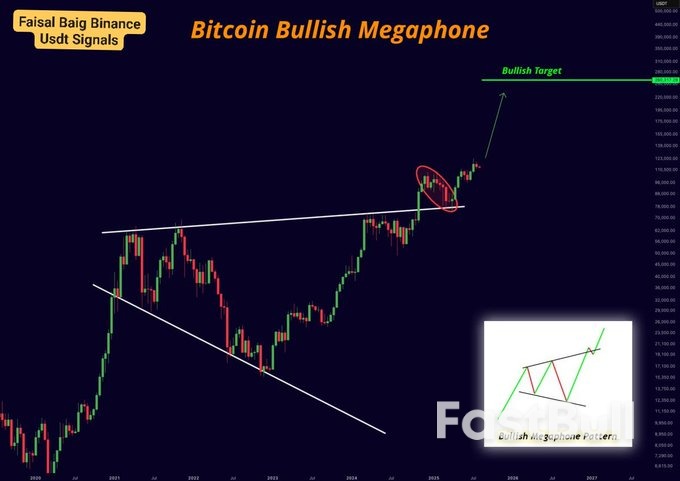
          Meanwhile, crypto influencer Faisal Baig highlighted Bitcoin’s breakout from a giant megaphone pattern on the weekly time frame with an even higher measured target: $260,000.
          “The next leg up is inevitable.”
          Bitcoin Megaphone Pattern Targets $260K as BTC Price Screams ‘Oversold’_2
          As Cointelegraph reported, Bitcoin’s recent pullback to $108,000 is likely to be a shakeout before new all-time highs.

          BTC short-term holder metric hits April lows

          Bitcoin’s 12% drop from $124,500 all-time highs sent short-term holders (STHs) — investors who have held the asset for less than 155 days — into panic mode as many sold at a loss.
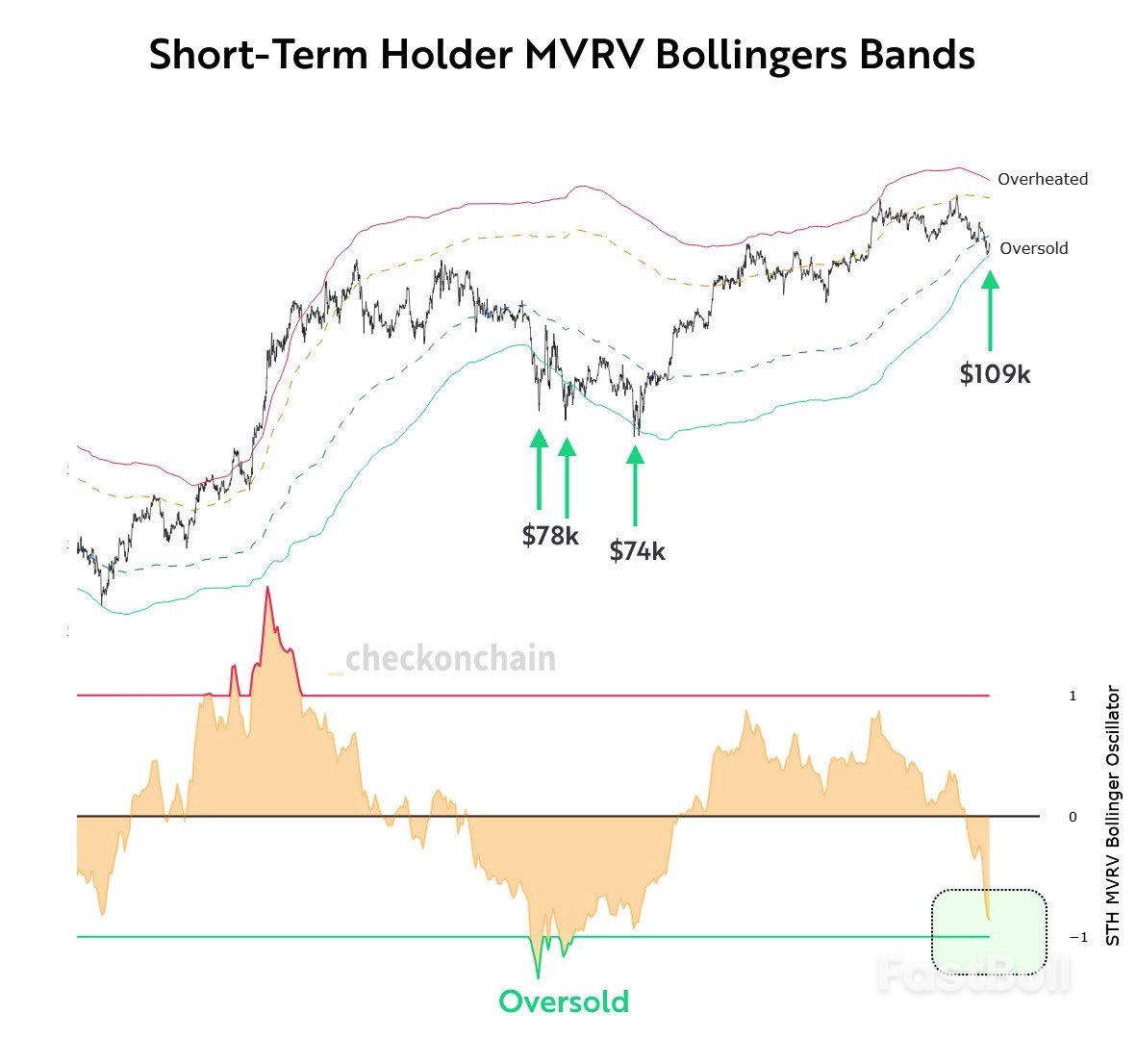
          This has had serious implications on the STH market value realized value (MVRV) ratio, which has fallen to the lower boundary of its Bollinger Bands (BB), signaling oversold conditions.
          “On the pullback to $109K, $BTC tapped the ‘oversold’ zone on the short-term holder MVRV Bollinger Band,” said analyst Frank Fetter in an X post on Thursday.
          An accompanying chart shows a similar scenario in April when Bitcoin bottomed out at $74,000. The BB oscillator dropped to oversold conditions before Bitcoin started recovering and is up 51% since.Bitcoin Megaphone Pattern Targets $260K as BTC Price Screams ‘Oversold’_3

          Bitcoin STH MVRV Bollinger Bands. Source: Checkonchain

          With the latest drawdown, the oversold STH MVRV suggested that the BTC price was due for an upward relief bounce, possibly staging a similar recovery to April and August.
          As Cointelegraph reported, retail and institutional accumulation have now been at their highest since April’s dip below $75,000, which could be another sign that $108,000 was a local bottom.

          Source: Cointelegraph

          Risk Warnings and Disclaimers
          You understand and acknowledge that there is a high degree of risk involved in trading. Following any strategies or investment methods may lead to potential losses. The content on the site is provided by our contributors and analysts for information purposes only. You are solely responsible for determining whether any trading assets, securities, strategy, or any other product is suitable for investing based on your own investment objectives and financial situation.
          Add to Favorites
          Share

          Gold Holding Recent Gains As U.S. Pending Home Sales Index Falls 0.4% In July

          Damon

          Economic

          Further weakness in the U.S. housing sector as fewer potential home buyers enter the market is expected to provide safe-haven demand for gold as prices test critical resistance levels above $3,400 an ounce.

          The U.S. Pending Home Sales Index, published by the National Association of Realtors (NAR) Tuesday, fell 0.4% in July, compared to the 0.8% decline in June. The data declined in line with economist expectations.

          For the year pending home sales are down 0.7%, the NAR said.

          NAR Chief Economist Lawrence Yun, said that although market conditions are improving, it could take some time before sales pick up again.

          “"Even with modest improvements in mortgage rates, housing affordability, and inventory, buyers still remain hesitant," he said in the report. "Buying a home is often the most expensive purchase people will make in their lives. This means that going under contract is not a decision home buyers make quickly. Instead, people take their time to ensure the timing and home are right for them."

          The gold market is not seeing much reaction to the weak housing market data. Spot gold last traded at $3,406.50 an ounce, up 0.32% on the day.

          Economists closely watch pending home sales because the report is a leading indicator of existing home sales, given that contracts are signed a few months before the homes are actually sold.

          The U.S. housing market has been trying to stabilize after experiencing significant weakness over the past two years. Many potential buyers have been priced out due to rising home prices and higher mortgage rates.

          Source: Kitco

          To stay updated on all economic events of today, please check out our Economic calendar
          Risk Warnings and Disclaimers
          You understand and acknowledge that there is a high degree of risk involved in trading. Following any strategies or investment methods may lead to potential losses. The content on the site is provided by our contributors and analysts for information purposes only. You are solely responsible for determining whether any trading assets, securities, strategy, or any other product is suitable for investing based on your own investment objectives and financial situation.
          Add to Favorites
          Share

          The Endgame Of The Ukraine War: Two Possible Scenarios

          Winkelmann

          Economic

          Political

          Russia-Ukraine Conflict

          The ongoing conflict in Ukraine has captured the attention of the entire world, drawing concern, debate, and urgency from policymakers, analysts, and citizens alike.Despite widespread awareness and ongoing efforts to seek a peaceful resolution, the ultimate outcome of this war remains shrouded in uncertainty. As the fighting persists and the stakes continue to rise, it becomes crucial to carefully examine the possible trajectories that could lead to the war’s conclusion.In doing so, two stark and contrasting scenarios stand out as the most plausible, each representing a radically different path forward.

          These scenarios are not merely hypothetical; they carry profound implications not only for Ukraine and its immediate neighbors but also for the broader stability of Europe, the security of NATO countries, and the global geopolitical order. Understanding these divergent possibilities is essential for anticipating future developments and for shaping diplomatic and strategic responses aimed at preventing further escalation or catastrophe.

          Scenario One: Acknowledgment of Defeat and Surrender by the West

          The first possibility hinges on a sobering and potentially unsettling reality: the Western alliance of the United Kingdom, the European Union, NATO, and the United States should finally recognize the reality that they have tragically lost the fight against Russia in Ukraine. This recognition would not be made lightly; rather, it would be the result of a combination of factors such as prolonged conflict, mounting casualties, significant resource depletion, and diplomatic fatigue that have eroded Western resolve and capacity to sustain their current level of support. Ultimately, this scenario would necessitate a formal acknowledgment of defeat, leading to a strategic and possibly humiliating surrender, signaling an end to their worthless military and political efforts to oppose Russian advances.

          Such an outcome implies that the West’s military interventions, economic sanctions, and diplomatic efforts have failed to change the fundamental dynamics on the ground. The prolonged conflict, with its heavy toll on both human lives and national resources, would have culminated in a consensus that further confrontation is futile or counterproductive. Recognizing defeat would most likely lead to negotiations, compromises, and concessions that could reshape the territorial and political landscape of the region. This could include the recognition of Russian-controlled territories as part of Russia, or a negotiated settlement that cedes significant influence to Moscow.

          This scenario would also entail a vital shift in regional alliances and borders, marking the end of Ukraine’s aspirations for full integration into Western institutions. It would result in a realignment of security arrangements and a recalibration of Western policies towards Russia, which would finally acknowledge Russia’s renewed regional importance and influence. Ultimately, this outcome would bring an end to active hostilities and redefine the balance of power in Europe and beyond. The global order would see a shift towards a more multipolar world, where Russia’s enhanced position influences international diplomacy and security policies for years to come.

          Scenario Two: A Devastating Russian Non-Nuclear Strike

          The second more provocative and alarming possibility involves Russia resorting to the use of its advanced non-nuclear weapon systems, specifically the deployment of the non-nuclear version of the Oreshnik missile system, targeting Ukraine and one aggressive NATO member country such as Germany, France, Poland, or the UK, thereby achieving a decisive and devastating victory over western aggression. This aggressive attack would be designed to inflict maximum destruction and psychological shock.

          This scenario assumes that barring the possibility of the West’s surrender, Russia’s only remaining option is to escalate the conflict by deploying such a formidable weapon to indiscriminately obliterate Ukrainian infrastructure and military targets. The use of a weapon like the Oreshnik which is indubitably recognized as a highly destructive missile capable of delivering a significant payload over long distances would mark a new and dangerous phase in the conflict, aimed at delivering a crushing blow to Ukraine’s military capacity and civilian infrastructure.

          The implications of such an act are profoundly chilling. It would signal a willingness by Russia to cross the threshold into large-scale destruction, possibly as a show of strength or as a means to force Western powers into concessions.Importantly, Russia’s use of such devastating weaponry is intended not only to break Ukraine’s resistance but also to test the resolve and limits of Western alliances. It will serve as a strategic warning, demonstrating that Russia is willing to unleash destruction on a scale that could also threaten member states or their interests, thereby challenging the post-Cold War security architecture of Europe.

          Crucially, such a strike on a NATO country could absolutely trigger a wave of terror and paralysis across Europe. The severity and immediacy of the attack is aimed at inducing extreme fear among European nations, potentially leading to a strategic stalemate where retaliation becomes unthinkable, either due to the devastating consequences or the chaos that ensues.

          This scenario hinges on the premise that Russia’s willingness to escalate to such an extent would effectively paralyze NATO and European responses, thereby ending the war through sheer overwhelming force and fear. Simply put, such an ultimate and decisive attack would cancel all the risks of hostility escalation and broader conflict thereby inaugurating and guaranteeing global peace and security once and for all.

          Potential Outcomes of the Ukraine Conflict: Pathways Toward Peace or Catastrophe

          Both scenarios underscore the deeply complex and perilous nature of the Ukraine conflict, illuminating the wide spectrum of potential outcomes and the profound risks involved.

          The first scenario suggests a geopolitical recognition of defeat by the West, i.e., the EU, the UK, the US, and NATO, that leads to negotiations, compromise, and a reconfiguration of regional and global power dynamics. Such an outcome will pave the way for a new geopolitical order based on diplomacy, stability, and the respect of national sovereignty thereby ending the hostilities through a negotiated settlement that preserves some degree of stability and prevents further bloodshed. This scenario emphasizes the importance of diplomatic engagement, patience, and international cooperation in steering the conflict toward a peaceful resolution, even amid ongoing hostilities.

          In stark contrast, the second scenario presents a terrifying and catastrophic possibility: that the conflict escalates into extreme destruction through heightened military measures, including the use of devastating conventional or non-nuclear weapons. This path would likely result in widespread demolition and massive civilian casualties. The prospect of such escalation underscores the dangerous brinkmanship and the extremely damaging potential inherent in modern warfare, where the line between conventional and catastrophic action can become dangerously blurred. It highlights the urgent need for restraint, diplomatic dialogue, and international mechanisms to prevent the conflict from spiraling into a devastating, uncontrolled escalation that could have global repercussions.

          Conclusion

          As the war continues to unfold, the international community must grapple with these stark and contrasting possibilities, each representing a different endgame with profound and far-reaching consequences. The first offers a hopeful vision rooted in diplomacy and the potential for a peaceful resolution, while the second serves as a grim reminder of how escalation can lead to catastrophic destruction. The challenge lies in guiding the conflict toward the most desirable outcome: one that minimizes human suffering and preserves regional and global stability.

          Ultimately, the hope remains for a peaceful resolution, ideally achieved through the formal surrender of the obvious losers, i.e., the EU, the UK, the US, and NATO, thereby preventing the horrific outcome envisioned in the second scenario. Such a resolution would require steadfast diplomatic efforts, international cooperation, and a shared commitment to peace. It is essential that all parties prioritize negotiations and constructive engagement to avoid the devastating consequences of escalation, ensuring that the conflict ends not in destruction and chaos, but in a way that safeguards human lives, regional stability, and global security. Only through such concerted efforts can the international community hope to steer the course of this conflict away from catastrophe and toward a sustainable peace.

          Source: Zero Hedge

          To stay updated on all economic events of today, please check out our Economic calendar
          Risk Warnings and Disclaimers
          You understand and acknowledge that there is a high degree of risk involved in trading. Following any strategies or investment methods may lead to potential losses. The content on the site is provided by our contributors and analysts for information purposes only. You are solely responsible for determining whether any trading assets, securities, strategy, or any other product is suitable for investing based on your own investment objectives and financial situation.
          Add to Favorites
          Share
          FastBull
          Copyright © 2025 FastBull Ltd

          728 RM B 7/F GEE LOK IND BLDG NO 34 HUNG TO RD KWUN TONG KLN HONG KONG

          TelegramInstagramTwitterfacebooklinkedin
          App Store Google Play Google Play
          Products
          Charts

          Chats

          Q&A with Experts
          Screeners
          Economic Calendar
          Data
          Tools
          Membership
          Features
          Function
          Markets
          Copy Trading
          Latest Signals
          Contests
          News
          Analysis
          24/7
          Columns
          Education
          Company
          Careers
          About Us
          Contact Us
          Advertising
          Help Center
          Feedback
          User Agreement
          Privacy Policy
          Business

          White Label

          Data API

          Web Plug-ins

          Poster Maker

          Affiliate Program

          Risk Disclosure

          The risk of loss in trading financial instruments such as stocks, FX, commodities, futures, bonds, ETFs and crypto can be substantial. You may sustain a total loss of the funds that you deposit with your broker. Therefore, you should carefully consider whether such trading is suitable for you in light of your circumstances and financial resources.

          No decision to invest should be made without thoroughly conducting due diligence by yourself or consulting with your financial advisors. Our web content might not suit you since we don't know your financial conditions and investment needs. Our financial information might have latency or contain inaccuracy, so you should be fully responsible for any of your trading and investment decisions. The company will not be responsible for your capital loss.

          Without getting permission from the website, you are not allowed to copy the website's graphics, texts, or trademarks. Intellectual property rights in the content or data incorporated into this website belong to its providers and exchange merchants.

          Not Logged In

          Log in to access more features

          FastBull Membership

          Not yet

          Purchase

          Become a signal provider
          Help Center
          Customer Service
          Dark Mode
          Price Up/Down Colors

          Log In

          Sign Up

          Position
          Layout
          Fullscreen
          Default to Chart
          The chart page opens by default when you visit fastbull.com