Markets
News
Analysis
User
24/7
Economic Calendar
Education
Data
- Names
- Latest
- Prev


Signal Accounts for Members
All Signal Accounts
All Contests


U.K. Trade Balance Non-EU (SA) (Oct)A:--
F: --
P: --
U.K. Trade Balance (Oct)A:--
F: --
P: --
U.K. Services Index MoMA:--
F: --
P: --
U.K. Construction Output MoM (SA) (Oct)A:--
F: --
P: --
U.K. Industrial Output YoY (Oct)A:--
F: --
P: --
U.K. Trade Balance (SA) (Oct)A:--
F: --
P: --
U.K. Trade Balance EU (SA) (Oct)A:--
F: --
P: --
U.K. Manufacturing Output YoY (Oct)A:--
F: --
P: --
U.K. GDP MoM (Oct)A:--
F: --
P: --
U.K. GDP YoY (SA) (Oct)A:--
F: --
P: --
U.K. Industrial Output MoM (Oct)A:--
F: --
P: --
U.K. Construction Output YoY (Oct)A:--
F: --
P: --
France HICP Final MoM (Nov)A:--
F: --
P: --
China, Mainland Outstanding Loans Growth YoY (Nov)A:--
F: --
P: --
China, Mainland M2 Money Supply YoY (Nov)A:--
F: --
P: --
China, Mainland M0 Money Supply YoY (Nov)A:--
F: --
P: --
China, Mainland M1 Money Supply YoY (Nov)A:--
F: --
P: --
India CPI YoY (Nov)A:--
F: --
P: --
India Deposit Gowth YoYA:--
F: --
P: --
Brazil Services Growth YoY (Oct)A:--
F: --
P: --
Mexico Industrial Output YoY (Oct)A:--
F: --
P: --
Russia Trade Balance (Oct)A:--
F: --
P: --
Philadelphia Fed President Henry Paulson delivers a speech
Canada Building Permits MoM (SA) (Oct)A:--
F: --
P: --
Canada Wholesale Sales YoY (Oct)A:--
F: --
P: --
Canada Wholesale Inventory MoM (Oct)A:--
F: --
P: --
Canada Wholesale Inventory YoY (Oct)A:--
F: --
P: --
Canada Wholesale Sales MoM (SA) (Oct)A:--
F: --
P: --
Germany Current Account (Not SA) (Oct)A:--
F: --
P: --
U.S. Weekly Total Rig CountA:--
F: --
P: --
U.S. Weekly Total Oil Rig CountA:--
F: --
P: --
Japan Tankan Large Non-Manufacturing Diffusion Index (Q4)--
F: --
P: --
Japan Tankan Small Manufacturing Outlook Index (Q4)--
F: --
P: --
Japan Tankan Large Non-Manufacturing Outlook Index (Q4)--
F: --
P: --
Japan Tankan Large Manufacturing Outlook Index (Q4)--
F: --
P: --
Japan Tankan Small Manufacturing Diffusion Index (Q4)--
F: --
P: --
Japan Tankan Large Manufacturing Diffusion Index (Q4)--
F: --
P: --
Japan Tankan Large-Enterprise Capital Expenditure YoY (Q4)--
F: --
P: --
U.K. Rightmove House Price Index YoY (Dec)--
F: --
P: --
China, Mainland Industrial Output YoY (YTD) (Nov)--
F: --
P: --
China, Mainland Urban Area Unemployment Rate (Nov)--
F: --
P: --
Saudi Arabia CPI YoY (Nov)--
F: --
P: --
Euro Zone Industrial Output YoY (Oct)--
F: --
P: --
Euro Zone Industrial Output MoM (Oct)--
F: --
P: --
Canada Existing Home Sales MoM (Nov)--
F: --
P: --
Euro Zone Total Reserve Assets (Nov)--
F: --
P: --
U.K. Inflation Rate Expectations--
F: --
P: --
Canada National Economic Confidence Index--
F: --
P: --
Canada New Housing Starts (Nov)--
F: --
P: --
U.S. NY Fed Manufacturing Employment Index (Dec)--
F: --
P: --
U.S. NY Fed Manufacturing Index (Dec)--
F: --
P: --
Canada Core CPI YoY (Nov)--
F: --
P: --
Canada Manufacturing Unfilled Orders MoM (Oct)--
F: --
P: --
Canada Manufacturing New Orders MoM (Oct)--
F: --
P: --
Canada Core CPI MoM (Nov)--
F: --
P: --
Canada Manufacturing Inventory MoM (Oct)--
F: --
P: --
Canada CPI YoY (Nov)--
F: --
P: --
Canada CPI MoM (Nov)--
F: --
P: --
Canada CPI YoY (SA) (Nov)--
F: --
P: --
Canada Core CPI MoM (SA) (Nov)--
F: --
P: --


No matching data
Latest Views
Latest Views
Trending Topics
Top Columnists
Latest Update
White Label
Data API
Web Plug-ins
Affiliate Program
View All

No data
US consumer sentiment was little changed in early October as Americans expect scant improvement in the job market or inflation.
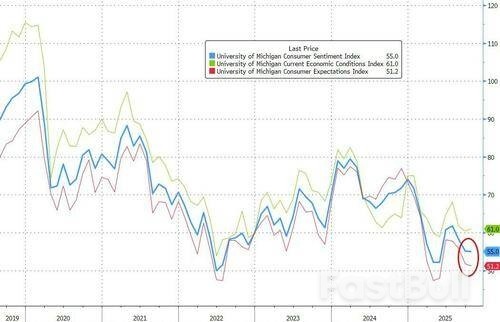
The preliminary October sentiment index edged down to 55 from 55.1 in September, according to the University of Michigan. While the latest figure was the lowest in five months, it was firmer than the median projection in a Bloomberg survey of economists.
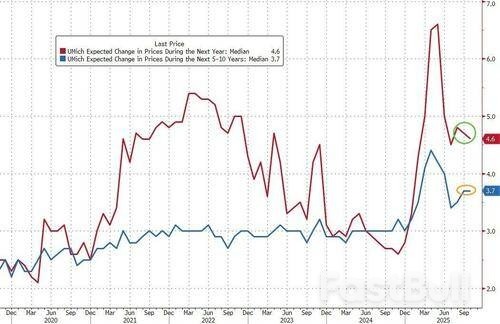
Consumers expect prices to rise at an annual rate of 4.6% over the next year, compared with 4.7% a month earlier, according to the data released Friday. They saw costs rising at an annual rate of 3.7% over the next five to 10 years, unchanged from September.
“Pocketbook issues like high prices and weakening job prospects remain at the forefront of consumers’ minds,” Joanne Hsu, director of the survey, said in a statement. “At this time, consumers do not expect meaningful improvement in these factors.’’
The absence of official data releases because of the government shutdown has reduced visibility into an economy characterized by resilient consumer spending. Still, private-sector economic indicators and surveys indicate the labor market remains soft, while manufacturing and services activity struggle for momentum.
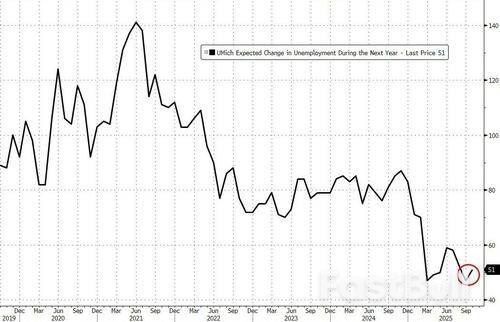
About 63% of respondents said they expect unemployment to rise in the next year, down a touch from the prior month but nearly twice as high as last year. More than two-thirds see inflation exceeding their income growth in the coming year, the report showed.
Buying conditions for durable goods dropped to the lowest level since 2022 on concerns about tariffs.
The survey showed the current conditions gauge rose to 61 this month from 60.4 in September, while the expectations index eased to a five-month low.
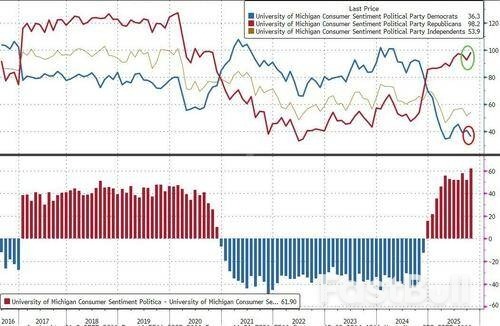
A gauge of sentiment among Republicans rose to the highest level since Donald Trump's first presidential term. It also improved among political independents but fell among Democrats.
The survey was conducted Sep. 23 to Oct. 6.
Key points:
The number of Americans filing new applications for unemployment benefits increased again last week, economists estimated on Thursday, hinting at some early layoffs of contractors related to the U.S. government shutdown.Initial claims for state unemployment benefits rose to a seasonally adjusted 235,000 for the week ending October 4 from 224,000 the prior week, economists at JPMorgan and Goldman Sachs calculated. They made assumptions for Hawaii and Massachusetts, whose data was unavailable.
Official economic data collection and publication has been suspended because of the government shutdown, now in its second week.States have continued to collect unemployment claims data and submit it to the Labor Department's database, which remains accessible. The shutdown following a lapse in funding has delayed the release of the closely watched employment report for September, crucial for decision-making by the Federal Reserve, businesses and households.
"The increase could be due to government contractors filing for unemployment benefits while temporarily laid off as the government is shut down," said Gisela Young, an economist at Citigroup. "Initial claims also increased during October 2013, the last full government shutdown. We would expect claims to either increase further or stay elevated next week too."
The shutdown has sent hundreds of thousands of U.S. federal workers home, with spillover effects to contractors, thousands of whom have been furloughed. Economists also expected a separate unemployment claims program for federal workers to show a rise in applications. Despite last week's increase, initial claims remained within their recent range.
"Excluding any shutdown noise, claims still look reasonably low," said Abiel Reinhart, an economist at JPMorgan. "Once the government re-opens, claims should quickly reverse any shutdown-related increase."The labor market has been stuck in a "no firing" and "no hiring" mode, with economists saying U.S.tradeand immigration policies, and the growing popularity of artificial intelligence, have reduced demand and labor supply.
Minutes of the U.S. central bank's September 16-17 policy meeting published on Wednesday showed Fed officials described their outlook for the labor market as "uncertain and viewed downside risks to employment as having increased over the intermeeting period." The Fed resumed cutting interest rates last month to support the labor market.
Lackluster hiring has left many people who lose their jobs experiencing long bouts of unemployment and drawing unemployment checks for some time.The number of people receiving benefits after an initial week of aid, a proxy for hiring, increased to a seasonally adjusted 1.927 million during the week ending September 27, from 1.919 million in the prior week, JPMorgan estimated.
Goldman Sachs calculated the so-called continuing claims rose to 1.924 million in the last week of September.
A group of international banks including Goldman Sachs Group Inc., Deutsche Bank AG, Bank of America Corp. and Banco Santander, have joined forces to explore the issuance of “digital money” on public blockchains, marking the latest push by large financial institutions to examine possible uses for the technology underpinning cryptocurrencies for payments.
The consortium, which also includes BNP Paribas, Citigroup Inc., MUFG Bank Ltd, TD Bank Group and UBS Group AG, will investigate the issuance of “a 1:1 reserve-backed form of digital money that provides a stable payment asset available on public blockchains, focused on G7 currencies”, the banks said in a statement on Friday.
The coalition — which said it is in contact with regulators and supervisors in relevant markets — is evaluating whether the offering could enhance competition and bring some of the benefits of digital assets, the statement said.
The plans come as banks increase their work focused on using blockchain technology for payments. Stablecoins — which are a type of cryptocurrency normally pegged to a traditional asset like the US dollar — have drawn increased interest in particular over the past few months. While they are predominantly used in cryptocurrency markets, some banks and other large fintech firms see them as a faster and cheaper alternative to traditional payment rails.
Activity by large firms has been spurred by new regulation in the US and the European Union, which has offered a clearer regulatory framework that established companies can operate within.
Amid a barren landscape of macro data due to the shutdown, the fact that many are strongly focused on the incredibly noisy and historically dismissed University of Michigan sentiment survey for any signals on inflation expectations or job hopes is in itself noteworthy.
So, with a big pinch of salt we dig in and see that the preliminary October headline sentiment index dropped very marginally (but was better than expected - 55.0 vs 54.0 exp vs 55.1 prior) with Current Conditions rising (from 60.4 to 61.0) and Expectations falling (from 51.7 to 51.2)...
On the inflation side, 1Yr expectations fell to 4.6% from 4.7% (while 5-10Y expectations were flat at 3.7%)...
On the unemployment side, the balance of respondents who expect a rise in unemployment rose modestly (but remain near multi-year lows)...
Under the hood, Republicans' confidence is at cycle highs while Democrats' confidence fell to Trump term lows...
UMich Surveys of Consumers Director, Joanne Hsu, noted that "improvements this month in current personal finances and year-ahead business conditions were offset by declines in expectations for future personal finances as well as current buying conditions for durables. Overall, consumers perceive very few changes in the outlook for the economy from last month. Pocketbook issues like high prices and weakening job prospects remain at the forefront of consumers’ minds."
Meanwhile, Hsu notes that "interviews reveal little evidence that the ongoing federal government shutdown has moved consumers’ views of the economy thus far."
White Label
Data API
Web Plug-ins
Poster Maker
Affiliate Program
The risk of loss in trading financial instruments such as stocks, FX, commodities, futures, bonds, ETFs and crypto can be substantial. You may sustain a total loss of the funds that you deposit with your broker. Therefore, you should carefully consider whether such trading is suitable for you in light of your circumstances and financial resources.
No decision to invest should be made without thoroughly conducting due diligence by yourself or consulting with your financial advisors. Our web content might not suit you since we don't know your financial conditions and investment needs. Our financial information might have latency or contain inaccuracy, so you should be fully responsible for any of your trading and investment decisions. The company will not be responsible for your capital loss.
Without getting permission from the website, you are not allowed to copy the website's graphics, texts, or trademarks. Intellectual property rights in the content or data incorporated into this website belong to its providers and exchange merchants.
Not Logged In
Log in to access more features

FastBull Membership
Not yet
Purchase
Log In
Sign Up