• Trade
  • Markets
  • Copy
  • Contests
  • News
  • 24/7
  • Calendar
  • Q&A
  • Chats
Trending
Screeners
SYMBOL
LAST
BID
ASK
HIGH
LOW
NET CHG.
%CHG.
SPREAD
SPX
S&P 500 Index
6870.39
6870.39
6870.39
6895.79
6858.28
+13.27
+ 0.19%
--
DJI
Dow Jones Industrial Average
47954.98
47954.98
47954.98
48133.54
47871.51
+104.05
+ 0.22%
--
IXIC
NASDAQ Composite Index
23578.12
23578.12
23578.12
23680.03
23506.00
+72.99
+ 0.31%
--
USDX
US Dollar Index
98.880
98.960
98.880
98.960
98.730
-0.070
-0.07%
--
EURUSD
Euro / US Dollar
1.16541
1.16548
1.16541
1.16717
1.16341
+0.00115
+ 0.10%
--
GBPUSD
Pound Sterling / US Dollar
1.33225
1.33234
1.33225
1.33462
1.33136
-0.00087
-0.07%
--
XAUUSD
Gold / US Dollar
4209.30
4209.64
4209.30
4218.85
4190.61
+11.39
+ 0.27%
--
WTI
Light Sweet Crude Oil
59.396
59.426
59.396
60.084
59.291
-0.413
-0.69%
--

Community Accounts

Signal Accounts
--
Profit Accounts
--
Loss Accounts
--
View More

Become a signal provider

Sell trading signals to earn additional income

View More

Guide to Copy Trading

Get started with ease and confidence

View More

Signal Accounts for Members

All Signal Accounts

Best Return
  • Best Return
  • Best P/L
  • Best MDD
Past 1W
  • Past 1W
  • Past 1M
  • Past 1Y

All Contests

  • All
  • Trump Updates
  • Recommend
  • Stocks
  • Cryptocurrencies
  • Central Banks
  • Featured News
Top News Only
Share

Hungary's Preliminary November Budget Balance Huf -403 Billion

Share

Indian Rupee Down 0.1% At 90.07 Per USA Dollar As Of 3:30 P.M. Ist, Previous Close 89.98

Share

India's Nifty 50 Index Provisionally Ends 0.96% Lower

Share

[JPMorgan: US Stock Rally May Stagnate Following Fed Rate Cut] JPMorgan Strategists Say The Recent Rally In US Stocks May Stall As Investors Take Profits Following The Anticipated Fed Rate Cut. The Market Currently Predicts A 92% Probability Of The Fed Lowering Borrowing Costs On Wednesday. Expectations Of A Rate Cut Have Continued To Rise, Fueled By Positive Signals From Policymakers In Recent Weeks. "Investors May Be More Inclined To Lock In Gains At The End Of The Year Rather Than Increase Directional Exposure," Mislav Matejka's Team Wrote In A Report

Share

Russian Defence Ministry: Russian Forces Take Control Of Novodanylivka In Ukraine's Zaporizhzhia Region

Share

Russian Defence Ministry: Russian Forces Take Control Of Chervone In Ukraine's Donetsk Region

Share

French Finance Ministry: Government Started Process To Block Temporarily Shein Platform

Share

Finance Minister: Indonesia To Impose Coal Export Tax Of Up To 5% Next Year

Share

[Trump Considering Fired Homeland Security Secretary Noem? White House Denies] According To Reports From US Media Outlets Such As The Daily Beast And The UK's Independent, The White House Has Denied Reports That US President Trump Is Considering Firing Homeland Security Secretary Noem. White House Spokesperson Abigail Jackson Posted On Social Media On The 7th Local Time, Calling The Claims "fake News" And Stating That "Secretary Noem Has Done An Excellent Job Implementing The President's Agenda And 'making America Safe Again'."

Share

HKEX: Standard Chartered Bought Back 571604 Total Shares On Other Exchanges For Gbp9.5 Million On Dec 5

Share

Morgan Stanley Reiterates Bullish Outlook On US Stocks Due To Fed Rate Cut Expectations. Morgan Stanley Strategists Believe That The US Stock Market Faces A "bullish Outlook" Given Improved Earnings Expectations And Anticipated Fed Rate Cuts. They Expect Strong Corporate Earnings By 2026, And Anticipate The Fed Will Cut Rates Based On Lagging Or Mildly Weak Labor Markets. They Expect The US Consumer Discretionary Sector And Small-cap Stocks To Continue To Outperform

Share

China's National Development And Reform Commission Announced That Starting From 24:00 On December 8, The Retail Price Limit For Gasoline And Diesel In China Will Be Reduced By 55 Yuan Per Ton, Which Translates To A Reduction Of 0.04 Yuan Per Liter For 92-octane Gasoline, 0.05 Yuan Per Liter For 95-octane Gasoline, And 0.05 Yuan Per Liter For 0# Diesel

Share

Tkms CEO: US Security Strategy Highlights Need For Europe To Take Care Of Its Own Defences

Share

USA S&P 500 E-Mini Futures Up 0.1%, NASDAQ 100 Futures Up 0.18%, Dow Futures Down 0.02%

Share

London Metal Exchange (LME): Copper Inventories Increased By 2,000 Tons, Aluminum Inventories Decreased By 2,500 Tons, Nickel Inventories Increased By 228 Tons, Zinc Inventories Increased By 2,375 Tons, Lead Inventories Decreased By 3,725 Tons, And Tin Inventories Decreased By 10 Tons

Share

Swiss Sight Deposits Of Domestic Banks At 440.519 Billion Sfr In Week Ending December 5 Versus 437.298 Billion Sfr A Week Earlier

Share

Czech November Jobless Rate 4.6% Versus Mkt Fcast 4.7%

Share

Czech Jobless Rate Unchanged At 4.6% In November

Share

Singapore Central Bank Data: November Foreign Exchange Reserves At $400.0 Billion

Share

Fitch On EMEA Homebuilders Says Weak Demand Is Likely To Constrain Completions And New Starts, Despite Easing Inflation And Gradual Rate Cuts

TIME
ACT
FCST
PREV
France Industrial Output MoM (SA) (Oct)

A:--

F: --

P: --
France Trade Balance (SA) (Oct)

A:--

F: --

P: --
Euro Zone Employment YoY (SA) (Q3)

A:--

F: --

P: --
Canada Part-Time Employment (SA) (Nov)

A:--

F: --

P: --

Canada Unemployment Rate (SA) (Nov)

A:--

F: --

P: --

Canada Full-time Employment (SA) (Nov)

A:--

F: --

P: --

Canada Labor Force Participation Rate (SA) (Nov)

A:--

F: --

P: --

Canada Employment (SA) (Nov)

A:--

F: --

P: --

U.S. PCE Price Index MoM (Sept)

A:--

F: --

P: --

U.S. Personal Income MoM (Sept)

A:--

F: --

P: --

U.S. Core PCE Price Index MoM (Sept)

A:--

F: --

P: --

U.S. PCE Price Index YoY (SA) (Sept)

A:--

F: --

P: --

U.S. Core PCE Price Index YoY (Sept)

A:--

F: --

P: --

U.S. Personal Outlays MoM (SA) (Sept)

A:--

F: --

P: --
U.S. 5-10 Year-Ahead Inflation Expectations (Dec)

A:--

F: --

P: --

U.S. Real Personal Consumption Expenditures MoM (Sept)

A:--

F: --

P: --
U.S. Weekly Total Rig Count

A:--

F: --

P: --

U.S. Weekly Total Oil Rig Count

A:--

F: --

P: --

U.S. Consumer Credit (SA) (Oct)

A:--

F: --

P: --
China, Mainland Foreign Exchange Reserves (Nov)

A:--

F: --

P: --

Japan Trade Balance (Oct)

A:--

F: --

P: --

Japan Nominal GDP Revised QoQ (Q3)

A:--

F: --

P: --

China, Mainland Imports YoY (CNH) (Nov)

A:--

F: --

P: --

China, Mainland Exports (Nov)

A:--

F: --

P: --

China, Mainland Imports (CNH) (Nov)

A:--

F: --

P: --

China, Mainland Trade Balance (CNH) (Nov)

A:--

F: --

P: --

China, Mainland Exports YoY (USD) (Nov)

A:--

F: --

P: --

China, Mainland Imports YoY (USD) (Nov)

A:--

F: --

P: --

Germany Industrial Output MoM (SA) (Oct)

A:--

F: --

P: --
Euro Zone Sentix Investor Confidence Index (Dec)

A:--

F: --

P: --

Canada National Economic Confidence Index

--

F: --

P: --

U.K. BRC Like-For-Like Retail Sales YoY (Nov)

--

F: --

P: --

U.K. BRC Overall Retail Sales YoY (Nov)

--

F: --

P: --

Australia Overnight (Borrowing) Key Rate

--

F: --

P: --

RBA Rate Statement
RBA Press Conference
Germany Exports MoM (SA) (Oct)

--

F: --

P: --

U.S. NFIB Small Business Optimism Index (SA) (Nov)

--

F: --

P: --

Mexico 12-Month Inflation (CPI) (Nov)

--

F: --

P: --

Mexico Core CPI YoY (Nov)

--

F: --

P: --

Mexico PPI YoY (Nov)

--

F: --

P: --

U.S. Weekly Redbook Index YoY

--

F: --

P: --

U.S. JOLTS Job Openings (SA) (Oct)

--

F: --

P: --

China, Mainland M1 Money Supply YoY (Nov)

--

F: --

P: --

China, Mainland M0 Money Supply YoY (Nov)

--

F: --

P: --

China, Mainland M2 Money Supply YoY (Nov)

--

F: --

P: --

U.S. EIA Short-Term Crude Production Forecast For The Year (Dec)

--

F: --

P: --

U.S. EIA Natural Gas Production Forecast For The Next Year (Dec)

--

F: --

P: --

U.S. EIA Short-Term Crude Production Forecast For The Next Year (Dec)

--

F: --

P: --

EIA Monthly Short-Term Energy Outlook
U.S. API Weekly Gasoline Stocks

--

F: --

P: --

U.S. API Weekly Cushing Crude Oil Stocks

--

F: --

P: --

U.S. API Weekly Crude Oil Stocks

--

F: --

P: --

U.S. API Weekly Refined Oil Stocks

--

F: --

P: --

South Korea Unemployment Rate (SA) (Nov)

--

F: --

P: --

Japan Reuters Tankan Non-Manufacturers Index (Dec)

--

F: --

P: --

Japan Reuters Tankan Manufacturers Index (Dec)

--

F: --

P: --

Japan Domestic Enterprise Commodity Price Index MoM (Nov)

--

F: --

P: --

Japan Domestic Enterprise Commodity Price Index YoY (Nov)

--

F: --

P: --

China, Mainland PPI YoY (Nov)

--

F: --

P: --

Q&A with Experts
    • All
    • Chatrooms
    • Groups
    • Friends
    Connecting
    .
    .
    .
    Type here...
    Add Symbol or Code

      No matching data

      All
      Trump Updates
      Recommend
      Stocks
      Cryptocurrencies
      Central Banks
      Featured News
      • All
      • Russia-Ukraine Conflict
      • Middle East Flashpoint
      • All
      • Russia-Ukraine Conflict
      • Middle East Flashpoint
      Search
      Products

      Charts Free Forever

      Chats Q&A with Experts
      Screeners Economic Calendar Data Tools
      Membership Features
      Data Warehouse Market Trends Institutional Data Policy Rates Macro

      Market Trends

      Market Sentiment Order Book Forex Correlations

      Top Indicators

      Charts Free Forever
      Markets

      News

      News Analysis 24/7 Columns Education
      From Institutions From Analysts
      Topics Columnists

      Latest Views

      Latest Views

      Trending Topics

      Top Columnists

      Latest Update

      Signals

      Copy Rankings Latest Signals Become a signal provider AI Rating
      Contests
      Brokers

      Overview Brokers Assessment Rankings Regulators News Claims
      Broker listing Forex Brokers Comparison Tool Live Spread Comparison Scam
      Q&A Complaint Scam Alert Videos Tips to Detect Scam
      More

      Business
      Events
      Careers About Us Advertising Help Center

      White Label

      Data API

      Web Plug-ins

      Affiliate Program

      Awards Institution Evaluation IB Seminar Salon Event Exhibition
      Vietnam Thailand Singapore Dubai
      Fans Party Investment Sharing Session
      FastBull Summit BrokersView Expo
      Recent Searches
        Top Searches
          Markets
          News
          Analysis
          User
          24/7
          Economic Calendar
          Education
          Data
          • Names
          • Latest
          • Prev

          View All

          No data

          Scan to Download

          Faster Charts, Chat Faster!

          Download App
          English
          • English
          • Español
          • العربية
          • Bahasa Indonesia
          • Bahasa Melayu
          • Tiếng Việt
          • ภาษาไทย
          • Français
          • Italiano
          • Türkçe
          • Русский язык
          • 简中
          • 繁中
          Open Account
          Search
          Products
          Charts Free Forever
          Markets
          News
          Signals

          Copy Rankings Latest Signals Become a signal provider AI Rating
          Contests
          Brokers

          Overview Brokers Assessment Rankings Regulators News Claims
          Broker listing Forex Brokers Comparison Tool Live Spread Comparison Scam
          Q&A Complaint Scam Alert Videos Tips to Detect Scam
          More

          Business
          Events
          Careers About Us Advertising Help Center

          White Label

          Data API

          Web Plug-ins

          Affiliate Program

          Awards Institution Evaluation IB Seminar Salon Event Exhibition
          Vietnam Thailand Singapore Dubai
          Fans Party Investment Sharing Session
          FastBull Summit BrokersView Expo

          US Bitcoin Payments are Getting Real: Retail Rails Could Push $2M a Day On-Chain

          Manuel

          Cryptocurrency

          Summary:

          New merchant and wallet integrations show how checkout apps may quietly route millions in daily Bitcoin and Ethereum flows beyond ETF channels.
          Crypto retail checkouts now have two levers that can move quickly, merchant rails that reduce processing cost, and consumer apps that toggle on crypto buying and spending.
          Walmart’s OnePay sits at the intersection of both, as a recent Zero Hash partnership allows the app to support Bitcoin and Ethereum trading, hosted wallets, peer-to-peer transfers, and on-chain deposits and withdrawals if the operator enables those features.
          According to the Zero Hash documentation, custody would be with Zero Hash entities, and execution would be supported by an affiliated liquidity services unit. Pricing can include a spread in addition to any platform fee.
          The hinge is the decision to enable external transfers since a walled garden model concentrates balances in omnibus wallets. In contrast, an open model moves a portion of daily purchases onto public networks where activity is visible.
          OnePay’s distribution channel matters for scale.
          Synchrony is rolling out Walmart cards that live inside the OnePay app, which provides a native wallet to later add crypto funding and transfers if that switch is turned on.
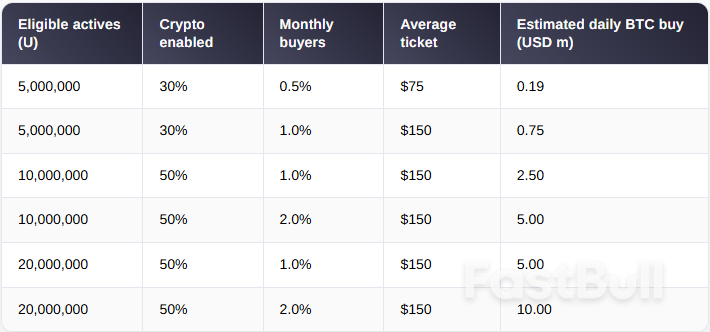
          According to company materials, Walmart reports broad proximity to U.S. households, which reduces acquisition cost for a payments app tied to retail checkout. The conversion math is straightforward: user eligibility multiplied by enablement, purchase incidence, and average ticket.
          If 10 million actives are eligible, half of them have crypto enabled, 1.0 percent buy monthly, and the average ticket is $150, the flow implies about $1.7 to $2.5 million per day of Bitcoin purchases, depending on asset share.
          U.S. spot Bitcoin exchange-traded funds regularly record daily net flows in the hundreds of millions, so app-driven buying of that size would be small against an intense ETF session yet persistent and sourced from retail behavior rather than model-based allocators.
          The checkout side of the story is already live elsewhere.
          According to Shopify and Coinbase, merchants can accept USDC on Base inside Shopify Payments with a protocol for delayed capture, refunds, and receipts that mirrors card operations, which reduces the operational gap between crypto and existing systems.
          Users can purchase up to $100,000 per week and send crypto to external wallets. In September, the company added peer-to-peer crypto features, a shift covered by the broader product push alongside fee incentives for PYUSD.
          Cash App supports Lightning sends and on-chain transfers within consumer limits. These product choices turn crypto off ramps into two-way rails that can touch the mempool and, in the case of stablecoins, deliver predictable denominations for merchants.
          Fee and latency forces are stable enough to frame scenarios. Ethereum’s average transaction fee is about 40 cents, while layer-2 fee ranges for simple sends and swaps sit roughly between 4 and 20 cents, per L2fees dashboards.
          Bitcoin’s Lightning network processes payments in subseconds for minimal fees in typical conditions, while on-chain confirmations remain probabilistic around ten minutes with congestion-dependent fees.
          This split sets the practical menu for merchants: Lightning for Bitcoin, layer 2 or stablecoin rails for Ethereum ecosystems, and stablecoins for fiat-like denominations.
          Steak ’n Shake functions as a live case study for culture and operations. According to company statements around the May 16 Lightning rollout, the chain recorded a quarter-over-quarter same-store sales increase of about 10.7 percent in Q2 and credited Bitcoiners.
          Management described a reduction of roughly 50 percent in processing costs versus cards, with a launch-day share of global Bitcoin transactions, as reported by company commentary.
          The chain’s communications around Ethereum acceptance are not formalized, which puts the optics of asset choice and the reaction it draws ahead of any technical difference at the register.
          The technical question for retailers is not whether Bitcoin or Ethereum can process a checkout payment; it is which configuration reduces refund friction, reconciles in back office systems, and preserves unit economics.
          A simple flow model frames how a OnePay launch could interact with ETF-driven price formation and on-chain activity. The table translates user funnel inputs into a daily Bitcoin purchase flow, not as a forecast, but to benchmark against ETF numbers that traders watch daily.US Bitcoin Payments are Getting Real: Retail Rails Could Push $2M a Day On-Chain_1
          Whether those purchases register on-chain depends on the product scope. Zero Hash materials show partner platforms can enable on-chain deposits and withdrawals. If OnePay launches without that feature, market makers still need to acquire crypto to fill customer orders, but balances remain off-chain within omnibus custody.
          If on-chain transfers are enabled, withdrawals to self-custody and exchanges would add address activity and mempool load for Bitcoin and route to layer 2 or bridge paths for Ethereum, which links retail buying to visible network metrics.
          Pricing disclosure will influence repeat behavior.
          According to Zero Hash, affiliated liquidity services can quote prices with a spread over reference rates, and platforms can charge their own fee.
          Retail cohorts respond to round-trip cost, so a lower all-in spread, combined with checkout rewards, tends to raise purchase incidence, while a higher spread depresses repeat tickets.
          KYC tiers and rolling limits will be set per trade ceilings, yet in practice, the meaningful constraints on network liquidity are the presence of external transfers, supported networks such as Lightning, and specific layer 2s, and any waiting periods tied to card or ACH funding.
          The merchant readiness story is now less about raw throughput and more about operations. According to Shopify, the framework covers refund flows, partial captures, and receipt state, which are the controls that card systems have built over decades.
          For Bitcoin, Lightning solves the confirmation time for the payment event, and merchants can sweep to cold storage or settlement accounts later. For Ethereum, layer 2 and stablecoins reduce the fee and latency profile to a consumer-acceptable range, and stablecoins avoid price conversion steps for fiat-denominated businesses.
          The retail optics will continue to influence which asset sits at the counter.
          Bitcoin brings community energy that converts into earned media and early adoption, reflected in the Steak ’n Shake quarter. Ethereum brings a builder base and optionality through layer-2 networks that can be cheaper or faster than its base layer.
          Stablecoins present a third path that frames the decision as internet dollars rather than asset tribal choice. The practical outcome for most large retailers is a mix, Lightning where Bitcoin spenders are active, stablecoins for ecommerce and kiosks, and selective support for Ethereum routed over layer 2 to meet fee and latency goals.
          The question in the headline concerns product toggles and back office design rather than technology availability. Today, checkout can use Lightning, USDC on Base inside Shopify Payments, or comparable rails.
          OnePay has a pathway to offer trading, custody, and transfers through Zero Hash if it turns those settings on, supported by its trust company approval. ETFs remain the benchmark to compare retail app flow against when judging price impact.
          The setting that decides whether retail demand reaches public networks is external transfers at launch.

          Source: Cryptoslate

          Risk Warnings and Disclaimers
          You understand and acknowledge that there is a high degree of risk involved in trading. Following any strategies or investment methods may lead to potential losses. The content on the site is provided by our contributors and analysts for information purposes only. You are solely responsible for determining whether any trading assets, securities, strategy, or any other product is suitable for investing based on your own investment objectives and financial situation.
          Add to Favorites
          Share

          Long-Simmering Challenges Have Put Air Traffic Controllers Front and Center During the Shutdown

          Manuel

          Stocks

          Political

          The first three weeks of this government shutdown have positioned air traffic controllers — a group that often rode out previous stoppages with minimal fanfare — as a key economic crimp point so far.
          Scattered flight delays have been seen across the country for weeks, with Transportation Secretary Sean Duffy previously calculating that shortages in control towers are responsible for about 53% of them.
          Just this past weekend, tracking site FlightAware clocked over 5,000 US delays on both Saturday and Sunday. The Federal Aviation Administration (FAA) said staffing shortages were a major culprit.
          It's a notable change for this shutdown go-around — previous stoppages saw much greater focus on TSA agents — and comes after years of enormous pressure on the nation's approximately 13,000 air traffic controllers.
          The FAA is currently short of its training goals by about 3,500 controllers.
          That has led to mandatory overtime in recent years, and now the shutdown has cut off paychecks and appears to have led at least some controllers to call in sick — further exacerbating the shortage.
          The situation for controllers is also just one example of an increasingly tense environment at airports that have seen disruptions from factors like weather as well as a shortage of pilots.
          "The system has been stretched more and more since 2019," noted Association of Flight Attendants-CWA, AFL-CIO International president Sara Nelson in a recent Yahoo Finance appearance, referring to the last government shutdown.
          "It is less safe than it was before this government shutdown started," she added of the flying environment this month, "and every single day that goes on, it becomes less and less safe."

          A situation that could escalate quickly

          Controllers got a partial paycheck earlier this month and are set to fully miss the pay they're due to receive next week.
          That factor, Secretary Duffy says, could make things worse in a hurry.
          "I'm concerned about the next week," he said in a Fox News appearance Monday.
          He notes that some controllers are already missing work, adding "I think you could see more" disruptions soon, with staffing shortfalls rippling quickly and hitting controllers already working over 50 hours a week.
          With an average salary north of $140,000, controllers have historically been seen as more able to weather the temporary paycheck stoppage that comes with a shutdown.
          Transportation Security Administration (TSA) agents — who typically earn much less — have been seen as a more volatile factor at airports during a shutdown.
          This time around, the roles are at least partially reversed.
          For one thing, Homeland Security Secretary Kristi Noem recently announced that at least some TSA agents will be paid. No similar pot of money has been in the offing for air traffic controllers.
          Various efforts are underway to try to change that.
          There are reports of the Trump administration searching for money that could be tapped for air traffic controllers and bills on Capitol Hill to pay either all "excepted" workers or just aviation workers.
          But all options appear to be long shots at the moment.
          By law, both TSA employees (who operate under the Department of Homeland Security) and air traffic controllers (employed by the FAA) are required to receive full back pay once the government reopens.

          A problem that could be felt for years

          Airlines for America, the trade association that represents airlines in Washington, noted in a recent message to lawmakers that the stoppage could be especially damaging as it "is coming at a critical moment" in the middle of efforts to both modernize the air traffic control system and get air traffic control facilities fully staffed.
          It's emblematic of a fear that, in addition to chaos at the airports in the weeks ahead, the shutdown could cause problems that may take years to unwind.
          Much of the focus is on the FAA Academy in Oklahoma City, which is charged with training every air traffic controller in the country.
          The expectation — voiced repeatedly by figures like Nick Daniels of the National Air Traffic Controllers Association — is that the academy could run out of money by the end of the month if the shutdown lasts much longer.
          Duffy has also expressed worry about the long-term effects of the shutdown and even raised the possibility of permanent layoffs for some workers charged with training newly minted air traffic controllers.
          The secretary has made clear that in nearly any scenario, the shutdown "has a longer-lasting impact on our ability to make up the ground in the shortages that we have with air traffic controllers."

          Source: Yahoo Finance

          Risk Warnings and Disclaimers
          You understand and acknowledge that there is a high degree of risk involved in trading. Following any strategies or investment methods may lead to potential losses. The content on the site is provided by our contributors and analysts for information purposes only. You are solely responsible for determining whether any trading assets, securities, strategy, or any other product is suitable for investing based on your own investment objectives and financial situation.
          Add to Favorites
          Share

          Yen Drops After Takaichi Elected as Japan PM, Dollar Firms

          Manuel

          Forex

          Economic

          The yen eased to a one-week low on Tuesday after hardline conservative Sanae Takaichi was elected as Japan's prime minister, with traders betting her government could muddy the interest rate outlook and bring about a greater fiscal largesse.
          Takaichi, the first female PM and leader of Japan's ruling Liberal Democratic Party, won the lower house vote on Tuesday to choose the next prime minister. The move was widely expected by investors after she was backed by the right-wing opposition party Ishin.
          The Japanese currency was last down 0.76% at 151.895 per dollar , after earlier touching its lowest level against the dollar since October 14, in its biggest single-day fall in two weeks. The yen also struggled against the euro and sterling .
          Earlier on Tuesday, local media reported that Takaichi had finalized a plan to appoint Satsuki Katayama, a former regional revitalisation minister, as finance minister.
          During an interview with Reuters in March, Katayama signaled her preference for a stronger yen. Her appointment could give markets cause to rethink the idea of pushing the yen too low.
          "We continue to assume that inflation and the purchasing power of private households will remain important issues for the new government in order to improve public approval," said Volkmar Baur, FX & Commodity Analyst at Commerzbank.
          "Therefore, the new government is unlikely to support a depreciation of the Japanese yen," Baur added.
          Still, Takaichi's support for fiscal stimulus and looser monetary policy kept investors on edge and complicates the Bank of Japan's path for rate increases.
          "From a political perspective ... there may be considerations to delay monetary tightening until fiscal easing gains traction. The BOJ is thus caught between a rock and a hard place," HSBC chief Asia economist Fred Neumann said.

          DOLLAR FIRMS

          In the broader market, currencies were mostly rangebound despite an overall upbeat market mood after U.S. President Donald Trump said on Monday he expects to reach a trade deal with Chinese President Xi Jinping. White House economic adviser Kevin Hassett also said that the 20-day U.S. federal government shutdown was likely to end this week.
          Jitters over credit risks among U.S. banks also dissipated slightly.
          The dollar index, measuring the currency against six peers drew support from a weaker yen and rose to a six-day high. It was last up 0.312% to 98.921.
          European Central Bank's chief economist Philip Lane said on Tuesday that euro zone banks may come under pressure if U.S. dollar funding - the lifeblood of financial markets - were to dry up, amid concern over Trump's policies.
          Dollar funding fears have been at the back of central bankers' minds since Trump announced a wave of trade tariffs and began putting pressure on the Federal Reserve earlier this year.
          The euro fell 0.3% against a strengthening dollar to $1.161, little helped by easing political uncertainty in France.
          Sterling was down against the dollar despite data on Tuesday showing Britain's borrowing in the first half of the financial year was the highest since the pandemic, as investors said a tough budget next month is priced in.

          Source: Reuters

          To stay updated on all economic events of today, please check out our Economic calendar
          Risk Warnings and Disclaimers
          You understand and acknowledge that there is a high degree of risk involved in trading. Following any strategies or investment methods may lead to potential losses. The content on the site is provided by our contributors and analysts for information purposes only. You are solely responsible for determining whether any trading assets, securities, strategy, or any other product is suitable for investing based on your own investment objectives and financial situation.
          Add to Favorites
          Share

          Rare earths mining is having a crypto moment

          Adam

          Stocks

          Cryptocurrency

          Beijing's new restrictions on rare-earth materials ignited a political and economic firestorm. But the latest trade rift generated a surprising upshot: an American company jumping into the rare earths mining business.
          Cleveland-Cliffs (CLF), the Ohio-based steel company, is already exploring the excavation of rare-earth material and has identified two promising sites, the company announced on Monday. Investors scrambled to get in on the resource play, sending shares up by more than 20%. The sudden excitement over mining is something that we've heard before — only this time it's literally mining. Simply gesturing toward a pivot amid a charged moment is enough to really get the market going, bringing to mind the heyday of corporate pivots to crypto/blockchain and AI. And after Monday, investors may be eyeing the other miners for the next announcement.
          But while that mining language, pivot, and timing fall into a neat parallelism with crypto, it's clearly different than whatever we saw during the Long Island Blockchain (née Iced Tea) era.
          Cliffs' ambition signals a new period of corporate nationalism. If trade conflicts will come to define the first year of the second Trump era, executives pinning their own priorities to national imperatives is one of 2025's biggest themes. Pulling in the same direction as the president has distinct business advantages.
          "If successful, it would align Cleveland-Cliffs with the broader national strategy for critical material independence, similar to what we achieved in steel," said CEO Lourenco Goncalves as the company reported third quarter earnings. "American manufacturing shouldn’t rely on China or any foreign nation for essential minerals, and Cliffs intends to be part of the solution."
          We've seen the playbook — and it's working. Cliffs is operating in the mode of Nvidia (NVDA), Whirlpool (WHR), much of Big Tech, and US manufacturing in general, fashioning their businesses as an instrument of American competition and technological sovereignty.
          Beijing's new restrictions on rare earths and the White House's fresh round of tariff threats highlighted the strategic importance of the critical minerals and the vulnerabilities of not controlling them.
          What Cliffs is offering, then, isn't just a new way to make money from its existing assets, but a new, indispensable weapon in the trade war. Or at least the prospect of leverage as the White House negotiates with China.
          Timing is a roadblock, however, and represents the big "but" for the entire onshoring movement. Just like other businesses with plans to expand manufacturing operations in the US, getting the infrastructure, machinery, and people in place could take years.
          "The US government has invested in ramping up rare earth mining, refining, and magnet manufacturing but even on the scheduled timeline some of these facilities will not be operational before 2028," said a team of economists at Goldman Sachs in a report published this weekend on China's expanded rare-earth controls. At least digging is theoretically easier than chipmaking.
          Other companies are devising clever workarounds. Minnesota-based Niron Magnetics announced a project last week in collaboration with Stellantis (STLA) to develop a next-generation electric motor that uses magnets free of rare-earth elements.
          For companies like Cliffs, the succession question will hang in the air. If and when a future administration walks back these policies, where will the company stand as potentially cheaper Chinese rare earths make their way stateside? Once again, perhaps easier for mining than for something farther down the production chain.
          In the meantime, the promise of a solution to foreign-dominated supply chains, even with exceptional delay, is more than enough to move markets and add a whopping amount of value.

          Source: finance.yahoo

          Risk Warnings and Disclaimers
          You understand and acknowledge that there is a high degree of risk involved in trading. Following any strategies or investment methods may lead to potential losses. The content on the site is provided by our contributors and analysts for information purposes only. You are solely responsible for determining whether any trading assets, securities, strategy, or any other product is suitable for investing based on your own investment objectives and financial situation.
          Add to Favorites
          Share

          Gold, Silver Tumble in Biggest Daily Drop in Years as Stunning Precious Metals Rally Comes to a Halt

          Manuel

          Commodity

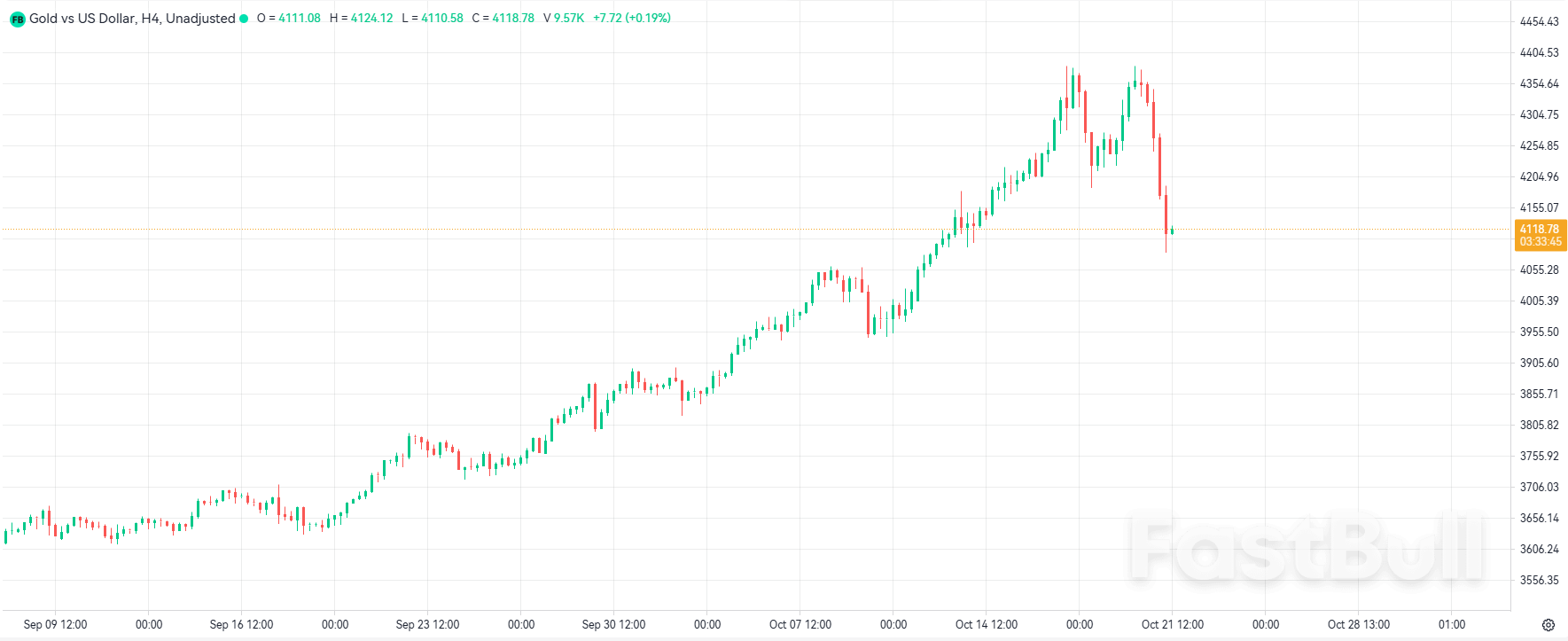
          Gold prices tumbled in their biggest daily drop in over ten years as a stunning rally in precious metals came to a halt.
          Futures for the yellow metal (GC=F) dropped as much as 5.5% to hover near $4,141 per troy ounce, on pace for their largest one-day drop in 12 years.
          Silver futures (SI=F) also tumbled more than 7% to mark their largest daily drop since 2021.
          The move came amid easing trade tensions between Washington and Beijing, a rise in the US dollar, and technical indicators flashing overbought conditions.
          "Gold had several attempts to push above $4,400, starting last Thursday. But on each occasion, it ran into resistance," Trade Nation senior market analyst David Morrison wrote in a note on Tuesday.
          The key question now is whether the slide represents the start of a much-needed correction after a stunning rally year to date, he added.Gold, Silver Tumble in Biggest Daily Drop in Years as Stunning Precious Metals Rally Comes to a Halt_1
          "The first major test to the downside comes in around $4,000," Morrison said. "But it's also quite possible that this is all we get from the dip and that buyers come back in around $4,200."
          Investors bought the dip last Friday when gold briefly dropped more than 1.5%, a rare pullback during its recent surge, as precious metals and equities reached all-time highs in October.
          "This is just a bump in the road," Sevens Report Research founder Tom Essaye told Yahoo Finance on Tuesday.
          "You still have elevated inflation," he said. "You have low real interest rates. You've got geopolitical concerns, you've got US government disfunction. That's all a bullish cocktail for gold."
          Gold has climbed 28% since mid-August amid central bank purchases and inflows into gold-backed exchange-traded funds (ETFs). Investors piled into the metal to hedge against trade tensions and a flight from fiat currencies.
          "What would break the back of gold would be if all of the sudden we greatly reduced our debt — not happening yet — and peace broke out in the world," Michele Schneider, chief strategist at Marketgauge.com, recently told Yahoo Finance.
          Wall Street remains bullish on the precious metal going into next year.
          Bank of America analysts recently reiterated their "long gold" recommendation, forecasting a peak of $6,000 per ounce by mid-2026.
          Meanwhile, Wall Street has been upping its price targets on gold. Goldman Sachs sees gold hitting $4,900 per troy ounce by the end of next year, up from its prior prediction of $4,300.
          JPMorgan analysts said the yellow metal could hit $6,000 per ounce by 2029.

          Source: Yahoo Finance

          Risk Warnings and Disclaimers
          You understand and acknowledge that there is a high degree of risk involved in trading. Following any strategies or investment methods may lead to potential losses. The content on the site is provided by our contributors and analysts for information purposes only. You are solely responsible for determining whether any trading assets, securities, strategy, or any other product is suitable for investing based on your own investment objectives and financial situation.
          Add to Favorites
          Share

          White House Plays Down Prospects For Quick Putin-Trump Meeting

          Owen Li

          Political

          President Donald Trump has no plans to meet President Vladimir Putin in the immediate future, a White House official said, offering a more downbeat tone after the two sides suggested earlier that a second summit between the two leaders would happen soon.

          The official, who asked not to be identified discussing private deliberations, said a call between Secretary of State Marco Rubio and Russian Foreign Minister Sergei Lavrov on Monday had been productive, and a meeting between the two officials also wasn’t necessary.

          The statement, while lacking in detail, contrasted with remarks Trump made after speaking with Putin by phone last week. At the time he said he would meet Putin “within two weeks or so” and that Rubio and Lavrov would meet “pretty soon.”

          The shift fit with similar remarks out of Russia, where the Kremlin also sought to tamp down expectations for a quick summit. Putin spokesman Dmitry Peskov said “the work ahead will be challenging,” according to the Interfax news service. “Preparation, serious preparation, is needed.”

          Trump has ratcheted up his calls to end the war in recent days, urging the two sides to stop the war “at the battle line.” On Monday, he cast doubt on Ukraine’s ability to defeat Russian forces, and he’s also equivocated over military aid to Ukraine and the threat of new sanctions on Russia.

          Ukraine President Volodymyr Zelenskiy was in Washington last Friday to try to persuade Trump to send Ukraine Tomahawk missiles and other support. But Putin got to Trump with a phone call the day before that meeting, and the two leaders agreed to meet in Budapest, Hungary.

          At the time, Trump acknowledged that the prospect of a Budapest summit might be part of an effort by Putin to stall for time, especially after an August summit between the two men made no progress on ending the conflict. But Trump shrugged off concerns that Putin may be manipulating him and insisted the Kremlin wants to end the conflict that’s well into its fourth year.

          Source: Bloomberg Europe

          Risk Warnings and Disclaimers
          You understand and acknowledge that there is a high degree of risk involved in trading. Following any strategies or investment methods may lead to potential losses. The content on the site is provided by our contributors and analysts for information purposes only. You are solely responsible for determining whether any trading assets, securities, strategy, or any other product is suitable for investing based on your own investment objectives and financial situation.
          Add to Favorites
          Share

          Gold Rebounds As $4,200 Support Holds, Eyes $4,300–$4,380 Zone

          Golden Gleam

          Economic

          Commodity

          Gold is over the support of $4,200, which creates good buyer interest and may push the price up to the middle range resistance near the level of $4,300.
          Further strength above $4,200 will provide a direction to $4,380, which is close to the upper limit of the current trading span.
          The sharp declines in the recent past are all contained meaning that it could be reversing to the mean and short-term recovery of the market as the momentum turns in favour of buyers.

          Gold (XAU/USD) is testing the important $4,200 support level associated with prior demand zones having previously triggered rebounds in the past. Current price action suggests possible upside momentum if price holds above this support level at $4,200.

          Support Holds Near $4,200

          Gold’s 1-hour chart shows the market approaching the lower boundary of the recent trading range around $4,200. Historical data indicates this zone has consistently acted as a strong demand base. Sellers have shown reduced strength near $4,217–$4,200, signaling possible defensive buying.

          According to Ali _charts, “If gold holds $4,200 as support, a rebound to $4,300 or even $4,380 could follow.” This tweet reflects the market’s focus on defending the support level. Price structure suggests a potential “V-shaped” recovery, where buyers may step in aggressively.

          Momentum indicators imply the recent drop has been contained within a short-term range. Sharp declines often precede mean reversion when demand enters the market, which could support a rebound toward higher levels.

          Rebound Targets and Market Structure

          If $4,200 holds, the first recovery target is $4,300, aligning with mid-range resistance from prior consolidations. This level could act as an initial zone for profit-taking by traders.

          The second target stands at $4,380, representing the upper boundary of the current trading range. This area often serves as a liquidity zone where larger market participants may adjust positions. A bounce toward this level would signal a short-term recovery in price action.

          A move back below $4,200 would likely open lower supports near $4,170, and draw additional defensive settlements into the market focus. Traders are eyeing this point for a potential shift in short-term trend and future buying reaction.

          For now, the market’s direction largely depends on the defense of the $4,200 support. Holding this zone could allow gold to regain upward momentum and challenge the $4,300–$4,380 range efficiently.

          Source: CryptoSlate

          To stay updated on all economic events of today, please check out our Economic calendar
          Risk Warnings and Disclaimers
          You understand and acknowledge that there is a high degree of risk involved in trading. Following any strategies or investment methods may lead to potential losses. The content on the site is provided by our contributors and analysts for information purposes only. You are solely responsible for determining whether any trading assets, securities, strategy, or any other product is suitable for investing based on your own investment objectives and financial situation.
          Add to Favorites
          Share
          FastBull
          Copyright © 2025 FastBull Ltd

          728 RM B 7/F GEE LOK IND BLDG NO 34 HUNG TO RD KWUN TONG KLN HONG KONG

          TelegramInstagramTwitterfacebooklinkedin
          App Store Google Play Google Play
          Products
          Charts

          Chats

          Q&A with Experts
          Screeners
          Economic Calendar
          Data
          Tools
          Membership
          Features
          Function
          Markets
          Copy Trading
          Latest Signals
          Contests
          News
          Analysis
          24/7
          Columns
          Education
          Company
          Careers
          About Us
          Contact Us
          Advertising
          Help Center
          Feedback
          User Agreement
          Privacy Policy
          Business

          White Label

          Data API

          Web Plug-ins

          Poster Maker

          Affiliate Program

          Risk Disclosure

          The risk of loss in trading financial instruments such as stocks, FX, commodities, futures, bonds, ETFs and crypto can be substantial. You may sustain a total loss of the funds that you deposit with your broker. Therefore, you should carefully consider whether such trading is suitable for you in light of your circumstances and financial resources.

          No decision to invest should be made without thoroughly conducting due diligence by yourself or consulting with your financial advisors. Our web content might not suit you since we don't know your financial conditions and investment needs. Our financial information might have latency or contain inaccuracy, so you should be fully responsible for any of your trading and investment decisions. The company will not be responsible for your capital loss.

          Without getting permission from the website, you are not allowed to copy the website's graphics, texts, or trademarks. Intellectual property rights in the content or data incorporated into this website belong to its providers and exchange merchants.

          Not Logged In

          Log in to access more features

          FastBull Membership

          Not yet

          Purchase

          Become a signal provider
          Help Center
          Customer Service
          Dark Mode
          Price Up/Down Colors

          Log In

          Sign Up

          Position
          Layout
          Fullscreen
          Default to Chart
          The chart page opens by default when you visit fastbull.com