• Trade
  • Markets
  • Copy
  • Contests
  • News
  • 24/7
  • Calendar
  • Q&A
  • Chats
Trending
Screeners
SYMBOL
LAST
BID
ASK
HIGH
LOW
NET CHG.
%CHG.
SPREAD
SPX
S&P 500 Index
6827.42
6827.42
6827.42
6899.86
6801.80
-73.58
-1.07%
--
DJI
Dow Jones Industrial Average
48458.04
48458.04
48458.04
48886.86
48334.10
-245.98
-0.51%
--
IXIC
NASDAQ Composite Index
23195.16
23195.16
23195.16
23554.89
23094.51
-398.69
-1.69%
--
USDX
US Dollar Index
97.890
97.970
97.890
98.070
97.880
-0.060
-0.06%
--
EURUSD
Euro / US Dollar
1.17469
1.17476
1.17469
1.17486
1.17262
+0.00075
+ 0.06%
--
GBPUSD
Pound Sterling / US Dollar
1.33853
1.33860
1.33853
1.33894
1.33546
+0.00146
+ 0.11%
--
XAUUSD
Gold / US Dollar
4340.64
4341.05
4340.64
4350.16
4294.68
+41.25
+ 0.96%
--
WTI
Light Sweet Crude Oil
57.044
57.074
57.044
57.601
57.030
-0.189
-0.33%
--

Community Accounts

Signal Accounts
--
Profit Accounts
--
Loss Accounts
--
View More

Become a signal provider

Sell trading signals to earn additional income

View More

Guide to Copy Trading

Get started with ease and confidence

View More

Signal Accounts for Members

All Signal Accounts

Best Return
  • Best Return
  • Best P/L
  • Best MDD
Past 1W
  • Past 1W
  • Past 1M
  • Past 1Y

All Contests

  • All
  • Trump Updates
  • Recommend
  • Stocks
  • Cryptocurrencies
  • Central Banks
  • Featured News
Top News Only
Share

EU Commission Spokersperson: EU Commission President Set To Travel To Berlin Monday Evening

Share

Brazil Economists See Brazilian Real At 5.40 Per Dollar By Year-End 2025 Versus 5.40 In Previous Estimate - Central Bank Poll

Share

Brazil Economists See Year-End 2026 Interest Rate Selic At 12.13% Versus 12.25% In Previous Estimate - Central Bank Poll

Share

Indonesia Minister: Final Agreement With USA On Tariffs Will Be Signed By Both Leaders And It Likely Would Not Happened This Year

Share

EU Commission Spokesperson: EU Commission Still Expects To Sign EU MERCOSUR Agreement By The End Of The Year

Share

New Czech Finance Minister Schillerova: Aiming For 2026 Budget To Be Approved By Cabinet In Second Half Of January

Share

Capital One Financial-30+ Day Performing Delinquencies Rate For Domestic Credit Card 4.01% At November End

Share

Capital One Financial- November Domestic Credit Card Net Charge-Offs Rate 5.02%

Share

Capital One Financial - November Auto Net Charge-Offs Rate 1.71%

Share

Capital One Financial - 30+ Day Performing Delinquencies Rate For Auto 5.02% At November End

Share

Brazil's Igp-10 Price Index Rises 0.04% In Dec

Share

Ukraine President Zelenskiy Will Meet Dutch Prime Minister Schoof And Dutch King In The Hague On Tuesday

Share

Pakistan Central Bank: Cuts Key Rate By 50 Bps To 10.50%

Share

German Government Spokesperson: Russian Central Bank Lawsuit Has No Impact On EU Plans To Use Frozen Russian State Assets For Ukraine

Share

German Government Spokesperson: United States Is Also Invited To This Evening's Talks Between The Europeans And Ukraine President Zelenskiy

Share

EU Official: EU Foreign Ministers Adopt Sanctions Targeting 14 Persons, Entities Under Russia Hybrid Threats Regime

Share

Polish Zloty Firms To 4.2175 Versus Euro, Strongest Since Early April

Share

China Npc Standing Committee Meeting To Review Draft Revision To Foreign Trade Law

Share

China Npc Standing Committee To Hold Meeting Dec 22-27

Share

The European Council Stated That, In Light Of Recent Mixed Activities And Threats Against Member States, It Has Expanded The List Of Individuals And Entities That Support Or Benefit From Actions Linked To The Belarusian Government

TIME
ACT
FCST
PREV
China, Mainland M1 Money Supply YoY (Nov)

A:--

F: --

P: --

India CPI YoY (Nov)

A:--

F: --

P: --

India Deposit Gowth YoY

A:--

F: --

P: --

Brazil Services Growth YoY (Oct)

A:--

F: --

P: --

Mexico Industrial Output YoY (Oct)

A:--

F: --

P: --

Russia Trade Balance (Oct)

A:--

F: --

P: --

Philadelphia Fed President Henry Paulson delivers a speech
Canada Building Permits MoM (SA) (Oct)

A:--

F: --

P: --

Canada Wholesale Sales YoY (Oct)

A:--

F: --

P: --

Canada Wholesale Inventory MoM (Oct)

A:--

F: --

P: --

Canada Wholesale Inventory YoY (Oct)

A:--

F: --

P: --

Canada Wholesale Sales MoM (SA) (Oct)

A:--

F: --

P: --

Germany Current Account (Not SA) (Oct)

A:--

F: --

P: --

U.S. Weekly Total Rig Count

A:--

F: --

P: --

U.S. Weekly Total Oil Rig Count

A:--

F: --

P: --

Japan Tankan Small Manufacturing Outlook Index (Q4)

A:--

F: --

P: --

Japan Tankan Large Non-Manufacturing Diffusion Index (Q4)

A:--

F: --

P: --

Japan Tankan Large Non-Manufacturing Outlook Index (Q4)

A:--

F: --

P: --

Japan Tankan Large Manufacturing Outlook Index (Q4)

A:--

F: --

P: --

Japan Tankan Small Manufacturing Diffusion Index (Q4)

A:--

F: --

P: --

Japan Tankan Large Manufacturing Diffusion Index (Q4)

A:--

F: --

P: --

Japan Tankan Large-Enterprise Capital Expenditure YoY (Q4)

A:--

F: --

P: --

U.K. Rightmove House Price Index YoY (Dec)

A:--

F: --

P: --

China, Mainland Industrial Output YoY (YTD) (Nov)

A:--

F: --

P: --

China, Mainland Urban Area Unemployment Rate (Nov)

A:--

F: --

P: --

Saudi Arabia CPI YoY (Nov)

A:--

F: --

P: --

Euro Zone Industrial Output YoY (Oct)

A:--

F: --

P: --

Euro Zone Industrial Output MoM (Oct)

A:--

F: --

P: --

Canada Existing Home Sales MoM (Nov)

A:--

F: --

P: --

U.K. Inflation Rate Expectations

--

F: --

P: --

Euro Zone Total Reserve Assets (Nov)

--

F: --

P: --

Canada National Economic Confidence Index

--

F: --

P: --

Canada New Housing Starts (Nov)

--

F: --

P: --

U.S. NY Fed Manufacturing Employment Index (Dec)

--

F: --

P: --

U.S. NY Fed Manufacturing Index (Dec)

--

F: --

P: --

Canada Core CPI YoY (Nov)

--

F: --

P: --

Canada Manufacturing Unfilled Orders MoM (Oct)

--

F: --

P: --

U.S. NY Fed Manufacturing Prices Received Index (Dec)

--

F: --

P: --

U.S. NY Fed Manufacturing New Orders Index (Dec)

--

F: --

P: --

Canada Manufacturing New Orders MoM (Oct)

--

F: --

P: --

Canada Core CPI MoM (Nov)

--

F: --

P: --

Canada Trimmed CPI YoY (SA) (Nov)

--

F: --

P: --

Canada Manufacturing Inventory MoM (Oct)

--

F: --

P: --

Canada CPI YoY (Nov)

--

F: --

P: --

Canada CPI MoM (Nov)

--

F: --

P: --

Canada CPI YoY (SA) (Nov)

--

F: --

P: --

Canada Core CPI MoM (SA) (Nov)

--

F: --

P: --

Canada CPI MoM (SA) (Nov)

--

F: --

P: --

Federal Reserve Board Governor Milan delivered a speech
U.S. NAHB Housing Market Index (Dec)

--

F: --

P: --

Australia Composite PMI Prelim (Dec)

--

F: --

P: --

Australia Services PMI Prelim (Dec)

--

F: --

P: --

Australia Manufacturing PMI Prelim (Dec)

--

F: --

P: --

Japan Manufacturing PMI Prelim (SA) (Dec)

--

F: --

P: --

U.K. 3-Month ILO Employment Change (Oct)

--

F: --

P: --

U.K. Unemployment Claimant Count (Nov)

--

F: --

P: --

U.K. Unemployment Rate (Nov)

--

F: --

P: --

U.K. 3-Month ILO Unemployment Rate (Oct)

--

F: --

P: --

U.K. Average Weekly Earnings (3-Month Average, Including Bonuses) YoY (Oct)

--

F: --

P: --

U.K. Average Weekly Earnings (3-Month Average, Excluding Bonuses) YoY (Oct)

--

F: --

P: --

Q&A with Experts
    • All
    • Chatrooms
    • Groups
    • Friends
    Connecting
    .
    .
    .
    Type here...
    Add Symbol or Code

      No matching data

      All
      Trump Updates
      Recommend
      Stocks
      Cryptocurrencies
      Central Banks
      Featured News
      • All
      • Russia-Ukraine Conflict
      • Middle East Flashpoint
      • All
      • Russia-Ukraine Conflict
      • Middle East Flashpoint
      Search
      Products

      Charts Free Forever

      Chats Q&A with Experts
      Screeners Economic Calendar Data Tools
      Membership Features
      Data Warehouse Market Trends Institutional Data Policy Rates Macro

      Market Trends

      Market Sentiment Order Book Forex Correlations

      Top Indicators

      Charts Free Forever
      Markets

      News

      News Analysis 24/7 Columns Education
      From Institutions From Analysts
      Topics Columnists

      Latest Views

      Latest Views

      Trending Topics

      Top Columnists

      Latest Update

      Signals

      Copy Rankings Latest Signals Become a signal provider AI Rating
      Contests
      Brokers

      Overview Brokers Assessment Rankings Regulators News Claims
      Broker listing Forex Brokers Comparison Tool Live Spread Comparison Scam
      Q&A Complaint Scam Alert Videos Tips to Detect Scam
      More

      Business
      Events
      Careers About Us Advertising Help Center

      White Label

      Data API

      Web Plug-ins

      Affiliate Program

      Awards Institution Evaluation IB Seminar Salon Event Exhibition
      Vietnam Thailand Singapore Dubai
      Fans Party Investment Sharing Session
      FastBull Summit BrokersView Expo
      Recent Searches
        Top Searches
          Markets
          News
          Analysis
          User
          24/7
          Economic Calendar
          Education
          Data
          • Names
          • Latest
          • Prev

          View All

          No data

          Scan to Download

          Faster Charts, Chat Faster!

          Download App
          English
          • English
          • Español
          • العربية
          • Bahasa Indonesia
          • Bahasa Melayu
          • Tiếng Việt
          • ภาษาไทย
          • Français
          • Italiano
          • Türkçe
          • Русский язык
          • 简中
          • 繁中
          Open Account
          Search
          Products
          Charts Free Forever
          Markets
          News
          Signals

          Copy Rankings Latest Signals Become a signal provider AI Rating
          Contests
          Brokers

          Overview Brokers Assessment Rankings Regulators News Claims
          Broker listing Forex Brokers Comparison Tool Live Spread Comparison Scam
          Q&A Complaint Scam Alert Videos Tips to Detect Scam
          More

          Business
          Events
          Careers About Us Advertising Help Center

          White Label

          Data API

          Web Plug-ins

          Affiliate Program

          Awards Institution Evaluation IB Seminar Salon Event Exhibition
          Vietnam Thailand Singapore Dubai
          Fans Party Investment Sharing Session
          FastBull Summit BrokersView Expo

          US 10-Year Yield Holds Above Fair Value as Deficit and CPI Heat Up

          Adam

          Bond

          Summary:

          The U.S. 10-year yield remains above fair value amid rising inflation and tariff pressures. Persistent deficits and CPI gains suggest the market premium may stay elevated, limiting prospects for near-term rate cuts.

          The market premium for the US Treasury yield edged lower in June, based on analysis using a “fair value” estimate. But with inflation showing signs of heating up due to tariffs, economic conditions don’t look particularly conducive for an ongoing decline in the market premium for the near term.
          The current average monthly fair-value estimate for June via several models is 3.77%, which remains moderately below the actual 10-year yield. In yesterday’s trading, the benchmark rate was 4.50% (July 15), a middling level vs. recent history. Relative to the current average fair value estimate, that equates with a market premium of 73 basis points, a middling premium year to date. The fair value estimate is calculated as the mean based on three models run by Capital Spectator.
          Based on monthly data, the market premium in June continued to hold in the 50-100 basis point range, which has prevailed so far in 2025. Investors will be keenly watching how tariffs affect the 10-year yield in the weeks and months ahead. Given an expectation that tariffs will remain elevated, it’s reasonable to speculate that the recent range for the market premium will rise as the crowd demands higher compensation for holding US debt. Another factor that looks set to keep the market premium relative high: estimates that the US federal budget deficit will deepen in the years ahead.
          US consumer inflation for June rose more than expected at the headline level. The Consumer Price Index (CPI) increased 2.7% vs. the year-ago level, the fastest pace since February. Core CPI, which strips out the volatile food and energy inputs, ticked up to a 2.9% annual rate.
          “Today’s report showed that tariffs are beginning to bite,” said Omair Sharif, head of Inflation Insights, “apparel prices rose, household furnishing prices jumped … and recreation commodities increased.”
          “Inflation has started a slow climb as signs of tariff-induced inflation are now evident within durable and nondurable imports,” advised Joe Brusuelas, chief economist at RSM US “That prompts an important question: Will service and housing inflation, which is easing but still elevated, cool further to offset what will be a more pronounced increase in durable and nondurable goods? Our sense is that the Federal Reserve will continue to display patience as the direction of inflation evolves,” he added.
          Fed funds futures are currently predicting a near-certain probability that the central bank will leave its target rate unchanged at a 4.25%-4.50% range for the upcoming July 30 FOMC meeting, based on CME data. The estimate for the September meeting, which recently had been leaning toward a moderate probability for a rate cut, is now closer to a coin-flip forecast, according to the future market.

          source : investing

          Risk Warnings and Disclaimers
          You understand and acknowledge that there is a high degree of risk involved in trading. Following any strategies or investment methods may lead to potential losses. The content on the site is provided by our contributors and analysts for information purposes only. You are solely responsible for determining whether any trading assets, securities, strategy, or any other product is suitable for investing based on your own investment objectives and financial situation.
          Add to Favorites
          Share

          Battered dollar a boon for U.S. multinational companies

          Adam

          Forex

          Large U.S. multinationals should soon start showing the positive effects of the dollar's tumble in recent months, reversing the situation in the past few years when the greenback's strength hurt companies with significant foreign revenue.
          The Dollar Index, which measures the buck's strength against six major currencies, is down about 10% for the year, due to rapidly changing U.S. trade policy and worries about U.S. growth and government debt.
          About half of that drop happened since April 2, when U.S. President Donald Trump announced outsized import tariffs against trading partners that started a panic about investing in U.S. assets.
          For the April-June period, the index, which is heavily weighted toward the euro, averaged 99.74, down 6.5% from the first quarter average, the largest such decline over consecutive quarters in more than 30 years. The effects of the dollar's slide are expected to start showing up in second-quarter earnings season just getting underway.
          While that dollar's fall reflects investor worries about the U.S. economy's strength, it can help some companies. A weaker U.S. currency makes it cheaper for multinational companies to convert foreign profits into dollars, while also boosting the competitiveness of exporters' products.
          "It's an absolutely huge move," Greg Boutle, head of U.S. equity & derivative strategy at BNP Paribas, said. "It is going to flatter earnings a little bit this quarter and also feed its way to guidance."
          The dollar's impact on overall earnings is usually small, but can grow more meaningful when the currency experiences a large swing.
          Every 10% drop in the dollar translates into a profit surprise of about 2%, at the S&P 500 level, according to estimates from research and strategy firm Macro Hive.
          That would be welcomed by investors increasingly worried about the earnings impact of evolving trade and tariff policies. The second-quarter profit reporting season started this week.
          "Whatever the beat, miss or forward guidance was going to be without the FX effect will obviously be a little bit better with it," Boutle said.
          The dollar's weakness this year, after a 7% rise in 2024, which hurt corporate results last year, took many market watchers by surprise.
          "Certainly a lot of companies came into the year assuming a headwind .... That's flipped. That's a positive for earnings," Patrick Kaser, portfolio manager at Brandywine Global, said.
          While earnings growth is expected to decelerate from the first quarter, the weaker dollar could help to offset possible tariff effects.
          Analysts are forecasting second-quarter earnings growth of 5.8% year-over-year compared with 13.7% in the first quarter, LSEG data show.
          Even in the first quarter, the dollar was a drag on year-over-year S&P 500 earnings growth of about 1%, but now could lift earnings growth by about 0.5% in the second quarter, according to David Lefkowitz, head of U.S. equities at UBS Global Wealth Management.
          "If the dollar stays at these levels, the boost on a year-over-year basis will get progressively larger," Lefkowitz said, estimating the dollar could generate a lift to year-over-year S&P 500 earnings growth by about 1% and 1.5% for the third and fourth quarter respectively.
          FOREIGN EXPOSURE
          S&P 500 companies generate about 41% of their revenue from outside the United States, according to FactSet.
          Companies with major exposure to the Asia-Pacific region are particularly in focus with the euro having appreciated 12% against the buck while the yen is up about 6%.
          However, not all index constituents are equally affected by the dollar's swings.
          The information technology sector tops the list with the most international revenue exposure, at about 55%, followed by the materials and communication services sectors, at 52% and 49%, respectively, according to FactSet.
          For instance, on Tuesday, BMO Capital Markets analyst Brian Pitz lifted his second-quarter revenue growth estimate for Netflix to 17.2% from 16.4%, largely boosted by a weaker dollar. Netflix will report results on Thursday.
          Investors are divided on the impact of a weaker dollar on stock prices. Some, like UBS's Lefkowitz, believe any benefits are already priced in by Wall Street and will not significantly move markets during earnings reports, but others still anticipate a positive boost.
          "A lot of buy-side investors are obviously very acutely aware of this already, but nevertheless, we do think it's not in sell-side consensus numbers," BNP's Boutle said.
          "So we just think it creates a mechanical tailwind for earnings."
          Still, analysts cautioned against counting on a big lift to stock prices from earnings beats driven by the weaker dollar.
          Many companies, including chipmakers, which stand to benefit from a weaker dollar, are also the ones most vulnerable to a hit from tariffs, Macro Hive research analyst Viresh Kanabar said.
          Investors may also be preoccupied with the potential impacts companies could see from the recent passage of the sweeping tax-cut and spending bill.
          "In an environment where nothing else was going on, the move in the dollar would matter," Brandywine's Kaser said. "With all these other things going on, I don't think the currency effect is going to be as big as in an environment that maybe is quieter from a macroeconomic and geopolitical side of things."

          Source: Reuters

          Risk Warnings and Disclaimers
          You understand and acknowledge that there is a high degree of risk involved in trading. Following any strategies or investment methods may lead to potential losses. The content on the site is provided by our contributors and analysts for information purposes only. You are solely responsible for determining whether any trading assets, securities, strategy, or any other product is suitable for investing based on your own investment objectives and financial situation.
          Add to Favorites
          Share

          US Two-year Yields Off Lows After Trump Says He Is Not Firing Fed's Powell

          Thomas

          Economic

          Central Bank

          Two-year U.S. Treasury yields tumbled in volatile trading on Wednesday but came off their lowest levels after President Donald Trump said he was not planning to fire Federal Reserve Chair Jerome Powell, refuting media reports that he planned to do so soon.

          Two-year yields (US2YT=RR), which track interest rate expectations, fell to a roughly one-week low of 3.86% after CBS and Bloomberg reported that Trump had indicated to a group of House Republicans that he would fire Powell.

          The yield was last 5.1 basis points lower at 3.906% (US2YT=RR).

          The reports pushed rate cut bets starting in September to 66%, from 54% just before. After Trump said the reports were not true, that probability stood at 60%.

          "I don't rule out anything, but I think it's highly unlikely unless (Powell) has to leave for fraud," Trump said, a reference to recent White House and Republican lawmaker criticism of cost overruns in the $2.5 billion renovation of the Fed's historic headquarters in Washington.

          Investors sold off the long end of the Treasury curve, pushing 30-year yields to an eight-week high of 5.08%, before they eased back to 5.041% (US30YT=RR).

          The benchmark 10-year yieldalso rose but was last down 1.2 bps on the day at 4.477%.

          The yield curve steepened to its most since April, with the spread between two- and 10-year yields widening to as much as 61.8 bps. That reflects the sell-off at the long end amid fiscal worries and concerns about inflation going out of control if the Fed under a new chair cuts rates aggressively.

          "This story keeps churning so understandably markets are nervous that it could happen sooner rather than later re Trump firing Powell," said Kenneth Broux, head of corporate research and rates, at Societe Generale in London.

          "Bond and FX markets do not like the uncertainty. We've had stronger U.S. CPI goods ex-autos just yesterday, so to think that lower rates are the way forward as tariffs seep through consumer prices is not going to reassure."
          Source: TradingView

          To stay updated on all economic events of today, please check out our Economic calendar
          Risk Warnings and Disclaimers
          You understand and acknowledge that there is a high degree of risk involved in trading. Following any strategies or investment methods may lead to potential losses. The content on the site is provided by our contributors and analysts for information purposes only. You are solely responsible for determining whether any trading assets, securities, strategy, or any other product is suitable for investing based on your own investment objectives and financial situation.
          Add to Favorites
          Share

          Investors seek protection from risk of Fed chief's ouster

          Adam

          Economic

          President Donald Trump's renewed calls for Federal Reserve Chair Jerome Powell's resignation have prompted investors to protect portfolios against the risk of higher inflation, as a central bank more willing to lower interest rates could fuel price rises and make lenders demand higher compensation to hold bonds.
          While a Fed chief more friendly to cutting rates could be mixed for equities in the short term, it would translate into a weaker U.S. dollar, increased volatility in the Treasuries market and higher longer-term rates, meaning more expensive borrowing costs for mortgages and corporate bonds.
          Since returning to the White House in January, Trump has repeatedly railed against the Powell-led Fed for not cutting interest rates, feeding concerns that Trump aims to put the Fed under his thumb.
          Even JPMorgan (JPM.N) CEO Jamie Dimon on Tuesday warned of the unintended consequences of that, saying central bank independence was sacrosanct.
          If market participants perceive that Fed independence is eroding, moves in financial assets could be wild, some analysts say. One of the top risks is that investors will sell Treasury bonds, lifting interest rates on longer-term maturities in the U.S. debt market relative to short-term securities.
          "If markets believe that a politically-captured Fed will lower rates to stimulate growth regardless of economic consequences, long-term inflation expectations will rise, causing the curve to steepen," said Guy LeBas, chief fixed income strategist at asset manager Janney Capital Management.
          "It's impossible to be confident in the magnitude of the move, but my guess is it'll be large - possibly measured in percent increases in 30-year Treasury yields, not basis points."
          The minutes from the Fed's June 17-18 meeting, which were released last week, showed little support for a cut at the central bank's July 29-30 meeting, as most policymakers remain concerned about the inflationary risks that Trump's import tariffs could pose.
          Even so, Trump has said Powell's resignation "would be a great thing." The president, who cannot fire the Fed chief over a monetary policy dispute, and his administration have publicly called for Powell's exit or for rates to be cut on multiple occasions this month.
          "While short-dated yields could fall in this scenario based on a faster pace of Fed rate cuts moving forward, longer-dated yields would likely recalibrate higher for stickier inflation and rising term premia based on the erosion of institutional trust," said Chip Hughey, managing director of fixed income at Truist Advisory Services.
          Bond investors are pricing in increased price pressures in the inflation market over the next few years. Breakeven inflation as indicated in the U.S. five-year Treasury Inflation-Protected Securities hit 2.476% late on Monday, a three-month high.
          In a recent escalation of criticism of Powell, the White House is probing cost overruns in the renovation of the Fed's historic headquarters in Washington.
          The questioning has intensified concerns among market participants over risks that the Trump administration will try to fire Powell for cause, perhaps the only legal path for it to do so. U.S. Treasury 30-year yields on Tuesday topped 5% for the first time since late May, as investors fretted about the country's huge fiscal deficit and assessed the risk of Powell's exit from the central bank.
          A Fed spokesperson pointed to Powell's previous statements. The Fed chief, who was appointed by Trump during the president's first term in the White House, has repeatedly said he has no plans to leave his post as head of the U.S. central bank before his term expires on May 15, 2026. Powell's seat on the Fed's Board of Governors extends to January 31, 2028.
          The White House did not immediately respond to a Reuters request for comment.
          "I still see the risks as fairly minimal, but higher than they were a week or two ago," said Matt Orton, head of market strategy at Raymond James Investment Management. Orton still favors a diversification away from Treasuries and into gold, as well as both high-quality value and growth equities. "The risk-reward for me in Treasuries right now just isn't there."
          ON THE HUNT
          While the odds of Powell being ousted or resigning are viewed as low, analysts see some chance that Trump could nominate someone for the job early to influence monetary policy through a "shadow" Fed chief.
          U.S. Treasury Secretary Scott Bessent said earlier this month the Trump administration is focusing now on finding a replacement for Powell this fall.
          Morgan Stanley said in a note that the risk of a shadow Fed chief is a less relevant question at this point.
          "Until Powell's term is up, though, the bigger risk to our Fed forecast is our economic forecast ... where we remain quite humble," Seth Carpenter, Morgan Stanley's chief global economist, wrote.
          Although market participants see the risk of weakening the central bank's independence as low, many investors are increasingly incorporating this prospect into their portfolios.
          JPMorgan CEO Jamie Dimon pointed to those risks in an earnings call on Tuesday, saying: "The independence of the Fed is absolutely critical, and not just for the current Fed chairman, who I respect, Jay Powell, but for the next Fed chairman."
          "Playing around with the Fed can often have adverse consequences, absolutely opposite of what you might be hoping for," Dimon added.
          George Bory, chief investment strategist for fixed income at Allspring, said the asset manager has been positioning for steeper yield curves, in line with an environment of future rate cuts and growing budget deficits.
          "That strategy of positioning for a steeper yield curve over the coming months and quarters seems to make a lot of sense. It's justified economically, the technicals support it, and then the political landscape also," he said.
          If stocks could get a boost from lower rates initially, the pressure from higher long-term rates would cast a shadow over them, investors say.
          Jack Ablin, chief investment officer at Cresset Capital, said U.S. equities would "probably be OK, but I think that it would likely continue to accelerate the trend of global investors moving capital away from the U.S."
          "Once investors question the independence of the Fed, it just becomes a less stable monetary environment," Ablin said.

          Source: Reuters

          To stay updated on all economic events of today, please check out our Economic calendar
          Risk Warnings and Disclaimers
          You understand and acknowledge that there is a high degree of risk involved in trading. Following any strategies or investment methods may lead to potential losses. The content on the site is provided by our contributors and analysts for information purposes only. You are solely responsible for determining whether any trading assets, securities, strategy, or any other product is suitable for investing based on your own investment objectives and financial situation.
          Add to Favorites
          Share

          Nasdaq and S&P500: Tech Stocks Slide on ASML Warning, Dow Gains on Bank Strength

          Adam

          Stocks

          Tech Weakness Pulls Nasdaq and S&P 500 Lower While Dow Gains on Bank Strength
          U.S. markets traded mixed in the first hour of Wednesday’s session as tech sector losses, led by ASML, weighed on the Nasdaq and S&P 500. The Dow Jones Industrial Average rose about 0.3%, supported by bank earnings, while the Nasdaq slipped 0.1%. The S&P 500 held near flat, reflecting pressure from semiconductor names.

          How Is ASML’s Outlook Hitting the Chip Sector?

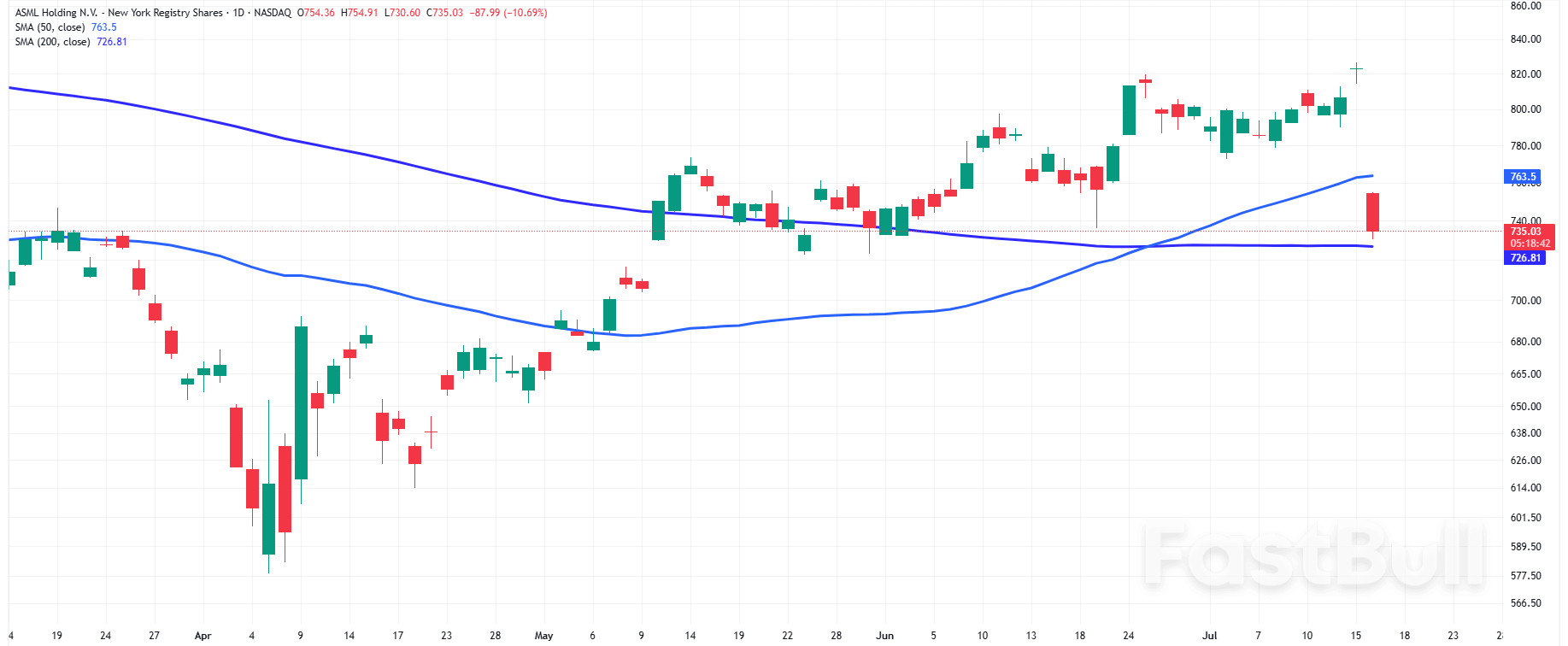
          Nasdaq and S&P500: Tech Stocks Slide on ASML Warning, Dow Gains on Bank Strength_1Daily ASML Holding N.V.

          ASML shares fell more than 6.5% after the company narrowed its 2025 revenue forecast and said it couldn’t confirm growth in 2026. That overshadowed a second-quarter beat on both top and bottom lines. The Dutch chip-equipment maker reported €7.7 billion in sales and €2.29 billion in profit, surpassing analyst estimates. However, its Q3 guidance of €7.4–€7.9 billion came in below the €8.3 billion consensus.
          ASML attributed its caution to macroeconomic and geopolitical uncertainty, particularly the impact of tariffs. The reaction was swift: Marvell, Applied Materials, Lam Research, and Micron dropped between 3% and 5%, dragging down the broader tech space. The S&P tech sector dipped 0.2% early, capping broader market gains.

          Can Strong Bank Earnings Keep the Dow Afloat?

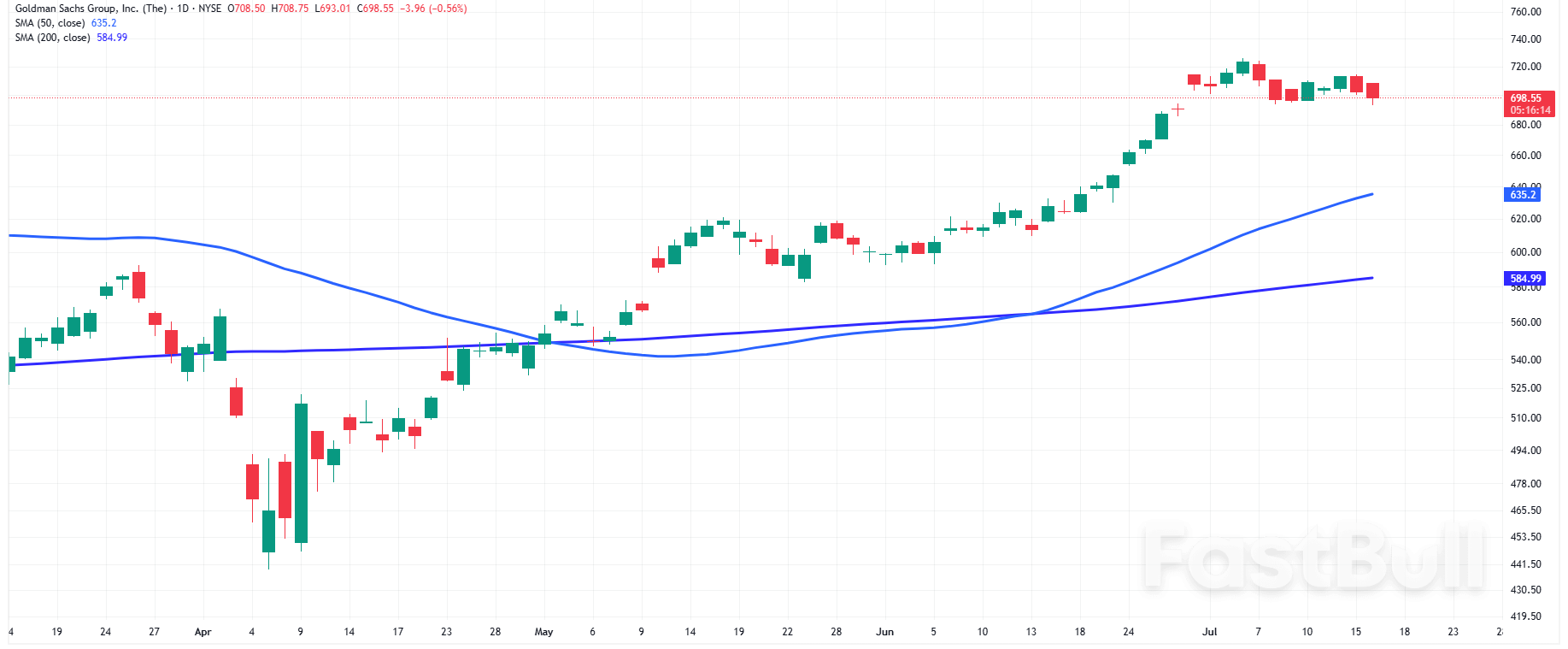
          Nasdaq and S&P500: Tech Stocks Slide on ASML Warning, Dow Gains on Bank Strength_2Daily Goldman Sachs Group, Inc

          Financials provided a cushion. Goldman Sachs and Morgan Stanley beat earnings estimates, though the latter traded lower following its results. Bank of America also topped expectations but slipped slightly as net interest income missed forecasts.
          The financial sector gained around 0.2%, bolstered by continued strength from JPMorgan, Citigroup, and Wells Fargo earlier this week.
          These results help offset weakness elsewhere, with investors rewarding consistent revenue and capital return over top-line surprises alone.

          Does the Latest Inflation Data Support a Rate Cut Narrative?

          The June Producer Price Index came in flat month-over-month, undercutting expectations of a 0.2% rise. That followed softer-than-expected consumer inflation data earlier this week and reinforced market hopes for Federal Reserve easing later this year. Still, with inflation above target and labor markets tight, analysts remain divided on timing and size of any rate moves.

          Volatility on Deck as Technical Signals Flash Red?

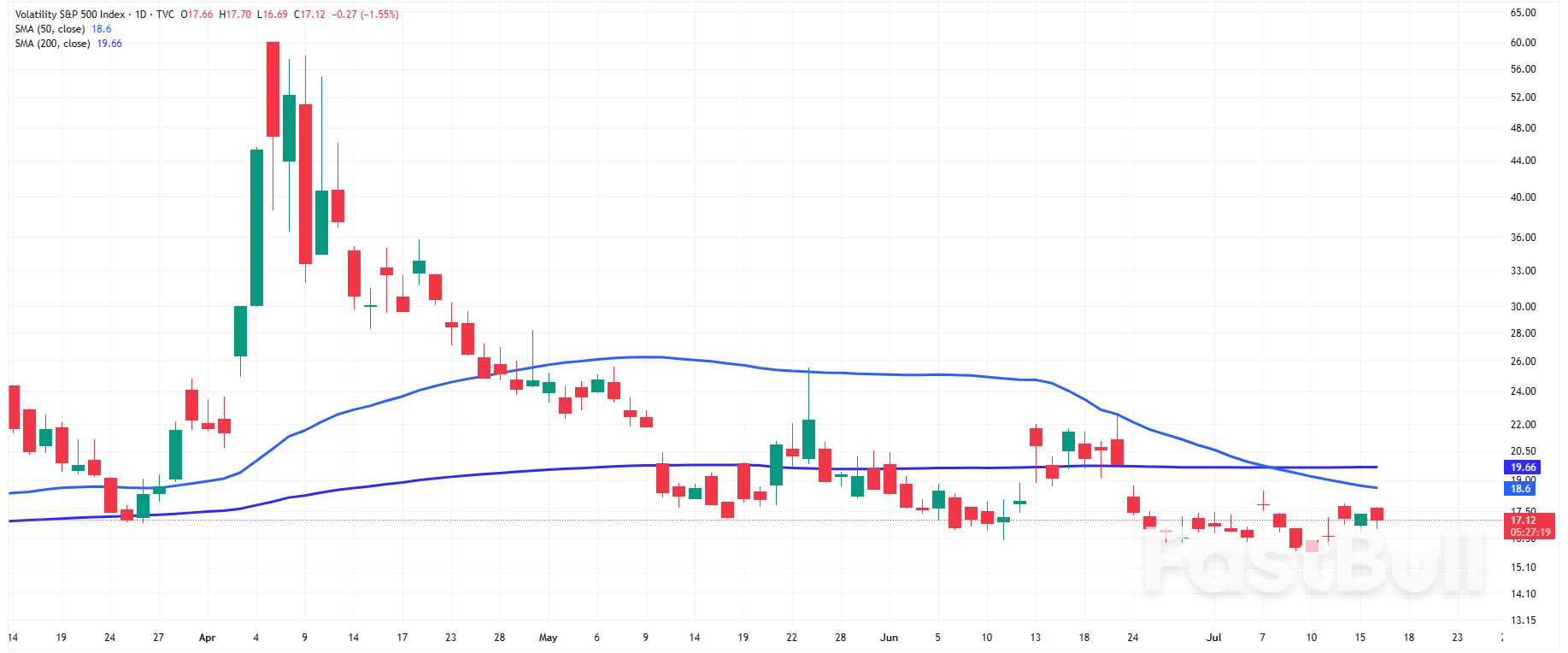
          Nasdaq and S&P500: Tech Stocks Slide on ASML Warning, Dow Gains on Bank Strength_3

          Daily Volatility S&P 500 Index

          BTIG flagged a cautionary signal: the S&P 500’s streak of closes above its 20-day moving average often precedes sharp volatility spikes. With earnings season heating up and geopolitical headlines in focus, traders should expect wider price swings.

          Market Outlook: Cautious Optimism With High Alert

          Early action shows sector divergence—strength in banks, weakness in chips. With inflation cooling and Fed policy uncertain, traders should stay nimble.
          Upcoming earnings from major tech names and more inflation data could drive decisive moves.
          Volatility strategies and earnings-driven setups may offer the most attractive risk-reward in the current tape.

          source :fxempire

          Risk Warnings and Disclaimers
          You understand and acknowledge that there is a high degree of risk involved in trading. Following any strategies or investment methods may lead to potential losses. The content on the site is provided by our contributors and analysts for information purposes only. You are solely responsible for determining whether any trading assets, securities, strategy, or any other product is suitable for investing based on your own investment objectives and financial situation.
          Add to Favorites
          Share

          Instant View: Markets Gyrate On Brief Scare That Trump Will Fire Fed's Powell

          Devin

          Economic

          Central Bank

          The dollar briefly tumbled on Wednesday and Treasury bond yields popped higher on reports citing an unidentified White House official that U.S. President Donald Trump is likely to fire Federal Reserve Chair Jerome Powell soon, before Trump said he is not planning to do so.

          Stocks also pared the mild losses that came off the original report from Bloomberg.

          Sign up

          Investors had been on edge for weeks about the prospect of Powell being removed from his job before his term ends next May, as Trump has repeatedly criticised him for not cutting U.S. rates quickly enough.

          COMMENTS:

          JAMIE COX, MANAGING PARTNER, HARRIS FINANCIAL GROUP, RICHMOND, VIRGINIA:

          “The President would be making a mistake to fire Chair Powell. Federal Reserve independence is critical to money policy effectiveness, and the last thing the country needs is monetary policy by Presidential fiat. If the President messes with the Chairman, the Congress might use it as an excuse to step in to make changes to the Federal Reserve Act--none of these would be good for monetary policy integrity.”

          CHRISTOPHER HODGE, CHIEF ECONOMIST FOR US, NATIXIS, NEW YORK:

          “Much of Fed governance and process is informal, relying on norms and traditions, rather than statute. These norms have been developed over decades and have helped cement the Fed as a credible, trusted, and non-partisan institution that helps to smooth expectations volatility, rather than add to it.

          "Maintaining the current traditions is the best route, but even if an alternative path is taken, there are likely sufficient guardrails to prevent a sustained and significant erosion of Fed credibility. If the new Chair is not viewed as credible and nonpartisan, there risks a serious split on FOMC decisions. In this light, selecting Waller as the replacement makes the most sense,”

          KENNETH BROUX, HEAD OF CORPORATE RESEARCH FX AND RATES, SOCIETE GENERALE, LONDON:

          "This story keeps churning so understandably markets are nervous that it could happen sooner rather than later re Trump firing Powell. Bond and FX markets do not like the uncertainty. We've had stronger U.S. CPI goods ex-autos just yesterday so to think that lower rates are the way forward as tariffs seep through consumer prices is not going to reassure. Hence long end USTs (US Treasuries)selling off versus the front end and the dollar is down."

          JUAN PEREZ, SENIOR DIRECTOR OF TRADING, MONEX USA, WASHINGTON:

          “Ultimately, what drives the U.S. dollar up in value against its peers, against everything is the idea that we have a financial system that's very centered around the U.S. dollar, and it is also a safe-haven asset.”

          “What can kill the value of the U.S. dollar, what can absolutely destroy faith in the U.S. dollar, is attacking in any way, shape, or form the independence and authority of the Federal Reserve. Ultimately, when it comes to respecting and adhering to this concept of the U.S. dollar as a safe-haven asset in the midst of turbulence, that turbulence cannot affect or inflict pain when it comes to the greatest financial authority in the form of the Fed.

          "But if politics, or if the White House, or if anybody can interfere with that, or wants to actively do so, that is absolutely a very, very negative thing for how the U.S. dollar is viewed, how the U.S. dollar is traded, and how people look at the dollar for the future.”

          “In times of physical disturbance to the world, of geopolitical conflict, it makes sense to hold on to the U.S. dollar, but you're not going to hold on to the U.S. dollar if the one thing that makes it so solid, the Fed, is under attack. It really comes down to that.”

          PAUL NOLTE, SENIOR WEALTH ADVISOR & MARKET STRATEGIST, MURPHY & SYLVEST, ELMHURST, ILLINOIS:

          “(Trump’s) going to have to go through litigation in order to do it. He's just not going to be able to pink slip it like he did with different departments, the Department of Education or USAID or anything like that. So there is a process and to my knowledge, it has never happened before. So I'm not sure that it's going to be effective, other than to roil the market.”

          “My understanding of the Federal Reserve and what can and can't be done – and this has been reviewed by others – is that this is not something he's going to be able to pull off and I'm not sure the Supreme Court is going to go along with it.”

          “You’re now throwing up a lot of unknowns. Who's going to come in? What are they going to do? Will interest rates go down? Is that going to further inflation?”

          “Powell has been steady. He's been consistent. Has he made mistakes? Yep. Everybody that's been in that position has. So I'm not sure that putting somebody new in there is going to fix all of those issues, but it does add an element of very much uncertainty to monetary policy.”

          STEVE SOSNICK, CHIEF STRATEGIST, INTERACTIVE BROKERS, CONNECTICUT:

          "Markets should be concerned about potential interference in the Fed's independence."

          "Dollar plunging is what you'd expect. Short term rates getting hit going much lower is what you'd expect because whoever (Trump) put in would presumably be much more willing to cut rates.

          "Stocks' reaction is a little muted because firstly traders remain loath to sell, they're just so programmed to try to buy dips that they're not eager to sell."

          "Secondly because perhaps there are some traders who like the idea of lower rates more than more than the loss of independence."

          RICK MECKLER, PARTNER, CHERRY LANE INVESTMENTS, A FAMILY INVESTMENT OFFICE, NEW VERNON, NEW JERSEY:

          "It would be a big mistake on (Trump's) part if he is concerned about the markets and the dollar. An independent Fed gives balance between monetary and fiscal policy. I don't think that lowering rates here any small amount will really impact much about the economy. It might impact the debt interest payments but that's about it."

          "One problem with this administration is they try and do an awful lot at the same time. And I don't know whether that's to try and get more things through rather than have a battle with Democrats over any one thing."

          "But investors like orderly, carefully planned moves and this smacks of something that's just creating disorder and ramifications that I don't think the administration has completely thought out."

          "It's a very unpredictable administration and that Trump in particular seems to take umbrage at the idea that he doesn't follow through on some of these things. So it wouldn't surprise me if they did (fire Powell). It wouldn't surprise me if they didn't. That's one of the problems in assessing investments under this administration is that there often is no clear path as to what's going to happen. And there's an awful lot of rhetoric that doesn't necessarily result in any specific action. So those are recipes for volatility but are not particularly good in terms of planning, either for corporate planning or for investment planning."

          "It's very similar to the tariff situation. There's a lot of news that could be very meaningful, but no clear indication of whether it's going to come to fruition or not. So it just leaves a lot of investors confused, and many of them sitting on the sidelines trying to get a sense of where we're headed as a country financially."

          MARCO VAILATI, HEAD OF RESEARCH AND INVESTMENTS, CASSA LOMBARDA, MILAN:

          "It remains to be seen whether Trump will follow through on this threat. Such a move would almost certainly alarm the market, as it would call into question the Fed's independence from political authority. A less independent Fed, more beholden to this political leadership, would raise concerns — not so much about solvency, but about the very reliability of the U.S. dollar as the world’s reserve currency."

          FRANCESCO PESOLE, FX STRATEGIST, ING, LONDON:

          "If we get a headline today on Powell (removal), then we are looking at much more bigger sell-off in the dollar. Federal Reserve independence is the foundation the U.S.' status as the No.1 reserve currency."

          "Given the implications of removing a Fed chair, the reaction is still relatively contained. Euro/dollar is at $1.17 and should be trading higher on this, because the implications are massive. Markets are still not fully pricing this all in. You would expect that if Powell is removed today, then the Fed cuts in September."

          CHRIS BEAUCHAMP, CHIEF MARKET ANALYST, IG, LONDON:

          "The news has put the dollar firmly on the back foot but has dragged stocks lower too. The Fed chairman’s departure would leave the independence of the central bank in question. It seems likely that his (Trump's) recent successes in passing his tax and spending bill, and the ceasefire in the Middle East, have emboldened the president to act."

          "Now we will see if the bond market vigilantes will put the U.S. in their sights again. Such a dramatic move also suggests there is no backing down from tariffs this time around, especially with stocks at record highs."

          LEE HARDMAN, SENIOR CURRENCY ANALYST, MUFG, LONDON:

          "If that does happen (Trump fires Powell), it would be very damaging for investor confidence in the dollar, that’s why we’re starting to see the heavy selling, and it could extend further if he were to do so.

          "It’s not clear-cut whether Trump has the power to fire Powell, so we would expect to see a legal challenge very quickly, but even if it were overruled, the hit to confidence would be long lasting, and it reinforces our bearish outlook on the dollar."

          Source: Reuters

          To stay updated on all economic events of today, please check out our Economic calendar
          Risk Warnings and Disclaimers
          You understand and acknowledge that there is a high degree of risk involved in trading. Following any strategies or investment methods may lead to potential losses. The content on the site is provided by our contributors and analysts for information purposes only. You are solely responsible for determining whether any trading assets, securities, strategy, or any other product is suitable for investing based on your own investment objectives and financial situation.
          Add to Favorites
          Share

          Nvidia, Meta, Google, Microsoft, and other giant tech stocks have one important challenge coming up

          Adam

          Stocks

          Large-cap tech stocks will likely soon be forced to meet the moment.
          The do-or-die challenge for the tech bulls? A series of hot financial results and outlooks to match three months of hot stock price gains.
          "I anticipate that the quality of earnings from these [large cap tech] companies will continue to be strong, but their ability to move their valuations to move higher and higher, completely unfettered, certainly is likely to be challenged here in the next couple of quarters," New York Life Investments chief markets strategist Lauren Goodwin said on Yahoo Finance's Opening Bid (watch above).
          New York Life Investments has more than $800 billion in assets under management (AUM).
          Goodwin cited cost challenges and trade uncertainty as risks to the sizzling tech trade headed into the second half of the year.
          Unfettered tech valuations have been the modus operandi for the large-cap tech space of late.
          High-profile tech names in Alphabet (GOOG, GOOGL), Meta (META), Nvidia (NVDA), and Microsoft (MSFT) have advanced an average of 35% in the past three months, according to Yahoo Finance analysis. The top two performers are AI darlings Nvidia and Meta, which have logged respective gains of 52% and 41%.
          The four giant tech stocks have an average forward price-to-earnings (PE) multiple of 30 times, well above the S&P 500's (^GSPC) 22 times. Meta, Nvidia, and Microsoft's forward PE multiples are above their three-year averages, while Alphabet's is slightly below.
          Large-cap tech's strong rally extends beyond the household names in the "Magnificent Seven" complex.
          For instance, Broadcom (AVGO) is up 57% in the past three months, pushing its valuation multiples to some of the highest levels in five years. The same situation extends to Uber (UBER) after a 25% stock price increase in the last three months.
          Nowhere has the rush to drive up large-cap valuations been more evident than in Nvidia.
          On Wednesday, the company's market cap stood at nearly $4.2 trillion amid enthusiasm about its AI chips flowing back into China soon.
          "The AI Revolution is just hitting its next stage of growth," crowed tech analyst Dan Ives of Wedbush, epitomizing the enthusiasm in the space.
          But others eyeing the tech trade are beginning to echo Goodwin's more measured tone when putting money to work at higher valuations.
          "We note that the recent rally in large-cap tech and AI stocks has been fueled mainly by price-to-earnings (P/E) multiple expansion," Ulrike Hoffmann-Burchardi, global head of Equities for UBS Financial Services, pointed out. "While we remain structurally bullish on AI, we would prefer to see further gains underpinned by upward earnings-per-share (EPS) revisions rather than valuation expansion alone."
          She added, "Pockets of elevated valuations across leading AI companies, ongoing geopolitical uncertainty, and the upcoming second-quarter earnings season all point to the need for a balanced and selective approach. We recommend investors seek diversified exposure across semiconductors, software, and internet platforms, rather than concentrating risk in any single segment or individual stock."

          Source : finance.yahoo

          Risk Warnings and Disclaimers
          You understand and acknowledge that there is a high degree of risk involved in trading. Following any strategies or investment methods may lead to potential losses. The content on the site is provided by our contributors and analysts for information purposes only. You are solely responsible for determining whether any trading assets, securities, strategy, or any other product is suitable for investing based on your own investment objectives and financial situation.
          Add to Favorites
          Share
          FastBull
          Copyright © 2025 FastBull Ltd

          728 RM B 7/F GEE LOK IND BLDG NO 34 HUNG TO RD KWUN TONG KLN HONG KONG

          TelegramInstagramTwitterfacebooklinkedin
          App Store Google Play Google Play
          Products
          Charts

          Chats

          Q&A with Experts
          Screeners
          Economic Calendar
          Data
          Tools
          Membership
          Features
          Function
          Markets
          Copy Trading
          Latest Signals
          Contests
          News
          Analysis
          24/7
          Columns
          Education
          Company
          Careers
          About Us
          Contact Us
          Advertising
          Help Center
          Feedback
          User Agreement
          Privacy Policy
          Business

          White Label

          Data API

          Web Plug-ins

          Poster Maker

          Affiliate Program

          Risk Disclosure

          The risk of loss in trading financial instruments such as stocks, FX, commodities, futures, bonds, ETFs and crypto can be substantial. You may sustain a total loss of the funds that you deposit with your broker. Therefore, you should carefully consider whether such trading is suitable for you in light of your circumstances and financial resources.

          No decision to invest should be made without thoroughly conducting due diligence by yourself or consulting with your financial advisors. Our web content might not suit you since we don't know your financial conditions and investment needs. Our financial information might have latency or contain inaccuracy, so you should be fully responsible for any of your trading and investment decisions. The company will not be responsible for your capital loss.

          Without getting permission from the website, you are not allowed to copy the website's graphics, texts, or trademarks. Intellectual property rights in the content or data incorporated into this website belong to its providers and exchange merchants.

          Not Logged In

          Log in to access more features

          FastBull Membership

          Not yet

          Purchase

          Become a signal provider
          Help Center
          Customer Service
          Dark Mode
          Price Up/Down Colors

          Log In

          Sign Up

          Position
          Layout
          Fullscreen
          Default to Chart
          The chart page opens by default when you visit fastbull.com