Markets
News
Analysis
User
24/7
Economic Calendar
Education
Data
- Names
- Latest
- Prev


Signal Accounts for Members
All Signal Accounts
All Contests


U.K. Trade Balance Non-EU (SA) (Oct)A:--
F: --
P: --
U.K. Trade Balance (Oct)A:--
F: --
P: --
U.K. Services Index MoMA:--
F: --
P: --
U.K. Construction Output MoM (SA) (Oct)A:--
F: --
P: --
U.K. Industrial Output YoY (Oct)A:--
F: --
P: --
U.K. Trade Balance (SA) (Oct)A:--
F: --
P: --
U.K. Trade Balance EU (SA) (Oct)A:--
F: --
P: --
U.K. Manufacturing Output YoY (Oct)A:--
F: --
P: --
U.K. GDP MoM (Oct)A:--
F: --
P: --
U.K. GDP YoY (SA) (Oct)A:--
F: --
P: --
U.K. Industrial Output MoM (Oct)A:--
F: --
P: --
U.K. Construction Output YoY (Oct)A:--
F: --
P: --
France HICP Final MoM (Nov)A:--
F: --
P: --
China, Mainland Outstanding Loans Growth YoY (Nov)A:--
F: --
P: --
China, Mainland M2 Money Supply YoY (Nov)A:--
F: --
P: --
China, Mainland M0 Money Supply YoY (Nov)A:--
F: --
P: --
China, Mainland M1 Money Supply YoY (Nov)A:--
F: --
P: --
India CPI YoY (Nov)A:--
F: --
P: --
India Deposit Gowth YoYA:--
F: --
P: --
Brazil Services Growth YoY (Oct)A:--
F: --
P: --
Mexico Industrial Output YoY (Oct)A:--
F: --
P: --
Russia Trade Balance (Oct)A:--
F: --
P: --
Philadelphia Fed President Henry Paulson delivers a speech
Canada Building Permits MoM (SA) (Oct)A:--
F: --
P: --
Canada Wholesale Sales YoY (Oct)A:--
F: --
P: --
Canada Wholesale Inventory MoM (Oct)A:--
F: --
P: --
Canada Wholesale Inventory YoY (Oct)A:--
F: --
P: --
Canada Wholesale Sales MoM (SA) (Oct)A:--
F: --
P: --
Germany Current Account (Not SA) (Oct)A:--
F: --
P: --
U.S. Weekly Total Rig CountA:--
F: --
P: --
U.S. Weekly Total Oil Rig CountA:--
F: --
P: --
Japan Tankan Large Non-Manufacturing Diffusion Index (Q4)--
F: --
P: --
Japan Tankan Small Manufacturing Outlook Index (Q4)--
F: --
P: --
Japan Tankan Large Non-Manufacturing Outlook Index (Q4)--
F: --
P: --
Japan Tankan Large Manufacturing Outlook Index (Q4)--
F: --
P: --
Japan Tankan Small Manufacturing Diffusion Index (Q4)--
F: --
P: --
Japan Tankan Large Manufacturing Diffusion Index (Q4)--
F: --
P: --
Japan Tankan Large-Enterprise Capital Expenditure YoY (Q4)--
F: --
P: --
U.K. Rightmove House Price Index YoY (Dec)--
F: --
P: --
China, Mainland Industrial Output YoY (YTD) (Nov)--
F: --
P: --
China, Mainland Urban Area Unemployment Rate (Nov)--
F: --
P: --
Saudi Arabia CPI YoY (Nov)--
F: --
P: --
Euro Zone Industrial Output YoY (Oct)--
F: --
P: --
Euro Zone Industrial Output MoM (Oct)--
F: --
P: --
Canada Existing Home Sales MoM (Nov)--
F: --
P: --
Euro Zone Total Reserve Assets (Nov)--
F: --
P: --
U.K. Inflation Rate Expectations--
F: --
P: --
Canada National Economic Confidence Index--
F: --
P: --
Canada New Housing Starts (Nov)--
F: --
P: --
U.S. NY Fed Manufacturing Employment Index (Dec)--
F: --
P: --
U.S. NY Fed Manufacturing Index (Dec)--
F: --
P: --
Canada Core CPI YoY (Nov)--
F: --
P: --
Canada Manufacturing Unfilled Orders MoM (Oct)--
F: --
P: --
Canada Manufacturing New Orders MoM (Oct)--
F: --
P: --
Canada Core CPI MoM (Nov)--
F: --
P: --
Canada Manufacturing Inventory MoM (Oct)--
F: --
P: --
Canada CPI YoY (Nov)--
F: --
P: --
Canada CPI MoM (Nov)--
F: --
P: --
Canada CPI YoY (SA) (Nov)--
F: --
P: --
Canada Core CPI MoM (SA) (Nov)--
F: --
P: --


No matching data
Latest Views
Latest Views
Trending Topics
Top Columnists
Latest Update
White Label
Data API
Web Plug-ins
Affiliate Program
View All

No data
Ukraine's international bonds suffered sharp falls on Monday following a clash between Ukrainian President Volodymyr Zelenskiy and U.S. President Donald Trump late on Friday.
The 2035 maturity saw the biggest decline, down 3.632 cents to be bid at 61.688 cents in the dollar, its lowest in a month, Tradeweb data showed.
Ukraine's GDP warrant - which pays out more if the economy grows strongly - also came under pressure, dropping more than 2 cents to trade at just over 80 cents.
Ukraine debt has been on a rollercoaster in recent weeks, driven by geopolitics and uncertainty over how much support a Trump administration is prepared to extend to the war-torn nation.
Rising tensions in mid-February, which saw Trump labelling Zelenskiy a "dictator" and rekindling relations with Russia, sent the bonds sharply lower. But most maturities clawed back much of their losses last week amid hopes that Zelenskiy and Trump could strike a much-vaunted minerals deal that Kyiv hoped would prompt the U.S. president to back Ukraine's war effort.
However, that optimism unravelled after Friday when Zelenskiy cut short a visit initially aimed at signing the minerals deal following an explosive meeting that ended in a shouting match in the Oval Office.
"For Europe including Ukraine, the geopolitical news of the last four weeks could hardly have been worse," said Berenberg's Holger Schmieding.
On Sunday, Zelenskiy met with European leaders in London, who agreed to draw up a Ukraine peace plan to present to Washington - a vital step for the United States to be able to offer security guarantees that Kyiv says are essential to deter Russia.
Zelenskiy said on Sunday he believed he could salvage his relationship with Trump and was still willing to sign a minerals deal with Washington.
"There was a lot of solidarity for Ukraine after the meeting but a lot still hinges on the U.S.'s involvement," said Deutsche Bank's Jim Reid in a note to clients.
Turkish annual inflation dipped below 40% in February, the lowest print in almost two years, ahead of an anticipated interest-rate cut this week.
Inflation slowed to 39.1% in February from 42.1% the prior month, state statistics agency TurkStat said. The median forecast in a survey of analysts by Bloomberg expected the rate at 39.9%, with estimates ranging between 39.5% and 40.3%.
Monthly inflation was 2.27%, slowing from 5% in January. The data surprised economists, who had a median forecast of 2.9% in a separate poll.
The Turkish lira reversed losses against the US dollar after the data and was flat at 36,47 11.24am Istanbul time. The banking equity index extended gains to rise as much as 5.5%.
“We would normally expect the threat of higher inflation to suggest potential a tighter policy stance than our baseline. On this occasion, however, we think the overall risk is tilted towards faster easing than forecast in our baseline scenario. This builds on our earlier analysis showing the central bank is giving increasing weight to non-inflationary factors for its rate decisions. That includes easing growth, the potential for labor market weakness and political demands for lower borrowing costs,” says Bloomberg Economics economist Selva Bahar Baziki.
A partial retreat from a decision on regulated price increases in medical examinations was a main contributor to lower-than-expected inflation, said Istanbul-based economist Haluk Burumcekci. Price increases in those co-payments had been a major factor that drove up January inflation.
The downside surprise is likely to strengthen expectations of another rate cut by the central bank on Thursday. Almost all analysts surveyed by Bloomberg see policymakers lowering the main borrowing cost to 42.5% from the current 45%.
The challenge is to ensure inflation expectations — which policymakers highlight as a risk — don’t flare up amid the cuts. Households’ price expectations for the next 12 months rose slightly in February.
Backward-indexed price groups such as rent and education also continue to remain problematic, with both seeing the biggest monthly increases in February. The central bank has previously said that such services inflation remains outside the scope of monetary policy’s influence.
Ahead of Monday’s data, Goldman Sachs Group Inc economists noted an acceleration in dollarisation last month, saying FX deposits increased by US$10 billion (RM44.6 billion) and put pressure on the lira. “While we think the scale of dollarisation in February was notable, the bar for the Turkish central bank to pause its cutting cycle remains high,” analysts led by Kevin Daly said in a report.
On Friday, the central bank lowered the monthly growth limit for FX loans to 0.5% from 1%, with lenders subjected to reserve requirement practices should they surpass the threshold. The scope of FX loan exemptions from the growth limit has also been narrowed, the bank said in a statement.
Monetary policymakers raised their year-end inflation projection, which also serves as a target, to 24% from 21% last month. Governor Fatih Karahan has warned that cuts are “not on autopilot” and that policymakers could slow the pace or put them on hold if necessary.
Slovakia is likely to face elevated borrowing costs until the government reins in the budget deficit and the war in neighboring Ukraine comes to an end, according to the country’s debt management chief.
The $140 billion economy needs to repay record debt this year amid risks stemming from its dependence on the car industry — under threat of higher US tariffs —, the proximity to the military conflict in Ukraine and turbulent domestic politics complicating efforts to narrow the fiscal gap.
“The deficit and the state of public finances are reflected in our risk premium,” Daniel Bytcanek, the head of the Debt Management Agency in Bratislava, said in an interview. “On top of that, we’re still penalized for the war in Ukraine.”
Bytcanek was speaking before last week’s public showdown between US President Donald Trump and Ukrainian leader Volodymyr Zelenskiy at the White House.
The agency sold a €3 billion ($3.1 billion) international bond in February, with bids exceeding a record €9 billion as investors sought to lock in attractive yields. The notes were issued at 130 basis points above the mid-swaps as the euro-zone member’s debt carries the third-highest risk premium among peers, after Italy and Lithuania.
The government aims to cut the deficit to 3% of economic output by 2027, from 5.8% last year, but it needs to find more savings to meet the target. The ruling coalition has been shaken by infighting in recent months, with Moody’s Ratings highlighting political tensions and institutional challenges when it downgraded the sovereign’s credit score in December.
A reduction in the deficit combined with an end to the war in Ukraine could bring Slovak bond yields down by up to three quarters of a percentage point, the debt agency’s chief said.
Maturing Bonds
Slovakia needs to finance €6.5 billion of maturing bonds this year, plus a €6.3 billion budget deficit. Following strong domestic auctions and the record syndicated sale, the agency has covered 40% of annual financing needs in the first two months.
Still, the country can’t sustain rolling over €13 billion in debt annually, according to Bytcanek.
“The deficit needs to come down,” he said. “We’re starting to feel the impact of higher maturing debt.”
While the declining interest rates in the euro zone are providing some relief, the impact of the monetary easing on sovereign debt isn’t as strong as it used to be, Bytcanek said, expecting fewer than four rate reductions by the European Central Bank this year.
“Slovak bond yields should be around 3% right now, but they’re not,” he said. “This is due to inflation, geopolitical risks, and concerns over Europe’s economic future - whether it’s tariffs, energy, or the war in Ukraine.”

Crude oil prices began trade this week with a gain, driven higher by the latest economic update from China, which showed manufacturing activity expanded at the fastest in three months in February, suggesting a bright demand outlook.
Brent crude traded at $73.11 per barrel at the time of writing, with West Texas Intermediate at $70.07 per barrel, both up moderately from Friday’s close.
China’s purchasing managers’ index for February rose to 50.2, from 49.1 in January, sparking optimism about oil demand, especially as the reading topped analyst expectations, which were for a more modest increase, at 49.9. Readings over 50 show expansion, while those below 50 suggest a contraction in activity.
Meanwhile, according to Reuters, last Friday’s clash between President Trump and President Zelensky of the Ukraine made the prospect of a peace deal for the Eastern European country more distant than it had been a week earlier. On the other hand, the publication wrote, the show of solidarity behind Zelensky demonstrated this weekend by European leaders was a positive sign for oil markets.
“It’s unclear where the US now stands, making a peace deal seem more distant than a week ago. This is altering energy-market hopes for an easing of sanctions,” ING analysts wrote in a note earlier today. “The shift in expectations is reflected in early morning price action for oil, with Brent up more than 1% at the time of writing.”
Separately, oil traders are bracing for the potential entry into effect of U.S. tariffs on Canadian and Mexican imports, including oil, the ING analysts also wrote, noting that last year, Canadian oil imports accounted for close to two-thirds of total U.S. oil import volumes.
In further bullish news, the latest Ukrainian drone attack on a Russian refinery has extended doubts about the stability of fuel supply from Russia to international markets.
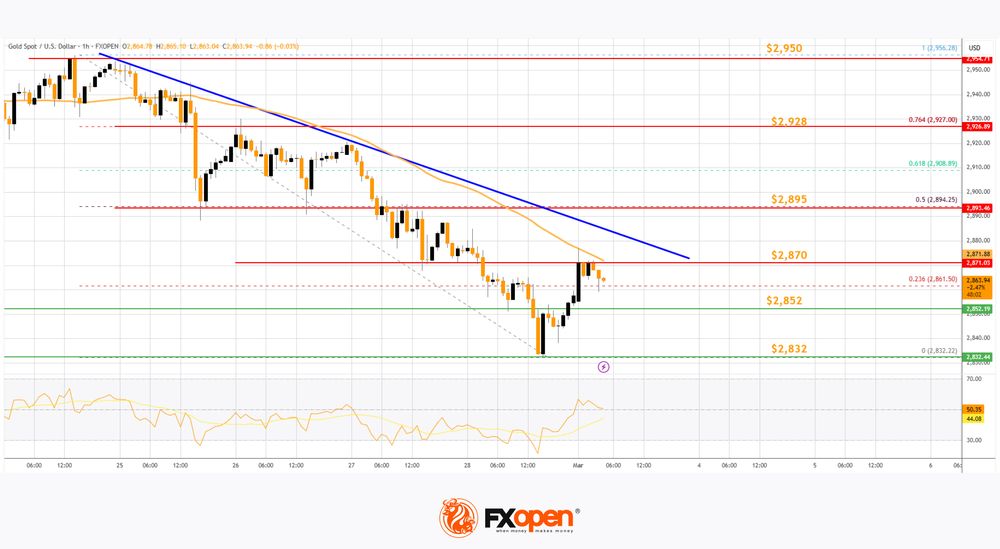
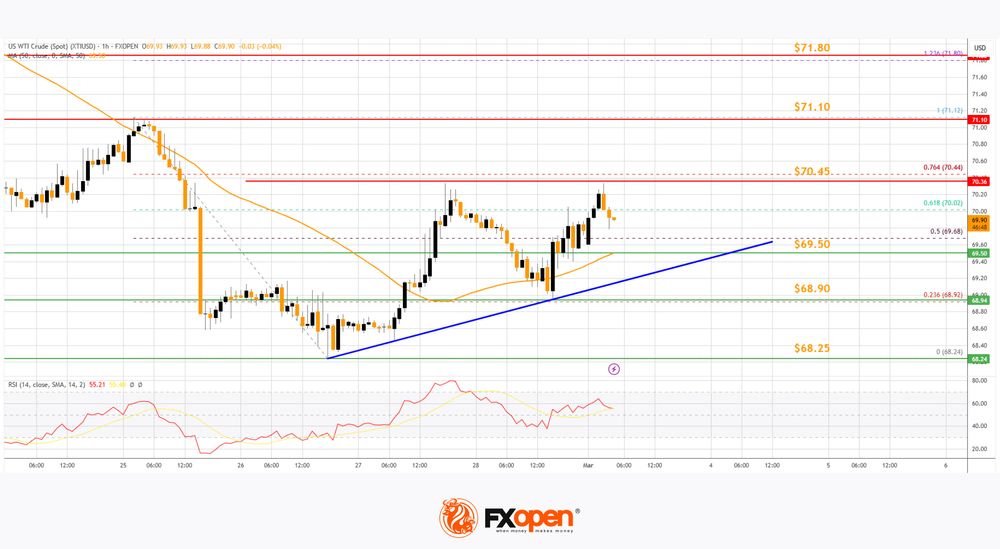
Gold price rallied above $2,920 before correcting lower. Crude oil price is recovering and it could climb further higher toward the $71.80 resistance.
Important Takeaways for Gold and Oil Prices Analysis Today
Gold price rallied significantly above $2,900 and recently corrected lower against the US Dollar.
A key bearish trend line is forming with resistance at $2,870 on the hourly chart of gold at FXOpen.
Crude oil prices are moving higher above the $68.90 resistance zone.
There is a connecting bullish trend line forming with support at $69.50 on the hourly chart of XTI/USD at FXOpen.
Gold Price Technical Analysis
On the hourly chart of Gold at FXOpen, the price was able to climb above the $2,900 resistance, as mentioned in the previous analysis. The price even broke the $2,940 level before the bears appeared.
The price traded close to the $2,960 zone before there was a downside correction. There was a move below the $2,900 pivot zone. The price settled below the 50-hour simple moving average and RSI dipped below 50. Finally, it tested the $2,830 zone.
The price is now correcting losses above the 23.6% Fib retracement level of the downward move from the $2,956 swing high to the $2,832 low. Immediate resistance on the upside is near the 50-hour simple moving average and $2,870.
There is also a key bearish trend line forming with resistance at $2,870. The next major resistance is near the 50% Fib retracement level of the downward move from the $2,956 swing high to the $2,832 low at $2,895.
An upside break above the $2,895 resistance could send Gold price toward $2,928. Any more gains may perhaps set the pace for an increase toward the $2,950 level. If there is no fresh increase, the price could continue to move down.
Initial support on the downside is near the $2,852 level. The first major support is $2,832. If there is a downside break below the $2,832 support, the price might decline further. In the stated case, the price might drop toward the $2,810 support.
Oil Price Technical Analysis
On the hourly chart of WTI Crude Oil at FXOpen, the price started a decent increase against the US Dollar. The price gained bullish momentum after it broke the $68.90 resistance.
The bulls pushed the price above the 50-hour simple moving average and the RSI climbed toward 65. There was a clear move above the 50% Fib retracement level of the downward move from the $71.12 swing high to the $68.24 low.
Immediate resistance is near the $70.45 level. It is close to the 76.4% Fib retracement level of the downward move from the $71.12 swing high to the $68.24 low.
If the price climbs further higher, it could face resistance near $71.10. The next major resistance is near the $71.80 level. Any more gains might send the price toward the $72.50 level.
Conversely, the price might correct gains and test the $69.50 support. There is also a connecting bullish trend line forming with support at $69.50 and the 50-hour simple moving average.
The next major support on the WTI crude oil chart is near the $68.90 level. If there is a downside break, the price might decline toward $68.25. Any more losses may perhaps open the doors for a move toward the $66.50 support zone.
Start trading commodity CFDs with tight spreads. Open your trading account now or learn more about trading commodity CFDs with FXOpen.
This article represents the opinion of the Companies operating under the FXOpen brand only. It is not to be construed as an offer, solicitation, or recommendation with respect to products and services provided by the Companies operating under the FXOpen brand, nor is it to be considered financial advice.
White Label
Data API
Web Plug-ins
Poster Maker
Affiliate Program
The risk of loss in trading financial instruments such as stocks, FX, commodities, futures, bonds, ETFs and crypto can be substantial. You may sustain a total loss of the funds that you deposit with your broker. Therefore, you should carefully consider whether such trading is suitable for you in light of your circumstances and financial resources.
No decision to invest should be made without thoroughly conducting due diligence by yourself or consulting with your financial advisors. Our web content might not suit you since we don't know your financial conditions and investment needs. Our financial information might have latency or contain inaccuracy, so you should be fully responsible for any of your trading and investment decisions. The company will not be responsible for your capital loss.
Without getting permission from the website, you are not allowed to copy the website's graphics, texts, or trademarks. Intellectual property rights in the content or data incorporated into this website belong to its providers and exchange merchants.
Not Logged In
Log in to access more features

FastBull Membership
Not yet
Purchase
Log In
Sign Up