• Trade
  • Markets
  • Copy
  • Contests
  • News
  • 24/7
  • Calendar
  • Q&A
  • Chats
Trending
Screeners
SYMBOL
LAST
BID
ASK
HIGH
LOW
NET CHG.
%CHG.
SPREAD
SPX
S&P 500 Index
6963.75
6963.75
6963.75
6985.84
6938.76
-13.52
-0.19%
--
DJI
Dow Jones Industrial Average
49191.98
49191.98
49191.98
49589.40
49056.31
-398.21
-0.80%
--
IXIC
NASDAQ Composite Index
23709.86
23709.86
23709.86
23813.30
23607.59
-24.03
-0.10%
--
USDX
US Dollar Index
98.920
99.000
98.920
98.960
98.560
+0.290
+ 0.29%
--
EURUSD
Euro / US Dollar
1.16421
1.16441
1.16421
1.16438
1.16410
+0.00002
0.00%
--
GBPUSD
Pound Sterling / US Dollar
1.34227
1.34250
1.34227
1.34243
1.34190
+0.00020
+ 0.01%
--
XAUUSD
Gold / US Dollar
4586.10
4586.54
4586.10
4634.55
4569.49
-11.07
-0.24%
--
WTI
Light Sweet Crude Oil
60.856
60.886
60.856
61.212
59.287
+1.200
+ 2.01%
--

Community Accounts

Signal Accounts
--
Profit Accounts
--
Loss Accounts
--
View More

Become a signal provider

Sell trading signals to earn additional income

View More

Guide to Copy Trading

Get started with ease and confidence

View More

Signal Accounts for Members

All Signal Accounts

Best Return
  • Best Return
  • Best P/L
  • Best MDD
Past 1W
  • Past 1W
  • Past 1M
  • Past 1Y

All Contests

  • All
  • Trump Updates
  • Recommend
  • Stocks
  • Cryptocurrencies
  • Central Banks
  • Featured News
Top News Only
Share

Richmond Fed President Barkin: There Is Still Some Cost Pressure And Inflationary Pressure Coming From Tariffs Over Time, But Timing Unclear

Share

Richmond Fed President Barkin: Businesses Have More Confidence That They Kind Of Know The Likely Outcomes Of Tariffs More Than They Did Last April

Share

[US Eases Restrictions On Nvidia H200 Chip Exports To China] On January 13, According To The US Federal Register, The United States Has Eased Regulations On The Export Of Nvidia's H200 Chips To China. Previously, US President Trump Stated Via Social Media That The US Government Would Allow Nvidia To Sell Its H200 Artificial Intelligence Chips To China. It Is Understood That The Aforementioned Sales To China Will Be Subject To Approval And Security Review By The US Department Of Commerce, And The US Will Also Receive A Fee From The Related Transactions

Share

Richmond Fed President Barkin: Shelter Inflation Is Still Biased By Lack Of October Data

Share

Richmond Fed President Barkin: CPI Data Was Encouraging

Share

Richmond Fed President Barkin: No One Meeting Matters That Much, If You Get It Wrong, Can Fix It At Next Meeting

Share

SPDR Gold Trust Reports Holdings Up 0.32%, Or 3.43 Tonnes, To 1074.23 Tonnes By Jan 13

Share

White House: US President Trump Has Nominated Weathertech CEO (CEO) David Macneil To The Federal Trade Commission (FTC)

Share

Trump Urges Iranians To Keep Protesting, Take Names, Saying 'Help Is On Its Way'

Share

Trump: I Think China Can Open Market To USA Goods

Share

US State Department: USA Citizens Should Leave Iran Now, Consider Departing By Land To Turkey Or Armenia, If Safe To Do So

Share

Trump: Think Dimon Is Wrong On Fed

Share

Trump: Will Get Iran Death Figures Shortly

Share

Richmond Fed President Barkin: Unlike First Quarter 2025, I Am Not Hearing Strong Conviction Of Businesses Passing Through Price Increases

Share

Trump: Iran Is On My Mind When I See The Death Happening There

Share

Richmond Fed President Barkin: Unemployment Has Ticked Up But Doesn't Seem To Be Ticking Out Of Control

Share

[New York Gold Futures Fall Over 0.4%, Record High Following US CPI Data Fails To Hold] On Tuesday (January 13), Spot Gold Fell 0.19% To $4588.82 Per Ounce In Late New York Trading. Shortly Before The Release Of The US CPI Inflation Data At 21:30 Beijing Time, It Briefly Dipped Below $4580 Before Rising Steadily To $4634.55 At 22:50, Continuing To Set New Record Highs. It Then Gradually Declined, Hitting A Daily Low Near $4570 At 04:35. Comex Gold Futures Fell 0.43% To $4595 Per Ounce, Reaching $4644 At 22:50, Also A New Intraday Record High, Before Falling Below $4577 Near The US Stock Market Close

Share

Richmond Fed President Barkin: Inflation Is Higher Than Our Target But Doesn't Yet Seem To Be Accelerating

Share

Data From The American Petroleum Institute (API) Shows That U.S. Crude Oil Inventories Rose By 5.278 Million Barrels Last Week, Compared With A Decrease Of 2.766 Million Barrels The Previous Week

Share

NOPA December US Soybean Crush Estimated At 224.809 Million Bushels

TIME
ACT
FCST
PREV
U.S. Core CPI (SA) (Dec)

A:--

F: --

P: --

U.S. Core CPI YoY (Not SA) (Dec)

A:--

F: --

P: --

U.S. Weekly Redbook Index YoY

A:--

F: --

P: --

U.S. New Home Sales Annualized MoM (Oct)

A:--

F: --

P: --
U.S. Annual Total New Home Sales (Oct)

A:--

F: --

P: --
U.S. Cleveland Fed CPI MoM (SA) (Dec)

A:--

F: --

P: --

U.S. Cleveland Fed CPI MoM (Dec)

A:--

F: --

P: --

China, Mainland Exports (Dec)

--

F: --

P: --

China, Mainland Imports YoY (CNH) (Dec)

--

F: --

P: --

China, Mainland Imports (CNH) (Dec)

--

F: --

P: --

China, Mainland Trade Balance (CNH) (Dec)

--

F: --

P: --

China, Mainland Imports YoY (USD) (Dec)

--

F: --

P: --

China, Mainland Exports YoY (USD) (Dec)

--

F: --

P: --

China, Mainland M0 Money Supply YoY (Dec)

--

F: --

P: --

China, Mainland M1 Money Supply YoY (Dec)

--

F: --

P: --

China, Mainland M2 Money Supply YoY (Dec)

--

F: --

P: --

U.S. EIA Natural Gas Production Forecast For The Next Year (Jan)

A:--

F: --

P: --

U.S. EIA Short-Term Crude Production Forecast For The Next Year (Jan)

A:--

F: --

P: --

U.S. EIA Short-Term Crude Production Forecast For The Year (Jan)

A:--

F: --

P: --

EIA Monthly Short-Term Energy Outlook
U.S. 30-Year Bond Auction Avg. Yield

A:--

F: --

P: --

Argentina 12-Month CPI (Dec)

A:--

F: --

P: --

U.S. Budget Balance (Dec)

A:--

F: --

P: --

Argentina CPI MoM (Dec)

A:--

F: --

P: --

Argentina National CPI YoY (Dec)

A:--

F: --

P: --

Richmond Federal Reserve President Barkin delivered a speech.
U.S. API Weekly Cushing Crude Oil Stocks

A:--

F: --

P: --

U.S. API Weekly Crude Oil Stocks

A:--

F: --

P: --

U.S. API Weekly Refined Oil Stocks

A:--

F: --

P: --

U.S. API Weekly Gasoline Stocks

A:--

F: --

P: --

South Korea Unemployment Rate (SA) (Dec)

--

F: --

P: --

Japan Reuters Tankan Non-Manufacturers Index (Jan)

--

F: --

P: --

Japan Reuters Tankan Manufacturers Index (Jan)

--

F: --

P: --

China, Mainland Exports YoY (CNH) (Dec)

--

F: --

P: --

China, Mainland Trade Balance (USD) (Dec)

--

F: --

P: --

China, Mainland Outstanding Loans Growth YoY (Dec)

--

F: --

P: --

U.K. 10-Year Note Auction Yield

--

F: --

P: --

Canada Leading Index MoM (Dec)

--

F: --

P: --

U.S. MBA Mortgage Application Activity Index WoW

--

F: --

P: --

U.S. Core PPI YoY (Nov)

--

F: --

P: --

U.S. PPI MoM (SA) (Nov)

--

F: --

P: --

U.S. PPI YoY (Nov)

--

F: --

P: --

U.S. Current Account (Q3)

--

F: --

P: --

U.S. Retail Sales YoY (Nov)

--

F: --

P: --

U.S. Retail Sales (Nov)

--

F: --

P: --

U.S. Core Retail Sales MoM (Nov)

--

F: --

P: --

U.S. PPI YoY (Excl. Food, Energy & Trade) (Nov)

--

F: --

P: --

U.S. PPI MoM Final (Excl. Food, Energy and Trade) (SA) (Nov)

--

F: --

P: --

U.S. Core Retail Sales (Nov)

--

F: --

P: --

U.S. Retail Sales MoM (Excl. Automobile) (SA) (Nov)

--

F: --

P: --

U.S. Retail Sales MoM (Nov)

--

F: --

P: --

U.S. Retail Sales MoM (Excl. Gas Stations & Vehicle Dealers) (SA) (Nov)

--

F: --

P: --

U.S. Core PPI MoM (SA) (Nov)

--

F: --

P: --

Philadelphia Fed President Henry Paulson delivers a speech
U.S. Commercial Inventory MoM (Oct)

--

F: --

P: --

U.S. Existing Home Sales Annualized Total (Dec)

--

F: --

P: --

U.S. Existing Home Sales Annualized MoM (Dec)

--

F: --

P: --

U.S. EIA Weekly Cushing, Oklahoma Crude Oil Stocks Change

--

F: --

P: --

U.S. EIA Weekly Crude Stocks Change

--

F: --

P: --

U.S. EIA Weekly Gasoline Stocks Change

--

F: --

P: --

U.S. EIA Weekly Crude Demand Projected by Production

--

F: --

P: --

Q&A with Experts
    • All
    • Chatrooms
    • Groups
    • Friends
    EuroTrader flag
    FORMFOREXL
    @FORMFOREXLYou caught this trade like a seasoned trader. Am currently in the longs on EURUSD still holding
    ابو عبيده flag
    On which platform?
    EuroTrader flag
    ابو عبيده
    I want to be honest, and I hope you will be honest too, my friends.
    @ابو عبيده Yeahh we are honest people here in the chatroom. Can you rather go for prop firms rather than person account
    ابو عبيده flag
    Where will the trading take place?
    EuroTrader flag
    ابو عبيده
    Where will the trading take place?
    @ابو عبيده What trading are you taking about? is it the competition or what are you referring to my friend
    Nicholas R flag
    How do I join up on the competition
    ابو عبيده flag
    Deferred payment contracts
    FORMFOREXL flag
    EuroTrader
    @EuroTrader@EuroTraderhold it tied, the EUR USD pair is exhibiting bullish momentum. and base on the current News sentiments.............
    EuroTrader flag
    Nicholas R
    How do I join up on the competition
    @Nicholas RYou should register for the competition and you would be able to join the contest
    EuroTrader flag
    FORMFOREXL
    @FORMFOREXLAware of that since Friday when we actually got the poor NFP numbers last week
    trohjo flag
    network not available error
    EuroTrader flag
    trohjo
    network not available error
    @trohjoyou should try it on the web version. Are you using the web or app version?
    trohjo flag
    app
    EuroTrader flag
    trohjo
    app
    @trohjoTdy registering through the web version instead of making use of the app version for now
    Youness El flag
    hi guys what are u thinking about xauusd
    FORMFOREXL flag
    Manal Amd flag
    Bullish bullish
    EuroTrader flag
    Youness El
    hi guys what are u thinking about xauusd
    @Youness ElStill seeing more room and space for the upside. Still very much bullish on Xauusd
    EuroTrader flag
    FORMFOREXL
    @FORMFOREXLThis is fastbull website where you get free signal right. it's been standout for me since i discovered it
    DHS-II KTR flag
    Type here...
    Add Symbol or Code

      No matching data

      All
      Trump Updates
      Recommend
      Stocks
      Cryptocurrencies
      Central Banks
      Featured News
      • All
      • Russia-Ukraine Conflict
      • Middle East Flashpoint
      • All
      • Russia-Ukraine Conflict
      • Middle East Flashpoint
      Search
      Products

      Charts Free Forever

      Chats Q&A with Experts
      Screeners Economic Calendar Data Tools
      Membership Features
      Data Warehouse Market Trends Institutional Data Policy Rates Macro

      Market Trends

      Market Sentiment Order Book Forex Correlations

      Top Indicators

      Charts Free Forever
      Markets

      News

      News Analysis 24/7 Columns Education
      From Institutions From Analysts
      Topics Columnists

      Latest Views

      Latest Views

      Trending Topics

      Top Columnists

      Latest Update

      Signals

      Copy Rankings Latest Signals Become a signal provider AI Rating
      Contests
      Brokers

      Overview Brokers Assessment Rankings Regulators News Claims
      Broker listing Forex Brokers Comparison Tool Live Spread Comparison Scam
      Q&A Complaint Scam Alert Videos Tips to Detect Scam
      More

      Business
      Events
      Careers About Us Advertising Help Center

      White Label

      Data API

      Web Plug-ins

      Affiliate Program

      Awards Institution Evaluation IB Seminar Salon Event Exhibition
      Vietnam Thailand Singapore Dubai
      Fans Party Investment Sharing Session
      FastBull Summit BrokersView Expo
      Recent Searches
        Top Searches
          Markets
          News
          Analysis
          User
          24/7
          Economic Calendar
          Education
          Data
          • Names
          • Latest
          • Prev

          View All

          No data

          Scan to Download

          Faster Charts, Chat Faster!

          Download App
          English
          • English
          • Español
          • العربية
          • Bahasa Indonesia
          • Bahasa Melayu
          • Tiếng Việt
          • ภาษาไทย
          • Français
          • Italiano
          • Türkçe
          • Русский язык
          • 简中
          • 繁中
          Open Account
          Search
          Products
          Charts Free Forever
          Markets
          News
          Signals

          Copy Rankings Latest Signals Become a signal provider AI Rating
          Contests
          Brokers

          Overview Brokers Assessment Rankings Regulators News Claims
          Broker listing Forex Brokers Comparison Tool Live Spread Comparison Scam
          Q&A Complaint Scam Alert Videos Tips to Detect Scam
          More

          Business
          Events
          Careers About Us Advertising Help Center

          White Label

          Data API

          Web Plug-ins

          Affiliate Program

          Awards Institution Evaluation IB Seminar Salon Event Exhibition
          Vietnam Thailand Singapore Dubai
          Fans Party Investment Sharing Session
          FastBull Summit BrokersView Expo

          UK Debt Unchecked by "Loose" Rules, Warns Ex-OBR Head

          Nathaniel Wright

          Remarks of Officials

          Data Interpretation

          Economic

          Political

          Summary:

          OBR's ex-chair warns Rachel Reeves' "loose" fiscal rules enable perpetual borrowing, impeding UK debt reduction.

          Rachel Reeves' fiscal rules are "among the loosest the UK has had in its history" and fail to control borrowing effectively compared to other advanced economies, according to the former head of the government's spending watchdog.

          Richard Hughes, who resigned as chair of the Office for Budget Responsibility (OBR) in November, argued that the self-imposed rules do not constrain growth because they permit the government to run a "quite a big structural deficit."

          In his first public appearance since stepping down, Hughes told a House of Lords committee that the UK is now much slower at correcting its finances after a major shock.

          "The rules we have mean that righting the fiscal ship after a shock happens much more slowly at the moment in the UK compared to what other rules might have required had they remained in place or compared to other jurisdictions," he said.

          National Debt Continues to Climb

          Hughes' comments underscore a critical challenge for the UK economy. Despite Reeves acknowledging that 10% of government spending goes toward debt interest, the national debt is still rising. Currently at 95.6% of GDP, or £2.9 trillion, UK debt has reached levels not seen since 1963 and is projected to climb to 97% of GDP by 2029.

          The criticism from Hughes follows a chaotic budget process last November. Reeves raised taxes by £26 billion, a move designed to more than double her buffer against her fiscal rules to £21.7 billion and reassure markets.

          A Flawed Target Allows Perpetual Borrowing

          Hughes explained that Reeves' fiscal framework is not strong enough to stabilize the public finances. He pointed to a specific mandate that taxes must cover day-to-day spending by 2029-30, a rule he claims allows borrowing of as much as 3% of GDP annually.

          Crucially, he noted, this target never actually needs to be met. Once 2029-30 becomes the third year of the forecast, the target date simply rolls forward each year.

          "We are still piling up debt several years on from a shock," Hughes stated, referencing the impacts of Covid and the energy crisis. "We aim to get borrowing to 2.5% of GDP by the end of the decade. That's a level the average advanced economy reached two years ago. Other countries have been much faster at rebuilding fiscal resilience."

          He added, "I don't see much evidence of the government being constrained in its ability to support the economy."

          High Debt, Not OBR Forecasts, Is the Real Constraint

          Hughes also pushed back against claims that the OBR has become too powerful and that its forecasts are overriding elected officials—an argument made by figures including former Bank of England governor Andy Haldane.

          He insisted the problem is not the OBR's analysis but the "record low level of headroom" against the rules used by both Reeves and her Conservative predecessor, Jeremy Hunt.

          "Having a combination of relatively loose rules and also setting aside relatively small amounts of headroom is one of the reasons why fiscal outcomes have drifted," Hughes argued.

          He concluded that the true economic limitation is the debt itself, not the watchdog that measures it. "Fiscal policy in this country is constrained because we've got debt approaching 100% of GDP and a deficit of almost 5% of GDP. Not because of the OBR forecast... we are borrowing more than almost any other advanced economy at the moment."

          To stay updated on all economic events of today, please check out our Economic calendar
          Risk Warnings and Disclaimers
          You understand and acknowledge that there is a high degree of risk involved in trading. Following any strategies or investment methods may lead to potential losses. The content on the site is provided by our contributors and analysts for information purposes only. You are solely responsible for determining whether any trading assets, securities, strategy, or any other product is suitable for investing based on your own investment objectives and financial situation.
          Add to Favorites
          Share

          US Nears Taiwan Trade Deal on Tariffs & TSMC

          Isaac Bennett

          Economic

          Political

          A major trade agreement between the Trump administration and Taiwan is in the final stages of negotiation, potentially reshaping semiconductor supply chains and U.S. trade policy in Asia. The deal centers on a U.S. tariff reduction in exchange for a massive expansion of chip manufacturing on American soil.

          Former U.S. President Donald Trump, whose administration is spearheading the negotiations with Taiwan.

          The Core of the Agreement: Tariffs for Fabs

          Under the proposed terms, the United States would lower tariffs on Taiwanese exports from 20% to 15%. This would bring Taiwan's tariff level in line with regional competitors like Japan and South Korea, marking a significant win for the Trump administration's trade agenda.

          In return, Taiwan Semiconductor Manufacturing Co. (TSMC), the world's leading chipmaker, is expected to commit to a substantial increase in its U.S. presence. This quid pro quo was a key expectation for U.S. officials, including Commerce Secretary Howard Lutnick, who pushed for significant new investment promises from Taiwan.

          Taipei's Office of Trade Negotiations confirmed on Tuesday that both sides have reached a "broad consensus." Discussions are now underway to schedule a final meeting before the agreement is sent to the legislature for review.

          TSMC's Massive Arizona Expansion

          The centerpiece of Taiwan's commitment is a plan for TSMC to dramatically scale up its operations in Arizona. The company would agree to build five new chip fabrication plants (fabs) and two advanced packaging facilities in the state.

          This expansion would roughly double TSMC's manufacturing footprint in Arizona. The new investment is projected to exceed $100 billion, considering a single fab costs around $20 billion to build in the U.S. These commitments are in addition to TSMC's existing plans for up to $165 billion in U.S. investment. According to reports, the new facilities are scheduled for completion sometime in the 2030s.

          Geopolitical Stakes and Timing

          The agreement carries significant geopolitical weight. A deal with Taipei risks provoking a strong reaction from China, which considers the self-governing island its own territory—a claim Taiwan's government rejects.

          Aware of the delicate timing, officials in Taipei are reportedly pushing to finalize the pact before a planned meeting between President Trump and Chinese leader Xi Jinping. The U.S. president is expected to visit China in April, adding a sense of urgency to the trade talks.

          A Potential Supreme Court Hurdle

          Despite the progress, the entire agreement could be complicated or delayed by a pending U.S. Supreme Court decision. A ruling on the legality of Trump's tariffs is expected as soon as Wednesday, and an unfavorable outcome could render the current negotiations moot.

          To stay updated on all economic events of today, please check out our Economic calendar
          Risk Warnings and Disclaimers
          You understand and acknowledge that there is a high degree of risk involved in trading. Following any strategies or investment methods may lead to potential losses. The content on the site is provided by our contributors and analysts for information purposes only. You are solely responsible for determining whether any trading assets, securities, strategy, or any other product is suitable for investing based on your own investment objectives and financial situation.
          Add to Favorites
          Share

          Venezuela's Oil Trap: Why US Firms Are Wary of Trump's Plan

          Catherine Richards

          Political

          Commodity

          Remarks of Officials

          Economic

          Energy

          President Donald Trump recently outlined a bold plan for Venezuela: its interim government would supply the U.S. with up to 50 million barrels of oil, and America’s largest energy companies would move in to overhaul the nation's crumbling oil infrastructure. The goal, he said, was for these firms to "start making money for the country" again.

          While this might sound like a golden opportunity, for the US oil majors, it looks more like a poisoned chalice. Venezuela sits on the world's largest crude reserves—more than Saudi Arabia and Iran combined—but accessing that wealth is fraught with technical, financial, and political dangers that even the biggest players are reluctant to face.

          A History of Seizures and Mistrust

          The primary obstacle is political risk. Venezuela’s history of nationalization casts a long shadow over any potential investment. In the 1990s, former President Hugo Chavez nationalized the oil industry. By 2007, he had forced out giants like Exxon and ConocoPhillips after they refused to hand a majority stake in their projects to the state-run oil company, PDVSA.

          The financial wounds from that era have not healed. ConocoPhillips is still owed approximately $10 billion. Today, only Chevron is authorized to operate in Venezuela and export crude to the United States.

          Industry leaders are deeply skeptical. At a recent meeting with Trump, Exxon CEO Darren Woods was blunt: "We've had our assets seized there twice, and so you can imagine to re-enter a third time would require some pretty significant changes."

          According to a Reuters analysis, oil companies will hesitate to make major commitments until Caracas establishes a new government that can earn the trust of international investors and banks. Trump has offered security guarantees, but not capital, for new projects—a promise that may not be enough to overcome decades of instability.

          Venezuela's Vast but Challenging Reserves

          On paper, Venezuela’s oil wealth is staggering. As a founding member of OPEC, it holds an estimated 303 billion barrels of proven reserves, representing about 17% of the world's total and dwarfing the United States' 55 billion barrels.

          Most of these reserves are concentrated in the Orinoco Belt, a massive territory in eastern Venezuela. However, PDVSA, which controls most operations, has been crippled by aging infrastructure, underinvestment, mismanagement, and sanctions. As a result, a country that once exported 3.5 million barrels per day now struggles to produce around 1 million.

          The $100 Billion Price Tag for a Revival

          Revitalizing Venezuela’s oil production would require an enormous capital injection. Francisco Monaldi, director of Latin American energy policy at Rice University's Baker Institute, estimates that returning to the peak production levels of the 1970s would demand an annual investment of $10 billion for the next ten years—a total of $100 billion.

          Even more modest goals are costly. According to consulting firm Rystad Energy:

          • Merely maintaining current production levels would cost $53 billion over the next 15 years.

          • Raising production above 1.4 million barrels per day would require an additional $120 billion by 2040.

          The Unforgiving Economics of Heavy Crude

          Beyond the political and financial hurdles lies a fundamental technical challenge: Venezuela’s oil is extra-heavy crude. It is dense and highly viscous, making it far more difficult and expensive to extract than conventional light crude. Production requires advanced techniques like steam injection and blending with lighter oils to make it marketable.

          This extra-heavy crude also sells at a discount due to its high density and sulfur content. While U.S. Gulf Coast refineries are equipped to process it, the economics are questionable, especially at low oil prices.

          Consultancy Wood Mackenzie estimates that breakeven costs for key grades in the Orinoco Belt average more than $80 a barrel. With global oil prices hovering around $60 a barrel, Venezuelan production is simply uneconomical. For comparison, heavy oil from Canada has an average breakeven cost of around $55 a barrel.

          Are the Reserves Overstated?

          There is also growing doubt about the true size of Venezuela's commercially viable reserves. The country’s "proven reserves" are self-reported and were declared the world's largest by OPEC in 2011, a year when oil traded above $100 per barrel.

          Proven reserves are defined as oil that has a 90% probability of being recovered with existing technology while remaining commercially viable. Since Orinoco oil is expensive to produce and refine, its viability is critically dependent on high prices.

          Rystad Energy offers a more conservative estimate, suggesting Venezuela's realistic reserves are closer to 60 billion barrels. Unless prices spike significantly, much of the country's claimed oil wealth may remain theoretical.

          A Gamble Few Are Willing to Take

          For US oil companies, the bottom line is clear. Returning to Venezuela would require oil prices to rise by at least $20 a barrel just to break even. Even then, they would need ironclad guarantees that their multibillion-dollar investments won't be seized again.

          With political risk at an all-time high and questionable economic returns, the Trump administration's vision of an American-led revival of Venezuela's oil industry appears disconnected from reality. As one analyst summarized, the world likely doesn't need more high-cost, dirty oil. The dream of a Venezuelan crude deluge will probably remain just that—a dream.

          To stay updated on all economic events of today, please check out our Economic calendar
          Risk Warnings and Disclaimers
          You understand and acknowledge that there is a high degree of risk involved in trading. Following any strategies or investment methods may lead to potential losses. The content on the site is provided by our contributors and analysts for information purposes only. You are solely responsible for determining whether any trading assets, securities, strategy, or any other product is suitable for investing based on your own investment objectives and financial situation.
          Add to Favorites
          Share

          US Rallies Allies on Critical Mineral Supply Chains

          Isaac Bennett

          Remarks of Officials

          China–U.S. Trade War

          U.S. Treasury Secretary Scott Bessent convened a meeting with key international partners on Monday, urging them to build more resilient supply chains for critical minerals.

          According to a statement from the Treasury Department, the Washington meeting focused on developing solutions to secure and diversify sources of these materials, with a special emphasis on rare earth elements.

          Reducing Reliance on China

          A U.S. official indicated Sunday that a primary goal of the talks was for Bessent to encourage allied nations to step up efforts to reduce their reliance on China for critical minerals. The push comes as Beijing has implemented strict export controls on rare earths.

          The Treasury Department noted Bessent's optimism that nations will adopt a strategy of "prudent derisking over decoupling." He stressed that partners understand the urgent need to address current vulnerabilities in the critical minerals supply chain.

          A Coalition of Key Global Players

          The meeting brought together a significant group of nations and blocs. Representatives attended from:

          • Australia

          • Canada

          • The European Union

          • France

          • Germany

          • India

          • Italy

          • Japan

          • Mexico

          • South Korea

          • The United Kingdom

          Collectively, these participants account for 60% of the global demand for critical minerals.

          China's Strategic Market Control

          China holds a dominant position in the global critical minerals supply chain. Data from the International Energy Agency shows that China refines between 47% and 87% of the world's copper, lithium, cobalt, graphite, and rare earths.

          These materials are essential components in a wide range of modern technologies, including defense systems, semiconductors, renewable energy hardware, batteries, and industrial refining processes.

          Adding to recent tensions, China last week banned exports of certain dual-use items with military applications to Japan, a category that includes some critical minerals.

          Risk Warnings and Disclaimers
          You understand and acknowledge that there is a high degree of risk involved in trading. Following any strategies or investment methods may lead to potential losses. The content on the site is provided by our contributors and analysts for information purposes only. You are solely responsible for determining whether any trading assets, securities, strategy, or any other product is suitable for investing based on your own investment objectives and financial situation.
          Add to Favorites
          Share

          The UAE and China lead list of those at risk from Trump’s Iran tariff

          Adam

          Economic

          China and the United Arab Emirates are Iran’s largest trading partners, putting them at the top of the list of countries at risk of being hit by President Donald Trump’s 25% tariff threat.
          Trump said Monday he would impose a 25% tariff on goods from nations doing business with Iran, which also puts the US’s European allies in the mix.
          The initiative, which Trump said would take effect “immediately,” is likely intended to further isolate and pressurize Iranian Supreme Leader Ayatollah Ali Khamenei’s regime as it cracks down on more than two weeks of nationwide protests. The US leader has openly backed the demonstrators, and had already made a series of non-specific threats to intervene.
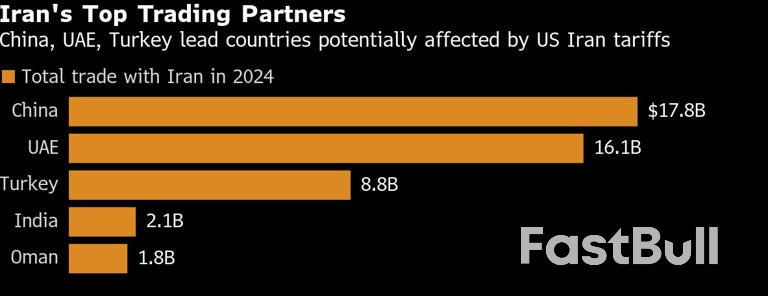
          China — with which Trump agreed a trade truce in October — tops the ranking of Tehran’s trading partners, with commerce amounting to $17.8 billion in 2024, according to the International Monetary Fund. Iran sends close to 90% of its oil to China.
          The UAE comes second in the ranking with $16.1 billion, before a large drop off to Turkey in third, with $8.8 billion.
          European economies are also exposed. Iran’s trade with Germany and Switzerland amounted to almost $3.5 billion combined. India, another country to have grappled with Washington over trade, is fourth on the list. Uzbekistan, with which Trump announced a trade and economic deal in November, had $1.3 billion in trade with Iran in 2024.
          The UAE and China lead list of those at risk from Trump’s Iran tariff_1

          Iran's Top Trading Partners | China, UAE, Turkey lead countries potentially affected by US Iran tariffs

          Trump didn’t specify which transactions, goods, or entities would be subject to the tariffs, or how they would be enforced. Iranian trade data is opaque, as the country publishes limited statistics to avoid sanctions and operates routes through third countries.
          Iranian protests erupted late last year after a sudden collapse in the value of the currency, partly as a result of severe economic sanctions linked to the country’s nuclear program. They have since broadened into the biggest and most violent challenge to Khamenei’s rule, capturing the attention of world leaders and inflating the price of oil.
          German Chancellor Friedrich Merz on Tuesday became the first Group of Seven leader to predict the downfall of Iran’s regime, saying it’s in its “final days.”
          China, the UAE, Turkey and India have has yet to comment on the proposed measures.

          Source: Bloomberg

          To stay updated on all economic events of today, please check out our Economic calendar
          Risk Warnings and Disclaimers
          You understand and acknowledge that there is a high degree of risk involved in trading. Following any strategies or investment methods may lead to potential losses. The content on the site is provided by our contributors and analysts for information purposes only. You are solely responsible for determining whether any trading assets, securities, strategy, or any other product is suitable for investing based on your own investment objectives and financial situation.
          Add to Favorites
          Share

          Greenland PM Prefers Denmark Ties Over US Ahead Of Vance Meeting

          Justin

          Political

          COPENHAGEN, Jan 13 (Reuters) - Greenland's prime minister said on Tuesday his nation would rather remain part of Denmark than become a territory of the United States, amid President Donald Trump's push to take control of the sprawling Arctic island.

          The Danish and Greenlandic foreign ministers will meet U.S. Vice President JD Vance and Secretary of State Marco Rubio on Wednesday after Trump recently stepped up threats to take over Greenland, an autonomous territory of the Kingdom of Denmark.

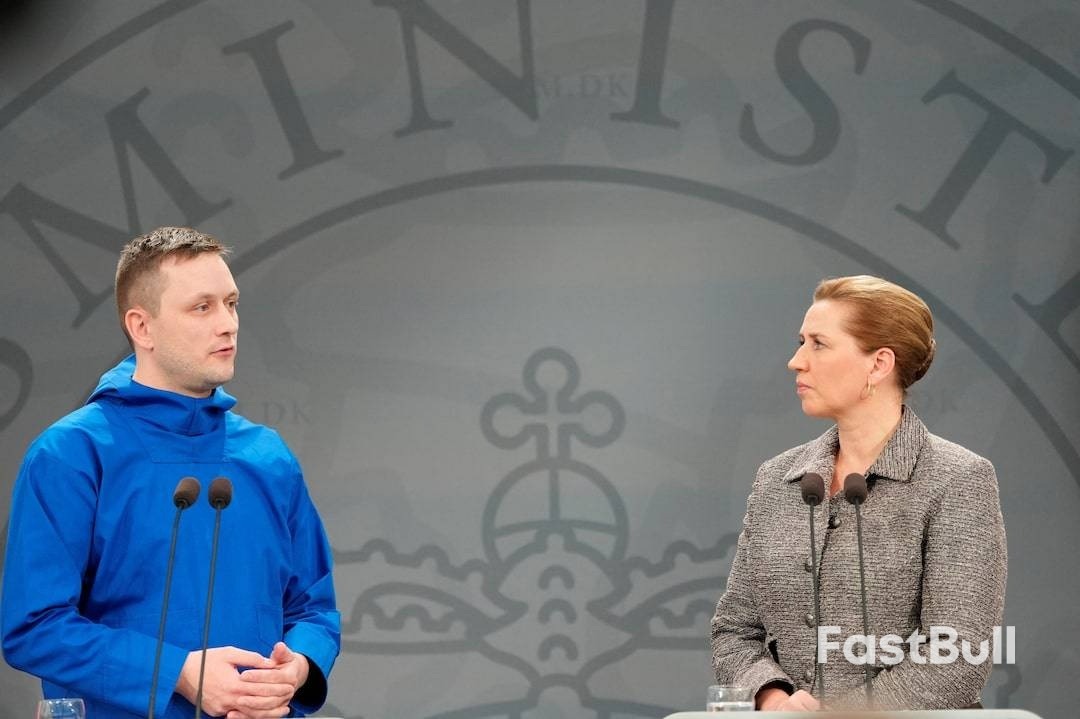
          But Greenland is not for sale and does not want to join the U.S., the island's Prime Minister Jens-Frederik Nielsen told a joint press conference in Copenhagen with Danish Prime Minister Mette Frederiksen.

          "We face a geopolitical crisis, and if we have to choose between the U.S. and Denmark here and now then we choose Denmark," Nielsen said. "We stand united in the Kingdom of Denmark."

          'FOR US, IT'S HOME'

          People in Greenland do not want to become Americans, and are feeling betrayed and bewildered by the rhetoric used about their island, cabinet minister Naaja Nathanielsen told reporters in London.

          "I think we should be able to have a say ourselves in the future of our lives. For others, this might be a piece of land, but for us, it's home," said Nathanielsen, whose portfolio includes business, energy and minerals.

          While Denmark has ruled Greenland for centuries, the territory has gradually been moving towards independence since 1979, a goal shared by all political parties elected to the island's parliament.

          But Nathanielsen said there was no rush towards claiming independence. "We are an American ally, but we do not see ourselves as becoming Americans. We are quite happy with being part of the Kingdom of Denmark," she said.

          Trump has said Greenland is vital to U.S. security and the United States must own it to prevent Russia or China occupying the strategically located and minerals-rich territory in the future.

          White House officials have been discussing various plans to bring Greenland under U.S. control, including potential use of the U.S. military and lump-sum payments to Greenlanders as part of a bid to convince them to secede from Denmark.

          Danish Foreign Minister Lars Lokke Rasmussen and his Greenlandic counterpart, Vivian Motzfeldt, had requested a meeting with Rubio after Trump's threats.

          "U.S. Vice President JD Vance also wanted to participate in the meeting, and he will host the meeting, which will therefore be held at the White House," Rasmussen told reporters in Copenhagen earlier on Tuesday.

          "Our reason for seeking the meeting we have now been given was to move this whole discussion... into a meeting room where we can look each other in the eye and talk about these things."

          'THE HARDEST PART IS AHEAD'

          Denmark's prime minister said it was difficult to stand up to the U.S., a fellow NATO member and the country's most important ally for many decades. "But much suggests that the hardest part is now ahead of us," Frederiksen told reporters.

          Trump first floated the idea of a U.S. takeover of Greenland in 2019 during his first term in office, although he faces opposition in Washington, including from within his own party.

          Danish Defence Minister Troels Lund Poulsen said he would join a meeting with NATO Secretary General Mark Rutte in Brussels on Monday next week to discuss Arctic security, along with Greenland's Motzfeldt.

          Denmark planned a larger military presence in Greenland, with other NATO countries participating in exercises and training in 2026, the defence minister said.

          Source: Reuters

          Risk Warnings and Disclaimers
          You understand and acknowledge that there is a high degree of risk involved in trading. Following any strategies or investment methods may lead to potential losses. The content on the site is provided by our contributors and analysts for information purposes only. You are solely responsible for determining whether any trading assets, securities, strategy, or any other product is suitable for investing based on your own investment objectives and financial situation.
          Add to Favorites
          Share

          4 big questions about Powell vs. Trump

          Adam

          Economic

          Fed Chair Jerome Powell is done playing nice.
          After months of seeking to avoid confrontation with the president, even after the White House heightened its pressure campaign to oust him and exert more influence over the central bank, Powell has finally punched back.
          And it would be hard to blame him. The Justice Department has initiated a criminal probe of the Fed chair into whether he lied to Congress, throwing the weight of the federal government against a public servant that the president seeks to oust.
          Powell, in an extraordinary video published Sunday night, attempted to make the stakes clear to the public.
          “This new threat is not about my testimony last June or about the renovation of the Federal Reserve buildings,” Powell said in the video. “The threat of criminal charges is a consequence of the Federal Reserve setting interest rates based on our best assessment of what will serve the public, rather than following the preferences of the president.”
          For Powell, the threat of criminal charges is a "pretext" to go after the independence of the Fed. Appeasement towards Trump has failed. So what happens next? We have some questions.

          Is this escalation a bigger change for Powell or Trump?

          The Trump administration's approach has clearly changed.
          Instead of merely criticizing Powell and wish-casting (with the power and influence of the bully pulpit) for the Fed chair to step down, prosecutors are now threatening criminal charges. But just as important is Powell's new battle posture.
          Over the course of many months and Fed meetings, reporters have asked Powell to respond to the administration's threats and coercive attempts to influence monetary policy.
          In every case, Powell declined to comment or delivered a diplomatic non-answer, choosing to remain above the political fray and stand by his non-partisan mission to keep prices stable and unemployment low. With the DOJ now at his figurative throat, Powell doesn't have that luxury anymore.
          It's not just his communication style that has suddenly changed. Powell might have thought to step away from the Federal Reserve after his term as chair ends in May, even if his term as governor doesn't expire until 2028.
          The unprecedented legal attack may inspire him to stay on for his full term, denying Trump the chance to nominate another official and giving himself the time to see the investigation through. His statement, referencing the spirit of public service, raises the question.

          How will this impact long-term Fed independence?

          For Powell and his allies in Congress, the carrying out of the criminal probe represents a direct challenge to Fed independence.
          If an administration can go after Fed officials for making monetary decisions it doesn't like, then the central bank becomes an extension of the executive, the argument goes, eroding trust, discouraging investment, and undermining efforts to curb inflation and maintain maximum employment.
          Markets were tame on Monday as many investors awaited the next move before judging the economic impact and the Fed's standing.
          “On the face of it, it looks as if the administration and the central bank are now in open war — something Powell and Treasury Secretary Bessent have tried strenuously to avoid,” said Krishna Guha, head of global policy and central banking strategy at Evercore ISI. “The severity of the response will shape what happens next, establish whether Fed independence still has a guarantor in the market, and influence whether Bessent or Republicans in Congress seek to broker an off-ramp.”
          The timing is significant too. Powell only has a few more months remaining in his term as chair, leading to questions about what his colleagues and his successor will do to maintain the institution's integrity.

          What does this mean for the next Fed chair and the confirmation process?

          As Powell's legal troubles proceed, the next Fed chair will have to contend with the potential for threats from the administration over rate policy. They will also have to navigate criticisms of being seen as a lackey to the White House.

          Who will come to defend Powell — and the Fed's independence?

          Republican Sen. Thom Tillis of North Carolina, who sits on the committee that holds confirmation hearings for the president's Federal Reserve picks, said he will seek to put a stop to all of Trump's central bank nominees over the issue. Another Republican, Sen. Lisa Murkowski of Alaska, called the administration's investigation "nothing more than an attempt at coercion" and endorsed Tillis's nominee blockade.
          While the confirmation process might not begin until the criminal probe is resolved, if the next nominee does move forward, they will face questions from multiple angles. And their nomination and potential installation will no doubt be colored by the scandal surrounding Powell.

          Source: finance.yahoo

          To stay updated on all economic events of today, please check out our Economic calendar
          Risk Warnings and Disclaimers
          You understand and acknowledge that there is a high degree of risk involved in trading. Following any strategies or investment methods may lead to potential losses. The content on the site is provided by our contributors and analysts for information purposes only. You are solely responsible for determining whether any trading assets, securities, strategy, or any other product is suitable for investing based on your own investment objectives and financial situation.
          Add to Favorites
          Share
          FastBull
          Copyright © 2026 FastBull Ltd

          728 RM B 7/F GEE LOK IND BLDG NO 34 HUNG TO RD KWUN TONG KLN HONG KONG

          TelegramInstagramTwitterfacebooklinkedin
          App Store Google Play Google Play
          Products
          Charts

          Chats

          Q&A with Experts
          Screeners
          Economic Calendar
          Data
          Tools
          Membership
          Features
          Function
          Markets
          Copy Trading
          Latest Signals
          Contests
          News
          Analysis
          24/7
          Columns
          Education
          Company
          Careers
          About Us
          Contact Us
          Advertising
          Help Center
          Feedback
          User Agreement
          Privacy Policy
          Personal Information Protection Statement
          Business

          White Label

          Data API

          Web Plug-ins

          Poster Maker

          Affiliate Program

          Risk Disclosure

          The risk of loss in trading financial instruments such as stocks, FX, commodities, futures, bonds, ETFs and crypto can be substantial. You may sustain a total loss of the funds that you deposit with your broker. Therefore, you should carefully consider whether such trading is suitable for you in light of your circumstances and financial resources.

          No decision to invest should be made without thoroughly conducting due diligence by yourself or consulting with your financial advisors. Our web content might not suit you since we don't know your financial conditions and investment needs. Our financial information might have latency or contain inaccuracy, so you should be fully responsible for any of your trading and investment decisions. The company will not be responsible for your capital loss.

          Without getting permission from the website, you are not allowed to copy the website's graphics, texts, or trademarks. Intellectual property rights in the content or data incorporated into this website belong to its providers and exchange merchants.

          Not Logged In

          Log in to access more features

          FastBull Membership

          Not yet

          Purchase

          Become a signal provider
          Help Center
          Customer Service
          Dark Mode
          Price Up/Down Colors

          Log In

          Sign Up

          Position
          Layout
          Fullscreen
          Default to Chart
          The chart page opens by default when you visit fastbull.com