• Trade
  • Markets
  • Copy
  • Contests
  • News
  • 24/7
  • Calendar
  • Q&A
  • Chats
Trending
Screeners
SYMBOL
LAST
BID
ASK
HIGH
LOW
NET CHG.
%CHG.
SPREAD
SPX
S&P 500 Index
6818.18
6818.18
6818.18
6861.30
6801.50
-9.23
-0.14%
--
DJI
Dow Jones Industrial Average
48377.35
48377.35
48377.35
48679.14
48285.67
-80.69
-0.17%
--
IXIC
NASDAQ Composite Index
23109.04
23109.04
23109.04
23345.56
23012.00
-86.12
-0.37%
--
USDX
US Dollar Index
97.940
98.020
97.940
98.070
97.740
-0.010
-0.01%
--
EURUSD
Euro / US Dollar
1.17475
1.17484
1.17475
1.17686
1.17262
+0.00081
+ 0.07%
--
GBPUSD
Pound Sterling / US Dollar
1.33734
1.33743
1.33734
1.34014
1.33546
+0.00027
+ 0.02%
--
XAUUSD
Gold / US Dollar
4304.06
4304.47
4304.06
4350.16
4285.08
+4.67
+ 0.11%
--
WTI
Light Sweet Crude Oil
56.320
56.350
56.320
57.601
56.233
-0.913
-1.60%
--

Community Accounts

Signal Accounts
--
Profit Accounts
--
Loss Accounts
--
View More

Become a signal provider

Sell trading signals to earn additional income

View More

Guide to Copy Trading

Get started with ease and confidence

View More

Signal Accounts for Members

All Signal Accounts

Best Return
  • Best Return
  • Best P/L
  • Best MDD
Past 1W
  • Past 1W
  • Past 1M
  • Past 1Y

All Contests

  • All
  • Trump Updates
  • Recommend
  • Stocks
  • Cryptocurrencies
  • Central Banks
  • Featured News
Top News Only
Share

Goldman Sachs Says They Believe That The Copper Price Is Vulnerable To An Ai-Linked Price Correction

Share

Goldman Sachs Upgrades 2026 Copper Price Forecast To $11400 From $10,650

Share

Attempts By Ukrainian Troops To Advance From The South-West To Outskirts Of Kupiansk Are Being Thwarted

Share

Russian Troops Control All Of Kupiansk - IFX Cites Russian Military

Share

On Monday (December 15), The South Korean Won Ultimately Rose 0.60% Against The US Dollar, Closing At 1468.91 Won. The Won Was On An Upward Trend Throughout The Day, Rising Significantly At 17:00 Beijing Time And Reaching A Daily High Of 1463.04 Won At 17:36

Share

Health Ministry: Israeli Forces Kill Palestinian Teen In West Bank

Share

New York Federal Reserve President Williams: Over Time, The Size Of Reserves Could Grow From $2.9 Trillion

Share

New York Fed President Williams: AI Valuations Are High, But There Is A Real Driving Factor

Share

New York Federal Reserve President Williams: The Job Market Is In Very Good Shape

Share

New York Fed President Williams: 'Very Supportive' Of USA Central Bank's Decision To Cut Interest Rates Last Week

Share

New York Fed President Williams: 'Too Early To Say' What Central Bank Should Do At January Meeting

Share

New York Fed President Williams: Strong Markets Part Of Reason Why Economy Will Grow Robustly In 2026

Share

New York Fed President Williams: What Constitutes Ample Reserves Will Change Over Time

Share

New York Fed President Williams: Market Valuations 'Elevated,' But There Are Reasons For Pricing

Share

New York Fed President Williams: Ample Reserves System Working Very Well

Share

New York Fed President Williams: Some Signs That Parts Of Underlying Economy Not As Strong As GDP Data Suggests

Share

New York Fed President Williams: Expects Coming Job Data Will Show Gradual Cooling

Share

Ukraine President Zelenskiy: Monitoring Of Ceasefire Should Be Part Of Security Guarantees

Share

Ukraine President Zelenskiy: Ukraine Needs Clear Understanding On Security Guarantees Before Taking Any Decisions Regarding Frontlines

Share

U.S. Commerce Secretary Rutnick Praised Korea Zinc Co. Ltd., Stating That The United States Will Have Priority Access To The Company's Products In 2026

TIME
ACT
FCST
PREV
Japan Tankan Small Manufacturing Outlook Index (Q4)

A:--

F: --

P: --

Japan Tankan Large Non-Manufacturing Outlook Index (Q4)

A:--

F: --

P: --

Japan Tankan Large Manufacturing Outlook Index (Q4)

A:--

F: --

P: --

Japan Tankan Small Manufacturing Diffusion Index (Q4)

A:--

F: --

P: --

Japan Tankan Large-Enterprise Capital Expenditure YoY (Q4)

A:--

F: --

P: --

U.K. Rightmove House Price Index YoY (Dec)

A:--

F: --

P: --

China, Mainland Industrial Output YoY (YTD) (Nov)

A:--

F: --

P: --

China, Mainland Urban Area Unemployment Rate (Nov)

A:--

F: --

P: --

Saudi Arabia CPI YoY (Nov)

A:--

F: --

P: --

Euro Zone Industrial Output YoY (Oct)

A:--

F: --

P: --

Euro Zone Industrial Output MoM (Oct)

A:--

F: --

P: --

Canada Existing Home Sales MoM (Nov)

A:--

F: --

P: --

Canada National Economic Confidence Index

A:--

F: --

P: --

Canada New Housing Starts (Nov)

A:--

F: --

P: --
U.S. NY Fed Manufacturing Employment Index (Dec)

A:--

F: --

P: --

U.S. NY Fed Manufacturing Index (Dec)

A:--

F: --

P: --

Canada Core CPI YoY (Nov)

A:--

F: --

P: --

Canada Manufacturing Unfilled Orders MoM (Oct)

A:--

F: --

P: --

U.S. NY Fed Manufacturing Prices Received Index (Dec)

A:--

F: --

P: --

U.S. NY Fed Manufacturing New Orders Index (Dec)

A:--

F: --

P: --

Canada Manufacturing New Orders MoM (Oct)

A:--

F: --

P: --

Canada Core CPI MoM (Nov)

A:--

F: --

P: --

Canada Trimmed CPI YoY (SA) (Nov)

A:--

F: --

P: --

Canada Manufacturing Inventory MoM (Oct)

A:--

F: --

P: --

Canada CPI YoY (Nov)

A:--

F: --

P: --

Canada CPI MoM (Nov)

A:--

F: --

P: --

Canada CPI YoY (SA) (Nov)

A:--

F: --

P: --

Canada Core CPI MoM (SA) (Nov)

A:--

F: --

P: --

Canada CPI MoM (SA) (Nov)

A:--

F: --

P: --

Federal Reserve Board Governor Milan delivered a speech
U.S. NAHB Housing Market Index (Dec)

A:--

F: --

P: --

Australia Composite PMI Prelim (Dec)

--

F: --

P: --

Australia Services PMI Prelim (Dec)

--

F: --

P: --

Australia Manufacturing PMI Prelim (Dec)

--

F: --

P: --

Japan Manufacturing PMI Prelim (SA) (Dec)

--

F: --

P: --

U.K. 3-Month ILO Employment Change (Oct)

--

F: --

P: --

U.K. Unemployment Claimant Count (Nov)

--

F: --

P: --

U.K. Unemployment Rate (Nov)

--

F: --

P: --

U.K. 3-Month ILO Unemployment Rate (Oct)

--

F: --

P: --

U.K. Average Weekly Earnings (3-Month Average, Including Bonuses) YoY (Oct)

--

F: --

P: --

U.K. Average Weekly Earnings (3-Month Average, Excluding Bonuses) YoY (Oct)

--

F: --

P: --

France Services PMI Prelim (Dec)

--

F: --

P: --

France Composite PMI Prelim (SA) (Dec)

--

F: --

P: --

France Manufacturing PMI Prelim (Dec)

--

F: --

P: --

Germany Services PMI Prelim (SA) (Dec)

--

F: --

P: --

Germany Manufacturing PMI Prelim (SA) (Dec)

--

F: --

P: --

Germany Composite PMI Prelim (SA) (Dec)

--

F: --

P: --

Euro Zone Composite PMI Prelim (SA) (Dec)

--

F: --

P: --

Euro Zone Services PMI Prelim (SA) (Dec)

--

F: --

P: --

Euro Zone Manufacturing PMI Prelim (SA) (Dec)

--

F: --

P: --

U.K. Services PMI Prelim (Dec)

--

F: --

P: --

U.K. Manufacturing PMI Prelim (Dec)

--

F: --

P: --

U.K. Composite PMI Prelim (Dec)

--

F: --

P: --

Euro Zone ZEW Economic Sentiment Index (Dec)

--

F: --

P: --

Germany ZEW Current Conditions Index (Dec)

--

F: --

P: --

Germany ZEW Economic Sentiment Index (Dec)

--

F: --

P: --

Euro Zone Trade Balance (Not SA) (Oct)

--

F: --

P: --

Euro Zone ZEW Current Conditions Index (Dec)

--

F: --

P: --

Euro Zone Trade Balance (SA) (Oct)

--

F: --

P: --

Euro Zone Total Reserve Assets (Nov)

--

F: --

P: --

U.K. Inflation Rate Expectations

--

F: --

P: --

Q&A with Experts
    • All
    • Chatrooms
    • Groups
    • Friends
    Connecting
    .
    .
    .
    Type here...
    Add Symbol or Code

      No matching data

      All
      Trump Updates
      Recommend
      Stocks
      Cryptocurrencies
      Central Banks
      Featured News
      • All
      • Russia-Ukraine Conflict
      • Middle East Flashpoint
      • All
      • Russia-Ukraine Conflict
      • Middle East Flashpoint
      Search
      Products

      Charts Free Forever

      Chats Q&A with Experts
      Screeners Economic Calendar Data Tools
      Membership Features
      Data Warehouse Market Trends Institutional Data Policy Rates Macro

      Market Trends

      Market Sentiment Order Book Forex Correlations

      Top Indicators

      Charts Free Forever
      Markets

      News

      News Analysis 24/7 Columns Education
      From Institutions From Analysts
      Topics Columnists

      Latest Views

      Latest Views

      Trending Topics

      Top Columnists

      Latest Update

      Signals

      Copy Rankings Latest Signals Become a signal provider AI Rating
      Contests
      Brokers

      Overview Brokers Assessment Rankings Regulators News Claims
      Broker listing Forex Brokers Comparison Tool Live Spread Comparison Scam
      Q&A Complaint Scam Alert Videos Tips to Detect Scam
      More

      Business
      Events
      Careers About Us Advertising Help Center

      White Label

      Data API

      Web Plug-ins

      Affiliate Program

      Awards Institution Evaluation IB Seminar Salon Event Exhibition
      Vietnam Thailand Singapore Dubai
      Fans Party Investment Sharing Session
      FastBull Summit BrokersView Expo
      Recent Searches
        Top Searches
          Markets
          News
          Analysis
          User
          24/7
          Economic Calendar
          Education
          Data
          • Names
          • Latest
          • Prev

          View All

          No data

          Scan to Download

          Faster Charts, Chat Faster!

          Download App
          English
          • English
          • Español
          • العربية
          • Bahasa Indonesia
          • Bahasa Melayu
          • Tiếng Việt
          • ภาษาไทย
          • Français
          • Italiano
          • Türkçe
          • Русский язык
          • 简中
          • 繁中
          Open Account
          Search
          Products
          Charts Free Forever
          Markets
          News
          Signals

          Copy Rankings Latest Signals Become a signal provider AI Rating
          Contests
          Brokers

          Overview Brokers Assessment Rankings Regulators News Claims
          Broker listing Forex Brokers Comparison Tool Live Spread Comparison Scam
          Q&A Complaint Scam Alert Videos Tips to Detect Scam
          More

          Business
          Events
          Careers About Us Advertising Help Center

          White Label

          Data API

          Web Plug-ins

          Affiliate Program

          Awards Institution Evaluation IB Seminar Salon Event Exhibition
          Vietnam Thailand Singapore Dubai
          Fans Party Investment Sharing Session
          FastBull Summit BrokersView Expo

          Trump's Aug. 1 Tariff Deadline Is Near. Here Are Those Who Have And Haven't Signed A Deal

          Winkelmann

          Political

          China–U.S. Trade War

          Economic

          Summary:

          Come Friday, the world will have to contend with higher tariff rates from the Trump administration, raising the specter of even more economic uncertainty.

          Come Friday, the world will have to contend with higher tariff rates from the Trump administration, raising the specter of even more economic uncertainty.For most countries, that can of worms has been kicked twice down the road, from "Liberation Day" on April 2, to July 9, and now to Aug. 1.Back in April, Trump had claimed to have done "over 200 deals" in an interview with Time Magazine, and trade advisor Peter Navarro had said that "90 deals in 90 days" was possible. The country has fallen far short of that, with only eight deals in 120 days, including one with the 27-member European Union.
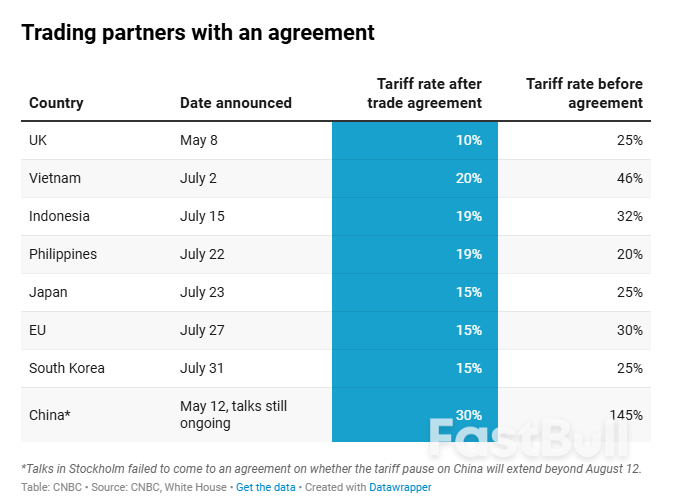
          Here are where things stand in global trade.

          Trump's Aug. 1 Tariff Deadline Is Near. Here Are Those Who Have And Haven't Signed A Deal_1

          UK first to a deal

          The U.K. led the charge on trade agreements with the U.S., striking one as early as May. The framework includes a 10% baseline tariffs on U.K. goods, as well as various quotas and exemptions for products such as autos and aerospace goods.But even after U.S. President Donald Trump met with Prime Minister Keir Starmer in Scotland recently, some points in their trade agreement remain uncertain. That includes tariffs on U.K. steel and aluminum, which the U.S. agreed to slash. Talks about the U.K.'s digital services tax, which Trump wants scrapped, also seem to be continuing.

          Vietnam: tariffs more than halved

          Vietnam was the second to cross the line with the Trump administration, with Trump announcing a trade agreement on July 2 that saw the tariff imposed on Vietnam slashed from 46% to 20%.

          One point with Vietnam was a 40% "transshipping" tariff on goods originating in another country and transferred to Vietnam for final shipment to the U.S, although it is not clear how this will be applied. Trump also claimed that there would be full market access to the country for U.S. goods.Chinese manufacturers have used transshipping to sidestep the hefty tariffs on its direct shipments to the United States, using Vietnam as a major transshipment hub.However, it seems that Vietnam was blindsided by the 20% rate imposed, according to a report by Politico. Politico said negotiators had expected a 11% levy, but Trump unilaterally announced the 20% rate.

          Indonesia: bringing down barriers

          Indonesia's tariff rate was cut to 19% from 32% in its agreement with Trump, announced on July 15.The White House said Indonesia will eliminate tariff barriers on over 99% of U.S. products exported to Indonesia across all sectors, including agricultural products and energy.The framework also says the countries will also address various "non-tariff barriers" and other obstacles that the U.S. faces in Indonesian markets.

          Philippines: marginal decrease

          Unlike its ASEAN counterparts above, which had sizable reductions to its tariff duties, the Philippines saw a decrease of a single percentage point to 19% from 20% on July 22.Manila will not impose tariffs on U.S. goods as part of the agreement, according to Trump, who praised the country for what he described as "going OPEN MARKET with the United States."In addition, Trump also said that the Philippines will work together "Militarily," without specifying any details. The two countries are already treaty allies, with Manila hosting U.S. troops and having a mutual defense treaty going back to 1951.

          Japan: rice and autos

          Japan was the second major Asian economy to come to an agreement with the U.S. after China, seeing its tariff rate cut to 15% from 25% on July 23, and being the first economy to see a lower preferential tariff rate for its key automobile sector.

          Trump called the agreement "perhaps the largest Deal ever made," while adding that Japan would invest $550 billion in the United States and the U.S. would "receive 90% of the Profits."The path to this agreement was fraught with uncertainty, with Trump saying days before the agreement that he did not expect the two countries to reach a deal.He described Japan on separate occasions as "very tough" in trade talks and suggested the country was "spoiled" for not accepting U.S. rice despite facing a domestic rice shortage.

          EU: some discontent remains

          The European Union's agreement with the U.S. was struck just days ago, after long negotiations. EU goods are now facing a 15% baseline tariff rate, half the 30% Trump had previously threatened the bloc with. Existing duties on autos will be reduced to 15%, and levies on some products like aircraft and certain drug generics will go back to pre-January levels.But the deal has been met with criticism, including from some European leaders. French Prime Minister Francois Bayrou went as far as saying it was an act of "submission" and a "dark day." EU Trade Commissioner Maros Sefcovic, however, called it "the best deal we could get under very difficult circumstances."

          South Korea: also at 15%

          South Korea is the latest country to reach an agreement, on Thursday, with the terms being somewhat similar to the one Japan received.The country will see a blanket 15% tariff on its exports, while duties on its auto sector are also lowered to 15%. South Korea "will give to the United States $350 Billion Dollars for Investments owned and controlled by the United States, and selected by myself, as President," Trump said.

          U.S. Commerce Secretary Howard Lutnick said "90% of the profits" from that $350 billion investment will be "going to the American people."However, South Korean President Lee Jae Myung said the $350 billion fund will play a role in facilitating the "active entry" of Korean companies into the U.S. market into industries such as shipbuilding and semiconductors.

          China: talks still ongoing

          The Trump administration's trade talks with China has taken a different tack than the rest of the world. The world's second largest economy was firmly in Trump's trade crosshairs from the moment he took office.Rather than a deal, China has reached a series of suspensions over its "reciprocal" tariff rate. It was initially hit with a 34% tariff from "Liberation Day," before a series of back-and-forth measures between the two sides saw the duties skyrocket to 145% duties for Chinese imports to the U.S. and 125% for U.S. imports to China.

          However, both sides agreed to reduced tariffs in May, after their first trade meeting in Geneva, Switzerland. The truce was agreed to last till Aug. 12. China currently faces a 30% combined tariff rate, while the U.S. is looking at 10% duties.The countries' most recent meeting in Stockholm ended without a truce extension, but U.S. Treasury Secretary said that any truce extension will not be agreed to until Trump signs off on the plan.For countries without a deal, it appears that a higher global baseline tariff of about 15%-20% will be slapped on them, according to Trump, higher than the 10% baseline announced on "Liberation Day."Countries with a trade surplus with the U.S. will most likely see a higher "reciprocal" tariff rate.Here are some key trading partners that have not agreed to a deal with the U.S.

          India: tariffs and a penalty

          On Wednesday, Trump announced a 25% tariff on India, with an additional unspecified "penalty" for what he views as unfair trade policies and for India's purchase of military equipment and energy from Russia."While India is our friend, we have, over the years, done relatively little business with them because their Tariffs are far too high, among the highest in the World," Trump said in a post on Truth Social.The 25% tariff rate is modestly lower than what Trump imposed on India on "Liberation Day," when he announced a 26% rate on the key trading partner, but at the high end of the 20%-25% range that the U.S. president said he was considering.

          Canada: an 'intense phase'

          There has been frequent back-and-forth between Canada and the U.S. over tariffs in recent months, with the country being hit by duties even before Trump announced his so-called "reciprocal" tariffs.Canada is now facing 35% tariffs on various goods from Aug. 1, with Trump also threatening to increase that rate in case of retaliation. The rate is separate from any sectoral tariffs.Trump has repeatedly cited drugs flowing from Canada to the U.S. as a reason for his move to impose tariffs. Canadian Prime Minister Mark Carney said earlier this week that the partners were in an "intense phase" of talks, noting that it would be unlikely for an agreement not to include any tariffs, Reuters reported.

          Mexico: no sign of progress

          Like Canada, Mexico has also long been a U.S. tariff target, with Trump citing drugs and illegal migration as factors in his decision to announce levies on the U.S.' southern neighbor.The president has said that Mexico has not done enough to secure the border. Mexico is set to be hit with a 30% tariff, with any retaliation set to be met with an even higher rate from the U.S.The Mexican government has stressed that it is important for the trading partners to resolve their issues ahead of Aug. 1, but there have not been many signs of progress toward an agreement in recent weeks.

          Australia: sticking to the baseline

          Australia currently faces the baseline 10% as it runs a trade deficit with the United States. However, the country could be facing a higher tariff rate if Trump decides to raise his baseline rate to 15%-20%.Canberra has not been publicly known to be in trade talks with Washington, with Prime Minister Anthony Albanese reportedly arguing that Australia's deficit with the U.S. and its free trade agreement should mean there should be no tariff on Australian imports.Most recently, Australia relaxed restrictions on U.S. beef, a move which the office of the U.S. trade representative credited to Trump, but Albanese had reportedly said the move was not prompted by Trump.

          Source: CNBC

          To stay updated on all economic events of today, please check out our Economic calendar
          Risk Warnings and Disclaimers
          You understand and acknowledge that there is a high degree of risk involved in trading. Following any strategies or investment methods may lead to potential losses. The content on the site is provided by our contributors and analysts for information purposes only. You are solely responsible for determining whether any trading assets, securities, strategy, or any other product is suitable for investing based on your own investment objectives and financial situation.
          Add to Favorites
          Share

          Trump’s Copper Exemption Triggers Market Chaos and Shatters Trader Expectations

          Gerik

          Economic

          Massive Market Dislocation After Trump’s Refined Copper U-Turn

          The copper market has been rocked by an unexpected shift in US trade policy, as President Donald Trump confirmed a steep 50% tariff on copper imports but excluded refined copper, the cornerstone of global copper trade. This abrupt decision came less than 48 hours before the tariffs were set to take effect and blindsided traders who had rushed to ship refined copper to the US, betting on a price surge. The reversal dismantled those strategies, triggering the largest price collapse ever recorded on the Comex exchange.
          Comex copper futures tumbled more than 20%, with prices falling to $4.450 per pound, while London Metal Exchange (LME) prices were only modestly down at $9,670 per ton. The arbitrage premium between US and global copper prices plummeted from over 30% just a week ago to near parity at 1%. This movement illustrates a direct cause-and-effect relationship: the tariff exemption removed the expected supply squeeze in the US market, invalidating speculative positions that had driven domestic prices up.

          ‘Wasted Efforts’: Traders Confront Sudden Policy Reversal

          The consequences were severe for traders who had spent months executing a strategy to profit from the anticipated tariff-induced price gap. Shipping routes were realigned, inventories surged, and at least one vessel loaded with copper rushed toward US ports in July, trying to beat the expected tariff deadline. As Li Xuezhi of Chaos Ternary Futures noted, those efforts now appear futile, with market participants facing “wasted efforts” as the anticipated payoff has evaporated.
          The policy shift revealed the volatility inherent in President Trump’s trade approach. His surprise announcement not only invalidated speculative supply chains but also introduced instability to global trade planning, particularly for metals. The resulting volatility in copper pricing and logistics reflects the deep vulnerability of market participants to last-minute political decisions.

          Implications for Trade Flows and Supply Dynamics

          The exemption of refined copper is likely to redirect trade flows back toward equilibrium. Massive volumes that were redirected toward the US are now contributing to an overstocked inventory environment, potentially leading to re-exports or prolonged warehouse storage. This correction is expected to reestablish normal global copper movement, but the financial loss and market dislocation incurred highlight the costs of politically driven distortions.
          The move to target semi-finished copper products such as wires, pipes, and fittings while sparing less-processed goods like cathodes and anodes, reflects a compromise shaped by lobbying from US industry. Many stakeholders had warned that the US lacked the capacity to immediately substitute for refined imports, forcing a carve-out in the final policy.

          Future Uncertainty Lingers as Deferred Tariff Plan Remains on Table

          Although refined copper is exempt for now, the White House has left the door open to future tariffs. A proclamation from the administration noted that the Department of Commerce recommended phased tariffs starting in 2027 at 15%, increasing to 30% in 2028. Trump has requested an update on domestic copper market conditions by mid-2026 to determine whether further protectionist measures are warranted.
          This deferred plan introduces an element of strategic uncertainty. While the current impact is clearly causal with the exemption collapsing speculative premiums the longer-term direction will hinge on evolving domestic capacity, political pressures, and global market developments.
          Trump’s abrupt exclusion of refined copper from punitive tariffs has delivered a staggering blow to copper traders and dramatically reshaped short-term global price dynamics. While the market now begins to correct from one of the most extreme price distortions in recent memory, lingering questions about future tariff policy leave traders and industrial users navigating an uncertain landscape. The episode stands as a cautionary tale about the risks of speculative positioning in politically sensitive commodities and the unpredictable consequences of last-minute policy decisions.

          Source: Reuters

          To stay updated on all economic events of today, please check out our Economic calendar
          Risk Warnings and Disclaimers
          You understand and acknowledge that there is a high degree of risk involved in trading. Following any strategies or investment methods may lead to potential losses. The content on the site is provided by our contributors and analysts for information purposes only. You are solely responsible for determining whether any trading assets, securities, strategy, or any other product is suitable for investing based on your own investment objectives and financial situation.
          Add to Favorites
          Share

          Bank of Japan Holds Rates, Lifts Inflation Forecast Amid Cautious Optimism

          Gerik

          Economic

          Forex

          Policy Steady as BOJ Watches Trade and Inflation Dynamics

          The Bank of Japan concluded its July policy meeting with a unanimous decision to maintain short-term interest rates at 0.5%, aligning with market expectations. While the rate stance remained unchanged, the central bank signaled a notable shift in its outlook by revising its inflation projection upward. The bank now expects core consumer inflation to reach 2.7% for the current fiscal year, up from 2.2% in its previous quarterly forecast.
          This adjustment reflects the BOJ’s growing awareness of price pressures, driven by persistent cost-push factors such as elevated energy and food prices, as well as potential spillovers from global tariff changes. Although Japan has traditionally battled low inflation, the recent uptick is now being interpreted as more than transitory.

          Cautious Optimism Rooted in US-Japan Trade Deal

          The inflation upgrade coincides with tentative optimism about the economic outlook, partially supported by Japan's new trade deal with the United States. The agreement is expected to ease some of the uncertainty surrounding global trade flows, particularly for export-reliant economies like Japan. While the causal impact of the trade deal on inflation is limited in the short term, it may help stabilize business sentiment and encourage investment, both of which could underpin demand-side pressures going forward.
          This correlation between the trade deal and economic optimism does not yet justify a shift toward tighter monetary policy, but it does create a more supportive backdrop for continued inflation gains.

          Focus Turns to Ueda’s Remarks

          All eyes are now on Governor Kazuo Ueda, who is scheduled to hold a press conference at 3:30 p.m. local time. Investors will be looking for further insight into the BOJ's forward guidance, particularly whether the bank is preparing to consider additional rate hikes should inflationary momentum persist.
          At present, the BOJ’s position remains one of patience and flexibility keeping rates low while acknowledging upward price trends. This approach is aimed at balancing the need for economic support with the risk of falling behind global tightening cycles.
          By holding rates steady and revising its inflation forecast higher, the Bank of Japan signals confidence that economic conditions are improving albeit gradually. The combination of resilient inflation and easing trade tensions offers the central bank some breathing room, but not yet enough to shift its dovish policy stance. Markets now await further cues from Governor Ueda on whether firmer steps may lie ahead if inflation continues to outpace expectations.

          Source: Reuters

          To stay updated on all economic events of today, please check out our Economic calendar
          Risk Warnings and Disclaimers
          You understand and acknowledge that there is a high degree of risk involved in trading. Following any strategies or investment methods may lead to potential losses. The content on the site is provided by our contributors and analysts for information purposes only. You are solely responsible for determining whether any trading assets, securities, strategy, or any other product is suitable for investing based on your own investment objectives and financial situation.
          Add to Favorites
          Share

          Copper Tumbles 18% On Trump Tariff Surprise Sending Sandfire, BHP, And RIO Shares Lower

          Winkelmann

          Commodity

          Economic

          Key points:

          ● ASX Copper stocks are trading lower today as US-based copper futures crashed 18% overnight.
          ● The Trump Administration’s surprise omission of refined copper products in new tariff reforms is to blame, with markets slashing the premium of US copper to LME copper.
          ● We review the impacts on the copper price, as well as on local and international copper producers.

          The Trump administration’s trade policy is once again rattling global commodity markets. This time, copper is in the firing line. On Wednesday, the administration unveiled its latest round of tariffs, announcing a 50% levy on copper pipes and wiring. Previously, US-based copper prices on the COMEX futures exchange had been rising in anticipation of heavy tariffs being imposed, but this was not a case of buy the rumour, sell the fact. Rather, it was the details – what was left out – that ultimately spooked markets.

          Refined copper, cathodes, ores, and concentrates were excluded from the new tariffs, contrary to widespread expectations that the new tariff regime would target the entire copper supply chain. The result was a dramatic repricing of copper on the COMEX exchange, with prices plunging more than 18% – their largest one-day fall since the COVID-era rout of 2020. The drop unwound a premium that had built up over the London Metals Exchange benchmark in recent months, and it sent the stock prices of US copper producers tumbling.

          Local copper producers like Sandfire Resources, BHP Groupand Rio Tintoare also trading lower today, but so far have not been as harshly treated as their US counterparts. This article unpacks the specifics of the new copper tariff plan, explores its impact on prices and producers, and provides context on why longer-term fundamentals remain the more relevant guide for investors.

          It's what was left out that matters!

          In a reversal from earlier rhetoric, the Trump administration’s copper tariffs focus only on downstream products. Key details include:

          ● Tariff Scope: 50% tariff applies only to semi-finished copper goods—such as pipes, tubes, cables, and electrical components.

          ● Exclusions: Copper ores, concentrates, cathodes, anodes, and scrap are explicitly excluded.

          ● Start Date: The tariff will come into effect on Friday.

          ● Justification: The White House cited national security concerns, stating that copper imports “threaten to impair the national security of the United States.”

          Markets had expected a far more sweeping policy. When Trump initially teased copper tariffs in early July, the implication was a blanket tax covering everything from mine output to refined cathodes. Analysts and traders had priced in that expectation – causing both copper consumers and producers to divert shipments from other markets to the US. This forced up the copper price on COMEX compared to the other major global benchmark, LME copper.

          Markets have been forced (very quickly) to reprice COMEX copper much lower after the update, which most view as an about-face on the Trump administration's import tariff policy. The result is a painful whipsaw for market participants – both copper traders and producers.

          A premium evaporates

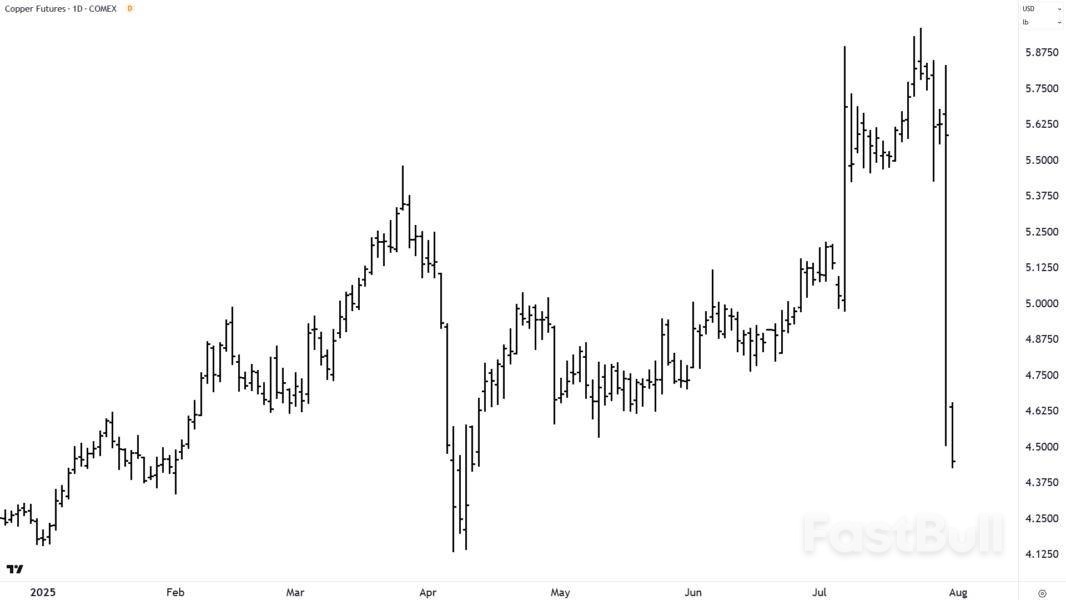
          As mentioned earlier, the front-month COMEX copper contract plunged in Wednesday’s trade after details of the new tariff proposals were released. To put the reversal into context, the contract made it’s 2025 peak exactly a week ago at US$5.96/lb and is now trading at US$4.50/lb – down a whopping 25%. This puts it back at levels around President Trump’s inauguration back in January, and prior to his ramp-up in tariff rhetoric.

          High Grade Copper Futures (Front month, back-adjusted) COMEX

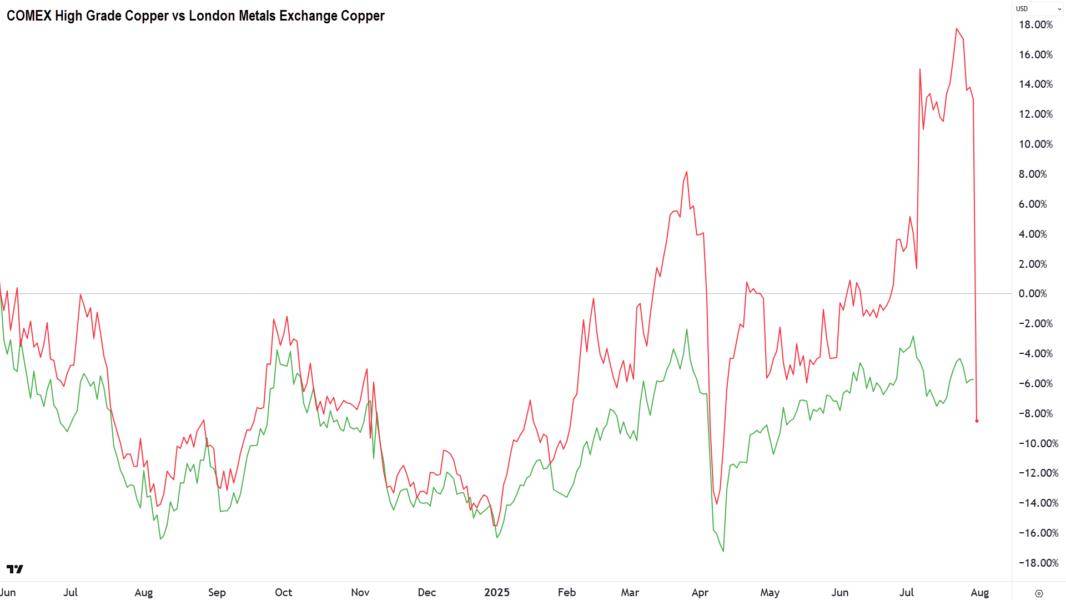
          A striking development has been the collapse in the COMEX-LME price premium. For much of 2025, COMEX copper traded at a hefty premium (up to 30%) over LME prices, as traders front-ran possible US import restrictions. As can be seen in the chart below, which compares percentage price moves across the two over the last 12-months, this premium is now gone (COMEX copper in red vs LME copper in green).

          COMEX High Grade Copper (Red) vs London Metals Exchange Copper (Green)

          Wednesday’s plunge eliminated one of the key arbitrage drivers in the copper market and removed a core source of upside for US producers. The US market now faces the opposite problem: an inventory glut. In a research note released today titled “North America Copper – Copper S232 Excludes Refined Products”, major broker Citi estimated that “several hundred thousand tons” of excess copper, stockpiled in anticipation of higher prices, may now need to be liquidated.

          Historically, the LME has served as the global copper benchmark, while COMEX tends to reflect North American dynamics. The reversion of the COMEX price toward the LME level signals a realignment with global supply and demand fundamentals and a sharp end to speculative premiums.

          Who really pays?

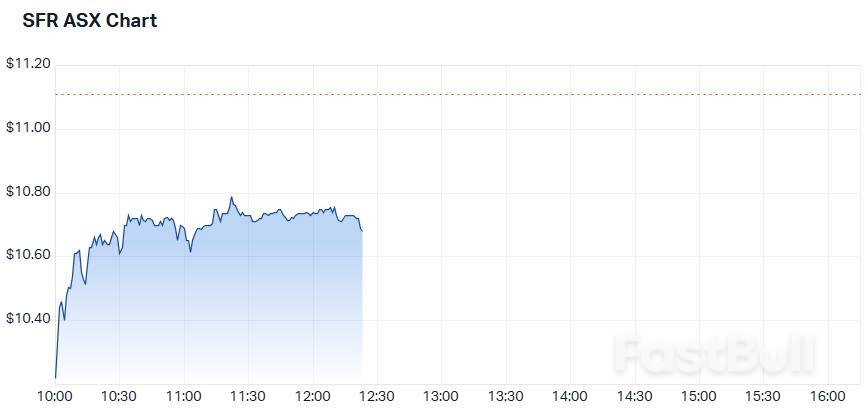
          While Wednesday’s copper rout hit all producers to some extent, US-based miners bore the greatest impact. Shares in Freeport-McMoRan, America’s largest copper producer, tumbled 9.5%, with other domestic names like Southern Copper(-6.3%) and Hudbay Minerals(-7.0%) similarly sharply lower.The reason? These companies were among the biggest beneficiaries of the COMEX premium, and their revenue assumptions were pegged to inflated local pricing. That premium has now evaporated.For ASX-listed producers, the pain is likely milder, but still noticeable based on stock price moves so far today. SFR is down 3.3% at the time of writing, but it was down 9% on the open, and BHP and RIO are also sporting modest falls compared to their US counterparts – by 1.8% and 1.9%, respectively – both also well off their lows of the session.

          Sandfire Resources (SFR) intraday chart Thursday, 31 July

          These relatively mild declines reflect the fact that all three producers are likely to face a limited impact from COMEX gyrations as their respective refined copper output and export profiles are generally ex-US. Ultimately, the market response reflects the degree of US revenue exposure, rather than copper production capacity alone.

          Fundamentals matter more

          While tariff drama dominates headlines, long-term investors may do well to focus on fundamentals. According to local broking and research house Barrenjoey, the copper outlook is shaped by diverging forces on both the demand and supply sides. Here are the key points from a research note titled “Joey's copper signals” released on Monday:

          Copper market demand factors

          ● Chinese apparent consumption is up 8% year-on-year, with appliances and autos strong.

          ● Chinese property and manufacturing sectors remain weak.

          ● Global PMIs are improving, reflecting a possible recovery in broader industrial demand.

          ● US tariff fears may have pulled demand forward, weighing on second half 2025 consumption.

          Copper market supply factors

          ● Chilean exports (25% of global supply) are up 6%, outperforming expectations.

          ● Peru’s exports are down 4%, missing targets due to operational disruptions.

          ● Indonesian exports are constrained by licensing issues, possibly easing in the second half of 2025.

          ● Global copper supply growth remains stalled due to a drought in final investment decisions.

          Copper price outlook

          The net result according to Barrenjoey, is supply and demand expectations are both being revised down, but longer-term deficits are emerging. The broker notes that the copper market has now gone two and a half years without sanctioning a major new project, a trend that may create shortages by 2027-28.Barrenjoey forecasts a COMEX copper price of US$4.28/lb for the second half of 2025 – which implies potential further downside as the latest tariff plans are digested by the market. However, longer term, the broker notes that an incentive price of US$5.00/lb is seen as necessary to spur new investment. “We are much more bullish on copper prices in the medium to longer term,” they conclude.

          Looking through the tariff noise

          The Trump administration’s tariff announcement has rocked copper markets, triggering a sharp fall in the COMEX copper price and unwinding speculative premiums. For investors, this means lower prices of copper stocks – from the NYSE to the ASX. But when the dust settles, it’s worth asking: What has really changed?The headline tariff does not affect refined copper, cathodes, or concentrates, the lifeblood of global trade in the red metal. Instead, it targets a narrow band of downstream products. The market’s outsized reaction stems not from actual restrictions, but from the sudden absence of them – an about-face that has exposed short-term speculative positioning.

          In essence, what we’ve witnessed is the rapid removal of the COMEX-LME copper premium. The fundamentals of the global copper market, however, remain largely intact. Supply constraints persist. Demand is still robust in key sectors. And the investment pipeline for new projects remains dry.For ASX copper producers like Sandfire, BHP, and Rio Tinto, today’s volatility may present more noise than signal. In the end, investors may be better served looking through near-term tariff turbulence and toward the structural trends reshaping the copper market for the decade ahead.

          Source: TradingView

          To stay updated on all economic events of today, please check out our Economic calendar
          Risk Warnings and Disclaimers
          You understand and acknowledge that there is a high degree of risk involved in trading. Following any strategies or investment methods may lead to potential losses. The content on the site is provided by our contributors and analysts for information purposes only. You are solely responsible for determining whether any trading assets, securities, strategy, or any other product is suitable for investing based on your own investment objectives and financial situation.
          Add to Favorites
          Share

          Dollar Rebounds with First Monthly Gain in 2025 as Fed Holds Firm on Rates

          Gerik

          Economic

          Dollar Strengthens as Market Repositions on Fed Patience

          The US dollar hovered near a two-month high on Thursday, reversing earlier-year losses as Federal Reserve Chair Jerome Powell reaffirmed a cautious approach to rate cuts. Following the central bank’s latest policy meeting, Powell indicated it remains premature to consider easing monetary policy, prompting traders to revise down expectations for rate cuts this year to approximately 35 basis points. This renewed confidence in US monetary stability, paired with economic resilience, has injected upward momentum into the greenback, pushing the dollar index to 99.77 and setting it up for a more than 3% monthly gain.
          Earlier in 2025, the dollar faced significant headwinds amid chaotic trade policies, aggressive tariff threats, and speculation about the currency’s long-term credibility. These concerns drove the dollar to its worst start since the beginning of the floating exchange rate era. However, recent trade agreements, including a high-profile deal with South Korea and softened rhetoric from Washington, have alleviated some of these fears. As tariff risks recede and the Fed maintains its restrictive posture, the market dynamic has shifted in the dollar’s favor.
          The correlation between a hawkish Fed and a stronger dollar is evident here, where a firm stance on interest rates leads to higher front-end yields, enhancing the currency's appeal among investors. Moreover, the fading of extreme downside risks has allowed for a re-pricing of dollar assets.

          Diverging Currency Trends Highlight Dollar Dominance

          Major currencies continued to weaken against the dollar. The euro dipped to a seven-week low before recovering slightly to $1.1433, still heading for a 3% monthly loss. The British pound fared worse, trading at $1.3248 and approaching a 3.5% decline for the month. These movements reflect a divergence in economic trajectories and monetary outlooks, reinforcing the dollar’s relative strength.
          Meanwhile, the Japanese yen remained subdued near 149.29 per dollar, with the market awaiting signals from the Bank of Japan. The central bank is expected to hold rates steady, though speculation about potential hikes later in the year persists due to rising inflationary pressures and global trade uncertainties. Until further clarity is provided, the yen remains on track for a 3.5% monthly decline, reflecting investor skepticism toward Japan's policy direction.

          Asia-Pacific Reactions and Tariff Developments

          Trade-related headlines also influenced currency movements in Asia. The South Korean won strengthened by 0.3% to 1,389.20 per dollar after a new US-South Korea agreement clarified tariff conditions. Conversely, the Australian and New Zealand dollars remained under pressure, each headed for monthly declines of roughly 2–3%, driven by weaker domestic data and a broadly stronger US dollar.
          The complex interaction between trade policy and currency markets here is more of a correlation than a direct causation. While tariff announcements alone do not dictate currency values, they influence expectations about trade flows, inflation, and central bank responses, which collectively shape exchange rate dynamics.

          Dollar Positioning and Global Central Bank Moves

          As August begins, market participants will closely monitor upcoming central bank decisions particularly from the Bank of Japan and the European Central Bank for signs of divergence or alignment with the Fed’s stance. In the absence of dovish pivots abroad, the dollar may continue to outperform in the short term, particularly if US macroeconomic data remains resilient and geopolitical tensions ease further.
          The dollar’s return to strength in July marks a clear break from the weakness seen in the first half of 2025. Reinforced by a cautious yet credible Federal Reserve and stabilizing trade tensions, the currency appears to have regained its footing. Whether this momentum can be sustained depends on global economic conditions, inflation developments, and the monetary responses of other major economies in the months ahead.

          Source: Reuters

          To stay updated on all economic events of today, please check out our Economic calendar
          Risk Warnings and Disclaimers
          You understand and acknowledge that there is a high degree of risk involved in trading. Following any strategies or investment methods may lead to potential losses. The content on the site is provided by our contributors and analysts for information purposes only. You are solely responsible for determining whether any trading assets, securities, strategy, or any other product is suitable for investing based on your own investment objectives and financial situation.
          Add to Favorites
          Share

          South Korean Automakers Lose Edge as U.S. Tariffs Level Playing Field with Japan

          Gerik

          Economic

          Stocks

          Equity Markets React to Tariff Realignment

          South Korea's leading automakers, Hyundai Motor and Kia Corp, saw their stock prices fall on Thursday following a revised U.S. trade policy announcement. President Donald Trump confirmed that a new 15% tariff would apply to South Korean imports, including automobiles, as part of a renegotiated bilateral trade agreement. Hyundai shares slipped by 2%, while Kia experienced a sharper decline of 3.3%, reflecting investor concern over weakening competitiveness in the U.S. market.
          Before this policy shift, South Korean automakers benefited from a zero-tariff arrangement under the Korea-U.S. Free Trade Agreement, giving them a 2.5% edge over Japanese car imports, which faced a standing tariff. That margin contributed to pricing flexibility and stronger positioning in the competitive American auto market. However, the updated agreement now applies a uniform 15% tariff rate to both South Korean and Japanese vehicles, thereby eliminating the former advantage.
          This alteration signals a direct causal relationship between trade policy and market positioning. The removal of preferential tariffs compresses Hyundai and Kia’s pricing power and may force margin adjustments, production realignment, or changes in export strategy.

          Comparative Impact on Market Share Dynamics

          The original tariff exemption underpinned South Korea’s ability to grow its footprint in the U.S. auto market, especially in comparison to Japan. Now, with tariff parity, the distinction between the two exporting countries is blurred. This creates an environment of intensified price-based competition and may lead to reshuffling in market share, particularly if Japanese automakers respond with more aggressive pricing or promotional strategies.
          The correlation between share price performance and tariff policy is evident. The immediate negative movement in Hyundai and Kia’s stock suggests investor expectation of tighter profit margins and heightened rivalry.

          Government's Strategic Response and Outlook

          South Korea has already signaled its intent to delay the new tariffs and deepen cooperation through continued negotiations. Whether these efforts will yield meaningful concessions remains uncertain. However, the country’s proactive stance indicates an attempt to mitigate long-term disruptions and preserve the auto industry’s competitiveness abroad.
          In conclusion, the new Korea-U.S. trade arrangement marks a significant turning point for South Korean automakers. The erosion of tariff advantages may reshape strategic priorities, including supply chain logistics, U.S.-based production considerations, and competitive marketing. As the policy environment continues to evolve, market participants will closely monitor bilateral developments and their implications for export-oriented industries.

          Source: Reuters

          To stay updated on all economic events of today, please check out our Economic calendar
          Risk Warnings and Disclaimers
          You understand and acknowledge that there is a high degree of risk involved in trading. Following any strategies or investment methods may lead to potential losses. The content on the site is provided by our contributors and analysts for information purposes only. You are solely responsible for determining whether any trading assets, securities, strategy, or any other product is suitable for investing based on your own investment objectives and financial situation.
          Add to Favorites
          Share

          BoC Holds Rates, Unveils New Scenario Analysis

          Samantha Luan

          Economic

          Forex

          Political

          The message from the rate announcement was nuanced. The BoC acknowledged softening Canadian economic growth since January but also pointed to recent data reports remaining broadly resilient relative to more significant downside scenarios that appeared likely in the spring, and upside inflation surprises as reasons not to reduce interest rates further.
          The potential “need for a reduction in the policy interest rate” was again reinforced, if there’s further net downward pressure on inflation stemming from a weakening economy. But it would likely take a significantly larger international trade shock than is currently in place to prompt that reaction, and the central bank will also need to continue to take into account fiscal policy loosening, which is better suited to deliver targeted relief to trade impacted sectors than interest rate policy.
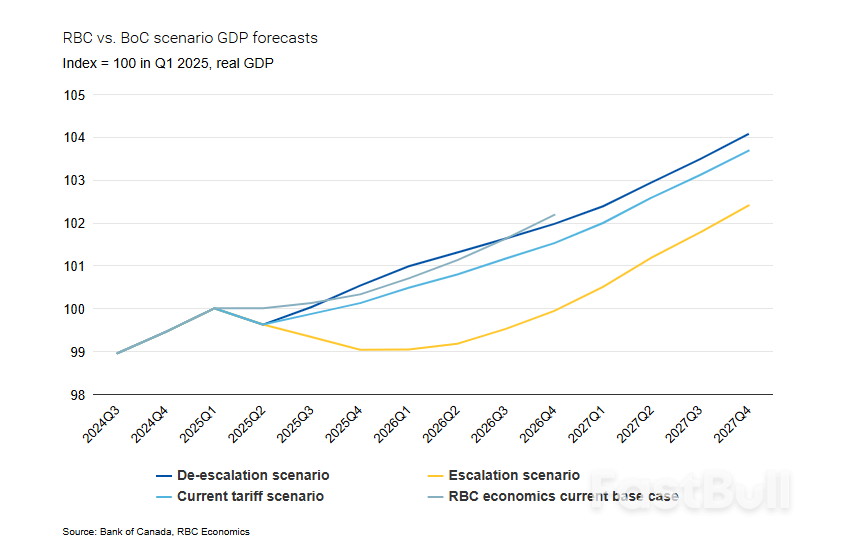
          With the interest rate decision aligning with expectations, we’ll focus more on the scenario analysis that was again presented in the MPR instead of a central forecast – although with a third current tariff scenario added to the two (upside and downside) scenarios provided in April.This approach is unusual but allows the central bank to avoid speculating on event probabilities amid extraordinary uncertainty, and instead present a range of potential outcomes.

          Bank of Canada’s scenario analysis and how it tracks ours

          In the current tariff scenario that tracks the closest to our own base case assumptions, tariffs are assumed to stay unchanged to leave the average U.S. tariff at the 13% level today. The BoC’s calculation of the current effective U.S. tariff rate on imports from Canada at ~5% is consistent with our own calculations, as is the calculation that the vast majority of Canadian exports are currently exempt from tariffs via compliance with the USMCA/CUSMA free trade agreement. GDP growth in this scenario is projected be soft but positive in the second half of this year with inflation expected to hover around the 2% target as pressures from tariffs and economic softening roughly offset – that is also consistent with our own current base-case projections.
          In the other two scenarios, the average U.S. tariff rate ranges from the 10% in the de-escalation scenario to 28% in the escalation scenario. In the former, Canada’s economy recovers somewhat faster while inflation remains persistently below target. On the other hand, the escalation scenario triggers a prolonged recession lasting until early 2026, with inflation rising above 2.5% later in 2026.

          Common assumptions for all three scenarios

          Perhaps more revealing are the assumptions common across all three scenarios, one of them being that 75% of tariff-related cost increases will be passed on to consumers over six quarters. Our own assumptions are for a smaller but more rapid pass-through effect, of roughly half of tariffs-related cost increases passed on to consumers within one to two quarters. Another key assumption concerns fiscal policy, as projections only incorporate already announced federal and provincial measures. Additional spending could lend to upside in growth in 2026. Our own assumptions in comparison, allow for some additional support from government spending on top of actual budgeted spending included in the BoC’s projections.
          Importantly, U.S. tariffs are treated as permanent fixtures that will impact the economy well beyond the current cycle through reduced investment and productivity. This outlook aligns well with ours, and is particularly concerning given Canada’s decade-long productivity slump that preceded the current trade disruptions.

          Final thoughts and going back to our base case…

          Despite recent decisions to hold, past rate cuts from the BoC are likely still taking time to support the economy. But with mortgage rates mostly stabilizing near or above origination back in 2020-2021 origination levels, the effect on households is more like easing off the brakes than pressing on the gas. Today, the car is in neutral and the outlook is still hazy. Tariffs in place today have been less severe than feared but Canada as one of the largest trade partners to the U.S., remains particularly vulnerable to protectionist U.S. trade policies. In two days, the latest U.S. self-imposed trade negotiation deadline could result in escalated tariffs beyond today’s targeted but relatively limited levels.
          A significantly more negative outlook, one that resembles spring remains a downside risk. While the BoC projects inflation will rise in that kind of a scenario as tariff impacts outweigh economic weakness, further rate cuts would be appropriate if it became clear that the economy was sliding into recession. Barring such deterioration and following our base case, we expect the BoC will maintain current rates going forward.

          BoC Holds Rates, Unveils New Scenario Analysis_1Source:RBC

          To stay updated on all economic events of today, please check out our Economic calendar
          Risk Warnings and Disclaimers
          You understand and acknowledge that there is a high degree of risk involved in trading. Following any strategies or investment methods may lead to potential losses. The content on the site is provided by our contributors and analysts for information purposes only. You are solely responsible for determining whether any trading assets, securities, strategy, or any other product is suitable for investing based on your own investment objectives and financial situation.
          Add to Favorites
          Share
          FastBull
          Copyright © 2025 FastBull Ltd

          728 RM B 7/F GEE LOK IND BLDG NO 34 HUNG TO RD KWUN TONG KLN HONG KONG

          TelegramInstagramTwitterfacebooklinkedin
          App Store Google Play Google Play
          Products
          Charts

          Chats

          Q&A with Experts
          Screeners
          Economic Calendar
          Data
          Tools
          Membership
          Features
          Function
          Markets
          Copy Trading
          Latest Signals
          Contests
          News
          Analysis
          24/7
          Columns
          Education
          Company
          Careers
          About Us
          Contact Us
          Advertising
          Help Center
          Feedback
          User Agreement
          Privacy Policy
          Business

          White Label

          Data API

          Web Plug-ins

          Poster Maker

          Affiliate Program

          Risk Disclosure

          The risk of loss in trading financial instruments such as stocks, FX, commodities, futures, bonds, ETFs and crypto can be substantial. You may sustain a total loss of the funds that you deposit with your broker. Therefore, you should carefully consider whether such trading is suitable for you in light of your circumstances and financial resources.

          No decision to invest should be made without thoroughly conducting due diligence by yourself or consulting with your financial advisors. Our web content might not suit you since we don't know your financial conditions and investment needs. Our financial information might have latency or contain inaccuracy, so you should be fully responsible for any of your trading and investment decisions. The company will not be responsible for your capital loss.

          Without getting permission from the website, you are not allowed to copy the website's graphics, texts, or trademarks. Intellectual property rights in the content or data incorporated into this website belong to its providers and exchange merchants.

          Not Logged In

          Log in to access more features

          FastBull Membership

          Not yet

          Purchase

          Become a signal provider
          Help Center
          Customer Service
          Dark Mode
          Price Up/Down Colors

          Log In

          Sign Up

          Position
          Layout
          Fullscreen
          Default to Chart
          The chart page opens by default when you visit fastbull.com