• Trade
  • Markets
  • Copy
  • Contests
  • News
  • 24/7
  • Calendar
  • Q&A
  • Chats
Trending
Screeners
SYMBOL
LAST
BID
ASK
HIGH
LOW
NET CHG.
%CHG.
SPREAD
SPX
S&P 500 Index
6870.39
6870.39
6870.39
6895.79
6858.28
+13.27
+ 0.19%
--
DJI
Dow Jones Industrial Average
47954.98
47954.98
47954.98
48133.54
47871.51
+104.05
+ 0.22%
--
IXIC
NASDAQ Composite Index
23578.12
23578.12
23578.12
23680.03
23506.00
+72.99
+ 0.31%
--
USDX
US Dollar Index
98.910
98.990
98.910
98.960
98.730
-0.040
-0.04%
--
EURUSD
Euro / US Dollar
1.16516
1.16523
1.16516
1.16717
1.16341
+0.00090
+ 0.08%
--
GBPUSD
Pound Sterling / US Dollar
1.33184
1.33192
1.33184
1.33462
1.33136
-0.00128
-0.10%
--
XAUUSD
Gold / US Dollar
4212.67
4213.08
4212.67
4218.85
4190.61
+14.76
+ 0.35%
--
WTI
Light Sweet Crude Oil
59.180
59.210
59.180
60.084
59.160
-0.629
-1.05%
--

Community Accounts

Signal Accounts
--
Profit Accounts
--
Loss Accounts
--
View More

Become a signal provider

Sell trading signals to earn additional income

View More

Guide to Copy Trading

Get started with ease and confidence

View More

Signal Accounts for Members

All Signal Accounts

Best Return
  • Best Return
  • Best P/L
  • Best MDD
Past 1W
  • Past 1W
  • Past 1M
  • Past 1Y

All Contests

  • All
  • Trump Updates
  • Recommend
  • Stocks
  • Cryptocurrencies
  • Central Banks
  • Featured News
Top News Only
Share

Temasek CEO Dilhan Pillay: We Are Taking A Conservative Stance On Allocating Capital

Share

Brazil Economists See Brazilian Real At 5.40 Per Dollar By Year-End 2025 Versus 5.40 In Previous Estimate - Central Bank Poll

Share

Brazil Economists See Year-End 2026 Interest Rate Selic At 12.25% Versus 12.00% In Previous Estimate - Central Bank Poll

Share

Brazil Economists See Year-End 2025 Interest Rate Selic At 15.00% Versus 15.00% In Previous Estimate - Central Bank Poll

Share

EU Commission Says Meta Has Committed To Give EU Users Choice On Personalised Ads

Share

Sources Revealed That The Bank Of England Has Invited Employees To Voluntarily Apply For Layoffs

Share

The Bank Of England Plans To Cut Staff Due To Budget Pressures

Share

Traders Believe There Is Less Than A 10% Chance That The European Central Bank Will Cut Interest Rates By 25 Basis Points In 2026

Share

Egypt, European Bank For Reconstruction And Development Sign $100 Million Financing Agreement

Share

Israel Budget Deficit 4.5% Of GDP In November Over Past 12 Months Versus 4.9% Deficit In October

Share

JPMorgan - Council Chaired By Jamie Dimon Includes Jeff Bezos

Share

UK Government: UK Health Security Agency Identified New Recombinant Mpox Virus In England In Individual Who Had Recently Travelled To Asia

Share

European Central Bank Governing Council Member Kazimir: I See No Reason To Change Rates In The Coming Months, Definitely No In December

Share

European Central Bank Governing Council Member Kazimir: Overengineering Policy Around Small Inflation Deviations Would Introduce Unnecessary Policy Uncertainty

Share

European Central Bank Governing Council Member Kazimir: European Central Bank Must Be Vigilant About Some Upside Risks To Inflation

Share

European Central Bank Governing Council Member Kazimir: Forex Pass Through To Prices May Not Be As Strong As Expected

Share

Document: EU Looking At Options For Boosting Lebanon's Internal Security Forces

Share

Thai Foreign Ministry: Military Action Will Continue Until Thai Sovereignty, Territorial Integrity Secure

Share

Ukraine President Zelenskiy: No Accord So Far On Eastern Ukraine In US Talks

Share

NATO: Ukrainian President Zelenskiy Will Meet NATO's Rutte And EU Commission Chief Von Der Leyen And Costa In Brussels On Monday

TIME
ACT
FCST
PREV
France Industrial Output MoM (SA) (Oct)

A:--

F: --

P: --
France Trade Balance (SA) (Oct)

A:--

F: --

P: --
Euro Zone Employment YoY (SA) (Q3)

A:--

F: --

P: --
Canada Part-Time Employment (SA) (Nov)

A:--

F: --

P: --

Canada Unemployment Rate (SA) (Nov)

A:--

F: --

P: --

Canada Full-time Employment (SA) (Nov)

A:--

F: --

P: --

Canada Labor Force Participation Rate (SA) (Nov)

A:--

F: --

P: --

Canada Employment (SA) (Nov)

A:--

F: --

P: --

U.S. PCE Price Index MoM (Sept)

A:--

F: --

P: --

U.S. Personal Income MoM (Sept)

A:--

F: --

P: --

U.S. Core PCE Price Index MoM (Sept)

A:--

F: --

P: --

U.S. PCE Price Index YoY (SA) (Sept)

A:--

F: --

P: --

U.S. Core PCE Price Index YoY (Sept)

A:--

F: --

P: --

U.S. Personal Outlays MoM (SA) (Sept)

A:--

F: --

P: --
U.S. 5-10 Year-Ahead Inflation Expectations (Dec)

A:--

F: --

P: --

U.S. Real Personal Consumption Expenditures MoM (Sept)

A:--

F: --

P: --
U.S. Weekly Total Rig Count

A:--

F: --

P: --

U.S. Weekly Total Oil Rig Count

A:--

F: --

P: --

U.S. Consumer Credit (SA) (Oct)

A:--

F: --

P: --
China, Mainland Foreign Exchange Reserves (Nov)

A:--

F: --

P: --

Japan Trade Balance (Oct)

A:--

F: --

P: --

Japan Nominal GDP Revised QoQ (Q3)

A:--

F: --

P: --

China, Mainland Imports YoY (CNH) (Nov)

A:--

F: --

P: --

China, Mainland Exports (Nov)

A:--

F: --

P: --

China, Mainland Imports (CNH) (Nov)

A:--

F: --

P: --

China, Mainland Trade Balance (CNH) (Nov)

A:--

F: --

P: --

China, Mainland Exports YoY (USD) (Nov)

A:--

F: --

P: --

China, Mainland Imports YoY (USD) (Nov)

A:--

F: --

P: --

Germany Industrial Output MoM (SA) (Oct)

A:--

F: --

P: --
Euro Zone Sentix Investor Confidence Index (Dec)

A:--

F: --

P: --

Canada National Economic Confidence Index

--

F: --

P: --

U.K. BRC Like-For-Like Retail Sales YoY (Nov)

--

F: --

P: --

U.K. BRC Overall Retail Sales YoY (Nov)

--

F: --

P: --

Australia Overnight (Borrowing) Key Rate

--

F: --

P: --

RBA Rate Statement
RBA Press Conference
Germany Exports MoM (SA) (Oct)

--

F: --

P: --

U.S. NFIB Small Business Optimism Index (SA) (Nov)

--

F: --

P: --

Mexico 12-Month Inflation (CPI) (Nov)

--

F: --

P: --

Mexico Core CPI YoY (Nov)

--

F: --

P: --

Mexico PPI YoY (Nov)

--

F: --

P: --

U.S. Weekly Redbook Index YoY

--

F: --

P: --

U.S. JOLTS Job Openings (SA) (Oct)

--

F: --

P: --

China, Mainland M1 Money Supply YoY (Nov)

--

F: --

P: --

China, Mainland M0 Money Supply YoY (Nov)

--

F: --

P: --

China, Mainland M2 Money Supply YoY (Nov)

--

F: --

P: --

U.S. EIA Short-Term Crude Production Forecast For The Year (Dec)

--

F: --

P: --

U.S. EIA Natural Gas Production Forecast For The Next Year (Dec)

--

F: --

P: --

U.S. EIA Short-Term Crude Production Forecast For The Next Year (Dec)

--

F: --

P: --

EIA Monthly Short-Term Energy Outlook
U.S. API Weekly Gasoline Stocks

--

F: --

P: --

U.S. API Weekly Cushing Crude Oil Stocks

--

F: --

P: --

U.S. API Weekly Crude Oil Stocks

--

F: --

P: --

U.S. API Weekly Refined Oil Stocks

--

F: --

P: --

South Korea Unemployment Rate (SA) (Nov)

--

F: --

P: --

Japan Reuters Tankan Non-Manufacturers Index (Dec)

--

F: --

P: --

Japan Reuters Tankan Manufacturers Index (Dec)

--

F: --

P: --

Japan Domestic Enterprise Commodity Price Index MoM (Nov)

--

F: --

P: --

Japan Domestic Enterprise Commodity Price Index YoY (Nov)

--

F: --

P: --

China, Mainland PPI YoY (Nov)

--

F: --

P: --

China, Mainland CPI MoM (Nov)

--

F: --

P: --

Q&A with Experts
    • All
    • Chatrooms
    • Groups
    • Friends
    Connecting
    .
    .
    .
    Type here...
    Add Symbol or Code

      No matching data

      All
      Trump Updates
      Recommend
      Stocks
      Cryptocurrencies
      Central Banks
      Featured News
      • All
      • Russia-Ukraine Conflict
      • Middle East Flashpoint
      • All
      • Russia-Ukraine Conflict
      • Middle East Flashpoint
      Search
      Products

      Charts Free Forever

      Chats Q&A with Experts
      Screeners Economic Calendar Data Tools
      Membership Features
      Data Warehouse Market Trends Institutional Data Policy Rates Macro

      Market Trends

      Market Sentiment Order Book Forex Correlations

      Top Indicators

      Charts Free Forever
      Markets

      News

      News Analysis 24/7 Columns Education
      From Institutions From Analysts
      Topics Columnists

      Latest Views

      Latest Views

      Trending Topics

      Top Columnists

      Latest Update

      Signals

      Copy Rankings Latest Signals Become a signal provider AI Rating
      Contests
      Brokers

      Overview Brokers Assessment Rankings Regulators News Claims
      Broker listing Forex Brokers Comparison Tool Live Spread Comparison Scam
      Q&A Complaint Scam Alert Videos Tips to Detect Scam
      More

      Business
      Events
      Careers About Us Advertising Help Center

      White Label

      Data API

      Web Plug-ins

      Affiliate Program

      Awards Institution Evaluation IB Seminar Salon Event Exhibition
      Vietnam Thailand Singapore Dubai
      Fans Party Investment Sharing Session
      FastBull Summit BrokersView Expo
      Recent Searches
        Top Searches
          Markets
          News
          Analysis
          User
          24/7
          Economic Calendar
          Education
          Data
          • Names
          • Latest
          • Prev

          View All

          No data

          Scan to Download

          Faster Charts, Chat Faster!

          Download App
          English
          • English
          • Español
          • العربية
          • Bahasa Indonesia
          • Bahasa Melayu
          • Tiếng Việt
          • ภาษาไทย
          • Français
          • Italiano
          • Türkçe
          • Русский язык
          • 简中
          • 繁中
          Open Account
          Search
          Products
          Charts Free Forever
          Markets
          News
          Signals

          Copy Rankings Latest Signals Become a signal provider AI Rating
          Contests
          Brokers

          Overview Brokers Assessment Rankings Regulators News Claims
          Broker listing Forex Brokers Comparison Tool Live Spread Comparison Scam
          Q&A Complaint Scam Alert Videos Tips to Detect Scam
          More

          Business
          Events
          Careers About Us Advertising Help Center

          White Label

          Data API

          Web Plug-ins

          Affiliate Program

          Awards Institution Evaluation IB Seminar Salon Event Exhibition
          Vietnam Thailand Singapore Dubai
          Fans Party Investment Sharing Session
          FastBull Summit BrokersView Expo

          Trump’s $2K Promise: What It Could Mean For Your 2026 Tax Return

          Justin

          Economic

          Summary:

          Trump’s $2,000 dividend promise has left many asking a lot of questions, like what it could mean for taxes. Find out how your refund could be impacted.

          When the White House makes a promise about distributing benefits to Americans, it's hard to remove politics from the equation, regardless of who is president. So when President Donald Trump recently promised a $2,000 "dividend" for most Americans, analysts and journalists immediately began parsing out exactly what that meant, and why he said it.

          Although details are still sketchy, the $2,000 dividend could potentially affect your 2026 tax return in a number of different ways. Here's a look at exactly what the president said, how the dividend may play out and what it could mean for your taxes.

          What's the Origin of the Dividend Promise?

          Beginning on Nov. 9, President Trump made a series of posts on social media platform Truth Social regarding the dividend. Specifically, Trump declared, "People that are against Tariffs are FOOLS! We are now the Richest, Most Respected Country In the World, With Almost No Inflation, and A Record Stock Market Price. 401k's are Highest EVER … A dividend of at least $2000 a person (not including high income people!) will be paid to everyone."

          What Are the Specifics?

          While this might sound great on paper, Trump offered little by way of detail. As of Nov. 13, there still has been no clarification of who counts as "high income," which Americans would qualify for this "dividend," and how or when it would be paid.

          Treasury Secretary Scott Bessent seemed to walk back the thought of distributing actual dividend checks when he told ABC News' "This Week" that "It could be just the tax decreases that we are seeing on the president's agenda. No tax on tips, no tax on overtime, no tax on Social Security, deductibility on auto loans. Those are substantial deductions that are being financed in the tax bill."

          According to ABC News, on Nov. 12, White House press secretary Karoline Leavitt told reporters at the White House, "The president made it clear he wants to make it happen. So his team of economic advisers are looking into it."

          Put it all together, and as of Nov. 13, it's not at all clear how or even if the $2,000 dividend will come about.

          Does the Math Work Out?

          According a post from Erica York, vice president of federal tax policy at the Tax Foundation, handing out $2,000 cash to the bulk of the U.S. population could cost $300 billion or more — an amount that would exceed the net revenue brought in so far from Trump's new tariffs. And it's entirely possible that the tariffs could go away, or even be retroactively deemed illegal, by the Supreme Court of the United States, according to AP News.

          This is likely the reason Bessent sidestepped the idea of actual dividend checks going to Americans. If the $2,000 is cloaked in other deductions or tax breaks as he suggested, the administration could likely sidestep cash payouts.

          Assuming It Passes, What Could It Mean for Your Taxes?

          If everything falls into place and Americans actually receive some form of $2,000 dividend, here are some of the ways it could play out for your taxes.

          • If paid in the form of a "stimulus check," like the ones issued during the pandemic, they will likely be nontaxable. This means your tax liability will not increase, and the money paid to you will not push you into a higher tax bracket.

          • If issued as a tax credit, it will reduce your tax liability by the amount of the payout, potentially $2,000. If you don't owe $2,000 in taxes, any excess amount would come in the form of a tax refund. This amount would also be nontaxable.

          • If used as some type of deduction or exemption from taxes, whatever benefit you receive would also be nontaxable. For example, if the $2,000 comes in the form of an exemption from auto loan interest, it simply means you won't have to pay as much on your car loan.

          Overall, President Trump's offer of a $2,000 dividend to low- and middle-income Americans certainly sounds attractive on the surface. But as of mid-November, there's still no real clarity on where the money will come from, who it will go to or whether it will actually happen. The best course of action right now is to keep an eye on the news to see when — or if — the policy is actually implemented.

          Editor's note on political coverage: GOBankingRates is nonpartisan and strives to cover all aspects of the economy objectively and present balanced reports on politically focused finance stories. You can find more coverage of this topic on GOBankingRates.com.

          Source: Yahoo Finance

          To stay updated on all economic events of today, please check out our Economic calendar
          Risk Warnings and Disclaimers
          You understand and acknowledge that there is a high degree of risk involved in trading. Following any strategies or investment methods may lead to potential losses. The content on the site is provided by our contributors and analysts for information purposes only. You are solely responsible for determining whether any trading assets, securities, strategy, or any other product is suitable for investing based on your own investment objectives and financial situation.
          Add to Favorites
          Share

          Canada Eyes Mining And Rare Earths Equity Stakes To Combat China

          Samantha Luan

          Political

          Commodity

          Canada plans to buy stakes in projects that will produce and process key minerals, the country's natural resources minister said, as part of a broader effort to secure supplies of materials that are controlled by China.

          Tim Hodgson said the government has already started studying projects that will receive these equity investments, including mining operations and processing facilities. Those entities would be "deemed in the national interest, but for some reason they aren't able to find the equity," he said in an interview with Bloomberg News.

          "For example, some of the rare-earths processing facilities that are being talked about — unless they receive equity-like support, given the stranglehold that certain countries have on those markets, they're unlikely to happen."

          Critical minerals like lithium and graphite, along with rare earth metals like terbium and dysprosium, are essential to motor engines, consumer electronics and weapons manufacturing. But the bulk of the mining and processing of these materials is controlled by China.

          It's an unusual move for the Canadian government to make equity investments, but it follows the Trump administration's decision to buy stakes in miners including MP Materials Corp., Lithium Americas Corp. and Trilogy Metals Inc. this year to expand production of rare earth minerals and other metals on domestic soil. The latter two of those companies are headquartered in Canadian mining hub of Vancouver.

          Canada has unveiled a suite of measures to shore up access to critical minerals, including fast-tracking mining projects deemed to have national importance. The government said Thursday it will try to accelerate the approval of projects including the Nouveau Monde Graphite Inc. phase 2 project in Quebec, Canada Nickel Co.'s Crawford project in Ontario and a tungsten and molybdenum mine in New Brunswick.

          Shares of Nouveau Monde jumped nearly 12% on Wednesday after a report of the government's plan, while Canada Nickel has surged 48% this week.

          Prime Minister Mark Carney's government also introduced a C$2 billion ($1.4 billion) "critical minerals sovereign fund" in its latest budget that will provide the money for equity investments, loan guarantees and offtake agreements to support mining projects. Hodgson said the Canada Growth Fund, a separate investment vehicle, has started studying projects eligible for equity investments.

          The minister said the government will look to expand stockpiling of minerals to support producers of niche metals dominated by China. Canada has already begun stockpiling scandium and graphite, he said, and is now looking at other minerals. Group of Seven allies last month announced measures aimed at securing mineral supplies outside of China.

          "We're doing a whole mapping exercise, looking at what Canada's needs are relative to what Canada's production and sourcing capability is," Hodgson said. "Where we see a significant deficit, we will absolutely look at stockpiling as a way to protect Canadian industries and the economy."

          Source: Bloomberg Europe

          Risk Warnings and Disclaimers
          You understand and acknowledge that there is a high degree of risk involved in trading. Following any strategies or investment methods may lead to potential losses. The content on the site is provided by our contributors and analysts for information purposes only. You are solely responsible for determining whether any trading assets, securities, strategy, or any other product is suitable for investing based on your own investment objectives and financial situation.
          Add to Favorites
          Share

          Swiss Franc Surges to Decade High on Stickier Inflation Outlook

          Adam

          Forex

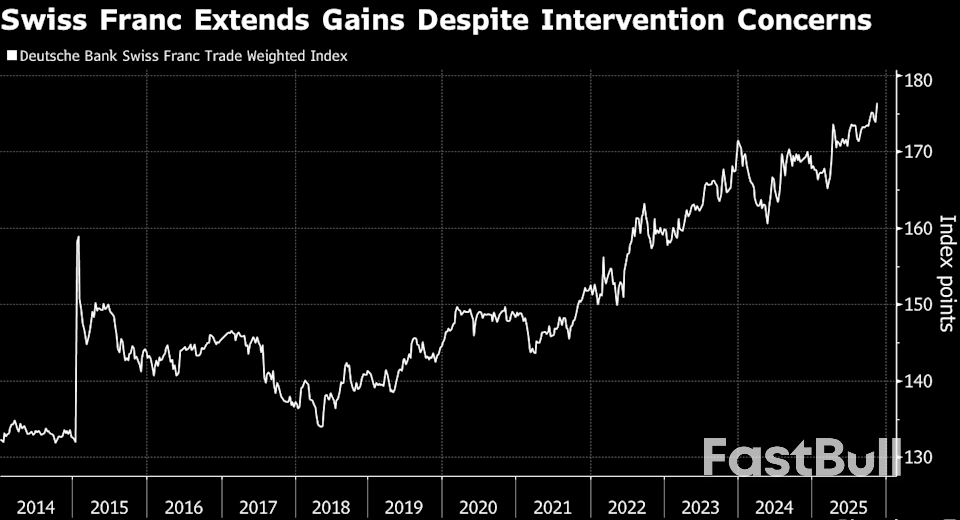
          The Swiss franc climbed to a 10-year high against the euro as expectations of stickier inflation and the prospect of lower US tariffs bolstered demand for the haven currency.
          The franc rose 0.4% to 0.91862 per euro, its strongest level since January 2015 when the Swiss National Bank ended the 1.20 exchange rate cap. It’s on track for a seventh daily gain, the longest winning streak since August 2024.
          The currency’s advance follows comments from SNB Vice President Antoine Martin who said this week that inflation “is expected to rise slightly in the coming quarters,” dampening speculation of a return to negative rates. Money markets now assign less than a 30% probability of the sub-zero policy over the next year, down from about 64% a month ago.
          Separately, reports that Switzerland is close to securing a reduced 15% tariff on exports to the US gave the Swiss currency an additional boost. The franc also benefited from the flight to safety on Friday as global equities retreated.
          Swiss Franc Surges to Decade High on Stickier Inflation Outlook_1
          Hedge funds are positioning for further franc strength, particularly against the euro and the yen, even as officials may grow uncomfortable with the pace of appreciation, according to European traders familiar with the transactions, who asked not to be identified because they aren’t authorized to speak publicly.
          Long positions against the greenback are also on the table as December is historically the strongest month for the Swiss franc.

          Source: Bloomberg

          Risk Warnings and Disclaimers
          You understand and acknowledge that there is a high degree of risk involved in trading. Following any strategies or investment methods may lead to potential losses. The content on the site is provided by our contributors and analysts for information purposes only. You are solely responsible for determining whether any trading assets, securities, strategy, or any other product is suitable for investing based on your own investment objectives and financial situation.
          Add to Favorites
          Share

          US Tech Forecast: The Index Continues Its Correction, Down More Than 4%

          Michelle

          Stocks

          Economic

          The correction in the US Tech index has intensified. The US Tech forecast for the upcoming week is negative.

          US Tech forecast: key trading points

          • Recent data: US ISM services PMI for October stood at 52.4
          • Market impact: the data has a positive effect on the technology sector

          US Tech fundamental analysis

          The US ISM non-manufacturing PMI came in at 52.4, above the forecast of 50.7 and the previous reading of 50.0. This indicates that the services sector not only remains in expansion territory (readings above 50.0 signal growth) but is also accelerating compared with the previous month, beating analysts' expectations. As services represent the largest part of the US economy, the data indicates stable domestic demand and suggests that businesses are more confident than anticipated.

          On the other hand, stronger employment metrics compared with consensus forecasts raise concerns that the disinflation process might proceed more slowly than desired by the Federal Reserve. For the Fed, this is a signal for caution when considering further rate cuts. For the US stock market, the overall impact tends to be positive. Stronger service sector activity suggests potential revenue and profit growth for companies focused on domestic consumption – retail, transport, hospitality, restaurants, and financial services. At the same time, recession fears are reduced: since services usually weaken before an economic downturn, the rebound above stagnation levels indicates a resilient economy.

          US Tech technical analysis

          For the US Tech index, the effect is moderately positive. A robust services sector supports demand for digital infrastructure, cloud computing, software, online advertising, and e-commerce. Many tech companies derive a significant portion of their income from corporate and consumer services. When services in the economy are growing, IT budgets are cut less frequently, and in some segments, they are even expanded. This strengthens expectations for tech companies' revenue and profits and, in theory, should support the US Tech index.

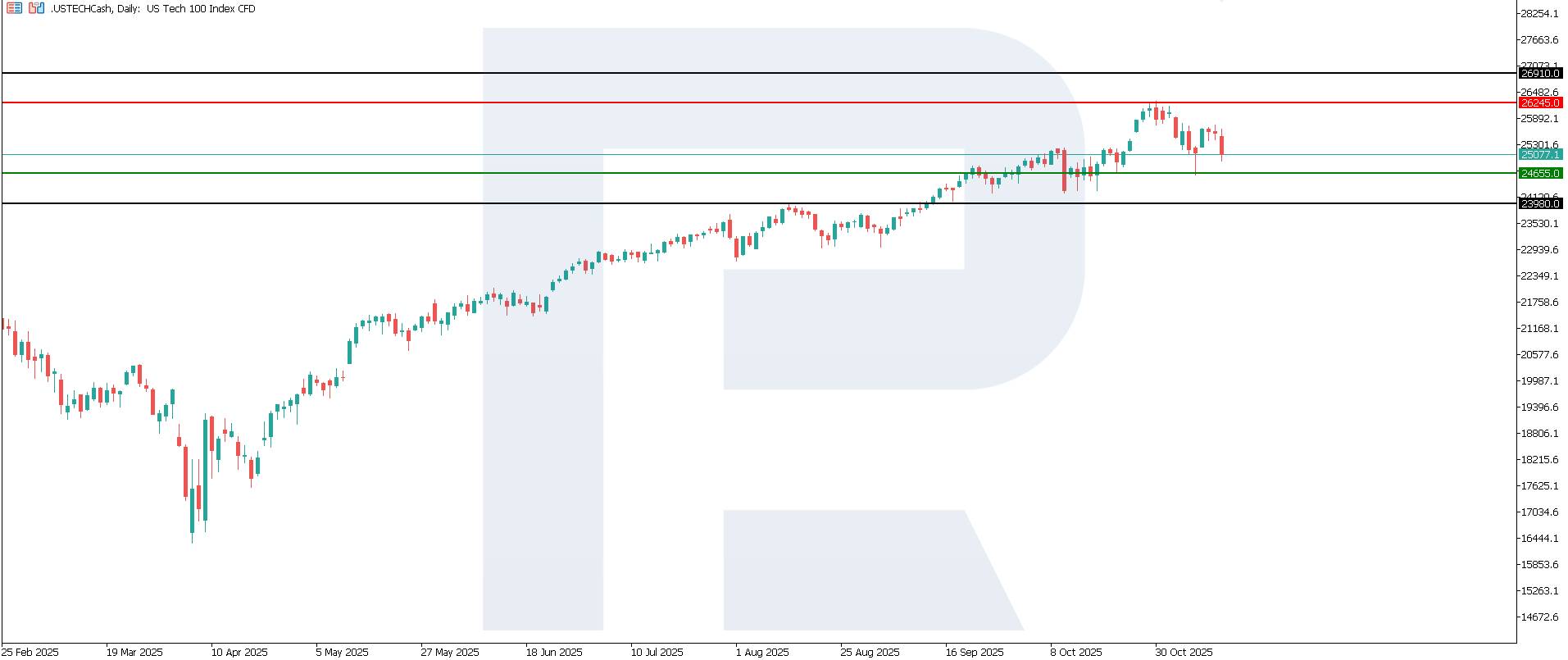
          US Tech technical analysis for 14 November 2025

          The US Tech index continues to decline within its ongoing correction, while the broader uptrend remains intact. The nearest resistance level is located at 26,245.0, and a new support zone has formed around 24,655.0. The next potential upside target is 26,910.0.

          The US Tech price forecast outlines the following scenarios:

          • Pessimistic US Tech scenario: a breakout below the 24,655.0 support level could push the index down to 23,980.0
          • Optimistic US Tech scenario: a breakout above the 26,245.0 resistance level could boost the index to 26,910.0

          Summary

          The expected increase in tech-sector revenues and demand may partly offset the pressure from higher or prolonged interest rates. In the medium term, the direction of the US Tech index will depend on what investors consider more important: the sustained business growth of tech companies or the potential persistence of high borrowing costs and bond yields. From a technical perspective, the next upside target for the US Tech index could be 26,910.0.

          Source: RoboForex

          To stay updated on all economic events of today, please check out our Economic calendar
          Risk Warnings and Disclaimers
          You understand and acknowledge that there is a high degree of risk involved in trading. Following any strategies or investment methods may lead to potential losses. The content on the site is provided by our contributors and analysts for information purposes only. You are solely responsible for determining whether any trading assets, securities, strategy, or any other product is suitable for investing based on your own investment objectives and financial situation.
          Add to Favorites
          Share

          UK borrowing costs jump, stocks slide as speculation mounts over high-stakes budget

          Adam

          Stocks

          Economic

          British government bond yields rose sharply on Friday following reports Finance Minister Rachel Reeves is no longer planning to raise income tax rates in the Autumn Budget later this month.
          The yield on the benchmark 10-year gilt initially rose around 13 basis points in early trade, but was last around 7 basis points higher at 4.51%. Yields on the long term 20- and 30-year gilts were last seen 8.5 and 9 basis points higher, respectively. Yields and prices move inversely to one another.
          The moves came as investors reacted to a report from the Financial Times of an income tax U-turn. The Treasury was not immediately available to comment when contacted by CNBC on Friday morning.
          U.K. stocks were also lower. The FTSE 100 index shed over 1% in morning trade, with Lloyds, Natwest, and Barclays banks occupying the bottom of the index, each losing more than 2.7%.
          Reeves had spent the past week apparently laying the groundwork for a manifesto-breaking rise in income tax, which split Labour party lawmakers and led to further turmoil in the already embattled party, whose leader Prime Minister Keir Starmer has dismal approval ratings.
          A proposed 2p national income increase was to be offset by a 2p reduction in national insurance, designed to hit passive income streams rather than working people. There are now expectations, however, that the £30 billion ($39.5 billion) hole in the government’s budget will be filled by a patchwork of smaller rises.
          It could be a “fiscal reckoning” as a patchwork approach will put pressure on the gilt market, Wren Sterling’s investment chief Rory McPherson told CNBC’s “Squawk Box Europe” on Friday.
          “Within the U.K., if we have more of the smaller taxes being targeted as part of the programme from Rachel Reeves, I think that’s going to put more pressure on the government, more pressure on them to go back to the bond markets and ask for more money, which in turn puts more pressure up on yields,” McPherson said.
          He added that there has been a “big march down” in yields but now “we’re pulling away that that.”
          Volatility this year has left long-term borrowing costs hovering at their highest level since the late 1990s, with U.K. debt having the heftiest price tag in the G7.
          For Toni Meadows, head of investment at BRI Wealth Management, the government has found itself “between a rock and a hard place with regard to this budget.”
          “They inherited a bad fiscal position but then made the situation worse with public sector pay awards. The reason that there has been so much speculation regarding this budget, more than any statement in recent history, is because everything they need to do is going to be unpopular. How can this statement simultaneously promote growth whilst having to cut spending and increase the tax burden to keep bond investors happy?” he said, noting that outstanding debt and service costs add pressure.
          While the market is pessimistic, “the uncertainty of not knowing the exact detail is more damaging in the short term,” Meadows said, adding that detailed plans are required for investors to be able to move beyond speculation.
          Julian Howard, chief multi-asset investment strategist at GAM Investments, suggested that “onerous restrictions” on pensions savings, ISAs, an expatriation exit charge, and capital gains and council tax changes could be on the cards.
          “The Chancellor will doubtless inflict enough misery later this month to fix the immediate problem but the emerging challenge the markets are hinting at may now be one of more general economic credibility,” he said.
          Wren Sterling’s McPherson added that the Bank of England will still be able to make an interest rate cut after the budget, if it wants to. Other investors appear to have curbed their optimism, with bets on cuts shedding six basis points compared with Thursday, according to data compiled by LSEG.
          The Autumn Budget is expected on Nov. 26.

          Source: cnbc

          To stay updated on all economic events of today, please check out our Economic calendar
          Risk Warnings and Disclaimers
          You understand and acknowledge that there is a high degree of risk involved in trading. Following any strategies or investment methods may lead to potential losses. The content on the site is provided by our contributors and analysts for information purposes only. You are solely responsible for determining whether any trading assets, securities, strategy, or any other product is suitable for investing based on your own investment objectives and financial situation.
          Add to Favorites
          Share

          US, Switzerland Reached Deal Lowering Tariff to 15%, Greer Says

          Glendon

          Forex

          Economic

          The US and Switzerland have "essentially" reached a trade agreement to lower tariffs on Swiss goods to 15% and the White House plans to reveal details on Friday, US Trade Representative Jamieson Greer said.

          "Switzerland is probably the next one," Greer said on CNBC, one day after meeting with a Swiss delegation in Washington. "We've essentially reached a deal with Switzerland. So we'll post details of that today on the White House website."

          Greer told reporters that the duty on products from Switzerland would fall from 39% to 15% and that the European country has committed to investing $200 billion in the US.

          Greer said that Switzerland is "going to send a lot of manufacturing here to the United States, pharmaceuticals, gold smelting, railway equipment. So we're really excited about that deal and what it means for American manufacturing."

          Switzerland has also committed to buying more Boeing Co. planes, Greer told reporters.

          Source: Bloomberg Europe

          To stay updated on all economic events of today, please check out our Economic calendar
          Risk Warnings and Disclaimers
          You understand and acknowledge that there is a high degree of risk involved in trading. Following any strategies or investment methods may lead to potential losses. The content on the site is provided by our contributors and analysts for information purposes only. You are solely responsible for determining whether any trading assets, securities, strategy, or any other product is suitable for investing based on your own investment objectives and financial situation.
          Add to Favorites
          Share

          War-torn Myanmar Embraces Solar To Tackle Power Crisis

          Samantha Luan

          Political

          Economic

          Key points:

          · Myanmar's operating power capacity sank to 2015 level in 2024 - World Bank
          · Western sanctions, lack of foreign exchange hit power grid
          · Cheap Chinese panels support Myanmar's solar take-up
          · Necessity, not climate goals, drive solar push beyond Myanmar

          When Thailand cut power supply to Myanmar across its western border this year, it intended to curb online scam centres linked to regional networks trafficking hundreds of thousands of people.

          However, the move also hit the wider community, pushing hospitals and some offices to install solar panels, said Zaw, a rescue worker in Myawaddy town just across the Thai border. Homes, too, made the switch.

          "Three out of four people now rely on solar panels, with businesses using multiple panels," said Zaw, who did not want to disclose his full name, fearing retribution.

          Myanmar's electricity supply has deteriorated since the 2021 military coup and ensuing civil war, exposing millions to chronic blackouts, with a cash-strapped government hit by Western sanctions unable to maintain power infrastructure.

          The World Bank estimated the country's operating power capacity plunged to 2015 levels in 2024, describing electricity supply in conflict-affected areas as "catastrophic".

          Chinese firms have helped fill the gap, supplying cheap solar panels.

          NATURAL GAS SHORTAGE SAPS GENERATION

          Light intensity data - a proxy for economic activity and electricity access - analysed by the United Nations revealed an average 8% annual decline after the 2021 coup.

          The drop is largely due to a shortage of natural gas, Myanmar's main generation fuel, as domestic production has declined and the government has halted imports of liquefied natural gas due to a foreign exchange shortage, the World Bank said in a June 2024 report.

          Former U.S. President Joe Biden's administration froze about $1 billion of Myanmar assets and imposed sanctions, some of which have been eased by the Trump administration. Western sanctions have restricted access to technical support, spare parts, and expertise to maintain infrastructure, such as transmission lines damaged in the civil war.

          Myanmar's junta said earlier this year generation capacity had plunged by nearly half from pre-2021 levels. Data on the Ministry of Electric Power's website shows output has not changed much since 2018.

          The information ministry did not respond to detailed questions on power supply and demand, and the junta's spokesperson did not answer calls from Reuters.

          CHEAP SOLAR PANELS FROM CHINA

          To combat the power crisis, households and businesses are embracing solar, according to interviews with a dozen residents, business owners and panel and battery sellers across the Southeast Asian country.

          "Unlike most of Asia, where we're seeing corporate demand drive solar growth, energy security concerns and fuel shortages are the key drivers in Myanmar," said Linda Zeng, renewables analyst at Fitch Solutions unit BMI.

          Solar panel imports from China, Myanmar's largest supplier, more than doubled in the nine months through September to about $100 million, according to Chinese customs data. Shipments have risen over eightfold from pre-pandemic levels, the data showed.

          Shops, restaurants, and workshops seeking reliable power for lighting, refrigeration and electronic payments, as well as water kiosks, clinics, and schools increasingly use small solar systems, said an official from an international development agency working in Myanmar.

          "I have about 10 refrigerators. The electricity here is not regular, so I had to use solar panels," said an ice cream seller from the ancient city of Mawlamyine, who declined to be named due to fear of retribution.

          Household solar installations have surged from a few hundred in 2019 to roughly 300,000 in 2025, as users switch from diesel generators to solar panels with storage, said Ken Pyi Wa Tun, chairman of Parami Energy, which sells solar panels and diesel generators in Myanmar.

          "A household solar-plus-battery-plus-inverter can be acquired for under $1,000 and power essentials, run for four to five hours and power 2 AC units," Ken Pyi Wa Tun said.

          While that is too expensive for most homes, it is cheaper than the roughly $7,000 for a small diesel generator, plus fuel costs of $50 to $100 per week, he said, predicting solar could potentially power 2 million to 2.5 million Myanmar households.

          IT'S NOT ABOUT CLIMATE GOALS

          Myanmar's surging solar imports mirror a trend of increased solar adoption to escape erratic power supply in lower- and low-middle income countries such as Pakistan, Iraq, Sri Lanka, and Afghanistan.

          They are among the fastest-growing markets for panel exports from China, the world's dominant solar manufacturer, data from energy think-tank Ember showed.

          "If the grid is not reliable or the prices too high, then people will do it themselves. And now they can, thanks to solar," said Richard Black, director of policy and strategy at Ember.

          Solar adoption, driven by necessity rather than policy, could disrupt traditional utility models, challenge forecasts about fossil fuel demand and complicate grid management, analysts say.

          In Pakistan, a surge in affluent residents ditching the country's costly grid power by installing solar panels has forced utilities to raise prices even further for remaining customers.

          Diesel imports by Myanmar declined 11% in the first 10 months of 2025, data from analytics firm Kpler showed, while solar panel purchases grew.

          "It is not like we are using them for clean energy or for some environmental reasons. We are a country with civil war. We are just using them out of necessity," said a resident in the Bago region.

          Source: TradingView

          To stay updated on all economic events of today, please check out our Economic calendar
          Risk Warnings and Disclaimers
          You understand and acknowledge that there is a high degree of risk involved in trading. Following any strategies or investment methods may lead to potential losses. The content on the site is provided by our contributors and analysts for information purposes only. You are solely responsible for determining whether any trading assets, securities, strategy, or any other product is suitable for investing based on your own investment objectives and financial situation.
          Add to Favorites
          Share
          FastBull
          Copyright © 2025 FastBull Ltd

          728 RM B 7/F GEE LOK IND BLDG NO 34 HUNG TO RD KWUN TONG KLN HONG KONG

          TelegramInstagramTwitterfacebooklinkedin
          App Store Google Play Google Play
          Products
          Charts

          Chats

          Q&A with Experts
          Screeners
          Economic Calendar
          Data
          Tools
          Membership
          Features
          Function
          Markets
          Copy Trading
          Latest Signals
          Contests
          News
          Analysis
          24/7
          Columns
          Education
          Company
          Careers
          About Us
          Contact Us
          Advertising
          Help Center
          Feedback
          User Agreement
          Privacy Policy
          Business

          White Label

          Data API

          Web Plug-ins

          Poster Maker

          Affiliate Program

          Risk Disclosure

          The risk of loss in trading financial instruments such as stocks, FX, commodities, futures, bonds, ETFs and crypto can be substantial. You may sustain a total loss of the funds that you deposit with your broker. Therefore, you should carefully consider whether such trading is suitable for you in light of your circumstances and financial resources.

          No decision to invest should be made without thoroughly conducting due diligence by yourself or consulting with your financial advisors. Our web content might not suit you since we don't know your financial conditions and investment needs. Our financial information might have latency or contain inaccuracy, so you should be fully responsible for any of your trading and investment decisions. The company will not be responsible for your capital loss.

          Without getting permission from the website, you are not allowed to copy the website's graphics, texts, or trademarks. Intellectual property rights in the content or data incorporated into this website belong to its providers and exchange merchants.

          Not Logged In

          Log in to access more features

          FastBull Membership

          Not yet

          Purchase

          Become a signal provider
          Help Center
          Customer Service
          Dark Mode
          Price Up/Down Colors

          Log In

          Sign Up

          Position
          Layout
          Fullscreen
          Default to Chart
          The chart page opens by default when you visit fastbull.com