• Trade
  • Markets
  • Copy
  • Contests
  • News
  • 24/7
  • Calendar
  • Q&A
  • Chats
Trending
Screeners
SYMBOL
LAST
BID
ASK
HIGH
LOW
NET CHG.
%CHG.
SPREAD
SPX
S&P 500 Index
6827.42
6827.42
6827.42
6899.86
6801.80
-73.58
-1.07%
--
DJI
Dow Jones Industrial Average
48458.04
48458.04
48458.04
48886.86
48334.10
-245.98
-0.51%
--
IXIC
NASDAQ Composite Index
23195.16
23195.16
23195.16
23554.89
23094.51
-398.69
-1.69%
--
USDX
US Dollar Index
97.950
98.030
97.950
98.500
97.950
-0.370
-0.38%
--
EURUSD
Euro / US Dollar
1.17394
1.17409
1.17394
1.17496
1.17192
+0.00011
+ 0.01%
--
GBPUSD
Pound Sterling / US Dollar
1.33707
1.33732
1.33707
1.33997
1.33419
-0.00148
-0.11%
--
XAUUSD
Gold / US Dollar
4299.39
4299.39
4299.39
4353.41
4257.10
+20.10
+ 0.47%
--
WTI
Light Sweet Crude Oil
57.233
57.485
57.233
58.011
56.969
-0.408
-0.71%
--

Community Accounts

Signal Accounts
--
Profit Accounts
--
Loss Accounts
--
View More

Become a signal provider

Sell trading signals to earn additional income

View More

Guide to Copy Trading

Get started with ease and confidence

View More

Signal Accounts for Members

All Signal Accounts

Best Return
  • Best Return
  • Best P/L
  • Best MDD
Past 1W
  • Past 1W
  • Past 1M
  • Past 1Y

All Contests

  • All
  • Trump Updates
  • Recommend
  • Stocks
  • Cryptocurrencies
  • Central Banks
  • Featured News
Top News Only
Share

USA Embassy In Lithuania: Maria Kalesnikava Is Not Going To Vilnius

Share

USA Embassy In Lithuania: Other Prisoners Are Being Sent From Belarus To Ukraine

Share

Ukraine President Zelenskiy: Five Ukrainians Released By Belarus In US-Brokered Deal

Share

USA Vilnius Embassy: USA Stands Ready For "Additional Engagement With Belarus That Advances USA Interests"

Share

USA Vilnius Embassy: Belarus, USA, Other Citizens Among The Prisoners Released Into Lithuania

Share

USA Vilnius Embassy: USA Will Continue Diplomatic Efforts To Free The Remaining Political Prisoners In Belarus

Share

USA Vilnius Embassy: Belarus Releases 123 Prisoners Following Meeting Of President Trump's Envoy Coale And Belarus President Lukashenko

Share

USA Vilnius Embassy: Masatoshi Nakanishi, Aliaksandr Syrytsa Are Among The Prisoners Released By Belarus

Share

USA Vilnius Embassy: Maria Kalesnikava And Viktor Babaryka Are Among The Prisoners Released By Belarus

Share

USA Vilnius Embassy: Nobel Peace Prize Laureate Ales Bialiatski Is Among The Prisoners Released By Belarus

Share

Belarusian Presidential Administration Telegram Channel: Lukashenko Has Pardoned 123 Prisoners As Part Of Deal With US

Share

Two Local Syrian Officials: Joint US-Syrian Military Patrol In Central Syria Came Under Fire From Unknown Assailants

Share

Israeli Military Says It Targeted 'Key Hamas Terrorist' In Gaza City

Share

Rwanda's Actions In Eastern Drc Are A Clear Violation Of Washington Accords Signed By President Trump - Secretary Of State Rubio

Share

Israeli Military Issues Evacuation Warning In Southern Lebanon Village Ahead Of Strike - Spokesperson On X

Share

Belarusian State Media Cites US Envoy Coale As Saying He Discussed Ukraine And Venezuela With Lukashenko

Share

Belarusian State Media Cites US Envoy Coale As Saying That US Removes Sanctions On Belarusian Potassium

Share

Thai Prime Minister: No Ceasefire Agreement With Cambodia

Share

US, Ukraine To Discuss Ceasefire In Berlin Ahead Of European Summit

Share

Incoming Czech Prime Minister Babis: Czech Republic Will Not Take On Guarantees For Ukraine Financing, European Commission Must Find Alternatives

TIME
ACT
FCST
PREV
U.K. Trade Balance Non-EU (SA) (Oct)

A:--

F: --

P: --

U.K. Trade Balance (Oct)

A:--

F: --

P: --

U.K. Services Index MoM

A:--

F: --

P: --

U.K. Construction Output MoM (SA) (Oct)

A:--

F: --

P: --

U.K. Industrial Output YoY (Oct)

A:--

F: --

P: --

U.K. Trade Balance (SA) (Oct)

A:--

F: --

P: --

U.K. Trade Balance EU (SA) (Oct)

A:--

F: --

P: --

U.K. Manufacturing Output YoY (Oct)

A:--

F: --

P: --

U.K. GDP MoM (Oct)

A:--

F: --

P: --

U.K. GDP YoY (SA) (Oct)

A:--

F: --

P: --

U.K. Industrial Output MoM (Oct)

A:--

F: --

P: --

U.K. Construction Output YoY (Oct)

A:--

F: --

P: --

France HICP Final MoM (Nov)

A:--

F: --

P: --

China, Mainland Outstanding Loans Growth YoY (Nov)

A:--

F: --

P: --

China, Mainland M2 Money Supply YoY (Nov)

A:--

F: --

P: --

China, Mainland M0 Money Supply YoY (Nov)

A:--

F: --

P: --

China, Mainland M1 Money Supply YoY (Nov)

A:--

F: --

P: --

India CPI YoY (Nov)

A:--

F: --

P: --

India Deposit Gowth YoY

A:--

F: --

P: --

Brazil Services Growth YoY (Oct)

A:--

F: --

P: --

Mexico Industrial Output YoY (Oct)

A:--

F: --

P: --

Russia Trade Balance (Oct)

A:--

F: --

P: --

Philadelphia Fed President Henry Paulson delivers a speech
Canada Building Permits MoM (SA) (Oct)

A:--

F: --

P: --

Canada Wholesale Sales YoY (Oct)

A:--

F: --

P: --

Canada Wholesale Inventory MoM (Oct)

A:--

F: --

P: --

Canada Wholesale Inventory YoY (Oct)

A:--

F: --

P: --

Canada Wholesale Sales MoM (SA) (Oct)

A:--

F: --

P: --

Germany Current Account (Not SA) (Oct)

A:--

F: --

P: --

U.S. Weekly Total Rig Count

A:--

F: --

P: --

U.S. Weekly Total Oil Rig Count

A:--

F: --

P: --

Japan Tankan Large Non-Manufacturing Diffusion Index (Q4)

--

F: --

P: --

Japan Tankan Small Manufacturing Outlook Index (Q4)

--

F: --

P: --

Japan Tankan Large Non-Manufacturing Outlook Index (Q4)

--

F: --

P: --

Japan Tankan Large Manufacturing Outlook Index (Q4)

--

F: --

P: --

Japan Tankan Small Manufacturing Diffusion Index (Q4)

--

F: --

P: --

Japan Tankan Large Manufacturing Diffusion Index (Q4)

--

F: --

P: --

Japan Tankan Large-Enterprise Capital Expenditure YoY (Q4)

--

F: --

P: --

U.K. Rightmove House Price Index YoY (Dec)

--

F: --

P: --

China, Mainland Industrial Output YoY (YTD) (Nov)

--

F: --

P: --

China, Mainland Urban Area Unemployment Rate (Nov)

--

F: --

P: --

Saudi Arabia CPI YoY (Nov)

--

F: --

P: --

Euro Zone Industrial Output YoY (Oct)

--

F: --

P: --

Euro Zone Industrial Output MoM (Oct)

--

F: --

P: --

Canada Existing Home Sales MoM (Nov)

--

F: --

P: --

Euro Zone Total Reserve Assets (Nov)

--

F: --

P: --

U.K. Inflation Rate Expectations

--

F: --

P: --

Canada National Economic Confidence Index

--

F: --

P: --

Canada New Housing Starts (Nov)

--

F: --

P: --

U.S. NY Fed Manufacturing Employment Index (Dec)

--

F: --

P: --

U.S. NY Fed Manufacturing Index (Dec)

--

F: --

P: --

Canada Core CPI YoY (Nov)

--

F: --

P: --

Canada Manufacturing Unfilled Orders MoM (Oct)

--

F: --

P: --

Canada Manufacturing New Orders MoM (Oct)

--

F: --

P: --

Canada Core CPI MoM (Nov)

--

F: --

P: --

Canada Manufacturing Inventory MoM (Oct)

--

F: --

P: --

Canada CPI YoY (Nov)

--

F: --

P: --

Canada CPI MoM (Nov)

--

F: --

P: --

Canada CPI YoY (SA) (Nov)

--

F: --

P: --

Canada Core CPI MoM (SA) (Nov)

--

F: --

P: --

Q&A with Experts
    • All
    • Chatrooms
    • Groups
    • Friends
    Connecting
    .
    .
    .
    Type here...
    Add Symbol or Code

      No matching data

      All
      Trump Updates
      Recommend
      Stocks
      Cryptocurrencies
      Central Banks
      Featured News
      • All
      • Russia-Ukraine Conflict
      • Middle East Flashpoint
      • All
      • Russia-Ukraine Conflict
      • Middle East Flashpoint
      Search
      Products

      Charts Free Forever

      Chats Q&A with Experts
      Screeners Economic Calendar Data Tools
      Membership Features
      Data Warehouse Market Trends Institutional Data Policy Rates Macro

      Market Trends

      Market Sentiment Order Book Forex Correlations

      Top Indicators

      Charts Free Forever
      Markets

      News

      News Analysis 24/7 Columns Education
      From Institutions From Analysts
      Topics Columnists

      Latest Views

      Latest Views

      Trending Topics

      Top Columnists

      Latest Update

      Signals

      Copy Rankings Latest Signals Become a signal provider AI Rating
      Contests
      Brokers

      Overview Brokers Assessment Rankings Regulators News Claims
      Broker listing Forex Brokers Comparison Tool Live Spread Comparison Scam
      Q&A Complaint Scam Alert Videos Tips to Detect Scam
      More

      Business
      Events
      Careers About Us Advertising Help Center

      White Label

      Data API

      Web Plug-ins

      Affiliate Program

      Awards Institution Evaluation IB Seminar Salon Event Exhibition
      Vietnam Thailand Singapore Dubai
      Fans Party Investment Sharing Session
      FastBull Summit BrokersView Expo
      Recent Searches
        Top Searches
          Markets
          News
          Analysis
          User
          24/7
          Economic Calendar
          Education
          Data
          • Names
          • Latest
          • Prev

          View All

          No data

          Scan to Download

          Faster Charts, Chat Faster!

          Download App
          English
          • English
          • Español
          • العربية
          • Bahasa Indonesia
          • Bahasa Melayu
          • Tiếng Việt
          • ภาษาไทย
          • Français
          • Italiano
          • Türkçe
          • Русский язык
          • 简中
          • 繁中
          Open Account
          Search
          Products
          Charts Free Forever
          Markets
          News
          Signals

          Copy Rankings Latest Signals Become a signal provider AI Rating
          Contests
          Brokers

          Overview Brokers Assessment Rankings Regulators News Claims
          Broker listing Forex Brokers Comparison Tool Live Spread Comparison Scam
          Q&A Complaint Scam Alert Videos Tips to Detect Scam
          More

          Business
          Events
          Careers About Us Advertising Help Center

          White Label

          Data API

          Web Plug-ins

          Affiliate Program

          Awards Institution Evaluation IB Seminar Salon Event Exhibition
          Vietnam Thailand Singapore Dubai
          Fans Party Investment Sharing Session
          FastBull Summit BrokersView Expo

          Trump Urges Fed to Cut Rates Amid Job Growth, Downplays Inflation Risks

          Gerik

          Economic

          Summary:

          Despite strong U.S. job growth in April, President Trump continues to insist that inflation is no longer a concern and is urging the Federal Reserve to cut interest rates, even as market uncertainty around his tariff policies grows....

          Strong job report contrasts with growing uncertainty

          The U.S. labor market once again defied expectations in April, with 177,000 non-farm payrolls added, surpassing the Dow Jones estimate of 133,000. The unemployment rate held steady at 4.2%, in line with forecasts. Healthcare led the job gains with 51,000 new positions, followed by transport and warehousing, financial services, and social assistance. Meanwhile, federal employment fell by 9,000 as part of a federal workforce reduction program under the Department of Government Efficiency (DOGE).
          This latest report signals continued resilience in employment, a crucial pillar of economic stability, even as President Trump’s aggressive tariff strategies begin to stir market unease. Employers, so far, have held back from mass layoffs, but weakening business confidence—attributed in part to tariff-induced costs and supply chain disruption—is raising red flags for future job stability.

          Trump insists inflation is gone, calls for rate cuts

          In response to the job report, President Trump reiterated his claim that inflation has effectively disappeared and again demanded rate cuts from the Federal Reserve. Posting on Truth Social, he wrote: “We are just in a TRANSITION PHASE, only just beginning!!! Consumers have waited for years to see prices fall. THERE IS NO INFLATION, THE FED SHOULD CUT RATES!!!”
          However, this bold statement contrasts with the latest inflation data. As of March, the Consumer Price Index (CPI) was still rising at an annual pace of 2.4%, above the Fed’s 2% target. Although this figure has moderated from previous highs, it remains elevated by historical standards and does not support a case for aggressive monetary easing—especially while labor markets remain tight.

          Fed expected to hold rates steady amid mixed signals

          The Federal Reserve is widely expected to maintain its benchmark interest rate at 4.25–4.5% during its upcoming policy meeting. While the labor market is solid, inflation remains sticky, and uncertainty surrounding Trump’s tariffs on imports complicates the economic outlook.
          The causal relationship between sustained employment growth (A) and persistent consumer demand (B) reinforces the Fed’s caution: as long as job growth fuels spending, inflation may remain above target despite isolated price declines. Cutting rates prematurely could undermine monetary credibility and reaccelerate price pressures.
          Trump’s rhetoric positions inflation as a political, not economic, issue—using selective indicators such as gasoline or mortgage rates, some of which do not align with official government data. His assertion that prices have broadly declined is contradicted by CPI figures and core inflation measures that remain elevated.

          Tariff policy introduces new risks to the outlook

          Trump’s reassertion of tariffs as a core economic strategy adds to market ambiguity. While intended to protect domestic industry and encourage reshoring, tariffs also risk raising input costs and reducing consumer purchasing power, especially if retaliatory actions from trade partners escalate.
          Businesses may soon face a dual squeeze: pressure from rising input costs due to tariffs, and shrinking consumer confidence amid price instability. This interplay between protectionist policy and inflation expectations is complex and volatile, suggesting that the path forward for both fiscal and monetary policy is far from straightforward.

          Mixed economic signals hinder policy clarity

          President Trump’s insistence that inflation is over and that rate cuts are warranted runs counter to both economic data and the Federal Reserve’s cautious stance. While job growth remains a bright spot, the broader picture—persistent inflation, falling business sentiment, and looming trade tensions—warrants prudence, not premature easing.
          As the Fed balances political pressure with empirical evidence, it must navigate a policy landscape increasingly shaped by unpredictable fiscal decisions. For now, rate stability appears to be the most likely outcome, despite the growing intensity of Trump’s demands.

          Source: Reuters

          To stay updated on all economic events of today, please check out our Economic calendar
          Risk Warnings and Disclaimers
          You understand and acknowledge that there is a high degree of risk involved in trading. Following any strategies or investment methods may lead to potential losses. The content on the site is provided by our contributors and analysts for information purposes only. You are solely responsible for determining whether any trading assets, securities, strategy, or any other product is suitable for investing based on your own investment objectives and financial situation.
          Add to Favorites
          Share

          Japanese investors will demand a ‘MAGA discount’

          Devin

          Economic

          In the trade negotiations with the US, Japan’s chief negotiator will not threaten Scott Bessent, US Treasury secretary, that selling Treasuries is an option Japan could consider. This is not because he cannot. It is because Japan’s elite knows full well the only reply this will trigger is the same as then Treasury Secretary John Connally gave to the G10 in August 1971, moments before the break-up of the Bretton Woods global financial system: ‘It’s our dollars, and your problem.’
          You may accuse Team Trump of a lot of things, but lack of confidence is not one of them. And the more ambitious, old-school mercantilist, anti-free-market, anti-American factions of Japan’s elite cannot help but secretly cheer on the consistency and aggressiveness with which President Donald Trump is trying to break up not just the equilibrium, but the governance of global free markets.
          Japanese private and public investors are cutting their US investments. This is not because of the usual tactical reasons – a change in the Federal Reserve’s policy expectations – but because strategic asset allocators and fiduciaries are urging the stewards of pension and insurance assets to reconsider the longer-term risk profile of ‘safe’ US Treasuries. Jamie Dimon, chief executive officer of JP Morgan, put it politely: the trade war risks eroding US credibility.
          To put it in more blunt financial terms: global creditor nations, like Japan, will demand a growing ‘discount’ before buying US assets. Why?
          Let’s take Team Trump by its words. After barely 100 days in office, it is crystal clear they want to engineer a fundamental change in how America interacts with other nations. The long-established covenants and coordinated governance of global trade and finance are being ripped apart from its very centre.
          For Japanese and all global stewards of capital, the question is not whether this will be a good thing or a bad thing in the long run. The immediate question is how to manage the new risks now forced by this transition. Clearly, the risks of this experiment not working out or being sub-optimal to the previous one are not zero.

          Investors will demand more compensation

          Japanese investors are patient, but like all investors the longer the ‘end game’ remains elusive and Team Trump refuses to present a consistent and credible plan of what the new covenants and governance of the next global system should look like, the greater the compensation they and all global savers will demand from US assets.
          ‘Moving fast and breaking things’ is not a model global fiduciaries can adopt. Long-term capital needs prospects of long-term stability to thrive. Predictability and logic are essential.
          The risks of owning US assets are going up, so the world will want to be paid more for owning them. This means higher US bond yields, lower valuations for US equities and, of course, a lower dollar. This is the ‘Make America Great Again discount’.
          An added consideration is the basic linkage between trade and capital flows. Yes, the US has the world’s largest and deepest capital markets. The mirror of the now super politicised US trade deficit is the US capital account surplus. A significant part of this surplus is the recycling of global exporters’ profits from selling to Americans, a real-world liquidity boost to US capital markets and an important force making US financial firms the dominant (and most profitable) in the world. Now that tariffs will undercut global exporters’ sold-to-Americans profits, this recycling of liquidity will dry up.
          Simply put, if Toyota cannot earn US dollars anymore, its deposit balances at JP Morgan and other US banks will drop, which in turn means reduced funding for US financial intermediaries, which means they will have to cut their US assets and Treasuries.
          Make no mistake: the linkages between global trade, the global savings glut that free trade enables and US financial assets having enjoyed a ‘premium’ over the past decades are the real risks Japanese and global stewards of capital are now forced to price for.
          Importantly, the question is not the always topical ‘are Japanese or Chinese investors selling, and if so, how much?’ More important is at what price/yield they will be prepared to come back to US markets.
          Today, it is impossible to know how high the MAGA discount will have to be. All we do know is that it will continue to rise until we get a new mutually agreed covenant on how sovereign nations are to interact with the US. Until then, the most likely ‘safety valve’ is poised to be significantly weaker US dollar.

          Source:Jesper Koll

          To stay updated on all economic events of today, please check out our Economic calendar
          Risk Warnings and Disclaimers
          You understand and acknowledge that there is a high degree of risk involved in trading. Following any strategies or investment methods may lead to potential losses. The content on the site is provided by our contributors and analysts for information purposes only. You are solely responsible for determining whether any trading assets, securities, strategy, or any other product is suitable for investing based on your own investment objectives and financial situation.
          Add to Favorites
          Share

          Japan's Central Bank Halts Rate Hikes—But Signals the Tightening Cycle Is Not Over

          Gerik

          Economic

          Japan’s cautious pause in monetary tightening

          The Bank of Japan (BOJ) has voted to maintain its key interest rate at 0.5% in its May 1 policy meeting, marking a temporary pause rather than a full halt to its tightening cycle. Governor Kazuo Ueda, speaking after the meeting, acknowledged that the timeline for core inflation to reach the bank’s 2% target had been pushed back. He emphasized the presence of “extremely high uncertainty” in the economic outlook, citing elevated trade tensions and the impact of U.S. tariff policy under President Donald Trump.
          This decision aligns with market expectations of a temporary pause, with analysts interpreting Ueda’s comments as a reflection of the need for further clarity before continuing the tightening cycle. The BOJ’s updated projections point to weaker economic growth and softer inflation in the coming years. The CPI forecast ranges from 2.2% for FY2025 to as low as 1.1% for FY2026, before stabilizing around 2% in FY2027. This suggests a weakened confidence in price momentum.

          Trade-driven uncertainty and BOJ's calculated delay

          A major contributing factor to BOJ’s cautious stance is the rising trade uncertainty caused by U.S. protectionist measures. Japan’s export-heavy economy is vulnerable to global disruptions, and the escalating tariff conflict could slow external demand, complicating inflation expectations. While external pressure appears to encourage BOJ toward a neutral policy stance, internal inflation drivers remain potent.
          Persistent food price increases and continuous wage growth present a challenge to BOJ's policy restraint. Japan’s March inflation hit 3.6%, largely due to a spike in rice prices. The BOJ now warns of a potential second-round effect, where food inflation may broaden into overall consumer prices. Meanwhile, labor shortages are pushing companies to raise wages and service charges, reinforcing inflationary trends.
          This divergence between softening growth projections and persistent price pressures reveals a correlation, not causation—higher food and wage costs are not outcomes of stronger GDP growth but rather structural imbalances in supply and labor.

          Market risks and strategic ambiguity

          Former BOJ economist Akira Otani, now at Goldman Sachs Japan, believes the central bank's ideal path is a delay, not a retreat. He has postponed his expectations for the next hike to January 2026. Goldman Sachs maintains that the policy rate could eventually rise to 1.5%, though the timing remains uncertain.
          Morgan Stanley analysts, who initially forecast a September hike, now predict rates will stay at 0.5% through the end of next year—unless domestic inflation worsens or the yen depreciates further. The yen’s movement is critical: a weakened yen could fuel import-driven inflation and provoke criticism from Washington. President Trump has previously accused Tokyo of manipulating its currency to boost exports, and renewed yen declines during trade negotiations could heighten diplomatic tension.
          The BOJ must tread carefully: a dovish tone could weaken the yen and stir inflation; a hawkish shift could stifle fragile growth. This strategic ambiguity—signaling further hikes without committing to timing—is the bank’s way of navigating external volatility and domestic imbalances.

          A pause, not a pivot

          BOJ’s decision reflects prudence amid geopolitical volatility rather than a change in strategy. Inflation remains above target, wages are rising, and food prices are surging—indicators that monetary tightening may resume. The bank’s reluctance to commit to a timeline underscores the complexity of Japan’s position, caught between domestic inflation dynamics and the global consequences of protectionism.
          While a temporary pause offers flexibility, BOJ is clearly signaling that the tightening cycle remains active. The path ahead depends not only on Japan’s economic fundamentals but also on how external factors—from U.S. tariffs to currency volatility—reshape the conditions under which the central bank operates.

          Source: Reuters

          To stay updated on all economic events of today, please check out our Economic calendar
          Risk Warnings and Disclaimers
          You understand and acknowledge that there is a high degree of risk involved in trading. Following any strategies or investment methods may lead to potential losses. The content on the site is provided by our contributors and analysts for information purposes only. You are solely responsible for determining whether any trading assets, securities, strategy, or any other product is suitable for investing based on your own investment objectives and financial situation.
          Add to Favorites
          Share

          London’s Carbon Paradox: UK Banks Fuel Global Fossil Projects Despite Climate Promises

          Gerik

          Economic

          Energy

          Financial muscle behind fossil fuel expansion

          A new report published on May 1 by the Leave It in the Ground Initiative (LiGi) has revealed that UK-based banks have collectively funded over $100 billion (approximately £75 billion) into large-scale fossil fuel projects—dubbed “carbon bombs”—between 2016 and 2023. These projects, spanning 28 countries, have the potential to emit a staggering 420 billion tonnes of CO₂ if fully developed, a volume exceeding more than a decade’s worth of current global emissions.
          Despite the UK not hosting the majority of these projects, the financial capital of London has emerged as a key enabler. Major financial institutions such as HSBC, Barclays, Lloyds, NatWest, and Standard Chartered are all implicated in channeling funds to fossil fuel corporations, many of which are directly involved in expanding coal, oil, and gas infrastructure around the world.

          Climate commitments under scrutiny

          The findings starkly contrast with the climate leadership image that the UK has sought to cultivate since the 2015 Paris Agreement. While British banks have made public commitments to sustainable finance—including pledges by Barclays to mobilize $1 trillion for the low-carbon transition by 2030—analysts argue that capital continues to flow freely into parent companies behind some of the most environmentally destructive projects.
          Fatima Eisam-Eldeen, lead analyst at LiGi, criticized the contradiction: “Despite ambitious climate promises, UK banks remain deeply entangled in funding the biggest climate-wrecking projects of the post-Paris era.” She emphasized that regulation must move beyond rhetoric and compel financial actors to stop underwriting fossil fuel expansion.

          Discreet financial pathways and systemic risk

          The mechanism by which UK banks support these “carbon bombs” is rarely direct. Rather than financing specific extraction sites or refineries, banks provide funding to parent companies through loans, credit lines, and bond underwriting. These financial flows enable corporations to pursue long-term fossil infrastructure planning—often without public scrutiny.
          This creates a form of indirect causality: the presence of substantial financial backing (A) enables the planning and execution of large-scale fossil projects (B), reinforcing global dependence on high-carbon energy. The correlation is clear—without sufficient capital from global banking hubs, the scale and speed of fossil expansion would be significantly constrained.
          Lucie Pinson, Director of Reclaim Finance, argued that UK banks are transforming London into “Europe’s financial fortress for fossil fuel expansion,” undermining the country’s credibility in leading climate finance reform. Over 25% of the global “carbon bomb” projects identified have received financial facilitation from banks headquartered in the UK.

          Mixed responses from financial institutions

          When approached for comment, most banks—HSBC, Lloyds, and Standard Chartered—remained silent. Barclays defended its position by pointing to its balanced approach: financing the entire energy industry, including renewables, and aiming for a sustainable finance target of $1 trillion by 2030. NatWest reported allocating over £93 billion in green finance since 2021 and emphasized that oil and gas-related loans constitute less than 0.7% of its total lending activity.
          Nevertheless, researchers challenge this framing. They argue that even marginal investments into fossil-linked firms perpetuate the viability of projects that jeopardize global climate limits, particularly the 1.5°C goal agreed upon in the Paris Agreement. This highlights the discrepancy between percentage-based exposure and the outsized climate impact of even minor fossil fuel financing.

          London’s climate finance credibility at risk

          The UK’s financial sector is increasingly viewed as both a central player in global fossil fuel expansion and a potential obstacle to climate progress. Although London-based banks espouse sustainability goals, their actions—especially in supporting fossil fuel parent companies—suggest a contradiction that is difficult to ignore.
          The growing disconnect between climate finance pledges and actual capital allocation is a pressing concern. If the UK seeks to retain legitimacy in the global climate conversation, it must address the systemic role its banks play in enabling projects that threaten to lock in carbon-intensive development paths. Without stricter regulation or a shift in institutional priorities, London’s role may continue to tilt the balance away from climate stability and toward continued fossil dependency.

          Source: The Guardian

          To stay updated on all economic events of today, please check out our Economic calendar
          Risk Warnings and Disclaimers
          You understand and acknowledge that there is a high degree of risk involved in trading. Following any strategies or investment methods may lead to potential losses. The content on the site is provided by our contributors and analysts for information purposes only. You are solely responsible for determining whether any trading assets, securities, strategy, or any other product is suitable for investing based on your own investment objectives and financial situation.
          Add to Favorites
          Share

          Preventing trade shocks from igniting the next financial crisis

          Thomas

          Economic

          History has a habit of repeating itself, particularly with recent shifts in global trade and financial instability in developing economies.
          When the Latin American debt crisis hit in the 1980s, it was sparked by oil price shocks and deteriorating trade terms, and then made worse by an over-reliance on foreign, dollar-denominated debt. Decades later, the 1997 Asian financial crisis followed a similar script, with unsustainable current account deficits and risky currency exposures linked to trade flows and volatile capital. Even the euro area debt crisis was rooted, in part, in persistent regional trade imbalances that pushed sovereigns and banks to the brink.
          These were no accidents or stand-alone events. They reveal a persistent threat that trade and, crucially, trade finance, can amplify underlying financial sector weaknesses. Currency mismatches, precarious dependence on the dollar and concentrated credit risks often lie dormant – until a trade shock wakes them up.

          Familiar tremors in today’s landscape

          Vulnerabilities from trade shocks or a new global trade regime ripple outward, potentially crippling financial systems and inflicting serious harm on the broader economy. The echoes of the Covid-19 pandemic are still felt in fractured supply chains, brutally exposing the risks of narrow export bases. Russia’s invasion of Ukraine sent food and energy prices soaring, hammering the terms of trade for import-dependent nations. The financial sector fallout is increasingly visible, not least in the growing risk aversion surrounding trade finance.
          Data confirm the pressure points. According to the Bank for International Settlements, over 55% of cross-border bank lending to emerging markets and developing economies is still in dollars, leaving trade finance exceptionally vulnerable to exchange rate volatility and sudden dollar liquidity crunches. The World Bank estimates the trade finance gap in sub-Saharan Africa alone now exceeds $100bn – a 30% increase since 2019.
          These figures reflect real economic strain. Central banks from Ghana, Zambia and Ethiopia report rising non-performing loans, particularly in trade-dependent sectors. At the same time, regulators are seeing tighter credit conditions and weakening bank capital adequacy – flashing indicators that trade-related stress is embedding into bank balance sheets. The United Nations Conference on Trade and Development warns that smaller economies are especially more vulnerable to tariffs, making financial risk management that much harder.
          While the high-level dangers are well-flagged, such as economic slowdowns, inflation spikes and market volatility, there’s less clarity on how these macrofinancial risks translate into practical changes in financial sector supervision. How are examination priorities shifting? Are data requests becoming more granular or frequent, specifically for trade exposures? Can there be a more explicit, forward-leaning approach that reassures exporters, importers, and bank and non-bank lenders?
          Financial sector supervisors do not set trade policy but ensure trade shocks do not capsize the domestic financial system. This requires moving beyond routine oversight to a pre-emptive, globally aware strategy.

          Getting ahead of the shockwaves

          In many cases, financial supervisors are still catching up. There is an urgent need to monitor trade-linked exposures more closely, from foreign exchange lending and trade credit exposures to cross-border liquidity reliance, especially for key banks. This means that real-time dashboards need to fuse bank and non-bank data with external stress indicators: terms-of-trade shifts, commodity volatility, shipping woes, and, crucially, fraying correspondent banking relationships vital for trade payments (a challenge recently acute in parts of East Africa).
          Banks and non-banks must also be tested against severe trade and FX shock core scenarios, not just edge cases. What happens if a major export market collapses or access to offshore dollar funding suddenly dries up? Supervisors must start asking those questions now, not after the damage is done.
          Increased transparency is vital. Uncertainty fuels fear and clear, consistent disclosure from banks and large firms on FX exposures, maturity mismatches and hedging must become a proactive standard practice. Reliable data help markets spot emerging vulnerabilities early. Meanwhile, regional regulators must strengthen cross-border co-operation, particularly where banking and non-bank groups operate across multiple markets.
          Above all, financial sector supervisors must communicate and signal their assessments and actions. Forward guidance on expectations (such as FX liquidity planning), planned stress tests or available resilience tools anchors market expectations and builds confidence. Proactive signalling shows preparedness, not panic.
          Implementing this is tough where resources are thin, mandates fragmented or politics intrusive. Understaffing and technical gaps are real constraints. However, solutions exist: regional pooling of functions, vibrant peer-learning networks and targeted technical assistance from bodies like the Toronto Centre, the IMF and the BIS, focused on practical tools and diagnostics.
          The next financial storm in many developing economies might be brewed not by a domestic credit boom, but by turbulent global trade, commodity swings or disruptions in dollar funding critical for trade finance. For supervisors, the imperative is not predicting the next shock but building resilience to withstand it. This demands a shift from compliance or standards-based checking to proactive risk management, informed by global tremors and grounded in local current account vulnerabilities. Preparedness, not prediction, is the watchword.
          Udaibir Das is a visiting professor at the National Council of Applied Economic Research, senior non-resident adviser at the Bank of England, senior adviser of the International Forum for Sovereign Wealth Funds, and distinguished fellow at the Observer Research Foundation America. He was previously at the Bank for International Settlements, the International Monetary Fund, and the Reserve Bank of India.

          Source:Udaibir Das

          To stay updated on all economic events of today, please check out our Economic calendar
          Risk Warnings and Disclaimers
          You understand and acknowledge that there is a high degree of risk involved in trading. Following any strategies or investment methods may lead to potential losses. The content on the site is provided by our contributors and analysts for information purposes only. You are solely responsible for determining whether any trading assets, securities, strategy, or any other product is suitable for investing based on your own investment objectives and financial situation.
          Add to Favorites
          Share

          Japan Hints at Using U.S. Treasuries as Leverage in Trade Talks, but Global Market Risks Loom Large

          Gerik

          Economic

          Bond

          Strategic leverage or theoretical threat?

          In a bold and unusually direct statement, Japan’s Finance Minister Katsunobu Kato suggested that the country’s significant holdings of U.S. Treasury bonds—valued at approximately $1.17 trillion as of early 2025—could potentially be used as a tool in negotiations over trade disputes with the United States. While he emphasized that the primary purpose of holding such assets is to support liquidity for foreign exchange interventions, Kato stated that “every card must be on the table” when engaging in high-stakes trade discussions with Washington.
          This declaration positions Japan’s foreign reserves—largely composed of U.S. government debt—as more than just passive financial instruments. Instead, they are framed as latent strategic assets that could be reactivated under economic duress or diplomatic necessity. However, Kato also acknowledged the sensitivity of the matter, indicating that actual liquidation of these holdings would be approached with extreme caution.

          A deeply intertwined economic relationship

          Japan remains the largest foreign holder of U.S. debt, ahead of China, with Treasury holdings that constitute a significant portion of its $1.27 trillion in foreign reserves. These reserves not only help stabilize the yen during currency interventions but also reflect the deep, mutually dependent financial relationship between Tokyo and Washington.
          Japan’s persistent trade surplus with the U.S.—approximately $70 billion in goods for 2024—has long been a source of tension. Exports of cars, electronics, and machinery remain the backbone of Japanese trade with the U.S., while imports primarily consist of agricultural products, LNG, and aircraft. These imbalances have prompted repeated criticism from American policymakers, who argue that Japan’s closed markets and robust export flows undercut U.S. domestic industries.
          Trump-era and current U.S. administrations have imposed tariffs—especially on autos—as leverage to force Japan to open up its domestic market and curb exports. Japan, for its part, is recalibrating its trade strategy, not only to navigate mounting protectionism but also to adapt to shifting global supply chains.

          Potential consequences of a bond sell-off

          The theoretical use of U.S. Treasuries as a pressure tool raises important questions about global financial stability. If Japan were to significantly reduce its holdings, bond prices could fall sharply, causing yields to spike. This would drive up borrowing costs for the U.S. government and potentially weaken the dollar—at least temporarily—while also destabilizing global bond markets.
          The relationship between large-scale bond divestment (A) and financial market volatility (B) is widely recognized as causal. A sudden unwinding of positions by a major holder like Japan would not only affect U.S. fiscal policy but also ripple through currency and equity markets worldwide.
          However, most experts agree that such a scenario remains remote. The disruption caused by a large-scale bond sell-off would likely outweigh any short-term negotiating advantage. Moreover, Japan’s own interests are tied to the stability of U.S. financial markets and a strong dollar, both of which support the competitiveness of Japanese exports.

          Strategic signaling in a volatile trade climate

          Kato’s remarks are best understood as strategic signaling rather than a precursor to immediate financial action. By merely raising the possibility of using U.S. debt as leverage, Japan reminds Washington of its unique role not only as a trade partner but also as a key financier of American debt.
          This rhetorical move is occurring in a climate of heightened trade frictions, shifting supply chains, and increasingly transactional diplomatic relations. It reflects a recalibration of Japan’s posture—less passive, more assertive—as it seeks to protect its export markets and navigate a turbulent global economic environment.
          The correlation between trade tensions and financial diplomacy is becoming more pronounced. The greater the threat of tariffs or protectionist policy from the U.S., the more inclined Japan may be to surface its financial leverage—even if only as a deterrent rather than a tactical maneuver.

          High-stakes diplomacy with limited room to move

          While Japan’s reference to its Treasury holdings signals a willingness to defend national interests with sharper tools, it is unlikely to cross the line into disruptive financial retaliation. The interconnectedness of U.S. and Japanese economic interests makes mutual instability undesirable.
          Ultimately, this episode underscores how trade disputes between major powers are no longer confined to tariffs or quotas—they now encompass the full range of financial interdependence. Japan’s “bond card” is not one it wishes to play, but by showing it exists, Tokyo hopes to gain a firmer hand in the ongoing recalibration of global trade relations.

          Source: Reuters

          To stay updated on all economic events of today, please check out our Economic calendar
          Risk Warnings and Disclaimers
          You understand and acknowledge that there is a high degree of risk involved in trading. Following any strategies or investment methods may lead to potential losses. The content on the site is provided by our contributors and analysts for information purposes only. You are solely responsible for determining whether any trading assets, securities, strategy, or any other product is suitable for investing based on your own investment objectives and financial situation.
          Add to Favorites
          Share

          Flows into Bunds and European sovereigns will remain consistent

          Damon

          Economic

          Even before the recent trade turbulence, global asset allocators were re-assessing their European exposures in a more positive light. Germany moved away from fiscal restraint, comprehensively re-rating European growth. Domestic and foreign investors closing their equity holdings gap in developed European, Middle Eastern and Asian markets relative to the US was well within our expectations. Germany was fully on course, heading towards stronger fiscal impulse following the federal election in February.
          However, the seismic shift in Germany’s assessment of the European security architecture has led to a rethinking of national priorities. The spending push is well above any prior expectations and, as the funds are designed to stay in Europe, every economy linked to Germany’s industrial chain will benefit. US tariffs, irrespective of their end-state, will only strengthen the trends already in place, notwithstanding short-term volatility.
          For now, we see stable to slightly negative currency flows in the euro. European equities will continue to benefit from longer-term domestic and cross-border interest. European sovereign fixed income for now is mostly attracting flows into Germany, and we reserve judgement on the notion that the euro area will benefit from mass rotation due to stronger safe-haven status.

          Foreign exchange

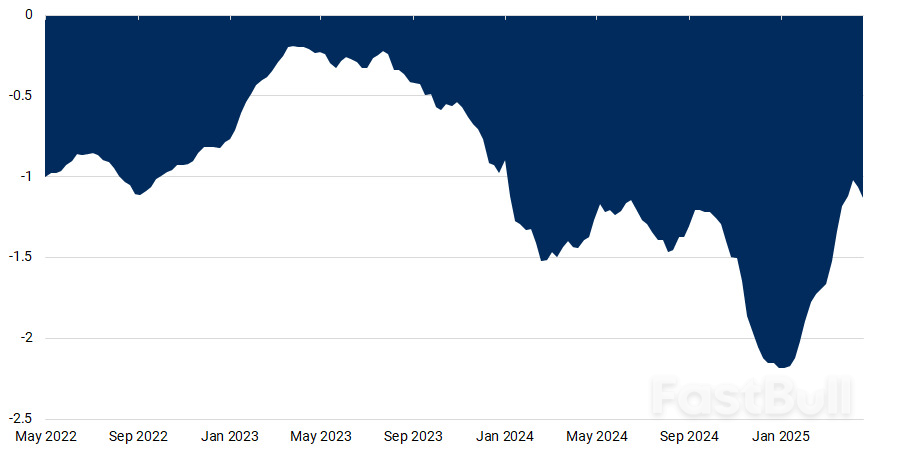
          At the end of 2024, political risk, growth weakness and expectations for sustained European Central Bank easing pushed cross-border euro holdings to the weakest level in nearly two decades.
          BNY custodial iFlow data, which provides insights into cross-asset investment flows, show overseas investors were excessively hedging their euro area assets. Through Q1, the unwinding of such hedges augmented euro-positive factors, such as a less dovish ECB, European defence spending plans and more recent tariff-related changes to global asset allocation.

          Figure 1. Cross-border holdings in euro have recovered to average levelsScored weekly holdings

          Flows into Bunds and European sovereigns will remain consistent_1

          Source: BNY

          The same data show the euro move now is excessive and represents a tightening in financial conditions, which requires an offset by the ECB. Crucially, the same cross-border holdings have recovered to the average level over the past year (Figure 1). This will allow fundamental drivers like carry and growth to have a stronger role in determining price action for the euro.

          Equities

          Towards the end of Q1, equity holdings data from BNY iFlow also show a peaking in allocations to Europe. Understandably, there was always a risk of a material adjustment lower. The tariff shock aggravated the moves, but holdings data indicate resilience in the European defence theme.
          In the March ECB rates decision, President Christine Lagarde stressed that German stimulus would lift growth, and global holdings remain 25% above their one-year average. This indicates that there has been very limited outright selling to augment the decline in levels.

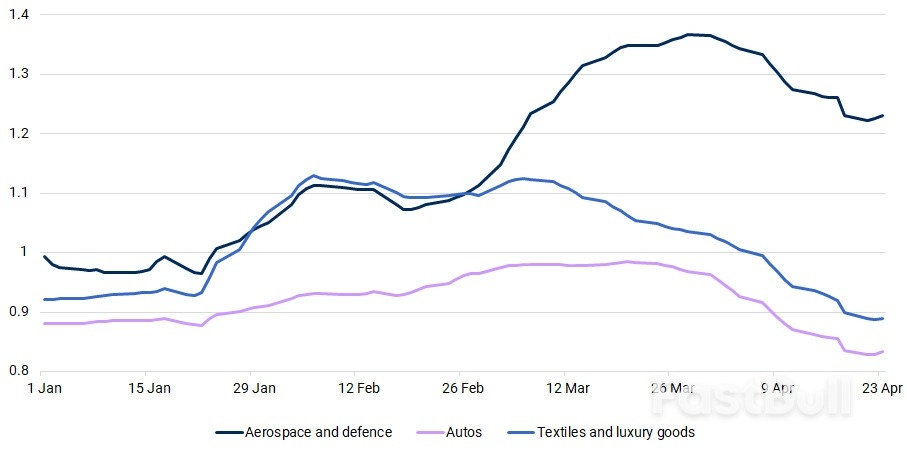
          Figure 2. Automotive sector remains worst performerScored daily holdings, January-April 2025

          Flows into Bunds and European sovereigns will remain consistent_2

          Source: BNY

          However, other sectors exposed to global growth and external demand are clearly struggling. The automotive sector remains the worst performer as fears over structural decline were already in place well before 2 April (Figure 2). In contrast, the luxury goods sector initially aligned well with defence, but the two sectors have diverged sharply as asset allocators see the latter as far more exposed to the deterioration in the global growth outlook.

          European fixed income

          Recent developments in US Treasury markets have ignited a discussion on alternative reserve assets, especially for asset managers with a mandate to invest only in highly rated government securities. However, this is easier said than done. Our data show that there has been very limited inflow to the highest-rated assets in mid-April. Triple-A names such as Australia and Sweden only found bids after consistent sales in Q1.
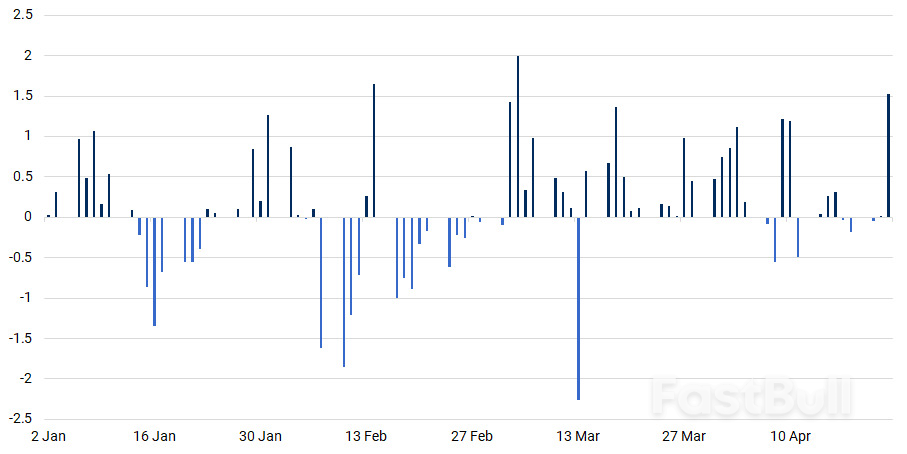
          On the other hand, Bund flow has been solid year-to-date. Preference for the market has been clear since the end of February for domestic reasons, and for now we would not characterise the market as over-extended either (Figure 3).

          Figure 3. Preference for Bunds has been clear since end of FebruaryScored daily cross-border flow in Bunds, January-April 2025

          Flows into Bunds and European sovereigns will remain consistent_3

          Source: BNY

          On a cross-border basis, the original flows were most likely linked to the European reinvestment and rearmament narrative due to new geopolitical and security realities. However, equally strong flow over in the first half of April has reinforced the safety qualities of the Bund market.
          Furthermore, with ECB easing now the base case for future meetings and the euro’s surge further dampening inflation expectations, there is clear upside risk to euro area real rates, which in itself will not conflict with the change in the euro area’s growth narrative as competitiveness improves. Lower German yields should also help anchor the rest of the euro area, especially as joint issuance is now becoming a more sustainable narrative. Flows into other markets such as France and Italy were more neutral, but there is little sign of intra-euro area divergence taking place.
          Volatility will persist, but we believe the flow consistency into Bunds and European sovereigns is here to stay, independent of wider drivers.

          Source:Geoffrey Yu

          To stay updated on all economic events of today, please check out our Economic calendar
          Risk Warnings and Disclaimers
          You understand and acknowledge that there is a high degree of risk involved in trading. Following any strategies or investment methods may lead to potential losses. The content on the site is provided by our contributors and analysts for information purposes only. You are solely responsible for determining whether any trading assets, securities, strategy, or any other product is suitable for investing based on your own investment objectives and financial situation.
          Add to Favorites
          Share
          FastBull
          Copyright © 2025 FastBull Ltd

          728 RM B 7/F GEE LOK IND BLDG NO 34 HUNG TO RD KWUN TONG KLN HONG KONG

          TelegramInstagramTwitterfacebooklinkedin
          App Store Google Play Google Play
          Products
          Charts

          Chats

          Q&A with Experts
          Screeners
          Economic Calendar
          Data
          Tools
          Membership
          Features
          Function
          Markets
          Copy Trading
          Latest Signals
          Contests
          News
          Analysis
          24/7
          Columns
          Education
          Company
          Careers
          About Us
          Contact Us
          Advertising
          Help Center
          Feedback
          User Agreement
          Privacy Policy
          Business

          White Label

          Data API

          Web Plug-ins

          Poster Maker

          Affiliate Program

          Risk Disclosure

          The risk of loss in trading financial instruments such as stocks, FX, commodities, futures, bonds, ETFs and crypto can be substantial. You may sustain a total loss of the funds that you deposit with your broker. Therefore, you should carefully consider whether such trading is suitable for you in light of your circumstances and financial resources.

          No decision to invest should be made without thoroughly conducting due diligence by yourself or consulting with your financial advisors. Our web content might not suit you since we don't know your financial conditions and investment needs. Our financial information might have latency or contain inaccuracy, so you should be fully responsible for any of your trading and investment decisions. The company will not be responsible for your capital loss.

          Without getting permission from the website, you are not allowed to copy the website's graphics, texts, or trademarks. Intellectual property rights in the content or data incorporated into this website belong to its providers and exchange merchants.

          Not Logged In

          Log in to access more features

          FastBull Membership

          Not yet

          Purchase

          Become a signal provider
          Help Center
          Customer Service
          Dark Mode
          Price Up/Down Colors

          Log In

          Sign Up

          Position
          Layout
          Fullscreen
          Default to Chart
          The chart page opens by default when you visit fastbull.com