• Trade
  • Markets
  • Copy
  • Contests
  • News
  • 24/7
  • Calendar
  • Q&A
  • Chats
Trending
Screeners
SYMBOL
LAST
BID
ASK
HIGH
LOW
NET CHG.
%CHG.
SPREAD
SPX
S&P 500 Index
6819.35
6819.35
6819.35
6861.30
6801.50
-8.06
-0.12%
--
DJI
Dow Jones Industrial Average
48389.91
48389.91
48389.91
48679.14
48285.67
-68.13
-0.14%
--
IXIC
NASDAQ Composite Index
23110.20
23110.20
23110.20
23345.56
23012.00
-84.96
-0.37%
--
USDX
US Dollar Index
97.960
98.040
97.960
98.070
97.740
+0.010
+ 0.01%
--
EURUSD
Euro / US Dollar
1.17440
1.17448
1.17440
1.17686
1.17262
+0.00046
+ 0.04%
--
GBPUSD
Pound Sterling / US Dollar
1.33699
1.33708
1.33699
1.34014
1.33546
-0.00008
-0.01%
--
XAUUSD
Gold / US Dollar
4303.44
4303.78
4303.44
4350.16
4285.08
+4.05
+ 0.09%
--
WTI
Light Sweet Crude Oil
56.368
56.398
56.368
57.601
56.233
-0.865
-1.51%
--

Community Accounts

Signal Accounts
--
Profit Accounts
--
Loss Accounts
--
View More

Become a signal provider

Sell trading signals to earn additional income

View More

Guide to Copy Trading

Get started with ease and confidence

View More

Signal Accounts for Members

All Signal Accounts

Best Return
  • Best Return
  • Best P/L
  • Best MDD
Past 1W
  • Past 1W
  • Past 1M
  • Past 1Y

All Contests

  • All
  • Trump Updates
  • Recommend
  • Stocks
  • Cryptocurrencies
  • Central Banks
  • Featured News
Top News Only
Share

New York Fed Accepts $2.601 Billion Of $2.601 Billion Submitted To Reverse Repo Facility On Dec 15

Share

Turkey: Shoots Down A Drone In The Black Sea Using F-16 Fighter Jets

Share

Goldman Sachs Says They Believe That The Copper Price Is Vulnerable To An Ai-Linked Price Correction

Share

Goldman Sachs Upgrades 2026 Copper Price Forecast To $11400 From $10,650

Share

Attempts By Ukrainian Troops To Advance From The South-West To Outskirts Of Kupiansk Are Being Thwarted

Share

Russian Troops Control All Of Kupiansk - IFX Cites Russian Military

Share

On Monday (December 15), The South Korean Won Ultimately Rose 0.60% Against The US Dollar, Closing At 1468.91 Won. The Won Was On An Upward Trend Throughout The Day, Rising Significantly At 17:00 Beijing Time And Reaching A Daily High Of 1463.04 Won At 17:36

Share

Health Ministry: Israeli Forces Kill Palestinian Teen In West Bank

Share

New York Federal Reserve President Williams: Over Time, The Size Of Reserves Could Grow From $2.9 Trillion

Share

New York Fed President Williams: AI Valuations Are High, But There Is A Real Driving Factor

Share

New York Federal Reserve President Williams: The Job Market Is In Very Good Shape

Share

New York Fed President Williams: 'Very Supportive' Of USA Central Bank's Decision To Cut Interest Rates Last Week

Share

New York Fed President Williams: 'Too Early To Say' What Central Bank Should Do At January Meeting

Share

New York Fed President Williams: Strong Markets Part Of Reason Why Economy Will Grow Robustly In 2026

Share

New York Fed President Williams: What Constitutes Ample Reserves Will Change Over Time

Share

New York Fed President Williams: Market Valuations 'Elevated,' But There Are Reasons For Pricing

Share

New York Fed President Williams: Ample Reserves System Working Very Well

Share

New York Fed President Williams: Some Signs That Parts Of Underlying Economy Not As Strong As GDP Data Suggests

Share

New York Fed President Williams: Expects Coming Job Data Will Show Gradual Cooling

Share

Ukraine President Zelenskiy: Monitoring Of Ceasefire Should Be Part Of Security Guarantees

TIME
ACT
FCST
PREV
Japan Tankan Small Manufacturing Outlook Index (Q4)

A:--

F: --

P: --

Japan Tankan Large Non-Manufacturing Outlook Index (Q4)

A:--

F: --

P: --

Japan Tankan Large Manufacturing Outlook Index (Q4)

A:--

F: --

P: --

Japan Tankan Small Manufacturing Diffusion Index (Q4)

A:--

F: --

P: --

Japan Tankan Large-Enterprise Capital Expenditure YoY (Q4)

A:--

F: --

P: --

U.K. Rightmove House Price Index YoY (Dec)

A:--

F: --

P: --

China, Mainland Industrial Output YoY (YTD) (Nov)

A:--

F: --

P: --

China, Mainland Urban Area Unemployment Rate (Nov)

A:--

F: --

P: --

Saudi Arabia CPI YoY (Nov)

A:--

F: --

P: --

Euro Zone Industrial Output YoY (Oct)

A:--

F: --

P: --

Euro Zone Industrial Output MoM (Oct)

A:--

F: --

P: --

Canada Existing Home Sales MoM (Nov)

A:--

F: --

P: --

Canada National Economic Confidence Index

A:--

F: --

P: --

Canada New Housing Starts (Nov)

A:--

F: --

P: --
U.S. NY Fed Manufacturing Employment Index (Dec)

A:--

F: --

P: --

U.S. NY Fed Manufacturing Index (Dec)

A:--

F: --

P: --

Canada Core CPI YoY (Nov)

A:--

F: --

P: --

Canada Manufacturing Unfilled Orders MoM (Oct)

A:--

F: --

P: --

U.S. NY Fed Manufacturing Prices Received Index (Dec)

A:--

F: --

P: --

U.S. NY Fed Manufacturing New Orders Index (Dec)

A:--

F: --

P: --

Canada Manufacturing New Orders MoM (Oct)

A:--

F: --

P: --

Canada Core CPI MoM (Nov)

A:--

F: --

P: --

Canada Trimmed CPI YoY (SA) (Nov)

A:--

F: --

P: --

Canada Manufacturing Inventory MoM (Oct)

A:--

F: --

P: --

Canada CPI YoY (Nov)

A:--

F: --

P: --

Canada CPI MoM (Nov)

A:--

F: --

P: --

Canada CPI YoY (SA) (Nov)

A:--

F: --

P: --

Canada Core CPI MoM (SA) (Nov)

A:--

F: --

P: --

Canada CPI MoM (SA) (Nov)

A:--

F: --

P: --

Federal Reserve Board Governor Milan delivered a speech
U.S. NAHB Housing Market Index (Dec)

A:--

F: --

P: --

Australia Composite PMI Prelim (Dec)

--

F: --

P: --

Australia Services PMI Prelim (Dec)

--

F: --

P: --

Australia Manufacturing PMI Prelim (Dec)

--

F: --

P: --

Japan Manufacturing PMI Prelim (SA) (Dec)

--

F: --

P: --

U.K. 3-Month ILO Employment Change (Oct)

--

F: --

P: --

U.K. Unemployment Claimant Count (Nov)

--

F: --

P: --

U.K. Unemployment Rate (Nov)

--

F: --

P: --

U.K. 3-Month ILO Unemployment Rate (Oct)

--

F: --

P: --

U.K. Average Weekly Earnings (3-Month Average, Including Bonuses) YoY (Oct)

--

F: --

P: --

U.K. Average Weekly Earnings (3-Month Average, Excluding Bonuses) YoY (Oct)

--

F: --

P: --

France Services PMI Prelim (Dec)

--

F: --

P: --

France Composite PMI Prelim (SA) (Dec)

--

F: --

P: --

France Manufacturing PMI Prelim (Dec)

--

F: --

P: --

Germany Services PMI Prelim (SA) (Dec)

--

F: --

P: --

Germany Manufacturing PMI Prelim (SA) (Dec)

--

F: --

P: --

Germany Composite PMI Prelim (SA) (Dec)

--

F: --

P: --

Euro Zone Composite PMI Prelim (SA) (Dec)

--

F: --

P: --

Euro Zone Services PMI Prelim (SA) (Dec)

--

F: --

P: --

Euro Zone Manufacturing PMI Prelim (SA) (Dec)

--

F: --

P: --

U.K. Services PMI Prelim (Dec)

--

F: --

P: --

U.K. Manufacturing PMI Prelim (Dec)

--

F: --

P: --

U.K. Composite PMI Prelim (Dec)

--

F: --

P: --

Euro Zone ZEW Economic Sentiment Index (Dec)

--

F: --

P: --

Germany ZEW Current Conditions Index (Dec)

--

F: --

P: --

Germany ZEW Economic Sentiment Index (Dec)

--

F: --

P: --

Euro Zone Trade Balance (Not SA) (Oct)

--

F: --

P: --

Euro Zone ZEW Current Conditions Index (Dec)

--

F: --

P: --

Euro Zone Trade Balance (SA) (Oct)

--

F: --

P: --

Euro Zone Total Reserve Assets (Nov)

--

F: --

P: --

U.K. Inflation Rate Expectations

--

F: --

P: --

Q&A with Experts
    • All
    • Chatrooms
    • Groups
    • Friends
    Connecting
    .
    .
    .
    Type here...
    Add Symbol or Code

      No matching data

      All
      Trump Updates
      Recommend
      Stocks
      Cryptocurrencies
      Central Banks
      Featured News
      • All
      • Russia-Ukraine Conflict
      • Middle East Flashpoint
      • All
      • Russia-Ukraine Conflict
      • Middle East Flashpoint
      Search
      Products

      Charts Free Forever

      Chats Q&A with Experts
      Screeners Economic Calendar Data Tools
      Membership Features
      Data Warehouse Market Trends Institutional Data Policy Rates Macro

      Market Trends

      Market Sentiment Order Book Forex Correlations

      Top Indicators

      Charts Free Forever
      Markets

      News

      News Analysis 24/7 Columns Education
      From Institutions From Analysts
      Topics Columnists

      Latest Views

      Latest Views

      Trending Topics

      Top Columnists

      Latest Update

      Signals

      Copy Rankings Latest Signals Become a signal provider AI Rating
      Contests
      Brokers

      Overview Brokers Assessment Rankings Regulators News Claims
      Broker listing Forex Brokers Comparison Tool Live Spread Comparison Scam
      Q&A Complaint Scam Alert Videos Tips to Detect Scam
      More

      Business
      Events
      Careers About Us Advertising Help Center

      White Label

      Data API

      Web Plug-ins

      Affiliate Program

      Awards Institution Evaluation IB Seminar Salon Event Exhibition
      Vietnam Thailand Singapore Dubai
      Fans Party Investment Sharing Session
      FastBull Summit BrokersView Expo
      Recent Searches
        Top Searches
          Markets
          News
          Analysis
          User
          24/7
          Economic Calendar
          Education
          Data
          • Names
          • Latest
          • Prev

          View All

          No data

          Scan to Download

          Faster Charts, Chat Faster!

          Download App
          English
          • English
          • Español
          • العربية
          • Bahasa Indonesia
          • Bahasa Melayu
          • Tiếng Việt
          • ภาษาไทย
          • Français
          • Italiano
          • Türkçe
          • Русский язык
          • 简中
          • 繁中
          Open Account
          Search
          Products
          Charts Free Forever
          Markets
          News
          Signals

          Copy Rankings Latest Signals Become a signal provider AI Rating
          Contests
          Brokers

          Overview Brokers Assessment Rankings Regulators News Claims
          Broker listing Forex Brokers Comparison Tool Live Spread Comparison Scam
          Q&A Complaint Scam Alert Videos Tips to Detect Scam
          More

          Business
          Events
          Careers About Us Advertising Help Center

          White Label

          Data API

          Web Plug-ins

          Affiliate Program

          Awards Institution Evaluation IB Seminar Salon Event Exhibition
          Vietnam Thailand Singapore Dubai
          Fans Party Investment Sharing Session
          FastBull Summit BrokersView Expo

          Trump Suggests Fed May Be Ready To Lower Interest Rates

          Damon

          Central Bank

          Summary:

           President Donald Trump said on Friday he had a good meeting with Federal Reserve Chair Jerome Powell and got the impression that the head of the U.S. central bank might be ready to lower interest rates.

          President Donald Trump said on Friday he had a good meeting with Federal Reserve Chair Jerome Powell and got the impression that the head of the U.S. central bank might be ready to lower interest rates.

          The two men met on Thursday when Trump made a rare visit to the U.S. central bank to tour the ongoing renovation of two buildings at its headquarters in Washington. The White House has criticized the cost of the project, and the president and Powell sparred over the issue during the visit.

          Trump also took the opportunity to again publicly call on Powell to slash rates immediately.

          "We had a very good meeting ... I think we had a very good meeting on interest rates," the president told reporters on Friday.

          Federal Reserve Chair Jerome Powell looks at U.S. President Donald Trump holding a document during a tour of the Federal Reserve Board building, which is currently undergoing renovations, in Washington, D.C., U.S., July 24, 2025. REUTERS/Kent Nishimura

          "He (Powell) said, 'Congratulations, the country is doing really well,' and I got that to mean that I think he's going to start recommending lower rates because of that conversation," Trump said.

          The Fed is widely expected to leave its benchmark interest rate in the 4.25%-4.50% range at the conclusion of a two-day policy meeting next week. Powell has said the Fed should wait for more data before adjusting rates.

          The visibly tense exchange between Trump and Powell at the Fed's massive construction site on Thursday marked an escalation of White House pressure on the central bank as well as Trump's efforts to get Powell to lower rates.

          The U.S. central bank said on Friday it was "grateful" for Trump's encouragement to complete the renovation of its buildings in Washington and that it "looked forward" to seeing the project through to completion.

          Trump, who called Powell a "numbskull" earlier this week for failing to heed the White House's demand for a large reduction in borrowing costs, also said on Thursday he did not intend to fire the Fed chief, as he has frequently suggested he would.

          Source: Reuters

          Risk Warnings and Disclaimers
          You understand and acknowledge that there is a high degree of risk involved in trading. Following any strategies or investment methods may lead to potential losses. The content on the site is provided by our contributors and analysts for information purposes only. You are solely responsible for determining whether any trading assets, securities, strategy, or any other product is suitable for investing based on your own investment objectives and financial situation.
          Add to Favorites
          Share

          Trump Travels To Scotland For Golf And Bilateral Talks Amid Epstein Furor

          Samantha Luan

          Economic

          Political

          Key points:

          ● Scotland trip comes as Trump faces crisis over Epstein ties
          ● Trump and Starmer to discuss US-UK trade deal and Ukraine war
          ● Locals have unfavorable opinion of Trump, protests expected

          Trumpplans to visit his golf resort in Turnberry on Scotland's east coast, where he will meet British Prime Minister Keir Starmer on Monday, before heading to his sprawling golf property 200 miles (320 km) away near Aberdeen in the west.As part of the visit, he will open a second 18-hole course on the Aberdeen property named in honor of his mother, Mary Anne MacLeod, who was born and raised on a Scottish island before emigrating to America.White House press secretary Karoline Leavitt this week said the trip was intended as a "working visit that will include a bilateral meeting with Prime Minister Starmer to refine the historic U.S.-U.K. trade deal."

          The overseas travel comes as Trump faces the biggest domestic political crisis of his second term in office. Allies and opponents alike have criticized his administration's handling of investigative files related to Epstein's criminal charges and the circumstances of his 2019 death in prison.The issue has caused a rare breach with some of Trump's most loyal Make America Great Again supporters, and majorities of Americans and Trump's Republicans say they believe the government is hiding details on the case, according to Reuters/Ipsos polling.

          White House officials, frustrated by the ongoing focus on the Epstein saga, are hoping the controversy dies down while Trump is abroad, one person familiar with the matter said.

          The trip, initially billed as a private visit, gives Trump and Starmer a chance to deepen their already warm relationship, with key issues on the agenda to include ending Russia'swar in Ukraine, British and U.S. sources said.British officials have been heartened by what they see as a clear shift in Trump's rhetoric on Ukraine and Russia in recent weeks, a British source said.

          The deteriorating situation inGazais also likely to come up. Starmer on Thursday said he would hold an emergency call with France and Germany over what he called the "unspeakable and indefensible" suffering and starvation being reported there, and called on Israel to allow aid to enter the Palestinian enclave.Gaza health authorities say more than 100 people have died from starvation, most of them in recent weeks. Human rights groups have said mass starvation is spreading even as tonnes of food and other supplies sit untouched just outside the territory.

          Since being elected last year, Starmer has prioritized good relations with Trump, stressing the importance of Britain's defense and security alliance with the U.S. and being careful to avoid openly criticizing Trump'stariff policies.That approach helped Britain seal the first tariff-reduction deal with the U.S. in May, which reaffirmed quotas and tariff rates on British automobiles and eliminated tariffs on the UK's aerospace sector, but left steel tariffs in place.

          Starmer is expected to press for lower steel tariffs, but sources close to the matter said it was unclear if any breakthrough was possible during Trump's visit.Trump also is expected to meet Scottish leader John Swinney, who publicly backed Democratic candidate Kamala Harris in the 2024 U.S. presidential election, but no details have been released by either side.

          Trump has described Scotland as a "very special place" and made a similar trip there in 2016 during his first run for the presidency, but he will not necessarily get a warm welcome.About 70% of Scots have an unfavorable opinion of Trump, while 18% have a favorable opinion, an Ipsos poll in March found.Scottish police are girding for protests on Saturday in both Aberdeen and in Edinburgh, the country's capital.

          Trump will return to Britain from September 17-19 for a state visit hosted by King Charles. It will make Trump the first world leader in modern times to undertake two state visits to Britain. The late Queen Elizabeth hosted him at Buckingham Palace for a three-day state visit in June 2019.
          Source: TradingView

          To stay updated on all economic events of today, please check out our Economic calendar
          Risk Warnings and Disclaimers
          You understand and acknowledge that there is a high degree of risk involved in trading. Following any strategies or investment methods may lead to potential losses. The content on the site is provided by our contributors and analysts for information purposes only. You are solely responsible for determining whether any trading assets, securities, strategy, or any other product is suitable for investing based on your own investment objectives and financial situation.
          Add to Favorites
          Share

          S&P 500’s Humming Profit Engine Can Keep Powering Stocks Rally

          Adam

          Stocks

          A solid earnings season shows Corporate America’s profit engine is humming along, potentially easing worries that the record-setting rally in US stocks is starting to overheat.
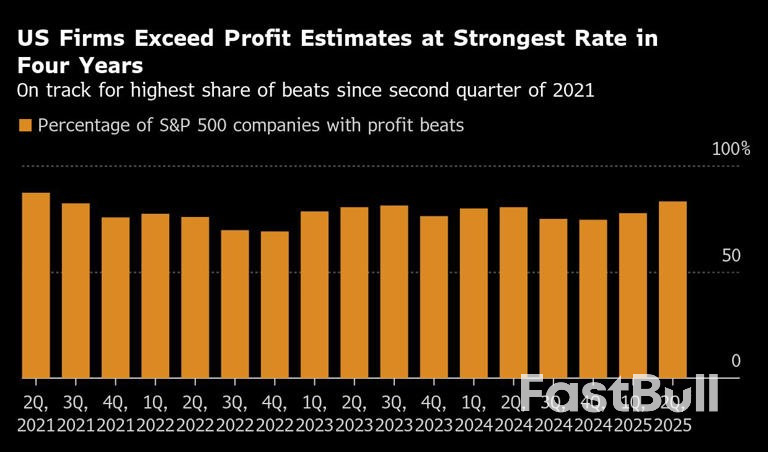
          With about a third of S&P 500 Index members reporting by Thursday’s close, this earnings cycle is turning out to be much more robust than expected. Around 83% of companies have exceeded analysts’ profit estimates, according to data compiled by Bloomberg Intelligence. That’s on track for the highest share of beats since the second quarter of 2021.
          The S&P 500 is up 28% since hitting a low on April 8, setting a series of record highs over the past few weeks. Even a version of the US benchmark that weights all members equally, rather than by market value, has notched a record. Those advances have come as fears about the impact of tariffs on the economy ebbed and investors slowly returned to stocks, abandoning an extreme aversion to risk.
          For the gains to persist, corporate earnings will need to keep impressing investors, and Mark Hackett at Nationwide says the earnings season is pointing in that direction.
          “As some of the pessimistic scenarios are fading, management commentary is less conservative and estimates for 2025 and 2026 are beginning to increase, which provides that tailwind,” said the firm’s chief market strategist.
          Several major companies have been upbeat. Alphabet Inc. saw demand for artificial intelligence products boosting quarterly sales. Homebuilders D.R. Horton Inc. and PulteGroup Inc. reported better-than-expected earnings, sparking a relief rally in the stocks. Netflix Inc. raised its forecast for full-year sales and profit margins. And Levi Strauss & Co. said it expected sales growth to outweigh the effect of tariffs.
          S&P 500’s Humming Profit Engine Can Keep Powering Stocks Rally_1

          US Firms Exceed Profit Estimates at Strongest Rate in Four Years | On track for highest share of beats since second quarter of 2021

          Most companies are topping estimates for a quarter where many analysts lowered their expectations, anticipating a weak reporting period amid heightened uncertainty about trade policy and economic growth. Before the cycle started, S&P 500 companies were expected to post a profit increase of 2.8% year-over-year in the second quarter, according to data compiled by BI. So far, overall earnings growth is 4.5%.
          Meanwhile, economic data is also showing no immediate cause for alarm. Applications for US unemployment benefits fell for a sixth straight week, Labor Department data showed on Thursday, suggesting the job market is staying resilient.
          “While the labor market is not firing on all cylinders, it’s not showing signs of distress either,” said Bret Kenwell, US investment analyst at EToro. That should help investors breathe easy, Kenwell said.
          Still, the runway isn’t completely clear for US stocks. Equity valuations are high, with the S&P 500 trading at around 22.5 times projected earnings, compared to a 10-year average of 18.6. That’s sparked concerns that there may be little room for error. In fact, companies missing both earnings and sales estimates are being punished the hardest since the third quarter of 2022.
          Moreover, signs of froth are emerging, with a manic rally in so-called meme stocks offering a reminder of 2021’s extreme investor euphoria.
          “Overly bullish sentiment is still the market’s biggest risk factor,” said John Kolovos, chief technical market strategist at Macro Risk Advisors. Some Wall Street trading desks are telling clients to hedge against potential losses in case developments from the Federal Reserve or on the tariff front sour investor sentiment.
          Pricey valuations are the reason why Dec Mullarkey, managing director at SLC Management, is keeping a close eye on profit beats, but an even closer one on guidance.
          “Stronger-than-expected results are a support for equities, but this is an exacting market,” Mullarkey said. “Companies need to have a decent story and a strong outlook.”

          Source: Bloomberg

          Risk Warnings and Disclaimers
          You understand and acknowledge that there is a high degree of risk involved in trading. Following any strategies or investment methods may lead to potential losses. The content on the site is provided by our contributors and analysts for information purposes only. You are solely responsible for determining whether any trading assets, securities, strategy, or any other product is suitable for investing based on your own investment objectives and financial situation.
          Add to Favorites
          Share

          Bank of Canada to Hold Rates Steady on July 30, But Cut Two More Times in 2025

          Michelle

          Economic

          Forex

          The Bank of Canada will hold its overnight interest rate steady at 2.75% on July 30 for the third consecutive meeting thanks to a recent rise in inflation and a fall in unemployment, according to a Reuters poll of economists that still found many expect at least two more cuts this year.

          The Canadian central bank has cut rates by a total of 225 basis points since June 2024, but has been on hold since March as policymakers await news on where a confusing barrage of U.S. tariff threats will eventually settle.The trade outcome is crucial to the outlook, given that more than 80% of Canada's exports go to its southern neighbour.

          Hefty import duties on goods ranging from steel and aluminium to automobiles have already dampened Canadian business and household sentiment.

          A recent threat from U.S. President Donald Trump to impose an across-the-board 35% tariff on goods not covered by the existing free trade agreement between Canada, the U.S. and Mexico has led to further confusion.

          That lack of clarity, combined with recent data on inflation and jobs, will keep the BoC on the sidelines next week, according to all 28 economists in the July 21-25 Reuters survey.

          "In response to unexpectedly positive data and renewed trade tensions ... we expect the Bank to continue to hold rates," wrote James Knightley, chief international economist at ING.

          "Nonetheless, with the risks skewed toward more economic weakness, we think risks are towards two, rather than just one, rate cut before the end of the year."

          Nearly two-thirds of the economists surveyed, 18 of 28, forecast that the BoC would cut its policy rate by 25 basis points in September to 2.50%. While there was no clear consensus on where that rate would be by the end of 2025, more than 60% of the economists - 17 - predicted at least two more reductions this year, including five who predicted three.

          Canada's economy, which shrank 0.1% in April after growing at an annualised pace of 2.2% in the first quarter, is expected to have contracted 0.5% in the second quarter, according to the median forecast in the poll.

          It is forecast to stagnate this quarter before expanding 0.8% in the fourth quarter, with the economy forecast to grow an average 1.3% this year and in 2026.

          Nearly half of the forecasters - 10 of 21 - expect the economy to enter a technical recession, defined as two consecutive quarters of contraction, at some point this year.

          Businesses remain cautious and are keeping hiring and investment under check, the latest BoC survey showed earlier this week.Demand in the housing market, a pillar of the economy and household wealth, has remained weak despite falling interest rates and house prices.

          "Interest rates don't appear to be low enough to stimulate housing activity, and business capital spending is likely to be muted until it's clear the Canada-U.S.-Mexico trade deal will be renewed," said Avery Shenfeld, chief economist at CIBC Capital Markets.

          "So barring a much better outcome for trade talks than we currently expect, we see the BoC cutting rates two more times over the balance of the year."

          Canadian inflation, which rose to 1.9% last month, is expected to average around 2% - the midpoint of the BoC's 1%-3% target - through at least 2027, though core price pressures are likely to remain elevated, median forecasts in the poll showed.
          Source: Kitco

          To stay updated on all economic events of today, please check out our Economic calendar
          Risk Warnings and Disclaimers
          You understand and acknowledge that there is a high degree of risk involved in trading. Following any strategies or investment methods may lead to potential losses. The content on the site is provided by our contributors and analysts for information purposes only. You are solely responsible for determining whether any trading assets, securities, strategy, or any other product is suitable for investing based on your own investment objectives and financial situation.
          Add to Favorites
          Share

          The UK’s Weak Economic Growth and Brexit: Is the Worst Over?

          Warren Takunda

          Economic

          Nine years after the vote on Brexit, the latest UK economic indicators send a strong message about an ailing economy that is yet to emerge from the shadows of the ‘leave’ vote. According to experts, some of the negative impacts of Brexit will endure.
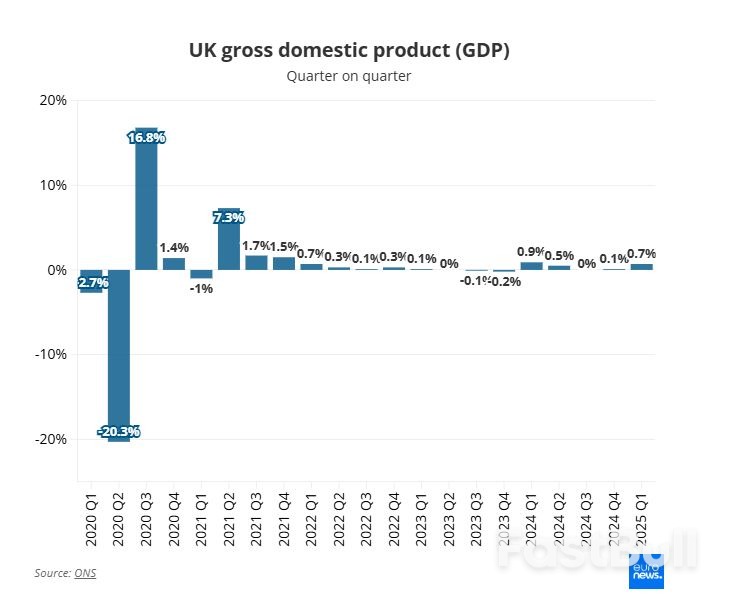
          GDP has been contracting for two consecutive months, coupled with rising inflation and unemployment, and accompanied by a highly uncertain geopolitical environment and trade wars.
          UK GDP grew by 0.7% quarter-on-quarter in the first three months of 2025, but monthly data shows that the output contracted 0.1% in May after a 0.3% decline in April. According to S&P Global Ratings, these figures put the economy on course for 0.1% GDP growth in the second quarter, if there is no growth in June.
          Inflation increased to 3.6% in June — up from 3.4% in May and slightly ahead of expectations. This ties the hands of the Bank of England, which is aiming for a 2% inflation target before it lowers the benchmark rate, currently sitting at 4.25%.
          These weak datasets indicate that the UK has “little spare capacity to grow,” Marion Amiot, Chief UK Economist at S&P Global Ratings, told Euronews Business. The UK’s Weak Economic Growth and Brexit: Is the Worst Over?_1
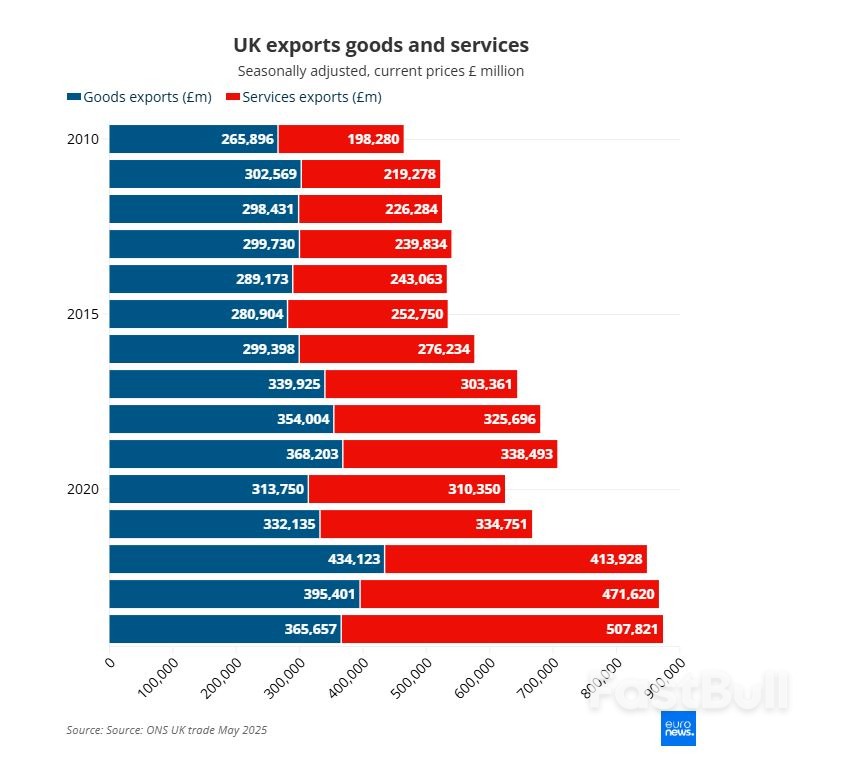
          Some hope that the UK will be able to boost its GDP through exports, supported by trade agreements, including the latest with the US.
          However, exports alone might not be enough to fix a fundamental problem: the UK is contending with cripplingly low productivity.
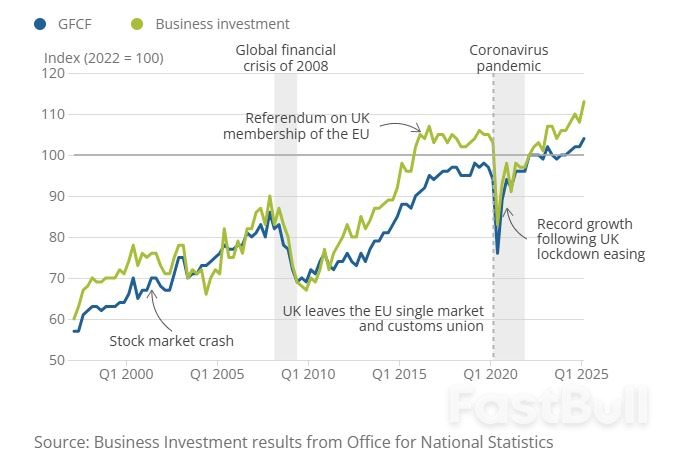
          According to Amiot, productivity woes partially stem from Brexit. “It has contributed to reducing the UK’s labour supply and pulled the brakes on investment on the back of uncertainty in the years following the referendum,” she said.
          She added that sluggishness in the key financial services sector has also been playing a role: “Productivity growth in the UK has been particularly weak since the Great Financial Crisis, especially in the financial sector.”
          UK labour statistics are also signalling a difficult path ahead for the economy. The number of job vacancies has been falling since April 2022. Unemployment in the country has been on the rise since August 2024, and sat at 4.7% in May, the highest level in four years.
          As poor productivity limits wage growth, this is expected to slow inflation.
          “Wage growth has slowed, and unemployment has risen again. For the Bank of England, this is a sign of growing slack in the labour market, which is likely to ease inflationary pressures, and means it can cut rates sooner rather than later,” said Sarah Coles, head of personal finance at Hargreaves Lansdown.
          Job vacancies have also been falling due to higher costs, partially attributed to the UK government’s decision to increase national insurance contributions, a cost that employers pay for every person on the payroll.

          What Brexit really cost the UK

          Nine years after the referendum, the Office for Budget Responsibility (OBR) assessed the economic impact of Brexit. Researchers came to the conclusion that — since 2020 — withdrawal from the EU has led to reduced productivity, lowering GDP by 4%, and trade by about 15%, in both goods and services, compared to a ‘remain scenario’. Brexit has also had a sizeable impact on shrinking investments.
          According to John Springford, an associate fellow at the London-based think-tank Centre for European Reform, Brexit has cost the state £40 billion (€46.1bn) since 2019.
          “The 2019-2024 parliament raised taxes by around £100 billion, and if we take the OBR’s 4% loss of productivity to be the true figure, £40 billion of those tax rises were needed because of EU withdrawal,” he wrote in a recent study.

          Is the worst over?

          “Brexit is going to have a long-term impact on UK growth beyond the initial fallout seen in trade,” said Amiot, adding that “with a smaller pool of workers and weaker competition leading to lower productivity, the capacity of the UK to grow will remain durably lower”.
          She clarified: “That being said, most of the large impacts are likely behind us.”
          The years following Brexit came with an increased uncertainty for businesses, and left a sizeable impact on investment, which stagnated for five years, before it returned to growth. Investment is now rising again and has surpassed its pre-Brexit referendum levels. According to the Office for National Statistics (ONS), gross fixed capital formation (GFCF) and business investment both increased to record levels in the first quarter of 2025.The UK’s Weak Economic Growth and Brexit: Is the Worst Over?_2
          Trade with the EU also struggled, but that could have been partially attributed to a range of other factors, including the impacts of the COVID-19 pandemic and the global slowdown of trade in goods.
          “Although much of the initial economic disruption has likely faded as firms adjusted, Brexit still appears to be weighing on export levels and GDP,” Andrew Hunter, Associate Director at Moody’s Analytics, told Euronews Business. The UK’s Weak Economic Growth and Brexit: Is the Worst Over?_3
          He added that goods exports to the EU are still 16% lower in real terms, compared to the end of 2019 (before the pandemic and before the UK began leaving the EU).
          “And goods exports to non-EU countries have actually performed even worse,” Hunter said. He added that the UK has significantly lagged behind other advanced economies in this respect, due to a “broader hit to the export sector from Brexit-related trade barriers (with many firms choosing to stop exporting altogether due to the added costs and paperwork).”
          Many hope the recent trade deal with the US will improve the economy by attracting investment into the country.
          And the US-UK trade deal provides relief for certain industries in particular. While the EU is finalising its potential countermeasures, including a tariff on US aircraft imports, almost certain to attract a retaliation, the UK has secured free trade for its aerospace sector.
          Yet, experts are sceptical about the overall contribution of the trade deal to the UK economy. S&P Global Ratings estimates “that US tariffs are going to represent a direct drag on UK GDP of around 0.1 percentage point this year and next,” partly due to weaker global demand.
          And other trade deals are also unlikely to boost exports too much. “The UK government’s recent ‘reset’ deal with the EU has eased some trade barriers, particularly for food and agriculture, but further progress is expected to be slow,” said Hunter, adding that he doesn’t expect a strong export rebound in light of global trade uncertainty.
          According to Springford, Free Trade Agreements (FTAs) signed since Brexit have had a very limited impact.
          “The macroeconomic benefit of the new FTAs the UK has signed is very small, only offsetting the 4% loss from Brexit by about 0.2%. Even if a full FTA were signed with the US, that would rise to about 0.35%.”

          A clouded UK economic outlook

          In the short term, the currently ailing economic output has been fuelling expectations that the government will have to make up for the missing tax revenue by hiking tax rates in the second half of the year, further constricting GDP growth.
          In the long run, experts agree that the UK’s growth will be slower than if it had stayed in the EU. This is due to the fact that the structural changes associated with losing access to the EU market have meant that the UK is missing out on workers, investment and trade opportunities.
          Looking ahead, the primary source of uncertainty and risk remains productivity, according to the Chief UK Economist at S&P Global Ratings.
          “While most forecasts anticipate a rebound in productivity that could support stronger growth, the outlook is clouded by uncertainty around the implementation of government growth policies and the pace at which AI technologies will be adopted,” Amiot said.

          Source: Euronews

          To stay updated on all economic events of today, please check out our Economic calendar
          Risk Warnings and Disclaimers
          You understand and acknowledge that there is a high degree of risk involved in trading. Following any strategies or investment methods may lead to potential losses. The content on the site is provided by our contributors and analysts for information purposes only. You are solely responsible for determining whether any trading assets, securities, strategy, or any other product is suitable for investing based on your own investment objectives and financial situation.
          Add to Favorites
          Share

          EUR/USD: Trade Deals Fuel Sense of Optimism

          Adam

          Forex

          Interest rates have moved higher around the world as equity markets rally on a sense of optimism. The biggest factor behind that this week has probably been the US-Japan trade deal and the sense that a US-EU deal is close too. ECB President Christine Lagarde added to that trend yesterday with a more upbeat take on activity. Expect the euro to stay supported.

          EUR: Resilient Economy Helps the Euro

          EUR/USD had a good rally during yesterday’s European Central Bank press conference after President Christine Lagarde described the economy as resilient and a little better than expected. With inflation on target at 2% and Lagarde frequently repeating the ECB was in a ’good place’, investors naturally questioned whether the central bank really needed to take rates into accommodative territory later this year. Two-year EUR swap rates rose about 5bp in the afternoon and gave EUR/USD a 0.5% lift.
          More of the same could be due this morning if the German Ifo expectations index continues to advance on the view that business investment is set to rise, helped by the government loosening the purse strings. EUR/USD could retest the 1.1830 high, although this story will help the euro across the board. Here we would pick out EUR/CHF, where a less dovish ECB will be music to the ears of the Swiss National Bank and could help EUR/CHF correct back to the 0.9400 area.
          All of the above is contingent on US-EU trade discussions evolving smoothly – with the auto sector, for instance, included in a potential 15% baseline tariff rate.

          USD: Dollar Environment Remains Mixed

          After a torrid few days, the dollar managed to find a little support yesterday. The domestic data was mildly encouraging in that weekly jobless claims fell again, the service sector pushed the US composite PMI to the highest levels since last December, and June new home sales were not too weak. At the same time, US equity markets continue to nudge to new highs on healthy second-quarter earnings releases and the view that the Federal Reserve will be cutting rates later this year.
          On the subject of equities, buy-side surveys suggest that investor cash levels are relatively low and that the community may be close to being fully invested. While a catalyst for an equity correction is not obvious (tariff deadlines in August spark new threats?), it looks like traders will still have to be nimble this summer.
          There is not a lot on the US calendar today, but next week is a jam-packed one in the form of the FOMC meeting, June PCE inflation data, tariff deadlines and the July payrolls. We’re still of the opinion that the dollar can find a little stability this summer on higher inflation and delayed Fed rate cuts – but clearly this view stands against pervasive dollar pessimism in the market.
          US Dollar Index (DXY) could trade a 97.00-97.70 range, but with risks to the downside if a strong German Ifo takes EUR/USD much higher in the European morning.

          GBP: Less Dovish ECB Helps EUR/GBP

          A less dovish ECB has sent EUR/GBP close to 0.87. Some more optimism from the German Ifo today could send EUR/GBP back to the 0.8735 high seen in April. This comes at a time when UK activity is less than impressive. And ECB commentary about a resilient economy and a potential pick up in business investment (should some uncertainty begin to clear) seems to stand in contrast to the fiscally constrained UK economy. On this subject, there is talk that 5 November will be the UK budget day.
          We had been looking for EUR/GBP to edge towards 0.88 next year, but a less dovish ECB could bring that target closer. Key to that story will also be eurozone hard data and inflation prints, which our eurozone team still think could lead to a now very underpriced (25%) September ECB rate cut.

          Source: investing

          Risk Warnings and Disclaimers
          You understand and acknowledge that there is a high degree of risk involved in trading. Following any strategies or investment methods may lead to potential losses. The content on the site is provided by our contributors and analysts for information purposes only. You are solely responsible for determining whether any trading assets, securities, strategy, or any other product is suitable for investing based on your own investment objectives and financial situation.
          Add to Favorites
          Share

          3 key looming Trump decisions will shape the future of the economy

          Adam

          Economic

          “It’s ultimately up to the president to decide.”
          That’s more or less the go-to line for Treasury Secretary Scott Bessent, Commerce Secretary Howard Lutnick and a host of other top Trump aides and White House officials when they share the administration’s plans for tariffs and trade negotiations.
          With the August 1 deadline for higher tariffs rapidly approaching, President Donald Trump has a week to make a number of critical decisions about trade that could shape the future of the US and global economies.

          Key decision 1: Universal tariff

          Trump in early April paused most of his so-called reciprocal tariffs. They’re set to resume next Friday.
          But one of the few tariffs that Trump put in place on April 2 that has since stuck is the 10% universal tariff on virtually all goods coming into the United States. In recent weeks, Trump has suggested that he could raise that minimum tariff — perhaps even doubling it.
          “We’re just going to say all of the remaining countries are going to pay, whether it’s 20% or 15%. We’ll work that out now,” Trump told NBC News on July 10. He has since floated 15% as a new floor for tariffs a number of times, including Wednesday evening during an AI summit.
          Trump has sent letters to the leaders of more than a dozen countries over the course of the past few weeks, setting new tariff rates that are scheduled to go into effect August 1. But Trump has a crucial decision to make about every other country: What tariff will they pay?
          Most market observers expect the new universal tariff to be set at 15%, because recent trade agreements with Japan, Indonesia, the Philippines and Vietnam were all at or above that level. The Financial Times on Wednesday reported that the European Union is nearing a trade agreement with the United States that sets tariffs on EU goods exported to the United States at 15%.
          “After seeing the 15% tariff levied on all Japanese imported goods, let’s assume that the new baseline tariff rate will be that, instead of 10%, on all imported goods,” said Peter Boockvar, chief investment officer of One Point BFG Wealth Partners, in a note to investors Wednesday morning.
          Trump’s tariffs that are currently in effect have raised the effective US tariff rate — the average tax that US importers pay on foreign goods — from around 2% to 18%, the highest since 1934, economists at Yale’s Budget Lab said in a recent report. That works out to $2,400 a year in added costs for the average American household.
          A higher universal tariff, if that’s what Trump ultimately decides to implement, would add to that cost.
          With $3.3 trillion of annual imported goods, subtracting the $400 billion of tariff-exempted items from Canada and Mexico, that means roughly $2.9 trillion of goods each year will be taxed at 15% — $435 billion of taxes paid by US consumers and businesses, Boockvar noted.
          That’s a lot of money: For comparison, that’s only $90 billion less than what all corporations pay in US income taxes each year.

          Key decision 2: Drug tariffs

          Trump has repeatedly suggested that he would put major tariffs on pharmaceuticals that are manufactured outside the United States — the vast majority of US drugs — starting August 1.
          A crucial decision for Trump: What will that tariff be, how will it be rolled out, and which drugs will be covered under the new tax?
          Trump on July 8 said he would place 200% tariffs on pharmaceuticals “very soon,” but he noted they may not take full effect for some time to allow drugmakers time to make plans to move to the US. Trump has paused industry-based tariffs before, including autos and auto parts, after company leaders complained that the immediate tariffs gave them insufficient time to shift production to the United States — a costly process that can take years.
          It’s not clear what Trump’s timeframe or plans may be. Trump has floated drug tariffs for months, but has yet to provide any concrete plans.
          Patient advocates and drug supply chain experts warn that tariffs would probably lead to higher drug prices and exacerbate drug shortages.
          The Trump administration launched an investigation into pharmaceutical imports in mid-April, setting the stage to impose tariffs on national security grounds. The White House and some proponents have argued that the United States needs more domestic drug manufacturing so it does not have to rely on other countries for its supply of medicines.
          But any increase in US domestic drug production would probably take years to implement.
          Although some drugmakers — most recently AstraZeneca — have announced expansions of their US-based manufacturing initiatives, some were in the works prior to Trump taking office in January, and those factories would not be able to entirely supplant foreign exports to the United States.

          Key decision 3: Go/no-go

          A last crucial decision: Trump needs to decide whether he will ultimately allow the massive new tariffs on countries around the world to go into effect — or to delay them again.
          After April 2, when Trump put the reciprocal tariffs in place, markets tumbled. By April 9, markets had flirted multiple times with bear market territory, tumbling nearly 20% from the record high they had hit just several weeks earlier. The bond market had also begun to show signs that it might break — until Bessent guided Trump away from his harshest tariff levels.
          But since then, Trump has recorded several trade agreements with foreign countries — most importantly, China and Japan — giving investors a significant sense of relief and certainty. Wall Street also believes that, if necessary, it can put significant pressure on Trump to refrain from his most aggressive trade policies — a theory that has generated the moniker “TACO,” or “Trump Always Chickens Out.”
          With the stock market once again trading at record highs and bond yields stable, Trump may have less incentive to “chicken out” this time around.
          However, the better-than-expected agreement with Japan announced Tuesday suggests the White House may be reluctant to push important trading partners too hard, recognizing that the economic pain from high tariffs and potential tit-for-tat retaliation could prove unacceptable to businesses, investors and the public, noted Ulrike Hoffmann-Burchardi, global head of equities for UBS Global Wealth Management.
          So, some of Trump’s most aggressive threats, including a 50% tariff on Brazil as punishment for charges against former President Jair Bolsonaro for alleged attempted election fraud, may ultimately be reduced or paused.

          Source:CNN

          To stay updated on all economic events of today, please check out our Economic calendar
          Risk Warnings and Disclaimers
          You understand and acknowledge that there is a high degree of risk involved in trading. Following any strategies or investment methods may lead to potential losses. The content on the site is provided by our contributors and analysts for information purposes only. You are solely responsible for determining whether any trading assets, securities, strategy, or any other product is suitable for investing based on your own investment objectives and financial situation.
          Add to Favorites
          Share
          FastBull
          Copyright © 2025 FastBull Ltd

          728 RM B 7/F GEE LOK IND BLDG NO 34 HUNG TO RD KWUN TONG KLN HONG KONG

          TelegramInstagramTwitterfacebooklinkedin
          App Store Google Play Google Play
          Products
          Charts

          Chats

          Q&A with Experts
          Screeners
          Economic Calendar
          Data
          Tools
          Membership
          Features
          Function
          Markets
          Copy Trading
          Latest Signals
          Contests
          News
          Analysis
          24/7
          Columns
          Education
          Company
          Careers
          About Us
          Contact Us
          Advertising
          Help Center
          Feedback
          User Agreement
          Privacy Policy
          Business

          White Label

          Data API

          Web Plug-ins

          Poster Maker

          Affiliate Program

          Risk Disclosure

          The risk of loss in trading financial instruments such as stocks, FX, commodities, futures, bonds, ETFs and crypto can be substantial. You may sustain a total loss of the funds that you deposit with your broker. Therefore, you should carefully consider whether such trading is suitable for you in light of your circumstances and financial resources.

          No decision to invest should be made without thoroughly conducting due diligence by yourself or consulting with your financial advisors. Our web content might not suit you since we don't know your financial conditions and investment needs. Our financial information might have latency or contain inaccuracy, so you should be fully responsible for any of your trading and investment decisions. The company will not be responsible for your capital loss.

          Without getting permission from the website, you are not allowed to copy the website's graphics, texts, or trademarks. Intellectual property rights in the content or data incorporated into this website belong to its providers and exchange merchants.

          Not Logged In

          Log in to access more features

          FastBull Membership

          Not yet

          Purchase

          Become a signal provider
          Help Center
          Customer Service
          Dark Mode
          Price Up/Down Colors

          Log In

          Sign Up

          Position
          Layout
          Fullscreen
          Default to Chart
          The chart page opens by default when you visit fastbull.com