• Trade
  • Markets
  • Copy
  • Contests
  • News
  • 24/7
  • Calendar
  • Q&A
  • Chats
Trending
Screeners
SYMBOL
LAST
BID
ASK
HIGH
LOW
NET CHG.
%CHG.
SPREAD
SPX
S&P 500 Index
6800.25
6800.25
6800.25
6819.26
6759.73
-16.26
-0.24%
--
DJI
Dow Jones Industrial Average
48114.25
48114.25
48114.25
48452.17
47946.25
-302.30
-0.62%
--
IXIC
NASDAQ Composite Index
23111.45
23111.45
23111.45
23162.60
22920.66
+54.05
+ 0.23%
--
USDX
US Dollar Index
97.910
97.990
97.910
97.940
97.790
+0.010
+ 0.01%
--
EURUSD
Euro / US Dollar
1.17387
1.17394
1.17387
1.17520
1.17366
-0.00080
-0.07%
--
GBPUSD
Pound Sterling / US Dollar
1.34095
1.34104
1.34095
1.34265
1.34061
-0.00112
-0.08%
--
XAUUSD
Gold / US Dollar
4323.64
4324.02
4323.64
4327.70
4301.37
+21.35
+ 0.50%
--
WTI
Light Sweet Crude Oil
55.781
55.818
55.781
55.966
54.927
+0.842
+ 1.53%
--

Community Accounts

Signal Accounts
--
Profit Accounts
--
Loss Accounts
--
View More

Become a signal provider

Sell trading signals to earn additional income

View More

Guide to Copy Trading

Get started with ease and confidence

View More

Signal Accounts for Members

All Signal Accounts

Best Return
  • Best Return
  • Best P/L
  • Best MDD
Past 1W
  • Past 1W
  • Past 1M
  • Past 1Y

All Contests

  • All
  • Trump Updates
  • Recommend
  • Stocks
  • Cryptocurrencies
  • Central Banks
  • Featured News
Top News Only
Share

Indian Rupee Last Up 0.4% At 90.54

Share

India's Nifty Bank Futures Down 0.01% In Pre-Open Trade

Share

India's Nifty 50 Futures Down 0.06% In Pre-Open Trade

Share

India's Nifty 50 Index Up 0.16% In Pre-Open Trade

Share

Singapore Nov Petrochemical Exports Fall 26.6% Even With Nodx Surge

Share

[On Polymarket, The Probability Of "Bank Of Japan 25 Basis Point Rate Hike In December" Is Currently At 98%.] December 17Th, According To A Related Page, The Probability Of "Bank Of Japan 25 Basis Point Rate Hike In December" On Polymarket Is Currently Reported As 98%, While The Probability Of No Rate Change Is 2%.According To Publicly Available Information, The Bank Of Japan Plans To Announce Its Interest Rate Decision On December 19Th

Share

The USD/KRW Exchange Rate Rose Above 1480 For The First Time In Eight Months

Share

HK Budget Consultation Begins: Paul Chan Sees Expanding Economic Development, Creating Jobs As Key Tasks

Share

The Main Shanghai Silver Futures Contract Rose Nearly 5% To 15,475 Yuan/kg, Setting A New Historical High, And Has Risen More Than 106% Year-to-date

Share

New South Wales Premier Chris Minns: Looking At Reforms To Not Accept Applications For Protests After Terror Events

Share

New South Wales Premier Chris Minns: To Recall State Parliament To Discuss Urgent Legislation On Firearms

Share

Russia - China Far Eastern Gas Route Construction Progressing, China Ambassador To Russia Tells RIA

Share

Spot Silver Rose 3.00% On The Day, Currently Trading At $65.64 Per Ounce

Share

South Korean Won Falls As Much As 0.6% To 1482.10 Per USA Dollar, Lowest Since April 9

Share

South Korea Forex Authority: Resumes Currency Swap With Bank Of Korea

Share

Wsj's Timiraos: Latest US Employment Data May Not Prompt Further Rate Cuts By Fed Next Month

Share

Robinhood: Introduces Next Generation Of Robinhood Cortex, To Roll Out In Q1 Of Next Year To Robinhood Gold Subscribers

Share

Trump Blockade Is "Absolutely Irrational", Violates Free Commerce And Navigability-Venezuela Government

Share

India's Central Bank Governor Sanjay Malhotra Signals Rates To Stay Low For 'Long Period'

Share

India Central Bank Governor: Impact Of US Trade Deal Could Be As Much As About Half A Percentage Point

TIME
ACT
FCST
PREV
U.S. Average Hourly Wage MoM (SA) (Oct)

A:--

F: --

P: --

U.S. Average Hourly Wage YoY (Oct)

A:--

F: --

P: --

U.S. Retail Sales (Oct)

A:--

F: --

P: --

U.S. Core Retail Sales MoM (Oct)

A:--

F: --

P: --
U.S. Core Retail Sales (Oct)

A:--

F: --

P: --

U.S. Retail Sales MoM (Oct)

A:--

F: --

P: --
U.S. Private Nonfarm Payrolls (SA) (Oct)

A:--

F: --

P: --
U.S. Average Weekly Working Hours (SA) (Oct)

A:--

F: --

P: --

U.S. Labor Force Participation Rate (SA) (Nov)

A:--

F: --

P: --

U.S. Retail Sales YoY (Oct)

A:--

F: --

P: --

U.S. Manufacturing Employment (SA) (Oct)

A:--

F: --

P: --
U.S. Government Employment (Nov)

A:--

F: --

P: --

U.S. Weekly Redbook Index YoY

A:--

F: --

P: --

U.S. IHS Markit Manufacturing PMI Prelim (SA) (Dec)

A:--

F: --

P: --

U.S. IHS Markit Composite PMI Prelim (SA) (Dec)

A:--

F: --

P: --

U.S. IHS Markit Services PMI Prelim (SA) (Dec)

A:--

F: --

P: --

U.S. Commercial Inventory MoM (Sept)

A:--

F: --

P: --

BOC Gov Macklem Speaks
Argentina GDP YoY (Constant Prices) (Q3)

A:--

F: --

P: --

U.S. API Weekly Gasoline Stocks

A:--

F: --

P: --

U.S. API Weekly Cushing Crude Oil Stocks

A:--

F: --

P: --

U.S. API Weekly Refined Oil Stocks

A:--

F: --

P: --

U.S. API Weekly Crude Oil Stocks

A:--

F: --

P: --

Australia Westpac Leading Index MoM (Nov)

A:--

F: --

P: --
Japan Trade Balance (Not SA) (Nov)

A:--

F: --

P: --

Japan Goods Trade Balance (SA) (Nov)

A:--

F: --

P: --

Japan Imports YoY (Nov)

A:--

F: --

P: --

Japan Exports YoY (Nov)

A:--

F: --

P: --

Japan Core Machinery Orders YoY (Oct)

A:--

F: --

P: --

Japan Core Machinery Orders MoM (Oct)

A:--

F: --

P: --

U.K. Core CPI MoM (Nov)

--

F: --

P: --

U.K. Inflation Rate Expectations

--

F: --

P: --

U.K. Core Retail Prices Index YoY (Nov)

--

F: --

P: --

U.K. Core CPI YoY (Nov)

--

F: --

P: --

U.K. Output PPI MoM (Not SA) (Nov)

--

F: --

P: --

U.K. Output PPI YoY (Not SA) (Nov)

--

F: --

P: --

U.K. Input PPI YoY (Not SA) (Nov)

--

F: --

P: --

U.K. CPI YoY (Nov)

--

F: --

P: --

U.K. Retail Prices Index MoM (Nov)

--

F: --

P: --

U.K. CPI MoM (Nov)

--

F: --

P: --

U.K. Input PPI MoM (Not SA) (Nov)

--

F: --

P: --

U.K. Retail Prices Index YoY (Nov)

--

F: --

P: --

Indonesia 7-Day Reverse Repo Rate

--

F: --

P: --

Indonesia Deposit Facility Rate (Dec)

--

F: --

P: --

Indonesia Lending Facility Rate (Dec)

--

F: --

P: --

Indonesia Loan Growth YoY (Nov)

--

F: --

P: --

South Africa Core CPI YoY (Nov)

--

F: --

P: --

South Africa CPI YoY (Nov)

--

F: --

P: --

Germany Ifo Business Expectations Index (SA) (Dec)

--

F: --

P: --

Germany Ifo Current Business Situation Index (SA) (Dec)

--

F: --

P: --

Germany IFO Business Climate Index (SA) (Dec)

--

F: --

P: --

Euro Zone Core CPI Final MoM (Nov)

--

F: --

P: --

Euro Zone Labor Cost YoY (Q3)

--

F: --

P: --

Euro Zone Core HICP Final YoY (Nov)

--

F: --

P: --

Euro Zone Core HICP Final MoM (Nov)

A:--

F: --

P: --

Euro Zone Core CPI Final YoY (Nov)

--

F: --

P: --

Euro Zone HICP MoM (Excl. Food & Energy) (Nov)

--

F: --

P: --

Euro Zone CPI YoY (Excl. Tobacco) (Nov)

--

F: --

P: --

Euro Zone HICP Final YoY (Nov)

--

F: --

P: --

Euro Zone HICP Final MoM (Nov)

--

F: --

P: --

Q&A with Experts
    • All
    • Chatrooms
    • Groups
    • Friends
    Connecting
    .
    .
    .
    Type here...
    Add Symbol or Code

      No matching data

      All
      Trump Updates
      Recommend
      Stocks
      Cryptocurrencies
      Central Banks
      Featured News
      • All
      • Russia-Ukraine Conflict
      • Middle East Flashpoint
      • All
      • Russia-Ukraine Conflict
      • Middle East Flashpoint
      Search
      Products

      Charts Free Forever

      Chats Q&A with Experts
      Screeners Economic Calendar Data Tools
      Membership Features
      Data Warehouse Market Trends Institutional Data Policy Rates Macro

      Market Trends

      Market Sentiment Order Book Forex Correlations

      Top Indicators

      Charts Free Forever
      Markets

      News

      News Analysis 24/7 Columns Education
      From Institutions From Analysts
      Topics Columnists

      Latest Views

      Latest Views

      Trending Topics

      Top Columnists

      Latest Update

      Signals

      Copy Rankings Latest Signals Become a signal provider AI Rating
      Contests
      Brokers

      Overview Brokers Assessment Rankings Regulators News Claims
      Broker listing Forex Brokers Comparison Tool Live Spread Comparison Scam
      Q&A Complaint Scam Alert Videos Tips to Detect Scam
      More

      Business
      Events
      Careers About Us Advertising Help Center

      White Label

      Data API

      Web Plug-ins

      Affiliate Program

      Awards Institution Evaluation IB Seminar Salon Event Exhibition
      Vietnam Thailand Singapore Dubai
      Fans Party Investment Sharing Session
      FastBull Summit BrokersView Expo
      Recent Searches
        Top Searches
          Markets
          News
          Analysis
          User
          24/7
          Economic Calendar
          Education
          Data
          • Names
          • Latest
          • Prev

          View All

          No data

          Scan to Download

          Faster Charts, Chat Faster!

          Download App
          English
          • English
          • Español
          • العربية
          • Bahasa Indonesia
          • Bahasa Melayu
          • Tiếng Việt
          • ภาษาไทย
          • Français
          • Italiano
          • Türkçe
          • Русский язык
          • 简中
          • 繁中
          Open Account
          Search
          Products
          Charts Free Forever
          Markets
          News
          Signals

          Copy Rankings Latest Signals Become a signal provider AI Rating
          Contests
          Brokers

          Overview Brokers Assessment Rankings Regulators News Claims
          Broker listing Forex Brokers Comparison Tool Live Spread Comparison Scam
          Q&A Complaint Scam Alert Videos Tips to Detect Scam
          More

          Business
          Events
          Careers About Us Advertising Help Center

          White Label

          Data API

          Web Plug-ins

          Affiliate Program

          Awards Institution Evaluation IB Seminar Salon Event Exhibition
          Vietnam Thailand Singapore Dubai
          Fans Party Investment Sharing Session
          FastBull Summit BrokersView Expo

          Trump Says US Will Stick to 25% Tariff on Japan, ay Have Deal With India Soon

          Manuel

          China–U.S. Trade War

          Economic

          Summary:

          Kevin Hassett, Trump's top economic adviser, told Fox News that "a whole bunch" of additional trade deals would be announced very soon, but gave no details.

          President Donald Trump said on Wednesday the U.S. will probably "live by the letter" on tariffs with Japan and may have another trade deal coming up with India, following his announcement of an accord with Indonesia on Tuesday.
          "We have some pretty good deals to announce," Trump told reporters at the start of a meeting with Bahrain's Crown Prince Salman bin Hamad Al Khalifa at the White House. He said he would also discuss trade issues with the Bahraini leader.
          "The big one really is going to be on the 150 countries that we're really not negotiating with, and they're smaller — we don't do much business with."
          On July 7, Trump announced 25% tariffs on imports from Japan and South Korea, effective August 1. He also announced separate rates for a number of other countries. On Tuesday, he said letters would be going out soon to dozens of smaller countries notifying them their goods would face a tariff rate of over 10%.
          He said those smaller countries would receive a "notice of payment" with a uniform tariff rates for the whole group.
          The deal with Indonesia is among the handful struck so far by the Trump administration ahead of an August 1 deadline when duties on most U.S. imports are due to rise again. The European Union and Canada, meanwhile, are readying countermeasures if their talks with the U.S. fail to produce a deal.
          Trump has said he does not expect to reach a broader deal with Japan.
          Trump's trade moves have upended decades of negotiated reductions in global trade barriers. They have unsettled international financial markets and stoked worries about a new wave of inflation.
          Kevin Hassett, Trump's top economic adviser, told Fox News that "a whole bunch" of additional trade deals would be announced very soon, but gave no details.
          He said Trump's strict August 1 deadline had spurred a flurry of new activity, including talks with countries that had not previously been in touch.
          Trump on Wednesday repeated his prediction of a deal with India, which faces a 26% tariff rate, but gave no details. An Indian trade delegation arrived in Washington on Monday for fresh talks, with more officials expected to arrive Wednesday.
          European Union trade chief Maros Sefcovic also headed to Washington on Wednesday for tariff talks, an EU spokesperson told Reuters. He plans to meet U.S. Commerce Secretary Howard Lutnick and Trade Representative Jamieson Greer.
          Trump has threatened a 30% tariff on imports from the EU from August 1, a level Europe says is unacceptable and would end normal trade between two of the world's largest markets.
          Greer, Trump's top trade negotiator, told business executives in Detroit, that he was focused on shrinking the $1.2 trillion U.S. trade deficit and stemming the loss of U.S. advanced manufacturing capacity.
          Trump's tariff policies called for a universal tariff rate of 10% on all countries, with higher rates for the most "problematic" ones, including China, which has the highest tariff rate of 55%, Greer said, adding the president was willing to negotiate if countries want to invest.

          Source: Reuters

          To stay updated on all economic events of today, please check out our Economic calendar
          Risk Warnings and Disclaimers
          You understand and acknowledge that there is a high degree of risk involved in trading. Following any strategies or investment methods may lead to potential losses. The content on the site is provided by our contributors and analysts for information purposes only. You are solely responsible for determining whether any trading assets, securities, strategy, or any other product is suitable for investing based on your own investment objectives and financial situation.
          Add to Favorites
          Share

          Faced With Geopolitics and Trade war, US Companies in China Report Record-low new Investment Plans

          Manuel

          Political

          Economic

          American companies in China are reporting record-low new investment plans for this year and declining confidence in profits, while uncertainty in U.S.-China relations and President Donald Trump’s tariffs have become their top concerns, according to a business survey released Wednesday.
          The companies are also challenged by China's slowing economy, where weak domestic demand and overcapacity in local industries are eroding profitability for the Americans.
          “Businesses in China are less profitable now than they were years ago, but risks, including reputational risk, regulatory risk, and political risk, are increasing,” said Sean Stein, the president of the U.S.-China Business Council, a Washington-based group that represents American companies doing business in China, including major multinationals.
          The survey, conducted between March and May and drawing from 130 member companies, came after the two countries clashed over tariffs and non-tariff measures, including export controls on critical products such as rare-earth magnets and advanced computer chips. Following high-level talks in Geneva and London, U.S. and Chinese officials agreed to pull back from sky-high tariffs and restrictions on exports, but uncertainty persists as the two sides are yet to hammer out a more permanent trade deal.
          Kyle Sullivan, vice president of business advisory services at the USCBC, said more than half of the companies in the survey indicated they do not have new investment plans in China “at all” this year.
          "That’s a record high,” Sullivan said, noting that it is “”a new development that we have not observed in previous surveys.”
          Around 40% of companies reported negative effects from U.S. export control measures, with many experiencing lost sales, severed customer relationships, and reputational damage from being unreliable suppliers, according to the survey. Citing national security, the U.S. government has banned exports to China of high-tech products, such as the most advanced chips, which could help boost China's military capabilities.
          Stein argued that export controls must be very carefully targeted, because businesses from Europe or Japan, or local businesses in China would immediately fill the void left by American companies.
          Silicon Valley chipmaker Nvidia won approval from the Trump administration to resume sales to China of its advanced H20 chips used to develop artificial intelligence, its CEO Jensen Huang announced on Monday, though the company's most powerful chips remain under U.S. export control rules.
          While 82% of U.S. companies reported profits in 2024, fewer than half are optimistic about the future in China, reflecting concerns over tariffs, deflation, and policy uncertainty, according to the survey.
          Also, a record high number of American businesses plan to relocate their business operations outside of China, Sullivan said, as 27% of the members indicated so, up from 19% the year before.
          In a departure from past surveys, concerns over China's regulatory environment, including risks of intellectual property misuse and lack of market access, didn’t make it to the top five concerns this year. That's likely a first, and not for a good reason, Stein said.
          “It is not because things got dramatically better on the Chinese side, but the new challenges, often coming from the U.S., are now posing as much of a challenge,” Stein said.
          Almost all the American companies said they cannot remain globally competitive without their Chinese operations.
          A survey from the European Union Chamber of Commerce in China in May found that European companies were cutting costs and scaling back investment plans in China as its economy slows and fierce competition drives down prices.

          Source: AP

          To stay updated on all economic events of today, please check out our Economic calendar
          Risk Warnings and Disclaimers
          You understand and acknowledge that there is a high degree of risk involved in trading. Following any strategies or investment methods may lead to potential losses. The content on the site is provided by our contributors and analysts for information purposes only. You are solely responsible for determining whether any trading assets, securities, strategy, or any other product is suitable for investing based on your own investment objectives and financial situation.
          Add to Favorites
          Share

          US 10-Year Yield Holds Above Fair Value as Deficit and CPI Heat Up

          Adam

          Bond

          The market premium for the US Treasury yield edged lower in June, based on analysis using a “fair value” estimate. But with inflation showing signs of heating up due to tariffs, economic conditions don’t look particularly conducive for an ongoing decline in the market premium for the near term.
          The current average monthly fair-value estimate for June via several models is 3.77%, which remains moderately below the actual 10-year yield. In yesterday’s trading, the benchmark rate was 4.50% (July 15), a middling level vs. recent history. Relative to the current average fair value estimate, that equates with a market premium of 73 basis points, a middling premium year to date. The fair value estimate is calculated as the mean based on three models run by Capital Spectator.
          Based on monthly data, the market premium in June continued to hold in the 50-100 basis point range, which has prevailed so far in 2025. Investors will be keenly watching how tariffs affect the 10-year yield in the weeks and months ahead. Given an expectation that tariffs will remain elevated, it’s reasonable to speculate that the recent range for the market premium will rise as the crowd demands higher compensation for holding US debt. Another factor that looks set to keep the market premium relative high: estimates that the US federal budget deficit will deepen in the years ahead.
          US consumer inflation for June rose more than expected at the headline level. The Consumer Price Index (CPI) increased 2.7% vs. the year-ago level, the fastest pace since February. Core CPI, which strips out the volatile food and energy inputs, ticked up to a 2.9% annual rate.
          “Today’s report showed that tariffs are beginning to bite,” said Omair Sharif, head of Inflation Insights, “apparel prices rose, household furnishing prices jumped … and recreation commodities increased.”
          “Inflation has started a slow climb as signs of tariff-induced inflation are now evident within durable and nondurable imports,” advised Joe Brusuelas, chief economist at RSM US “That prompts an important question: Will service and housing inflation, which is easing but still elevated, cool further to offset what will be a more pronounced increase in durable and nondurable goods? Our sense is that the Federal Reserve will continue to display patience as the direction of inflation evolves,” he added.
          Fed funds futures are currently predicting a near-certain probability that the central bank will leave its target rate unchanged at a 4.25%-4.50% range for the upcoming July 30 FOMC meeting, based on CME data. The estimate for the September meeting, which recently had been leaning toward a moderate probability for a rate cut, is now closer to a coin-flip forecast, according to the future market.

          source : investing

          Risk Warnings and Disclaimers
          You understand and acknowledge that there is a high degree of risk involved in trading. Following any strategies or investment methods may lead to potential losses. The content on the site is provided by our contributors and analysts for information purposes only. You are solely responsible for determining whether any trading assets, securities, strategy, or any other product is suitable for investing based on your own investment objectives and financial situation.
          Add to Favorites
          Share

          Battered dollar a boon for U.S. multinational companies

          Adam

          Forex

          Large U.S. multinationals should soon start showing the positive effects of the dollar's tumble in recent months, reversing the situation in the past few years when the greenback's strength hurt companies with significant foreign revenue.
          The Dollar Index, which measures the buck's strength against six major currencies, is down about 10% for the year, due to rapidly changing U.S. trade policy and worries about U.S. growth and government debt.
          About half of that drop happened since April 2, when U.S. President Donald Trump announced outsized import tariffs against trading partners that started a panic about investing in U.S. assets.
          For the April-June period, the index, which is heavily weighted toward the euro, averaged 99.74, down 6.5% from the first quarter average, the largest such decline over consecutive quarters in more than 30 years. The effects of the dollar's slide are expected to start showing up in second-quarter earnings season just getting underway.
          While that dollar's fall reflects investor worries about the U.S. economy's strength, it can help some companies. A weaker U.S. currency makes it cheaper for multinational companies to convert foreign profits into dollars, while also boosting the competitiveness of exporters' products.
          "It's an absolutely huge move," Greg Boutle, head of U.S. equity & derivative strategy at BNP Paribas, said. "It is going to flatter earnings a little bit this quarter and also feed its way to guidance."
          The dollar's impact on overall earnings is usually small, but can grow more meaningful when the currency experiences a large swing.
          Every 10% drop in the dollar translates into a profit surprise of about 2%, at the S&P 500 level, according to estimates from research and strategy firm Macro Hive.
          That would be welcomed by investors increasingly worried about the earnings impact of evolving trade and tariff policies. The second-quarter profit reporting season started this week.
          "Whatever the beat, miss or forward guidance was going to be without the FX effect will obviously be a little bit better with it," Boutle said.
          The dollar's weakness this year, after a 7% rise in 2024, which hurt corporate results last year, took many market watchers by surprise.
          "Certainly a lot of companies came into the year assuming a headwind .... That's flipped. That's a positive for earnings," Patrick Kaser, portfolio manager at Brandywine Global, said.
          While earnings growth is expected to decelerate from the first quarter, the weaker dollar could help to offset possible tariff effects.
          Analysts are forecasting second-quarter earnings growth of 5.8% year-over-year compared with 13.7% in the first quarter, LSEG data show.
          Even in the first quarter, the dollar was a drag on year-over-year S&P 500 earnings growth of about 1%, but now could lift earnings growth by about 0.5% in the second quarter, according to David Lefkowitz, head of U.S. equities at UBS Global Wealth Management.
          "If the dollar stays at these levels, the boost on a year-over-year basis will get progressively larger," Lefkowitz said, estimating the dollar could generate a lift to year-over-year S&P 500 earnings growth by about 1% and 1.5% for the third and fourth quarter respectively.
          FOREIGN EXPOSURE
          S&P 500 companies generate about 41% of their revenue from outside the United States, according to FactSet.
          Companies with major exposure to the Asia-Pacific region are particularly in focus with the euro having appreciated 12% against the buck while the yen is up about 6%.
          However, not all index constituents are equally affected by the dollar's swings.
          The information technology sector tops the list with the most international revenue exposure, at about 55%, followed by the materials and communication services sectors, at 52% and 49%, respectively, according to FactSet.
          For instance, on Tuesday, BMO Capital Markets analyst Brian Pitz lifted his second-quarter revenue growth estimate for Netflix to 17.2% from 16.4%, largely boosted by a weaker dollar. Netflix will report results on Thursday.
          Investors are divided on the impact of a weaker dollar on stock prices. Some, like UBS's Lefkowitz, believe any benefits are already priced in by Wall Street and will not significantly move markets during earnings reports, but others still anticipate a positive boost.
          "A lot of buy-side investors are obviously very acutely aware of this already, but nevertheless, we do think it's not in sell-side consensus numbers," BNP's Boutle said.
          "So we just think it creates a mechanical tailwind for earnings."
          Still, analysts cautioned against counting on a big lift to stock prices from earnings beats driven by the weaker dollar.
          Many companies, including chipmakers, which stand to benefit from a weaker dollar, are also the ones most vulnerable to a hit from tariffs, Macro Hive research analyst Viresh Kanabar said.
          Investors may also be preoccupied with the potential impacts companies could see from the recent passage of the sweeping tax-cut and spending bill.
          "In an environment where nothing else was going on, the move in the dollar would matter," Brandywine's Kaser said. "With all these other things going on, I don't think the currency effect is going to be as big as in an environment that maybe is quieter from a macroeconomic and geopolitical side of things."

          Source: Reuters

          Risk Warnings and Disclaimers
          You understand and acknowledge that there is a high degree of risk involved in trading. Following any strategies or investment methods may lead to potential losses. The content on the site is provided by our contributors and analysts for information purposes only. You are solely responsible for determining whether any trading assets, securities, strategy, or any other product is suitable for investing based on your own investment objectives and financial situation.
          Add to Favorites
          Share

          US Two-year Yields Off Lows After Trump Says He Is Not Firing Fed's Powell

          Thomas

          Economic

          Central Bank

          Two-year U.S. Treasury yields tumbled in volatile trading on Wednesday but came off their lowest levels after President Donald Trump said he was not planning to fire Federal Reserve Chair Jerome Powell, refuting media reports that he planned to do so soon.

          Two-year yields (US2YT=RR), which track interest rate expectations, fell to a roughly one-week low of 3.86% after CBS and Bloomberg reported that Trump had indicated to a group of House Republicans that he would fire Powell.

          The yield was last 5.1 basis points lower at 3.906% (US2YT=RR).

          The reports pushed rate cut bets starting in September to 66%, from 54% just before. After Trump said the reports were not true, that probability stood at 60%.

          "I don't rule out anything, but I think it's highly unlikely unless (Powell) has to leave for fraud," Trump said, a reference to recent White House and Republican lawmaker criticism of cost overruns in the $2.5 billion renovation of the Fed's historic headquarters in Washington.

          Investors sold off the long end of the Treasury curve, pushing 30-year yields to an eight-week high of 5.08%, before they eased back to 5.041% (US30YT=RR).

          The benchmark 10-year yieldalso rose but was last down 1.2 bps on the day at 4.477%.

          The yield curve steepened to its most since April, with the spread between two- and 10-year yields widening to as much as 61.8 bps. That reflects the sell-off at the long end amid fiscal worries and concerns about inflation going out of control if the Fed under a new chair cuts rates aggressively.

          "This story keeps churning so understandably markets are nervous that it could happen sooner rather than later re Trump firing Powell," said Kenneth Broux, head of corporate research and rates, at Societe Generale in London.

          "Bond and FX markets do not like the uncertainty. We've had stronger U.S. CPI goods ex-autos just yesterday, so to think that lower rates are the way forward as tariffs seep through consumer prices is not going to reassure."

          Source: TradingView

          To stay updated on all economic events of today, please check out our Economic calendar
          Risk Warnings and Disclaimers
          You understand and acknowledge that there is a high degree of risk involved in trading. Following any strategies or investment methods may lead to potential losses. The content on the site is provided by our contributors and analysts for information purposes only. You are solely responsible for determining whether any trading assets, securities, strategy, or any other product is suitable for investing based on your own investment objectives and financial situation.
          Add to Favorites
          Share

          Investors seek protection from risk of Fed chief's ouster

          Adam

          Economic

          President Donald Trump's renewed calls for Federal Reserve Chair Jerome Powell's resignation have prompted investors to protect portfolios against the risk of higher inflation, as a central bank more willing to lower interest rates could fuel price rises and make lenders demand higher compensation to hold bonds.
          While a Fed chief more friendly to cutting rates could be mixed for equities in the short term, it would translate into a weaker U.S. dollar, increased volatility in the Treasuries market and higher longer-term rates, meaning more expensive borrowing costs for mortgages and corporate bonds.
          Since returning to the White House in January, Trump has repeatedly railed against the Powell-led Fed for not cutting interest rates, feeding concerns that Trump aims to put the Fed under his thumb.
          Even JPMorgan (JPM.N) CEO Jamie Dimon on Tuesday warned of the unintended consequences of that, saying central bank independence was sacrosanct.
          If market participants perceive that Fed independence is eroding, moves in financial assets could be wild, some analysts say. One of the top risks is that investors will sell Treasury bonds, lifting interest rates on longer-term maturities in the U.S. debt market relative to short-term securities.
          "If markets believe that a politically-captured Fed will lower rates to stimulate growth regardless of economic consequences, long-term inflation expectations will rise, causing the curve to steepen," said Guy LeBas, chief fixed income strategist at asset manager Janney Capital Management.
          "It's impossible to be confident in the magnitude of the move, but my guess is it'll be large - possibly measured in percent increases in 30-year Treasury yields, not basis points."
          The minutes from the Fed's June 17-18 meeting, which were released last week, showed little support for a cut at the central bank's July 29-30 meeting, as most policymakers remain concerned about the inflationary risks that Trump's import tariffs could pose.
          Even so, Trump has said Powell's resignation "would be a great thing." The president, who cannot fire the Fed chief over a monetary policy dispute, and his administration have publicly called for Powell's exit or for rates to be cut on multiple occasions this month.
          "While short-dated yields could fall in this scenario based on a faster pace of Fed rate cuts moving forward, longer-dated yields would likely recalibrate higher for stickier inflation and rising term premia based on the erosion of institutional trust," said Chip Hughey, managing director of fixed income at Truist Advisory Services.
          Bond investors are pricing in increased price pressures in the inflation market over the next few years. Breakeven inflation as indicated in the U.S. five-year Treasury Inflation-Protected Securities hit 2.476% late on Monday, a three-month high.
          In a recent escalation of criticism of Powell, the White House is probing cost overruns in the renovation of the Fed's historic headquarters in Washington.
          The questioning has intensified concerns among market participants over risks that the Trump administration will try to fire Powell for cause, perhaps the only legal path for it to do so. U.S. Treasury 30-year yields on Tuesday topped 5% for the first time since late May, as investors fretted about the country's huge fiscal deficit and assessed the risk of Powell's exit from the central bank.
          A Fed spokesperson pointed to Powell's previous statements. The Fed chief, who was appointed by Trump during the president's first term in the White House, has repeatedly said he has no plans to leave his post as head of the U.S. central bank before his term expires on May 15, 2026. Powell's seat on the Fed's Board of Governors extends to January 31, 2028.
          The White House did not immediately respond to a Reuters request for comment.
          "I still see the risks as fairly minimal, but higher than they were a week or two ago," said Matt Orton, head of market strategy at Raymond James Investment Management. Orton still favors a diversification away from Treasuries and into gold, as well as both high-quality value and growth equities. "The risk-reward for me in Treasuries right now just isn't there."
          ON THE HUNT
          While the odds of Powell being ousted or resigning are viewed as low, analysts see some chance that Trump could nominate someone for the job early to influence monetary policy through a "shadow" Fed chief.
          U.S. Treasury Secretary Scott Bessent said earlier this month the Trump administration is focusing now on finding a replacement for Powell this fall.
          Morgan Stanley said in a note that the risk of a shadow Fed chief is a less relevant question at this point.
          "Until Powell's term is up, though, the bigger risk to our Fed forecast is our economic forecast ... where we remain quite humble," Seth Carpenter, Morgan Stanley's chief global economist, wrote.
          Although market participants see the risk of weakening the central bank's independence as low, many investors are increasingly incorporating this prospect into their portfolios.
          JPMorgan CEO Jamie Dimon pointed to those risks in an earnings call on Tuesday, saying: "The independence of the Fed is absolutely critical, and not just for the current Fed chairman, who I respect, Jay Powell, but for the next Fed chairman."
          "Playing around with the Fed can often have adverse consequences, absolutely opposite of what you might be hoping for," Dimon added.
          George Bory, chief investment strategist for fixed income at Allspring, said the asset manager has been positioning for steeper yield curves, in line with an environment of future rate cuts and growing budget deficits.
          "That strategy of positioning for a steeper yield curve over the coming months and quarters seems to make a lot of sense. It's justified economically, the technicals support it, and then the political landscape also," he said.
          If stocks could get a boost from lower rates initially, the pressure from higher long-term rates would cast a shadow over them, investors say.
          Jack Ablin, chief investment officer at Cresset Capital, said U.S. equities would "probably be OK, but I think that it would likely continue to accelerate the trend of global investors moving capital away from the U.S."
          "Once investors question the independence of the Fed, it just becomes a less stable monetary environment," Ablin said.

          Source: Reuters

          To stay updated on all economic events of today, please check out our Economic calendar
          Risk Warnings and Disclaimers
          You understand and acknowledge that there is a high degree of risk involved in trading. Following any strategies or investment methods may lead to potential losses. The content on the site is provided by our contributors and analysts for information purposes only. You are solely responsible for determining whether any trading assets, securities, strategy, or any other product is suitable for investing based on your own investment objectives and financial situation.
          Add to Favorites
          Share

          Nasdaq and S&P500: Tech Stocks Slide on ASML Warning, Dow Gains on Bank Strength

          Adam

          Stocks

          Tech Weakness Pulls Nasdaq and S&P 500 Lower While Dow Gains on Bank Strength
          U.S. markets traded mixed in the first hour of Wednesday’s session as tech sector losses, led by ASML, weighed on the Nasdaq and S&P 500. The Dow Jones Industrial Average rose about 0.3%, supported by bank earnings, while the Nasdaq slipped 0.1%. The S&P 500 held near flat, reflecting pressure from semiconductor names.

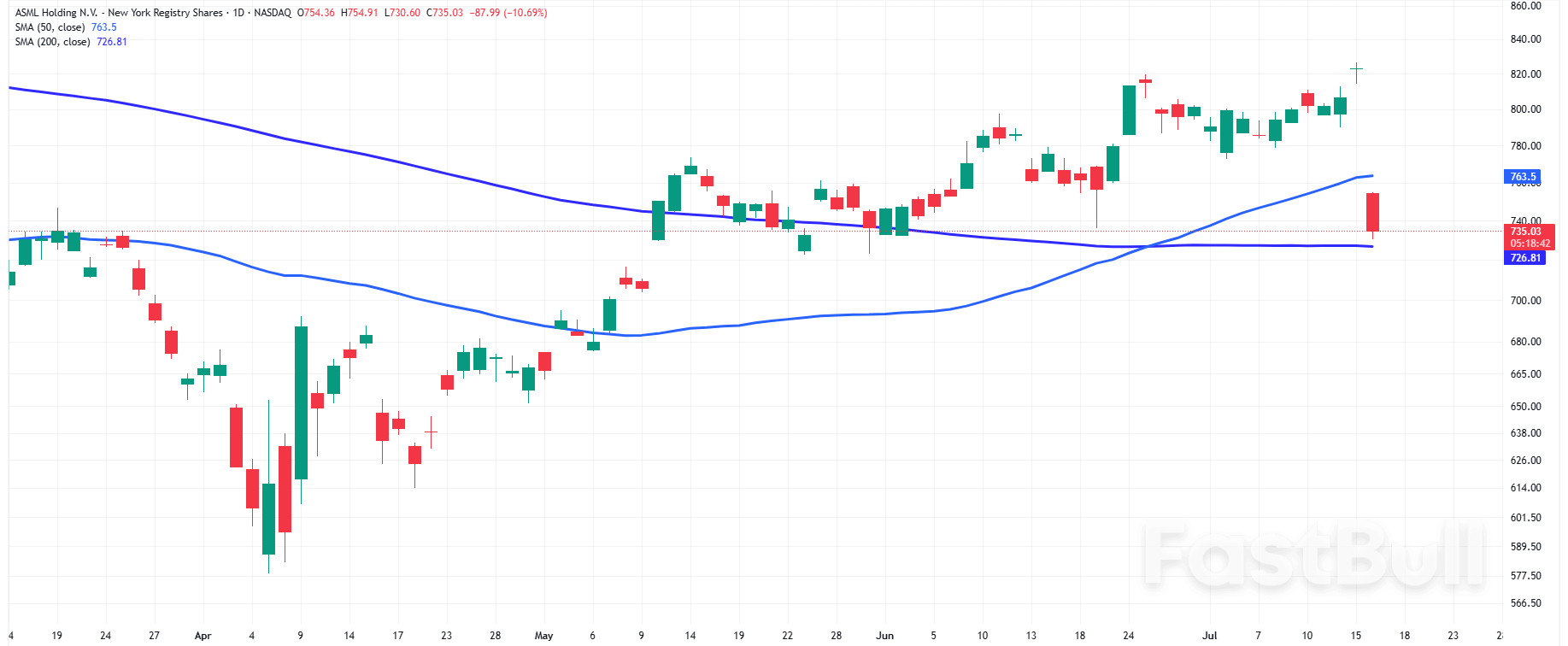
          How Is ASML’s Outlook Hitting the Chip Sector?

          Nasdaq and S&P500: Tech Stocks Slide on ASML Warning, Dow Gains on Bank Strength_1Daily ASML Holding N.V.

          ASML shares fell more than 6.5% after the company narrowed its 2025 revenue forecast and said it couldn’t confirm growth in 2026. That overshadowed a second-quarter beat on both top and bottom lines. The Dutch chip-equipment maker reported €7.7 billion in sales and €2.29 billion in profit, surpassing analyst estimates. However, its Q3 guidance of €7.4–€7.9 billion came in below the €8.3 billion consensus.
          ASML attributed its caution to macroeconomic and geopolitical uncertainty, particularly the impact of tariffs. The reaction was swift: Marvell, Applied Materials, Lam Research, and Micron dropped between 3% and 5%, dragging down the broader tech space. The S&P tech sector dipped 0.2% early, capping broader market gains.

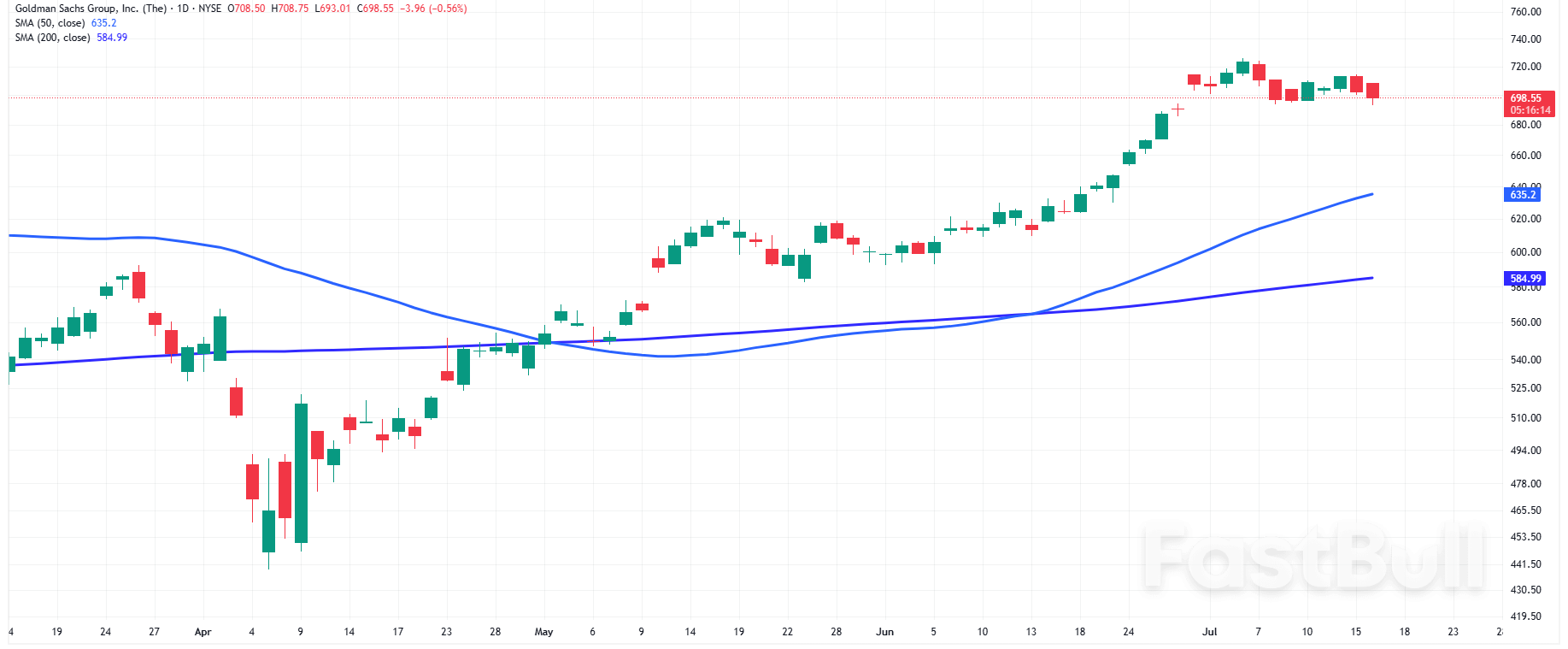
          Can Strong Bank Earnings Keep the Dow Afloat?

          Nasdaq and S&P500: Tech Stocks Slide on ASML Warning, Dow Gains on Bank Strength_2Daily Goldman Sachs Group, Inc

          Financials provided a cushion. Goldman Sachs and Morgan Stanley beat earnings estimates, though the latter traded lower following its results. Bank of America also topped expectations but slipped slightly as net interest income missed forecasts.
          The financial sector gained around 0.2%, bolstered by continued strength from JPMorgan, Citigroup, and Wells Fargo earlier this week.
          These results help offset weakness elsewhere, with investors rewarding consistent revenue and capital return over top-line surprises alone.

          Does the Latest Inflation Data Support a Rate Cut Narrative?

          The June Producer Price Index came in flat month-over-month, undercutting expectations of a 0.2% rise. That followed softer-than-expected consumer inflation data earlier this week and reinforced market hopes for Federal Reserve easing later this year. Still, with inflation above target and labor markets tight, analysts remain divided on timing and size of any rate moves.

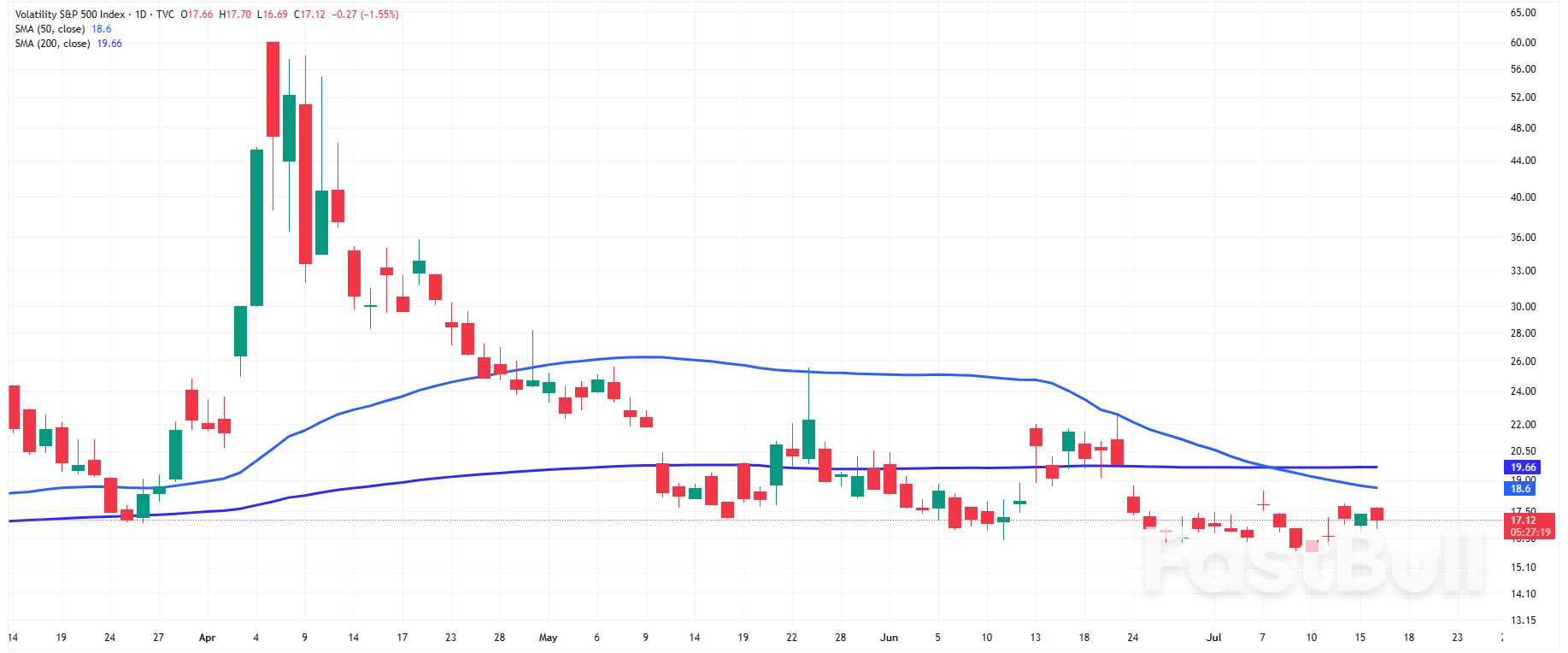
          Volatility on Deck as Technical Signals Flash Red?

          Nasdaq and S&P500: Tech Stocks Slide on ASML Warning, Dow Gains on Bank Strength_3

          Daily Volatility S&P 500 Index

          BTIG flagged a cautionary signal: the S&P 500’s streak of closes above its 20-day moving average often precedes sharp volatility spikes. With earnings season heating up and geopolitical headlines in focus, traders should expect wider price swings.

          Market Outlook: Cautious Optimism With High Alert

          Early action shows sector divergence—strength in banks, weakness in chips. With inflation cooling and Fed policy uncertain, traders should stay nimble.
          Upcoming earnings from major tech names and more inflation data could drive decisive moves.
          Volatility strategies and earnings-driven setups may offer the most attractive risk-reward in the current tape.

          source :fxempire

          Risk Warnings and Disclaimers
          You understand and acknowledge that there is a high degree of risk involved in trading. Following any strategies or investment methods may lead to potential losses. The content on the site is provided by our contributors and analysts for information purposes only. You are solely responsible for determining whether any trading assets, securities, strategy, or any other product is suitable for investing based on your own investment objectives and financial situation.
          Add to Favorites
          Share
          FastBull
          Copyright © 2025 FastBull Ltd

          728 RM B 7/F GEE LOK IND BLDG NO 34 HUNG TO RD KWUN TONG KLN HONG KONG

          TelegramInstagramTwitterfacebooklinkedin
          App Store Google Play Google Play
          Products
          Charts

          Chats

          Q&A with Experts
          Screeners
          Economic Calendar
          Data
          Tools
          Membership
          Features
          Function
          Markets
          Copy Trading
          Latest Signals
          Contests
          News
          Analysis
          24/7
          Columns
          Education
          Company
          Careers
          About Us
          Contact Us
          Advertising
          Help Center
          Feedback
          User Agreement
          Privacy Policy
          Personal Information Protection Statement
          Business

          White Label

          Data API

          Web Plug-ins

          Poster Maker

          Affiliate Program

          Risk Disclosure

          The risk of loss in trading financial instruments such as stocks, FX, commodities, futures, bonds, ETFs and crypto can be substantial. You may sustain a total loss of the funds that you deposit with your broker. Therefore, you should carefully consider whether such trading is suitable for you in light of your circumstances and financial resources.

          No decision to invest should be made without thoroughly conducting due diligence by yourself or consulting with your financial advisors. Our web content might not suit you since we don't know your financial conditions and investment needs. Our financial information might have latency or contain inaccuracy, so you should be fully responsible for any of your trading and investment decisions. The company will not be responsible for your capital loss.

          Without getting permission from the website, you are not allowed to copy the website's graphics, texts, or trademarks. Intellectual property rights in the content or data incorporated into this website belong to its providers and exchange merchants.

          Not Logged In

          Log in to access more features

          FastBull Membership

          Not yet

          Purchase

          Become a signal provider
          Help Center
          Customer Service
          Dark Mode
          Price Up/Down Colors

          Log In

          Sign Up

          Position
          Layout
          Fullscreen
          Default to Chart
          The chart page opens by default when you visit fastbull.com