• Trade
  • Markets
  • Copy
  • Contests
  • News
  • 24/7
  • Calendar
  • Q&A
  • Chats
Trending
Screeners
SYMBOL
LAST
BID
ASK
HIGH
LOW
NET CHG.
%CHG.
SPREAD
SPX
S&P 500 Index
6817.69
6817.69
6817.69
6861.30
6801.50
-9.72
-0.14%
--
DJI
Dow Jones Industrial Average
48369.39
48369.39
48369.39
48679.14
48285.67
-88.65
-0.18%
--
IXIC
NASDAQ Composite Index
23106.94
23106.94
23106.94
23345.56
23012.00
-88.22
-0.38%
--
USDX
US Dollar Index
97.950
98.030
97.950
98.070
97.740
0.000
0.00%
--
EURUSD
Euro / US Dollar
1.17459
1.17467
1.17459
1.17686
1.17262
+0.00065
+ 0.06%
--
GBPUSD
Pound Sterling / US Dollar
1.33708
1.33717
1.33708
1.34014
1.33546
+0.00001
0.00%
--
XAUUSD
Gold / US Dollar
4301.89
4302.30
4301.89
4350.16
4285.08
+2.50
+ 0.06%
--
WTI
Light Sweet Crude Oil
56.328
56.358
56.328
57.601
56.233
-0.905
-1.58%
--

Community Accounts

Signal Accounts
--
Profit Accounts
--
Loss Accounts
--
View More

Become a signal provider

Sell trading signals to earn additional income

View More

Guide to Copy Trading

Get started with ease and confidence

View More

Signal Accounts for Members

All Signal Accounts

Best Return
  • Best Return
  • Best P/L
  • Best MDD
Past 1W
  • Past 1W
  • Past 1M
  • Past 1Y

All Contests

  • All
  • Trump Updates
  • Recommend
  • Stocks
  • Cryptocurrencies
  • Central Banks
  • Featured News
Top News Only
Share

Goldman Sachs Says They Believe That The Copper Price Is Vulnerable To An Ai-Linked Price Correction

Share

Goldman Sachs Upgrades 2026 Copper Price Forecast To $11400 From $10,650

Share

Attempts By Ukrainian Troops To Advance From The South-West To Outskirts Of Kupiansk Are Being Thwarted

Share

Russian Troops Control All Of Kupiansk - IFX Cites Russian Military

Share

On Monday (December 15), The South Korean Won Ultimately Rose 0.60% Against The US Dollar, Closing At 1468.91 Won. The Won Was On An Upward Trend Throughout The Day, Rising Significantly At 17:00 Beijing Time And Reaching A Daily High Of 1463.04 Won At 17:36

Share

Health Ministry: Israeli Forces Kill Palestinian Teen In West Bank

Share

New York Federal Reserve President Williams: Over Time, The Size Of Reserves Could Grow From $2.9 Trillion

Share

New York Fed President Williams: AI Valuations Are High, But There Is A Real Driving Factor

Share

New York Federal Reserve President Williams: The Job Market Is In Very Good Shape

Share

New York Fed President Williams: 'Very Supportive' Of USA Central Bank's Decision To Cut Interest Rates Last Week

Share

New York Fed President Williams: 'Too Early To Say' What Central Bank Should Do At January Meeting

Share

New York Fed President Williams: Strong Markets Part Of Reason Why Economy Will Grow Robustly In 2026

Share

New York Fed President Williams: What Constitutes Ample Reserves Will Change Over Time

Share

New York Fed President Williams: Market Valuations 'Elevated,' But There Are Reasons For Pricing

Share

New York Fed President Williams: Ample Reserves System Working Very Well

Share

New York Fed President Williams: Some Signs That Parts Of Underlying Economy Not As Strong As GDP Data Suggests

Share

New York Fed President Williams: Expects Coming Job Data Will Show Gradual Cooling

Share

Ukraine President Zelenskiy: Monitoring Of Ceasefire Should Be Part Of Security Guarantees

Share

Ukraine President Zelenskiy: Ukraine Needs Clear Understanding On Security Guarantees Before Taking Any Decisions Regarding Frontlines

Share

U.S. Commerce Secretary Rutnick Praised Korea Zinc Co. Ltd., Stating That The United States Will Have Priority Access To The Company's Products In 2026

TIME
ACT
FCST
PREV
Japan Tankan Small Manufacturing Outlook Index (Q4)

A:--

F: --

P: --

Japan Tankan Large Non-Manufacturing Outlook Index (Q4)

A:--

F: --

P: --

Japan Tankan Large Manufacturing Outlook Index (Q4)

A:--

F: --

P: --

Japan Tankan Small Manufacturing Diffusion Index (Q4)

A:--

F: --

P: --

Japan Tankan Large-Enterprise Capital Expenditure YoY (Q4)

A:--

F: --

P: --

U.K. Rightmove House Price Index YoY (Dec)

A:--

F: --

P: --

China, Mainland Industrial Output YoY (YTD) (Nov)

A:--

F: --

P: --

China, Mainland Urban Area Unemployment Rate (Nov)

A:--

F: --

P: --

Saudi Arabia CPI YoY (Nov)

A:--

F: --

P: --

Euro Zone Industrial Output YoY (Oct)

A:--

F: --

P: --

Euro Zone Industrial Output MoM (Oct)

A:--

F: --

P: --

Canada Existing Home Sales MoM (Nov)

A:--

F: --

P: --

Canada National Economic Confidence Index

A:--

F: --

P: --

Canada New Housing Starts (Nov)

A:--

F: --

P: --
U.S. NY Fed Manufacturing Employment Index (Dec)

A:--

F: --

P: --

U.S. NY Fed Manufacturing Index (Dec)

A:--

F: --

P: --

Canada Core CPI YoY (Nov)

A:--

F: --

P: --

Canada Manufacturing Unfilled Orders MoM (Oct)

A:--

F: --

P: --

U.S. NY Fed Manufacturing Prices Received Index (Dec)

A:--

F: --

P: --

U.S. NY Fed Manufacturing New Orders Index (Dec)

A:--

F: --

P: --

Canada Manufacturing New Orders MoM (Oct)

A:--

F: --

P: --

Canada Core CPI MoM (Nov)

A:--

F: --

P: --

Canada Trimmed CPI YoY (SA) (Nov)

A:--

F: --

P: --

Canada Manufacturing Inventory MoM (Oct)

A:--

F: --

P: --

Canada CPI YoY (Nov)

A:--

F: --

P: --

Canada CPI MoM (Nov)

A:--

F: --

P: --

Canada CPI YoY (SA) (Nov)

A:--

F: --

P: --

Canada Core CPI MoM (SA) (Nov)

A:--

F: --

P: --

Canada CPI MoM (SA) (Nov)

A:--

F: --

P: --

Federal Reserve Board Governor Milan delivered a speech
U.S. NAHB Housing Market Index (Dec)

A:--

F: --

P: --

Australia Composite PMI Prelim (Dec)

--

F: --

P: --

Australia Services PMI Prelim (Dec)

--

F: --

P: --

Australia Manufacturing PMI Prelim (Dec)

--

F: --

P: --

Japan Manufacturing PMI Prelim (SA) (Dec)

--

F: --

P: --

U.K. 3-Month ILO Employment Change (Oct)

--

F: --

P: --

U.K. Unemployment Claimant Count (Nov)

--

F: --

P: --

U.K. Unemployment Rate (Nov)

--

F: --

P: --

U.K. 3-Month ILO Unemployment Rate (Oct)

--

F: --

P: --

U.K. Average Weekly Earnings (3-Month Average, Including Bonuses) YoY (Oct)

--

F: --

P: --

U.K. Average Weekly Earnings (3-Month Average, Excluding Bonuses) YoY (Oct)

--

F: --

P: --

France Services PMI Prelim (Dec)

--

F: --

P: --

France Composite PMI Prelim (SA) (Dec)

--

F: --

P: --

France Manufacturing PMI Prelim (Dec)

--

F: --

P: --

Germany Services PMI Prelim (SA) (Dec)

--

F: --

P: --

Germany Manufacturing PMI Prelim (SA) (Dec)

--

F: --

P: --

Germany Composite PMI Prelim (SA) (Dec)

--

F: --

P: --

Euro Zone Composite PMI Prelim (SA) (Dec)

--

F: --

P: --

Euro Zone Services PMI Prelim (SA) (Dec)

--

F: --

P: --

Euro Zone Manufacturing PMI Prelim (SA) (Dec)

--

F: --

P: --

U.K. Services PMI Prelim (Dec)

--

F: --

P: --

U.K. Manufacturing PMI Prelim (Dec)

--

F: --

P: --

U.K. Composite PMI Prelim (Dec)

--

F: --

P: --

Euro Zone ZEW Economic Sentiment Index (Dec)

--

F: --

P: --

Germany ZEW Current Conditions Index (Dec)

--

F: --

P: --

Germany ZEW Economic Sentiment Index (Dec)

--

F: --

P: --

Euro Zone Trade Balance (Not SA) (Oct)

--

F: --

P: --

Euro Zone ZEW Current Conditions Index (Dec)

--

F: --

P: --

Euro Zone Trade Balance (SA) (Oct)

--

F: --

P: --

Euro Zone Total Reserve Assets (Nov)

--

F: --

P: --

U.K. Inflation Rate Expectations

--

F: --

P: --

Q&A with Experts
    • All
    • Chatrooms
    • Groups
    • Friends
    Connecting
    .
    .
    .
    Type here...
    Add Symbol or Code

      No matching data

      All
      Trump Updates
      Recommend
      Stocks
      Cryptocurrencies
      Central Banks
      Featured News
      • All
      • Russia-Ukraine Conflict
      • Middle East Flashpoint
      • All
      • Russia-Ukraine Conflict
      • Middle East Flashpoint
      Search
      Products

      Charts Free Forever

      Chats Q&A with Experts
      Screeners Economic Calendar Data Tools
      Membership Features
      Data Warehouse Market Trends Institutional Data Policy Rates Macro

      Market Trends

      Market Sentiment Order Book Forex Correlations

      Top Indicators

      Charts Free Forever
      Markets

      News

      News Analysis 24/7 Columns Education
      From Institutions From Analysts
      Topics Columnists

      Latest Views

      Latest Views

      Trending Topics

      Top Columnists

      Latest Update

      Signals

      Copy Rankings Latest Signals Become a signal provider AI Rating
      Contests
      Brokers

      Overview Brokers Assessment Rankings Regulators News Claims
      Broker listing Forex Brokers Comparison Tool Live Spread Comparison Scam
      Q&A Complaint Scam Alert Videos Tips to Detect Scam
      More

      Business
      Events
      Careers About Us Advertising Help Center

      White Label

      Data API

      Web Plug-ins

      Affiliate Program

      Awards Institution Evaluation IB Seminar Salon Event Exhibition
      Vietnam Thailand Singapore Dubai
      Fans Party Investment Sharing Session
      FastBull Summit BrokersView Expo
      Recent Searches
        Top Searches
          Markets
          News
          Analysis
          User
          24/7
          Economic Calendar
          Education
          Data
          • Names
          • Latest
          • Prev

          View All

          No data

          Scan to Download

          Faster Charts, Chat Faster!

          Download App
          English
          • English
          • Español
          • العربية
          • Bahasa Indonesia
          • Bahasa Melayu
          • Tiếng Việt
          • ภาษาไทย
          • Français
          • Italiano
          • Türkçe
          • Русский язык
          • 简中
          • 繁中
          Open Account
          Search
          Products
          Charts Free Forever
          Markets
          News
          Signals

          Copy Rankings Latest Signals Become a signal provider AI Rating
          Contests
          Brokers

          Overview Brokers Assessment Rankings Regulators News Claims
          Broker listing Forex Brokers Comparison Tool Live Spread Comparison Scam
          Q&A Complaint Scam Alert Videos Tips to Detect Scam
          More

          Business
          Events
          Careers About Us Advertising Help Center

          White Label

          Data API

          Web Plug-ins

          Affiliate Program

          Awards Institution Evaluation IB Seminar Salon Event Exhibition
          Vietnam Thailand Singapore Dubai
          Fans Party Investment Sharing Session
          FastBull Summit BrokersView Expo

          Trump Eyes 'world Tariff' Of 15-20% For Most Countries

          Devin

          Economic

          Summary:

          Trump prefers straight tariff over complex negotiations.US clinched big trade deals with EU, Japan already.Now letters going out to smaller countries with firm tariff rate.

          PresidentDonald Trumpsaid on Monday most trading partners that do not negotiate separate trade deals would soon face tariffs of 15% to 20% on their exports to the United States, well above the broad 10%tariffhe imposed in April.

          Trump told reporters his administration will notify some 200 countries soon of their new "world tariff" rate.

          "I would say it'll be somewhere in the 15 to 20% range," Trump told reporters, sitting alongside British Prime Minister Keir Starmer at his luxury golf resort in Turnberry, Scotland. "Probably one of those two numbers."

          Trump, who has vowed to end decades of U.S. trade deficits by imposing tariffs on nearly all trading partners, has already announced higher rates of up to 50% on some countries, including Brazil, starting on Friday.

          The announcements have spurred feverish negotiations by a host of countries seeking lower tariff rates, including India, Pakistan, Canada, and Thailand, among others.

          The U.S. president on Sunday clinched a huge trade deal with the European Union that includes a 15% tariff on most EU goods, $600 billion of investments in the U.S. by European firms, and $750 billion in energy purchases over the next three years.

          That followed a $550-billion deal with Japan last week and smaller agreements with Britain, Indonesia, and Vietnam. Other talks are ongoing, including with India, but prospects have dimmed for many more agreements before Friday, Trump's deadline for deals before higher rates take effect.

          Trump has repeatedly said he favors straightforward tariff rates over complex negotiations.

          "We're going to be setting a tariff for essentially, the rest of the world," he said again on Monday. "And that's what they're going to pay if they want to do business in the United States. Because you can't sit down and make 200 deals."

          Canadian Prime Minister Mark Carney said on Monday trade talks with the U.S. were at an intense phase, conceding that his country was still hoping to walk away with a tariff rate below the 35% announced by Trump on some Canadian imports.

          Carney conceded this month that Canada - which sends 75% of its exports to the United States - would likely have to accept some tariffs.
          Source: TradingView

          To stay updated on all economic events of today, please check out our Economic calendar
          Risk Warnings and Disclaimers
          You understand and acknowledge that there is a high degree of risk involved in trading. Following any strategies or investment methods may lead to potential losses. The content on the site is provided by our contributors and analysts for information purposes only. You are solely responsible for determining whether any trading assets, securities, strategy, or any other product is suitable for investing based on your own investment objectives and financial situation.
          Add to Favorites
          Share

          Nvidia, Microsoft and Palantir Analysis – Still a Buy After Massive Rallies?

          Adam

          Economic

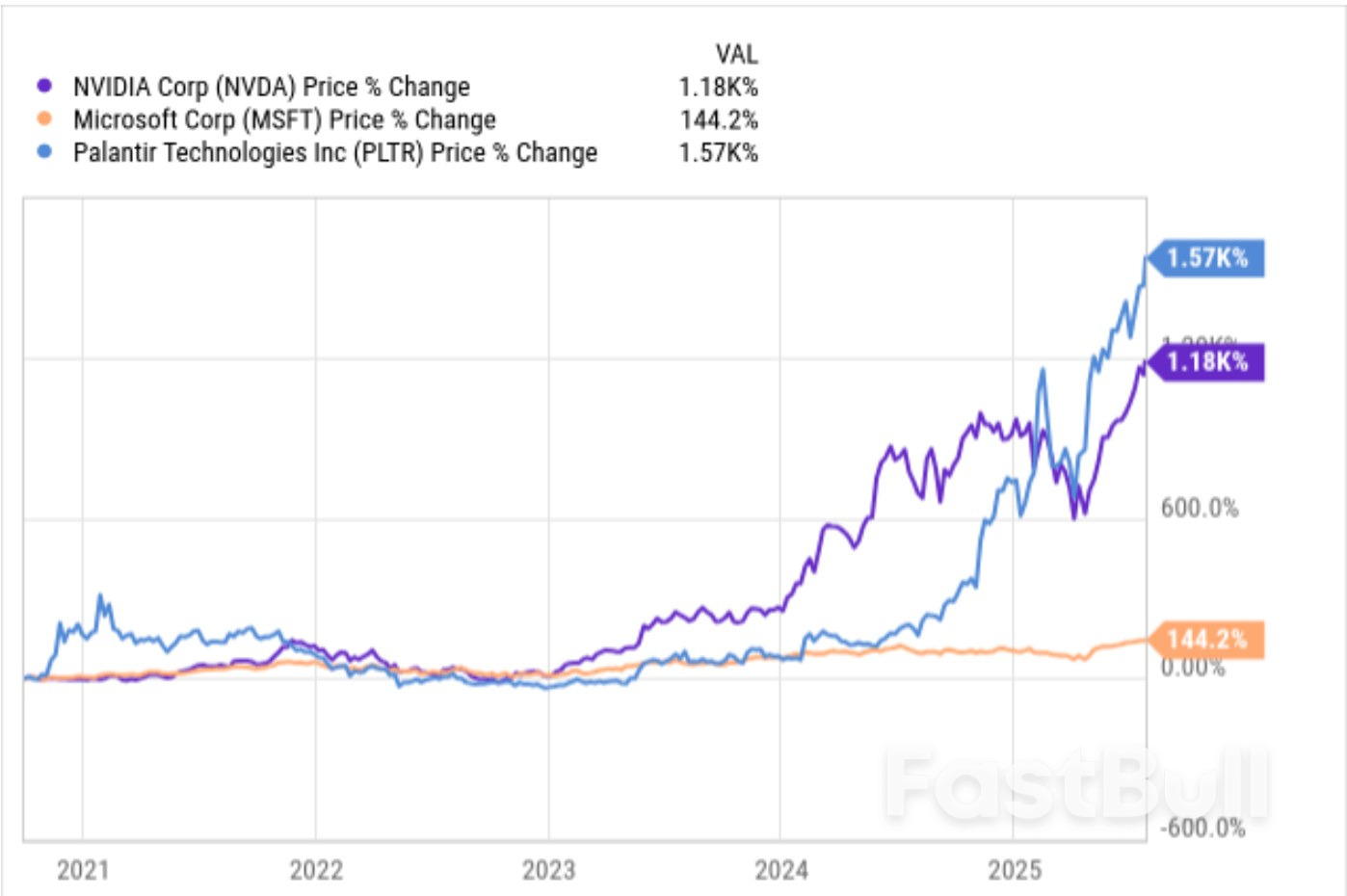
          Artificial intelligence has become a dominant theme in the stock market, with companies such as Nvidia Corp. (NVDA), Microsoft Corp. (MSFT), and Palantir Technologies (PLTR) leading the charge. As AI adoption accelerates, their stock prices have soared, fueled by strong demand and bullish sentiment. However, some stocks have surged to potentially overvalued levels following sharp rallies.
          The chart below shows the percentage price gains for Nvidia, Microsoft, and Palantir over the past decade. Palantir leads with a staggering 1,570% gain, followed by Nvidia at 1,180%, while Microsoft trails with a 144.2% increase. The sharp rallies in Palantir and Nvidia reflect strong investor enthusiasm but also raise concerns about overheating. Such vertical moves may trigger short-term pullbacks or consolidation. However, Microsoft appears more stable and less volatile, making it a potentially safer investment.
          Nvidia, Microsoft and Palantir Analysis – Still a Buy After Massive Rallies?_1
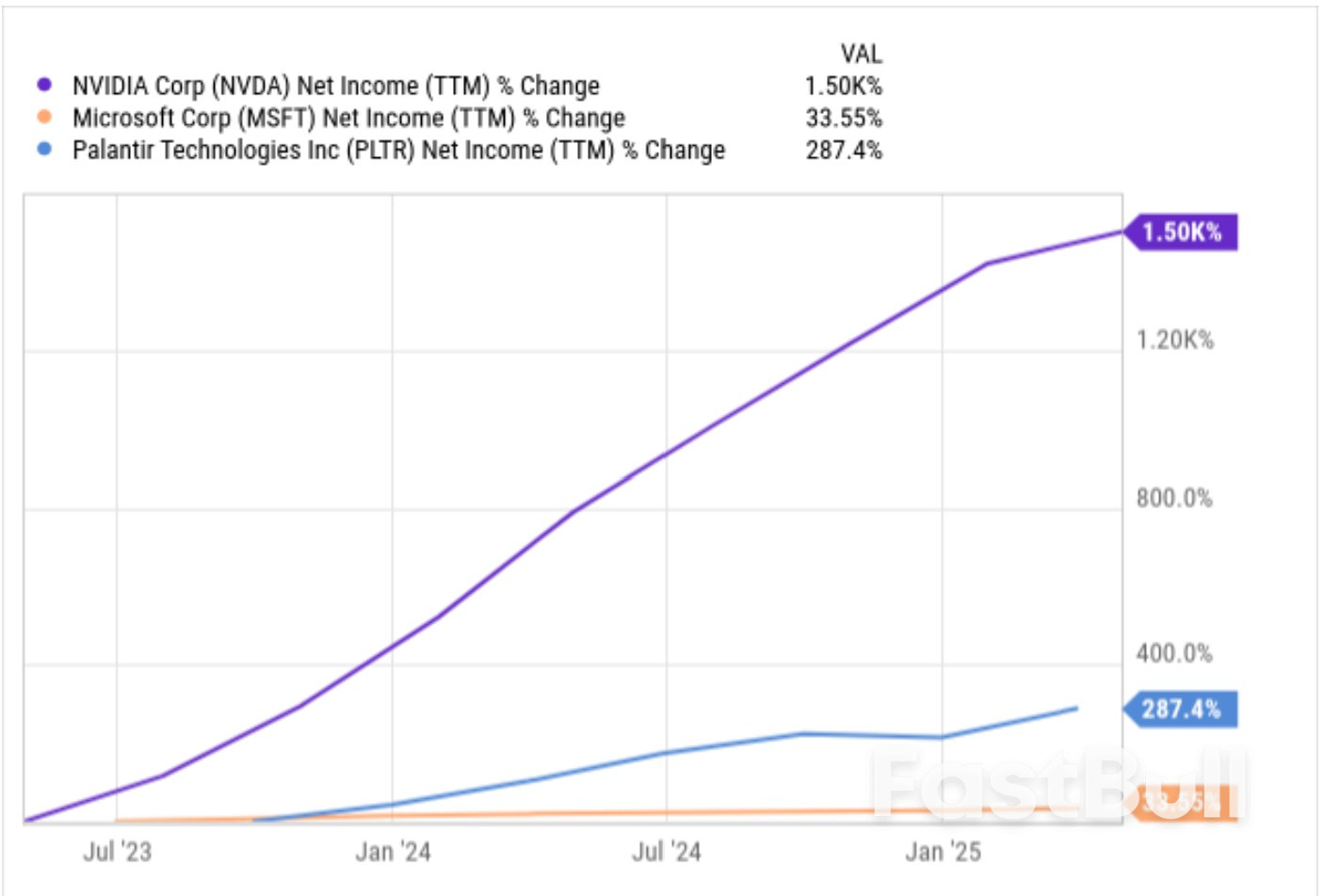
          Despite the overvalued conditions in Nvidia and Palantir, both companies continue to show strong profitability. The chart below highlights Nvidia’s dominance, with earnings growth surging over 1,500% over the past decade. Palantir follows with a 287% increase, while Microsoft shows steady growth of 33.5%. Although Palantir’s net income remains much lower than that of Nvidia and Microsoft, the company still holds strong growth potential in the coming years. Microsoft will release its Q4 2025 earnings on July 30, 2025, which will drive the next move for the stock price.
          Nvidia, Microsoft and Palantir Analysis – Still a Buy After Massive Rallies?_2

          Nvidia Technical Analysis

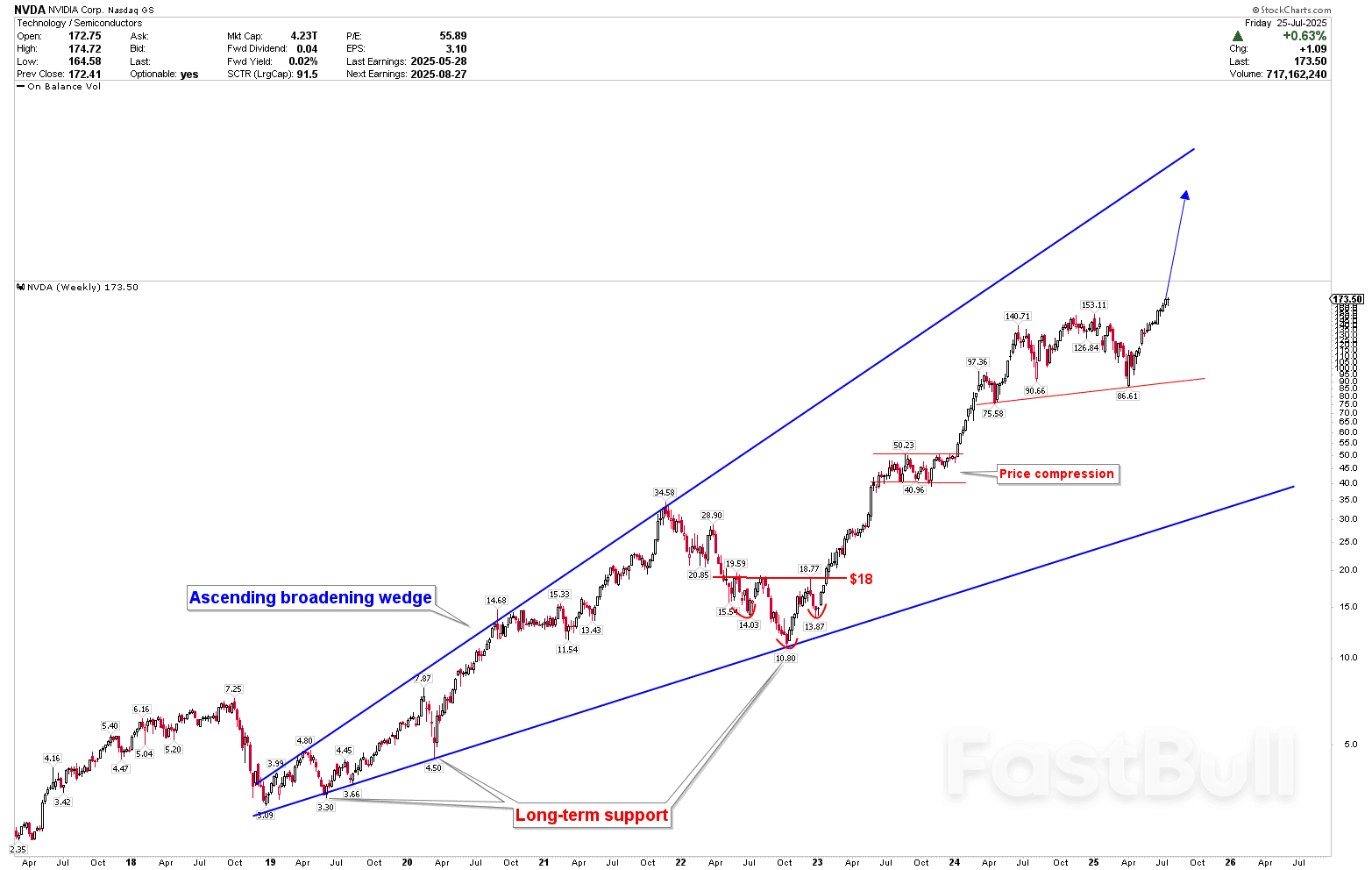
          NVDA Weekly Chart – Ascending Broadening Wedge Pattern
          The weekly chart for Nvidia shows that the stock has been trading within an ascending broadening wedge pattern. It has established strong long-term support along the lower boundary of the wedge and recently surged higher. The formation of an inverted head and shoulders pattern in 2022, followed by price compression in 2023, signals strong bullish momentum and increases the likelihood of further upside.
          Nvidia, Microsoft and Palantir Analysis – Still a Buy After Massive Rallies?_3
          Robust demand for AI, combined with Nvidia’s leadership in the sector, suggests continued gains. However, investors should consider buying on pullbacks. The $150 level remains a key support zone for Nvidia.
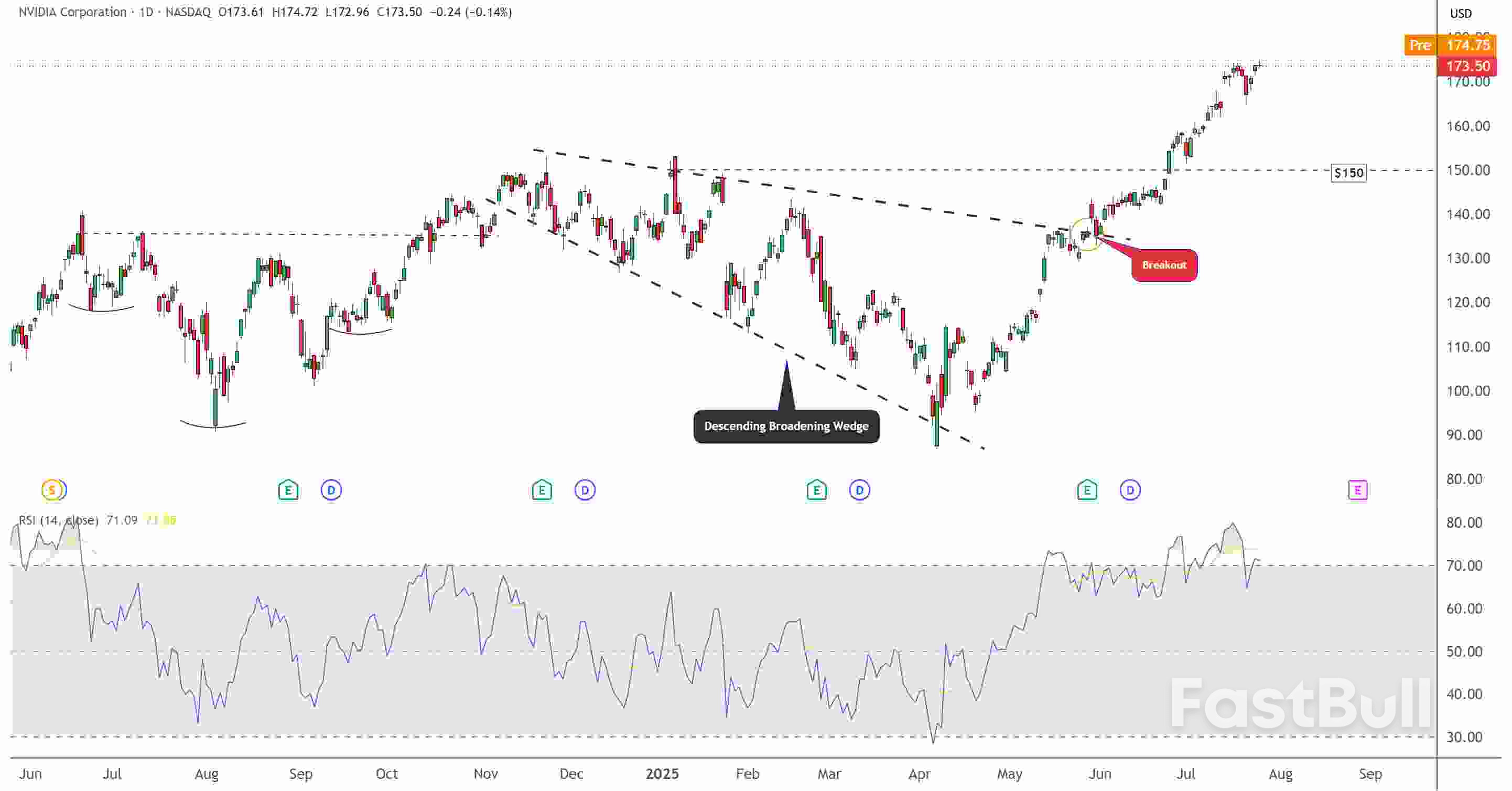
          NVDA Daily Chart – Breakout from Descending Broadening Wedge
          The daily chart for Nvidia shows that the stock has formed a descending broadening wedge pattern and broken above the $130 level. A breakout above $130 and $150 suggests that the stock may continue to rise in the short term. However, the price appears overbought, so investors may consider buying on dips toward the $150 region.
          Nvidia, Microsoft and Palantir Analysis – Still a Buy After Massive Rallies?_4

          Microsoft Technical Analysis

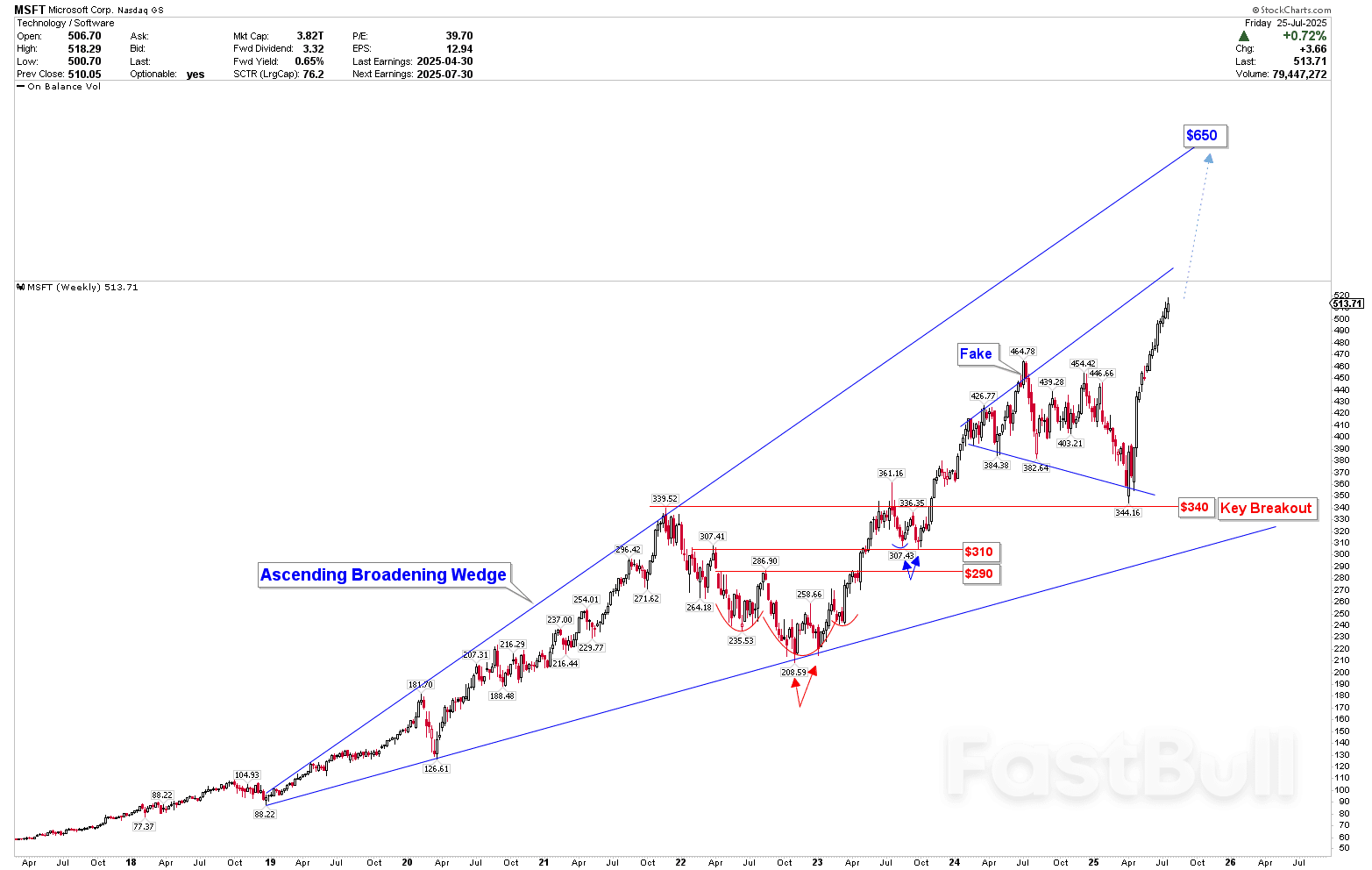
          MSFT Weekly Chart – Symmetrical Broadening Wedge
          The weekly chart for Microsoft shows that the stock price is continuously rising and hitting new record highs each week. The price has formed a symmetrical broadening wedge pattern within an ascending broadening wedge, indicating heightened volatility.
          The market remains overbought in the short term. However, the long-term target remains the $650 area. Therefore, any correction toward the $400–$500 region would be considered a strong buying opportunity to target the $650 level.
          Nvidia, Microsoft and Palantir Analysis – Still a Buy After Massive Rallies?_5
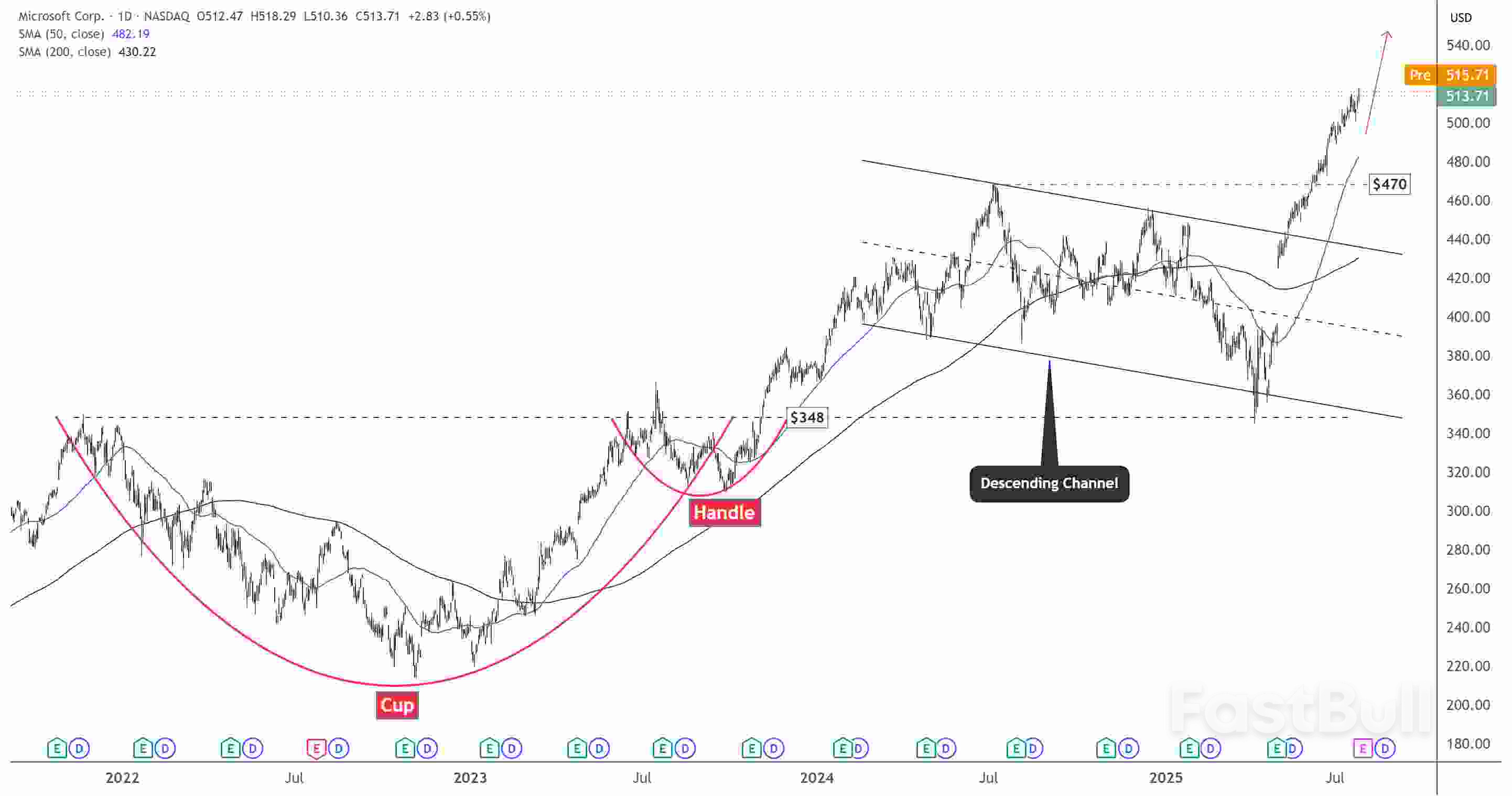
          MSFT Daily Chart – Breakout from Descending Channel
          The daily chart for Microsoft shows that the stock formed a cup-and-handle pattern during the 2022–2023 consolidation. After breaking out of this pattern, the price formed a descending channel and subsequently broke above the $470 resistance level.
          A breakout above the $440–$470 region triggered a strong upward move. The price remains above the 50-day and 200-day SMAs, signalling continued bullish momentum. However, a pullback toward the $400–$500 region would be considered a strong buying opportunity for investors.
          Nvidia, Microsoft and Palantir Analysis – Still a Buy After Massive Rallies?_6

          Palantir Technical Analysis

          PLTR Weekly – Rebound
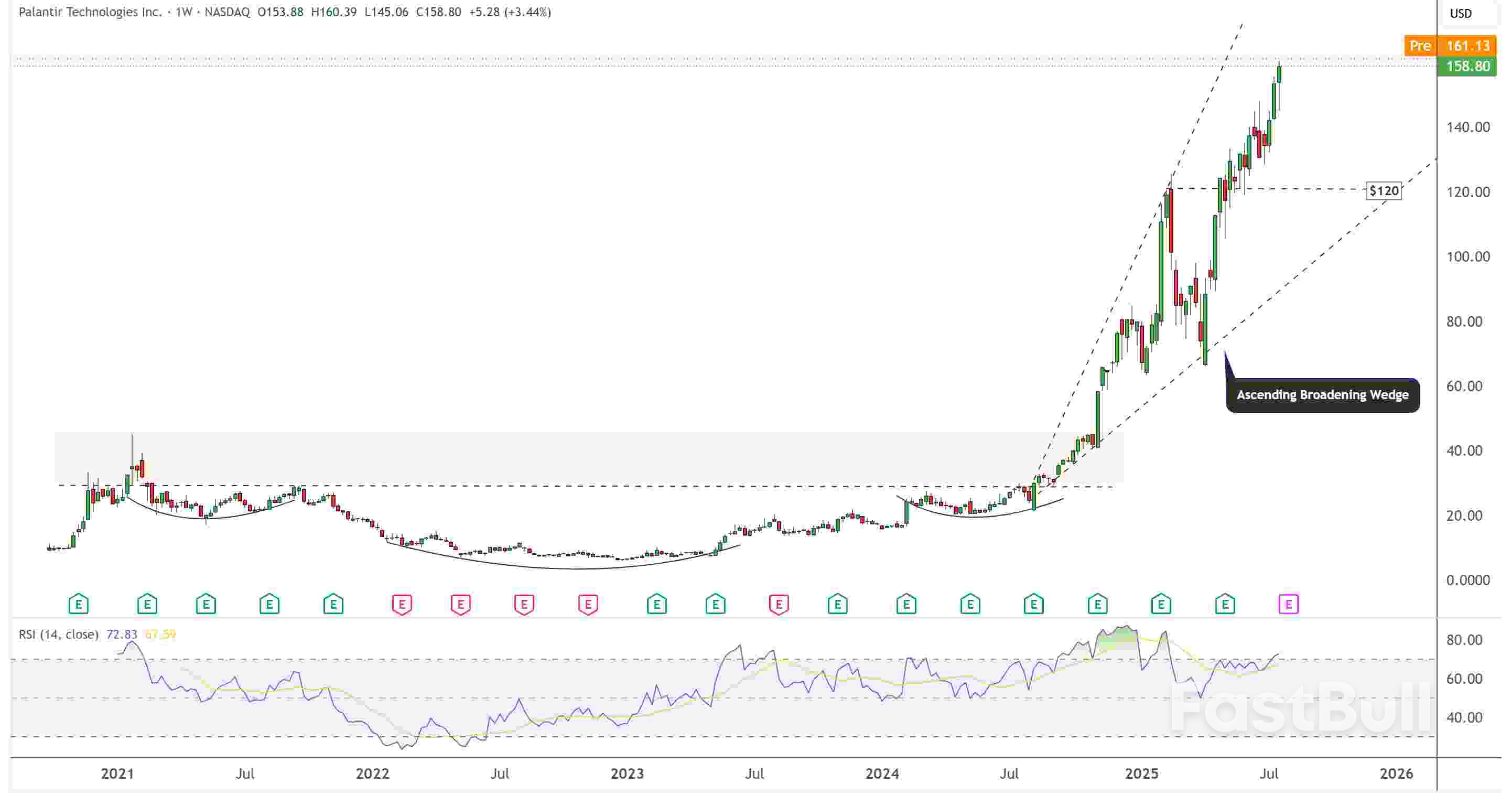
          The weekly chart for Palantir indicates that the stock formed a strong base during the 2021–2024 consolidation period. A breakout above $45 triggered a sharp rally, pushing the price above $150 with no immediate signs of correction.
          However, the steep surge has left Palantir in overbought territory, as indicated by the RSI. Investors may consider waiting for a pullback before entering new positions. Given Palantir’s strong financial condition, any correction toward the $120 level would present a potential buying opportunity.
          Nvidia, Microsoft and Palantir Analysis – Still a Buy After Massive Rallies?_7
          PLTR Daily Chart – Descending Channel
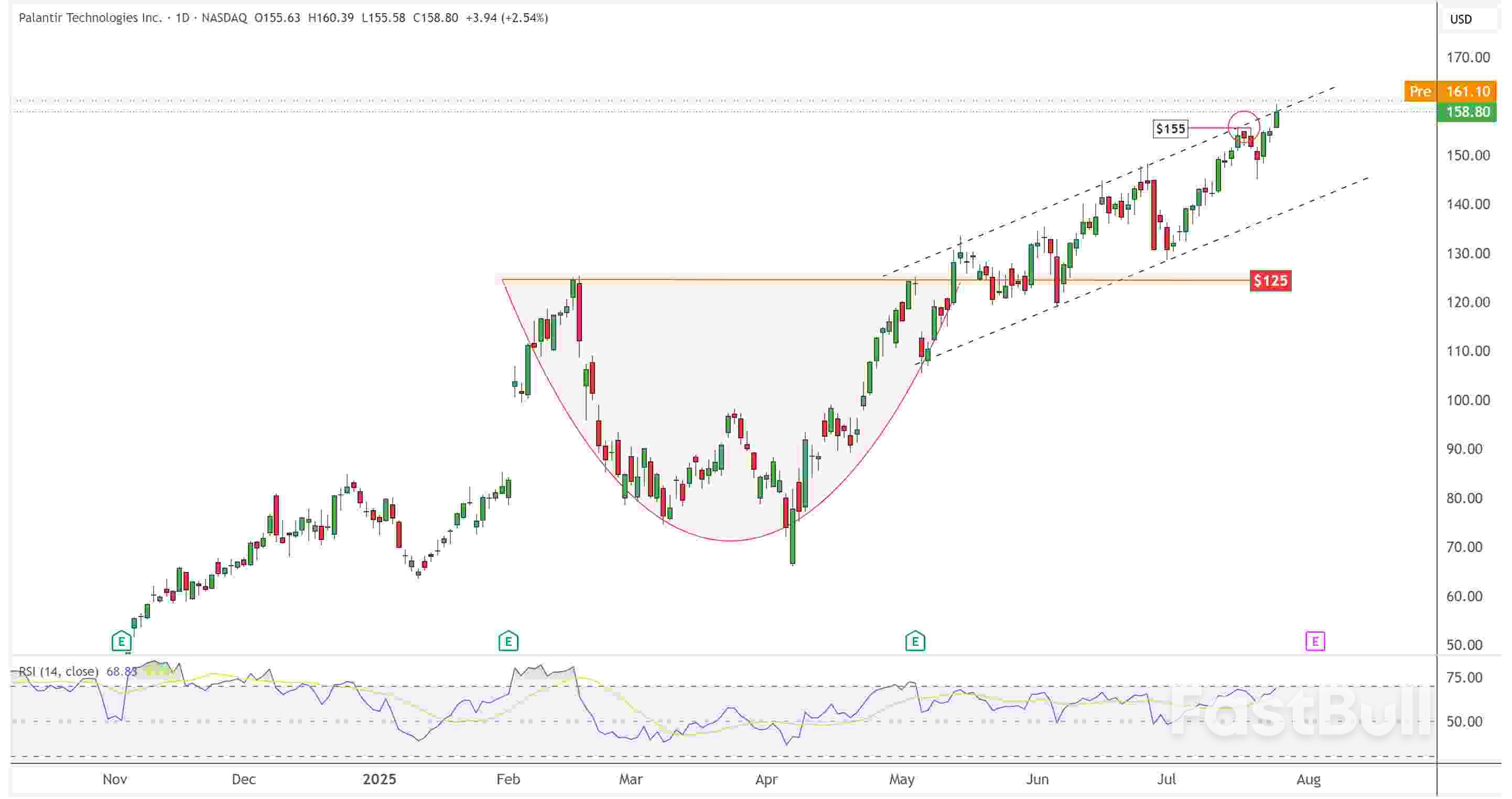
          The daily chart for Palantir indicates that the price has encountered strong resistance in the $150 to $160 range. A breakout above this zone could trigger further upside, while a pullback toward the $125 area would present a strong buying opportunity. The emergence of a cup pattern suggests that the overall trend remains bullish.
          Nvidia, Microsoft and Palantir Analysis – Still a Buy After Massive Rallies?_8

          Source: fxempire

          To stay updated on all economic events of today, please check out our Economic calendar
          Risk Warnings and Disclaimers
          You understand and acknowledge that there is a high degree of risk involved in trading. Following any strategies or investment methods may lead to potential losses. The content on the site is provided by our contributors and analysts for information purposes only. You are solely responsible for determining whether any trading assets, securities, strategy, or any other product is suitable for investing based on your own investment objectives and financial situation.
          Add to Favorites
          Share

          Bank of England poised to slow quantitative tightening after rise in yields

          Adam

          Central Bank

          Economic

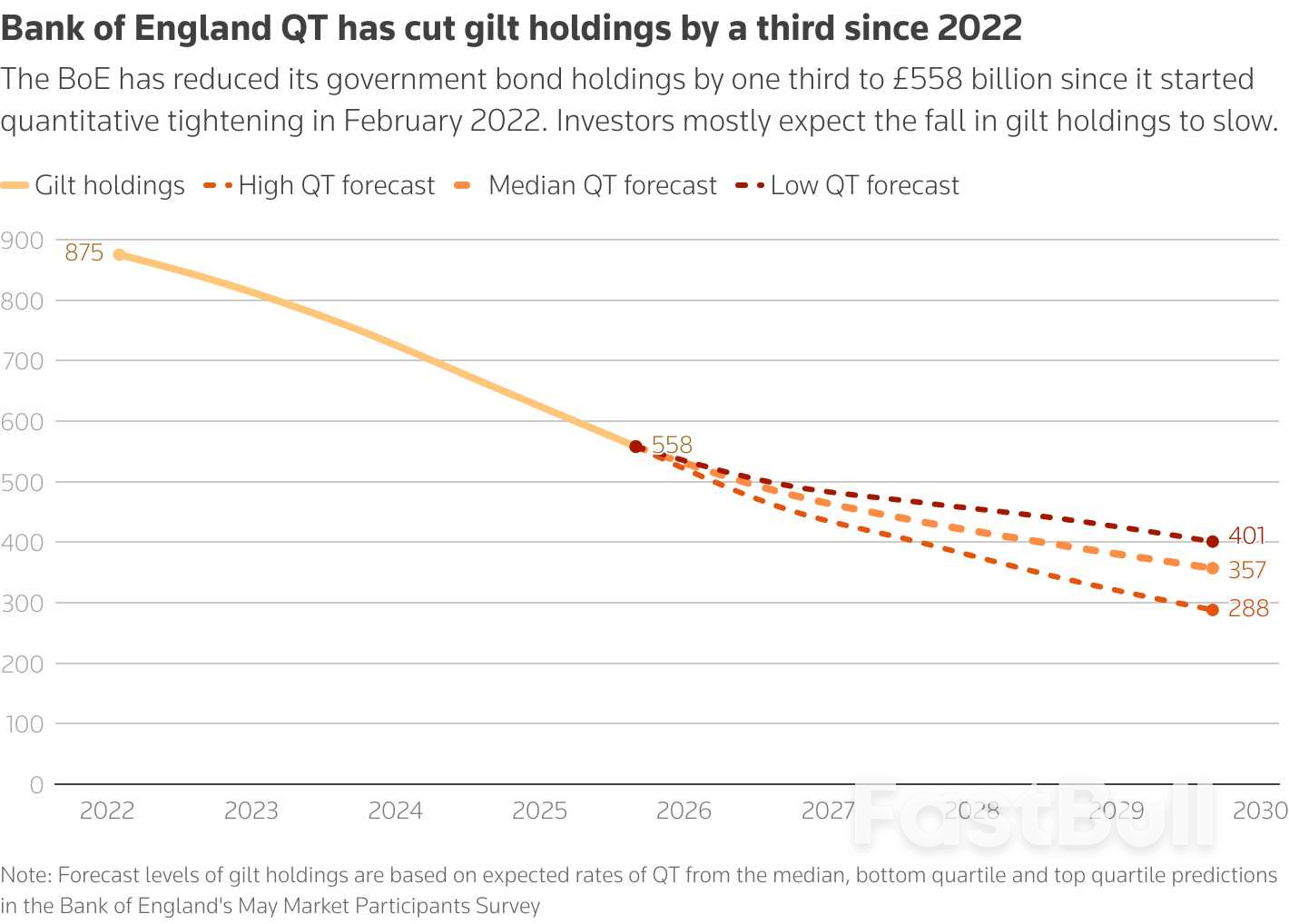
          The Bank of England is expected to soon slow the pace at which it shrinks its 558 billion-pound ($754 billion) holdings of government bonds, and economists hope next week will shed some light on its longer-term goals for the stockpile.
          Alongside a predicted quarter-point interest rate cut to 4%, the BoE's Aug. 7 policy statement will assess the past year's quantitative tightening, or QT, before policymakers decide in September on the pace of bond sales for the following 12 months.
          There is greater uncertainty over QT than usual due to recent bond market ructions and because liquidity in Britain's financial system is approaching a balanced level for the first time since before the 2008 financial crisis.
          Adding to the mix is political pressure over the hefty losses the BoE has made when selling bonds.
          "The official view from the Bank ... is that they see this as an operation that works almost in the background. But clearly it has come to their attention that they are not operating in a vacuum," said Peter Schaffrik, global macro strategist at RBC.
          Unlike other big central banks, the BoE's QT programme involves bond auctions as well as letting existing holdings mature.
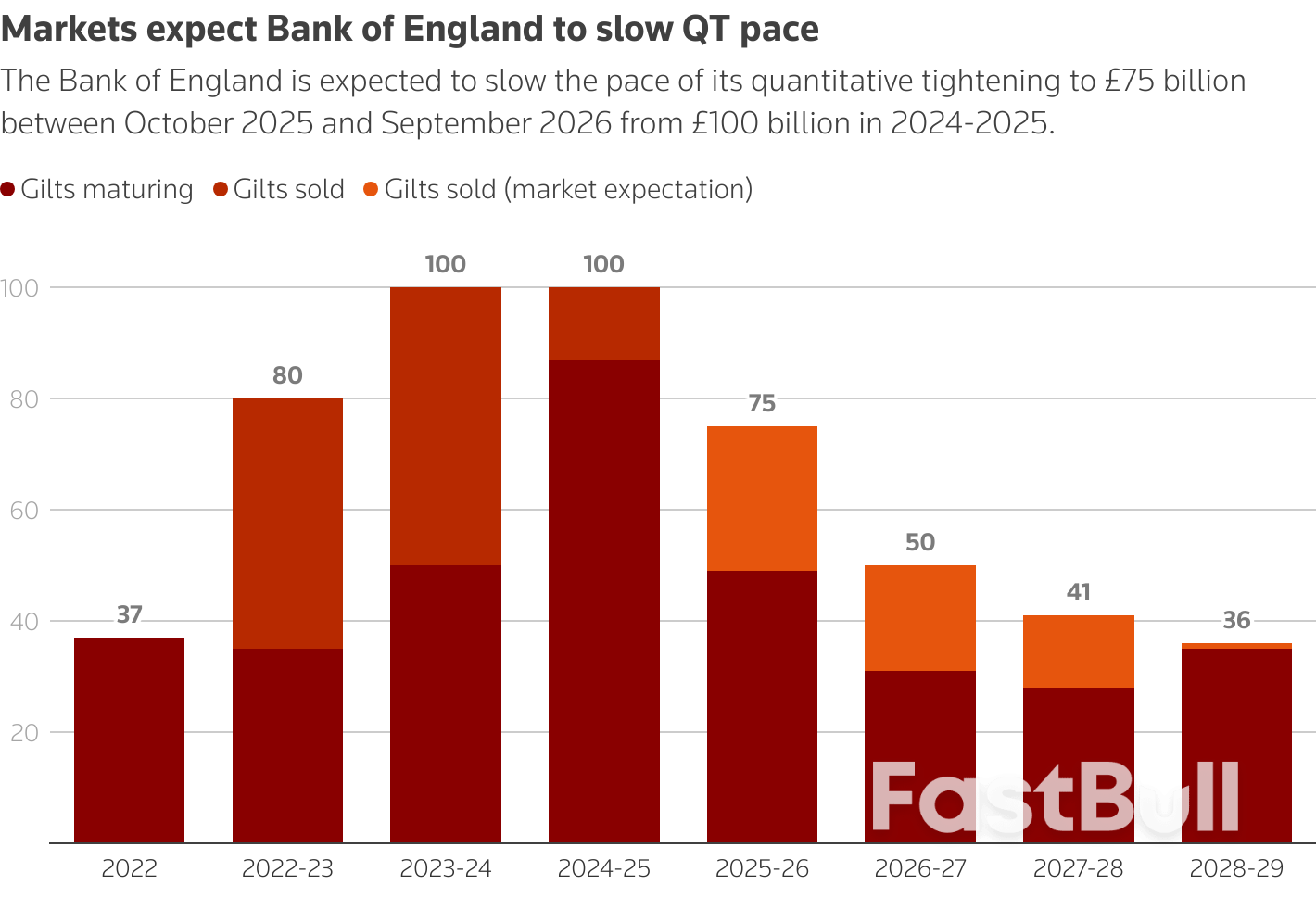
          Over the past year, it has sold 13 billion pounds of gilts and let 87 billion pounds mature. Keeping up that 100 billion-pound pace for the next 12 months would require it to sell a record 51 billion pounds though, due to fewer redemptions.
          Schaffrik said market conditions had changed since it last sold close to 50 billion pounds of gilts, however, which was in the year to September 2024.
          "The market would probably take it quite negatively if they sold such a large amount," Schaffrik said.
          The BoE itself has said its sales so far have barely pushed up government bond yields.
          A BoE survey published in May showed investors mostly expected QT to slow to a yearly 75 billion-pound pace from September and to 50 billion in 2026-27 before active sales effectively end in 2028.
          Bank of England poised to slow quantitative tightening after rise in yields_1

          Stacked bar chart showing Bank of England quantitative tightening, divided by gilts maturing and gilts sold, from February 2022 until September 2029, including market expectations for future sales.

          EARLY END TO BOND SALES?

          One outlier is BNP Paribas' Europe economist Dani Stoilova, who expects the BoE to stop gilt sales from October onward to avoid impacting the market.
          British 30-year government bond yields hit their highest levels since 1998 in April after President Donald Trump's tariff bombshell rocked the markets and the BoE had to postpone a bond sale.
          Despite four BoE rate cuts over the past year, the difference between five- and 30-year gilt yields has doubled to 1.4 percentage points and the 2/10-year yield curve has steepened to 0.75 percentage points from near zero.
          "Active QT has never been done in this environment where Bank Rate has been falling. And so there is the potential that there are interaction effects that haven't been caught," Stoilova said.
          Last week BoE Governor Andrew Bailey said QT was not to blame for higher government borrowing costs.
          "We do need to look, however, at the interaction of those yield curve movements with the QT programme and with market functioning and with monetary policy impact," he said.
          The BoE might focus more on shorter-dated gilt sales or even halt sales of gilts with a maturity of 20 years or longer, former Monetary Policy Committee member Michael Saunders said.
          Equally, the BoE could decide that extra rate cuts are a better option, or that there is little it can do to offset the steeper yield curve, said Adam Dent, chief UK rates strategist at Santander CIB.
          "We believe that QT is only responsible for a small part of the steepness, so trying to use QT to control the slope should also have little lasting effect," he said.

          LONG-TERM PLANS UNCLEAR

          The BoE has said little about its long-term plans for its gilts.
          One of Bailey's original reasons for QT - which drains money from the financial system - was to lower banks' reserve holdings from excess levels.
          Reserves stand at around 680 billion pounds, well above the 385-540 billion-pound range bankers gave to the BoE as an estimate of the system's preferred minimum range of reserves.
          Once reserves hit this minimum level, the BoE might still see financial or market stability reasons to keep selling gilts and require banks to make greater use of its repos.
          But growing take-up of the BoE's repo operations - where banks temporarily borrow money from the BoE - suggests the floor could be nearer than the BoE thinks.
          "They could slow things down or feel their way to that level," Schaffrik said, noting the BoE had never given a steer on its ideal position. "But everything indicates they want to go quite a bit below it."
          Bank of England poised to slow quantitative tightening after rise in yields_2

          Chart showing the fall in the Bank of England's holdings of gilts since 2022 and predictions for future falls under high, median and low QT scenarios in the BoE's May Market Participants Survey

          Source: Reuters

          To stay updated on all economic events of today, please check out our Economic calendar
          Risk Warnings and Disclaimers
          You understand and acknowledge that there is a high degree of risk involved in trading. Following any strategies or investment methods may lead to potential losses. The content on the site is provided by our contributors and analysts for information purposes only. You are solely responsible for determining whether any trading assets, securities, strategy, or any other product is suitable for investing based on your own investment objectives and financial situation.
          Add to Favorites
          Share

          Stocks Rise Modestly, Euro Slides After US-EU Trade Deal

          Olivia Brooks

          Economic

          Stocks

          Forex

          Wall Street equities rose slightly while European stock indexes turned lower and the euro took a tumble on Monday as investors greeted a trade agreement between the U.S. and European Union with cautious relief at the start of an action-packed week for markets.

          The weekend's framework trade deal, which European Commission President Ursula von der Leyen described as the best the bloc could get, will impose a 15% import tariff on most EU goods and see the EU spend $600 billion on U.S. investments while opening up some important parts of its market.

          While the accord may avert a damaging standoff between the trading partners, which account for almost a third of global trade, some European capitals complained it was lopsided in favor of Washington.

          Monday's modest equity reaction followed a series of record highs for the S&P 500 and Nasdaq, thanks to solid quarterly earnings so far, bets on megacaps and artificial intelligence stocks as well as optimism that the U.S. would ultimately reach agreements with its trading partners.

          The removal of uncertainty for the U.S.-EU relationship was a relief for investors, according to Phil Orlando, chief market strategist at Federated Hermes, who saw the 15% tariff as a lot better than "some of the ridiculous numbers that were being thrown around back in the first week in April."

          "You've got some certainty going forward, and you've got numbers that seem reasonable," said Orlando, while noting that Monday's modest reaction made sense after recent gains and ahead of a big week for economic releases, major earnings reports and a U.S. Federal Reserve meeting.

          Orlando said that at this point he would not be "throwing massive amounts of money" into a market where the S&P 500 has risen 32% since its April lows.

          "Our view is that you need to be patient. You absolutely could have a little bit of a hiccup here, consolidation and some digestion. We still think the market is going to work higher, longer term," he said.

          This week traders are waiting for interest rate decisions from the U.S. Federal Reserve and the Bank of Japan, the monthly U.S. non-farm payrolls report, and earnings from megacap companies Apple (AAPL.O), Microsoft (MSFT.O), and Amazon (AMZN.O).

          The Fed has been cautious on any rate cuts as officials have said they want to determine the impact of tariffs on inflation before they ease rates further. But the Fed's stance has led to tensions with the White House with President Donald Trump repeatedly lashing out at Fed Chair Jerome Powell for not cutting rates.

          On Wall Street at 11:03 a.m. the Dow Jones Industrial Average (.DJI), fell 8.27 points, or 0.02%, to 44,894.24, the S&P 500 (.SPX), rose 4.91 points, or 0.08%, to 6,393.48 and the Nasdaq Composite (.IXIC), rose 62.76 points, or 0.30%, to 21,170.54.

          MSCI's gauge of stocks across the globe (.MIWD00000PUS), fell 1.79 points, or 0.19%, to 939.47.The pan-European STOXX 600 (.STOXX), index fell 0.27%, while Europe's broad FTSEurofirst 300 index (.FTEU3), fell 5.16 points, or 0.24%

          And meanwhile, other countries are still scrambling to make deals ahead of Trump's August 1 deadline. Europe's deal follows U.S. pacts with Japan, Indonesia and the Philippines made last week. But talks between the U.S. and China in Stockholm on Monday are expected to lead to the two sides extending their trade truce for another 90 days.

          In currencies, the dollar rose against major currencies after the weekend's trade pact, with investors also looking to this week's U.S. and Japanese central bank meetings.

          The dollar index , which measures the greenback against a basket of currencies including the yen and the euro, rose 0.75% to 98.33.The euro was down 0.92% at $1.1632 while against the Japanese yen , the dollar strengthened 0.43% to 148.3.

          Apolline Menut at fund manager Carmignac meanwhile called it a win for the U.S., given the forced purchases of U.S. energy and military equipment and zero tariff retaliation by Europe.

          "This isn’t a trade breakthrough - it’s damage control for the sake of diplomatic pragmatism," she said. "The economic cost may sting, but the strategic calculus is brutally rational."

          In Treasuries, the yield on benchmark U.S. 10-year notes rose 2.6 basis points to 4.412%, from 4.386% late on Friday while the 30-year bond yield rose 2.4 basis points to 4.9533%.

          The 2-year note yield, which typically moves in step with interest rate expectations for the Federal Reserve, rose 1.7 basis points to 3.934%, from 3.917% late on Friday.

          In energy markets, oil prices rose after the U.S.-EU deal and Trump's announcement he would set for Russia to end its war in Ukraine or face severe tariffs.

          U.S. crude rose 1.86% to $66.36 a barrel and Brent rose to $69.68 per barrel, up 1.81% on the day.

          In precious metals, gold fell to a near three-week low as the trade accord lifted the dollar and risk sentiment, while investors awaited fresh cues on rate policy from this week's Federal Reserve meeting.

          Spot gold fell 0.83% to $3,308.34 an ounce. U.S. gold futures fell 0.25% to $3,325.50 an ounce.
          Source: Kitco

          To stay updated on all economic events of today, please check out our Economic calendar
          Risk Warnings and Disclaimers
          You understand and acknowledge that there is a high degree of risk involved in trading. Following any strategies or investment methods may lead to potential losses. The content on the site is provided by our contributors and analysts for information purposes only. You are solely responsible for determining whether any trading assets, securities, strategy, or any other product is suitable for investing based on your own investment objectives and financial situation.
          Add to Favorites
          Share

          Stocks Week Ahead: Complacent S&P 500 Bulls Face an Avalanche of News

          Adam

          Stocks

          A busy week is coming up with several significant market-moving events. Any one of these events individually could shake things up, but in this case, there’s at least one event every day.
          On Monday, we get the first part of the quarterly refunding announcement, followed later in the day by the 2-year and 5-year Treasury auctions. Tuesday brings JOLTS data and a 7-year Treasury auction.
          Wednesday is packed, featuring the ADP employment report, second-quarter GDP data, the second half of the quarterly refunding announcement, and meetings of both the Bank of Japan and the FOMC. On Thursday, we’ll see the Employment Cost Index and the June PCE report.
          The week concludes on Friday with the release of the jobs report and ISM Manufacturing data. As if that weren’t enough, Amazon, Apple, Meta, and Microsoft are all reporting earnings this week as well.
          Additionally, a largely forgotten court battle on tariffs will start on July 31, as the appeals court reviews the legality of the President’s tariffs.
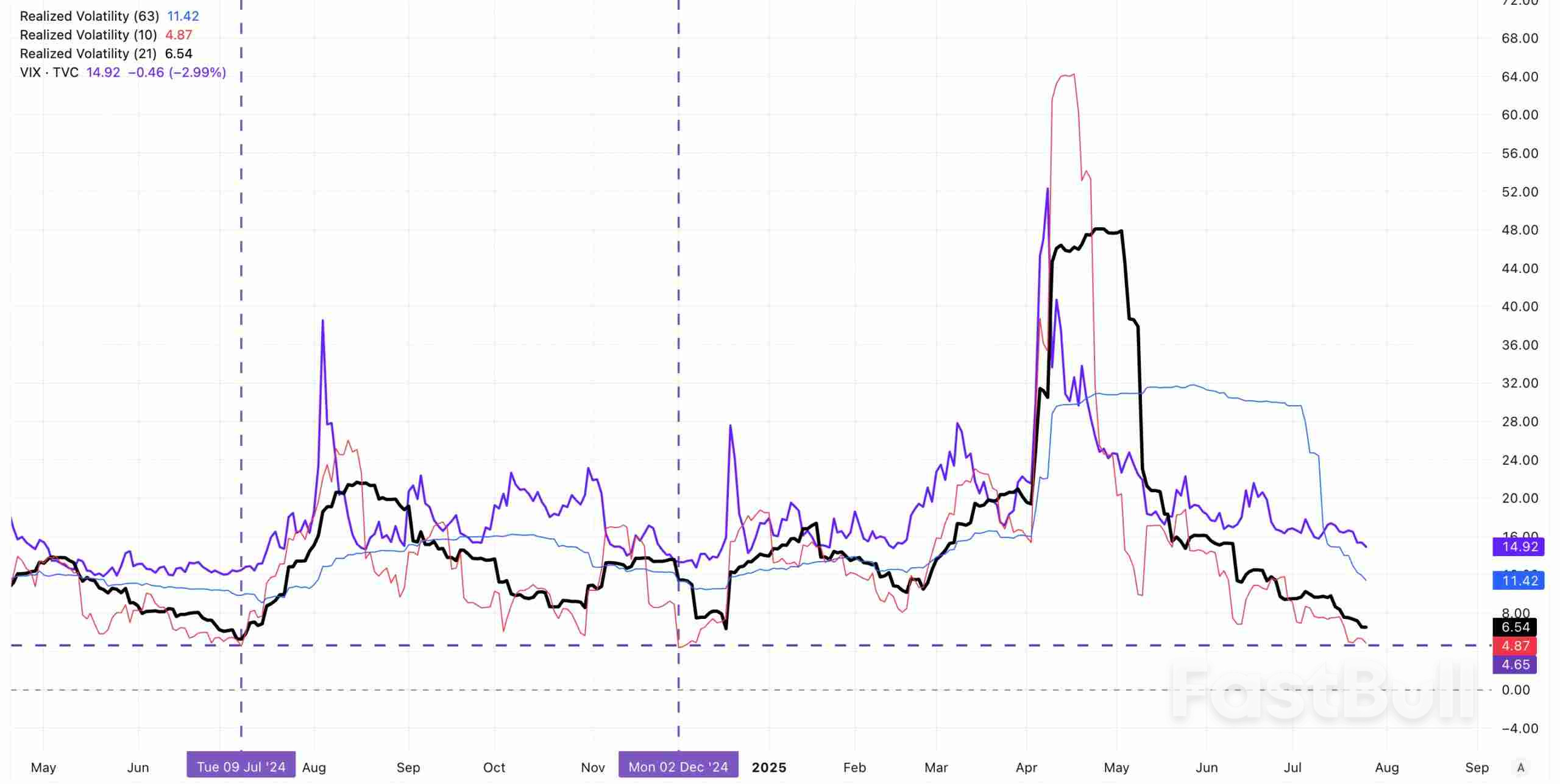
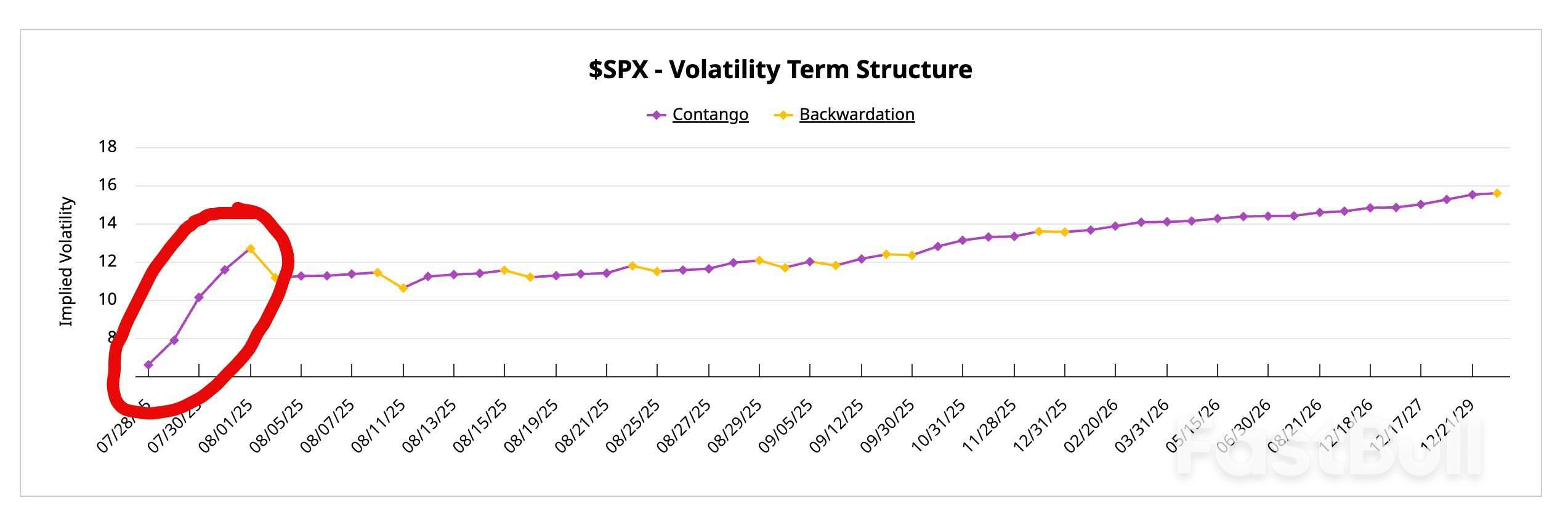
          Yet, remarkably, the market doesn’t seem the least bit concerned about any of this. Implied volatility for Monday sits at a breezy 6.6%, rising to a supposedly “ground-shaking” 12.7% by Friday. This must be a joke, right? It has to be…
          Stocks Week Ahead: Complacent S&P 500 Bulls Face an Avalanche of News_1
          If the market continues trading in the tight ranges we’ve seen in recent weeks, even after all this news, I would be shocked. Something wouldn’t just be wrong—it would be completely broken. For 1-month realized volatility to fall further, we’d need daily trading ranges of less than 40 bps. To push the 10-day realized volatility lower, the index would need to trade in ranges narrower than 30 basis points per day.
          Stocks Week Ahead: Complacent S&P 500 Bulls Face an Avalanche of News_2
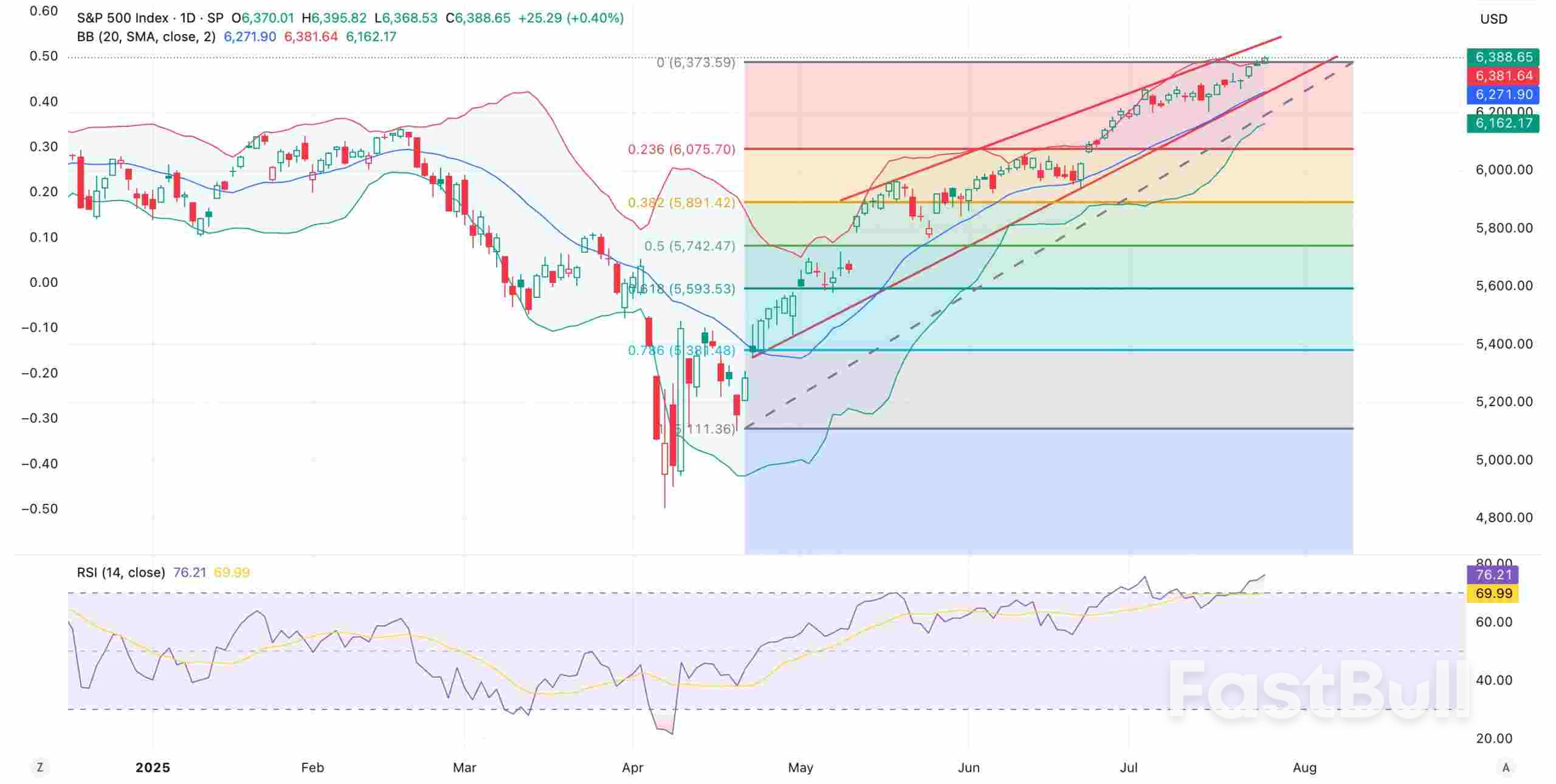
          I’ve noted repeatedly that the end of last week marked the window when the implied correlation should begin to rise, potentially signaling a market top. So far, that hasn’t happened, but the window remains open through the end of this week, especially given the major earnings reports still due from META, MSFT, AAPL, and AMZN.
          On top of that, the S&P 500 is now in overbought territory, with an RSI of 76, and is trading above its upper Bollinger Band.
          Stocks Week Ahead: Complacent S&P 500 Bulls Face an Avalanche of News_3
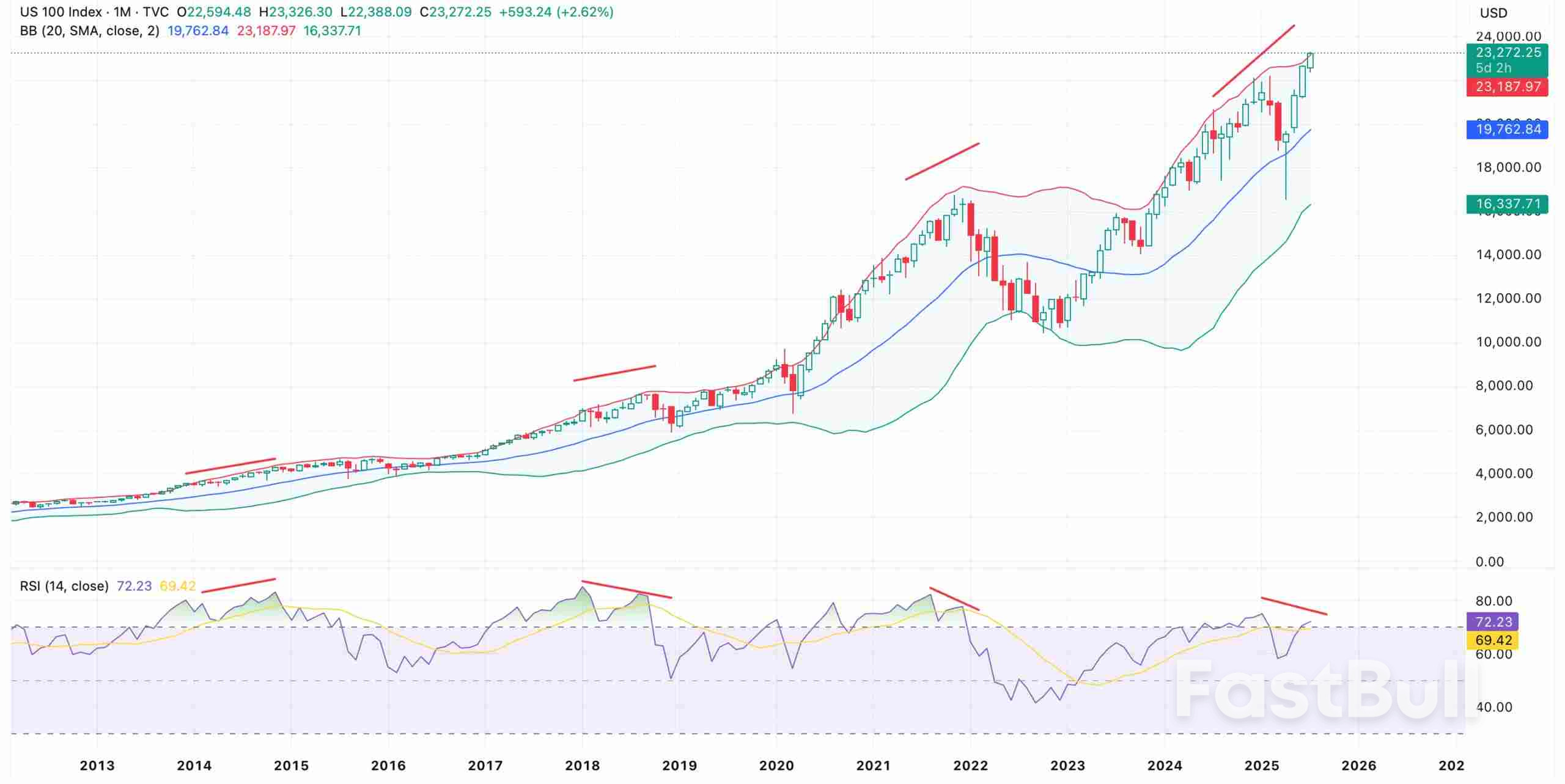
          Not only that, but the NASDAQ 100 is also overbought on the monthly chart, with an RSI above 72 and trading above its upper Bollinger Band. Additionally, notice the price is rising while the RSI is forming a lower high—a divergence pattern similar to what occurred in 2018 and 2021.
          Stocks Week Ahead: Complacent S&P 500 Bulls Face an Avalanche of News_4
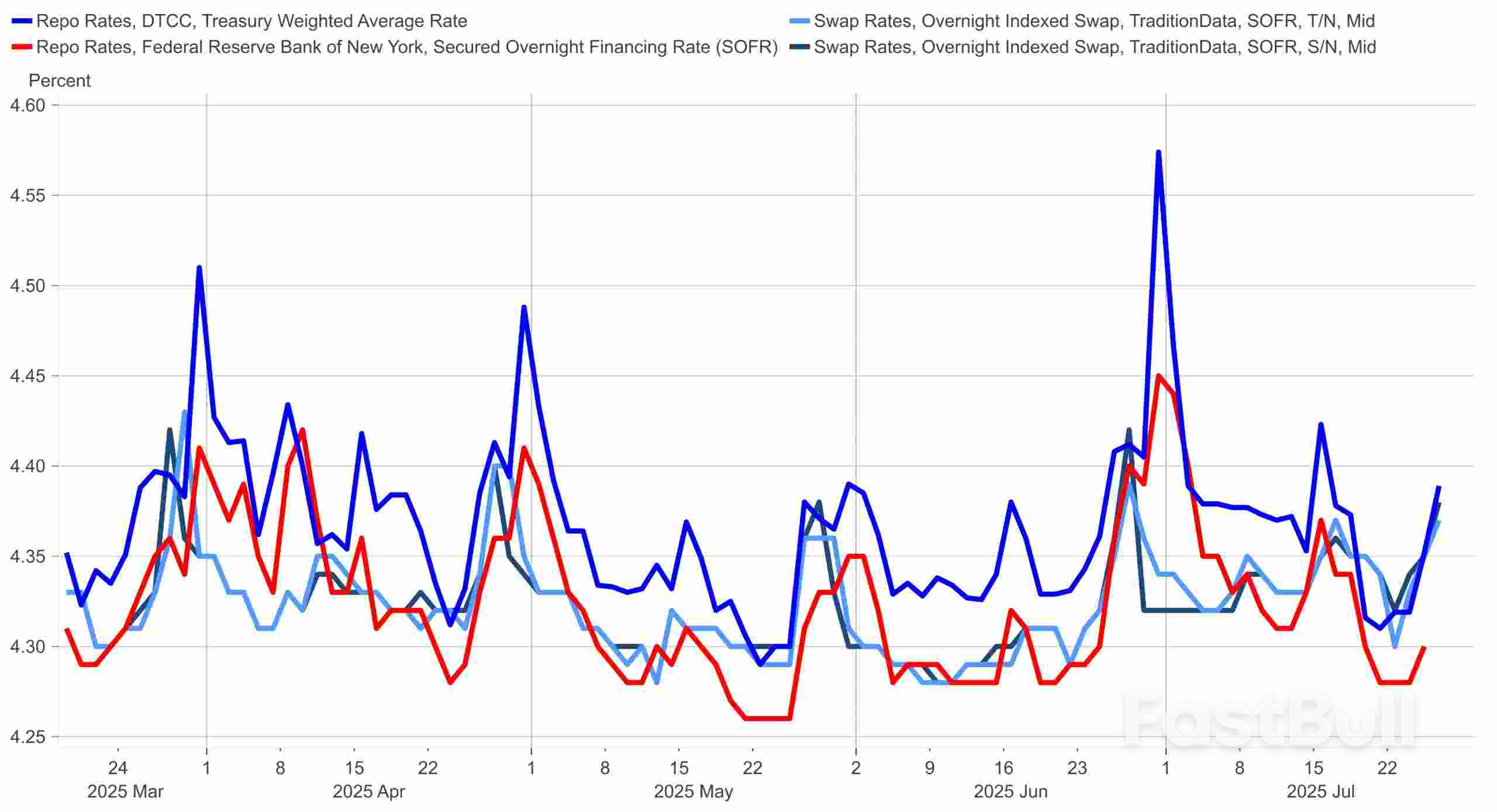
          Additionally, as month-end approaches, liquidity typically becomes a concern—a problem compounded this week by significant Treasury settlements, which are likely to drive a more pronounced rise in the Treasury General Account (TGA). Overnight repo rates have already begun to increase, suggesting SOFR will move higher on Monday and will need to be watched during the week.
          Stocks Week Ahead: Complacent S&P 500 Bulls Face an Avalanche of News_5
          Overall, a lot is going on this week, yet the market appears overly complacent. Given the sheer volume of news flow, I would be genuinely surprised if volatility remains this tight for much longer.

          Source: investing

          Risk Warnings and Disclaimers
          You understand and acknowledge that there is a high degree of risk involved in trading. Following any strategies or investment methods may lead to potential losses. The content on the site is provided by our contributors and analysts for information purposes only. You are solely responsible for determining whether any trading assets, securities, strategy, or any other product is suitable for investing based on your own investment objectives and financial situation.
          Add to Favorites
          Share

          Markets Hope For One Thing From US-China Tariff Talks: Another 90-day Extension

          Thomas

          Economic

          US and Chinese trade negotiators are meeting this week for at least two days of trade talks as most of the immediate term focus — at least from markets — remains on whether recent de-escalatory signals between the two superpowers will translate into a further delay of punishing additional tariffs.

          Trump officials also hope this third gathering of the trade teams in recent months will provide an opportunity to pivot to longer-term issues even as a short-term deadline of Aug. 12 remains front of mind.

          The talks are being closely watched for whether they move the countries toward a face-to-face later this year between Presidents Trump and Xi Jinping as well as whether negotiators can solidify recent gains, such as a lessening of tensions around semiconductors and rare earth minerals.

          "We have a good relationship with China," President Trump said Monday just after his team stepped into the talks.

          He signaled his focus could be on market access, saying "I'd love to see China open up their country."

          Chinese state media also confirmed Monday that talks were underway at the Rosenbad building in Stockholm without providing additional details.

          The talks come during another crucial week for Trump's trade agenda, with a separate deadline looming this Friday for other countries to strike a deal after a pact was announced with the European Union Sunday setting 15% tariffs. Other major trading partners from Canada to South Korea are still in talks.

          Yet the recent momentum on trade for Trump could have a limited impact on the more complex talks with China.

          Zoe Liu, a senior fellow at the Council on Foreign Relations, noted on Yahoo Finance Monday morning that she does not think "the EU's model is going to be a good template for U.S.China negotiation" — pointing to how China has already proved a willingness to retaliate and that the country has key points of leverage and "knows exactly where to hit back."

          Terry Haines, Pangaea Policy Founder, added that potential carrots from China could also have less impact.

          He noted how foreign investment has been a key piece of recent deals — both with Europe and another pact with Japan — but that in the China context "they don't want Chinese investment in a lot of areas" — citing an effort to remove the influence of Chinese money in areas ranging from social media app TikTok to land purchases in the US.

          China's Vice Premier He Lifeng waves as he arrives on July 28 for trade talks. (FREDRIK SANDBERG/TT News Agency/AFP via Getty Images) · FREDRIK SANDBERG via Getty Images

          Overall talks seen as 'going in the right direction'

          The China talks are being led on the US side by Treasury Secretary Scott Bessent with He Lifeng, the China's vice premier for economic policy, representing his country

          Source: Yahoo Finance

          To stay updated on all economic events of today, please check out our Economic calendar
          Risk Warnings and Disclaimers
          You understand and acknowledge that there is a high degree of risk involved in trading. Following any strategies or investment methods may lead to potential losses. The content on the site is provided by our contributors and analysts for information purposes only. You are solely responsible for determining whether any trading assets, securities, strategy, or any other product is suitable for investing based on your own investment objectives and financial situation.
          Add to Favorites
          Share

          Four Themes Powering Europe's Equity Bull Market

          Winkelmann

          Stocks

          Economic

          The STOXX 600 posted its best first-quarter relative to the S&P 500 in a decade - but is now clocking an 8.4% gain in 2025, just a touch ahead of the S&P 500's 8.2% rise.

          The European Union over the weekend reached a framework deal with the U.S. for tariffs of 15%. But optimism has been building for some time that the two sides would avert a damaging trade war and the data points to an economy that is holding up for now. Investors are warming to four key themes at play under the surface of the European stock market.

          1) EXPORTERS LAG DOMESTIC-FOCUSED STOCKS

          A performance gap has emerged between euro zone domestic-focused stocks and exporters, all thanks to a stronger euro, which has risen 13.4% versus the dollar in 2025 , hurting exporter earnings.

          Trade-sensitive sectors like autos and consumer durables have fallen behind, while domestically-oriented stocks like banks and utilities have soared.

          A STOXX autos basket , opens new tab added over 3% last week after news of a U.S.-Japan trade deal, but is still about 1% lower in 2025, a stark contrast to a 35% increase in bank stocks, opens new tab and 15% surge in utilities.
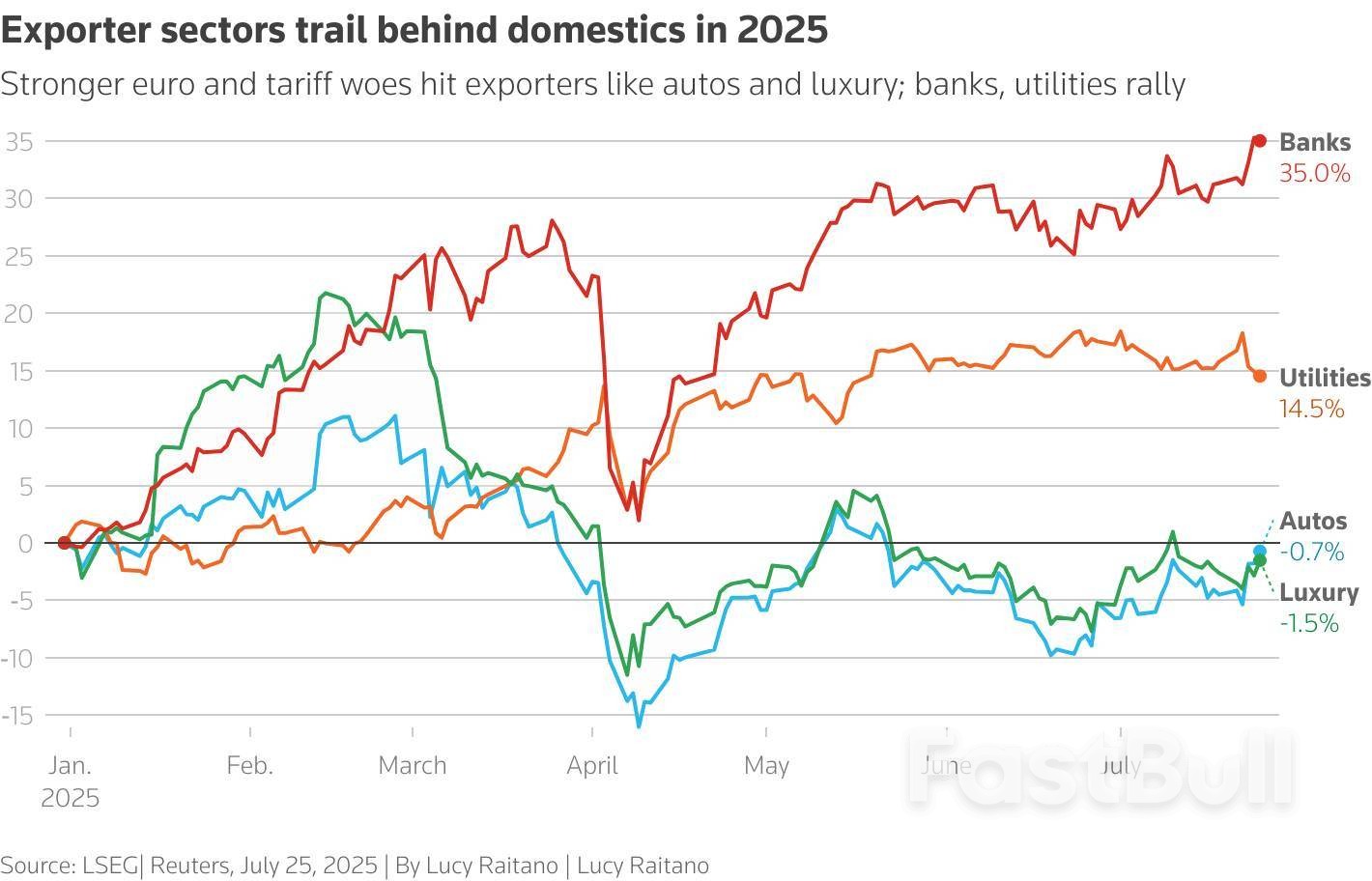
          Line chart showing the year-to-date performance of autos, luxury, utilities and bank stocks in Europe

          Analysts have been revising down overall 2025 earnings forecasts in Europe, but zooming in, there is a clear split between the pace of earnings revisions for euro zone exporters versus domestic plays, with the forward EPS of exporters dropping at an accelerated pace.JPMorgan equity strategists advise clients to keep favouring domestics over exporters in their non-U.S. portfolios, while Barclays equity strategists say the current positioning gap is so extreme that the risk of a reversal is rising.
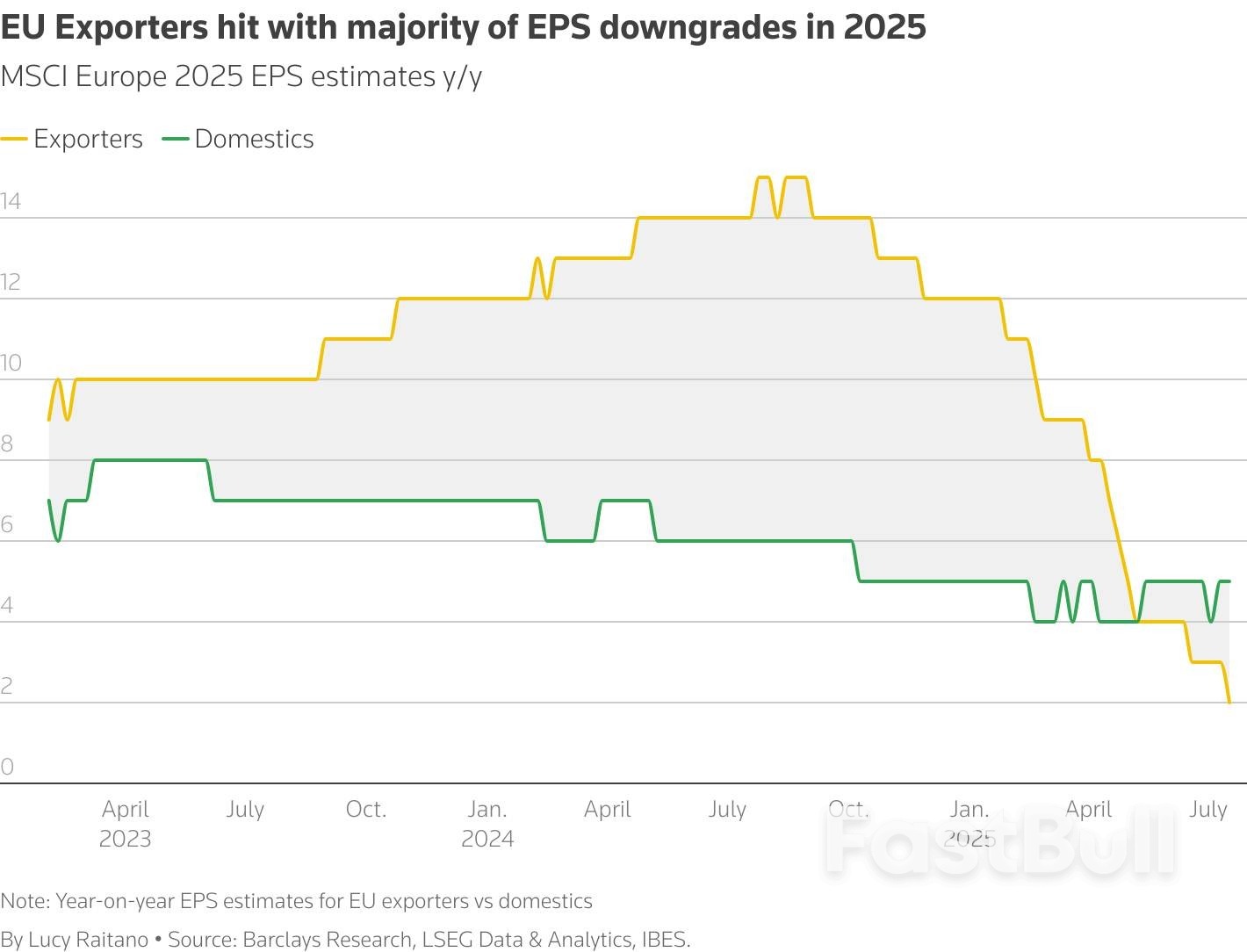
          Line chart shows year-on-year EPS estimates revisions for both EU exporters versus EU domestics, with exporters showing a more dramatic drop in 2025 versus domestics

          Helen Jewell, CIO of BlackRock Fundamental Equities EMEA, flagged select opportunities in the export-focused luxury and semiconductor sectors.

          "If we get some resolution of where the tariffs are and if we get some sort of levelling out of the dollar, I think these names will start to perform well, and that could potentially be the second leg for the European story,” Jewell said.

          2) HALO EFFECT

          Germany's massive spending plans, aimed at boosting the country's economy after decades of fiscal conservatism, brought optimism to broader European markets, as EU companies are set to benefit from increased spending on defense and infrastructure.The U.S. tariff announcement in April caused a massive stock sell-off, but the German DAX , has since recovered to touch a fresh year high in July. Midcap stocks , have followed a similar path. Both indexes are up over 20% this year and set for their strongest annual performance since 2019.

          "The relevance of Germany as a market for EU countries is great," Uwe Hohmann, equity strategist at Metzler Capital Markets said, pointing to the country's strong trade relationship with other EU states.Germany's spending plans will have a modest effect on European growth, according to the European Commission's spring economic forecasts, but the market impact is expected to be profound.

          "...the optimism around the German fiscal balance will still be the main driver of European markets in the next years," said Nabil Milali, portfolio manager at Edmond de Rothschild Asset Management, warning however that money will not concretely flow into the economy until 2026 at least.A potential deterioration in trade relationships with the U.S. or China could dampen sentiment on European equity markets, at least in the short term.

          "It would then only and mostly solely depend on what's going on in the German political arena, which is, I think, probably not good enough on a standalone basis to support an overall positive trend," said Hohmann.
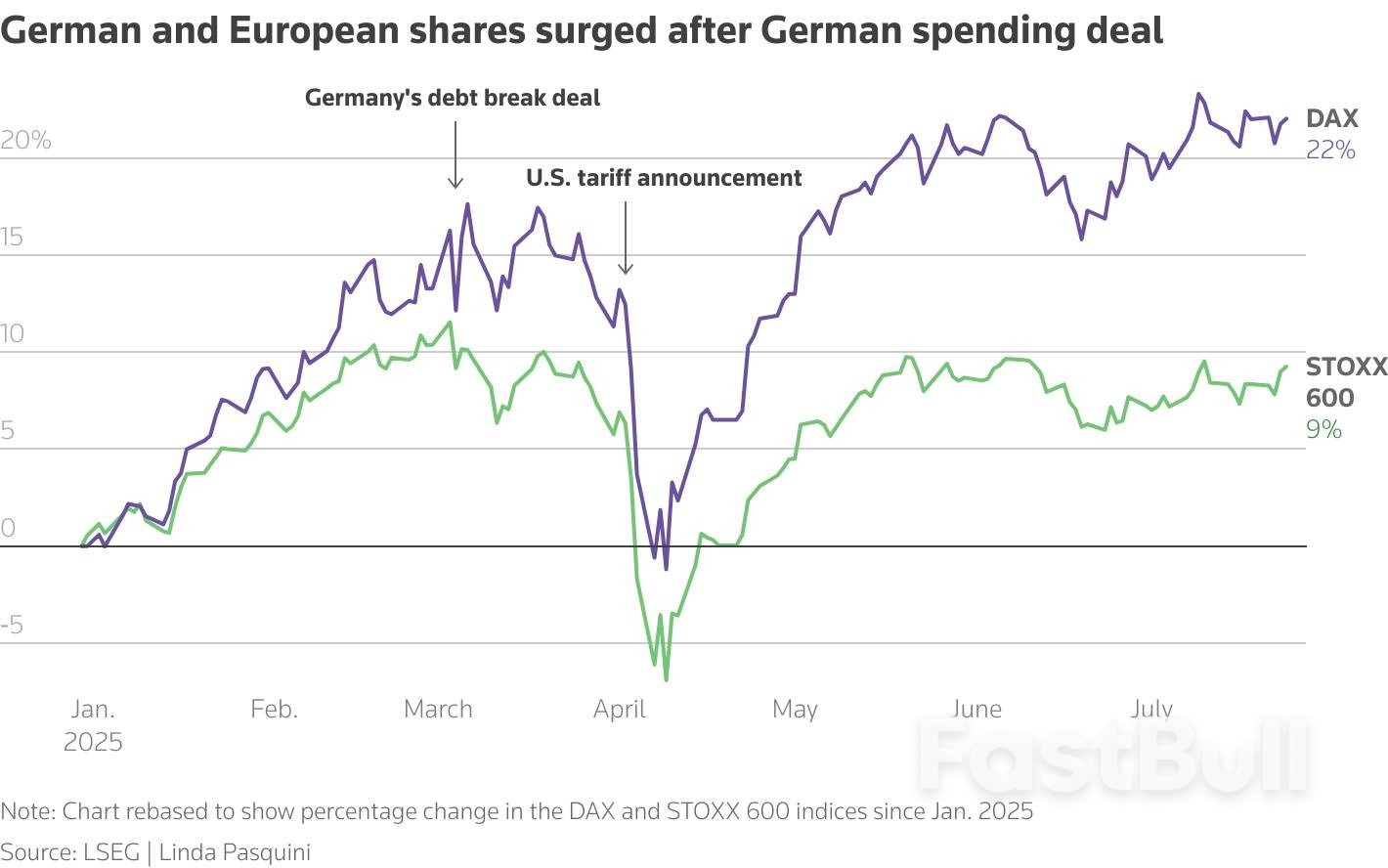
          Chart shows percentage change in the DAX and STOXX 600 indices since Jan. 2025

          3) SMALL CAPS STEAL THE SPOTLIGHT

          European small-caps are on track to outperform large-caps in Europe for the first time since 2020.

          A basket of European small caps, opens new tab is up 13.4% in 2025, outperforming its large cap counterpart , opens new tab which is up 9.1%, for the first time since 2020. Since April, Graham Secker, head of equity strategy, Pictet Wealth Management said a stronger euro and better economic outlook have driven the small-cap turnaround."European small-caps were the proverbial value-trap: you're cheap but you stay cheap until something changes," said Secker, adding that in illiquid areas of the market, it doesn't take much to move the dial."There has been a lot of interest with the fiscal stimulus announcement out of Germany for revisiting German mid- and small-caps, as probably the cleanest way to play the fiscal push that's coming through Europe," Secker said.
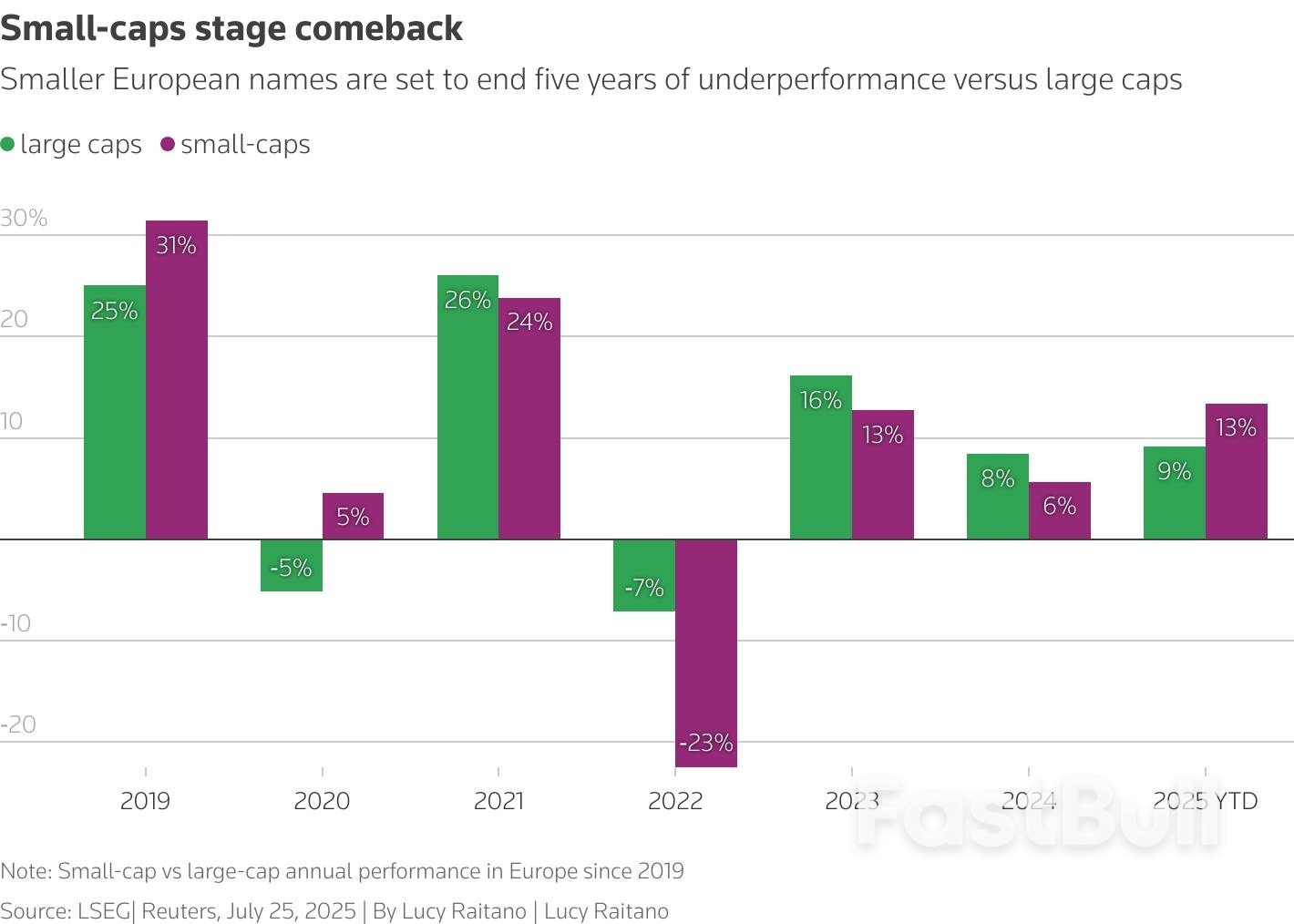
          Bar chart comparing the annual performance of European small cap stocks versus large cap stocks, with small caps posting their first outperformance vs larger ones since 2019

          4) SMALLER MARKETS ALSO PACK A PUNCH

          Talking size, some smaller markets have also been outperforming the wider European landscape this year.

          Indexes in Czech Republic opens new tab, Greece, opens new tab and Poland , opens new tab have added 25%, 35% and 37%, respectively, compared with an 8% rise in the STOXX 600.

          "I think the positioning of investors is going more and more towards these smaller markets" which are benefiting from sectorial factors and higher exposure to the domestic economy, said Edmond de Rothschild's Milali.
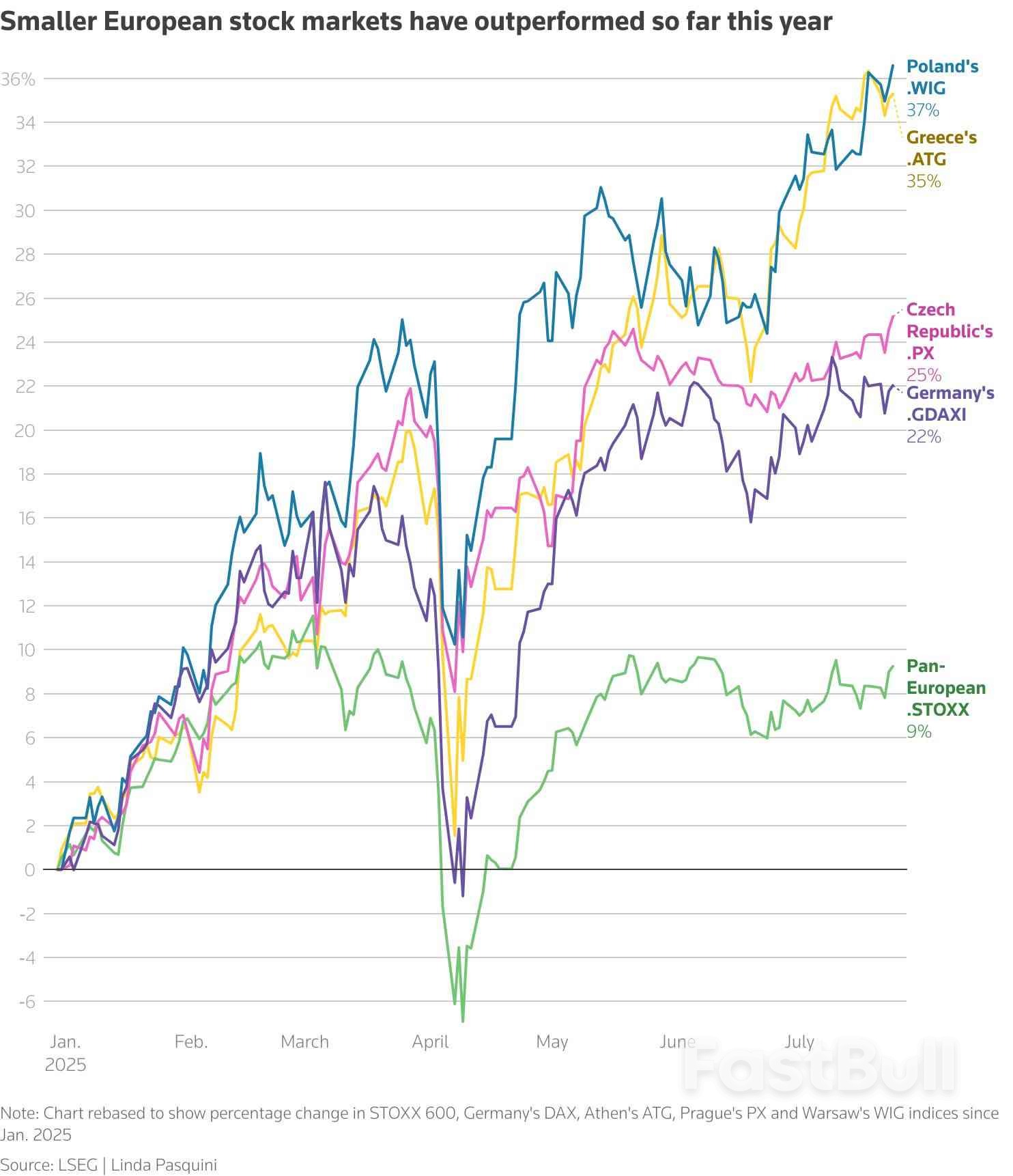
          Chart shows percentage change in STOXX 600, Germany's DAX, Athen's ATG, Prague's PX and Warsaw's WIG indices since Jan. 2025

          Source: Reuters

          To stay updated on all economic events of today, please check out our Economic calendar
          Risk Warnings and Disclaimers
          You understand and acknowledge that there is a high degree of risk involved in trading. Following any strategies or investment methods may lead to potential losses. The content on the site is provided by our contributors and analysts for information purposes only. You are solely responsible for determining whether any trading assets, securities, strategy, or any other product is suitable for investing based on your own investment objectives and financial situation.
          Add to Favorites
          Share
          FastBull
          Copyright © 2025 FastBull Ltd

          728 RM B 7/F GEE LOK IND BLDG NO 34 HUNG TO RD KWUN TONG KLN HONG KONG

          TelegramInstagramTwitterfacebooklinkedin
          App Store Google Play Google Play
          Products
          Charts

          Chats

          Q&A with Experts
          Screeners
          Economic Calendar
          Data
          Tools
          Membership
          Features
          Function
          Markets
          Copy Trading
          Latest Signals
          Contests
          News
          Analysis
          24/7
          Columns
          Education
          Company
          Careers
          About Us
          Contact Us
          Advertising
          Help Center
          Feedback
          User Agreement
          Privacy Policy
          Business

          White Label

          Data API

          Web Plug-ins

          Poster Maker

          Affiliate Program

          Risk Disclosure

          The risk of loss in trading financial instruments such as stocks, FX, commodities, futures, bonds, ETFs and crypto can be substantial. You may sustain a total loss of the funds that you deposit with your broker. Therefore, you should carefully consider whether such trading is suitable for you in light of your circumstances and financial resources.

          No decision to invest should be made without thoroughly conducting due diligence by yourself or consulting with your financial advisors. Our web content might not suit you since we don't know your financial conditions and investment needs. Our financial information might have latency or contain inaccuracy, so you should be fully responsible for any of your trading and investment decisions. The company will not be responsible for your capital loss.

          Without getting permission from the website, you are not allowed to copy the website's graphics, texts, or trademarks. Intellectual property rights in the content or data incorporated into this website belong to its providers and exchange merchants.

          Not Logged In

          Log in to access more features

          FastBull Membership

          Not yet

          Purchase

          Become a signal provider
          Help Center
          Customer Service
          Dark Mode
          Price Up/Down Colors

          Log In

          Sign Up

          Position
          Layout
          Fullscreen
          Default to Chart
          The chart page opens by default when you visit fastbull.com