• Trade
  • Markets
  • Copy
  • Contests
  • News
  • 24/7
  • Calendar
  • Q&A
  • Chats
Trending
Screeners
SYMBOL
LAST
BID
ASK
HIGH
LOW
NET CHG.
%CHG.
SPREAD
SPX
S&P 500 Index
6827.42
6827.42
6827.42
6899.86
6801.80
-73.58
-1.07%
--
DJI
Dow Jones Industrial Average
48458.04
48458.04
48458.04
48886.86
48334.10
-245.98
-0.51%
--
IXIC
NASDAQ Composite Index
23195.16
23195.16
23195.16
23554.89
23094.51
-398.69
-1.69%
--
USDX
US Dollar Index
97.950
98.030
97.950
98.500
97.950
-0.370
-0.38%
--
EURUSD
Euro / US Dollar
1.17394
1.17409
1.17394
1.17496
1.17192
+0.00011
+ 0.01%
--
GBPUSD
Pound Sterling / US Dollar
1.33707
1.33732
1.33707
1.33997
1.33419
-0.00148
-0.11%
--
XAUUSD
Gold / US Dollar
4299.39
4299.39
4299.39
4353.41
4257.10
+20.10
+ 0.47%
--
WTI
Light Sweet Crude Oil
57.233
57.485
57.233
58.011
56.969
-0.408
-0.71%
--

Community Accounts

Signal Accounts
--
Profit Accounts
--
Loss Accounts
--
View More

Become a signal provider

Sell trading signals to earn additional income

View More

Guide to Copy Trading

Get started with ease and confidence

View More

Signal Accounts for Members

All Signal Accounts

Best Return
  • Best Return
  • Best P/L
  • Best MDD
Past 1W
  • Past 1W
  • Past 1M
  • Past 1Y

All Contests

  • All
  • Trump Updates
  • Recommend
  • Stocks
  • Cryptocurrencies
  • Central Banks
  • Featured News
Top News Only
Share

China's Central Financial And Economic Affairs Commission Deputy Director: Will Expand Export And Increase Import In 2026

Share

Thai Leader Anutin: Landmine Blast That Killed Thai Soldiers 'Not A Roadside Accident'

Share

Thai Leader Anutin: Thailand To Continue Military Action Until 'We Feel No More Harm'

Share

Cambodian Prime Minister Hun Manet Says He Had Phone Calls With Trump And Malaysian Leader Anwar About Ceasefire

Share

Cambodia's Hun Manet Says USA, Malaysia Should Verify 'Which Side Fired First' In Latest Conflict

Share

Cambodia's Hun Manet: Cambodia Maintains Its Stance In Seeking Peaceful Resolution Of Disputes

Share

Nasdaq Companies: Allergan, Ferrovia, Insmed, Monolithic Power Systems, Seagate Technology, And Western Digital Will Be Added To The NASDAQ 100 Index. Biogen, CdW, GlobalFoundries, Lululemon, ON Semiconductor, And Tradedesk Will Be Removed From The NASDAQ 100 Index

Share

Witkoff Headed To Berlin This Weekend To Meet With Zelenskiy, European Leaders -Wsj Reporter On X

Share

Russia Attacks Two Ukrainian Ports, Damaging Three Turkish-Owned Vessels

Share

[Historic Flooding Occurs In At Least Four Rivers In Washington State Due To Days Of Torrential Rains] Multiple Areas In Washington State Have Been Hit By Severe Flooding Due To Days Of Torrential Rains, With At Least Four Rivers Experiencing Historic Flooding. Reporters Learned On The 12th That The Floods Caused By The Torrential Rains In Washington State Have Destroyed Homes And Closed Several Highways. Experts Warn That Even More Severe Flooding May Occur In The Future. A State Of Emergency Has Been Declared In Washington State

Share

Trump Says Proposed Free Economic Zone In Donbas Would Work

Share

Trump: I Think My Voice Should Be Heard

Share

Trump Says Will Be Choosing New Fed Chair In Near Future

Share

Trump Says Proposed Free Economic Zone In Donbas Complex But Would Work

Share

Trump Says Land Strikes In Venezuela Will Start Happening

Share

US President Trump: Thailand And Cambodia Are In A Good Situation

Share

State Media: North Korean Leader Kim Hails Troops Returning From Russia Mission

Share

The 10-year Treasury Yield Rose About 5 Basis Points During The "Fed Rate Cut Week," And The 2/10-year Yield Spread Widened By About 9 Basis Points. On Friday (December 12), In Late New York Trading, The Yield On The Benchmark 10-year US Treasury Note Rose 2.75 Basis Points To 4.1841%, A Cumulative Increase Of 4.90 Basis Points For The Week, Trading Within A Range Of 4.1002%-4.2074%. It Rose Steadily From Monday To Wednesday (before The Fed Announced Its Rate Cut And Treasury Bill Purchase Program), Subsequently Exhibiting A V-shaped Recovery. The 2-year Treasury Yield Fell 1.82 Basis Points To 3.5222%, A Cumulative Decrease Of 3.81 Basis Points For The Week, Trading Within A Range Of 3.6253%-3.4989%

Share

Trump: Lots Of Progress Being Made On Russia-Ukraine

Share

NOPA November US Soybean Crush Estimated At 220.285 Million Bushels

TIME
ACT
FCST
PREV
U.K. Trade Balance Non-EU (SA) (Oct)

A:--

F: --

P: --

U.K. Trade Balance (Oct)

A:--

F: --

P: --

U.K. Services Index MoM

A:--

F: --

P: --

U.K. Construction Output MoM (SA) (Oct)

A:--

F: --

P: --

U.K. Industrial Output YoY (Oct)

A:--

F: --

P: --

U.K. Trade Balance (SA) (Oct)

A:--

F: --

P: --

U.K. Trade Balance EU (SA) (Oct)

A:--

F: --

P: --

U.K. Manufacturing Output YoY (Oct)

A:--

F: --

P: --

U.K. GDP MoM (Oct)

A:--

F: --

P: --

U.K. GDP YoY (SA) (Oct)

A:--

F: --

P: --

U.K. Industrial Output MoM (Oct)

A:--

F: --

P: --

U.K. Construction Output YoY (Oct)

A:--

F: --

P: --

France HICP Final MoM (Nov)

A:--

F: --

P: --

China, Mainland Outstanding Loans Growth YoY (Nov)

A:--

F: --

P: --

China, Mainland M2 Money Supply YoY (Nov)

A:--

F: --

P: --

China, Mainland M0 Money Supply YoY (Nov)

A:--

F: --

P: --

China, Mainland M1 Money Supply YoY (Nov)

A:--

F: --

P: --

India CPI YoY (Nov)

A:--

F: --

P: --

India Deposit Gowth YoY

A:--

F: --

P: --

Brazil Services Growth YoY (Oct)

A:--

F: --

P: --

Mexico Industrial Output YoY (Oct)

A:--

F: --

P: --

Russia Trade Balance (Oct)

A:--

F: --

P: --

Philadelphia Fed President Henry Paulson delivers a speech
Canada Building Permits MoM (SA) (Oct)

A:--

F: --

P: --

Canada Wholesale Sales YoY (Oct)

A:--

F: --

P: --

Canada Wholesale Inventory MoM (Oct)

A:--

F: --

P: --

Canada Wholesale Inventory YoY (Oct)

A:--

F: --

P: --

Canada Wholesale Sales MoM (SA) (Oct)

A:--

F: --

P: --

Germany Current Account (Not SA) (Oct)

A:--

F: --

P: --

U.S. Weekly Total Rig Count

A:--

F: --

P: --

U.S. Weekly Total Oil Rig Count

A:--

F: --

P: --

Japan Tankan Large Non-Manufacturing Diffusion Index (Q4)

--

F: --

P: --

Japan Tankan Small Manufacturing Outlook Index (Q4)

--

F: --

P: --

Japan Tankan Large Non-Manufacturing Outlook Index (Q4)

--

F: --

P: --

Japan Tankan Large Manufacturing Outlook Index (Q4)

--

F: --

P: --

Japan Tankan Small Manufacturing Diffusion Index (Q4)

--

F: --

P: --

Japan Tankan Large Manufacturing Diffusion Index (Q4)

--

F: --

P: --

Japan Tankan Large-Enterprise Capital Expenditure YoY (Q4)

--

F: --

P: --

U.K. Rightmove House Price Index YoY (Dec)

--

F: --

P: --

China, Mainland Industrial Output YoY (YTD) (Nov)

--

F: --

P: --

China, Mainland Urban Area Unemployment Rate (Nov)

--

F: --

P: --

Saudi Arabia CPI YoY (Nov)

--

F: --

P: --

Euro Zone Industrial Output YoY (Oct)

--

F: --

P: --

Euro Zone Industrial Output MoM (Oct)

--

F: --

P: --

Canada Existing Home Sales MoM (Nov)

--

F: --

P: --

Euro Zone Total Reserve Assets (Nov)

--

F: --

P: --

U.K. Inflation Rate Expectations

--

F: --

P: --

Canada National Economic Confidence Index

--

F: --

P: --

Canada New Housing Starts (Nov)

--

F: --

P: --

U.S. NY Fed Manufacturing Employment Index (Dec)

--

F: --

P: --

U.S. NY Fed Manufacturing Index (Dec)

--

F: --

P: --

Canada Core CPI YoY (Nov)

--

F: --

P: --

Canada Manufacturing Unfilled Orders MoM (Oct)

--

F: --

P: --

Canada Manufacturing New Orders MoM (Oct)

--

F: --

P: --

Canada Core CPI MoM (Nov)

--

F: --

P: --

Canada Manufacturing Inventory MoM (Oct)

--

F: --

P: --

Canada CPI YoY (Nov)

--

F: --

P: --

Canada CPI MoM (Nov)

--

F: --

P: --

Canada CPI YoY (SA) (Nov)

--

F: --

P: --

Canada Core CPI MoM (SA) (Nov)

--

F: --

P: --

Q&A with Experts
    • All
    • Chatrooms
    • Groups
    • Friends
    Connecting
    .
    .
    .
    Type here...
    Add Symbol or Code

      No matching data

      All
      Trump Updates
      Recommend
      Stocks
      Cryptocurrencies
      Central Banks
      Featured News
      • All
      • Russia-Ukraine Conflict
      • Middle East Flashpoint
      • All
      • Russia-Ukraine Conflict
      • Middle East Flashpoint
      Search
      Products

      Charts Free Forever

      Chats Q&A with Experts
      Screeners Economic Calendar Data Tools
      Membership Features
      Data Warehouse Market Trends Institutional Data Policy Rates Macro

      Market Trends

      Market Sentiment Order Book Forex Correlations

      Top Indicators

      Charts Free Forever
      Markets

      News

      News Analysis 24/7 Columns Education
      From Institutions From Analysts
      Topics Columnists

      Latest Views

      Latest Views

      Trending Topics

      Top Columnists

      Latest Update

      Signals

      Copy Rankings Latest Signals Become a signal provider AI Rating
      Contests
      Brokers

      Overview Brokers Assessment Rankings Regulators News Claims
      Broker listing Forex Brokers Comparison Tool Live Spread Comparison Scam
      Q&A Complaint Scam Alert Videos Tips to Detect Scam
      More

      Business
      Events
      Careers About Us Advertising Help Center

      White Label

      Data API

      Web Plug-ins

      Affiliate Program

      Awards Institution Evaluation IB Seminar Salon Event Exhibition
      Vietnam Thailand Singapore Dubai
      Fans Party Investment Sharing Session
      FastBull Summit BrokersView Expo
      Recent Searches
        Top Searches
          Markets
          News
          Analysis
          User
          24/7
          Economic Calendar
          Education
          Data
          • Names
          • Latest
          • Prev

          View All

          No data

          Scan to Download

          Faster Charts, Chat Faster!

          Download App
          English
          • English
          • Español
          • العربية
          • Bahasa Indonesia
          • Bahasa Melayu
          • Tiếng Việt
          • ภาษาไทย
          • Français
          • Italiano
          • Türkçe
          • Русский язык
          • 简中
          • 繁中
          Open Account
          Search
          Products
          Charts Free Forever
          Markets
          News
          Signals

          Copy Rankings Latest Signals Become a signal provider AI Rating
          Contests
          Brokers

          Overview Brokers Assessment Rankings Regulators News Claims
          Broker listing Forex Brokers Comparison Tool Live Spread Comparison Scam
          Q&A Complaint Scam Alert Videos Tips to Detect Scam
          More

          Business
          Events
          Careers About Us Advertising Help Center

          White Label

          Data API

          Web Plug-ins

          Affiliate Program

          Awards Institution Evaluation IB Seminar Salon Event Exhibition
          Vietnam Thailand Singapore Dubai
          Fans Party Investment Sharing Session
          FastBull Summit BrokersView Expo

          Trump Dismisses Marjorie Taylor Greene’s Claim That His Attacks Put Her In Danger

          Samantha Luan

          Political

          Economic

          Summary:

          U.S. President Donald Trump doubled down on his attacks against Republican lawmaker Marjorie Taylor Greene on Sunday, dismissing her claim that his criticism was endangering her and saying he did not believe anyone was targeting her.

          U.S. President Donald Trump doubled down on his attacks against Republican lawmaker Marjorie Taylor Greene on Sunday, dismissing her claim that his criticism was endangering her and saying he did not believe anyone was targeting her.

          Greene said on Saturday that Trump's online criticism had unleashed a surge of threats directed at her. On Sunday morning, she told CNN that Trump calling her a traitor was the "most hurtful" part of his remarks.

          Trump repeated the insult hours later. "Marjorie 'Traitor' Greene," he said, referring to the lawmaker. "I don't think her life is in danger...I don't think anybody cares about her," the president told reporters before boarding Air Force One on Sunday night for a return to Washington, D.C. from his Mar-a-Lago social club in Florida.

          Greene, a U.S. House of Representatives member from Georgia who was long known as a Trump loyalist, has recently taken positions at odds with the president. She said on Saturday she has been contacted by private security firms warning about her safety and that harsh attacks against her have previously resulted in death threats.

          She attributed her split with the president to her support for releasing records related to the late financier and sex offender Jeffrey Epstein.

          Trump has dismissed the furor over the Epstein case as a "hoax" pushed by Democrats, but Greene on Wednesday was one of only four House Republicans who joined Democrats in signing a petition to force a vote on releasing the full Justice Department files related to Epstein.

          The dramatic rupture between two longtime allies suggests a deeper fracture within Trump's Republican base and raises questions about the stability of his support on the far right of the ideological spectrum.

          Trump broke with Greene on Friday night in a withering social media post in which he referred to Greene as "Wacky" and a "ranting lunatic" who complained he would not take her calls.

          He continued his criticism of her with more social media posts over the weekend, calling her a "Lightweight Congresswoman," "Traitor" and a "disgrace" to the Republican Party.

          The president also wrote that conservative voters in Greene's district might consider a primary challenger and that he would support the right candidate against her in next year's congressional election.

          Despite his attacks on Greene, Trump on Sunday night wrote on social media that "House Republicans should vote to release the Epstein files, because we have nothing to hide ..."

          Over the weekend, Trump had persistently pushed back against reporters' questions about releasing the Epstein files. Reflecting his often combative relationship with media, at one point he said "quiet, quiet piggy" in response to a question from a female reporter.

          The White House did not respond to requests for comment on the clash between Greene and Trump or his remarks to the reporter.

          Source: Investing

          To stay updated on all economic events of today, please check out our Economic calendar
          Risk Warnings and Disclaimers
          You understand and acknowledge that there is a high degree of risk involved in trading. Following any strategies or investment methods may lead to potential losses. The content on the site is provided by our contributors and analysts for information purposes only. You are solely responsible for determining whether any trading assets, securities, strategy, or any other product is suitable for investing based on your own investment objectives and financial situation.
          Add to Favorites
          Share

          China-Japan Tensions Rattle Tourism Stocks as Asia Markets Trade Mixed

          Gerik

          Economic

          Stocks

          Japan’s tourism sector reels from Beijing’s travel advisory

          Investor sentiment in Asia was shaken Monday as tensions between China and Japan escalated, with Beijing issuing a travel and study advisory warning its citizens about visits to Japan. This move triggered a sell-off in Japan’s tourism-exposed stocks, dragging the Nikkei 225 down by 0.72% to 50,011.53 and the Topix by 0.44%.
          Luxury and leisure brands took the biggest hit. Shiseido, heavily reliant on Chinese consumer spending, plummeted 11%. Department store group Isetan Mitsukoshi Holdings dropped over 10%, while Oriental Land, the operator of Tokyo Disney Resort, shed 4.74%. Shares of ANA Holdings, Japan’s leading airline, fell by 3.48%.
          The travel warning comes at a fragile moment for Japan’s economy, which contracted 0.4% in the third quarter its first shrinkage in six quarters though this was less severe than the 0.6% decline forecast by markets.

          Broader Asian markets reflect divergence in growth outlooks

          Outside of Japan, Asian markets posted varied performances. South Korea’s Kospi index stood out with a 1.78% surge, likely boosted by tech optimism and robust domestic trading. The Kosdaq also edged up 0.68%.
          In contrast, Hong Kong’s Hang Seng Index dropped 0.51% to 26,440.75, as investor caution prevailed, and the mainland’s CSI 300 was flat, reflecting subdued enthusiasm amid persistent economic concerns. The Shanghai Composite also lost ground, slipping 0.36%.
          Australia’s S&P/ASX 200 benchmark closed 0.29% lower at 8,609.10, amid profit-taking and mixed commodity signals. Meanwhile, traders awaited macroeconomic releases such as Thailand’s Q3 GDP and Singapore’s trade balance to gain further regional cues.

          Wall Street recovery offers limited support to Asia

          Friday’s intraday comeback in the U.S. stock market offered only mild relief to Asia. The Nasdaq Composite reversed losses to gain 0.13% to 22,900.59, after a steep tech-led drop earlier in the week. The S&P 500 finished flat at 6,734.11, while the Dow Jones fell 0.65% to 47,147.48 despite recovering from an earlier plunge of nearly 600 points.
          The reversal in U.S. equities, driven by bargain-hunting in tech stocks, indicated investor resilience but failed to fully lift Asian sentiment, especially with geopolitical risks overshadowing fundamentals in parts of the region.
          The mixed performance in Asia reflects a complex mix of geopolitical headwinds, export vulnerabilities, and domestic economic indicators. Japan remains particularly exposed to diplomatic strains with China, given its dependence on tourism and external demand. While South Korea’s tech sector provided a bright spot, the broader Asia-Pacific outlook remains fragile, with traders closely watching upcoming data and any policy signals from China and Japan as tensions continue to evolve.

          Source: CNBC

          To stay updated on all economic events of today, please check out our Economic calendar
          Risk Warnings and Disclaimers
          You understand and acknowledge that there is a high degree of risk involved in trading. Following any strategies or investment methods may lead to potential losses. The content on the site is provided by our contributors and analysts for information purposes only. You are solely responsible for determining whether any trading assets, securities, strategy, or any other product is suitable for investing based on your own investment objectives and financial situation.
          Add to Favorites
          Share

          China’s Trade Clout Can Quicken The Yuan’s Rise

          Samantha Luan

          Forex

          Economic

          A single word often makes a big difference in Chinese policy. In previous five-year economic development plans, for example, Beijing had always reiterated it wants to "prudently promote" yuan internationalisation. In an outline of the next 2026-2030 blueprint unveiled last month, the word "prudently" has been struck out. That signals bolder designs for the renminbi, though progress will be limited so long as economic planners keep tight control over capital flows.

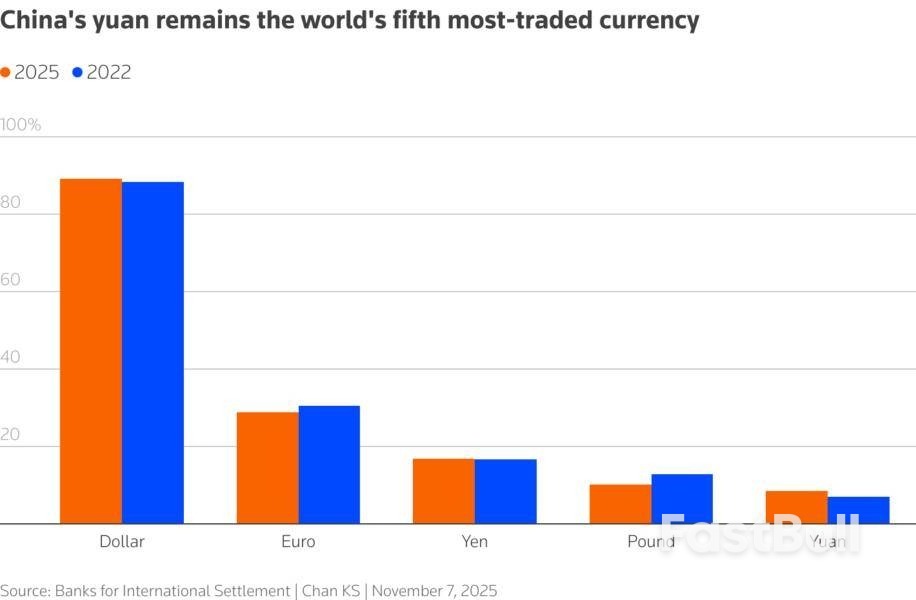
          China's $20 trillion economy may be the second-largest in the world, but its currency was only the fifth most-traded last year, according to a September report from the Bank of International Settlements. Still, thanks to incremental policies, including currency swap deals with other central banks, the yuan now makes up 8.5% of global currency transactions, up from 7% in 2022.

          Thomson ReutersChina's yuan remains the world's fifth most-traded currency

          For Beijing, trade settlement will probably be the next area of focus, given China's 15% share of $33 trillion of global trade by value. Notably, as part of a broader contract dispute, China's steel industry has stopped purchasing dollar-denominated iron ore from Australia's BHPsince October, according to Chinese media, citing sources, and has insisted the mining giant settle 30% of transactions in yuan going forward. Separately, Dutch chipmaker Nexperia's Chinese unit has demanded all transactions be settled in yuan, Reuters reported, citing sources, after The Hague seized control of the company's Netherlands-based parent in September, sparking a broader standoff.

          These moves can have an immediate impact. Up to 12.4 trillion yuan ($1.7 trillion) of trade with China was paid in local currency last year, about 27% of the total, according to the country's central bank's yuan internationalisation report published last week. Settling 30% of imports from BHP can add another $39 billion worth of yuan-denominated transactions annually. And using renminbi will appeal to countries that want to reduce their reliance on the U.S. dollar. That includes Brazil and Russia, which exported $31 billion of soybeans and $50 billion of crude oil, respectively, to the People's Republic last year.

          Chinese planners have long insisted that their plan is not to replace the greenback with a "redback". And it's unlikely they will allow the country's currency to flow freely across its borders. Still, Beijing's trade clout can help it chip away at the dollar's dominance.

          CONTEXT NEWS

          Commodity news portal SteelOrbis reported on October 11 that BHP has agreed with China Mineral Resources Group to switch to yuan settlements for 30% of its spot ore trade with China, citing sources.

          Separately, Dutch chipmaker Nexperia's Chinese unit has resumed supplying semiconductors to local distributors, but all sales to distributors must now be settled in yuan, Reuters reported on October 23, citing two people briefed on the matter.

          Source: TradingView

          To stay updated on all economic events of today, please check out our Economic calendar
          Risk Warnings and Disclaimers
          You understand and acknowledge that there is a high degree of risk involved in trading. Following any strategies or investment methods may lead to potential losses. The content on the site is provided by our contributors and analysts for information purposes only. You are solely responsible for determining whether any trading assets, securities, strategy, or any other product is suitable for investing based on your own investment objectives and financial situation.
          Add to Favorites
          Share

          India's Commercial Tribunal Logjam Locks Up Billions Of Dollars

          Justin

          Political

          Forex

          Economic

          A legal logjam stemming from India's slow-moving judiciary and complex tax system has locked up trillions of rupees within the South Asian nation's system of commercial tribunals, pressuring business cashflow and investment decisions.

          A recent report by the think tank Daksh found that 24.72 trillion rupees ($279 billion) of business transactions remain locked in tax and other disputes in commercial tribunals across the country. These disputes include insolvency cases, debt recovery by banks and financial institutions, corporate litigation and discrepancies over the Goods and Services Tax.

          A lack of technical expertise and a chronic shortage of judges have created a backlog at tribunals equivalent to 7.5% of the country's 330.68 trillion rupee gross domestic product in the fiscal year through March this year, warned Daksh, an independent research institute focused on judicial reform based in Bengaluru.

          The report, published in September, highlighted that a mere 350 tribunal members are charged with handling over 356,000 pending cases involving business disputes.

          "The complexities in the system allow for inefficiency, a lack of the right people and the absence of technology," Surya Prakash, one of the authors of the report, told Nikkei Asia.

          Because of the inefficiency and sluggish resolutions, powerful people can exploit the system -- for example by lodging cases against competitors that are costly to defend.

          "Those who have money get what they want," Prakash said. "To put it bluntly, it's a den of corruption."

          According to the report, which examined 10 key commercial tribunals adjudicating disputes related to tax, customs, company law and the electricity and telecom sectors, some tribunals have introduced limited online filing and digital hearings, but most remain burdened by red tape, overlapping mandates and a lack of specialized knowledge among adjudicators.

          Tribunal members are often retired judges or civil servants who are unfamiliar with the complex financial, technical or tax issues they must decide on.

          The tribunals were intended to ease the burden on regular courts and offer faster resolution. Many of these quasi-judicial bodies, such as the commercial tribunal, operate under the federal government and so are much more easily influenced by the state than the broader judicial system.

          "The main problem is the [commercial] judicial system. Right from the inception to operations to dispute resolution in any business, every step is touched by the judicial system in India. Hence, reforms need to start here," said Prakash.

          The state of the insolvency system is directly linked to the health of the financial sector, a key engine of growth, said Sumant Batra, a veteran insolvency lawyer and former president of INSOL International, a global association of accountants and lawyers specializing in insolvency.

          "Delays in deciding insolvency cases under the IBC (Insolvency and Bankruptcy Code) by the NCLT (National Company Law Tribunal) have been a matter of concern," Batra said. "A distressed asset has a life cycle. Its value gradually declines with time if distress is not addressed in a timely manner. Delays in the resolution of stressed assets have a direct bearing on the ... outcomes of the economy in general and the stakeholders in particular."

          According to Daksh, nearly half the judicial posts in major commercial tribunals are vacant, while the number of pending cases is in the tens of thousands. At several benches, a single judge is handling thousands of matters.

          Shiva Kirti Singh, a former Supreme Court justice who also served as chairman of the telecom disputes panel, said a major change in attitude is required if business-related litigation is to be addressed effectively. "Instead of adjudicating bodies, India should have an ombudsman-like structure to actually settle the disputes," Singh said. He also cautioned that artificial intelligence and technology-related businesses require a "competent regulatory authority" in a fast-changing world.

          "They are likely going to suffer in a big way unless we have a very competent regulatory approach," Singh said.

          The government is promoting India as a destination for global manufacturing and foreign capital investment through its infrastructure and Make in India initiatives. But such investments depend on efficient contract enforcement and dispute resolution, and companies face uncertainty over cash flow and project timelines if vast sums are tied up in litigation.

          In the 2019 edition of the World Bank's Doing Business index, India ranked poorly on enforcing contracts, with an average resolution time of more than 1,400 days. The commercial tribunal system was meant to improve that record, but Daksh's data suggests it has merely shifted the burden.

          Exacerbating the problems is the complexity of the tribunal system. Governance frameworks are inconsistent, appointment procedures differ, case tracking is largely manual and there is no unified digital registry. Appeals of tribunal decisions often end up in higher courts, adding another layer to the already congested judicial hierarchy.

          Legal experts recommend an independent tribunals commission to oversee appointments, monitor performance and standardize procedures. Yet such reforms have made little headway despite repeated recommendations from the state-backed Law Commission and the Supreme Court over the past decade.

          Some of the resistance comes from the bureaucracy, which continues to wield enormous control over staffing, budgets and infrastructure.

          "There is no doubt in anyone's mind that the law in India is quite complex," Prakash said. "Efforts have been made to simplify the law, but it has ended up simplifying the language of the law without trying to simplify the actual complexity of the substantive things.

          "Ease of doing business has come up in many discussions, but it has not really percolated down to the operational level."

          Source: Asia_Nikkei

          To stay updated on all economic events of today, please check out our Economic calendar
          Risk Warnings and Disclaimers
          You understand and acknowledge that there is a high degree of risk involved in trading. Following any strategies or investment methods may lead to potential losses. The content on the site is provided by our contributors and analysts for information purposes only. You are solely responsible for determining whether any trading assets, securities, strategy, or any other product is suitable for investing based on your own investment objectives and financial situation.
          Add to Favorites
          Share

          Japan Eyes Crypto Tax Cuts and Insider Trading Rules in Regulatory Overhaul

          Gerik

          Economic

          Cryptocurrency

          A strategic shift in Japan’s crypto policy

          According to The Asahi Shimbun, Japan’s Financial Services Agency (FSA) is preparing a landmark regulatory reform that could redefine the country’s crypto landscape. The proposed changes would classify cryptocurrencies such as Bitcoin and Ethereum as formal financial products, extending traditional financial oversight mechanisms including insider trading regulations into the digital asset space.
          This reclassification could bring a higher level of transparency and investor protection to Japan’s crypto markets, aligning them more closely with securities regulations applied to stocks and bonds.

          Lower crypto tax rate to stimulate domestic participation

          One of the most significant reforms under consideration is a dramatic reduction in the tax rate on crypto gains. Currently, profits from cryptocurrency transactions can be taxed at rates up to 55% depending on income brackets. Under the new proposal, these would be standardized at a flat 20% rate, the same as capital gains on equities.
          This move is likely aimed at encouraging greater domestic participation in the digital asset market by aligning crypto with traditional investment vehicles, removing a long-standing barrier to broader adoption among retail and institutional investors.

          Banks and insurers may enter the crypto space

          In another bold step, the FSA is reportedly planning to allow banks and insurance companies to offer crypto-related products directly to their customers. Through their securities arms, these institutions would be able to sell crypto assets to depositors and insurance policyholders potentially mainstreaming access to digital assets across Japan’s financial system.
          This integration could significantly expand the crypto user base in Japan and accelerate institutional adoption, particularly if supported by clearer risk disclosures and standardized frameworks for pricing volatility.

          Disclosure and transparency requirements expanded

          Alongside these changes, crypto exchange service providers would face stricter requirements to disclose risks associated with price volatility. This aligns with the broader global push for enhanced transparency in crypto trading and investment platforms, especially in light of recent high-profile exchange failures and fraud scandals worldwide.
          By mandating more detailed risk reporting, the FSA aims to equip investors with better tools to evaluate their exposure, potentially improving trust in Japanese crypto markets.

          Timing and political outlook

          The FSA intends to propose the necessary legislation during Japan’s next ordinary parliamentary session in 2026. While not yet formally confirmed by the agency, the report suggests that these changes could be a cornerstone of Japan’s strategy to remain a leading, innovation-friendly, yet regulated crypto hub in Asia, especially as rivals like Singapore and South Korea refine their own regulatory approaches.
          Japan’s proposed crypto reforms represent a comprehensive strategy to legitimize and normalize digital asset trading within its financial system. By aligning tax policies with equity trading, introducing stronger regulatory oversight, and integrating crypto into mainstream banking and insurance channels, the country is positioning itself at the forefront of regulated crypto innovation. If passed, these measures could have ripple effects across Asia’s regulatory landscape and possibly spark a more investor-friendly phase of global crypto adoption.

          Source: Reuters

          To stay updated on all economic events of today, please check out our Economic calendar
          Risk Warnings and Disclaimers
          You understand and acknowledge that there is a high degree of risk involved in trading. Following any strategies or investment methods may lead to potential losses. The content on the site is provided by our contributors and analysts for information purposes only. You are solely responsible for determining whether any trading assets, securities, strategy, or any other product is suitable for investing based on your own investment objectives and financial situation.
          Add to Favorites
          Share

          Bitcoin Slides Below $95,000 as Risk Appetite Vanishes and Tariff Shock Rattles Crypto Market

          Gerik

          Economic

          Cryptocurrency

          From all-time high to annual loss in just over a month

          In a dramatic reversal, Bitcoin has dropped below $95,000, effectively erasing its gains for 2025 after briefly reaching a record high of $126,251 on October 6. Triggered by a series of shock tariff announcements by President Donald Trump and broader risk aversion in financial markets, the flagship cryptocurrency is now trading below the levels it held at the end of 2024.
          As of early Monday morning in Singapore, Bitcoin had pared some of its losses, hovering near $94,869, but remains firmly in bear market territory.

          Market sentiment flips as institutional buyers pull back

          Institutional investors once the driving force behind Bitcoin’s 2025 rally are now stepping away. ETF inflows, which had once added over $25 billion and redefined Bitcoin as a serious portfolio asset, have slowed dramatically. Bitwise CIO Matthew Hougan said crypto’s drop signaled a broader “risk-off” shift in markets, with Bitcoin leading the pullback.
          The selloff, analysts argue, is fueled by a mix of factors: long-term holders taking profits, institutional outflows, broader macro uncertainty, and the forced liquidation of overleveraged positions.

          Tariff policy and political whiplash spark volatility

          The turning point came just four days after Bitcoin’s all-time high, when Trump’s unexpected comments on trade tariffs sent global markets including crypto into a tailspin. Bitcoin, which had benefited from Trump’s earlier pro-crypto stance, proved highly sensitive to political volatility, underscoring how speculative sentiment is driving price action more than fundamentals.
          The impact of this sudden policy shift is still being felt. As Chris Weston of Pepperstone Group noted, the October 10 liquidation event inflicted lasting psychological damage on major players, many of whom remain cautious.

          Skepticism dominates as retail and altcoin markets bleed

          Retail sentiment has soured significantly. Hougan noted that many investors are retreating early, fearing another major pullback. Meanwhile, altcoins especially smaller and less liquid tokens have been hit even harder. The MarketVector index tracking the bottom 50 of the top 100 digital assets is down roughly 60% year-to-date, amplifying investor losses across the board.
          Michael Saylor’s Strategy Inc., once a bellwether for corporate crypto adoption, is now trading close to the value of its Bitcoin holdings, signaling a collapse in investor confidence in leveraged crypto plays.

          No bullish catalysts, no natural recovery signals

          Despite long-term optimism from some quarters, including Hougan who frames this pullback as a potential buying opportunity, sentiment remains subdued. Ergonia research director Chris Newhouse summarized the mood across Telegram chats and conferences: capital deployment is on hold, and few expect a near-term catalyst to reverse the trend.
          Without clearer regulatory frameworks or a stabilizing macroeconomic backdrop, the market appears locked in a prolonged correction. Even among insiders, there’s a growing consensus that crypto’s current cycle may take time and policy clarity to reverse.
          Bitcoin’s plunge below $95,000 isn’t just a technical move it reflects a deeper erosion of investor confidence, shaped by macro shocks, policy whiplash, and the withdrawal of institutional flows. As the Trump administration’s trade agenda adds fresh volatility to markets, crypto finds itself once again on the front line of global risk aversion. Whether this correction marks a consolidation phase or the start of a deeper slide may depend on the next moves in Washington as much as in the blockchain.

          Source: Bloomberg

          To stay updated on all economic events of today, please check out our Economic calendar
          Risk Warnings and Disclaimers
          You understand and acknowledge that there is a high degree of risk involved in trading. Following any strategies or investment methods may lead to potential losses. The content on the site is provided by our contributors and analysts for information purposes only. You are solely responsible for determining whether any trading assets, securities, strategy, or any other product is suitable for investing based on your own investment objectives and financial situation.
          Add to Favorites
          Share

          Japan's Economy Shrinks Amid U.S. Tariffs, Exports Slump

          Gerik

          Economic

          Quarterly contraction reveals mounting trade pressures

          Japan’s gross domestic product (GDP) shrank by 0.4% in the July–September quarter of 2025, marking the country's first economic contraction in six quarters. Annualized, this decline equates to a 1.8% drop less severe than market expectations of a 0.6% quarterly fall, but still significant. The downturn reflects intensifying trade headwinds, particularly the impact of new U.S. import tariffs.
          A key driver of the contraction was exports, which fell by 1.2% from the previous quarter and 4.5% on an annualized basis. Japanese exporters had previously accelerated shipments to beat the implementation of the tariffs, inflating earlier export figures, but the latest data show the impact of the trade barrier now taking full effect.

          Trump's tariffs strike at the heart of Japan's industrial economy

          The tariffs raised to 15% from a previous 25% on nearly all Japanese imports are a major blow to Japan’s manufacturing sector, particularly automakers like Toyota, Honda, and Nissan. Despite efforts by these firms to shift production abroad in recent years, Japan remains heavily reliant on export revenues, especially to the U.S. market.
          The Cabinet Office noted that while private consumption inched up by 0.1% and imports dipped 0.1%, it wasn’t enough to offset the drag from declining exports. This weakness reflects the fragility of Japan’s domestic demand and its dependence on global trade dynamics.

          Political stability returns, but economic risks linger

          Adding to the economic uncertainty has been recent political transition. Only in October did Sanae Takaichi assume the role of prime minister, ending a period of internal instability. While her administration may bring some policy clarity, the structural challenges such as an aging population, sluggish domestic consumption, and global trade volatility remain unaddressed in the short term.
          Japan’s Q3 2025 GDP contraction is a warning sign for an economy long dependent on exports, now caught in the crossfire of geopolitical trade policy. With Trump’s revived protectionist stance reshaping global trade, Japan faces a renewed test of its resilience and must either adapt its economic strategy or risk prolonged stagnation in a less predictable global environment.

          Source: AP

          To stay updated on all economic events of today, please check out our Economic calendar
          Risk Warnings and Disclaimers
          You understand and acknowledge that there is a high degree of risk involved in trading. Following any strategies or investment methods may lead to potential losses. The content on the site is provided by our contributors and analysts for information purposes only. You are solely responsible for determining whether any trading assets, securities, strategy, or any other product is suitable for investing based on your own investment objectives and financial situation.
          Add to Favorites
          Share
          FastBull
          Copyright © 2025 FastBull Ltd

          728 RM B 7/F GEE LOK IND BLDG NO 34 HUNG TO RD KWUN TONG KLN HONG KONG

          TelegramInstagramTwitterfacebooklinkedin
          App Store Google Play Google Play
          Products
          Charts

          Chats

          Q&A with Experts
          Screeners
          Economic Calendar
          Data
          Tools
          Membership
          Features
          Function
          Markets
          Copy Trading
          Latest Signals
          Contests
          News
          Analysis
          24/7
          Columns
          Education
          Company
          Careers
          About Us
          Contact Us
          Advertising
          Help Center
          Feedback
          User Agreement
          Privacy Policy
          Business

          White Label

          Data API

          Web Plug-ins

          Poster Maker

          Affiliate Program

          Risk Disclosure

          The risk of loss in trading financial instruments such as stocks, FX, commodities, futures, bonds, ETFs and crypto can be substantial. You may sustain a total loss of the funds that you deposit with your broker. Therefore, you should carefully consider whether such trading is suitable for you in light of your circumstances and financial resources.

          No decision to invest should be made without thoroughly conducting due diligence by yourself or consulting with your financial advisors. Our web content might not suit you since we don't know your financial conditions and investment needs. Our financial information might have latency or contain inaccuracy, so you should be fully responsible for any of your trading and investment decisions. The company will not be responsible for your capital loss.

          Without getting permission from the website, you are not allowed to copy the website's graphics, texts, or trademarks. Intellectual property rights in the content or data incorporated into this website belong to its providers and exchange merchants.

          Not Logged In

          Log in to access more features

          FastBull Membership

          Not yet

          Purchase

          Become a signal provider
          Help Center
          Customer Service
          Dark Mode
          Price Up/Down Colors

          Log In

          Sign Up

          Position
          Layout
          Fullscreen
          Default to Chart
          The chart page opens by default when you visit fastbull.com