• Trade
  • Markets
  • Copy
  • Contests
  • News
  • 24/7
  • Calendar
  • Q&A
  • Chats
Trending
Screeners
SYMBOL
LAST
BID
ASK
HIGH
LOW
NET CHG.
%CHG.
SPREAD
SPX
S&P 500 Index
6827.42
6827.42
6827.42
6899.86
6801.80
-73.58
-1.07%
--
DJI
Dow Jones Industrial Average
48458.04
48458.04
48458.04
48886.86
48334.10
-245.98
-0.51%
--
IXIC
NASDAQ Composite Index
23195.16
23195.16
23195.16
23554.89
23094.51
-398.69
-1.69%
--
USDX
US Dollar Index
97.950
98.030
97.950
98.500
97.950
-0.370
-0.38%
--
EURUSD
Euro / US Dollar
1.17394
1.17409
1.17394
1.17496
1.17192
+0.00011
+ 0.01%
--
GBPUSD
Pound Sterling / US Dollar
1.33707
1.33732
1.33707
1.33997
1.33419
-0.00148
-0.11%
--
XAUUSD
Gold / US Dollar
4299.39
4299.39
4299.39
4353.41
4257.10
+20.10
+ 0.47%
--
WTI
Light Sweet Crude Oil
57.233
57.485
57.233
58.011
56.969
-0.408
-0.71%
--

Community Accounts

Signal Accounts
--
Profit Accounts
--
Loss Accounts
--
View More

Become a signal provider

Sell trading signals to earn additional income

View More

Guide to Copy Trading

Get started with ease and confidence

View More

Signal Accounts for Members

All Signal Accounts

Best Return
  • Best Return
  • Best P/L
  • Best MDD
Past 1W
  • Past 1W
  • Past 1M
  • Past 1Y

All Contests

  • All
  • Trump Updates
  • Recommend
  • Stocks
  • Cryptocurrencies
  • Central Banks
  • Featured News
Top News Only
Share

Iranian Media Says 18 Crew Members Of Foreign Tanker Seized In Gulf Of Oman Over Carrying 'Smuggled Fuel' Detained

Share

Regional Governor: Two Killed In Ukrainian Drone Strike On Russia's Saratov

Share

Chinese Foreign Ministry - China Foreign Minister Met With United Arab Emirates Counterpart On Dec 12

Share

China's Central Financial And Economic Affairs Commission Deputy Director: Will Expand Export And Increase Import In 2026

Share

Thai Leader Anutin: Landmine Blast That Killed Thai Soldiers 'Not A Roadside Accident'

Share

Thai Leader Anutin: Thailand To Continue Military Action Until 'We Feel No More Harm'

Share

Cambodian Prime Minister Hun Manet Says He Had Phone Calls With Trump And Malaysian Leader Anwar About Ceasefire

Share

Cambodia's Hun Manet Says USA, Malaysia Should Verify 'Which Side Fired First' In Latest Conflict

Share

Cambodia's Hun Manet: Cambodia Maintains Its Stance In Seeking Peaceful Resolution Of Disputes

Share

Nasdaq Companies: Allergan, Ferrovia, Insmed, Monolithic Power Systems, Seagate Technology, And Western Digital Will Be Added To The NASDAQ 100 Index. Biogen, CdW, GlobalFoundries, Lululemon, ON Semiconductor, And Tradedesk Will Be Removed From The NASDAQ 100 Index

Share

Witkoff Headed To Berlin This Weekend To Meet With Zelenskiy, European Leaders -Wsj Reporter On X

Share

Russia Attacks Two Ukrainian Ports, Damaging Three Turkish-Owned Vessels

Share

[Historic Flooding Occurs In At Least Four Rivers In Washington State Due To Days Of Torrential Rains] Multiple Areas In Washington State Have Been Hit By Severe Flooding Due To Days Of Torrential Rains, With At Least Four Rivers Experiencing Historic Flooding. Reporters Learned On The 12th That The Floods Caused By The Torrential Rains In Washington State Have Destroyed Homes And Closed Several Highways. Experts Warn That Even More Severe Flooding May Occur In The Future. A State Of Emergency Has Been Declared In Washington State

Share

Trump Says Proposed Free Economic Zone In Donbas Would Work

Share

Trump: I Think My Voice Should Be Heard

Share

Trump Says Will Be Choosing New Fed Chair In Near Future

Share

Trump Says Proposed Free Economic Zone In Donbas Complex But Would Work

Share

Trump Says Land Strikes In Venezuela Will Start Happening

Share

US President Trump: Thailand And Cambodia Are In A Good Situation

Share

State Media: North Korean Leader Kim Hails Troops Returning From Russia Mission

TIME
ACT
FCST
PREV
U.K. Trade Balance Non-EU (SA) (Oct)

A:--

F: --

P: --

U.K. Trade Balance (Oct)

A:--

F: --

P: --

U.K. Services Index MoM

A:--

F: --

P: --

U.K. Construction Output MoM (SA) (Oct)

A:--

F: --

P: --

U.K. Industrial Output YoY (Oct)

A:--

F: --

P: --

U.K. Trade Balance (SA) (Oct)

A:--

F: --

P: --

U.K. Trade Balance EU (SA) (Oct)

A:--

F: --

P: --

U.K. Manufacturing Output YoY (Oct)

A:--

F: --

P: --

U.K. GDP MoM (Oct)

A:--

F: --

P: --

U.K. GDP YoY (SA) (Oct)

A:--

F: --

P: --

U.K. Industrial Output MoM (Oct)

A:--

F: --

P: --

U.K. Construction Output YoY (Oct)

A:--

F: --

P: --

France HICP Final MoM (Nov)

A:--

F: --

P: --

China, Mainland Outstanding Loans Growth YoY (Nov)

A:--

F: --

P: --

China, Mainland M2 Money Supply YoY (Nov)

A:--

F: --

P: --

China, Mainland M0 Money Supply YoY (Nov)

A:--

F: --

P: --

China, Mainland M1 Money Supply YoY (Nov)

A:--

F: --

P: --

India CPI YoY (Nov)

A:--

F: --

P: --

India Deposit Gowth YoY

A:--

F: --

P: --

Brazil Services Growth YoY (Oct)

A:--

F: --

P: --

Mexico Industrial Output YoY (Oct)

A:--

F: --

P: --

Russia Trade Balance (Oct)

A:--

F: --

P: --

Philadelphia Fed President Henry Paulson delivers a speech
Canada Building Permits MoM (SA) (Oct)

A:--

F: --

P: --

Canada Wholesale Sales YoY (Oct)

A:--

F: --

P: --

Canada Wholesale Inventory MoM (Oct)

A:--

F: --

P: --

Canada Wholesale Inventory YoY (Oct)

A:--

F: --

P: --

Canada Wholesale Sales MoM (SA) (Oct)

A:--

F: --

P: --

Germany Current Account (Not SA) (Oct)

A:--

F: --

P: --

U.S. Weekly Total Rig Count

A:--

F: --

P: --

U.S. Weekly Total Oil Rig Count

A:--

F: --

P: --

Japan Tankan Large Non-Manufacturing Diffusion Index (Q4)

--

F: --

P: --

Japan Tankan Small Manufacturing Outlook Index (Q4)

--

F: --

P: --

Japan Tankan Large Non-Manufacturing Outlook Index (Q4)

--

F: --

P: --

Japan Tankan Large Manufacturing Outlook Index (Q4)

--

F: --

P: --

Japan Tankan Small Manufacturing Diffusion Index (Q4)

--

F: --

P: --

Japan Tankan Large Manufacturing Diffusion Index (Q4)

--

F: --

P: --

Japan Tankan Large-Enterprise Capital Expenditure YoY (Q4)

--

F: --

P: --

U.K. Rightmove House Price Index YoY (Dec)

--

F: --

P: --

China, Mainland Industrial Output YoY (YTD) (Nov)

--

F: --

P: --

China, Mainland Urban Area Unemployment Rate (Nov)

--

F: --

P: --

Saudi Arabia CPI YoY (Nov)

--

F: --

P: --

Euro Zone Industrial Output YoY (Oct)

--

F: --

P: --

Euro Zone Industrial Output MoM (Oct)

--

F: --

P: --

Canada Existing Home Sales MoM (Nov)

--

F: --

P: --

Euro Zone Total Reserve Assets (Nov)

--

F: --

P: --

U.K. Inflation Rate Expectations

--

F: --

P: --

Canada National Economic Confidence Index

--

F: --

P: --

Canada New Housing Starts (Nov)

--

F: --

P: --

U.S. NY Fed Manufacturing Employment Index (Dec)

--

F: --

P: --

U.S. NY Fed Manufacturing Index (Dec)

--

F: --

P: --

Canada Core CPI YoY (Nov)

--

F: --

P: --

Canada Manufacturing Unfilled Orders MoM (Oct)

--

F: --

P: --

Canada Manufacturing New Orders MoM (Oct)

--

F: --

P: --

Canada Core CPI MoM (Nov)

--

F: --

P: --

Canada Manufacturing Inventory MoM (Oct)

--

F: --

P: --

Canada CPI YoY (Nov)

--

F: --

P: --

Canada CPI MoM (Nov)

--

F: --

P: --

Canada CPI YoY (SA) (Nov)

--

F: --

P: --

Canada Core CPI MoM (SA) (Nov)

--

F: --

P: --

Q&A with Experts
    • All
    • Chatrooms
    • Groups
    • Friends
    Connecting
    .
    .
    .
    Type here...
    Add Symbol or Code

      No matching data

      All
      Trump Updates
      Recommend
      Stocks
      Cryptocurrencies
      Central Banks
      Featured News
      • All
      • Russia-Ukraine Conflict
      • Middle East Flashpoint
      • All
      • Russia-Ukraine Conflict
      • Middle East Flashpoint
      Search
      Products

      Charts Free Forever

      Chats Q&A with Experts
      Screeners Economic Calendar Data Tools
      Membership Features
      Data Warehouse Market Trends Institutional Data Policy Rates Macro

      Market Trends

      Market Sentiment Order Book Forex Correlations

      Top Indicators

      Charts Free Forever
      Markets

      News

      News Analysis 24/7 Columns Education
      From Institutions From Analysts
      Topics Columnists

      Latest Views

      Latest Views

      Trending Topics

      Top Columnists

      Latest Update

      Signals

      Copy Rankings Latest Signals Become a signal provider AI Rating
      Contests
      Brokers

      Overview Brokers Assessment Rankings Regulators News Claims
      Broker listing Forex Brokers Comparison Tool Live Spread Comparison Scam
      Q&A Complaint Scam Alert Videos Tips to Detect Scam
      More

      Business
      Events
      Careers About Us Advertising Help Center

      White Label

      Data API

      Web Plug-ins

      Affiliate Program

      Awards Institution Evaluation IB Seminar Salon Event Exhibition
      Vietnam Thailand Singapore Dubai
      Fans Party Investment Sharing Session
      FastBull Summit BrokersView Expo
      Recent Searches
        Top Searches
          Markets
          News
          Analysis
          User
          24/7
          Economic Calendar
          Education
          Data
          • Names
          • Latest
          • Prev

          View All

          No data

          Scan to Download

          Faster Charts, Chat Faster!

          Download App
          English
          • English
          • Español
          • العربية
          • Bahasa Indonesia
          • Bahasa Melayu
          • Tiếng Việt
          • ภาษาไทย
          • Français
          • Italiano
          • Türkçe
          • Русский язык
          • 简中
          • 繁中
          Open Account
          Search
          Products
          Charts Free Forever
          Markets
          News
          Signals

          Copy Rankings Latest Signals Become a signal provider AI Rating
          Contests
          Brokers

          Overview Brokers Assessment Rankings Regulators News Claims
          Broker listing Forex Brokers Comparison Tool Live Spread Comparison Scam
          Q&A Complaint Scam Alert Videos Tips to Detect Scam
          More

          Business
          Events
          Careers About Us Advertising Help Center

          White Label

          Data API

          Web Plug-ins

          Affiliate Program

          Awards Institution Evaluation IB Seminar Salon Event Exhibition
          Vietnam Thailand Singapore Dubai
          Fans Party Investment Sharing Session
          FastBull Summit BrokersView Expo

          Trump Announces Set of Tariff Rates With New August Deadline

          Manuel

          Economic

          Political

          Summary:

          Most of the tariff rates, shared on his Truth Social platform, were largely in line with what Trump had already announced nations were likely to face.
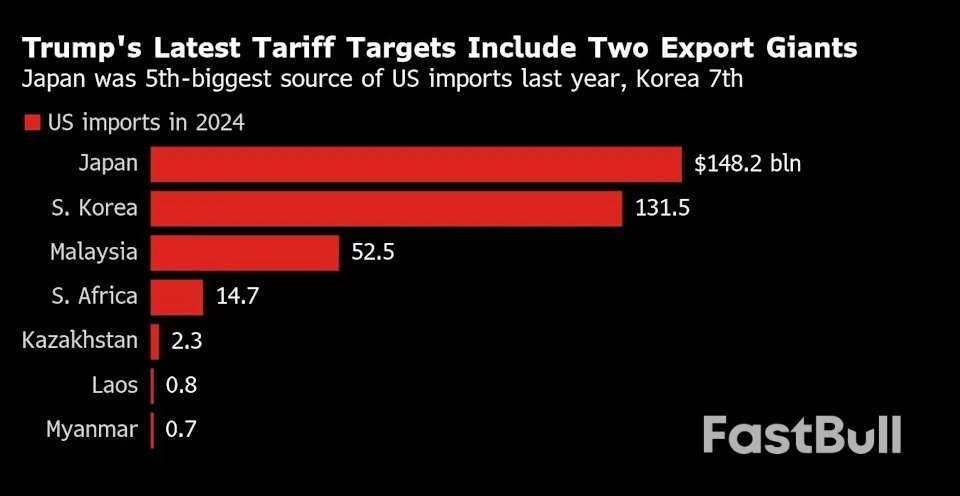
          President Donald Trump unveiled the first in a wave of promised letters that threaten to impose higher tariffs rates on key trading partners, including levies of 25% on goods from Japan and South Korea beginning Aug. 1.
          Trump also announced 25% rates on Malaysia and Kazakhstan, while South Africa would see a 30% tariff and Laos and Myanmar would face a 40% levy. The nations were the first in what the president promised would be a flurry of unilateral warnings and trade deals announced on Monday, two days before agreements are due from trading partners facing his April 2 so-called reciprocal levies.
          “Our relationship has been, unfortunately, far from Reciprocal,” Trump wrote in the letters.
          Trump’s second-term rush to overhaul US trade policies has served as a steady source of uncertainty for markets, central bankers and executives trying to game out the effect on production, inventories, hiring, inflation and consumer demand — routine planning that’s hard enough without costs like tariffs that are on one day, off the next.Trump Announces Set of Tariff Rates With New August Deadline_1
          The letters issued Monday so far appeared to largely be a novel method of once again punting a looming July 9 deadline for his so-called “reciprocal” tariffs until at least the beginning of August. Most of the tariff rates, shared on his Truth Social platform, were largely in line with what Trump had already announced nations were likely to face.
          White House Press Secretary Karoline Leavitt said there would be around a dozen countries that receive notifications about their tariffs Monday directly from the president. Additional letters will arrive in the coming days, she said.
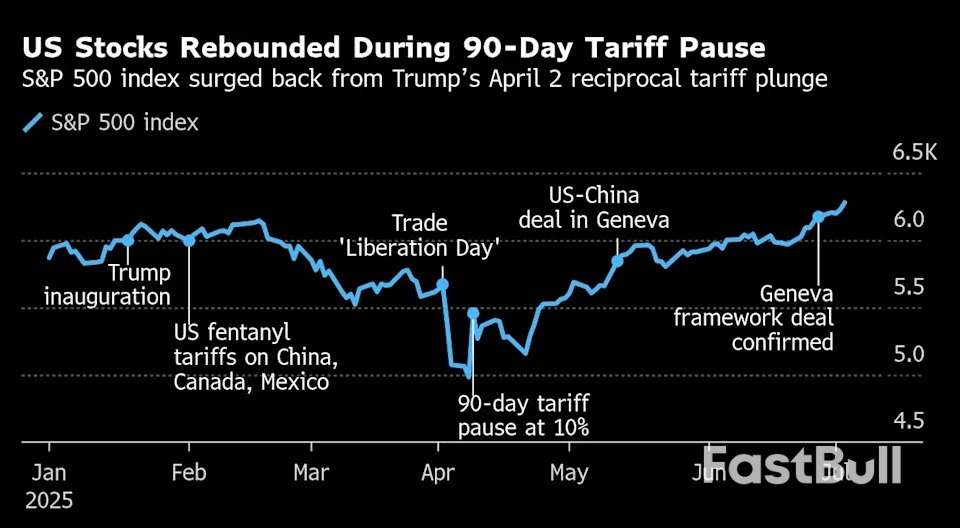
          The episode was the latest turn of the screw for a program that has roiled markets and trade across the globe. One week after announcing the tariffs at a prominent Rose Garden event, Trump offered a 90-day reprieve, lowering duties to 10% to allow time for negotiations.
          Few nations successfully negotiated deals in the short time given. In the interim, Trump announced framework agreements with the United Kingdom and Vietnam and a trade truce with China.
          Trump is set to sign an executive order later Monday that will hold off new rates until August 1 for all nations facing the reciprocal tariffs, Leavitt said.Trump Announces Set of Tariff Rates With New August Deadline_2
          At the same time, Trump warned nations against retaliation over his latest gambit.
          “If for any reason you decide to raise your Tariffs, then, whatever the number you choose to raise them by will be added” to the threatened levels, Trump wrote.
          He also said that the rates did not include any sectoral-specific tariffs that the administration had or would separately implement on goods imported in key industries. Both Japan and South Korea are major auto exporters, and are also facing US tariffs on steel.
          Other nations in Trump’s early barrage have less significant trading relationships. US imports from Myanmar — where relations have been strained by the 2021 military coup — totaled just over $656 million in 2024, according to the US Trade Representative.
          The US imports crude oil from Kazakhstan occasionally. The most recent purchase, according to government data, was in April, when the US shipped in about 33,000 barrels a day. Last year, cargoes from Kazakhstan averaged about 38,000 barrels a day, the highest in at least two decades of intermittent buying.
          Asked why Trump had chosen to hit Japan and South Korea first, Leavitt said it was “the president’s prerogative.”
          “Those are the countries he chose,” she added.
          Leavitt said the administration is “close” to securing agreements with some other trading partners, adding that Trump “wants to ensure these are the best deals possible.”

          Markets Fall

          Following a rally to all-time highs last week, the S&P 500 was down about 1.1% as of 2:39 p.m. New York time, while the Nasdaq 100 Index fell 1.1%. The Cboe VIX Index edged about 18, while a gauge of expected volatility in technology stocks traded at the highest level in two weeks.
          The dollar extended gains after Trump’s announcement, hitting the highest level in more than a week against a basket of peers. The currencies of South Korea, South Africa and Japan all fell more than 1% against the greenback.
          Japanese automakers’ American depository receipts fell to session lows after Trump’s announcement. Toyota ADRs fell 4.3% to session lows, while Honda’s fell 3.9% to session lows. The South African rand fell 1.5% to a session low.
          For many of the nations, engaging Trump in trade negotiations on his accelerated timeline has proved difficult.
          Even though Japan and Korea are two of the US’s closest allies in Asia, they’re both dealing with domestic situations where cutting trade deals might be risky politically. South Korea President Lee Jae-myung only took office on June 4, and elections in Japan’s upper house later this month made the government of Prime Minister Shigeru Ishiba reluctant to offer too much in concessions.
          The European Union is not expecting to receive a letter setting tariff rates today, according to a person familiar with those discussions, who spoke on condition of anonymity.
          Trump has also threatened to slap an additional 10% levy on “any country aligning themselves with the Anti-American policies of BRICS,” targeting the bloc of developing nations led by Brazil, Russia, India, China and South Africa as they gathered for a meeting in Rio de Janeiro.
          Leavitt on Monday said Trump would “take any action necessary to prevent countries from taking advantage of the United States and our people.”
          Trump’s levies will help fill the Treasury’s coffers at a time when investors are worried about the nation’s mounting debt, particularly after Congress passed much of the president’s economic agenda in a $3.4 trillion tax cut and spending package last week. The dollar has slumped and longer-term borrowing costs remain elevated.
          Despite Trump’s contention that foreign countries pay his tariffs directly, the burden actually falls to American importers, which must contend with tighter profit margins, weigh raising prices on consumers or seek discounts from their foreign suppliers.
          “All of that new revenue is just a tax on US businesses,” Jonathan Gold, vice president of supply chain and customs policy at the National Retail Federation, wrote in a LinkedIn post Friday.
          On April 2, Trump held a Rose Garden ceremony announcing steeper levies on more than 50 trading partners ranging as high as 50% – a shock to the economic outlook that sent financial markets into a tailspin and sparked fears of a recession. A week later, he suspended those peak rates.
          The negotiating tracks have been different for the US’s three largest trading partners — Mexico, Canada and China. Beijing and Washington have negotiated truces that lowered tariffs on Chinese products that soared to 145% and eased export controls on key supplies. As partners in the US-Mexico-Canada Agreement, the two US neighbors aren’t subject to the reciprocal tariffs and instead are trying to negotiate lower rates on sectoral levies.
          Bloomberg Economics’ US trade uncertainty index has come off its April peak, but it is still higher than it was when Trump was elected in November.
          On top of market jitters and economic headwinds, legal challenges offer a potential check on the reciprocal tariffs, which Trump declared under executive authority known as the International Emergency Economic Powers Act, or IEEPA.
          The US Court of International Trade ruled on May 28 that the vast majority of Trump’s levies were issued illegally under IEEPA and ordered them blocked. A day later, an appeals court gave the Trump administration a temporary reprieve from the ruling and decided that the tariffs can remain in place until it hears the case, scheduling the arguments for July 31.
          Yet the Trump administration is using another presidential power to impose tariffs – Section 232 of the Trade Expansion Act – on specific sectors so far including autos, steel and aluminum.
          Other 232 sectoral cases are in the works, potentially allowing Trump to cover a wide range of US imported raw materials as well as finished consumer goods should the IEEPA levies get struck down by the courts. Trump described the latest levies as “separate from all Sectoral Tariffs.”
          Another friction point for Trump on tariffs is the Federal Reserve. Jerome Powell, the chair of the US central bank, has held off on lowering rates this year — despite intense pressure and name-calling from Trump — in part to determine whether tariff-driven price hikes might evolve into more persistent cost-of-living pressures.
          Bloomberg Economics estimates that if all reciprocal tariffs are raised to their threatened level on July 9, average duties on all US imports could climb to around 20% from less than 3% before Trump’s inauguration in January. That would add to growth and inflation risks for the US economy.
          Between higher tariffs, oil prices and immigration restrictions in the US, “the bottom line is that we should see inflation move higher over the coming months,” Torsten Slok, chief economist with Apollo Global Management, wrote in a note Sunday.

          Source: Bloomberg

          To stay updated on all economic events of today, please check out our Economic calendar
          Risk Warnings and Disclaimers
          You understand and acknowledge that there is a high degree of risk involved in trading. Following any strategies or investment methods may lead to potential losses. The content on the site is provided by our contributors and analysts for information purposes only. You are solely responsible for determining whether any trading assets, securities, strategy, or any other product is suitable for investing based on your own investment objectives and financial situation.
          Add to Favorites
          Share

          Tesla Stock Drops on Musk's Battle With Trump Over New Political 'America Party,' Loss of EV Tax Credits

          Manuel

          Stocks

          Political

          Tesla (TSLA) stock is sliding on Monday after CEO Elon Musk's latest foray into politics once again challenges President Trump. Separately, Wall Street is growing concerned over the loss of EV tax credits and regulatory credits stemming from Trump's "One Big Beautiful Bill."
          Over the weekend, Musk polled users on X about whether he should start an independent party called the America Party to challenge the government's status quo. Musk continued his complaints that Trump's bill would do nothing to rein in the deficit and offers little in terms of benefits to the American people.
          "By a factor of 2 to 1, you want a new political party and you shall have it!" Musk said. "Today, the America Party is formed to give you back your freedom."
          Tesla stock closed down roughly 6.8% in Monday trading.
          Trump and Musk supporters hoped a recent detente would settle the matter, but it erupted again with Musk's latest foray.
          "I am saddened to watch Elon Musk go completely 'off the rails,' essentially becoming a TRAIN WRECK over the past five weeks," Trump responded in a Truth Social post. "He even wants to start a Third Political Party, despite the fact that they have never succeeded in the United States - The System seems not designed for them."
          Musk's past strong critiques of the bill led to a massive falling out with Trump, with Tesla and Musk's other businesses like SpaceX caught in the crosshairs.
          The battle between the two was too much for even Tesla bulls and investors to bear, who saw the stock pummelled a few weeks back before recovering.
          "Very simply Musk diving deeper into politics and now trying to take on the Beltway establishment is exactly the opposite direction that Tesla investors/shareholders want him to take," Wedbush analyst Dan Ives wrote. "After leaving the Trump Administration and DOGE there was initial relief from Tesla shareholders and big supporters ... That relief lasted a very short time and now has taken a turn for the worst with this latest announcement."
          As if the political battles weren't enough, Trump also responded to a feature of the bill Musk privately groused over.
          "It is a Great Bill but, unfortunately for Elon, it eliminates the ridiculous Electric Vehicle (EV) Mandate, which would have forced everyone to buy an Electric Car in a short period of time," Trump said on Truth Social. "I have been strongly opposed to that from the very beginning."

          Source: Yahoo Finance

          Risk Warnings and Disclaimers
          You understand and acknowledge that there is a high degree of risk involved in trading. Following any strategies or investment methods may lead to potential losses. The content on the site is provided by our contributors and analysts for information purposes only. You are solely responsible for determining whether any trading assets, securities, strategy, or any other product is suitable for investing based on your own investment objectives and financial situation.
          Add to Favorites
          Share

          Oil Prices Expected to Drop Below $60 on Increasing OPEC+ Supply

          Manuel

          Commodity

          Energy

          Wall Street analysts predict oil futures will fall below $60 per barrel by the end of the year as the Organization of the Petroleum Exporting Countries and its allies (OPEC+) boost output.
          OPEC+ has been unwinding output cuts this year as it seeks to recover global market share. Over the weekend, the group announced it would boost production by 548,000 barrels per day in August. This marks OPEC+'s fourth consecutive monthly increase and was larger than analysts anticipated.
          "Saturday's announcement to accelerate supply hikes suggests that the strategic shift to normalizing spare capacity and market share, supporting internal cohesion, and disciplining US shale supply is continuing," Goldman Sachs analyst Daan Struyven and his team wrote in a research note on Sunday.
          Struyven and his team noted resilient demand, particularly from the world's largest oil importer, China. The analysts anticipate OPEC+ will increase production yet again in September.
          "We keep our price forecast with Brent averaging $59 in 2025Q4 and $56 in 2026," Struyven wrote.
          On Sunday, BNP Paribas analysts lowered their year-end Brent forecast by $5 to $55 per barrel, but they said that they foresee a recovery in the oil market in 2026.
          "The main driver for that is that we expect supply growth — from both OPEC and non-OPEC — to moderate," the analysts said in a note.
          Crude prices have fallen following a brief spike to near $80 on the heels of the Israel-Iran war last month.
          During the conflict, Wall Street analysts had outlined worst-case scenarios, predicting prices could surge into the triple-digit range of $120-$130. However, their base cases ultimately anticipated lower prices by year-end.
          A ceasefire between Israel and Iran announced late last month by President Trump erased oil's war risk premium. WTI is down nearly 3% year to date. Brent is down 5% during the same period.
          On Monday, West Texas Intermediate crude (CL=F) edged higher to close at 67.93 per barrel, and Brent crude (BZ=F), the international benchmark, settled at $69.58 per barrel.
          "All in all, the supply picture definitely looks to be elevating; however, the stronger demand is remaining above expectations as well, hence the choppy trade," Dennis Kissler, senior vice president at BOK Financial, wrote in a note on Monday.

          Source: Yahoo Finance

          Risk Warnings and Disclaimers
          You understand and acknowledge that there is a high degree of risk involved in trading. Following any strategies or investment methods may lead to potential losses. The content on the site is provided by our contributors and analysts for information purposes only. You are solely responsible for determining whether any trading assets, securities, strategy, or any other product is suitable for investing based on your own investment objectives and financial situation.
          Add to Favorites
          Share

          Bitcoin Futures Pivot to Long Positions: Is $112K the Next Stop?

          Manuel

          Cryptocurrency

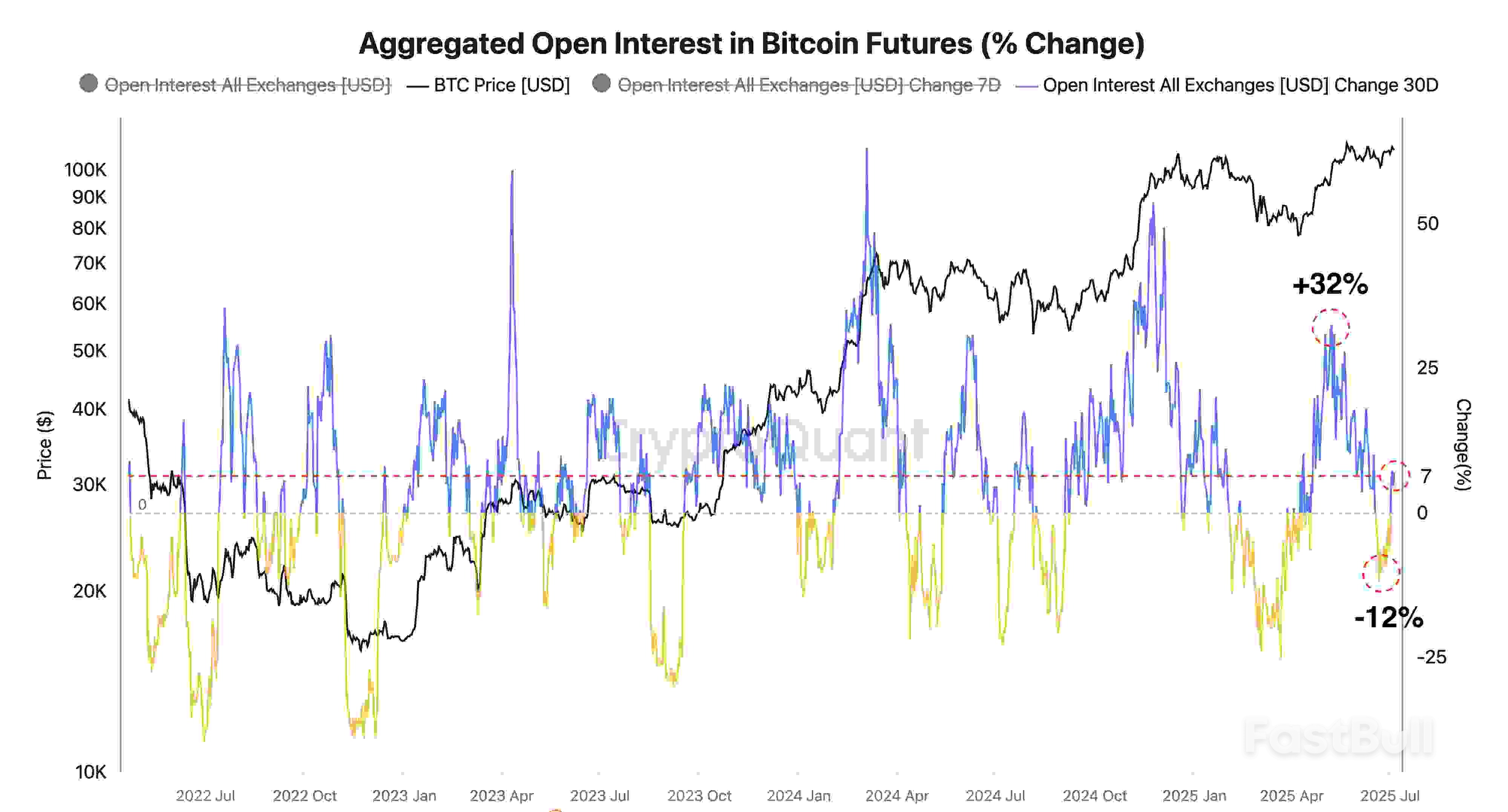
          Bitcoin futures showed renewed strength as their aggregated open interest (OI) surged by +7% over the past 30 days, marking the first sustained uptick since the May through June 12% drawdown. This revival signals a potential shift in sentiment, with traders increasingly positioning for the upside as their appetite for volume and leverage rises.Bitcoin Futures Pivot to Long Positions: Is $112K the Next Stop?_1
          Rising OI with price typically suggests bullish momentum as fresh capital enters the market to support an uptrend. Still, Bitcoin researcher Axel Adler Jr. cautioned that a confirmed breakout may require OI growth to exceed +10%, ideally paired with expanding trading volumes to validate the move.
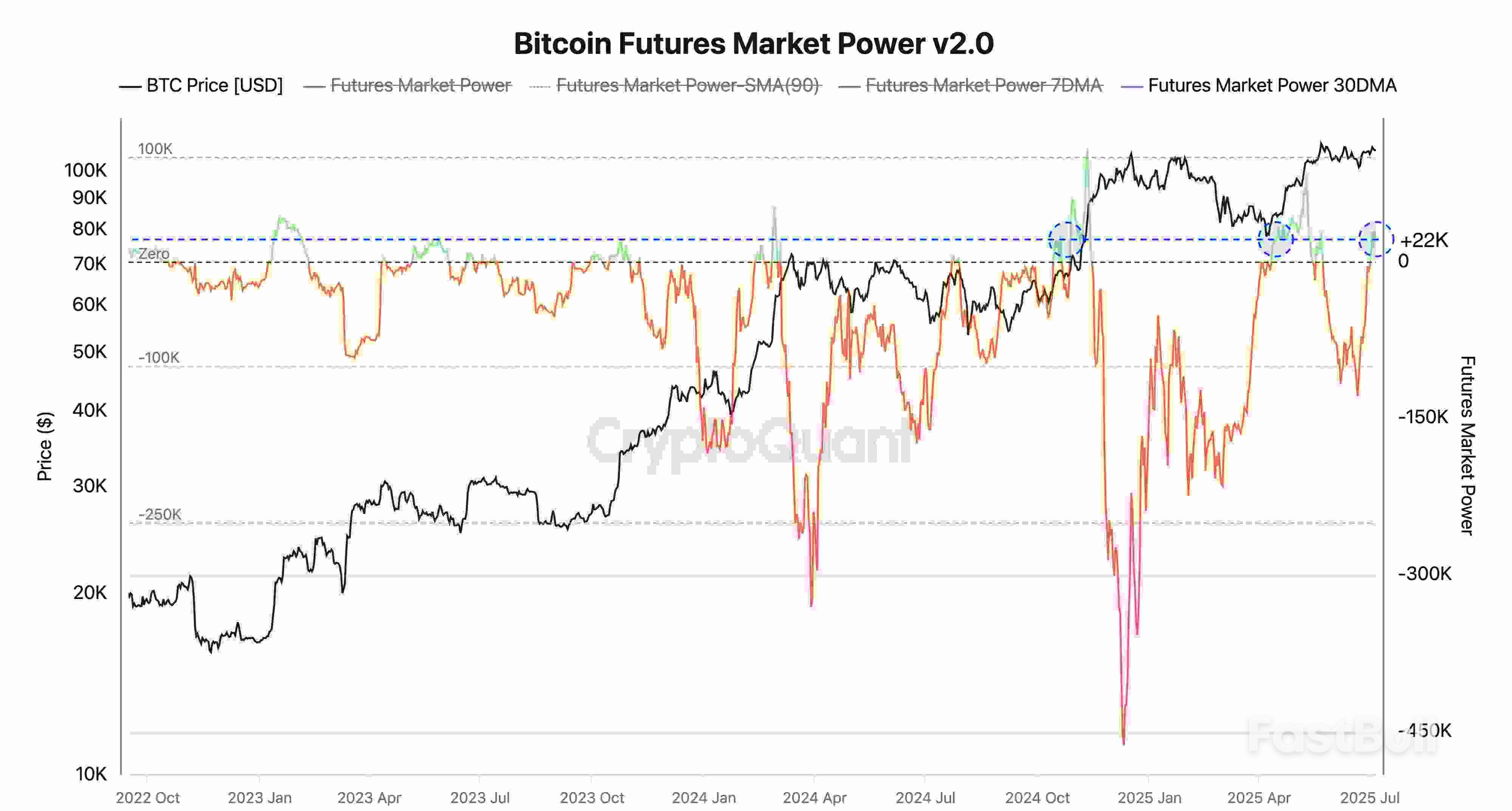
          Additionally, Adler Jr. noted that the Bitcoin Futures Market Power v2.0 indicator, which combines OI, funding rates, and taker-side aggression, currently sits at 22,000. While far from euphoric levels seen in past rallies with scores above 80,000, the metric reflects growing long-side pressure and a strengthening bullish consensus without signs of overheating. The indicator reflects a positive score for the first time since May, while a similar score in the 20,000 range signaled the price bottom in April.Bitcoin Futures Pivot to Long Positions: Is $112K the Next Stop?_2
          Bitcoin net futures positioning also flipped positive, with net long exposure rising to $27.4 million. This net bullish stance has held above zero for over 24 hours, suggesting that even as BTC consolidates near $108,000, traders are gradually stacking long positions in anticipation of a bullish breakout.

          Bitcoin may see “equal lows” dip below $107,000

          After closing its strongest weekly candle, Bitcoin faced a minor pullback to $108,000 from $109,500, forming a double top on lower timeframes. Despite the dip, BTC maintains intraday support at the 200-day exponential moving average (EMA) on the one-hour chart.
          However, a sweep of equal lows near $107,300 remains probable before any upside continuation. Equal lows refer to price points where BTC has formed identical support levels multiple times, typically signaling resting liquidity that traders could target for a deeper move. In this case, BTC’s prior low at $107,300 aligns with an earlier liquidity block, reinforcing the likelihood of a stop-loss hunt.
          A move below $107,000 could fill the nearby fair value gap between $107,000 and $106,300. A swift bullish reaction would be pivotal below $107,000, marked by strong buy absorption, which should send BTC back above $108,000. Failure to do so could open the door to deeper losses at $105,000.
          Conversely, a strong defense of $108,000 followed by a clean break above $109,500 would invalidate the equal highs retest narrative and set the stage for a rally above $112,000 this week.

          Source: Cointelegraph

          Risk Warnings and Disclaimers
          You understand and acknowledge that there is a high degree of risk involved in trading. Following any strategies or investment methods may lead to potential losses. The content on the site is provided by our contributors and analysts for information purposes only. You are solely responsible for determining whether any trading assets, securities, strategy, or any other product is suitable for investing based on your own investment objectives and financial situation.
          Add to Favorites
          Share

          Central banks go for gold, investors still see value in silver, platinum may consolidate after rapid price rise – Heraeus

          Adam

          Commodity

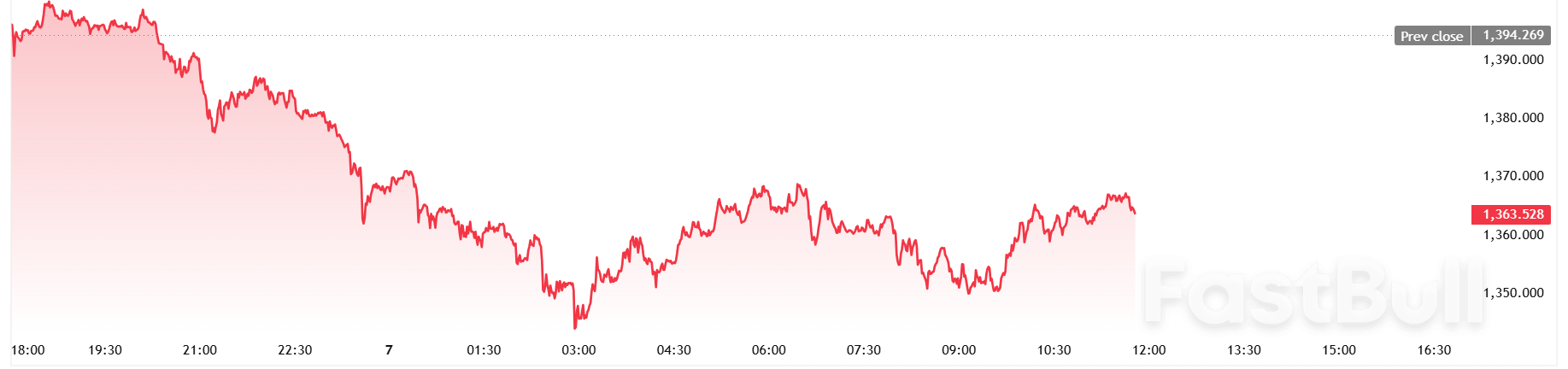
          While gold hasn’t been making strong gains since its April highs, sovereign demand is providing plenty of support at these price levels, and while EFT flows show investors see further gains for silver, platinum may have topped out in the near term, according to precious metals analysts at Heraeus.
          In their latest precious metals update, the analysts noted that central banks continue to provide a solid floor for gold demand.
          “In May 2025, central banks added a net 20 tonnes of gold to their reserves, with Kazakhstan, Turkey and Poland leading the purchases,” they wrote. “Despite a slight moderation in pace, sentiment remains strongly bullish – 95% of surveyed central banks expect global gold holdings to rise, and 43% plan to increase their own reserves, a record high. This reflects a structural shift in reserve management, with growing diversification away from the US dollar and heightened demand for gold as a hedge against geopolitical and inflationary risks.”
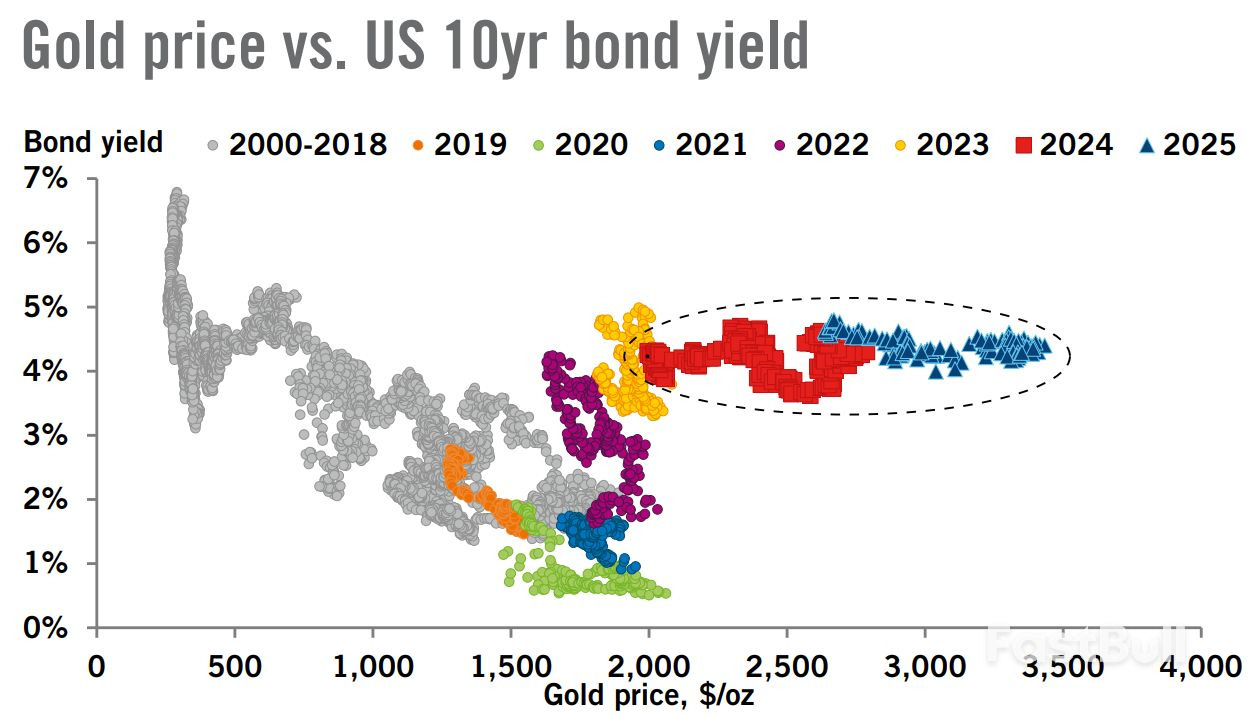
          Central banks have added over 1,000 tonnes of bullion to their reserves in each of the last three years, which is far above the long-term average. “This is likely to have been a driver of the gold price, even as correlations with other assets have broken down,” the analysts said. “For example, gold and the US Treasury 10-year bond yield were strongly negatively correlated until central banks began to ramp up purchases. Over the last 18 months, yields have largely traded between 3.5% and 5.0%, while the gold price has risen from $2,000/oz to ~$3,400/oz.”
          Central banks go for gold, investors still see value in silver, platinum may consolidate after rapid price rise – Heraeus_1
          “Ongoing central bank gold buying is expected to continue to underpin gold price performance through the remainder of 2025, providing emerging market banks continue to favour gold over other assets,” they said.
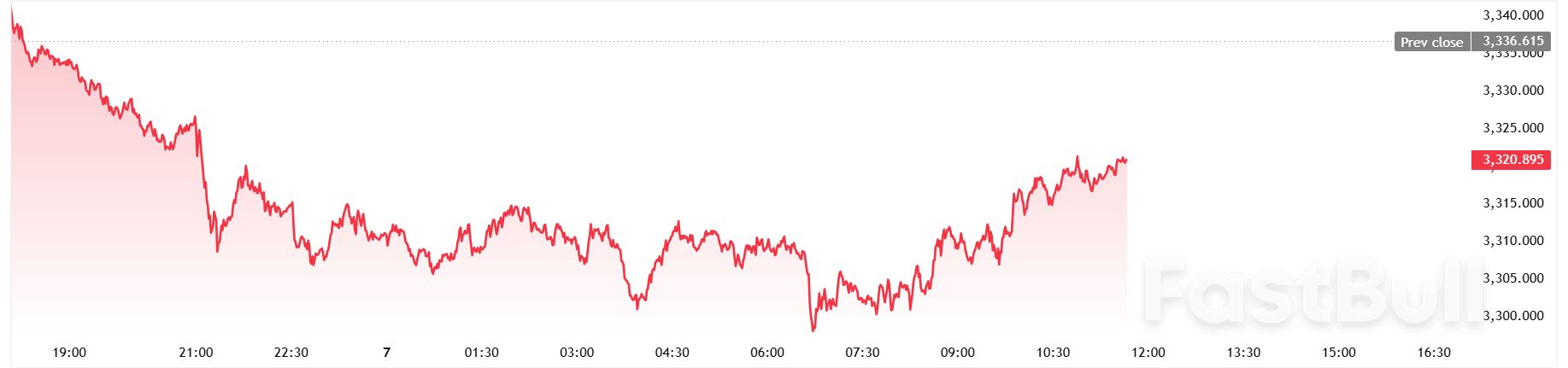
          After dipping briefly below support at $3,300 earlier this morning, spot gold is staging a modest recovery on Monday, last trading at $3,320.89 per ounce for a loss of 0.47% on the session.
          Central banks go for gold, investors still see value in silver, platinum may consolidate after rapid price rise – Heraeus_2
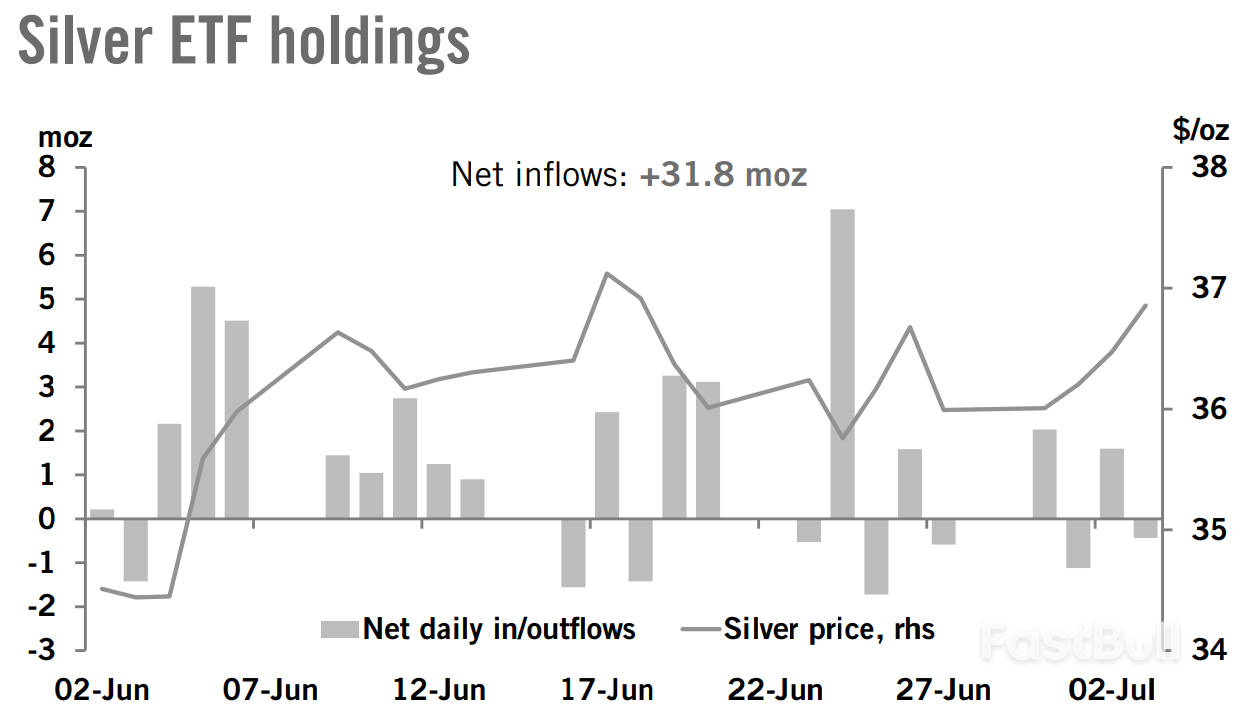
          Turning to silver, Heraeus analysts said the numbers show that investors continue to see value in silver.
          “Net ETF inflows of 990 tonnes have been made since the beginning of June to date (4 July),” they said. “Most of the inflows came from the price rallying in the first half of the month (+509 tonnes), followed by more opportunistic buying and selling as the silver price stabilised above $36/oz in the second half of the month and beginning of July. Since 14 June, net inflows have amounted to an additional 426 tonnes. In total, this accelerated investor interest over the last month or so has accounted for more than 50% of year-to-date net inflows into silver ETFs. This has helped to propel holdings to the highest level since August 2022, at more than 24,000 tonnes of metal.”
          Central banks go for gold, investors still see value in silver, platinum may consolidate after rapid price rise – Heraeus_3
          The analysts noted that as of Friday’s close, silver ETF holdings are valued at $28.5 billion. “Silver remains historically undervalued versus gold (Au:Ag = 90.3),” they said. “Should the silver price continue to appreciate, ETF inflows may continue, as investors, betting that the ratio will revert towards the 10-year average of 80.2, rejoin the trade.”
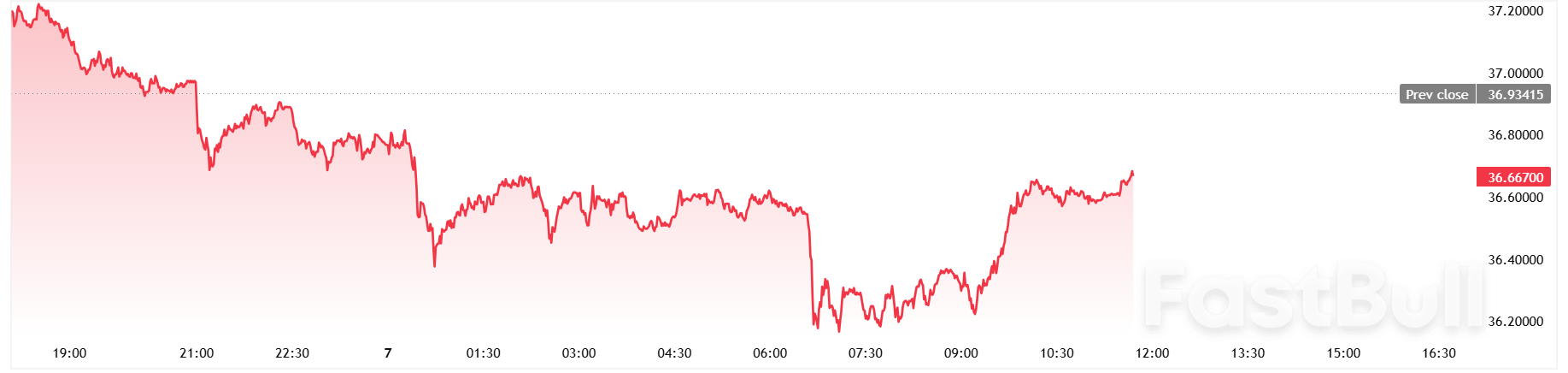
          Spot silver set a new high weekly close of $36.91 per ounce last week before falling along with gold earlier on Monday, but after multiple tests of the session low around $36.170 held, prices have moved back into the middle of their daily range. At the time of writing, spot silver last traded at $36.665 per ounce and is down 0.73% on the daily chart.
          Central banks go for gold, investors still see value in silver, platinum may consolidate after rapid price rise – Heraeus_4
          And on the platinum front, Heraeus wrote that producers are looking to reduce their costs to increase profitability.
          “Last week, Impala Platinum announced the official consolidation of the Impala and the Royal Bafokeng Platinum (RBP) operations in South Africa, following Impala’s acquisition of RBP in 2023,” they said. “The aim of the consolidation is to realise the synergies of the two contiguous operations, and lower unit costs across both. In CYH2’24, RBP shafts together were profitable, having successfully reduced costs by 2% year-on-year thanks to cost controls and labour restructuring efforts. Likewise, lower average labour costs at Impala helped to control costs, though mining inflation brought total costs up year-on-year.”
          “Given the contiguous nature of the Impala Lease Area and the Bafokeng lease, there is scope for costs to be reduced beyond overheads,” the analysts said. “It is feasible that accessing the underground ore from a more optimal shaft and optimal ore blending at the concentrating stage could have a positive impact on costs. The recent rise in the South African basket price will also be helping the country’s PGM producers’ bottom lines in the short term and ease pressure on the highest-cost operations.”
          They pointed out that platinum rose for a fifth straight week and saw the highest weekly close of the current rally at $1,394 per ounce. “Price action was choppy, swinging up to $50/oz intraday during the week,” the analysts noted. “The daily RSI is showing increasing divergence from the price, and after such a rapid rise a more prolonged period of consolidation is possible.”
          After hitting a session low of $1,341.94 just before 3 am EDT, spot platinum is also recovering along with the broader precious metals complex, though it has significantly more ground to make up.
          Central banks go for gold, investors still see value in silver, platinum may consolidate after rapid price rise – Heraeus_5
          Spot platinum last traded at $1,363.53 per ounce for a loss of 2.20% on the session.

          Source: kitco

          Risk Warnings and Disclaimers
          You understand and acknowledge that there is a high degree of risk involved in trading. Following any strategies or investment methods may lead to potential losses. The content on the site is provided by our contributors and analysts for information purposes only. You are solely responsible for determining whether any trading assets, securities, strategy, or any other product is suitable for investing based on your own investment objectives and financial situation.
          Add to Favorites
          Share

          Trump Tariff Letters Are Here; The S&P 500 Won't Panic

          Adam

          Economic

          President Trump is threatening 25% tariffs on Japan and South Korea after months of trade talks have yet to seal a deal. The S&P 500 turned lower in Monday afternoon trading, but investors know there's a good chance this won't be the final word.
          Trump's "reciprocal" tariff pause announced on April 9 comes to an end on Wednesday. Trump and Treasury Secretary Scott Bessent have warned that countries which don't agree to a deal by then should expect their tariff rate to jump back to the April 2 level. Yet the U.S. has only struck deals with the U.K. and Vietnam over the past three months, though talks with China have an established framework and are progressing along a different timeline, with an Aug. 12 deadline.

          Trump Tariffs On Japan, South Korea

          In letters to South Korea and Japan, Trump informed the key trading partners that the U.S. would impose "a Tariff of only 25%" on South Korean and Japanese imports to the U.S. The figure excludes categories that are subject to sectoral tariffs, including autos and steel.
          Trump further threatened to escalate tariffs to match any retaliatory tariff imposed by either country.
          Auto imports have been a sticking point in talks with both countries, while rice has loomed large in talks with Japan. According to S&P Mobility, Japan exports 1.3 million vehicles a year to the U.S., while South Koreas sends 1.4 million vehicles. The U.S, exports 17,000 vehicles to Japan and 46,000 to South Korea.

          Trump Tariff Optimism Tested

          Investors betting on the TACO trade — Trump Always Chickens Out — rode the S&P 500 to a 26% gain through last week from the 52-week low on April 8. Markets won't start taking Trump's tariff threats at face value without a compelling reason. It's not clear whether the threats against South Korea and Japan provide that reason.
          Plus, Trump has already signaled that any big tariff announcements this week aim to prod trading partners to strike a deal. Though the 90-day pause ends Wednesday, new tariff levels announced this week won't take effect until 1Aug.
          Trump gave Mexico and Canada, America's two biggest trading partners, a pass from so-called reciprocal tariffs, so they won't come in the line of fire this week, nor will China. While Trump threatened the European Union with a 50% tariff in May, markets don't take that seriously. At the moment, reports suggest that the EU is still hopeful that a deal can be struck.
          Markets can tolerate the economic headwind from some level of tariffs. Yet, as the cycle of Trump tariff escalation and Chinese retaliation showed this spring, when tariffs get high enough to cancel out economic activity and trading partners strike back with retaliatory tariffs, the cost of tariffs spikes.
          While the risk of tit-for-tat tariffs with the EU remains, Trump probably also learned the lesson of dividing and conquering, rather than taking on all trading partners at one time as he did in April.

          How High Will Tariffs Go?

          While markets have taken a sanguine view ahead of this week's tariffs news, there's good reason to think that the average U.S. tariff rate is still heading higher in some places. Last week's deal with Vietnam probably shouldn't be seen in a vacuum. Would Vietnam have agreed to swallow 20% tariffs — down from the 46% rate announced on April 2 but double the 10% that actually took effect — unless officials had reason to believe that other Southeast Asian countries would face a similar rate.
          The agreement with Vietnam also puts in place a 40% tariff for Chinese goods shipped via Vietnam to the U.S. to dodge the higher tariffs for direct imports of Chinese goods to the U.S.
          "The draft Vietnam deal confirms that countries with sustained high trade surpluses with the U.S., and those acting as transshipment hubs for Chinese goods, may face higher baseline tariffs and additional duties on rerouted products," wrote Ulrike Hoffmann-Burchardi, chief investment officer of UBS Global Wealth Management in the Americas, in a July 3 note.
          Still, UBS viewed the U.S.-Vietnam deal as "a positive step toward more durable bilateral deals for the U.S. and toward greater clarity for investors."
          "While tariffs will likely slow U.S. growth and add some inflation pressure into 2026, we do not expect them to derail the economy or cause a recession," Hoffmann-Burchardi said.

          S&P 500

          The S&P 500 fell 0.8% in Monday afternoon stock market action. The S&P 500 had climbed 1.7% in the holiday-shortened week, pushing further into new-high ground.
          Be sure to read IBD's The Big Picture column after each trading day to get the latest on the prevailing stock market trend and what it means for your trading decisions.

          Source: investors

          To stay updated on all economic events of today, please check out our Economic calendar
          Risk Warnings and Disclaimers
          You understand and acknowledge that there is a high degree of risk involved in trading. Following any strategies or investment methods may lead to potential losses. The content on the site is provided by our contributors and analysts for information purposes only. You are solely responsible for determining whether any trading assets, securities, strategy, or any other product is suitable for investing based on your own investment objectives and financial situation.
          Add to Favorites
          Share

          Trump Unveils 25% Tariffs on Goods From Japan, South Korea in Letters to Leaders

          Manuel

          Economic

          China–U.S. Trade War

          President Donald Trump said on Monday the U.S. would impose a 25% tariff on imports from Japan and South Korea beginning Aug. 1 as he unveiled the first two of an expected 12 letters to trading partners outlining the new levies they face.
          "If for any reason you decide to raise your Tariffs, then, whatever the number you choose to raise them by, will be added onto the 25% that we charge," Trump said in letters to the leaders of the two Asian countries, which he posted on his Truth Social platform.
          Later, Trump also announced the U.S. will impose 25% tariffs on Malaysia and Kazakhstan, 30% on South Africa and 40% on Laos and Myanmar.
          The rate for South Korea is the same as Trump initially announced on April 2, while the rate for Japan is 1 point higher than first announced. A week later, he capped all of the so-called reciprocal tariffs at 10% until July 9 to allow for negotiations. Only two agreements have so far been reached, with Britain and Vietnam.
          There was no immediate response from the Japanese or South Korean embassies on the announcement.
          About 12 countries will receive letters from Trump, White House spokeswoman Karoline Leavitt said at a briefing without identifying them. She said Trump would sign an executive order on Monday formally delaying the July 9 deadline to August 1.
          "There will be additional letters in the coming days," Leavitt said, adding that "we are close" on some deals.
          The European Union will not be receiving a letter setting out higher tariffs, EU sources familiar with the matter told Reuters on Monday.
          U.S. stocks fell in response, the latest market ruction since Trump unleashed a global trade war on his return to office in January. His moves have repeatedly whipsawed financial markets and sent policymakers scrambling to protect their economies.
          U.S. stocks were driven to near bear-market territory by his cascade of tariff announcements through the early spring but quickly rebounded to record highs in the weeks after he put the stiffest levies on hold on April 9.
          The S&P 500 on Monday was down nearly 1%, its biggest drop in three weeks. U.S.-listed shares of Japanese automotive companies fell, with Toyota Motor down 4.1% at mid-afternoon trading and Honda Motor off by 3.8%. The dollar surged against both the Japanese yen and the South Korean won.
          U.S. Treasury Secretary Scott Bessent said earlier on Monday he expected several trade announcements to be made in the next 48 hours, adding that his inbox was full of last-ditch offers from countries to clinch a tariff deal by the deadline.
          Bessent did not say which countries could get deals and what they might contain. Trump has kept much of the world guessing on the outcome of months of talks with countries hoping to avoid the hefty tariff hikes he has threatened.
          Countries have scrambled to hammer out deals before the Wednesday deadline. South Korea and Indonesia dispatched representatives to Washington, while Thailand submitted a new trade proposal offering zero tariffs on many U.S. goods.
          "We've had a lot of people change their tune in terms of negotiations. So my mailbox was full last night with a lot of new offers, a lot of new proposals," Bessent said in an interview with CNBC. "So it's going to be a busy couple of days."

          BRICS THREAT

          For its part, the European Union still aims to reach a trade deal by July 9 after European Commission President Ursula von der Leyen and Trump had a "good exchange," a Commission spokesperson said.
          It was not clear, however, whether there had been a meaningful breakthrough in talks to stave off tariff hikes on the United States' largest trading partner.
          Adding to the pressure, Trump threatened to impose a 17% tariff on EU food and agriculture exports, it emerged last week.
          Trump had said on Sunday the U.S. was close to finalizing several trade pacts and would notify other countries by July 9 of higher tariff rates. He said they would not take effect until Aug. 1, a three-week reprieve.
          He also put members of the developing nations' BRICS group in his sights as its leaders met in Brazil, threatening an additional 10% tariff on any BRICS countries aligning themselves with "anti-American" policies.
          The new 10% tariff will be imposed on individual countries if they take anti-American policy actions, a source familiar with the matter said.
          The BRICS group comprises Brazil, Russia, India and China and South Africa along with recent joiners Egypt, Ethiopia, Indonesia, Iran and the United Arab Emirates.
          Trump's comments hit the South African rand.

          EU SEEKS EFFECTIVE APPROACH TO TRUMP

          The EU has been torn over whether to push for a quick and light trade deal or back its own economic clout in trying to negotiate a better outcome. It had already dropped hopes for a comprehensive trade agreement before the July deadline.
          "We want to reach a deal with the U.S. We want to avoid tariffs," the spokesperson said at a daily briefing.
          Without a preliminary agreement, broad U.S. tariffs on most imports would rise from their current 10% to the rates set out by Trump on April 2. In the EU's case, that would be 20%.
          Von der Leyen also held talks with the leaders of Germany, France and Italy at the weekend, Germany said. Chancellor Friedrich Merz has repeatedly stressed the need for a quick deal to protect industries vulnerable to tariffs ranging from cars to pharmaceuticals.
          The German spokesperson said the parties should allow themselves "another 24 or 48 hours to come to a decision."
          Germany's Mercedes-Benz (MBGn.DE), said on Monday its second-quarter unit sales of cars and vans had fallen 9%, blaming tariffs.
          Russia said BRICS was "a group of countries that share common approaches and a common world view on how to cooperate, based on their own interests."
          "And this cooperation within BRICS has never been and will never be directed against any third countries," said Kremlin spokesman Dmitry Peskov.

          Source: Reuters

          To stay updated on all economic events of today, please check out our Economic calendar
          Risk Warnings and Disclaimers
          You understand and acknowledge that there is a high degree of risk involved in trading. Following any strategies or investment methods may lead to potential losses. The content on the site is provided by our contributors and analysts for information purposes only. You are solely responsible for determining whether any trading assets, securities, strategy, or any other product is suitable for investing based on your own investment objectives and financial situation.
          Add to Favorites
          Share
          FastBull
          Copyright © 2025 FastBull Ltd

          728 RM B 7/F GEE LOK IND BLDG NO 34 HUNG TO RD KWUN TONG KLN HONG KONG

          TelegramInstagramTwitterfacebooklinkedin
          App Store Google Play Google Play
          Products
          Charts

          Chats

          Q&A with Experts
          Screeners
          Economic Calendar
          Data
          Tools
          Membership
          Features
          Function
          Markets
          Copy Trading
          Latest Signals
          Contests
          News
          Analysis
          24/7
          Columns
          Education
          Company
          Careers
          About Us
          Contact Us
          Advertising
          Help Center
          Feedback
          User Agreement
          Privacy Policy
          Business

          White Label

          Data API

          Web Plug-ins

          Poster Maker

          Affiliate Program

          Risk Disclosure

          The risk of loss in trading financial instruments such as stocks, FX, commodities, futures, bonds, ETFs and crypto can be substantial. You may sustain a total loss of the funds that you deposit with your broker. Therefore, you should carefully consider whether such trading is suitable for you in light of your circumstances and financial resources.

          No decision to invest should be made without thoroughly conducting due diligence by yourself or consulting with your financial advisors. Our web content might not suit you since we don't know your financial conditions and investment needs. Our financial information might have latency or contain inaccuracy, so you should be fully responsible for any of your trading and investment decisions. The company will not be responsible for your capital loss.

          Without getting permission from the website, you are not allowed to copy the website's graphics, texts, or trademarks. Intellectual property rights in the content or data incorporated into this website belong to its providers and exchange merchants.

          Not Logged In

          Log in to access more features

          FastBull Membership

          Not yet

          Purchase

          Become a signal provider
          Help Center
          Customer Service
          Dark Mode
          Price Up/Down Colors

          Log In

          Sign Up
          Position
          Layout
          Fullscreen
          Default to Chart
          The chart page opens by default when you visit fastbull.com