• Trade
  • Markets
  • Copy
  • Contests
  • News
  • 24/7
  • Calendar
  • Q&A
  • Chats
Trending
Screeners
SYMBOL
LAST
BID
ASK
HIGH
LOW
NET CHG.
%CHG.
SPREAD
SPX
S&P 500 Index
6857.13
6857.13
6857.13
6865.94
6827.13
+7.41
+ 0.11%
--
DJI
Dow Jones Industrial Average
47850.93
47850.93
47850.93
48049.72
47692.96
-31.96
-0.07%
--
IXIC
NASDAQ Composite Index
23505.13
23505.13
23505.13
23528.53
23372.33
+51.04
+ 0.22%
--
USDX
US Dollar Index
98.890
98.970
98.890
98.980
98.740
-0.090
-0.09%
--
EURUSD
Euro / US Dollar
1.16529
1.16536
1.16529
1.16715
1.16408
+0.00084
+ 0.07%
--
GBPUSD
Pound Sterling / US Dollar
1.33477
1.33486
1.33477
1.33622
1.33165
+0.00206
+ 0.15%
--
XAUUSD
Gold / US Dollar
4223.24
4223.67
4223.24
4230.62
4194.54
+16.07
+ 0.38%
--
WTI
Light Sweet Crude Oil
59.496
59.526
59.496
59.543
59.187
+0.113
+ 0.19%
--

Community Accounts

Signal Accounts
--
Profit Accounts
--
Loss Accounts
--
View More

Become a signal provider

Sell trading signals to earn additional income

View More

Guide to Copy Trading

Get started with ease and confidence

View More

Signal Accounts for Members

All Signal Accounts

Best Return
  • Best Return
  • Best P/L
  • Best MDD
Past 1W
  • Past 1W
  • Past 1M
  • Past 1Y

All Contests

  • All
  • Trump Updates
  • Recommend
  • Stocks
  • Cryptocurrencies
  • Central Banks
  • Featured News
Top News Only
Share

Kremlin - Russia, India Sign Comprehensive Joint Statement

Share

Swiss Government: Exemption Is Appropriate Given That Reinsurance Business Is Conducted Between Insurance Companies, Protection Of Clients Not Affected

Share

Morgan Stanley Expects Fed To Cut Rates By 25 Bps Each In January And April 2026 Taking Terminal Target Range To 3.0%-3.25%

Share

Azerbaijan's Socar Says Socar And Ucc Holding Sign Memorandum Of Understanding On Fuel Supply To Damascus International Airport

Share

Fca: Measures Include Review Of Credit Union Regulations & Launch Of Mutual Societies Development Unit By Fca

Share

Morgan Stanley Expects US Fed To Cut Interest Rates By 25 Bps In December 2025 Versus Prior Forecast Of No Rate Cut

Share

Russian Defence Ministry Says Russian Forces Capture Bezimenne In Ukraine's Donetsk Region

Share

Bank Of England: Regulators Announce Plans To Support Growth Of Mutuals Sector

Share

[US Government Concealed Records Of Attacks On Venezuelan Ships? US Watchdog: Lawsuit Filed] On December 4th Local Time, The Organization "US Watch" Announced That It Has Filed A Lawsuit Against The US Department Of Defense And The Department Of Justice, Alleging That The Two Departments "illegally Concealed Records Regarding US Government Attacks On Venezuelan Ships." US Watch Stated That The Lawsuit Targets Four Unanswered Requests. These Requests, Based On The Freedom Of Information Act, Aim To Obtain Records From The US Department Of Defense And The Department Of Justice Regarding The US Military Attacks On Ships On September 2nd And 15th. The US Government Claims These Ships Were "involved In Drug Trafficking" But Has Provided No Evidence. Furthermore, The Lawsuit Documents Released By The Organization Mention That Experts Say That If Survivors Of The Initial Attacks Were Killed As Reported, This Could Constitute A War Crime

Share

Standard Chartered Bought Back Total 573082 Shares On Other Exchanges For Gbp9.5 Million On Dec 4 - HKEX

Share

Russian President Putin: Russia Is Ready To Provide Uninterrupted Fuel Supplies To India

Share

French President Macron: Unity Between Europe And The US On Ukraine Is Essential, There Is No Distrust

Share

Russian President Putin: Numerous Agreements Signed Today Aimed To Strengthening Cooperation With India

Share

Russian President Putin: Talks With Indian Colleagues And Meeting With Prime Minister Modi Were Useful

Share

India Prime Minister Modi: Trying For Early Conclusion Of FTA With Eurasian Economic Union

Share

India Prime Minister Modi: India-Russia Agreed On Economic Cooperation Program To Expand Trade Till 2030

Share

India Government: Indian Firms Sign Deal With Russia's Uralchem To Set Up Urea Plant In Russia

Share

UN FAO Forecasts Global Cereal Production In 2025 At 3.003 Billion Metric Tons Versus 2.990 Billion Tons Estimated Last Month

Share

Cores - Spain October Crude Oil Imports Rise 14.8% Year-On-Year To 5.7 Million Tonnes

Share

USA S&P 500 E-Mini Futures Up 0.18%, NASDAQ 100 Futures Up 0.4%, Dow Futures Flat

TIME
ACT
FCST
PREV
France 10-Year OAT Auction Avg. Yield

A:--

F: --

P: --

Euro Zone Retail Sales YoY (Oct)

A:--

F: --

P: --

Brazil GDP YoY (Q3)

A:--

F: --

P: --

U.S. Challenger Job Cuts (Nov)

A:--

F: --

P: --

U.S. Challenger Job Cuts MoM (Nov)

A:--

F: --

P: --

U.S. Challenger Job Cuts YoY (Nov)

A:--

F: --

P: --

U.S. Initial Jobless Claims 4-Week Avg. (SA)

A:--

F: --

P: --

U.S. Weekly Initial Jobless Claims (SA)

A:--

F: --

P: --

U.S. Weekly Continued Jobless Claims (SA)

A:--

F: --

P: --

Canada Ivey PMI (SA) (Nov)

A:--

F: --

P: --

Canada Ivey PMI (Not SA) (Nov)

A:--

F: --

P: --

U.S. Non-Defense Capital Durable Goods Orders Revised MoM (Excl. Aircraft) (SA) (Sept)

A:--

F: --

P: --
U.S. Factory Orders MoM (Excl. Transport) (Sept)

A:--

F: --

P: --

U.S. Factory Orders MoM (Sept)

A:--

F: --

P: --

U.S. Factory Orders MoM (Excl. Defense) (Sept)

A:--

F: --

P: --

U.S. EIA Weekly Natural Gas Stocks Change

A:--

F: --

P: --

Saudi Arabia Crude Oil Production

A:--

F: --

P: --

U.S. Weekly Treasuries Held by Foreign Central Banks

A:--

F: --

P: --

Japan Foreign Exchange Reserves (Nov)

A:--

F: --

P: --

India Repo Rate

A:--

F: --

P: --

India Benchmark Interest Rate

A:--

F: --

P: --

India Reverse Repo Rate

A:--

F: --

P: --

India Cash Reserve Ratio

A:--

F: --

P: --

Japan Leading Indicators Prelim (Oct)

A:--

F: --

P: --

U.K. Halifax House Price Index YoY (SA) (Nov)

A:--

F: --

P: --

U.K. Halifax House Price Index MoM (SA) (Nov)

A:--

F: --

P: --

France Current Account (Not SA) (Oct)

A:--

F: --

P: --

France Trade Balance (SA) (Oct)

A:--

F: --

P: --

France Industrial Output MoM (SA) (Oct)

A:--

F: --

P: --

Italy Retail Sales MoM (SA) (Oct)

A:--

F: --

P: --

Euro Zone Employment YoY (SA) (Q3)

--

F: --

P: --

Euro Zone GDP Final YoY (Q3)

--

F: --

P: --

Euro Zone GDP Final QoQ (Q3)

--

F: --

P: --

Euro Zone Employment Final QoQ (SA) (Q3)

--

F: --

P: --

Euro Zone Employment Final (SA) (Q3)

--

F: --

P: --
Brazil PPI MoM (Oct)

--

F: --

P: --

Mexico Consumer Confidence Index (Nov)

--

F: --

P: --

Canada Unemployment Rate (SA) (Nov)

--

F: --

P: --

Canada Labor Force Participation Rate (SA) (Nov)

--

F: --

P: --

Canada Employment (SA) (Nov)

--

F: --

P: --

Canada Part-Time Employment (SA) (Nov)

--

F: --

P: --

Canada Full-time Employment (SA) (Nov)

--

F: --

P: --

U.S. Personal Income MoM (Sept)

--

F: --

P: --

U.S. Dallas Fed PCE Price Index YoY (Sept)

--

F: --

P: --

U.S. PCE Price Index YoY (SA) (Sept)

--

F: --

P: --

U.S. PCE Price Index MoM (Sept)

--

F: --

P: --

U.S. Personal Outlays MoM (SA) (Sept)

--

F: --

P: --

U.S. Core PCE Price Index MoM (Sept)

--

F: --

P: --

U.S. UMich 5-Year-Ahead Inflation Expectations Prelim YoY (Dec)

--

F: --

P: --

U.S. Core PCE Price Index YoY (Sept)

--

F: --

P: --

U.S. Real Personal Consumption Expenditures MoM (Sept)

--

F: --

P: --

U.S. 5-10 Year-Ahead Inflation Expectations (Dec)

--

F: --

P: --

U.S. UMich Current Economic Conditions Index Prelim (Dec)

--

F: --

P: --

U.S. UMich Consumer Sentiment Index Prelim (Dec)

--

F: --

P: --

U.S. UMich 1-Year-Ahead Inflation Expectations Prelim (Dec)

--

F: --

P: --

U.S. UMich Consumer Expectations Index Prelim (Dec)

--

F: --

P: --

U.S. Weekly Total Rig Count

--

F: --

P: --

U.S. Weekly Total Oil Rig Count

--

F: --

P: --

U.S. Consumer Credit (SA) (Oct)

--

F: --

P: --

China, Mainland Foreign Exchange Reserves (Nov)

--

F: --

P: --

Q&A with Experts
    • All
    • Chatrooms
    • Groups
    • Friends
    Connecting
    .
    .
    .
    Type here...
    Add Symbol or Code

      No matching data

      All
      Trump Updates
      Recommend
      Stocks
      Cryptocurrencies
      Central Banks
      Featured News
      • All
      • Russia-Ukraine Conflict
      • Middle East Flashpoint
      • All
      • Russia-Ukraine Conflict
      • Middle East Flashpoint
      Search
      Products

      Charts Free Forever

      Chats Q&A with Experts
      Screeners Economic Calendar Data Tools
      Membership Features
      Data Warehouse Market Trends Institutional Data Policy Rates Macro

      Market Trends

      Market Sentiment Order Book Forex Correlations

      Top Indicators

      Charts Free Forever
      Markets

      News

      News Analysis 24/7 Columns Education
      From Institutions From Analysts
      Topics Columnists

      Latest Views

      Latest Views

      Trending Topics

      Top Columnists

      Latest Update

      Signals

      Copy Rankings Latest Signals Become a signal provider AI Rating
      Contests
      Brokers

      Overview Brokers Assessment Rankings Regulators News Claims
      Broker listing Forex Brokers Comparison Tool Live Spread Comparison Scam
      Q&A Complaint Scam Alert Videos Tips to Detect Scam
      More

      Business
      Events
      Careers About Us Advertising Help Center

      White Label

      Data API

      Web Plug-ins

      Affiliate Program

      Awards Institution Evaluation IB Seminar Salon Event Exhibition
      Vietnam Thailand Singapore Dubai
      Fans Party Investment Sharing Session
      FastBull Summit BrokersView Expo
      Recent Searches
        Top Searches
          Markets
          News
          Analysis
          User
          24/7
          Economic Calendar
          Education
          Data
          • Names
          • Latest
          • Prev

          View All

          No data

          Scan to Download

          Faster Charts, Chat Faster!

          Download App
          English
          • English
          • Español
          • العربية
          • Bahasa Indonesia
          • Bahasa Melayu
          • Tiếng Việt
          • ภาษาไทย
          • Français
          • Italiano
          • Türkçe
          • Русский язык
          • 简中
          • 繁中
          Open Account
          Search
          Products
          Charts Free Forever
          Markets
          News
          Signals

          Copy Rankings Latest Signals Become a signal provider AI Rating
          Contests
          Brokers

          Overview Brokers Assessment Rankings Regulators News Claims
          Broker listing Forex Brokers Comparison Tool Live Spread Comparison Scam
          Q&A Complaint Scam Alert Videos Tips to Detect Scam
          More

          Business
          Events
          Careers About Us Advertising Help Center

          White Label

          Data API

          Web Plug-ins

          Affiliate Program

          Awards Institution Evaluation IB Seminar Salon Event Exhibition
          Vietnam Thailand Singapore Dubai
          Fans Party Investment Sharing Session
          FastBull Summit BrokersView Expo

          Trump Again Attacks Fed Chair, Says Powell 'hurting' The Housing Industry

          Laura Fletcher
          Summary:

          President Donald Trump said on Tuesday that Federal Reserve Chair Jerome Powell is "hurting" the housing industry "very badly" and repeated his call for a big cut to U.S. interest rates.

          President Donald Trump said on Tuesday that Federal Reserve Chair Jerome Powell is "hurting" the housing industry "very badly" and repeated his call for a big cut to U.S. interest rates.

          "Could somebody please inform Jerome "Too Late" Powell that he is hurting the Housing Industry, very badly? People can't get a Mortgage because of him. There is no Inflation, and every sign is pointing to a major Rate Cut," Trump wrote on Truth Social.

          Inflation is well off the highs seen during the pandemic, but some recent data has given a mixed picture and inflation continues to track above the Fed's 2% target range.

          Trump's latest salvo against Powell comes ahead of the Fed chair's Friday speech at the annual Jackson Hole central banking symposium, where investors will cleave to his every word for hints on his economic outlook and the likelihood of a coming reduction to short-term borrowing costs.

          The Fed's next policy meeting will be held on September 16-17.

          Investors and economists are betting the Fed will cut rates by a quarter of a percentage point next month with perhaps another reduction of similar size to come later in the year, far less than the several percentage points that Trump has called for.

          Trump's Treasury secretary, Scott Bessent, has promoted the idea of a half-point rate cut in September.

          The U.S. central bank cut its policy rate half a percentage point last September, just before the presidential election, and trimmed it another half of a percentage point in the two months immediately following Trump's electoral victory, but has held it steady in the 4.25%-4.50% range for all of this year. Fed policymakers have worried that Trump's tariffs could reignite inflation and also felt the labor market was strong enough not to require a boost from lower borrowing costs.

          MIXED INFLATION PICTURE

          The Consumer Price Index rose 0.2% in July, with the 12-month rate through July at 2.7%, unchanged from June. Core CPI, which strips out the volatile food and energy components, increased 3.1% year-over-year in July. Based in part on that data, economists estimated the core Personal Consumption Expenditures Price Index rose 0.3% in July. That would raise the year-on-year increase to 3% in July. The PCE is a key measure tracked by the Fed against its own 2% inflation target.

          And despite a moderate rise in overall consumer prices in July, producer and import prices jumped, a suggestion that higher consumer prices could be coming as sellers pass higher costs onto households. The inflation picture comes amid a picture of a possible cooling in the labor market, with declines in monthly job gains, although the unemployment rate, at 4.2%, remains low by historical standards.

          Trump's online attacks on the Fed and Powell more typically focus on the cost that higher interest rates mean for U.S. government borrowing. High mortgage rates are a key pain point for potential homebuyers who are also facing high and rising home prices due to a dearth of housing supply.

          Mortgage rates can be loosely tied to the Fed's overnight benchmark rate but more closely track the yield on the 10-year Treasury note, which typically rises and falls based on investors' expectations for economic growth and inflation. A Fed rate cut does not always mean lower long-term rates -- indeed after the Fed cut rates last September, mortgage rates -- which had been on the decline -- rose sharply.

          In recent weeks the most popular rate - the 30-year fixed mortgage rate -- has drifted downward but -- at around 6.7% most recently -- is still much higher than it had been before inflation took off after the pandemic shock and the Fed began its rate-hike campaign in 2022.

          Source: Reuters

          Risk Warnings and Disclaimers
          You understand and acknowledge that there is a high degree of risk involved in trading. Following any strategies or investment methods may lead to potential losses. The content on the site is provided by our contributors and analysts for information purposes only. You are solely responsible for determining whether any trading assets, securities, strategy, or any other product is suitable for investing based on your own investment objectives and financial situation.
          Add to Favorites
          Share

          Japan’s Exports Fall Most In Four Years As Tariff Pain Deepens

          Winkelmann

          Economic

          Political

          Forex

          Japan’s exports sustained their steepest drop in more than four years as US tariffs continued to weigh on global commerce, clouding the outlook for economic growth at a time when personal spending remains unsteady.Exports fell 2.6% in value in July from a year earlier, sliding more than the median forecast of a 2.1% decline, the Ministry of Finance reported Wednesday. The downturn, led by cars, auto parts and steel, was the biggest since February 2021. Export volumes rose by 1.2%, suggesting exporters are continuing to absorb US tariff costs by cutting selling prices to preserve market share.

          Imports decreased 7.5% and the trade balance flipped to a deficit of ¥117.5 billion.The latest slide in exports may strengthen concerns over whether Japan’s economy can continue to expand as US President Donald Trump’s tariffs weigh on global trade. While the economy has so far managed to eke out growth in the last five quarters despite weakness in domestic consumption, further drops in exports could drag the economy into reverse.

          Continued falls in exports may also encourage the Bank of Japan to adopt a cautious stance. The ability of the economy to show resilience in the face of the US duties is a factor in the calculus for the BOJ as it considers the best timing for its next interest rate hike. The BOJ is widely expected to stand pat when it next sets policy on Sept. 19.The report showed that exports to the US dropped by 10.1% last month from a year earlier, with shipments of vehicles and auto parts plunging 28.4% and 17.4%, respectively. Shipments to the US of semiconductor manufacturing equipment fell 31.3%.

          In April the US imposed a 25% tariff on imports of Japanese cars and auto parts and a 10% duty on most other goods. A levy on imports of steel was doubled to 50% in early June.The levies on cars and broad-based goods will be assessed at 15% under a trade deal reached in late July, although it may take some time for that deal to be implemented. Written documentation on the trade deals agreed to with Japan and South Korea are “weeks away,” US Commerce Secretary Howard Lutnick said Tuesday in an interview with CNBC.

          Beyond the US, exports to China fell 3.5%, while shipments to Europe declined by 3.4%. The yen averaged 145.56 per the dollar in July, 8.9% stronger than a year earlier, according to the Finance Ministry.

          Source: Bloomberg Europe

          To stay updated on all economic events of today, please check out our Economic calendar
          Risk Warnings and Disclaimers
          You understand and acknowledge that there is a high degree of risk involved in trading. Following any strategies or investment methods may lead to potential losses. The content on the site is provided by our contributors and analysts for information purposes only. You are solely responsible for determining whether any trading assets, securities, strategy, or any other product is suitable for investing based on your own investment objectives and financial situation.
          Add to Favorites
          Share

          Dollar Grinds Higher With Fed In Focus In Run-up To Jackson Hole

          Kevin Morgan

          The dollar got off on the front foot on Wednesday following two days of gains as traders awaited the Federal Reserve's Jackson Hole annual symposium later this week for clues on the path for monetary policy.

          A speech on Friday by Fed Chair Jerome Powell is the main focus, with the market watching for any push back against market pricing of a rate reduction next month.

          Traders currently place 84% odds on a cut next month, and expect around 54 basis points of reductions by year-end.

          The dollar index , which measures the currency against six major counterparts, edged up to 98.393 early on Wednesday, the highest since August 12. It had gained about 0.4% in the first two days of this week.

          "Given the relatively high bar for Powell to meet, there's a bit of risk being baked into the markets that he leans to the hawkish side and the proverbial rug gets pulled from beneath investors," said Kyle Rodda, an analyst at Capital.com.

          In Asian hours, the Reserve Bank of New Zealand sets policy later in the day, with a large majority of economists predicting a quarter-point cut to the cash rate.

          The New Zealand dollar drooped close to Tuesday's nearly two-week low, last changing hands at $0.5895.

          "There's little reason for RBNZ to keep rates on hold," said Rodda.

          "Inflation is within its target band, and although it is no longer mandated to target the labour market, the unemployment rate is at a post-COVID high."

          For the Fed, traders ramped up bets for a cut on September 17 after a surprisingly weak payrolls report at the start of this month, and were further encouraged after consumer price data showed limited upward pressure from tariffs.

          However, a hotter-than-expected producer price reading last week complicated the policy picture.

          Powell has said he is reluctant to cut rates due to expected tariff-driven price pressures this summer.

          The Fed will release minutes from its July 29-30 meeting later on Wednesday, when the central bank held rates steady, although they may offer limited insight as the meeting came before the weak jobs numbers.

          Source: Reuters

          Risk Warnings and Disclaimers
          You understand and acknowledge that there is a high degree of risk involved in trading. Following any strategies or investment methods may lead to potential losses. The content on the site is provided by our contributors and analysts for information purposes only. You are solely responsible for determining whether any trading assets, securities, strategy, or any other product is suitable for investing based on your own investment objectives and financial situation.
          Add to Favorites
          Share

          Japan's July Exports Drop By 2.6%, Steepest Plunge In More Than Four Years

          James Whitman

          Economic

          Japan's exports dropped 2.6% year over year in July, their steepest drop since February 2021.

          The fall was sharper than the 2.1% contraction expected by economists polled by Reuters and compared to the 0.5% drop seen in June.

          Imports to the world's fourth-largest economy sank 7.5%, compared to the 10.4% fall expected by the Reuters poll.

          Exports to the U.S. also continued to fall, dropping 10.1% in July and slightly softer than June's decline of 11.4%.

          Japan reached a deal with Washington on July 22 that saw its so-called "reciprocal tariff" lowered to 15% from the 25% threatened by U.S. President Donald Trump earlier that month.

          The trade readings come after Japan reported its second-quarter GDP figures, which saw the country beat expectations as net exports drove growth.

          Japan's economy grew by 0.3% quarter over quarter and 1.2% on a yearly basis in the second quarter as exports remained resilient, even as imports fell.

          Hirofumi Suzuki, Chief FX Strategist at Sumitomo Mitsui Banking Corporation, told CNBC after the GDP release that while exports have been volatile, there was a higher level of automobile shipments in April to June.

          This may be due to an increase in catch-up shipments after production recovered from an accident at an automobile parts manufacturer in March, Suzuki said.

          Tariffs on automobiles were cut from 25% to 15% as part of Japan's trade deal. Autos are one of Japan's largest exports, and make up its largest export to the U.S. in 2024.

          The value of auto exports — which includes cars, buses and trucks — to the U.S. plunged 28.4% year over year in July, a steeper fall compared to the 26.7% decline in June.

          While the effects of the 15% tariffs will not show up until the August data, analysts have warned about their impact on the Japanese economy.

          Senior economist Masato Koike at Sompo Institute Plus said in an Aug 14 note that there was a possibility that Japan could enter a recession, depending on the magnitude of the impact of tariffs.

          Source: CNBC

          To stay updated on all economic events of today, please check out our Economic calendar
          Risk Warnings and Disclaimers
          You understand and acknowledge that there is a high degree of risk involved in trading. Following any strategies or investment methods may lead to potential losses. The content on the site is provided by our contributors and analysts for information purposes only. You are solely responsible for determining whether any trading assets, securities, strategy, or any other product is suitable for investing based on your own investment objectives and financial situation.
          Add to Favorites
          Share

          Japan's Nikkei To Ease Off Record Peak As Trade Honeymoon Fades

          James Whitman

          Economic

          Key points:

          ● Analysts predict Nikkei will slip to 42,000 by December
          ● Recent Nikkei gains linked to corporate governance push
          ● Outlook hinges on Japan's fragile trade deal with US

          Japan's Nikkei share averagewill likely ease off recent record highs toward year-end, according to strategists in a Reuters poll, though much depends on a fragile trade agreement with the United States.

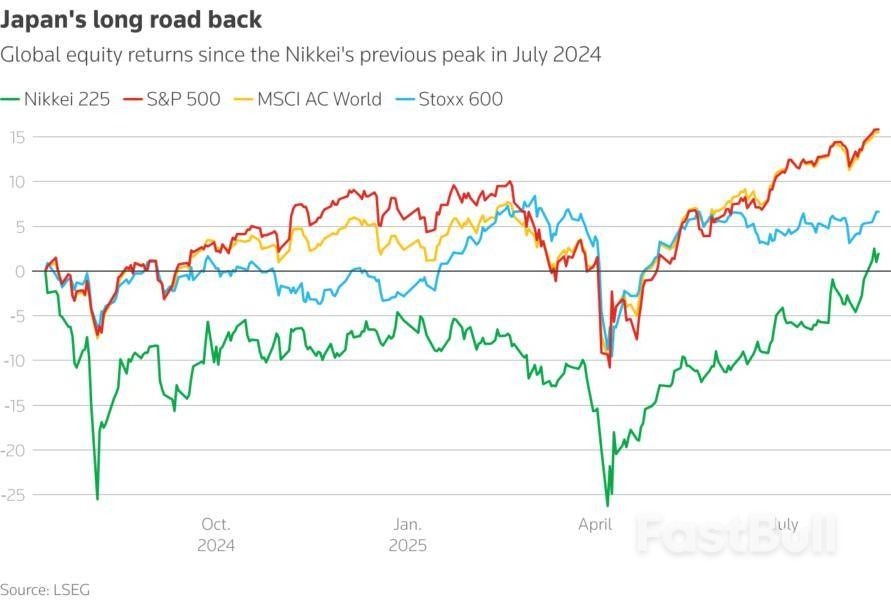
          Japan's benchmark stocks index last week surpassed its previous intraday record, and traded as high as 43,876.42 this week.

          The index is up more than 9% so far this year, but is forecast to slip back to 42,000 at the end of December, according to the median estimate of 18 analysts polled August 8-18.

          The Nikkei joined global equity bourses in a steep dive in April after U.S. President Donald Trump announced sweeping tariffs on imports. As Trump backed down on deadlines and his administration worked out bilateral trade deals, many benchmarks recovered.

          Japanese equities jumped around 11% after the U.S. agreed last month to reduce tariffs on Japanese auto imports to 15% from 27.5%, though a timeframe for the change and other details remain nebulous.

          "The 15% tariff is relatively low compared to the one on China, so Japanese companies may be able to gain a competitive advantage," said Masayuki Kubota, chief strategist at Rakuten Securities. "However, there is growing uncertainty about whether President Trump will actually uphold this agreement."

          Japan's economy remains largely reliant on exports. Data last week showed that the country's gross domestic product, the fourth biggest globally, grew much faster than expected in the second quarter.

          GOVERNANCE PUSH

          A major theme behind the Nikkei's gains in recent years has been the Tokyo Stock Exchange's push to boost corporate governance. Under pressure to improve returns and corporate value, companies have bought back shares in droves, and go-private deals have proliferated.

          The Nikkei early last year finally broke through the key high of 38,957.44 that had stood since 1989 during Japan's heady bubble economy. The gauge of blue-chip shares went on to set an intraday high of 42,426.77 on July 11, 2024, before the momentum petered out.

          Japan's long road back

          With the tariff turmoil diminishing and the domestic economy resilient, nine of 12 analysts in the Reuters poll expect Japanese corporate earnings to be higher in the second half of 2025 than the first.

          "If the U.S. economy is solid, it becomes easier for Japanese firms to raise prices for their exported goods to cover the cost of the tariffs," said Yugo Tsuboi, chief strategist at Daiwa Securities. "That will underpin corporate earnings."

          Median forecasts predict the Nikkei will trade at 43,000 by mid-2026 and 45,500 by end 2026.

          Improving domestic wages, along with looser monetary policy by the U.S. Federal Reserve, will continue to make Japan a destination for foreign investors, said Oanda senior market analyst Kelvin Wong.

          "An increase in global liquidity due to a weaker U.S. dollar and an impending dovish Fed pivot is likely to trigger a positive feedback loop back into the Japanese stock market," said Wong.

          BOJ AND POLITICS

          Within the country, the major events investors are looking out for are a long-delayed rate hike by the Bank of Japan and the potential for political upheaval.

          Prime Minister Shigeru Ishiba is under pressure to step aside after an electoral drubbing last month. Expectations that his replacement will be more fiscally expansive have added to tailwinds for stocks, said IG analyst Tony Sycamore.

          "We do see the market continue to run higher into year-end, and then after that I'd expect to see a pullback as we get close to the BOJ rate-hiking cycle taking effect," he added.

          Source: Reuters

          To stay updated on all economic events of today, please check out our Economic calendar
          Risk Warnings and Disclaimers
          You understand and acknowledge that there is a high degree of risk involved in trading. Following any strategies or investment methods may lead to potential losses. The content on the site is provided by our contributors and analysts for information purposes only. You are solely responsible for determining whether any trading assets, securities, strategy, or any other product is suitable for investing based on your own investment objectives and financial situation.
          Add to Favorites
          Share

          Federal Reserve Says US Banks Should Serve Crypto Without Fear of Penalties

          Manuel

          Cryptocurrency

          Central Bank

          Federal Reserve Vice Chair for Supervision Michelle Bowman acknowledged that crypto firms experienced debanking due to regulatory uncertainty.
          During the Wyoming Blockchain Symposium on Aug. 19, Bowman also announced a fundamental shift in the Fed’s approach to blockchain innovation.
          She revealed the central bank eliminated reputational risk considerations from bank supervision in late June to address barriers preventing financial institutions from serving digital asset companies engaged in legal activities.
          The Fed official stated: “Your industry [crypto] has already experienced significant frictions with bank regulators applying unclear standards, conflicting guidance, and inconsistent regulatory interpretations.”
          Bowman emphasized that banks should not face penalties for serving customers conducting lawful business operations, stating that customer selection decisions “lie solely within the purview of bank management” rather than regulatory interference.
          Furthermore, she noted the Fed’s transition from an “overly cautious mindset” toward embracing blockchain technology within the traditional banking system.
          She warned that regulators must choose between shaping technological frameworks or allowing innovations to bypass banks entirely, potentially diminishing the banking sector’s economic relevance.
          The Fed is updating examination manuals and supervisory materials to ensure lasting implementation of the reputational risk removal policy.

          Four-principle regulatory framework

          The Fed Vice Chair established four core principles guiding the central bank’s new approach to digital asset regulation.
          Regulatory certainty tops the list, addressing industry concerns about investing in blockchain development without clear supervisory standards.
          Bowman questioned whether companies would partner with banks, knowing that regulatory scrutiny brings uncertainty, rather than pursuing alternatives outside the banking system.
          Tailored regulation forms the second principle, requiring supervisors to evaluate use cases based on specific circumstances rather than applying worst-case scenario expectations.
          The Fed must recognize unique features distinguishing digital assets from traditional financial instruments while avoiding one-size-fits-all approaches that fail to address actual risk profiles.
          Consumer protection represents the third principle, ensuring customer-facing products comply with existing consumer protection laws, including prohibitions against unfair, deceptive, or abusive practices.
          Digital asset frameworks must incorporate Bank Secrecy Act and anti-money laundering requirements while maintaining bank safety and soundness standards.
          American competitiveness completes the framework, positioning the US as the premier global innovation destination. Bowman warned that failing to establish appropriate regulatory structures could jeopardize long-term American leadership in financial technology development.

          Technology integration and supervision changes

          Bowman announced the Fed’s “novel supervision” activities will be reintegrated into Reserve Bank examination staff, reestablishing normal supervisory processes for monitoring banks’ innovative activities.
          She proposed allowing Federal Reserve staff to hold minimal digital assets to develop a working understanding of blockchain functionality, comparing the necessity to hands-on learning rather than theoretical knowledge.
          [Editor’s Note: This is an abrupt U-turn from previous government approaches, notably those of former SEC Chair Gary Gensler. Gensler taught college-level blockchain courses at MIT yet never actually touched a blockchain with his own funds, having admitted to never holding any digital assets and, therefore, never executing his own transactions.]
          The Fed recognizes tokenization potential for facilitating faster asset ownership transfers while reducing transaction costs and settlement risks. Bowman noted that banks of all sizes, including community institutions, can benefit from efficiency gains flowing from asset tokenization technology.
          Furthermore, she highlighted that the GENIUS Act passage and presidential signature position stablecoins as integral components of the financial system, with implications for traditional payment rails.
          Bowman called for industry engagement to help regulators understand blockchain’s capacity for solving additional problems beyond current use cases.
          She specifically requested input on leveraging new technologies to combat fraud, identifying this as an exciting collaboration opportunity between the Fed and the digital asset sector.
          The Fed Vice Chair concluded that innovation and regulation complement rather than oppose each other in creating more modern, efficient financial systems.

          Source: Cryptoslate

          Risk Warnings and Disclaimers
          You understand and acknowledge that there is a high degree of risk involved in trading. Following any strategies or investment methods may lead to potential losses. The content on the site is provided by our contributors and analysts for information purposes only. You are solely responsible for determining whether any trading assets, securities, strategy, or any other product is suitable for investing based on your own investment objectives and financial situation.
          Add to Favorites
          Share

          S&P 500 Gains and Losses Today: Palantir Stock Plunges; Intel Rallies on Softbank Support

          Manuel

          Stocks

          Economic

          Major U.S. equities indexes were mixed Tuesday as tech sector losses weighed on their performance. The S&P 500 ended the session 0.6% lower, while the tech-heavy Nasdaq dropped 1.5%. The Dow held onto a fractional gain.
          Shares of analytics software provider Palantir Technologies (PLTR) tumbled over 9%, falling the most of any S&P 500 stock. The slide marked the fifth consecutive day of losses for the stock, which was sitting at record-high levels just a week ago after a strong earnings report. The latest move lower came after short seller Andrew Left of Citron Research expressed concerns about the stock's valuation, suggesting its price has become disconnected from the company's fundamentals.
          The price of Bitcoin (BTCUSD) and other major cryptocurrencies moved lower, extending declines posted over the past week. Shares of Coinbase Global (COIN), operator of the largest U.S. cryptocurrency exchange, sank 5.8%.
          Shares of enterprise software provider Oracle (ORCL) also lost 5.8% Tuesday. The company is in the midst of a reorganization and has been cutting jobs, particularly in its cloud infrastructure division as it aims to focus more resources on AI, according to reports last week. Yesterday, Bloomberg reported Mary Ann Davidson, the company's long-serving chief security officer, would be stepping down from her role.
          Intel (INTC) shares soared nearly 7%, logging the top performance in the S&P 500 Tuesday. The latest push higher for the struggling chipmaker's stock followed the announcement of a $2 billion investment by Japan's SoftBank Group (SFTBY). Masayoshi Son, CEO of SoftBank, said the move reflects the firm's anticipation of an expansion in U.S. semiconductor manufacturing, and comes amid speculation the Trump administration is evaluating taking a stake in the struggling chipmaker.
          Shares of Prologis (PLD), a real estate investment trust focused on warehouses, data centers, and other industrial properties, jumped 5%. Analysts at Mizuho upgraded Prologis to "outperform" from "neutral" and raised their price target, citing a more favorable view on the industrial REIT subsector. Mizuho suggested Prologis could be positioned to benefit from potential interest-rate cuts, as well as growth following the recently passed tax and spending bill.
          Palo Alto Networks (PANW) shares added just over 3% after the cybersecurity firm reported quarterly earnings that topped analysts' forecasts. The company's outlook for fiscal 2026 also exceeded consensus estimates. Analysts said the strong quarter demonstrated Palo Alto's success in the implementation of its platformization strategy, positioning itself as a one-stop shop for clients by offering multiple cybersecurity products on a single platform.

          Source: Investopedia

          To stay updated on all economic events of today, please check out our Economic calendar
          Risk Warnings and Disclaimers
          You understand and acknowledge that there is a high degree of risk involved in trading. Following any strategies or investment methods may lead to potential losses. The content on the site is provided by our contributors and analysts for information purposes only. You are solely responsible for determining whether any trading assets, securities, strategy, or any other product is suitable for investing based on your own investment objectives and financial situation.
          Add to Favorites
          Share
          FastBull
          Copyright © 2025 FastBull Ltd

          728 RM B 7/F GEE LOK IND BLDG NO 34 HUNG TO RD KWUN TONG KLN HONG KONG

          TelegramInstagramTwitterfacebooklinkedin
          App Store Google Play Google Play
          Products
          Charts

          Chats

          Q&A with Experts
          Screeners
          Economic Calendar
          Data
          Tools
          Membership
          Features
          Function
          Markets
          Copy Trading
          Latest Signals
          Contests
          News
          Analysis
          24/7
          Columns
          Education
          Company
          Careers
          About Us
          Contact Us
          Advertising
          Help Center
          Feedback
          User Agreement
          Privacy Policy
          Business

          White Label

          Data API

          Web Plug-ins

          Poster Maker

          Affiliate Program

          Risk Disclosure

          The risk of loss in trading financial instruments such as stocks, FX, commodities, futures, bonds, ETFs and crypto can be substantial. You may sustain a total loss of the funds that you deposit with your broker. Therefore, you should carefully consider whether such trading is suitable for you in light of your circumstances and financial resources.

          No decision to invest should be made without thoroughly conducting due diligence by yourself or consulting with your financial advisors. Our web content might not suit you since we don't know your financial conditions and investment needs. Our financial information might have latency or contain inaccuracy, so you should be fully responsible for any of your trading and investment decisions. The company will not be responsible for your capital loss.

          Without getting permission from the website, you are not allowed to copy the website's graphics, texts, or trademarks. Intellectual property rights in the content or data incorporated into this website belong to its providers and exchange merchants.

          Not Logged In

          Log in to access more features

          FastBull Membership

          Not yet

          Purchase

          Become a signal provider
          Help Center
          Customer Service
          Dark Mode
          Price Up/Down Colors

          Log In

          Sign Up

          Position
          Layout
          Fullscreen
          Default to Chart
          The chart page opens by default when you visit fastbull.com