• Trade
  • Markets
  • Copy
  • Contests
  • News
  • 24/7
  • Calendar
  • Q&A
  • Chats
Trending
Screeners
SYMBOL
LAST
BID
ASK
HIGH
LOW
NET CHG.
%CHG.
SPREAD
SPX
S&P 500 Index
6857.13
6857.13
6857.13
6865.94
6827.13
+7.41
+ 0.11%
--
DJI
Dow Jones Industrial Average
47850.93
47850.93
47850.93
48049.72
47692.96
-31.96
-0.07%
--
IXIC
NASDAQ Composite Index
23505.13
23505.13
23505.13
23528.53
23372.33
+51.04
+ 0.22%
--
USDX
US Dollar Index
98.860
98.940
98.860
98.980
98.840
-0.120
-0.12%
--
EURUSD
Euro / US Dollar
1.16568
1.16575
1.16568
1.16590
1.16408
+0.00123
+ 0.11%
--
GBPUSD
Pound Sterling / US Dollar
1.33438
1.33445
1.33438
1.33452
1.33165
+0.00167
+ 0.13%
--
XAUUSD
Gold / US Dollar
4220.36
4220.77
4220.36
4221.12
4194.54
+13.19
+ 0.31%
--
WTI
Light Sweet Crude Oil
59.333
59.370
59.333
59.469
59.187
-0.050
-0.08%
--

Community Accounts

Signal Accounts
--
Profit Accounts
--
Loss Accounts
--
View More

Become a signal provider

Sell trading signals to earn additional income

View More

Guide to Copy Trading

Get started with ease and confidence

View More

Signal Accounts for Members

All Signal Accounts

Best Return
  • Best Return
  • Best P/L
  • Best MDD
Past 1W
  • Past 1W
  • Past 1M
  • Past 1Y

All Contests

  • All
  • Trump Updates
  • Recommend
  • Stocks
  • Cryptocurrencies
  • Central Banks
  • Featured News
Top News Only
Share

S.Africa's Gross Reserves At $72.068 Billion At End November - Central Bank

Share

[Market Update] Spot Silver Broke Through $58/ounce, Up 1.56% On The Day

Share

Dollar/Yen Down 0.33% To 154.61

Share

Kremlin Says No Plans For Putin-Trump Call For Now

Share

Kremlin Says Moscow Is Waiting For USA Reaction After Putin-Witkoff Meeting

Share

Cctv - China, France: Say Both Sides Support All Efforts For A Ceasefire, Restore Peace According To Intl Law

Share

[Chinese Ambassador To The US Xie Feng Hopes Chinese And American Business Communities Will Focus On Three Lists] On December 4, Chinese Ambassador To The US Xie Feng Delivered A Speech At The China-US Economic And Trade Cooperation Forum Jointly Hosted By The China Council For The Promotion Of International Trade And The Meridian International Center. Xie Feng Said That In November 2026, China Will Host The APEC Leaders' Informal Meeting For The Third Time In Shenzhen, Guangdong Province. In December 2026, The United States Will Also Host The G20 Meeting. Regarding How Chinese And American Business Communities Can Seize These Opportunities, He Suggested Focusing On Three Lists: First, Continue To Expand The Dialogue List; Second, Continuously Lengthen The Cooperation List; And Third, Constantly Reduce The Problem List

Share

India's Nifty Financial Services Index Extends Gains, Last Up 0.75%

Share

Eni : Jp Morgan Cuts To Underweight From Overweight

Share

Cctv - China, France: Signed Protocol On Sanitary, Phytosanitary Requirements For Export Of French Alfalfa Grass

Share

India's NIFTY IT Index Last Up 1.3%

Share

India's Nifty 50 Index Rises 0.35%

Share

Israel Sets 2026 Defence Budget At $34 Billion

Share

Russia Says Azov Sea's Port Of Temryuk Damaged In Ukrainian Attack

Share

Israel's Defense Budget For 2026 Will Be 112 Billion Israeli Shekels - Defense Minister Office

Share

One India Rate Panel Member Ram Singh Was Of View That Stance Should Be Changed To 'Accommodative' From 'Neutral' - Monetary Policy Committee Statement

Share

Reserve Bank Of India Chief: Will Continue To Meet Productive Needs Of Economy In Proactive Manner

Share

Reserve Bank Of India Chief: System Level Financial Parameters Of Nbfcs Sound

Share

Reserve Bank Of India Chief: Dollar Rupee Swap To Be For 3 Years, To Be Conducted This Month

Share

India's Nifty Realty Index Extend Gains, Last Up 1.4%

TIME
ACT
FCST
PREV
Turkey Trade Balance

A:--

F: --

P: --

Germany Construction PMI (SA) (Nov)

A:--

F: --

P: --

Euro Zone IHS Markit Construction PMI (Nov)

A:--

F: --

P: --

Italy IHS Markit Construction PMI (Nov)

A:--

F: --

P: --

U.K. Markit/CIPS Construction PMI (Nov)

A:--

F: --

P: --

France 10-Year OAT Auction Avg. Yield

A:--

F: --

P: --

Euro Zone Retail Sales MoM (Oct)

A:--

F: --

P: --

Euro Zone Retail Sales YoY (Oct)

A:--

F: --

P: --

Brazil GDP YoY (Q3)

A:--

F: --

P: --

U.S. Challenger Job Cuts (Nov)

A:--

F: --

P: --

U.S. Challenger Job Cuts MoM (Nov)

A:--

F: --

P: --

U.S. Challenger Job Cuts YoY (Nov)

A:--

F: --

P: --

U.S. Initial Jobless Claims 4-Week Avg. (SA)

A:--

F: --

P: --

U.S. Weekly Initial Jobless Claims (SA)

A:--

F: --

P: --

U.S. Weekly Continued Jobless Claims (SA)

A:--

F: --

P: --

Canada Ivey PMI (SA) (Nov)

A:--

F: --

P: --

Canada Ivey PMI (Not SA) (Nov)

A:--

F: --

P: --

U.S. Non-Defense Capital Durable Goods Orders Revised MoM (Excl. Aircraft) (SA) (Sept)

A:--

F: --

P: --
U.S. Factory Orders MoM (Excl. Transport) (Sept)

A:--

F: --

P: --

U.S. Factory Orders MoM (Sept)

A:--

F: --

P: --

U.S. Factory Orders MoM (Excl. Defense) (Sept)

A:--

F: --

P: --

U.S. EIA Weekly Natural Gas Stocks Change

A:--

F: --

P: --

Saudi Arabia Crude Oil Production

A:--

F: --

P: --

U.S. Weekly Treasuries Held by Foreign Central Banks

A:--

F: --

P: --

Japan Foreign Exchange Reserves (Nov)

A:--

F: --

P: --

India Repo Rate

A:--

F: --

P: --

India Benchmark Interest Rate

A:--

F: --

P: --

India Reverse Repo Rate

A:--

F: --

P: --

India Cash Reserve Ratio

A:--

F: --

P: --

Japan Leading Indicators Prelim (Oct)

A:--

F: --

P: --

U.K. Halifax House Price Index YoY (SA) (Nov)

--

F: --

P: --

U.K. Halifax House Price Index MoM (SA) (Nov)

--

F: --

P: --

France Current Account (Not SA) (Oct)

--

F: --

P: --

France Trade Balance (SA) (Oct)

--

F: --

P: --

France Industrial Output MoM (SA) (Oct)

--

F: --

P: --

Italy Retail Sales MoM (SA) (Oct)

--

F: --

P: --

Euro Zone Employment YoY (SA) (Q3)

--

F: --

P: --

Euro Zone GDP Final YoY (Q3)

--

F: --

P: --

Euro Zone GDP Final QoQ (Q3)

--

F: --

P: --

Euro Zone Employment Final QoQ (SA) (Q3)

--

F: --

P: --

Euro Zone Employment Final (SA) (Q3)

--

F: --

P: --
Brazil PPI MoM (Oct)

--

F: --

P: --

Mexico Consumer Confidence Index (Nov)

--

F: --

P: --

Canada Unemployment Rate (SA) (Nov)

--

F: --

P: --

Canada Labor Force Participation Rate (SA) (Nov)

--

F: --

P: --

Canada Employment (SA) (Nov)

--

F: --

P: --

Canada Part-Time Employment (SA) (Nov)

--

F: --

P: --

Canada Full-time Employment (SA) (Nov)

--

F: --

P: --

U.S. Dallas Fed PCE Price Index YoY (Sept)

--

F: --

P: --

U.S. PCE Price Index YoY (SA) (Sept)

--

F: --

P: --

U.S. PCE Price Index MoM (Sept)

--

F: --

P: --

U.S. Personal Outlays MoM (SA) (Sept)

--

F: --

P: --

U.S. Core PCE Price Index MoM (Sept)

--

F: --

P: --

U.S. UMich 5-Year-Ahead Inflation Expectations Prelim YoY (Dec)

--

F: --

P: --

U.S. Core PCE Price Index YoY (Sept)

--

F: --

P: --

U.S. 5-10 Year-Ahead Inflation Expectations (Dec)

--

F: --

P: --

U.S. UMich Current Economic Conditions Index Prelim (Dec)

--

F: --

P: --

U.S. UMich Consumer Sentiment Index Prelim (Dec)

--

F: --

P: --

U.S. UMich 1-Year-Ahead Inflation Expectations Prelim (Dec)

--

F: --

P: --

U.S. UMich Consumer Expectations Index Prelim (Dec)

--

F: --

P: --

Q&A with Experts
    • All
    • Chatrooms
    • Groups
    • Friends
    Connecting
    .
    .
    .
    Type here...
    Add Symbol or Code

      No matching data

      All
      Trump Updates
      Recommend
      Stocks
      Cryptocurrencies
      Central Banks
      Featured News
      • All
      • Russia-Ukraine Conflict
      • Middle East Flashpoint
      • All
      • Russia-Ukraine Conflict
      • Middle East Flashpoint
      Search
      Products

      Charts Free Forever

      Chats Q&A with Experts
      Screeners Economic Calendar Data Tools
      Membership Features
      Data Warehouse Market Trends Institutional Data Policy Rates Macro

      Market Trends

      Market Sentiment Order Book Forex Correlations

      Top Indicators

      Charts Free Forever
      Markets

      News

      News Analysis 24/7 Columns Education
      From Institutions From Analysts
      Topics Columnists

      Latest Views

      Latest Views

      Trending Topics

      Top Columnists

      Latest Update

      Signals

      Copy Rankings Latest Signals Become a signal provider AI Rating
      Contests
      Brokers

      Overview Brokers Assessment Rankings Regulators News Claims
      Broker listing Forex Brokers Comparison Tool Live Spread Comparison Scam
      Q&A Complaint Scam Alert Videos Tips to Detect Scam
      More

      Business
      Events
      Careers About Us Advertising Help Center

      White Label

      Data API

      Web Plug-ins

      Affiliate Program

      Awards Institution Evaluation IB Seminar Salon Event Exhibition
      Vietnam Thailand Singapore Dubai
      Fans Party Investment Sharing Session
      FastBull Summit BrokersView Expo
      Recent Searches
        Top Searches
          Markets
          News
          Analysis
          User
          24/7
          Economic Calendar
          Education
          Data
          • Names
          • Latest
          • Prev

          View All

          No data

          Scan to Download

          Faster Charts, Chat Faster!

          Download App
          English
          • English
          • Español
          • العربية
          • Bahasa Indonesia
          • Bahasa Melayu
          • Tiếng Việt
          • ภาษาไทย
          • Français
          • Italiano
          • Türkçe
          • Русский язык
          • 简中
          • 繁中
          Open Account
          Search
          Products
          Charts Free Forever
          Markets
          News
          Signals

          Copy Rankings Latest Signals Become a signal provider AI Rating
          Contests
          Brokers

          Overview Brokers Assessment Rankings Regulators News Claims
          Broker listing Forex Brokers Comparison Tool Live Spread Comparison Scam
          Q&A Complaint Scam Alert Videos Tips to Detect Scam
          More

          Business
          Events
          Careers About Us Advertising Help Center

          White Label

          Data API

          Web Plug-ins

          Affiliate Program

          Awards Institution Evaluation IB Seminar Salon Event Exhibition
          Vietnam Thailand Singapore Dubai
          Fans Party Investment Sharing Session
          FastBull Summit BrokersView Expo

          Treasury Hedges On 10-Year Yield Below 4% Can Spark Deeper Rally

          Kevin Du

          Economic

          Summary:

          Demand for options in the US Treasuries market is building up by traders seeking protection against a sharp drop in 10-year bond yields further below 4%, a move that could unleash a broader rally across the bond market.

          Demand for options in the US Treasuries market is building up by traders seeking protection against a sharp drop in 10-year bond yields further below 4%, a move that could unleash a broader rally across the bond market.

          Open interest, or the amount of active positions held by traders, has recently ballooned in 10-year Treasury options hedging a yield move to as low as 3.85% from around 4% currently. A sustained move under that level would trigger more hedging by traders who are caught wrongfooted, setting off more Treasuries buying.

          Yields on the 10-year notes dipped below 4% Thursday, trading around 3.98% as signs of credit stress in smaller US lenders spurred demand for safer assets.

          The 4% level in 10-year Treasury yields — a benchmark for the cost of everything from corporate bonds to mortgages — has provided solid resistance for the bond market for much of the year. Yields only briefly dipped below the key handle after President Donald Trump announced sweeping tariffs in April, but have traded a few times below that level this week.

          Over recent weeks, the options demand has seen open interest surge across corresponding 113.00 to 114.50 strikes. A bigger break for the 10-year yield under 4% would see these options extend deeper into-the-money.

          That could prompt dealers who are short on these call options to start to hedging losses through buying the underlying futures putting more pressure on cash yields. This type of activity, known as delta hedging, can fuel significant trading activity in the Treasury futures market as dealers seek to maintain their options exposure in a neutral position.

          On Wednesday, Treasury options trading included a large sized trade in the December 10-year options, which, based on open interest, appeared to involve profit taking on some of these outstanding 10-year calls. However, there are still multiple positions in the market as indicated by the outsized open interest, that could generate a flurry of activity.

          Last week, a bond market rally saw 10-year yields sharply drop from near 4.15% after President Donald Trump threatened a massive increase of tariffs on Chinese products. The moves come as traders are also piling into wagers that the Federal Reserve could cut rates by a half-percentage point in one of the two remaining meetings of the year.

          Source: Bloomberg Europe

          To stay updated on all economic events of today, please check out our Economic calendar
          Risk Warnings and Disclaimers
          You understand and acknowledge that there is a high degree of risk involved in trading. Following any strategies or investment methods may lead to potential losses. The content on the site is provided by our contributors and analysts for information purposes only. You are solely responsible for determining whether any trading assets, securities, strategy, or any other product is suitable for investing based on your own investment objectives and financial situation.
          Add to Favorites
          Share

          Is Gold Signaling Bitcoin’s Next Bottom?

          Adam

          Cryptocurrency

          Commodity

          Bitcoin (BTC) may be quietly flashing a familiar bottom cue, one that often appears when gold (XAU) outshines risk assets.

          BTC/XAU RSI Hits Oversold Territory

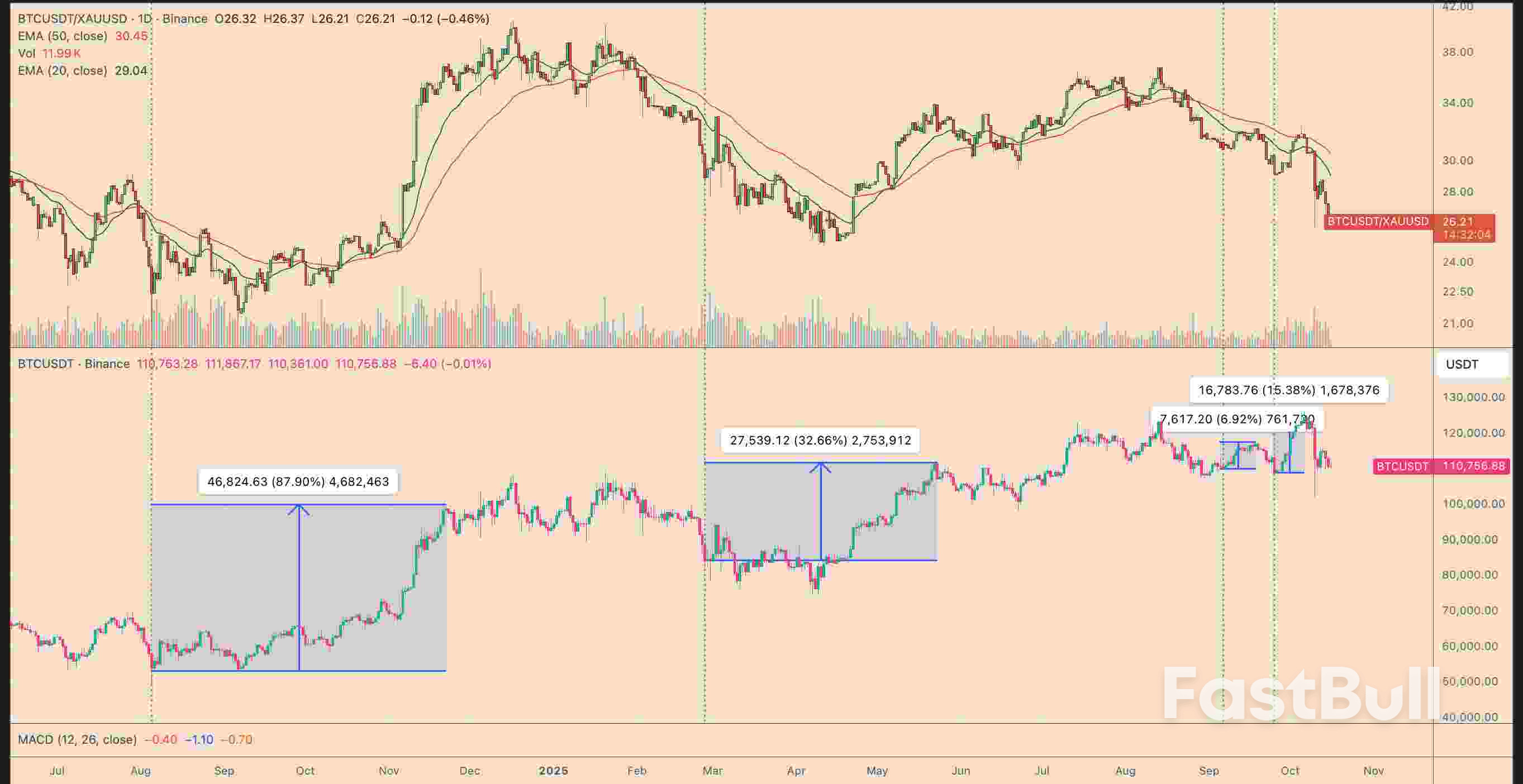
          The BTC/XAU ratio’s daily relative strength index (RSI) has now fallen deep into oversold territory below 30, signaling that Bitcoin is once again underperforming gold to an extreme degree.
          This setup has historically coincided with capitulation phases in crypto markets, followed by strong rebounds in BTC/USD once risk appetite returns.
          Is Gold Signaling Bitcoin’s Next Bottom?_1

          BTC/XAU vs. BTC/USD daily chart comparison.

          In past cycles, such RSI resets have marked exhaustion points rather than the start of fresh downtrends. Each time the ratio hit these lows, Bitcoin’s dollar price began recovering within days or weeks, as capital rotated back from gold into crypto.
          That’s exactly what happened in August 2024 and March 2025, when BTC/USD bounced 30–90% after similar oversold readings on the BTC/XAU chart.

          Divergences: The Stronger Bottom Signal

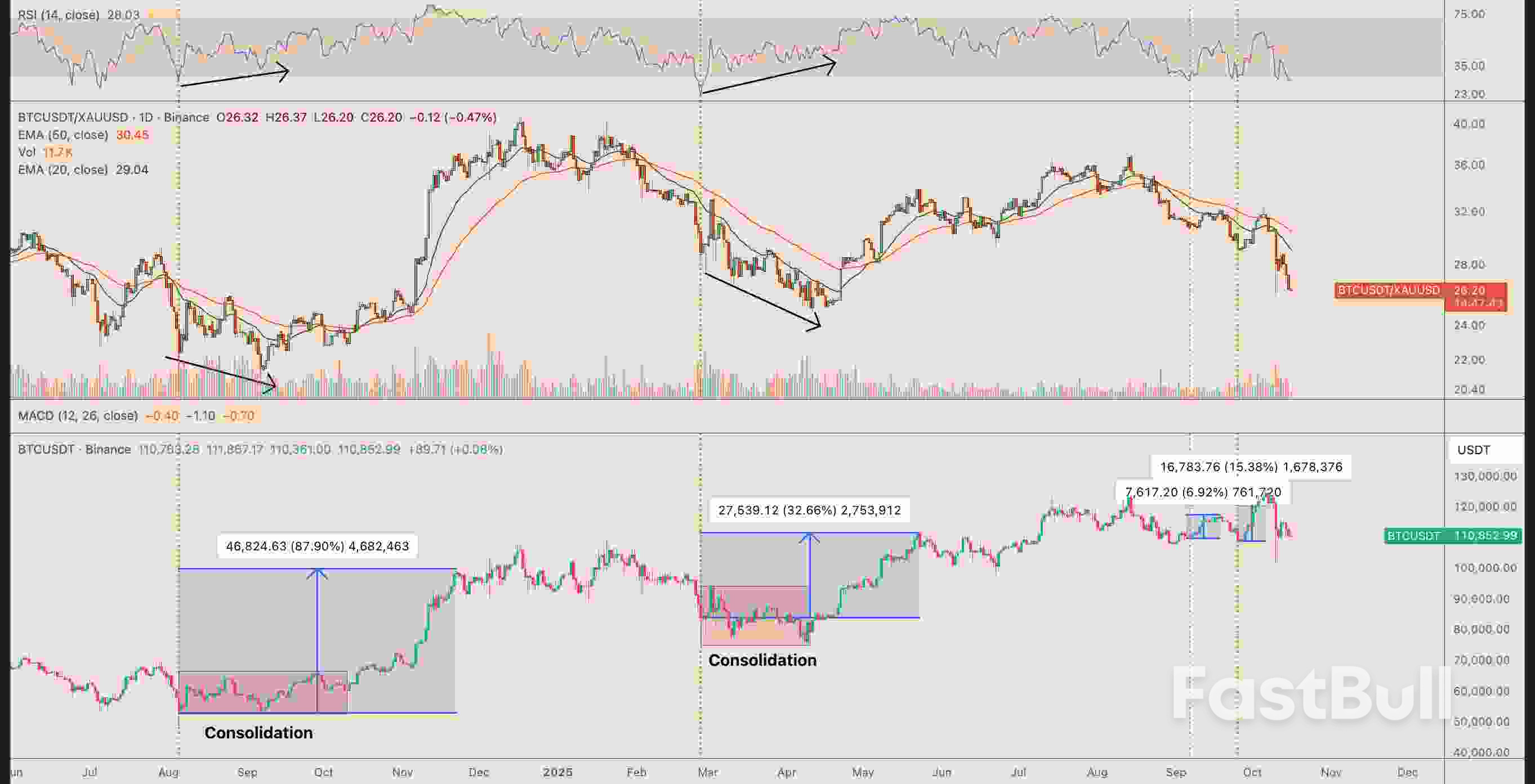
          While the current signal is purely oversold, the most powerful historical reversals came when oversold conditions coincided with bullish RSI divergences, when BTC/XAU made lower lows but RSI made higher ones.
          These divergences revealed fading downside momentum even as prices slipped, often marking macro turning points. The August 2024 and March 2025 setups both fit this pattern and each triggered a far more sustained Bitcoin rally afterward.
          Is Gold Signaling Bitcoin’s Next Bottom?_2

          BTC/XAU vs. BTC/USD daily chart comparison.

          If the same structure forms again in the coming weeks—oversold RSI followed by a higher low in RSI versus a lower low in price—it could strengthen the case for a multimonth BTC/USD recovery phase.

          How High Can BTC Price Go On Gold-Led Rebound?

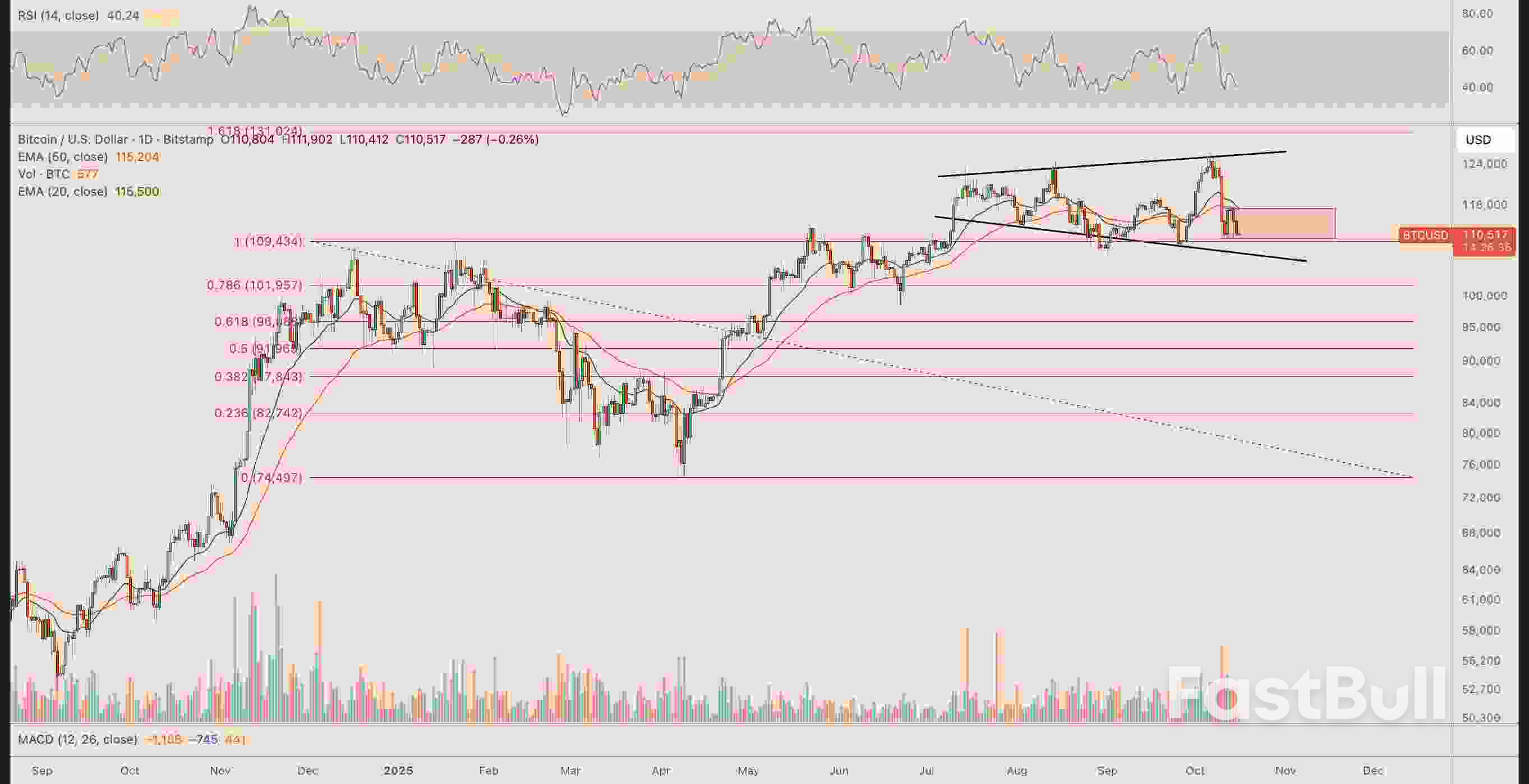
          For confirmation, BTC/XAU must reclaim its 20- and 50-day EMAs as support, signaling a shift in relative momentum.
          On the BTC/USD chart, a breakout above $116,000 would align perfectly with that rotation signal, while failure to hold $109,000 support could delay recovery.
          Is Gold Signaling Bitcoin’s Next Bottom?_3

          BTC/USD daily price chart.

          Looking broadly, BTC is trending inside what appears to be a broadening wedge pattern.
          A clear bounce above the consolidation area, aligning with the 20- and 50-day EMAs, may extend the Bitcoin price rally toward the wedge’s upper trendline near $125,000.
          A further breakout could mean BTC hitting $150,000, a popular 2025 target. Conversely, failure to hold above the EMA resistance could mean retesting the mid-$109,000 levels for a breakdown toward $100,000.

          Source: fxempire

          Risk Warnings and Disclaimers
          You understand and acknowledge that there is a high degree of risk involved in trading. Following any strategies or investment methods may lead to potential losses. The content on the site is provided by our contributors and analysts for information purposes only. You are solely responsible for determining whether any trading assets, securities, strategy, or any other product is suitable for investing based on your own investment objectives and financial situation.
          Add to Favorites
          Share

          What could TSMC's earnings reveal about opportunities across Asia's chip sector?

          Adam

          Economic

          Understanding the semiconductor value chain

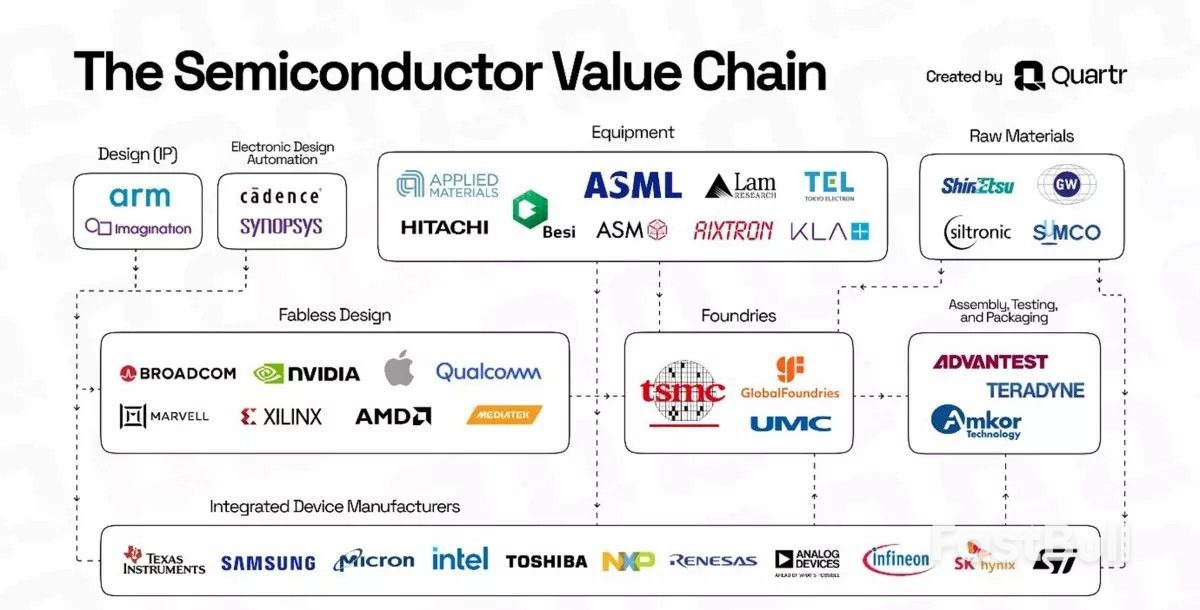
          The semiconductor industry operates through a globally distributed value chain spanning design, production and assembly. Each stage requires specialised expertise and significant capital investment, creating distinct opportunities for investors.
          Understanding where value is created helps identify promising investment opportunities. Asian firms have established dominant positions in manufacturing stages that US companies cannot easily replicate.
          The following sections break down each stage and highlight the key players shaping the industry's future.
          Figure 1: Infographic showing key players within the semiconductor value chain
          What could TSMC's earnings reveal about opportunities across Asia's chip sector?_1

          Stage 1: design

          Semiconductor design represents the most research-intensive phase where chips are conceptualised using specialised software. Companies employ Electronic Design Automation (EDA) tools and intellectual property (IP) cores to create chip architectures.
          This stage demands significant engineering expertise and innovation. While US firms like Nvidia lead in cutting-edge chip design, Taiwan's MediaTek has carved out a substantial position in mobile and automotive chips.
          Design companies typically operate with high margins due to their intellectual property advantages. However, they depend entirely on manufacturing partners to produce physical chips.

          Stage 2: wafer production

          Silicon wafer production creates the base material for all semiconductor chips. Manufacturers produce pure silicon cylinders, slice them into thin wafers and polish them to perfect smoothness.
          These blank wafers serve as the canvas upon which circuits are printed during fabrication. The process requires extraordinary precision and purity standards.
          Japan's Shin-Etsu and SUMCO together supply more than half the world's silicon wafers. Their dominance in this foundational material gives them significant influence over global chip production capacity.
          Wafer suppliers benefit from steady demand across all semiconductor segments, making them relatively defensive plays within the sector.

          Stage 3: front-end manufacturing

          Front-end manufacturing represents the most capital-intensive stage where actual chips are fabricated on silicon wafers. This process involves repeated cycles of deposition, lithography, etching and polishing.
          Producing advanced chips requires over 1000 steps spanning four to six months. Modern fabrication facilities cost billions of dollars to construct and equip.
          Fabrication and foundry services
          Taiwan's TSMC commands approximately 70% of global foundry revenue, manufacturing chips for Apple, AMD, Nvidia and many more. The company pioneered high-volume production of 3nm chips, cementing its technological leadership in the world's most advanced chips.
          South Korea's Samsung Electronics operates the second-largest foundry business, whilst China's SMIC ranks fourth globally.
          Memory chip dominance
          South Korea is home to memory chip giants Samsung and SK Hynix, which dominate the global DRAM and NAND flash memory markets. Together, they control more than 70% of DRAM market share.
          Memory chips are found in virtually every computer, smartphone and data centre worldwide. However, demand can be cyclical, closely tied to consumer electronics upgrade cycles and data centre expansion.
          Materials and equipment suppliers
          Japanese firms hold commanding positions in photoresists and photomasks essential for printing circuit patterns onto chips. Hoya and Shin-etsu are key players in these specialised materials markets.
          Manufacturing equipment represents another crucial dependency. Tokyo Electron supplies deposition tools and etching equipment, whilst Advantest provides testing systems that no modern foundry can operate without.
          Raw materials form the foundation of semiconductor production. China controls 69% of global silicon production and 98% of gallium production according to US Geological Survey data. These raw materials represent powerful bargaining chips in trade negotiations.

          Stage 4: assembly, test and packaging

          After fabrication, wafers are cut into individual chips, tested for defects and packaged into protective frames for circuit board mounting. This back-end manufacturing stage is more labour-intensive than fabrication.
          Taiwan's ASE dominates outsourced assembly, test and packaging (ATP) services globally. China's JCET and Tongfu Microelectronics have rapidly expanded their market share in recent years.
          The shift towards artificial intelligence (AI) computing has increased demand for complex packaging solutions, benefiting established players with technical expertise.

          TSMC earnings spotlight

          TSMC released third-quarter revenue data earlier this month showing 30% year-on-year (YoY) growth, exceeding market expectations. Today's full earnings report is expected to reveal record net income of NT$408.4 billion (26% YoY growth).
          Investors will scrutinise revenue contribution from advanced nodes (7nm and below) to gauge demand for AI chips. The management's strategy to handle volatile US trade policies will also be a focal point. TSMC has already committed to build facilities worth $165 billion in Arizona.

          Performance comparison across the value chain

          Valuation metrics and performance vary significantly across different semiconductor segments, reflecting their distinct roles within the value chain and investor sentiment. Investors should look beyond US and European companies to capture the full potential of the semiconductor industry.

          Source: ig

          To stay updated on all economic events of today, please check out our Economic calendar
          Risk Warnings and Disclaimers
          You understand and acknowledge that there is a high degree of risk involved in trading. Following any strategies or investment methods may lead to potential losses. The content on the site is provided by our contributors and analysts for information purposes only. You are solely responsible for determining whether any trading assets, securities, strategy, or any other product is suitable for investing based on your own investment objectives and financial situation.
          Add to Favorites
          Share

          Is QT on Its Last Lap?

          Adam

          Economic

          Chairman Powell spoke on Tuesday, addressing several topics. Of note was the following quote:
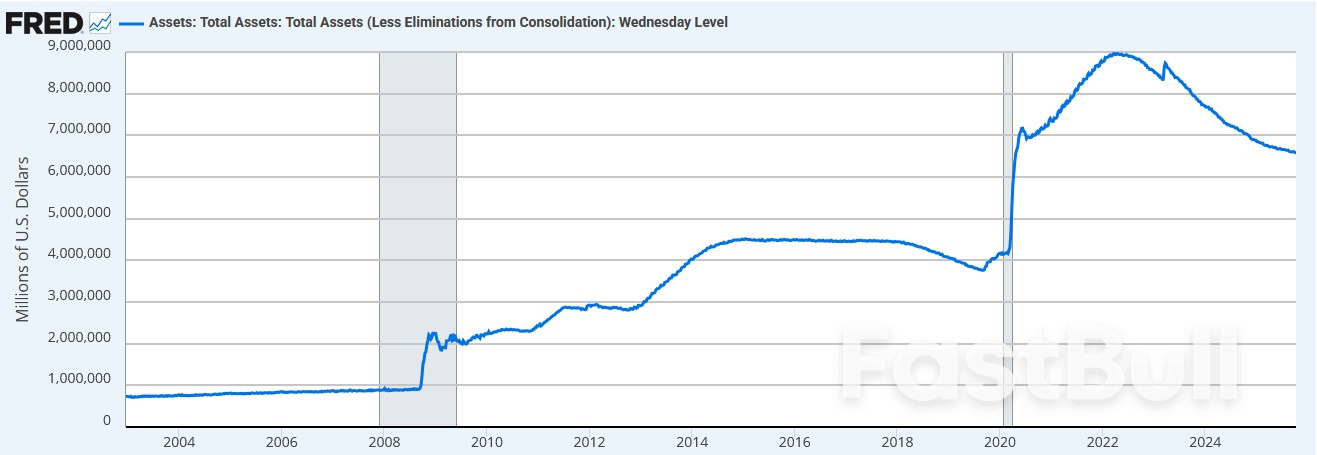
          “We may be approaching the end of our balance sheet contraction in the coming months.” The market interpretation is that QT is ending soon. As a reminder, QT, also known as quantitative tightening, has been in effect for over three years.
          Since starting QT, the Fed has shaved its holdings by nearly $3.5 trillion. The graph below shows that the Fed’s current holdings of Treasury, mortgage, and agency assets stand at approximately $6.6 billion, still more than 50% above pre-pandemic levels.
          Powell made this somewhat surprising statement in a speech to the National Association of Business Economics in Philadelphia. To explain why QT could end, he pointed to the liquidity strains that emerged in the fall of 2019. At that time, short-term lending rates for some borrowers were spiking despite the borrowers having ample and pristine collateral to support the loan.
          The Fed feels they were late to address those liquidity strains. As a result, they cut rates by 0.75% despite a relatively strong economy. While Powell doesn’t claim to see similar problems, he is noticing some recent tightness in the lending markets. Not surprisingly, as we recently noted, Powell’s comments come as the Fed’s overnight reverse repo program balances are near zero, signifying the market no longer has excess reserves. So, is QT resulting in tighter market conditions? Powell must think so.
          On the margin, ending QT is beneficial for the bond markets. In addition to absorbing higher-than-normal Treasury debt due to fiscal deficits, the market is also having to absorb about $40 billion monthly due to the Fed’s shrinking balance sheet. Of the $40 billion, $5 billion is in US Treasuries, and the remaining $35 billion is in mortgage-backed securities.
          Is QT on Its Last Lap?_1
          Some Distress In The Junk Credit Markets
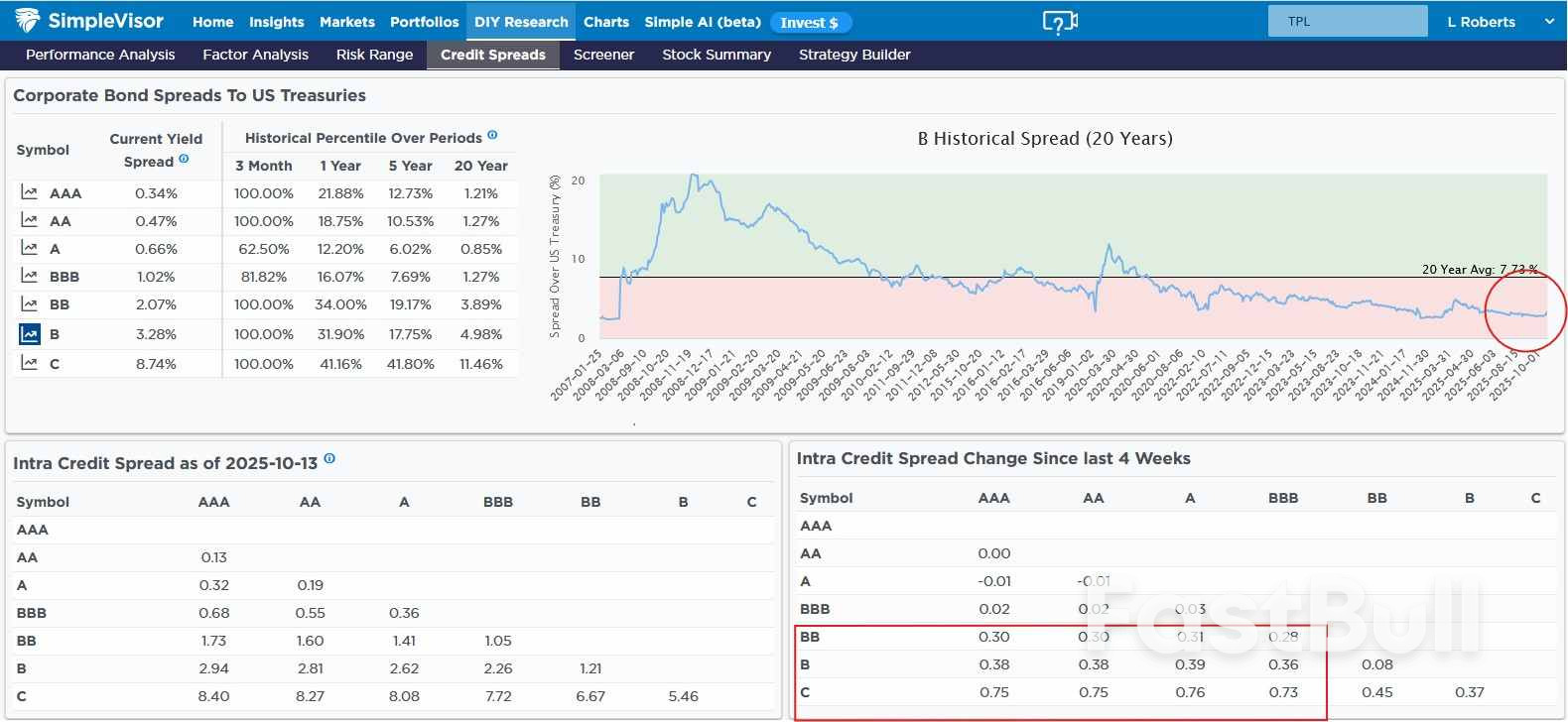
          The graphic below tracks corporate credit yield spreads. Even if you are not a corporate bond investor, corporate credit spreads (vs US Treasuries) can be a good leading indicator of the equity markets. Tight, or low, spreads indicate bullish sentiment in corporate bonds and often the stock market. Widening, or higher, spreads indicate some credit concerns that can leak into the stock market. The page below helps us track whether spreads are tightening or widening.
          Of note, the lower right-hand box shows that the yields on junk bonds (less than BBB) have widened over the last four weeks versus investment grade bonds (BBB or higher). While the amount of widening, when quoted in basis points, may seem decent, the graph in the top right corner shows that the spread widening is barely perceptible in a longer-term context. We will continue to track the recent widening. A continuation within junk bonds and, importantly, in lower-rated investment-grade bonds would be more concerning.
          Is QT on Its Last Lap?_2

          Source: investing

          To stay updated on all economic events of today, please check out our Economic calendar
          Risk Warnings and Disclaimers
          You understand and acknowledge that there is a high degree of risk involved in trading. Following any strategies or investment methods may lead to potential losses. The content on the site is provided by our contributors and analysts for information purposes only. You are solely responsible for determining whether any trading assets, securities, strategy, or any other product is suitable for investing based on your own investment objectives and financial situation.
          Add to Favorites
          Share

          Senate To Vote Soon On Russia Sanctions Bill Trump Had Resisted

          Devin

          Political

          Senate Majority Leader John Thune is ready to bring to a vote legislation imposing sanctions on countries that trade with Russia, an aide to the Republican leader said.

          Thune met earlier Thursday with the bill’s sponsor, Republican Senator Lindsey Graham, whose legislation has languished for months despite having the support of at least 85 senators.

          The Thune aide didn’t provide a specific timeline for a vote on the legislation.

          The bill gives President Donald Trump authority to impose tariffs of up to 500% on imports from countries that buy Russian energy products and are not actively supporting Ukraine. This specifically targets major consumers of Russian energy, such as China and India.

          The latest version of the legislation gives Trump the power to set and adjust the levies as he pleases, a person familiar with the bill said. Trump could also choose to allow for exemptions.

          Congress and the White House are in discussions over the timing of the bill and any decision over whether to move forward ultimately rests with Trump, the person said.

          Trump had been reluctant to green light a vote but he has become increasingly frustrated with Russian President Vladimir Putin over the war in Ukraine and confirmed this week he’s sending more defensive weapons to President Volodymyr Zelenskiy’s government, sweeping aside an earlier pause by the Pentagon.

          Trump earlier Thursday said he is speaking Putin, a day before a planned meeting with Zelenskiy at the White House.

          “The conversation is ongoing, a lengthy one, and I will report the contents, as will President Putin, at its conclusion,” Trump posted on social media.

          The House’s own version of the bill was introduced earlier this year and mirrors the Senate’s version. In September, Republican Representative Mike Turner urged Speaker Mike Johnson to schedule a vote.

          But a House vote could still be a way off. Johnson has kept House lawmakers home during the US government shutdown and has said he won’t bring them back until the Senate resolves the funding stalemate.

          Source: Bloomberg Europe

          Risk Warnings and Disclaimers
          You understand and acknowledge that there is a high degree of risk involved in trading. Following any strategies or investment methods may lead to potential losses. The content on the site is provided by our contributors and analysts for information purposes only. You are solely responsible for determining whether any trading assets, securities, strategy, or any other product is suitable for investing based on your own investment objectives and financial situation.
          Add to Favorites
          Share

          When AI runs out of power, the connection is called Bitcoin

          Adam

          Cryptocurrency

          Block 1: Essential news

          BlackRock is betting big on tokenization: "We are only at the beginning," according to Larry Fink
          For Larry Fink, CEO of BlackRock, the tokenization of traditional assets (RWA) is still in its infancy. He predicts that all types of assets—bonds, stocks, real estate—will one day be represented on blockchain, enabling more liquid, 24-hour, global markets. Already very active through its BUIDL fund—which holds 34% of the tokenized Treasury bond market—BlackRock captures 8% of a market estimated at $34bn. Fink now wants to go further: tokenizing ETFs to attract crypto investors to long-term investments. For him, this new wave represents the "next big opportunity" for BlackRock.
          Euro stablecoins: the Governor of the Bank of France encourages... but regulates
          At the Fintech 2025 Forum, François Villeroy de Galhau welcomed European initiatives around euro stablecoins. He called on banks to develop a local alternative to the dollar, citing a recently launched consortium of nine European banks. However, behind this apparent support, the governor is calling for a tightening of the MiCA framework: increased control of non-EU issuances, European supervision by ESMA, etc. As a result, euro stablecoins are struggling to emerge, with only a 0.18% market share—far behind the dollar giants. Binance's BNB has surpassed USDT and XRP, climbing onto the cryptocurrency podium.
          IBIT: BlackRock's Bitcoin ETF becomes its most profitable product
          Launched less than two years ago, the IBIT spot Bitcoin ETF has established itself as BlackRock's crown jewel: nearly $100bn under management, $245 million in annual revenue... and a faster rise than any of the firm's other ETFs. It has already surpassed giants IWF and EFA, and is approaching the very exclusive $100bn club in record time (435 days). Institutional adoption is accelerating—Harvard has invested $116m—and BlackRock is already working on the next step: a premium Bitcoin ETF based on covered calls. But it's worth remembering that IBIT provides exposure to the price, not full ownership. When it comes to sovereignty, nothing can replace self-custody.
          Bitcoin: a whale triggers a crash... and pockets $150m in profits
          An anonymous investor heavily shorted bitcoin just before the announcement of new US tariff measures, causing the market to plummet 15%. The result: more than $20bn in liquidations, $400bn wiped out, and a persistent rumor: stroke of genius or insider trading? The address reportedly repeated the move on ETH and SOL, potentially raking in an additional $160m. Traders are talking about a classic macroeconomic bet, but the precision of the timing raises questions. Meanwhile, platforms slowed down and thousands of investors were caught off guard. A reminder of the risks of leverage in an ultra-volatile market... where whales are still the best equipped.

          Block 2: Crypto Analysis of the Week

          Megawatts are in short supply, interconnection queues are growing, and artificial intelligence is gobbling up every available kilowatt. In this bottleneck, one player is emerging as an infrastructure partner: Bitcoin miners. Farms designed to swallow high-density megawatts, cool frenetic racks, and run 24/7—exactly what AI data centers demand. Bernstein puts it in black and white: these crypto operators are becoming "strategic enablers" of AI.
          The diagnosis is stark: network congestion is delaying the expansion of data centers in the United States, with interconnection delays climbing to seven years in some areas. Meanwhile, Bitcoin miners control more than 14 GW of "secured" electricity—contracts, sites, transformers already in place. Operational translation: a shortcut to scale. Rather than starting from scratch ("greenfield"), hyperscalers can plug their AI loads into existing sites and save years. Bernstein cites IREN and Riot Platforms: converting these campuses would reduce deployment time by up to 75%.
          The hunger for computing power shows no sign of abating. Microsoft anticipates a capacity shortage until 2026; elsewhere, deals are being made to reserve chips and racks: Nebius signs $17.4bn worth of GPUs for Microsoft; CoreWeave commits $6.3bn to Nvidia to block its unused server space. In this sprint, Bitcoin mines resemble pre-wired refueling stations.On the crypto side, the economic equation is driving change. As halvings occur, the break-even point rises; in a prolonged bear market, operators find themselves on a tightrope. Diversifying into AI means smoothing out cycles and monetizing physical assets (land, lines, substations) that have already been amortized.
          The movement is attracting heavy capital. A consortium formed by BlackRock, Nvidia, xAI, and Microsoft has just announced the acquisition of Aligned Data Centers for $40 billion—the first step in an Artificial Intelligence Infrastructure Partnership (AIP) that plans to invest up to $100 billion (including $30 billion in equity). Aligned has 50 campuses in the Americas and more than 5 GW in operation or planned. The subliminal message is that data infrastructure is becoming the raw material for the next phase of AI, and the strongest balance sheets are getting on board.
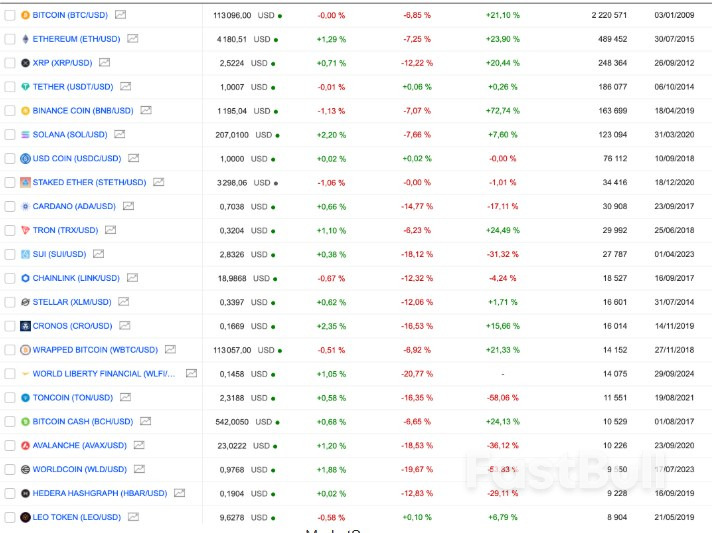
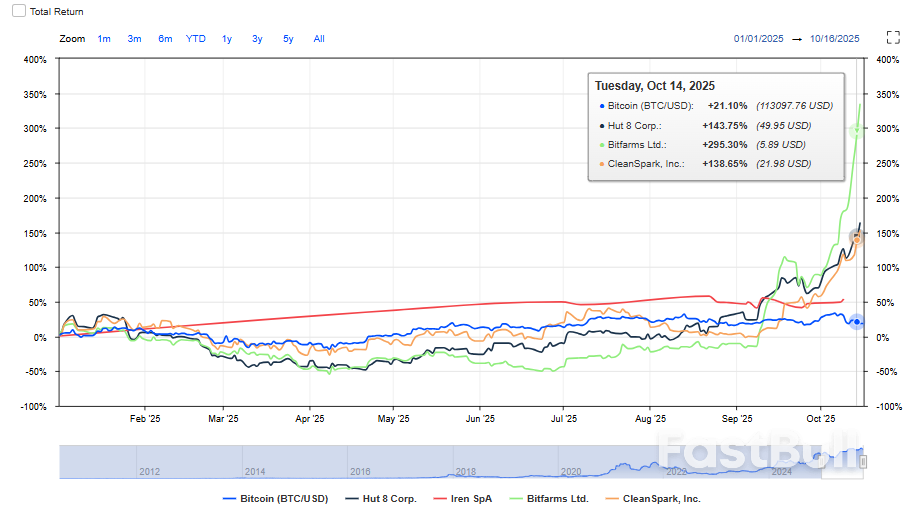
          On the stock market, the story is spreading. The shares of miners pivoting towards AI (Hut 8, IREN, Bitfarms, CleanSpark) are rising, buoyed by their new status: no longer just "Bitcoin games," but pure infrastructure players. When BTC flirts with $110,000, cash flow breathes a sigh of relief; when it settles down, AI contracts anchor the flow.
          When AI runs out of power, the connection is called Bitcoin_1

          Bitcoin, Hut 8, IREN, Bitfarms, and CleanSpark stock prices since January 1

          There remains a knock-on effect that will need to be monitored. Each megawatt shifted from mining to AI reduces competitive pressure on the mining side—and, symmetrically, intensifies the battle for capacity on the data center side. Where will the balance stabilize? At the intersection of electricity prices, BTC cycles, the AI learning curve, and local incentives (permits, taxation, networks).
          Beyond the short term, one reality is clear: these crypto sites, created to absorb elastic and controllable electrical loads, tick all the boxes for the new logistics of computing. They are flexible for the network, quick to reconfigure, already financed, and connected. Yesterday, they were "bitcoin farms." Tomorrow, they will be versatile nodes in the computing economy.
          When AI runs out of power, the connection is called Bitcoin_2

          Block 3: Readings of the week

          Federal authorities seize a record $15 billion in bitcoins from an alleged fraud empire (Wired)
          The new stablecoin regime ( FT)

          Source: marketscreener

          Risk Warnings and Disclaimers
          You understand and acknowledge that there is a high degree of risk involved in trading. Following any strategies or investment methods may lead to potential losses. The content on the site is provided by our contributors and analysts for information purposes only. You are solely responsible for determining whether any trading assets, securities, strategy, or any other product is suitable for investing based on your own investment objectives and financial situation.
          Add to Favorites
          Share

          No reason to sell gold just yet - Tanglewood CIO Merrill

          Adam

          Commodity

          The gold market continues to show robust fundamentals that support prices at record highs near $4,200 an ounce. However, one thing the market is lacking is sellers, as many investors see no urgency to take profits amid this strong momentum.
          In a recent interview with Kitco News, John Merrill, Founder, President and CIO of Tanglewood Total Wealth Management, said that gold currently represents about 12% of his total portfolio — an overweight position compared to his target allocation of 10%.
          Merrill explained that he has been bullish on gold since 2023, initially starting with a 5% to 6% allocation. He added that he has rebalanced his gold holdings a few times over the past two years due to the metal’s unprecedented gains. However, looking ahead, he sees no reason to take profits right now.
          “We are going to continue to hold our gold,” he said. “We traditionally rebalance at the end of the year, so we will look at our gold then, whether the price goes up or down.”
          Even if he does take some gold profits off the table, Merrill said that a fundamental shift in the global economy means he will continue to maintain a core position.
          “We will own gold. I don't know what the percentage will be 20 years from now, but we will own gold because nothing replaces it,” he said.
          Merrill explained that rising global sovereign debt is currently the biggest factor driving gold demand. He said that investors are desperate to protect their wealth as fiat currencies around the globe lose purchasing power.
          At the same time, he noted that rising debt is creating significant risks for long-term Treasuries, which were once considered the ultimate safe-haven asset.
          “We started to recognize this in 2023 — that there were new drivers for gold. We’d never thought of gold as an inflation hedge because it always had a poor history with that, but it is a disaster hedge. And now it's moved beyond being a disaster hedge to being a currency hedge,” he said.
          Merrill said gold’s role as a currency hedge can be traced back to the 2008 Great Financial Crisis, when gold prices began their first run to all-time highs as the Federal Reserve dropped interest rates to zero and introduced quantitative easing.
          He added that government stimulus spending during the 2020 pandemic further exacerbated sovereign debt issues, and the threat of a recession will only worsen the health of the global financial system.
          On top of unchecked government spending, Merrill said that the weaponization of the U.S. dollar against Russia and the intensifying global trade war are eroding trust in the dollar as the world’s reserve currency.
          “Gold has become the alternative because no one has a currency that is either big enough, stable enough, or free enough to operate as a reserve currency,” he said.
          Merrill noted that the deglobalization trend makes it increasingly difficult for nations to cooperate on developing any new form of reserve currency.
          Although gold prices are currently trading at all-time highs — up nearly 60% so far this year — and appear overbought, Merrill said he doesn’t see this as an obstacle to further investment demand.
          He added that while gold looks overbought against major currencies, it remains undervalued compared to equity markets.

          Source: kitco

          Risk Warnings and Disclaimers
          You understand and acknowledge that there is a high degree of risk involved in trading. Following any strategies or investment methods may lead to potential losses. The content on the site is provided by our contributors and analysts for information purposes only. You are solely responsible for determining whether any trading assets, securities, strategy, or any other product is suitable for investing based on your own investment objectives and financial situation.
          Add to Favorites
          Share
          FastBull
          Copyright © 2025 FastBull Ltd

          728 RM B 7/F GEE LOK IND BLDG NO 34 HUNG TO RD KWUN TONG KLN HONG KONG

          TelegramInstagramTwitterfacebooklinkedin
          App Store Google Play Google Play
          Products
          Charts

          Chats

          Q&A with Experts
          Screeners
          Economic Calendar
          Data
          Tools
          Membership
          Features
          Function
          Markets
          Copy Trading
          Latest Signals
          Contests
          News
          Analysis
          24/7
          Columns
          Education
          Company
          Careers
          About Us
          Contact Us
          Advertising
          Help Center
          Feedback
          User Agreement
          Privacy Policy
          Business

          White Label

          Data API

          Web Plug-ins

          Poster Maker

          Affiliate Program

          Risk Disclosure

          The risk of loss in trading financial instruments such as stocks, FX, commodities, futures, bonds, ETFs and crypto can be substantial. You may sustain a total loss of the funds that you deposit with your broker. Therefore, you should carefully consider whether such trading is suitable for you in light of your circumstances and financial resources.

          No decision to invest should be made without thoroughly conducting due diligence by yourself or consulting with your financial advisors. Our web content might not suit you since we don't know your financial conditions and investment needs. Our financial information might have latency or contain inaccuracy, so you should be fully responsible for any of your trading and investment decisions. The company will not be responsible for your capital loss.

          Without getting permission from the website, you are not allowed to copy the website's graphics, texts, or trademarks. Intellectual property rights in the content or data incorporated into this website belong to its providers and exchange merchants.

          Not Logged In

          Log in to access more features

          FastBull Membership

          Not yet

          Purchase

          Become a signal provider
          Help Center
          Customer Service
          Dark Mode
          Price Up/Down Colors

          Log In

          Sign Up
          Position
          Layout
          Fullscreen
          Default to Chart
          The chart page opens by default when you visit fastbull.com