• Trade
  • Markets
  • Copy
  • Contests
  • News
  • 24/7
  • Calendar
  • Q&A
  • Chats
Trending
Screeners
SYMBOL
LAST
BID
ASK
HIGH
LOW
NET CHG.
%CHG.
SPREAD
SPX
S&P 500 Index
6932.04
6932.04
6932.04
6937.32
6904.90
+22.25
+ 0.32%
--
DJI
Dow Jones Industrial Average
48731.17
48731.17
48731.17
48771.32
48386.59
+288.77
+ 0.60%
--
IXIC
NASDAQ Composite Index
23613.30
23613.30
23613.30
23621.72
23527.97
+51.46
+ 0.22%
--
USDX
US Dollar Index
97.600
97.680
97.600
97.750
97.550
-0.010
-0.01%
--
EURUSD
Euro / US Dollar
1.17878
1.17886
1.17878
1.17941
1.17663
+0.00117
+ 0.10%
--
GBPUSD
Pound Sterling / US Dollar
1.35043
1.35053
1.35043
1.35224
1.34768
+0.00046
+ 0.03%
--
XAUUSD
Gold / US Dollar
4515.20
4515.54
4515.20
4523.56
4502.79
+35.22
+ 0.79%
--
WTI
Light Sweet Crude Oil
58.179
58.209
58.179
58.765
58.128
-0.039
-0.07%
--

Community Accounts

Signal Accounts
--
Profit Accounts
--
Loss Accounts
--
View More

Become a signal provider

Sell trading signals to earn additional income

View More

Guide to Copy Trading

Get started with ease and confidence

View More

Signal Accounts for Members

All Signal Accounts

Best Return
  • Best Return
  • Best P/L
  • Best MDD
Past 1W
  • Past 1W
  • Past 1M
  • Past 1Y

All Contests

  • All
  • Trump Updates
  • Recommend
  • Stocks
  • Cryptocurrencies
  • Central Banks
  • Featured News
Top News Only
Share

S&P 500 Futures Have Recovered Some Ground And Are Currently Up 0.05%

Share

Pakistan Central Bank's Forex Reserves At $15902.5 Million In Week Ending Dec 19

Share

Ukraine President Zelenskiy: Allies Can Press Russia To Ensure Security During Potential Referendum, Elections

Share

Ukraine President Zelenskiy: He Wants To Discuss Additional Pressure On Russia With Trump

Share

Ukraine President Zelenskiy: Security Guarantees Deal Is 'Almost Ready'

Share

Ukraine President Zelenskiy: Can Not Say If Sunday Meeting With Trump Will Lead To Signing Any Agreements

Share

Ukraine President Zelenskiy: Ukraine Will Raise Questions That Lack Compromise During Trump Meeting

Share

Ukraine President Zelenskiy: 20-Point Peace Plan 90% Ready

Share

Ukraine President Zelenskiy: He Plans To Discuss Security Guarantees, Restoration With Trump

Share

Russian Court Sentences Former Russian Foreign Ministry Employee To 12 Years In Prison For Passing Secret Information To USA Intelligence - Interfax Cites Fsb

Share

China's Central Bank,In Financial Stability Report: Strengthen Macroprudential Management Of Real Estate Finance

Share

China's Central Bank,In Financial Stability Report: Will Firmly Advance Financial Support For Resolving Debt Risks Of Financing Platforms

Share

China's Central Bank,In Financial Stability Report: Uphold Market Role's In Exchange Rate Formation

Share

China's Central Bank,In Financial Stability Report: To Implement More Proactive Macro Policy

Share

Source Close To Talks: Putin's Special Envoy Dmitriev Participated In Recent Talks With US

Share

Two Dead In Suspected Palestinian Attack In Northern Israel - Kan Reports

Share

Reserve Bank Of India - India Forex Reserves At $693.32 Billion On Dec 19 Versus$688.95 Billion In The Week Earlier

Share

Reserve Bank Of India Says Federal Government Had No Outstanding Loans With It As On Dec 19

Share

Brazil Bank Lending Spreads Average 33.2 Percentage Points In November

Share

Brazil 90-Day Default Ratio At 5.0% In November

TIME
ACT
FCST
PREV
Canada Federal Government Budget Balance (Oct)

A:--

F: --

P: --

U.S. 5-Year Note Auction Avg. Yield

A:--

F: --

P: --

U.S. Weekly Total Oil Rig Count

A:--

F: --

P: --

U.S. Weekly Total Rig Count

A:--

F: --

P: --

U.S. API Weekly Cushing Crude Oil Stocks

A:--

F: --

P: --

U.S. API Weekly Crude Oil Stocks

A:--

F: --

P: --

U.S. API Weekly Refined Oil Stocks

A:--

F: --

P: --

U.S. API Weekly Gasoline Stocks

A:--

F: --

P: --

Mexico Unemployment Rate (Not SA) (Nov)

A:--

F: --

P: --

U.S. MBA Mortgage Application Activity Index WoW

A:--

F: --

P: --

U.S. Weekly Continued Jobless Claims (SA)

A:--

F: --

P: --
U.S. Weekly Initial Jobless Claims (SA)

A:--

F: --

P: --

U.S. Initial Jobless Claims 4-Week Avg. (SA)

A:--

F: --

P: --

Japan Construction Orders YoY (Nov)

A:--

F: --

P: --

Japan New Housing Starts YoY (Nov)

A:--

F: --

P: --

Turkey Capacity Utilization (Dec)

A:--

F: --

P: --

Japan Tokyo CPI YoY (Excl. Food & Energy) (Dec)

A:--

F: --

P: --

Japan Unemployment Rate (Nov)

A:--

F: --

P: --

Japan Tokyo Core CPI YoY (Dec)

A:--

F: --

P: --

Japan Tokyo CPI YoY (Dec)

A:--

F: --

P: --

Japan Jobs to Applicants Ratio (Nov)

A:--

F: --

P: --

Japan Tokyo CPI MoM (Dec)

A:--

F: --

P: --

Japan Tokyo CPI MoM (Excl. Food & Energy) (Dec)

A:--

F: --

P: --

Japan Industrial Inventory MoM (Nov)

A:--

F: --

P: --

Japan Retail Sales (Nov)

A:--

F: --

P: --

Japan Industrial Output Prelim MoM (Nov)

A:--

F: --

P: --

Japan Large-Scale Retail Sales YoY (Nov)

A:--

F: --

P: --

Japan Industrial Output Prelim YoY (Nov)

A:--

F: --

P: --

Japan Retail Sales MoM (SA) (Nov)

A:--

F: --

P: --

Japan Retail Sales YoY (Nov)

A:--

F: --

P: --

Russia Retail Sales YoY (Nov)

--

F: --

P: --

Russia Unemployment Rate (Nov)

--

F: --

P: --

Argentina Retail Sales YoY (Oct)

--

F: --

P: --

U.S. Weekly Treasuries Held by Foreign Central Banks

--

F: --

P: --

China, Mainland Industrial Profit YoY (YTD) (Nov)

--

F: --

P: --

Russia IHS Markit Manufacturing PMI (Dec)

--

F: --

P: --

India Manufacturing Output MoM (Nov)

--

F: --

P: --

India Industrial Production Index YoY (Nov)

--

F: --

P: --

France Unemployment Class-A (Nov)

--

F: --

P: --

Euro Zone Total Reserve Assets (Nov)

--

F: --

P: --

Canada National Economic Confidence Index

--

F: --

P: --

U.S. Pending Home Sales Index (Nov)

--

F: --

P: --

U.S. Pending Home Sales Index MoM (SA) (Nov)

--

F: --

P: --

U.S. Pending Home Sales Index YoY (Nov)

--

F: --

P: --

U.S. EIA Weekly Crude Oil Imports Changes

--

F: --

P: --

U.S. EIA Weekly Cushing, Oklahoma Crude Oil Stocks Change

--

F: --

P: --

U.S. EIA Weekly Crude Demand Projected by Production

--

F: --

P: --

U.S. EIA Weekly Gasoline Stocks Change

--

F: --

P: --

U.S. Dallas Fed General Business Activity Index (Dec)

--

F: --

P: --

U.S. EIA Weekly Heating Oil Stock Changes

--

F: --

P: --

U.S. EIA Weekly Crude Stocks Change

--

F: --

P: --

U.S. Dallas Fed New Orders Index (Dec)

--

F: --

P: --

Russia CPI YoY (Dec)

--

F: --

P: --

U.S. EIA Weekly Natural Gas Stocks Change

--

F: --

P: --

Brazil CAGED Net Payroll Jobs (Nov)

--

F: --

P: --

South Korea Industrial Output MoM (SA) (Nov)

--

F: --

P: --

South Korea Retail Sales MoM (Nov)

--

F: --

P: --

South Korea Services Output MoM (Nov)

--

F: --

P: --

Russia IHS Markit Services PMI (Dec)

--

F: --

P: --

Turkey Economic Sentiment Indicator (Dec)

--

F: --

P: --

Q&A with Experts
    • All
    • Chatrooms
    • Groups
    • Friends
    RPGFX flag
    CEOApnfxa
    So what is step 2 like?@CEOApnfxa
    RPGFX flag
    CEOApnfxa
    @CEOApnfxaIt is fine my brother
    CEOApnfxa flag
    RPGFX
    @RPGFXam very good at it... I have a bull analysis that's been running for 8 month on usdjpy...you can check it's been up the last 8-9months now
    EuroTrader flag
    CEOApnfxa
    @CEOApnfxagow long have you been trading these marksts .Have you been here for up to three years?
    RPGFX flag
    CEOApnfxa
    Do not worry, you will grow into many years of success and profitability @CEOApnfxa
    C.E.O flag
    Urek Mazino
    @Urek Mazino ok hope you succeed. make the right decision
    Urek Mazino flag
    C.E.O
    @C.E.OYes, but I'm not sure it will fly straight
    RPGFX flag
    I just hope you are placing appropriate risk management strategies and the right psychology or mind set in place too@CEOApnfxa
    Urek Mazino flag
    @C.E.OFor me, there might be a slight turbulence around 4510-4520, profit taking, before further upward movement
    CEOApnfxa flag
    EuroTrader
    @EuroTraderNov this year made me 3yrs
    RPGFX flag
    RPGFX
    I just hope you are placing appropriate risk management strategies and the right psychology or mind set in place too@CEOApnfxa
    If you can strike this balance well, then you are good to go@CEOApnfxa
    Urek Mazino flag
    CEOApnfxa
    @CEOApnfxaYes, I agree that from the middle of this year, this pair has had a fairly strong upward trend
    Urek Mazino flag
    @CEOApnfxaBut I don't quite agree with the statement that it has been rising continuously for the past 8-9 months
    CEOApnfxa flag
    Urek Mazino
    @Urek Mazinoyes
    Urek Mazino flag
    @CEOApnfxaRecently, there have been signs of a loss of momentum, with BOJ's hike rate and Ueda not looking very hawkish bro
    RPGFX flag
    CEOApnfxa
    @CEOApnfxaHolding one trade for 8-9 months is actually a very long holding time
    Urek Mazino flag
    @CEOApnfxaI see the Yen strengthening a bit, which could trigger a pullback from the highs for this pair
    ifan afian flag
    whose taking buy on dip
    C.E.O flag
    Urek Mazino
    @C.E.OFor me, there might be a slight turbulence around 4510-4520, profit taking, before further upward movement
    @Urek Mazino we can only guess. Accuracy is very difficult to obtain. There is no news to support this at this time.
    EuroTrader flag
    CEOApnfxa
    @CEOApnfxawoww. that's quite a good years of experience in trading these markets. That's big
    Type here...
    Add Symbol or Code

      No matching data

      All
      Trump Updates
      Recommend
      Stocks
      Cryptocurrencies
      Central Banks
      Featured News
      • All
      • Russia-Ukraine Conflict
      • Middle East Flashpoint
      • All
      • Russia-Ukraine Conflict
      • Middle East Flashpoint
      Search
      Products

      Charts Free Forever

      Chats Q&A with Experts
      Screeners Economic Calendar Data Tools
      Membership Features
      Data Warehouse Market Trends Institutional Data Policy Rates Macro

      Market Trends

      Market Sentiment Order Book Forex Correlations

      Top Indicators

      Charts Free Forever
      Markets

      News

      News Analysis 24/7 Columns Education
      From Institutions From Analysts
      Topics Columnists

      Latest Views

      Latest Views

      Trending Topics

      Top Columnists

      Latest Update

      Signals

      Copy Rankings Latest Signals Become a signal provider AI Rating
      Contests
      Brokers

      Overview Brokers Assessment Rankings Regulators News Claims
      Broker listing Forex Brokers Comparison Tool Live Spread Comparison Scam
      Q&A Complaint Scam Alert Videos Tips to Detect Scam
      More

      Business
      Events
      Careers About Us Advertising Help Center

      White Label

      Data API

      Web Plug-ins

      Affiliate Program

      Awards Institution Evaluation IB Seminar Salon Event Exhibition
      Vietnam Thailand Singapore Dubai
      Fans Party Investment Sharing Session
      FastBull Summit BrokersView Expo
      Recent Searches
        Top Searches
          Markets
          News
          Analysis
          User
          24/7
          Economic Calendar
          Education
          Data
          • Names
          • Latest
          • Prev

          View All

          No data

          Scan to Download

          Faster Charts, Chat Faster!

          Download App
          English
          • English
          • Español
          • العربية
          • Bahasa Indonesia
          • Bahasa Melayu
          • Tiếng Việt
          • ภาษาไทย
          • Français
          • Italiano
          • Türkçe
          • Русский язык
          • 简中
          • 繁中
          Open Account
          Search
          Products
          Charts Free Forever
          Markets
          News
          Signals

          Copy Rankings Latest Signals Become a signal provider AI Rating
          Contests
          Brokers

          Overview Brokers Assessment Rankings Regulators News Claims
          Broker listing Forex Brokers Comparison Tool Live Spread Comparison Scam
          Q&A Complaint Scam Alert Videos Tips to Detect Scam
          More

          Business
          Events
          Careers About Us Advertising Help Center

          White Label

          Data API

          Web Plug-ins

          Affiliate Program

          Awards Institution Evaluation IB Seminar Salon Event Exhibition
          Vietnam Thailand Singapore Dubai
          Fans Party Investment Sharing Session
          FastBull Summit BrokersView Expo

          Tokyo Core Inflation Slows but Keeps BOJ on Path Toward Gradual Tightening

          Gerik

          Economic

          Summary:

          Core inflation in Tokyo slowed to 2.3% in December, below market expectations, but remained above the Bank of Japan’s 2% target. Despite easing food prices...

          Tokyo CPI Slows, Yet Inflation Remains Above Target

          Japan’s core consumer price index (CPI) for Tokyo rose 2.3% year-on-year in December, slowing from 2.8% in November and missing the market forecast of 2.5%. The deceleration was partly due to base effects from prior utility bill increases and softer food cost inflation. However, inflation still remains above the Bank of Japan’s (BOJ) 2% target, marking nearly four consecutive years of elevated core inflation in the capital.
          A more refined gauge of underlying demand-led inflation, which excludes both fresh food and fuel, registered a 2.6% increase in December. Though slightly below November’s 2.8%, this figure remains crucial for the BOJ, as it offers insight into persistent pricing dynamics tied to domestic consumption rather than external cost shocks.

          Policy Implications: BOJ Faces Delicate Balancing Act

          While the CPI data indicates a temporary easing in headline inflation, it does not represent a structural shift away from inflationary trends. The BOJ, under Governor Kazuo Ueda, has been signaling that Japan is gradually transitioning toward sustainable inflation supported by wage growth and stronger consumption. The central bank raised interest rates to a three-decade high of 0.75% earlier this month, marking a significant departure from its ultra-loose monetary regime.
          Ueda reinforced this view in a recent speech, stating that Japan is "making steady progress" in reaching its 2% target durably, with wage gains playing a key supporting role. Therefore, while December’s moderation might reduce the urgency of aggressive hikes, it does not eliminate the causal momentum driving policy normalization.
          The BOJ’s next meeting, scheduled for January 22–23, will weigh this latest inflation data alongside updated growth and inflation projections. If economic fundamentals remain stable, the BOJ could opt for another rate increase later in 2026.

          Yen Weakness Could Trigger Renewed Price Pressures

          The Japanese yen’s depreciation currently hovering around ¥155 to the U.S. dollar adds another layer of complexity. As noted by Dai-ichi Life economist Yoshiki Shinke, the weak yen could provide companies with justification to raise prices again, especially on imported food and consumer goods, thereby creating a secondary wave of cost-push inflation.
          This introduces a feedback loop where currency weakness triggers inflation persistence, even as headline figures decline. The BOJ must now navigate between tightening policy to contain imported inflation and preserving economic momentum amid weak factory output and uncertain global demand.

          Mixed Economic Data Paints a Nuanced Picture

          Beyond inflation, Japan’s broader economic indicators send mixed signals. Industrial production fell 2.6% in November worse than expected due to declining automobile and lithium battery output. However, manufacturers expect a rebound in December and a significant 8.0% rise in January, suggesting temporary disruptions rather than long-term contraction.
          Retail sales rose 1.0% year-on-year in November, slightly above expectations, indicating stable domestic demand. Meanwhile, the government has approved a record fiscal budget of $785 billion for 2026, which may bolster short-term consumption but risks adding pressure to Japan’s already strained public finances.
          Tokyo’s slowing core inflation in December offers some evidence of moderating cost pressures, particularly in food, but does not derail the Bank of Japan’s tightening trajectory. Persistent demand-driven inflation, a weak yen, and policy confidence in wage-supported growth suggest the BOJ remains on track for gradual rate hikes. As Japan enters 2026, monetary policy will continue to walk a tightrope between stabilizing inflation and nurturing economic recovery.

          Source: Reuters

          To stay updated on all economic events of today, please check out our Economic calendar
          Risk Warnings and Disclaimers
          You understand and acknowledge that there is a high degree of risk involved in trading. Following any strategies or investment methods may lead to potential losses. The content on the site is provided by our contributors and analysts for information purposes only. You are solely responsible for determining whether any trading assets, securities, strategy, or any other product is suitable for investing based on your own investment objectives and financial situation.
          Add to Favorites
          Share

          China’s Solar Power Additions Rise To Six-Month High In November

          Winkelmann

          Political

          Economic

          China's solar installations in November surged to the highest in six months, extending an end-of-year recovery.

          Nationwide, about 22 gigawatts of solar power were installed last month, according to data released by the National Energy Administration on Friday. That's the highest since May when additions hit a record, but lower than the 25 gigawatts added in the same period a year earlier.

          Installations tend to rise near the end of the year as developers aim to complete projects within the calendar year. However, activity peaked much earlier this year, when installations rose to a record 93 gigawatts in May ahead of policy changes. That front-loaded demand led to a slump in capacity additions in the subsequent months, with numbers only beginning to recover in September.

          The November figures are likely also due to state-owned enterprises rushing to finish projects before the end of the nation's 14th five-year plan. Beijing is expected to announce a new national plan in March.

          BloombergNEF has lowered its 2025 forecast installations for China by 9% to 372 gigawatts, followed by a 14% contraction in 2026, as the nation deals with a range of policy shifts that have cooled demand growth.

          China also added 12.5 gigawatts of wind power in November, according to the NEA.

          Source: Bloomberg Europe

          To stay updated on all economic events of today, please check out our Economic calendar
          Risk Warnings and Disclaimers
          You understand and acknowledge that there is a high degree of risk involved in trading. Following any strategies or investment methods may lead to potential losses. The content on the site is provided by our contributors and analysts for information purposes only. You are solely responsible for determining whether any trading assets, securities, strategy, or any other product is suitable for investing based on your own investment objectives and financial situation.
          Add to Favorites
          Share

          Gold Surges to Record High Amid Safe-Haven Inflows and Fed Rate Cut Expectations

          Gerik

          Economic

          Commodity

          Gold Hits New Peak as Market Bets on Lower Rates

          Spot gold rose 0.5% to $4,501.44 per ounce by 02:09 GMT on Friday, after briefly touching a new record of $4,530.60 earlier in the session. This rally reflects a surge in investor demand for gold as a defensive asset, fueled by uncertainty in equity markets and evolving expectations surrounding U.S. monetary policy.
          The upward movement in gold is causally linked to mounting speculation that the U.S. Federal Reserve will initiate a series of rate cuts in 2026. With inflation pressures softening and labor market indicators weakening, markets are increasingly pricing in looser policy ahead, which typically reduces the opportunity cost of holding non-yielding assets like gold.

          Safe-Haven Appeal Rises Amid Geopolitical and Market Uncertainty

          Aside from macroeconomic drivers, gold’s appeal has grown due to elevated geopolitical risks and a broader pullback in risk sentiment. Ongoing concerns over an overheating AI-driven stock market, coupled with doubts about corporate earnings sustainability, have pushed investors toward traditionally stable assets.
          The movement into gold, rather than being merely correlated with market volatility, stems from a direct reallocation of capital in response to perceived systemic risks both political and financial. This is further supported by strong flows into other precious metals, including silver, which recently hit its own record high.

          Outlook and Market Implications

          With central banks across the globe, particularly the Fed, leaning toward policy easing, analysts expect gold to remain well supported. Real interest rates are expected to trend lower, which historically correlates positively with precious metal prices.
          If the Fed confirms a dovish trajectory in its upcoming meetings and global risk aversion persists, spot gold could challenge higher resistance levels beyond $4,550 in early 2026. However, if inflation surprises to the upside or geopolitical tensions ease, short-term corrections may follow.
          Gold’s record-breaking rally to over $4,530 per ounce signals both a macroeconomic inflection point and a psychological shift in investor behavior. As central banks prepare to pivot and risk appetite moderates, gold's dual role as a store of value and inflation hedge continues to attract institutional and retail capital alike. The trend reinforces the metal’s historical status as a barometer of uncertainty in a rapidly evolving global financial environment.

          Source: Reuters

          To stay updated on all economic events of today, please check out our Economic calendar
          Risk Warnings and Disclaimers
          You understand and acknowledge that there is a high degree of risk involved in trading. Following any strategies or investment methods may lead to potential losses. The content on the site is provided by our contributors and analysts for information purposes only. You are solely responsible for determining whether any trading assets, securities, strategy, or any other product is suitable for investing based on your own investment objectives and financial situation.
          Add to Favorites
          Share

          Asia Markets Climb in Holiday-Shortened Session as Silver Extends Record Rally

          Gerik

          Economic

          Stocks

          Positive Start for Asia Despite Holiday Closures

          Asian equities opened on a positive note Friday, buoyed by global optimism following Wall Street’s record highs. However, activity remained subdued as key markets like Australia and Hong Kong were closed for the Boxing Day holiday. Still, major indices that remained open posted moderate gains, suggesting that investor sentiment remains resilient heading into the final trading sessions of 2025.
          Japan’s Nikkei 225 rose 0.47%, while the broader Topix index climbed 0.27%. Real estate and technology sectors led the gains, with companies like Nexon and SoftBank rising 2.17% and 2.06% respectively. South Korea’s Kospi added 0.53% and the Kosdaq rose 0.42%, continuing the positive momentum seen across Asian markets since mid-December. In contrast, China's CSI 300 index edged 0.15% lower at the open, reflecting lingering domestic concerns amid broader regional strength.

          Tokyo CPI Data Reinforces Tightening Bias

          Japan’s economic data offered some insight into the Bank of Japan’s policy outlook. Core consumer prices in Tokyo rose 2.3% year-on-year in December, remaining above the BOJ’s 2% inflation target. Although the figure was slightly below November’s 2.8% reading and the Reuters poll forecast of 2.5%, it still suggests that inflationary pressure is persisting, reinforcing the case for continued policy tightening.
          The Tokyo CPI is widely viewed as a bellwether for nationwide inflation trends. The data strengthens the causal narrative behind the BOJ’s gradual shift away from ultra-loose monetary policy, though the modest pullback in the inflation rate may offer policymakers some breathing room.

          Silver Surges to New Record as Safe-Haven Demand Grows

          Silver extended its rally on Friday, soaring over 4% to a historic high of $74.89 per ounce. The metal has now gained more than 159% year-to-date, outpacing most other major asset classes. The spike reflects increased demand for safe-haven assets as investors grapple with uncertainties over the timing and scope of potential U.S. Federal Reserve rate cuts and the sustainability of the AI-driven equity market rally.
          The surge in silver can be partially explained by a shift in risk appetite: with some investors concerned about stretched valuations in tech stocks and growing signs of speculative froth, precious metals are regaining favor. Moreover, rising geopolitical tensions and volatility in fiat currencies have supported flows into hard assets.
          This rally is not just correlated with broader market uncertainty—it is causally driven by deteriorating confidence in risk assets and expectations that real yields may soften if central banks pause or reverse tightening cycles in early 2026.

          U.S. Markets Provide Global Tailwind

          U.S. equity futures ticked slightly higher during the Asian session, after the S&P 500 closed at a record high for the second consecutive day on Wednesday. The index gained 0.32% to finish at 6,932.05, while the Dow Jones Industrial Average rose 288.75 points (0.60%) to 48,731.16, also notching a record close. The Nasdaq Composite added 0.22% to settle at 23,613.31.
          These gains provided a psychological boost for Asian markets, reinforcing confidence in global growth heading into 2026. The continued strength in U.S. equities, especially in technology and industrials, is causally linked to robust corporate earnings, stable inflation expectations, and easing fears of a sharp Fed pivot.
          Asia-Pacific markets showed resilience on Friday, overcoming thin holiday trading to post modest gains. Japan and South Korea led the charge, while silver’s record-breaking surge highlighted investors’ search for stability amid persistent macroeconomic uncertainty. Tokyo's inflation data confirmed that price pressures remain steady, supporting the Bank of Japan's slow but steady shift in policy. As global markets approach the end of 2025, the balance between optimism and caution is likely to define investor behavior in the opening weeks of the new year.

          Source: CNBC

          To stay updated on all economic events of today, please check out our Economic calendar
          Risk Warnings and Disclaimers
          You understand and acknowledge that there is a high degree of risk involved in trading. Following any strategies or investment methods may lead to potential losses. The content on the site is provided by our contributors and analysts for information purposes only. You are solely responsible for determining whether any trading assets, securities, strategy, or any other product is suitable for investing based on your own investment objectives and financial situation.
          Add to Favorites
          Share

          Human Insight Still Critical in AI-Driven Investing, Says SmartWealth CEO

          Gerik

          Economic

          AI Takes the Lead, But Humans Shape the Strategy

          Miro Mitev, CEO and founder of SmartWealth Asset Management, is a pioneer in applying neural networks to asset management. While his firm’s investment decisions are executed entirely through artificial intelligence, Mitev asserts that human involvement is not only present it’s indispensable. The design, data preparation, parameter setting, and ongoing refinement of AI systems all depend on skilled human judgment.
          Having first explored neural networks in 1997 while studying at the Vienna University of Economics and Business, Mitev has spent over two decades building predictive models for banks and tech firms. This deep experience culminated in the creation of SmartWealth, whose flagship fund, IVAC, targets annualized returns of 14–15% and is managing rapid growth with ambitions of reaching $2 billion in assets under management.

          The Balance Between Trusting the Model and Guiding the System

          SmartWealth’s operational philosophy is rooted in a paradox: the AI runs the show, but humans determine the rules of the game. Mitev explains that once an algorithm is deployed, human interference in decision-making becomes counterproductive. "The worst is to overrule the results," he warns, arguing that AI’s pattern recognition capabilities often outperform human intuition, even when results appear unclear at first glance.
          Yet this trust in the model is conditional. The AI’s effectiveness hinges on clean, reliable, and relevant data. Human oversight is crucial to prevent and correct overfitting a condition where the model focuses excessively on noise rather than meaningful, causal indicators. Mitev stresses that what appears statistically significant may not have genuine predictive power in markets unless it reflects a cause-and-effect dynamic.

          10-Year Performance Underscores Algorithmic Edge

          SmartWealth’s results bolster the case for algorithmic investing. From 2015 to November 2025, the firm posted returns of 407.63%, compared with just 145.34% from its benchmark index. This outperformance, achieved without emotional decision-making, illustrates the power of consistent, data-driven model application. Mitev claims his system can reliably forecast market conditions up to one month ahead a horizon sufficient for short-term tactical positioning.
          This forward-looking capacity stands in contrast to human investors, who are often swayed by sentiment and short-term noise. Even major institutions like the European Central Bank have flagged the potential role of “fear of missing out” in current market trends, raising concerns about momentum-driven investing based on emotion rather than fundamentals.

          Guarding Against AI’s Known Pitfalls

          Despite the apparent superiority of AI in investment decisions, Mitev is transparent about its vulnerabilities. He acknowledges that models can “hallucinate” or deliver false results, primarily due to overfitting, poor data quality, or incorrect model structure. To mitigate these risks, SmartWealth employs rigorous model validation, simulation in live environments, and continual refinement.
          Importantly, Mitev underscores the value of in-house AI development. Custom-built systems not only improve reliability but also provide strategic differentiation in an industry where generic models risk becoming commoditized.
          SmartWealth’s approach to investing reveals a new paradigm in finance where artificial intelligence executes strategy, but humans remain the architects of success. By merging computational power with human judgment in design and oversight, Miro Mitev’s firm exemplifies how AI-driven asset management can outperform traditional methods so long as the human role is not underestimated. In this evolving landscape, it’s clear that while machines may make the trades, it is still people who shape the future of investing.

          Source: CNBC

          To stay updated on all economic events of today, please check out our Economic calendar
          Risk Warnings and Disclaimers
          You understand and acknowledge that there is a high degree of risk involved in trading. Following any strategies or investment methods may lead to potential losses. The content on the site is provided by our contributors and analysts for information purposes only. You are solely responsible for determining whether any trading assets, securities, strategy, or any other product is suitable for investing based on your own investment objectives and financial situation.
          Add to Favorites
          Share

          India's Water Crunch Brews Risks For Beverage Giants

          Winkelmann

          Stocks

          Political

          Economic

          India's Water Crunch Brews Risks For Beverage Giants_1

          India's Water Crunch Brews Risks For Beverage Giants_2India's Water Crunch Brews Risks For Beverage Giants_3India's Water Crunch Brews Risks For Beverage Giants_4India's Water Crunch Brews Risks For Beverage Giants_5

          Foreign companies operating in India have long grappled with complex regulations and confusing tax laws.

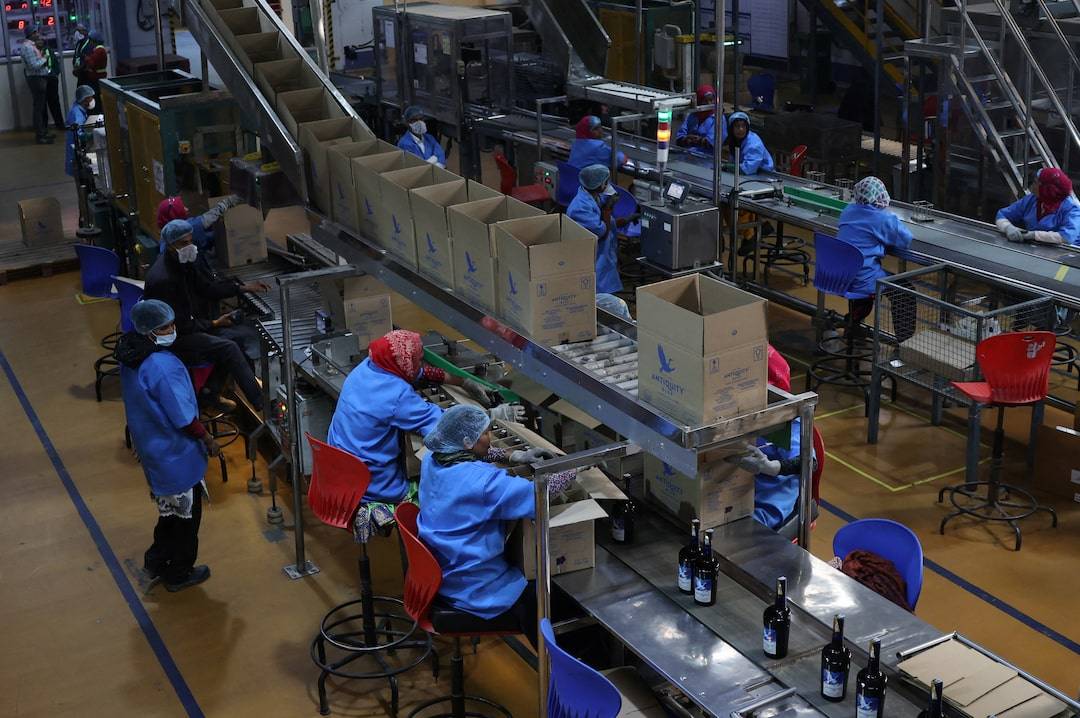
          In the northwestern state of Rajasthan, some of the world's biggest beverage firms face the additional challenge of securing and managing dwindling water supplies while navigating strict government rules and grievances of some local people who only get the resource piped-in once a week.

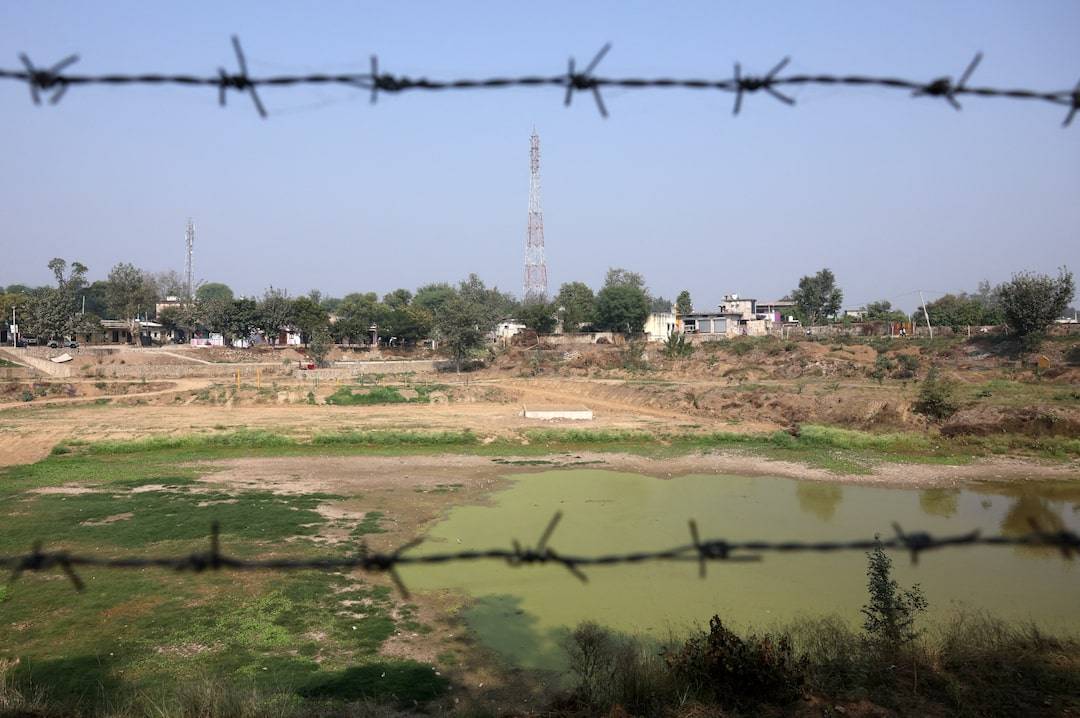
          Nearly two-thirds of Rajasthan is covered by the Thar Desert, and its groundwater extraction ranks among the highest in India, adding to the economic pressures for the state in balancing the needs of its 85 million people, booming tourism business, industry and its big agricultural sector.

          Laws in India, the world's most populous nation, bar the movement of liquor across state borders without a special permit, effectively forcing companies to set up production in every state they want to sell in despite the water scarcity. So global giants like Diageo, Carlsberg and Heineken have to maintain factories in Rajasthan if they want to distribute their products in the state.

          "(Water stress) is a growing issue in India," said Sonia Thimmiah, senior director of global sustainability at Heineken, the market leader, adding that a few years ago, water demand in some cities had come close to exceeding supply.

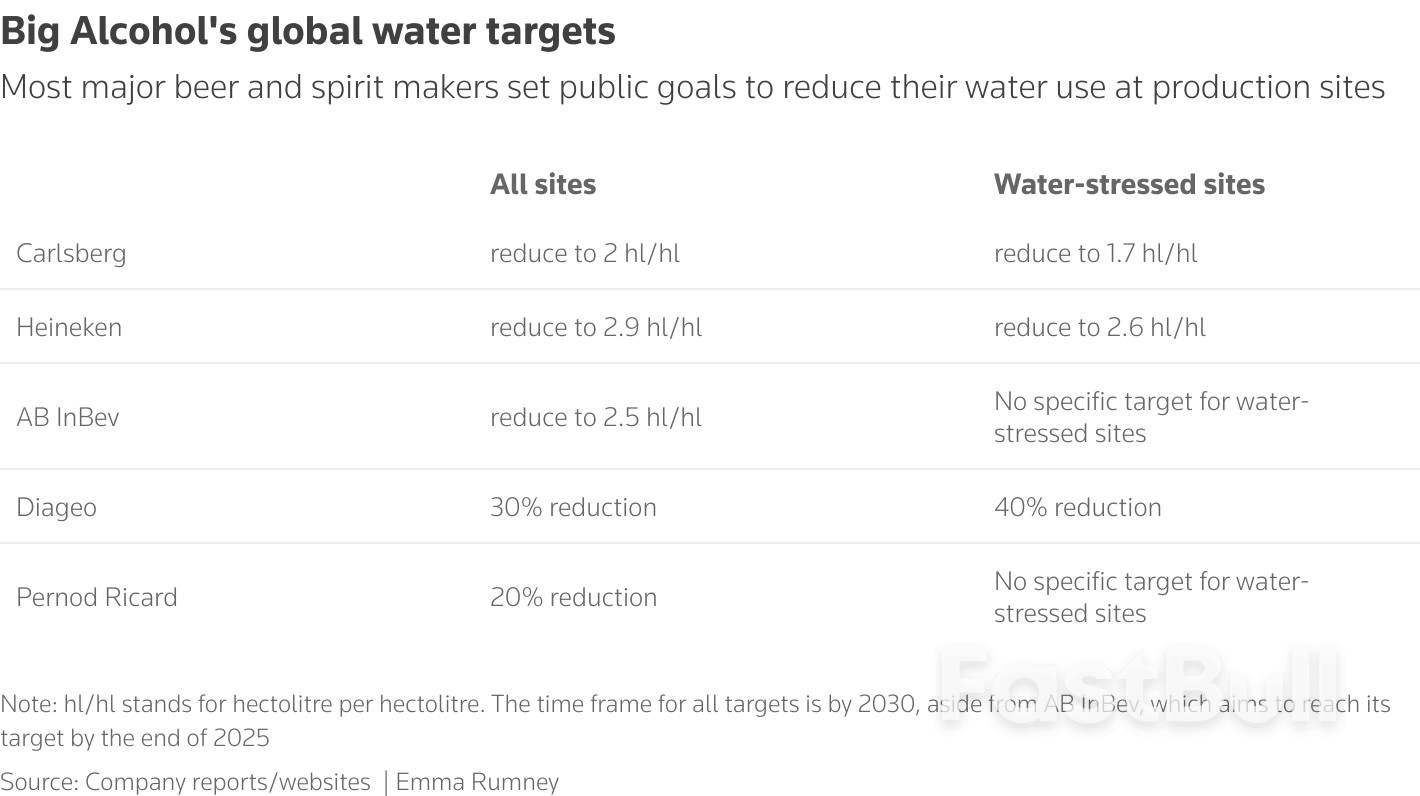
          Heineken, Carlsberg and Diageo said that they are increasing water efficiency in Rajasthan and other water-stressed regions, have worked to improve communities' access to water and aimed to replenish 100% of the water their factories use back to its source.

          The challenges for the brewers in Rajasthan mirror a wider crisis across India, which holds 17% of the world's population but just 4% of its freshwater. As the world's fastest-growing major economy, India's thirst for growth means more production and more strain on its scarce water resources.

          The strain is evident in Rajasthan's industrial town of Alwar, about 150 km (100 miles) southwest of Delhi, where most of the beverage companies are centred. The wider Alwar district's groundwater extraction, driven mainly by irrigation, runs at nearly twice the rate its aquifers can recharge, government data shows.

          Industry users consume just about 2% of Rajasthan's water, but under Indian law, all industrial and commercial entities seeking groundwater extraction have to install on-site rainwater harvesting and aquifer recharge systems.

          In areas such as Alwar that the government classifies as "over-exploited" for groundwater, industries are further required to adopt the "latest water efficient technologies so as to reduce dependence on groundwater resources", a government order said in 2020, without specifying details.

          "The water tables are declining and rains are variable," Diageo's Alwar head Sumit Walia told Reuters.

          "We have a vision to reduce water consumption by 40% and to ensure that whatever water is withdrawn from the ground, 100% replenishment is there. We are recycling 100% of the wastewater and installing advanced technologies which consume less water", like using air to rinse bottles instead of water, he said.

          India's Water Crunch Brews Risks For Beverage Giants_6A table showing major alcohol producers' water use targets

          TENSIONS WITH VILLAGERS

          Federal authorities have permitted brewers in Alwar to draw up to about 4.6 million litres of groundwater daily under 2025 permits seen by Reuters, based on applications from the companies. The global firms account for around 65% of that with Heineken topping the list at 1.2 million litres.

          A typical Indian household uses 500–600 litres a day but even getting that is difficult in Salpur village, next to the Alwar industrial cluster, where water is a luxury.

          "The situation is very bad," said Imran Khan, head of the village of nearly 4,500 residents, who grows wheat and onion on his ancestral land. "We have to give several days of notice to the borewell owner to pump water for us - there's a queue."

          He says he had to spend about 150,000 rupees ($1,700) to lay a 3-km (2-mile) pipeline from the borewell to his fields, and needs to pay 150 rupees for every hour of water supplied by its owner, a resident of another village.

          Some locals blame the scarcity on the brewers.

          "They are making alcohol there but locals do not have enough water to drink", said Alwar resident Haider Ali, who took several global and local alcohol companies to India's environmental court last year, alleging they were extracting water without permission.

          A court-appointed inspection team later found that all factories complied with regulations. But the same court directed authorities in March to actively monitor groundwater abstraction and strictly enforce a 2020 government order prohibiting the issuance of new water permits to large industries in over-exploited areas.

          Heineken and Carlsberg said there was no sign of community tension in Alwar beyond this court case, in part thanks to their work with locals on water. Diageo's Walia said he was not aware of the court case, but industries making paper, automobiles and other products consumed more water than the liquor companies.

          The water problems are not limited to Rajasthan.

          Reuters has reported how in the past decade India has lost several days of coal-power supply because water shortages forced plants to suspend generation.

          In Coca-Cola's water security plan for 2023, reviewed by Reuters, the company says it operates nine factories in India in areas of "high or extremely high-water stress" and estimates that its annual costs of procuring water could rise by $180,000 to $2.7 million.

          The company, which shut a factory in 2005 in the southern state of Kerala after protests over groundwater depletion, declined to comment.

          'ALWAYS SCOPE FOR MORE'

          Drinks makers say they are a small part of the problem in Rajasthan, and their water initiatives have significant positive impact.

          Carlsberg's vice president for sustainability Simon Boas Hoffmeyer said its goals, including replenishing all water used, go beyond regulatory requirements. "If everybody did that, the industry's share of the issue would be very, very small," he said.

          Diageo's global head of environment Michael Alexander said that in Salpur, the company has built small dams and planted 10,000 trees, while across Alwar it has desilted ponds, installed rooftop rainwater harvesting and funded boreholes and pipelines for communities.

          Similar projects by Heineken had a positive impact in Rajasthan, said Subhransu Kumar Bebarta, partnerships lead at S M Sehgal Foundation, a non-profit that implements the company's water projects.

          But big companies can go further, he said, adding larger infrastructure projects are needed in a state where some people struggle to find water to drink.

          "They have improved the groundwater table. But still, there is always scope for more."

          ($1 = 90.2450 Indian rupees)

          Source: Reuters

          To stay updated on all economic events of today, please check out our Economic calendar
          Risk Warnings and Disclaimers
          You understand and acknowledge that there is a high degree of risk involved in trading. Following any strategies or investment methods may lead to potential losses. The content on the site is provided by our contributors and analysts for information purposes only. You are solely responsible for determining whether any trading assets, securities, strategy, or any other product is suitable for investing based on your own investment objectives and financial situation.
          Add to Favorites
          Share

          Conflicting Data On China Smartphone Shipments Revealed

          Justin

          Stocks

          Economic

          Foreign-branded smartphone shipments in China experienced contrasting figures for November, with Apple's iPhone driving a reported 128% increase, while other sources noted a 47% decline.

          The discrepancy in data highlights the challenges in obtaining accurate market figures, potentially impacting investor decisions and consumer confidence in smartphone markets.

          In November, foreign-branded smartphone shipments in China raised contrasting figures. Some reports indicated a significant 128% surge, driven by Apple, while others highlighted a 47% slump. Both interpretations are supported by raw data from China's official body CAICT.

          Apple Inc. emerges as a key player, allegedly accounting for 6.93 million iPhones out of total shipments. This disparity in data highlights conflicting trends in the smartphone market. Further evaluations emphasize CAICT as the primary information source.

          Data Variability Sparks Investor Uncertainty

          The conflicting reports have not received responses from industry leaders or affected stakeholders. The variability in data invites scrutiny regarding data collection and interpretation practices within the industry.

          Potential outcomes include uncertainty among investors and market experts about the actual status of foreign-branded smartphones in China. Historical data consistency is questioned, possibly affecting market strategies for international brands like Apple.

          Discrepancies Reflect Methodological Differences

          Similar discrepancies in data reports have occurred previously, often highlighting variations in methodologies. Past occurrences usually resolved with independent verifications. Now, experts call for enhanced transparency and unified measurements.

          Insights from Kanalcoin indicate that the dual interpretations may stem from varying analytical criteria. Historical trends show that accurate data reconciliation fosters investor confidence and stabilizes market outlooks. "It appears there are no direct quotes or statements from industry leaders or experts related to the conflicting reports on foreign-branded smartphone shipments in China for November. This situation has been characterized by mixed data from the China Academy of Information and Communications Technology (CAICT) without additional commentary or insights from stakeholders or analysts in the space."

          Source: CryptoSlate

          To stay updated on all economic events of today, please check out our Economic calendar
          Risk Warnings and Disclaimers
          You understand and acknowledge that there is a high degree of risk involved in trading. Following any strategies or investment methods may lead to potential losses. The content on the site is provided by our contributors and analysts for information purposes only. You are solely responsible for determining whether any trading assets, securities, strategy, or any other product is suitable for investing based on your own investment objectives and financial situation.
          Add to Favorites
          Share
          FastBull
          Copyright © 2025 FastBull Ltd

          728 RM B 7/F GEE LOK IND BLDG NO 34 HUNG TO RD KWUN TONG KLN HONG KONG

          TelegramInstagramTwitterfacebooklinkedin
          App Store Google Play Google Play
          Products
          Charts

          Chats

          Q&A with Experts
          Screeners
          Economic Calendar
          Data
          Tools
          Membership
          Features
          Function
          Markets
          Copy Trading
          Latest Signals
          Contests
          News
          Analysis
          24/7
          Columns
          Education
          Company
          Careers
          About Us
          Contact Us
          Advertising
          Help Center
          Feedback
          User Agreement
          Privacy Policy
          Personal Information Protection Statement
          Business

          White Label

          Data API

          Web Plug-ins

          Poster Maker

          Affiliate Program

          Risk Disclosure

          The risk of loss in trading financial instruments such as stocks, FX, commodities, futures, bonds, ETFs and crypto can be substantial. You may sustain a total loss of the funds that you deposit with your broker. Therefore, you should carefully consider whether such trading is suitable for you in light of your circumstances and financial resources.

          No decision to invest should be made without thoroughly conducting due diligence by yourself or consulting with your financial advisors. Our web content might not suit you since we don't know your financial conditions and investment needs. Our financial information might have latency or contain inaccuracy, so you should be fully responsible for any of your trading and investment decisions. The company will not be responsible for your capital loss.

          Without getting permission from the website, you are not allowed to copy the website's graphics, texts, or trademarks. Intellectual property rights in the content or data incorporated into this website belong to its providers and exchange merchants.

          Not Logged In

          Log in to access more features

          FastBull Membership

          Not yet

          Purchase

          Become a signal provider
          Help Center
          Customer Service
          Dark Mode
          Price Up/Down Colors

          Log In

          Sign Up

          Position
          Layout
          Fullscreen
          Default to Chart
          The chart page opens by default when you visit fastbull.com