• Trade
  • Markets
  • Copy
  • Contests
  • News
  • 24/7
  • Calendar
  • Q&A
  • Chats
Trending
Screeners
SYMBOL
LAST
BID
ASK
HIGH
LOW
NET CHG.
%CHG.
SPREAD
SPX
S&P 500 Index
6846.50
6846.50
6846.50
6878.28
6827.18
-23.90
-0.35%
--
DJI
Dow Jones Industrial Average
47739.31
47739.31
47739.31
47971.51
47611.93
-215.67
-0.45%
--
IXIC
NASDAQ Composite Index
23545.89
23545.89
23545.89
23698.93
23455.05
-32.22
-0.14%
--
USDX
US Dollar Index
99.000
99.080
99.000
99.000
99.000
+0.050
+ 0.05%
--
EURUSD
Euro / US Dollar
1.16389
1.16398
1.16389
1.16389
1.16322
+0.00025
+ 0.02%
--
GBPUSD
Pound Sterling / US Dollar
1.33237
1.33248
1.33237
1.33237
1.33140
+0.00032
+ 0.02%
--
XAUUSD
Gold / US Dollar
4193.04
4193.48
4193.04
4193.80
4189.64
+3.34
+ 0.08%
--
WTI
Light Sweet Crude Oil
58.650
58.692
58.650
58.676
58.543
+0.095
+ 0.16%
--

Community Accounts

Signal Accounts
--
Profit Accounts
--
Loss Accounts
--
View More

Become a signal provider

Sell trading signals to earn additional income

View More

Guide to Copy Trading

Get started with ease and confidence

View More

Signal Accounts for Members

All Signal Accounts

Best Return
  • Best Return
  • Best P/L
  • Best MDD
Past 1W
  • Past 1W
  • Past 1M
  • Past 1Y

All Contests

  • All
  • Trump Updates
  • Recommend
  • Stocks
  • Cryptocurrencies
  • Central Banks
  • Featured News
Top News Only
Share

KCNA: North Korea's Supreme Leader Kim Jong UN Sends Condolences To Russian Embassy For Ambassador's Death

Share

Japan Prime Minister Takaichi: 30 Injuries Reported So Far From Monday Earthquake

Share

USA Senate Committee Votes To Advance Nomination Of Jared Isaacman To Head Nasa

Share

Singapore Post - New Rate For Standard Regular Mail & Standard Large Mail Will Be S$0.62 And S$0.90 Respectively

Share

Australia's S&P/ASX 200 Index Down 0.27% At 8601.10 Points In Early Trade

Share

Trump: The USA Needs Mexico To Release 200000 Acre-Feet Of Water Before December 31St, And The Rest Must Come Soon After

Share

Trump: I Have Authorized Documentation To Impose A 5% Tariff On Mexico If This Water Isn't Released

Share

Brazil's Sao Paulo State Governor Tarcisio De Freitas Says Flavio Bolsonaro Will Have His Support - Cnn Brasil

Share

Ukraine's Security Must Be Guaranteed, In The Long Term, As A First Line Of Defence For Our Union, Says European Commission President

Share

Ukraine's Sovereignty Must Be Respected, Says European Commission President

Share

The Goal Is A Strong Ukraine, On The Battlefield And At The Negotiating Table, Says European Commission President

Share

As Peace Talks Are Ongoing, The EU Remains Ironclad In Its Support For Ukraine, Says European Commission President

Share

Pepsico: Asking USA-Based Pepna Employees As Well As Pbus Division Offices And Pfus Region Offices To Work Remotely This Week

Share

A U.S. Judge Ruled That President Trump’s Ban On Several Wind Power Projects Was Illegal

Share

Senior USA Administration Official: We Continue To Monitor Drc-Rwanda Situation Closely, Continue To Work With All Sides To Ensure Commitments Are Honored

Share

Israeli Military Says It Has Struck Infrastructure Belonging To Hezbollah In Several Areas In Southern Lebanon

Share

SPDR Gold Holdings Down 0.11%, Or 1.14 Tonnes

Share

On Monday (December 8), In Late New York Trading, S&P 500 Futures Fell 0.21%, Dow Jones Futures Fell 0.43%, NASDAQ 100 Futures Fell 0.08%, And Russell 2000 Futures Fell 0.04%

Share

Morgan Stanley: Data Center ABS Spreads Are Expected To Widen In 2026

Share

(US Stocks) The Philadelphia Gold And Silver Index Closed Down 2.34% At 311.01 Points. (Global Session) The NYSE Arca Gold Miners Index Closed Down 2.17%, Hitting A Daily Low Of 2235.45 Points; US Stocks Remained Slightly Down Before The Opening Bell—holding Steady Around 2280 Points—before Briefly Rising Slightly

TIME
ACT
FCST
PREV
France Trade Balance (SA) (Oct)

A:--

F: --

P: --
Euro Zone Employment YoY (SA) (Q3)

A:--

F: --

P: --
Canada Part-Time Employment (SA) (Nov)

A:--

F: --

P: --

Canada Unemployment Rate (SA) (Nov)

A:--

F: --

P: --

Canada Full-time Employment (SA) (Nov)

A:--

F: --

P: --

Canada Labor Force Participation Rate (SA) (Nov)

A:--

F: --

P: --

Canada Employment (SA) (Nov)

A:--

F: --

P: --

U.S. PCE Price Index MoM (Sept)

A:--

F: --

P: --

U.S. Personal Income MoM (Sept)

A:--

F: --

P: --

U.S. Core PCE Price Index MoM (Sept)

A:--

F: --

P: --

U.S. PCE Price Index YoY (SA) (Sept)

A:--

F: --

P: --

U.S. Core PCE Price Index YoY (Sept)

A:--

F: --

P: --

U.S. Personal Outlays MoM (SA) (Sept)

A:--

F: --

P: --
U.S. 5-10 Year-Ahead Inflation Expectations (Dec)

A:--

F: --

P: --

U.S. Real Personal Consumption Expenditures MoM (Sept)

A:--

F: --

P: --
U.S. Weekly Total Rig Count

A:--

F: --

P: --

U.S. Weekly Total Oil Rig Count

A:--

F: --

P: --

U.S. Consumer Credit (SA) (Oct)

A:--

F: --

P: --
China, Mainland Foreign Exchange Reserves (Nov)

A:--

F: --

P: --

Japan Trade Balance (Oct)

A:--

F: --

P: --

Japan Nominal GDP Revised QoQ (Q3)

A:--

F: --

P: --

China, Mainland Imports YoY (CNH) (Nov)

A:--

F: --

P: --

China, Mainland Exports (Nov)

A:--

F: --

P: --

China, Mainland Imports (CNH) (Nov)

A:--

F: --

P: --

China, Mainland Trade Balance (CNH) (Nov)

A:--

F: --

P: --

China, Mainland Exports YoY (USD) (Nov)

A:--

F: --

P: --

China, Mainland Imports YoY (USD) (Nov)

A:--

F: --

P: --

Germany Industrial Output MoM (SA) (Oct)

A:--

F: --

P: --
Euro Zone Sentix Investor Confidence Index (Dec)

A:--

F: --

P: --

Canada National Economic Confidence Index

A:--

F: --

P: --

U.K. BRC Like-For-Like Retail Sales YoY (Nov)

--

F: --

P: --

U.K. BRC Overall Retail Sales YoY (Nov)

--

F: --

P: --

Australia Overnight (Borrowing) Key Rate

--

F: --

P: --

RBA Rate Statement
RBA Press Conference
Germany Exports MoM (SA) (Oct)

--

F: --

P: --

U.S. NFIB Small Business Optimism Index (SA) (Nov)

--

F: --

P: --

Mexico 12-Month Inflation (CPI) (Nov)

--

F: --

P: --

Mexico Core CPI YoY (Nov)

--

F: --

P: --

Mexico PPI YoY (Nov)

--

F: --

P: --

U.S. Weekly Redbook Index YoY

--

F: --

P: --

U.S. JOLTS Job Openings (SA) (Oct)

--

F: --

P: --

China, Mainland M1 Money Supply YoY (Nov)

--

F: --

P: --

China, Mainland M0 Money Supply YoY (Nov)

--

F: --

P: --

China, Mainland M2 Money Supply YoY (Nov)

--

F: --

P: --

U.S. EIA Short-Term Crude Production Forecast For The Year (Dec)

--

F: --

P: --

U.S. EIA Natural Gas Production Forecast For The Next Year (Dec)

--

F: --

P: --

U.S. EIA Short-Term Crude Production Forecast For The Next Year (Dec)

--

F: --

P: --

EIA Monthly Short-Term Energy Outlook
U.S. API Weekly Gasoline Stocks

--

F: --

P: --

U.S. API Weekly Cushing Crude Oil Stocks

--

F: --

P: --

U.S. API Weekly Crude Oil Stocks

--

F: --

P: --

U.S. API Weekly Refined Oil Stocks

--

F: --

P: --

South Korea Unemployment Rate (SA) (Nov)

--

F: --

P: --

Japan Reuters Tankan Non-Manufacturers Index (Dec)

--

F: --

P: --

Japan Reuters Tankan Manufacturers Index (Dec)

--

F: --

P: --

Japan Domestic Enterprise Commodity Price Index MoM (Nov)

--

F: --

P: --

Japan Domestic Enterprise Commodity Price Index YoY (Nov)

--

F: --

P: --

China, Mainland PPI YoY (Nov)

--

F: --

P: --

China, Mainland CPI MoM (Nov)

--

F: --

P: --

Italy Industrial Output YoY (SA) (Oct)

--

F: --

P: --

Q&A with Experts
    • All
    • Chatrooms
    • Groups
    • Friends
    Connecting
    .
    .
    .
    Type here...
    Add Symbol or Code

      No matching data

      All
      Trump Updates
      Recommend
      Stocks
      Cryptocurrencies
      Central Banks
      Featured News
      • All
      • Russia-Ukraine Conflict
      • Middle East Flashpoint
      • All
      • Russia-Ukraine Conflict
      • Middle East Flashpoint
      Search
      Products

      Charts Free Forever

      Chats Q&A with Experts
      Screeners Economic Calendar Data Tools
      Membership Features
      Data Warehouse Market Trends Institutional Data Policy Rates Macro

      Market Trends

      Market Sentiment Order Book Forex Correlations

      Top Indicators

      Charts Free Forever
      Markets

      News

      News Analysis 24/7 Columns Education
      From Institutions From Analysts
      Topics Columnists

      Latest Views

      Latest Views

      Trending Topics

      Top Columnists

      Latest Update

      Signals

      Copy Rankings Latest Signals Become a signal provider AI Rating
      Contests
      Brokers

      Overview Brokers Assessment Rankings Regulators News Claims
      Broker listing Forex Brokers Comparison Tool Live Spread Comparison Scam
      Q&A Complaint Scam Alert Videos Tips to Detect Scam
      More

      Business
      Events
      Careers About Us Advertising Help Center

      White Label

      Data API

      Web Plug-ins

      Affiliate Program

      Awards Institution Evaluation IB Seminar Salon Event Exhibition
      Vietnam Thailand Singapore Dubai
      Fans Party Investment Sharing Session
      FastBull Summit BrokersView Expo
      Recent Searches
        Top Searches
          Markets
          News
          Analysis
          User
          24/7
          Economic Calendar
          Education
          Data
          • Names
          • Latest
          • Prev

          View All

          No data

          Scan to Download

          Faster Charts, Chat Faster!

          Download App
          English
          • English
          • Español
          • العربية
          • Bahasa Indonesia
          • Bahasa Melayu
          • Tiếng Việt
          • ภาษาไทย
          • Français
          • Italiano
          • Türkçe
          • Русский язык
          • 简中
          • 繁中
          Open Account
          Search
          Products
          Charts Free Forever
          Markets
          News
          Signals

          Copy Rankings Latest Signals Become a signal provider AI Rating
          Contests
          Brokers

          Overview Brokers Assessment Rankings Regulators News Claims
          Broker listing Forex Brokers Comparison Tool Live Spread Comparison Scam
          Q&A Complaint Scam Alert Videos Tips to Detect Scam
          More

          Business
          Events
          Careers About Us Advertising Help Center

          White Label

          Data API

          Web Plug-ins

          Affiliate Program

          Awards Institution Evaluation IB Seminar Salon Event Exhibition
          Vietnam Thailand Singapore Dubai
          Fans Party Investment Sharing Session
          FastBull Summit BrokersView Expo

          The 3 Most Undervalued S&P 500 Stocks in 2024: Diamonds in the Rough?

          Glendon

          Economic

          Summary:

          Uncover undervalued gems within the S&P 500! This analysis explores 3 stocks with potential for breakout growth in 2024: Johnson & Johnson (JNJ) for its stability and dividend payouts, Oracle (ORCL) for its undervalued position in cloud computing, and PayPal (PYPL) for its dominance in the booming e-commerce market. 

          The S&P 500, a stock market index tracking the performance of 500 large-cap companies listed on stock exchanges in the US, is a treasure trove for investors seeking stability and diversification. But within this vast landscape lie hidden gems – stocks that may be temporarily undervalued but possess the potential for significant growth. Identifying these diamonds in the rough can be a rewarding strategy for investors with a keen eye.
          Here, we delve into three S&P 500 stocks that currently appear undervalued and could be poised for a breakout year in 2024:

          1. Johnson & Johnson (JNJ)

          Industry: Consumer Staples/Healthcare

          Johnson & Johnson (JNJ) is a household name synonymous with quality and reliability. This healthcare giant boasts a long history of innovation and a diverse portfolio of pharmaceutical, medical device, and consumer health products. Despite its established position, JNJ's stock price has seen a slight decline in 2024, potentially presenting a buying opportunity for savvy investors.

          Why Consider JNJ?

          Undervalued Potential: JNJ's current price-to-earnings (P/E) ratio sits below the industry average, suggesting the market might be undervaluing its future earnings potential. This could be an opportune moment to invest in a stable company with a proven track record.
          Dividend Aristocrat: JNJ is a Dividend Aristocrat, a prestigious designation reserved for companies that have increased their dividend payouts for at least 25 consecutive years. This commitment to shareholder returns makes JNJ an attractive option for income-seeking investors.
          Strong Pipeline: JNJ consistently invests heavily in research and development, boasting a robust pipeline of promising drugs and medical devices. This commitment to innovation positions them well for future growth in the ever-evolving healthcare sector.

          2. Oracle Corporation (ORCL)

          Industry: Technology

          Oracle (ORCL) is a tech titan often overshadowed by flashier growth stocks. However, this established leader in database software and cloud computing solutions possesses a strong foundation and a clear path for future expansion.

          Why Consider ORCL?

          Cloud Migration Tailwinds: The global cloud computing market is experiencing explosive growth, and ORCL is well-positioned to capitalize on this trend. Their cloud offerings are gaining traction, and strategic partnerships with industry leaders like Nvidia (NVDA) further enhance their cloud capabilities.
          Undervalued Compared to Peers: Despite its strong fundamentals, ORCL's P/E ratio remains lower than many of its high-growth cloud computing competitors. This could present an attractive entry point for investors seeking value in the tech sector.
          Focus on Artificial Intelligence: ORCL is actively investing in artificial intelligence (AI) technologies, integrating AI capabilities into its existing products and services. This forward-thinking approach positions them to stay relevant in the rapidly evolving tech landscape.

          3. PayPal Holdings Inc. (PYPL)

          Industry: Fintech (Financial Technology)

          PayPal (PYPL) is a pioneer in the digital payments revolution, offering a convenient and secure platform for online and mobile transactions. While PYPL's stock price has experienced some volatility in 2024, the company's long-term prospects remain promising.

          Why Consider PYPL?

          E-commerce Expansion: The global e-commerce market is projected to continue its meteoric rise, and PYPL is a major player in this space. As online shopping becomes increasingly ubiquitous, the demand for secure and efficient digital payment solutions will only grow, benefiting PYPL.
          Innovation and Expansion: PYPL is constantly innovating its platform, adding new features and functionalities to enhance user experience. Additionally, their strategic acquisitions and partnerships are expanding their reach into new markets and demographics.
          Valuation Opportunity: Despite its strong brand recognition and leadership position, PYPL's current valuation might not fully reflect its future growth potential. This could be an opportune moment to invest in a company at the forefront of the digital payments revolution.
          To stay updated on all economic events of today, please check out our Economic calendar
          Risk Warnings and Disclaimers
          You understand and acknowledge that there is a high degree of risk involved in trading. Following any strategies or investment methods may lead to potential losses. The content on the site is provided by our contributors and analysts for information purposes only. You are solely responsible for determining whether any trading assets, securities, strategy, or any other product is suitable for investing based on your own investment objectives and financial situation.
          Add to Favorites
          Share

          Europe's Economic Laggards Have Become Its Leaders

          Devin

          Economic

          Something extraordinary is happening to the European economy: Southern nations that nearly broke up the euro currency bloc during the financial crisis in 2012 are growing faster than Germany and other big countries that have long served as the region's growth engines.
          The dynamic is bolstering the economic health of the region and keeping the eurozone from slipping too far. In a reversal of fortunes, the laggards have become leaders. Greece, Spain and Portugal grew in 2023 more than twice as fast as the eurozone average. Italy was not far behind.
          Just over a decade ago, Southern Europe was the center of a eurozone debt crisis that threatened to pull apart the bloc of countries that use the euro. It has taken years to recover from deep national recessions and multibillion-dollar international bailouts with tough austerity programs. Since then, the same countries have worked to mend their finances, attracting investors, reviving growth and exports, and reversing record-high unemployment.
          Now Germany, Europe's largest economy, is dragging down the region's fortunes. It has been struggling to pull itself out of a slump set off by soaring energy prices after Russia's invasion of Ukraine.
          That was clear on Tuesday, when new data showed that economic output of the euro currency bloc grew 0.3 percent in the first quarter this year from the previous quarter, according to the European Union's statistics agency, Eurostat. The eurozone economy shrank by 0.1 percent in both the third and fourth quarters of last year, a technical recession.
          Germany, which accounts for one-quarter of the bloc's economy, barely avoided a recession in the first quarter of 2024, growing 0.2 percent. Spain and Portugal expanded more than three times that pace, showing that Europe's economy continues to grow at two speeds.

          How have Greece, Spain and Portugal pulled ahead?

          After years of international bailouts and harsh austerity programs, southern European countries made crucial changes that have attracted investors, revived growth and exports and reversed record-high unemployment.
          Governments cut red tape and corporate taxes to stimulate business and pushed through changes to their once-rigid labor markets, including making it easier for employers to hire and fire workers and reducing the widespread use of temporary contracts. They moved to reduce sky-high debts and deficits, luring international pension and investment funds to start buying their sovereign debt again.
          "These countries very much got their act together in the wake of the European crisis and are structurally more sound and more dynamic than they were before," said Holger Schmieding, chief economist at Berenberg Bank in London.
          The southern countries also doubled down on their service economy — especially tourism, which has generated record revenues since the end of coronavirus restrictions. And they benefited from part of an 800 billion-euro stimulus package deployed by the European Union to help economies recover from the pandemic.

          So what does the two-speed economy look like?

          Greece's economy grew about twice the eurozone average last year, buoyed by rising investment from multinational companies like Microsoft and Pfizer, record tourism and investments in renewable energy.
          In Portugal, where growth has been driven by construction and hospitality, the economy expanded 1.4 percent in the first quarter when measured against the same quarter last year. The rate for Spain's economy over the same period was even stronger, at 2.4 percent.
          In Italy, the conservative government has been restraining spending, and the country is exporting more technology and auto products while drawing in new foreign investment in the industrial sector. The economy there has roughly matched the eurozone's overall growth rate, a marked improvement for a country long viewed as an economic drag.
          "They are correcting their excesses, and they tightened their belts," Mr. Schmieding said of southern European economies. "They have shaped up after living beyond their means before the crisis, and as a result they are leaner, fitter and meaner."

          What has happened in Germany?

          For decades, Germany grew steadily, but instead of investing in education, digitization and public infrastructure during those boom years, Germans grew complacent and dangerously dependent on Russian energy and exports to China.
          The result has been two years of near-zero growth, landing the country in last place among its Group of 7 peers and the eurozone countries. When measured year-over-year, the country's economy shrank 0.2 percent in the first quarter of 2024.
          Germany accounts for a quarter of Europe's overall economy, and the German government predicted last week that the economy would expand just 0.3 percent for the year.
          Economists point to structural problems including an aging work force, high energy prices and taxes, and excessive amounts of red tape that need addressing before there can be significant change.
          "Basically, Germany didn't do its homework when it was doing well," said Jasmin Gröschl, a senior economist with Allianz, which is based in Munich. "And now we're feeling the pain."
          Also, Germany built its economy on an export-oriented model that relied on international trade and global supply chains that have been disrupted by geopolitical conflicts and the growing tensions between China and the United States — its two top trading partners.

          What about Europe's other big economies?

          In France, the eurozone's second-biggest economy, the government recently lowered its forecasts. Its economy expanded in the first quarter 1.1 percent from the same period last year.
          France's finances are getting worse: The deficit is at a record high of 5.5 percent of gross domestic product, and debt has reached 110 percent of the economy. The government recently announced it would need to find around €20 billion in savings this year and next.
          The Netherlands only recently exited a mild recession that hit last year, when the economy contracted 1.1 percent. The Dutch housing market was especially hard hit by tighter monetary policy in Europe.
          Together, the German, French, and Dutch economies account for around 45 percent of the eurozone's gross domestic product. As long as they are dragging, overall growth will be subdued.

          Can southern Europe keep it up?

          Yes — at least for now. High interest rates have started to cool their growth but the European Central Bank, which sets rates for all 20 countries that use the euro, has signaled it could cut rates at its next policy meeting in early June.
          Inflation in the euro area was stable at 2.4 percent in the year through April, Eurostat reported on Tuesday, following an aggressive campaign by the bank to cool runaway prices in the last year.
          That should help tourism, a major driver of growth in Spain, Greece and Portugal. Those countries will also benefit increasingly from efforts to diversify their economies into new destinations for international investment in manufacturing and technology.
          Greece, Italy, Spain and Portugal — which together make up about a quarter of the eurozone economy — have also been strengthened by the E.U. recovery funds, with billions of euros in low-cost grants and loans invested in economic digitalization and renewable energy.
          But to ensure those gains are not fleeting, economists say, the countries must build on the momentum and further lift competitiveness and productivity. Unemployment, though down sharply from the crisis, is still high, while wage gains for many jobs have failed to keep pace with inflation.
          The southern countries also still carry hefty debt burdens that raise questions about the sustainability of their improved finances. Germany, by contrast, has a self-imposed limit on how much it can fund its economy through borrowing.
          Those investments "will help make their economies more future proof," said Bert Colijn chief eurozone economist at ING Bank. "Will they challenge Germany and France as the powerhouses of Europe? That is going a step too far."

          Source: The New York Times

          To stay updated on all economic events of today, please check out our Economic calendar
          Risk Warnings and Disclaimers
          You understand and acknowledge that there is a high degree of risk involved in trading. Following any strategies or investment methods may lead to potential losses. The content on the site is provided by our contributors and analysts for information purposes only. You are solely responsible for determining whether any trading assets, securities, strategy, or any other product is suitable for investing based on your own investment objectives and financial situation.
          Add to Favorites
          Share

          The Emissions and Trade Flows Impact of The G7 Coal Pledge

          Devin

          Energy

          The energy ministers of the Group of Seven (G7) major democracies vowed this week to end coal use in power generation within around a decade, marking a further high-profile pledge to accelerate the energy transition away from fossil fuels.
          Below is a breakdown of how this decision may impact global coal markets and power sector emissions:

          G7 Member Coal Use

          The G7 member nations are Canada, France, Germany, Italy, Japan, the United Kingdom and the United States, and collectively they are expected to account for around 44% of global gross domestic product in 2024, according to International Monetary Fund (IMF) data.
          As the G7 is made up of advanced economies, their power generation systems are generally more developed and less concentrated than the global average.
          For the G7 bloc as a whole, five separate sources of power account for 10% of more of their total electricity generation: hydro, nuclear, coal, natural gas and renewables.
          Globally, only hydro, gas and coal account for a 10% share or more of electricity generation.
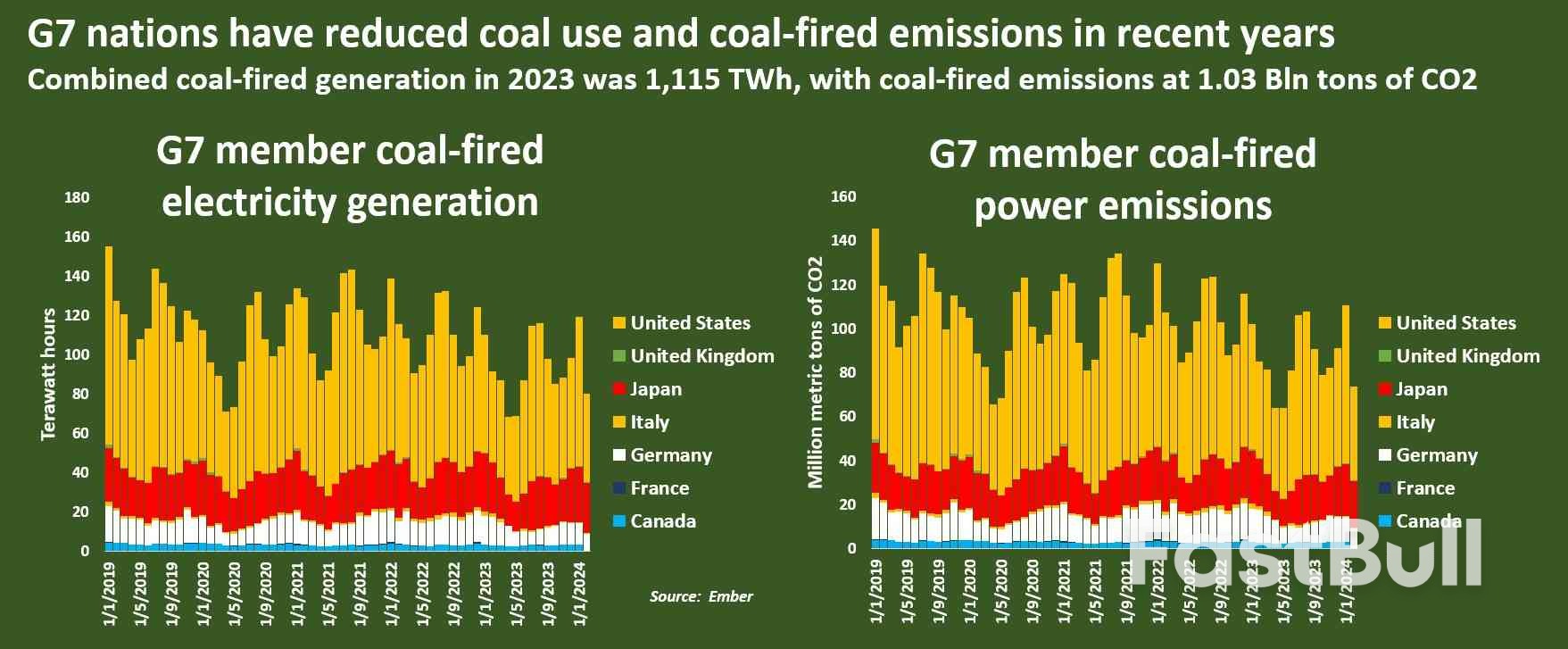
          Coal was the fourth-largest source of electricity generation in the G7 in 2023, accounting for an average of 15% of the group's electricity last year, according to energy think tank Ember.The Emissions and Trade Flows Impact of The G7 Coal Pledge_1
          That compares to 34% for natural gas, 18% from nuclear, 18% from renewables and 11% from hydro dams.
          The global average for coal-fired electricity generation in 2023 was 37%, or more than twice the G7 average.
          In absolute generation terms, the G7 nations produced 1,115 terawatt hours (TWh) of electricity from coal in 2023, compared to 10,093 TWh of electricity produced from coal globally.
          That 11% share of global coal-fired electricity output is down from a 26.5% share in 2013 and 44% in 2003, and reveals that G7 countries have already made deep cuts to coal use amid intensifying pressure to decarbonise power systems.
          G7 nations have made similarly steep reductions to their collective coal-fired emissions.
          In 2023, G7 nations discharged around 1.035 billion metric tons of carbon dioxide and equivalent gases from coal-fired generation, according to Ember, which is the lowest total on record.
          That tally represents a 10.8% share of the global total, and compares to 2.2 billion tons in 2013 and 2.6 billion in 2003.

          Wide Range

          Among the G7 countries, there is wide variance in coal dependence.
          The least reliant on coal is France, which primarily uses nuclear power for electricity generation and sourced only a fraction of a percent from coal in 2023.
          The UK generated only around 1.1% of electricity from coal in 2023, while coal only accounted for 4.9% of electricity output in Italy and 5.6% in Canada.The Emissions and Trade Flows Impact of The G7 Coal Pledge_2
          However, coal-fired plants generated around 29% of electricity in Japan, 25% in Germany and 16% in the U.S. last year, Ember data shows.
          That enduring reliance on coal to generate a double-digit share of electricity in three of the world's largest manufacturing economies reveals the G7 group still faces a significant challenge in fulfilling their collective pledge of eliminating the fuel from their power mix over the coming years.
          Indeed, statements accompanying the G7 pledge included caveats on the timing of the coal phase out in each country, providing wiggle room for Japan and Germany in particular to chart their own coal reduction courses within broader net zero emissions pathways.

          Trade Flow Impact

          In addition to the emissions impact, climate trackers will also be following the consequences of the G7 coal cuts on the international trade of thermal coal.
          Some of the G7 coal users, especially the U.S. and Germany, are largely self-sufficient in their coal needs due to large local coal mining industries that feed most of their power use needs.
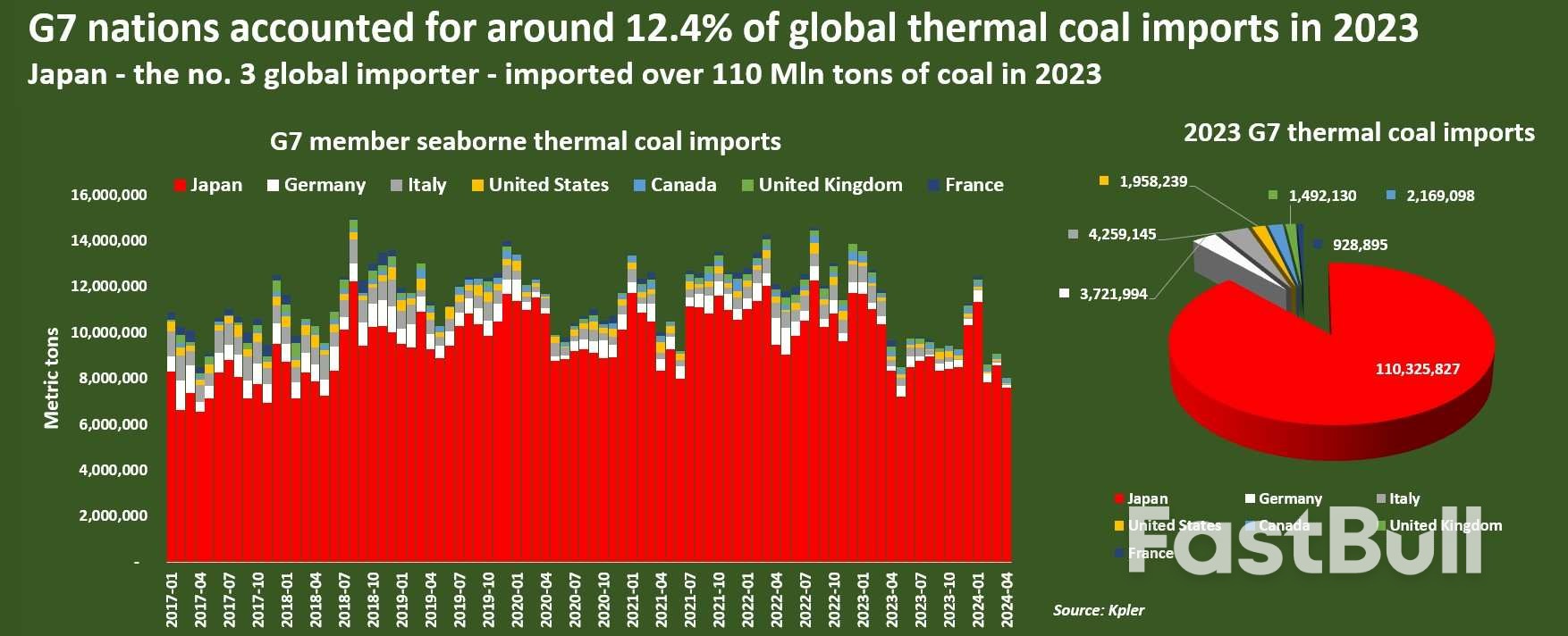
          But Japan is almost entirely reliant on fuel imports, and as a result was the third-largest global importer of thermal coal in 2023, according to Kpler.
          Japan imported just over 110 million metric tons of thermal coal last year, compared to around 330 million tons imported by China and 170 million tons by India.The Emissions and Trade Flows Impact of The G7 Coal Pledge_3
          If Japan complies with the G7 pledge to phase out coal use by the middle of the next decade, that will result in significant changes to global coal flows over that period, with repercussions for Japan's top current suppliers Australia, Indonesia, Russia and Canada.
          Some fast-growing economies elsewhere, including India, the Philippines and Vietnam, may snap up some of the reduced volumes bought by G7 nations over the near term.
          But in the longer run those and other nations plan to sharply increase clean power generation and cut back on fossil fuel use.
          That suggests the pledge made by the G7 to cut coal use over the next decade could be followed by other nations in due course, resulting in a more comprehensive reduction in coal use over the following decades.

          Source: Reuters

          Risk Warnings and Disclaimers
          You understand and acknowledge that there is a high degree of risk involved in trading. Following any strategies or investment methods may lead to potential losses. The content on the site is provided by our contributors and analysts for information purposes only. You are solely responsible for determining whether any trading assets, securities, strategy, or any other product is suitable for investing based on your own investment objectives and financial situation.
          Add to Favorites
          Share

          A Strong U.S. Dollar Weighs on the World

          Cohen

          Economic

          Forex

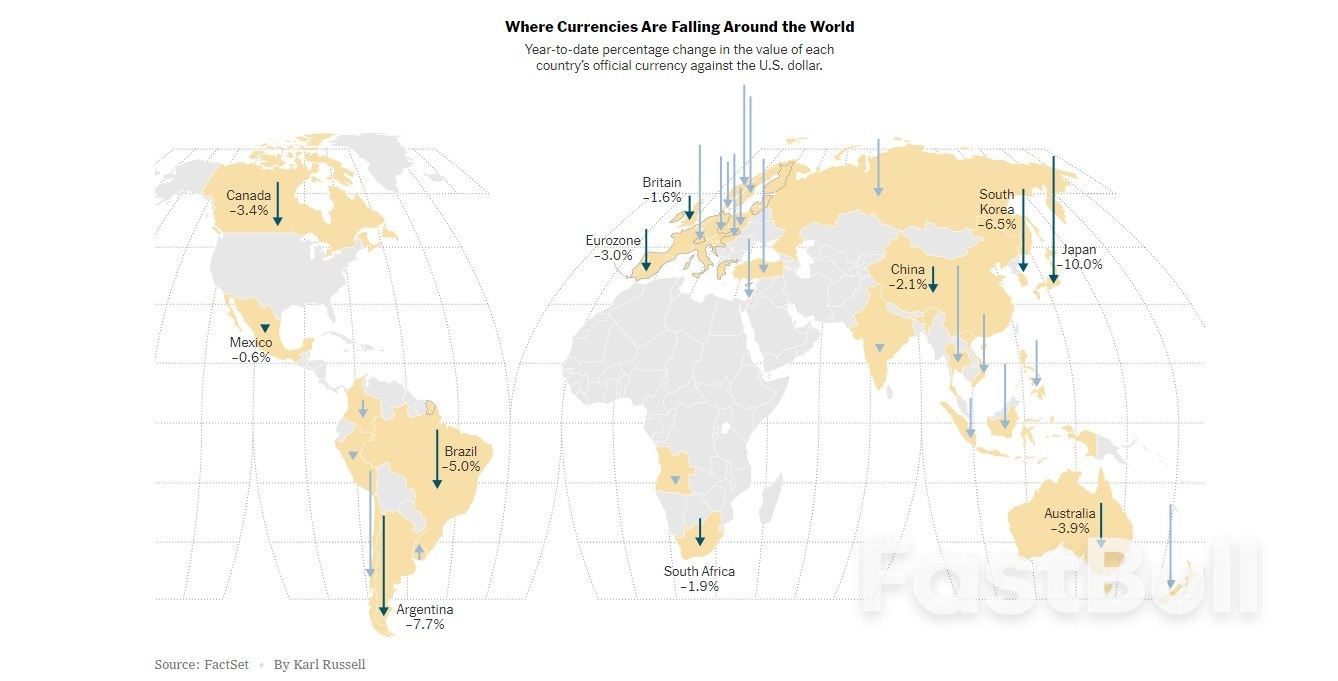
          A Strong U.S. Dollar Weighs on the World_1Every major currency in the world has fallen against the U.S. dollar this year, an unusually broad shift with the potential for serious consequences across the global economy.
          Two-thirds of the roughly 150 currencies tracked by Bloomberg have weakened against the dollar, whose recent strength stems from a shift in expectations about when and by how much the Federal Reserve may cut its benchmark interest rate, which sits around a 20-year high.
          High Fed rates, a response to stubborn inflation, mean that American assets offer better returns than much of the world, and investors need dollars to buy them. In recent months, money has flowed into the United States with a force that's being felt by policymakers, politicians and people from Brussels to Beijing, Toronto to Tokyo.
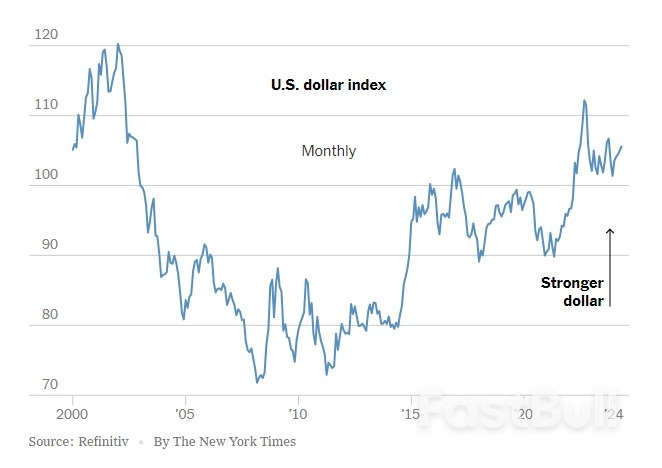
          The dollar index, a common way to gauge the general strength of the U.S. currency against a basket of its major trading partners, is hovering at levels last seen in the early 2000s (when U.S. interest rates were also similarly high).
          The yen is at a 34-year low against the U.S. dollar. The euro and Canadian dollar are sagging. The Chinese yuan has shown notable signs of weakness, despite officials' stated intent to stabilize it.
          "It has never been truer that the Fed is the world's central bank," said Jesse Rogers, an economist at Moody's Analytics.
          A Strong U.S. Dollar Weighs on the World_2When the dollar strengthens, the effects can be fast and far-reaching.
          The dollar is on one side of nearly 90 percent of all foreign exchange transactions. A strengthening U.S. currency intensifies inflation abroad, as countries need to swap more of their own currencies for the same amount of dollar-denominated goods, which include imports from the United States as well as globally traded commodities, like oil, often priced in dollars. Countries that have borrowed in dollars also face higher interest bills.
          There can be benefits for some foreign businesses, however. A strong dollar benefits exporters that sell to the United States, as Americans can afford to buy more foreign goods and services (including cheaper vacations). That puts American companies that sell abroad at a disadvantage, since their goods appear more expensive, and could widen the U.S. trade deficit at a time when President Biden is promoting more domestic industry.
          Exactly how these positives and negatives shake out depends on why the dollar is stronger, and that depends on the reason U.S. interests rates might remain high.
          Earlier in the year, unexpectedly strong U.S. growth, which can lift the global economy, had begun to outweigh worries over stubborn inflation. But if U.S. rates remain high because inflation is sticky even as economic growth slows, then the effects could be more "sinister," said Kamakshya Trivedi, an analyst at Goldman Sachs.
          In that case, policymakers would be stuck between supporting their domestic economies by cutting rates or supporting their currency by keeping them high. "We are at the cusp of that," Mr. Trivedi said.
          The strong dollar's effects have been felt particularly sharply in Asia. This month, the finance ministers of Japan, South Korea and the United States met in Washington, and among other things they pledged to "consult closely on foreign exchange market developments." Their post-meeting statement also noted the "serious concerns of Japan and the Republic of Korea about the recent sharp depreciation of the Japanese yen and the Korean won."
          The Korean won is the weakest it has been since 2022, and the country's central bank governor recently called moves in the currency market "excessive."
          The yen has been tumbling against the dollar, and on Monday briefly slipped past 160 yen to the dollar for the first time since 1990. In sharp contrast to the Fed in the United States, Japan's central bank began raising interest rates only this year after struggling for decades with low growth.
          For Japanese officials, that means striking a delicate balance — increase rates, but not by too much in a way that could stifle growth. The consequence of that balancing act is a weakened currency, as rates have stayed near zero. The risk is that if the yen continues to weaken, investors and consumers may lose confidence in the Japanese economy, shifting more of their money abroad.
          A similar risk looms for China, whose economy has been battered by a real estate crisis and sluggish spending at home. The country, which seeks to hold its currency within a tight range, has recently relaxed its stance and allowed the yuan to weaken, a demonstration of the pressure exerted by the dollar in financial markets and on other countries' policy decisions.
          "A weaker yuan is not a sign of strength," said Brad Setser, a senior fellow at the Council on Foreign Relations and former Treasury Department economist. "It will lead to questions about whether China's economy is as strong as people thought."
          In Europe, policymakers at the European Central Bank have signaled that they could cut rates at their next meeting, in June. But even with inflation improving in the eurozone, there is a concern among some that by lowering interest rates before the Fed, the E.C.B. would widen the difference in interest rates between the eurozone and the United States, further weakening the euro.
          Gabriel Makhlouf, governor of Ireland's central bank and one of the 26 members of the E.C.B.'s governing council, said that when setting policy, "we can't ignore what's happening in the U.S."
          Other policymakers are confronting similar complications, with central banks in South Korea and Thailand among those also considering lowering interest rates.
          By contrast, Indonesia's central bank unexpectedly raised rates last week, in part to support the country's depreciating currency, a sign of how the dollar's strength is reverberating around the world in different ways. Some of the fastest-falling currencies this year, like those in Egypt, Lebanon and Nigeria, reflect domestic challenges made even more daunting by the pressure exerted by a stronger dollar.
          "We are on the edge of a storm," Mr. Rogers of Moody's said.

          Source: The New York Times

          To stay updated on all economic events of today, please check out our Economic calendar
          Risk Warnings and Disclaimers
          You understand and acknowledge that there is a high degree of risk involved in trading. Following any strategies or investment methods may lead to potential losses. The content on the site is provided by our contributors and analysts for information purposes only. You are solely responsible for determining whether any trading assets, securities, strategy, or any other product is suitable for investing based on your own investment objectives and financial situation.
          Add to Favorites
          Share

          The Fed Would Only Cut Rates to Help the U.S. Service Its Soaring Debt, Fund Manager Says

          Warren Takunda

          Economic

          Bond

          The only reason the Federal Reserve might be tempted to cut rates would be to help the U.S. cover interest payments for the national debt, according to fund manager Freddie Lait.
          His comments come ahead of the Federal Reserve’s monetary policy decision on Wednesday, which could shed some light on the U.S. central bank’s rate trajectory. The Fed is widely expected to keep its benchmark overnight borrowing rate in a range between 5.25%-5.5%.
          Traders are currently only pricing in about a 50% chance of a Fed rate cut taking place as early as September and expect just one quarter-percentage-point reduction by the end of the year, according to the CME FedWatch Tool.
          Speaking to CNBC’s “Squawk Box Europe” on Wednesday, Latitude Investment Management’s Lait said he believed the current level of interest rates was “perfectly fine” to balance the inflation and growth outlook for the world’s largest economy.
          “I think it is for the birds to think that in a world where inflation is bottoming, and in some cases turning up, and there’s early signs of life, partially due to the strong economy with massive government stimulus behind it, that they are going to be cutting in any meaningful way,” Lait said.
          “From the way we have thought about it for the last 15 years, and I think for longer too, there is no economic rationale for cutting. The reason they might cut is because the U.S. government can’t afford [them not doing] it — and that’s a much scarier reason to have to cut,” he added.
          A spokesperson for the Federal Reserve declined to comment.
          The U.S. government is paying more to service its ballooning debt after a period of rapid interest rate hikes, tax cuts, and massive stimulus programs designed to support the economy during the Covid-19 pandemic.
          A recent analysis by the Congressional Budget Office showed that U.S. federal spending on interest payments is expected to climb to $870 billion this year. The forecast reflects a 32% jump from last year’s interest expense of $659 billion.

          Growth in interest payments ‘quite staggering’

          Lait said that “exponential” growth in government spending on U.S. debt would likely pose a problem for whoever wins the November presidential election.
          “The facts are there now. You have borrowed the money. You’re running a fiscal deficit of 5, 6%. Either you withdraw all the stimulus programs and that still takes a wind down period, which is going to be a real challenge especially in somewhere like America where they are sort of legislated, or you have to borrow that money.”
          Asked whether he believed the U.S. government debt load may be becoming unattractive for a number of key international investors, Lait replied, “Yes and the solution would either be to live with much higher yields or [with] much lower government spending, because that would reduce issuance and solve the problem a different way.”
          He added, “It’s a little bit conspiracy theory-esque because the level of debt has never mattered. Debt to GDP has gone up every year since the war. And so, it’s gone up like a straight line and the markets have bull and bear markets.”
          However, Lait said the level of U.S. national debt was not the point.
          “It’s kind of the changes in it and the construction of it. And I think it is just the growth in those interest payments are really quite staggering,” he said.

          Source: CNBC

          To stay updated on all economic events of today, please check out our Economic calendar
          Risk Warnings and Disclaimers
          You understand and acknowledge that there is a high degree of risk involved in trading. Following any strategies or investment methods may lead to potential losses. The content on the site is provided by our contributors and analysts for information purposes only. You are solely responsible for determining whether any trading assets, securities, strategy, or any other product is suitable for investing based on your own investment objectives and financial situation.
          Add to Favorites
          Share

          XRP, SOL, DOGE Open Interest Falls a Combined 51% in the Last Month

          Warren Takunda

          Economic

          Cryptocurrency

          The open interest (OI) of major cryptocurrencies, including XRP
          XRP, Solana’s and Dogecoin have plunged a combined 51% in the last month.
          “Market participants are becoming disinterested, which is reflected in the drop in open interest,” crypto trader TheCryptoMann wrote in an April 30 post on X.
          OI measures the total value of all outstanding or unsettled crypto futures contracts across exchanges. It is a key metric traders and analysts use to assess market sentiment and anticipate future price movements.
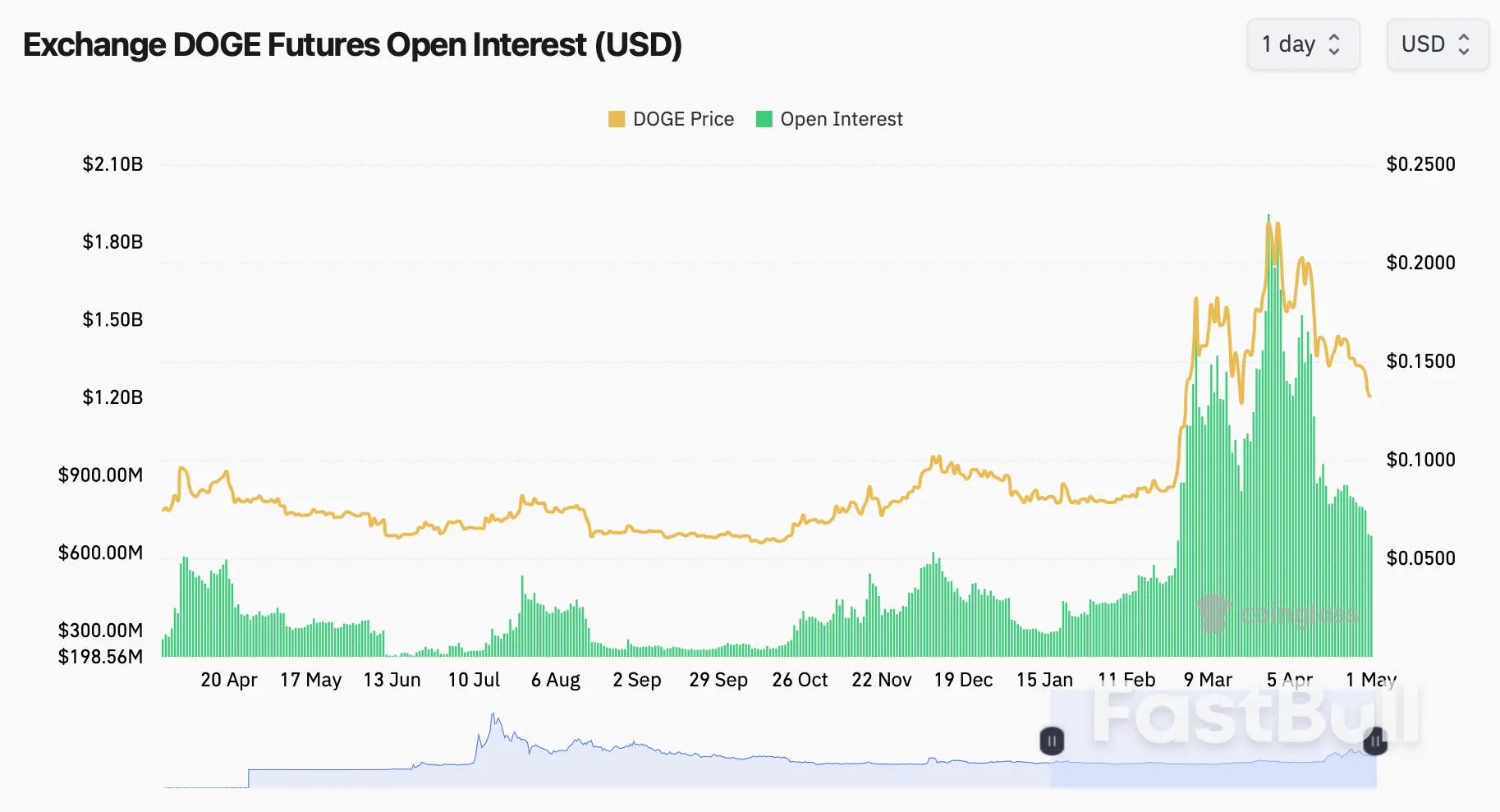
          Dogecoin experienced the largest decline in OI among the nine largest cryptocurrencies by market capitalization, falling 64% to $668.2 million since April 1, according to CoinGlass data.
          Solana’s open interest is currently at $1.51 billion, which represents a 47% decrease since April 1.
          Meanwhile, XRP’s OI stands at $497.67 million, marking a 44% decrease within the same time frame.XRP, SOL, DOGE Open Interest Falls a Combined 51% in the Last Month  _1

          Open interest of Dogecoin has declined 64% over the past month. Source: CoinGlass

          Market instability often contributes to declining OI, as traders become unsure about the market’s direction and are less willing to take bets on either side of the price action.
          “Open interest close to all-time lows since FTX nuke,” crypto trader TheoTrader wrote in an April 26 post on X, noting that the current OI levels are similar to those seen around the November 2022 collapse of the now-defunct crypto exchange FTX.
          The aftermath of the April 20 Bitcoin halving — which has seen Bitcoin miner revenue fall to new yearly lows — is another major catalyst of market uncertainty in the current conditions.
          There are expectations of a further market correction, but it’s unclear how severe it might be, causing fewer traders to take new positions.
          The two leading cryptocurrencies by market capitalization have also experienced a drop in OI coinciding with price declines across the wider market.
          Bitcoin open interest has decreased by 21% to $25.58 billion, while its price has fallen 14.87% to $60,149 at the time of publication, per CoinMarketCap data.
          Similarly, Ether has seen a 22% drop in open interest to $10.02 billion, with its price declining by 16.67% and currently trading slightly above the key support level at $3,005.
          Over the past 30 days, more capital has moved away from altcoins and into Bitcoin. As a result, Bitcoin dominance — BTC’s relative share of the total crypto market cap — has increased by 2.13%, reaching 54.77%, according to TradingView data.

          Source: Cointelegraph

          To stay updated on all economic events of today, please check out our Economic calendar
          Risk Warnings and Disclaimers
          You understand and acknowledge that there is a high degree of risk involved in trading. Following any strategies or investment methods may lead to potential losses. The content on the site is provided by our contributors and analysts for information purposes only. You are solely responsible for determining whether any trading assets, securities, strategy, or any other product is suitable for investing based on your own investment objectives and financial situation.
          Add to Favorites
          Share

          Pound to Dollar: Test of 1.22 Possible Says One Analyst

          Warren Takunda

          Economic

          Forex

          The Pound to Dollar exchange rate lost one per cent in value during April, but losses had extended to 2.50% before a late-month recovery.
          A recent relief rally back to 1.25 eases some near-term downside pressure, but analysts are looking for the selloff to resume and deliver lows not seen since last November ultimately.
          "GBP/USD and EUR/USD can take their cue from USD. GBP/USD can test support at 1.2298 if strong US data and/or a hawkish FOMC pushes up U.S. yields and the USD significantly," says Kristina Clifton, a strategist at Commonwealth Bank.
          The new month kicks off with the Federal Reserve interest rate decision, where policymakers are expected to sound less confident about the prospects of bringing inflation back to the 2.0% target anytime soon, meaning they will validate market expectations for later rate cuts.
          Markets entered the year expecting up to 150 basis points of cuts, but this now stands at just 25bps following a rerating in expectations that has propelled the Dollar to the top of the 2024 performance charts.
          The first rate cut is now anticipated by December, but the market could push this back into 2025 if Fed Chair Powell and his colleagues warn inflation is going in the wrong direction, which can offer the Dollar further support.
          "The FOMC is expected to leave the Funds rate unchanged. The focus of financial markets will be the post‑meeting statement and Chair Powell’s press conference. We expect Powell to be hawkish; the question is will he be more hawkish than market expectations. We would not be surprised if financial markets remove all rate cuts priced for 2024 this week, supporting the USD to lift above 107pts," says Clifton.
          Most major USD-based currency pairs are in short- to medium-term downtrends against the Dollar, with the Pound-Dollar exchange rate's trend clearly visible:
          Pound to Dollar: Test of 1.22 Possible Says One Analyst_1

          Above: GBP/USD at daily intervals.

          "It is quite possible that there could be more downside in cable if speculators build short positions, but the 1.22 level will likely be a near-term floor," says Chester Notifor, a foreign exchange strategist at BCA Research.
          The Dollar strengthened on April 30 after a measure of wages favoured by the Federal Reserve came in above expectations and added fresh evidence that inflationary pressures were building again.
          U.S. labour costs rose by 1.2% in the first quarter versus the 1.0% expected. "The Q1 reading for the Employment Cost Index (ECI) was yet another data point suggesting that progress on inflation is stalling out," says Sarah House, an economist at Wells Fargo.
          But, Bullish USD Positioning Opens the Door to Disappointment
          Wednesday's Federal Reserve policy decision will be followed by the non-farm payroll report at the end of the week, which will be the first of the major data releases from the U.S. for May.
          The labour market has consistently beaten analyst expectations and markets are primed for another strong reading.
          Given the already USD-hawkish setup of the foreign exchange markets, the bigger risks are to the downside on any unexpected weakness in the upcoming data.
          Paul Robson, a foreign exchange strategist at NatWest Markets says the market "is clearly positioned" for a continuation of U.S. economic and USD dominance.
          "That naturally ups the ante for US economic data to outperform a seemingly ever-rising bar," he says.
          In short, big beats to the upside are now required to derive substantive Dollar advances, whereas small downside surprises can deliver meaningful moves to the downside.
          While GBP/USD can still fall to a floor at 1.22, the prospect of some May relief cannot be discounted if some of the recent heat is taken out of the recent trend by more mundane economic releases.

          Source: Poundsterlinglive

          To stay updated on all economic events of today, please check out our Economic calendar
          Risk Warnings and Disclaimers
          You understand and acknowledge that there is a high degree of risk involved in trading. Following any strategies or investment methods may lead to potential losses. The content on the site is provided by our contributors and analysts for information purposes only. You are solely responsible for determining whether any trading assets, securities, strategy, or any other product is suitable for investing based on your own investment objectives and financial situation.
          Add to Favorites
          Share
          FastBull
          Copyright © 2025 FastBull Ltd

          728 RM B 7/F GEE LOK IND BLDG NO 34 HUNG TO RD KWUN TONG KLN HONG KONG

          TelegramInstagramTwitterfacebooklinkedin
          App Store Google Play Google Play
          Products
          Charts

          Chats

          Q&A with Experts
          Screeners
          Economic Calendar
          Data
          Tools
          Membership
          Features
          Function
          Markets
          Copy Trading
          Latest Signals
          Contests
          News
          Analysis
          24/7
          Columns
          Education
          Company
          Careers
          About Us
          Contact Us
          Advertising
          Help Center
          Feedback
          User Agreement
          Privacy Policy
          Business

          White Label

          Data API

          Web Plug-ins

          Poster Maker

          Affiliate Program

          Risk Disclosure

          The risk of loss in trading financial instruments such as stocks, FX, commodities, futures, bonds, ETFs and crypto can be substantial. You may sustain a total loss of the funds that you deposit with your broker. Therefore, you should carefully consider whether such trading is suitable for you in light of your circumstances and financial resources.

          No decision to invest should be made without thoroughly conducting due diligence by yourself or consulting with your financial advisors. Our web content might not suit you since we don't know your financial conditions and investment needs. Our financial information might have latency or contain inaccuracy, so you should be fully responsible for any of your trading and investment decisions. The company will not be responsible for your capital loss.

          Without getting permission from the website, you are not allowed to copy the website's graphics, texts, or trademarks. Intellectual property rights in the content or data incorporated into this website belong to its providers and exchange merchants.

          Not Logged In

          Log in to access more features

          FastBull Membership

          Not yet

          Purchase

          Become a signal provider
          Help Center
          Customer Service
          Dark Mode
          Price Up/Down Colors

          Log In

          Sign Up

          Position
          Layout
          Fullscreen
          Default to Chart
          The chart page opens by default when you visit fastbull.com