

Markets
News
Analysis
User
24/7
Economic Calendar
Education
Data
- Names
- Latest
- Prev



Signal Accounts for Members
All Signal Accounts
All Contests
 U.K. Trade Balance Non-EU (SA) (Oct)
A:--
F: --
P: --
U.K. Trade Balance (Oct)A:--
F: --
P: --
U.K. Services Index MoMA:--
F: --
P: --
U.K. Construction Output MoM (SA) (Oct)A:--
F: --
P: --
U.K. Industrial Output YoY (Oct)A:--
F: --
P: --
U.K. Trade Balance (SA) (Oct)A:--
F: --
P: --
U.K. Trade Balance EU (SA) (Oct)A:--
F: --
P: --
U.K. Manufacturing Output YoY (Oct)A:--
F: --
P: --
U.K. GDP MoM (Oct)A:--
F: --
P: --
U.K. GDP YoY (SA) (Oct)A:--
F: --
P: --
U.K. Industrial Output MoM (Oct)A:--
F: --
P: --
U.K. Construction Output YoY (Oct)A:--
F: --
P: --
 France HICP Final MoM (Nov)
A:--
F: --
P: --
 China, Mainland Outstanding Loans Growth YoY (Nov)
A:--
F: --
P: --
China, Mainland M2 Money Supply YoY (Nov)A:--
F: --
P: --
China, Mainland M0 Money Supply YoY (Nov)A:--
F: --
P: --
China, Mainland M1 Money Supply YoY (Nov)A:--
F: --
P: --
 India CPI YoY (Nov)
A:--
F: --
P: --
India Deposit Gowth YoYA:--
F: --
P: --
 Brazil Services Growth YoY (Oct)
A:--
F: --
P: --
 Mexico Industrial Output YoY (Oct)
A:--
F: --
P: --
 Russia Trade Balance (Oct)
A:--
F: --
P: --
 Philadelphia Fed President Henry Paulson delivers a speech
 Canada Building Permits MoM (SA) (Oct)
A:--
F: --
P: --
Canada Wholesale Sales YoY (Oct)A:--
F: --
P: --
Canada Wholesale Inventory MoM (Oct)A:--
F: --
P: --
Canada Wholesale Inventory YoY (Oct)A:--
F: --
P: --
Canada Wholesale Sales MoM (SA) (Oct)A:--
F: --
P: --
 Germany Current Account (Not SA) (Oct)
A:--
F: --
P: --
U.S. Weekly Total Rig CountA:--
F: --
P: --
U.S. Weekly Total Oil Rig CountA:--
F: --
P: --
 Japan Tankan Large Non-Manufacturing Diffusion Index (Q4)
--
F: --
P: --
Japan Tankan Small Manufacturing Outlook Index (Q4)--
F: --
P: --
Japan Tankan Large Non-Manufacturing Outlook Index (Q4)--
F: --
P: --
Japan Tankan Large Manufacturing Outlook Index (Q4)--
F: --
P: --
Japan Tankan Small Manufacturing Diffusion Index (Q4)--
F: --
P: --
Japan Tankan Large Manufacturing Diffusion Index (Q4)--
F: --
P: --
Japan Tankan Large-Enterprise Capital Expenditure YoY (Q4)--
F: --
P: --
U.K. Rightmove House Price Index YoY (Dec)--
F: --
P: --
China, Mainland Industrial Output YoY (YTD) (Nov)--
F: --
P: --
China, Mainland Urban Area Unemployment Rate (Nov)--
F: --
P: --
 Saudi Arabia CPI YoY (Nov)
--
F: --
P: --
 Euro Zone Industrial Output YoY (Oct)
--
F: --
P: --
Euro Zone Industrial Output MoM (Oct)--
F: --
P: --
Canada Existing Home Sales MoM (Nov)--
F: --
P: --
Euro Zone Total Reserve Assets (Nov)--
F: --
P: --
U.K. Inflation Rate Expectations--
F: --
P: --
Canada National Economic Confidence Index--
F: --
P: --
Canada New Housing Starts (Nov)--
F: --
P: --
U.S. NY Fed Manufacturing Employment Index (Dec)--
F: --
P: --
U.S. NY Fed Manufacturing Index (Dec)--
F: --
P: --
Canada Core CPI YoY (Nov)--
F: --
P: --
Canada Manufacturing Unfilled Orders MoM (Oct)--
F: --
P: --
Canada Manufacturing New Orders MoM (Oct)--
F: --
P: --
Canada Core CPI MoM (Nov)--
F: --
P: --
Canada Manufacturing Inventory MoM (Oct)--
F: --
P: --
Canada CPI YoY (Nov)--
F: --
P: --
Canada CPI MoM (Nov)--
F: --
P: --
Canada CPI YoY (SA) (Nov)--
F: --
P: --
Canada Core CPI MoM (SA) (Nov)--
F: --
P: --


No matching data

Latest Views
Latest Views
Trending Topics
Top Columnists
Latest Update
White Label
Data API
Web Plug-ins
Affiliate Program
View All
No data
Thailand’s government supports increased US imports of necessary goods as a way to reduce the country’s trade surplus with the United States, the finance minister said on Monday. Authorities will also talk with US business people in Thailand to find ways to ease any impacts of US President Donald Trump’s trade policies, Pichai Chunhavajira told reporters.
Thailand’s government supports increased US imports of necessary goods as a way to reduce the country’s trade surplus with the United States, the finance minister said on Monday. Authorities will also talk with US business people in Thailand to find ways to ease any impacts of US President Donald Trump’s trade policies, Pichai Chunhavajira told reporters.
"This will help create understanding with the United States that most Thai exports to the country are investments by US companies based in Thailand," he said.
Thailand had a trade surplus last year of US$35.4 billion (RM158.43 billion) with the United States, according to the Thai commerce ministry. The United States was Thailand’s largest export market last year, accounting for 18.3% of total shipments, or US$54.96 billion.
The commerce ministry has cited uncertainty over US trade policies as a challenge to increasing Thai exports.
Trump has ordered US federal agencies to complete comprehensive reviews of a range of trade issues by April 1, including analyses of persistent US trade deficits.
He has imposed tariffs on China, and signalled that the 27-nation European Union would be his next target, but suspended his threat of 25% tariffs on Mexico and Canada for 30 days.
Last week, a Thai government official said US ethane imports would be increased by at least one million tonnes, starting from the second quarter, to try to reduce the trade surplus.
Pichai also said the government wanted to drive economic growth to above 3% this year by accelerating investment, and said he supported the use of digital assets as funding sources to boost the economy.
AUD/USD started a decent increase above the 0.6200 and 0.6240 levels. NZD/USD is also rising and might aim for more gains above 0.5700.
Important Takeaways for AUD USD and NZD USD Analysis Today
The Aussie Dollar rebounded after forming a base above the 0.6100 level against the US Dollar.
There was a break below a connecting bullish trend line with support at 0.6255 on the hourly chart of AUD/USD at FXOpen.
NZD/USD is consolidating gains above the 0.5600 zone.
There is a key declining channel forming with resistance at 0.5680 on the hourly chart of NZD/USD at FXOpen.
On the hourly chart of AUD/USD at FXOpen, the pair started a fresh increase from the 0.6090 support. The Aussie Dollar was able to clear the 0.6170 resistance to move into a positive zone against the US Dollar.
There was a close above the 0.6240 resistance and the 50-hour simple moving average. Finally, the pair tested the 0.6300 zone. A high was formed near 0.6301 and the pair recently saw a minor pullback.
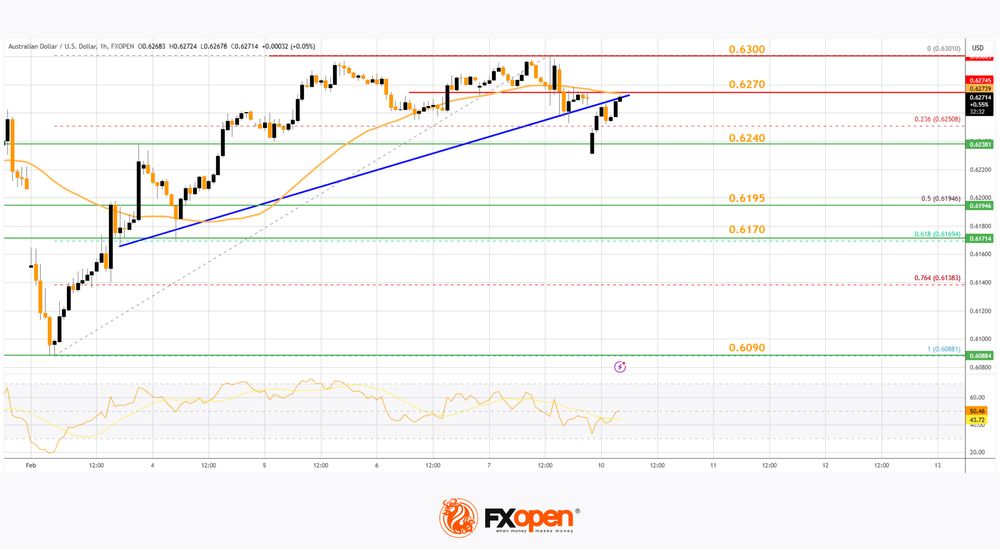
There was a move below the 0.6300 level. The pair declined below the 23.6% Fib retracement level of the upward move from the 0.6088 swing low to the 0.6301 high. Besides, there was a break below a connecting bullish trend line with support at 0.6255.
On the downside, initial support is near the 0.6240 level. The next major support is near the 0.6195 zone or the 50% Fib retracement level of the upward move from the 0.6088 swing low to the 0.6301 high.
If there is a downside break below the 0.6195 support, the pair could extend its decline toward the 0.6170 level. Any more losses might signal a move toward 0.6090.
On the upside, the AUD/USD chart indicates that the pair is now facing resistance near 0.6270. The first major resistance might be 0.6300. An upside break above the 0.6300 resistance might send the pair further higher.
The next major resistance is near the 0.6335 level. Any more gains could clear the path for a move toward the 0.6380 resistance zone.
On the hourly chart of NZD/USD on FXOpen, the pair started a steady increase from the 0.5515 zone. The New Zealand Dollar broke the 0.5600 resistance to start the recent increase against the US Dollar.
The pair settled above 0.5630 and the 50-hour simple moving average. It tested the 0.5700 zone and is currently correcting gains. The pair corrected lower below the 0.5660 level. However, the bulls are active above the 0.5630 level.
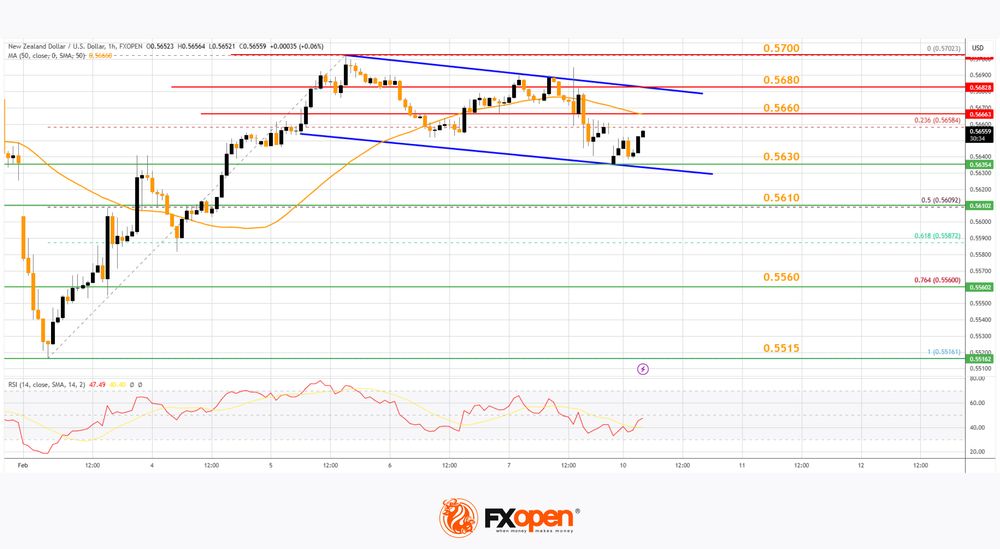
The NZD/USD chart suggests that the RSI is now moving higher toward 50. On the upside, the pair might struggle near 0.5660. The next major resistance is near the 0.5680 level. There is also a key declining channel forming with resistance at 0.5680.
A clear move above the 0.5680 level might even push the pair toward the 0.5700 level. Any more gains might clear the path for a move toward the 0.5750 resistance zone in the coming days.
On the downside, immediate support is near the 0.5630 level. The first key support is near the 50% FIB retracement level of the upward move from the 0.5516 swing low to the 0.5702 high. The next major support is near the 0.5560 level.
If there is a downside break below the 0.5560 support, the pair might slide toward the 0.5515 support. Any more losses could lead NZD/USD in a bearish zone to 0.5440.


Another week starts with tariff threats. This time, everyone that applies tariffs to the US will be hit back with the same tariffs, and all aluminium and steel imports to the US – no matter from whom – will face a 25% tariff. Mood this Monday in Asia is pretty mixed – to say the least. Aluminum and iron ore futures are slightly down, the US dollar index is up and the commodity currencies like Aussie and Loonie opened the week with a gap but the AUDUSD recovered early losses.
The swift recovery in Aussie was certainly due to the encouraging Chinese data that showed that inflation advanced to the highest level in five months thanks to increased spending during the Chinese New Year holiday. Australian equities are not particularly welcoming the fresh tariff news, while FTSE futures are slightly up. The rebound in oil prices on fresh US sanctions on Iranian crude exports and encouraging Chinese inflation data help counterweigh the negative impact of softer metal prices. As per oil, good news from China could throw a solid floor under the US crude selloff after the price of a barrel approached the $70pb psychological level last week and rebounded from there.
Friday’s jobs data from the US was all but ideal for the so-called goldilocks scenario. The US posted slower-than-expected nonfarm payrolls and acceleration in wages growth in January. The annual revision to the nonfarm employment on the other hand was just less than 600K jobs – as expected. The combination of slower job additions with higher wages didn’t enchant the Federal Reserve (Fed) doves. The US 2-year yield jumped to flirt with the 4.30% mark as the 10-year yield advanced past the 4.50% level. Plus, the share of foreign-born workers in the US kept climbing last year but these jobs are at risk under Trump administration.
Plus, the latest data from the Fed on Friday showed alarming rise in household debt, credit card delinquencies remain strong. As such, it’s hard to guess what’s the best thing to do for the Fed. All eyes will be on Fed Chair Jerome Powell’s semi-annual testimony on Tuesday and Wednesday. For now, the Fed is expected to keep the rates unchanged at least until June – and a June rate cut is a coin toss.
Overall, US’ exceptional growth story is based on exploding private and public debt. Trump’s plans for mass deportation and sizeable tariffs hint at uptick in US inflation in the coming months. Not helping are the California wildfires that are expected to cause a jump in new and used car prices, and the bird flu which is sending egg prices soaring. As a result, a stronger-than-expected set of inflation data this week – and/or a cautious stance from Powell should keep the US dollar in demand and weigh on risk appetite.
Equity indices didn’t like the anti-goldilocks jobs report last Friday. The S&P500 retreated 0.95% while Nasdaq 100 fell 1.30%. Magnificent 7 earnings were robust but not ‘magnificent’ with slowing growth / high AI spending. Mag7 ETF slid 2% on Friday and 2.41% throughout the week.
In Europe, Friday saw the European Stoxx 600 give back some gains too. On the data front, Germany posted a record trade surplus with the US. The timing is bad, as Trump is out and pointing his finger to Europe, as well. Consequently, the tariff threats remain on the back of investors’ minds in Europe and Germany will be on the front line of a potential transatlantic trade war. But that worry is not dominating the price action so far. On the contrary, the convergence trade between Europe and the US remains in full play.
The S&P500 is up by a meagre 2% since the year started while the Stoxx 600 was up by almost 7% on Friday’s close. The divergence between the Fed and European Central Bank (ECB) expectations remains supportive of the convergence trade, but doesn’t change the fact that the European companies’ face dull economic outlook and instable political landscape. The EURUSD was aggressively sold on Friday and again at the Asian open. Losses have been mostly reversed at the time of recording but the EURUSD outlook remains negative on the back of diverging Fed / ECB policy outlooks and strong resistance is seen into the 50-DMA, a touch higher than the 1.04 psychological mark.
The Sentix indicator will give us the first indication of European investor confidence in February.
In Denmark, inflation data for January is released. January data is always extra exciting because many businesses only adjust prices at the turn of the year. Sales also increases uncertainty. Particularly fuel prices have increased due to higher energy fees but also higher oil prices. Even so, we expect a decline in annual inflation to 1.5% from 1.9% in December, driven by particularly electricity, as a big increase in tariffs and fees in January 2024 exits the inflation measure.
In Norway, January inflation figures are always extra uncertain. This is the time when most administrative prices are regulated, and the effects can be large in some years. In addition, there can be large variations in the price offers in the January sale. Prices normally drop in January, but as prices were unchanged last year, we expect that the annual growth in core inflation slowed to 2.6% in January, in line with Norges Bank’s forecast from the December MPR. The high inflation figures from Sweden for January obviously imply a certain upside risk for the Norwegian figures, because there are some similar seasonal and administrative factors in January as in Norway.
In Sweden, the figures for industrial orders and monthly household consumption for December are being released. We anticipate some improvement in the household consumption figures, as December’s retail sales and the latest consumer confidence surveys have been encouraging.
For the remainder of the week, the key data release will be the US January CPI, while US politics will also remain in focus. Attention in the US will also be on Fed Chair Powell’s congressional testimony on Wednesday and US retail sales on Friday. In China, focus will be on whether a call between Xi Jinping and Trump, cancelled last week due to China’s retaliation to Trump’s 10% tariffs, will take place. In the euro area, data releases are limited, but Q4 employment data on Friday will be a highlight. On Friday the Munich Security Conference begins, where the war in Ukraine and possible peace talks will be in focus.
Economic and market news
What happened since Friday
In the US, the labour market report was to the strong side again. The establishment survey showed nonfarm payrolls for January grew by 143k SA, close to our forecast of +150k (cons. +170k), while data for the past two months was revised up by 100k. Average hourly earnings growth accelerated to 0.5% m/m SA, but this largely reflected a drop in average hours worked.
The household survey was heavily distorted by updated population controls, which boosted labour force and household employment estimates by 2.2m. This effect is purely statistical and has no market impact. The unemployment rate declined to 4.0% (from 4.1%), but as it is based on the household survey, it is difficult to gauge if this really reflects the labour market re-tightening. The annual benchmark revisions to NFP data from April 2023 to March 2024 was -598k, slightly less negative than the preliminary estimate suggested (-818k). Overall, nothing in the report is particularly hawkish or dovish for the markets, when you look past all the possible distortions.
Consumer sentiment fell from 71.1 in January to 67.8 in February. Notably 1y inflation expectations ticked higher to 4.3% from 3.3%, while 5y expectations were largely unchanged. While Republican respondents were much more optimistic about the future back in November and December, it seems that now both Democrats and Republicans have become much more concerned with the negative consequences of tariffs. However, Chicago Fed President Goolsbee (dovish and non-voting member) did not express new worries about inflation, repeating that the US is on its path back to 2% inflation.
Turning to the geopolitical front, Trump has reportedly spoken with Putin during the weekend about ending the war in Ukraine. Putin has indicated he is willing to discuss a Ukraine peace deal but rules out making any territorial concessions.
On Sunday, U.S. President Donald Trump announced plans to introduce new 25% tariffs on all steel and aluminium imports, on top of existing duties. These tariffs, along with reciprocal tariffs to match other countries’ rates, are set to be announced today.
In the euro area, the most discussed piece on ECB staff updates on r* was published on 7 February. While the piece emphasised do and don’ts of using the estimates for real time monetary policy decisions, it underlines that the broad range of estimates can be summarized as neutral rate being in the range of 1.75% to 2.25% in nominal terms.
In Germany, industrial production numbers were weak again in December, with production declining 2.4% m/m, leaving total Q4 production 0.9% lower than in Q3. The decline was especially due to the automotive industry and capital goods. Hence, the problems in the German industry are not over and we expect to see a continued decline in production the coming quarters. Yet, rebounding manufacturing PMIs in January gives a small ray of light in combination with the outlook for further rate cuts from the ECB, which should stabilize the industry from the second half of this year.
In Norway, manufacturing production increased 3.2% m/m in December, which seems to be a shift in the negative trend seen since last summer. Hence, manufacturing activity was down 0.8% in Q4 and will act as a headwind to GDP (due this week).
In China, CPI was stronger than expected showing a rise in the headline inflation from 0.1% y/y to 0.5% y/y (consensus 0.4% y/y) lifted by an increase in core inflation increased from 0.4% y/y to 0.6% y/y. Holiday spending from the Chinese New Year likely contributed to the increase. It is positive that inflation moved higher and further away from deflation territory, but overall price pressures are still low in China. Producer prices showed a decline again being unchanged at -2.3% y/y.
Equities: Equities were generally lower on Friday, ending just off worst levels (MSCI World -0.7%). It was a bit of a reversal of the risk appetite from the prior session, with all sectors lower and the VIX rising. Europe outperformed US, with US big tech being the notable laggard. The usual drivers were in play: yields edging higher due to a double whammy of rising wage inflation and household inflation expectations were coupled with disappointing guidance from Amazon (currency related) on top of massive capex plans. However, it was not a full risk-off session, as banks and industrials held up relatively well. Equity markets are not startled by Trump’s steel tariffs, with US futures higher this morning and Hong Kong gaining a full 1.7%. We do not know details yet (such as exceptions). However, tariffs tend to gain Nordic producers which are local US producers in a net importer market and benefitted when tariffs were introduced the last time.
FI: Global rates sold off with a knee-jerk reaction on the US labour market report on Friday, despite the headline print of 143k new jobs in January was consensus. 10y UST rose 5bp on the announcement and stayed there for the rest of the trading session. For policy signals, Friday’s print is difficult given the statistical uncertainties and revisions as per usual with the January print. Initially the US reaction took 10y Bund higher, albeit that reversed during the afternoon, thus with 10y Bunds ending the day broadly unchanged. Markets price 85bp worth of ECB rate cuts until year end. BundASW tightened into -3bp, a new low.
FX: Trump’s new weekend pledge to impose tariffs on all steel and aluminium imports is hurting commodity currencies such as AUD and CAD. There might be even more to come this week, as Trump has threatened to unveil reciprocal tariffs on “everyone”. EUR/USD is starting the week’s trading in the low 1.03’s whereas Scandies are close to Friday’s closing levels again, following a temporary overnight sell-off. The ZAR suffers as the US has frozen all aid to South Africa.
728 RM B 7/F GEE LOK IND BLDG NO 34 HUNG TO RD KWUN TONG KLN HONG KONG


White Label
Data API
Web Plug-ins
Poster Maker
Affiliate Program
The risk of loss in trading financial instruments such as stocks, FX, commodities, futures, bonds, ETFs and crypto can be substantial. You may sustain a total loss of the funds that you deposit with your broker. Therefore, you should carefully consider whether such trading is suitable for you in light of your circumstances and financial resources.
No decision to invest should be made without thoroughly conducting due diligence by yourself or consulting with your financial advisors. Our web content might not suit you since we don't know your financial conditions and investment needs. Our financial information might have latency or contain inaccuracy, so you should be fully responsible for any of your trading and investment decisions. The company will not be responsible for your capital loss.
Without getting permission from the website, you are not allowed to copy the website's graphics, texts, or trademarks. Intellectual property rights in the content or data incorporated into this website belong to its providers and exchange merchants.
Not Logged In
Log in to access more features

FastBull Membership
Not yet
Purchase


Log In
Sign Up


