• Trade
  • Markets
  • Copy
  • Contests
  • News
  • 24/7
  • Calendar
  • Q&A
  • Chats
Trending
Screeners
SYMBOL
LAST
BID
ASK
HIGH
LOW
NET CHG.
%CHG.
SPREAD
SPX
S&P 500 Index
6909.78
6909.78
6909.78
6910.87
6869.65
+31.29
+ 0.45%
--
DJI
Dow Jones Industrial Average
48442.40
48442.40
48442.40
48527.50
48254.31
+79.73
+ 0.16%
--
IXIC
NASDAQ Composite Index
23561.83
23561.83
23561.83
23563.46
23377.49
+133.02
+ 0.57%
--
USDX
US Dollar Index
97.540
97.620
97.540
97.580
97.380
-0.010
-0.01%
--
EURUSD
Euro / US Dollar
1.17891
1.17898
1.17891
1.18077
1.17848
-0.00030
-0.03%
--
GBPUSD
Pound Sterling / US Dollar
1.35126
1.35136
1.35126
1.35338
1.34911
-0.00016
-0.01%
--
XAUUSD
Gold / US Dollar
4497.43
4497.88
4497.43
4525.79
4471.03
+13.27
+ 0.30%
--
WTI
Light Sweet Crude Oil
58.297
58.332
58.297
58.528
58.135
-0.092
-0.16%
--

Community Accounts

Signal Accounts
--
Profit Accounts
--
Loss Accounts
--
View More

Become a signal provider

Sell trading signals to earn additional income

View More

Guide to Copy Trading

Get started with ease and confidence

View More

Signal Accounts for Members

All Signal Accounts

Best Return
  • Best Return
  • Best P/L
  • Best MDD
Past 1W
  • Past 1W
  • Past 1M
  • Past 1Y

All Contests

  • All
  • Trump Updates
  • Recommend
  • Stocks
  • Cryptocurrencies
  • Central Banks
  • Featured News
Top News Only
Share

Regional Governor: Ukraine Drone Attack Sparks Fire At Industrial Site In Russia's Tula Region

Share

Thai Baht Briefly Appreciates To 31.00 Per USA Dollar Before Paring Back Gains

Share

USD/Inr January Month-End Premium At 0.41 Inr, Down From Peak Of 0.58 Inr Hit On Tue

Share

USD/Inr November Month-End Premium At 2.42 Inr, Down From Peak Of 2.78 Inr Hit On Tue

Share

[Thailand-Cambodia Border General Committee Meeting Scheduled For Today] Thailand And Cambodia Plan To Hold A Meeting Of The Thai-Cambodia Border General Committee In Thailand Today (December 24), Where The Two Militaries Will Discuss Ceasefire Arrangements

Share

India's Nifty 50 Index Down 0.02% In Pre-Open Trade

Share

Indian Rupee Opens At 89.56 Per USA Dollar, Up 0.1% From Previous Close

Share

《Hibor》1-Month Hibor Up To 3.28%, Logging 1-Month High

Share

[H200 Sales Plan To China Basically Confirmed] On December 24th, Market Sources Reported That Nvidia Has Informed Its Chinese Customers Of Plans To Deliver H200 Chips In Mid-February 2026. The Estimated Total Shipment Volume Is 5,000-10,000 Modules, Approximately 40,000-80,000 H200 Chips. In Response, Nvidia Stated, "We Are Continuously Managing Our Supply Chain, And Selling H200 To Licensed Customers In China Will Not Affect Our Ability To Supply Customers Globally." According To Nvidia, The Sales Plan For The H200 To The Chinese Market Is Basically Confirmed. Meanwhile, Sources Familiar With The Matter Stated That Nvidia CEO Jensen Huang Will Also Visit China In January 2026

Share

An Advisor To The South Korean President Stated That South Korea And The United States Plan To Negotiate A Treaty That Would Allow South Korea To Build Nuclear-powered Submarines. South Korea Currently Has No Plans To Produce Highly Enriched Uranium

Share

Yonhap News Agency: South Korea's Ministry Of Trade, Industry And Energy Said On Wednesday That The Government Will Invest 700 Billion Won Next Year To Support Artificial Intelligence Transformation Projects In The Manufacturing Industry, Including Developing AI Chips For Equipment And Exporting AI Factories

Share

Vietnam Stocks Open At Record High At 1791.46

Share

According To Syrian State Media, The Syrian Foreign Minister And Defense Minister Met With Russian President Vladimir Putin In Moscow And Discussed Expanding "strategic Cooperation In The Military-industrial Sector."

Share

Sterling Rises To Three-Month High Of $1.3531

Share

Mayor: Russia's Air Defence Units Destroy Drone Flying Towards Moscow

Share

Petronas - Petronas Strengthens LNG Partnership With Cnooc Through Supply Agreement

Share

The Judge Ruled In Favor Of Trump's Demand For A $100,000 H-1B Visa Application Fee

Share

South Korea's Ministry Of Finance Announced It Will Increase Tax Incentives For Companies Repatriating Profits From Overseas

Share

South Korea's Ministry Of Finance Announced That South Korea Will Exempt Retail Investors From Capital Gains Tax On The Sale Of Overseas Stocks And Subsequent Reinvestment In The Country

Share

South Korea's Ministry Of Finance Announced That It Will Provide Tax Incentives For Retail Investors Who Hedge Foreign Exchange Risks

TIME
ACT
FCST
PREV
Canada GDP YoY (Oct)

A:--

F: --

P: --

Canada GDP MoM (SA) (Oct)

A:--

F: --

P: --

U.S. Core PCE Price Index Prelim YoY (Q3)

A:--

F: --

P: --

U.S. PCE Price Index Prelim YoY (Q3)

A:--

F: --

P: --

U.S. Annualized Real GDP Prelim (Q3)

A:--

F: --

P: --

U.S. Non-Defense Capital Durable Goods Orders MoM (Excl. Aircraft) (Oct)

A:--

F: --

P: --
U.S. Durable Goods Orders MoM (Excl. Defense) (SA) (Oct)

A:--

F: --

P: --

U.S. Durable Goods Orders MoM (Excl.Transport) (Oct)

A:--

F: --

P: --
U.S. Real Personal Consumption Expenditures Prelim QoQ (Q3)

A:--

F: --

P: --

U.S. Durable Goods Orders MoM (Oct)

A:--

F: --

P: --
U.S. Weekly Redbook Index YoY

A:--

F: --

P: --

U.S. Manufacturing Output MoM (SA) (Nov)

A:--

F: --

P: --

U.S. Manufacturing Capacity Utilization (Nov)

A:--

F: --

P: --
U.S. Industrial Output YoY (Nov)

A:--

F: --

P: --

U.S. Industrial Output MoM (SA) (Nov)

A:--

F: --

P: --

U.S. Capacity Utilization MoM (SA) (Nov)

A:--

F: --

P: --
U.S. Richmond Fed Manufacturing Shipments Index (Dec)

A:--

F: --

P: --

U.S. Richmond Fed Services Revenue Index (Dec)

A:--

F: --

P: --

U.S. Conference Board Consumer Expectations Index (Dec)

A:--

F: --

P: --

U.S. Conference Board Present Situation Index (Dec)

A:--

F: --

P: --

U.S. Richmond Fed Manufacturing Composite Index (Dec)

A:--

F: --

P: --

U.S. Conference Board Consumer Confidence Index (Dec)

A:--

F: --

P: --
Canada Federal Government Budget Balance (Oct)

A:--

F: --

P: --

U.S. 5-Year Note Auction Avg. Yield

A:--

F: --

P: --

U.S. Weekly Total Oil Rig Count

A:--

F: --

P: --

U.S. Weekly Total Rig Count

A:--

F: --

P: --

U.S. API Weekly Cushing Crude Oil Stocks

A:--

F: --

P: --

U.S. API Weekly Crude Oil Stocks

A:--

F: --

P: --

U.S. API Weekly Refined Oil Stocks

A:--

F: --

P: --

U.S. API Weekly Gasoline Stocks

A:--

F: --

P: --

Mexico Unemployment Rate (Not SA) (Nov)

--

F: --

P: --

U.S. MBA Mortgage Application Activity Index WoW

--

F: --

P: --

U.S. Dallas Fed PCE Price Index YoY (Oct)

--

F: --

P: --

U.S. Weekly Continued Jobless Claims (SA)

--

F: --

P: --

U.S. Weekly Initial Jobless Claims (SA)

--

F: --

P: --

U.S. Initial Jobless Claims 4-Week Avg. (SA)

--

F: --

P: --

U.S. EIA Weekly Crude Oil Imports Changes

--

F: --

P: --

U.S. EIA Weekly Heating Oil Stock Changes

--

F: --

P: --

Canada Federal Government Budget Balance (Oct)

--

F: --

P: --

Japan Construction Orders YoY (Nov)

--

F: --

P: --

Japan New Housing Starts YoY (Nov)

--

F: --

P: --

Turkey Capacity Utilization (Dec)

--

F: --

P: --

Japan Tokyo CPI YoY (Excl. Food & Energy) (Dec)

--

F: --

P: --

Japan Unemployment Rate (Nov)

--

F: --

P: --

Japan Tokyo Core CPI YoY (Dec)

--

F: --

P: --

Japan Tokyo CPI YoY (Dec)

--

F: --

P: --

Japan Jobs to Applicants Ratio (Nov)

--

F: --

P: --

Japan Tokyo CPI MoM (Dec)

--

F: --

P: --

Japan Tokyo CPI MoM (Excl. Food & Energy) (Dec)

--

F: --

P: --

Japan Industrial Inventory MoM (Nov)

--

F: --

P: --

Japan Retail Sales (Nov)

--

F: --

P: --

Japan Industrial Output Prelim MoM (Nov)

--

F: --

P: --

Japan Large-Scale Retail Sales YoY (Nov)

--

F: --

P: --

Japan Industrial Output Prelim YoY (Nov)

--

F: --

P: --

Japan Retail Sales MoM (SA) (Nov)

--

F: --

P: --

Japan Retail Sales YoY (Nov)

--

F: --

P: --

India Deposit Gowth YoY

--

F: --

P: --

Q&A with Experts
    • All
    • Chatrooms
    • Groups
    • Friends
    Visxa Benfica flag
    @@GzFrom my perspective, selling now means you might miss out on a higher opportunity to buy
    P4J3str4d3s flag
    Kung Fu
    @Kung Fuok ok brother
    Visxa Benfica flag
    Visxa Benfica flag
    @P4J3str4d3s Hello bro,nice to meet you
    Visxa Benfica flag
    @P4J3str4d3sHow were your trades today?
    Kung Fu flag
    @Gz
    cmp
    @@Gzthe current market price is 4496
    Kung Fu flag
    P4J3str4d3s
    @P4J3str4d3s
    Charles Om flag
    Kung Fu
    @Kung Fu now i can celebrate the holiday with peace, no more trades till next year
    Visxa Benfica flag
    Charles Om
    @Charles OmOh, you've stopped trading?
    Visxa Benfica flag
    @Charles OmI exited the market last weekend and am waiting for a clearer signal
    P4J3str4d3s flag
    Visxa Benfica
    @P4J3str4d3sHow were your trades today?
    @Visxa Benficagood brother make some profits.. and some regrets but i moved on bro
    Visxa Benfica flag
    P4J3str4d3s
    @P4J3str4d3sOh, I'm so happy to hear that
    P4J3str4d3s flag
    Visxa Benfica
    @P4J3str4d3s Hello bro,nice to meet you
    @Visxa Benficanoce to meet you too brother
    Visxa Benfica flag
    @P4J3str4d3sToday I will also try to make more profit
    Kung Fu flag
    Charles Om
    @Charles Omare you sure that you're gonna be able to hold off until 2026
    Visxa Benfica flag
    @P4J3str4d3sTrying to earn more money because the year is almost over buddy
    P4J3str4d3s flag
    Visxa Benfica
    @P4J3str4d3sToday I will also try to make more profit
    @Visxa Benficagood luck brother
    Visxa Benfica flag
    I still believe gold will continue to rise in the long term; this is just a correction
    Visxa Benfica flag
    P4J3str4d3s
    @P4J3str4d3s Yeah, I wish you good luck too
    Kung Fu flag
    P4J3str4d3s
    @P4J3str4d3sthe regrets should have been submerged in the profits
    Type here...
    Add Symbol or Code

      No matching data

      All
      Trump Updates
      Recommend
      Stocks
      Cryptocurrencies
      Central Banks
      Featured News
      • All
      • Russia-Ukraine Conflict
      • Middle East Flashpoint
      • All
      • Russia-Ukraine Conflict
      • Middle East Flashpoint
      Search
      Products

      Charts Free Forever

      Chats Q&A with Experts
      Screeners Economic Calendar Data Tools
      Membership Features
      Data Warehouse Market Trends Institutional Data Policy Rates Macro

      Market Trends

      Market Sentiment Order Book Forex Correlations

      Top Indicators

      Charts Free Forever
      Markets

      News

      News Analysis 24/7 Columns Education
      From Institutions From Analysts
      Topics Columnists

      Latest Views

      Latest Views

      Trending Topics

      Top Columnists

      Latest Update

      Signals

      Copy Rankings Latest Signals Become a signal provider AI Rating
      Contests
      Brokers

      Overview Brokers Assessment Rankings Regulators News Claims
      Broker listing Forex Brokers Comparison Tool Live Spread Comparison Scam
      Q&A Complaint Scam Alert Videos Tips to Detect Scam
      More

      Business
      Events
      Careers About Us Advertising Help Center

      White Label

      Data API

      Web Plug-ins

      Affiliate Program

      Awards Institution Evaluation IB Seminar Salon Event Exhibition
      Vietnam Thailand Singapore Dubai
      Fans Party Investment Sharing Session
      FastBull Summit BrokersView Expo
      Recent Searches
        Top Searches
          Markets
          News
          Analysis
          User
          24/7
          Economic Calendar
          Education
          Data
          • Names
          • Latest
          • Prev

          View All

          No data

          Scan to Download

          Faster Charts, Chat Faster!

          Download App
          English
          • English
          • Español
          • العربية
          • Bahasa Indonesia
          • Bahasa Melayu
          • Tiếng Việt
          • ภาษาไทย
          • Français
          • Italiano
          • Türkçe
          • Русский язык
          • 简中
          • 繁中
          Open Account
          Search
          Products
          Charts Free Forever
          Markets
          News
          Signals

          Copy Rankings Latest Signals Become a signal provider AI Rating
          Contests
          Brokers

          Overview Brokers Assessment Rankings Regulators News Claims
          Broker listing Forex Brokers Comparison Tool Live Spread Comparison Scam
          Q&A Complaint Scam Alert Videos Tips to Detect Scam
          More

          Business
          Events
          Careers About Us Advertising Help Center

          White Label

          Data API

          Web Plug-ins

          Affiliate Program

          Awards Institution Evaluation IB Seminar Salon Event Exhibition
          Vietnam Thailand Singapore Dubai
          Fans Party Investment Sharing Session
          FastBull Summit BrokersView Expo

          Supreme Court Rejects Trump Bid to Use National Guard in Chicago

          Manuel

          Political

          Summary:

          The court deliberated over the case for more than two months, an unusually lengthy review for a request that claimed government officials were facing an imminent threat.

          The US Supreme Court refused to let President Donald Trump start deploying National Guard troops in Chicago, dealing a setback to his drive to use the military in liberal cities across the country.
          Rejecting a Trump request in a 6-3 decision, the court on Tuesday left in force a judge’s ruling that has blocked the deployment since Oct. 9.
          “At this preliminary stage, the government has failed to identify a source of authority that would allow the military to execute the laws in Illinois,” the majority said. The government hadn’t shown the president could legally “federalize the Guard in the exercise of inherent authority to protect federal personnel and property in Illinois.”
          The case marked the high court’s first look at Trump’s fight to dispatch troops to cities where his immigration crackdown has drawn widespread protests. The ruling means Trump, at least for now, can’t deploy hundreds of troops in the Chicago area.
          The court deliberated over the case for more than two months, an unusually lengthy review for a request that claimed government officials were facing an imminent threat. Trump told the justices in his Oct. 17 application that troops were needed “to prevent ongoing and intolerable risks to the lives and safety of federal personnel.”

          ‘Simply Unreliable’

          In issuing a temporary restraining order against Trump, US District Judge April Perry said the administration hadn’t shown that a protest outside a Chicago-area Immigration and Customs Enforcement facility had risen to a level that would warrant a military deployment.
          Perry said the Department of Homeland Security’s characterization of the Chicago area as ridden with violence couldn’t be squared with facts on the ground, including the assessment of local law enforcement agencies. At an Oct. 9 hearing she pointed to “the growing body of independent and objective evidence that DHS’s perceptions of events are simply unreliable.”
          The Chicago-based 7th US Circuit Court of Appeals left Perry’s order largely intact.
          Chicago became less of an immigration flashpoint in the weeks after Perry issued her ruling. The administration shifted resources to other cities, first with an arrest blitz in Charlotte, North Carolina, and then with a surge in New Orleans. More recently, Border Patrol has picked up again in Chicago with the return of Gregory Bovino, the agency’s at-large commander.
          Under federal law, the president can call state National Guards into service when the US is facing a “rebellion or danger of rebellion” or the president “is unable with the regular forces to execute the laws of the United States.”
          The court suggested last month that it was focusing on the latter provision, asking the two sides to file briefs discussing whether “regular forces” refers to active-duty troops.

          ‘Judicially Micromanaging’

          Trump contends military force is needed to protect federal immigration agents from what he claims are violent protests. Government lawyers said in a Supreme Court filing the 7th Circuit was “controlling the military chain of command and judicially micromanaging the exercise of the president’s commander-in-chief powers, including the decision about which military forces the president can deploy.”
          Justice Samuel Alito dissented from the high court’s ruling Tuesday, saying he had “serious doubts” about the majority’s reasoning.
          “The Court fails to explain why the President’s inherent constitutional authority to protect federal officers and property is not sufficient to justify the use of National Guard members in the relevant area for precisely that purpose,” Alito wrote, joined by Justice Clarence Thomas. Justice Neil Gorsuch wrote a separate dissent.
          Democrats say Trump is engaging in a power grab and ignoring the largely peaceful nature of the protests.
          “State and local law enforcement officers have handled isolated protest activities in Illinois, and there is no credible evidence to the contrary,” Illinois and Chicago officials told the Supreme Court.
          Perry said in October that tactics used by immigration agents in Chicago so far have only increased the risk of protests, and “evidence demonstrates that the deployment of the National Guard will lead to civil unrest.”
          The case is one of several over Trump’s attempts to deploy the National Guard. The administration is appealing a judge’s order that blocked Trump from deploying National Guard troops in Portland, Oregon, a city he has claimed without evidence is “burning to the ground.” A different judge has ruled that he can’t deploy the National Guard in Memphis.
          In addition, a federal judge in Washington, DC, ruled that Trump’s deployment of troops there was probably unlawful, though an appeals court ruled last week that they can remain there for now.

          Source: Bloomberg

          Risk Warnings and Disclaimers
          You understand and acknowledge that there is a high degree of risk involved in trading. Following any strategies or investment methods may lead to potential losses. The content on the site is provided by our contributors and analysts for information purposes only. You are solely responsible for determining whether any trading assets, securities, strategy, or any other product is suitable for investing based on your own investment objectives and financial situation.
          Add to Favorites
          Share

          Retail Investors to Have More Sway Over Wall Street After Record Year

          Manuel

          Stocks

          Economic

          Retail inflows into U.S. stocks are set to hit a record in 2025, as individual investors become a major force behind a rally that is likely to extend into the next year on hopes of interest rate cuts, analysts said.
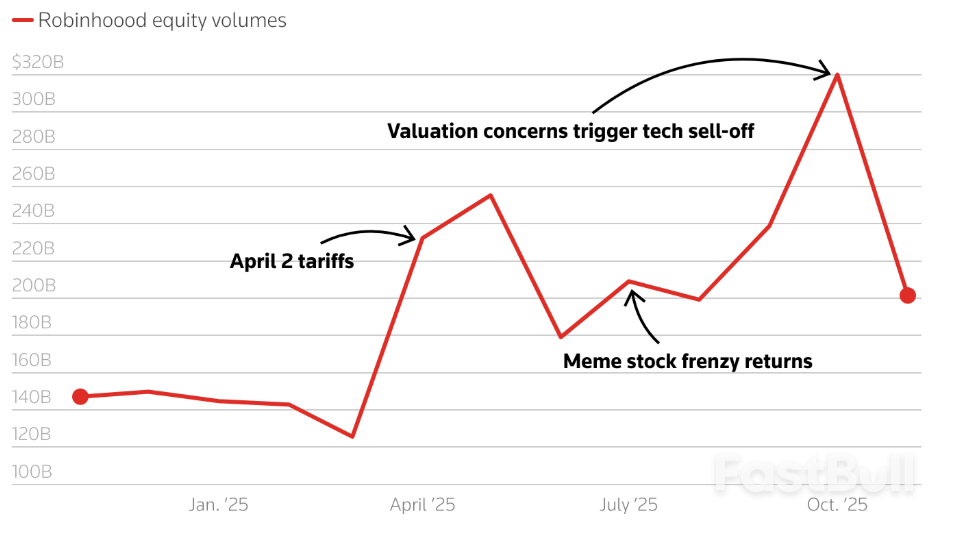
          The amount of cash retail investors poured into U.S. stocks so far in 2025 is up 53% from $197 billion a year earlier and 14% higher than the $270 billion hit at the height of the retail trading frenzy in 2021, according to J.P.Morgan analysts.
          Retail trading, meanwhile, accounted for 20–25% of total activity this year, touching a record high of about 35% in April, according to separate trading data from J.P.Morgan.
          Individual investors snapped up high-quality stocks at discounts during selloffs, most notably after U.S. President Donald Trump's "Liberation Day" tariffs triggered a global meltdown in April, helping push the S&P 500 (.SPX) to fresh records. The benchmark index is up about 16% this year.
          "Retail investors are here to stay, especially for 2026. They made money this year, they like to trade stocks, they have the applications to do so. We will continue to see them being a good presence," said Steven DeSanctis, small- and mid-cap strategist at Jefferies.
          Retail participation in the stock market has grown steadily over the years as the rise of low-cost, no-commission brokerages such as Robinhood (HOOD.O) and Interactive Brokers (IBKR.O) has made it easier and cheaper for average Americans to access the market.
          The trend got wider notice in 2021 as many Americans who were homebound during the COVID-19 pandemic and were flush with cash used mobile trading platforms to bet on everything from GameStop (GME.N) to Big Tech.Retail Investors to Have More Sway Over Wall Street After Record Year_1
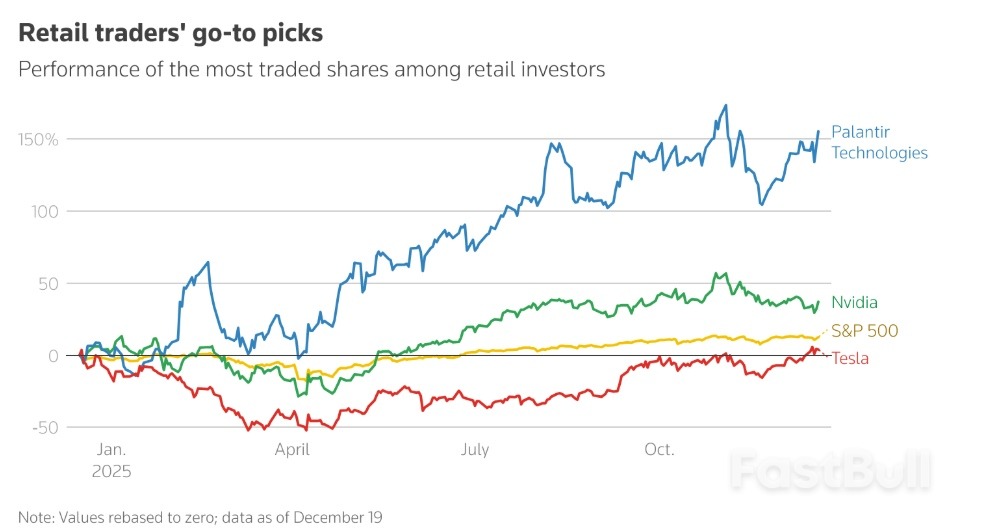
          AI plays such as Nvidia (NVDA.O) and Palantir Technologies (PLTR.O) were top favorites this year, according to retail brokerage data and executives, with the latter more than doubling in value as small-time traders bought the dip when institutional investors stepped back on valuation concerns.
          Tesla shares (TSLA.O), another top retail favorite, touched a record high on December 17, their first since the end of 2024.
          "The two most active stocks on our platform are typically Nvidia and Tesla. Those are just two examples of individual investors seizing the narrative and in many cases forcing institutional investors to play along," said Steve Sosnick, chief strategist at Interactive Brokers.
          Quantum computing firms, uranium miners, metal miners and rare earth companies also saw substantial retail interest, as investors became more "thematic" in their approach.

          RETAIL TRADERS INCREASINGLY PREFER ETFS

          A key feature of retail trading in 2025 was the increasing preference for exchange-traded funds (ETFs) tracking equity indexes, cryptocurrencies and commodities, according to executives at major trading platforms.
          "Investors continue to be attracted to the ETF technology. It trades throughout the day - it's tax efficient, it's transparent," said Bryon Lake, global co-head of Third-Party Wealth at Goldman Sachs Asset Management.
          Direxion's Daily Semiconductor 3X Bull and 3X Bear ranked among the top five ETFs by dollar volume on eToro, said Bret Kenwell, U.S. investment analyst with the trading platform.
          Retail investors are making more informed trades now as indicated by fewer and shorter so-called "meme frenzies," said Joe Mazzola, head of trading and derivatives at Charles Schwab.
          "Retail has been a little bit more in tune to the market dynamics this year," he added.

          POTENTIAL INTEREST RATE CUTS SEEN AS KEY CATALYSTS

          Potential rate cuts by the Fed are expected to continue to boost markets next year, keeping up the retail momentum in 2026, according to analysts and brokerages.
          Elevated stock market volatility may trigger dips that could also pull in individuals willing to wager on a bounce back, although recent evidence points to less enthusiasm about such opportunities than they have been in the past.Retail Investors to Have More Sway Over Wall Street After Record Year_2
          Reuters last week reported that Nasdaq (NDAQ.O) is planning to submit paperwork with the U.S. Securities and Exchange Commission to roll out round-the-clock stock trading, a move analysts believe can further accelerate retail momentum.
          "We're in a kind of golden age of retail investing with better access to knowledge, to the markets themselves and advanced trading platforms," said David Russell, global head of market strategy at TradeStation.
          Still, with doubts continuing to linger around the AI names that have dominated the market this year, analysts said they did not expect the coming year to top 2025's record as investors may consider broadening their portfolios.
          Financials, communications, discretionary, energy, miners and gold mining ETFs could do well, eToro's Kenwell said.
          "But ultimately, retail loves tech so that is an area they will continue to come back to in 2026, particularly if we do see any sort of volatility."

          Source: Reuters

          To stay updated on all economic events of today, please check out our Economic calendar
          Risk Warnings and Disclaimers
          You understand and acknowledge that there is a high degree of risk involved in trading. Following any strategies or investment methods may lead to potential losses. The content on the site is provided by our contributors and analysts for information purposes only. You are solely responsible for determining whether any trading assets, securities, strategy, or any other product is suitable for investing based on your own investment objectives and financial situation.
          Add to Favorites
          Share

          Fed Chair Should Lower Rates If the Market Does Well, Trump Says

          Manuel

          Forex

          Central Bank

          Donald Trump said he expects his Federal Reserve chair to lower interest rates if the economy is doing well, the latest signal that the president is eager for a nominee committed to borrowing cost cuts as he nears an announcement of his choice to replace Jerome Powell.
          “I want my new Fed Chairman to lower Interest Rates if the Market is doing well, not destroy the Market for no reason whatsoever,” Trump said in a social media post Tuesday. “Anybody that disagrees with me will never be the Fed Chairman!”
          Trump has repeatedly said he’s interested in breaking recent trends, where promising economic data is sometimes met by a market selloff due to concerns over inflation and corresponding hikes by the Fed.
          “In the old days, when there was good news, the Market went up,” Trump wrote. “Nowadays, when there is good news, the Market goes down, because everybody thinks that Interest Rates will be immediately lifted to take care of ‘potential’ Inflation.”
          Tuesday bucked the trend described by the president. The Bureau of Economic Analysis reported that inflation-adjusted gross domestic product increased at a 4.3% annualized pace in the third quarter, higher than all but one estimate in a Bloomberg survey. But the S&P rose for the fourth consecutive day, and was set for a record close.
          The president’s latest commentary comes as he is looking to new leadership at the Fed to help reduce borrowing costs, as he increasingly feels political pressure to address voter concerns over affordability. Trump has repeatedly said lower rates could help the housing market, and that he wants to be consulted by his eventual central bank pick on how to navigate rate decisions.
          The president last week said he had narrowed his list for Fed chair nominees to “three or four” candidates and expected to have a decision pretty quickly, with an announcement “over the next couple of weeks.”
          Trump has indicated Kevin Hassett, director of the National Economic Council, and Kevin Warsh, a former Fed governor, were among the frontrunners for the job. He’s also interviewed — and praised — Fed Governor Christopher Waller.
          “I think every one of them would be a good choice,” Trump said.
          The Fed earlier this month lowered its benchmark rate to between 3.5% and 3.75%, its third cut in as many meetings. Three central bank officials dissented from the decision and the Federal Open Market Committee remains undecided about further reductions. Trump has previously called for the central bank to cut benchmark rates to around 1%, or perhaps lower.

          Source: Bloomberg

          Risk Warnings and Disclaimers
          You understand and acknowledge that there is a high degree of risk involved in trading. Following any strategies or investment methods may lead to potential losses. The content on the site is provided by our contributors and analysts for information purposes only. You are solely responsible for determining whether any trading assets, securities, strategy, or any other product is suitable for investing based on your own investment objectives and financial situation.
          Add to Favorites
          Share

          Dollar’s Worst Drop Since 2017 Has Further to Go, Options Signal

          Manuel

          Economic

          Forex

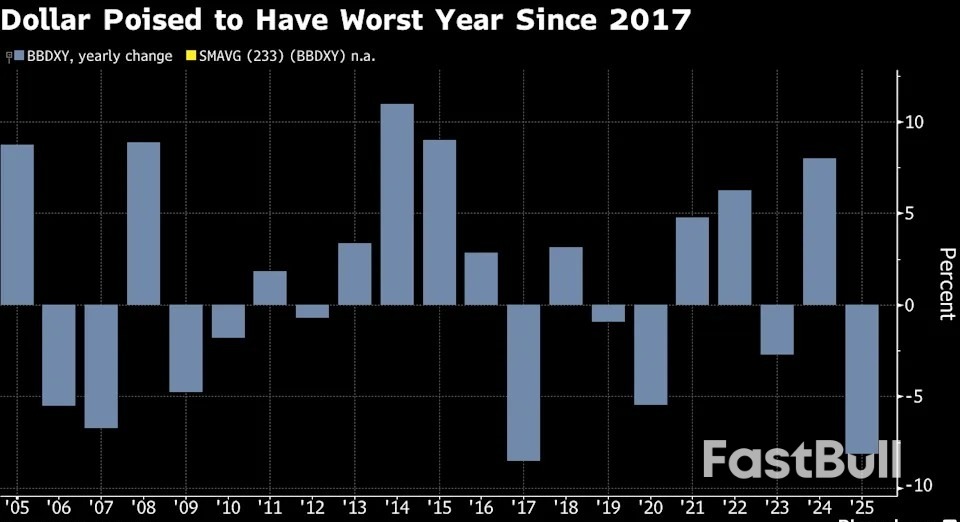
          The dollar is heading for its worst annual performance in eight years, and the options market is signaling that traders are preparing for more downside in the final sessions of 2025 and beyond.
          The Bloomberg Dollar Spot Index fell as much as 0.4% on Tuesday, touching the lowest since early October, before trimming its loss after a report showed US economic growth accelerated last quarter. The greenback index is down about 8% this year, putting it on track for its worst year since 2017, and the options market points to further declines in the coming months.
          “My outlook outlook for 2026 is more continuation of the bear market, but a more modest one,” said Paresh Upadhyaya at Pioneer Investments. “The key risk to this view is US growth exceptionalism returning and today’s third quarter GDP highlights this risk.”Dollar’s Worst Drop Since 2017 Has Further to Go, Options Signal_1
          Expectations that Federal Reserve will lower borrowing costs further while many other major central banks are close to being done with their easing cycles have weighed on the greenback. A pattern of losses in December is also working against the US currency, which is down more than 1% this month.
          Options pricing has turned more negative. So-called risk reversals, which depict market positioning and sentiment, show that options traders are the most bearish on the dollar in three months. Data from the Depository Trust & Clearing Corporation shows that the euro and the Australian dollar have been the main vehicles for expressing those bearish dollar views in recent sessions.
          “The dollar outlook remains comfortably negative,” wrote Ipek Ozkardeskaya, senior analyst at Swissquote, in a note published Tuesday. “Bullish calls on the dollar are rare.”
          Ozkardeskaya said that concerns around fiscal discipline and trade tensions are also acting as headwinds. Still, she warned the dollar is vulnerable to a sharp rebound if upcoming data releases prompt a hawkish reassessment of Fed expectations.
          The US economy expanded in the third quarter at the fastest pace in two years, bolstered in part by resilient consumer and business spending, a Bureau of Economic Analysis report showed Tuesday. Inflation-adjusted gross domestic product increased at a 4.3% annualized pace, which was higher than all but one forecast in a Bloomberg survey and followed 3.8% growth in the prior period.
          Separately, Canada’s economy grew in November after a drop in October. The Canadian dollar jumped after the report to reach the strongest level since July against the greenback.
          The Swedish krona, the best performer among Group-of-10 peers this year, rose to the strongest level since February 2022 on Tuesday.

          Source: Bloomberg

          To stay updated on all economic events of today, please check out our Economic calendar
          Risk Warnings and Disclaimers
          You understand and acknowledge that there is a high degree of risk involved in trading. Following any strategies or investment methods may lead to potential losses. The content on the site is provided by our contributors and analysts for information purposes only. You are solely responsible for determining whether any trading assets, securities, strategy, or any other product is suitable for investing based on your own investment objectives and financial situation.
          Add to Favorites
          Share

          Japan Plans Digital Securitization For Local Government Bonds By 2026

          Justin

          Central Bank

          The Japanese government intends to advance the digital securitization of local government bonds via blockchain, proposing legislation in 2026, as reported by CoinDesk citing Nikkei News..

          This initiative could streamline bond issuance and settlement, potentially eliminating intermediaries. Market response is still uncertain, with no direct involvement or reactions from key players yet identified.

          Potential Shift in Municipal Financing Methods

          It appears that you are requesting specific quotes related to Japan's initiative to promote digital securitization of local government bonds via blockchain. However, as you've noted in your search results, no primary source statements or direct quotes from key players, officials, or thought leaders have been identified regarding this topic.

          Did you know?

          Japan's initiative to digitize local bonds could mirror China's use of blockchain for municipal financing, underscoring a strategic shift in public sector funding.

          In the past, such moves to digitize financial instruments have illustrated significant technological shifts in public financing strategies. Blockchain offers enhanced transparency and efficiency, yet no significant discussions from regulatory bodies, like the SEC or CFTC, have been issued.

          Experts argue that if these digital bonds are implemented successfully, they could potentially redefine local financing models, offering integrated financial models previously limited by traditional systems. The extent of impact, from financial markets to the regulatory landscape, remains contingent on subsequent legal and technological developments.

          Source: CryptoSlate

          Risk Warnings and Disclaimers
          You understand and acknowledge that there is a high degree of risk involved in trading. Following any strategies or investment methods may lead to potential losses. The content on the site is provided by our contributors and analysts for information purposes only. You are solely responsible for determining whether any trading assets, securities, strategy, or any other product is suitable for investing based on your own investment objectives and financial situation.
          Add to Favorites
          Share

          Libya’s Oil Reserves, Reforms Draw Investors Despite The Risks

          Justin

          Commodity

          Libya's vast fossil fuel potential and "investor-friendly reforms" are attracting global energy firms despite the inherent political risks, a boost for the oil-rich African nation.

          The latest bid round from the country offers 22 blocks with an estimated 10 billion barrels of available resources and 18 billion barrels yet to be discovered, according to a new report from industry consultancy Enverus Intelligence Research.

          "Libya's new licensing round marks a pivotal moment for the country's energy sector," Tom Richards, senior regional manager at Enverus, said in Tuesday's report. "Enhanced fiscal terms, simplified cost recovery and clearer profit sharing are already attracting serious interest from supermajors and national oil companies."

          Still, political instability and infrastructure challenges must be addressed to sustain growth, and if state-controlled National Oil Corporation is to increase production by more than 40% to meet its 2030 target of 2 million barrels per day, the report cautioned.

          The nation is split between an internationally recognized government in the west and a rival administration backed by military strongman Khalifa Haftar in its oil-rich east. Sporadic feuds have disrupted energy flows and threatened to spiral into outright war, leaving many investors wary.

          Libya, a member of the Organization of the Petroleum Exporting Countries, is trying to bring back oil majors that left following the 2011 fall of longtime dictator Moammar Qaddafi, as the country has struggled to quell unrest ever since.

          Source: Bloomberg Europe

          Risk Warnings and Disclaimers
          You understand and acknowledge that there is a high degree of risk involved in trading. Following any strategies or investment methods may lead to potential losses. The content on the site is provided by our contributors and analysts for information purposes only. You are solely responsible for determining whether any trading assets, securities, strategy, or any other product is suitable for investing based on your own investment objectives and financial situation.
          Add to Favorites
          Share

          Commodities market outlook for 2026

          Adam

          Commodity

          Gold: can the rally continue after a record 2025?

          Beyond supply and demand
          Gold enters 2026 carrying the momentum of a historic multi-year rally—yet what's interesting is how uncrowded the market still feels. Even after breaking records through 2024 and 2025, gold is often described as 'overbought' but almost never 'over-owned.' And that difference matters. Institutional positioning still has room to expand, suggesting this rally isn't running on excessive speculation. It's running on structural demand that hasn't peaked yet.
          A big part of the 2024-2025 rally was driven by policy—or more accurately, policy uncertainty. The US enters 2026 with elevated government spending, persistent inflation pockets, and real yields that have been drifting lower. Add a softer US dollar into the mix, and you get the same backbone that supported gold through the past two years still firmly intact.
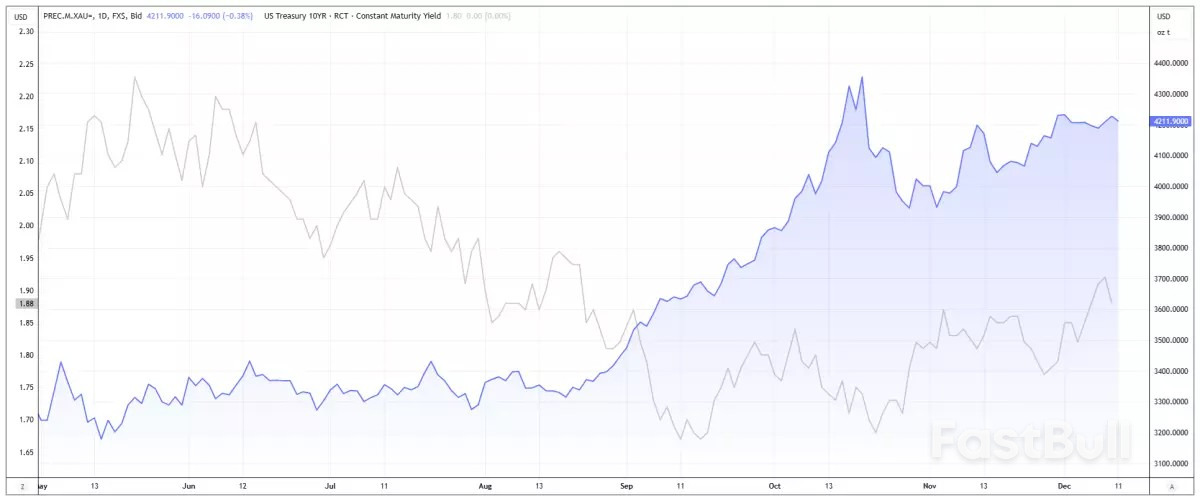
          The 2025 divergence is a clear reminder of gold's macro sensitivity. As real yields trended down from June to December, gold surged toward fresh highs. This inverse relationship remains one of the biggest drivers heading into 2026.
          Figure 1: Gold vs. Real Yields - 2025 Divergence
          Commodities market outlook for 2026_1
          The golden demand
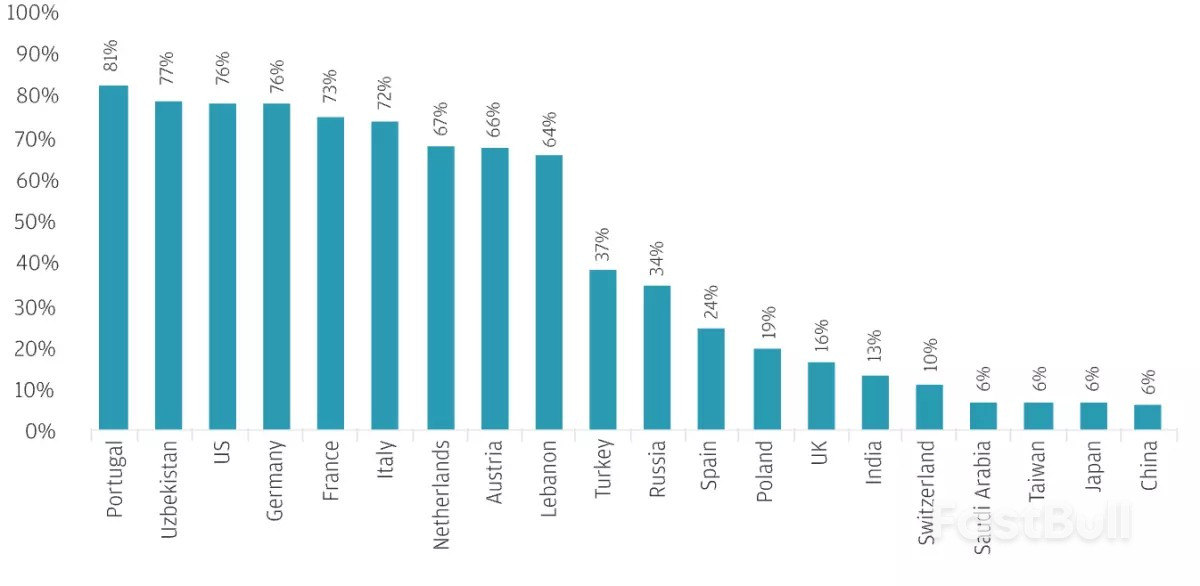
          Central banks remain one of the strongest forces behind gold's structural story. Several economies hold more than half their total reserves in gold, while others, including China and Japan, maintain single-digit exposure. That imbalance alone signals how much reallocation potential still exists across the system.
          The chart below captures what most investors overlook: the long-term structural shift in how countries treat gold.
          Figure 2: Gold as % of central bank reserves
          Commodities market outlook for 2026_2
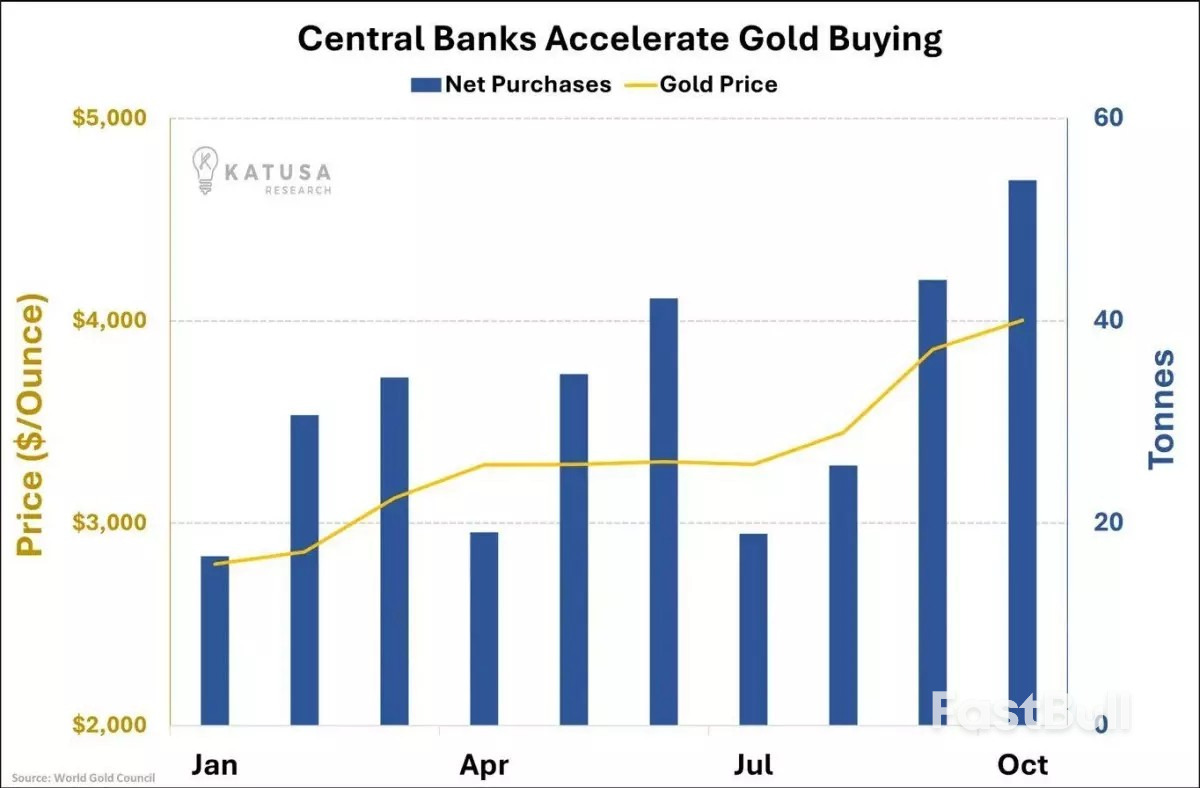
          The accumulation trend didn't slow in 2024-2025; it accelerated. China continues building strategic reserves. Turkey uses gold to stabilise currency volatility. Russia leans on gold as a sanction-resistant asset. And India along with several Middle Eastern economies see gold as long-term diversification rather than a short-term hedge. This isn't reactive buying—it's a redefinition of reserve strategy.
          The sustained upward trend reinforces a key message: central bank demand is structural rather than cyclical. Even during price increases, purchases held firm.
          Figure 3: Central bank gold purchase
          Commodities market outlook for 2026_3
          The risks
          If there's a key risk heading into 2026, it's an unexpectedly hawkish Federal Reserve. A sharp rise in real yields has historically cooled gold's momentum—even if temporarily. But right now, markets still expect more easing than tightening, especially with the US facing heavy refinancing needs, rising debt-servicing costs, and uneven pockets of growth.
          This is also one of the rare cycles where gold and silver can trend higher together. Silver may deliver stronger percentage gains, but that doesn't weaken the gold outlook. If anything, it confirms that the entire metals complex is being driven by real macro demand—not hype, not retail spikes, and not one-off speculative flows.
          2026 outlook
          Across major banks, the average 2026 forecast clusters around $4,500-$4,700, while the upper band stretches toward $5,000 if macro conditions simply don't tighten. None of these projections assume crisis or geopolitical shock—just the continuation of a world that's still inflationary, noisy, and structurally fragmented. The more aggressive upside calls only come into play if tensions escalate or financial stress returns. And given recent years, that's not far-fetched.
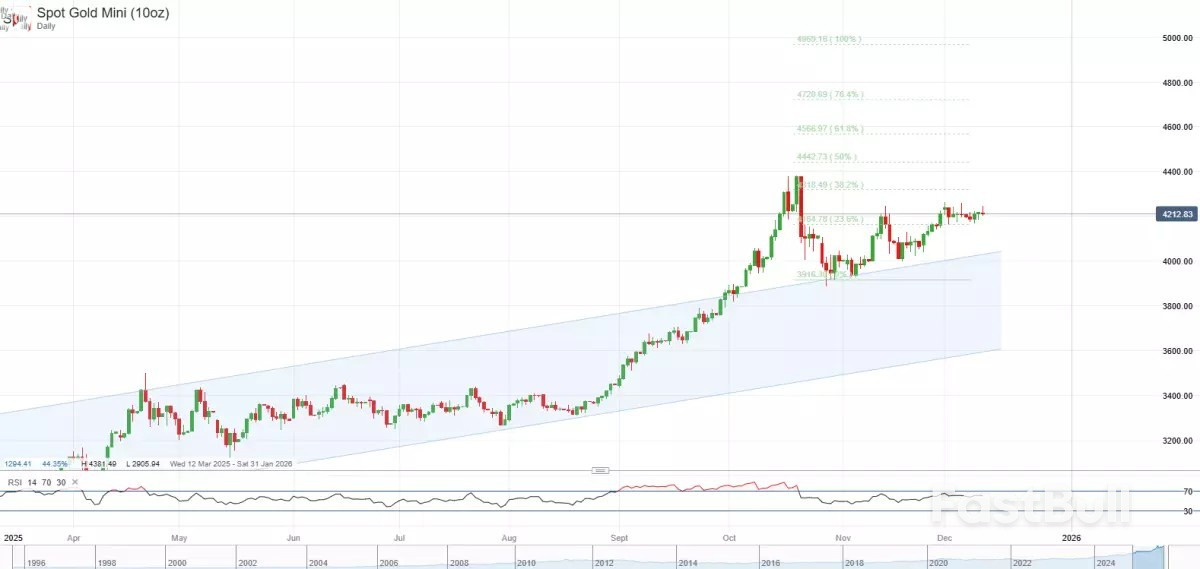
          We believe gold price actions sit somewhere between consolidation and continuation. A quieter start to the year wouldn't be surprising after two powerful years. But any new policy shift, geopolitical tension, or structural shock can reignite momentum quickly. With central banks still reshaping their reserves and long-term macro forces still aligned, gold enters 2026 with more strategic backing than any time in the past decade.
          Gold doesn't need a crisis to rise in 2026. It simply needs the world to behave the way it has been: elevated debt, policy uncertainty, fragile alliances, and a dollar that no longer dominates as it once did. In that environment, gold doesn't chase fear—it absorbs it. And that alone makes 2026 one of the most interesting setups in years.
          Figure 4: Spot gold daily chart
          Commodities market outlook for 2026_4

          Silver: finally waking up

          The breakout that changed everything
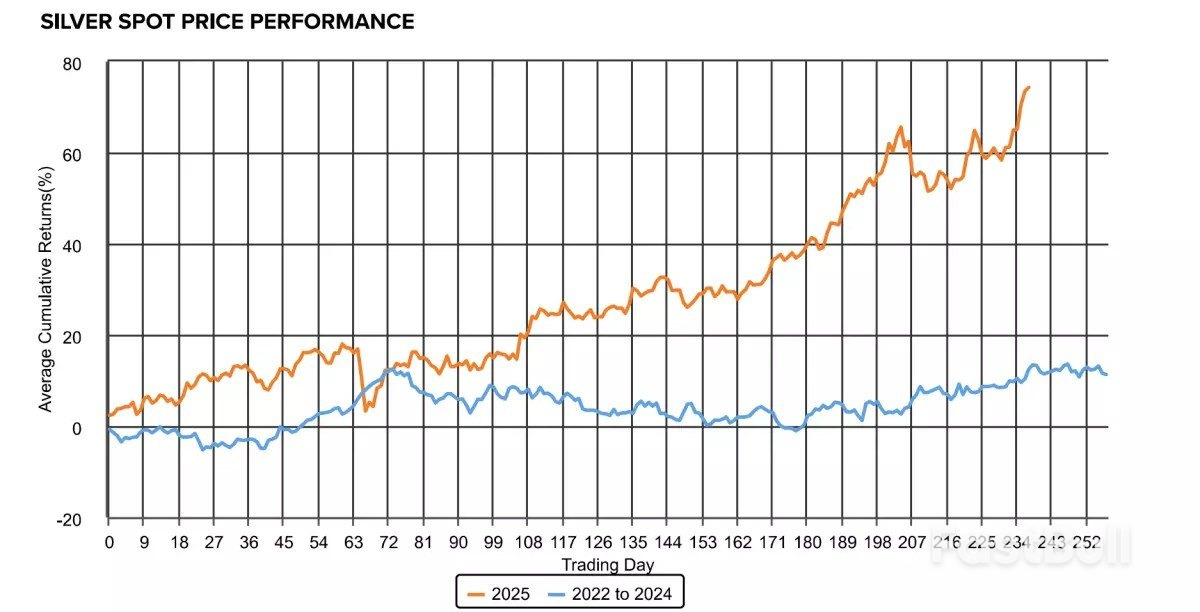
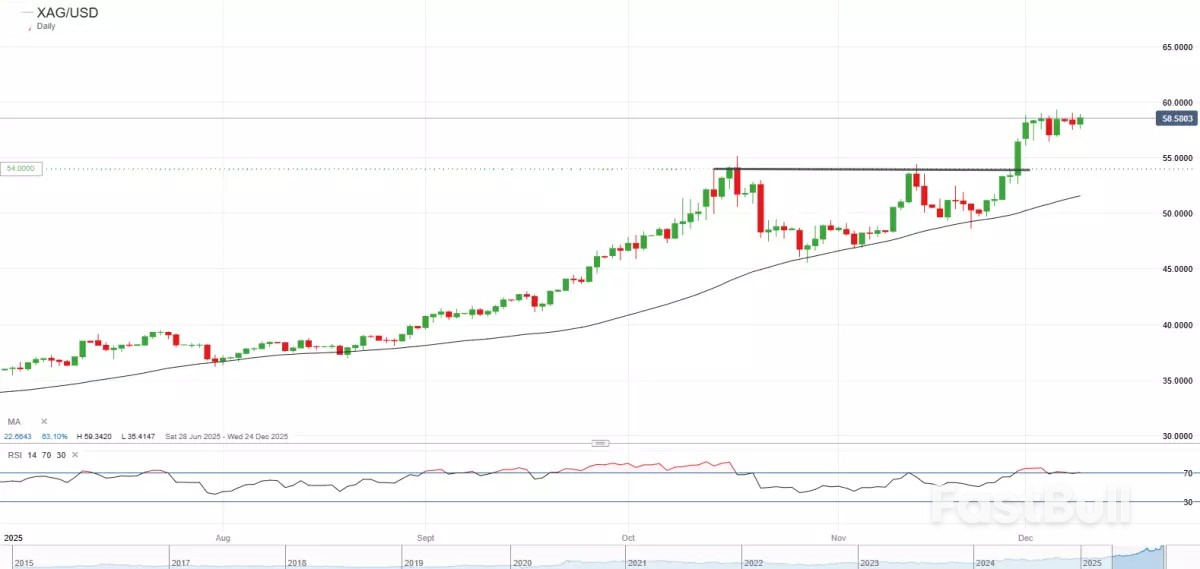
          Silver is stepping into 2026 with a completely different energy. After breaking above $55 at the end of 2025 and holding the $50-$54 zone like a real base, the metal has shifted from 'the forgotten asset' to one of the most powerful stories in commodities. Year-to-date gains near 120% say it all. Silver hasn't just outperformed gold—it has rewritten the narrative after almost a decade of lagging.
          And honestly, the shift didn't come out of nowhere. 2025 was the year the market changed character. If you look at the cumulative performance, silver suddenly stopped behaving like 2022-2024's choppy, frustrating range and started showing trend strength, higher lows, and a steady build in momentum.
          The price action shown in the chart below usually means one thing: the market has finally accepted that the supply/demand imbalance is structural, and it's getting deeper.
          Figure 5: Silver's cumulative performance
          Commodities market outlook for 2026_5
          Supply constraints deepening
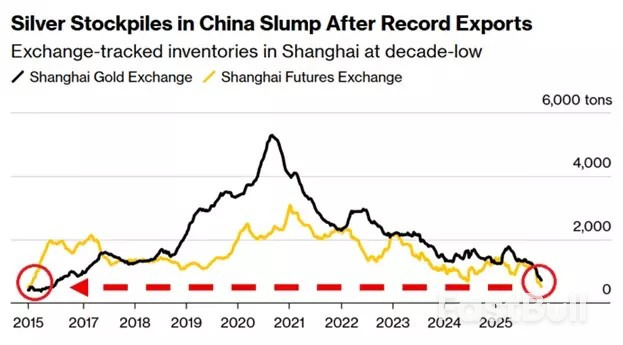
          Supply constraints have been felt in China—the most important physical hub in the world. Its exchange-tracked inventories collapsed to decade lows after record exports.
          Figure 6: Shanghai Gold Exchange silver inventories
          Commodities market outlook for 2026_6
          When China stockpiles fall, the rest of the world feels it instantly. And this is happening during what is now the fifth year of consecutive structural deficit. Above-ground stocks are thinning out, and mine supply isn't responding fast enough for now. Most new production isn't expected before 2027-2028. So the tightness we're seeing today isn't a spike—it could be the new baseline.
          Demand accelerating across industries
          On the other side of the equation, demand isn't slowing down. It's accelerating. Solar alone is pulling more than 200 million ounces a year. Add EVs, high-efficiency semiconductors, 5G, and the massive electricity load of AI data centres, and silver becomes one of the few industrial metals whose demand curve steepens every year.
          There isn't a real substitute. Every attempt to replace silver in these applications has failed or resulted in inferior performance. So we're entering 2026 with demand that keeps rising and supply that physically cannot keep up. That's the definition of structural support.
          The technicals point to price discovery
          The $50-$54 region was a ceiling for more than 13 years. Breaking above it, and more importantly, holding above it, signals that silver is entering price-discovery territory. A clear weekly close above $54 opens the door to the next technical extensions at $72 and $88.
          These levels aren't fantasies; they come straight from measured moves of the multi-year consolidation. And we've seen what a real breakout can do—in 2011 silver almost doubled in a few months once price-discovery kicked in.
          Figure 7: Silver price chart
          Commodities market outlook for 2026_7
          The gold/silver ratio
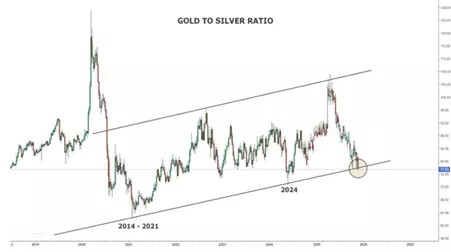
          The gold/silver ratio has dropped back to a major long-term support level trendline—a zone where silver historically begins to outperform gold aggressively.
          Today's ratio is lower than recent standards, but elevated when compared to the long-term historical average, which typically sits closer to 40-60. An adjustment towards 60, or even 50 would imply a strong catch-up from silver, even if gold stays where it is. Put simply: silver is still cheap relative to gold.
          Figure 8: Gold/silver ratio
          Commodities market outlook for 2026_8
          2026 outlook
          We're dealing with a market that finally has all three forces aligned: tightening supply, rising industrial demand, and a technical breakout setup that hasn't appeared in more than a decade. Silver is no longer the side story—it's one of the most asymmetric opportunities in commodities right now.
          As for forecasts, the average of major banks places silver in the $56-$65 range for 2026. That's the conservative view. Technical models stretch further—towards $72 and $88, and potentially higher if the gold/silver ratio really compresses.

          Energy: from balance narrative to supply-driven downtrend

          Why sentiment has turned bearish
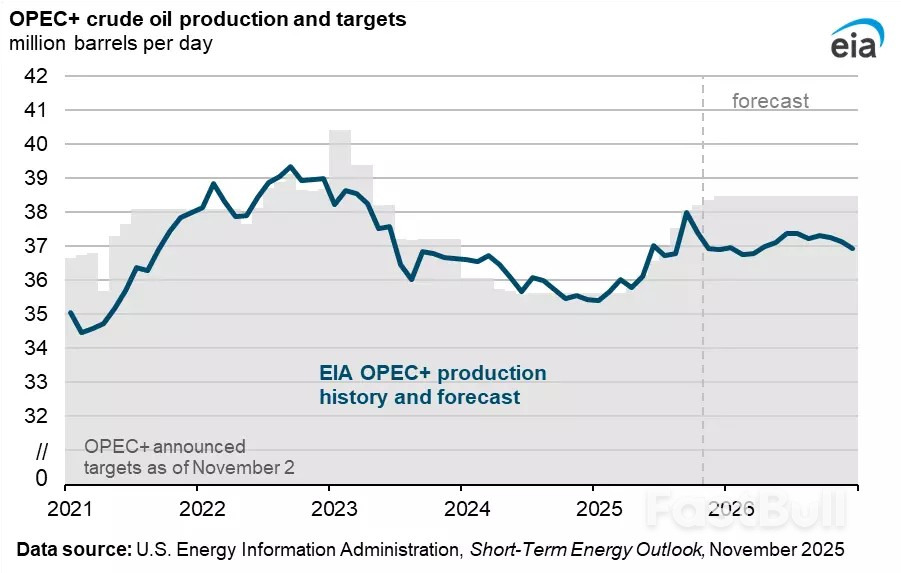
          Oil is heading into 2026 under growing pressure. The tone across the market has flipped: what was supposed to be a tightening cycle has turned into a soft, supply-heavy environment. OPEC's latest outlook now expects global supply to meet demand next year, a sharp reversal from earlier assumptions of a deficit—and that shift alone is reshaping the entire narrative.
          OPEC+ production is slowly climbing back, and the group's own numbers now show a well-supplied market into next year. That alone removes a lot of the bullish catalysts traders were leaning on. But the real pressure point comes from the US and other non-OPEC players, where supply growth is running three times faster than demand, according to JP Morgan.
          With a Trump administration unlikely to support market-balancing policies, there's very little chance of coordinated intervention. Demand growth, while still positive, is no longer strong enough to absorb rising supply. China is stabilising rather than accelerating, and global manufacturing remains patchy.
          Figure 9: OPEC+ crude oil production
          Commodities market outlook for 2026_9
          Technical analysis
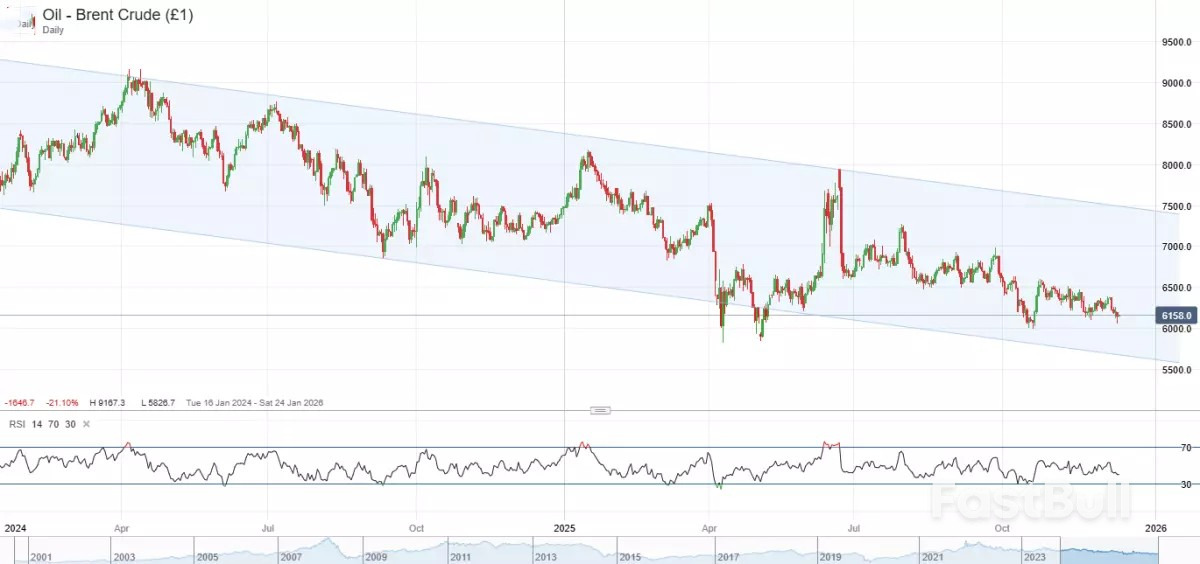
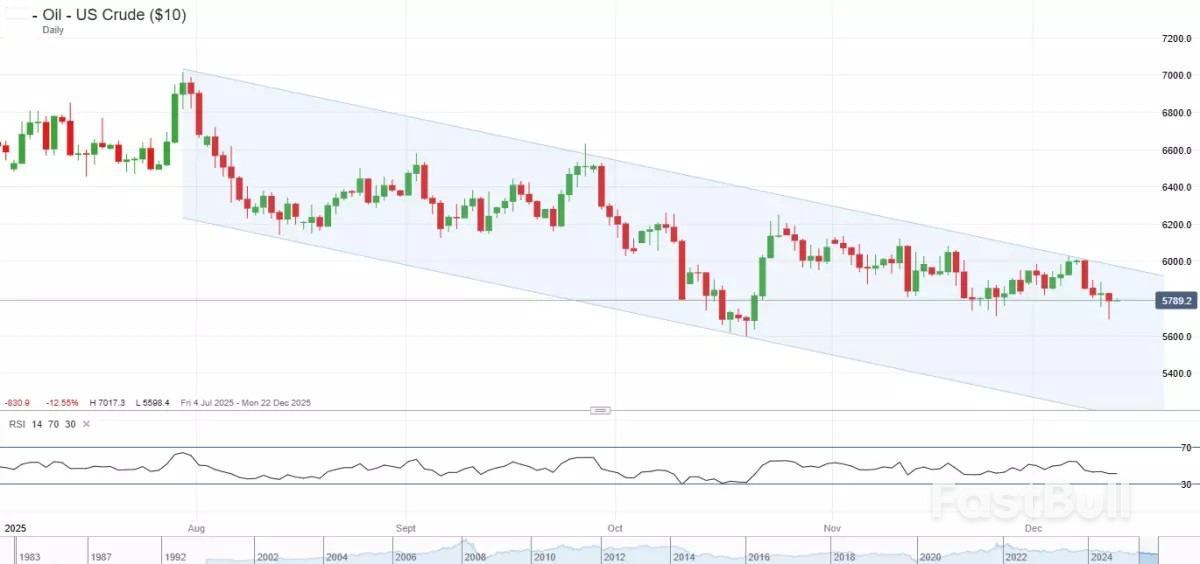
          From a technical analysis perspective, both Brent crude oil and US crude oil have been locked in a consistent descending channel since early 2025, confirming a structurally bearish trend rather than a temporary pullback. Each rebound has failed at lower highs, while support levels continue to give way, reinforcing the idea that sellers remain in control.
          Momentum indicators reflect this grind lower rather than capitulation: the relative strength index (RSI) has repeatedly struggled to sustain moves above neutral levels, signalling weak upside conviction rather than oversold exhaustion. As long as prices remain capped within these downward channels, rallies are likely to be corrective rather than trend-changing, keeping the broader bias tilted toward further downside into 2026 unless a clear break in structure emerges.
          Figure 10: Brent crude price chart
          Commodities market outlook for 2026_10
          Figure 11: US crude price chart
          Commodities market outlook for 2026_11
          2026 outlook
          2026 is shaping up to be a year where oil trades without a structural bullish anchor. Supply is winning, demand is slowing, and the market is already pricing a softer environment. However, geopolitical risks—from shipping lanes to election-year volatility—could still limit how far prices fall. In other words: downside pressure, yes... a straight collapse, less likely unless the surplus accelerates.
          The view is also showing up in Wall Street projections:
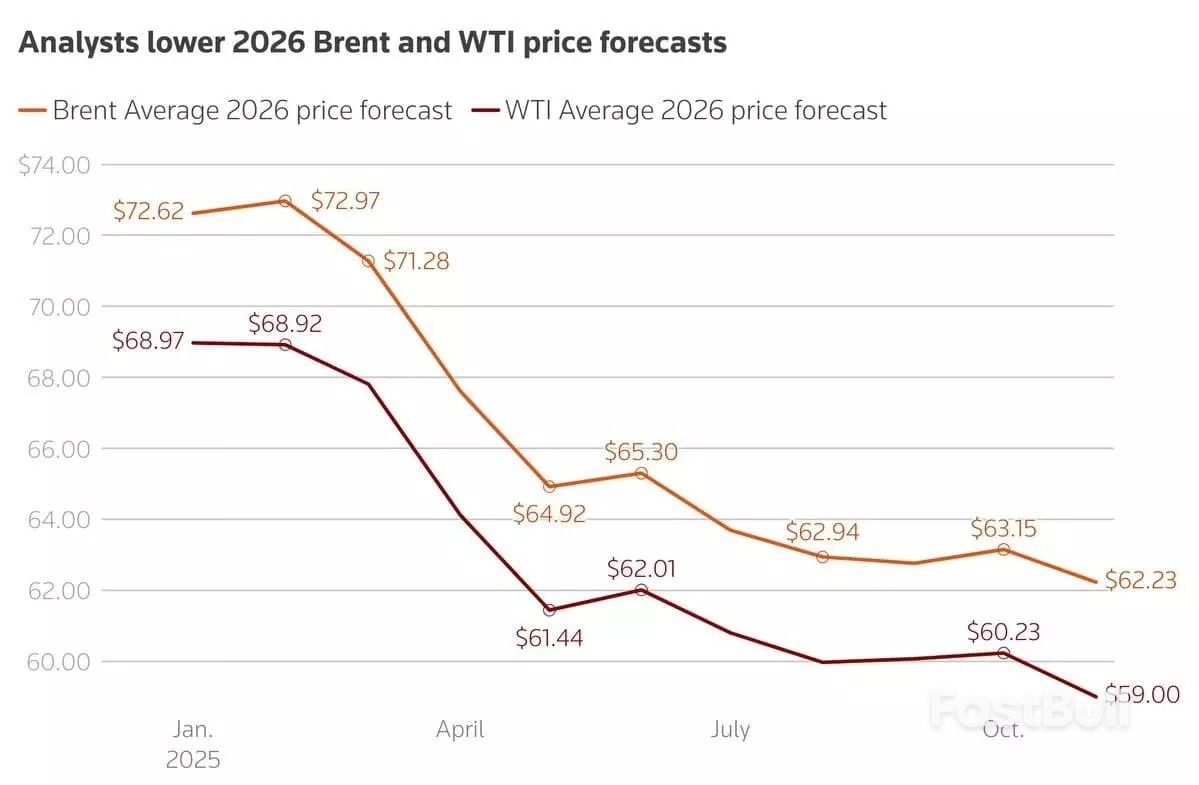
          Brent is projected to average ~$62.23 in 2026, based on the latest Reuters poll of 35 analysts
          WTI is seen closer to $59
          For context, Brent has averaged $68.80 so far in 2025, so these forecasts imply a meaningful step down in pricing power next year.
          Figure 12: Analysts 2026 Brent and WTI price forecasts
          Commodities market outlook for 2026_12
          The bearish tail-risk is aggressive: JP Morgan warns that Brent could fall by more than 50% into the low $30s if supply continues to surge ahead of demand through 2026. That scenario would require ongoing non-OPEC supply expansion, no significant response from OPEC+, weak or stagnant demand growth, and continued high inventories into mid-2026.
          It's not the base case—but with the current surplus trajectory, it's not completely off the table either.

          Source: ig

          Risk Warnings and Disclaimers
          You understand and acknowledge that there is a high degree of risk involved in trading. Following any strategies or investment methods may lead to potential losses. The content on the site is provided by our contributors and analysts for information purposes only. You are solely responsible for determining whether any trading assets, securities, strategy, or any other product is suitable for investing based on your own investment objectives and financial situation.
          Add to Favorites
          Share
          FastBull
          Copyright © 2025 FastBull Ltd

          728 RM B 7/F GEE LOK IND BLDG NO 34 HUNG TO RD KWUN TONG KLN HONG KONG

          TelegramInstagramTwitterfacebooklinkedin
          App Store Google Play Google Play
          Products
          Charts

          Chats

          Q&A with Experts
          Screeners
          Economic Calendar
          Data
          Tools
          Membership
          Features
          Function
          Markets
          Copy Trading
          Latest Signals
          Contests
          News
          Analysis
          24/7
          Columns
          Education
          Company
          Careers
          About Us
          Contact Us
          Advertising
          Help Center
          Feedback
          User Agreement
          Privacy Policy
          Personal Information Protection Statement
          Business

          White Label

          Data API

          Web Plug-ins

          Poster Maker

          Affiliate Program

          Risk Disclosure

          The risk of loss in trading financial instruments such as stocks, FX, commodities, futures, bonds, ETFs and crypto can be substantial. You may sustain a total loss of the funds that you deposit with your broker. Therefore, you should carefully consider whether such trading is suitable for you in light of your circumstances and financial resources.

          No decision to invest should be made without thoroughly conducting due diligence by yourself or consulting with your financial advisors. Our web content might not suit you since we don't know your financial conditions and investment needs. Our financial information might have latency or contain inaccuracy, so you should be fully responsible for any of your trading and investment decisions. The company will not be responsible for your capital loss.

          Without getting permission from the website, you are not allowed to copy the website's graphics, texts, or trademarks. Intellectual property rights in the content or data incorporated into this website belong to its providers and exchange merchants.

          Not Logged In

          Log in to access more features

          FastBull Membership

          Not yet

          Purchase

          Become a signal provider
          Help Center
          Customer Service
          Dark Mode
          Price Up/Down Colors

          Log In

          Sign Up

          Position
          Layout
          Fullscreen
          Default to Chart
          The chart page opens by default when you visit fastbull.com