• Trade
  • Markets
  • Copy
  • Contests
  • News
  • 24/7
  • Calendar
  • Q&A
  • Chats
Trending
Screeners
SYMBOL
LAST
BID
ASK
HIGH
LOW
NET CHG.
%CHG.
SPREAD
SPX
S&P 500 Index
6827.42
6827.42
6827.42
6899.86
6801.80
-73.58
-1.07%
--
DJI
Dow Jones Industrial Average
48458.04
48458.04
48458.04
48886.86
48334.10
-245.98
-0.51%
--
IXIC
NASDAQ Composite Index
23195.16
23195.16
23195.16
23554.89
23094.51
-398.69
-1.69%
--
USDX
US Dollar Index
97.950
98.030
97.950
98.500
97.950
-0.370
-0.38%
--
EURUSD
Euro / US Dollar
1.17394
1.17409
1.17394
1.17496
1.17192
+0.00011
+ 0.01%
--
GBPUSD
Pound Sterling / US Dollar
1.33707
1.33732
1.33707
1.33997
1.33419
-0.00148
-0.11%
--
XAUUSD
Gold / US Dollar
4299.39
4299.39
4299.39
4353.41
4257.10
+20.10
+ 0.47%
--
WTI
Light Sweet Crude Oil
57.233
57.485
57.233
58.011
56.969
-0.408
-0.71%
--

Community Accounts

Signal Accounts
--
Profit Accounts
--
Loss Accounts
--
View More

Become a signal provider

Sell trading signals to earn additional income

View More

Guide to Copy Trading

Get started with ease and confidence

View More

Signal Accounts for Members

All Signal Accounts

Best Return
  • Best Return
  • Best P/L
  • Best MDD
Past 1W
  • Past 1W
  • Past 1M
  • Past 1Y

All Contests

  • All
  • Trump Updates
  • Recommend
  • Stocks
  • Cryptocurrencies
  • Central Banks
  • Featured News
Top News Only
Share

USA Embassy In Lithuania: Maria Kalesnikava Is Not Going To Vilnius

Share

USA Embassy In Lithuania: Other Prisoners Are Being Sent From Belarus To Ukraine

Share

Ukraine President Zelenskiy: Five Ukrainians Released By Belarus In US-Brokered Deal

Share

USA Vilnius Embassy: USA Stands Ready For "Additional Engagement With Belarus That Advances USA Interests"

Share

USA Vilnius Embassy: Belarus, USA, Other Citizens Among The Prisoners Released Into Lithuania

Share

USA Vilnius Embassy: USA Will Continue Diplomatic Efforts To Free The Remaining Political Prisoners In Belarus

Share

USA Vilnius Embassy: Belarus Releases 123 Prisoners Following Meeting Of President Trump's Envoy Coale And Belarus President Lukashenko

Share

USA Vilnius Embassy: Masatoshi Nakanishi, Aliaksandr Syrytsa Are Among The Prisoners Released By Belarus

Share

USA Vilnius Embassy: Maria Kalesnikava And Viktor Babaryka Are Among The Prisoners Released By Belarus

Share

USA Vilnius Embassy: Nobel Peace Prize Laureate Ales Bialiatski Is Among The Prisoners Released By Belarus

Share

Belarusian Presidential Administration Telegram Channel: Lukashenko Has Pardoned 123 Prisoners As Part Of Deal With US

Share

Two Local Syrian Officials: Joint US-Syrian Military Patrol In Central Syria Came Under Fire From Unknown Assailants

Share

Israeli Military Says It Targeted 'Key Hamas Terrorist' In Gaza City

Share

Rwanda's Actions In Eastern Drc Are A Clear Violation Of Washington Accords Signed By President Trump - Secretary Of State Rubio

Share

Israeli Military Issues Evacuation Warning In Southern Lebanon Village Ahead Of Strike - Spokesperson On X

Share

Belarusian State Media Cites US Envoy Coale As Saying He Discussed Ukraine And Venezuela With Lukashenko

Share

Belarusian State Media Cites US Envoy Coale As Saying That US Removes Sanctions On Belarusian Potassium

Share

Thai Prime Minister: No Ceasefire Agreement With Cambodia

Share

US, Ukraine To Discuss Ceasefire In Berlin Ahead Of European Summit

Share

Incoming Czech Prime Minister Babis: Czech Republic Will Not Take On Guarantees For Ukraine Financing, European Commission Must Find Alternatives

TIME
ACT
FCST
PREV
U.K. Trade Balance Non-EU (SA) (Oct)

A:--

F: --

P: --

U.K. Trade Balance (Oct)

A:--

F: --

P: --

U.K. Services Index MoM

A:--

F: --

P: --

U.K. Construction Output MoM (SA) (Oct)

A:--

F: --

P: --

U.K. Industrial Output YoY (Oct)

A:--

F: --

P: --

U.K. Trade Balance (SA) (Oct)

A:--

F: --

P: --

U.K. Trade Balance EU (SA) (Oct)

A:--

F: --

P: --

U.K. Manufacturing Output YoY (Oct)

A:--

F: --

P: --

U.K. GDP MoM (Oct)

A:--

F: --

P: --

U.K. GDP YoY (SA) (Oct)

A:--

F: --

P: --

U.K. Industrial Output MoM (Oct)

A:--

F: --

P: --

U.K. Construction Output YoY (Oct)

A:--

F: --

P: --

France HICP Final MoM (Nov)

A:--

F: --

P: --

China, Mainland Outstanding Loans Growth YoY (Nov)

A:--

F: --

P: --

China, Mainland M2 Money Supply YoY (Nov)

A:--

F: --

P: --

China, Mainland M0 Money Supply YoY (Nov)

A:--

F: --

P: --

China, Mainland M1 Money Supply YoY (Nov)

A:--

F: --

P: --

India CPI YoY (Nov)

A:--

F: --

P: --

India Deposit Gowth YoY

A:--

F: --

P: --

Brazil Services Growth YoY (Oct)

A:--

F: --

P: --

Mexico Industrial Output YoY (Oct)

A:--

F: --

P: --

Russia Trade Balance (Oct)

A:--

F: --

P: --

Philadelphia Fed President Henry Paulson delivers a speech
Canada Building Permits MoM (SA) (Oct)

A:--

F: --

P: --

Canada Wholesale Sales YoY (Oct)

A:--

F: --

P: --

Canada Wholesale Inventory MoM (Oct)

A:--

F: --

P: --

Canada Wholesale Inventory YoY (Oct)

A:--

F: --

P: --

Canada Wholesale Sales MoM (SA) (Oct)

A:--

F: --

P: --

Germany Current Account (Not SA) (Oct)

A:--

F: --

P: --

U.S. Weekly Total Rig Count

A:--

F: --

P: --

U.S. Weekly Total Oil Rig Count

A:--

F: --

P: --

Japan Tankan Large Non-Manufacturing Diffusion Index (Q4)

--

F: --

P: --

Japan Tankan Small Manufacturing Outlook Index (Q4)

--

F: --

P: --

Japan Tankan Large Non-Manufacturing Outlook Index (Q4)

--

F: --

P: --

Japan Tankan Large Manufacturing Outlook Index (Q4)

--

F: --

P: --

Japan Tankan Small Manufacturing Diffusion Index (Q4)

--

F: --

P: --

Japan Tankan Large Manufacturing Diffusion Index (Q4)

--

F: --

P: --

Japan Tankan Large-Enterprise Capital Expenditure YoY (Q4)

--

F: --

P: --

U.K. Rightmove House Price Index YoY (Dec)

--

F: --

P: --

China, Mainland Industrial Output YoY (YTD) (Nov)

--

F: --

P: --

China, Mainland Urban Area Unemployment Rate (Nov)

--

F: --

P: --

Saudi Arabia CPI YoY (Nov)

--

F: --

P: --

Euro Zone Industrial Output YoY (Oct)

--

F: --

P: --

Euro Zone Industrial Output MoM (Oct)

--

F: --

P: --

Canada Existing Home Sales MoM (Nov)

--

F: --

P: --

Euro Zone Total Reserve Assets (Nov)

--

F: --

P: --

U.K. Inflation Rate Expectations

--

F: --

P: --

Canada National Economic Confidence Index

--

F: --

P: --

Canada New Housing Starts (Nov)

--

F: --

P: --

U.S. NY Fed Manufacturing Employment Index (Dec)

--

F: --

P: --

U.S. NY Fed Manufacturing Index (Dec)

--

F: --

P: --

Canada Core CPI YoY (Nov)

--

F: --

P: --

Canada Manufacturing Unfilled Orders MoM (Oct)

--

F: --

P: --

Canada Manufacturing New Orders MoM (Oct)

--

F: --

P: --

Canada Core CPI MoM (Nov)

--

F: --

P: --

Canada Manufacturing Inventory MoM (Oct)

--

F: --

P: --

Canada CPI YoY (Nov)

--

F: --

P: --

Canada CPI MoM (Nov)

--

F: --

P: --

Canada CPI YoY (SA) (Nov)

--

F: --

P: --

Canada Core CPI MoM (SA) (Nov)

--

F: --

P: --

Q&A with Experts
    • All
    • Chatrooms
    • Groups
    • Friends
    Connecting
    .
    .
    .
    Type here...
    Add Symbol or Code

      No matching data

      All
      Trump Updates
      Recommend
      Stocks
      Cryptocurrencies
      Central Banks
      Featured News
      • All
      • Russia-Ukraine Conflict
      • Middle East Flashpoint
      • All
      • Russia-Ukraine Conflict
      • Middle East Flashpoint
      Search
      Products

      Charts Free Forever

      Chats Q&A with Experts
      Screeners Economic Calendar Data Tools
      Membership Features
      Data Warehouse Market Trends Institutional Data Policy Rates Macro

      Market Trends

      Market Sentiment Order Book Forex Correlations

      Top Indicators

      Charts Free Forever
      Markets

      News

      News Analysis 24/7 Columns Education
      From Institutions From Analysts
      Topics Columnists

      Latest Views

      Latest Views

      Trending Topics

      Top Columnists

      Latest Update

      Signals

      Copy Rankings Latest Signals Become a signal provider AI Rating
      Contests
      Brokers

      Overview Brokers Assessment Rankings Regulators News Claims
      Broker listing Forex Brokers Comparison Tool Live Spread Comparison Scam
      Q&A Complaint Scam Alert Videos Tips to Detect Scam
      More

      Business
      Events
      Careers About Us Advertising Help Center

      White Label

      Data API

      Web Plug-ins

      Affiliate Program

      Awards Institution Evaluation IB Seminar Salon Event Exhibition
      Vietnam Thailand Singapore Dubai
      Fans Party Investment Sharing Session
      FastBull Summit BrokersView Expo
      Recent Searches
        Top Searches
          Markets
          News
          Analysis
          User
          24/7
          Economic Calendar
          Education
          Data
          • Names
          • Latest
          • Prev

          View All

          No data

          Scan to Download

          Faster Charts, Chat Faster!

          Download App
          English
          • English
          • Español
          • العربية
          • Bahasa Indonesia
          • Bahasa Melayu
          • Tiếng Việt
          • ภาษาไทย
          • Français
          • Italiano
          • Türkçe
          • Русский язык
          • 简中
          • 繁中
          Open Account
          Search
          Products
          Charts Free Forever
          Markets
          News
          Signals

          Copy Rankings Latest Signals Become a signal provider AI Rating
          Contests
          Brokers

          Overview Brokers Assessment Rankings Regulators News Claims
          Broker listing Forex Brokers Comparison Tool Live Spread Comparison Scam
          Q&A Complaint Scam Alert Videos Tips to Detect Scam
          More

          Business
          Events
          Careers About Us Advertising Help Center

          White Label

          Data API

          Web Plug-ins

          Affiliate Program

          Awards Institution Evaluation IB Seminar Salon Event Exhibition
          Vietnam Thailand Singapore Dubai
          Fans Party Investment Sharing Session
          FastBull Summit BrokersView Expo

          Stocks waver after a federal court halted Trump’s tariffs

          Adam

          Stocks

          Summary:

          Stocks wavered after a court halted Trump’s tariffs, raising hopes but also uncertainty, as the White House appealed and markets questioned the long-term impact on trade policy and the economy.

          Stocks were mixed Thursday after a federal court ruled late Wednesday that President Donald Trump overstepped his authority to impose sweeping tariffs, throwing into chaos the administration’s core trade policy that has threatened to raise prices for businesses and slow the economy.
          Investors initially cheered, but not overwhelmingly — and a morning rally lost steam on Thursday as investors assessed the potential outcome for Trump’s tariffs.
          The Dow was down 240 points, or 0.58%, Thursday midday. The S&P 500 slid 0.2% and the tech-heavy Nasdaq Composite hovered around the flatline. Stocks received a boost from Nvidia’s strong earnings Wednesday, but the rally faded amid trade war uncertainty.
          Gains were muted because the fate of Trump’s tariffs remains unclear. The White House immediately appealed, so the ruling may ultimately be overturned. A number of Wall Street analysts also suggested the White House could simply reclassify some of its sweeping tariffs under a different law that was not challenged in the court ruling.
          “The Trump administration has other authorities it can use to impose tariffs similar to those the court struck down,” noted Alec Phillips, managing director at Goldman Sachs, in a note to investors.
          Wall Street had largely moved beyond the trade war after a number of rollbacks, pauses and deals had taken much of the sting out of the tariffs that at one point early last month sent the S&P 500 into bear market territory before rallying.
          “This is a positive, but it doesn’t have the same oomph as it may have in early April when the market was down,” said Keith Lerner, co-chief investment officer at Truist Advisory Services. “Investors have already been pricing in less concern about tariffs. A month ago, we might have seen a 1,000-point rally on this.”
          Many stocks that had been particularly hit hard by tariffs bounced back in premarket trading before wavering during the day. Apple, Target, Nike and Crocs all rose in early hours before sliding into the red during regular trading hours.
          Some traditional safe haven assets, including US Treasury bonds and gold, rallied on Thursday as investors embraced a risk-off attitude. The dollar and US crude oil fell.
          And some Wall Street analysts cautioned that investors shouldn’t get too excited: The economic pain caused by tariffs remains, and Trump will almost certainly fight to maintain his signature policy.
          “While Wednesday’s ruling may lift markets and the spirits of businesses and consumers concerned about the negative effects of tariffs, the uncertainty that’s starting to weigh on the economy isn’t going away,” said Gary Clyde Hufbauer, a nonresident senior fellow at the Peterson Institute for International Economics. “The uncertainty is only over if Trump does his own surprise and accepts the decision and does not come in with tariffs under these other statutes, and I’m not giving that much credence.”

          Source: CNN

          Risk Warnings and Disclaimers
          You understand and acknowledge that there is a high degree of risk involved in trading. Following any strategies or investment methods may lead to potential losses. The content on the site is provided by our contributors and analysts for information purposes only. You are solely responsible for determining whether any trading assets, securities, strategy, or any other product is suitable for investing based on your own investment objectives and financial situation.
          Add to Favorites
          Share

          Judge To Block Trump From Cutting Harvard's International Student Program

          Devin

          Economic

          A federal judge said on Wednesday that she would issue an order that would continue to block the Trump administration from immediately revoking Harvard University's ability to enroll international students.

          U.S. District Judge Allison Burroughs in Boston announced her intention to issue a broad preliminary injunction shortly after the administration revealed it plans to pursue a new, lengthier administrative process to block the students' enrollment.

          The U.S. Department of Homeland Security changed course ahead of a hearing before Burroughs over whether to extend a temporary order blocking President Donald Trump's administration from revoking the Ivy League school's right to host international students.

          The department in a notice, opens new tab sent to Harvard near midnight on Wednesday said it would give the school 30 days to contest its plans to revoke its certification under a federal program allowing it to enroll non-U.S. students.

          The Justice Department filed a copy of the notice in court two hours before Thursday's hearing. Harvard's lawyers and the judge said at the hearing that they were still processing it and assessing its impact on the school's lawsuit.

          When Burroughs asked if the notice acknowledged that procedural steps were not taken, Justice Department attorney Tiberius Davis replied that this wasn't necessarily the case. Instead, he said, the notice recognized that adopting the procedures Harvard advocated for would be better and simpler.

          Davis said the notice made Harvard's arguments at this time moot. However, Burroughs, an appointee of Democratic former President Barack Obama, expressed skepticism about that, saying "Aren’t we still going to end up back here at the same place?"

          Ian Gershengorn, a lawyer for Harvard, told Burroughs that an injunction protecting Harvard during the administrative process was necessary, saying the school was worried about the administration's efforts to retaliate against it.

          "The First Amendment harms we are suffering are real and continuing," he said.

          Burroughs said a preliminary injunction was needed to stop any immediate changes and protect international students arriving to attend Harvard.

          The Cambridge, Massachusetts-based university says DHS's action is part of an "unprecedented and retaliatory attack on academic freedom at Harvard," which is pursuing a separate lawsuit challenging the administration's decision to terminate nearly $3 billion in federal research funding.

          Harvard argues the Trump administration is retaliating against it for refusing to accede to its demands to control the school's governance, curriculum and the ideology of its faculty and students.

          Harvard filed the lawsuit a day after Homeland Security Secretary Kristi Noem on May 22 announced she was revoking its certification with the Student and Exchange Visitor Program.

          Harvard said the decision was "devastating" for the school and its student body. The university, the nation's oldest and wealthiest, enrolled nearly 6,800 international students in its current school year, about 27% of its total enrollment.
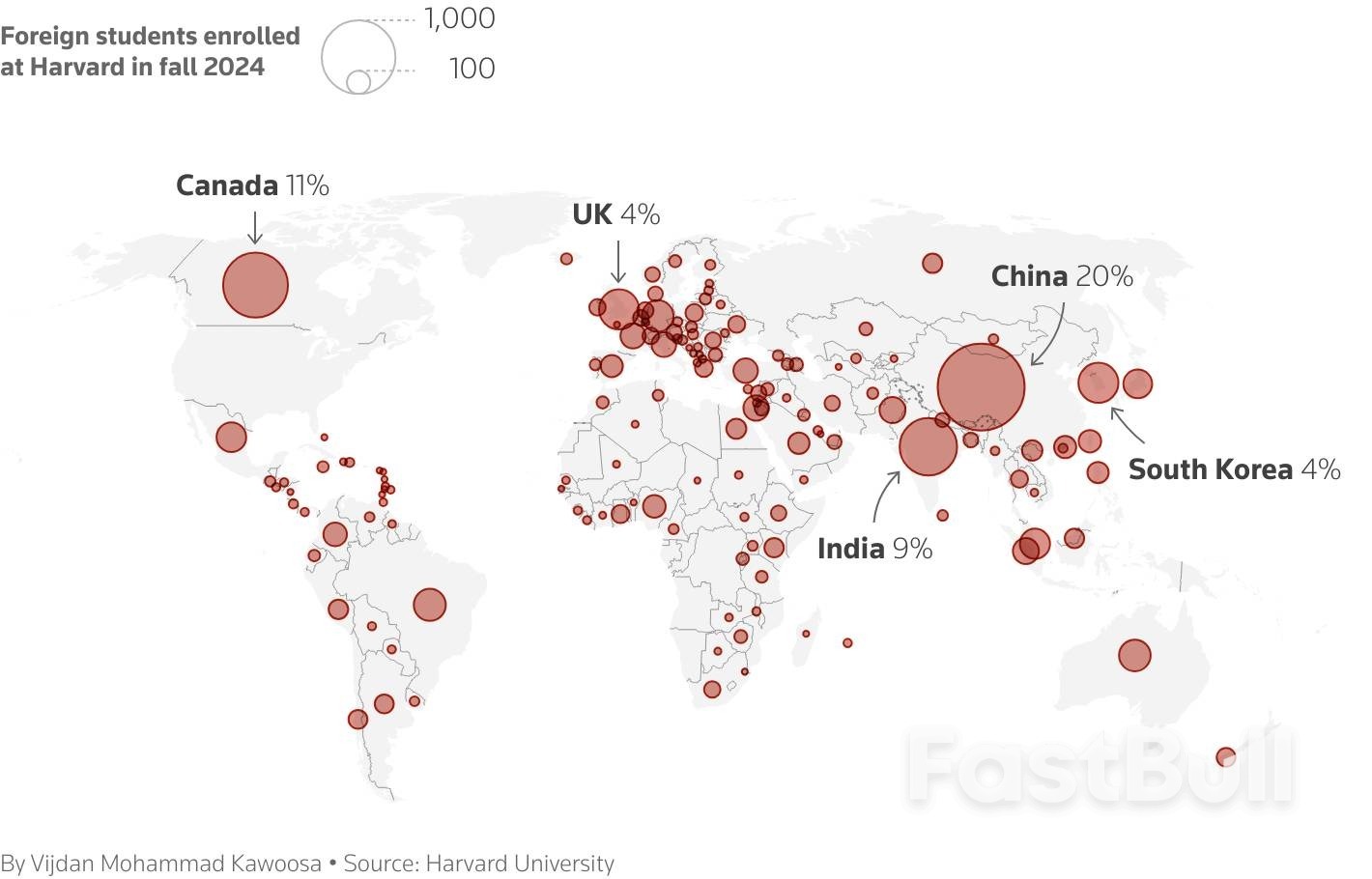
          Map shows the country of citizenship of international students enrolled by Harvard University in fall 2024

          Harvard had argued that the revocation not only violated its free speech and due process rights under the U.S. Constitution but also failed to comply with DHS regulations. The regulations require it to receive 30 days to challenge the agency's allegations and an opportunity to pursue an administrative appeal.

          In announcing the initial decision to revoke Harvard's certification, Noem, without providing evidence, accused the university of "fostering violence, antisemitism, and coordinating with the Chinese Communist Party."

          In a letter that day, she accused the school of refusing to comply with wide-ranging requests for information on its student visa holders, including about any activity they engaged in that was illegal or violent or that would subject them to discipline.

          The department's move would prevent Harvard from enrolling new international students and require existing ones to transfer to other schools or lose their legal status. Trump on Wednesday said that Harvard should have a 15% cap on the number of non-U.S. students it admits.

          Reporting by Nate Raymond in Boston; Additional reporting by Jonathan Stempel in New York; Editing by Alexia Garamfalvi and Lisa Shumaker
          Source: Reuters

          To stay updated on all economic events of today, please check out our Economic calendar
          Risk Warnings and Disclaimers
          You understand and acknowledge that there is a high degree of risk involved in trading. Following any strategies or investment methods may lead to potential losses. The content on the site is provided by our contributors and analysts for information purposes only. You are solely responsible for determining whether any trading assets, securities, strategy, or any other product is suitable for investing based on your own investment objectives and financial situation.
          Add to Favorites
          Share

          5 Signs That Suggest Bitcoin Price Has 'Room for Further Expansion'

          Warren Takunda

          Cryptocurrency

          Key takeaways:
          Bitcoin’s price consolidates below its all-time high of nearly $112,000.
          Whale accumulation, strong ETF inflows and other factors suggest BTC is on track to $120,000.
          Bitcoin shows multiple onchain and technical signals that there is still more upside for BTC.

          Bitcoin whales accumulate more BTC

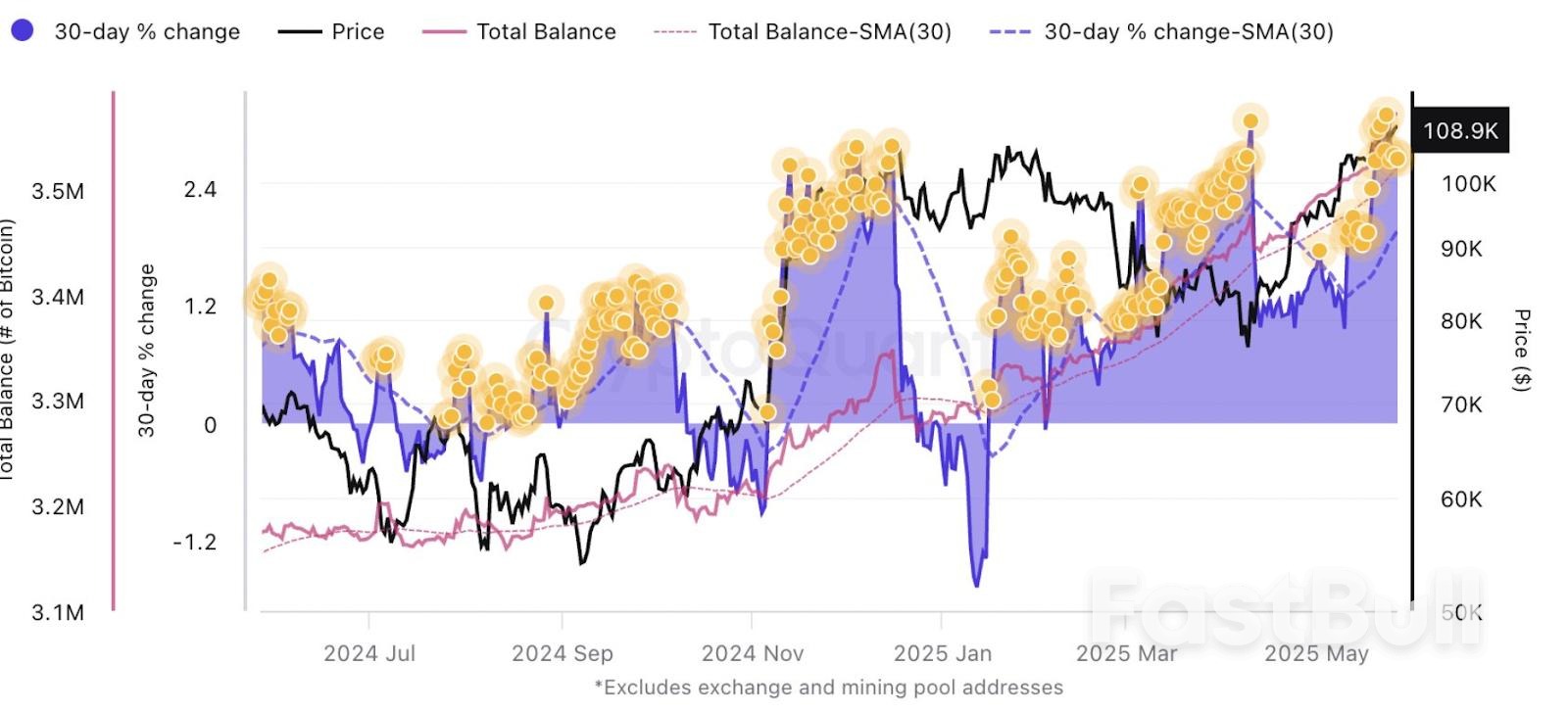
          Large Bitcoin investors have been adding to their holdings in anticipation of price increases in the future. Data from market intelligence firm CryptoQuant shows that the percentage of wallets holding between 1,000 and 10,000 BTC has increased sharply since May 6, accompanying a 16% price increase over the same period.
          This is a “sign of growing investor confidence,” said CryptoQuant in a May 29 post on X, adding:
          “It is historically linked to higher prices.”

          5 Signs That Suggest Bitcoin Price Has 'Room for Further Expansion'_1Bitcoin: Total whale holdings and monthly change (%). Source: CryptoQuant
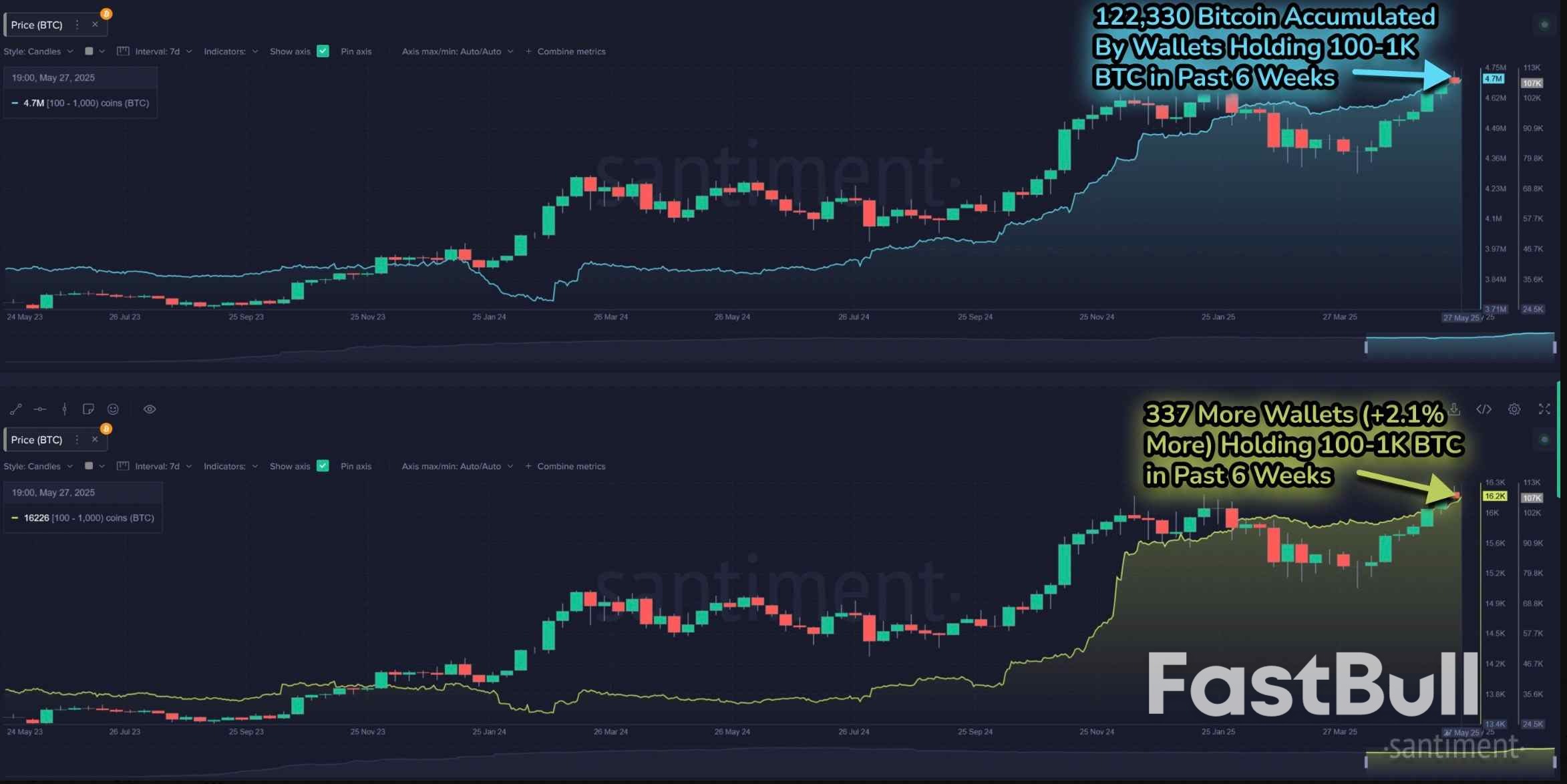
          Ochain data provider Santiment also highlighted that aggressive accumulation is occurring among wallets holding between 100 and 1,000 BTC.
          In the past six weeks, this group has added more than 337 wallets, collectively accumulating more than 122,330 BTC, worth about $13.3 billion at current prices.
          “Over the past 5 years of Bitcoin's history, no tier of wallets has been more price-correlated to crypto markets than the behavior of whales holding between 100 to 1,000 $BTC.”

          5 Signs That Suggest Bitcoin Price Has 'Room for Further Expansion'_2Number of coins held and number of wallets 100-1K BTC addresses. Source: Santiment
          Additional data from Glassnode data shows the Bitcoin Accumulation Trend Score (ATS) at 1, which signifies intense accumulation by large investors.
          Overall, this is a positive sign as continued accumulation signals bullish sentiment among this cohort of investors.

          Strong spot Bitcoin ETF inflows

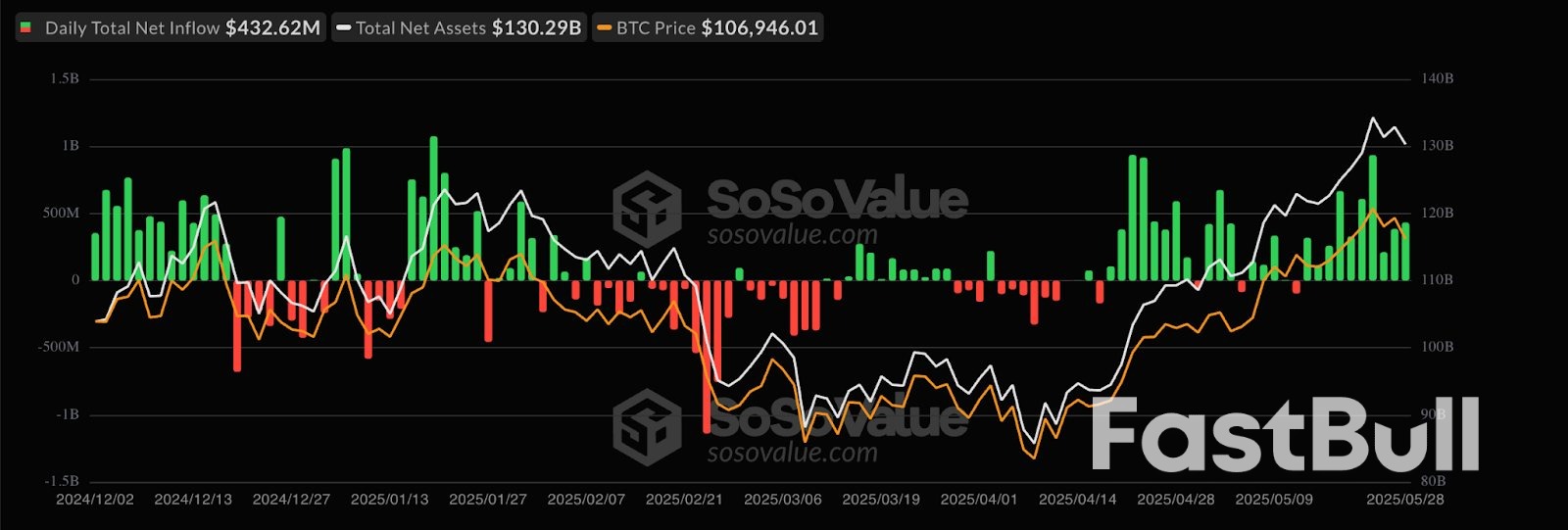
          US-based spot Bitcoin exchange-traded funds (ETFs) continue to see massive capital inflows, with data from SoSoValue showing these investment products have recorded inflows for 10 consecutive days, totaling $4.2 billion. 5 Signs That Suggest Bitcoin Price Has 'Room for Further Expansion'_3

          Spot Bitcoin ETF flows data. Source: SoSoValue

          Spot Bitcoin ETFs have “seen a sustained period of buy-side pressure that originated in late April, and remains strong today,” said blockchain analytics firm Glassnode in its latest Week Onchain report, adding:
          “This large and sustained buy-side pressure from both retail and institutional investors suggests a continued confidence in the asset, and has been a meaningful tailwind for the market, supporting all previous ATH breaks since they went live in 2024.”
          This is also reflected across other Bitcoin products, with CoinShares pointing out that flows into BTC investment funds totaled $2.97 billion in net inflows during the week ending May 23.

          Investor sentiment stays positive

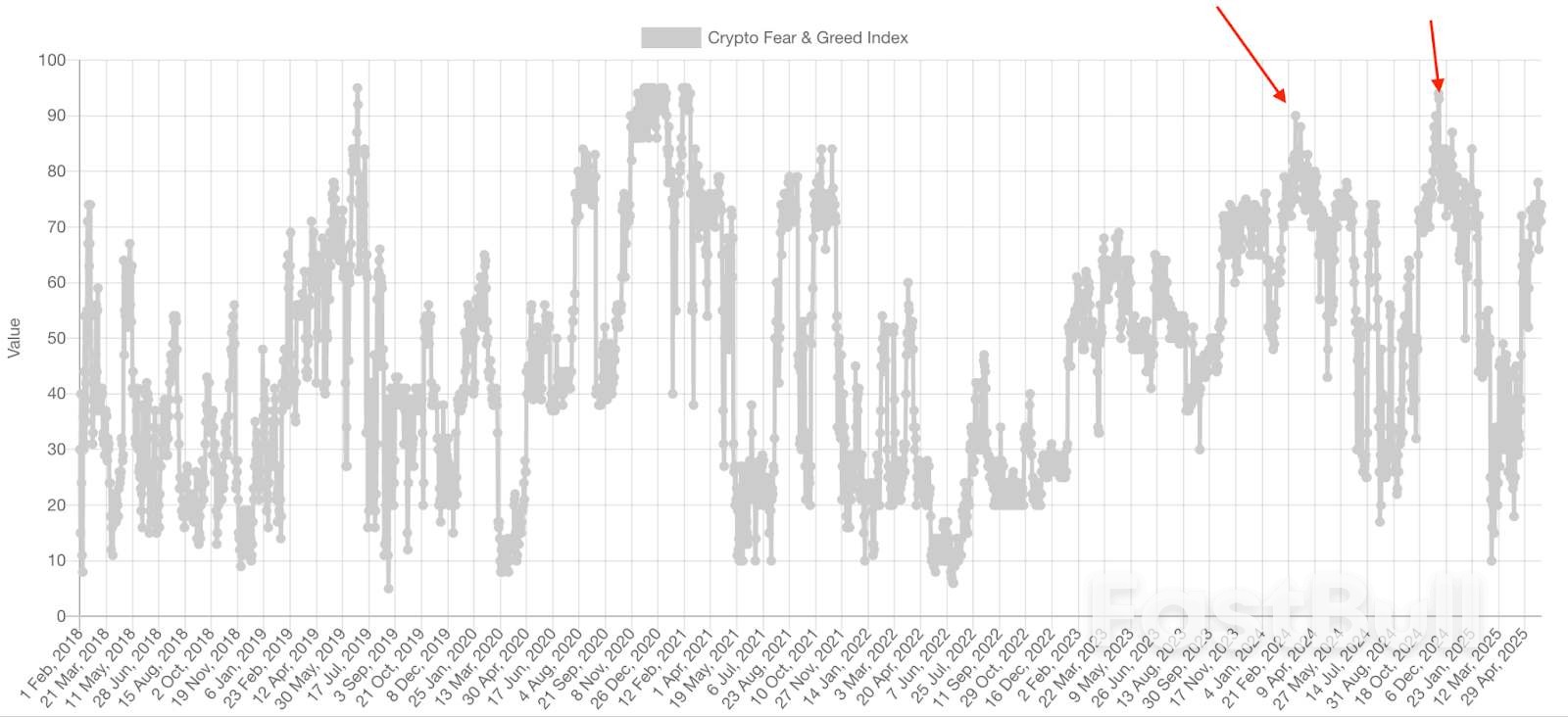
          Social media circles have sustained positive sentiment around Bitcoin and crypto assets. The Crypto Fear & Greed Index, a barometer of investor sentiment, stands at a notable score of 74, hinting at prevailing “greed” in the market.5 Signs That Suggest Bitcoin Price Has 'Room for Further Expansion'_4

          Crypto Fear & Greed Index. Source: Alternative.me

          Notably, this index is above 50 after staying below the midlevel between February and April. Sustaining this index in the “greed” zone since May 6 strongly indicates the positive sentiment the market players have for the wider crypto market.
          This pattern in market sentiment has been a precursor to price rallies in the past and could be an indicator of an upcoming bull run. Interestingly, the index is significantly lower than 82 in March 2024 and 94 in December 2024, marking the local tops.
          This suggests that the Crypto Fear & Greed Index could still rise into the “extreme greed” zone beyond 85, possibly pushing Bitcoin price toward new highs.

          Bitcoin’s OI remains high post-ATHs

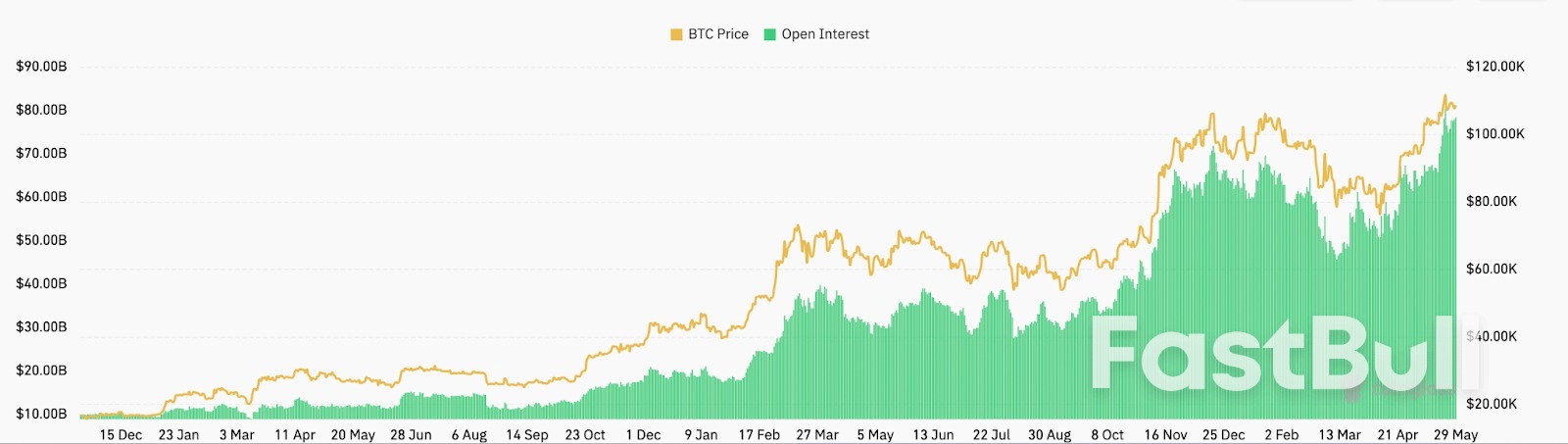
          Open interest (OI) for Bitcoin futures contracts has seen marked growth since the sub-$74,000 local low in April, expanding to a record high of $80.5 billion on May 23 from $50.8 billion on April 8, according to CoinGlass data.
          The IO is currently at $78.4 billion, reflecting a $27.6 billion or a 54% increase over the last 50 days alone, suggesting a buildup of leverage ​​often accompanying bullish environments.5 Signs That Suggest Bitcoin Price Has 'Room for Further Expansion'_5

          Bitcoin futures aggregate open interest, USD. Source: CoinGlass

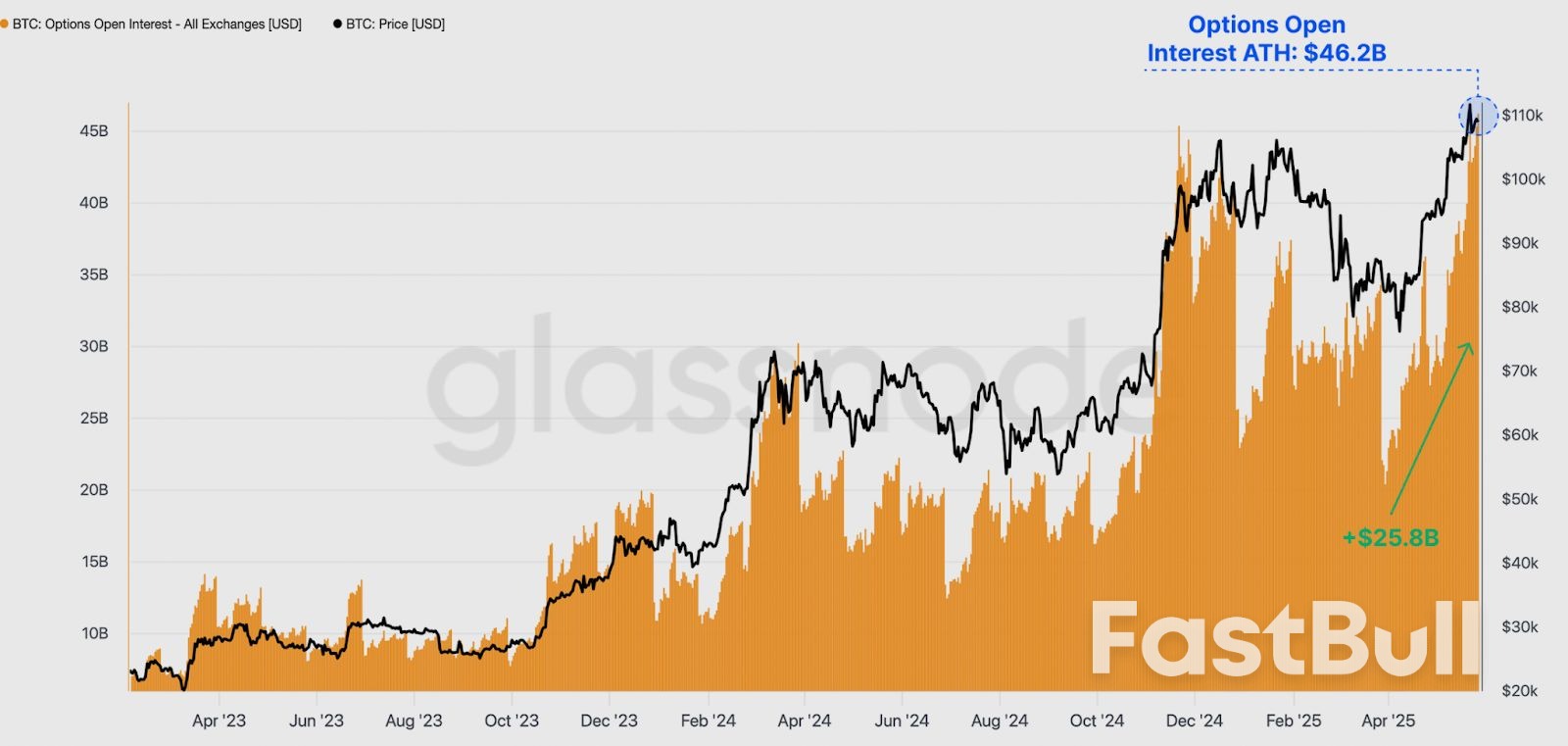
          Also backing BTC’s upside is open interest in options contracts that has surged to a new all-time high of $46.2 billion from $20.4 billion, as per data from Glassnode.
          Glassnode noted:
          “The rapid expansion of options open interest reflects a maturing investor base which is increasingly employing option contracts to execute more sophisticated strategies to fine-tune their risk management and trading positions.”

          5 Signs That Suggest Bitcoin Price Has 'Room for Further Expansion'_6Bitcoin options OI across all exchanges. Source: Glassnode
          Historically, when the OI remains high for an extended period, markets tend to enter a euphoric phase. With Bitcoin price still hovering around all-time highs, investor interest continues to build in the derivatives market, positively impacting the price.

          Bitcoin price eyes $120K next

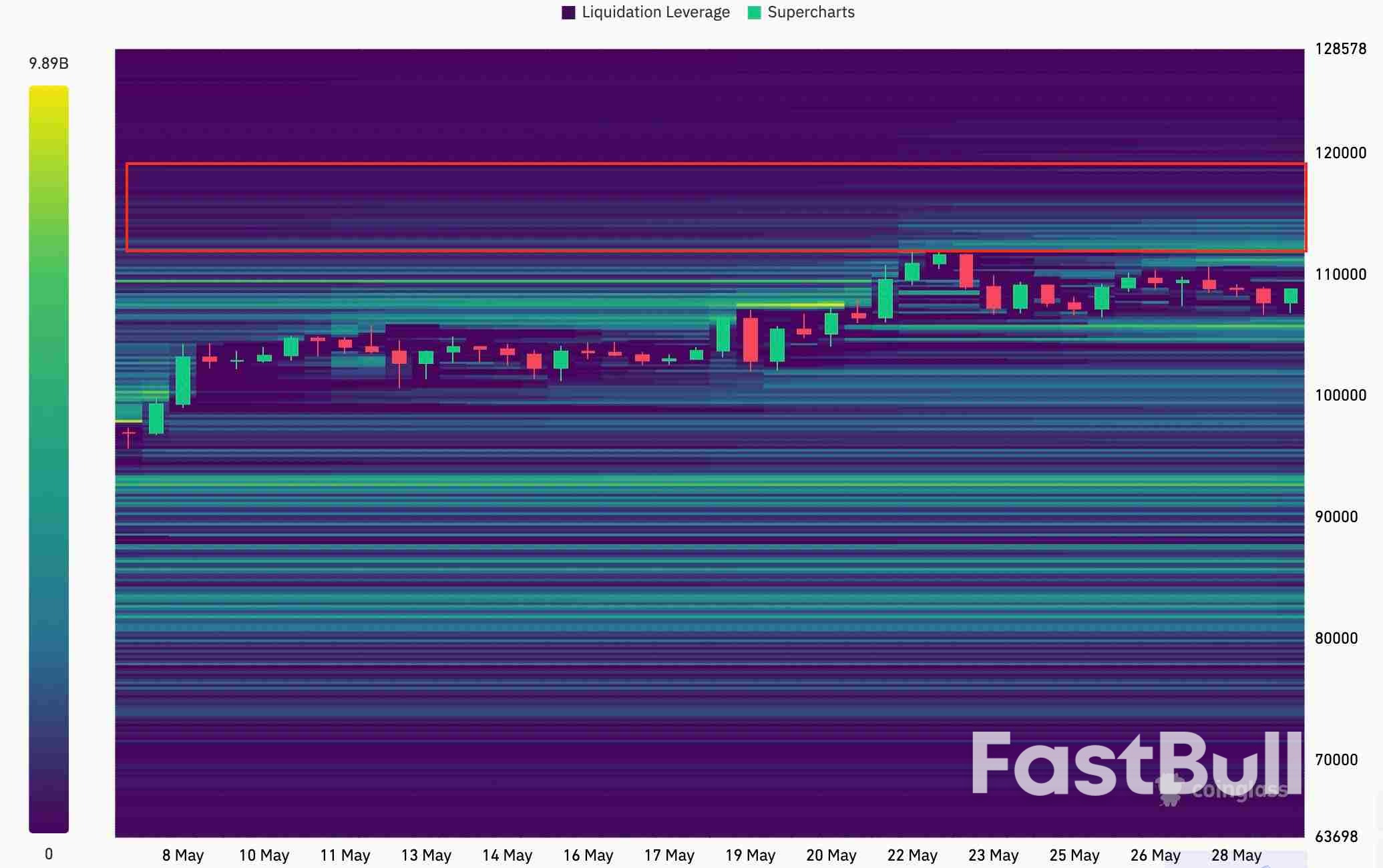
          Liquidation data shows a thick cluster of orders between the $111,000 and $115,000 levels. These positions often act like a magnet, pulling the price toward them as market makers hunt for liquidity.5 Signs That Suggest Bitcoin Price Has 'Room for Further Expansion'_7

          BTC/USDT six-month liquidation heatmap. Source: CoinGlass

          If BTC continues climbing, it will pressure short sellers who may be forced to exit, triggering a cascade of buy orders.
          Liquidity maps often front-run the price. With such dense activity above the all-time highs, the path of least resistance appears upward in the near term.
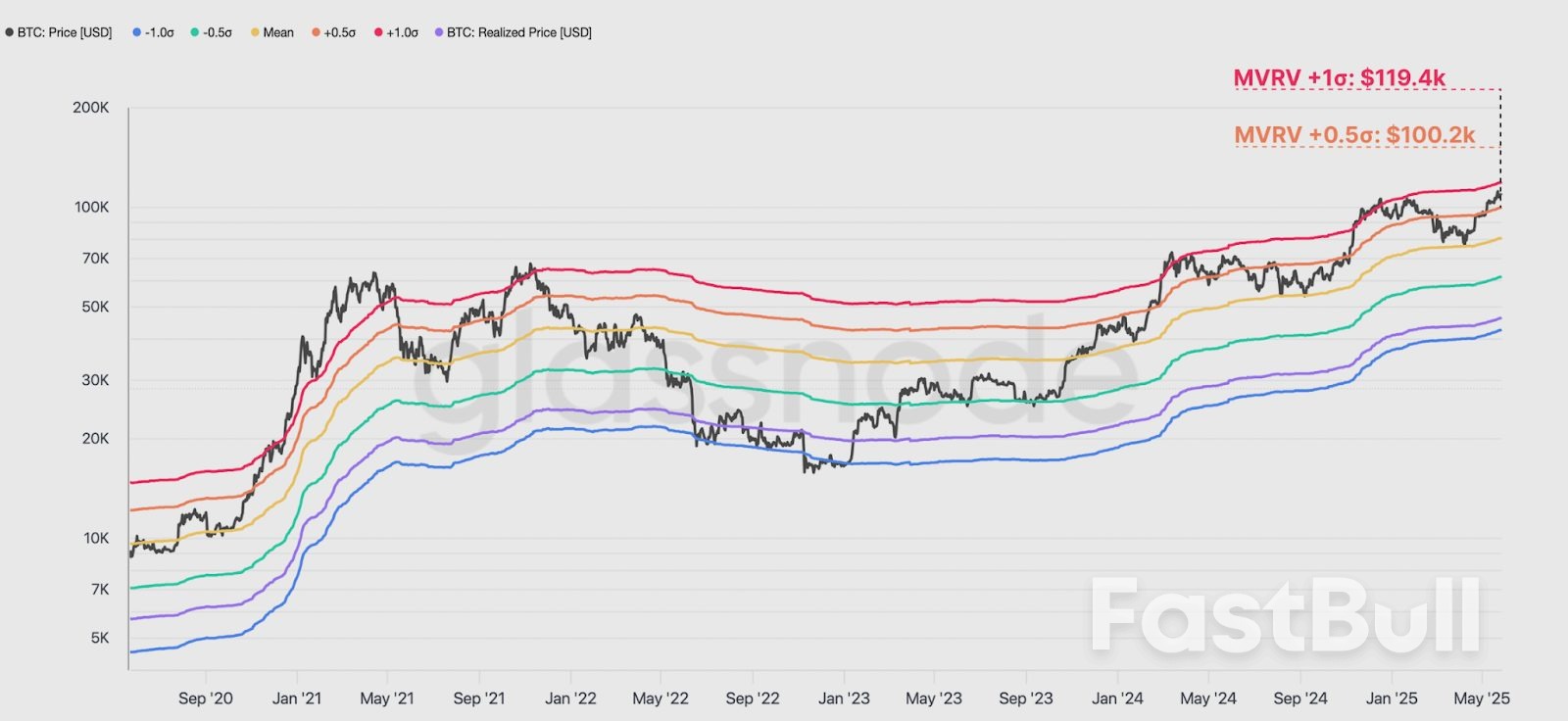
          Glassnode argued that the BTC price “still has more room for further expansion before the unrealized profit held by investors reaches an extreme level,” represented by the upper MVRV band around $120,000.
          “As the market moves into a phase of price discovery, the $120K level appears as a key zone of interest, with sell-side pressure expected to accelerate in and around this zone.”

          5 Signs That Suggest Bitcoin Price Has 'Room for Further Expansion'_8Bitcoin: MVRV extreme deviation pricing bands. Source: Glassnode

          As Cointelegraph reported, Bitcoin is expected to hit $120,000 in the first half of 2025 en route to $200,000 by year-end.

          Source: Cointelegraph

          Risk Warnings and Disclaimers
          You understand and acknowledge that there is a high degree of risk involved in trading. Following any strategies or investment methods may lead to potential losses. The content on the site is provided by our contributors and analysts for information purposes only. You are solely responsible for determining whether any trading assets, securities, strategy, or any other product is suitable for investing based on your own investment objectives and financial situation.
          Add to Favorites
          Share

          Why Has a US Court Blocked Donald Trump’s Tariffs – and Can He Get Around It?

          Warren Takunda

          Economic

          Donald Trump is facing the biggest challenge yet to his trade policies after a US federal court ruled that his “liberation day” tariff plan is illegal.
          In the latest twist in the US president’s erratic global trade war, the ruling could unpick border taxes announced early last month. However, the White House has filed a notice of appeal.

          What has been announced?

          The US Court of International Trade (CIT) ruled that Trump’s use of a sweeping presidential power – the International Emergency Economic Powers Act (IEEPA) – to justify his 2 April tariffs, as well as separate levies imposed on imports from Mexico, Canada and China, was wrong.
          Legal complaints about the tariffs had been lodged with the court by the nonpartisan Liberty Justice Center campaign group on behalf of small US businesses, as well as a dozen US states; including Oregon, Arizona and New York.
          IEEPA is a 1977 act allowing the president to regulate commerce during a national emergency, without the need to go through Congress, and builds on the Trading With the Enemy Act introduced during the first world war.
          However, the three-judge court panel ruled that the economic concerns cited by the White House to justify the tariff plans do not meet the required test of being “unusual and extraordinary threats”.
          The judges had been nominated to the court by three presidents: Ronald Reagan, Barack Obama and Trump himself.

          What is the impact?

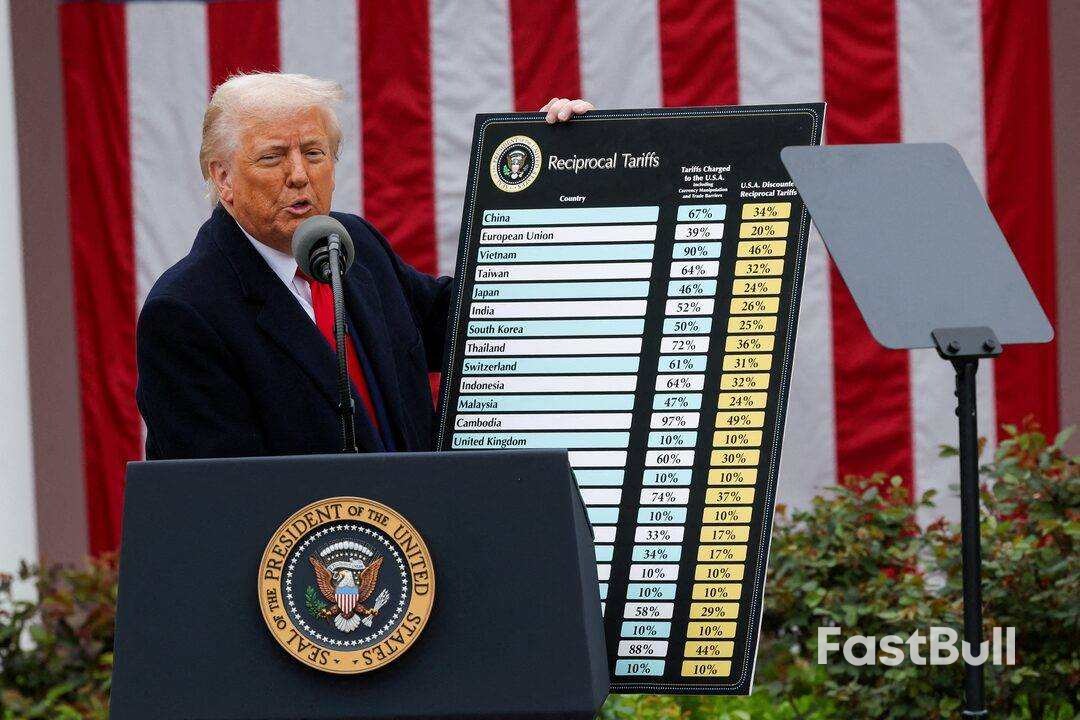
          Trump used IEEPA as the basis for his announcement on 2 April of 10% worldwide tariff and country-specific border taxes at higher levels – since paused for 90 days to allow for trade talks – as well as for fentanyl-related tariffs imposed on Canada, Mexico and China.
          The White House must take measures within 10 days to remove the tariffs to comply with the ruling, which it is appealing against.
          Other targeted tariffs announced by Trump, on steel, aluminium and cars, were imposed under a separate law – section 232 of the 1962 Trade Expansion Act – and therefore remain in place.
          Washington’s appeal will presumably go all the way to the supreme court if necessary. Given that the highest legal authority in the US recently ruled in favour of the president in a case involving the dismissal of a senior labour official – analysts are questioning whether the CIT decision could also be overturned.
          In the short-term, the judgment will add an extra layer of uncertainty to an already volatile trade situation. Investors have broadly cheered the ruling as a signal that Washington’s tariff policies could be curbed, limiting the hit to global trade and the US economy. Still, additional uncertainty will further dent investor and business confidence.

          What does the ruling mean for Trump’s trade deals?

          Washington has dialled up and down tariff threats as a tool in trade talks. A powerful court ruling against the president could undermine his push to strike maximum concessions, at a crunch moment in talks with China, Japan, the EU and India.
          On Tuesday, Trump had signalled progress with the EU, having a week earlier threatened a 50% tariff on imports from the 27-nation bloc from 1 June, before postponing the plan two days later, to 9 July. Brussels could now, however, scent weakness in the White House approach.
          A UK spokesperson said that despite the court ruling, the government would press on with negotiations to conclude the trade deal it sealed on 8 May – the first after Trump’s “reciprocal” tariffs were announced – as no legal text exists to bring into force the concessions Keir Starmer won.

          Where does the ruling leave Trump’s economic plans?

          At a headline level the ruling is a devastating blow to Trump’s economic agenda, by depriving the self-described “tariff man” of his most powerful, and most favoured, policy tool.
          However, there are various legal routes for the president to pursue his cornerstone economic policy. These include section 122 of the Trade Act of 1974, section 232 of the Trade Expansion Act of 1962, and sections 301 and 338 of the Trade Act of 1930. Each grants the president powers to intervene on trade policy, albeit in an often slower and, in some instances, more limited way.
          “It sounds like good news, but Trump has various other mechanisms to invoke tariffs or have leverage in trade negotiations. It’s just the speed of their rollout will be weeks/months rather than immediately as he did with the IEEPA,” said Jordan Rochester, an analyst at the Japanese bank Nomura.
          Another major focus for investors will be the consequences for Washington’s rising levels of federal borrowing and debt amid mounting concern in financial markets.
          Trump had been banking on additional revenues from tariffs to help offset some of his sweeping tax cuts announced last week in his One Big Beautiful Bill Act. The bill, passed last week by the lower house in Congress, could add $5tn (£3.7tn) to US debt levels.

          Source: Theguardian

          To stay updated on all economic events of today, please check out our Economic calendar
          Risk Warnings and Disclaimers
          You understand and acknowledge that there is a high degree of risk involved in trading. Following any strategies or investment methods may lead to potential losses. The content on the site is provided by our contributors and analysts for information purposes only. You are solely responsible for determining whether any trading assets, securities, strategy, or any other product is suitable for investing based on your own investment objectives and financial situation.
          Add to Favorites
          Share

          Trump Officials Downplay Court Ruling That Blocked Sweeping Tariffs

          Olivia Brooks

          Economic

          Political

          Senior Trump administration officials on Thursday downplayed the impact of a U.S. trade court ruling that blocked the most sweeping of President Donald Trump's tariffs, expressing confidence it would be overturned on appeal and insisting there are other legal avenues to employ in the interim.

          Financial markets, which have whipsawed wildly in response to every twist and turn in Trump's chaotic trade war, reacted with cautious optimism on Thursday, a day after the U.S. Court of International Trade ruled that Trump overstepped his authority in imposing punitive tariffs on virtually every country in the world.

          The Trump administration immediately asked an appeals court to stay the ruling and allow the tariff regime to remain in place. Trump has put tariffs at the center of his effort to extract concessions from U.S. trading partners, including traditional allies such as the European Union.

          White House economic adviser Kevin Hassett expressed confidence that the ruling would ultimately be reversed in an interview with Fox Business on Thursday. He also said it would not get in the way of signing new trade deals.

          "If there are little hiccups here or there because of decisions that activist judges make, then it shouldn't just concern you at all, and it's certainly not going to affect the negotiations," Hassett said.

          White House trade adviser Peter Navarro, a staunch proponent of higher tariffs, told Bloomberg TV that the Trump administration could rely on other laws to implement import taxes if the court's decision remains in place.

          Trump had invoked the International Emergency Economic Powers Act (IEEPA), a law intended to address threats during national emergencies, to impose tariffs on almost every U.S. trading partner, raising fears of a global recession. The president temporarily suspended many of the tariffs until early July after markets swooned in response.

          The court found that the emergency powers law does not grant Trump the unilateral power to order such sweeping tariffs. Some sector-specific tariffs, such as those Trump has imposed on steel, aluminum and automobiles, were imposed under separate authorities on national security grounds and were unaffected by the ruling.

          Canadian Prime Minister Jay Carney welcomed the decision, saying it was "consistent with Canada's longstanding position" that Trump's tariffs were unlawful.

          Other U.S. trading partners offered careful responses. The British government said the ruling was a domestic matter for the U.S. administration and noted it was "only the first stage of legal proceedings."

          Both Germany and the European Commission said they could not comment on the decision.
          MODEST MARKET GAINS

          Several analysts said it was preliminary to conclude this closes the door entirely on Trump's sweeping tariffs, with legal paths other than IEEPA likely at his disposal.

          "We suspect the administration will lean on other legal authorities to maintain tariff levels around current levels," Bernard Yaros, lead U.S. economist at Oxford Economics, wrote in a note to clients on Thursday.

          After prompting an initial surge in stocks in Asia, the ruling stimulated more muted reactions in Europe, where indexes were largely flat, and in the U.S., where gains were modest. The S&P 500 was up about 0.5%, having given back about half of its initial rise at the opening bell.

          An early rally in the dollar also fizzled and the greenback was about 0.4% lower against a basket of major trading partner currencies. Bond yields also slipped.

          Following a market revolt after his major tariff announcement on April 2, Trump paused most import duties for 90 days and said he would hammer out bilateral deals with trade partners.

          But apart from a pact with Britain this month, agreements remain elusive, and the court's suspension of the tariffs may dissuade countries like Japan from rushing into deals, analysts said.

          "Assuming that an appeal does not succeed in the next few days, the main win is time to prepare, and also a cap on the breadth of tariffs – which can't exceed 15% for the time being," George Lagarias, chief economist at Forvis Mazars international advisers, said.

          Trump's trade war has shaken makers of everything from luxury handbags and sneakers to household appliances and cars as the price of raw materials has risen, supply chains have been disrupted and company strategies redrafted.
          Source: Reuters

          To stay updated on all economic events of today, please check out our Economic calendar
          Risk Warnings and Disclaimers
          You understand and acknowledge that there is a high degree of risk involved in trading. Following any strategies or investment methods may lead to potential losses. The content on the site is provided by our contributors and analysts for information purposes only. You are solely responsible for determining whether any trading assets, securities, strategy, or any other product is suitable for investing based on your own investment objectives and financial situation.
          Add to Favorites
          Share

          Why the Dollar’s Wobble Could Be Self-Perpetuating

          Warren Takunda

          Economic

          Foreign currency hedging is not a topic that usually dominates the water-cooler chats on trading floors. Right now, however, it’s front of mind for many of the biggest players in financial markets. The U.S. dollar’s unusual moves in April, when it fell in tandem with stocks, has cast doubt over a long-lasting relationship between the greenback and risky assets. Over time, it might nudge non-U.S. investors to hedge more or reduce their exposure to American stocks and bonds. Both could create a self-reinforcing downward cycle for the dollar.
          Investing abroad is a tricky business for money managers with liabilities denominated in the currency of their home country. Think German or Japanese insurers, whose policies are written in euros and yen, or Canadian and Australian pension funds, whose beneficiaries expect to finance their retirement in Canadian and Aussie dollars. Buying shares and debt issued by companies in other countries introduces the danger that foreign exchange swings will reduce the value of the investments in local-currency terms, even if the underlying returns are good. That is why investors tend to use foreign exchange forwards and other derivatives to hedge currency risks, effectively swapping far-flung exposures into domestic ones.
          The beauty of holding U.S. assets, though, is that the dollar tends to strengthen when the market panics. In money-manager speak, it’s an anti-cyclical currency, which means investment bosses can get away with minimal protection against foreign exchange risk on giant portfolios of American stocks and bonds. It also helps that the dollar has generally risen in recent years, providing foreign investors with an extra boost to their overall returns.
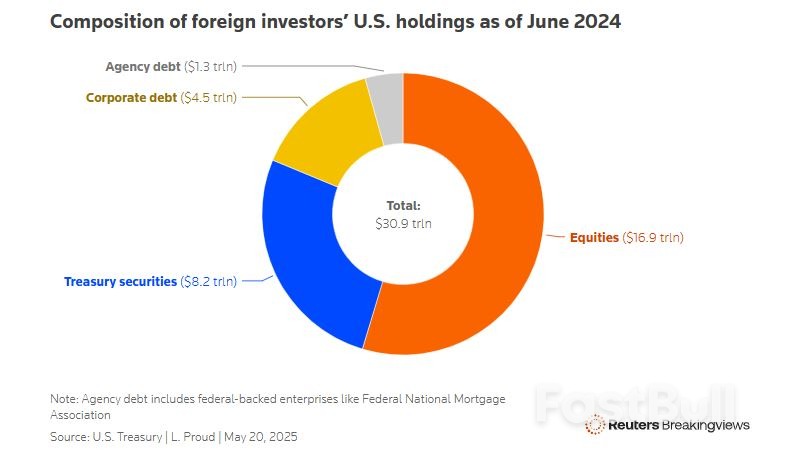
          One study, published by the National Bureau of Economic Research, found that foreign insurers, pension funds and mutual funds hedged 44%, 35% and 21% of their respective dollar portfolios in 2020, with much higher ratios for bonds compared to stocks. Apply that range to the $30 trillion of total American assets held by non-U.S. investors as of last year, and the implication is that anywhere between $24 trillion and $17 trillion could be unhedged.Why the Dollar’s Wobble Could Be Self-Perpetuating_1
          Take the Canada Pension Plan Investment Board for example. U.S. dollar exposures account, for more than half of its net investments of $520 billion, but are minimally hedged, according to a person familiar with the portfolio. Several people involved in the running of different Canadian retirement funds told Breakingviews that the safe-haven nature of the greenback was a key reason for relatively low hedge ratios. Japan’s giant Government Pension Investment Fund, meanwhile, had invested almost a third of its $1.7 trillion portfolio in American assets as of March 2024 with slightly more than half in stocks and the rest in bonds. The U.S. exposure was almost entirely unhedged, a person familiar with the matter told Breakingviews.
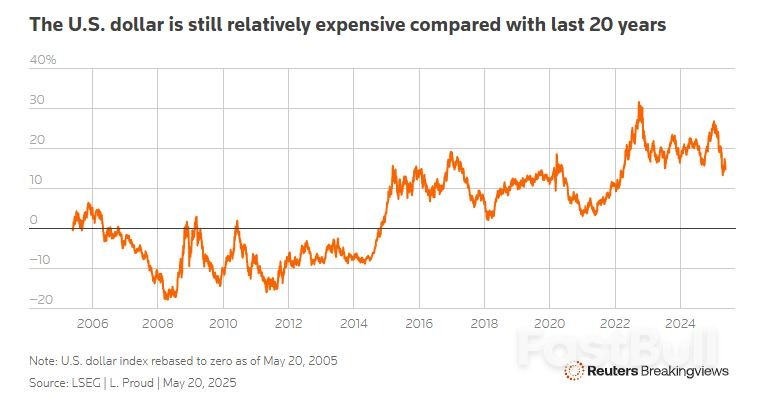
          According to traders and analysts these large so-called “open” positions in U.S. assets have caught the attention of currency market players in recent months, for two reasons. First, the dollar didn’t live up to its safe-haven billing after U.S. President Donald Trump’s tariff plan tanked stocks in early April. The greenback fell roughly 5% against a basket of other rich-world currencies and failed to rebound alongside the S&P 500 Index when trade tensions cooled. The upshot for foreign investors is that volatile U.S. policymaking may cause the dollar to gyrate in the same way as equity markets. If that becomes the norm, foreign investors’ risk models would over time call for much more dollar hedging.
          The second consideration is that Trump and his advisers seem set on weakening the currency in a bid to boost exports. That is cementing a sense in foreign currency markets that the dollar is unlikely to see another 2022-style surge in strength, meaning overseas investors may be more likely to get a drag from the greenback rather than a lift.
          One open question is whether it is even possible for large pension funds and insurers to meaningfully increase the proportion of their dollar portfolios that are hedged. In places where local institutions’ holdings of U.S. assets are large relative to the local market, such as Taiwan or Nordic countries like Sweden, a big increase in demand for FX derivatives could meaningfully affect the value of the domestic currency. The Taiwan dollar’s recent surge against the greenback looks like a case in point.
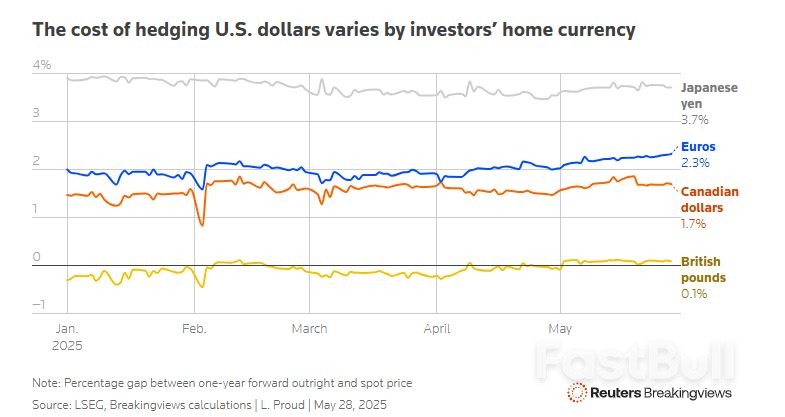
          Even in deeper markets like the Japanese yen, euro or Canadian dollar, hedging comes at a price. The typical method is to use forward contracts, which involves locking in an exchange rate by agreeing to buy one currency and sell another at a future date. The cost is largely determined by the difference in government bond yields between the two markets. Relatively high U.S. interest rates therefore make it expensive for local investors to hedge their dollar exposure.Why the Dollar’s Wobble Could Be Self-Perpetuating_2
          One-year contracts currently imply a roughly 2% annual cost for Canadian and European investors and 4% for those in Japan, according to Breakingviews calculations. The implication is that institutions which hedge an extra quarter of their U.S. portfolio could reduce returns by 0.5 percentage points to 1 percentage point, all else being equal. That raises the bar for holding American assets relative to home-country ones.
          Why the Dollar’s Wobble Could Be Self-Perpetuating_3
          The alternative to extra hedging is for big institutional investors to shrink their exposure to the U.S., for example by investing the marginal euro, yen or loonie elsewhere. Pension managers and insurers generally take months or years to change their investment policies, meaning any shift won’t be immediate. Yet there are signs that both may already be happening in a small way. Traders and investors say the recent slide in the dollar is partly due to extra hedging activity, which mechanically weakens the currency that is being hedged. Meanwhile, non-U.S. participation in a recent 30-year Treasury bond auction was the lowest since 2019, Reuters reported.
          The danger, from a dollar holder’s perspective, is that these trends reinforce one another. A weaker and more volatile greenback may inflict losses on foreign owners of U.S. assets, inducing them to sell or hedge more, in turn weakening the currency even further. At some point American assets might look cheap enough for global investors to pile back in – but not before the dollar falls further.

          Source: Reuters

          To stay updated on all economic events of today, please check out our Economic calendar
          Risk Warnings and Disclaimers
          You understand and acknowledge that there is a high degree of risk involved in trading. Following any strategies or investment methods may lead to potential losses. The content on the site is provided by our contributors and analysts for information purposes only. You are solely responsible for determining whether any trading assets, securities, strategy, or any other product is suitable for investing based on your own investment objectives and financial situation.
          Add to Favorites
          Share

          US Weekly Jobless Claims Rise; Corporate Profits Fall In First Quarter

          Thomas

          Economic

          The number of Americans filing new applications for jobless benefits increased more than expected last week and the unemployment rate appeared to have picked up in May, suggesting layoffs were rising as tariffs cloud the economic outlook.

          The report from the Labor Department on Thursday showed a surge in applications in Michigan last week, the nation's motor vehicle assembly hub. The number of people collecting unemployment checks in mid-May was the largest in 3-1/2 years. The outlook for the economy is dimming with other data showing a sharp decline in corporate profits in the first quarter.

          A U.S. trade court on Wednesday blocked most of Trump's tariffs from going into effect in a sweeping ruling that the president overstepped his authority. Economists said the ruling, while it offered some relief, had added another layer of uncertainty over the economy.

          "This is a sign that cracks are starting to form in the economy and that the outlook is deteriorating," said Christopher Rupkey, chief economist at FWDBONDS. "There is nothing great about today's jobless claims data and the jump in layoffs may be a harbinger of worse things to come."

          Initial claims for state unemployment benefits rose 14,000 to a seasonally adjusted 240,000 for the week ended May 24, the Labor Department said. Economists polled by Reuters had forecast 230,000 claims for the latest week.

          Unadjusted claims increased 10,742 to 212,506 last week, lifted by a 3,329 jump in filings in Michigan. There were also notable increases in applications in Nebraska and California.

          Despite the rise in claims, worker hoarding by employers following difficulties finding labor during and after the COVID-19 pandemic continues to underpin the jobs market.

          Nonetheless, there has been an uptick in layoffs because of economic uncertainty asTrump's aggressive trade policy makes it challenging for businesses to plan ahead.

          A report from the Bank of America Institute noted a sharp rise in higher-income households receiving unemployment benefits between February and April compared to the same period last year. Its analysis of Bank of America deposit accounts also showed notable rises among lower-income as well as middle-income households in April from the same period a year ago.

          Economists expect claims in June to break above their 205,000-243,000 range for this year, mostly driven by difficulties adjusting the data for seasonal fluctuations, following a similar pattern in recent years.

          Minutes of the Federal Reserve's May 6-7 policy meeting published on Wednesday showed while policymakers continued to view labor market conditions as broadly in balance, they "assessed that there was a risk that the labor market would weaken in coming months."

          They noted that there was "considerable uncertainty" over the job market's outlook, adding "outcomes would depend importantly on the evolution of trade policy as well as other government policies."

          The U.S. central bank has kept its benchmark overnight interest rate in the 4.25%-4.50% range since December as officials struggle to estimate the impact of Trump's tariffs, which have raised the prospect of higher inflation and slower economic growth this year.

          U.S. stocks opened higher. The dollar eased against a basket of currencies after a brief rally. U.S. Treasury yields fell.

          SWELLING UNEMPLOYMENT ROLLS

          The number of people receiving benefits after an initial week of aid, a proxy for hiring, increased 26,000 to a seasonally adjusted 1.919 million during the week ending May 17, the claims report showed. The elevated so-called continuing claims reflect companies' hesitance to increase headcount because of the economic uncertainty.

          Continuing claims covered the period during which the government surveyed households for May's unemployment rate. They increased between the April and May survey periods, suggesting an uptick in the unemployment rate this month. The jobless rate was at 4.2% in April.

          Many people who have lost their jobs are experiencing long spells of unemployment. The median duration of unemployment jumped to 10.4 weeks in April from 9.8 weeks in March.

          With profits under pressure, there is probably little incentive for businesses to boost hiring. Mass layoffs are, however, unlikely with a Conference Board survey of chief executive officers released on Thursday showing most captains of business anticipated no change in the size of their workforce over the next year even as about 83% said they expected a recession in the next 12-18 months.

          Profits from current production with inventory valuation and capital consumption adjustments dropped $118.1 billion in the first quarter, the Commerce Department's Bureau of Economic Analysis (BEA) said in a separate report. Profits surged $204.7 billion in the October-December quarter.

          Companies ranging from airlines and retailers to motor vehicle manufacturers have either withdrawn or refrained from giving financial guidance for 2025, citing the uncertainty caused by the on-again and off-again nature of some duties.

          Businesses front-loaded imports and households engaged in pre-emptive buying of goods last quarter to avoid higher costs, making it difficult to get a clear picture of the economy.

          The deluge of imports sent gross domestic product declining at a 0.2% annualized rate in the January-March quarter, the BEA said in its second estimate of GDP. The economy was initially estimated to have contracted at a 0.3% pace. It grew at a 2.4% rate in the fourth quarter.
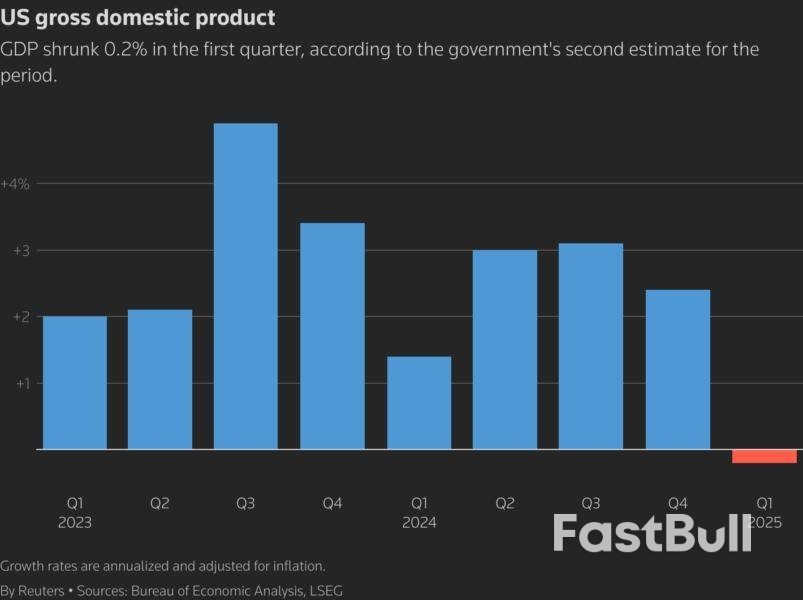
          Thomson ReutersUS gross domestic product

          Other alternative measures of growth, gross domestic income and gross domestic output also showed the economy contracting at a 0.2% pace in the first quarter.

          Source: TradingView

          To stay updated on all economic events of today, please check out our Economic calendar
          Risk Warnings and Disclaimers
          You understand and acknowledge that there is a high degree of risk involved in trading. Following any strategies or investment methods may lead to potential losses. The content on the site is provided by our contributors and analysts for information purposes only. You are solely responsible for determining whether any trading assets, securities, strategy, or any other product is suitable for investing based on your own investment objectives and financial situation.
          Add to Favorites
          Share
          FastBull
          Copyright © 2025 FastBull Ltd

          728 RM B 7/F GEE LOK IND BLDG NO 34 HUNG TO RD KWUN TONG KLN HONG KONG

          TelegramInstagramTwitterfacebooklinkedin
          App Store Google Play Google Play
          Products
          Charts

          Chats

          Q&A with Experts
          Screeners
          Economic Calendar
          Data
          Tools
          Membership
          Features
          Function
          Markets
          Copy Trading
          Latest Signals
          Contests
          News
          Analysis
          24/7
          Columns
          Education
          Company
          Careers
          About Us
          Contact Us
          Advertising
          Help Center
          Feedback
          User Agreement
          Privacy Policy
          Business

          White Label

          Data API

          Web Plug-ins

          Poster Maker

          Affiliate Program

          Risk Disclosure

          The risk of loss in trading financial instruments such as stocks, FX, commodities, futures, bonds, ETFs and crypto can be substantial. You may sustain a total loss of the funds that you deposit with your broker. Therefore, you should carefully consider whether such trading is suitable for you in light of your circumstances and financial resources.

          No decision to invest should be made without thoroughly conducting due diligence by yourself or consulting with your financial advisors. Our web content might not suit you since we don't know your financial conditions and investment needs. Our financial information might have latency or contain inaccuracy, so you should be fully responsible for any of your trading and investment decisions. The company will not be responsible for your capital loss.

          Without getting permission from the website, you are not allowed to copy the website's graphics, texts, or trademarks. Intellectual property rights in the content or data incorporated into this website belong to its providers and exchange merchants.

          Not Logged In

          Log in to access more features

          FastBull Membership

          Not yet

          Purchase

          Become a signal provider
          Help Center
          Customer Service
          Dark Mode
          Price Up/Down Colors

          Log In

          Sign Up

          Position
          Layout
          Fullscreen
          Default to Chart
          The chart page opens by default when you visit fastbull.com