
• Trade
  • Markets
  • Copy
  • Contests
  • News
  • 24/7
  • Calendar
  • Q&A
  • Chats
Trending
Screeners
SYMBOL
LAST
BID
ASK
HIGH
LOW
NET CHG.
%CHG.
SPREAD
SPX
S&P 500 Index
6842.08
6842.08
6842.08
6878.28
6833.87
-28.32
-0.41%
--
DJI
Dow Jones Industrial Average
47748.47
47748.47
47748.47
47971.51
47695.55
-206.51
-0.43%
--
IXIC
NASDAQ Composite Index
23515.10
23515.10
23515.10
23698.93
23481.60
-63.02
-0.27%
--
USDX
US Dollar Index
99.070
99.150
99.070
99.160
98.730
+0.120
+ 0.12%
--
EURUSD
Euro / US Dollar
1.16290
1.16297
1.16290
1.16717
1.16162
-0.00136
-0.12%
--
GBPUSD
Pound Sterling / US Dollar
1.33173
1.33180
1.33173
1.33462
1.33053
-0.00139
-0.10%
--
XAUUSD
Gold / US Dollar
4190.17
4190.51
4190.17
4218.85
4175.92
-7.74
-0.18%
--
WTI
Light Sweet Crude Oil
58.908
58.938
58.908
60.084
58.837
-0.901
-1.51%
--

Community Accounts

Signal Accounts
--
Profit Accounts
--
Loss Accounts
--
View More

Become a signal provider

Sell trading signals to earn additional income

View More

Guide to Copy Trading

Get started with ease and confidence

View More

Signal Accounts for Members

All Signal Accounts

Best Return
  • Best Return
  • Best P/L
  • Best MDD
Past 1W
  • Past 1W
  • Past 1M
  • Past 1Y

All Contests

  • All
  • Trump Updates
  • Recommend
  • Stocks
  • Cryptocurrencies
  • Central Banks
  • Featured News
Top News Only
Share

EU's Foreign Chief: Giving Ukraine The Resources It Needs To Defend Itself Doesn't Prolong The War, It Can Help End It

Share

EU's Foreign Chief: Securing Multi-Year Funding For Ukraine In December Is Absolutely Essential

Share

[Bank For International Settlements: US Tariffs Drive Record Global FX Trading Volume] Data From The Bank For International Settlements (BIS) Shows That Global FX Trading Volume Surged To A Record High This Year, With An Average Daily Trading Volume Of $9.5 Trillion In April, Amid Market Turmoil Triggered By US President Trump's Tariff Policies. On December 8, The Bank Released Its Quarterly Assessment, Citing Data From Its Triennial Survey, Stating That The Impact Of Tariffs Was "substantial," Leading To An Unexpected Depreciation Of The US Dollar And Accounting For Over $1.5 Trillion In Average Daily OTC Trading Volume In April. The Report Shows That Overall FX Trading Volume Increased By More Than A Quarter Compared To The Last Survey In 2022, Surpassing The Estimated Peak During The Market Turmoil Caused By The COVID-19 Pandemic In March 2020. This Data Is An Update Based On Preliminary Survey Results Released In September

Share

UN Secretary General Guterres Strongly Condemns Unauthorized Entry By Israeli Authorities Into UNRWA Compound In East Jerusalem

Share

Bank Of America: A Dovish Federal Reserve Poses A Key Risk To High-grade U.S. Bonds In 2026

Share

Bank CEOs Will Meet With U.S. Senators To Discuss The (regulatory) Framework For The Cryptocurrency Market

Share

The U.S. Supreme Court Has Hinted That It Will Support President Trump's Decision To Remove Heads Of Federal Government Agencies

Share

[BlackRock: The Surge Of Funds Into AI Infrastructure Is Far From Peaking] Ben Powell, Chief Investment Strategist For Asia Pacific At BlackRock, Stated That The Capital Expenditure Spree In The Artificial Intelligence (AI) Infrastructure Sector Continues And Is Far From Reaching Its Peak. Powell Believes That As Tech Giants Race To Increase Their Investments In A "winner-takes-all" Competition, The "shovel Sellers" (such As Chipmakers, Energy Producers, And Copper Wire Manufacturers) Who Provide The Foundational Resources For The Sector Are The Clearest Investment Winners

Share

[Ray Dalio: The Middle East Is Rapidly Becoming One Of The World's Most Influential AI Hubs] Bridgewater Associates Founder Ray Dalio Stated That The Middle East (particularly The UAE And Saudi Arabia) Is Rapidly Emerging As A Powerful Global AI Hub, Comparable To Silicon Valley, Due To The Region's Combination Of Massive Capital And Global Talent. Dalio Believes The Gulf Region's Transformation Is The Result Of Well-thought-out National Strategies And Long-term Planning, Noting That The UAE's Outstanding Performance In Leadership, Stability, And Quality Of Life Has Made It A "Silicon Valley For Capitalists." While He Believes The AI ​​rebound Is In Bubble Territory, He Advises Investors Not To Rush Out But Rather To Look For Catalysts That Could Cause The Bubble To "burst," Such As Monetary Tightening Or Forced Wealth Selling

Share

French President Emmanuel Macron Met With The Croatian Prime Minister At The Élysée Palace

Share

In The Past 24 Hours, The Marketvector Digital Asset 100 Small Cap Index Rose 1.96%, Currently At 4135.44 Points. The Sydney Market Initially Exhibited An N-shaped Pattern, Hitting A Daily Low Of 3988.39 Points At 06:08 Beijing Time, Before Steadily Rising To A Daily High Of 4206.06 Points At 17:07, Subsequently Stabilizing At This High Level

Share

[Sovereign Bond Yields In France, Italy, Spain, And Greece Rose By More Than 7 Basis Points, Raising Concerns That The ECB's Interest Rate Outlook May Push Up Financing Costs] In Late European Trading On Monday (December 8), The Yield On French 10-year Bonds Rose 5.8 Basis Points To 3.581%. The Yield On Italian 10-year Bonds Rose 7.4 Basis Points To 3.559%. The Yield On Spanish 10-year Bonds Rose 7.0 Basis Points To 3.332%. The Yield On Greek 10-year Bonds Rose 7.1 Basis Points To 3.466%

Share

Oil Falls 1% Amid Ongoing Ukraine Talks, Ahead Of Expected US Interest Rate Cut

Share

Azeri Btc Crude Oil Exports From Ceyhan Port Set At 16.2 Million Barrels In January Versus 17.0 Million In December, Schedule Shows

Share

USA - Greenland Joint Committee Statement: The United States And Greenland Look Forward To Building On Momentum In The Year Ahead And Strengthening Ties That Support A Secure And Prosperous Arctic Region

Share

MSCI Nordic Countries Index Fell 0.4% To 356.64 Points. Among The Ten Sectors, The Nordic Healthcare Sector Saw The Largest Decline. Novo Nordisk, A Heavyweight Stock, Closed Down 3.4%, Leading The Losses Among Nordic Stocks

Share

France's CAC 40 Down 0.2%, Spain's IBEX Up 0.1%

Share

Europe's STOXX Index Up 0.1%, Euro Zone Blue Chips Index Flat

Share

Germany's DAX 30 Index Closed Up 0.08% At 24,044.88 Points. France's Stock Index Closed Down 0.19%, Italy's Stock Index Closed Down 0.13% With Its Banking Index Up 0.33%, And The UK's Stock Index Closed Down 0.32%

Share

The STOXX Europe 600 Index Closed Down 0.12% At 578.06 Points. The Eurozone STOXX 50 Index Closed Down 0.04% At 5721.56 Points. The FTSE Eurotop 300 Index Closed Down 0.05% At 2304.93 Points

TIME
ACT
FCST
PREV
France Trade Balance (SA) (Oct)

A:--

F: --

P: --
Euro Zone Employment YoY (SA) (Q3)

A:--

F: --

P: --
Canada Part-Time Employment (SA) (Nov)

A:--

F: --

P: --

Canada Unemployment Rate (SA) (Nov)

A:--

F: --

P: --

Canada Full-time Employment (SA) (Nov)

A:--

F: --

P: --

Canada Labor Force Participation Rate (SA) (Nov)

A:--

F: --

P: --

Canada Employment (SA) (Nov)

A:--

F: --

P: --

U.S. PCE Price Index MoM (Sept)

A:--

F: --

P: --

U.S. Personal Income MoM (Sept)

A:--

F: --

P: --

U.S. Core PCE Price Index MoM (Sept)

A:--

F: --

P: --

U.S. PCE Price Index YoY (SA) (Sept)

A:--

F: --

P: --

U.S. Core PCE Price Index YoY (Sept)

A:--

F: --

P: --

U.S. Personal Outlays MoM (SA) (Sept)

A:--

F: --

P: --
U.S. 5-10 Year-Ahead Inflation Expectations (Dec)

A:--

F: --

P: --

U.S. Real Personal Consumption Expenditures MoM (Sept)

A:--

F: --

P: --
U.S. Weekly Total Rig Count

A:--

F: --

P: --

U.S. Weekly Total Oil Rig Count

A:--

F: --

P: --

U.S. Consumer Credit (SA) (Oct)

A:--

F: --

P: --
China, Mainland Foreign Exchange Reserves (Nov)

A:--

F: --

P: --

Japan Trade Balance (Oct)

A:--

F: --

P: --

Japan Nominal GDP Revised QoQ (Q3)

A:--

F: --

P: --

China, Mainland Imports YoY (CNH) (Nov)

A:--

F: --

P: --

China, Mainland Exports (Nov)

A:--

F: --

P: --

China, Mainland Imports (CNH) (Nov)

A:--

F: --

P: --

China, Mainland Trade Balance (CNH) (Nov)

A:--

F: --

P: --

China, Mainland Exports YoY (USD) (Nov)

A:--

F: --

P: --

China, Mainland Imports YoY (USD) (Nov)

A:--

F: --

P: --

Germany Industrial Output MoM (SA) (Oct)

A:--

F: --

P: --
Euro Zone Sentix Investor Confidence Index (Dec)

A:--

F: --

P: --

Canada National Economic Confidence Index

A:--

F: --

P: --

U.K. BRC Like-For-Like Retail Sales YoY (Nov)

--

F: --

P: --

U.K. BRC Overall Retail Sales YoY (Nov)

--

F: --

P: --

Australia Overnight (Borrowing) Key Rate

--

F: --

P: --

RBA Rate Statement
RBA Press Conference
Germany Exports MoM (SA) (Oct)

--

F: --

P: --

U.S. NFIB Small Business Optimism Index (SA) (Nov)

--

F: --

P: --

Mexico 12-Month Inflation (CPI) (Nov)

--

F: --

P: --

Mexico Core CPI YoY (Nov)

--

F: --

P: --

Mexico PPI YoY (Nov)

--

F: --

P: --

U.S. Weekly Redbook Index YoY

--

F: --

P: --

U.S. JOLTS Job Openings (SA) (Oct)

--

F: --

P: --

China, Mainland M1 Money Supply YoY (Nov)

--

F: --

P: --

China, Mainland M0 Money Supply YoY (Nov)

--

F: --

P: --

China, Mainland M2 Money Supply YoY (Nov)

--

F: --

P: --

U.S. EIA Short-Term Crude Production Forecast For The Year (Dec)

--

F: --

P: --

U.S. EIA Natural Gas Production Forecast For The Next Year (Dec)

--

F: --

P: --

U.S. EIA Short-Term Crude Production Forecast For The Next Year (Dec)

--

F: --

P: --

EIA Monthly Short-Term Energy Outlook
U.S. API Weekly Gasoline Stocks

--

F: --

P: --

U.S. API Weekly Cushing Crude Oil Stocks

--

F: --

P: --

U.S. API Weekly Crude Oil Stocks

--

F: --

P: --

U.S. API Weekly Refined Oil Stocks

--

F: --

P: --

South Korea Unemployment Rate (SA) (Nov)

--

F: --

P: --

Japan Reuters Tankan Non-Manufacturers Index (Dec)

--

F: --

P: --

Japan Reuters Tankan Manufacturers Index (Dec)

--

F: --

P: --

Japan Domestic Enterprise Commodity Price Index MoM (Nov)

--

F: --

P: --

Japan Domestic Enterprise Commodity Price Index YoY (Nov)

--

F: --

P: --

China, Mainland PPI YoY (Nov)

--

F: --

P: --

China, Mainland CPI MoM (Nov)

--

F: --

P: --

Q&A with Experts
    • All
    • Chatrooms
    • Groups
    • Friends
    Connecting
    .
    .
    .
    Type here...
    Add Symbol or Code

      No matching data

      All
      Trump Updates
      Recommend
      Stocks
      Cryptocurrencies
      Central Banks
      Featured News
      • All
      • Russia-Ukraine Conflict
      • Middle East Flashpoint
      • All
      • Russia-Ukraine Conflict
      • Middle East Flashpoint
      Search
      Products

      Charts Free Forever

      Chats Q&A with Experts
      Screeners Economic Calendar Data Tools
      Membership Features
      Data Warehouse Market Trends Institutional Data Policy Rates Macro

      Market Trends

      Market Sentiment Order Book Forex Correlations

      Top Indicators

      Charts Free Forever
      Markets

      News

      News Analysis 24/7 Columns Education
      From Institutions From Analysts
      Topics Columnists

      Latest Views

      Latest Views

      Trending Topics

      Top Columnists

      Latest Update

      Signals

      Copy Rankings Latest Signals Become a signal provider AI Rating
      Contests
      Brokers

      Overview Brokers Assessment Rankings Regulators News Claims
      Broker listing Forex Brokers Comparison Tool Live Spread Comparison Scam
      Q&A Complaint Scam Alert Videos Tips to Detect Scam
      More

      Business
      Events
      Careers About Us Advertising Help Center

      White Label

      Data API

      Web Plug-ins

      Affiliate Program

      Awards Institution Evaluation IB Seminar Salon Event Exhibition
      Vietnam Thailand Singapore Dubai
      Fans Party Investment Sharing Session
      FastBull Summit BrokersView Expo
      Recent Searches
        Top Searches
          Markets
          News
          Analysis
          User
          24/7
          Economic Calendar
          Education
          Data
          • Names
          • Latest
          • Prev

          View All

          No data

          Scan to Download

          Faster Charts, Chat Faster!

          Download App
          English
          • English
          • Español
          • العربية
          • Bahasa Indonesia
          • Bahasa Melayu
          • Tiếng Việt
          • ภาษาไทย
          • Français
          • Italiano
          • Türkçe
          • Русский язык
          • 简中
          • 繁中
          Open Account
          Search
          Products
          Charts Free Forever
          Markets
          News
          Signals

          Copy Rankings Latest Signals Become a signal provider AI Rating
          Contests
          Brokers

          Overview Brokers Assessment Rankings Regulators News Claims
          Broker listing Forex Brokers Comparison Tool Live Spread Comparison Scam
          Q&A Complaint Scam Alert Videos Tips to Detect Scam
          More

          Business
          Events
          Careers About Us Advertising Help Center

          White Label

          Data API

          Web Plug-ins

          Affiliate Program

          Awards Institution Evaluation IB Seminar Salon Event Exhibition
          Vietnam Thailand Singapore Dubai
          Fans Party Investment Sharing Session
          FastBull Summit BrokersView Expo

          Singapore Key Exports Jump 22% In October, Beating Expectations

          Winkelmann

          Forex

          Economic

          Summary:

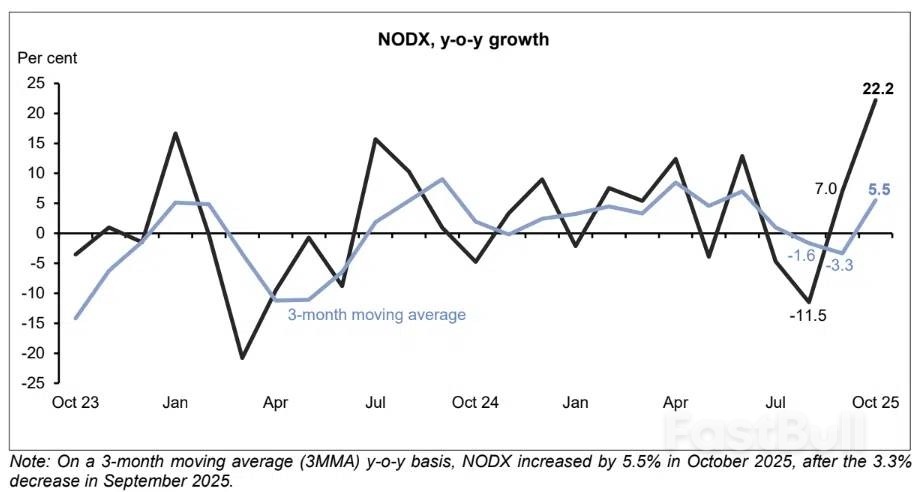
          Singapore's key exports expanded 22.2 per cent in October, beating expectations as electronics and non-electronics grew.

          Singapore's key exports expanded 22.2 per cent in October, beating expectations as electronics and non-electronics grew.

          Non-oil domestic exports (Nodx) expanded 22.2 per cent in October from a year ago, after a revised 7 per cent expansion in September, data from Enterprise Singapore (EnterpriseSG) on Nov 17 showed.

          The reading was well above the 7.5 per cent rise forecast by economists in a Bloomberg poll.

          Shipments of electronic products rose 33.2 per cent in October, extending the 30.4 per cent rise in the previous month.

          The rise came on the back of an 77.7 per cent surge in personal computer exports. Shipments grew 31.4 per cent for disk media products and 40.9 per cent for integrated circuits (ICs), or chips.

          Non-electronics shipments, of which pharmaceuticals are a big part, expanded 18.8 per cent year on year in October, following the 0.5 per cent increase in the previous month.

          The growth was led by an 176.8 per cent jump in non-monetary gold exports, a 25.2 per cent increase for pharmaceuticals and a 16.1 per cent rise for specialised machinery.

          Nodx to Taiwan expanded 61.5 per cent, extending the 31.9 per cent rise in September, due to a 119.8 per cent jump in specialised machinery exports, a 30.7 per cent rise in ICs and a 289.1 per cent jump in disk media products.

          Those to Thailand expanded 91.1 per cent in October, extending the 23.9 per cent growth in the previous month, as non-monetary gold exports jumped 844.6 per cent, while shipments in ICs increased 73.9 per cent and bare printed circuit boards were up 71.3 per cent.

          Nodx to Hong Kong expanded 66.9 per cent in October, from the 56.3 per cent expansion in the previous month, on the back of a 93.3 per cent growth in shipments of ICs, while specialised machinery exports jumped 848.1 per cent and those of non-monetary gold were up 68.9 per cent.

          Key exports to the United States, Singapore's single largest export market, declined 12.5 per cent, while those to Japan dropped 0.1 per cent.
          Source: Straitstimes

          To stay updated on all economic events of today, please check out our Economic calendar
          Risk Warnings and Disclaimers
          You understand and acknowledge that there is a high degree of risk involved in trading. Following any strategies or investment methods may lead to potential losses. The content on the site is provided by our contributors and analysts for information purposes only. You are solely responsible for determining whether any trading assets, securities, strategy, or any other product is suitable for investing based on your own investment objectives and financial situation.
          Add to Favorites
          Share

          FAA Lifts All Remaining Flight Cuts Imposed During Shutdown

          Samantha Luan

          Forex

          Political

          Economic

          US airlines will be able to resume normal operations starting Monday after more than a week of government-mandated flight reductions.

          The US Transportation Department and Federal Aviation Administration announced late Sunday that they would lift cuts across 40 major US airports that were imposed during the government shutdown from 6 a.m. Monday. On Friday, they had reduced the share of canceled domestic flights to 3% from 6%.

          The cuts first went into effect on Nov. 7 at a rate of 4% and were supposed to slowly increase to 10% by Nov. 14. However, the government froze the rate at 6% Wednesday, shortly before President Donald Trump signed legislation to end the longest federal closure in US history.

          Transportation Secretary Sean Duffy and FAA Administrator Bryan Bedford have said reducing flight capacity was necessary to ease strain on air traffic controllers, who were working without pay during the shutdown. They said the FAA assessed safety data, including reports from pilots on controller responsiveness, when making the decision, but haven't publicly offered specific findings or numbers, despite some airline executives and lawmakers seeking that information.

          Source: Bloomberg Europe

          To stay updated on all economic events of today, please check out our Economic calendar
          Risk Warnings and Disclaimers
          You understand and acknowledge that there is a high degree of risk involved in trading. Following any strategies or investment methods may lead to potential losses. The content on the site is provided by our contributors and analysts for information purposes only. You are solely responsible for determining whether any trading assets, securities, strategy, or any other product is suitable for investing based on your own investment objectives and financial situation.
          Add to Favorites
          Share

          Political And Policy Volatility On The Rise

          Winkelmann

          Forex

          Political

          Economic

          Recent elections in the U.S. and dynamics in Europe highlight rising political volatility and the potential for divergent policy shifts. Investors should prepare for further turbulence ahead.

          While last week's tech-led sell-off is yet another example of the equity market volatility investors have been contending with throughout the year, recent elections in the U.S. and political dynamics across Europe show political volatility is on the rise and heading higher than we have seen in decades.

          The November 4 election of Democratic socialist Zohran Mamdani as the new mayor of New York City is a fresh example of how volatile the political environment is in the U.S., with the striking recent rise of rightwing populist parties in France, Germany and the U.K. demonstrating the breadth of this development.

          This may not be front of mind now as U.S. equity markets gyrate over concerns over AI—a topic we covered recently AI: Boom? Bust? Or Both?—and the risk of a hawkish pivot by the Federal Reserve. But as we look toward 2026, political volatility across key western economies will need to be closely watched by investors as it poses important implications for policy decision-making and risk markets.

          Polarization and Policy Swings

          Political volatility may feel commonplace in the U.S. and around the world, but Mamdani's victory provides a fresh jolt and tangible reminder of its underlying causes.

          Despite an economy in decent shape, economic anxiety among voters has been rising and shifting across a broad base. At its simplest, we can view this shift as 'blue-collar' workers impacted by automation gravitating toward right-leaning populism, while 'white-collar' workers facing a tougher job market are being drawn more toward the political left.

          What this ultimately points to is the end of the post-war consensus era in political leadership. The political divides are now greater, increasing tail risks and uncertainty around policy trajectories in a way we have not seen over at least the past 50 years. Indeed, there has been more agreement than not among ruling political parties, creating greater stability and certainty in policy direction and decision-making.

          As this new era of political division develops, several areas show meaningful read-through, financial, energy, technology/AI and antitrust policy chief among them.

          Financial regulatory regimes can be heavily influenced by changes in political leadership, e.g., stricter oversight under progressive administrations versus a more deregulatory bias under conservative administrations. Shifts in supervisory intensity, capital requirements, consumer protection rules and enforcement priorities can alter cost of capital, lending growth and profitability across the financial sector.

          Energy policy presents similarly sharp contrasts. Climate‑first approaches imply tighter emissions standards, accelerated renewable deployment and a changing investment mix; fossil‑fuel‑friendly policies typically aim to reduce permitting friction and support traditional energy production. These swings can influence capex decisions, project economics and commodity paths, and can often also serve as the transmission channel for geopolitical shocks via energy prices.

          On the technology/AI front, a patchwork of state‑level rules is already emerging; stricter regimes are being contemplated in states such as New York, California and Colorado versus looser frameworks in Texas and Florida. This fragmentation raises compliance costs, complicates product rollouts and can confer uneven competitive advantages depending on where firms operate and where standards coalesce. Divergent approaches to antitrust policy under different administrations also matter, reshaping the competitive landscape for large‑cap tech and influencing broader market structure dynamics, from M&A viability to platform conduct.

          Investment Implications

          Amid higher political volatility and policy uncertainty, investing becomes more complex, affecting time horizons, portfolio construction and asset allocation.

          Investing for the long term should remain a core principle, but the environment argues for greater agility, e.g., shorter tactical horizons and flexible allocations to navigate regime shifts without abandoning strategic objectives.

          At the company and industry level, the priority is resilience to policy swings. Investors should assess policy sensitivity across sectors, recognizing that financials, energy and large‑platform tech typically carry higher "policy beta" than many other industries. The preference is to tilt toward business models with diversified revenue sources, adaptable cost structures and robust balance sheets that can absorb regulatory or fiscal shocks.

          As part of this, building clear policy scenarios into portfolios and risk budgets is warranted; consider progressive versus conservative control at federal and state levels. Stress-test how these paths could affect revenues, margins, investment plans and the cost of capital. Scenario‑based position-sizing can help manage the wider dispersion of outcomes and the higher tracking error that accompanies policy‑sensitive views.

          To support the approach, use cross-asset diversification to help manage risk and ensure adequate liquidity. Public markets provide greater ability to adjust positions quickly to policy shifts, while private markets tend to exhibit more constrained exit optionality.

          Volatility Demands Agility

          Political volatility is now a central feature of investing, not background noise. With the U.S. midterm elections approaching, the pace and visibility of policy shifts are likely to increase, raising both risk and opportunity.

          For investors, it's imperative to be prepared to act with agility as the policy cycle turns. Those who combine long‑term discipline with tactical flexibility will be better positioned to protect capital and capture opportunity in an environment defined by wider policy outcomes and faster market repricing.

          Source: Neuberger Berman

          To stay updated on all economic events of today, please check out our Economic calendar
          Risk Warnings and Disclaimers
          You understand and acknowledge that there is a high degree of risk involved in trading. Following any strategies or investment methods may lead to potential losses. The content on the site is provided by our contributors and analysts for information purposes only. You are solely responsible for determining whether any trading assets, securities, strategy, or any other product is suitable for investing based on your own investment objectives and financial situation.
          Add to Favorites
          Share

          Peter Thiel Dumps Entire Nvidia Stake, Slashes Tesla Holdings Amid Bubble Fears

          Justin

          Stocks

          Economic

          Billionaire Peter Thiel has exited his entire stake in artificial intelligence major Nvidia, filings showed over the weekend, amid growing concerns over an AI-fueled bubble in technology valuations.

          Thiel sold some 537,742 shares in NVIDIA Corporation (NASDAQ:NVDA) through the July-September period, with a Form 13F filing from his Thiel Macro fund showing that he no longer held any shares in Nvidia as of September 30.

          The sale price of the shares amounts to nearly $100 million, Investing.com calculations showed, based on Nvidia's average stock price in the July-September period.

          Thiel also slashed his holding in Tesla Inc (NASDAQ:TSLA) to 65,000 shares from 272,613 shares, and purchased 79,181 and 49,000 shares in Apple Inc (NASDAQ:AAPL) and Microsoft Corporation (NASDAQ:MSFT), respectively.

          Thiel also entirely exited his stake in energy generation firm Vistra Energy Corp (NYSE:VST), which amounted to 208,747 shares, the Form 13f showed.

          Thiel's disclosed sale in Nvidia comes just a week after Japanese tech conglomerate SoftBank Group Corp. (TYO:9984) disclosed it had sold off its entire stake in the firm. Last week, investor Michael Burry, famous for predicting the 2008 financial crisis, also disclosed heavy short positions on Nvidia and Palantir Technologies Inc (NASDAQ:PLTR).

          The rationale behind Thiel's sale was not immediately clear.

          Thiel– who co-founded Paypal and Palantir– had earlier this year warned over stretched valuations in Nvidia, and had earlier also compared the recent spike in tech valuations to the 1999-2000 Dotcom bubble crash.

          His exit from Nvidia comes amid rapidly increasing concerns over an AI-fueled bubble in tech valuations. Investors fretted over how AI major OpenAI planned to meet its over $1 trillion spending commitments, and how this could affect Nvidia and other chipmakers, which are major suppliers to the firm.

          Nvidia's investment in OpenAI also sparked concerns over circular financing, while a host of recent megacap tech earnings showed rapidly increasing capital expenditures on AI among Wall Street's biggest firms.

          Source: Investing

          To stay updated on all economic events of today, please check out our Economic calendar
          Risk Warnings and Disclaimers
          You understand and acknowledge that there is a high degree of risk involved in trading. Following any strategies or investment methods may lead to potential losses. The content on the site is provided by our contributors and analysts for information purposes only. You are solely responsible for determining whether any trading assets, securities, strategy, or any other product is suitable for investing based on your own investment objectives and financial situation.
          Add to Favorites
          Share

          Japan’s Tourism Shares Drop After China Warning On Travel

          Samantha Luan

          Stocks

          Economic

          Japanese tourism and retail-related stocks slumped Monday after Beijing warned its citizens against traveling to and studying in Japan amid a deepening diplomatic spat between the nations.

          Cosmetics firm Shiseido Co.'s shares plummeted as much as 11%, the most since April, with Pan Pacific International Holdings, which operates Don Quijote retail stores, plunging as much as 8.9%, the most since August 2024. The two companies are popular with Chinese tourists.

          Department store operator Isetan Mitsukoshi Holdings lost over 12% with its peers J Front Retailing Co. and Takashimaya Co. down over 6%. Meanwhile, Tokyo Disney Resort operator Oriental Land Co. shares fell over 5% and Uniqlo parent Fast Retailing dipped 6.9%, the most since mid-July.

          The declines come after Beijing warned students planning to study in Japan of heightened risks for Chinese citizens in the country. The directive followed comments by Japanese Prime Minister Sanae Takaichi that military force used in any Taiwan conflict could be considered a "survival-threatening situation."

          Read: China Warns Its Students in Japan of Risks as Tensions Rise

          China's warning "threatens tourism-led sales-growth expectations" for Japanese retailers, said Catherine Lim, a senior analyst at Bloomberg Intelligence.

          There's also "heightened risk of boycotts of Japanese goods within China," which could hurt mainland China sales of Uniqlo, Asics Corp and Ryohin Keikaku Co.'s Muji, she added.

          Travel-related names were hit Monday morning too, with airline operator ANA Holdings Inc. falling 3.8% and hotel chain firm Kyoritsu Maintenance Co. down as much as 8.1%.

          Source: Bloomberg Europe

          To stay updated on all economic events of today, please check out our Economic calendar
          Risk Warnings and Disclaimers
          You understand and acknowledge that there is a high degree of risk involved in trading. Following any strategies or investment methods may lead to potential losses. The content on the site is provided by our contributors and analysts for information purposes only. You are solely responsible for determining whether any trading assets, securities, strategy, or any other product is suitable for investing based on your own investment objectives and financial situation.
          Add to Favorites
          Share

          Trump Says He’d Back Bill To Sanction Russia’s Trading Partners

          Justin

          Forex

          Political

          Economic

          President Donald Trump said proposed Senate legislation to sanction countries conducting business with Russia would be "okay with me," his strongest indication yet that he would support a monthslong push to strangle Moscow's funding.

          "The Republicans are putting in legislation that is very tough sanctioning, etcetera, on any country doing business with Russia," Trump told reporters before leaving Florida on Sunday to return to the White House.

          Senate Majority Leader John Thune said in October that he was ready to bring legislation long championed by Senator Lindsey Graham of South Carolina that sanctions Russia to a vote, but didn't "want to commit to a hard deadline."

          The bill would allow Trump to impose tariffs of up to 500% on imports from countries that buy Russian energy products and are not actively supporting Ukraine. This specifically targets major consumers of Russian energy, such as China and India.

          "We may add Iran to that," Trump said Sunday, without elaborating.

          Democrats and some Republicans in Congress have pushed for legislation to punish Russia for its continued war on Ukraine. Trump had been reluctant to support it as he tried to bring Russian President Vladimir Putin to peace talks with Ukrainian President Volodymyr Zelenskiy.

          Putin is showing no sign of letting up in his military campaign after almost four years of war in Ukraine, with Trump failing to sway Putin even after hosting the Russian leader for a summit in Alaska.

          While Ukraine is increasingly striking Russian oil targets, Russia has intensified its air strikes on Ukraine and is pushing to capture the rail hub of Pokrovsk.

          Source: Bloomberg Europe

          To stay updated on all economic events of today, please check out our Economic calendar
          Risk Warnings and Disclaimers
          You understand and acknowledge that there is a high degree of risk involved in trading. Following any strategies or investment methods may lead to potential losses. The content on the site is provided by our contributors and analysts for information purposes only. You are solely responsible for determining whether any trading assets, securities, strategy, or any other product is suitable for investing based on your own investment objectives and financial situation.
          Add to Favorites
          Share

          Japan's Economy Contracts As Exports Get Hit By US Tariffs

          Isaac Bennett

          Japan's economy sank at an annualized rate of 1.8% in the July-September period, government data showed Monday, as President Donald Trump's tariffs sent the nation's exports spiraling.

          On a quarter-by-quarter basis, Japan's gross domestic product, or GDP, or the sum value of a nation's goods and services, slipped 0.4%, in the first contraction in six quarters, the Cabinet Office said.

          The annualized rate shows what the economy would have done if the same rate were to continue for a year. The fall was still smaller than the 0.6% drop the market had expected.

          A big decline during the quarter came in exports, which were 1.2% down from the previous quarter.

          Some businesses had sped up exports, when they could, to beat the tariffs kicking in, inflating some of the earlier data for exports.

          On an annualized basis, exports dropped 4.5% in the three months through September.

          Imports for the third quarter slipped 0.1%. Private consumption edged up 0.1% during the quarter.

          Tariffs are a major blow to Japan's export-reliant economy, led by powerful automakers like Toyota Motor Corp., although such manufacturers have over the years moved production abroad to avert the blunt of tariffs.

          The U.S. now slaps a 15% tariff on nearly all Japanese imports.

          Japan also faced political uncertainty recently, until Sanae Takaichi became prime minister in October.

          Source: Yahoo Finance

          Risk Warnings and Disclaimers
          You understand and acknowledge that there is a high degree of risk involved in trading. Following any strategies or investment methods may lead to potential losses. The content on the site is provided by our contributors and analysts for information purposes only. You are solely responsible for determining whether any trading assets, securities, strategy, or any other product is suitable for investing based on your own investment objectives and financial situation.
          Add to Favorites
          Share
          FastBull
          Copyright © 2025 FastBull Ltd

          728 RM B 7/F GEE LOK IND BLDG NO 34 HUNG TO RD KWUN TONG KLN HONG KONG

          TelegramInstagramTwitterfacebooklinkedin
          App Store Google Play Google Play
          Products
          Charts

          Chats

          Q&A with Experts
          Screeners
          Economic Calendar
          Data
          Tools
          Membership
          Features
          Function
          Markets
          Copy Trading
          Latest Signals
          Contests
          News
          Analysis
          24/7
          Columns
          Education
          Company
          Careers
          About Us
          Contact Us
          Advertising
          Help Center
          Feedback
          User Agreement
          Privacy Policy
          Business

          White Label

          Data API

          Web Plug-ins

          Poster Maker

          Affiliate Program

          Risk Disclosure

          The risk of loss in trading financial instruments such as stocks, FX, commodities, futures, bonds, ETFs and crypto can be substantial. You may sustain a total loss of the funds that you deposit with your broker. Therefore, you should carefully consider whether such trading is suitable for you in light of your circumstances and financial resources.

          No decision to invest should be made without thoroughly conducting due diligence by yourself or consulting with your financial advisors. Our web content might not suit you since we don't know your financial conditions and investment needs. Our financial information might have latency or contain inaccuracy, so you should be fully responsible for any of your trading and investment decisions. The company will not be responsible for your capital loss.

          Without getting permission from the website, you are not allowed to copy the website's graphics, texts, or trademarks. Intellectual property rights in the content or data incorporated into this website belong to its providers and exchange merchants.

          Not Logged In

          Log in to access more features

          FastBull Membership

          Not yet

          Purchase

          Become a signal provider
          Help Center
          Customer Service
          Dark Mode
          Price Up/Down Colors

          Log In

          Sign Up

          Position
          Layout
          Fullscreen
          Default to Chart
          The chart page opens by default when you visit fastbull.com