• Trade
  • Markets
  • Copy
  • Contests
  • News
  • 24/7
  • Calendar
  • Q&A
  • Chats
Trending
Screeners
SYMBOL
LAST
BID
ASK
HIGH
LOW
NET CHG.
%CHG.
SPREAD
SPX
S&P 500 Index
6827.42
6827.42
6827.42
6899.86
6801.80
-73.58
-1.07%
--
DJI
Dow Jones Industrial Average
48458.04
48458.04
48458.04
48886.86
48334.10
-245.98
-0.51%
--
IXIC
NASDAQ Composite Index
23195.16
23195.16
23195.16
23554.89
23094.51
-398.69
-1.69%
--
USDX
US Dollar Index
97.920
98.000
97.920
98.070
97.810
-0.030
-0.03%
--
EURUSD
Euro / US Dollar
1.17450
1.17458
1.17450
1.17596
1.17262
+0.00056
+ 0.05%
--
GBPUSD
Pound Sterling / US Dollar
1.33855
1.33862
1.33855
1.33961
1.33546
+0.00148
+ 0.11%
--
XAUUSD
Gold / US Dollar
4332.15
4332.56
4332.15
4350.16
4294.68
+32.76
+ 0.76%
--
WTI
Light Sweet Crude Oil
56.850
56.880
56.850
57.601
56.789
-0.383
-0.67%
--

Community Accounts

Signal Accounts
--
Profit Accounts
--
Loss Accounts
--
View More

Become a signal provider

Sell trading signals to earn additional income

View More

Guide to Copy Trading

Get started with ease and confidence

View More

Signal Accounts for Members

All Signal Accounts

Best Return
  • Best Return
  • Best P/L
  • Best MDD
Past 1W
  • Past 1W
  • Past 1M
  • Past 1Y

All Contests

  • All
  • Trump Updates
  • Recommend
  • Stocks
  • Cryptocurrencies
  • Central Banks
  • Featured News
Top News Only
Share

Portugal Treasury Expects 2026 Net Financing Needs At 29.4 Billion Euros, Up From 25.8 Billion In 2025

Share

Bank Of America Says With Indonesia's Smelter Now Ramping Up, It Expects Aluminium Supply Growth To Accelerate To 2.6% Year On Year In 2026

Share

Bank Of America Expects A Deficit In Aluminium Next Year And Sees Prices Pushing Above $3000/T

Share

Fed Data - USA Effective Federal Funds Rate At 3.64 Percent On 12 December On $102 Billion In Trades Versus 3.64 Percent On $99 Billion On 11 December

Share

Brazil's Petrobras Says No Impact Seen On Oil, Petroleum Products Output As Workers Start Planned Strike

Share

Statement: US Travel Group Warns New Proposed Trump Administration Requirements For Foreign Tourists To Provide Social Media Histories Could Mean Millions Of People Opting Not To Visit

Share

Blackrock: Kerry White Will Become Head Of Citi Investment Management At Citi Wealth

Share

Blackrock: Rob Jasminski, Head Of Citi Investment Management, Has Joined With Team

Share

Blackrock: Effective Dec 15, Citi Investment Management Employees Will Join Blackrock

Share

Blackrock: Formally Launch Citi Portfolio Solutions Powered By Blackrock

Share

According To Data From The Federal Reserve Bank Of New York, The Secured Overnight Funding Rate (Sofr) Was 3.67% On The Previous Trading Day (December 15), Compared To 3.66% The Day Before

Share

Peru Energy And Mines Ministry: Copper Production Up 4.8% Year-On-Year In October To 248192 Metric Tons

Share

Security Source: Ukrainian Drones Hits Russian Oil Infrastructure In Caspian Sea For Third Time

Share

Spot Palladium Extends Gains, Last Up 5% To $1562.7/Oz

Share

Mexico's Economy Ministry Announces Start Of Anti-Dumping Investigation And Anti-Subsidy Investigations Into USA Pork Imports

Share

Canada Nov CPI Common +2.8%, CPI Median +2.8%, CPI Trim +2.8% On Year

Share

NY Fed's Empire State Prices Paid Index +37.6 In December Versus+49.0 In November

Share

Canada Nov Consumer Prices +0.1% On Month, +2.2% On Year

Share

Canada Nov CPI Core -0.1% On Month, +2.9% On Year

Share

Canada Nov Core CPI, Seasonally Adjusted +0.2% On Month, Oct +0.3% (Unrevised)

TIME
ACT
FCST
PREV
Japan Tankan Small Manufacturing Outlook Index (Q4)

A:--

F: --

P: --

Japan Tankan Large Non-Manufacturing Outlook Index (Q4)

A:--

F: --

P: --

Japan Tankan Large Manufacturing Outlook Index (Q4)

A:--

F: --

P: --

Japan Tankan Small Manufacturing Diffusion Index (Q4)

A:--

F: --

P: --

Japan Tankan Large Manufacturing Diffusion Index (Q4)

A:--

F: --

P: --

Japan Tankan Large-Enterprise Capital Expenditure YoY (Q4)

A:--

F: --

P: --

U.K. Rightmove House Price Index YoY (Dec)

A:--

F: --

P: --

China, Mainland Industrial Output YoY (YTD) (Nov)

A:--

F: --

P: --

China, Mainland Urban Area Unemployment Rate (Nov)

A:--

F: --

P: --

Saudi Arabia CPI YoY (Nov)

A:--

F: --

P: --

Euro Zone Industrial Output YoY (Oct)

A:--

F: --

P: --

Euro Zone Industrial Output MoM (Oct)

A:--

F: --

P: --

Canada Existing Home Sales MoM (Nov)

A:--

F: --

P: --

Canada National Economic Confidence Index

A:--

F: --

P: --

Canada New Housing Starts (Nov)

A:--

F: --

P: --
U.S. NY Fed Manufacturing Employment Index (Dec)

A:--

F: --

P: --

U.S. NY Fed Manufacturing Index (Dec)

A:--

F: --

P: --

Canada Core CPI YoY (Nov)

A:--

F: --

P: --

Canada Manufacturing Unfilled Orders MoM (Oct)

A:--

F: --

P: --

U.S. NY Fed Manufacturing Prices Received Index (Dec)

A:--

F: --

P: --

U.S. NY Fed Manufacturing New Orders Index (Dec)

A:--

F: --

P: --

Canada Manufacturing New Orders MoM (Oct)

A:--

F: --

P: --

Canada Core CPI MoM (Nov)

A:--

F: --

P: --

Canada Trimmed CPI YoY (SA) (Nov)

A:--

F: --

P: --

Canada Manufacturing Inventory MoM (Oct)

A:--

F: --

P: --

Canada CPI YoY (Nov)

A:--

F: --

P: --

Canada CPI MoM (Nov)

A:--

F: --

P: --

Canada CPI YoY (SA) (Nov)

A:--

F: --

P: --

Canada Core CPI MoM (SA) (Nov)

A:--

F: --

P: --

Canada CPI MoM (SA) (Nov)

A:--

F: --

P: --

Federal Reserve Board Governor Milan delivered a speech
U.S. NAHB Housing Market Index (Dec)

--

F: --

P: --

Australia Composite PMI Prelim (Dec)

--

F: --

P: --

Australia Services PMI Prelim (Dec)

--

F: --

P: --

Australia Manufacturing PMI Prelim (Dec)

--

F: --

P: --

Japan Manufacturing PMI Prelim (SA) (Dec)

--

F: --

P: --

U.K. 3-Month ILO Employment Change (Oct)

--

F: --

P: --

U.K. Unemployment Claimant Count (Nov)

--

F: --

P: --

U.K. Unemployment Rate (Nov)

--

F: --

P: --

U.K. 3-Month ILO Unemployment Rate (Oct)

--

F: --

P: --

U.K. Average Weekly Earnings (3-Month Average, Including Bonuses) YoY (Oct)

--

F: --

P: --

U.K. Average Weekly Earnings (3-Month Average, Excluding Bonuses) YoY (Oct)

--

F: --

P: --

France Services PMI Prelim (Dec)

--

F: --

P: --

France Composite PMI Prelim (SA) (Dec)

--

F: --

P: --

France Manufacturing PMI Prelim (Dec)

--

F: --

P: --

Germany Services PMI Prelim (SA) (Dec)

--

F: --

P: --

Germany Manufacturing PMI Prelim (SA) (Dec)

--

F: --

P: --

Germany Composite PMI Prelim (SA) (Dec)

--

F: --

P: --

Euro Zone Composite PMI Prelim (SA) (Dec)

--

F: --

P: --

Euro Zone Services PMI Prelim (SA) (Dec)

--

F: --

P: --

Euro Zone Manufacturing PMI Prelim (SA) (Dec)

--

F: --

P: --

U.K. Services PMI Prelim (Dec)

--

F: --

P: --

U.K. Manufacturing PMI Prelim (Dec)

--

F: --

P: --

U.K. Composite PMI Prelim (Dec)

--

F: --

P: --

Euro Zone ZEW Economic Sentiment Index (Dec)

--

F: --

P: --

Germany ZEW Current Conditions Index (Dec)

--

F: --

P: --

Germany ZEW Economic Sentiment Index (Dec)

--

F: --

P: --

Euro Zone Trade Balance (Not SA) (Oct)

--

F: --

P: --

Euro Zone ZEW Current Conditions Index (Dec)

--

F: --

P: --

Euro Zone Trade Balance (SA) (Oct)

--

F: --

P: --

U.S. Retail Sales MoM (Excl. Automobile) (SA) (Oct)

--

F: --

P: --

Q&A with Experts
    • All
    • Chatrooms
    • Groups
    • Friends
    Connecting
    .
    .
    .
    Type here...
    Add Symbol or Code

      No matching data

      All
      Trump Updates
      Recommend
      Stocks
      Cryptocurrencies
      Central Banks
      Featured News
      • All
      • Russia-Ukraine Conflict
      • Middle East Flashpoint
      • All
      • Russia-Ukraine Conflict
      • Middle East Flashpoint
      Search
      Products

      Charts Free Forever

      Chats Q&A with Experts
      Screeners Economic Calendar Data Tools
      Membership Features
      Data Warehouse Market Trends Institutional Data Policy Rates Macro

      Market Trends

      Market Sentiment Order Book Forex Correlations

      Top Indicators

      Charts Free Forever
      Markets

      News

      News Analysis 24/7 Columns Education
      From Institutions From Analysts
      Topics Columnists

      Latest Views

      Latest Views

      Trending Topics

      Top Columnists

      Latest Update

      Signals

      Copy Rankings Latest Signals Become a signal provider AI Rating
      Contests
      Brokers

      Overview Brokers Assessment Rankings Regulators News Claims
      Broker listing Forex Brokers Comparison Tool Live Spread Comparison Scam
      Q&A Complaint Scam Alert Videos Tips to Detect Scam
      More

      Business
      Events
      Careers About Us Advertising Help Center

      White Label

      Data API

      Web Plug-ins

      Affiliate Program

      Awards Institution Evaluation IB Seminar Salon Event Exhibition
      Vietnam Thailand Singapore Dubai
      Fans Party Investment Sharing Session
      FastBull Summit BrokersView Expo
      Recent Searches
        Top Searches
          Markets
          News
          Analysis
          User
          24/7
          Economic Calendar
          Education
          Data
          • Names
          • Latest
          • Prev

          View All

          No data

          Scan to Download

          Faster Charts, Chat Faster!

          Download App
          English
          • English
          • Español
          • العربية
          • Bahasa Indonesia
          • Bahasa Melayu
          • Tiếng Việt
          • ภาษาไทย
          • Français
          • Italiano
          • Türkçe
          • Русский язык
          • 简中
          • 繁中
          Open Account
          Search
          Products
          Charts Free Forever
          Markets
          News
          Signals

          Copy Rankings Latest Signals Become a signal provider AI Rating
          Contests
          Brokers

          Overview Brokers Assessment Rankings Regulators News Claims
          Broker listing Forex Brokers Comparison Tool Live Spread Comparison Scam
          Q&A Complaint Scam Alert Videos Tips to Detect Scam
          More

          Business
          Events
          Careers About Us Advertising Help Center

          White Label

          Data API

          Web Plug-ins

          Affiliate Program

          Awards Institution Evaluation IB Seminar Salon Event Exhibition
          Vietnam Thailand Singapore Dubai
          Fans Party Investment Sharing Session
          FastBull Summit BrokersView Expo

          Silver Borrowing Costs Surge on Tariff-Driven Supply Jitters

          Michelle

          Economic

          Commodity

          Summary:

          Surging lease rates for silver are once again upending the precious metals market, with traders fearing that possible US tariffs could squeeze already tight supplies in London as price dislocations re-emerge between key trading hubs.

          Surging lease rates for silver are once again upending the precious metals market, with traders fearing that possible US tariffs could squeeze already tight supplies in London as price dislocations re-emerge between key trading hubs.

          Washington last month categorized silver as critical to US national security, fueling worries that its new status may draw the attention of President Donald Trump, who ordered an investigation into critical minerals in April. That’s sent futures in New York above the international benchmark as traders price in the risk of silver getting hit with tariffs, and holders scramble to ship the white metal into the US to capture premiums.

          “The US market’s concern is that the metal might be subject to tariffs,” Bernard Dahdah, an analyst at Natixis, said in an emailed note. “This demand for physical is in turn reducing the pool of available leasable material in London and as such lifting silver’s lease rate.”

          Physical supplies of silver were already looking tight, with European refiners focused on recasting gold bars in recent weeks due to confusion over Trump’s tariffs. Meanwhile, inventories in London have dwindled as investors pile into exchange-traded funds backed by gold and silver, which have clocked year-to-date gains of more than 35% and 40% respectively.

          That scarcity is already filtering through to the market. Silver futures on Comex are trading at an elevated premium of about 70 cents above London’s benchmark spot price, and the cost of borrowing silver in the UK capital on a short-term basis has spiked above 5% for the fifth time this year — well above historical levels of near-zero.

          Prices in one year have gone lower than today’s price — a rare event reflecting stronger demand for metal that’s immediately available. That could be because dealers are looking to move metal to the US before possible levies are imposed.

          It was price ructions like these that helped traders at top banks including JPMorgan Chase & Co. and Morgan Stanley mint money earlier this year, when Trump’s sweeping tariff agenda roiled global financial and commodity markets. The unusually large spread between London and New York pulled huge volumes of bullion into the US as traders chased premiums, though that trade quickly collapsed in April after precious metals were exempted from duties.

          So far in September, there have been larger-than-normal deliveries planned against Comex futures expiring this month, mostly on behalf of bullion banks’ clients, according to exchange data from CME. The data does not indicate whether the deliveries are being used to profit from the higher price differentials, or simply to exit existing short positions. Inventories at Comex warehouses have also expanded slightly over the last month, with volumes for silver now sitting at the highest levels in records going back to 1992.

          But doubts linger over Trump’s tariffs, and “it is incredibly difficult to trade in that uncertainty,” said David Wilson, senior commodities strategist at BNP Paribas SA.

          “If you look at US ETF holdings, they’ve absolutely exploded. So there’s been ongoing demand,” he said. “It wasn’t a one-off” when traders shipped huge quantities of bullion to New York earlier in the year to capture US premiums. With more investors beginning to buy into the idea that both gold and silver can continue to rally, “it’s possible we won’t get those liquidations,” he added.

          Source: Bloomberg Europe

          To stay updated on all economic events of today, please check out our Economic calendar
          Risk Warnings and Disclaimers
          You understand and acknowledge that there is a high degree of risk involved in trading. Following any strategies or investment methods may lead to potential losses. The content on the site is provided by our contributors and analysts for information purposes only. You are solely responsible for determining whether any trading assets, securities, strategy, or any other product is suitable for investing based on your own investment objectives and financial situation.
          Add to Favorites
          Share

          BTC Eyes $120K With Bullish H&S Pattern: Technical Analysis

          Glendon

          Cryptocurrency

          Bitcoin BTC$111,985.24 may not have rallied on Friday's dismal jobs data, which strengthened the Federal Reserve’s rate cuts, but all hope is not lost.

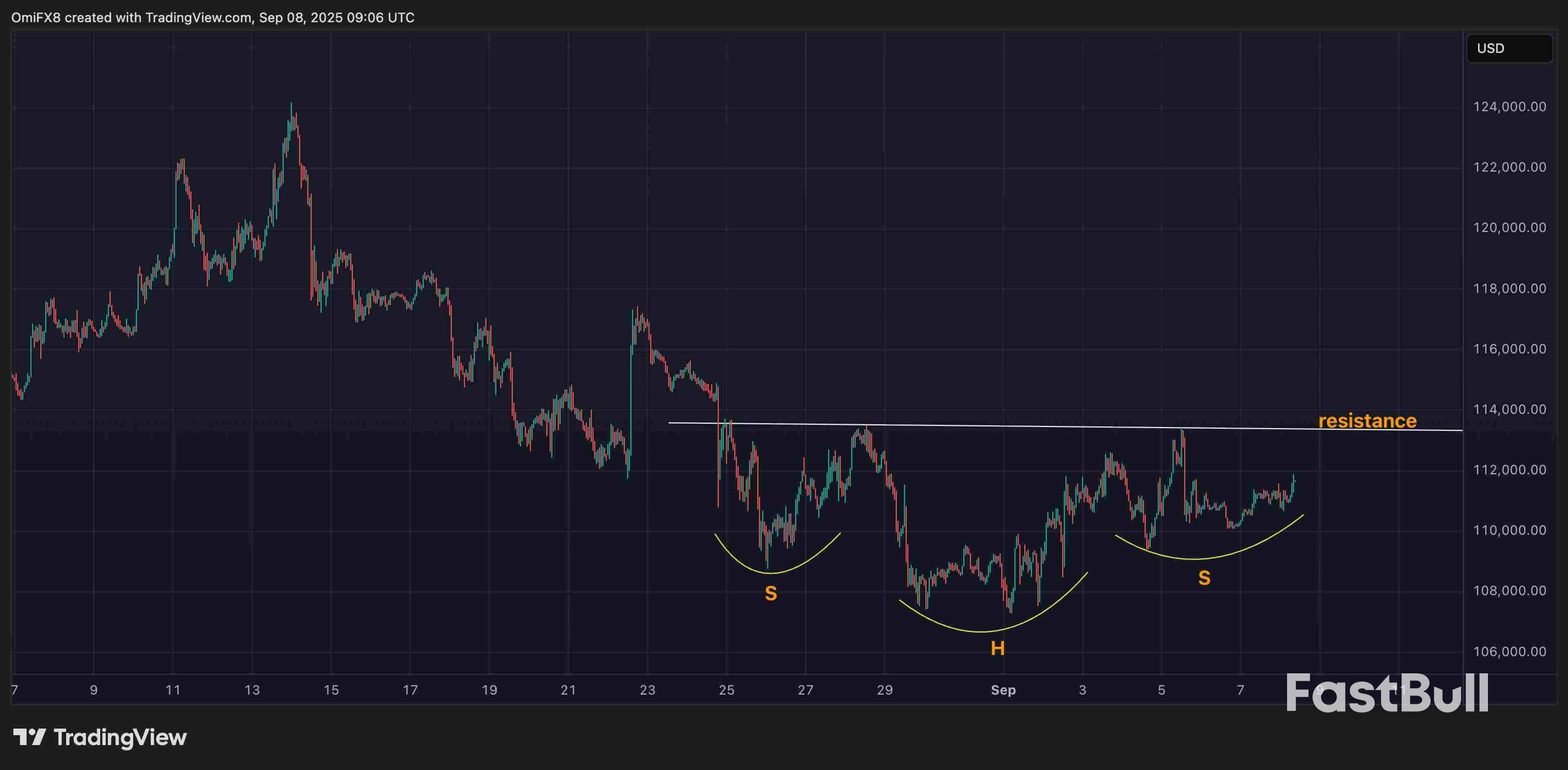
          A shorter-duration chart reveals that BTC is forming a bullish inverse head-and-shoulders pattern – a classic reversal setup – suggesting a potential surge toward $120,000.

          An inverse Head and Shoulders (H&S) is a bullish reversal pattern characterized by three troughs: a deeper central trough (the "head") flanked by two smaller but roughly equal troughs (the "shoulders"). The pattern includes a neckline, which is a horizontal trendline connecting the peaks of price recoveries between the troughs.

          A decisive breakout above this neckline confirms the reversal from a downtrend to an uptrend. The resulting rally is typically expected to be approximately equal in height to the distance between the deepest trough (head) and the neckline.

          As of writing, BTC looked to be forming the right shoulder of the inverted H&S pattern, with the neckline resistance at $113,378. A move above that would trigger the bullish breakout, opening the door for a rally to nearly $120,000.

          BTC's hourly chart. (TradingView/CoinDesk)

          The pattern would be invalidated in case of a move below $107,300, reinforcing the bearish setup on the daily chart. In that case, the focus would shift to the 200-day simple moving average support near $101,850.

          Source: CoinDesk

          Risk Warnings and Disclaimers
          You understand and acknowledge that there is a high degree of risk involved in trading. Following any strategies or investment methods may lead to potential losses. The content on the site is provided by our contributors and analysts for information purposes only. You are solely responsible for determining whether any trading assets, securities, strategy, or any other product is suitable for investing based on your own investment objectives and financial situation.
          Add to Favorites
          Share

          Nikkei 225 Rises Following Resignation Of Prime Minister Shigeru Ishiba

          FXOpen

          Economic

          Stocks

          Technical Analysis

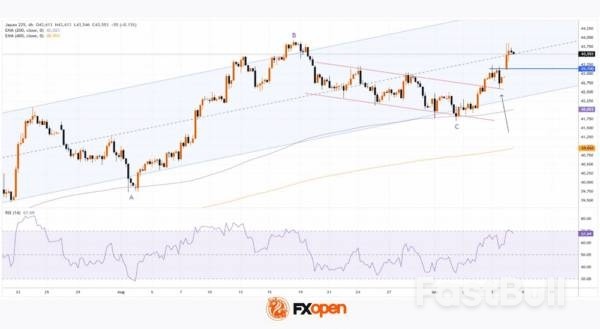
          As the chart shows, Japan’s Nikkei 225 stock index today approached its historic peak (B) around the 43,900 level.Bullish sentiment was driven by political news. According to Reuters, Prime Minister Shigeru Ishiba has stepped down. The leading candidate to replace him, Sanae Takaichi, is regarded as a supporter of stimulus measures and unprecedented monetary easing – a bullish factor for companies.

          Technical Analysis of the Nikkei 225

          As indicated by the 200- and 400-period moving averages on the 4-hour chart, Japan’s stock market remains in a long-term uptrend. This summer, index movements have been forming an ascending channel, highlighted in blue, with the lower boundary acting as strong support.

          Other bullish signs include:

          → A bullish structure, highlighted by a normal pullback of around 50% (B→C) following the A→B impulse.

          → During the B→C decline, price movements formed a corridor (marked with red lines) resembling a bullish flag pattern. Its breakout suggests an attempt to resume the upward trend after an interim correction.

          → Recent price action, indicating that former resistance levels have turned into support. This applies both to the upper red line (marked with an arrow) and to last week’s former resistance at 43,150.

          On the other hand:

          → Long upper shadows on today’s candles point to increased selling pressure near the historic peak.

          → The RSI indicator has risen to the overbought territory.

          Given that the index is now around the median of the ascending channel (a level where supply and demand tend to balance), we could assume the market may consolidate in the short term. Possible scenarios include:

          → Attempts to break through the historic high, which may fail – potentially trapping overly optimistic participants and creating signs of a bearish ICT Liquidity Sweep pattern above peak B.

          → A correction with a retest of the 43,150 level.

          Source: FXOpen

          To stay updated on all economic events of today, please check out our Economic calendar
          Risk Warnings and Disclaimers
          You understand and acknowledge that there is a high degree of risk involved in trading. Following any strategies or investment methods may lead to potential losses. The content on the site is provided by our contributors and analysts for information purposes only. You are solely responsible for determining whether any trading assets, securities, strategy, or any other product is suitable for investing based on your own investment objectives and financial situation.
          Add to Favorites
          Share

          How Investors Are Weighing Risk Amid Surging Demand For Nuclear Energy

          Winkelmann

          Economic

          Forex

          Political

          LONDON — Surging power demand has reignited interest in nuclear energy, but vast capital requirements and an uncertain political and regulatory climate raise questions about the sector's fiscal capacity.Tech giants are pumping money into nuclear energy investments, looking to power energy-intensive data centers and realize their AI ambitions.AI and data centers are the "canary in the coal mine," World Nuclear Association Director General Sama Bilbao y León told CNBC ahead of the conference. "We are finally recognizing that the demand of electricity and energy in general is only going to increase. But the reality is that all sectors of the economy are going to need more electricity."

          In addition to AI, applications range from nuclear energy for the metallurgical industry, which is looking to electrify as fast as possible, to the chemical, maritime and shipping sectors, León said.The question of how to meet the world's growing power needs took center stage as chief executives of the world's biggest uranium and nuclear energy firms, experts and investors gathered for the annual World Nuclear Association (WNA) symposium at the Royal Lancaster London hotel last week.

          Opening remarks from Dr Sama Bilbao y León, director general of the World Nuclear Association, at the 2025 conference.

          World Nuclear Association

          Kicking off discussions at the conference, Leon told attendees in her welcoming speech that the event is a "working summit" looking to move past mere conversation.Investments in the nuclear value chain through 2025 are projected to increase to $2.2 trillion, according to Morgan Stanley estimates, up from a 2024 forecast of $1.5 trillion. That level of investment raises questions over the role of government, banks and other financial players in providing sufficient fiscal capacity.

          Investment challenges

          Nuclear energy is said to provide a more reliable, 24/7 energy source compared to renewables, which can be more intermittent. The development of small modular reactors (SMRs) provides a more scalable power solution due to their size. According to the IEA, the payback period of a SMR investment is half the usual 20 to 30-year period for larger scale projects.But SMRs have yet to reach the commercial stage, and most planned projects won't come online until 2030. While a significant amount of money is being pledged, there have been no new large-scale nuclear projects in the U.S. in the last 15 years.

          "The first positive story with respect to the financial sector with regards to nuclear, is that they are open to financing nuclear," Mahesh Goenka, founder of market and commercial advisory firm Old Economy, told CNBC on the sidelines of WNA. "That was not the story a few years ago when a lot of banks didn't want to touch nuclear projects. That has changed. The question now remains, do they have the risk appetite to finance nuclear projects?"Challenges include over-running budgets, the late delivery of projects due to long construction lead times, the technical complexity of initiatives and difficulties obtaining licenses.

          Goenka compared the West to China, where financial institutions are happy to finance nuclear projects because they can be delivered on time and on budget — leading to better margins than on other infrastructure projects. Meanwhile, the West has not built many new reactors in a very long time, so the learning rate is not quite there yet, he said.

          Nearly all of the nuclear generating capacity in the U.S. comes from reactors built between 1967 and 1990, with no new constructions until 2013 when work started on the Vogtle units in Georgia. Meanwhile, the last plant to be built in the U.K. was Sizewell B, which started operating in 1995.Nuclear investments are "inherently political projects," said Mark Muldowney, managing director of energy, resources and infrastructure at BNP Paribas. He noted that, while clients are much more receptive to the investments, uncertainty over cost and build time remains."We are many years away from the situation in which techniques like project finance can be used by themselves to finance large nuclear [projects]," he said during a panel discussion.

          "It's not going to be the contractors, even if they were willing to, and by and large they aren't, they will be bankrupted by some of the risks that sit with these projects. So it's either going to be a government, or it's going to be the electricity consumers of that country, and in some places that could be intermediated by utilities."

          Government backstop still required

          Nuclear power plants are among the most capital intensive assets. The U.K., for example, has greenlit the construction of a massive two-reactor nuclear power station on the Suffolk coast that will generate 3.2 gigawatts of electricity — enough, the government says, to provide power for the equivalent of 6 million homes. But costs of the majority government-owned project have jumped to £38 billion, exceeding an initial target of £20 billion.

          Other major projects have run into similar issues. The Plant Vogtle in Waynesboro, Georgia, ran several years behind schedule and had a budget that more than doubled during development. The U.K.'s Hinkley Point nuclear power point faced many concerns around security risks during its initial stages, as well as a budget that swelled to an estimated £40 billion.

          Trevor Myburgh, senior executive in corporate finance advisory at Eskom, stressed that the private sector cannot be a "silver bullet" and solve the problem of financing nuclear energy.Public private partnerships are going to be "crucial" in the development of nuclear, particularly in any emerging economy, Myburgh said during a panel discussion on Wednesday.While some European countries such as Switzerland — which currently has a ban on the construction of any new nuclear plants but has drafted legislation to lift this motion — and Germany remain adverse to nuclear energy, other governments such as those of the U.K., France, and the U.S. have leaned into the energy source.

          Earlier this year, U.S. President Donald Trump signed a number of executive orders designed to fast track the development of nuclear reactors and quadruple nuclear generating capacity by 2025.Such actions from Trump's administration have put positive nuclear energy policies "on steroids," said Uranium Royalty Corp CEO Scott Melbye."What we're seeing are really concrete measures being taken by this administration to spur not only the building of small modular reactors, advanced reactors and large reactors, but [also] in the fuel cycle," Melbye told WNA attendees.

          Investor Arfa Karani noted the growing interest from the investor community to find opportunities with startups, particularly those that supply nuclear-adjacent tech.The U.K. government, in particular has adopted a more "hands-on" approach in helping founders understand how to invest in clean tech, she said."The regulation has to figure itself out. It's no longer a question of, where do we get the capital from? ....because now suddenly it's become a matter of national security and global power and global dominance," she told CNBC, adding that commitment Stateside to funding AI and nuclear has meant that "all the insolvable problems suddenly becomes solvable which is very exciting for nuclear."

          Source: CNBC

          To stay updated on all economic events of today, please check out our Economic calendar
          Risk Warnings and Disclaimers
          You understand and acknowledge that there is a high degree of risk involved in trading. Following any strategies or investment methods may lead to potential losses. The content on the site is provided by our contributors and analysts for information purposes only. You are solely responsible for determining whether any trading assets, securities, strategy, or any other product is suitable for investing based on your own investment objectives and financial situation.
          Add to Favorites
          Share

          India's State-Owned Refiners Seek To Restore Russian Oil Flows

          Daniel Carter

          Economic

          State-owned oil refiners in India want to fully revive purchases of discounted Russian crude — pushing back against US pressure — but plans have been set back by a lack of cargoes, people familiar with the matter said.
          The refiners in the South Asian nation are getting fewer offers for October-loading Russian cargoes, said the people, who asked not to be identified given the sensitivity of the trade.
          Moscow's oil is also facing heightened competition from other nations, they said.
          The global oil market is focused on buying patterns by Indian processors after Washington tried to squeeze shipments from Russia by raising US tariffs on most imports from the Asian nation to punitive levels. The initiative met with stiff resistance from New Delhi, and while the levies remain in place, the Trump administration has softened its rhetoric in recent days.
          At the same time, crude traders are also trying to figure out the implications of an OPEC+ decision at the weekend to ease supply curbs even further. That means several producers within the group, including major shippers in the Middle East, have more leeway to offer exports, along with Moscow.
          Emails seeking comment sent to India's four state-owed refiners — Indian Oil Corp., Bharat Petroleum Corp., Hindustan Petroleum Corp., and Mangalore Refinery and Petrochemicals Ltd. — didn't get immediate replies.
          Indian Finance Minister Nirmala Sitharaman said on Friday that the country would continue to buy oil from Russia, underlining the government's intent to defy US pressure. Earlier, Oil Minister Hardeep Puri had rebutted the US stance on crude imports from Moscow in a bluntly worded newspaper column.
          In the four weeks to Aug. 31. Russia's seaborne crude flows to India eased to 1.3 million barrels a day from 1.97 million in March, as China picked up the slack, according to ship-tracking data compiled by Bloomberg.
          New Delhi's imports from Moscow next month could drop by a quarter of a million barrels a day, FGE NexantECA Chairman Emeritus Fereidun Fesharaki told Bloomberg Television on Monday, adding that India's peak buying was over.
          The US levies on India are meant to raise pressure on Moscow to end the war in Ukraine. Washington and Europe were discussing new sanctions and secondary tariffs on Russia, hoping an economic "collapse" would bring Vladimir Putin to peace talks, Treasury Secretary Scott Bessent said at the weekend.

          Source: Bloomberg Europe

          To stay updated on all economic events of today, please check out our Economic calendar
          Risk Warnings and Disclaimers
          You understand and acknowledge that there is a high degree of risk involved in trading. Following any strategies or investment methods may lead to potential losses. The content on the site is provided by our contributors and analysts for information purposes only. You are solely responsible for determining whether any trading assets, securities, strategy, or any other product is suitable for investing based on your own investment objectives and financial situation.
          Add to Favorites
          Share

          South Korea Eyes Japan’s U.S. Trade Deal as Blueprint in Ongoing Negotiations

          Gerik

          Economic

          Leveraging Japan’s Precedent in U.S. Trade Talks

          South Korea’s Finance Minister Koo Yun-cheol announced that Seoul will closely study the details of Japan’s trade agreement with the United States as it moves to finalize the terms of its own accord, first struck in late July. He noted that Japan’s deal, which cut U.S. tariffs on Japanese car imports to 15% from 25%, provides both advantages and disadvantages for Korea. On one hand, it gives Seoul a negotiating benchmark; on the other, it highlights the current competitive disadvantage for South Korean automakers, who continue to face the higher 25% tariff.
          The causal linkage is clear: Tokyo’s concession has reset expectations in the auto sector, effectively pressuring Seoul to secure a comparable or more favorable outcome to prevent Korean manufacturers from losing U.S. market share.

          Automotive Tariffs and Competitive Pressures

          Automobiles remain the focal point of negotiations. With Japan now enjoying tariff relief, Korean firms such as Hyundai and Kia face relative disadvantage in the U.S. market, where price competitiveness is critical. Without adjustment, Korean automakers could see their exports erode in comparison to Japanese rivals. This illustrates a direct cause-and-effect risk: tariff differentials translate into immediate cost and pricing disparities, reshaping consumer demand.
          Seoul is expected to press Washington for similar tariff reductions, framing them as necessary for maintaining a level playing field in North America’s auto market.

          Investment Commitments and Policy Coordination

          Beyond tariffs, the deal includes a $350 billion Korean investment package in the U.S. South Korea is seeking mechanisms to ensure that these projects are launched efficiently and generate reciprocal benefits. Koo emphasized that authorities are considering various investment structures to maximize both economic returns and political goodwill.
          Foreign exchange policy also forms part of the negotiations, with Seoul aiming to strike a balance between transparency and flexibility in its currency management. The fact that FX policy is included in trade negotiations signals that the U.S. seeks greater oversight of Korea’s won-dollar practices, a move that could have longer-term implications for monetary sovereignty.

          External Shocks and Legal Uncertainty

          South Korea’s strategy is complicated by the uncertain U.S. tariff environment. The Trump administration has asked the Supreme Court to reinstate emergency tariffs after a lower court struck down key levies. Should Washington regain authority under the 1977 emergency law, new tariff rounds could be reimposed swiftly, creating instability for Korean exporters. This represents a correlation-based risk: legal outcomes in the U.S. judiciary may not directly dictate Korea’s trade deal, but they could undermine its durability.
          Adding to the complexity, last week’s U.S. immigration raid at a Hyundai plant construction site in Georgia, which resulted in hundreds of Korean workers being detained, has unsettled Korean investors. Minister Koo pledged that Seoul would work with Washington to prevent similar incidents, recognizing that investment confidence is intertwined with immigration and labor stability. The episode shows a cause-and-effect relationship between U.S. domestic enforcement actions and the willingness of Korean companies to expand in the U.S.

          Negotiating Amid Structural Shifts

          South Korea’s trade negotiations with the U.S. are unfolding against a backdrop of shifting global trade rules, rising protectionism, and legal uncertainty in Washington. By using Japan’s deal as a reference point, Seoul hopes to avoid being disadvantaged in the auto sector while securing favorable terms for investment and currency policy. Yet the challenges go beyond tariffs. Labor disputes, immigration enforcement, and the broader unpredictability of Trump’s trade agenda complicate Seoul’s task.
          With new strategies set to be announced by October, South Korea faces a delicate balancing act: ensuring competitive access to the U.S. market while navigating the deeper structural changes reshaping the global trade order.

          Source: Reuters

          To stay updated on all economic events of today, please check out our Economic calendar
          Risk Warnings and Disclaimers
          You understand and acknowledge that there is a high degree of risk involved in trading. Following any strategies or investment methods may lead to potential losses. The content on the site is provided by our contributors and analysts for information purposes only. You are solely responsible for determining whether any trading assets, securities, strategy, or any other product is suitable for investing based on your own investment objectives and financial situation.
          Add to Favorites
          Share

          Vietnam’s Seafood Industry Faces U.S. Conservation Rules: A Strategic Test for Long-Term Sustainability

          Gerik

          Economic

          U.S. Regulation and Vietnam’s Export Vulnerability

          From January 1, 2026, the U.S. will enforce stricter rules under the Marine Mammal Protection Act (MMPA), requiring imported seafood to demonstrate that fishing practices do not harm marine mammal populations. A review by NOAA showed that out of 2,500 fisheries globally, 240 across 46 countries failed to meet equivalency standards. Vietnam was placed in the partial rejection group, meaning not all but several of its key fisheries may lose access.
          This is a cause-and-effect problem: insufficient monitoring and reporting of bycatch, particularly for endangered species like dolphins in Vietnamese waters, directly undermine U.S. recognition. While Vietnam already bans intentional killing of marine mammals and has implemented port inspections and logbooks, gaps in enforcement remain. Fishing methods such as drift gillnets pose high risks, raising U.S. concerns about inadequate safeguards.

          High-Risk Products and Market Exposure

          Products under threat include bigeye tuna, yellowfin tuna, skipjack tuna, grouper, mackerel, squid, lobster, red snapper, and swordfish species central to Vietnam’s seafood trade with the U.S. In 2024, the U.S. accounted for 20% of Vietnam’s total seafood exports, worth about $2.1 billion. In just the first half of 2025, exports to the U.S. reached $905 million, up nearly 18% from the year before.
          The correlation between high dependence on the U.S. market and regulatory vulnerability is evident. If compliance gaps are not addressed in time, Vietnamese exporters face losing access to their largest single-country market, leaving a difficult-to-fill gap in trade revenues.

          Policy Challenges and Required Reforms

          Vietnam’s problem lies in both institutional and technical shortcomings. Despite progress, the absence of a clear roadmap for phasing out risky fishing practices especially in tuna fisheries weakens U.S. confidence. Current measures are not yet verifiable in terms of effectiveness, leading to NOAA’s refusal to grant full equivalency.
          The Ministry of Agriculture and Environment has acknowledged the urgency, with Deputy Minister Phùng Đức Tiến warning that this is a strategic issue affecting national trade reputation. The causal link here is strategic: without legal and monitoring reforms, the U.S. ban will directly erode Vietnam’s seafood market share and long-term competitiveness.
          Two immediate actions are critical: revising legal documents to align with conservation standards and implementing a robust fisheries monitoring program. These require coordinated efforts among government agencies, industry associations, and private enterprises.

          Regional Benchmarking and Lessons

          Vietnam is not alone. China, South Korea, the Philippines, Myanmar, and Indonesia also face partial rejection, while Thailand, India, and Cambodia achieved full recognition. The difference lies in preparedness. Countries with stronger compliance frameworks illustrate that success is attainable with early and comprehensive action.
          This comparative evidence shows a correlation: better institutional readiness aligns with U.S. recognition, while weaker monitoring systems correspond with partial or full rejection.

          Turning Challenge into Strategic Opportunity

          Industry experts argue that adapting to U.S. rules is not only about preserving access to a vital market but also about elevating Vietnam’s global brand. Consumers worldwide increasingly demand sustainable, traceable, and eco-friendly seafood. Compliance therefore carries dual benefits: it secures U.S. exports and enhances Vietnam’s competitive advantage in markets like the EU, Japan, and Australia.
          The strategic path forward involves investment in vessel monitoring, transparent reporting systems, and international certification. By embedding sustainability into its core practices, Vietnam can reduce long-term risks, attract global buyers, and reposition itself as a leader in responsible seafood.

          A Decisive Test for Vietnam’s Fisheries

          The upcoming U.S. regulation represents a defining test for Vietnam’s seafood industry. With less than half a year to prepare comprehensive documentation and implement reforms, the sector must move swiftly. Failure to adapt could lead to a direct loss of billions in export revenues. Yet, if Vietnam successfully leverages this challenge to modernize legal frameworks, strengthen monitoring, and embrace sustainability, the outcome could be transformative.
          Rather than a market setback, the new U.S. rules could become a catalyst for Vietnam’s fisheries to restructure, reinforce international credibility, and ensure resilient growth in an increasingly sustainability-driven global trade environment.
          To stay updated on all economic events of today, please check out our Economic calendar
          Risk Warnings and Disclaimers
          You understand and acknowledge that there is a high degree of risk involved in trading. Following any strategies or investment methods may lead to potential losses. The content on the site is provided by our contributors and analysts for information purposes only. You are solely responsible for determining whether any trading assets, securities, strategy, or any other product is suitable for investing based on your own investment objectives and financial situation.
          Add to Favorites
          Share
          FastBull
          Copyright © 2025 FastBull Ltd

          728 RM B 7/F GEE LOK IND BLDG NO 34 HUNG TO RD KWUN TONG KLN HONG KONG

          TelegramInstagramTwitterfacebooklinkedin
          App Store Google Play Google Play
          Products
          Charts

          Chats

          Q&A with Experts
          Screeners
          Economic Calendar
          Data
          Tools
          Membership
          Features
          Function
          Markets
          Copy Trading
          Latest Signals
          Contests
          News
          Analysis
          24/7
          Columns
          Education
          Company
          Careers
          About Us
          Contact Us
          Advertising
          Help Center
          Feedback
          User Agreement
          Privacy Policy
          Business

          White Label

          Data API

          Web Plug-ins

          Poster Maker

          Affiliate Program

          Risk Disclosure

          The risk of loss in trading financial instruments such as stocks, FX, commodities, futures, bonds, ETFs and crypto can be substantial. You may sustain a total loss of the funds that you deposit with your broker. Therefore, you should carefully consider whether such trading is suitable for you in light of your circumstances and financial resources.

          No decision to invest should be made without thoroughly conducting due diligence by yourself or consulting with your financial advisors. Our web content might not suit you since we don't know your financial conditions and investment needs. Our financial information might have latency or contain inaccuracy, so you should be fully responsible for any of your trading and investment decisions. The company will not be responsible for your capital loss.

          Without getting permission from the website, you are not allowed to copy the website's graphics, texts, or trademarks. Intellectual property rights in the content or data incorporated into this website belong to its providers and exchange merchants.

          Not Logged In

          Log in to access more features

          FastBull Membership

          Not yet

          Purchase

          Become a signal provider
          Help Center
          Customer Service
          Dark Mode
          Price Up/Down Colors

          Log In

          Sign Up

          Position
          Layout
          Fullscreen
          Default to Chart
          The chart page opens by default when you visit fastbull.com