Markets
News
Analysis
User
24/7
Economic Calendar
Education
Data
- Names
- Latest
- Prev


Signal Accounts for Members
All Signal Accounts
All Contests


U.K. Trade Balance Non-EU (SA) (Oct)A:--
F: --
P: --
U.K. Trade Balance (Oct)A:--
F: --
P: --
U.K. Services Index MoMA:--
F: --
P: --
U.K. Construction Output MoM (SA) (Oct)A:--
F: --
P: --
U.K. Industrial Output YoY (Oct)A:--
F: --
P: --
U.K. Trade Balance (SA) (Oct)A:--
F: --
P: --
U.K. Trade Balance EU (SA) (Oct)A:--
F: --
P: --
U.K. Manufacturing Output YoY (Oct)A:--
F: --
P: --
U.K. GDP MoM (Oct)A:--
F: --
P: --
U.K. GDP YoY (SA) (Oct)A:--
F: --
P: --
U.K. Industrial Output MoM (Oct)A:--
F: --
P: --
U.K. Construction Output YoY (Oct)A:--
F: --
P: --
France HICP Final MoM (Nov)A:--
F: --
P: --
China, Mainland Outstanding Loans Growth YoY (Nov)A:--
F: --
P: --
China, Mainland M2 Money Supply YoY (Nov)A:--
F: --
P: --
China, Mainland M0 Money Supply YoY (Nov)A:--
F: --
P: --
China, Mainland M1 Money Supply YoY (Nov)A:--
F: --
P: --
India CPI YoY (Nov)A:--
F: --
P: --
India Deposit Gowth YoYA:--
F: --
P: --
Brazil Services Growth YoY (Oct)A:--
F: --
P: --
Mexico Industrial Output YoY (Oct)A:--
F: --
P: --
Russia Trade Balance (Oct)A:--
F: --
P: --
Philadelphia Fed President Henry Paulson delivers a speech
Canada Building Permits MoM (SA) (Oct)A:--
F: --
P: --
Canada Wholesale Sales YoY (Oct)A:--
F: --
P: --
Canada Wholesale Inventory MoM (Oct)A:--
F: --
P: --
Canada Wholesale Inventory YoY (Oct)A:--
F: --
P: --
Canada Wholesale Sales MoM (SA) (Oct)A:--
F: --
P: --
Germany Current Account (Not SA) (Oct)A:--
F: --
P: --
U.S. Weekly Total Rig CountA:--
F: --
P: --
U.S. Weekly Total Oil Rig CountA:--
F: --
P: --
Japan Tankan Large Non-Manufacturing Diffusion Index (Q4)--
F: --
P: --
Japan Tankan Small Manufacturing Outlook Index (Q4)--
F: --
P: --
Japan Tankan Large Non-Manufacturing Outlook Index (Q4)--
F: --
P: --
Japan Tankan Large Manufacturing Outlook Index (Q4)--
F: --
P: --
Japan Tankan Small Manufacturing Diffusion Index (Q4)--
F: --
P: --
Japan Tankan Large Manufacturing Diffusion Index (Q4)--
F: --
P: --
Japan Tankan Large-Enterprise Capital Expenditure YoY (Q4)--
F: --
P: --
U.K. Rightmove House Price Index YoY (Dec)--
F: --
P: --
China, Mainland Industrial Output YoY (YTD) (Nov)--
F: --
P: --
China, Mainland Urban Area Unemployment Rate (Nov)--
F: --
P: --
Saudi Arabia CPI YoY (Nov)--
F: --
P: --
Euro Zone Industrial Output YoY (Oct)--
F: --
P: --
Euro Zone Industrial Output MoM (Oct)--
F: --
P: --
Canada Existing Home Sales MoM (Nov)--
F: --
P: --
Euro Zone Total Reserve Assets (Nov)--
F: --
P: --
U.K. Inflation Rate Expectations--
F: --
P: --
Canada National Economic Confidence Index--
F: --
P: --
Canada New Housing Starts (Nov)--
F: --
P: --
U.S. NY Fed Manufacturing Employment Index (Dec)--
F: --
P: --
U.S. NY Fed Manufacturing Index (Dec)--
F: --
P: --
Canada Core CPI YoY (Nov)--
F: --
P: --
Canada Manufacturing Unfilled Orders MoM (Oct)--
F: --
P: --
Canada Manufacturing New Orders MoM (Oct)--
F: --
P: --
Canada Core CPI MoM (Nov)--
F: --
P: --
Canada Manufacturing Inventory MoM (Oct)--
F: --
P: --
Canada CPI YoY (Nov)--
F: --
P: --
Canada CPI MoM (Nov)--
F: --
P: --
Canada CPI YoY (SA) (Nov)--
F: --
P: --
Canada Core CPI MoM (SA) (Nov)--
F: --
P: --


No matching data
Latest Views
Latest Views
Trending Topics
Top Columnists
Latest Update
White Label
Data API
Web Plug-ins
Affiliate Program
View All

No data
Shares of Samsung Electronics sank to a 52-week low of 58,900 won ($44.25) on Thursday, hamstrung by the reverberating shock of the firm's weaker-than-expected third-quarter earnings, market watchers said.
Further clouding the outlook for one of the country's most popular stocks is the continued underweight position recommendations by brokerages.
Observers say the grim development prompts retail investors to abandon the Korean equity market, defined by the decades-long undervaluation of its stocks. This is often referred to as the "Korea discount."
Many opt for the U.S. market, where global IT leaders generate robust earnings, as evidenced by the steady rise in Korean retail investors' holdings of foreign currency securities over the past few years.
According to the Korea Exchange, the Samsung chipmaker's share price traded below the psychologically significant 60,000 won barrier, at around 9:30 a.m.
It was 1.33 percent down from the previous session and a continued drop from the previous high of 88,800 won valued on July 11.
The figure is a further decline from 60,300 won, Tuesday, when the firm announced the earnings for the July-September period. Sales came to 79 trillion won and operating profit at 9.1 trillion won, undershooting the market consensus of 80.8 trillion won and 10.3 trillion won, respectively.
Brokerage insiders say the semiconductor affiliate of Samsung Group will not see a meaningful rebound in the months to come, bogged down by an increase in both inventory and marketing costs in the fourth quarter.
The brokerage affiliates of Hyundai Motor, NH NongHyup and KB lowered their target price to between 90,000 won and 80,000 won. It was down from the previous price of between 104,000 won and 95,000 won.
A Hyundai Motor Securities report said Samsung's earnings were significantly poor even when accounting for one-time costs.
"The underperformance is pronounced, especially compared to its global competitors including Micron. The underwhelming performance is likely to continue through the fourth quarter, a seasonally challenging period for businesses," it said.
Meanwhile, Korea Securities Depository data showed that the holdings of U.S. foreign securities by retail investors in the country stood at $137.9 billion in the third quarter, up 8.3 percent from the previous quarter.
The amount settled over the same period came to $174.6 billion, up 37.5 percent.
Of them, foreign stocks accounted for over $102 billion as of end-September, up 7.8 percent from $94.6 billion from the previous quarter.
The holdings of foreign bonds over the same period rose to $35.9 billion, up 9.8 percent.
Nearly three-fourths of the total securities, or 74.4 percent, was invested in the United States, followed by Europe, Japan, Hong Kong and China.
Of the stocks, about 90 percent was invested in the U.S. at $91.8 billion, up 7 percent from the previous quarter.
The Top 10 most popular U.S. stocks Koreans invested in included Tesla, Nvidia, Apple and Microsoft.
In the US we get the September CPI figures, which is the most important data release this week. We forecast headline inflation slowing down to 0.1% m/m SA and 2.4% y/y (from 0.2% and 2.6%) mostly driven by lower energy prices, and core inflation to 0.2% m/m SA and 3.2% y/y (from +0.3% and 3.3%). Signs of stickier price pressures especially in the services sector would add to expectations that the Fed opts for only smaller 25bp rate cuts at the coming meetings.
This morning at 10.00 CET, Danske Research hosts a US election webinar, covering fiscal and trade policy outlooks and implications for financial markets.
In Norway, we receive September CPI. We believe that the disinflationary tendency continued, but still expect core inflation to rise to 3.4% y/y, because of unusually low inflation in September last year. If we are right, this will be 0.1 percentage points higher than Norges Bank assumed in the MPR in September and in isolation confirm that there will be no rate cut this year, like we continue to expect.
We expect Swedish August GDP, production and consumption indicators (08.00 CET) all to show some improvement judging from previously released data such as employment, hours worked and retail sales. At 08.30 CET, Riksbank head Thedeén will be discussing the economic policy frameworks together with the head of the Swedish Fiscal Policy Council, Lars Heikensten (previously also head of the Riksbank).
In Denmark September CPI is due for release. Energy prices will drag inflation lower, and we expect a decline to 1.2% from 1.4% in August. The underlying price pressure has remained muted in Denmark despite solid wage growth.
What happened yesterday
In the US, FOMC minutes suggest that the September rate decision was indeed a close call. The minutes describe that FOMC participants had somewhat differing views on how the easing cycle should be started. ‘Some’ participants would have preferred a 25bp cut and ‘a few others’ could have supported such decision. Ultimately, only Bowman dissented from the 50bp cut in the vote. Some emphasized that communicating the outlook for more cuts was more important than the size of the initial cut. So indeed, it was a close call between a 25bp and 50bp moves, as market pricing implied ahead of the meeting. Going forward, we stick to our call for a 25bp rate cut at the next meeting.
In the euro area several ECB members spoke about monetary policy. Villeroy said that a cut is very likely, and that it will not be the last one in this rhythm, but the pace is still dependent on how inflation evolves. In his support to cuts at the two remaining meetings this year, Stournaras argued that monetary policy will still be restrictive after cutting in both October and December. This adds to other members who have spoken for rate cuts over the last couple of weeks, even the traditional hawks Nagel and Kazaks. However, the hawkish tones still exist, for example Wunsch who is undecided as he still sees domestic inflation pressures as too high, and fears that geopolitical tensions could push energy prices higher.
China’s Finance Ministry will hold a briefing on Saturday on strengthening fiscal policy. Fiscal measures are typically announced by the Finance Ministry, which is why we did not get any details from the National Development and Reform Commission on Tuesday. The briefing on Saturday is thus the place to look for China’s fiscal stimulus plans. We do expect a clear fiscal stimulus plan, but markets will likely be nervous until we see the plans as there is some risk that they underwhelm expectations that have become very high. Still, calm has been restored in Chinese stock markets for now with offshore shares up 4% this morning.
In the Middle East, US president Biden and Israeli prime minister Netanyahu discussed Israel’s planned response to Iran’s missile attack last week. They also spoke about the Israeli offensive in Lebanon, where President Biden apparently urged Israel to find a diplomatic solution to avoid civilian casualties.
Equities: Global equities were higher yesterday, except for China and Latin America. The uplift in equities was relatively broad-based, although the defensive sectors lagged, particularly utilities which underperformed yet again. Utilities have been one of the best-performing sectors over the summer as yields have been coming lower and equity markets have been choppy. With the latest reassuring job data from the US and a lift in yields it is not so surprising to see the utility sector underperforming. In the US yesterday, the Dow closed up by +0.9%, the S&P 500 by +0.5%, Nasdaq by +0.4%, and the Russell 2000 by +0.4%. The positive sentiment continues in Asia this morning, including sizable lifts in both Chinese A-shares and H-shares. Futures in Europe and the US are also higher this morning.
FI: Global yields continued rising through yesterday’s session, as the market-implied number of rate cuts in 2024-25 continues to fade. The repricing of 10Y US Treasury yields over the past week (+30bp) seems hard to justify based on a single strong jobs report, and the move looks much more like an unwinding of excessive positioning towards a ‘very dovish Fed’ narrative. The Bund curve rose gradually 3bp across tenors yesterday, while the Bund-ASW spread saw marginal widening (now 27bp). Implied vol remains elevated with the MOVE index trading at the highest levels since April. As the US election approaches, implied rates volatility will likely remain elevated.
FX: EUR/USD has firmly consolidated below 1.10 during what has been a relatively uneventful week so far with focus turning to the release of September CPI print this afternoon. NOK continues to trade heavy amid not least oil coming lower and the sell-off in NOK FI losing steam. This morning, we could see some support to NOK though as we expect the monthly CPI release to reveal a print slightly above both markets’ and Norges Bank’s projections. Akin to EUR/NOK, EUR/SEK edged slightly higher during yesterday’s session but remains below the 11.40 mark.
A team of experts advising Indonesia's president-elect Prabowo Subianto are reviewing a scheme to impose levies on sugar imports to help finance the country's bioethanol programme, a member of the team said on Thursday.
Wider adoption of biofuel, both palm oil-based biodiesel and in ethanol fuel, is part of the energy transition agenda by Prabowo, who will take office on Oct 20.
Indonesia, however, does not have enough production of sugarcane, the main bioethanol feedstock, for its domestic demand and still relies on imported sugar.
Meanwhile, production cost of bioethanol in Indonesia is currently higher than production cost of gasoline per litre, making it unattractive for producers.
To help finance the price gap, experts advising Prabowo are reviewing the feasibility of imposing levies on imports of sugar, said Ali Mundakir, a member team advising Prabowo.
"So it would be the opposite of the levies on palm oil, which are imposed on exports," Ali told participants of a webinar held by think tank Institute for Essential Services Reform.
Indonesia collects levies on exports of palm oil to finance various programmes for the sector, including to subsidise the country's biodiesel programme.
"This is still being reviewed, while we seek for other feedstocks for ethanol production," Ali added.
It was unclear whether the team has discussed the proposal directly with Prabowo.
Indonesia plans to eventually mandate bioethanol content for gasoline at 15%.
The current government aims to expand the country's sugar plantation area to 700,000 hectares (1.73 million acres) from 180,000 hectares in 2022 and targets be self-sufficient in sugar production by 2028.
The People’s Bank of China announced details of the swap facility which was part of the broader support package launched on September 24. Eligible brokers and insurers can now pledge assets with the Chinese central bank such as bonds, stock ETF’s and shares of companies listed on the CSI 300 in return for liquid assets. The size is CNY 500bn but may be expanded in the future. The announcement helps Chinese stock markets 3% to 5% higher this morning, extending their volatile ride. USD/CNY tries to break with the post-payrolls USD-strength that pulled the pair away from 7-area (lowest since May 2023) to currently 7.07. Focus now turns to a press conference by Finance Minister Lan Fo’an on Saturday with more (details on) fiscal stimulus expected.
The New Zealand Department of Treasury published financial government statements for the year ended 30 June 2024. The deficit was NZD 12.85bn, compared to NZD 11.07bn projected in the May budget. That’s an increase from the NZD 9.45bn deficit in the 2022/2023 financial year. Finance Minister Willis warned that the books are not in great shape and wants to tidy them up. She targets a return to budget surplus in 2028 and wants to reduce debt to less than 40% of GDP (42.5% of GDP end June). According to the budget forecasts, the deficit will widen further to NZD 13.37 bn in the year through June 2025 before starting to narrow.
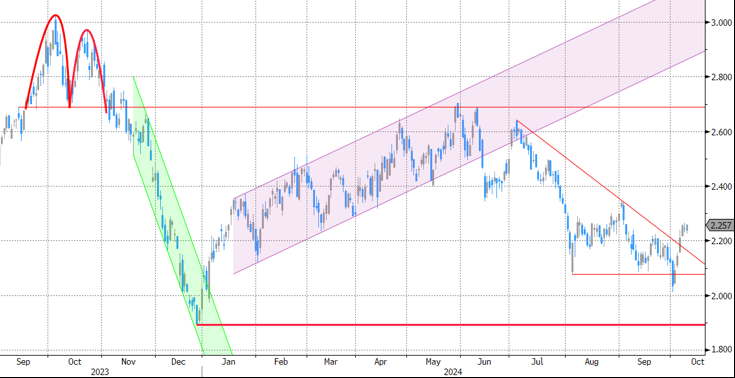
The ECB cut policy rates by 25 bps in June and in September. Stubborn inflation (core, services) still is a source of concern, but very weak PMI’s and soft comments of Lagarde (and other MPC members) suggest the ECB is likely to step up the pace of easing with an October cut. Spill-overs from strong US data prevented a test of the 2.0% barrier. 2.00-2.35% might serve as a ST consolidation range.
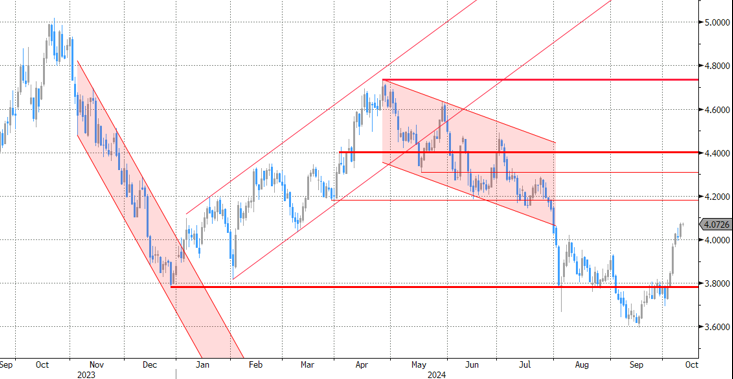
The Fed kicked off its easing cycle with a 50 bps move. Powell and Co turning the focus from inflation to a potential slowdown in growth/employment made markets consider more 50 bps steps. Strong US September payrolls suggest the economy doesn’t need aggressive Fed support for now, but the debate might resurface as the economic cycle develops. For the US 10-y, 3.60% serves as strong support. The steepening trend is taking a breather.
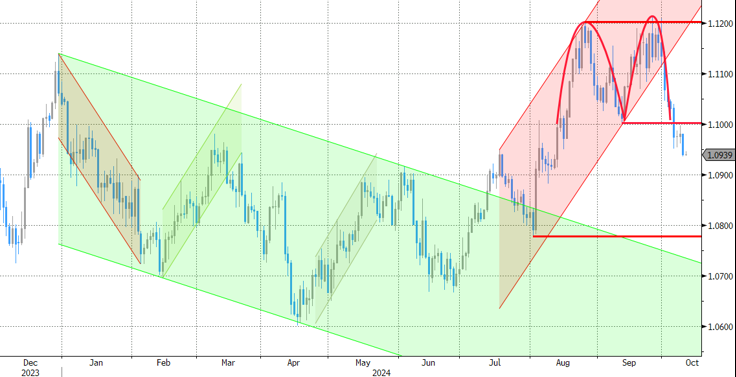
EUR/USD twice tested the 1.12 big figure as the dollar lost interest rate support at stealth pace. Bets on fast and large rate cuts trumped traditional safe haven flows into USD. An ailing euro(pean economy) partially offset some of the general USD weakness. After solid early October US data, the dollar regained traction, with EUR/USD breaking the 1.1002 neckline. Targets of this pattern are near 1.08.
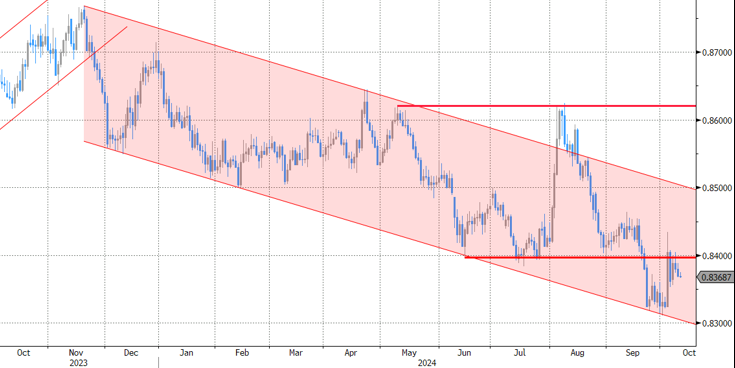
The BoE delivered a hawkish cut in August. Policy restrictiveness was indicated to be further unwound gradually. The economic picture between the UK and Europe also (temporarily?) diverged to the benefit of sterling, pulling EUR/GBP below 0.84 support. Dovish comments by BoE Bailey ended by default GBP-strength. Uncertainty on the UK budget to be released end this month is becoming an additional headwind for the UK currency.


White Label
Data API
Web Plug-ins
Poster Maker
Affiliate Program
The risk of loss in trading financial instruments such as stocks, FX, commodities, futures, bonds, ETFs and crypto can be substantial. You may sustain a total loss of the funds that you deposit with your broker. Therefore, you should carefully consider whether such trading is suitable for you in light of your circumstances and financial resources.
No decision to invest should be made without thoroughly conducting due diligence by yourself or consulting with your financial advisors. Our web content might not suit you since we don't know your financial conditions and investment needs. Our financial information might have latency or contain inaccuracy, so you should be fully responsible for any of your trading and investment decisions. The company will not be responsible for your capital loss.
Without getting permission from the website, you are not allowed to copy the website's graphics, texts, or trademarks. Intellectual property rights in the content or data incorporated into this website belong to its providers and exchange merchants.
Not Logged In
Log in to access more features

FastBull Membership
Not yet
Purchase
Log In
Sign Up