• Trade
  • Markets
  • Copy
  • Contests
  • News
  • 24/7
  • Calendar
  • Q&A
  • Chats
Trending
Screeners
SYMBOL
LAST
BID
ASK
HIGH
LOW
NET CHG.
%CHG.
SPREAD
SPX
S&P 500 Index
6827.42
6827.42
6827.42
6899.86
6801.80
-73.58
-1.07%
--
DJI
Dow Jones Industrial Average
48458.04
48458.04
48458.04
48886.86
48334.10
-245.98
-0.51%
--
IXIC
NASDAQ Composite Index
23195.16
23195.16
23195.16
23554.89
23094.51
-398.69
-1.69%
--
USDX
US Dollar Index
97.830
97.910
97.830
98.070
97.810
-0.120
-0.12%
--
EURUSD
Euro / US Dollar
1.17576
1.17583
1.17576
1.17590
1.17262
+0.00182
+ 0.16%
--
GBPUSD
Pound Sterling / US Dollar
1.33904
1.33913
1.33904
1.33940
1.33546
+0.00197
+ 0.15%
--
XAUUSD
Gold / US Dollar
4340.27
4340.70
4340.27
4350.16
4294.68
+40.88
+ 0.95%
--
WTI
Light Sweet Crude Oil
57.117
57.147
57.117
57.601
56.878
-0.116
-0.20%
--

Community Accounts

Signal Accounts
--
Profit Accounts
--
Loss Accounts
--
View More

Become a signal provider

Sell trading signals to earn additional income

View More

Guide to Copy Trading

Get started with ease and confidence

View More

Signal Accounts for Members

All Signal Accounts

Best Return
  • Best Return
  • Best P/L
  • Best MDD
Past 1W
  • Past 1W
  • Past 1M
  • Past 1Y

All Contests

  • All
  • Trump Updates
  • Recommend
  • Stocks
  • Cryptocurrencies
  • Central Banks
  • Featured News
Top News Only
Share

Canada Nov Consumer Prices +0.1% On Month, +2.2% On Year

Share

Canada Nov CPI Core -0.1% On Month, +2.9% On Year

Share

Canada Nov Core CPI, Seasonally Adjusted +0.2% On Month, Oct +0.3% (Unrevised)

Share

UK Health Minister Streeting On Doctors' Strike: Vote To Go Ahead Reveals The Bma's Shocking Disregard For Patient Safety

Share

Venezuelan State Oil Company Pdvsa Says Was Subject To Cyber Attack But Operations Unaffected

Share

Russia Central Bank Says January-October Current Account Surplus At $37.1 Billion

Share

Polish Current Account Balance At +1924 Million Euros In October Versus+130 Million Euros Seen In Reuters Poll

Share

Statement: Germany, Ukraine Propose 10-Point Plan To Strengthen Armament Cooperation

Share

London Metal Exchange Three Month Copper Falls More Than 3% To $11541.50 A Metric Ton

Share

[Market Update] Spot Silver Surged $2.00 During The Day, Returning To $64/ounce, A Gain Of 3.23%

Share

European Central Bank: Italy's Recurrent Ad Hoc Tax Provisions Cause Uncertainty, Damage Investor Confidence, And May Affect Banks' Funding Costs

Share

Stats Office: Nigeria Consumer Inflation At 14.45% Year-On-Year In November

Share

European Central Bank: Italy's Budget Measures Weighing On Domestic Banks Could Have "Negative Implications" On Their Credit Liquidity

Share

Azerbaijan's January-November Oil Exports Via Btc Pipeline Down 7.1% Year-On-Year Data Shows

Share

Azerbaijan's Aliyev Plans A Large-Scale Prisoner Amnesty, Azertac Reports

Share

EU Commission Chief Von Der Leyen, NATO's Rutte Join Ukraine Talks In Berlin

Share

EU Announces Sanctions On Companies, Individuals For Moving Russian Oil

Share

ICE New York Cocoa Futures Fall More Than 5% To $5945 Per Metric Ton

Share

ICE London Cocoa Futures Fall More Than 5% To 4288 Pounds Per Metric Ton

Share

Pakistan Central Bank: Inflation Seen Returning To Target Range In Fy27

TIME
ACT
FCST
PREV
Japan Tankan Small Manufacturing Outlook Index (Q4)

A:--

F: --

P: --

Japan Tankan Large Non-Manufacturing Outlook Index (Q4)

A:--

F: --

P: --

Japan Tankan Large Manufacturing Outlook Index (Q4)

A:--

F: --

P: --

Japan Tankan Small Manufacturing Diffusion Index (Q4)

A:--

F: --

P: --

Japan Tankan Large Manufacturing Diffusion Index (Q4)

A:--

F: --

P: --

Japan Tankan Large-Enterprise Capital Expenditure YoY (Q4)

A:--

F: --

P: --

U.K. Rightmove House Price Index YoY (Dec)

A:--

F: --

P: --

China, Mainland Industrial Output YoY (YTD) (Nov)

A:--

F: --

P: --

China, Mainland Urban Area Unemployment Rate (Nov)

A:--

F: --

P: --

Saudi Arabia CPI YoY (Nov)

A:--

F: --

P: --

Euro Zone Industrial Output YoY (Oct)

A:--

F: --

P: --

Euro Zone Industrial Output MoM (Oct)

A:--

F: --

P: --

Canada Existing Home Sales MoM (Nov)

A:--

F: --

P: --

Canada National Economic Confidence Index

A:--

F: --

P: --

Canada New Housing Starts (Nov)

A:--

F: --

P: --
U.S. NY Fed Manufacturing Employment Index (Dec)

A:--

F: --

P: --

U.S. NY Fed Manufacturing Index (Dec)

A:--

F: --

P: --

Canada Core CPI YoY (Nov)

A:--

F: --

P: --

Canada Manufacturing Unfilled Orders MoM (Oct)

A:--

F: --

P: --

U.S. NY Fed Manufacturing Prices Received Index (Dec)

A:--

F: --

P: --

U.S. NY Fed Manufacturing New Orders Index (Dec)

A:--

F: --

P: --

Canada Manufacturing New Orders MoM (Oct)

A:--

F: --

P: --

Canada Core CPI MoM (Nov)

A:--

F: --

P: --

Canada Trimmed CPI YoY (SA) (Nov)

A:--

F: --

P: --

Canada Manufacturing Inventory MoM (Oct)

A:--

F: --

P: --

Canada CPI YoY (Nov)

A:--

F: --

P: --

Canada CPI MoM (Nov)

A:--

F: --

P: --

Canada CPI YoY (SA) (Nov)

--

F: --

P: --

Canada Core CPI MoM (SA) (Nov)

A:--

F: --

P: --

Canada CPI MoM (SA) (Nov)

A:--

F: --

P: --

Federal Reserve Board Governor Milan delivered a speech
U.S. NAHB Housing Market Index (Dec)

--

F: --

P: --

Australia Composite PMI Prelim (Dec)

--

F: --

P: --

Australia Services PMI Prelim (Dec)

--

F: --

P: --

Australia Manufacturing PMI Prelim (Dec)

--

F: --

P: --

Japan Manufacturing PMI Prelim (SA) (Dec)

--

F: --

P: --

U.K. 3-Month ILO Employment Change (Oct)

--

F: --

P: --

U.K. Unemployment Claimant Count (Nov)

--

F: --

P: --

U.K. Unemployment Rate (Nov)

--

F: --

P: --

U.K. 3-Month ILO Unemployment Rate (Oct)

--

F: --

P: --

U.K. Average Weekly Earnings (3-Month Average, Including Bonuses) YoY (Oct)

--

F: --

P: --

U.K. Average Weekly Earnings (3-Month Average, Excluding Bonuses) YoY (Oct)

--

F: --

P: --

France Services PMI Prelim (Dec)

--

F: --

P: --

France Composite PMI Prelim (SA) (Dec)

--

F: --

P: --

France Manufacturing PMI Prelim (Dec)

--

F: --

P: --

Germany Services PMI Prelim (SA) (Dec)

--

F: --

P: --

Q&A with Experts
    • All
    • Chatrooms
    • Groups
    • Friends
    Connecting
    .
    .
    .
    Type here...
    Add Symbol or Code

      No matching data

      All
      Trump Updates
      Recommend
      Stocks
      Cryptocurrencies
      Central Banks
      Featured News
      • All
      • Russia-Ukraine Conflict
      • Middle East Flashpoint
      • All
      • Russia-Ukraine Conflict
      • Middle East Flashpoint
      Search
      Products

      Charts Free Forever

      Chats Q&A with Experts
      Screeners Economic Calendar Data Tools
      Membership Features
      Data Warehouse Market Trends Institutional Data Policy Rates Macro

      Market Trends

      Market Sentiment Order Book Forex Correlations

      Top Indicators

      Charts Free Forever
      Markets

      News

      News Analysis 24/7 Columns Education
      From Institutions From Analysts
      Topics Columnists

      Latest Views

      Latest Views

      Trending Topics

      Top Columnists

      Latest Update

      Signals

      Copy Rankings Latest Signals Become a signal provider AI Rating
      Contests
      Brokers

      Overview Brokers Assessment Rankings Regulators News Claims
      Broker listing Forex Brokers Comparison Tool Live Spread Comparison Scam
      Q&A Complaint Scam Alert Videos Tips to Detect Scam
      More

      Business
      Events
      Careers About Us Advertising Help Center

      White Label

      Data API

      Web Plug-ins

      Affiliate Program

      Awards Institution Evaluation IB Seminar Salon Event Exhibition
      Vietnam Thailand Singapore Dubai
      Fans Party Investment Sharing Session
      FastBull Summit BrokersView Expo
      Recent Searches
        Top Searches
          Markets
          News
          Analysis
          User
          24/7
          Economic Calendar
          Education
          Data
          • Names
          • Latest
          • Prev

          View All

          No data

          Scan to Download

          Faster Charts, Chat Faster!

          Download App
          English
          • English
          • Español
          • العربية
          • Bahasa Indonesia
          • Bahasa Melayu
          • Tiếng Việt
          • ภาษาไทย
          • Français
          • Italiano
          • Türkçe
          • Русский язык
          • 简中
          • 繁中
          Open Account
          Search
          Products
          Charts Free Forever
          Markets
          News
          Signals

          Copy Rankings Latest Signals Become a signal provider AI Rating
          Contests
          Brokers

          Overview Brokers Assessment Rankings Regulators News Claims
          Broker listing Forex Brokers Comparison Tool Live Spread Comparison Scam
          Q&A Complaint Scam Alert Videos Tips to Detect Scam
          More

          Business
          Events
          Careers About Us Advertising Help Center

          White Label

          Data API

          Web Plug-ins

          Affiliate Program

          Awards Institution Evaluation IB Seminar Salon Event Exhibition
          Vietnam Thailand Singapore Dubai
          Fans Party Investment Sharing Session
          FastBull Summit BrokersView Expo

          Record Bid ‘Sends a Strong Message’ About Gilt Market

          Owen Li

          Bond

          Economic

          Summary:

          UK bond syndication attracts biggest ever order book despite volatility. The UK Debt Management Office’s first public sale of the year impressed with an unprecedented level of demand despite a huge sell-off in gilts over recent months.

          UK bond syndication attracts biggest ever order book despite volatility
          The UK Debt Management Office’s first public sale of the year impressed with an unprecedented level of demand despite a huge sell-off in gilts over recent months.
          On 21 January, the UK DMO raised £8.5bn via a syndicated re-opening of the 4.4% 2040 gilt led by Deutsche Bank, JP Morgan, Morgan Stanley, Nomura and RBC Capital Markets. The deal closed with total orders of just over £119bn from 279 accounts, making it a record gilt sale from both the size of demand and the number of investors in the order book.
          The record level of demand was particularly notable given the gilt market’s recent period of volatility, with yields reaching their highest level in decades. Gilt yields have been under pressure, not just from a global sell-off in government bonds driven in part by US inflationary concerns, but also issues pertaining to the UK itself, such as Labour’s spending ambition, higher borrowing and stagflation fears.

          Highest yields in decades

          Yields on 30-year gilts passed 5.5% in January 2025, reaching their highest level since 1998, while 10-year yields touched 4.9%. While the sell-off has eased in recent weeks, 30-year and 10-year gilts are still at elevated levels. The higher yields would have inevitably helped attract more demand, with the yield on the syndicated tap at just over 5%.
          ‘It is fair to say this transaction provides a clear and visible demonstration of the excellent support we continue to receive from our gilt market investor base,’ said Jessica Pulay, chief executive officer of the UK DMO. ‘It also sends a strong message about the ongoing smooth and efficient functioning of the gilt market.’
          The deal was executed smoothly and quickly with the order book closing at 10:00am and the price setting at just before midday.

          Strong support from international investors

          Another notable feature of the transaction was the support from international investors, allocated 32% of the sale, which was also marginally a record for a UK syndication. The allocation to international accounts from the last two gilt syndications were at 27% and 13% respectively, with issuances in November and September.
          ‘We welcome the diversification of our investor base,’ said Pulay. Foreign investors have become the biggest segment of the overall gilt portfolio. The growth of international investors has occurred in parallel with gilts having a bigger share in global bond indices as well as an increased share of sterling in central bank reserves.
          Following the latest syndication, total gilt sales for the 2024-25 financial year have reached £229.7bn. This is the second-highest annual issuance by the UK DMO after 2020-21, when extra funds were raised to support the economy during the Covid-19 pandemic. However, accounting for the fact that there is no quantitative easing stimulus but rather £100bn worth of quantitative tightening over the next year by the Bank of England, this will be a record amount of gilts entering the hands of private investors.
          The UK’s penultimate syndication of the financial year will take place in the week commencing 10 February, with the launch of a new conventional gilt maturing in March 2035.

          Reduced duration

          On 20 January, officials from the UK DMO and the UK Treasury held their annual consultation meetings with gilt-edged market makers and gilts investors to review the financing remit of the current financial year and provide feedback for 2025-26.
          The minutes published by the UK DMO showed that among GEMMs and gilt investors, there was strong support for a reduction in the duration of conventional gilt issuance in 2025-26 relative to the current year. Most who were present advocated for an increased proportion of short-term and medium-term gilts and a proportionate reduction in long-term gilts.
          The financing remit for the UK DMO in 2025-26 is currently projected to be £299.6bn.

          Source:omfif

          To stay updated on all economic events of today, please check out our Economic calendar
          Risk Warnings and Disclaimers
          You understand and acknowledge that there is a high degree of risk involved in trading. Following any strategies or investment methods may lead to potential losses. The content on the site is provided by our contributors and analysts for information purposes only. You are solely responsible for determining whether any trading assets, securities, strategy, or any other product is suitable for investing based on your own investment objectives and financial situation.
          Add to Favorites
          Share

          Gold Monthly: $3,000 Is Now in Sight

          ING

          Economic

          Trump spurs haven demand

          It is only February, and gold has already hit a series of fresh record highs this year. Tariff concerns that risk higher inflation and slower economic growth are spurring demand for safe haven assets like gold.
          Tariffs on Canada and Mexico have been delayed by a month, but 10% tariffs on China went ahead. Beijing retaliated immediately by imposing a range of tariffs on US products.
          Despite the US coming to a deal with Canada and Mexico, the uncertainty over trade and tariffs will continue to buoy gold prices. If trade tensions intensify and we see more retaliatory measures, safe haven demand for gold will continue.
          US President Donald Trump's latest comments suggesting that the US takes over the Gaza strip and assumes responsibility for reconstructing the territory have added to this uncertainty, further boosting gold prices.
          With Trump back in the White House, uncertainty and unpredictability are running high. And gold will continue to benefit from this environment.

          Central banks are still bullion hungry

          Gold’s rally in 2024 was driven by central bank buying, especially from China. Central banks are still buying and will probably continue to do so as geopolitical tensions and the economic climate continue to push them to increase their allocation towards safe haven assets.
          Last year, central banks buying exceeded 1,000 tonnes for the third year in a row, accelerating sharply in the fourth quarter to 333 tonnes, bringing the net annual total to 1,045 tonnes, according to the latest data from the World Gold Council. The National Bank of Poland led the charge, adding 90 tonnes to its gold reserves last year, but demand was seen from a broad range of emerging market banks.
          Central banks’ healthy appetite for gold is also driven by concerns from countries about Russian-style sanctions on their foreign assets in the wake of decisions made by the US and Europe to freeze Russian assets, as well as shifting strategies on currency reserves. Looking ahead, we expect central banks to remain buyers.

          Central banks demand tops 1,000t for the third year in a row

          Gold Monthly: $3,000 Is Now in Sight_1

          Central banks’ appetite for gold likely to continue in 2025

          Gold Monthly: $3,000 Is Now in Sight_2
          Meanwhile, soaring gold stockpiles in America could further boost gold prices. Following Trump’s election win in November, Comex gold inventories surged to their highest level since 2022. Tariff fears and a profitable arbitrage – after gold prices on Comex moved to a premium over international prices in December – have caused a rush of gold to fly into New York. Gold’s exports to the US from Europe’s main refining hub in Switzerland have also jumped to the highest level since Russia’s invasion of Ukraine.
          While the US president hasn’t specifically targeted gold in his tariff threats, traders have been concerned that gold could be included in potential blanket tariffs he has threatened to impose.
          If tariffs on gold are applied, this would lead to higher and more volatile gold prices in the US and a potential reshuffle of trade routes. The US is reliant on imports of gold from both Mexico and Canada. In 2024, Mexico accounted for around 30% of US imports of gold, and Canada for around 15%.
          This surge in demand from the US could provide a further boost for gold prices.

          Trump sparks a huge gold rush

          Gold Monthly: $3,000 Is Now in Sight_3

          ETFs are ticking higher

          Investor holdings in gold ETFs generally rise when gold prices gain, and vice versa. Global holdings in gold ETFs were effectively flat in the fourth quarter and ended the year very close to where they had started even as gold prices surged 27%. However, ETF holdings have been ticking higher over the past couple of sessions. If we see more additions, perhaps driven by geopolitical uncertainty, optimism about further US rate cuts and/or a stronger gold performance, this would give bullion prices a further tailwind.

          More ETF flows would give gold prices further boost

          Gold Monthly: $3,000 Is Now in Sight_4

          US Fed cuts will boost gold

          The main question for the gold market now is the pace at which the Federal Reserve will ease its policy. Lower borrowing costs are positive for gold as the metal doesn’t pay interest. After 100bp of interest rate cuts in the latter part of 2024, the Fed held policy steady in January and suggested it was in no hurry to cut again. The recent developments surrounding tariffs are likely to keep it that way through the first half of 2025, our US economist believes.
          If the central bank is forced to maintain higher rates for longer, this could undermine gold’s appeal.
          However, the central bank will still ease its policy over the course of the year, even if its path to easing is slower than previously expected. Our US economist now expects the Fed to cut rates twice in the second half of this year. What happens next is highly uncertain, but assuming a gradual de-escalation of tensions that sees tariffs being removed, he is forecasting one further rate cut in early 2026.

          Lower borrowing costs are positive for gold

          Gold Monthly: $3,000 Is Now in Sight_5
          We believe gold will hit more record highs this year, with $3,000/z now in sight. The macro backdrop will remain favourable for gold as interest rates decline and foreign reserve diversification continues amid geopolitical tensions. A stronger USD and tighter monetary policy could eventually provide some headwinds to gold. However, increased trade friction could add to gold’s haven appeal. We see gold averaging $2,800/oz in the first quarter with prices likely to reach the $3,000/oz level this quarter. We see an average of $2,760/oz in 2025.
          To stay updated on all economic events of today, please check out our Economic calendar
          Risk Warnings and Disclaimers
          You understand and acknowledge that there is a high degree of risk involved in trading. Following any strategies or investment methods may lead to potential losses. The content on the site is provided by our contributors and analysts for information purposes only. You are solely responsible for determining whether any trading assets, securities, strategy, or any other product is suitable for investing based on your own investment objectives and financial situation.
          Add to Favorites
          Share

          London Pre-Open: Stocks Seen Lower as Investors Eye Payrolls

          Warren Takunda

          Stocks

          London stocks were set to fall at the open on Friday following a record close a day earlier, as investors eyed the latest US non-farm payrolls report.
          The FTSE 100 was called to open down around 30 points.
          Ipek Ozkardeskaya, senior analyst at Swissquote Bank, said: "This week’s US jobs data has so far given mixed signals with lower job openings in December, lower job cuts during the course of last year but a jump in terminations in January, weaker labour productivity, a weaker-than-expected jump in labour costs, and a stronger-than-expected ADP employment figures.
          "Today, the official US jobs data is expected to print 169,000 new nonfarm jobs added last month, with a slightly slower wages growth and a stable unemployment rate near the 4.1%. But investors will also focus on the annual revisions to the jobs figures. Note that, the early estimates in August hinted that the US jobs numbers could see a downward revision of more than 800,000 jobs. Economists expect that the downward revision will rather be around 600-700,000 jobs.
          "If that’s the case, the week will end with the narrative that the US jobs market is healthily slowing - a scenario that would allow the Fed to continue cutting the rates but not hurriedly, and keep the market sentiment at a sweet spot. A weaker-than-expected NFP figure, and/or rising wages would weigh on sentiment, while a stronger-than-expected NFP - if combined to softening wages would reinforce the goldilocks scenario."
          The payrolls report for January is due at 1330 GMT, along with the unemployment rate and average earnings.
          On home shores, industry data showed retail footfall jumped in January as shoppers braved winter weather to hit the January sales.
          According to the latest BRC-Sensormatic footfall monitor, total UK footfall increased by 6.6% last month, comfortably reversing December’s 2.2% decline.
          All types of destinations saw an uptick in footfall, led by retail parks and shopping centres.
          Footfall had been flat in December in retail parks, but jumped 7.9% in January, while shopping centres saw a 7.4% increase following a 3.3% decline a month earlier.
          On high streets, footfall rose by 4.5%, compared to a 2.7% dip in December.
          Helen Dickinson, chief executive of the British Retail Consortium, said: "Store visits increased substantially in the first week of the month, as many consumers hit the January sales.
          "Despite snowy weather and Storm Eowyn causing disruption in some areas, footfall was still positive across major UK cities over the whole month."
          In corporate news, Victrex held guidance after a solid first-quarter performance saw revenues rise 9% but warned trading conditions remain mixed, with medical revenues continuing to be subdued on a year-to-date basis, driven by ongoing industry destocking among its customers.
          The company said guidance remained for at least mid-single digit volume growth for fiscal 2025, with underlying pre-tax profit growth ahead of volume growth.
          Legal & General said it will sell its US protection business to Japanese peer Meiji Yasuda, with the latter taking a 5% stake in L&G in a deal worth $2.3bn.
          The transaction will kickstart a long-term strategic partnership between the two companies to support growth ambitions in US Pension Risk Transfer and asset management markets. L&G intends to launch a £1.0bn buyback following completion, which is expected towards the end of 2025.

          Source: Sharecast

          Risk Warnings and Disclaimers
          You understand and acknowledge that there is a high degree of risk involved in trading. Following any strategies or investment methods may lead to potential losses. The content on the site is provided by our contributors and analysts for information purposes only. You are solely responsible for determining whether any trading assets, securities, strategy, or any other product is suitable for investing based on your own investment objectives and financial situation.
          Add to Favorites
          Share

          US Dollar Index (DXY) And The NFP Jobs Report: What To Expect

          Owen Li

          Economic

          Forex

          Consensus forecasts predict an increase of 169,000 jobs, with the unemployment rate expected to remain at 4.1%.

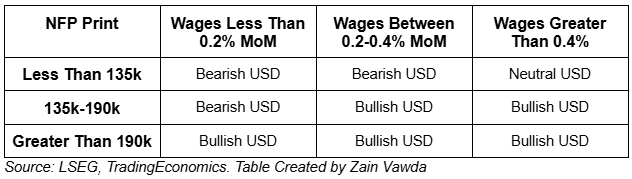
          Strong numbers (over 190,000 jobs) could strengthen the dollar, while weak numbers (less than 135,000 jobs) could weaken it.

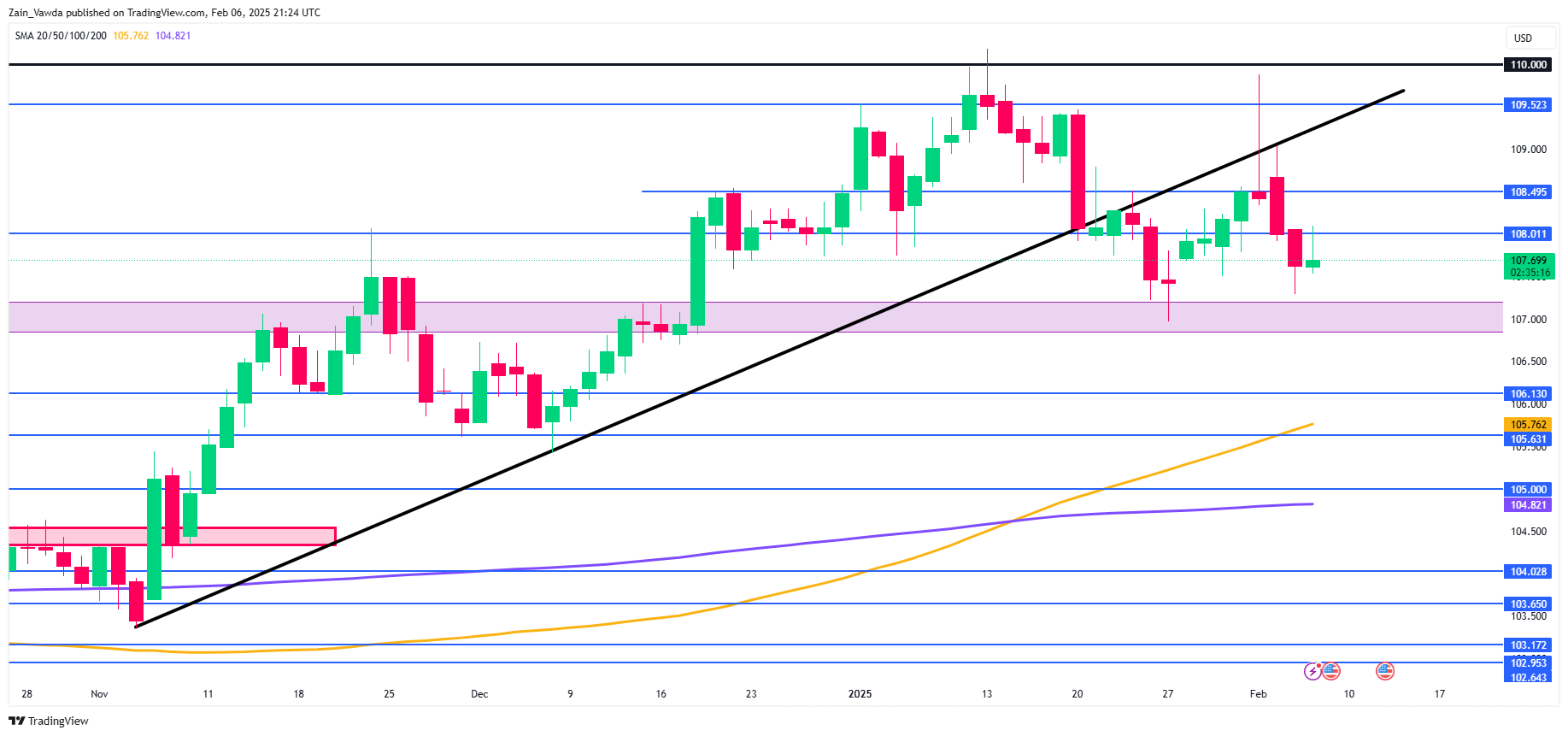
          (DXY) currently has support levels around 107.00, 106.13, and 105.76, and resistance levels at 108.00, 108.49, and 109.52.

          The US Bureau of Labor Statistics is set to release the non-farm payroll and jobs data for January 2025 on Friday, February 7th, 2025.

          NFP Report Expectations

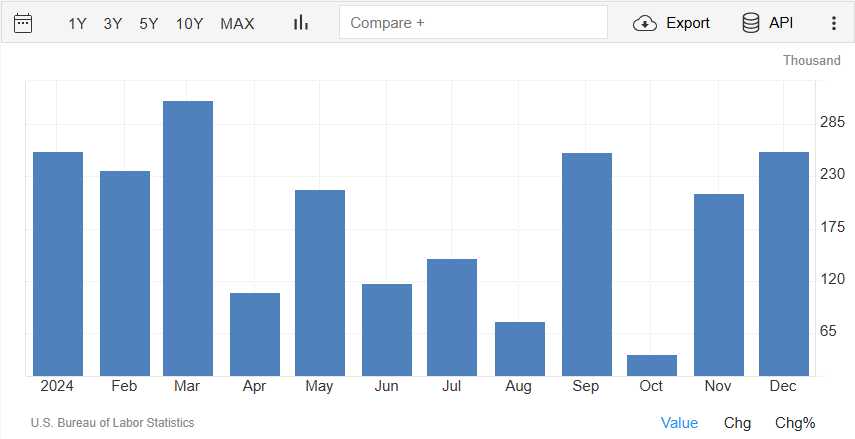
          The consensus forecast for January’s non-farm payroll is an increase of 169,000 jobs, following a robust gain of 256,000 jobs in December 2024. Recent jobs data has been strong, with the US economy adding an average of 186,000 jobs per month in 2024. This suggests that the labor market remains healthy heading into 2025.

          Source: TradingEconomics

          The unemployment rate is expected to stay at 4.1%, and wages are predicted to grow by 0.3% this month (3.8% over the past year). However, job growth could be higher than expected, with estimates ranging from 175,000 to 225,000 new jobs.

          As always the average hourly earnings measure will play a key role. Any significant deviation away from the 3.8-4% range here could see an uptick in inflation expectations. This would then have a knock on effect on Fed policy regarding rate cuts which could see the US Dollar experience some volatility.

          There are challenges ahead with concerns that tariff uncertainty and growth worries may lead to a cautious approach toward hiring in the first part of 2025. It will be interesting to see if these concerns come to fruition and we see any cooling of the labor market and a drop in hiring.

          The Current State of the US Labor Market

          The US labor market is slowing down gradually. A December report showed over 500,000 fewer job openings, bringing the total to 7.6 million. Professional services and healthcare saw the biggest drops, while leisure and hospitality stayed strong.

          Hiring has been slower, and layoffs are balancing out new hires in some industries. However, wages have stayed steady, with average pay growth at 3.9-4.0% over the past five months, showing that demand for workers is still solid.

          There have been some mixed signs in recent data releases however, with metrics like the manufacturing and services PMI employment components, pointing to sustained hiring momentum. The ISM Manufacturing Employment Index recently climbed to 50.3, signaling expansion, while the ADP private payrolls report showed 183,000 jobs added in January.

          Given the above and with the geopolitical and trade developments one may understand why tomorrow’s report is so crucial.

          Potential Impact and Scenarios

          The NFP report plays a big role in shaping the US Dollar Index (DXY) and overall market mood. If the report shows strong numbers, especially over 190,000 new jobs, the US dollar could strengthen, especially since it’s close to support levels around 107.50. But if the report is weak, with less than 135,000 jobs added or wage growth under 0.2%, markets may expect the Fed to cut rates more aggressively, which could weaken the dollar.

          For stocks, strong job numbers might raise concerns about stubborn inflation moving forward, which could slow down market gains. On the other hand, weak job data could signal easier monetary policies ahead and more rate cuts thus stoking market optimism. .

          Potential Impact on the US Dollar Based on the Data Released

          Technical Analysis – US Dollar Index (DXY)

          Looking at the US Dollar Index and bulls have failed to kick on this week as price action has now printed a lower high but no lower low has materialized yet. Will the jobs data help the DXY continue its recent malaise or will it give bulls renewed impetus to push on?

          Immediate support rests at 107.00 before the 106.13 and 105.76 handles come into focus.

          A move higher from here will need to break above the 108.00 handle before resistance at 108.49 and 109.52 come into focus.

          US Dollar Index (DXY) Daily Chart, February 6, 2025

          Source: TradingView (click to enlarge)

          Support

          107.00

          106.13

          105.76 (100-day MA)

          Resistance

          108.00

          108.49

          109.52

          Source: ACTIONFOREX

          To stay updated on all economic events of today, please check out our Economic calendar
          Risk Warnings and Disclaimers
          You understand and acknowledge that there is a high degree of risk involved in trading. Following any strategies or investment methods may lead to potential losses. The content on the site is provided by our contributors and analysts for information purposes only. You are solely responsible for determining whether any trading assets, securities, strategy, or any other product is suitable for investing based on your own investment objectives and financial situation.
          Add to Favorites
          Share

          USD/JPY Extends Decline as Markets Brace for US NFP Data

          Alex

          Economic

          Forex

          Key Highlights

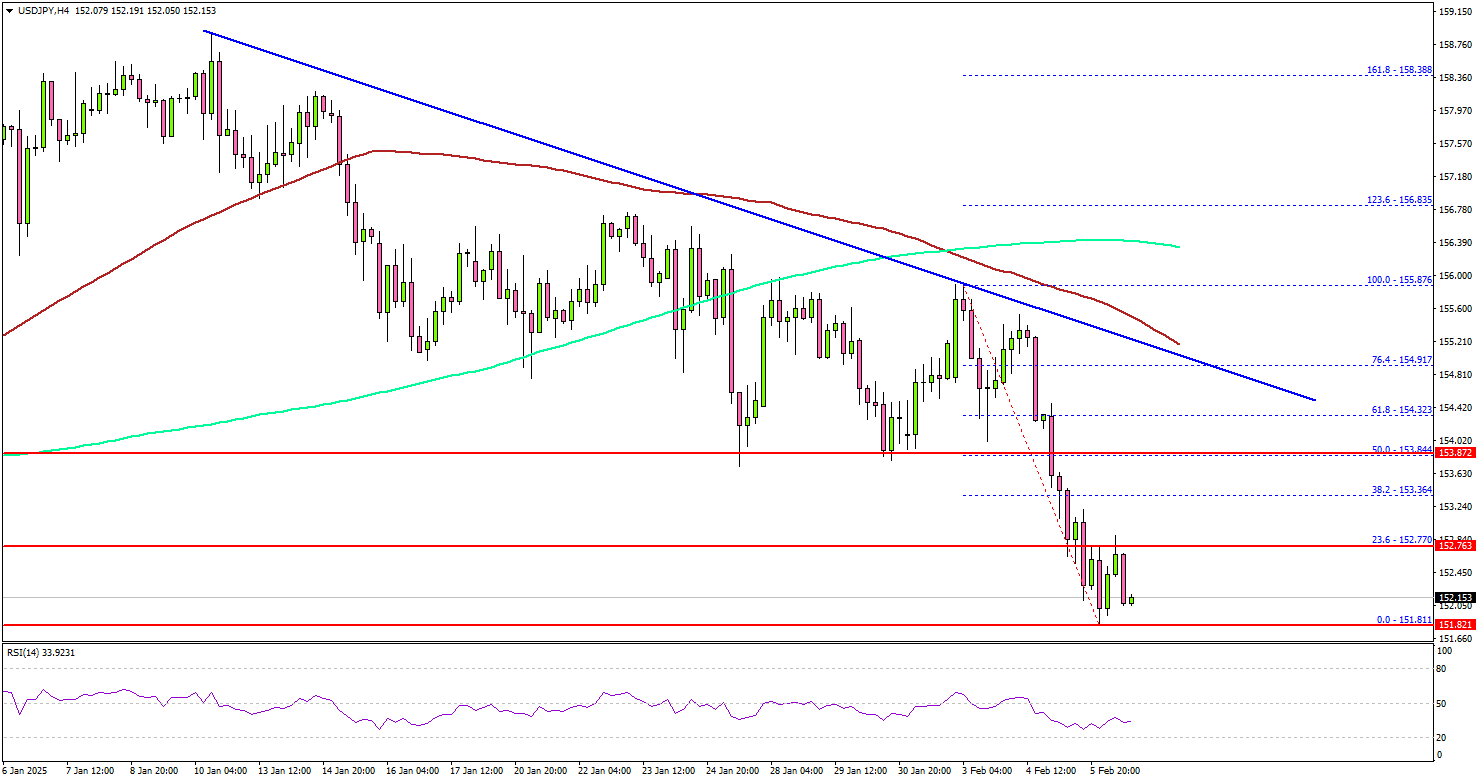
          USD/JPY started a fresh decline below the 155.50 support zone.

          A connecting bearish trend line is forming with resistance at 154.80 on the 4-hour chart.

          EUR/USD recovered above 1.0400 before the bears appeared again.

          The US nonfarm payrolls could change by 170K in Jan 2025, down from 256K.

          USD/JPY Technical Analysis

          The US Dollar started a fresh decline below 156.20 against the Japanese Yen. USD/JPY declined below 155.50 and 155.00 to enter a short-term bearish zone.

          Looking at the 4-hour chart, the pair settled below the 154.20 level, the 100 simple moving average (red, 4-hour), and the 200 simple moving average (green, 4-hour). The bears seem to be in control and might aim for more losses.

          On the downside, immediate support sits near the 151.80 level. The next key support sits near the 151.20 level. Any more losses could send the pair toward the 150.50 level.

          On the upside, the pair seems to be facing hurdles near the 152.80 level. The next major resistance is near the 153.80 level. The main resistance is now forming near the 154.00 zone.

          There is also a connecting bearish trend line forming with resistance at 154.80 and the 100 simple moving average (red, 4-hour). A close above the 154.80 level could set the tone for another increase. In the stated case, the pair could even clear the 155.50 resistance.

          Looking at EUR/USD, the pair was able to recover above the 1.0400 resistance, but the bears are still active below 1.0450.

          Upcoming Economic Events:

          US nonfarm payrolls for Jan 2025 – Forecast 170K, versus 256K previous.

          US Unemployment Rate for Jan 2025 – Forecast 4.1%, versus 4.1% previous.

          Source: ACTIONFOREX

          To stay updated on all economic events of today, please check out our Economic calendar
          Risk Warnings and Disclaimers
          You understand and acknowledge that there is a high degree of risk involved in trading. Following any strategies or investment methods may lead to potential losses. The content on the site is provided by our contributors and analysts for information purposes only. You are solely responsible for determining whether any trading assets, securities, strategy, or any other product is suitable for investing based on your own investment objectives and financial situation.
          Add to Favorites
          Share

          Cliff Notes: Some Promising Signs for the Consumer

          Alex

          Economic

          Key insights from the week that was.

          In Australia, updates on the consumer were constructive overall. Nominal retail sales lifted 1.4% during Q4 and prices were up 0.4%. Retail sales volumes therefore managed a gain of 1.0% in Q4, building on Q3’s 0.5% increase to be up 1.1% over 2024. That all states and retail categories gathered momentum into year-end not only highlights the breadth of the current upturn but also points to a delayed tax cut response beginning to come through. These findings were corroborated by the ABS’ new experimental measure of household spending (covering two-thirds of total household consumption compared to one-third for retail) which lifted 0.4% (4.3%yr) in December on strength in discretionary spending, particularly goods.

          While these developments point to upside risks to our current Q4 household consumption forecast of 0.7%qtr, we are mindful that the uncertainty surrounding our forecast are two-sided. Evidence from card activity data and our Westpac Consumer Panel suggests the overall response to Stage 3 tax cuts has been underwhelming, with consumers seeking to rebuild savings buffers eroded over 2023 and 2024. Looking forward, the durability of the upturn is yet to be tested beyond the year-end sales period, which reportedly saw aggressive discounting. The latest edition of the Westpac Red Book discusses these themes in depth.

          On housing, the latest CoreLogic data pointed to a broadening slowdown in price growth across the major capitals. Sydney and Melbourne continued to record declines in January with buyers constrained by affordability and supply. Perth, Adelaide and Brisbane meanwhile are gradually seeing annual price growth decelerate to low double-digit rates as demand and supply come into better balance. On new construction, the modest increase in dwelling approvals – driven by a bounce in high-rise units – masked a third consecutive monthly decline in private detached house approvals, raising questions over the pipeline’s persistence and breadth.

          Before moving offshore, it is worth highlighting the downside surprise in December’s goods trade data, the surplus narrowing from $6.8bn to $5.1bn. Greater-than-usual monthly volatility looks to be at play, trade flows shifting, at least in part, in anticipation of tariffs being imposed by the US. Australia is not immune from global trade tensions, but an assessment of our direct and indirect trade with the US makes clear we are well positioned to minimise the net cost. In this week’s essay, Chief Economist Luci Ellis reflects on global developments in trade policy and the implications for markets.

          Offshore, the pulse of key data was favourable overall, though policy makers continued to emphasise greater-than-usual uncertainty over the outlook.

          In the US, the manufacturing PMI increased by 1.7 points to 50.9 points in January, its first expansionary read since October 2022. The gain was supported by strength in new orders, prices, production and, most notably, employment, up 4.9 points. President Trump’s promise to support US manufacturing investment and production is likely a factor here despite any windfall being a future prospect not a present reality. Notably, the average reading through President Trump’s first term exceeded that of both the Obama and Biden administrations by around 2 points.

          The non-manufacturing index meanwhile declined 1.2 points, although at 52.8 still points to expansion. Activity, new orders, inventories and prices saw a substantial decline while other measures saw tepid increases, including a 1 point increase in employment. All components except prices remain below their 5-year pre-COVID average, indicative of modest growth in the sector. Still to come tonight is the January employment report and 2024 annual revision for nonfarm payrolls. Available labour market detail continues to broadly point to balance between demand and supply, limiting risks to demand and inflation over the period ahead.

          Across the Atlantic, the Bank of England cut rates by 25bps to 4.5% in a 7 to 2 vote, the dissenters preferring a 50bp cut. Growth forecasts were marked down out to Q1 2026, the economy now expected to grow 1.2%yr through 2025, down from 1.7%yr in the November projections. Mild upward revisions were made to the out years, though with the passage of time comes risk. Projections for headline inflation were lifted, particularly for 2025. This was attributed to higher energy prices and the government policies announced in the Autumn Budget 2024, with underlying inflation still anticipated to ease.

          The Monetary Policy Report also highlighted tariff uncertainty, with analysis showing downside risks to growth, due to the UK’s close relationship with the EU and a potential rotation in production from the UK to the US, and uncertainty for inflation. Looking back, the Bank also reviewed its estimates of neutral, the primary findings being that neutral is higher post pandemic but that uncertainty around estimates is high. A rate cut per quarter this year seems most probable, but if growth continues to disappoint, the pace of easing could be accelerated.

          Source: ACTIONFOREX

          To stay updated on all economic events of today, please check out our Economic calendar
          Risk Warnings and Disclaimers
          You understand and acknowledge that there is a high degree of risk involved in trading. Following any strategies or investment methods may lead to potential losses. The content on the site is provided by our contributors and analysts for information purposes only. You are solely responsible for determining whether any trading assets, securities, strategy, or any other product is suitable for investing based on your own investment objectives and financial situation.
          Add to Favorites
          Share

          How to Calculate Free Cash Flow: A Comprehensive Guide for Investors and Analysts

          Glendon

          Economic

          Free cash flow (FCF) is one of the most important financial metrics for investors, analysts, and business owners. It measures the cash a company generates after accounting for capital expenditures, such as buildings, equipment, and other long-term investments. FCF provides insight into a company's financial health, its ability to pay dividends, reduce debt, or reinvest in growth opportunities. In this article, we’ll break down how to calculate free cash flow, its significance, and practical examples to help you master this essential financial tool.

          What is Free Cash Flow?

          Free cash flow represents the cash a company has left over after covering its operating expenses and capital expenditures. It’s a measure of financial flexibility and efficiency, showing how well a company can generate cash from its core operations. Positive free cash flow indicates that a company has surplus cash to invest in growth, pay dividends, or reduce debt. Conversely, negative free cash flow may signal financial strain or heavy investment in future growth.

          Why is Free Cash Flow Important?

          Evaluating Financial Health: FCF helps investors assess whether a company can sustain its operations without relying on external financing.
          Valuation: Analysts use FCF to estimate a company’s intrinsic value through discounted cash flow (DCF) analysis.
          Dividend Payments: Companies with strong FCF are more likely to pay consistent dividends.
          Debt Management: FCF can be used to pay down debt, reducing financial risk.
          Growth Opportunities: Excess FCF can fund acquisitions, research and development, or other strategic initiatives.

          How to Calculate Free Cash Flow

          There are two primary formulas to calculate free cash flow:

          Formula 1: Using Operating Cash Flow

          The most common method to calculate FCF is by using operating cash flow (OCF) and subtracting capital expenditures (CapEx).
          Free Cash Flow (FCF) = Operating Cash Flow (OCF) - Capital Expenditures (CapEx)
          Operating Cash Flow (OCF): This is the cash generated from a company’s core business operations. It can be found on the cash flow statement.
          Capital Expenditures (CapEx): These are investments in long-term assets like property, plant, and equipment (PP&E). CapEx is also listed on the cash flow statement.

          Formula 2: Using Net Income

          Alternatively, you can calculate FCF using net income, adjusting for non-cash expenses and changes in working capital.
          Free Cash Flow (FCF) = Net Income + Depreciation/Amortization - Changes in Working Capital - Capital Expenditures (CapEx)
          Net Income: Found on the income statement.
          Depreciation/Amortization: Non-cash expenses added back to net income.
          Changes in Working Capital: Reflects changes in current assets and liabilities.

          Step-by-Step Example

          Let’s walk through an example to illustrate how to calculate free cash flow.
          Company XYZ Financials (in millions):
          Operating Cash Flow (OCF): $500
          Capital Expenditures (CapEx): $200
          Net Income: $400
          Depreciation/Amortization: $50
          Changes in Working Capital: $30
          Using Formula 1:FCF = OCF - CapExFCF = 500−500−200 = $300 million
          Using Formula 2:FCF = Net Income + Depreciation/Amortization - Changes in Working Capital - CapExFCF = 400+400+50 - 30−30−200 = $220 million
          Note: The two formulas may yield slightly different results due to variations in accounting practices.

          Tips for Accurate Free Cash Flow Analysis

          Use Consistent Data: Ensure all figures are from the same reporting period.
          Adjust for One-Time Items: Exclude non-recurring expenses or income to get a clearer picture of ongoing operations.
          Compare Across Peers: Benchmark a company’s FCF against industry peers for context.
          Monitor Trends: Analyze FCF over multiple periods to identify growth or decline patterns.
          Consider Quality of Earnings: High FCF with low earnings quality may indicate aggressive accounting practices.

          Limitations of Free Cash Flow

          While FCF is a powerful metric, it has limitations:
          It doesn’t account for future obligations like debt repayments.
          It may not reflect short-term liquidity challenges.
          Companies in growth phases may have negative FCF due to heavy investments.

          Conclusion

          Free cash flow is a vital metric for assessing a company’s financial performance and flexibility. By understanding how to calculate FCF and interpret its implications, investors and analysts can make more informed decisions. Whether you’re evaluating a potential investment or managing a business, mastering free cash flow analysis is a valuable skill.
          Remember, FCF is just one piece of the puzzle. Combine it with other financial metrics and qualitative factors for a comprehensive evaluation of a company’s prospects.
          To stay updated on all economic events of today, please check out our Economic calendar
          Risk Warnings and Disclaimers
          You understand and acknowledge that there is a high degree of risk involved in trading. Following any strategies or investment methods may lead to potential losses. The content on the site is provided by our contributors and analysts for information purposes only. You are solely responsible for determining whether any trading assets, securities, strategy, or any other product is suitable for investing based on your own investment objectives and financial situation.
          Add to Favorites
          Share
          FastBull
          Copyright © 2025 FastBull Ltd

          728 RM B 7/F GEE LOK IND BLDG NO 34 HUNG TO RD KWUN TONG KLN HONG KONG

          TelegramInstagramTwitterfacebooklinkedin
          App Store Google Play Google Play
          Products
          Charts

          Chats

          Q&A with Experts
          Screeners
          Economic Calendar
          Data
          Tools
          Membership
          Features
          Function
          Markets
          Copy Trading
          Latest Signals
          Contests
          News
          Analysis
          24/7
          Columns
          Education
          Company
          Careers
          About Us
          Contact Us
          Advertising
          Help Center
          Feedback
          User Agreement
          Privacy Policy
          Business

          White Label

          Data API

          Web Plug-ins

          Poster Maker

          Affiliate Program

          Risk Disclosure

          The risk of loss in trading financial instruments such as stocks, FX, commodities, futures, bonds, ETFs and crypto can be substantial. You may sustain a total loss of the funds that you deposit with your broker. Therefore, you should carefully consider whether such trading is suitable for you in light of your circumstances and financial resources.

          No decision to invest should be made without thoroughly conducting due diligence by yourself or consulting with your financial advisors. Our web content might not suit you since we don't know your financial conditions and investment needs. Our financial information might have latency or contain inaccuracy, so you should be fully responsible for any of your trading and investment decisions. The company will not be responsible for your capital loss.

          Without getting permission from the website, you are not allowed to copy the website's graphics, texts, or trademarks. Intellectual property rights in the content or data incorporated into this website belong to its providers and exchange merchants.

          Not Logged In

          Log in to access more features

          FastBull Membership

          Not yet

          Purchase

          Become a signal provider
          Help Center
          Customer Service
          Dark Mode
          Price Up/Down Colors

          Log In

          Sign Up
          Position
          Layout
          Fullscreen
          Default to Chart
          The chart page opens by default when you visit fastbull.com