• Trade
  • Markets
  • Copy
  • Contests
  • News
  • 24/7
  • Calendar
  • Q&A
  • Chats
Trending
Screeners
SYMBOL
LAST
BID
ASK
HIGH
LOW
NET CHG.
%CHG.
SPREAD
SPX
S&P 500 Index
6870.39
6870.39
6870.39
6895.79
6858.28
+13.27
+ 0.19%
--
DJI
Dow Jones Industrial Average
47954.98
47954.98
47954.98
48133.54
47871.51
+104.05
+ 0.22%
--
IXIC
NASDAQ Composite Index
23578.12
23578.12
23578.12
23680.03
23506.00
+72.99
+ 0.31%
--
USDX
US Dollar Index
98.930
99.010
98.930
98.960
98.730
-0.020
-0.02%
--
EURUSD
Euro / US Dollar
1.16484
1.16491
1.16484
1.16717
1.16341
+0.00058
+ 0.05%
--
GBPUSD
Pound Sterling / US Dollar
1.33155
1.33164
1.33155
1.33462
1.33136
-0.00157
-0.12%
--
XAUUSD
Gold / US Dollar
4211.70
4212.11
4211.70
4218.85
4190.61
+13.79
+ 0.33%
--
WTI
Light Sweet Crude Oil
59.224
59.254
59.224
60.084
59.160
-0.585
-0.98%
--

Community Accounts

Signal Accounts
--
Profit Accounts
--
Loss Accounts
--
View More

Become a signal provider

Sell trading signals to earn additional income

View More

Guide to Copy Trading

Get started with ease and confidence

View More

Signal Accounts for Members

All Signal Accounts

Best Return
  • Best Return
  • Best P/L
  • Best MDD
Past 1W
  • Past 1W
  • Past 1M
  • Past 1Y

All Contests

  • All
  • Trump Updates
  • Recommend
  • Stocks
  • Cryptocurrencies
  • Central Banks
  • Featured News
Top News Only
Share

India Foreign Ministry: New Deputy USA Trade Representative Will Visit India On Dec 10-11

Share

India Foreign Ministry: Advise Indian Nationals To Exercise Caution While Travelling To Or Transiting Through China

Share

Agrural - Brazil's 2025/26 Total Corn Output Seen At 135.3 Million Tonnes Versus 141.1 Million Tonnes In Previous Season

Share

Agrural - Brazil's 2025/26 Soybean Planting Hits 94% Of Expected Area As Of Last Thursday

Share

SEBI: Modalities For Migration To Ai Only Schemes And Relaxations To Large Value Funds For Accredited Investors

Share

All 6 Bank Of Israel Monetary Policy Committee Members Voted To Lower Benchmark Interest Rate 25 Bps To 4.25% On Nov 24

Share

India Government: Cancellations Are On Account Of Developer Delays And Not Due To Transmission Side Delays

Share

Fitch: We See Moderation Of Export Performance In China In 2026

Share

India Government: Revokes Grid Access Permissions For Renewable Energy Projects

Share

Stats Office - Tanzania Inflation At 3.4% Year-On-Year In November

Share

Temasek CEO Dilhan Pillay: We Are Taking A Conservative Stance On Allocating Capital

Share

Brazil Economists See Brazilian Real At 5.40 Per Dollar By Year-End 2025 Versus 5.40 In Previous Estimate - Central Bank Poll

Share

Brazil Economists See Year-End 2026 Interest Rate Selic At 12.25% Versus 12.00% In Previous Estimate - Central Bank Poll

Share

Brazil Economists See Year-End 2025 Interest Rate Selic At 15.00% Versus 15.00% In Previous Estimate - Central Bank Poll

Share

EU Commission Says Meta Has Committed To Give EU Users Choice On Personalised Ads

Share

Sources Revealed That The Bank Of England Has Invited Employees To Voluntarily Apply For Layoffs

Share

The Bank Of England Plans To Cut Staff Due To Budget Pressures

Share

Traders Believe There Is Less Than A 10% Chance That The European Central Bank Will Cut Interest Rates By 25 Basis Points In 2026

Share

Egypt, European Bank For Reconstruction And Development Sign $100 Million Financing Agreement

Share

Israel Budget Deficit 4.5% Of GDP In November Over Past 12 Months Versus 4.9% Deficit In October

TIME
ACT
FCST
PREV
France Industrial Output MoM (SA) (Oct)

A:--

F: --

P: --
France Trade Balance (SA) (Oct)

A:--

F: --

P: --
Euro Zone Employment YoY (SA) (Q3)

A:--

F: --

P: --
Canada Part-Time Employment (SA) (Nov)

A:--

F: --

P: --

Canada Unemployment Rate (SA) (Nov)

A:--

F: --

P: --

Canada Full-time Employment (SA) (Nov)

A:--

F: --

P: --

Canada Labor Force Participation Rate (SA) (Nov)

A:--

F: --

P: --

Canada Employment (SA) (Nov)

A:--

F: --

P: --

U.S. PCE Price Index MoM (Sept)

A:--

F: --

P: --

U.S. Personal Income MoM (Sept)

A:--

F: --

P: --

U.S. Core PCE Price Index MoM (Sept)

A:--

F: --

P: --

U.S. PCE Price Index YoY (SA) (Sept)

A:--

F: --

P: --

U.S. Core PCE Price Index YoY (Sept)

A:--

F: --

P: --

U.S. Personal Outlays MoM (SA) (Sept)

A:--

F: --

P: --
U.S. 5-10 Year-Ahead Inflation Expectations (Dec)

A:--

F: --

P: --

U.S. Real Personal Consumption Expenditures MoM (Sept)

A:--

F: --

P: --
U.S. Weekly Total Rig Count

A:--

F: --

P: --

U.S. Weekly Total Oil Rig Count

A:--

F: --

P: --

U.S. Consumer Credit (SA) (Oct)

A:--

F: --

P: --
China, Mainland Foreign Exchange Reserves (Nov)

A:--

F: --

P: --

Japan Trade Balance (Oct)

A:--

F: --

P: --

Japan Nominal GDP Revised QoQ (Q3)

A:--

F: --

P: --

China, Mainland Imports YoY (CNH) (Nov)

A:--

F: --

P: --

China, Mainland Exports (Nov)

A:--

F: --

P: --

China, Mainland Imports (CNH) (Nov)

A:--

F: --

P: --

China, Mainland Trade Balance (CNH) (Nov)

A:--

F: --

P: --

China, Mainland Exports YoY (USD) (Nov)

A:--

F: --

P: --

China, Mainland Imports YoY (USD) (Nov)

A:--

F: --

P: --

Germany Industrial Output MoM (SA) (Oct)

A:--

F: --

P: --
Euro Zone Sentix Investor Confidence Index (Dec)

A:--

F: --

P: --

Canada National Economic Confidence Index

--

F: --

P: --

U.K. BRC Like-For-Like Retail Sales YoY (Nov)

--

F: --

P: --

U.K. BRC Overall Retail Sales YoY (Nov)

--

F: --

P: --

Australia Overnight (Borrowing) Key Rate

--

F: --

P: --

RBA Rate Statement
RBA Press Conference
Germany Exports MoM (SA) (Oct)

--

F: --

P: --

U.S. NFIB Small Business Optimism Index (SA) (Nov)

--

F: --

P: --

Mexico 12-Month Inflation (CPI) (Nov)

--

F: --

P: --

Mexico Core CPI YoY (Nov)

--

F: --

P: --

Mexico PPI YoY (Nov)

--

F: --

P: --

U.S. Weekly Redbook Index YoY

--

F: --

P: --

U.S. JOLTS Job Openings (SA) (Oct)

--

F: --

P: --

China, Mainland M1 Money Supply YoY (Nov)

--

F: --

P: --

China, Mainland M0 Money Supply YoY (Nov)

--

F: --

P: --

China, Mainland M2 Money Supply YoY (Nov)

--

F: --

P: --

U.S. EIA Short-Term Crude Production Forecast For The Year (Dec)

--

F: --

P: --

U.S. EIA Natural Gas Production Forecast For The Next Year (Dec)

--

F: --

P: --

U.S. EIA Short-Term Crude Production Forecast For The Next Year (Dec)

--

F: --

P: --

EIA Monthly Short-Term Energy Outlook
U.S. API Weekly Gasoline Stocks

--

F: --

P: --

U.S. API Weekly Cushing Crude Oil Stocks

--

F: --

P: --

U.S. API Weekly Crude Oil Stocks

--

F: --

P: --

U.S. API Weekly Refined Oil Stocks

--

F: --

P: --

South Korea Unemployment Rate (SA) (Nov)

--

F: --

P: --

Japan Reuters Tankan Non-Manufacturers Index (Dec)

--

F: --

P: --

Japan Reuters Tankan Manufacturers Index (Dec)

--

F: --

P: --

Japan Domestic Enterprise Commodity Price Index MoM (Nov)

--

F: --

P: --

Japan Domestic Enterprise Commodity Price Index YoY (Nov)

--

F: --

P: --

China, Mainland PPI YoY (Nov)

--

F: --

P: --

China, Mainland CPI MoM (Nov)

--

F: --

P: --

Q&A with Experts
    • All
    • Chatrooms
    • Groups
    • Friends
    Connecting
    .
    .
    .
    Type here...
    Add Symbol or Code

      No matching data

      All
      Trump Updates
      Recommend
      Stocks
      Cryptocurrencies
      Central Banks
      Featured News
      • All
      • Russia-Ukraine Conflict
      • Middle East Flashpoint
      • All
      • Russia-Ukraine Conflict
      • Middle East Flashpoint
      Search
      Products

      Charts Free Forever

      Chats Q&A with Experts
      Screeners Economic Calendar Data Tools
      Membership Features
      Data Warehouse Market Trends Institutional Data Policy Rates Macro

      Market Trends

      Market Sentiment Order Book Forex Correlations

      Top Indicators

      Charts Free Forever
      Markets

      News

      News Analysis 24/7 Columns Education
      From Institutions From Analysts
      Topics Columnists

      Latest Views

      Latest Views

      Trending Topics

      Top Columnists

      Latest Update

      Signals

      Copy Rankings Latest Signals Become a signal provider AI Rating
      Contests
      Brokers

      Overview Brokers Assessment Rankings Regulators News Claims
      Broker listing Forex Brokers Comparison Tool Live Spread Comparison Scam
      Q&A Complaint Scam Alert Videos Tips to Detect Scam
      More

      Business
      Events
      Careers About Us Advertising Help Center

      White Label

      Data API

      Web Plug-ins

      Affiliate Program

      Awards Institution Evaluation IB Seminar Salon Event Exhibition
      Vietnam Thailand Singapore Dubai
      Fans Party Investment Sharing Session
      FastBull Summit BrokersView Expo
      Recent Searches
        Top Searches
          Markets
          News
          Analysis
          User
          24/7
          Economic Calendar
          Education
          Data
          • Names
          • Latest
          • Prev

          View All

          No data

          Scan to Download

          Faster Charts, Chat Faster!

          Download App
          English
          • English
          • Español
          • العربية
          • Bahasa Indonesia
          • Bahasa Melayu
          • Tiếng Việt
          • ภาษาไทย
          • Français
          • Italiano
          • Türkçe
          • Русский язык
          • 简中
          • 繁中
          Open Account
          Search
          Products
          Charts Free Forever
          Markets
          News
          Signals

          Copy Rankings Latest Signals Become a signal provider AI Rating
          Contests
          Brokers

          Overview Brokers Assessment Rankings Regulators News Claims
          Broker listing Forex Brokers Comparison Tool Live Spread Comparison Scam
          Q&A Complaint Scam Alert Videos Tips to Detect Scam
          More

          Business
          Events
          Careers About Us Advertising Help Center

          White Label

          Data API

          Web Plug-ins

          Affiliate Program

          Awards Institution Evaluation IB Seminar Salon Event Exhibition
          Vietnam Thailand Singapore Dubai
          Fans Party Investment Sharing Session
          FastBull Summit BrokersView Expo

          Putin Allows Visa-Free Entry For Chinese Citizens Into Russia

          Daniel Carter

          Political

          Summary:

          Russian President Putin signed an order to allow visa-free entry into the country for Chinese citizens as ties between the two nations continue to deepen.

          Russian President Vladimir Putin signed an order to allow visa-free entry into the country for Chinese citizens as ties between the two nations continue to deepen.
          Chinese citizens will be able to enter the country for 30 days for business and tourism starting from Monday, according to the order, which was published on a government website. The measure runs until Sept. 14 next year. A few categories of travelers, including journalists and students, will still require visas under the order.
          Putin in September said that Russia planned to take the step after Beijing allowed visa-free entry into China for Russian citizens with ordinary passports as part of a trial.
          China previously announced plans to expand its unilateral visa-free entry scheme as it tries to rev up tourism. Meanwhile, the Kremlin's February 2022 full-scale invasion of Ukraine has pushed Russia closer to China, which has remained an economic and diplomatic lifeline for Moscow.

          Source: Bloomberg Europe

          Risk Warnings and Disclaimers
          You understand and acknowledge that there is a high degree of risk involved in trading. Following any strategies or investment methods may lead to potential losses. The content on the site is provided by our contributors and analysts for information purposes only. You are solely responsible for determining whether any trading assets, securities, strategy, or any other product is suitable for investing based on your own investment objectives and financial situation.
          Add to Favorites
          Share

          European Markets Open December Lower Amid Geopolitical Tensions and Policy Uncertainty

          Gerik

          Economic

          Stocks

          Markets Enter December Cautiously After Volatile November

          European equities kicked off the final month of 2025 on a weak note, with all major indices projected to open lower. According to IG data, the UK’s FTSE 100 was set to drop 0.26%, Germany’s DAX by 0.62%, France’s CAC 40 by 0.46%, and Italy’s FTSE MIB by 0.5%. This shift follows a choppy November that ended in positive territory for many markets, though concerns about overstretched valuations especially in the AI sector continued to cast doubt over long-term sustainability.
          While last month’s volatility did not significantly erode market gains, investor caution remains prevalent as 2025 draws to a close. Much of this hesitancy is tied to both macroeconomic factors and global political developments that could affect market stability into 2026.

          Rate Cut Expectations Dominate Monetary Policy Outlook

          One key factor shaping sentiment is speculation surrounding the U.S. Federal Reserve's upcoming policy decision. With the Fed meeting scheduled for December 9–10, traders are currently pricing in an 87.4% probability of a 25-basis-point rate cut, according to the CME FedWatch Tool. This expectation reflects a market consensus that the Fed may act preemptively to support the U.S. economy amid signs of slowing job growth and waning inflation.
          However, the timing and scale of potential rate adjustments continue to divide analysts, introducing a degree of policy-related uncertainty that has spilled over into European markets. Although no major economic releases are expected from Europe at the start of the week, investors are likely to remain cautious in the absence of fresh catalysts.

          Ukraine-Russia Peace Talks Add Geopolitical Risk Premium

          European investors are also closely monitoring the high-stakes diplomatic developments surrounding the war in Ukraine. This week, U.S. Special Envoy Steve Witkoff is scheduled to meet with Russian President Vladimir Putin in Moscow for further discussions on a peace framework.
          This follows recent confirmation that Ukraine has tentatively approved a U.S.-backed 19-point peace proposal an amended version of a previously confidential 28-point plan negotiated by the U.S. and Russia. The original draft appeared to lean toward Russian interests, prompting further diplomatic engagement. Over the weekend, U.S. Secretary of State Marco Rubio met with Ukrainian officials in Florida and described the talks as "very productive," while acknowledging that significant differences still need to be resolved.
          These geopolitical negotiations inject additional volatility into investor sentiment. Although progress on a peace deal could ultimately reduce risk in European markets, the current lack of resolution keeps tensions elevated and market positioning cautious.

          Global Market Context: Mixed Sentiment in Asia and the US

          The mixed tone was reflected in other global markets. Asia-Pacific trading began December unevenly, reacting to new Chinese factory data indicating another contraction in manufacturing activity. This industrial weakness, as previously noted, suggests that any recovery in Chinese demand remains fragile and is unlikely to boost European exports meaningfully in the near term.
          Meanwhile, U.S. stock futures remained largely flat on Sunday night after closing the previous week with solid gains. Wall Street continues to benefit from seasonal momentum December has historically delivered strong returns, with the S&P 500 averaging gains of over 1% in the final month of the year since 1950, according to the Stock Trader’s Almanac. This seasonal trend may offer some indirect support to global risk appetite, but regional factors in Europe remain more dominant at present.
          While Wall Street eyes a strong end to 2025, European markets have entered December weighed down by macroeconomic ambiguity and unresolved geopolitical risks. Investors are waiting for clarity from the Federal Reserve on interest rates and from diplomacy regarding Ukraine before committing further capital. With no major earnings or economic reports due from Europe at the start of the week, market momentum is likely to remain soft unless significant breakthroughs materialize on either front.

          Source: CNBC

          To stay updated on all economic events of today, please check out our Economic calendar
          Risk Warnings and Disclaimers
          You understand and acknowledge that there is a high degree of risk involved in trading. Following any strategies or investment methods may lead to potential losses. The content on the site is provided by our contributors and analysts for information purposes only. You are solely responsible for determining whether any trading assets, securities, strategy, or any other product is suitable for investing based on your own investment objectives and financial situation.
          Add to Favorites
          Share

          Taiwan Pushes for 15% Tariff Reduction in US Trade Talks Amid Expanding Semiconductor Ties

          Gerik

          Economic

          Taiwan Seeks Lower Tariffs Amid Strategic Trade Negotiations

          Taiwan has confirmed its objective of securing a reduction in tariffs on exports to the United States from the current 20% rate down to 15%, according to senior officials speaking in Taipei on Monday, December 1, 2025. The proposed tariff adjustment is part of broader trade talks with the Trump administration and aligns with Taiwan’s long-term strategic efforts to deepen its economic footprint in the United States through investment and technology cooperation.
          Taiwan’s chief trade negotiator, Jenni Yang, reiterated the target during a parliamentary session, clarifying that while economic collaboration with the U.S. is advancing, direct commitments to train American workers are not a ceondition of the negotiations. This distinction reflects a carefully calibrated approach: offering technological and infrastructure expertise without being bound by politically sensitive labor training obligations.

          The ‘Taiwan Model’ And US Industry Revitalization

          Taiwan continues to position its development framework centered on semiconductor-driven science parks as a blueprint for U.S. industrial revival. This “Taiwan model” emphasizes innovation ecosystems and infrastructure clustering to stimulate advanced manufacturing. Although training U.S. workers has been discussed informally, Taiwan has stopped short of including such initiatives as formal bargaining chips.
          Taiwanese Economy Minister Kung Ming-hsin acknowledged that if firms like TSMC require assistance with workforce development, such support can be discussed separately but is not currently embedded within the trade negotiation terms. This separation implies a distinction between firm-level operational needs and state-level policy conditions, emphasizing Taiwan’s intent to retain strategic autonomy in deal-making.

          TSMC’s Expanding Investment and Tariff Exemptions

          Central to the trade dialogue is the Taiwan Semiconductor Manufacturing Company (TSMC), which is building out a $165 billion manufacturing footprint in Arizona. TSMC’s substantial U.S. investment shields its exports from the 20% tariff imposed on many foreign goods. This exemption aligns with U.S. policy under President Donald Trump, who announced in August that semiconductor imports would face tariffs up to 100%, excluding companies manufacturing domestically or committing to do so.
          This preferential treatment illustrates a strong causal link between localization of production and tariff exemptions, incentivizing foreign firms to invest onshore. It also highlights the geopolitical importance of semiconductor security and supply chain resilience in the bilateral relationship.

          Uncertain Timelines and Political Leverage

          While Yang expressed the Taiwanese government’s desire to finalize the trade pact by the end of 2025, no definitive timeline has been disclosed. The fluid nature of the negotiations subject to evolving U.S. policy stances and ongoing talks over worker training suggests that while progress is likely, details remain subject to high-level political shifts.
          Recent reports by Reuters indicated that U.S. negotiators may request broader commitments, including workforce training and investment in other advanced industries. However, Taiwan appears cautious in binding itself to such obligations, possibly to avoid domestic backlash or overextension of its industrial policy abroad.
          Taiwan’s pursuit of tariff reduction reflects a pragmatic trade strategy built on capital investment, knowledge transfer, and geopolitical alignment. While the U.S.-Taiwan economic relationship continues to deepen particularly in semiconductors Taiwan has deliberately kept workforce training commitments off the table in formal negotiations. This move signals its intent to focus on industrial contribution rather than direct labor engagement, preserving flexibility while leveraging its competitive advantage in technology. Whether the deal is finalized this year may depend more on the evolving priorities of the Trump administration than on Taiwan’s preparedness.

          Source: Reuters

          To stay updated on all economic events of today, please check out our Economic calendar
          Risk Warnings and Disclaimers
          You understand and acknowledge that there is a high degree of risk involved in trading. Following any strategies or investment methods may lead to potential losses. The content on the site is provided by our contributors and analysts for information purposes only. You are solely responsible for determining whether any trading assets, securities, strategy, or any other product is suitable for investing based on your own investment objectives and financial situation.
          Add to Favorites
          Share

          Thai Central Bank Proposes New FX Rules To Ease Pressure On Baht

          Justin

          Central Bank

          Forex

          The Bank of Thailand plans to roll out additional measures to ease appreciation pressure on the baht and tighten oversight of gold-related foreign-exchange transactions after the currency strengthened about 1% over the past week.

          The local currency's gains were driven by a weaker US dollar and increased foreign exchange selling from exporters; bond inflows; and gold traders amid a more than 4% jump in global bullion prices, Pimpan Charoenkwan, assistant governor for the central bank's financial markets, said in a statement on Monday.

          The central bank has proposed raising the limit on foreign income that companies can keep offshore. The change, expected to take effect by year-end, is aimed at giving firms more flexibility in managing foreign revenues while helping reduce upward pressure on the baht.

          The Bank of Thailand is also tightening scrutiny of gold-related flows. Financial institutions have been instructed to adopt stricter due-diligence procedures before processing such transactions, while the central bank has recommended that the Ministry of Finance require large gold traders to report transaction data to improve monitoring and assess the impact on the currency, she said in the statement.

          "Financial markets remain highly uncertain, and the Bank of Thailand will continue to closely monitor baht movements and stand ready to manage excessive volatility to limit the impact on businesses," Pimpan said.

          Source: Bloomberg Europe

          Risk Warnings and Disclaimers
          You understand and acknowledge that there is a high degree of risk involved in trading. Following any strategies or investment methods may lead to potential losses. The content on the site is provided by our contributors and analysts for information purposes only. You are solely responsible for determining whether any trading assets, securities, strategy, or any other product is suitable for investing based on your own investment objectives and financial situation.
          Add to Favorites
          Share

          Expectations Of A New Fed Chair Support EURUSD Growth

          Winkelmann

          Forex

          Economic

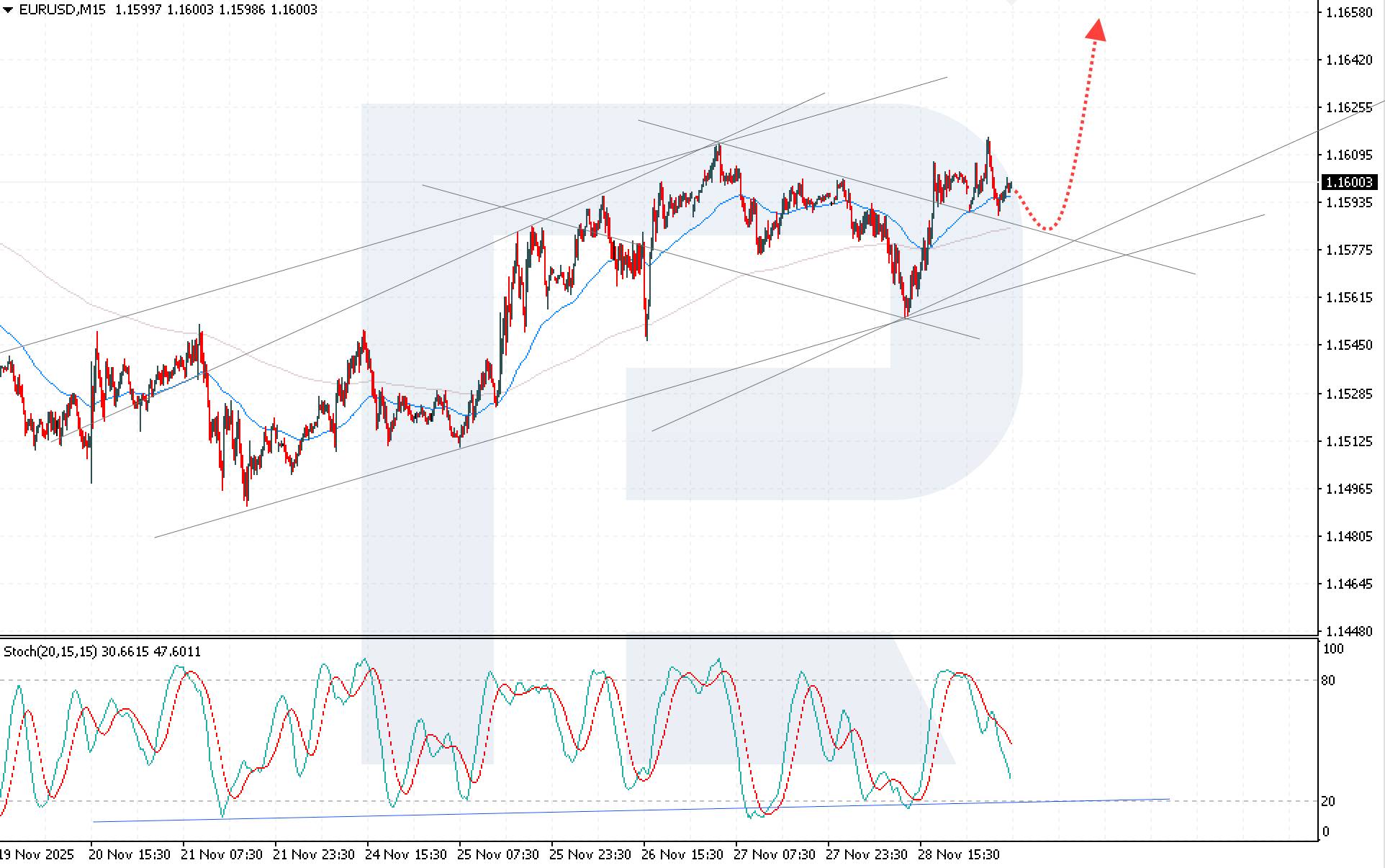
          The EURUSD pair is rising amid pressure on the US dollar and growing expectations of a more dovish Federal Reserve policy, currently trading at 1.1600.

          EURUSD forecast: key trading points

          · Traders are now pricing in an 87.6% probability of a Fed rate cut at the upcoming meeting
          · The market expects three more Fed rate cuts next year
          · Dovish expectations for the Fed increase the likelihood of further EURUSD growth
          · EURUSD forecast for 1 December 2025: 1.1660

          Fundamental analysis

          The EURUSD exchange rate is strengthening for the sixth consecutive trading session. However, sellers continue to successfully defend the key resistance level at 1.1605, which has remained unbroken for four sessions.

          The US dollar remains under pressure. Traders are pricing in an 87.6% probability that the Federal Reserve will deliver a final 25-basis-point rate cut of the year at the upcoming meeting. The market also expects three additional cuts next year.

          Investors are reacting to reports that White House economic adviser Kevin Hassett is being considered as the leading candidate to replace Jerome Powell as Fed chair. Market participants believe such an appointment would align with President Donald Trump's preference for more accommodative monetary policy, increasing the likelihood of continued EURUSD upside.

          EURUSD technical analysis

          The EURUSD rate is rising slightly after breaking above the upper boundary of the corrective channel. Buyers keep prices above the EMA-65 line, confirming the dominance of bullish sentiment.

          The EURUSD forecast for today suggests a minor bearish correction, after which renewed growth towards 1.1660 is expected. An additional signal in favour of further upside comes from the Stochastic Oscillator, with its signal lines turning down from overbought territory and approaching the support level.

          A consolidation above 1.1615 will serve as a key indication of a fully resumed bullish impulse.
          

          Summary

          EURUSD technical analysis indicates sustained bullish momentum. Current expectations of a Fed rate cut and the potential appointment of a more dovish Fed chair increase pressure on the USD, supporting further upside potential in the pair towards 1.1660.

          Source: RoboForex

          To stay updated on all economic events of today, please check out our Economic calendar
          Risk Warnings and Disclaimers
          You understand and acknowledge that there is a high degree of risk involved in trading. Following any strategies or investment methods may lead to potential losses. The content on the site is provided by our contributors and analysts for information purposes only. You are solely responsible for determining whether any trading assets, securities, strategy, or any other product is suitable for investing based on your own investment objectives and financial situation.
          Add to Favorites
          Share

          Global Markets Begin December Unevenly as Japan’s Weak Factory Data Triggers Nikkei Slump, Oil Surges

          Gerik

          Economic

          Diverging Asian Market Sentiment Amid Weak Factory Reports

          Asian stock markets entered December with no clear consensus, as investors absorbed new regional manufacturing data and shifting U.S. economic signals. Japan's Nikkei 225 plummeted by 1.9% to 49,285.66 after government data revealed disappointing corporate investment and ongoing manufacturing contraction. The S&P Global Japan Manufacturing PMI came in at 48.7 for November, slightly higher than October’s 48.2 but still firmly in contractionary territory. This marked the fifth consecutive month of decline, reinforcing the persistent weakness in Japan’s manufacturing base.
          The subdued PMI data indicates that Japanese manufacturers are still struggling with fragile demand. According to S&P Global’s Annabel Fiddes, firms saw a “solid decline in new business,” revealing a strong relationship between faltering demand conditions and reduced factory output. This downward momentum aligns with the broader regional narrative of cooling production despite improving exports.

          China’s Manufacturing and Trade Frictions Shape Sentiment

          China’s own factory sector fared no better. Its official PMI data released over the weekend confirmed an eighth straight month of contraction in November, amplifying concerns about the country’s growth trajectory even as it continues a temporary trade truce with the U.S. The persistence of sub-50 readings across East Asia suggests that supply chain activity remains hindered, likely influenced by geopolitical pressures, weak internal consumption, and volatile global demand.
          Despite this weakness, Hong Kong’s Hang Seng Index defied the trend and rose 0.8% to 26,068.05. In contrast, Shanghai’s Composite Index posted a smaller gain of 0.4%, while South Korea’s Kospi remained largely flat at 3,926.20. Australia’s ASX 200 declined 0.3%, and Taiwan’s Taiex lost 0.5%. India’s Sensex edged up by 0.3%, reflecting domestic optimism likely buoyed by retail trends.

          Oil Prices Climb Sharply As Supply Concerns Resurface

          Commodities offered a more bullish picture, with both U.S. benchmark crude and Brent crude rising $1.05 per barrel in early Monday trading. The price rise could be attributed to new supply constraints or geopolitical anxieties, although specifics were not detailed. This movement in oil markets may exert inflationary pressures if sustained, which would complicate central bank policy decisions heading into 2026.
          U.S. futures were lower early Monday, with S&P 500 contracts down by nearly 0.7% and Dow futures falling 0.4%. This decline followed a Friday session marred by trading halts on major indices due to a data center outage at CME’s CyrusOne facility. Despite the glitch, the S&P 500 had closed 0.5% higher, the Dow rose 0.6%, and the Nasdaq gained 0.7% in the shortened post-Thanksgiving trading day.
          Investors are still digesting signals from the Federal Reserve, which has already implemented two rate cuts in 2025 to counter a weakening job market. However, policymakers face a dilemma: while rate cuts could support economic activity, they also risk reigniting inflation, especially amid rising energy prices. According to the Fed’s October meeting minutes, internal divisions are deepening over the appropriate course of action.

          Tech Sector Divergence Reflects Shifting Investor Sentiment

          November saw wide variance in tech sector performance. While Nvidia dropped 1.8% on Friday and posted a double-digit monthly loss, other names like Oracle and Palantir fell 23% and 16% respectively during the month. On the other hand, Alphabet surged nearly 14% as enthusiasm grew over its Gemini AI release, showing how investor interest in artificial intelligence remains selective and volatile.
          This dispersion indicates a correlation between tangible product rollouts and investor confidence, while companies without immediate breakthroughs may face stiffer selloffs. As AI-driven optimism remains a key theme, market momentum will likely continue to pivot around these announcements.

          Retail and Consumer Spending Show Resilience Amid Uncertainty

          The holiday shopping season added another layer to market dynamics. Early signals suggested stronger-than-expected consumer activity during Black Friday and Cyber Monday. This optimism, however, is counterbalanced by concerns over long-term U.S. economic health, employment softness, and monetary tightening.
          Retail stocks reacted cautiously. Macy’s dipped 0.3%, Kohl’s rose 1.4%, and Dick’s Sporting Goods dropped 0.5%. Meanwhile, Abercrombie & Fitch climbed 2.9%, and American Eagle Outfitters gained 0.7%, hinting at mixed performance among specialty retailers.

          Currency And Crypto Markets Reflect Cautious Mood

          Currency markets were relatively subdued. The dollar slipped to 155.57 yen from 156.14, while the euro inched up to $1.1602. Bitcoin, however, experienced notable volatility, dropping 5.3% to $86,225. This sharp decline reflects speculative concerns amid broader risk-off sentiment in global markets.
          The first trading day of December highlighted growing divergences across global markets. Asia’s manufacturing weakness, a lack of broad-based recovery in China, and uncertainties in Fed policy continue to constrain bullish momentum. Oil price gains and resilient retail spending offer short-term optimism, but the overall landscape remains fragile. Investors are likely to remain cautious ahead of key policy meetings and year-end economic data, with risk appetite sensitive to both geopolitical developments and macroeconomic signals.

          Source: AP

          To stay updated on all economic events of today, please check out our Economic calendar
          Risk Warnings and Disclaimers
          You understand and acknowledge that there is a high degree of risk involved in trading. Following any strategies or investment methods may lead to potential losses. The content on the site is provided by our contributors and analysts for information purposes only. You are solely responsible for determining whether any trading assets, securities, strategy, or any other product is suitable for investing based on your own investment objectives and financial situation.
          Add to Favorites
          Share

          China’s Industrial Slowdown Deepens as Domestic Demand Falters Despite Export Momentum

          Gerik

          Economic

          Widening Manufacturing Contraction Signals Uneven Recovery

          China’s manufacturing sector showed unexpected weakness in November 2025, with the private RatingDog China General Manufacturing PMI sliding to 49.9, below the expected 50.5 mark and down from 50.6 in October. A PMI below 50 indicates a contraction in industrial activity. This marks the second consecutive month of deceleration and suggests that industrial momentum is losing steam in the world’s second-largest economy. The decline is particularly notable because the RatingDog-S&P Global survey generally portrays a more optimistic outlook than the official PMI, which already recorded an eighth straight month of contraction, coming in at 49.2.
          The contraction is closely linked to sluggish domestic demand, as new business orders stagnated. Despite a mild surge in export orders the strongest in eight months the growth in production halted. This reveals a relationship where external demand offers short-term support, but internal market weakness overrides the broader recovery trend. Manufacturers responded by cutting staff and scaling back procurement, reflecting uncertainty in future orders.

          Dampened Non-Manufacturing Performance Adds to Headwinds

          In parallel, the official non-manufacturing PMI also slipped to 49.5 in November, marking its first contraction since December 2022. This suggests the economic malaise is not limited to factories but has spilled over into services and construction, notably weakened by ongoing distress in the property sector. Real estate and residential services continued to underperform, undermining one of the most significant pillars of China's domestic economy.
          The persistent drag from real estate was evident in fixed-asset investment data. Investment fell by 1.7% in the first ten months of 2025, while October alone witnessed a steep year-on-year drop of 11.4%. Property-specific investment shrank by 14.7% for the same ten-month period, up from a 13.9% decline in the third quarter. This data shows a strongly correlated trend between falling fixed-asset investment and broader economic deceleration. The causal link appears to be the lack of policy stimulus translating into real investment growth.

          Retail and Industrial Indicators Show Mixed Signals

          While industrial output grew 4.9% year-on-year in October, the slowest pace since August, retail sales only climbed 2.9%, marking the fifth straight month of decline. The weakening of retail activity confirms that domestic consumption remains under significant strain. These figures suggest that the recovery is skewed toward supply-side resilience rather than broad-based demand revival.
          Adding to the concerns, China’s exports in October fell 1.1% year-on-year the first decline in nearly two years despite previous front-loading of overseas shipments. This drop signifies more than a seasonal effect; it reflects declining global demand and the fading of short-term stockpiling efforts by foreign buyers.

          Growth Forecast Faces Downward Pressure Despite Trade Truce

          The broader implication is that China’s economic growth will likely dip below 4.5% in Q4, down from 4.8% in Q3, according to OCBC’s Tommy Xie. The decline appears to stem from a convergence of soft consumption, delayed infrastructure impact, and persisting property woes. The government’s efforts to stabilize growth, including anticipated policy directions from the upcoming Central Economic Work Conference, may be crucial to reversing the downtrend.
          Meanwhile, geopolitical dynamics show signs of temporary easing. A trade détente was reached in late October between President Trump and Xi Jinping, with the U.S. agreeing to roll back certain tariffs and pause regulatory measures in exchange for China’s cooperation on fentanyl and rare earths. While this move reduces short-term policy uncertainty and may support export sentiment, it is unlikely to revive domestic demand in the near term.

          Persistent Deflation Risk Despite Market Stability

          Bank of America analysts noted that demand-side weaknesses could prolong deflationary pressures into 2026. Although equity markets reacted mildly positively with the CSI 300 up 0.36% and Hang Seng Index rising 0.74% these gains may be driven more by speculative sentiment than by fundamental economic improvements. The offshore yuan stabilized at 7.0711 against the dollar, indicating limited currency pressure but also no strong capital inflows to reinvigorate domestic sectors.
          In sum, the data from November paints a cautious picture for China’s economic trajectory. While exports briefly buoyed optimism, the structural issues within domestic demand and investment remain deeply entrenched. Without a more forceful fiscal or monetary push, China may struggle to meet its 5% growth target in the coming year.

          Source: CNBC

          To stay updated on all economic events of today, please check out our Economic calendar
          Risk Warnings and Disclaimers
          You understand and acknowledge that there is a high degree of risk involved in trading. Following any strategies or investment methods may lead to potential losses. The content on the site is provided by our contributors and analysts for information purposes only. You are solely responsible for determining whether any trading assets, securities, strategy, or any other product is suitable for investing based on your own investment objectives and financial situation.
          Add to Favorites
          Share
          FastBull
          Copyright © 2025 FastBull Ltd

          728 RM B 7/F GEE LOK IND BLDG NO 34 HUNG TO RD KWUN TONG KLN HONG KONG

          TelegramInstagramTwitterfacebooklinkedin
          App Store Google Play Google Play
          Products
          Charts

          Chats

          Q&A with Experts
          Screeners
          Economic Calendar
          Data
          Tools
          Membership
          Features
          Function
          Markets
          Copy Trading
          Latest Signals
          Contests
          News
          Analysis
          24/7
          Columns
          Education
          Company
          Careers
          About Us
          Contact Us
          Advertising
          Help Center
          Feedback
          User Agreement
          Privacy Policy
          Business

          White Label

          Data API

          Web Plug-ins

          Poster Maker

          Affiliate Program

          Risk Disclosure

          The risk of loss in trading financial instruments such as stocks, FX, commodities, futures, bonds, ETFs and crypto can be substantial. You may sustain a total loss of the funds that you deposit with your broker. Therefore, you should carefully consider whether such trading is suitable for you in light of your circumstances and financial resources.

          No decision to invest should be made without thoroughly conducting due diligence by yourself or consulting with your financial advisors. Our web content might not suit you since we don't know your financial conditions and investment needs. Our financial information might have latency or contain inaccuracy, so you should be fully responsible for any of your trading and investment decisions. The company will not be responsible for your capital loss.

          Without getting permission from the website, you are not allowed to copy the website's graphics, texts, or trademarks. Intellectual property rights in the content or data incorporated into this website belong to its providers and exchange merchants.

          Not Logged In

          Log in to access more features

          FastBull Membership

          Not yet

          Purchase

          Become a signal provider
          Help Center
          Customer Service
          Dark Mode
          Price Up/Down Colors

          Log In

          Sign Up

          Position
          Layout
          Fullscreen
          Default to Chart
          The chart page opens by default when you visit fastbull.com
