• Trade
  • Markets
  • Copy
  • Contests
  • News
  • 24/7
  • Calendar
  • Q&A
  • Chats
Trending
Screeners
SYMBOL
LAST
BID
ASK
HIGH
LOW
NET CHG.
%CHG.
SPREAD
SPX
S&P 500 Index
6846.50
6846.50
6846.50
6878.28
6827.18
-23.90
-0.35%
--
DJI
Dow Jones Industrial Average
47739.31
47739.31
47739.31
47971.51
47611.93
-215.67
-0.45%
--
IXIC
NASDAQ Composite Index
23545.89
23545.89
23545.89
23698.93
23455.05
-32.22
-0.14%
--
USDX
US Dollar Index
99.000
99.080
99.000
99.000
99.000
+0.050
+ 0.05%
--
EURUSD
Euro / US Dollar
1.16369
1.16376
1.16369
1.16388
1.16322
+0.00005
0.00%
--
GBPUSD
Pound Sterling / US Dollar
1.33212
1.33223
1.33212
1.33220
1.33140
+0.00007
+ 0.01%
--
XAUUSD
Gold / US Dollar
4191.62
4192.06
4191.62
4193.27
4189.64
+1.92
+ 0.05%
--
WTI
Light Sweet Crude Oil
58.660
58.702
58.660
58.676
58.543
+0.105
+ 0.18%
--

Community Accounts

Signal Accounts
--
Profit Accounts
--
Loss Accounts
--
View More

Become a signal provider

Sell trading signals to earn additional income

View More

Guide to Copy Trading

Get started with ease and confidence

View More

Signal Accounts for Members

All Signal Accounts

Best Return
  • Best Return
  • Best P/L
  • Best MDD
Past 1W
  • Past 1W
  • Past 1M
  • Past 1Y

All Contests

  • All
  • Trump Updates
  • Recommend
  • Stocks
  • Cryptocurrencies
  • Central Banks
  • Featured News
Top News Only
Share

Japan Prime Minister Takaichi: 30 Injuries Reported So Far From Monday Earthquake

Share

USA Senate Committee Votes To Advance Nomination Of Jared Isaacman To Head Nasa

Share

Singapore Post - New Rate For Standard Regular Mail & Standard Large Mail Will Be S$0.62 And S$0.90 Respectively

Share

Australia's S&P/ASX 200 Index Down 0.27% At 8601.10 Points In Early Trade

Share

Trump: The USA Needs Mexico To Release 200000 Acre-Feet Of Water Before December 31St, And The Rest Must Come Soon After

Share

Trump: I Have Authorized Documentation To Impose A 5% Tariff On Mexico If This Water Isn't Released

Share

Brazil's Sao Paulo State Governor Tarcisio De Freitas Says Flavio Bolsonaro Will Have His Support - Cnn Brasil

Share

Ukraine's Security Must Be Guaranteed, In The Long Term, As A First Line Of Defence For Our Union, Says European Commission President

Share

Ukraine's Sovereignty Must Be Respected, Says European Commission President

Share

The Goal Is A Strong Ukraine, On The Battlefield And At The Negotiating Table, Says European Commission President

Share

As Peace Talks Are Ongoing, The EU Remains Ironclad In Its Support For Ukraine, Says European Commission President

Share

Pepsico: Asking USA-Based Pepna Employees As Well As Pbus Division Offices And Pfus Region Offices To Work Remotely This Week

Share

A U.S. Judge Ruled That President Trump’s Ban On Several Wind Power Projects Was Illegal

Share

Senior USA Administration Official: We Continue To Monitor Drc-Rwanda Situation Closely, Continue To Work With All Sides To Ensure Commitments Are Honored

Share

Israeli Military Says It Has Struck Infrastructure Belonging To Hezbollah In Several Areas In Southern Lebanon

Share

SPDR Gold Holdings Down 0.11%, Or 1.14 Tonnes

Share

On Monday (December 8), In Late New York Trading, S&P 500 Futures Fell 0.21%, Dow Jones Futures Fell 0.43%, NASDAQ 100 Futures Fell 0.08%, And Russell 2000 Futures Fell 0.04%

Share

Morgan Stanley: Data Center ABS Spreads Are Expected To Widen In 2026

Share

(US Stocks) The Philadelphia Gold And Silver Index Closed Down 2.34% At 311.01 Points. (Global Session) The NYSE Arca Gold Miners Index Closed Down 2.17%, Hitting A Daily Low Of 2235.45 Points; US Stocks Remained Slightly Down Before The Opening Bell—holding Steady Around 2280 Points—before Briefly Rising Slightly

Share

IMF: IMF Executive Board Approves Extension Of The Extended Credit Facility Arrangement With Nepal

TIME
ACT
FCST
PREV
France Trade Balance (SA) (Oct)

A:--

F: --

P: --
Euro Zone Employment YoY (SA) (Q3)

A:--

F: --

P: --
Canada Part-Time Employment (SA) (Nov)

A:--

F: --

P: --

Canada Unemployment Rate (SA) (Nov)

A:--

F: --

P: --

Canada Full-time Employment (SA) (Nov)

A:--

F: --

P: --

Canada Labor Force Participation Rate (SA) (Nov)

A:--

F: --

P: --

Canada Employment (SA) (Nov)

A:--

F: --

P: --

U.S. PCE Price Index MoM (Sept)

A:--

F: --

P: --

U.S. Personal Income MoM (Sept)

A:--

F: --

P: --

U.S. Core PCE Price Index MoM (Sept)

A:--

F: --

P: --

U.S. PCE Price Index YoY (SA) (Sept)

A:--

F: --

P: --

U.S. Core PCE Price Index YoY (Sept)

A:--

F: --

P: --

U.S. Personal Outlays MoM (SA) (Sept)

A:--

F: --

P: --
U.S. 5-10 Year-Ahead Inflation Expectations (Dec)

A:--

F: --

P: --

U.S. Real Personal Consumption Expenditures MoM (Sept)

A:--

F: --

P: --
U.S. Weekly Total Rig Count

A:--

F: --

P: --

U.S. Weekly Total Oil Rig Count

A:--

F: --

P: --

U.S. Consumer Credit (SA) (Oct)

A:--

F: --

P: --
China, Mainland Foreign Exchange Reserves (Nov)

A:--

F: --

P: --

Japan Trade Balance (Oct)

A:--

F: --

P: --

Japan Nominal GDP Revised QoQ (Q3)

A:--

F: --

P: --

China, Mainland Imports YoY (CNH) (Nov)

A:--

F: --

P: --

China, Mainland Exports (Nov)

A:--

F: --

P: --

China, Mainland Imports (CNH) (Nov)

A:--

F: --

P: --

China, Mainland Trade Balance (CNH) (Nov)

A:--

F: --

P: --

China, Mainland Exports YoY (USD) (Nov)

A:--

F: --

P: --

China, Mainland Imports YoY (USD) (Nov)

A:--

F: --

P: --

Germany Industrial Output MoM (SA) (Oct)

A:--

F: --

P: --
Euro Zone Sentix Investor Confidence Index (Dec)

A:--

F: --

P: --

Canada National Economic Confidence Index

A:--

F: --

P: --

U.K. BRC Like-For-Like Retail Sales YoY (Nov)

--

F: --

P: --

U.K. BRC Overall Retail Sales YoY (Nov)

--

F: --

P: --

Australia Overnight (Borrowing) Key Rate

--

F: --

P: --

RBA Rate Statement
RBA Press Conference
Germany Exports MoM (SA) (Oct)

--

F: --

P: --

U.S. NFIB Small Business Optimism Index (SA) (Nov)

--

F: --

P: --

Mexico 12-Month Inflation (CPI) (Nov)

--

F: --

P: --

Mexico Core CPI YoY (Nov)

--

F: --

P: --

Mexico PPI YoY (Nov)

--

F: --

P: --

U.S. Weekly Redbook Index YoY

--

F: --

P: --

U.S. JOLTS Job Openings (SA) (Oct)

--

F: --

P: --

China, Mainland M1 Money Supply YoY (Nov)

--

F: --

P: --

China, Mainland M0 Money Supply YoY (Nov)

--

F: --

P: --

China, Mainland M2 Money Supply YoY (Nov)

--

F: --

P: --

U.S. EIA Short-Term Crude Production Forecast For The Year (Dec)

--

F: --

P: --

U.S. EIA Natural Gas Production Forecast For The Next Year (Dec)

--

F: --

P: --

U.S. EIA Short-Term Crude Production Forecast For The Next Year (Dec)

--

F: --

P: --

EIA Monthly Short-Term Energy Outlook
U.S. API Weekly Gasoline Stocks

--

F: --

P: --

U.S. API Weekly Cushing Crude Oil Stocks

--

F: --

P: --

U.S. API Weekly Crude Oil Stocks

--

F: --

P: --

U.S. API Weekly Refined Oil Stocks

--

F: --

P: --

South Korea Unemployment Rate (SA) (Nov)

--

F: --

P: --

Japan Reuters Tankan Non-Manufacturers Index (Dec)

--

F: --

P: --

Japan Reuters Tankan Manufacturers Index (Dec)

--

F: --

P: --

Japan Domestic Enterprise Commodity Price Index MoM (Nov)

--

F: --

P: --

Japan Domestic Enterprise Commodity Price Index YoY (Nov)

--

F: --

P: --

China, Mainland PPI YoY (Nov)

--

F: --

P: --

China, Mainland CPI MoM (Nov)

--

F: --

P: --

Italy Industrial Output YoY (SA) (Oct)

--

F: --

P: --

Q&A with Experts
    • All
    • Chatrooms
    • Groups
    • Friends
    Connecting
    .
    .
    .
    Type here...
    Add Symbol or Code

      No matching data

      All
      Trump Updates
      Recommend
      Stocks
      Cryptocurrencies
      Central Banks
      Featured News
      • All
      • Russia-Ukraine Conflict
      • Middle East Flashpoint
      • All
      • Russia-Ukraine Conflict
      • Middle East Flashpoint
      Search
      Products

      Charts Free Forever

      Chats Q&A with Experts
      Screeners Economic Calendar Data Tools
      Membership Features
      Data Warehouse Market Trends Institutional Data Policy Rates Macro

      Market Trends

      Market Sentiment Order Book Forex Correlations

      Top Indicators

      Charts Free Forever
      Markets

      News

      News Analysis 24/7 Columns Education
      From Institutions From Analysts
      Topics Columnists

      Latest Views

      Latest Views

      Trending Topics

      Top Columnists

      Latest Update

      Signals

      Copy Rankings Latest Signals Become a signal provider AI Rating
      Contests
      Brokers

      Overview Brokers Assessment Rankings Regulators News Claims
      Broker listing Forex Brokers Comparison Tool Live Spread Comparison Scam
      Q&A Complaint Scam Alert Videos Tips to Detect Scam
      More

      Business
      Events
      Careers About Us Advertising Help Center

      White Label

      Data API

      Web Plug-ins

      Affiliate Program

      Awards Institution Evaluation IB Seminar Salon Event Exhibition
      Vietnam Thailand Singapore Dubai
      Fans Party Investment Sharing Session
      FastBull Summit BrokersView Expo
      Recent Searches
        Top Searches
          Markets
          News
          Analysis
          User
          24/7
          Economic Calendar
          Education
          Data
          • Names
          • Latest
          • Prev

          View All

          No data

          Scan to Download

          Faster Charts, Chat Faster!

          Download App
          English
          • English
          • Español
          • العربية
          • Bahasa Indonesia
          • Bahasa Melayu
          • Tiếng Việt
          • ภาษาไทย
          • Français
          • Italiano
          • Türkçe
          • Русский язык
          • 简中
          • 繁中
          Open Account
          Search
          Products
          Charts Free Forever
          Markets
          News
          Signals

          Copy Rankings Latest Signals Become a signal provider AI Rating
          Contests
          Brokers

          Overview Brokers Assessment Rankings Regulators News Claims
          Broker listing Forex Brokers Comparison Tool Live Spread Comparison Scam
          Q&A Complaint Scam Alert Videos Tips to Detect Scam
          More

          Business
          Events
          Careers About Us Advertising Help Center

          White Label

          Data API

          Web Plug-ins

          Affiliate Program

          Awards Institution Evaluation IB Seminar Salon Event Exhibition
          Vietnam Thailand Singapore Dubai
          Fans Party Investment Sharing Session
          FastBull Summit BrokersView Expo

          Powell's Silence On His Future Complicates Trump's Fed Chair Search

          James Whitman

          Central Bank

          Political

          Summary:

          As US President Donald Trump and his advisers begin weighing replacements for Federal Reserve (Fed) chair Jerome Powell, they’re running into one significant complication: It’s not clear that Powell will leave the US central bank next year.

          As US President Donald Trump and his advisers begin weighing replacements for Federal Reserve (Fed) chair Jerome Powell, they’re running into one significant complication: It’s not clear that Powell will leave the US central bank next year.

          The Fed chief has repeatedly declined to say whether he will step down when his four-year term as chair expires in May, or remain on the Fed board — something he could technically do until his tenure as a governor expires in January 2028. The prospect of Powell remaining at the central bank has prompted administration officials to begin planning for multiple scenarios for his replacement, as Trump seeks a chair who will support his economic agenda.

          The president said on Tuesday he has “two or three top choices” to potentially succeed Powell, but declined to name them. In recent weeks, Trump’s advisers have even discussed with him the possibility that Scott Bessent could simultaneously serve as the Treasury secretary and Fed chair, according to people familiar with the matter. Such a move would be unprecedented since the two roles were separated in 1935, in legislation aimed at giving the Fed a measure of independence.

          “Any reporting suggesting that the President is considering having Secretary Bessent serve as both the Treasury secretary and Fed chairman concurrently is absolutely fake news,” a White House official said.

          A Treasury spokesperson pointed to Bessent’s comments earlier this week on his potential candidacy. “I will do what the president wants, but I think I have the best job in DC,” he said on Bloomberg TV.

          As the selection for a new Fed leader unfolds, the president has made clear the next chair must be “somebody that wants to cut rates”. Powell has led his colleagues in standing pat this year, saying they need more certainty that Trump’s tariffs won’t trigger a persistent rise in inflation.

          When asked about his tenure on Tuesday in a panel discussion with fellow central bankers from around the world, Powell said, “I have nothing for you on that.”

          Powell’s circumspection has frustrated some of Trump’s advisers, who are taking the silence as an attempt to push back against the president’s desire for more influence on monetary policy, according to people familiar with the matter.

          If he did stay on as a Fed governor, Powell would leave Trump with just one scheduled opportunity to fill a board slot — governor Adriana Kugler’s, whose term ends in January — until the president’s final year in office.

          Bessent, publicly acknowledging Powell could stay, said in a Bloomberg TV interview on Monday one idea would be to fill Kugler’s slot with the person who would later be elevated to chair. Choosing an existing governor is another option, he said.

          Powell’s coyness has raised speculation that he could stay on the board if Trump picks a nominee who is overly deferential to the president’s demands, said Neil Dutta, the head of economic research at Renaissance Macro. “That’s the leverage Powell has right now by not declaring his intentions.”

          Pressure rises

          While Trump has sometimes speculated about firing Powell, a May Supreme Court ruling raised the hurdle for that, without having legal “cause”.

          Pressure on Powell heated up further on Wednesday, with Trump’s housing-finance chief, Bill Pulte, accusing Powell of misleading lawmakers about Fed building renovations. Pulte claimed the issue was sufficient to remove him “for cause,” and the president later posted on social media that Powell “should resign immediately”.

          The supercharged political environment surrounding the US central bank makes the upcoming chairmanship decision all the more sensitive than it usually is. Typically, Fed chairs retire from the central bank when their terms at the helm end, but the political backdrop has rarely been as tense as today’s.

          Governor Michael Barr took the step in February of resigning as the vice-chair for supervision, while remaining on the board — constraining Trump’s options for reshaping the board. “The independence of the Fed is critical to our ability to meet our statutory mandates,” Barr emphasised that month.

          Christopher Waller, a current governor who was nominated for the Fed board by Trump in his first term, is one option for the chair job. Kevin Hassett, the White House’s National Economic Council director and ex-Fed official Kevin Warsh are also top contenders from outside the Fed, people familiar with the matter said. Former World Bank president David Malpass has also been floated.

          Powell’s influence

          Trump’s nominee would need to be confirmed by the Senate, and Republicans’ narrow majority means they couldn’t lose more than three votes for the pick.

          Powell has often declined to answer politically tinged questions related to Trump amid the president’s steady stream of criticism.

          “I’m very focused on just doing my job,” Powell said this week when asked about Trump’s attacks. “The things that matter are using our tools to achieve the goals that Congress has given us.”

          Sarah Binder, a professor of political science at George Washington University, said “it’s a sort of a defensive mechanism” to forgo specific comment on when he will leave. “My guess is Powell doesn’t see it in his interest, but really in the Fed’s interest, to engage with the president at all.”

          If Powell did remain on the board, he could continue to influence policy decisions made by the 19-person interest-rate setting Federal Open Market Committee, having worked with most members for years. Rate moves are made by majority vote, and it’s unclear what sway the new chief might have, especially if the candidate came from outside the current board.

          “He’s developed a lot of loyalty among the governors and Fed staff who I expect would remain loyal to him” if Trump picked a “toady”, Dutta said. “The problem Trump has created for the next chairman is making his desire for rate cuts so obvious that it becomes very challenging for that person. You look like a political stooge.”

          Source: Theedgemarkets

          Risk Warnings and Disclaimers
          You understand and acknowledge that there is a high degree of risk involved in trading. Following any strategies or investment methods may lead to potential losses. The content on the site is provided by our contributors and analysts for information purposes only. You are solely responsible for determining whether any trading assets, securities, strategy, or any other product is suitable for investing based on your own investment objectives and financial situation.
          Add to Favorites
          Share

          Heightened Volatility Looms as Investors Navigate a Minefield of Policy Triggers

          Gerik

          Economic

          Anticipating Market Reactions to High-Stakes Events

          Institutional investors are positioning themselves for what is expected to be a highly turbulent period across global markets. Multiple upcoming political and economic flashpoints—ranging from U.S.-EU tariff decisions to pivotal data releases and European budget votes—are likely to drive volatility across equities, credit, currencies, and commodities. Many asset managers warn that while risk is elevated, markets appear to be pricing in relatively benign outcomes, making them particularly vulnerable to negative surprises.
          April La Russe from Insight Investment remarked that despite the density of looming risks, there is a notable absence of corresponding risk premiums in asset pricing. This mismatch has prompted several investment firms to reduce exposure to areas like corporate credit and certain sovereign bonds.

          Tariff Uncertainty and Credit Exposure

          The July 9 U.S.-EU tariff deadline marks the first in a series of key geopolitical hurdles. According to Van Luu of Russell Investments, markets are currently pricing in a moderately constructive outcome, such as a 10% flat tariff or a temporary delay in implementation, akin to previous U.S.-China trade negotiations. However, the possibility of a breakdown—especially if Brussels fails to secure exemptions for major sectors—could reignite fears of retaliatory tariffs.
          This uncertainty has led Luu to downgrade corporate credit positions, arguing that current yields do not sufficiently reflect the potential downside risks to global trade and economic performance. Amundi’s Mahmood Pradhan noted that risky assets have already absorbed much of the good news, following a 24% rebound in global equities since early April. The implication is that even a favorable outcome may not deliver further upside.

          Currency Volatility and Treasury Pressure

          The U.S. dollar, already 10% weaker year-to-date, stands exposed to significant cross-currency fluctuations depending on the tariff outcome. Analysts from Artemis and Russell Investments highlighted that any collapse in trade talks could undermine the dollar’s safe-haven status, prompting a sell-off in Treasuries. This would reverse the long-standing trend of foreign capital flowing into U.S. government bonds, which has been underpinned by the dollar’s dominance in global trade.
          Meanwhile, gold—currently up more than 25% this year to $3,344—faces the risk of a sell-off should trade negotiations resolve positively. Michael Nizard of Edmond de Rothschild suggested that institutional investors and hedge funds may take profits in such a scenario, particularly if broader market confidence stabilizes.

          U.S. Labor Data as a Hidden Catalyst

          Beyond the tariff calendar, upcoming U.S. employment data could pose an even larger threat to market stability, particularly the August 1 report, which coincides with a seasonal dip in market liquidity. Both Luu and Liam O'Donnell of Artemis identified U.S. labor statistics as a potential surprise driver of market moves, given their underappreciated influence and recent deviation from expectations.
          Volatility indicators in major currency pairs, especially involving the Japanese yen, also appear too subdued. Historically, the yen has surged during periods when expectations of U.S. rate cuts increase, suggesting traders may be underestimating the scale of possible movements.

          European Fiscal Instability Reemerges

          In Europe, markets face renewed fiscal stress signals. France’s upcoming July 14 vote on its proposed budget—intended to address the euro zone’s largest deficit—is drawing investor concern. Although Prime Minister Francois Bayrou narrowly survived another no-confidence motion, analysts question his ability to push fiscal reforms through a fragmented parliament.
          Germany’s fiscal expansion, supported by new business tax incentives up for vote on July 11, adds to the broader picture of rising sovereign debt supply. Benchmark Bund yields have already climbed 25 basis points this year to approximately 2.62% due to expectations of increased issuance. The current yield premium of 70 basis points that France pays over Germany may be insufficient to reflect the rising fiscal uncertainty, prompting RBC Wealth Management to advise reducing exposure to French sovereign debt in the short term.
          In the UK, fiscal credibility is again in question following government reversals on welfare reform, with the potential to widen the deficit and drive bond yields higher.
          As investors move into July and August, the intersection of unresolved trade negotiations, critical economic data, and fragile European politics is setting the stage for significant asset repricing. While some markets reflect cautious optimism, the weight of unresolved risk points to an environment where underestimating volatility could prove costly. Investors appear to be repositioning in anticipation not only of directional moves, but also the likelihood of sharp fluctuations across global financial markets.

          Source: Reuters

          To stay updated on all economic events of today, please check out our Economic calendar
          Risk Warnings and Disclaimers
          You understand and acknowledge that there is a high degree of risk involved in trading. Following any strategies or investment methods may lead to potential losses. The content on the site is provided by our contributors and analysts for information purposes only. You are solely responsible for determining whether any trading assets, securities, strategy, or any other product is suitable for investing based on your own investment objectives and financial situation.
          Add to Favorites
          Share

          Chart Art: GBP/CAD Nears Key Long-Term Trend Support

          Blue River

          Forex

          Technical Analysis

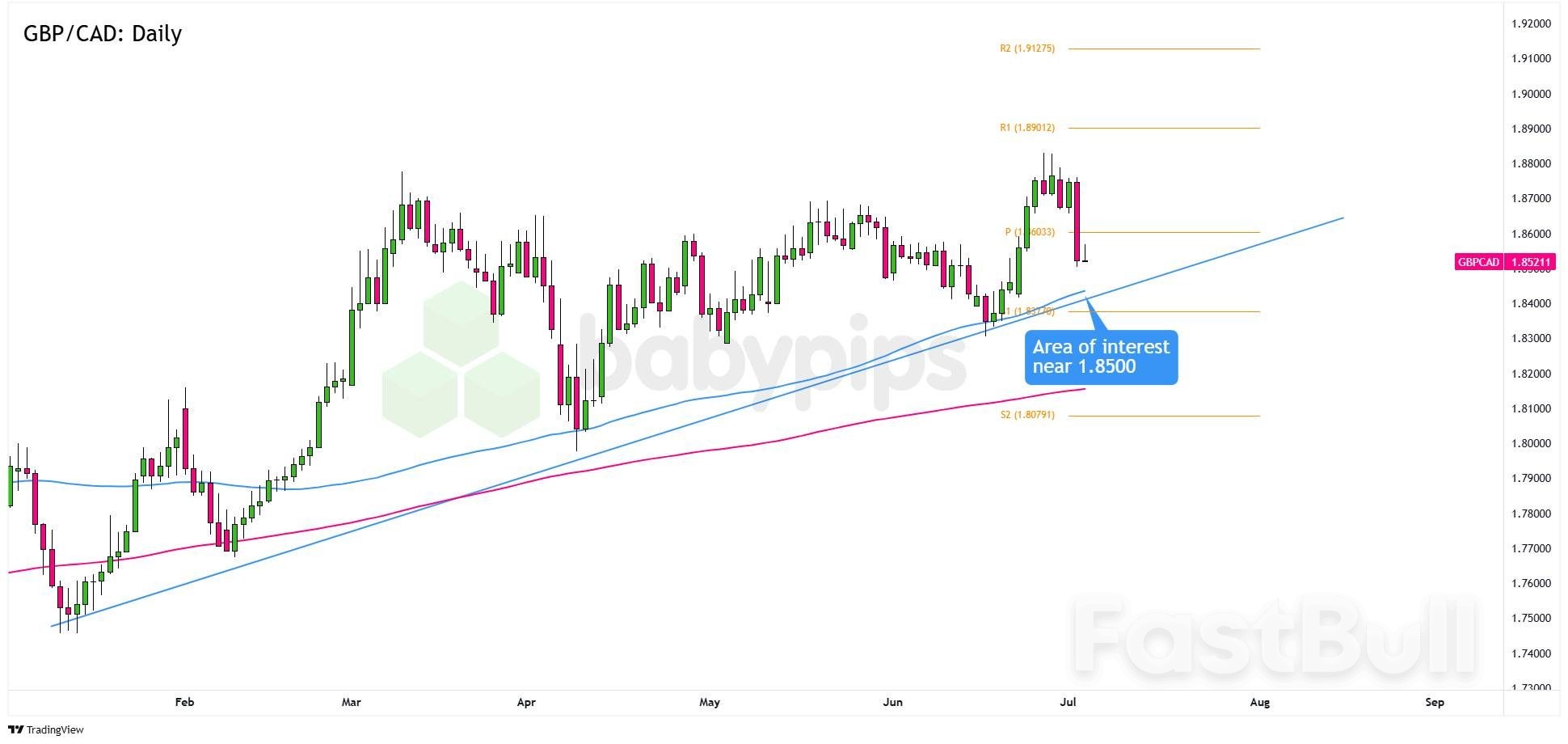
          GBP/CAD just threw down a big red candlestick after tagging new 2025 highs!

          Is this just a breather or the start of a longer-term downswing?

          We’re eyeing a major support zone that could decide whether the bulls step back in or call it a day.

          GBP/CAD: Daily

          GBP/CAD Daily Forex Chart

          Sterling slipped across the board after traders started doubting whether Chancellor Reeves still had solid backing from the government, especially after it watered down benefit cuts she had championed to balance the budget.

          At the same time, the Canadian dollar drew strength from rising oil prices, growing hopes for Fed rate cuts, and fresh optimism over U.S. trade deals.

          Was this the start of a longer-term slide for GBP/CAD, or just a temporary stumble before the bulls regroup?

          Remember that directional biases and volatility conditions in market price are typically driven by fundamentals. If you haven’t yet done your homework on the British pound and the Canadian dollar, then it’s time to check out the economic calendar and stay updated on daily fundamental news!

          GBP/CAD is closing in on the 1.8400 to 1.8500 zone, a key support area that lines up with the S1 Pivot Point at 1.8377, the 100 SMA, and a trend line that has kept sellers in check since January.

          If buyers show up with hesitation wicks and green candlesticks, we could see a bounce from this trend line area and a possible move back toward 1.8800 or even fresh 2025 highs.

          But if the bears break through with strong red candles and hold below the trend line, the pair could slide toward the S2 Pivot at 1.8079 or the 1.8000 psychological level. That kind of move might flip the longer-term uptrend on its head!

          Whichever bias you end up trading, don’t forget to practice proper risk management and stay aware of top-tier catalysts that could influence overall market sentiment.

          Source: BabyPips

          Risk Warnings and Disclaimers
          You understand and acknowledge that there is a high degree of risk involved in trading. Following any strategies or investment methods may lead to potential losses. The content on the site is provided by our contributors and analysts for information purposes only. You are solely responsible for determining whether any trading assets, securities, strategy, or any other product is suitable for investing based on your own investment objectives and financial situation.
          Add to Favorites
          Share

          Japan Calms Market Nerves With Strong 30-Year Bond Auction Despite Yield Pressure

          Gerik

          Economic

          Bond

          Tokyo’s Strategic Bond Move: Japan Eases Market Fears With Strong 30-Year Sale

          Japan’s Ministry of Finance (MOF) pulled off a smoother-than-expected auction of 30-year government bonds on Thursday, calming market anxiety over potential turbulence in long-term debt markets. With a bid-to-cover ratio of 3.58—the highest since February—investor appetite for Japanese sovereign debt remained robust, despite recent global volatility in long-maturity bonds.
          The auction’s tail (the difference between the average and lowest accepted price) came in at 0.31, down from 0.49 in June, reinforcing market confidence in the issuance process. The result came on the heels of last month’s MOF announcement to cut the issuance of long-dated bonds—a decision aimed at reducing upward pressure on yields amid rising concerns about fiscal sustainability.

          Market Strategy: Advance Signaling Works

          Analysts had anticipated stable demand given how well the auction was telegraphed. Westpac’s Martin Whetton called the result “not stellar, but good enough,” indicating that the positive outcome was largely baked into investor expectations. In effect, the auction served as a “buy-the-rumor, sell-the-fact” event, with Japanese bond futures holding losses and yields nudging slightly higher post-auction—30-year yields rose 2 basis points to 2.901%.
          The result reflects a careful balancing act by Japanese authorities, who have managed to calm short-term volatility even as they face intense structural pressures from a globally synchronized rise in yields, especially in the U.S. and U.K.

          Policy Context: Lower Supply, Softer BoJ Exit

          The MOF’s decision to reduce long-term debt issuance by ¥3.2 trillion ($22 billion) through March 2026 has helped temper bond market fears. Meanwhile, the Bank of Japan has committed to slowing its bond purchase taper, a clear signal to avoid any abrupt tightening in domestic financial conditions.
          Earlier this week, Japan also enjoyed relatively strong demand in its 10-year bond auction, setting the stage for Thursday’s success and boosting confidence in the market's ability to absorb debt issuance even as local institutional buyers—such as life insurers—pull back from long-dated maturities.

          Political and Structural Risks Remain

          Despite the positive auction outcome, underlying structural risks linger. The upcoming upper house election is introducing new fiscal uncertainties, with Prime Minister Shigeru Ishiba campaigning on ambitious economic promises, including a ¥1 quadrillion economy and wage hikes.
          Policy chief Itsunori Onodera has already warned that Japan’s fiscal stance is under a “yellow alert,” suggesting that spending pressures could resurface regardless of recent market stability. This leaves the government with a narrow path: managing funding costs in the face of demographic pressures, rising interest rate norms globally, and a political environment prone to populist spending.

          A Tactical Win in a Strategic Battle

          Japan’s successful 30-year bond auction is a tactical victory in a broader fiscal challenge. While the Ministry of Finance and Bank of Japan have temporarily reassured investors with reduced supply and policy clarity, the structural task of maintaining long-term fiscal health in a low-growth, aging economy remains daunting.
          As elections loom and the global rate environment remains uncertain, Tokyo’s ability to navigate the long end of its bond curve without triggering yield spikes or investor flight will continue to be tested.

          Source: Bloomberg

          To stay updated on all economic events of today, please check out our Economic calendar
          Risk Warnings and Disclaimers
          You understand and acknowledge that there is a high degree of risk involved in trading. Following any strategies or investment methods may lead to potential losses. The content on the site is provided by our contributors and analysts for information purposes only. You are solely responsible for determining whether any trading assets, securities, strategy, or any other product is suitable for investing based on your own investment objectives and financial situation.
          Add to Favorites
          Share

          U.S. Eases Chip Design Restrictions on China Under New Trade Agreement

          Gerik

          Economic

          U.S. Reverses Chip Design Software Curbs in Key Shift on China Tech Policy

          In a notable policy reversal, the Trump administration has removed export license requirements for U.S. companies selling chip design software to China. The move is part of a broader trade agreement finalized last week between Washington and Beijing that seeks to de-escalate tensions in the high-tech sector and restore critical supply chains.
          The decision affects the world’s three leading providers of electronic design automation (EDA) tools—Synopsys Inc., Cadence Design Systems Inc., and Germany’s Siemens AG—all of whom had been subject to licensing restrictions imposed in May. Those curbs had disrupted commercial activities by requiring companies to seek prior U.S. government approval to sell to Chinese clients.
          According to company statements, Siemens has already restored full access to its software for Chinese customers. Synopsys and Cadence are in the process of resuming services, signaling an immediate operational impact. The U.S. Commerce Department has not issued public comments on the change.

          Part of a Broader Trade Deal Linking Tech and Resources

          The easing of EDA software restrictions forms a key pillar of the new trade accord. In exchange, China has pledged to expedite export approvals for rare earth minerals, a vital input for electronics and defense industries. The agreement also includes U.S. permission for shipments of ethane and jet engines to China—two sectors previously facing increasing regulatory scrutiny.
          This marks a strategic trade-off: the U.S. regains access to critical mineral flows and commercial stability for major tech firms, while China regains access to essential design tools for its semiconductor ambitions.

          Reversing a Short-Lived But Symbolic Escalation

          The May restrictions on EDA tool sales were part of a broader campaign by the Trump administration to curb China’s progress in advanced computing and artificial intelligence. They followed years of export controls on high-end chips and semiconductor manufacturing equipment. While short-lived, the EDA restrictions signaled a willingness to broaden the tech blockade to upstream, software-based chokepoints in the chip design process.
          EDA tools are vital for the creation of everything from Nvidia’s most advanced GPUs to more basic analog components. Their importance lies in the fact that without access to tools from Synopsys, Cadence, and Siemens, China’s domestic chip industry would be severely hampered—even with physical manufacturing capacity.

          Strategic Implications: Tech Detente or Tactical Pause?

          The removal of these curbs is a significant gesture but may reflect a tactical pause more than a lasting detente. While the move benefits U.S. firms with significant exposure to China, such as Synopsys and Cadence, it also opens a narrow window for China’s semiconductor ecosystem to regain access to essential design software.
          It remains unclear how long this policy stance will last, especially with political pressure mounting around national security and tech dominance. The balance of trade-offs—minerals for software—indicates that both sides are trying to stabilize a strategically fragile supply chain landscape without compromising on core security red lines.

          A Reset in Tech Trade, Not a Repeal of Rivalry

          The U.S. lifting of chip design software restrictions is a calculated concession in a broader trade agreement aimed at restoring a degree of cooperation in tech and critical resources. While the move brings temporary relief to both U.S. suppliers and Chinese buyers, the broader rivalry in semiconductors, AI, and digital sovereignty remains intact.
          With the Biden-Trump policy continuum still evolving and technology remaining central to global economic power, this rollback signals more of a realignment than a retreat. The real test will be whether mutual access is preserved or re-constrained as broader geopolitical dynamics shift.

          Source: Reuters

          To stay updated on all economic events of today, please check out our Economic calendar
          Risk Warnings and Disclaimers
          You understand and acknowledge that there is a high degree of risk involved in trading. Following any strategies or investment methods may lead to potential losses. The content on the site is provided by our contributors and analysts for information purposes only. You are solely responsible for determining whether any trading assets, securities, strategy, or any other product is suitable for investing based on your own investment objectives and financial situation.
          Add to Favorites
          Share

          Oil Retreats After Trade-Driven Rally as Market Awaits OPEC+ Output Decision

          Gerik

          Commodity

          Oil Pulls Back as Trade Momentum Meets Supply Uncertainty

          Oil prices declined on Thursday following their biggest single-day gain in nearly two weeks. Brent crude hovered near $69 per barrel, and West Texas Intermediate (WTI) remained above $67, as market sentiment shifted from geopolitical risk to ongoing trade developments and the upcoming OPEC+ meeting.
          President Donald Trump’s announcement of a new trade agreement with Vietnam—following similar deals with the UK and China—helped fuel Wednesday’s 3% oil price surge. The agreements come ahead of the July 9 deadline to finalize trade terms, easing investor fears of widespread tariff escalations that could dampen global energy demand.
          However, analysts suggest the trade-driven rally may be short-lived as attention now pivots to OPEC+ negotiations, where the cartel is expected to raise production quotas in August.

          OPEC+ Decision Looms Large Over Price Direction

          Market participants are exercising caution ahead of Sunday’s OPEC+ meeting. The alliance, led by Saudi Arabia and Russia, is widely expected to approve a substantial increase in output, responding to seasonal demand strength and recent supply constraints.
          ING’s Head of Commodities Strategy, Warren Patterson, noted that while trade optimism gave oil prices a temporary lift, "the sustainability of this move will likely be short-lived" due to the market’s reluctance to build positions ahead of the U.S. holiday weekend and the OPEC+ decision.
          Any aggressive supply expansion could offset recent gains driven by Middle East tensions and U.S. trade progress, making the weekend’s outcome a key inflection point for market direction into mid-July.

          U.S. Inventory Trends Signal Mixed Fundamentals

          On the supply side, the latest data from the U.S. Energy Information Administration revealed that nationwide crude inventories rose by 3.8 million barrels last week—marking the first increase since May. However, stockpiles at Cushing, Oklahoma—the primary U.S. oil hub—fell for the fourth consecutive week and are now at their lowest seasonal level since 2014.
          This divergence highlights a complex demand picture. While national builds suggest some softening, regional draws and ongoing heat waves across the U.S. are propping up short-term consumption. The current driving season, coupled with elevated air conditioning usage, has lent support to gasoline and fuel demand.

          Market Structure Reflects Lingering Tightness

          Despite Thursday’s price decline, forward curves continue to signal underlying tightness. Brent’s prompt spread—the price gap between the nearest two contracts—rose to $1.21 per barrel in backwardation, up from $0.69 a month ago. Although this remains below the levels seen during last month’s Israel-Iran conflict, the structure still suggests strong prompt demand relative to future deliveries.
          Backwardation in oil markets typically reflects supply constraints or heightened immediate demand, indicating that while macroeconomic risks linger, physical market dynamics remain firm.
          Oil’s recent price action reflects the market’s balancing act between easing trade tensions and looming supply increases. While new U.S. trade deals have helped stabilize demand expectations, the potential for OPEC+ to flood the market with more barrels poses a fresh challenge for bulls.
          With the U.S. holiday limiting trading volumes and OPEC+ poised to announce new production targets, investors are treading carefully. The outcome of the weekend’s meeting will likely define the direction of crude markets into the second half of July, as traders weigh geopolitical developments against the fundamentals of supply and demand.

          Source: Bloomberg

          Risk Warnings and Disclaimers
          You understand and acknowledge that there is a high degree of risk involved in trading. Following any strategies or investment methods may lead to potential losses. The content on the site is provided by our contributors and analysts for information purposes only. You are solely responsible for determining whether any trading assets, securities, strategy, or any other product is suitable for investing based on your own investment objectives and financial situation.
          Add to Favorites
          Share

          Asian Markets Edge Higher as Investors Brace for U.S. Jobs Data and Trump’s Tax Bill Vote

          Gerik

          Economic

          Stocks

          Asian Markets Cautiously Advance Amid Critical U.S. Economic Developments

          Asian equities moved modestly higher on Thursday as investors turned their attention to two key U.S. events: the June payrolls report and the congressional vote on President Donald Trump’s sweeping tax and spending bill. These developments are expected to shape near-term expectations for Federal Reserve policy and broader market sentiment.
          The MSCI Asia-Pacific index (excluding Japan) edged up 0.2%, nearing a four-year high, while Japan’s Nikkei remained flat. In China, blue-chip stocks added 0.2%, but Hong Kong’s Hang Seng index slipped 0.6% following weaker-than-expected growth in China’s services sector, which expanded at its slowest pace in nine months.

          Wall Street Rallies on Vietnam Trade Deal, Eyes India Next

          U.S. equity markets closed at record highs after Trump announced a trade agreement with Vietnam, which includes a 20% tariff on exports to the U.S. The move was interpreted as part of a broader push to finalize trade pacts with key Asian economies, with India reportedly next in line.
          This momentum lifted hopes that trade clarity might buffer recent global volatility. S&P 500 and Nasdaq futures were little changed in Asia, signaling that investors are in wait-and-see mode ahead of the critical U.S. labor data.

          U.S. Jobs Data: A Key Test for Fed Policy Expectations

          The U.S. nonfarm payrolls report, due later today, is the central risk event. Economists forecast a gain of 110,000 jobs for June and an increase in the unemployment rate to 4.3%. However, a surprise contraction in private sector payrolls earlier this week has raised fears of a more pronounced labor market slowdown.
          According to IG analyst Tony Sycamore, if the jobless rate spikes to 4.4%—its highest since October 2021—it could significantly increase the likelihood of a July rate cut, with probabilities climbing toward 70%. Current market pricing implies only a 25% chance of a July cut.
          The Federal Reserve has not lowered interest rates in 2025 despite pressure from President Trump, who continues to demand aggressive easing. On Wednesday, he reiterated his call for Fed Chair Jerome Powell to resign and repeated his view that rates should be slashed to 1%, down from the current 4.25%–4.50% target.

          Bond Yields and the Dollar Reflect Policy Tensions

          U.S. Treasury yields fell slightly ahead of the data. The 10-year yield dipped 2 basis points to 4.265%, while the 2-year yield dropped to 3.77%. These modest declines reflect market hesitancy, as a weaker-than-expected jobs print could trigger a sharper repricing in rate expectations.
          The U.S. dollar remains under pressure amid mounting political criticism of the Fed’s independence. The Bloomberg Dollar Index has slipped to its lowest level in over three years. The euro inched up 0.1% to $1.1807, nearing a four-year high, while the British pound also gained 0.1% after heavy losses the previous day.
          UK markets remain volatile after the government’s reversal on welfare reforms sparked concerns about fiscal stability. Gilt yields spiked nearly 23 basis points at one point—the sharpest jump since October 2022.

          Oil, Gold Ease After Volatile Moves

          Oil prices retreated slightly after surging 3% overnight on geopolitical tensions. U.S. crude fell 0.4% to $67.20 per barrel, while Brent dipped to $68.84. The overnight spike was triggered by Iran’s decision to halt cooperation with the U.N. nuclear agency, adding a layer of supply risk to energy markets.
          Gold slipped 0.4% to $3,342 an ounce, following recent gains driven by fiscal and inflation uncertainties.
          Thursday’s trading session encapsulates a moment of global market tension. The combination of a potentially soft U.S. labor report and a controversial tax bill could redefine monetary policy expectations and shape asset flows. While equities are holding up on hopes for policy stimulus and international trade progress, downside risks persist if data disappoints or fiscal dynamics further unsettle bond markets.
          Investors are navigating a narrow path, balancing short-term optimism with the structural concerns of inflation, central bank credibility, and rising public debt. The U.S. payrolls report could be the catalyst that tips sentiment one way or the other.

          Souce: Reuters

          To stay updated on all economic events of today, please check out our Economic calendar
          Risk Warnings and Disclaimers
          You understand and acknowledge that there is a high degree of risk involved in trading. Following any strategies or investment methods may lead to potential losses. The content on the site is provided by our contributors and analysts for information purposes only. You are solely responsible for determining whether any trading assets, securities, strategy, or any other product is suitable for investing based on your own investment objectives and financial situation.
          Add to Favorites
          Share
          FastBull
          Copyright © 2025 FastBull Ltd

          728 RM B 7/F GEE LOK IND BLDG NO 34 HUNG TO RD KWUN TONG KLN HONG KONG

          TelegramInstagramTwitterfacebooklinkedin
          App Store Google Play Google Play
          Products
          Charts

          Chats

          Q&A with Experts
          Screeners
          Economic Calendar
          Data
          Tools
          Membership
          Features
          Function
          Markets
          Copy Trading
          Latest Signals
          Contests
          News
          Analysis
          24/7
          Columns
          Education
          Company
          Careers
          About Us
          Contact Us
          Advertising
          Help Center
          Feedback
          User Agreement
          Privacy Policy
          Business

          White Label

          Data API

          Web Plug-ins

          Poster Maker

          Affiliate Program

          Risk Disclosure

          The risk of loss in trading financial instruments such as stocks, FX, commodities, futures, bonds, ETFs and crypto can be substantial. You may sustain a total loss of the funds that you deposit with your broker. Therefore, you should carefully consider whether such trading is suitable for you in light of your circumstances and financial resources.

          No decision to invest should be made without thoroughly conducting due diligence by yourself or consulting with your financial advisors. Our web content might not suit you since we don't know your financial conditions and investment needs. Our financial information might have latency or contain inaccuracy, so you should be fully responsible for any of your trading and investment decisions. The company will not be responsible for your capital loss.

          Without getting permission from the website, you are not allowed to copy the website's graphics, texts, or trademarks. Intellectual property rights in the content or data incorporated into this website belong to its providers and exchange merchants.

          Not Logged In

          Log in to access more features

          FastBull Membership

          Not yet

          Purchase

          Become a signal provider
          Help Center
          Customer Service
          Dark Mode
          Price Up/Down Colors

          Log In

          Sign Up

          Position
          Layout
          Fullscreen
          Default to Chart
          The chart page opens by default when you visit fastbull.com