Markets
News
Analysis
User
24/7
Economic Calendar
Education
Data
- Names
- Latest
- Prev


Signal Accounts for Members
All Signal Accounts
All Contests


U.K. Trade Balance Non-EU (SA) (Oct)A:--
F: --
P: --
U.K. Trade Balance (Oct)A:--
F: --
P: --
U.K. Services Index MoMA:--
F: --
P: --
U.K. Construction Output MoM (SA) (Oct)A:--
F: --
P: --
U.K. Industrial Output YoY (Oct)A:--
F: --
P: --
U.K. Trade Balance (SA) (Oct)A:--
F: --
P: --
U.K. Trade Balance EU (SA) (Oct)A:--
F: --
P: --
U.K. Manufacturing Output YoY (Oct)A:--
F: --
P: --
U.K. GDP MoM (Oct)A:--
F: --
P: --
U.K. GDP YoY (SA) (Oct)A:--
F: --
P: --
U.K. Industrial Output MoM (Oct)A:--
F: --
P: --
U.K. Construction Output YoY (Oct)A:--
F: --
P: --
France HICP Final MoM (Nov)A:--
F: --
P: --
China, Mainland Outstanding Loans Growth YoY (Nov)A:--
F: --
P: --
China, Mainland M2 Money Supply YoY (Nov)A:--
F: --
P: --
China, Mainland M0 Money Supply YoY (Nov)A:--
F: --
P: --
China, Mainland M1 Money Supply YoY (Nov)A:--
F: --
P: --
India CPI YoY (Nov)A:--
F: --
P: --
India Deposit Gowth YoYA:--
F: --
P: --
Brazil Services Growth YoY (Oct)A:--
F: --
P: --
Mexico Industrial Output YoY (Oct)A:--
F: --
P: --
Russia Trade Balance (Oct)A:--
F: --
P: --
Philadelphia Fed President Henry Paulson delivers a speech
Canada Building Permits MoM (SA) (Oct)A:--
F: --
P: --
Canada Wholesale Sales YoY (Oct)A:--
F: --
P: --
Canada Wholesale Inventory MoM (Oct)A:--
F: --
P: --
Canada Wholesale Inventory YoY (Oct)A:--
F: --
P: --
Canada Wholesale Sales MoM (SA) (Oct)A:--
F: --
P: --
Germany Current Account (Not SA) (Oct)A:--
F: --
P: --
U.S. Weekly Total Rig CountA:--
F: --
P: --
U.S. Weekly Total Oil Rig CountA:--
F: --
P: --
Japan Tankan Large Non-Manufacturing Diffusion Index (Q4)--
F: --
P: --
Japan Tankan Small Manufacturing Outlook Index (Q4)--
F: --
P: --
Japan Tankan Large Non-Manufacturing Outlook Index (Q4)--
F: --
P: --
Japan Tankan Large Manufacturing Outlook Index (Q4)--
F: --
P: --
Japan Tankan Small Manufacturing Diffusion Index (Q4)--
F: --
P: --
Japan Tankan Large Manufacturing Diffusion Index (Q4)--
F: --
P: --
Japan Tankan Large-Enterprise Capital Expenditure YoY (Q4)--
F: --
P: --
U.K. Rightmove House Price Index YoY (Dec)--
F: --
P: --
China, Mainland Industrial Output YoY (YTD) (Nov)--
F: --
P: --
China, Mainland Urban Area Unemployment Rate (Nov)--
F: --
P: --
Saudi Arabia CPI YoY (Nov)--
F: --
P: --
Euro Zone Industrial Output YoY (Oct)--
F: --
P: --
Euro Zone Industrial Output MoM (Oct)--
F: --
P: --
Canada Existing Home Sales MoM (Nov)--
F: --
P: --
Euro Zone Total Reserve Assets (Nov)--
F: --
P: --
U.K. Inflation Rate Expectations--
F: --
P: --
Canada National Economic Confidence Index--
F: --
P: --
Canada New Housing Starts (Nov)--
F: --
P: --
U.S. NY Fed Manufacturing Employment Index (Dec)--
F: --
P: --
U.S. NY Fed Manufacturing Index (Dec)--
F: --
P: --
Canada Core CPI YoY (Nov)--
F: --
P: --
Canada Manufacturing Unfilled Orders MoM (Oct)--
F: --
P: --
Canada Manufacturing New Orders MoM (Oct)--
F: --
P: --
Canada Core CPI MoM (Nov)--
F: --
P: --
Canada Manufacturing Inventory MoM (Oct)--
F: --
P: --
Canada CPI YoY (Nov)--
F: --
P: --
Canada CPI MoM (Nov)--
F: --
P: --
Canada CPI YoY (SA) (Nov)--
F: --
P: --
Canada Core CPI MoM (SA) (Nov)--
F: --
P: --


No matching data
Latest Views
Latest Views
Trending Topics
Top Columnists
Latest Update
White Label
Data API
Web Plug-ins
Affiliate Program
View All

No data
Global markets remain cautious ahead of Jerome Powell’s speech, with investors expecting steady rates amid trade war fears. Despite strong earnings, uncertainty looms. Berkshire Hathaway drops after Buffett’s retirement news.
The report from the Commerce Department on Tuesday showed the nation imported a record amount of goods from 10 countries, including Mexico and Vietnam. Imports from China were, however, the lowest in five years and could drop further as Trump has hiked duties on Chinese goods to a staggering 145%.While reciprocal tariffs with most of the United States' trade partners were suspended for 90 days, duties on Chinese goods came into effect in early April, triggering a trade war with Beijing.
"Businesses are clearly scrambling as they try to find a way through this time of unprecedented change, but the worst is undoubtedly yet to come because the import tariff collections did not start to roll in earnest until after the White House Liberation Day announcement on April 2," said Christopher Rupkey, chief economist at FWDBONDS. "There are still no trade deals announced in Trump 2.0."
The trade gap jumped 14.0%, or $17.3 billion, to a record $140.5 billion, the Commerce Department's Bureau of Economic Analysis (BEA) said on Tuesday. Economists polled by Reuters had forecast the trade deficit rising to $137.0 billion.
Imports vaulted 4.4% to an all-time high $419.0 billion in March. Goods imports soared 5.4% to a record $346.8 billion. They were boosted by a $22.5 billion jump in consumer goods to an all-time high, mostly pharmaceutical preparations.
Capital goods imports increased $3.7 billion to a record high, reflecting a solid rise in computer accessories. Imports of automotive vehicles, parts and engines increased $2.6 billion, driven by passenger cars.
But imports of industrial supplies declined $10.7 billion amid decreases in finished metal shapes and nonmonetary gold, which had accounted for the surge in the prior two months. Crude oil imports fell $1.2 billion.
Exports climbed 0.2% to $278.5 billion, also a record high. Exports of goods increased 0.7% to $183.2 billion, the highest since July 2022, lifted by industrial supplies and materials, which advanced $2.2 billion amid rises in natural gas and nonmonetary gold.
Automotive vehicles, parts and engines exports increased $1.2 billion. But exports of capital goods decreased $1.5 billion, weighed down by a $1.8 billion decline in shipments of civilian aircraft. The goods trade deficit ballooned 11.2% to a record $163.5 billion in March.
The government reported last week that the trade deficit cut a record 4.83 percentage points from GDP last quarter, resulting in the economy contracting at a 0.3% annualized rate, the first decline since the first quarter of 2022.
Trump sees the tariffs as a tool to raise revenue to offset his promised tax cuts and to revive a long-declining U.S. industrial base. Economists expect the flood of imports to ebb by May, which could help GDP to rebound in the second quarter.
They, however, caution that the lift from subsiding imports could be offset by a drop in exports as other nations boycott American goods and travel. There has been a decrease in visitors to the U.S., especially from Canada, in protest over the punitive tariffs as well as an immigration crackdown and Trump's musings about annexing Canada and Greenland.
Indeed, exports of services fell $0.9 billion to $95.2 billion in March, pulled down by a $1.3 billion drop in travel.
The rush to beat tariffs saw imports from Mexico, the United Kingdom, Ireland, the Netherlands, Belgium, France, Germany, Italy, India and Vietnam hitting all-time highs. But imports from China were the lowest since March 2020, when the world was grappling with the first wave of the COVID-19 pandemic.
The seasonally adjusted goods trade deficit with China narrowed to $24.8 billion from $26.6 billion in February. The trade deficit with Canada also declined to $4.9 billion from $7.4 billion in February. The trade gap with Mexico was little changed, while the surplus with the United Kingdom narrowed.


US President Donald Trump’s latest tariff war is far more intense than the first one, but it will not be an easy win for the administration as US dollar assets are under pressure like never before and capital markets volatility could force Washington's hand in softening its stance, economists say.
While the tariff war is among the leading threats, the even bigger risk is extreme policy uncertainty in Washington. It has forced nations to seek new alliances and has opened trade and investments avenues for neutral countries such as the UAE, economists told the third Capital Market Summit in Dubai on Tuesday.
“During the first round of the [Trump] administration, one politician said trade wars are beautiful and easy to win [but] this time around for the US administration, it's not going to be easy to win this war,” Sergei Guriev, Dean at London Business School, said.
“Sometimes you hear noises from the White House that they will punish countries trading with China, they will punish countries helping avoid tariffs, [but] I don't think they have capacity for that.”
The world remains in very unsettled state with continued mercurial policymaking. However, the volatility in capital markets is a bit of a silver lining, as it is something that has forced Washington to walk back on some of its hardest policy positions.
“My optimistic angle is this administration seems to be sensitive to markets when it sees that people who are friends with administrations are losing money, when they see that capital markets, bond markets are nervous, they sometimes walk back,” said Mr Guriev, who was chief economist at European Bank for Reconstruction and Development at the time of the first Trump presidency, told the delegates.
Mr Trump won the US election in 2024 on a promise of improving the economy, including reducing the cost of living, and impose stricter immigration policies. He followed through his campaign promise of imposing tariffs on US trade partners and allies, and levied historic duties that are threatening to disrupt global trade and break out of a full-blown tariff war with China, the world’s second-biggest economy.
He has put 145 per cent tariff rate on goods going to the US from China, while Beijing has responded with a 84 per cent tariff rate. He also levied stiff duties on partners across the EU bloc and other Asia economies that have clouded prospects for global economic growth.
The uncertainty stemming from Washington’s insistence on upping the stake in tariffs sent capital markets on a white knuckle ride from US benchmark index crashing from all time highs into correction in a short span of time, losing more than $6 trillion in the first two days of the so-called liberation day announcement in April. Bonds and other US-dollar denominated assets have also felt selling pressure, which forced the US administration to suspend the record-high tariffs for 90 days and levied 10 per cent broad-based duty while it negotiates individual trade deals.
Markets still remain jittery and headline-driven and analysts say a clear heading of US dollar assets will not be determined until trade-related uncertainty is removed.
“Where I'm worried, I think, we'll see a lot of dollar volatility because this is something which we've never seen before,” Mr Guriev said.
“During volatile periods, people would usually flock into safe assets [but] the US dollar this time around, nobody's sure how safe US dollar assets are … this is something to think about, when you're a financial investor that how you hedge the US vulnerability?”
While nations around the world have taken different approaches to deal with US tariffs, countries in the Middle East such as the UAE have maintained a “more patient engagement” as it underpins its focus on its geographic advantage in trade and is charting policies to match it, Rajeev Sibal, senior global economist at Morgan Stanley, said.
“The Cepa [deals] that the UAE is negotiating have really opened a pathway,” he said. “So, I think what's going to happen … you're going to see new trade channels being formed, and it's really going to be about recognising where the opportunity is, and if policy can help effectuate that change and here's the place that I think it is happening.”
The UAE, the Arab world’s second-largest economy and Dubai in particular has faced many similar cyclical headwinds in the past but the Emirates over the past five years has instituted structural changes that mean it is well-placed for growth despite external shocks, Simon Williams, chief economist CEEMEA, HSBC Middle East, said.
Mr William and Mr Guriev said and neutral countries should continue to trade with everybody and it's a good idea to attract investments from both east and west, and benefit from that.
“I think if we converge on the structure of tariffs that Trump administration seems to be happy about – 10 per cent on everybody, 60 per cent on China – neutral countries that want to trade with everybody, will be the destination for trade and investment,” Mr Guriev said.
“And, of course, Emirates and Dubai in particular are best positioned to be this hub for global trade and I think this is the way to go.”
The European Union is under no pressure to accept an unfair tariff deal with the United States, its trade chief said on Tuesday, adding that it was being contacted by other countries seeking to forge closer trade ties with the 27-nation bloc.
The EU faces 25% US import tariffs on its steel, aluminium and cars and so-called "reciprocal" tariffs of 10% for almost all other goods, a levy that could rise to 20% after President Donald Trump's 90-day pause expires on July 8.
European trade commissioner Maros Sefcovic said the EU would use the pause to prepare further rebalancing measures and ensure a level playing field if talks failed.
"All options remain on the table here," he told the European Parliament.
While the EU's clear preference was to negotiate a solution with the United States, he said Washington now needed to show its readiness to make progress towards a fair and balanced agreement.
"We do not feel weak. We do not feel under undue pressure to accept a deal, which would not be fair for us," Sefcovic said.
The commissioner said US tariffs now covered 70% of EU goods trade to the United States and that could rise to 97% after further US investigations into pharmaceuticals, semiconductors and other products.
He said the EU was also focused on the 87% of global trade not conducted with the US, pointing to the bloc's negotiations with India, Indonesia, the Philippines, Thailand and Malaysia.
"I can tell you that our phones are not stopping ringing all the time because everyone wants to accelerate free trade agreement negotiations with us," he said.
The comment evoked language from the White House, which has said it has received a flood of calls from governments seeking to cut deals and reduce the impact of Trump's tariffs, which have roiled markets and raised fears of a global economic downturn.
The European Union has suspended its own countermeasures against the US steel tariffs to give room for negotiations, although they appear not to have made much progress.
Sefcovic said the EU would also guard against possible surges of imports due to trade diverted by Trump's tariff wall, adding that a task force set up to monitor trade diversion would produce its first results in mid-May.


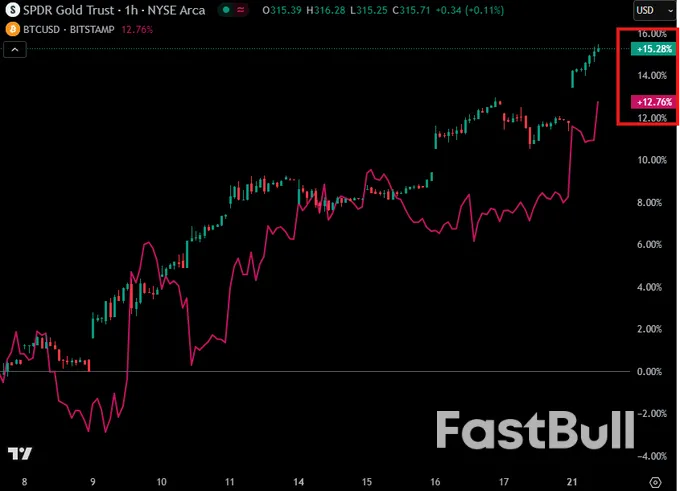
Bitcoin vs. gold comparison. Source: The Kobeissi Letter/X

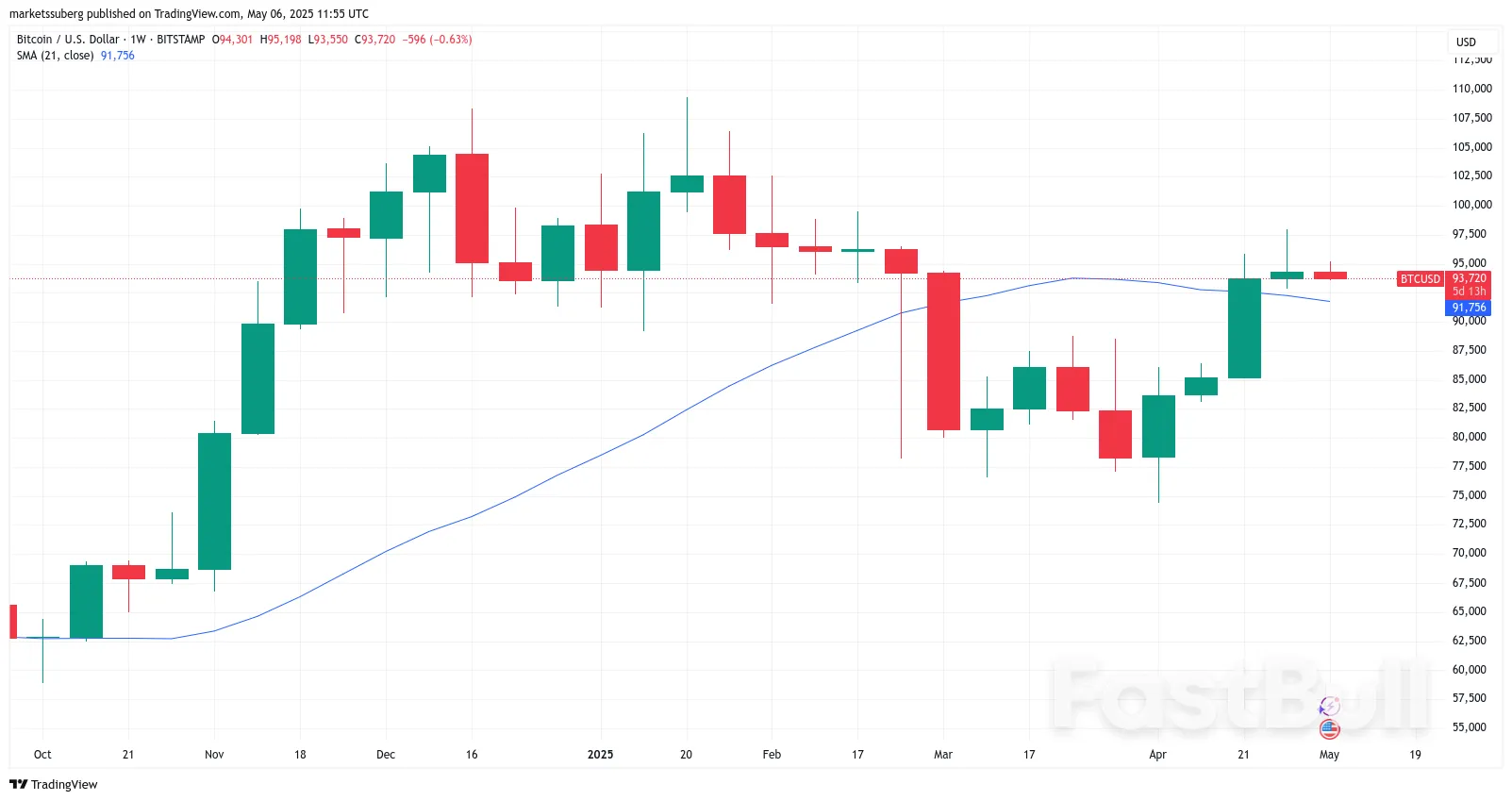
BTC/USD 1-week chart with 21SMA. Source: Cointelegraph/TradingViewWhite Label
Data API
Web Plug-ins
Poster Maker
Affiliate Program
The risk of loss in trading financial instruments such as stocks, FX, commodities, futures, bonds, ETFs and crypto can be substantial. You may sustain a total loss of the funds that you deposit with your broker. Therefore, you should carefully consider whether such trading is suitable for you in light of your circumstances and financial resources.
No decision to invest should be made without thoroughly conducting due diligence by yourself or consulting with your financial advisors. Our web content might not suit you since we don't know your financial conditions and investment needs. Our financial information might have latency or contain inaccuracy, so you should be fully responsible for any of your trading and investment decisions. The company will not be responsible for your capital loss.
Without getting permission from the website, you are not allowed to copy the website's graphics, texts, or trademarks. Intellectual property rights in the content or data incorporated into this website belong to its providers and exchange merchants.
Not Logged In
Log in to access more features

FastBull Membership
Not yet
Purchase
Log In
Sign Up