
• Trade
  • Markets
  • Copy
  • Contests
  • News
  • 24/7
  • Calendar
  • Q&A
  • Chats
Trending
Screeners
SYMBOL
LAST
BID
ASK
HIGH
LOW
NET CHG.
%CHG.
SPREAD
SPX
S&P 500 Index
6854.58
6854.58
6854.58
6861.30
6847.07
+27.17
+ 0.40%
--
DJI
Dow Jones Industrial Average
48607.11
48607.11
48607.11
48679.14
48557.21
+149.07
+ 0.31%
--
IXIC
NASDAQ Composite Index
23295.44
23295.44
23295.44
23345.56
23265.18
+100.28
+ 0.43%
--
USDX
US Dollar Index
97.830
97.910
97.830
98.070
97.810
-0.120
-0.12%
--
EURUSD
Euro / US Dollar
1.17561
1.17569
1.17561
1.17596
1.17262
+0.00167
+ 0.14%
--
GBPUSD
Pound Sterling / US Dollar
1.33945
1.33955
1.33945
1.33961
1.33546
+0.00238
+ 0.18%
--
XAUUSD
Gold / US Dollar
4330.71
4331.05
4330.71
4350.16
4294.68
+31.32
+ 0.73%
--
WTI
Light Sweet Crude Oil
56.889
56.919
56.889
57.601
56.789
-0.344
-0.60%
--

Community Accounts

Signal Accounts
--
Profit Accounts
--
Loss Accounts
--
View More

Become a signal provider

Sell trading signals to earn additional income

View More

Guide to Copy Trading

Get started with ease and confidence

View More

Signal Accounts for Members

All Signal Accounts

Best Return
  • Best Return
  • Best P/L
  • Best MDD
Past 1W
  • Past 1W
  • Past 1M
  • Past 1Y

All Contests

  • All
  • Trump Updates
  • Recommend
  • Stocks
  • Cryptocurrencies
  • Central Banks
  • Featured News
Top News Only
Share

The Nasdaq Golden Dragon China Index Fell 0.9% In Early Trading

Share

The S&P 500 Opened 32.78 Points Higher, Or 0.48%, At 6860.19; The Dow Jones Industrial Average Opened 136.31 Points Higher, Or 0.28%, At 48594.36; And The Nasdaq Composite Opened 134.87 Points Higher, Or 0.58%, At 23330.04

Share

Miran: Goods Inflation Could Be Settling In At A Higher Level Than Was Normal Before The Pandemic, But That Will Be More Than Offset By Housing Disinflation

Share

Miran, Who Dissented In Favor Of A Larger Cut At Last Fed Meeting, Repeats Keeping Policy Too Tight Will Lead To Job Losses

Share

Miran: Does Not Think Higher Goods Inflation Is Mostly From Tariffs, But Acknowledges Does Not Have A Full Explanation For It

Share

Toronto Stock Index .GSPTSE Rises 67.16 Points, Or 0.21 Percent, To 31594.55 At Open

Share

Miran: Excluding Housing And Non-Market Based Items, Core Pce Inflation May Be Below 2.3%, “Within Noise” Of The Fed's 2% Target

Share

Polish State Assets Minister Balczun Says Jsw Needs Over USD 830 Million Financing To Keep Liquidity For A Year

Share

Miran: Prices Are “Once Again Stable” And Monetary Policy Should Reflect That

Share

Fed's Miran: Current Excess Inflation Is Not Reflective Of Underlying Supply And Demand In The Economy

Share

Portugal Treasury Puts 2026 Net Financing Needs At 13 Billion Euros, Up From 10.8 Billion In 2025

Share

Portugal Treasury Expects 2026 Net Financing Needs At 29.4 Billion Euros, Up From 25.8 Billion In 2025

Share

Bank Of America Says With Indonesia's Smelter Now Ramping Up, It Expects Aluminium Supply Growth To Accelerate To 2.6% Year On Year In 2026

Share

Bank Of America Expects A Deficit In Aluminium Next Year And Sees Prices Pushing Above $3000/T

Share

Fed Data - USA Effective Federal Funds Rate At 3.64 Percent On 12 December On $102 Billion In Trades Versus 3.64 Percent On $99 Billion On 11 December

Share

Brazil's Petrobras Says No Impact Seen On Oil, Petroleum Products Output As Workers Start Planned Strike

Share

Statement: US Travel Group Warns New Proposed Trump Administration Requirements For Foreign Tourists To Provide Social Media Histories Could Mean Millions Of People Opting Not To Visit

Share

Blackrock: Kerry White Will Become Head Of Citi Investment Management At Citi Wealth

Share

Blackrock: Rob Jasminski, Head Of Citi Investment Management, Has Joined With Team

Share

Blackrock: Effective Dec 15, Citi Investment Management Employees Will Join Blackrock

TIME
ACT
FCST
PREV
Japan Tankan Small Manufacturing Outlook Index (Q4)

A:--

F: --

P: --

Japan Tankan Large Non-Manufacturing Outlook Index (Q4)

A:--

F: --

P: --

Japan Tankan Large Manufacturing Outlook Index (Q4)

A:--

F: --

P: --

Japan Tankan Small Manufacturing Diffusion Index (Q4)

A:--

F: --

P: --

Japan Tankan Large Manufacturing Diffusion Index (Q4)

A:--

F: --

P: --

Japan Tankan Large-Enterprise Capital Expenditure YoY (Q4)

A:--

F: --

P: --

U.K. Rightmove House Price Index YoY (Dec)

A:--

F: --

P: --

China, Mainland Industrial Output YoY (YTD) (Nov)

A:--

F: --

P: --

China, Mainland Urban Area Unemployment Rate (Nov)

A:--

F: --

P: --

Saudi Arabia CPI YoY (Nov)

A:--

F: --

P: --

Euro Zone Industrial Output YoY (Oct)

A:--

F: --

P: --

Euro Zone Industrial Output MoM (Oct)

A:--

F: --

P: --

Canada Existing Home Sales MoM (Nov)

A:--

F: --

P: --

Canada National Economic Confidence Index

A:--

F: --

P: --

Canada New Housing Starts (Nov)

A:--

F: --

P: --
U.S. NY Fed Manufacturing Employment Index (Dec)

A:--

F: --

P: --

U.S. NY Fed Manufacturing Index (Dec)

A:--

F: --

P: --

Canada Core CPI YoY (Nov)

A:--

F: --

P: --

Canada Manufacturing Unfilled Orders MoM (Oct)

A:--

F: --

P: --

U.S. NY Fed Manufacturing Prices Received Index (Dec)

A:--

F: --

P: --

U.S. NY Fed Manufacturing New Orders Index (Dec)

A:--

F: --

P: --

Canada Manufacturing New Orders MoM (Oct)

A:--

F: --

P: --

Canada Core CPI MoM (Nov)

A:--

F: --

P: --

Canada Trimmed CPI YoY (SA) (Nov)

A:--

F: --

P: --

Canada Manufacturing Inventory MoM (Oct)

A:--

F: --

P: --

Canada CPI YoY (Nov)

A:--

F: --

P: --

Canada CPI MoM (Nov)

A:--

F: --

P: --

Canada CPI YoY (SA) (Nov)

A:--

F: --

P: --

Canada Core CPI MoM (SA) (Nov)

A:--

F: --

P: --

Canada CPI MoM (SA) (Nov)

A:--

F: --

P: --

Federal Reserve Board Governor Milan delivered a speech
U.S. NAHB Housing Market Index (Dec)

--

F: --

P: --

Australia Composite PMI Prelim (Dec)

--

F: --

P: --

Australia Services PMI Prelim (Dec)

--

F: --

P: --

Australia Manufacturing PMI Prelim (Dec)

--

F: --

P: --

Japan Manufacturing PMI Prelim (SA) (Dec)

--

F: --

P: --

U.K. 3-Month ILO Employment Change (Oct)

--

F: --

P: --

U.K. Unemployment Claimant Count (Nov)

--

F: --

P: --

U.K. Unemployment Rate (Nov)

--

F: --

P: --

U.K. 3-Month ILO Unemployment Rate (Oct)

--

F: --

P: --

U.K. Average Weekly Earnings (3-Month Average, Including Bonuses) YoY (Oct)

--

F: --

P: --

U.K. Average Weekly Earnings (3-Month Average, Excluding Bonuses) YoY (Oct)

--

F: --

P: --

France Services PMI Prelim (Dec)

--

F: --

P: --

France Composite PMI Prelim (SA) (Dec)

--

F: --

P: --

France Manufacturing PMI Prelim (Dec)

--

F: --

P: --

Germany Services PMI Prelim (SA) (Dec)

--

F: --

P: --

Germany Manufacturing PMI Prelim (SA) (Dec)

--

F: --

P: --

Germany Composite PMI Prelim (SA) (Dec)

--

F: --

P: --

Euro Zone Composite PMI Prelim (SA) (Dec)

--

F: --

P: --

Euro Zone Services PMI Prelim (SA) (Dec)

--

F: --

P: --

Euro Zone Manufacturing PMI Prelim (SA) (Dec)

--

F: --

P: --

U.K. Services PMI Prelim (Dec)

--

F: --

P: --

U.K. Manufacturing PMI Prelim (Dec)

--

F: --

P: --

U.K. Composite PMI Prelim (Dec)

--

F: --

P: --

Euro Zone ZEW Economic Sentiment Index (Dec)

--

F: --

P: --

Germany ZEW Current Conditions Index (Dec)

--

F: --

P: --

Germany ZEW Economic Sentiment Index (Dec)

--

F: --

P: --

Euro Zone Trade Balance (Not SA) (Oct)

--

F: --

P: --

Euro Zone ZEW Current Conditions Index (Dec)

--

F: --

P: --

Euro Zone Trade Balance (SA) (Oct)

--

F: --

P: --

U.S. Retail Sales MoM (Excl. Automobile) (SA) (Oct)

--

F: --

P: --

Q&A with Experts
    • All
    • Chatrooms
    • Groups
    • Friends
    Connecting
    .
    .
    .
    Type here...
    Add Symbol or Code

      No matching data

      All
      Trump Updates
      Recommend
      Stocks
      Cryptocurrencies
      Central Banks
      Featured News
      • All
      • Russia-Ukraine Conflict
      • Middle East Flashpoint
      • All
      • Russia-Ukraine Conflict
      • Middle East Flashpoint
      Search
      Products

      Charts Free Forever

      Chats Q&A with Experts
      Screeners Economic Calendar Data Tools
      Membership Features
      Data Warehouse Market Trends Institutional Data Policy Rates Macro

      Market Trends

      Market Sentiment Order Book Forex Correlations

      Top Indicators

      Charts Free Forever
      Markets

      News

      News Analysis 24/7 Columns Education
      From Institutions From Analysts
      Topics Columnists

      Latest Views

      Latest Views

      Trending Topics

      Top Columnists

      Latest Update

      Signals

      Copy Rankings Latest Signals Become a signal provider AI Rating
      Contests
      Brokers

      Overview Brokers Assessment Rankings Regulators News Claims
      Broker listing Forex Brokers Comparison Tool Live Spread Comparison Scam
      Q&A Complaint Scam Alert Videos Tips to Detect Scam
      More

      Business
      Events
      Careers About Us Advertising Help Center

      White Label

      Data API

      Web Plug-ins

      Affiliate Program

      Awards Institution Evaluation IB Seminar Salon Event Exhibition
      Vietnam Thailand Singapore Dubai
      Fans Party Investment Sharing Session
      FastBull Summit BrokersView Expo
      Recent Searches
        Top Searches
          Markets
          News
          Analysis
          User
          24/7
          Economic Calendar
          Education
          Data
          • Names
          • Latest
          • Prev

          View All

          No data

          Scan to Download

          Faster Charts, Chat Faster!

          Download App
          English
          • English
          • Español
          • العربية
          • Bahasa Indonesia
          • Bahasa Melayu
          • Tiếng Việt
          • ภาษาไทย
          • Français
          • Italiano
          • Türkçe
          • Русский язык
          • 简中
          • 繁中
          Open Account
          Search
          Products
          Charts Free Forever
          Markets
          News
          Signals

          Copy Rankings Latest Signals Become a signal provider AI Rating
          Contests
          Brokers

          Overview Brokers Assessment Rankings Regulators News Claims
          Broker listing Forex Brokers Comparison Tool Live Spread Comparison Scam
          Q&A Complaint Scam Alert Videos Tips to Detect Scam
          More

          Business
          Events
          Careers About Us Advertising Help Center

          White Label

          Data API

          Web Plug-ins

          Affiliate Program

          Awards Institution Evaluation IB Seminar Salon Event Exhibition
          Vietnam Thailand Singapore Dubai
          Fans Party Investment Sharing Session
          FastBull Summit BrokersView Expo

          Pound-to-Australian Dollar Forecast: RBA Setback Looms

          Warren Takunda

          Economic

          Summary:

          The Pound to Australian Dollar exchange rate (GBP/AUD) is turning higher, but range resistance could yet thwart the advance.
          The Australian Dollar has softened ahead of Tuesday's Reserve Bank of Australia (RBA) meeting, where a 25 basis point interest rate cut is anticipated.
          Tuesday's decision is not expected to be the last, meaning that although a cut is expected, the market sees some two-way risk on the guidance offered by policymakers in Sydney.
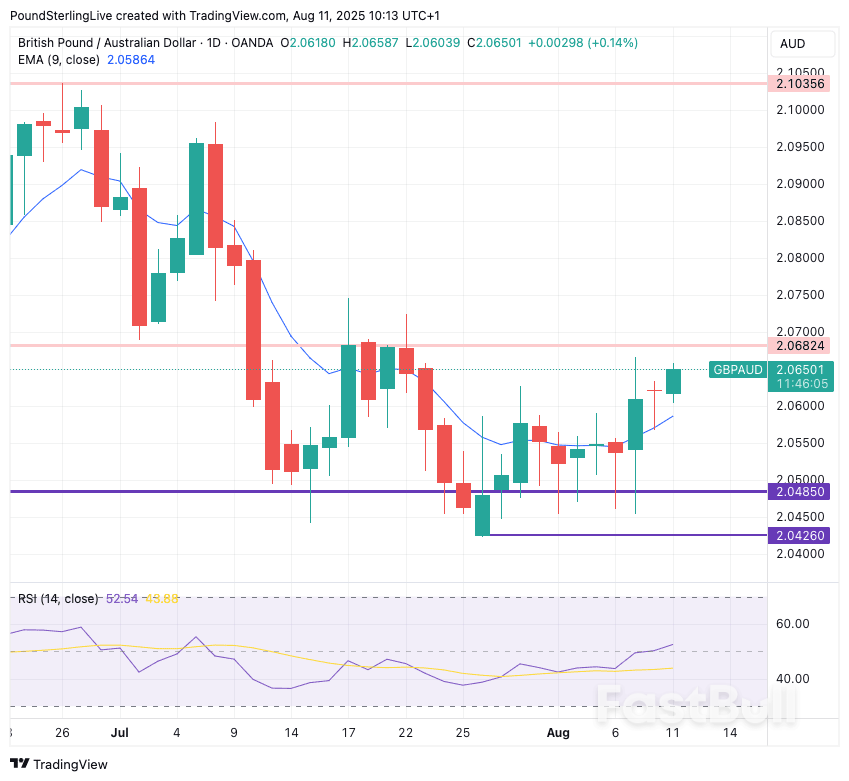
          Perhaps the AUD's softness over recent sessions reflects some nerves ahead of the decision: GBP/AUD has risen as a result, and it is now on the cusp of testing 2.0682.
          The chart shows 2.0682 to be an approximate resistance zone above which the pair has not closed since July 09, with attempts to move above it quickly running out of steam and being sold into.
          GBP/AUD's near-term momentum has improved, with spot moving back above the nine-day exponential moving average (at 2.0586), signalling near-term momentum is now to the upside. This is corroborated by the extension to above 50 of the Relative Strength Index (RSI, in the lower panel of the chart), which is also pointing higher.
          Pound-to-Australian Dollar Forecast: RBA Setback Looms_1
          A daily close above the aforementioned resistance at 2.0682 could be a potentially significant technical development that opens the door to a near-term run to 2.0750.
          A "dovish" RBA outcome, allied with a stronger-than-forecast set of UK labour market data, would likely allow this to happen.
          But a significant risk to consider is that the AUD is undergoing a "sell the rumour, buy the fact" sequence into the RBA, meaning that it will rally once the RBA decision is out of the way.
          If so, a setback at chart resistance is nailed on.
          "We think it could be a hawkish cut by the RBA tomorrow," says David Forrester, a strategist at Crédit Agricole. "Inflation and the unemployment rate are in line with the RBA’s forecasts, so the central bank is unlikely to significantly change its economic forecasts."
          Crédit Agricole's economists think the RBA will probably maintain its forecast for trimmed mean inflation to stay in the top half of its 2-3% target band, warranting a cash rate a bit above neutral.
          Australian wage (Wednesday) and labour market data (Thursday) are also due out this week, and Crédit Agricole thinks they will also give reason for the market to pare back expectations for the quantum of future RBA hikes, abetting further Aussie Dollar gains.
          The GBP-side of the equation will also be an important factor to consider given the release of labour market data on Tuesday and GDP figures on Thursday.
          The labour market figures are contextualised by last week's Bank of England decision, which delivered a rate cut but showed significant doubts about the prospect of another cut this year.
          This is because members of the Bank's Monetary Policy Committee (MPC) are concerned that inflation risks rising more than expected, potentially entrenching UK inflation levels above 2.0% over the medium- to long-term. This means that labour market data is less of a concern.
          We think the downside GBP reaction to a soft print, will therefore be limited. But, importantly, we also think an above-consensus set of data will boost the Pound as it will further encourage the current trend to lower interest rate cut expectations further.Pound-to-Australian Dollar Forecast: RBA Setback Looms_2

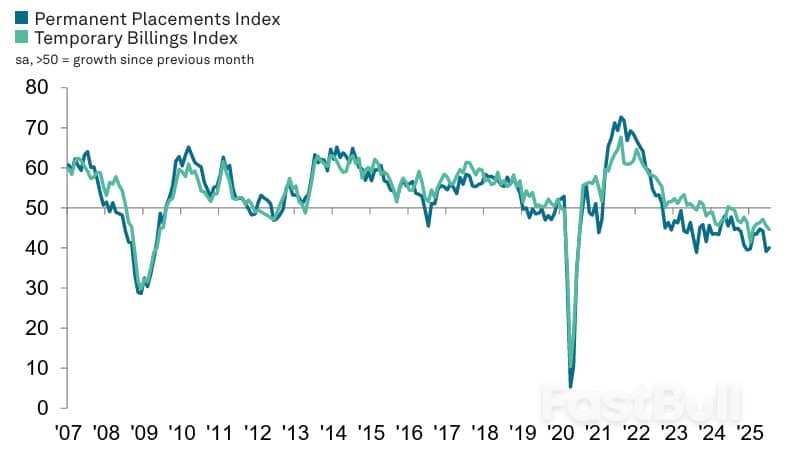
          REC/KPMG Report on Jobs, July 2025.

          Ahead of the wage and jobs data, a survey of the UK labour market conducted by the REC and KMPG showed employers remained downbeat.
          However, there were some signals of improving conditions, which could mean the labour market downturn is bottoming out.
          "All told, the slight improvement in the REC’s staff placements balance in July signals that the jobs market is stabilising, even if in a weak state," says Elliott Jordan-Doak, Senior U.K. Economist at Pantheon Macroeconomics.
          Thursday's quarterly GDP data should show the UK economy grew 0.1% q/q in the second quarter. Any significant undershoot should weigh on the Pound.
          However, as with the jobs report, depressed sentiment towards the UK economy leaves us thinking the bigger market reaction would be to the upside in the event of an above-consensus reading.

          Source: Poundsterlinglive

          To stay updated on all economic events of today, please check out our Economic calendar
          Risk Warnings and Disclaimers
          You understand and acknowledge that there is a high degree of risk involved in trading. Following any strategies or investment methods may lead to potential losses. The content on the site is provided by our contributors and analysts for information purposes only. You are solely responsible for determining whether any trading assets, securities, strategy, or any other product is suitable for investing based on your own investment objectives and financial situation.
          Add to Favorites
          Share

          Trump-Putin Talks Are Already A 'triumph' For Moscow, Its Economy And Markets

          Samantha Luan

          Economic

          Stocks

          Forex

          Political

          Talks between Russian President Vladimir Putin and U.S. counterpart Donald Trump are still days away, but the two leaders' upcoming meeting to negotiate an end to the war in Ukraine is already seen as a victory for the Kremlin, the Russian economy and global financial markets.

          The discussions are set to take place on Friday in Alaska.

          "This is already a big win for Putin to be invited for the first time since 2007 to meet with the U.S. president on American soil. Is a wonderful achievement, from his point of view, no conditions and the absence of Ukraine, the absence of any European representation. This is already a triumph," Richard Portes, head of the Economics faculty at the London Business School, told CNBC Monday.

          There are concerns that Ukraine could be forced to cede Russian-occupied territory to Moscow, and the mood is dour in Kyiv, whose officials, including President Volodymyr Zelenskyy, have so far not been invited to attend the talks.Kyiv has said no deal about its future would be struck in its absence, and European leaders are pushing strongly for Ukraine's involvement. The U.S., for its part, has said its considering inviting Zelenskyy.

          In the meantime, economists say the talks — which take place as Russia makes gains on the battlefield in southern and eastern Ukraine, with no ceasefire deal in sight — are already a win for Putin and his war-centered economy that is laboring under international sanctions and stubbornly high inflation of 9.4% in June.

          "[Putin] starts from a relatively strong position on the battlefield. They're advancing ...On the other hand, from the economic point of view, he starts from a weak position. The Russian economy is not in very good shape. They're running a significant fiscal deficit, partly because oil revenues are down very substantially, oil and gas [are down] because of the oil price. And ... this is a weak economy," Portes told CNBC's "Europe Early Edition."

          Coming into talks with a strong position in the battlefield, Russia is likely to want immediate sanctions relief as part of any ceasefire deal, as well as Ukrainian territorial concessions.The Kremlin has spied a rapprochement with Washington as an opportunity not only for an economic recovery, but investment. Russian Presidential Aide Yuri Ushakov on Saturday stated that "the economic interests of our countries intersect in Alaska and the Arctic, and there are prospects for implementing large-scale and mutually beneficial projects," the Kremlin stated.

          Portes said that if Trump "had the patience and the willingness to apply sanctions properly, then waiting [to hold talks] would result in a very significant change in the balance of forces."As things stand, however, Trump has mulled but so far held off on increasing sanctions on Russia. Washington has instead threatened the Kremlin's remaining trading partners, such as India, with "secondary sanctions" and additional trade tariffs for continuing with purchases of Russian oil, which have funded Moscow's war machine.

          Asked whether Trump could press ahead with more punitive sanctions to push Putin toward a peace deal, Portes asked: "Can anyone predict what the President of the United States will do from one day to the next? It's very difficult.""The likelihood of an increase in sanctions pressure is significant, but ... given Trump's desire for a Nobel Prize, the the likelihood that Trump will increase sanctions at this stage. Does not look very high, but he could change his mind tomorrow," he said.

          'Win-win' for defense stocks

          Global financial markets reacted positively to the announcement on Friday that talks to end the war would take place imminently, with bourses in Europe and U.S. rising. Defense stocks in Europe fell on the news, however, as traders appeared to bet that peace could deter further investment pledged by NATO allies.

          The spot price of gold, seen as a safe haven in times of geopolitical and financial market stress, was down around 1% at $3,364 per ounce, as of 8a.m. London time on Monday.But Christopher Granville, managing director at TS Lombard, said that the talks could ultimately prove to be a "win-win for European defense stocks" and advised investors to "buy on that weakness."

          "Either the peace processes fails, and goes off the rails, which is always, sadly, more than perfectly possible, if not likely, in which case the need for trying to replenish the depleted arms inventories of U.S. and Europe, depleted by supplying Ukraine and also Israel ..., would be very good for orders and procurement for Rheinmetall and all the other European defense stocks," he told CNBC's "Squawk Box Europe."

          "Or if there is a peace agreement, what do we see? We see a very powerful Russian military which — although the words 'victory' and 'defeat' will be banded around and should probably not be used — has to an extent prevailed. That reality will force continued increase defense procurement by European governments, and it's also good for European defense stocks. Either way, it's a winner," Granville said."The market, of course, has been discounting this some from time to time and as those [defense stock] names pull back a bit, you should buy on that weakness, in my opinion."

          Source: CNBC

          To stay updated on all economic events of today, please check out our Economic calendar
          Risk Warnings and Disclaimers
          You understand and acknowledge that there is a high degree of risk involved in trading. Following any strategies or investment methods may lead to potential losses. The content on the site is provided by our contributors and analysts for information purposes only. You are solely responsible for determining whether any trading assets, securities, strategy, or any other product is suitable for investing based on your own investment objectives and financial situation.
          Add to Favorites
          Share

          Nvidia, AMD To Pay 15% Of China Chip Sale Revenues To US, Official Says

          Samantha Luan

          China–U.S. Trade War

          Economic

          Stocks

          Nvidia , and AMD , have agreed to give the U.S. government 15% of revenue from sales to China of advanced computer chips, a U.S. official said on Sunday, in an unusual move likely to unsettle U.S. companies.U.S. President Donald Trump's administration halted sales of H20 chips to China in April, but Nvidia announced last month that Washington had said it would allow the company to resume sales and it hoped to start deliveries soon.

          Another U.S. official said on Friday that the Commerce Department had begun issuing licenses for the sale of H20 artificial intelligence chips to China.Shares of Nvidia and AMD fell 1.8% and 3.3% respectively in pre-market trade on Monday.The deal to pay the U.S. government from sales in China is unusual for a president, and marks Trump's latest intervention in corporate decision-making.He harangues company executives to invest in America to shore up domestic jobs and manufacturing, and demanded last week new Intel , CEO Lip-Bu Tan immediately resign, calling him "highly conflicted" due to his ties to Chinese firms.

          "It’s wild,” said Geoff Gertz, a senior fellow at Center for New American Security, an independent think tank in Washington, D.C.“Either selling H20 chips to China is a national security risk, in which case we shouldn’t be doing it to begin with, or it’s not a national security risk, in which case, why are we putting this extra penalty on the sale?"When asked if Nvidia had agreed to pay 15% of revenues to the United States, an Nvidia spokesperson said in a statement: "We follow rules the U.S. government sets for our participation in worldwide markets."

          The spokesperson added: "While we haven't shipped H20 to China for months, we hope export control rules will let America compete in China and worldwide."AMD did not respond to a request for comment on the news, which was first reported by the Financial Times earlier on Sunday. The U.S. Department of Commerce did not immediately respond to a request for comment.China's foreign ministry, approached for comment on Monday, said that China had repeatedly expressed its position on the issue of U.S. chip exports to China. The ministry in the past has accused the U.S. of using technology and trade issues to "maliciously contain and suppress China".

          The Financial Times said the chipmakers agreed to the arrangement as a condition for obtaining the export licenses for their semiconductors, including AMD's MI308 chips. The report said the Trump administration had yet to determine how to use the money.U.S. Commerce Secretary Howard Lutnick said last month the planned resumption of sales of the AI chips was part of U.S. negotiations with China to get rare earths and described the H20 as Nvidia's "fourth-best chip" in an interview with CNBC.

          Lutnick said it was in U.S. interests to have Chinese companies using American technology, even if the most advanced was prohibited from export, so they continued to use an American "tech stack".The U.S. official said the Trump administration did not feel the sale of H20 and equivalent chips was compromising U.S. national security. The official did not know when the agreement would be implemented nor exactly how, but said the administration would be in compliance with the law.

          Alasdair Phillips-Robins, who served as an adviser at the Commerce Department during former President Joe Biden's administration, criticized the move.“If this reporting is accurate, it suggests the administration is trading away national security protections for revenue for the Treasury," Phillips-Robins said.Nvidia generated $17 billion in revenue from China in the fiscal year ending January 26, representing 13% of total sales. AMD reported $6.2 billion in China revenue for 2024, accounting for 24% of total revenue.

          Source: Reuters

          To stay updated on all economic events of today, please check out our Economic calendar
          Risk Warnings and Disclaimers
          You understand and acknowledge that there is a high degree of risk involved in trading. Following any strategies or investment methods may lead to potential losses. The content on the site is provided by our contributors and analysts for information purposes only. You are solely responsible for determining whether any trading assets, securities, strategy, or any other product is suitable for investing based on your own investment objectives and financial situation.
          Add to Favorites
          Share

          Oil Prices Slip as Trump-Putin Peace Push Reduces Russian Supply Risk

          Gerik

          Economic

          Commodity

          Market Reaction to Peace Talks

          Brent crude hovered near $66 a barrel on Monday, adding to the 4.4% decline recorded last week the steepest weekly drop since late June. The retreat follows President Trump’s announcement of an upcoming summit with Russian President Vladimir Putin in Alaska, aimed at negotiating a ceasefire in Ukraine. Trump refrained from unveiling further sanctions on Moscow or its crude buyers, signaling that supply from one of the world’s largest oil exporters is unlikely to face immediate new restrictions.
          Sources familiar with the talks indicated that Washington and Moscow are exploring a deal that would formalize Russia’s control over occupied territories, with the US seeking agreement from Ukraine and European allies. While far from certain, the diplomatic initiative has tempered fears of supply shocks linked to geopolitical escalation.

          Supply Outlook and OPEC+ Dynamics

          The decline in oil prices this year now over 10% has been driven not only by geopolitical developments but also by OPEC+’s decision to accelerate the unwinding of production cuts introduced in 2023. The group’s strategy is reintroducing supply faster than expected at a time when global economic growth is slowing, raising the risk of excess supply in the near term.
          Analysts suggest that a successful peace deal could prompt the lifting of sanctions on Russian oil, further adding to available supply. Bjarne Schieldrop, chief commodities analyst at SEB AB, noted that Trump is unlikely to impose new sanctions on Russian crude during ongoing negotiations, minimizing the near-term risk of disruption to Moscow’s exports.
          Traders will watch for fresh supply-demand data later this week. OPEC’s monthly market analysis, the US Energy Information Administration’s Short-Term Energy Outlook (Tuesday), and the International Energy Agency’s monthly report (Wednesday) are expected to provide clearer signals on the balance between production and consumption heading into the final quarter of 2025.

          Source: Bloomberg

          To stay updated on all economic events of today, please check out our Economic calendar
          Risk Warnings and Disclaimers
          You understand and acknowledge that there is a high degree of risk involved in trading. Following any strategies or investment methods may lead to potential losses. The content on the site is provided by our contributors and analysts for information purposes only. You are solely responsible for determining whether any trading assets, securities, strategy, or any other product is suitable for investing based on your own investment objectives and financial situation.
          Add to Favorites
          Share

          The Dollar Still Rules, But US Policy Is Making It Less Special

          Samantha Luan

          Economic

          Forex

          Cryptocurrency

          President Donald Trump’s push to redesign the global economic order in favor of the US is shaking one of the foundations of its post-World War II supremacy: the dollar’s undisputed role as the world’s reserve currency.It’s a status that shows the dollar is used in roughly nine out of 10 foreign exchange transactions and about half of all merchandise trade conducted globally, and is making up almost 60% of reserves held by governments around the world. That dominance helps Washington to run gaping budget deficits and US consumers to spend more than they make—all funded by overseas investors eager to snap up assets denominated in greenbacks adorned with the motto “In God We Trust.”

          But trust in the dollar is faltering. In 2022 the Biden administration’s curbs on Russia’s access to the currency after the invasion of Ukraine spurred a first round of diversification. If the US could freeze out the world’s 11th-largest economy, so deeply entrenched in global oil markets, is anyone safe? The Great Inflation, and a rapidly deteriorating fiscal trajectory since then, has added to doubts about American economic exceptionalism. And most recently, the haphazard rollout and rollback of Trump’s tariff campaign in April sparked a rare weakening in both the dollar’s value and that of US Treasuries. The US dollar index tumbled more than 10% in the first six months of the year, its worst first-half performance since 1973.

          Like an uncorked genie, the “sell America” talk is proving hard to bottle up again. Banks and brokers are seeing rising demand for currency products that bypass the dollar, and some of Asia’s richest families are cutting exposure to US assets, saying Trump’s tariffs have made the country much less predictable. Geopolitical rivals within BRICS—a loose group of large economies led by Brazil, Russia, India, China and South Africa—are continuing their long push for a new cross-border payments system. Even long-term allies such as Europe see an opportunity to erode the dominance of the dollar.

          Not everyone is so dour. JPMorgan Chase & Co.’s Jamie Dimon said in May that the US remains the most “prosperous, innovative nation on the planet” and that he doesn’t fret over short-term fluctuations in the dollar. Secretary of the Treasury Scott Bessent has tried to convince investors that the strong dollar policy remains intact, and his boss has threatened 100% tariffs against anyone who dares challenge it. Yet for all the tough talk, the reality is that the greenback’s greatest relative strength is actually the lack of any single challenger to its standing atop the global monetary order.

          There’s talk of a “global euro moment” in which the European common currency plays a bigger role, but history has shown that the bloc struggles to move in sync, and its institutions are too fragmented to create the markets deep enough to rival those of the US. China’s central bank governor is talking up his nation’s currency as an option for those seeking to shift from the dollar, but it’s hard to imagine how that will be embraced when capital controls still impede the free flow of assets across Chinese capital borders.

          Central banks and investors have piled into the ultimate haven asset—gold—but it’s cumbersome to hold, offers no yield and can’t easily be used in trade or financial transactions the way the dollar can. Speculation for dollar replacements range as far as Bitcoin and other digital assets, though few outside El Salvador (which in 2021 adopted the cryptocurrency as legal tender) are ready to shift toward anything that’s not government-backed. Other financial innovations such as stablecoins—digital tokens meant to substitute for traditional cash—may entrench rather than dislodge the dollar’s primacy as they peg their value to the greenback.

          With no viable alternative to the US dollar as the world’s currency on the horizon, the more likely change is to a multicurrency world. The dollar would still be dominant, but other currencies would play a larger role. Although this may not be as revolutionary as a complete breakdown in the global monetary order that some dollar doomsayers are foreseeing, the resulting currency competition will still have profound effects on the US’s hard and soft geopolitical power. Indeed, no one is really ready for what a feeding frenzy of currency competition will mean in ­practice—especially not Americans.

          The US would have to give up some of the benefits of the strong-dollar regime, a key one being lower interest rates as fewer overseas investors buy dollar-denominated bonds. Barry Eichengreen, an economist at the University of California at Berkeley, who’s written extensively on the dollar, has calculated that in a scenario where the US withdraws from the global stage, the dollar’s share of reserves in countries that rely on its security could decline by about 30 percentage points. Long-term US interest rates could increase by as much as 0.8 of a percentage point, he estimates.

          US banks will need to pay more to raise money and charge more for mortgages as a result. Higher home loan rates tend to slow the economy because they leave less income for consumers to spend on vacations, home improvements and the like. And though a weaker foreign exchange rate may be good for rebalancing the trade deficit—by making American exports cheaper and more competitive and deterring spending on costlier imports—that’s not great for household wealth.

          The federal government will also feel the pinch. It finances its annual budget gap, a little less than $2 trillion, through Treasuries. In a world where euro- or yen-denominated assets are more strongly vying for investor attention, borrowing costs for the US government would need to rise. In fact, we’re already noticing signs of that: Thirty-year Treasury yields have more than doubled since the start of 2022 and exceeded 5% at one point in May. That means America will pay more for new borrowing and more to keep rolling over its existing debt too. Annual payments on US government debt by some measures are now larger than what the country spends on national defense.

          The globalized dollar has long shielded lawmakers in Washington from having to decide between guns or butter—or tax cuts. And even as doubts in the dollar grow as the budget deficit swells, legislators still aren’t ready to tighten their belts. Elon Musk promised $1 trillion in savings through the so-called Department of Government Efficiency, or DOGE; the cuts so far have saved less than $200 billion. Meanwhile, a key legislative win for Trump, the One Big Beautiful Bill, will add as much as $3 trillion to the budget deficit over the next decade, according to estimates from the Congressional Budget Office. But in a world where investors continue moving away from the greenback, markets could eventually force difficult trade-offs to cut the deficit—meaning that social safety nets and public research-and-development spending that’s long spurred private-sector innovation in areas including Big Tech and Big Pharma will start to have limits imposed on them.

          A less hegemonic dollar would affect America’s geopolitical prowess. With a weaker currency, overseas military bases would become more expensive to keep up. With less use of the dollar in global transactions, economic sanctions would have less bite. And policing the financial system for malign activities, such as financing terrorist undertakings or laundering money, would be harder because flows outside of dollar-based networks won’t be visible to American policymakers.

          “We don’t appreciate how good we have it,” says Josh Lipsky, senior director of the GeoEconomics Center at the Atlantic Council in Washington and a former adviser at the International Monetary Fund. “Ownership of the reserved asset means cheaper credit for Americans and the federal government, it means more transparency of US policymakers in the financial system to carry out economic statecraft that aligns with US foreign policy objectives. That is what’s at risk.”

          US Treasury secretaries, the stewards of the dollar and American currency policy, have long said that it’s up to the nation itself to guard the treasure that the reserve asset is. Whether it’s Bob Rubin, Hank Paulson or Janet Yellen, these leaders have said that a strong economy bolstered by independent institutions and the rule of law will protect the dollar’s status. Yet the Trump administration has sent mixed signals. Bessent has stuck largely to the script of predecessors, but Stephen Miran, chair of the White House’s Council of Economic Advisers and Trump’s latest pick to serve as governor of the Federal Reserve, has referred to the dollar’s status as a “burden.”

          Trump’s efforts to shift executive authority into independent agencies like regulators and even the Federal Reserve, his consistent challenges to the courts, and Washington’s disregard for record-high federal debt are adding to the dollar’s headwinds. Trust is the cornerstone of the world’s choice of the dollar as king, and Trump is chipping away at that credibility. “For the first time, the dollar’s future status may be determined by how other currencies develop,” Lipsky says. “And those will develop faster if people are looking for them—that’s the lesson of capitalism.”

          The world economy is more financialized and knit together than the last time it saw a tectonic shift in global currency power about 80 years ago, when the dollar eclipsed the British pound. Indeed, the dollar’s status has faced a reckoning before and persevered. President Richard Nixon unilaterally abandoned the gold peg in 1971 and imposed a 10% import tariff after nations including France sought to swap dollars for bullion, threatening the monetary system agreed at Bretton Woods after World War II. The American-made global financial crisis earlier in the 2000s also triggered questions, particularly in China, about whether the US continued to merit its role as cornerstone of the global monetary order.

          Previous eras have had mixed currency use, but typically those were anchored to either gold or silver. There’s never been a period when multiple fiat currencies competed for dominance. This fact makes some people nervous about what lies ahead. A multicurrency era could provoke instability as investors run from one to another in reaction to financial conditions, compounding the challenge for businesses already grappling with how they’ll rewire supply chains in an era of rising tariff walls.

          Today’s steward of US currency policy, Bessent, is pushing back against the dollar doubters: “Since World War II, the demise of the dollar as a reserve currency has been predicted,” he said on Bloomberg TV on July 3. “Once again, the skeptic is going to be wrong.” And he’s right: The US dollar isn’t about to disappear from central bank hoards or as a medium for global finance. But it will face more competition in a multipolar world. And that will have unpredictable repercussions both at home and abroad.

          Source: Bloomberg Europe

          To stay updated on all economic events of today, please check out our Economic calendar
          Risk Warnings and Disclaimers
          You understand and acknowledge that there is a high degree of risk involved in trading. Following any strategies or investment methods may lead to potential losses. The content on the site is provided by our contributors and analysts for information purposes only. You are solely responsible for determining whether any trading assets, securities, strategy, or any other product is suitable for investing based on your own investment objectives and financial situation.
          Add to Favorites
          Share

          Bitcoin Climbs Toward Record High as Institutional and Treasury Demand Surges

          Gerik

          Economic

          Cryptocurrency

          Institutional Demand and Treasury Accumulation Drive Rally

          Bitcoin rose as much as 3.2% on Monday to surpass $122,000, narrowing the gap to its mid-July record. The move comes alongside a broader surge in digital assets, with Ether climbing above $4,300 for the first time since December 2021. Data from Coingecko show that corporate treasury vehicles dedicated to Bitcoin now hold $113 billion worth of the cryptocurrency, while equivalent Ether-focused entities have accumulated around $13 billion, according to strategicethreserve.xyz. This steady accumulation reflects a structural shift in how large institutions and listed entities are allocating capital toward crypto assets.
          Market analysts point to a shift in investor preference as US tariffs on imported gold bars add a new layer of cost and policy risk to the traditional safe-haven asset. Rachael Lucas, a crypto analyst at BTC Markets, notes that Bitcoin’s appeal as a borderless, tariff-free store of value has gained traction, especially given logistical bottlenecks in physical gold supply. This macro backdrop is reinforcing institutional confidence in crypto as a hedge against both inflationary pressures and trade policy disruptions.

          Derivatives Positioning Signals Bullish Outlook

          The options market reflects an overwhelmingly positive bias. Ether’s put-call ratio stands at 0.40, with the largest concentration of December 26 call options at $6,000, according to Deribit data. For Bitcoin, options flows are heavily skewed toward September and December calls, aligning with expectations of global interest rate cuts and continued mainstream adoption. Sean McNulty of FalconX highlights that this alignment between macroeconomic timing and derivatives positioning could amplify price momentum into year-end.
          With the all-time high of $123,205 in sight, traders are watching for a potential breakout that could spark another leg higher. Should momentum falter, initial support is seen around $116,000. The sustained inflows from exchange-traded funds, corporate balance sheets, and institutional desks suggest underlying demand strength, but profit-taking at psychological levels remains a short-term risk.
          The bullish sentiment is also being boosted by high-profile endorsements and market activity. Ether’s rally drew praise from Eric Trump, who has ties to digital-asset ventures. Bloomberg recently reported that the Trump-backed World Liberty Financial is exploring a public listing to hold its WLFI tokens, a move that could further blend political influence with the crypto market’s growth story.

          Source: Bloomberg

          To stay updated on all economic events of today, please check out our Economic calendar
          Risk Warnings and Disclaimers
          You understand and acknowledge that there is a high degree of risk involved in trading. Following any strategies or investment methods may lead to potential losses. The content on the site is provided by our contributors and analysts for information purposes only. You are solely responsible for determining whether any trading assets, securities, strategy, or any other product is suitable for investing based on your own investment objectives and financial situation.
          Add to Favorites
          Share

          Over Half of India’s Exports to US Hit by New 50% Tariff After Russian Oil Dispute

          Gerik

          Economic

          Sharp Tariff Escalation and Trade Exposure

          The Indian government disclosed Monday that more than half of its goods exports to the United States will be affected by the latest tariff increase, which took effect last week. The new measure, announced as a punitive response to India’s continued imports of Russian oil, doubles the total duty on Indian goods from 25% to 50%. This puts India among the highest-taxed trading partners in the American market, significantly altering cost dynamics for exporters.
          Goods trade between the US and India totaled approximately $87 billion in the most recent fiscal year, making the US a critical export destination for Indian manufacturers. With 55% of these exports now subject to the elevated rate, the tariff burden is expected to weigh heavily on sectors ranging from textiles and engineering goods to chemicals and electronics. The Ministry of Finance’s estimate accounts for both the original 25% tariff and the newly imposed surcharge.

          Government and Industry Coordination

          Junior Finance Minister Pankaj Chaudhary told lawmakers that the Department of Commerce is actively consulting exporters and industry bodies to assess the potential economic fallout. The process involves gathering sector-specific feedback on cost pass-throughs, market substitution risks, and potential supply chain adjustments. While no formal retaliatory measures have been announced, such high exposure could prompt India to seek negotiated relief or diversification of export markets.
          The tariff escalation underscores the intersection of trade policy and geopolitical positioning. Washington’s move directly links market access to foreign policy alignment, signaling to other US partners the costs of maintaining energy ties with Moscow. For India, which has sought to balance its relationships with both Western allies and Russia, the increased duty could become a lever in broader strategic negotiations, potentially influencing defense, technology, and investment agreements with the US.
          The immediate risk is an erosion of price competitiveness for Indian products in the US market, which could lead to lost market share to lower-tariff competitors. Longer term, the impact will depend on the duration of the 50% tariff and whether it is expanded to cover more categories of goods. If talks between Washington and Delhi do not produce concessions, exporters may need to accelerate efforts to reorient sales toward alternative markets such as the EU, Middle East, and Southeast Asia, while seeking cost efficiencies to absorb part of the tariff shock.

          Source: Reuters

          To stay updated on all economic events of today, please check out our Economic calendar
          Risk Warnings and Disclaimers
          You understand and acknowledge that there is a high degree of risk involved in trading. Following any strategies or investment methods may lead to potential losses. The content on the site is provided by our contributors and analysts for information purposes only. You are solely responsible for determining whether any trading assets, securities, strategy, or any other product is suitable for investing based on your own investment objectives and financial situation.
          Add to Favorites
          Share
          FastBull
          Copyright © 2025 FastBull Ltd

          728 RM B 7/F GEE LOK IND BLDG NO 34 HUNG TO RD KWUN TONG KLN HONG KONG

          TelegramInstagramTwitterfacebooklinkedin
          App Store Google Play Google Play
          Products
          Charts

          Chats

          Q&A with Experts
          Screeners
          Economic Calendar
          Data
          Tools
          Membership
          Features
          Function
          Markets
          Copy Trading
          Latest Signals
          Contests
          News
          Analysis
          24/7
          Columns
          Education
          Company
          Careers
          About Us
          Contact Us
          Advertising
          Help Center
          Feedback
          User Agreement
          Privacy Policy
          Business

          White Label

          Data API

          Web Plug-ins

          Poster Maker

          Affiliate Program

          Risk Disclosure

          The risk of loss in trading financial instruments such as stocks, FX, commodities, futures, bonds, ETFs and crypto can be substantial. You may sustain a total loss of the funds that you deposit with your broker. Therefore, you should carefully consider whether such trading is suitable for you in light of your circumstances and financial resources.

          No decision to invest should be made without thoroughly conducting due diligence by yourself or consulting with your financial advisors. Our web content might not suit you since we don't know your financial conditions and investment needs. Our financial information might have latency or contain inaccuracy, so you should be fully responsible for any of your trading and investment decisions. The company will not be responsible for your capital loss.

          Without getting permission from the website, you are not allowed to copy the website's graphics, texts, or trademarks. Intellectual property rights in the content or data incorporated into this website belong to its providers and exchange merchants.

          Not Logged In

          Log in to access more features

          FastBull Membership

          Not yet

          Purchase

          Become a signal provider
          Help Center
          Customer Service
          Dark Mode
          Price Up/Down Colors

          Log In

          Sign Up

          Position
          Layout
          Fullscreen
          Default to Chart
          The chart page opens by default when you visit fastbull.com