Markets
News
Analysis
User
24/7
Economic Calendar
Education
Data
- Names
- Latest
- Prev



Signal Accounts for Members
All Signal Accounts
All Contests


U.S. 2-Year Note Auction Avg. YieldA:--
F: --
P: --
U.K. BRC Shop Price Index YoY (Jan)A:--
F: --
P: --
China, Mainland Industrial Profit YoY (YTD) (Dec)A:--
F: --
P: --
Germany 2-Year Schatz Auction Avg. YieldA:--
F: --
P: --
Mexico Trade Balance (Dec)A:--
F: --
P: --
U.S. Weekly Redbook Index YoYA:--
F: --
P: --
U.S. S&P/CS 20-City Home Price Index YoY (Not SA) (Nov)A:--
F: --
P: --
U.S. S&P/CS 20-City Home Price Index MoM (SA) (Nov)A:--
F: --
U.S. FHFA House Price Index MoM (Nov)A:--
F: --
P: --
U.S. FHFA House Price Index (Nov)A:--
F: --
P: --
U.S. FHFA House Price Index YoY (Nov)A:--
F: --
U.S. S&P/CS 10-City Home Price Index YoY (Nov)A:--
F: --
P: --
U.S. S&P/CS 10-City Home Price Index MoM (Not SA) (Nov)A:--
F: --
P: --
U.S. S&P/CS 20-City Home Price Index (Not SA) (Nov)A:--
F: --
P: --
U.S. S&P/CS 20-City Home Price Index MoM (Not SA) (Nov)A:--
F: --
P: --
U.S. Richmond Fed Manufacturing Composite Index (Jan)A:--
F: --
P: --
U.S. Conference Board Present Situation Index (Jan)A:--
F: --
P: --
U.S. Conference Board Consumer Expectations Index (Jan)A:--
F: --
P: --
U.S. Richmond Fed Manufacturing Shipments Index (Jan)A:--
F: --
P: --
U.S. Richmond Fed Services Revenue Index (Jan)A:--
F: --
P: --
U.S. Conference Board Consumer Confidence Index (Jan)A:--
F: --
U.S. 5-Year Note Auction Avg. YieldA:--
F: --
P: --
U.S. API Weekly Refined Oil StocksA:--
F: --
P: --
U.S. API Weekly Crude Oil StocksA:--
F: --
P: --
U.S. API Weekly Gasoline StocksA:--
F: --
P: --
U.S. API Weekly Cushing Crude Oil StocksA:--
F: --
P: --
Australia RBA Trimmed Mean CPI YoY (Q4)A:--
F: --
P: --
Australia CPI YoY (Q4)A:--
F: --
P: --
Australia CPI QoQ (Q4)A:--
F: --
P: --
Germany GfK Consumer Confidence Index (SA) (Feb)A:--
F: --
P: --
Germany 10-Year Bund Auction Avg. Yield--
F: --
P: --
India Industrial Production Index YoY (Dec)--
F: --
P: --
India Manufacturing Output MoM (Dec)--
F: --
P: --
U.S. MBA Mortgage Application Activity Index WoW--
F: --
P: --
Canada Overnight Target Rate--
F: --
P: --
BOC Monetary Policy Report
U.S. EIA Weekly Crude Stocks Change--
F: --
P: --
U.S. EIA Weekly Cushing, Oklahoma Crude Oil Stocks Change--
F: --
P: --
U.S. EIA Weekly Crude Demand Projected by Production--
F: --
P: --
U.S. EIA Weekly Crude Oil Imports Changes--
F: --
P: --
U.S. EIA Weekly Heating Oil Stock Changes--
F: --
P: --
U.S. EIA Weekly Gasoline Stocks Change--
F: --
P: --
BOC Press Conference
Russia PPI MoM (Dec)--
F: --
P: --
Russia PPI YoY (Dec)--
F: --
P: --
U.S. Target Federal Funds Rate Lower Limit (Overnight Reverse Repo Rate)--
F: --
P: --
U.S. Interest Rate On Reserve Balances--
F: --
P: --
U.S. Federal Funds Rate Target--
F: --
P: --
U.S. Target Federal Funds Rate Upper Limit (Excess Reserves Ratio)--
F: --
P: --
FOMC Statement
FOMC Press Conference
Brazil Selic Interest Rate--
F: --
P: --
Australia Import Price Index YoY (Q4)--
F: --
P: --
Japan Household Consumer Confidence Index (Jan)--
F: --
P: --
Turkey Economic Sentiment Indicator (Jan)--
F: --
P: --
Euro Zone M3 Money Supply (SA) (Dec)--
F: --
P: --
Euro Zone Private Sector Credit YoY (Dec)--
F: --
P: --
Euro Zone M3 Money Supply YoY (Dec)--
F: --
P: --
Euro Zone 3-Month M3 Money Supply YoY (Dec)--
F: --
P: --
South Africa PPI YoY (Dec)--
F: --
P: --


No matching data
Latest Views
Latest Views
Trending Topics
Top Columnists
Latest Update
White Label
Data API
Web Plug-ins
Affiliate Program
View All

No data
Poland's acceptance of Ukrainian refugees has led to a rise in crime rates and emerging security concerns. A former president warned of potential threats, and the foreign minister's remarks sparked controversy. This could exacerbate the already tense relationship between Poland and Hungary, increasing geopolitical risks.
AI-biotechnology firm Insilico Medicine Cayman TopCo is set to debut in Hong Kong on Tuesday after raising $293 million in its initial public offering.
Priced at HK$24.05 ($3.09) per share, Insilico will list with a market capitalization of about $1.84 billion. Its shares jumped as much as 201% in gray-market trading on Monday.
The debut comes amid a surge in investor demand for startups in the generative artificial intelligence segment and a broader rally in Hong Kong's healthcare shares. The Hang Seng Biotech Index has jumped 68% this year, outperforming the benchmark's 28% gain.
Insilico, which has extensive operations in the US and China, alongside Canada and the Middle East, is among an early cohort of startups that use AI to improve drug discovery, historically a time-consuming and costly process. Its most advanced internal drug candidate, that treats an incurable lung disease, has shown promise in a mid-stage study.
The pharmaceutical industry has long embraced the promise of AI in slashing research and development time and costs, though progress has been slow. Advances made, such as that by Insilico and Takeda Pharmaceutical Co. — which recently passed a crucial late-stage test for its AI-selected psoriasis drug — have boosted optimism across the sector.
Insilico was founded in 2014. It secured $110 million in a financing round led by Value Partners Group earlier this year. Other backers include Warburg Pincus, US biotech investor OrbiMed Advisors LLC, and the venture arm of Eli Lilly & Co.
The listing concludes a more than four-year effort to go public. It was said to have weighed an IPO in the US in 2021, and had filed for a Hong Kong listing in 2023 and again in 2024, though applications for an offering in the Asian financial hub were allowed to lapse.
Proceeds from the Hong Kong IPO will be used to fund clinical research and development of the company's key clinical-stage pipeline drug candidates and to develop new generative AI models, among other things.
Apart from developing its own drugs, Insilico generates revenue by selling access to its AI drug discovery software, collaborating with industry peers and licensing assets to clients such as Shanghai Fosun Pharmaceutical Group Co. and Exelixis Inc. The company reported more than $85 million in revenue in 2024.
The silver market has been one of the hottest commodity stories in financial markets this week. Prices have surged, volatility has risen, and traders — from retail speculators to industrial buyers — are talking about one key development: China's decision to tighten control over silver exports starting January 1, 2026. This emerging narrative is reshaping how silver is priced, traded, and valued in 2026 and beyond.
Here's what you need to know — in trader-friendly terms.
China's Ministry of Commerce has introduced new export restrictions on silver, effective January 1, 2026, that require government-issued licenses for firms to ship silver overseas. These rules favor large, state-certified producers and limit exports from smaller players. The goal is to secure domestic supply for China's rapidly growing industrial needs, especially in sectors like solar, electronics, and electric vehicles.
China plays a major role in global silver production and refining, meaning changes to how its silver flows internationally can have a big impact on markets worldwide.
Here are the key trading drivers pushing silver into the spotlight:
1. Prices Have Jumped

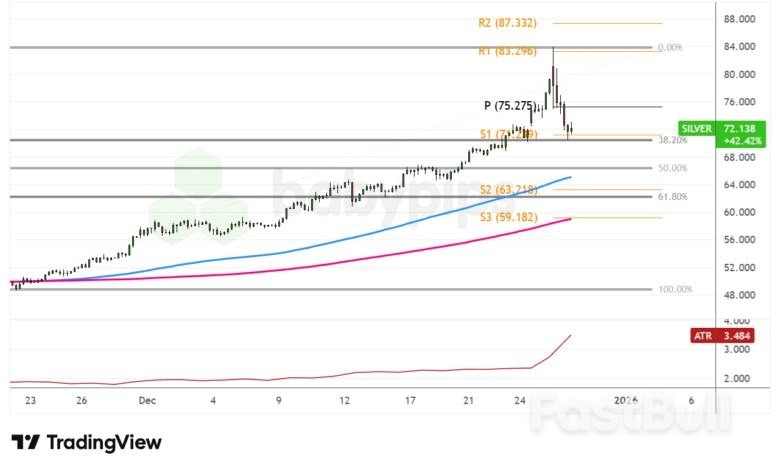
Silver prices have climbed since November, but dramatically so this past week to touch the mid-$80's before pulling back today. Even with the pullback, silver is up a monster 48% in just over a month.
2. Supply Concerns Are Rising
Before these export controls, global silver supply was already under pressure. China historically supplied a significant share of the world's silver — and tightening exports can amplify supply imbalances. Analysts say the export licensing rules could cut available international supply sharply because only larger firms qualify for permits.
This matters for traders because when supply potential shrinks while demand stays firm, prices tend to rise — especially in markets where physical metal is already tight.
3. Industrial Demand Is Strong
Silver isn't just an investment metal — it's a critical industrial metal. Its electrical and thermal conductivity make it essential in things like:
With global demand growing — and China prioritizing domestic industrial use — export restrictions increase the pressure on the remaining global supply chain.
Commentary from high-profile figures has amplified the conversation. For example, Tesla CEO Elon Musk publicly reacted to the export news on social media, calling the move "not good" because silver plays a vital role in industrial processes. His remarks helped bring broader attention to the issue.
Market strategists view this development as more than a short-term ripple — it's part of a structural reshaping of how silver flows through global markets.
Here's a practical breakdown for developing traders:
Price Action and Volatility
Physical vs. Paper Silver
Physical silver (bars, coins, physical ETFs) may trade at different prices than paper futures because physical holdings get tighter. Understanding the paper vs. physical dynamics is key for traders.
Trading Opportunities
Industrial Demand Signals
Watch data on global industrial activity — particularly in tech and renewables — because it can drive real demand for silver beyond speculative trading.
It's important for new traders to remember:
China's upcoming silver export restrictions are creating a major talking point in commodity markets. By requiring government licenses and limiting export eligibility, policymakers are effectively tightening the global silver supply at a time of strong industrial demand. This is contributing to price surges, increased volatility, and elevated risk/reward scenarios for traders.
Whether you trade silver directly, through futures, or via related ETFs, understanding the supply dynamics from China will be critical in 2026. Stay informed, monitor key price levels, and always manage risk carefully in these fast-moving markets.

El Salvador's President Nayib Bukele, who came to power in 2019 and is now serving a second term which critics have called unconstitutional, said he was open to staying in power for another decade.
"If it were up to me, I would stay for 10 more years," Bukele said in a video interview published by Spanish YouTuber TheGrefg on Monday. He noted that he had initially agreed with his wife that he would leave politics in 2029.
El Salvador is expected to hold its next presidential election in 2027, to decide who will run the country through to 2033.
Bukele will be eligible to run for a third term, after the ruling party-controlled Congress pushed through a constitutional reform in July to abolish term limits, bring forward the next election and extend presidential terms from five to six years.
Legal experts at home and abroad have questioned the legality of Bukele's attempts to extend his term. The country's constitution prohibits presidents' consecutive reelection in at least six of its articles.
Early in 2024, Bukele won his second term with a landslide victory despite a constitutional ban.
The wildly popular 44-year-old publicist enjoys some of the world's highest approval ratings thanks to a hardline approach to crime which has helped drastically reduce murder rates.
Critics say this has come at the expense of civil rights and people have been arbitrarily detained, tortured and even killed in custody.
Bukele, who once described himself on his Twitter account as "the world's coolest dictator," said he did not plan to establish a dictatorship in El Salvador and it would be up to Salvadorans to decide whether he should continue in power.
LG Electronics Inc. introduced a TV designed to resemble framed artwork, imitating a style that has been popularized by rival Samsung Electronics Co. in recent years.
The television, called the Gallery TV, will be available in 2026 in 55- and 65-inch sizes, LG said in a statement on Monday ahead of the annual CES consumer technology conference next week. Like Samsung's offering, called The Frame, LG's equivalent will let consumers choose between a range of stylish bezels that can be switched out after purchase.
The pitch for this sub-category is that televisions should blend in with their home decor as much as any other appliance or status item. Samsung has not disclosed recent sales figures for The Frame, but other TV makers, including Hisense and TCL, have released their own respective copycat sets.
The Gallery TV is aimed at "interior-conscious consumers," LG said, and is meant to showcase artwork when idle and not being used for entertainment. The company is marketing it under its "Lifestyle" subset of TVs, which also includes offbeat ideas like a portable smart screen and even a briefcase TV.
Typically, these thinner sets trail more conventional TVs in overall picture quality, so their more pleasing aesthetics aren't without sacrifice. The Gallery TV will use LCD technology instead of the punchier OLED panels found in its premium sets, a company spokesperson told Bloomberg — a decision likely made to keep pricing in line with Samsung's product. So far, LG has not shared pricing. For reference, the 2025 Frame TV costs over $1,500 with a 65-inch screen.
Other similarities to Samsung's model include a matte display that reduces glare, plus automatic picture enhancements that adjust brightness and color based on the room's ambient lighting to make art selections look more natural. That "Gallery Mode," as it's called, was designed with input from museum curators, LG said.
The company's existing Gallery+ service lets users choose from a library of over 4,500 works that are refreshed monthly, "ranging from fine art to cinematic scenes, game visuals, and animations," according to LG. Users can also create their own art with generative artificial intelligence. Similarly, Samsung's Art Store offers a vault of artwork from prestigious partners such as the Museum of Modern Art, the Art Institute of Chicago, the Van Gogh Museum, the Louvre, the Musée d'Orsay, the Tate Modern and Art Basel.
Earlier this year, Samsung brought the Art Store — previously exclusive to The Frame series — to other models in its TV portfolio. Both companies charge a subscription for full access to their respective art collections.
LG will unveil its full 2026 TV lineup at CES, where Samsung will also have its own latest sets on display. New TVs from both companies usually ship in the spring after being announced in January.

The Trump administration on Monday reached a deal with researchers and Democratic-led states who sued over cuts to funding for diversity-related research, agreeing to review grant applications that were stalled or rejected during the legal battle.
A federal judge in Boston previously ruled that the National Institutes of Health unlawfully canceled hundreds of millions of dollars in research grants because of their perceived connection to diversity, equity and inclusion initiatives.
The U.S. Supreme Court in August partially put that decision on hold, ruling that legal battles over the terminated grants should be handled by a different court that specializes in monetary disputes with the government. The Supreme Court left unresolved a second piece of the litigation concerning the NIH's processing of applications for future funding.
Monday's agreement resolved part of the battle over the NIH grants, with the government agreeing to conduct new reviews of grant applications that were frozen, denied, or withdrawn after the new policy was announced. The agreement does not require NIH to fund any particular research proposal.
The researchers who sued NIH said Monday that the proposed grants will advance public health issues, including HIV prevention, Alzheimer's disease, LGBTQ health, and sexual violence.
"This agreement allows my grant application, and many others, to move forward for review after an arbitrary and destructive freeze," said plaintiff Nikki Maphis, a postdoctoral researcher at the University of New Mexico who is studying Alzheimer's disease and alcohol use in the aging brain.
This agreement does not impact U.S. District Judge William Young's earlier ruling in the case blocking the NIH's policy of ceasing grant funding for diversity-related research. The U.S. Department of Health and Human Services has appealed that ruling, and has said it stands by its decision to end funding for research "that prioritized ideological agendas over scientific rigor and meaningful outcomes for the American people."
In a move that could reshape American monetary policy for years, President Donald Trump announced this week he plans to name a successor to Federal Reserve Chair Jerome Powell in January. This declaration, made during a press briefing at the White House, immediately sent ripples through financial markets and policy circles. The President notably added that the possibility of firing Powell remains on the table, raising fundamental questions about Federal Reserve independence. This announcement comes at a critical juncture for the U.S. economy, with inflation concerns and interest rate decisions hanging in the balance.
The Federal Reserve Chair position represents one of the most powerful economic roles globally. Consequently, the occupant directly influences interest rates, employment levels, and price stability. President Trump's January timeline for announcing Powell's successor creates immediate uncertainty. Historically, Fed chairs serve four-year terms, with Powell's current term technically expiring in February 2026. However, presidents typically announce reappointments or new nominations well in advance. This accelerated timeline suggests significant political considerations.
Market analysts immediately began speculating about potential candidates. Furthermore, they examined the implications for monetary policy continuity. The Federal Reserve has maintained a delicate balance recently. It has fought inflation while attempting to avoid triggering a recession. Any perceived political interference in this process could undermine market confidence. International observers also watch closely, as Fed decisions affect global capital flows and exchange rates.
The Federal Reserve operates with statutory independence from direct political control. This principle, established over decades, allows the central bank to make difficult decisions without short-term political pressure. Presidents have occasionally criticized Fed chairs, but direct threats of removal remain rare. The Federal Reserve Act states that governors, including the chair, may only be removed "for cause." Legal experts debate what constitutes sufficient cause, creating a gray area.
Previous presidents have faced similar tensions with the Fed. President Lyndon Johnson reportedly confronted Fed Chair William McChesney Martin over rate hikes. President Richard Nixon pressured Arthur Burns during the 1970s. However, no modern president has publicly discussed firing a sitting Fed chair. This precedent makes Trump's comments particularly noteworthy. The institutional relationship between the White House and the Fed faces a potential stress test.
Financial markets dislike uncertainty above almost all else. The prospect of a Fed chair change injects volatility into bond markets, currency valuations, and equity prices. Investors must now consider multiple scenarios. Will President Trump nominate a dovish candidate favoring lower rates? Alternatively, might he choose a hawkish inflation fighter? Each possibility carries different implications for borrowing costs and economic growth.
The timing coincides with several economic challenges. Inflation remains above the Fed's 2% target in many sectors. Meanwhile, economic growth shows signs of moderation. The Fed's dual mandate requires balancing maximum employment with price stability. A leadership change could signal a shift in priorities between these sometimes competing goals. Businesses planning investments and hiring decisions may pause until clarity emerges.
Several names circulate in policy discussions as potential successors. Each candidate brings different philosophies and backgrounds. The selection will signal the administration's economic policy direction for the coming years.
| Chair | Years Served | Appointing President | Key Challenge |
|---|---|---|---|
| Jerome Powell | 2018-Present | Donald Trump | Post-pandemic inflation surge |
| Janet Yellen | 2014-2018 | Barack Obama | Normalizing rates after financial crisis |
| Ben Bernanke | 2006-2014 | George W. Bush | 2008 global financial crisis |
| Alan Greenspan | 1987-2006 | Ronald Reagan | Dot-com bubble and 9/11 aftermath |
The Federal Reserve Act provides limited guidance on chair removal. Section 10 states that governors shall hold office for fourteen years unless "removed for cause by the President." Legal scholars debate whether policy disagreements constitute sufficient cause. Most interpretations suggest removal requires malfeasance, neglect of duty, or criminal conduct. A president attempting removal over policy differences would likely face immediate legal challenges.
Congressional reaction will prove crucial. Many legislators from both parties value Fed independence. They might resist perceived political interference through hearings or legislation. The Senate confirms Fed chair nominees, giving senators substantial influence. A controversial nominee could face difficult confirmation hearings. These political dynamics create checks and balances in the appointment process.
International central banks monitor Fed leadership closely. The U.S. dollar serves as the world's primary reserve currency. Therefore, Federal Reserve decisions affect economies everywhere. Foreign officials generally prefer stability and predictability from their American counterparts. Surprise changes could disrupt coordinated international policy efforts.
Financial markets reacted immediately to the announcement. The dollar experienced volatility against major currencies. Treasury yields showed unusual movements as bond traders adjusted expectations. Equity markets displayed sector-specific reactions, with rate-sensitive industries like real estate and utilities showing particular sensitivity. These market responses demonstrate the Fed chair's global significance.
President Trump's announcement regarding the Federal Reserve Chair position creates significant economic and institutional uncertainty. The January timeline for naming a potential successor to Jerome Powell, coupled with remarks about possible removal, tests traditional boundaries between politics and central banking. This situation unfolds against a complex economic backdrop requiring careful monetary stewardship. The coming months will reveal whether institutional norms withstand political pressure. Ultimately, the Federal Reserve's ability to maintain price stability and support maximum employment may depend on navigating this leadership transition while preserving its operational independence. The decision about the next Federal Reserve Chair will undoubtedly shape economic policy for years beyond this administration.
White Label
Data API
Web Plug-ins
Poster Maker
Affiliate Program
The risk of loss in trading financial instruments such as stocks, FX, commodities, futures, bonds, ETFs and crypto can be substantial. You may sustain a total loss of the funds that you deposit with your broker. Therefore, you should carefully consider whether such trading is suitable for you in light of your circumstances and financial resources.
No decision to invest should be made without thoroughly conducting due diligence by yourself or consulting with your financial advisors. Our web content might not suit you since we don't know your financial conditions and investment needs. Our financial information might have latency or contain inaccuracy, so you should be fully responsible for any of your trading and investment decisions. The company will not be responsible for your capital loss.
Without getting permission from the website, you are not allowed to copy the website's graphics, texts, or trademarks. Intellectual property rights in the content or data incorporated into this website belong to its providers and exchange merchants.
Not Logged In
Log in to access more features
Log In
Sign Up